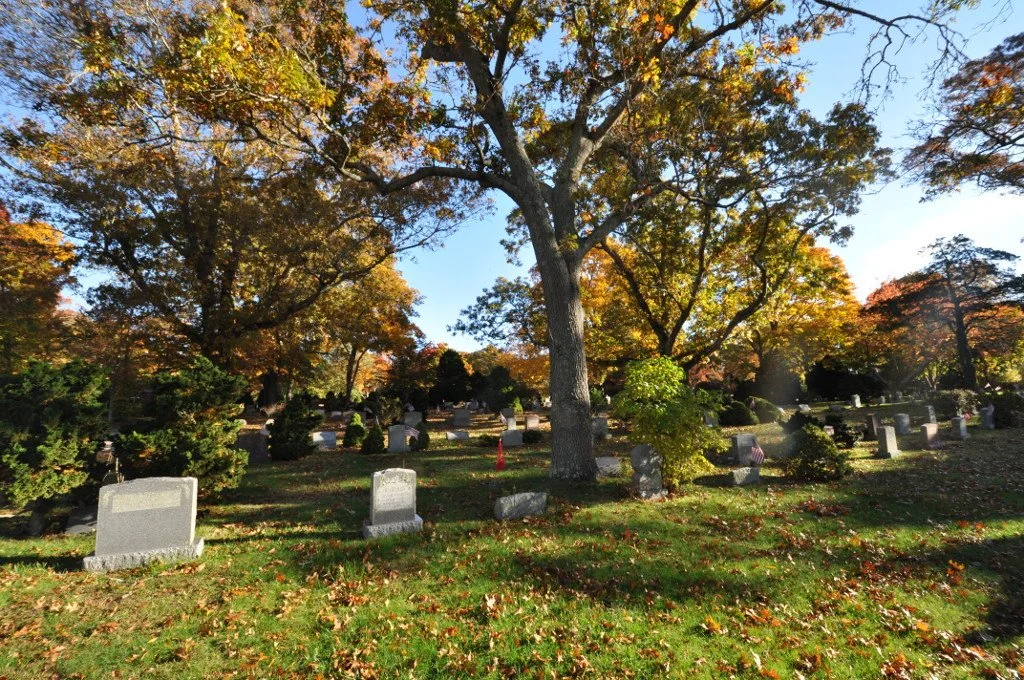
Oak Grove Cemetery, in Falmouth, Mass.
Photo by Magicpiano
Adapted from Robert Whitcomb’s “Digital Diary,’’ in GoLocalProv.com.
As my father noted to me at a family funeral back in 1975 a few months before suddenly dying at 58: “It’s something we all have to do.’’
Back when I was a reporter for the Boston Herald Traveler (long dead itself), I sometimes had the not-sought-after duty of going to the home of a decedent and talking with his or her survivors and then writing it up. Sometimes accompanied by an irascible or jokey photographer, I was usually expected to get (or, as we usually said, “grab’’) there what was called in my newsroom a “takeout’’—a photo of the dead person.
I found one such assignment particularly fraught, being a somewhat shy person myself. A teenage boy had died in a car crash. I was told to drive to his family’s suburban house, talk to his parents about their son and make sure that I got a picture of him on the way out. Mortifying.
It’s one thing to mourn loved ones or friends who die in a nursing home at 90 after a few years of not recognizing anyone (but visit them anyway: they’ll probably much appreciate your presence) but quite another to take in the death of a nice kid with possible high promise.
But I was deeply surprised by how nice and helpful the traumatized parents were. As we sat at their kitchen table for an hour or two, they told me, occasionally weeping, about their son’s personality and achievements. They seemed to feel empathy for me in having been ordered to interview them. As I stood to take my leave, I asked for a picture of their son to run with my story. His mother left the kitchen and came back with one.
I drove back to return it a few days later, not willing to trust the mail.
The challenge in writing an obituary is to try to present the person in the round. That of course can be difficult, particularly if the dead person isn’t a public figure about whom much is widely known. Family members and friends might prefer that some important things be left out. But a good obituary writer can draw out enough stuff, through patience, charm, guile and lucky timing of questions, to present a picture not that far from reality.
At their best, writing or reading obituaries can make readers – and the writer--- reflect on their own lives more than they usually would and maybe think about how they can move ahead, perhaps beyond paralyzing regrets, and make the best of their remaining time.
There’s a new novel, by turns funny and maudlin, called I See You’ve Called in Dead, by John Kenney, about a troubled and soon-to-be fired middle-aged obituary writer in New York City that speaks to some of this stuff, and how enriching the experience of exploring a recently ended life can be. (I particularly liked that much of it was set in my old complicated neighborhood in Brooklyn.)
xxx
Monty Python and “Bring Out Your Dead’’
xxx
There’s a nifty article in City Lab about how some cemeteries are widening their attractions as well-managed-and-monitored parks and even becoming quiet entertainment centers as traditional and outrageously expensive casket burials continue to decline. (Cremation and, er, composting are becoming ever more popular.)
The famous Mount Auburn Cemetery, in Cambridge, Mass., is the article’s centerpiece. Gorgeous Swan Point Cemetery, on the East Side of Providence, is the nearest Rhode Island equivalent. Both cemeteries, created in the first half of the 19th Century, are examples of how the creation of such green public amenities spread as relief from the grit of the Industrial Revolution and the rapid urbanization that went with it.
(I’m environmentally correct! My “cremains” will be deposited into a shoe-box sized box under a tiny metal plaque at a very old cemetery in Falmouth, Mass., in a section with a lot of my mostly very long departed ancestors. There’s still some space if you’d care to join me.)