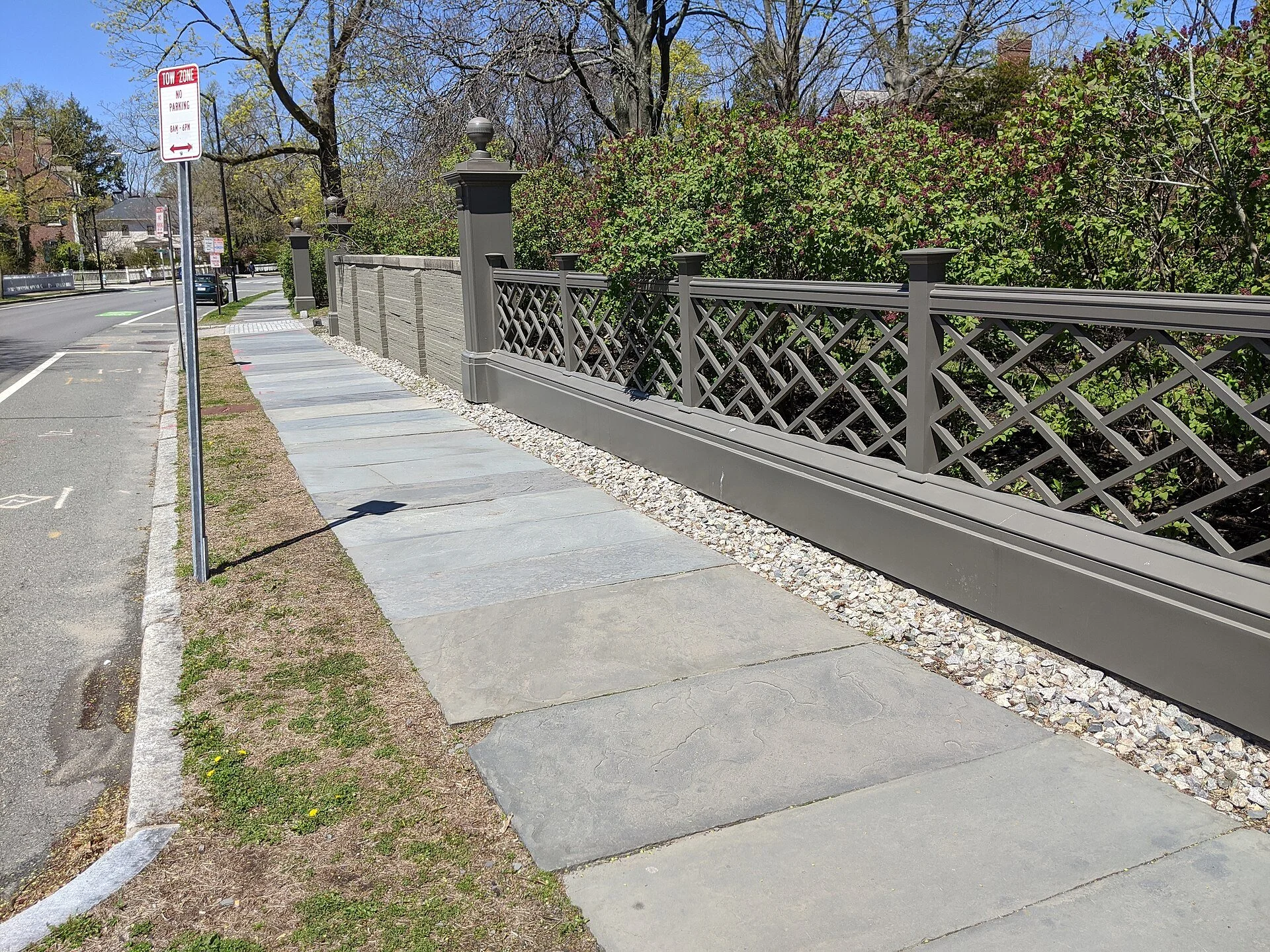
— Photo by Macrakis
Some thoughts on Michael Pollack’s Sidewalk Nation: The Life and Law of America’s Most Overlooked Resource
Don’t overlook sidewalks, warns Michael Pollack, a professor at Cardozo Law School, in New York City. “They strengthen local economies, support critical infrastructure, and serve as “third places” where communities take root and blossom,” he says.
“They’re sites of commerce: from dining to vending, advertising, waiting in line, and even new technologies like bikeshare, scooter rentals, EV charging, and delivery robots. They’re sites of speech, protest, and public art,” he adds.
“They’re where people collect signatures for petitions and picket establishments they want to protest. They’re where unhoused people often live [more in the U.S. than in any other developed country, by the way] or at least spend time panhandling. They’re where police conduct a substantial amount of investigation, for better or worse, and they’re sites of much of modern surveillance architecture. They’re even places where we can work to manage climate change and create sustainable and resilient cities.”
In his book Sidewalk Nation: The Life and Law of America’s Most Overlooked Resource (Harvard University Press, 2026) Pollack explores the legal, social and political significance of American sidewalks.
The book grabbed my attention perhaps because it felt somehow linked to another one I enjoyed recently, Christopher Brown’s A Natural History of Empty Lots, if only because these spaces— sidewalks and empty lots—(plus perhaps beaches, restaurants and cafes) are the places I interact with most. See Whose Woods These Aren’t.
As for sidewalks, I put value on those that allow long-distance walks without suddenly ending and stranding pedestrians on busy roadways. And those that offer relatively safe passage.
In fact, I’ve been scolded by my kids for losing control of the forsythia and other shrubs along the sidewalk of our side street. A complaint I dismissed until I was reminded of the impact on people with disabilities. Especially now that I know arthritis and bone breaks close up.
As Pollack notes, even one gap in navigable sidewalks from starting point to destination can negate transit for millions of people, especially those with limited mobility, resulting in something like “house arrest.”
Pollack frequently uses the attribution style of “people I spoke to said,” which sticklers might find lazy, but it makes for an easy read.
One especially interesting chapter focuses on sidewalks in Gonzales, La., a city of about 12,000 midway between New Orleans and Baton Rouge. The city recently contracted with a company to conduct at trip-hazard removal program. The program in Gonzales documented big vertical distances between pavers, then began shaving down those gaps with financial support from the city and property owners.
The city also plugged “regional” projects wherever possible to avoid disjointed work and appeal to funders looking for more impact. Such regional approaches bring economies of scale championed by grantmakers in such other arenas as higher ed. And they make good sense on the ground where I’ve noticed sidewalks often ending abruptly at town lines.
Pollack also offers thoughtful discussion of how labor unions and others can use the sidewalks for constitutionally protected protests and pickets.
He persistently returns to a call for municipalities to establish a Department of Sidewalks—a consolidated body watching over sidewalk uses and conflicts and empowered to foster more efficient maintenance and regulation for property owners, businesses and all users who share the space.
“Sidewalks are unfortunately a terrific example of the tragedy of the commons,” writes Pollack. “The conflicting uses, the overuse, the physical damage—all of it can be traced to the fact that sidewalks are finite in space, time, and durability but open to everyone.”
In this context, Pollack tells the disturbing story of Salt Lake City handing over a stretch of public sidewalk to the Church of Jesus Christ of Latter-Day Saints (Mormons), which would now follow through on its plan to regulate how people behave and dress on the newly private section.
Big real estate sites like Zillow and Redfin now reference “walkability” in their efforts to describe neighborhoods.
Pollack notes that people in poorer people often lacking yards see their sidewalks as places to socialize. Yet their neighborhoods tend to have the worst sidewalks.
Sidewalks in my town vary between “formal” light-colored cement and rougher, but in some ways, quainter, tar.
Whatever their material, my own sidewalks know me embarrassingly well. My never-delivered presentations and ultimatums. My bad singing. My self-disparaging. But they’re always a valued companion.
John O. Harney, a writer who lives in Reading, Mass., was executive editor of the late, great New England Journal of Higher Education.