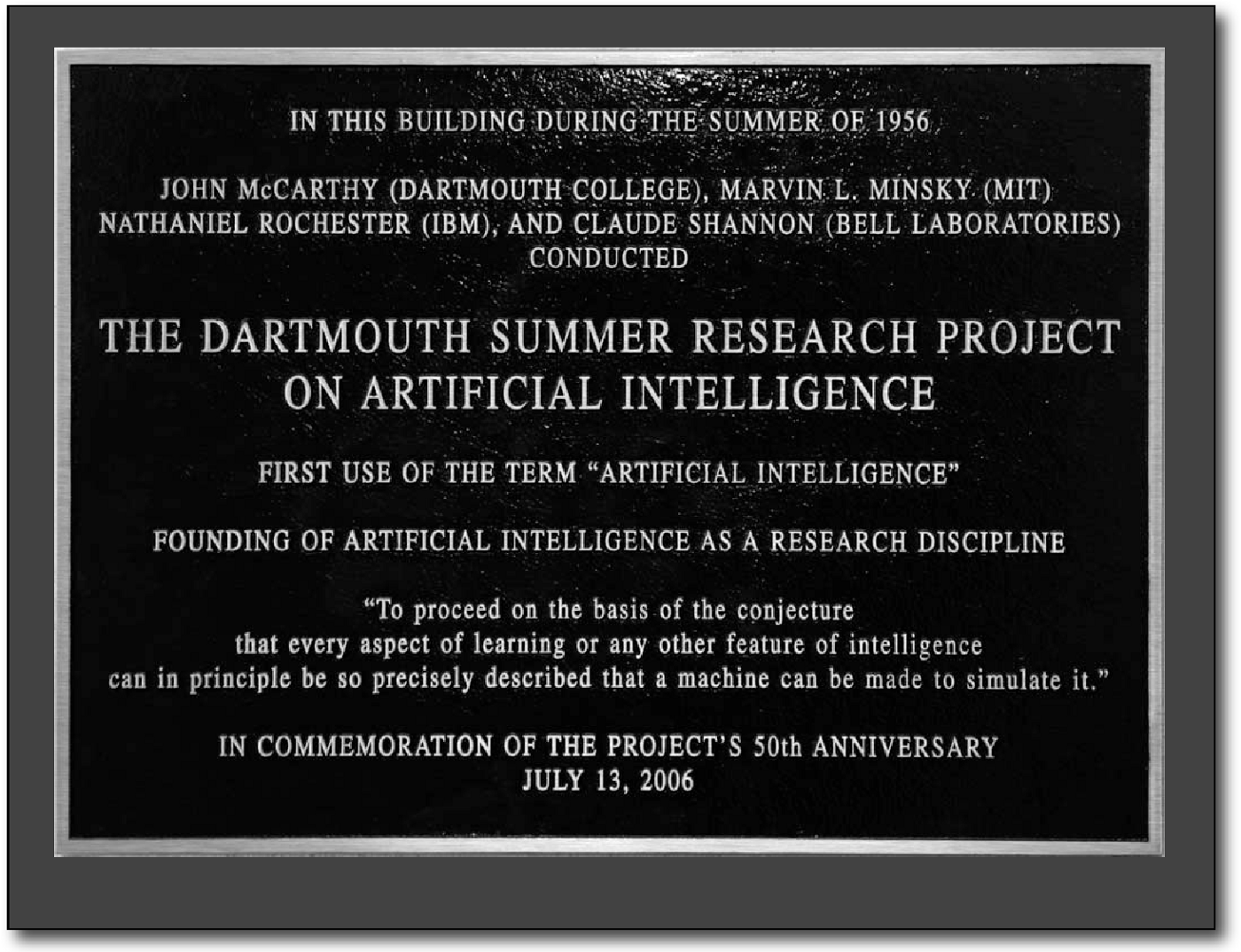
Plaque in Dartmouth Hall, at Dartmouth College, in Hanover, N.H. Signpost on way to paradise or disaster?
Artificial intelligence in government is here, and here to stay—the only question is whether it will be a relief or a disaster for we the people. Part one of the rollout was using and misusing AI in a scattershot effort to cut programs through the Department of Government Efficiency in early 2025, and part two was integrating AI into Pentagon systems soon afterward. Both efforts became messy, politicized affairs. But an even bigger test may come in part three: weaving AI into the regulation processes that shape the life of every business, as well as individuals like you.
The Donald Trump administration took a small step in that direction recently with the launch of America.gov, which aggregates data from about 29,000 federal websites to help users navigate procedures like changing their address across benefit programs. Will laying a large language model atop the expanse of government rules make it easier to deal with, or generate useful information for employees running the thing?
We’ve been taught that America’s regulatory system is organized in legal codes, like traffic signals and road signs. In reality, the codes are more like an overgrown jungle, incoherent to any real person and often contradictory—three billion words in total, according to Stanford law professor Daniel Ho.
Setting artificial intelligence loose into the red-tape thicket, experts think, will untangle the knots and make government work better. This is simplistic and largely misguided. While AI can certainly identify duplication and contradictions, it cannot replace the rigidities of red-tape operating structures that preempt common sense as a matter of law.
In a review of New York City school law during the Mike Bloomberg administration, for example, I found that disciplining a student could require 66 different legal steps and considerations. AI can identify idiocies like these, but actually restoring teacher control of the classroom requires a new framework that empowers teachers and administrators to use their judgment—not clarifying the legal gauntlet required for daily disciplinary choices.
Even more unrealistic is the idea of using AI to enforce law. Americans would revolt if they started getting sanctioned automatically. The comedic possibilities are nearly endless. Just give AI access to Flock and traffic cameras. Tickets for speeding go to . . . every driver in America. Eight million New York residents are cited for jaywalking. After the third infraction, California might require automatic life sentences. Maybe put bars around the entire state.
Now imagine how the Internal Revenue Service might use AI. No tax filing of any complexity is likely to survive its scrutiny. Any item out of the ordinary will provoke an audit and a demand for objective proof that, say, the expense was truly “ordinary and necessary.” To update President Ronald Reagan’s famous quip, the new scariest words in English may soon be: I’m a government AI, and I’m here to help. The role of software should not be to tell us what to do.
AI cannot solve the foundational flaws of the red-tape state—the conceit that billions of words of “clear law” obviate the need for human judgment. Thousands of worker safety rules specify how to do everything—for example, to light stairwells with “natural or artificial illumination” and to keep records of compliance. But studies show that worker safety is enhanced not by rules but by human attention—manifested in training and in workplace culture, not by obsessive compliance with thousands of detailed rules. Workers with their noses in rule books don’t see the buzz saw.
AI could indeed transform government for the better—not by making the current jungle more transparent but by facilitating a long-overdue recodification to restore human responsibility. By exposing the unnecessary complexity, AI can guide reformers to simpler frameworks that are activated by the judgment of responsible officials. “With artificial intelligence,” public administration guru Stephen Goldsmith recently told me, “there should be no need to get 12 different permits to open a restaurant.”
In the hands of responsible officials, AI would be a powerful tool for good government. Police could use AI to identify problem spots and trends. Educators could use it to identify gaps in learning and to tutor students who need extra help. Procurement officers could use it to evaluate proposals and bids. Using AI to evaluate healthcare delivery could allow officials and insurers to replace the red tape that today requires doctors and nurses to spend half their days filling out forms.
Some of these improvements are already taking shape. For example, the Office of Personnel Management, which is essentially the HR department for the whole federal workforce, has created a tool that shows job applicants the roles that best match their skills, including at agencies they might never have considered.
Read:
Yes, AI Might Really Kill Us All
But left to operate by itself, AI would exacerbate the flaws of the red-tape state. Needless complexity crushes schools, hospitals, and nursing homes by diverting professionals away from the needs of real people. Environmental protection requires judgments about trade-offs—whether the benefits of a transmission line, say, outweigh the harm of building it through a pristine forest.
Law doesn’t work without human judgment. AI cannot reliably weigh trade-offs and make value judgments needed for fairness and trust. “Justice . . . is a concept by far more subtle and indefinite,” U.S. Supreme Court Justice Benjamin Cardozo noted, than “is yielded by mere obedience to a rule.” Even with clear violations, judgment is needed. As professor (now judge) Gerard Lynch observed, “Deciding to prosecute is not a simple matter of finding that a law has been violated. . . . In a world in which regulations are piled so high that many well-meaning people trip over them, prosecutors must decide every day whether a particular violation is merely technical or is one that requires the awesome step of criminal prosecution.”
Letting officials use their judgment does not require blind trust. It requires a framework with checks and balances and accountability, so that poor choices rarely get past first base. This is the framework of the Constitution—7,500 words of goals, guiding principles, and checks and balances that are coherent to real people. The post-1960s legal system designed to preempt human judgment, by contrast, has inflicted upon Americans a red-tape state that is both inept and overbearing.
American government is at an inflection point. The current presumption is to use AI to double down on the post-1960s dream of governing as a kind of software program. Just follow the rules. In this conception, AI will identify duplication and crossed wires in dense codes, and then begin enforcing those codes automatically. It won’t take long for people to view AI as a disembodied tyrant. What’s left of public morality will go out the window as people see the enemy as a machine. Continual badgering by anti-human dictates will cause alienation to metastasize into resistance to the newly efficient Big Brother: Orwell exponential.
The better choice is to embrace AI as a reason to restore human control over government. AI can help design simpler codes that humans can actually understand. Then it can provide information and tools that empower responsible people to do a better job and also help other people to evaluate their work and hold them accountable.
Someday soon, an AI system within the Commerce Department might monitor import volumes and prices for foreign goods and flag major swings to the responsible officials, prompting them to contact affected businesses or a foreign counterpart. At the Transportation Department, AI could rank contractors’ performance on a highway grant program and suggest new criteria for the next round.
AI provides the impetus to remake the red-tape state. The important change should not be toward all-powerful AI, however, but using AI as a tool to restore the primacy of human responsibility as the operating mechanism of American democracy.
Philip K. Howard (pkinghoward@gmail.com)is founder and chairman of Common Good, which promotes legal and regulatory reform, and a New York-based civic leader, lawyer, author and photographer. His latest book is Saving Can-Do: How to Revive the Spirit of America. This essay, slightly edited here, first ran in The Free Press.