Llewellyn King: The sad decline in creative swearing
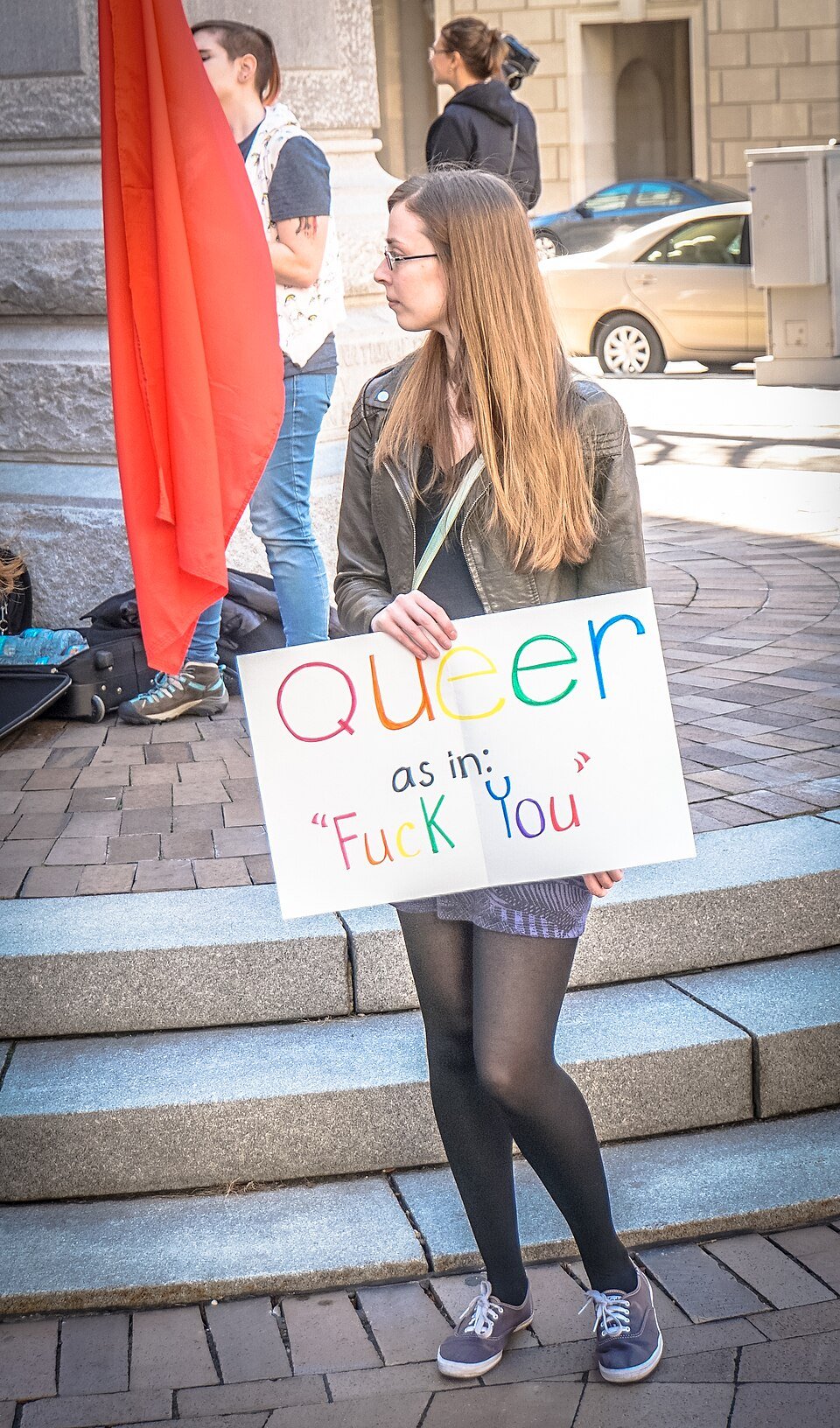
Term such as queer can be reappropriated by the people they are directed against, as in this demonstration in Washington.
—Photo by Ted Eytan
WEST WARWICK, R.I.
Mark Twain wrote an essay on the decay in the art of lying. His conclusion was that you had better have a damn good memory.
Oscar Wilde wrote an essay — in the form of a philosophical dialogue — on the same subject, but he was trying to prove that art didn’t need to be based on the real world.
I have the temerity to offer this: the decay in the art of swearing.
As a boy, I read in Richard Dana’s book Two Years Before the Mast that the captain could swear for minutes without repeating himself. Ever since, I have been fascinated by swearing and those who maintain it as — dare I say it — an art form.
At the heart of the decline is the lack of respect for the f-word. In its day, it was the capstone, shocking and bound to offend. Ergo, it had to be used sparingly and calculatedly.
Now it is everywhere, in movies, in BBC television shows, and has been heard in the Congress and from the lips of the president of the United States. Shame.
If this keeps up, the f-word will be no more upsetting than bloody, which was a true shocker when George Bernard Shaw used it his 1913 play Pygmalion, but is now no more shocking than any other adjective.
Bugger is another word that has become inoffensive. Once a shocker with kiloton-explosive quality, it has been defused.
Here are some great swearers I have known and who kept alive the creative art of profanity.
Stockard Channing has an exquisite command of the language and with, as you would expect from one of our great actresses, impeccable timing.
Decades ago, she and I were both guests at The Ashram, an exclusive health resort in California. I have fond memories of the two of us trying to jog down the beach in Malibu while she let loose with a powerful and profane description of some of Hollywood’s executives. Invigorating.
Ben Bradlee, the legendary executive editor of The Washington Post, knew how to use the f-word as a tool of editorial management. He dropped it straight and true like the blade of a guillotine on any stupid idea or meandering argument.
I saw this happen with deadly effect when, in an editorial conference (a daily event in newspapers), the coterie of assistant managing editors was getting overly excited about the struggle of a Post reporter in the Middle East. Bradlee listened, then declared, “F-word, this sounds like a story about how we didn’t get the story.” Quite so.
James Schlesinger, the great public servant who in turn was chairman of the Atomic Energy Commission, director of the CIA, secretary of defense and secretary of energy, liked to shock in formal situations. He used to use his command of profanity to bring pompous discussions down to earth.
Once I was visiting with him at the CIA, and we were shooting the breeze as we did often, when his aide came in and said, “Sir, the admiral has been waiting a long time to see you.”
Schlesinger signaled to me to stay put. “It’s good for [strong expletive] admirals to wait.”
That was in the early days of his tenure at the agency, and clearly he wanted word to get around that he was the absolute authority at Langley – and he was anywhere he held office. Awesome.
The master of what I think of as narrative swearing was my friend Guy Hawtin, a distinguished journalist with the Financial Times and the New York Post, who abandoned the wicked ways of journalism for the Episcopal priesthood.
Hawtin, who resembled the actor Peter Ustinov, could put English words together any time, anywhere, but his memorable tirade of swearing and invective happened to be in the hallowed ground of New York’s Algonquin Hotel. The perfect set.
Our lunch wasn’t intended as a reprise of the famous Algonquin Round Table of the 1930s, though we were seated at a round table. Our mutual friends David Fishlock, the FT’s science editor, and John McCaughey, a former FT subeditor, were also there.
The FT editor had dismissed Hawtin, leaving considerable bad blood. When Fishlock suggested that the editor was doing a good job, Hawtin launched into a brilliantly sustained angry monologue — the finest display of serial swearing this connoisseur had ever heard before or since.
Sitting by himself in a corner was the real, older, Peter Ustinov. He raised a hand with his thumb and index finger making a circle. Approval.
Our politicians aren’t adding to the art. They should have their mouths’ washed out with soap — my mother’s remedy for potty-mouth.
Llewellyn King, based in Rhode Island, is executive producer and host of White House Chronicle, on PBS, and an international energy-sector consultant. His email is llewellynking1@gmail.com.