Llewellyn King: In a warming world, we need to fight fire with
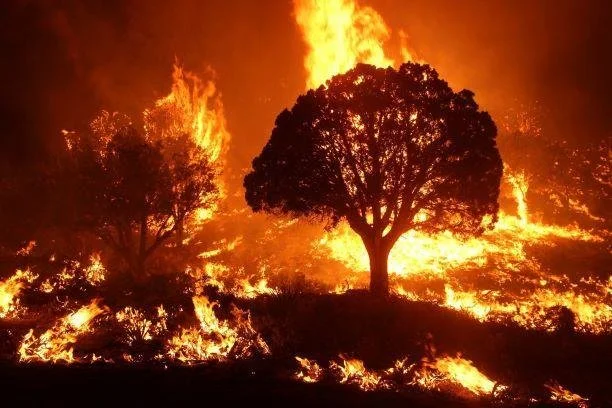
Wildfire burning in the Kaibab National Forest, Arizona. New England had a bad woodland fire season last year.
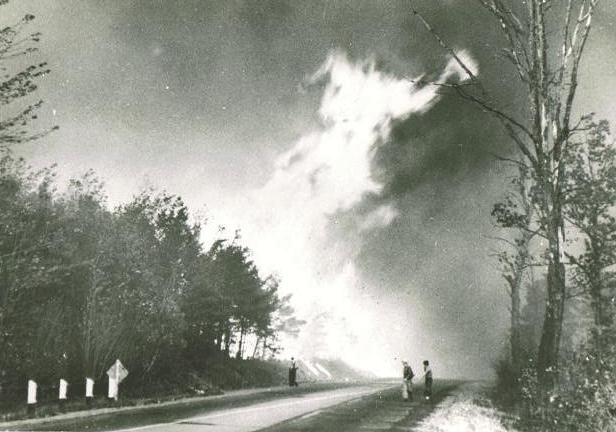
Extreme forest fire in North Kennebunkport Maine, during October 1947, Maine’s most disastrous fire season.
It was blamed on extended heat and drought. By mid-October, many small wildfires spread out of control. These burned over 220,000 acres, destroyed 1,000 homes, left 2,500 people homeless and 16 people dead.
WEST WARWICK, R.I.
Wildfire takes no prisoners, has no mercy, knows no boundaries, respects no nation, and is a clear-and-present danger this and every summer as summers grow drier and hotter.
The American West is burning, across Canada there are wildfires and swaths of France, Spain, Portugal and Greece are ablaze. In 2022, faraway Siberia was ablaze.
California bears the scars of where wildfires and humans have collided and the humans and their homes have lost, recently and devastatingly in Los Angeles’s Pacific Palisades neighborhood. Experts say that even in the former moist East, conditions for wildfire are growing.
The damage to lives and livelihoods here and abroad is beyond calculation.
Olive oil and wine from Europe will be more expensive this year, so many trees and vines have burned. Humankind’s ancient enemy stalks the world: irrational, brutal and very hard to stop.
One of the largest U.S. electric utilities, Pacific Gas and Electric, facing an estimated $30 billion in liabilities from wildfires in 2017 and 2018, believed to have been caused by their equipment, filed for bankruptcy protection in 2019. Utilities have been on the forefront of wildfire suppression because some fires are started by sparking from overhead lines.
An army of people and technology is deployed in the United States to fight wildfires and still it comes up short; these tools include AI and drones, aircraft and, of course, the indefatigable but inevitably limited intervention of firefighters on the ground.
There is an additional tool: Fighting fire with fire with so-called prescribed burning or controlled burning.
I learned about this technique from J. Morgan Varner, director of research and senior scientist at Tall Timbers in Tallahassee, Fla.
For 60 years, Tall Timbers, a nonprofit group, has been doing prescribed burning – the controlled application of fire to a specific area of land to achieve defined management objectives -- in southern Georgia and northern Florida. Now its expertise on this traditional and effective tool for maintaining ecosystems and reducing wildfire risks is widely deployed and sought.
Even so, Varner said, the technique has its critics, mostly from those who have sought to suppress or avoid fire as the first line of defense.
Varner explained that this has led to decades of “fuel” (made up of dead trees and vegetation) agglomeration on forest floors. When this burns, it burns with great heat and destroys everything; whereas in a prescribed burn, the damage is less severe and more of a forest’s natural infrastructure survives.
I didn’t see a burn in progress, but I did see the aftermath of one on a hunting estate in southern Georgia, where the landlord worked with Tall Timbers. There was a strong smell of burning, some residual smoldering logs, but the land was ready for natural rejuvenation.
The idea is that with careful burning, the land is returned to its natural rhythm. This region of Georgia along the Florida border, known as the Red Hills, has seen controlled burning for a long time and the forests and the wildlife are both healthy.
Wildlife is one of the concerns about deliberate burning, but Varner says animals are naturally fire- sensitive and very adept at getting out of the way.
A prescribed burn is a carefully managed event. Conditions must be exactly right: wind, humidity, the nature of the vegetation, and the amount of fuel on the ground.
The ideal burn area, according to Varner, is 40 acres and it is done in the spring or the fall, not in the summer heat. A team of experts surveys the area of the burn and calculates the behavior of the fire before ignition.
Although prescribed burning has ancient history and a lot of scientific evidence supporting it, it isn’t everyone’s solution. I asked the president of a West Coast utility about using it and got a curt reply, “No way.”
Looking at a beautiful stand of trees, I find it hard to imagine deliberately setting it alight, although I am convinced that fire has to be used to fight fire; that periodically in nature there is wildfire, and it is part of a natural cycle. I’m beginning to take note of the dead trees among the living ones.
If summers get even hotter and drier, more radical solutions to fire will have to be employed, including fire.
Llewellyn King, based in Rhode Island, is executive producer and host of White House Chronicle, on PBS. His email is llewellynking1@gmail.com. He is also a celebrated international energy-sector consultant.