Memories of old boats
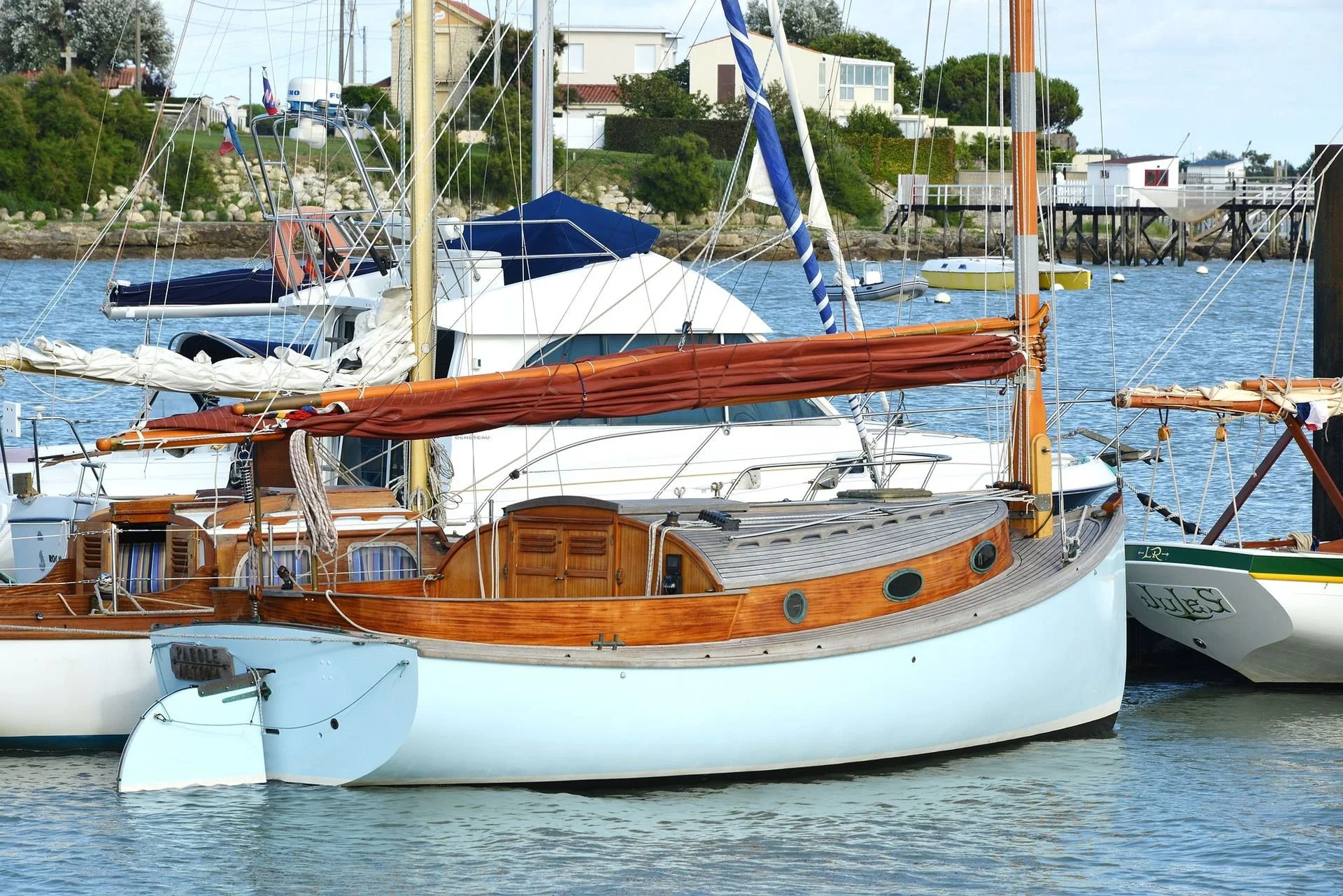
Traditional cruising catboat.
— Photo by Jean-Pierre Bazard Jpbazard
Adapted from Robert Whitcomb’s “Digital Diary,’’ in GoLocal24.com
I grew up very close to the harbor of Cohasset, Mass., and so my family had a bunch of small boats – rowboats and a sailboat. The former, which were wooden, were mostly to get out to the mooring for our 17-foot-long fiberglass sailboat and occasionally to fish from (mostly flounder and oily, but delicious, mackerel). The best time was when we’d (or sometimes just me) sail far enough offshore on a hot day so that the southwest wind would cool after blowing over 68-degree water to a refreshing air temperature of 70 degrees while it was 90 on land.
But those boats, as small as they were, took a lot of work – mostly in the spring – though having a boat got easier with the arrival of fiberglass, in the late ‘50’s. Before then, there was tedious calking and sanding before laying on a new layer or two of anti-fouling copper paint. And then there was the chore of putting the boats in the water and then hauling them out a week or two after Labor Day.
The most exciting boat in my latter boyhood was the recently invented Boston Whaler. A friend who was a next-door neighbor and orphan had one (his grandmother bought it for him), and for a couple of summers, we often sped around in the remarkably stable craft, powered by a loud Johnson (or was it an Evinrude?) outboard. It gave us a feeling of youthful freedom, for which I’m still nostalgic, sort of like the nostalgia I feel for my first car, a used VW bug.
The experience made me realize that it could be a lot easier to enjoy someone else’s boat than your own. That, of course, reminds folks of the old line that your second-best day is when you buy your boat, and the best is when you sell it.
To suggest how long ago this was: You could buy “chicken lobsters” (small but legal) at the town lobster pound for 25 cents each. The region’s waters then had lots of lobsters, and there were many brightly colored buoys floating over the rocky bottoms favored by the creatures. (Sometimes there would be little territorial wars between lobstermen, with, a few times, brandishing of shotguns.) Warming waters, changing currents and some other factors there have much reduced the catch. Lobsters are moving northeast.
For generations, people in my father’s (mostly middle-class) family often had small sailboats, especially on Cape Cod, where some of them were from and where others, starting after the Civil War, went for stretches in the summer. These had centerboards instead of keels because the waters were shallow with sandy shoals, rather than the deeper, rocky waters along the shores north of the peninsula.
The most popular craft were catboats, with a single sail. I have a much faded photo of my father sailing a small one in about 1930. I had a pang when I found in his desk, soon after his sudden death at 58, a sales brochure promoting a 25-foot-long catboat with a little cabin two people could sleep in, cook in and, er, eliminate in. Extravagant!
That, I suppose, was going to be an escape vehicle as he approached retirement.
On the Beach
“This is a day that’s beautiful as well,
and warm and clear. At seven o’clock I saw
the dogs being walked along the famous beach
as usual, in a shiny gray-green dawn,
leaving their paw prints draining in the wet.’’
--From “Suicide of a Moderate Dictator,’’ by Elizabeth Bishop (1911-1979), American poet and short-story writer
xxx
Now, of course, is toward the end of prime ocean beachgoing season for millions – the salty breeze, the semi-hypnotic sound of the waves, the warm upland sand, the cool sandcastle sand between the tides, the adventures of beachcombing and socializing. But not much more than a century ago, people tended to avoid beaches, complaining about the smells of decaying dead fish and seaweed, and, for the affluent, trying to avoid suntans (which are signs of burns) because they were seen on poor farmers and others who worked outside. Lower class….
But over the next few decades, going to the beach and developing a tan there became something of a status symbol. It meant, among other things, that you had leisure time. (That’s a reason, along with air-conditioning and faster transportation, for the unfortunate rise of Florida.) But more knowledge of skin cancer in the past few decades has led people to cover up much more, and now villages of tents and umbrellas cover many popular beaches.
The best time to walk on the beach around here is September and October.
Before the summer beach house mania started in the late 19th Century, New Englanders usually avoided dwelling right along the coast – too vulnerable to storms. Instead, they lived safely inland, often around town greens. They were right.