Fine dining for Boston’s rats

A Brown Rat (aka Norway rat— the species found in Boston) looking for food waste in a park.
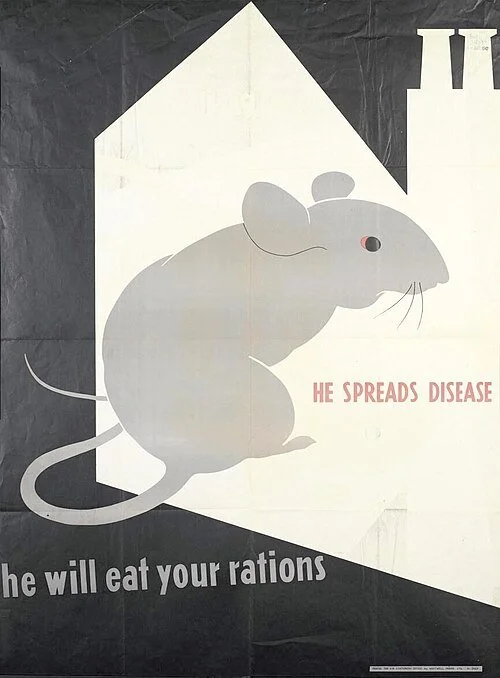
World War II poster.
A Boston Guardian article by Cullen Paradis. Images above put in by New England Diary.)
(New England Diary’s editor, Robert Whitcomb, is chairman of The Boston Guardian’s board.)
Although city government is already implementing new measures to curb Boston’s rat population, such hotspots as the South End and Back Bay still have weeks or months to wait before officials are done collecting data and rolling out new sensors and bins.
Special Project Manager Luke Hines and environmental services’ Assistant Commissioner John Ulrich couldn’t say definitively which neighborhoods have the worst rat problems today, though they hoped to have a clearer picture within two months as new monitoring systems come online.
Zac Brown, a manager with Clancy Bros. Pest Control, was able to supply The Boston Guardian with his company’s call statistics by ZIP code.
This year they got the most calls for rat infestations in Boston’s central neighborhoods from the South End at 43, followed by the Back Bay and Bay Village at 33.
While Clancy Bros.’ geographic breakdown would be affected by any number of business and cultural trends, its overall rat infestation call totals should give a more comprehensive picture of how fast populations are growing. This year’s rodent calls are already 10 percent above 2024’s total, sitting at 1,605 this July compared to 1,456 in the entirety of 2024.
Clancy Bros. responded to 15 rat infestations in the South End’s 02118 area code in 2024, but this year has already had 43. The Back Bay’s code of 02116 called just twice in 2024, but this year has called 33 times.
“There are just so many available food sources with the trash handling and old structures,” Brown said. “I’ve been doing this since I was 15 years old, been in the industry for like 22 years now, and it’s progressively just gotten worse over time. Every season increases more and more. The population in Boston has grown too, and [rats] thrive taking advantage of available food and structures.”
Brown, Hines and Ulrich all agreed that the main problem was trash left accessible, whether in common areas or as part of larger commercial operations. In years past the city has largely blamed a small number of commercial actors improperly disposing of their waste, but officials are now looking at the problem with a broader focus.
That focus has materialized as the Boston Rodent Action Plan, an analysis published with the help of urban rodentologist Dr. Bobby Corrigan back in July 2024. It identified four PANs (Priority Action Neighborhoods) which are Back Bay/Beacon Hill, Allston/Brighton, Dorchester/Roxbury, and the grab bag of District 3, which includes the Downtown, Chinatown, North End, South End, and Haymarket.
A year later, that plan is bearing material fruit as several pilot programs take root around the city. Mayor Michelle Wu herself highlighted new trash cans with lids installed in the North End, and a different barrel design on the Common has its own durable build and difficult to access interior.
Electronic counting traps set up in rat thoroughfares let officials monitor rat populations directly instead of relying on 311 calls for tipoffs about rat numbers and movement.
There are some tradeoffs, with newer designs requiring more maintenance, more money to buy and slightly more effort to access. But Hines said workers actually preferred servicing the new, more complex designs in initial trials. It turns out opening a lid is less frustrating than arriving on site and finding the trash barrels full of holes and garbage strewn around the street.
Today officials are collecting data with the sensors they’ve deployed to inform exactly where countermeasures are needed, a process that should finish by September. In September the sewer traps in the North End will be expanded into the Back Bay, followed by another six weeks to measure how effective new countermeasures are compared to control sites.
Until then, Brown recommends that residents keep an eye out for rat problems and report them before a property’s population balloons. The city does also perform inspections of potentially infested properties if they are reported to 311. An online public meeting is planned for August 12 at 6pm for residents that want to know more about the city’s rat control programs.