Chris Powell: More government and so, of course, more lobbyists
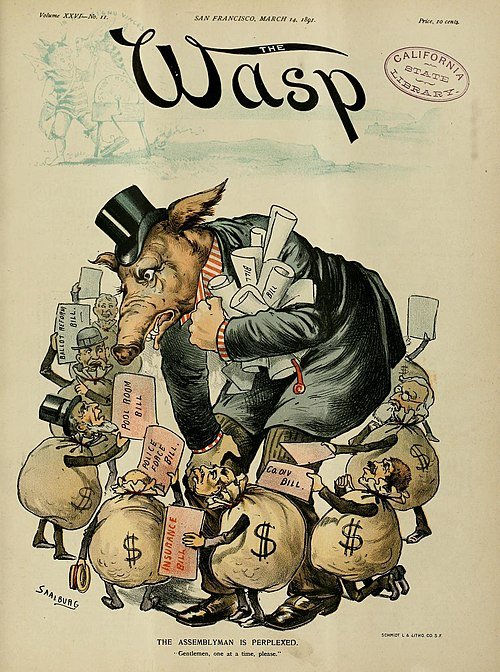
1891 cartoon of a legislator besieged by lobbyists.
MANCHESTER, Conn.
Lobbyists in Connecticut have a bad reputation, and it may get worse with the recent report from the Office of State Ethics that spending on lobbyists exceeded $28 million in the first quarter of this year and may reach a record high by the end of the year.
Why is there so much lobbying?
Mainly because there is so much government.
A telling clue is that that the organization spending the most on lobbyists in the first quarter was the Connecticut Hospital Association, at $1.45 million. Other big spending on lobbyists in the first quarter also involved medicine: the Partnership for America's Health Care Future, representing hospitals, medical insurers and drug manufacturers, at $349,000; Hartford HealthCare, at $248,266; the Connecticut Association of Health Plans, at $230,370; Elevance Health and Affiliates, with $214,940; and Yale New Haven Health System, at $214,447.
Again, this spending was just for the first quarter.
No businesses are more subject to government spending and regulation than hospitals, medical insurers, and drug manufacturers. Modern medicine is now largely a matter of price-fixing and cost-shifting by government, what with Medicare, Medicaid and legislative and regulatory mandates.
Even a small change in law, regulation, or government policy can have huge financial impact on the components of medical case, and, of course, huge impact on patients and policyholders.
Whether these laws, regulations and policies are good or bad, they are pervasive, and so all the entities affected need to watch the government around the clock and intervene urgently on behalf of their interests.
Legislators and governors are supposed to represent the public interest, but the lobbyists work at the state Capitol nearly every day while their constituents are just trying to make a living and to get home in time for dinner and some television. The programs they watch are not about public policy.
Many lobbyists are often well paid for subverting the public interest in favor of a special interest. So special interests sometimes provide disguises for their lobbyists.
That's why the Partnership for America's Health Care Future doesn't call itself what it really is -- the Partnership for the Prosperity of Hospitals, Medical Insurers and Drug Manufacturers -- and why the Connecticut Education Association doesn't call itself the Connecticut Teachers Union.
Even so, lobbyists are crucial for democracy and the legislative process, especially on the state level. For while the governor and legislative committees can draw on expertise from the Office of Legislative Research and state government agencies, lobbyists often have much relevant information that government doesn't have -- and not just information but insight about policies and how they are likely to be received not just by special interests but the public as well.
Thirty-seven years ago, in the aftermath of the Watergate scandal, the General Assembly and Gov. Ella T. Grasso seemed to think that lobbyists were the nexus of political corruption. So a law was enacted requiring lobbyists to register with the Office of State Ethics and wear special badges on the job. The implication was that lobbyists had the plague and legislators shouldn't want to be around them.
Caution was in order but it wasn't because lobbyists had the plague and weren't identifying themselves. It was because legislators had a sort of plague -- the desperate craving for campaign contributions -- and were easily tempted to seek them first from the special interests represented by the lobbyists. Tagged with badges, lobbyists became easier to shake down.
Indeed, years ago neophyte candidates for the legislature who sought advice about raising campaign money were urged to visit the Office of State Ethics, ask for a list of all the lobbyists, and start there.
Things are a bit better now. Campaign contributions from lobbyists are restricted, and the state has a program of public financing of campaigns that diminishes need for special-interest money.
But special-interest money still abounds in politics, and, as always, the best defenses against bad law and corruption are vigorous news organizations and an attentive public. They are much weaker these days.
Chris Powell has written about Connecticut government and politics for many years (CPowell@cox.net).