Gerald FitzGerald: My exotic adventures on a dairy farm
I stood on green mash loaded on the wagon floor next to a pony-tailed, skinny day laborer, both of us pitching the silage with big steel forks, until the pain blitzed through my right calf straight to my brain. Looking down, I saw two tines embedded in my leg. His hands were no longer holding his pitchfork but it stayed perpendicular to my leg, steady and straight as an erection. The kid looked stupefied; hands to his face, eyes glaring as if I were suddenly headless.
I cannot recall who pulled out the fork but I do remember thinking how often I’d used those forks to finish off a load of dry manure in the small dump truck for delivery to customers of the farm, in Concord, Mass. Holly and I had spent all our savings backpacking for two years pretty much ‘round the world and her Aunt Betty was kind to offer a minimum wage job on her dairy farm and use of the old trailer to live in back by the bullpen. The trailer kept us dry and the heating usually worked.
Then Holly had a brilliant idea: fresh paint the long side of the trailer, not so much with a color as with a vision. She’d loved our adventures in East Africa. So Holly invited family and friends to join us in creating a mural of savannah on the outside of the trailer to include acacia trees, monkeys, a rhino, water buffalo, giraffe and Holly’s lion.
Best of all, we had a real vegetable garden growing just outside our door so we needn’t pick its sweet corn until the water was boiling.
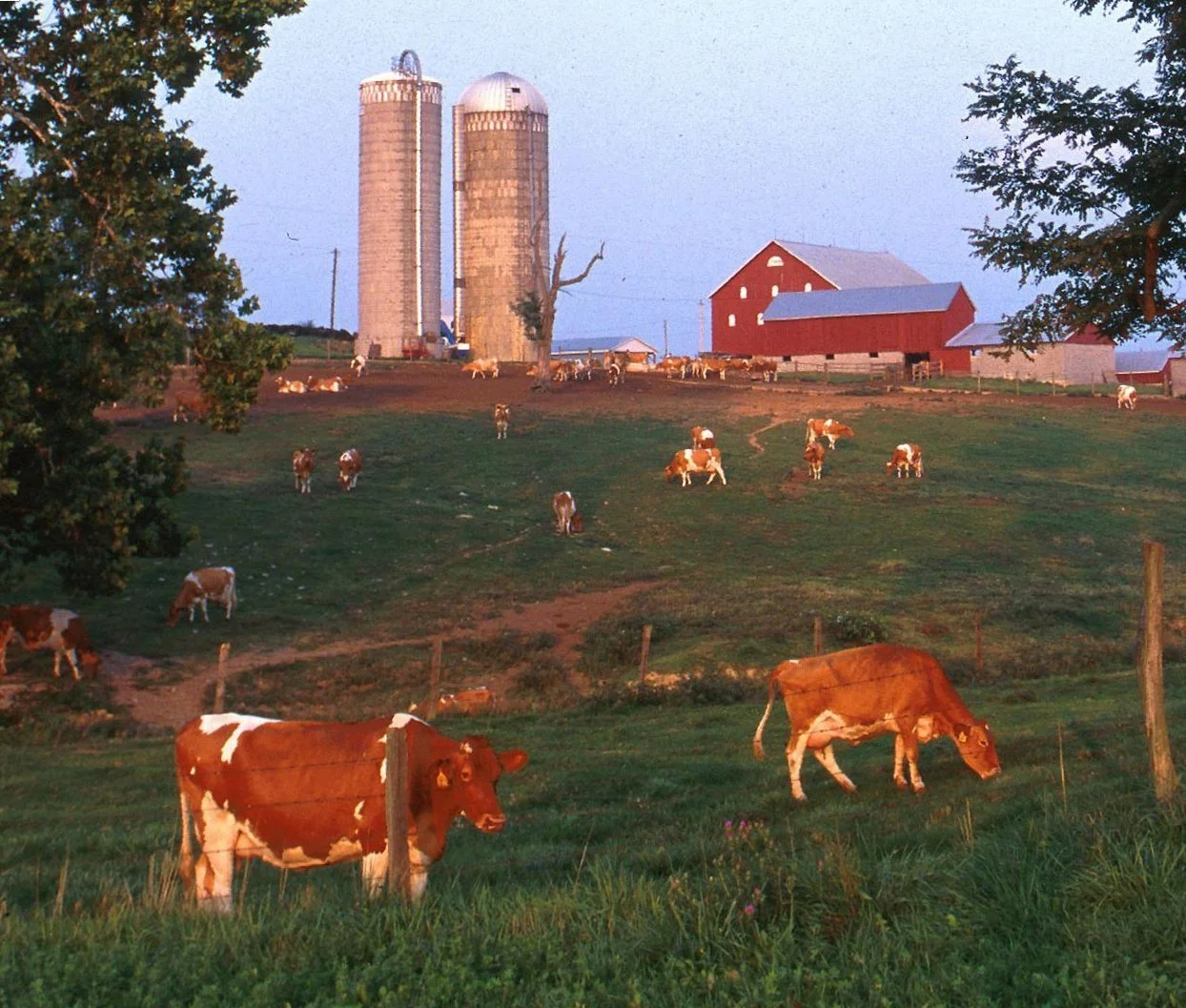
Farm life was good, with warm bread, bacon and black coffee to begin each workday morning at 6:15 in Betty’s kitchen. A herdsman milked twice daily, which was fine by me since cows take no holidays at all. I never counted the cows, but I want to say that there were at least 30 or so milkers in the barn, each one an Ayrshire. Ayrshires are Scottish with white and red to brown markings. They don’t give as much milk as, say, a Holstein, but they give more cream. I bedded each cow in its stall twice a day by scraping out and replacing the wet soiled wood shavings. Also, I checked each one’s steel bowl to keep it free of all but water made to flow by the bovine depressing a small circular float with its muzzle. I also added grain to a mix of hay and silage placed twice daily within easy eating range.
Gutters ran through the floor beneath the back ends of the stalls. They contained metal sweepers activated to push the waste along to a steel conveyor belt that carried it all up to the deep end of a dump truck. When the truck was full it was driven to a field and dumped out to dry. Some manure was loaded into a spreader for a springtime cover of the acreage. Depending on the need and the season I plowed fields, seeded crops, spread manure, baled hay and filled the lofts, patched barn roofs, stored new loads of shavings, turned the cows out to pasture to graze or called them home again, cleaned the milk pipes, mucked the stalls or delivered product to residential and commercial customers. Once I watched a dead cow being dragged out of the barn with a rope pulled by a tractor, I think to be chain-sawed to pieces for disposal. Twice, I watched the herdsman try to jump-start a pickup only to have the battery explode nearly in his face. Twice.
When calves were born, I taught them to drink from a bucket by submerging my hand in the formula and coaxing them to suck my two fingers like a teat. Female calves were eventually taken to the heifer barn; the young males were soon sold for veal. The farm only needed one bull, and I suspect that he was generally happy, though possibly less so when the eldest son used rubber-gloved hands to extract bull semen back in the day when A.I. meant artificial insemination.
One sunny autumn day I got to wade thigh-deep in fresh garbage at the Concord landfill. I collected trash weekly from the farm and its workers’ homes. Arriving at one house I found the plastic bags piled in the trash corner of the garage. Atop the bags lay a wreath made of brown growth and pine cones. Its presence gave me pause. I knocked on the side door loudly. Nobody was home. To me the wreath looked like something found in an Amish store in Ohio. And, to me, there it would stay.
But crafts are tricky; you know, “one man’s treasure, etc.” But here it lay squarely piled with the trash without a warning note or sign and nobody home in these days before cell phones. I carted it off with the rest. I was wrong. I received a message sternly summarizing the frantic concerns of the wife who’d made the object, along with a directive to return to the landfill to make close inspection until I found the wreath. It took a messy while but I did.
The farm had its own gasoline pump. Arguably, the stupidest act I ever committed on the farm was to leave my burning cigarette in the ashtray of a dump truck while I stepped out to fill its tank situated behind and below the driver’s door. I removed the cap from the short fuel filler neck, filled the tank, replaced the handle on the pump and climbed back inside. Then I saw my cigarette. With my right hand I took one last drag as I pulled away, while cranking down the window with my left. I tossed the lit butt out the window. A millisecond later, horror filled my head. I had not replaced the gas cap. I faced the side mirror in time to see the glowing tip of the cigarette wobbly balancing on the rim of the open fuel neck before falling… to the dirt. I leapt from the truck and crushed the butt with my foot, then walked the few steps back to the gas cap and replaced it. A few years earlier in Vietnam I had been struck by an artillery round that landed in my foxhole but failed to explode. Not a day has passed since without me seeing that shell, over and over again.
Not so often, but occasionally, I still see that glowing cigarette vertically wobbling on the rim of the fuel pipe.
I had never done well in school, but I stuck with it, mostly from Holly’s encouragement. So, after moving to the farm, I found a nearby state college and signed up for night classes. This was the sixth college I attended. At registration I waited in one long line and noticed a shorter one moving in a different direction. I eavesdropped on some chatting girls and discovered that they were in line to register for a path that provided college credit for “life experience” – if you could demonstrate valuable knowledge derived outside of the classroom. I switched to that line and was accepted. About 17 months after joining the farm I was but one course shy of a college degree and had scored successfully in taking the law boards.
At the farm, we sold manure both dried and wet. The wet was less expensive but more difficult to handle. I drove an order of three cubic yards, wet, over to a home in a particularly upscale neighborhood of Lexington, just a Minuteman’s march from Concord. It was a lovely stone-fronted home with a long driveway and curved flagstone walk to the front door, flanked by landscaped cedar gardens. A woman came out to greet me and even asked my name before giving directions as to how the load should be divided. I explained to her that the dump truck was not a precise machine, particularly when dropping a wet (i.e., almost liquid) load of fresh manure.
“Nothing drops until the truck bed reaches the tipping point,” I told her. “I’ll flip the lever immediately and hope that sends the bed back down in time but to tell you the truth, ma’am, once that load starts to slip its momentum has a mind of its own.”
“Well, you know me, Jerry, “ she replied, “I cannot bear a mess.” First, I did not know her. I’d never met her before. Second, she’s the one who ordered the cheap stuff. I kept my hand on the hoist-control lever of that truck and worked it hard at the first suggestion of load movement, but in the end nothing on God’s earth was going to keep that heavy slop from emancipation once it started to slide. She jumped away from the emptying dump and watched open-mouthed as the three cubic yards groaned to earth in one loud, filthy blast. It covered the width of the driveway, then the strip of lawn, then seeped down the flagstone path. She began to scream. I jumped back into the cab and swung the truck around while mumbling apologies.
Exiting the driveway, I glanced in the rearview and saw that she was still screaming while standing in the brown river holding her head with both hands.
The farm was where Williams Road met the Old Road to Nine Acre Corner, and its fields back then began at every point of that junction. Soon, I was awarded the job of stringing double strands of barbed wire to fence every field in sight. Why? Because the President of the United States was coming to Concord Bridge to celebrate the 200th anniversary of the battles that opened America’s War of Independence. Gerald Ford was to speak at the bridge on April 19, 1975. Exuberant town fathers expected so many visitors that they had extended the official overflow parking much of the way down Old Road to Nine Acre Corner, at least three miles, or more, distant from the bridge. The farmers doubted that visitors would stick to the macadam of that narrow road but, more likely, would drive onto the moist fields to park. The spring thaw then would guarantee that we’d be hitching a tractor to one mud-stuck vehicle after another. It took two full days working alone to stake and string the barbed wire.
Despite the thickest work gloves I could find, my hands and fingers bled like Padre Pio. April 19th came and went with not a single vehicle parking in the overflow area. It took me two more days to take down all the pickets and roll up all that wire.
After that, life moved smoothly until I woke up one morning to discover that I could breathe only if I lay in one position. Holly drove me to Emerson Hospital, a mile or so up the road, the same place I went following the pitchfork stabbing. Only now it wasn’t just a trip to the ER. I was admitted to 10 days of intensive care. Most of the first week was spent trying to identify what was trying to kill me. Dr. Henry Childs, M.D., a distinguished young physician from neighboring Stow, Mass., worked diligently to find the culprit: Farmers Lung Disease. The spores from mold that can grow in damp hay penetrate the lining of the lungs and seriously constrict breathing. I and others had been breaking down a giant round hay bale to horse bales in a mostly closed barn just a few days earlier, without face masks. The others did not become ill.
What I recall most from my last few days in ICU is the parade of students from Boston/Cambridge medical schools who traveled out to Concord to observe and to question the bearer of a somewhat rare disease.
I just read online that a patient’s average life span after suffering Farmers Lung is about eight years. Thus far, it’s been fifty for me.
Gerald FitzGerald is a former newspaper reporter, managing editor, assistant district attorney and trial lawyer.