Cullen Paradis: Boston/Cambridge ranked as nation’s third biggest innovation hub
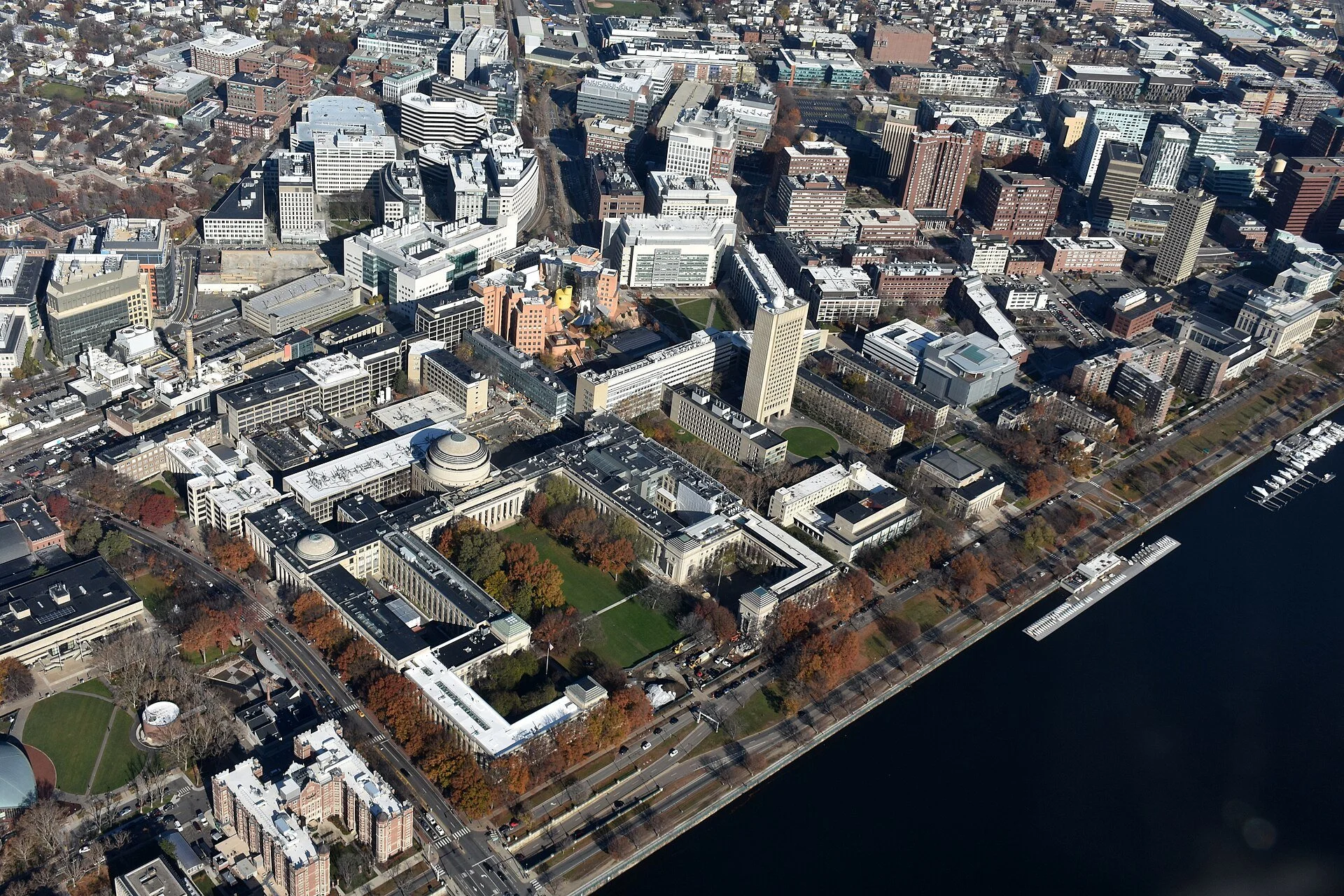
MIT's central and east campus from above the Harvard Bridge. Left of center is the Great Dome over Killian Court, with the Stata Center behind.
— Photo by Nick Allen
(Robert Whitcomb, New England Diary’s editor/publisher, is The Boston Guardian chairman.)
While residents may complain about poorly timed traffic lights and power outages, Boston and Cambridge have been ranked the third largest innovation engine in America and the ninth worldwide.
The World Intellectual Property Organization (WIPOP), a subsidiary of the United Nations that tracks, protects and distributes intellectual property, has released new data on which cities and regions around the globe are innovation hotspots in 2025.
Boston placed quite well nationally, ranking behind only San Francisco and New York City.
“Innovation clusters, whether innovation-driven cities or regions, form the beating heart of national innovation systems,” the report said.
“These hubs unite top universities, researchers, inventors, venture capitalists and research and development (R&D) firms in driving forward breakthrough ideas. From Bengaluru to Berlin, Boston to São Paulo, Shenzhen or Seoul, global cities blend research, start-ups and R&D firms to power innovation.”
WIPO’s global innovation index (GII) measures a combination of investment in innovation, technological progress and adoption of new technologies, and socioeconomic impacts. Boston actually does even better on rankings that take size into account, scoring 3rd globally behind only San Francisco and Cambridge, UK. WIPO gave special notice to San Francisco and Boston as the only cities to place top ten in both overall innovation and innovation density.
Those placements have real numbers behind them, with one of every hundred publications filed worldwide coming from Boston according to WIPO metrics. One of every sixty-six international patent treaties comes from Boston, and one of every fifty venture capital dollars spent globally is invested right here.
A large part of that is Boston’s education system.
The Massachusetts Institute of Technology (MIT) got second place in the Times Higher Education 2026 rankings with a perfect 100 points for industry connections and innovation. WIPO also noted that the Quacquarelli Symonds World University 2026 rankings gave MIT first place globally with a perfect 100.
Harvard Medical School got its own shoutout from WIPO as the region’s top scientific organization.
Other private enterprises played their own role, with Boston Scientific coming third in WIPO’s global ranking of medical device companies.
Boston’s rankings this year are a shift from 2024, better in some areas but slipping slightly back in others. While not all of the metrics between years are the same, Boston’s placement on the overall ranking slipped from 8th to 9th in 2025. Ranked with density taken into account, however, saw Boston jump from 5th place to 3rd. This could suggest that while Boston is ramping up innovation investment it’s not enough to fully compensate for the city’s size.
“The GII uses a bottom-up, data-driven methodology that disregards administrative or political borders and instead pinpoints those geographical areas where there is a high density of inventors and scientific authors,” said the 2025 report.
The city’s placements in 2024 were mostly the same for 2023 and 2022 as well, suggesting that this is a recent change rather than the continuation of an ongoing trend.The mayor’s office, Harvard Medical School and the MIT did not respond to a request for comment on this article by press time.
Top 10 innovation clusters
1. Shenzhen-Hong Kong-Guangzhou
2. Tokyo-Yokohama
3. San Jose-San Francisco
4. Beijing
5. Seoul
6. Shanghai-Suzhou
7. New York
8. London
9. Boston-Cambridge
10. Los Angeles
Cullen Paradis is a Boston Guardian contributor.