
Vox clamantis in deserto







Let’s look at the science in the tree vs. solar farm question
Brief text excerpt from an ecoRI News article by Brown University Prof. Stephen Porder. It may surprise you.
“The seemingly endless debate in Rhode Island about clearing trees to put up solar panels reared its head again in a recent column in ecoRI News by Frank Carini, who wrote that ‘Bulldozing trees to build utility-scale renewable energy facilities — 4 megawatts, in this case — essentially eliminates any of the project’s climate benefits.’ The article goes on to discuss very real concerns associated with clearing trees: loss of habitat, fragmentation of continuous forest, and water quality impacts.
‘‘I’ve studied forests all over the world for the past 20 years, and I share these concerns. I completely agree with Mr. Carini that ‘Rhode Island needs to get serious about protecting the environment.’ But let’s get the math right before we start the harder discussion about the tradeoffs that we have to make to address the climate crisis.’’
‘Yearning for this place’
From “Dog Years’’ show by Maine artist Dean McCrillis at Cove Street Arts, Portland, Maine, Nov. 29-Jan. 17.
The artist says show is of “recent paintings that explore personal and profound connections to formative spaces. This body of work is a recognition of the ephemeral, and of a fundamental sense of interconnectedness to a place, its people, flora, and fauna.
“The woods and waters of Western Maine serve as a backdrop for this group of pictures, as it holds the deepest love and connection of any area I have known. However, with the passing of time, and an ever-growing distance between my present station in life and the tributaries of my youth, I feel a sense of yearning for this place that shaped me.’’
At secret meeting, Trump regime, Big Tech push for apps to partly replace physicians, other health-care professionals

From Kaiser Family Foundation Health News, except for images above
A cadre of elite techies, financiers, and high-level Trump administration officials have spent a year quietly charting an extraordinary and rapid campaign to persuade Americans to use apps and other artificial intelligence-powered tools to manage their health care and medical records.
As that campaign has unfolded, administration officials have granted tech companies an unusual opportunity to nudge the nation toward a loosely regulated future for AI health apps in which the government reimburses them for services as it does medical professionals.
In February, federal health officials invited those businesses — including tech giants Microsoft, Anthropic, OpenAI, Apple, and Google — to a listening session on conversational AI products for patients, such as chatbots. Representatives from at least 35 industry organizations attended the meeting held by the Food and Drug Administration, which is responsible for regulating health apps as medical devices. Companies were prompted in advance to explain their AI products and how they access patients’ sensitive medical information.
But the meeting did not appear on the FDA’s public calendar or regulatory notices, nor was the public invited. Rather, the invitation for a select group to help shape federal policy governing AI in healthcare was extended in a chat room on the messaging service Slack.
“This is a great opportunity to support HHS’ goals and share your state-of-the-art understanding of safe Conversational AI development and monitoring to help FDA shape future guidance,” CMS senior policy adviser Morgan Taylor wrote in the Slack workspace.
The Centers for Medicare & Medicaid Services has not formally announced the chat room through federal regulatory channels, though CMS officials have talked about it at industry conferences. Legal experts said the chat room resembles a federal advisory panel, which would be required to operate in public view.
KFF Health News reviewed thousands of Slack messages, meeting transcripts, and video recordings that reveal how the Trump administration has granted the industry a direct line to top government officials — including former head of the Department of Government Efficiency Amy Gleason.
The conversation took place behind the scenes as federal health officials publicly worked to integrate AI and other technology into nearly every aspect of healthcare, a plan they’ve branded the “Health Technology Ecosystem.”
“We wanted to give industry a chance to play in the sandbox of government-supported health care,” CMS Administrator Mehmet Oz said in September at the public launch of an initiative that allows health apps to bill Medicare for AI services such as wearable device tracking. The other week, Health and Human Services Secretary Robert F. Kennedy Jr. delivered an enthusiastic endorsement of AI in healthcare, claiming it is “much better informed than any doctor in the country.”
Meanwhile, HHS staff even promised that a recently launched Medicare App Library would serve as a lucrative pipeline for those businesses to get new users. The library’s webpage currently promotes only two dozen commercial apps to millions of American seniors and those with disabilities.
As Trump officials sell it, Americans will get easier access to their medical records so apps can swiftly provide health or wellness advice. In practice, however, so will the tech companies.
Doctors, meanwhile, are increasingly worried about how patients use and share their medical records with the nascent technology.
“Some of these tools just aren’t ready for primetime,” said John Whyte, CEO of the American Medical Association. “We don’t have enough data about them. We don’t understand how they work, how they’re using the information. There’s no liability if these tools get things wrong.”
CMS officials declined to answer several questions about the Slack workspace, including about its legality.
“CMS is focused on giving Medicare beneficiaries greater access to their health information and useful digital tools while promoting an open, interoperable healthcare system,” Gleason, now chief product officer for the newly created Office of Health Technology and Products at CMS, wrote in an emailed statement. “The Health Technology Ecosystem is an open, voluntary technical collaboration. CMS will continue working with patients, providers, payers, technology organizations, and other stakeholders to make health information more accessible and useful to the Americans it serves.”
The FDA did not respond to a request for comment.
Dense with towns
Map of New England municipalities with municipal, unorganized territories, and national borders.
— Map by JShen
A couple of weeks of color before the monochrome
“Fall Birches” (oil) by Melanie Barash Levitt, at Jackson Art Studio and Gallery, Jackson, N.H.
Chris Powell: Not only teachers think they’re underpaid
MANCHESTER, Conn.
Has any candidate in Connecticut ever repudiated his own campaign television commercial as quickly as Gov. Ned Lamont, a Democrat seeking election to a third term, did the other day?
The governor's commercial calling the state's schools the best in the country included a pledge to arrange pay raises for teachers. Some people wondered if that meant the governor would support enacting a statewide minimum starting salary for teachers of $60,000. But questioned by Connecticut's Hearst newspapers, the governor said he was not advocating that and offered no explanation of what, if anything, his assertion in the commercial meant.
In any case, the commercial provided an opportunity for the president of the state's largest teachers union, the Connecticut Education Association, to make another pitch for raises. The union's president, Kate Dias, noted that while the estimated average salary for teachers in the state is, at $91,000, the sixth highest among the states, the states with the highest teacher salaries also have the highest cost of living.
Even for a single person in Connecticut, Dias said, that $91,000 is barely a living wage, especially since the cost of housing in the state is so high. For a teacher trying to support a family, she said, that salary is "woefully short."
But this isn't much of an argument. For teachers are not the only Connecticut residents under financial strain. Indeed, most people are feeling pinched lately amid inflation, and the latest report from the state's United Way organization said that about 40 percent of Connecticut residents are financially unstable and unable to afford essentials.
These people just don't have a politically influential union to represent them. They have to rely on their state legislators, who listen more carefully to special interests like teacher unions.
Besides, teachers receive valuable compensation that doesn't get counted in their salaries: medical insurance and pension benefits that are much better than what private-sector workers have, as well as job security under the teacher-tenure law.
Some teachers still may deserve a raise. But most teachers, covered by union contracts, \ will get raises even when many private-sector workers won't, and if teachers deserve raises larger than what their union contracts get them, it will be mainly because their students increasingly are unparented and poorly behaved.
So rather than be given special treatment, teachers should be welcomed to the growing club of financially strained Connecticut residents and should pursue policy solutions that benefit people generally -- more housing construction, which will require curtailing municipal zoning, and ending inflation, which will require reducing government spending.
Since solutions are probably impossible politically amid state government's subservience to special interests, change is unlikely.
Lamont's campaign commercials tout the many goodies the Democratic state administration has bestowed on Connecticut, while the commercials of his Republican challenger, Greenwich state Sen. Ryan Fazio, promise big cuts in taxes. So it's fair to conclude that, as usual, the Democrats will spend more, the Republicans less.
But Fazio isn't leveling with people much more than the governor is.
Big cuts in taxes eventually will require big cuts in spending, and Fazio isn't strong on specifics there. In an interview with the Connecticut Examiner the other day he talked about "unfunded state mandates" on municipalities and cited the requirement for them to put legal notices in newspapers -- a small expense -- but didn't mention the elephants in the budget room, binding arbitration of municipal employee union contracts and the minimum budget requirement for school systems. Those laws actually prohibit public control over most municipal spending even as they can't be discussed because it would upset the biggest local special interests, municipal government employee unions.
Polls suggest that Fazio is yet to catch on with voters, and President Trump's unpopularity may bring down all Republicans in Connecticut next month. So when you're likely to lose anyway, you might as well try candor and telling the truth. Shocking people like that will get lots of attention and make it easier for the next guy who might try candor and the truth.
Chris Powell has written about Connecticut government and politics for many years\ (CPowell@cox.net).
Making Prints in response to troubled America’s 250th
“Intercessor 1: Minnesota ICE” (white line woodcut), by Annie Bissett, in the show “Perspectives: America at 250,’’ at the Center for Contemporary Printmaking, Norwalk, Conn., through Nov. 8.
The show has 120 original prints made by members of The Boston Printmakers who were asked to address six themes tied to America’s 250th birthday.
Brown gets $37 million grant for research on aging
Brown University shield
Edited from a New England Council report
Brown University and Brown University Health, in Providence, recently received a $37 million gift from the Starr Foundation to advance and expand clinical trials, treatments, and research on aging. The funding goes towards research at Brown’s Center on the Biology of Aging, with clinical trials and treatments across Brown University Health, Rhode Island’s largest health-care system.
The five-year gift will establish two endowed faculty positions in geroscience at Brown University, focused on studying the genetic, molecular and cellular mechanisms of aging with the goal of increasing the number of years people live in good health. The Starr Foundation’s Healthspan Innovation Alliance bridges the gap between Brown University with Brown University Health; the health system currently conducts about 500 clinical trials in Rhode Island, with about two-thirds focused on aging and aging-associated disorders.
“By uniting world-class science at Brown with clinical care across the Brown University Health system, we can translate cutting-edge research into life-changing treatments for devastating conditions like cancer and dementia,” said Brown University President Christina H. Paxson.
‘The ups and downs’
From Midge Battelle’s show “Love Letter to a Dream, at the Provincetown Art Museum and Museum, through Oct. 25.
The gallery says:
“Midge’s works are meditations on the joys and sorrows, the ups and downs, the sadness and wonders of life. The Grid, The Blue, The Silver, the Pale and sometimes the Saints. Her work is Healing, as is the spending of time with her. The photographs, the Cyanotypes, the prints and the paintings all work together to express Midge’s view of the world.’’
Llewellyn King: The sad decline in creative swearing
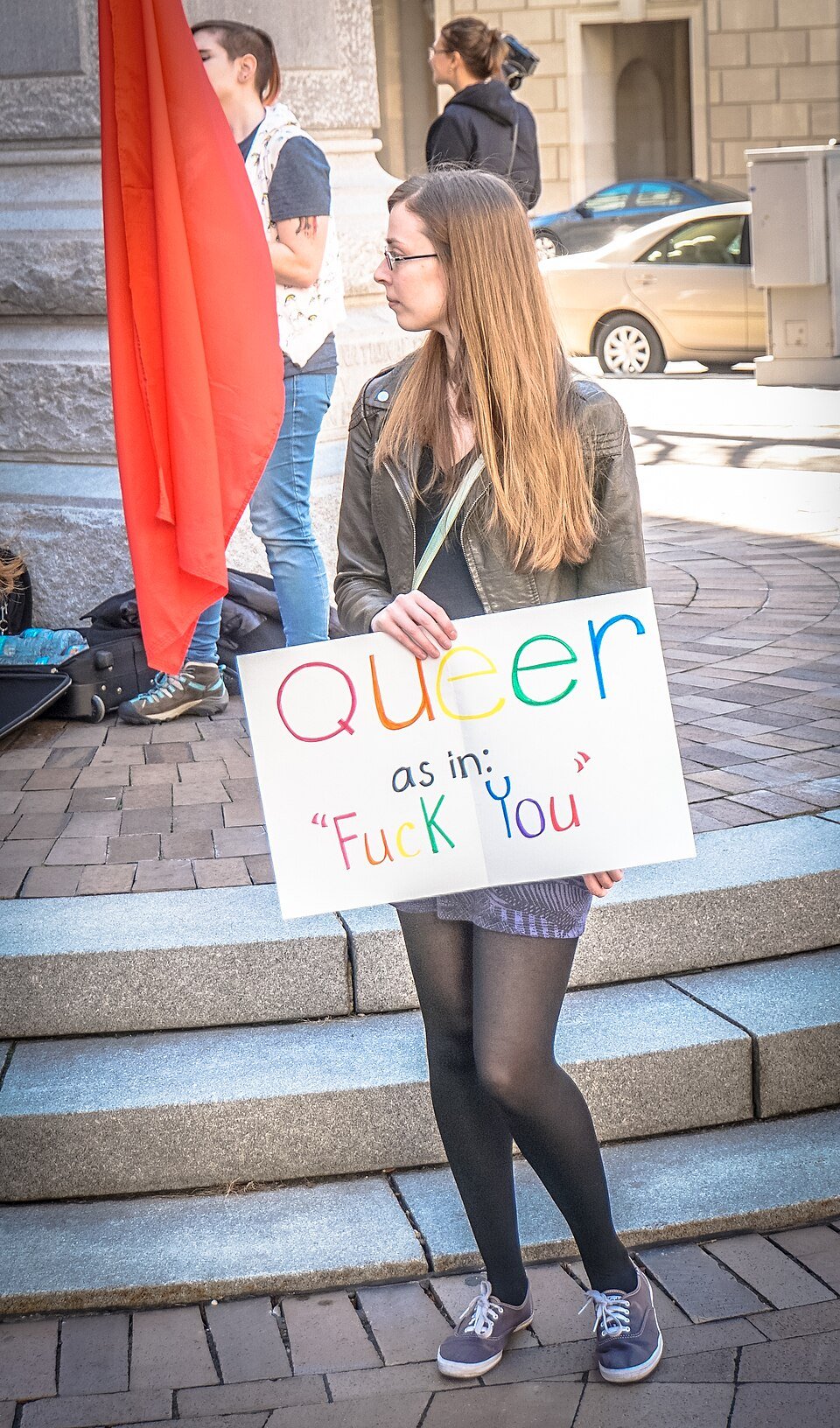
Term such as queer can be reappropriated by the people they are directed against, as in this demonstration in Washington.
—Photo by Ted Eytan
WEST WARWICK, R.I.
Mark Twain wrote an essay on the decay in the art of lying. His conclusion was that you had better have a damn good memory.
Oscar Wilde wrote an essay — in the form of a philosophical dialogue — on the same subject, but he was trying to prove that art didn’t need to be based on the real world.
I have the temerity to offer this: the decay in the art of swearing.
As a boy, I read in Richard Dana’s book Two Years Before the Mast that the captain could swear for minutes without repeating himself. Ever since, I have been fascinated by swearing and those who maintain it as — dare I say it — an art form.
At the heart of the decline is the lack of respect for the f-word. In its day, it was the capstone, shocking and bound to offend. Ergo, it had to be used sparingly and calculatedly.
Now it is everywhere, in movies, in BBC television shows, and has been heard in the Congress and from the lips of the president of the United States. Shame.
If this keeps up, the f-word will be no more upsetting than bloody, which was a true shocker when George Bernard Shaw used it his 1913 play Pygmalion, but is now no more shocking than any other adjective.
Bugger is another word that has become inoffensive. Once a shocker with kiloton-explosive quality, it has been defused.
Here are some great swearers I have known and who kept alive the creative art of profanity.
Stockard Channing has an exquisite command of the language and with, as you would expect from one of our great actresses, impeccable timing.
Decades ago, she and I were both guests at The Ashram, an exclusive health resort in California. I have fond memories of the two of us trying to jog down the beach in Malibu while she let loose with a powerful and profane description of some of Hollywood’s executives. Invigorating.
Ben Bradlee, the legendary executive editor of The Washington Post, knew how to use the f-word as a tool of editorial management. He dropped it straight and true like the blade of a guillotine on any stupid idea or meandering argument.
I saw this happen with deadly effect when, in an editorial conference (a daily event in newspapers), the coterie of assistant managing editors was getting overly excited about the struggle of a Post reporter in the Middle East. Bradlee listened, then declared, “F-word, this sounds like a story about how we didn’t get the story.” Quite so.
James Schlesinger, the great public servant who in turn was chairman of the Atomic Energy Commission, director of the CIA, secretary of defense and secretary of energy, liked to shock in formal situations. He used to use his command of profanity to bring pompous discussions down to earth.
Once I was visiting with him at the CIA, and we were shooting the breeze as we did often, when his aide came in and said, “Sir, the admiral has been waiting a long time to see you.”
Schlesinger signaled to me to stay put. “It’s good for [strong expletive] admirals to wait.”
That was in the early days of his tenure at the agency, and clearly he wanted word to get around that he was the absolute authority at Langley – and he was anywhere he held office. Awesome.
The master of what I think of as narrative swearing was my friend Guy Hawtin, a distinguished journalist with the Financial Times and the New York Post, who abandoned the wicked ways of journalism for the Episcopal priesthood.
Hawtin, who resembled the actor Peter Ustinov, could put English words together any time, anywhere, but his memorable tirade of swearing and invective happened to be in the hallowed ground of New York’s Algonquin Hotel. The perfect set.
Our lunch wasn’t intended as a reprise of the famous Algonquin Round Table of the 1930s, though we were seated at a round table. Our mutual friends David Fishlock, the FT’s science editor, and John McCaughey, a former FT subeditor, were also there.
The FT editor had dismissed Hawtin, leaving considerable bad blood. When Fishlock suggested that the editor was doing a good job, Hawtin launched into a brilliantly sustained angry monologue — the finest display of serial swearing this connoisseur had ever heard before or since.
Sitting by himself in a corner was the real, older, Peter Ustinov. He raised a hand with his thumb and index finger making a circle. Approval.
Our politicians aren’t adding to the art. They should have their mouths’ washed out with soap — my mother’s remedy for potty-mouth.
Llewellyn King, based in Rhode Island, is executive producer and host of White House Chronicle, on PBS, and an international energy-sector consultant. His email is llewellynking1@gmail.com.
Brief flaming days

“October” (oil), by Willard Metcalf, (1858-1925). He was dubbed the visual equivalent of “poet laureate of the New England hills.’’
O hushed October morning mild,
Thy leaves have ripened to the fall;
To-morrow’s wind, if it be wild,
Should waste them all.
The crows above the forest call;
To-morrow they may form and go.
O hushed October morning mild,
Begin the hours of this day slow,
Make the day seem to us less brief.
Hearts not averse to being beguiled,
Beguile us in the way you know;
Release one leaf at break of day;
At noon release another leaf;
One from our trees, one far away;
Retard the sun with gentle mist;
Enchant the land with amethyst.
Slow, slow!
For the grapes’ sake, if they were all,
Whose leaves already are burnt with frost,
Whose clustered fruit must else be lost—
For the grapes’ sake along the wall.
— “October,’’ by Robert Frost (1874-1963)
The future of the storied Maine Coast

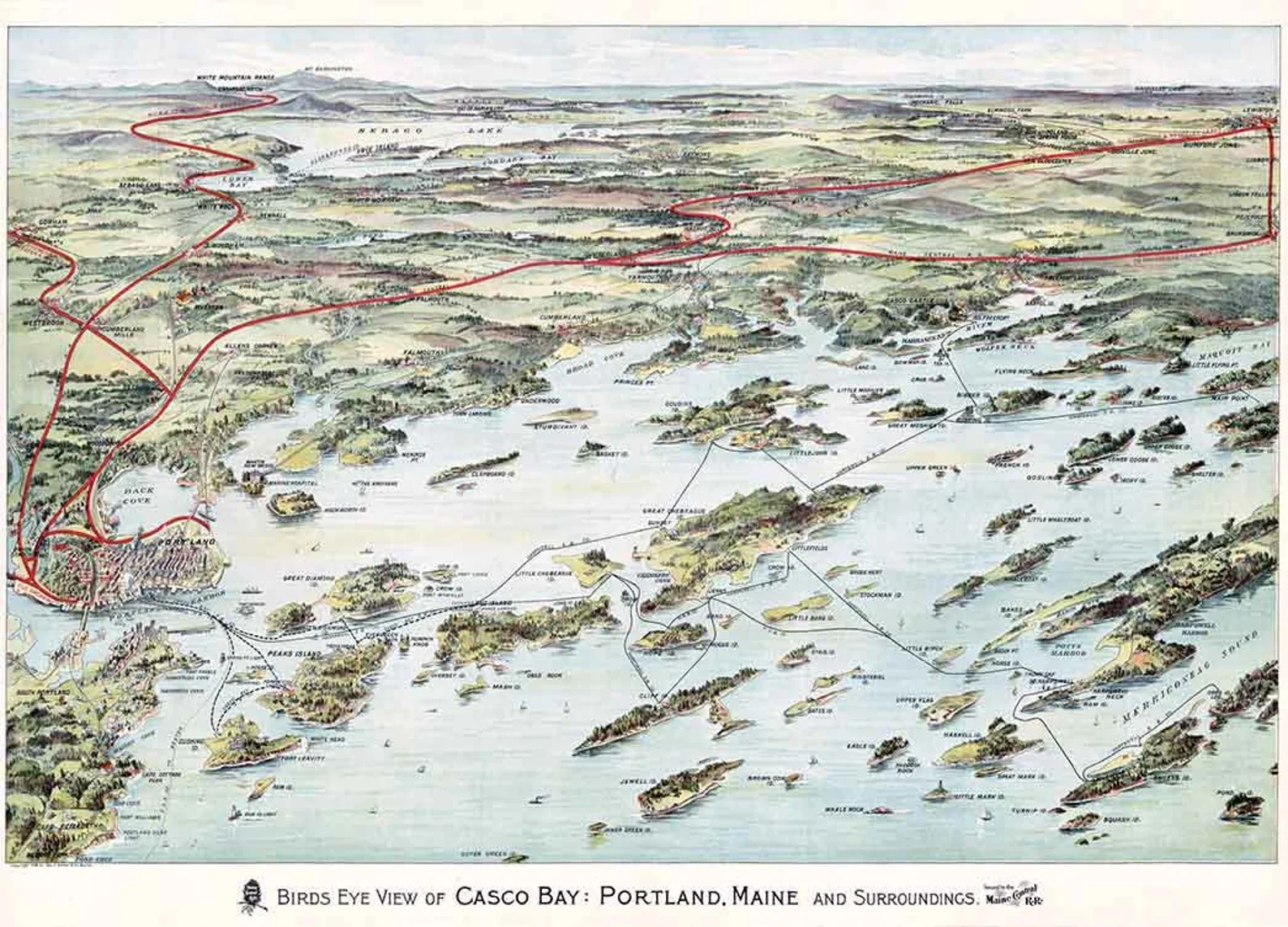
Rising Tides: Adapting to Maine’s Coastal Future captures the memorable voices of Mainers in a rapidly changing world. These include oyster farmers and other aquaculturalists, fishermen, marine biologists and other scientists, and community leaders who are navigating dramatic changes along and off Maine’s iconic coast. Presenting deep geological, climatological, and human history, in-depth interviews, and other research, the book shows the challenges and opportunities as rising seas caused by global warming, along with sometimes controversial shoreline development, are reshaping ways of life along The Pine Tree State’s storied coast. The vivid changes include shifting fisheries, new industries and markets and the technology that pushes them.
The problems, opportunities, and adaptations in Maine carry lessons for coastal communities around the world. These are global issues described locally through the stories of Mainers on the frontlines. A powerful and timely portrait, Rising Tides is both a warning and an inspiration. It displays the dangers posed by change while also serving as a testament to the ingenuity and determination required not only in Maine but on coasts everywhere.
Shaking hands over the body
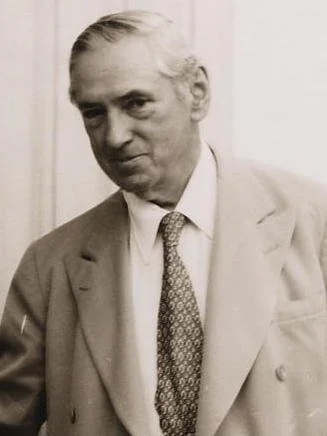
The ultimate Boston Irish politician — James Michael Curley (1874-1958), who as “The Hub’s’’ legendary mayor spent a lot of time quietly campaigning at wakes. Read the novel The Last Hurrah, which is based on him.
“This tailgate is a Time – which is what Massachusetts politicians throw whenever they must once again run for office….A Time is usually a fund-raising dinner, but it can be a fund-raising lunch, a fund-raising trip to the ballpark, or yes, a fund-raising wake, where, very likely, Jumbo Jr. will be shaking hands over the departed Jumbo Sr. preparatory to a run for the Governor’s Council.’’
-- Charles P. Pierce (born 1953) is a Boston area-based American sportswriter, political blogger, liberal pundit, author, and game show panelist.
‘Holistic way of seeing and being’

“Politics of Eternity”| (glass, collage, acrylic, steel), by Dustin Yellin, in his show at the Bruce Museum, Greenwich, Conn., through March 28.
The museum says:
“Brooklyn-based artist Dustin Yellin (American, b. 1975) is internationally recognized for his captivating sculptures, which feature found images and painted passages compressed between dozens of panes of laminated glass. With their monumental scale and minute details, Yellin’s intricate and varied landscapes guide viewers on a journey of personal and cultural discovery. Close looking reveals references to humankind’s treasures (rare minerals, ancient artifacts, masterpieces of art history); its detritus (nuclear waste, rusting cars, decommissioned infrastructure); and its speculative future (jet packs, rockets, colonies on Mars). Through this expansive visual language, the artist blurs the boundaries between art, history, and science, proposing an integrated, holistic way of seeing and being.’’
Between realism and idealization

“Boy and Girl Gazing at Moon” (1926), cover illustration for The Saturday Evening Post, of April 24, 1926, in the show “Norman Rockwell: The Human Touch,’’at the Norman Rockwell Museum, Stockbridge, Mass., Nov. 14-May 31.
The museum says
“As a Time magazine reporter observed in 1943, Norman Rockwell (1894-1978) ‘constantly achieves that compromise between a love of realism and the tendency to idealize, which is one of the most deeply ingrained characteristics of the American people.’ His art has long been defined by a hopeful and admiring view of humanity. Throughout his career, he sought to capture the warmth and complexities of people’s fleeting interactions with one another― narratives shaped as much by observations and affection for his subjects as by their shared emotions and experiences.’’
Joëlle Rollo-Koster: A golden Vatican PR tool

Golden Rose by Giuseppe and Pietro Paolo Spagna. Rome, around 1818/19. Kept today in the Imperial Treasury in Hofburg Imperial Palace, in Vienna.
From The Conversation, except for picture above.
KINGSTON, R.I.
Almost every ceremonial object or ornament of the medieval papal monarchy has disappeared or lost its original purpose. Yet one survives: the golden rose.
On Sept. 26, 2026, during Pope Leo XIV’s visit to France, he traveled to Lourdes, home to one of the world’s most famous shrines to the Virgin Mary. After praying, Leo presented a golden rose to Our Lady of Lourdes – the fifth time he has dedicated a rose to a Marian shrine or image.
The ornate rose Leo offered to Lourdes is not that different from its medieval iterations. The oldest surviving rose is now at the Musée de Cluny in Paris and dates from the early 1300s. Both are golden, with several branches and buds.
Pope Leo XIV offered a golden rose in Lourdes as part of a four-day trip to France.
Yet who receives the roses, and why, has changed dramatically.
As a medieval historian researching the papacy, I frequently find mentions of the roses. They are ubiquitous in medieval chronicles – most of all, in papal accounting registers. The history of the roses’ beneficiaries reflects the history of the papacy and how its influence has shifted over the centuries.
Roots of tradition
Most medieval roses were made of gold and silver, adorned with precious stones such as sapphires and rubies. One of the buds formed a small receptacle that held some musk and balsam, rare and expensive fragrances.
The Vatican Apostolic Archives have preserved the accounting registers that itemized many of the roses’ costs. On average, they weighed 11-16 ounces of precious metal and cost the equivalent of 10 years of a laborer’s annual wage.
The golden rose first appeared during the papacy of Leo IX. On April 18, 1049, the pope exempted a nunnery in Alsace – now in Sainte-Croix-en-Plaine, France – from the legal authority and supervision of the local bishop. In return, the head of the nunnery was required to offer the pope a golden rose of some 2 ounces, or of equivalent value. At the time, roses were often used to symbolize a feudal pledge: the submission of a vassal to a lord.
Within a couple of generations, the gift had changed direction: The pope now granted a rose. The first clearly documented case took place in 1096, when Urban II, touring France and preaching the First Crusade, granted it to Fulk of Anjou to reward him for his willingness to participate.
A 13th-century illustration of a pope bestowing a golden rose on Laetare Sunday. Musée de Cluny via Wikimedia Commons
From the 11th C
entury on, the pope offered a rose once a year, on Laetare Sunday: the fourth Sunday of Lent, the period before Easter when many Catholics commit to some form of penance. According to ceremonial books called “ordines,” the pope held the rose during the worship service, preached about its symbolism, and presented it to a recipient.
On that Sunday, gifting the rose reminded believers that while Lent was difficult, beauty and joy would emerge from it. The day was also a feast in honor of the recipient – typically the prefect of Rome, who supervised the city’s jurisdictions and police.
Diplomatic tool
Eventually, the decision about who should receive the honor rested solely with the pope. Still, it was always bestowed upon those who wielded power: the prefect of Rome, emperors, kings, military leaders and defenders of Christian lands. Receiving the rose was a public acknowledgment that the recipient – usually a warrior – stood beside the pope in protecting the church.
In 1148, for example, Pope Eugene III offered it to the king of Leon and Castile, Alfonso VII. A century later, Pope Innocent IV gave it to Raymond Berenger, count of Provence. In both cases the pope rewarded the fight against Muslims, whom the Vatican saw as “infidels” or heretics.
The Avignon papacy of the 14th Century, a period when several popes resided in what is now southern France, accelerated this evolution. Away from Rome, and in the absence of a Roman prefect, the rose’s role as a negotiating tool intensified.
By the 14th Century, the ceremony had grown even more elaborate. According to ceremonial books, the pope carried the rose in procession, while its beneficiary held the reins of his horse and kissed the pope’s feet – a gesture of submission.
Holy Roman Emperor Sigismund in a procession with a golden rose in a 15th-century illustration. Chronik des Constanzer Concils by Ulrich von Richental/New York Public Library
Warriors, women – and shrines
Historians can estimate how many people received the rose based on evidence available in the Vatican’s accounting registers and other historical records. Over the years, more and more began to be presented to women, and then to shrines. This change shows the history of the papacy – and of its communication strategy. Simply put, the evolution of the rose followed the evolution of papal power itself.
The first few centuries of the rose were a period of conquests and Catholic expansionism, when conversion often came through war. With very few exceptions, roses were offered to commend male medieval rulers, often ones who had militarily defended Catholicism.
The early modern period saw the birth of the Protestant Reformation and many religious conflicts. Popes looked for support from the era’s powerful women rulers, such as Catherine de’ Medici, who played a crucial role during France’s wars of religion between Protestants and Catholics. From the 16th century onward, roses were often given to women like her: empresses, queens and the wives of high dignitaries.
That shift accelerated in the 18th and 19th centuries, when most roses were gifted to Catholic women of high standing. From 1790 to 1893 not a single man received the rose.
This was a period of revolutions and secularization, when the church could not depend on the military leadership of a king, duke or the nobility. Again, queens and empresses dominated the beneficiaries. With the rose, popes could flatter and honor the wives of important rulers, who in turn could pressure their spouses if needed. Eugénie, empress of the French and wife of Napoleon III, received it in 1856 for her piety and philanthropy.
Charlotte, the grand duchess of Luxembourg, received a rose in 1956. Library of Congress via Wikimedia Commons
The 20th and 21st centuries saw a total abandonment of gifting the rose to humans. Instead, popes have presented them to shrines and basilicas, typically ones dedicated to the Virgin Mary. The last person given a rose was Charlotte, grand duchess of Luxembourg, who received one in 1956 for her piety and courage during World War II.
1,000 years of change
Today, Leo XIV continues the tradition. Devotion to Mary remains central to Catholic identity in an age when political authority no longer carries the same religious weight. Gifting the roses to holy shrines, images or basilicas separates them from any suggestion of political and religious alliance or favoritism.
The history of the golden rose reveals the shift of papal priorities from political alliance-building to devotional symbolism. What was once a diplomatic gift addressed to earthly power is now offered to Marian shrines: the roses embody faith itself. The recipients changed because the church’s relationship to power changed.
I see the rose as a perfect example of the Catholic Church’s deep understanding and adaptation to its time and its gift for reinvention. Few institutions have managed to keep a medieval ceremony alive for nearly a millennium while completely transforming its meaning. The golden rose is the papacy’s oldest public relations tool.
Joëlle Rollo-Koster is professor emerita of medieval history at the University of Rhode Island. She does not work for, consult, own shares in or receive funding from any company or organization that would benefit from this article, and has disclosed no relevant affiliations beyond their academic appointment.
Accepting cold feet

“Maine Coast Winter 1909” (oil on canvas), by Rockwell Kent (1882-1971), at the Museum of Fine Arts, Boston.

“My grandfather once told her if you couldn't read with cold feet, there wouldn't be a literate soul in the state of Maine.”
― Marilynne Robinson (born 1943), from her novel Gilead
xxx
“Maine out of season is unmistakably a great destination: hospitable, good-humored, plenty of elbow room, short days, dark nights of crackling ice crystals.’’
— Paul Theroux (1941), American travel writer, novelist and essayist
‘Remaking the land’

“Totem #1 (primal places)’’ (acrylic, oil on birch panel), by Molly Dickinson, in her show “Of Longing and Loss,’’ at the Jamestown (R.I.) Arts Center, Nov. 20-Jan 9.
She has asked:
“Do we find beauty in nature, or only after we have reshaped the landscape to our own purposes? Perhaps impossible to answer, as little of these lands have escaped the imprint of human activity. I paint my pieces directly, quickly, so that one feels my hand, my marks, remaking the land, too.’’

‘Humor and hope’



“Noggin,’’ in Kathleen Schneider’s show “Taken to Heart,’’ at Burlington (Vt.) City Arts, Oct. 16-Jan. 23.
The gallery says:
“Through the methodical, time-intensive processes of dyeing, sewing, printing, and assembling, Kathleen Schneider creates sculpture, textiles, and prints that are labors of love, reflecting on our ever-changing world. Inspired by daily life, poetry, and treasured books, her work explores the relationship between personal experience and larger social and political histories. Using vibrant colors and shadows cast by the work, the artist investigates how humor and hope can exist alongside uncertainty and struggle, inviting viewers to consider how the current political landscape impacts our lives and communities. Schneider gives emotions, speech, and activism physical form, showing how personal reflection can become collective action.’’