In The Green Mountain State’s short swimming season
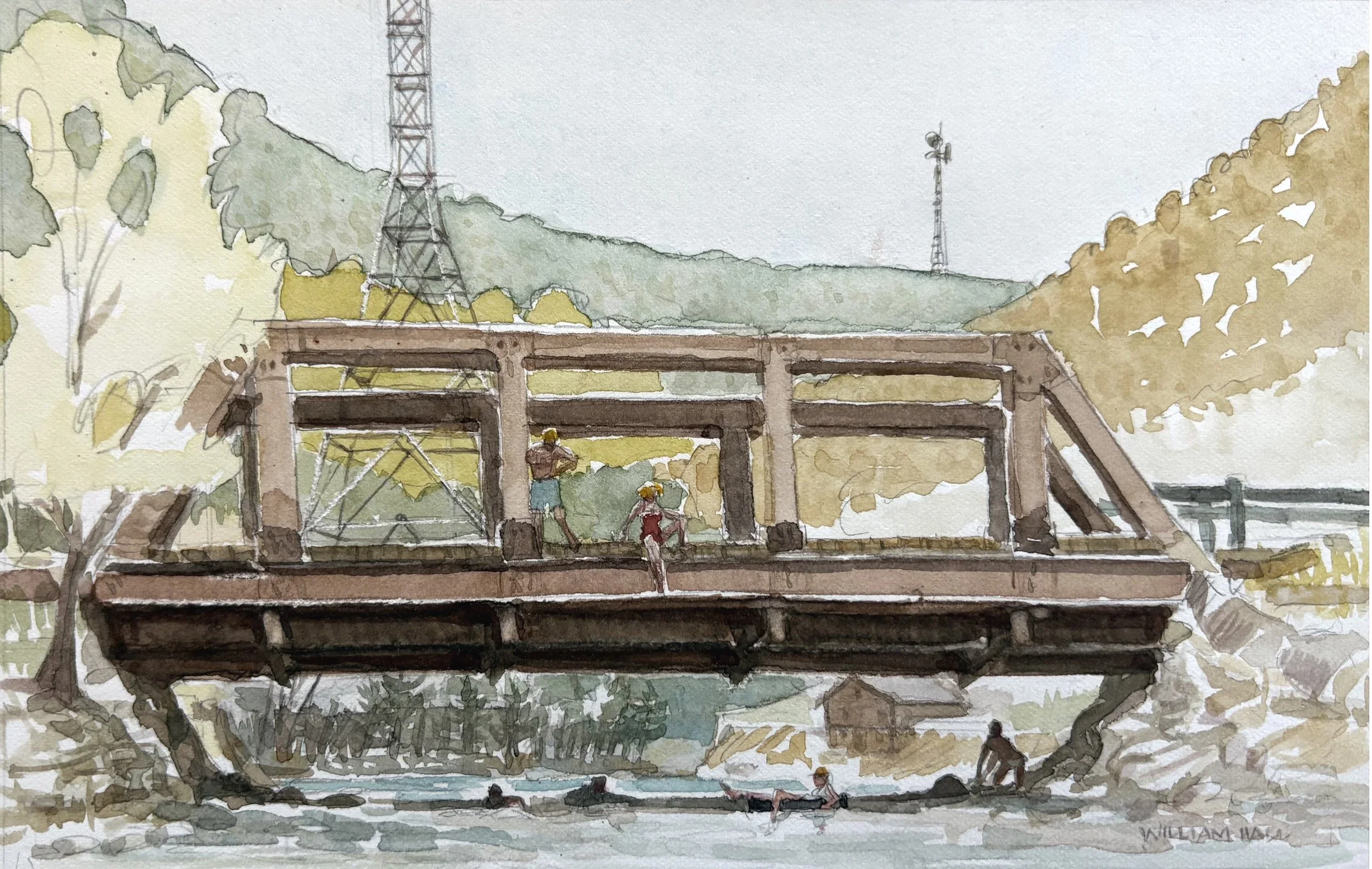
“Couple on Bridge” (watercolor), by William Talmadge Hall, in his “Obstruction to a Landscape” series. He grew up in Vermont and Rhode Island.
Using beach debris to make some statements

“Five Articles Selected for the Poly S. Tyrene Memorial Maritime Museum” (painted salvaged plastic, ink, wax), in the show “Duke Riley: What the Waves May Bring,’’ at the Cahoon Museum of American Art, Cotuit, Mass., through Sept. 14.
The museum says Mr. Riley “transforms salvaged plastic collected from beaches and waterways into intricate mosaics and sculptures inspired by maritime history and folk traditions. The exhibition features finely crafted artworks that reference 19th Century nautical history and maritime crafts — such as scrimshaw, fishing lures, and sailors’ valentines—yet are made from contemporary debris. Through these unexpected materials, Riley offers a striking commentary on corporate greed, ocean degradation, and the stories we choose to preserve.’’
Chris Powell: Why Trump is squeezing Yale, et al.

In simpler times: Front view of “Yale-College" and the chapel, printed by Daniel Bowen in 1786.
MANCHESTER, Conn.
For many years the ravenous far left in Connecticut has advocated taxing Yale University, in New Haven. Yale's endowment long has been managed spectacularly well and now totals more than $40 billion, the second-largest university endowment in the country, trailing only Harvard's.
Indeed, the popular joke is that Yale is a hedge fund masquerading as a university. The popular resentment is that about 57 percent of real estate in New Haven is exempt from municipal property taxes and most of that exempt property, worth about $3.5 billion, is owned by Yale.
Financial aid from state government and “payments in lieu of taxes" makes up for some of the foregone property-tax revenue but far from all of it. Of course, if Yale's property was fully subject to the city's property tax, the city wouldn't be any better off, given its awful management, but city employees might be able to retire at full pay after only two or three years on the job, since the satisfaction of its employees is city government's highest objective.
Now reform is coming to Yale not because of leftists in Connecticut but, ironically, because of President Trump and the narrow Republican majority in Congress.
Their new federal tax and spending law imposes progressive taxes on college endowments. The biggest endowments, like Yale's, will be taxed at 4 percent a year, and one study estimates that this will clip Yale's for $1.5 billion over five years.
Of course Trump and the Republicans aren't taxing college endowments out of any liberal belief in wealth redistribution. They are taxing the endowments because higher education has become a great engine of the political left and the Democratic Party, which is also why Connecticut state government, a leftist Democratic operation, has declined to tax the endowments of private colleges (Yale's particularly) and has declined to subject private colleges (again, Yale particularly) to municipal property taxes.
The Republicans want to cut higher education down to size politically while the Democrats want to keep it a strong source of patronage and propaganda.
Trump and the Republicans are right for the wrong reasons, but that's better than being wrong. For as the college loan disaster has shown, higher education's importance to the country is grossly overestimated. The country's education problem is lower education, as shown by the few proficiency tests still permitted in elementary, middle, and high schools in Connecticut, and by their disgraceful racial performance gaps.
COWARDLY, UNACCOUNTABLE, PATHETIC: How much more does anyone really need to know about the corruption and incompetence of the Connecticut State Colleges and Universities System than something that was reported a week ago?
The system is still embroiled in the scandal over its departing chancellor, Terrence Cheng, who last year was caught abusing his expense account despite his annual compensation of nearly $500,000. The system's Board of Regents decided he had to go but feared that the contract the board had given him, which extended to next July, might be construed in court to prevent his dismissal. So it was agreed that he would leave the chancellorship on July 1 and become "strategic adviser" to the board for another year, doing amorphous stuff for the same compensation.
An interim chancellor, O. John Maduko, lately administrator of the community college system, has been appointed to serve for a year at a salary estimated at $425,000, not counting fringe benefits.
Fair questions remain about the college system's administration and state legislators continue to criticize it. So a week ago, the Hartford Courant asked for an interview with the chairman of the Board of Regents, Martin Guay. He refused.
How cowardly, unaccountable, and pathetic for the chairman of a major government agency.
Gov. Ned Lamont, a Democrat, who appoints most of the regents, should be embarrassed.
Democratic state legislators should be embarrassed too. They should be emboldened to ask more critical questions of the regents and college administrators generally. Legislators could start with: Is it really impossible to hire a competent, public-spirited administrator for less than a half million dollars per year?
Chris Powell has written about Connecticut government and politics for many years (CPowell@cox.net).
Horses still allowed to share?
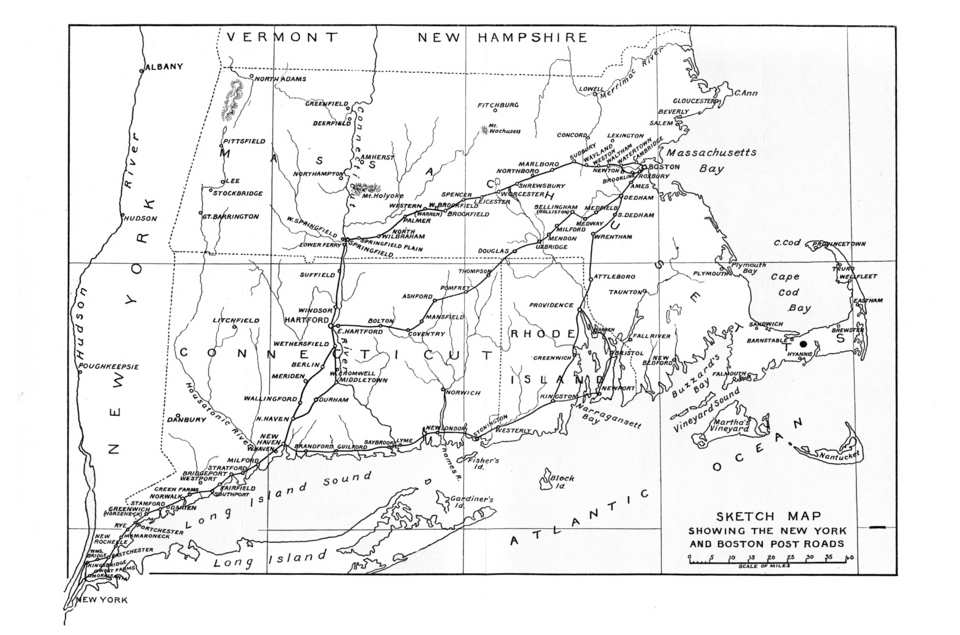
Map of the various alignments of the Boston Post Road. Scanned from S. Jenkins, The old Boston Post Road, (G.P. Putnam and Sons, New York and London, 1914)
Quick, before they wilt

“An Echo of Gratitude’’ (archival inkjet print), by Widline Cadet, in a group show through Aug. 22 at The Fine Arts Work Center, Provincetown, Mass.
Julie Walsh: Dangerous misinformation campaigns from medieval Europe to today’s social media

Representation of the Salem witch trials (1692-1693) lithograph from 1892

Torturing woman accused of witchcraft, in this 1577 picture.
From The Conversation, except for images above
Julie Walsh is Whitehead Associate Professor of Critical Thought and Associate Professor of Philosophy, Wellesley College
She receives funding from the National Science Foundation
WELLESLEY, Mass.
Between 1400 and 1780, an estimated 100,000 people, mostly women, were prosecuted for witchcraft in Europe. About half that number were executed – killings motivated by a constellation of beliefs about women, truth, evil and magic.
But the witch hunts could not have had the reach they did without the media machinery that made them possible: an industry of printed manuals that taught readers how to find and exterminate witches.
I regularly teach a class on philosophy and witchcraft, where we discuss the religious, social, economic and philosophical contexts of early modern witch hunts in Europe and colonial America. I also teach and research the ethics of digital technologies.
These fields aren’t as different as they seem. The parallels between the spread of false information in the witch-hunting era and in today’s online information ecosystem are striking – and instructive.
Birth of a publishing empire
The printing press, invented around 1440, revolutionized how information spread – helping to create the era’s equivalent of a viral conspiracy theory.
By 1486, two Dominican friars had published the “Malleus Maleficarum,” or “Hammer of Witches.” The book has three central claims that came to dominate the witch hunts.
A 1669 edition of ‘Malleus Maleficarum.’ Wellcome Collection/Wikimedia Commons, CC BY-SA
First, it describes women as morally weak and therefore more likely to be witches. Second, it tightly links witchcraft with sexuality. The authors claim that women are sexually insatiable – part of what leads them to witchcraft. Third, witchcraft involves a pact with the devil, who tempts would-be witches through pleasures such as orgies and sexual favors. After establishing these “facts,” the authors conclude with instructions for interrogating, torturing and punishing witches.
The book was a hit. It had more than two dozen editions and was translated into multiple languages. While “Malleus Maleficarum” was not the only text of its kind, its influence was enormous.
Prior to 1500, witch hunts in Europe were rare. But after the “Malleus Maleficarum,” they picked up steam. Indeed, new printings of the book correlate with surges in witch-hunting in Central Europe. The book’s success wasn’t just about content; it was about credibility. Pope Innocent VIII had recently affirmed the existence of witches and conferred authority on inquisitors to persecute them, giving the book further authority.
Ideas about witches from earlier texts and folklore – such as the “fact” that witches could use spells to make penises vanish – were recycled and repackaged in the “Malleus Maleficarum,” which in turn served as a “source” for future works. It was often quoted in later manuals and woven into civic law.
The popularity and influence of the book helped crystallize a new domain of expertise: demonologist, an expert on the nefarious activities of witches. As demonologists repeated one another’s spurious claims, an echo chamber of “evidence” was born. The identity of the witch was thus formalized: dangerous and decisively female.
Skeptics fight back
Not everyone bought into the witch hysteria. As early as 1563, dissenting voices emerged – though, notably, most didn’t argue that witches weren’t real. Instead, they questioned the methods used to identify and prosecute them.
Essayist Michel de Montaigne, painted around 1578 by an unknown artist. Conde Museum/Wikimedia Commons
Dutch physician Johann Weyer argued that women accused of witchcraft were suffering from melancholia – what we might now call mental illness – and needed medical treatment, not execution. In 1580, French philosopher Michel de Montaigne visited imprisoned witches and concluded they needed “hellebore rather than hemlock”: medicine rather than poison.
These skeptics also identified something more insidious: the moral responsibility of people spreading the stories. In 1677, English chaplain, physician and philosopher John Webster wrote a scathing critique, claiming that most demonologists’ texts were straightforward copy and paste jobs where the authors repeated one another’s lies. The demonologists offered no original analysis, no evidence and no witnesses – failing to meet the standards of good scholarship.
The cost of this failure was enormous. As Montaigne wrote, “The witches of my neighborhood are in mortal danger every time some new author comes along and attests to the reality of their visions.”
Demonologists benefited from the social and political status associated with the popularity of their books. The financial benefit was, for the most part, enjoyed by the printers and booksellers – what today we refer to as publishers.
Witch hunts petered out throughout the 1700s across Europe. Doubt about the standards of evidence, and increased awareness that accused “witches” may have been suffering from delusion, were factors in the end of the persecution. The skeptics’ voices were heard.
Psychology of viral lies
Early modern skeptics understood something we’re still grappling with today: Certain people are more vulnerable to believing extraordinary claims. They identified “melancholics,” people predisposed to anxiety and fantastical thinking, as particularly susceptible.
Nicolas Malebranche, a 17th-century French philosopher, believed that our imaginations have enormous power to convince us of things that are not true – especially fear of invisible, malevolent forces. He noted that “extravagant tales of witchcraft are taken as authentic histories,” increasing people’s credulity. The more stories, and the more they were told, the greater the influence on the imagination. The repetition served as false confirmation.
“If they were to cease punishing (women accused of witchcraft) and treat them as mad people,” Malebranche wrote, “in a little while they would no longer be sorcerers.”
The title page of a treatise on witchcraft from 1613. Wellcome Collection/Wikimedia Commons, CC BY-SA
Today’s researchers have identified similar patterns in how misinformation and disinformation – false information intended to confuse or manipulate people – spreads online. We’re more likely to believe stories that feel familiar, stories that connect to content we’ve previously seen. Likes, shares and retweets becomes proxies for truth. Emotional content designed to shock or outrage spreads far and fast.
Social media channels are particularly fertile ground. Companies’ algorithms are designed to maximize engagement, so a post that receives likes, shares and comments will be shown to more people. The more viewers, the higher the likelihood of more engagement, and so on – creating a cycle of confirmation bias.
Speed of a keystroke
Early modern skeptics reserved their harshest criticism not for those who believed in witches but for those who spread the stories. Yet they were curiously silent on the ultimate arbiters and financial beneficiaries of what got printed and circulated: the publishers.
Today, 54% of American adults get at least some news from social media platforms. These platforms, like the printing presses of old, don’t just distribute information. They shape what we believe through algorithms that prioritize engagement over accuracy: The more a story is repeated, the more priority it gets.
The witch hunts offer a sobering reminder that delusion and misinformation are recurring features of human society, especially during times of technological change and social upheaval. As we navigate our own information revolution, those early skeptics’ questions remain urgent: Who bears responsibility when false information leads to real harm? How do we protect the most vulnerable from exploitation by those who profit from confusion and fear?
In an age when anyone can be a publisher, and extravagant tales spread at the speed of a keystroke, understanding how previous societies dealt with similar challenges isn’t just academic – it’s essential.
Haze from western fires?

“Fork Shaped Tree” (archival pigment print on paper), by Joyce Tenneson, at the Fitchburg (Mass.) Art Museum.

Escaping the valley heat

“Herd on the Ridge” (oil on canvas), by Robert Chapla, in his joint show, “Colorful Edge of Soul,’’ with Valery Mahuchy at the the Gallery at WREN, Bethlehem, N.H., through Aug. 29.

Mt. Agassiz, in Bethlehem, N.H., in a colorized 1906 postcard.

The gallery says the show features paintings and collage. “Using Fauvist color and organic, fluid shapes and texture, Chapla and Mahuchy forge a visual and spiritual relationship with the world around them.’’
Tom Courage: Mantis summer at a Providence law firm

Praying Mantis
Photo by Mihai C. Popa
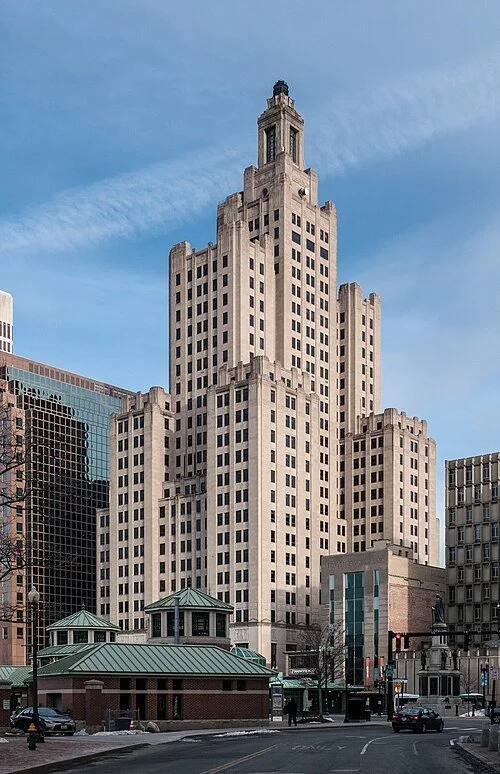
Industrial Trust Building, aka “Superman Building,’’ in downtown Providence. It’s been empty since 2013.
Tom Courage, a retired partner at the Providence-based law firm of Hinckley Allen, sent us this.
Law firms used to be quiet places in the summer. In many places the courts shut down during the summer, or at least slowed their pace to a crawl.
At my firm, young lawyers could only take vacations during the summer. Many offices shut down when the temperature exceeded a certain level.
Hinckley Allen had a legendary senior litigation partner named Matthew Goering. About half of the firm stories during my tenure were about Mr. Goering, who combined gruffness with an absurdly stilted Victorian manner of speech.
We also had a young litigation attorney, Thomas Gidley (who grew into legend, but was still a mortal person at the time of the events described here). Gidley, a graduate of Dartmouth College and Yale Law School, was one of the most literate attorneys I ever met, able to quote and draw on the wisdom of Chaucer, Yeats and everyone in between at will, and on any subject.
This was complemented by a dark sense of humor and redneck political views, which he displayed openly and with undisguised relish. This went along with being a conspicuously provocative Yankee fan in the midst of Red Sox Nation. You could not be around Gidley for very long without witnessing his reverence for Ronald Reagan and Reggie Jackson, his twin deities.
In short, Gidley was a fun person to be around. (Ed. note: this is actually true.)
Shortly after Gidley’s arrival at the firm, in the late 1960’s, Providence was afflicted by a cycle reminiscent of the plagues of Egypt, except with Praying Mantises instead of locusts. The windows were kept open, and Praying Mantises happily body surfed on the breezes through our offices in the Superman Building.
At the end of the work day, Gidley had just made his way uphill through the sweltering air to his modest quarters on the East Side when his phone rang. Worse, it was Mr. Goering. Mr. Goering’s voice needed no personal introduction, and never received one.
“Are you inextricably occupied?” was the terrifying growl transmitted over the telephone wires, words from which no deliverance would be forthcoming. In short order, Gidley found himself occupied in Mr. Goering’s living room, in the presence of Mr. Goering, Mr. Goering’s pet bulldog, and a small cardboard box held by Mr. Goering.
It is the box that requires an explanation, but this story cannot be told without first taking due note of Mr. Goering’s dog. Everyone knows the meme about owners looking like their dogs; what makes this story unique is the broad consensus that, in this case, it was Mr. Goering who looked like that first.
Okay, the box. The point of the box was that it was the perfect size for incarcerating Praying Mantises.
Your author must apologize for the reader’s justifiable impatience. Every story has its salient facts. The problem with this story is that these facts cannot all be told first. So let me lay it out in what might be seen in retrospect as a coherent sequence. Salient fact #1: Mr Goering’s wife took justifiable pride in her rose garden. Salient fact #2: the same weather conditions that caused a plague of Praying Mantises also caused a plague of Japanese Beetles. Salient fact #3: Japanese Beetles eat roses. Salient fact #4: Praying Mantises eat Japanese Beetles.
Your author is visualizing that the perceptive reader has processed the salient facts, and that the story is already taking shape in the reader’s mind.
And, indeed, the next morning found the young Dartmouth and Yale Law School graduate (in his neatly pressed blue suit) crawling on all fours among the parapets of the Superman Building, 400 feet above the traffic humming on the streets below, hunting down the Praying Mantises that would hopefully save Mrs. Goering’s roses. And stuffing them in the cardboard box so thoughtfully provided by Mr. Goering.
All of us (then) young lawyers agreed: It was pretty much a typical day in the life of a young Hinckley Allen lawyer.
Epilogue
There are those who suppose that life in a law firm is one of dreary monotony, every spark of human imagination snuffed out by ponderous Latin phrases. Your author himself can’t help but wonder what “real life” would have been like.
I’d rather be the tree

Squash flowers
From “Squash in Blossom,’’ by poet Robert Francis (1901-1987). He lived most of his life in Amherst, Mass., in the Connecticut River Valley, New England’s dominant agricultural area
“Let the squash be what it was doomed to be
By the old Gardener with the shrewd green thumb.
Let it expand and sprawl, defenceless, dumb.
But let me be the fiber-disciplined tree
“Whose leaf (with something to say in wind) is small,
Reduced to the ingenuity of a green splinter
Sharp to defy or fraternize with winter,
Or if not that, prepared in fall to fall.’’
A time for reflection

“Laid Back, Eastern Chimpanzee, Gombe Stream National Park, Tanzania’’(photo), by Tom Mangelsen, at Springfield (Mass.) Museums, in the ongoing show “Comedy Wildlife Photography Awards.’’
Philip K. Howard: A way to reboot America
This is a lightly edited version of a press release touting my old friend Philip K. Howard’s latest book. The New York-based lawyer, civic leader and photographer is chairman of the nonprofit reform organization Common Good.
In Saving Can-Do: How to Revive the Spirit of America civic philosopher Howard proposes a governing framework to revive America’s can-do culture — not by DOGE’s Indiscriminate Cuts, and nor by “Abundance”.
Saving Can-Do shows why the waste and paralysis of the red-tape state can be cured only by a new governing framework that empowers human responsibility on the spot. Letting Americans use common sense also holds the key to relieving populist resentment.
This brief book, to be published by Rodin Books on Sept. 23, responds to Americans’ desire for government that delivers results, not overbearing red tape.
“Washington needs to be rebooted, but neither party presents a vision to do this,” Howard notes.
“Republicans focus on cutting programs, not making them work. Democrats want to throw more money at a failing system. Aspiring to abundance is important, but escaping bureaucratic quicksand requires a radical shift in governing philosophy — replacing the red-tape compliance system with a framework activated by human responsibility.”
All societies periodically undergo a major shift in the social order. America is at one of those moments of change, and needs a coherent new overhaul vision to avoid the risks of extremism.
President Trump is swinging a wrecking ball at the status quo, but has no plan for how Washington will work better the day after DOGE. Democrats are in denial, waiting their turn to run a bloated government that Americans increasingly loathe.
Saving Can-Do offers a dramatically simpler governing vision: Replace red tape with responsibility. Let Americans use their judgment. Let other Americans hold them accountable for their results and their values.
“The geniuses in the 1960s tried to create a government better than people,” Howard says. “Just follow the rules. Or prove that your judgment about someone is fair. But how do you prove who has poor judgment, or doesn’t try hard? Bureaucracy makes people go brain dead—so focused on mindless compliance that they can’t solve the problem before them. Americans hate it.”
“We must scrap the red tape state,” argues Howard. “New leadership is not sufficient, because the new leaders will be shackled by rigid legal mandates. Trying to prune the red tape still leaves a jungle of other mandates.’’
“What’s required is a multi-year effort to replace command-and-control bureaucracies with simpler codes that delineate the authority to make tradeoff judgments. The idea is not radical, but traditional— it’s the operating philosophy of the U.S. Constitution. As America approaches the 250th anniversary of the revolution, it’s time to reclaim the magic of America’s unique can-do culture.”
For more information, please contact Henry Miller at hmiller@highimpactpartnering.com.
SELECTED PRAISE FOR PHILIP HOWARD’S PREVIOUS BOOKS
Everyday Freedom, Rodin Books, 2024
“Everyday Freedom offers a master class in consequences of lost agency. Agency not only promotes freedom, but its deprivation through policies and regulations saps civil vitality. Politicians’ inattentiveness to the problem stokes alienation and populism. Re-empowering individuals can produce a can-do, let ‘er rip economy of opportunity and flourishing. We’ve corrected such ‘system failure’ before, and Howard provides a roadmap for doing so again. The book is a must read for any student of what ails this society—that is, all of us.”
— Glenn Hubbard, Russell L. Carson Professor of Economics and Finance, Columbia University, and former chairman of the White House Council of Economic Advisers.
Not Accountable, Rodin Books, 2023
“I love cities and want them to thrive. Philip Howard shows a major reason why American cities struggle, and why they fail so many of their citizens: public employee unions prevent accountability, efficiency, and reform.
“Howard’s novel insight: Their power is not only unconscionable, for its harm to the public good; it might also be unconstitutional.”
— Jonathan Haidt, Thomas Cooley Professor of Ethical Leadership at New York University’s Stern School of Business, author of The Righteous Mind and co-author of The Coddling of the American Mind.
Try Common Sense, W. W. Norton, 2019
“A thunderous little book.”
— Gillian Tett, Financial Times
The Rule of Nobody, W. W. Norton, 2014
“Philip Howard offers a startlingly fresh slant on what is holding America back. No one is free to make choices, including, especially, government officials. Regulatory law has become a nearly impenetrable web of detailed prohibitions and specifications. Everyone is hamstrung. Dense regulation discourages individuals, communities, and companies from taking new initiatives. It also prevents government officials from making the case by case judgment needed for effective regulatory oversight.”
— Edmund S. Phelps, winner of the 2006 Nobel Prize in Economics
Life Without Lawyers, W. W. Norton, 2009
“Philip Howard’s Life Without Lawyers hits the nail on the head -– incoherent legalities stultify necessary change and frustrate attempts to use common sense in solving the problems that face our country. This is a real wake-up call from one of America’s finest public minds.”
—Bill Bradley, former U.S. senator
The Collapse of the Common Good, Ballantine Books, 2007
“Philip K. Howard’s book rings true. Teachers have such a hard time being themselves, dragging around the millstone of bureaucracy. Will all our well-intentioned efforts to regulate and manage our way to social welfare backfire, creating a society where people aren’t free to exercise their own judgment and good will?”
— Wendy Kopp, founder and president of Teach for America
The Death of Common Sense, Random House, 1995
“A brilliant diagnosis … forceful, trenchant, and eloquent.”
— Arthur M. Schlesinger Jr., Pulitzer Prize-winning historian.
Can we import power from Nova Scotia wind farms?

Some have suggested laying an underwater cable to send power from wind farms off Nova Scotia to southern New England.
Adapted from Robert Whitcomb’s “Digital Diary,’’ in GoLocal24.com.
Given local opposition by some to current and proposed wind-farm projects off southern New England and the Trump administration’s dislike of wind-power projects, and, indeed, of “green energy” in general, it’s perhaps not surprising that Massachusetts officials are sounding out Canada about getting power from planned offshore wind projects around Nova Scotia.
Of course, this would pose such challenges as the need to install extra transmission capacity to bring the power to southern New England and would undermine hopes for jobs in construction and maintenance for offshore wind projects in our region. And building a transmission line on land could face the sort of pushback from powerful groups and localities that has long delayed such projects as getting more hydroelectricity from Quebec into New England.
Of course, laying a mostly underwater line would be possible but would present problems, too, perhaps including complaints from fishermen.
And would Trump seek a way to put a tariff on that electricity?
We should bear in mind that Trump’s gyrational tariffs and his threats to take over what had been such a friendly ally have created long-term distrust and animosity there toward our crazy country, which over time will do considerable economic and geopolitical damage to the United States.
Meanwhile, visits by Canadians to New England, a region our northern neighbors have long favored, continue to fall because of Trump policies.
New ancient art

“Face First” (mosaic), by Pat McChristian, in the show “New England Mosaic Society: Ten Years on the Cutting Edge,’’ at the Art Complex Museum, Duxbury, Mass., opening Aug. 17.
The museum says:
“Mosaics as an art form is constantly stretching and expanding to be used in endlessly different ways. This exhibition features work made from multitudes of materials, used in unexpected and compelling ways, which completely relate to the current world and circumstances.’’
Llewellyn King: A way forward for PBS from genteel poverty

Studios of WGBH-TV, on Guest Street in Boston (with “digital mural" LED screen). The now PBS affiliate, which opened in 1955, is one of the oldest and best endowed public-television stations, and the site of much programing used by PBS.
The station's call letters refer to Great Blue Hill, in Milton, the highest point in the inner Greater Boston area, at 635 feet. The top of the hill served as the original location of WGBH-TV's transmitter facility. The transmitter for WGBH radio, a major NPR affiliate, continues to operate to this day.
WEST WARWICK, R.I.
Over the years, I have often been critical of the Public Broadcasting Service. That in spite of the fact that for 28 years, I have produced and hosted a program, White House Chronicle, which is carried by many PBS stations.
It is an independent program for which I find all the funding and decide its direction, content and staffing.
My argument with PBS — brought to mind by the administration’s canceling of $1.1 billion in funding for it and National Public Radio — is that it is too cautious, that it is consciously or by default lagging rather than leading.
Television needs creativity, change and excitement. Old programs, carefully curated travel, and cooking shows don’t really don’t cut it. News and public-affairs shows are not enough. Cable does them 24/7.
My co-host on White House Chronicle, Adam Clayton Powell III, a savant of public broadcasting, having held executive positions at NPR and PBS, assures us that they aren’t going away, although some stations will fail.
I believe that PBS has often been too careful because of the money, which has been dribbled out by the Corporation for Public Broadcasting. Some conservatives have been after PBS since its launch.
It is reasonable to look to the British Broadcasting Corp. when discussing PBS because the BBC is the source of so much of the programming that is carried by PBS — although not all the British programming is from the BBC. Two of the most successful imports were from the U.K. — Upstairs, Downstairs, which aired in the 1970s, and, more recently, Downton Abbey — were developed by British commercial television, not by the BBC.
Even so, the BBC is a force that has played a major role in shaping state broadcasters in many countries. At its best, it is formidable in news, in drama and in creativity. It is also said to be left-of-center and woke. Both of these are things PBS is accused of, but I have never found bias in the news products. What I have found is a kind of genteel poverty.
I once asked the head of a major PBS station why it didn’t do more original American drama. “It would cost too much,” was the response in a flash. Yet, there are local theater companies aplenty who would love to craft something for PBS if they were invited.
Sometimes the idea is more important than the money. Get that right, and PBS will have something it can sell around the world. It should be an on-ramp for talent.
Maybe, stirred by its newly induced poverty, PBS can lead the television world into a new business paradigm.
First, of course, take advertising and don’t be coy about it, as Masterpiece Theater is about Viking cruises. Take the advertising.
Second, see what is happening across the television firmament, where more TV is now viewed on YouTube than on TV sets. This happens at a time of the viewer’s choosing. PBS needs to jump on this and create a pay-per-view paradigm so that when it has a big show, as it did with Ken Burns’ Civil War years ago, it can prosper, as well as selling the show around the globe.
PBS is a confederation of stations, each one independent but tethered to PBS in Washington, which provides what is known as the hard feed. These are programs pre-approved for central distribution by PBS. Independent producers aren’t acknowledged on this, nor do they get listed as being PBS programs.
I remember how I had heard that WHUT, Howard University’s television station, was open to new programs. So I took a pilot over to WHUT. One young woman said “yes” and a program was born.
PBS needs to open its doors to new talent, new shows and uses of new technologies. Leading the pack in broadcasting innovation would be the best revenge. New money will follow.
NPR is a different story. Its product is successful. But it needs to be open to new funding, including much better acknowledged corporate funding. If Google or some other cash-laden entity wants to underwrite a day of broadcasting, let it. Don’t give it the editor’s chair, just a seat in accounting.
On X: @llewellynking2
Bluesky: @llewellynking.bsky.social
Subscribe to Llewellyn King's File on Substack
Llewellyn King is executive producer and host of White House Chronicle, on PBS. He’s based in Rhode Island.
xxx
Tom Lehrer —The great mid-century singing songwriter/ satirist

Tom Lehrer performing in Copenhagen in 1967.
Tom Lehrer, mathematician, satirical songwriter and performer, died July 26 in Cambridge, Mass., at 97.
In the ‘50’s and ‘60’s he was a darling of upper-middle class college-educated people, especially in the Northeast, though his fame spread beyond them.
Thee are indirect references to Harvard and Yale in this song, “Bright College Days’’. His this link to hear him sing it.
And here’s his most famous record album.
Bright college days, oh, carefree days that fly
To thee we sing with our glasses raised on high
Let's drink a toast as each of us recalls
Ivy-covered professors in ivy-covered halls
Turn on the spigot
Pour the beer and swig it
And gaudeamus igit-ur
Here's to parties we tossed
To the games that we lost
(We shall claim that we won them some day)
To the girls young and sweet
To the spacious back seat
Of our roommate's beat up Chevrolet
To the beer and Benzedrine
To the way that the dean
Tried so hard to be pals with us all
To excuses we fibbed
To the papers we cribbed
From the genius who lived down the hall
To the tables down at Mory's
(Wherever that may be)
Let us drink a toast to all we love the best
We will sleep through all the lectures
And cheat on the exams
And we'll pass, and be forgotten with the rest
Oh, soon we'll be out amid the cold world's strife
Soon we'll be sliding down the razor blade of life
But as we go our sordid sep'rate ways
We shall ne'er forget thee, thou golden college days
Hearts full of youth
Hearts full of truth
Six parts gin to one part vermouth
We all need more escape routes these days

“Escape Routes” (acrylic on canvas), by Marcia Santore, in her show “The Long View Paintings,’’ at the Belknap Mill Museum Riverside Gallery, Laconia, N.H., opening Sept. 2
The gallery explains:
“This exhibition draws on half-remembered, dreamed, or imagined places created by seen or unseen openings, indeterminate interior and exterior spaces, the questions raised of who might inhabit those spaces or what lies over the horizon, and the potential to tell or conceal multiple, unfolding stories.’’

Jules Roscoe: Alleged drug dealers attack 2 Globe journalists and 2 other people at infamous Boston intersection

Addicts near “Mass and Cass,’ in Boston.
From The Boston Guardian
(Robert Whitcomb, editor of New England Diary, is chairman of The Boston Guardian board.)
Two South End residents and two Boston Globe staff members were attacked on the street last week by a group of alleged drug dealers after taking photos of open-air drug use.
The attack marks an escalation in the continuing health crisis at the intersection of Massachusetts Avenue and Melnea Cass Boulevard, colloquially Mass and Cass, which is widely considered the epicenter of Boston’s drug problem.
The two residents were touring the area around Rosie’s Place on Harrison Avenue on July 16 with Globe reporter Niki Griswold and photographer Barry Chin, to document instances of open-air drug use. It was a humid 93-degree day, and the city had just conducted a sweep to disperse groups of drug users from Mass and Cass.
“The city had swept the main intersection 15 minutes before [the reporter] got there,” one of the residents said. “Seems to keep happening before reporters show up.”
When Chin started to take photos, the residents said, a drug user approached them and started threatening them by swinging a “cat’s paw” weapon, a metal rod with nails sticking out of it.
They managed to deter this person, but as the Globe staffers continued taking photos, the person got the attention of some others whom the residents identified as dealers.
“I don’t know for a fact that he’s a dealer,” the second resident said. Both residents were granted anonymity for their safety. “But it is my observation that many of the dealers ride on blue bikes from encampment to encampment. He was much more threatening. He wanted to take the camera, wanted us to delete the pictures.”
To protect the photographer, the first resident started to usher the group out of the area, which got the alleged dealer’s attention.
“He starts going toe-to-toe with me, saying, ‘I’m going to ruin your life,’” the first resident said. “Then he reaches for his pocket, and I think he’s going for a knife or a gun or something, and I’ve got one second here.”
This resident has some self-defense training, so he managed to flip the assailant onto the ground, stunning him and the other dealers long enough for the group to run towards the nearby Boston Water and Sewer commission.
“I started banging on the door, grabbing every single piece of glass, trying to find something open, screaming, trying to draw attention,” the resident said. When the group got in, the alleged dealers stopped pursuing them, allowing them to call the police. The second resident had to be escorted home to ensure they weren’t followed.
“I’m glad no one was hurt,” the second resident said. “The bigger thing was that the city still hasn't cleaned this up. They try to hide it, but it’s still dangerous. The reporter was trying to figure out how dangerous it was, and it was not our intention to give them such accurate firsthand knowledge.”
Since the attack, the residents have been contacted by the Suffolk County District Attorney’s office and the detective assigned to the case, but have not received outreach from Mayor Wu or her staff. As of July 20, the two residents had not yet been given a copy of the police report.
Mass and Cass has been a sore point for city government for over a decade, but Michelle Wu’s administration has continually made claims that it’s improving thanks to such initiatives as shelter construction and voluntary treatment options. Residents, however, say that such city measures are not effective.
“It’s not improving,” City Councilor Ed Flynn, who reached out to both residents after the attack, said in a phone call. “It is a public health and public safety crisis, and it’s impacting so many neighborhoods throughout Boston. The problem has spread significantly. There is an escalation of violence.”
One of the residents shared a catalogue of photo and video evidence he had taken from their home windows with The Boston Guardian, including photos of active drug use, cash changing hands, and people carrying what look like firearms.
“The one team doing the job is [the Coordinated Response Team],” the first resident said. “I have only good things to say about Kelly Young’s team. There’s only five of them and they do miracles. But other than that, everyone’s patting us on the head saying they’re making it better, and you’re not. We’re getting attacked. We’re getting hurt, we’re documenting it. You’re lying to us.”
Cubism in Cushing

“Forest Geometries Cube (Earth),’’ by Gina Siepel, at Langlais Art Preserve, Cushing, Maine.
This is a site-specific installation by interdisciplinary artist Siepel on the preserve’s 2.3-mile woodland trail.

Olson House, in Cushing, in 1995
Photo by lcm1863
This description is edited from Wikipedia:
The Olson House was depicted in Andrew Wyeth's famous 1948 painting Christina's World, which was used as Dahlia Gillespie's house in the horror video game series Silent Hill, and inspired the farmer's house in the 1978 film Days of Heaven.