
Democratizing investing (a bit)

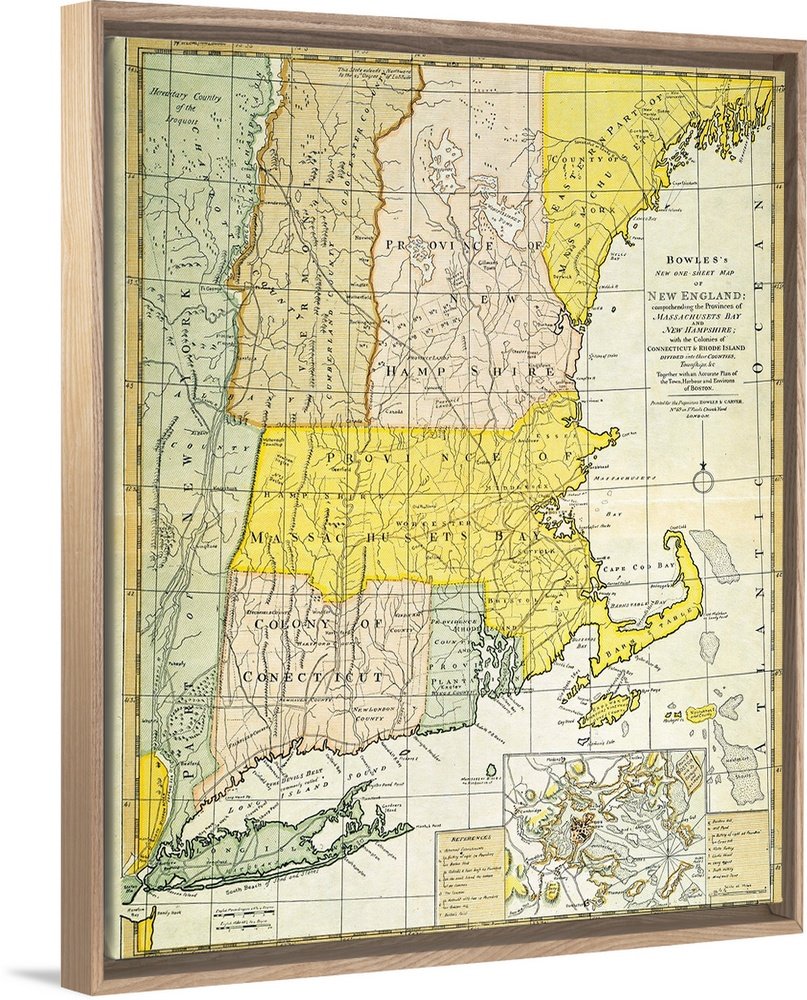
Watching the stock-price ticker tape in 1918.
“Many people think of Boston as the birthplace of democracy in our country. They may not realize it is also the birthplace {in 1924} of the democratization of investing. It was there… that three stock salesmen {Sherman Adams, Charles H. Learoyd and Ashton L. Carr} created the first mutual fund and opened up what was once an exclusive province of the affluent to just about everyone.’’
— Anne Kates Smith, executive editor, Kiplinger’s Personal Finance
From Wikipedia:
“The first mutual fund in the United States, and one of the earliest globally, was the Massachusetts Investors Trust (MIT), established in 1924. This fund paved the way for the modern mutual fund industry by offering a way for individual investors to pool their resources and invest in a diversified portfolio of securities.’’
‘Charmingly incorrect’

“Bound” (mixed media on canvas), by Skowhegan, Maine, artist Ryan Kohler at Portland Art Gallery.
Mr. Kohler writes in his artist’s statement:
“Charmingly incorrect is the result that I typically shoot for, rather than literal and precise. There comes a point where too much detail and obvious overstatement becomes detrimental to the power of a painting. Letting edges blur and being ambiguous with brushwork usually leads to more interesting results. This is something I am constantly thinking about while painting and I try to walk away from them when they are at an evocative and unpredictable state.’’
Before they learn what it’s like
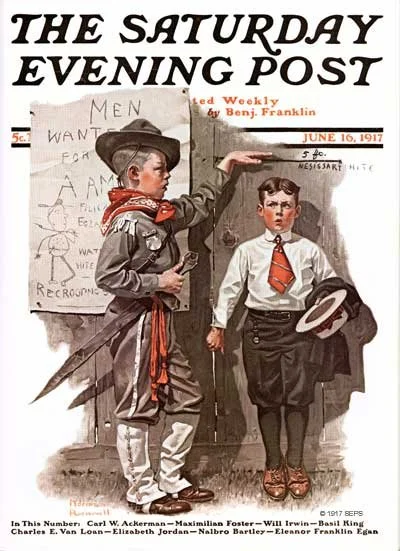
“The Clubhouse Recuitment,’’ by Norman Rockwell, done in the first months of American participation in World War I.
Chris Powell: Big questions about growing poverty in Conn.

MANCHESTER, Conn.
Clamor at the Hartford Capitol for more money for various social programs suggests a comprehensive problem that has yet to be recognized by anyone in authority.
Many state legislators are supporting more state tax credits to help households support their children -- tax credits not just for low-income households but also for households with incomes as high as $250,000 a year. Such tax credits -- payable in cash if households don't have enough income-tax liability to offset them -- are a more sophisticated form of welfare.
More money is being sought to cover the rising numbers of people requiring state Medicaid insurance and to raise doctor payment rates that haven't been substantially adjusted for inflation for 17 years. About 22 percent of Connecticut's population is covered by Medicaid and about 40 percent of births in the state are to women on Medicaid.
State government recently established a “baby bonds" program for children born on Medicaid. The program assumes that without “baby bonds" the children will be raised in poverty and remain poor when they reach adulthood. So now state government is appropriating $3,200 for each child born on Medicaid and investing the money in the expectation of giving such children $11,000 or more when they reach 18.
Many legislators and Gov. Ned Lamont support a vast expansion of state-funded day care for households that can't afford it and even for households that can. The other week rallies were held throughout the state in support of state government subsidies for day care. As traffic went by advocates waved signs reading “Honk if you want affordable child care." That is, “Honk if you'd like others to pay for your kids."
Two months ago the General Assembly and Governor Lamont enacted an emergency appropriation of $40 million for schools to cover the rising numbers and costs of students needing “special education," many of whom are victims of neglect at home.
More money is being sought to help food banks assist the rising numbers of households that can't afford to feed themselves. The other week Connecticut Foodshare said food insecurity in the state increased 10 percent in the last year, with more than a half million people not sure of where their next meal is coming from.
The COVID-19 epidemic is long over but chronic absenteeism in the state's schools remains high. In New Haven's high schools it has reached 50 percent.
All these developments proclaim that poverty is overtaking Connecticut, which still likes to think of itself as a prosperous state.
While elected officials and social-service groups recognize the increasing needs, they aren't linking them and wondering about the underlying causes. No one in authority is asking: Where are all these people who can't support themselves and their children coming from?
The sharp rise of inflation in housing, food and energy prices during the Biden administration is a big factor. But poverty was worsening in Connecticut long before the inflation of the Biden years -- along with open borders and transgenderism -- caused voters to repudiate the administration in last November's election.
Of course elected officials must be sensitive to the growing inability of people to support themselves. But throwing subsidies on top of subsidies doesn't address the causes of impoverishment. Indeed, it may worsen inflation.
Any inquiry into the worsening impoverishment should ask questions that go far beyond inflation and additional subsidies.
For example, how does a welfare system that for decades has been destroying the family, robbing children of fathers in their home, help them grow up?
How are children helped by social promotion in Connecticut's schools, which now happily graduate illiterates and near-illiterates in the belief that self-esteem is more important than learning enough to become self-sufficient?
How is the cost of living reduced by letting municipal zoning impede development of less-expensive housing?
If, as the clamor at the Capitol suggests, Connecticut is falling apart under the weight of social disintegration, people in authority should summon the courage to acknowledge it and pursue its causes and not just keep trying to remediate its effects.
Chris Powell has written about Connecticut government and politics for many years (CPowell@cox.net).
Cory Mitchell: Four stories to think about regarding foreign students at Harvard
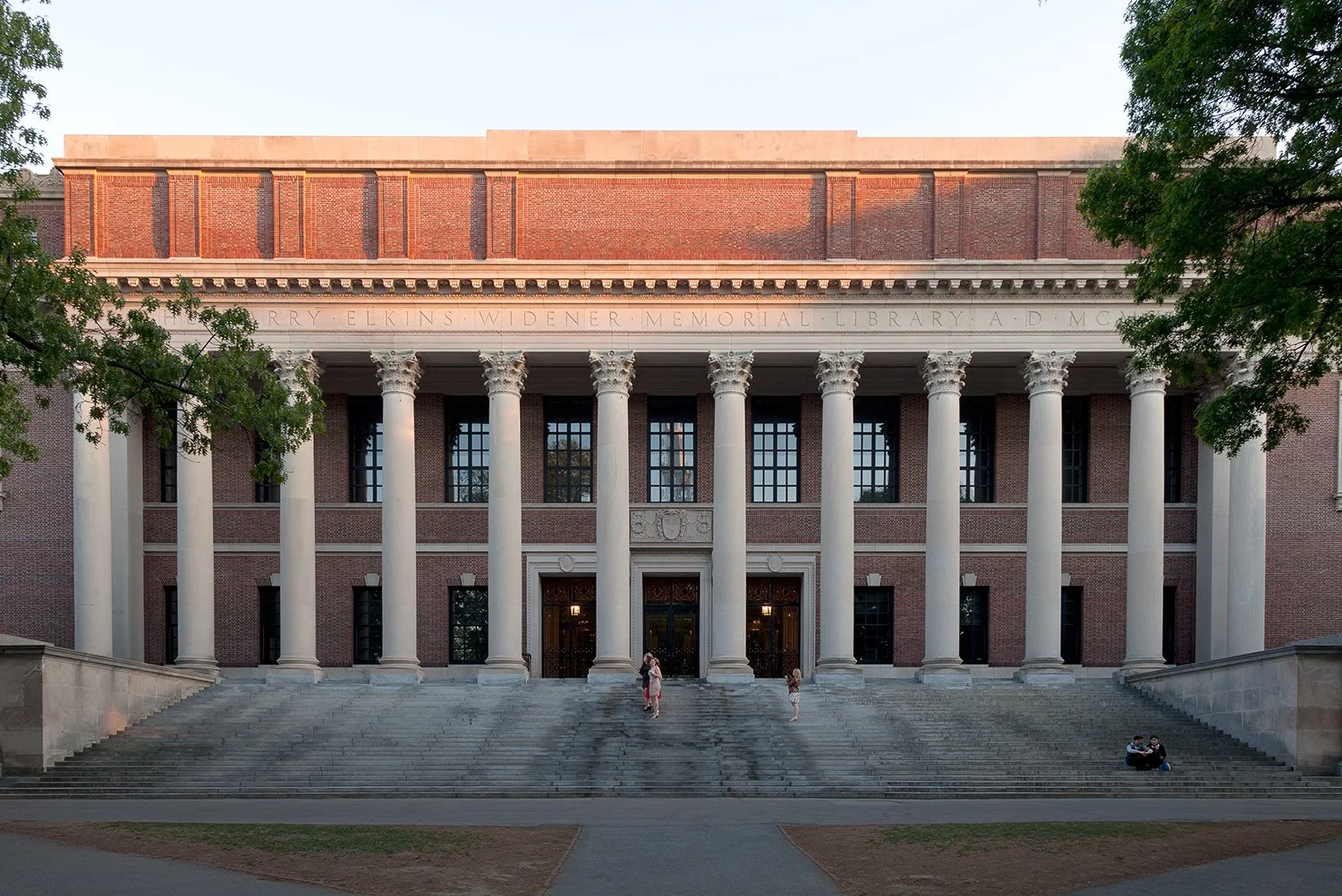
The Widener Library at Harvard, the flagship of the largest academic library system in the world, with more than 20 million physical and digital items.
From The Conversation (except for image above)
Corey Mitchell is The Conversation’s education editor
A federal judge in Boston on May 23, 2025, temporarily blocked a Trump administration order that would have revoked Harvard University’s authorization to enroll international students.
The directive from the U.S. Department of Homeland Security and resulting lawsuit from Harvard have escalated the ongoing conflict between the Trump administration and the Ivy League institution.
It’s also the latest step in a White House campaign to ramp up vetting and screening of foreign nationals, including students.
Homeland Security officials accused Harvard of creating a hostile campus climate by accommodating “anti-American” and “pro-terrorist agitators.” The accusation stems from the university’s alleged support for certain political groups and their activities on campus.
In early April, the Trump administration terminated the immigration statuses of thousands of international students listed in a government database, the Student and Exchange Visitor Information System. The database includes country of citizenship, which U.S. school they attend and what they study.
Barring Harvard from enrolling international students could have significant implications for the campus’s climate and the local economy. International students account for 27% of the university’s enrollment.
Here are four stories from The Conversation’s archive about the Trump administration’s battle with Harvard and the economic impact of international students.
1. A target on Harvard
This isn’t the first time the Trump administration has targeted the university.
The White House has threatened to end the university’s tax-exempt status, and some media outlets have reported that the Internal Revenue Service is taking steps in that direction.
But it is illegal to revoke an entity’s tax-emempt status “on a whim,” according to Philip Hackney, a University of Pittsburgh law professor, and Brian Mittendorf, an accounting professor at Ohio State University.
“Before the IRS can do that, tax law requires that it first audit that charity,” they wrote. “And it’s illegal for U.S. presidents or other officials to force the IRS to conduct an audit or stop one that’s already begun.”
Several U.S. senators, all Democrats, have urged the IRS inspector general to see whether the IRS has begun auditing Harvard or any nonprofits in response to the administration’s requests or whether Trump has violated any laws with his pressure campaign.
Hackney and Mittendorf wrote that the Trump administration’s moves are part of a larger push to exert control over Harvard, including its efforts to increase its diversity and its response to claims of discrimination on campus.
University of Michigan students on campus on April 3, 2025, in Ann Arbor, Mich. Bill Pugliano/Getty Images
2. International students help keep ‘America First’
The U.S. has long been the global leader in attracting international students. But competition for these students is increasing as other countries vie to attract the scholars.
In a recent story for The Conversation, David L. Di Maria, vice provost for global engagement at the University of Maryland, Baltimore County, wrote that stepped-up screening and vetting of students could make the U.S. a less attractive study destination.
Di Maria wrote that such efforts could hamper the Trump administration’s ability to achieve its “America First” priorities related to the economy, science and technology, and national security.
Trump administration officials have emphasized the importance of recruiting top global talent. And Trump has said that international students who graduate from U.S. colleges should be awarded a green card with their degree.
Research shows that international students launch successful startups at a rate that is eight to nine times higher than their U.S.-born peers. Roughly 25% of billion-dollar companies in the U.S. were founded by former international students, Di Maria noted.
3. A boost to local economies
Indeed, international students have a tremendous economic impact on local communities.
If these global scholars stay home or go elsewhere, that’s bad economic news for cities and towns across the United States, wrote Barnet Sherman, a professor of multinational finance and trade at Boston University.
With the money they spend on tuition, food, housing and other other items, international students pump money into the local economy, but there are additional benefits.
On average, a new job is created for every three international students enrolled in a U.S. college or university. In the 2023-24 academic year, about 378,175 jobs were created, Sherman wrote.
In Greater Boston, where Harvard is located, there are about 63,000 international students who contribute to the economy. The gains are huge – about US$3 billion.
4. Rising number of international students
The rising number of foreign students studying in the U.S. has long led to concerns about U.S. students being displaced by international peers.
The unease is often fueled by the assumption that financial interests are driving the trend, Cynthia Miller-Idriss of American University and Bernhard Streitwieser of George Washington University wrote in a 2015 story for The Conversation.
A common claim, they wrote, is the flawed assumption that “cash-strapped public universities” aggressively recruit more affluent students from abroad who can afford to pay rising tuition costs. The pair wrote that, historically, shifting demographics on college campuses result from social and economic changes.
In today’s context, Miller-Idriss and Streitwieser maintain that the argument that colleges prioritize international students fails to account for the global role of U.S. universities, which help support national security, foster international development projects and accelerate the pace of globalization.
Read more: Foreign students not a threat, but an advantage
This story is a roundup of articles from The Conversation’s archives.
If only we could molt

“Second Feet (Molting)” (ceramic, glaze, shells, rock), by Elizabeth Atterbury, in her show “Leaf Litter,’’ at the Center for Maine Contemporary Art, through Oct. 31.
— Photo: Boru O’Brien O’Connell.
Beech trees under attack

Excerpted and edited from an ecoRI News article.
“NEWPORT, R.I. — There are at least 504 beech trees in varieties large and small, native and foreign, dotting the private and public properties in this city.
“‘Now, this is probably just a fraction of what actually exists in Newport,’ said Joe Verstandig, Newport Tree Conservancy’s living-collection manager….
“Speaking in front of a crowd of about 150 people in person and about 200 more on Zoom, Verstandig went on to say the largest individual beech tree in the Newport Arboretum collection is a European beech that sits next to the Edward King House; it’s 80 inches in diameter.’’
“‘Unfortunately, that tree is in a great state of decline,’ he added.’’
“Verstandig was referring to beech leaf disease, a nematode that has infested American and European beech trees in the northeastern United States for years now, killing a huge number of trees over the past several years….’’
Then they take over

Painting by Joan Baldwin in her show “Hallucinations’’ at Kingston Gallery, Boston, June 5-30.
The gallery says:
“While wandering in Cape Cod, Joan Baldwin is always on the lookout for a fresh approach to her environment, observing the plants and animals along the saltwater shores. The images that attract her attention become a springboard for the ideas in her paintings. In order to express her fantasies, she personifies what she sees, often putting herself into the role of the painting’s main subject. Later, when she’s working in her studio, she allows herself to go beyond the reality of what she visually observed, the branches, grasses, insects and animals, and lets the happenings in these compositions take on a life of their own.’’
Llewellyn King: When elderly leaders stay too long

Winston Churchill (1874-1965) with Queen Elizabeth II, Prince Charles and Princess Anne on Feb. 23, 1953, during his second stretch as prime minister.
WEST WARWICK, R.I.
Old age is a thorny issue. I can attest to that. As someone said to my wife about me, “He’s got age on him.” Indubitably.
The problem, as now in the venomously debated case of former President Joe Biden, is how do you measure mental deterioration? When do you take away an individual’s right to serve? When do you restrict choice and freedom by the calendar and not by some other measure? Can you oblige the old to pass arbitrary competency tests for everything from driving to running a country?
Part of the answer in the Biden case, and in many things, is a vigorous and fearless press. And, contrary to the current allegations that Biden’s health decline was hidden by the press, nothing was hidden except by those close to him.
Anyone who watched Biden on television or heard him speak knew he was having problems. Months before the last election, I wrote a column about it. And so did others. Nothing was hidden from anyone except the full severity of the decline might have been buried by Biden’s family and his White House staff.
But supposing they had felt strongly that the 46th president should step aside, how would that have been managed if Biden had refused their entreaties? How do we know what his wife, Jill, said to him in private? Biden had reason to go on to protect his son, Hunter, who was the victim of considerable political animus.
Probably, most of all, Biden wanted to finish what he saw as the business he had started: promoting people he felt had been unfairly left out. The symbols of that were Vice President Kamala Harris and Associate Justice Ketanji Brown Jackson.
Before Biden ran for president, I had a chat with him at a reception by a brain cancer support group in Washington. I had interviewed some of the doctors involved on television, and I went away thinking how likable Biden was and what a pity he was too old to run for president.
But he did run, and the Biden presidency was a success, measured by the economy, peace and optimism about the future. By the end, it might have been running on inertia. Only those close to Biden know how much was staff work, and what was directed by Biden.
Biden wasn’t the only man who had trouble at the end of a successful political career. So did a much greater man, a true figure of destiny: Winston Churchill.
The second Churchill administration was, as the late historian and philosopher Roger Scruton courageously pointed out, a disaster. The man who stepped into the prime minister’s role in 1951 wasn’t the great statesman who stepped into the same office in 1940, aged 65.
Ten momentous years had taken its toll. This was an old, forgetful man whose constant drinking was adding to his failing powers.
He would, as he had during the war, call the news desk at The Daily Express every night and inquire, “What’s the news?” During his second term as prime minister, it is reported that he was often confused and didn’t seem to know what day it was.
But he was Winston Churchill, the man who had saved Britain. And no one, no journalist on The Daily Express, was going to whisper that Churchill was failing.
Lord Beaverbrook, the proprietor of The Daily Express, and close friend and ally of Churchill, did tell the editor of the paper, Bob Edwards, “I’m dying from the legs down and Churchill is dying from the neck up.”
Many problems in Britain weren’t addressed by the prime minister and his government, and were to haunt Britain until Margaret Thatcher became prime minister in 1979. Foremost among these were a lack of any kind of immigration restrictions for people from the former empire, and trade union power that was allowed to grow unchecked.
The Churchill case is instructive: Had there been an age limit of 65 for prime ministers, as many companies have for their top executives, Churchill wouldn’t have been allowed to assume office when he was so needed in 1940.
Candor from loved ones may be the best defense against senility in leadership. After all, children do take the car keys from old and failing parents or should.
If you love what you do, is it right for society to force retirement? Noel Coward, the prolific British playwright, actor, songwritet and director, said, “Work is more fun than fun.” So, apparently, is high office.
Llewellyn King is executive producer and host of White House Chronicle, on PBS. His email is llewellynking1@gmail.com.
Electric Boat gets over $12.4 billion in contract modifications for Virginia Class submarines

Virginia Class submarine.

Electric Boat facility in Groton, Conn.
BDMillan photo
Edited from a New England Council report
The U.S. Navy has awarded the Electric Boat division of General Dynamics over $12.4 billion in contract modifications to build two new Virginia-class submarines. Authorized first in the fiscal 2024 defense budget, the award will not only help Electric Boat design, build and repair the nuclear submarines, but it will also be invested in improvements to the Groton, Conn., shipyard to help boost workforce-support and productivity programs.
“Over the past two years, we successfully worked with the Navy, Congress and the administration to secure funds that enable us to increase wages for the nuclear-powered vessel workforce and allow for significant additional investments in capacity, shipyard processes and systems,” said Mark Rayha, president of General Dynamics Electric Boat. “This contract modification validates the unique and important role submarines and submarine shipbuilders play in our national defense.”
Congressman Joe Courtney (D.-Conn.), ranking member of the House Seapower and Projection Forces Subcommittee, called the award a “welcomed development for our effort to hire and retain a highly-skilled shipyard workforce in southern New England.”
Natural art

“Morris Island Art, Chatham, Cape Cod,’’ by Bobby Baker
— Copyright Bobby Baker Fine Art
“At the beach, the time you enjoy wasting is not wasted.”
— T. S. Eliot (1888-1965)
Foreign and issue flags shouldn’t be displayed at government buildings

Palestine flag
Adapted from Robert Whitcomb’s “Digital Diary,’’ in GoLocal24.com
Palestinian flags have recently been displayed in the Providence City Council chamber and over City Hall. The display of flags of foreign jurisdictions at such public buildings is utterly inappropriate. The only flags that belong in such a setting are the U.S., state and Providence flags. The councilors have enough important work to do for their constituents without getting into international controversies.
The Palestinian flag was particularly inappropriate given that the U.S. doesn’t recognize the existence of a country called Palestine. Flying the flag was a political statement, apparently led by City Council President Rachel Miller. Domestic-issue flags, such as LGBTQ Pride flags, are also inappropriate at government buildings.
In the next hurricane

“Rocking the Boat” (oil on canvas), by Sarah L. Fisher, in the show “Flights of Fancy,’’ at Maine Art Gallery, Wiscasset, Maine.
- Courtesy of Maine Farmland Trust
Exploring ‘mythologies, societies, states of being’

“Weightless” (stoneware, encaustic, pigment), by Massachusetts-and-Maine-based artist (including interior design) Sarah Springer.

Her artist’s statement includes this:
“In the metamorphic alchemy of clay, encaustic wax, and found materials, my work explores a diverse array of human mythologies, societies, and states of being.’’
When the Feds built nice housing for working-class people

Plans and elevations of typical U.S. Housing Corporation housing.
From The Conversation, except for image above
Eran Ben-Joseph is a professor of landscape architecture and urban planning at the Massachusetts Institute of Technology (MIT), in Cambridge, Mass.
He does not work for, consult, own shares in or receive funding from any company or organization that would benefit from this article, and has disclosed no relevant affiliations beyond his academic appointment.
In 1918, as World War I intensified overseas, the U.S. government embarked on a radical experiment: It quietly became the nation’s largest housing developer, designing and constructing more than 80 new communities across 26 states in just two years.
These weren’t hastily erected barracks or rows of identical homes. They were thoughtfully designed neighborhoods, complete with parks, schools, shops and sewer systems.
In just two years, this federal initiative provided housing for almost 100,000 people.
Few Americans are aware that such an ambitious and comprehensive public housing effort ever took place. Many of the homes are still standing today.
But as an urban planning scholar, I believe that this brief historic moment – spearheaded by a shuttered agency called the United States Housing Corporation – offers a revealing lesson on what government-led planning can achieve during a time of national need.
Government mobilization
When the U.S. declared war against Germany in April 1917, federal authorities immediately realized that ship, vehicle and arms manufacturing would be at the heart of the war effort. To meet demand, there needed to be sufficient worker housing near shipyards, munitions plants and steel factories.
So on May 16, 1918, Congress authorized President Woodrow Wilson to provide housing and infrastructure for industrial workers vital to national defense. By July, it had appropriated $100 million – about $2.3 billion today – for the effort, with Secretary of Labor William B. Wilson tasked with overseeing it via the U.S. Housing Corporation.
Over the course of two years, the agency designed and planned over 80 housing projects. Some developments were small, consisting of a few dozen dwellings. Others approached the size of entire new towns.
For example, Cradock, near Norfolk, Va., was planned on a 310-acre site, with more than 800 detached homes developed on just 100 of those acres. In Dayton, Ohio, the agency created a 107-acre community that included 175 detached homes and a mix of over 600 semidetached homes and row houses, along with schools, shops, a community center and a park.
Designing ideal communities
Notably, the Housing Corporation was not simply committed to offering shelter.
Its architects, planners and engineers aimed to create communities that were not only functional but also livable and beautiful. They drew heavily from Britain’s late-19th century Garden City movement, a planning philosophy that emphasized low-density housing, the integration of open spaces and a balance between built and natural environments.
Importantly, instead of simply creating complexes of apartment units, akin to the public housing projects that most Americans associate with government-funded housing, the agency focused on the construction of single-family and small multifamily residential buildings that workers and their families could eventually own.
This approach reflected a belief by the policymakers that property ownership could strengthen community responsibility and social stability. During the war, the federal government rented these homes to workers at regulated rates designed to be fair, while covering maintenance costs. After the war, the government began selling the homes – often to the tenants living in them – through affordable installment plans that provided a practical path to ownership.
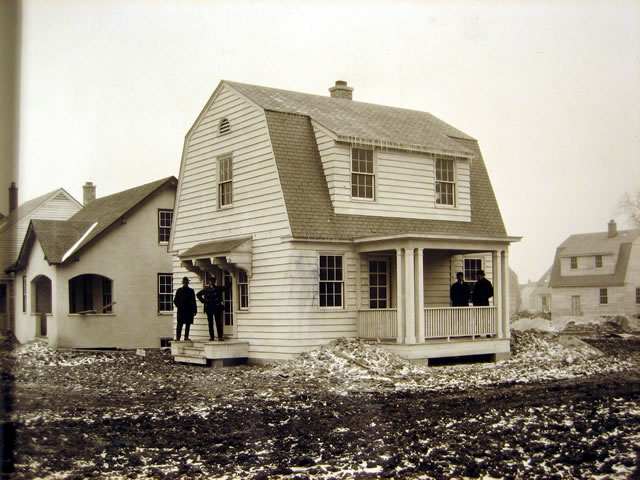
A single-family home in Davenport, Iowa, built by the U.S. Housing Corporation. National Archives
Though the scope of the Housing Corporation’s work was national, each planned community took into account regional growth and local architectural styles. Engineers often built streets that adapted to the natural landscape. They spaced houses apart to maximize light, air and privacy, with landscaped yards. No resident lived far from greenery.
In Quincy, Mass., for example, the agency built a 22-acre neighborhood with 236 homes designed mostly in a Colonial Revival style to serve the nearby Fore River Shipyard. The development was laid out to maximize views, green space and access to the waterfront, while maintaining density through compact street and lot design.
At Mare Island, Calif. developers located the housing site on a steep hillside near a naval base. Rather than flatten the land, designers worked with the slope, creating winding roads and terraced lots that preserved views and minimized erosion. The result was a 52-acre community with over 200 homes, many of which were designed in the Craftsman style. There was also a school, stores, parks and community centers.
Infrastructure and innovation
Alongside housing construction, the Housing Corporation invested in critical infrastructure. Engineers installed over 649,000 feet of modern sewer and water systems, ensuring that these new communities set a high standard for sanitation and public health.
Attention to detail extended inside the homes. Architects experimented with efficient interior layouts and space-saving furnishings, including foldaway beds and built-in kitchenettes. Some of these innovations came from private companies that saw the program as a platform to demonstrate new housing technologies.
One company, for example, designed fully furnished studio apartments with furniture that could be rotated or hidden, transforming a space from living room to bedroom to dining room throughout the day.
To manage the large scale of this effort, the agency developed and published a set of planning and design standards − the first of their kind in the United States. These manuals covered everything from block configurations and road widths to lighting fixtures and tree-planting guidelines.
The standards emphasized functionality, aesthetics and long-term livability.
Architects and planners who worked for the Housing Corporation carried these ideas into private practice, academia and housing initiatives. Many of the planning norms still used today, such as street hierarchies, lot setbacks and mixed-use zoning, were first tested in these wartime communities.
And many of the planners involved in experimental New Deal community projects, such as Greenbelt, Md., had worked for or alongside Housing Corporation designers and planners. Their influence is apparent in the layout and design of these communities.
A brief but lasting legacy
With the end of World War I, the political support for federal housing initiatives quickly waned. The Housing Corporation was dissolved by Congress, and many planned projects were never completed. Others were incorporated into existing towns and cities.
Yet, many of the neighborhoods built during this period still exist today, integrated in the fabric of the country’s cities and suburbs. Residents in places such as Aberdeen, Md.; Bremerton, Wash.; Bethlehem, Penn., Watertown, N.Y., and New Orleans may not even realize that many of the homes in their communities originated from a bold federal housing experiment.
These homes on Lawn Avenue in Quincy, Mass., in 2019 were built by the U.S. Housing Corporation. Google Street View
The Housing Corporation’s efforts, though brief, showed that large-scale public housing could be thoughtfully designed, community oriented and quickly executed. For a short time, in response to extraordinary circumstances, the U.S. government succeeded in building more than just houses. It constructed entire communities, demonstrating that government has a major role and can lead in finding appropriate, innovative solutions to complex challenges.
At a moment when the U.S. once again faces a housing crisis, the legacy of the U.S. Housing Corporation serves as a reminder that bold public action can meet urgent needs.
After black fly season?

“Mount Katahdin from the West Branch of the Penobscot” (1870) (oil on canvas), by Virgil Williams, in the current show “Some American Stories,’’ at the Colby College Museum of Art, Waterville, Maine.
— Photo: Peter Siegel, Pillar Digital Imaging LLC.
The show displays art from before the American Revolution to the present day.
Show-biz celebrities take over commencements

Adapted from Robert Whitcomb’s “Digital Diary,’’ in GoLocal 24.com
Many colleges and universities hire show-business and sports figures (and professional sports are part of show biz) much more than, say, scholars to give commencement addresses. I suppose this is to get more publicity to the schools, but it diverts attention from what you’d think would be the institutions’ main mission – the rigorous creation and teaching of knowledge.
My undergraduate alma mater, Dartmouth College, in Hanover, N.H., is a prime example of this obsession with celebrity culture. It has had the likes of Shonda Rimes, Connie Britton, Conan O’Brien, Jake Tapper and sainted tennis legend Roger Federer as recent commencement speakers. This year it will be Sandra Oh, who is, I am told, a famous Canadian-American actress but a mystery to me. But then, our MAGA Master owes his political success to being a “reality TV” star on the absurd but very popular-in-the-Heartland TV show The Apprentice.
One thinks yet again of Neil Postman’s classic book Amusing Ourselves to Death: Public Discourse in the Age of Show Business
The commencement speakers used to be mostly the likes of foreign or U.S. government leaders, diplomats, academics, including celebrated scholars and college presidents, statesmanlike corporate leaders, and philanthropists. Consider that the speaker in 1970, when I got my degree, was the classicist William Arrowsmith, who very briefly mentioned Vietnam. But higher culture doesn’t pack ‘em in.
Familiar scenes in a new light

“Armistad Pier, New London, Connecticut” (silver gelatin print), by William Earle Williams, in his show “Their Kindred Earth,’’ at the Florence Griswold Museum, Old Lyme, Conn., through June 22.
— Photo courtesy of Mr. Williams
The museum says:
“Williams’s poignant images make visible little-known sites significant to enslavement, emancipation, and African Americans’ contributions to Connecticut history and culture. The photos prompt viewers to consider familiar landscapes in a new light and to imagine, perhaps for the first time, what life was like for enslaved people in Connecticut 200 years ago.’’
Chris Powell: Hiding police misconduct; inappropriate flags at public buildings

MANCHESTER, Conn.
State government's retreat from accountability for its employees and municipal employees is continuing, as legislation that would conceal accusations of misconduct against police officers is working its way through the General Assembly without any critical reflection by legislators.
The bill, publicized by Connecticut Inside Investigator's Katherine Revello, was approved unanimously by the Senate and would prohibit the release of complaints of misconduct against officers prior to any formal adjudication of the complaints by police management.
Of course that's an invitation to police agencies to conceal all complaints of misconduct and delay formal adjudication of them.
Yes, there can be false or misleading complaints against officers, and maybe disclosure of such complaints will unfairly harm some officer's reputation someday. But the chances of that are small. News organizations aren't likely to publicize such complaints without doing some investigation themselves, and the local news business is withering away.
But police misconduct is always being covered up somewhere, Connecticut has a long record of it, going back to the murder of the Perkins brothers by four state troopers in Norwich in 1969, and chances that government will strive to conceal its mistakes and wrongdoing are always high, just as the chances that the state Board of Mediation and Arbitration will nullify any serious discipline for government employees are always high.
Testifying against the secrecy legislation, former South Windsor Police Chief Matthew Reed, now a lawyer for the state Freedom of Information Commission, noted that the bill would impair the high standards Connecticut purports to want in police work. Reed cited the state law that prohibits municipal police departments from hiring any former officer who resigned or retired while under investigation. If such investigations are kept secret, that law may become useless.
Government employees in Connecticut are always seeking exemption from the scrutiny guaranteed by the state's freedom-of-information law, and imposing secrecy on complaints against police is likely to lead to requests from other groups of government employees for similar exemptions.
Even the state senators from districts with large minority populations who have supported police- accountability legislation in the past seem to have given the complaint-secrecy bill a pass. Maybe they are tired of being criticized as anti-police when they are really pro-accountability. Will there be enough pro-accountability members of the House of Representatives to stop the cover-up enabling act?

“Pride’’ flags like this shouldn’t go up at public buildings.
To help save it from itself, Connecticut could use a few more gadflies like T. Chaz Stevens, a Florida resident who used to live in Shelton, Conn., and who keeps an eye out for government's excessive entanglement with religion.
Stevens is the founder of what he calls the Church of Satanology and Perpetual Soirée, and the other day he scolded the Hartford City Council for having flown a Christian religion flag at City Hall in April. In response Stevens wrote to Mayor Arunan Arulampalam asking that City Hall also fly the flag of his church, thereby complying with the 2022 U.S. Supreme Court decision holding that if government buildings grant requests to fly non-government flags, they have to grant all such requests, lest they violate First Amendment rights.
If Stevens's request is denied, he could sue and well might win.
The Hartford Courant reports that two members of the Hartford City Council, Joshua Michtom and John Gale, both lawyers, saw this problem coming and voted against flying the Christian flag. Other cities in Connecticut recently have made the same mistake by flying a Christian flag on government flagpoles: Bridgeport, New Britain, Torrington and Waterbury.
No matter how the U.S. Constitution is construed, government flagpoles should be restricted to government flags, which represent everyone. Anything else lets the government be propagandized by groups with political influence. That is especially the case with the continuing efforts around the state to fly the “Pride’’ flag on government flagpoles.
The national and state flags already represent freedom of sexual orientation. But the “Pride" flag is construed to represent letting men into women's restrooms, sports, and prisons, politically correct silliness about which there is sharp division of opinion.
Chris Powell has written about Connecticut government and politics for many years (CPowell@cox.net).