
Our ignorance will cost us our liberty
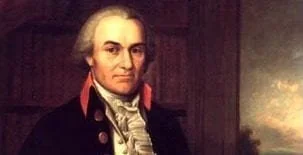
Oliver Ellsworth
Remarks by Oliver Ellsworth (1745-1807), of Windsor, Conn., published Dec. 10, 1787, during the great debates about the U.S. Constitution. He would go on to become the third U.S. chief justice
‘To the Landholders and Farmers:
The publication of Col. Mason’s reasons for not signing the new Constitution, has extorted some truths that would otherwise in all probability have remained unknown to us all. His reasons, like Mr. Gerry’s, are most of them ex post facto, have been revised in New York by R. H. L. and by him brought into their present artful and insidious form. The factious spirit of R. H. L., his implacable hatred to General Washington, his well-known intrigues against him in the late war, his attempts to displace him and give the command of the American army to General Lee, is so recent in your minds it is not necessary to repeat them. He is supposed to be the author of most of the scurrility poured out in the New-York papers against the new constitution.
Just at the close of the Convention, whose proceedings in general were zealously supported by Mr. Mason, he moved for a clause that no navigation act should ever be passed but with the consent of two-thirds of both branches; urging that a navigation act might otherwise be passed excluding foreign bottoms from carrying American produce to market, and throw a monopoly of the carrying business into the hands of the eastern states who attend to navigation, and that such an exclusion of foreigners would raise the freight of the produce of the southern states, and for these reasons Mr. Mason would have it in the power of the southern states to prevent any navigation act. This clause, as unequal and partial in the extreme to the southern states, was rejected; because it ought to be left on the same footing with other national concerns, and because no state would have a right to complain of a navigation act which should leave the carrying business equally open to them all. Those who preferred cultivating their lands would do so; those who chose to navigate and become carriers would do that. The loss of this question determined Mr. Mason against the signing the doings of the convention, and is undoubtedly among his reasons as drawn for the southern states; but for the eastern states this reason would not do. It would convince us that Mr. Mason preferred the subjects of every foreign power to the subjects of the United States who live in New-England; even the British who lately ravaged Virginia—that Virginia, my countrymen, where your relations lavished their blood—where your sons laid down their lives to secure to her and us the freedom and independence in which we now rejoice, and which can only be continued to us by a firm, equal and effective union. But do not believe that the people of Virginia are all thus selfish: No, there is a Washington, a Blair, a Madison and a Lee, (not R. H. L.) and I am persuaded there is a majority of liberal, just and federal men in Virginia, who, whatever their sentiments may be of the new constitution, will despise the artful injustice contained in Col. Mason’s reasons as published in the Connecticut papers.
The President of the United States has no council, etc., says Col. Mason. His proposed council would have been expensive— they must constantly attend the president, because the president constantly acts. This council must have been composed of great characters, who could not be kept attending without great salaries, and if their opinions were binding on the president his responsibility would be destroyed—if divided, prevent vigor and dispatch—if not binding, they would be no security. The states who have had such councils have found them useless, and complain of them as a dead weight. In others, as in England, the supreme executive advises when and with whom he pleases; if any information is wanted, the heads of the departments who are always at hand can best give it, and from the manner of their appointment will be trustworthy. Secrecy, vigor, dispatch and responsibility, require that the supreme executive should be one person, and unfettered otherwise than by the laws he is to execute.
There is no Declaration of Rights. Bills of Rights were introduced in England when its kings claimed all power and jurisdiction, and were considered by them as grants to the people. They are insignificant since government is considered as originating from the people, and all the power government now has is a grant from the people. The constitution they establish with powers limited and defined, becomes now to the legislator and magistrate, what originally a bill of rights was to the people. To have inserted in this constitution a bill of rights for the states would suppose them to derive and hold their rights from the federal government, when the reverse is the case.
There is to be no ex post facto laws. This was moved by Mr Gerry and supported by Mr. Mason, and is exceptional only as being unnecessary; for it ought not to be presumed that government will be so tyranical, and opposed to the sense of all modern civilians, as to pass such laws: if they should, they would be void.
The general Legislature is restrained from prohibiting the further importation of slaves for twenty odd years. But every state legislature may restrain its own subjects; but if they should not, shall we refuse to confederate with them? their consciences are their own, tho’ their wealth and strength are blended with ours. Mr. Mason has himself about three hundred slaves, and lives in Virginia, where it is found by prudent management they can breed and raise slaves faster than they want them for their own use, and could supply the deficiency in Georgia and South Carolina; and perhaps Col. Mason may suppose it more humane to breed than import slaves—those imported having been bred and born free, may not so tamely bear slavery as those born slaves, and from their infancy inured to it; but his objections are not on the side of freedom, nor in compassion to the human race who are slaves, but that such importations render the United States weaker, more vulnerable, and less capable of defence. To this I readily agree, and all good men wish the entire abolition of slavery, as soon as it can take place with safety to the public, and for the lasting good of the present wretched race of slaves. The only possible step that could be taken towards it by the convention was to fix a period after which they should not be imported.
There is no declaration of any kind to preserve the Liberty of the press, etc. Nor is liberty of conscience, or of matrimony, or of burial of the dead; it is enough that congress have no power to prohibit either, and can have no temptation. This objection is answered in that the states have all the power originally, and congress have only what the states grant them.
The judiciary of the United States is so constructed and extended as to absorb and destroy the judiciaries of the several states; thereby rendering law as tedious, intricate and expensive, and justice as unattainable by a great part of the community, as in England; and enable the rich to oppress and ruin the poor.
It extends only to objects and cases specified, and wherein the national peace or rights, or the harmony of the states is concerned, and not to controversies between citizens of the same state (except where they claim under grants of different states); and nothing hinders but the supreme federal court may be held in different districts, or in all the states, and that all the cases, except the few in which it has original and not appellate jurisdiction, may in the first instance be had in the state courts and those trials be final except in cases of great magnitude; and the trials be by jury also in most or all the causes which were wont to be tried by them, as congress shall provide, whose appointment is security enough for their attention to the wishes and convenience of the people.
In chancery courts juries are never used, nor are they proper in admiralty courts, which proceed not by municipal laws, which they may be supposed to understand, but by the civil law and law of nations.
Mr. Mason deems the president and senate’s power to make treaties dangerous, because they become laws of the land. If the president and his proposed council had this power, or the president alone, as in England and other nations is the case, could the danger be less?—or is the representative branch suited to the making of treaties, which are often intricate, and require much negotiation and secrecy? The senate is objected to as having too much power, and bold unfounded assertions that they will destroy any balance in the government, and accomplish what usurpation they please upon the rights and liberties of the people; to which it may be answered, they are elective and rotative, to the mass of the people; the populace can as well balance the senatorial branch there as in the states, and much better than in England, where the lords are hereditary, and yet the commons preserve their weight; but the state governments on which the constitution is built will forever be security enough to the people against aristocratic usurpations:—The danger of the constitution is not aristrocracy or monarchy, but anarchy.
I intreat you, my fellow citizens, to read and examine the new constitution with candor—examine it for yourselves: you are, most of you, as learned as the objector, and certainly as able to judge of its virtues or vices as he is. To make the objections the more plausible, they are called The objections of the Hon. George Mason, etc.—They may possibly be his, but be assured they were not those made in convention, and being directly against what he there supported in one instance ought to caution you against giving any credit to the rest; his violent opposition to the powers given congress to regulate trade, was an open decided preference of all the world to you. A man governed by such narrow views and local prejudices, can never be trusted; and his pompous declaration in the House of Delegates in Virginia that no man was more federal than himself, amounts to no more than this, “Make a federal government that will secure Virginia all her natural advantages, promote all her interests regardless of every disadvantage to the other states, and I will subscribe to it.”
It may be asked how I came by my information respecting Col. Mason’s conduct in convention, as the doors were shut? To this I answer, no delegate of the late convention will contradict my assertions, as I have repeatedly heard them made by others in presence of several of them, who could not deny their truth. Whether the constitution in question will be adopted by the United States in our day is uncertain; but it is neither aristocracy or monarchy can grow out of it, so long as the present descent of landed estates last, and the mass of the people have, as at present, a tolerable education; and were it ever so perfect a scheme of freedom, when we become ignorant, vicious, idle, and regardless of the education of our children, our liberties will be lost—we shall be fitted for slavery, and it will be an easy business to reduce us to obey one or more tyrants.
City planner

“Architects of the Future, City Inside Her” (woodblock and screenprint with gold leaf), by Chitra Ganesh, in the “Better on Paper’’ show at the Davis Museum at Wellesley College, Wellesley, Mass.
The wind is winning

“This old world needs propping up
When it gets this cold and windy….’’
— From “Windy Evening,’’ by Charles Simic (1938-2023), Serbian-American poet. He taught for many years at the University of New Hampshire and lived in Strafford, N.H.
Llewellyn King: Trump/Musk ‘fraud’ search and lies defraud America

WEST WARWICK, R.I.
Seminal is a strong word. It means that when an event is seminal, nothing will ever be the same again.
Elon Musk and his marauding young minions will leave the United States damaged in ways that won't be easily put right, toppling the country from the position it has held so long as the world’s pillar of decency, generosity and law. As President Ronald Reagan said, “a shining city on a hill.”
Every day the small but deadly Musk force, authorized and encouraged by President Trump, is tarnishing that image.
Once you have established yourself as a capricious and unreliable partner, you won’t be trusted again; trust lost defies repair. It doesn’t come back with an apology, a course correction or a change of administration. It is gone, sometimes for centuries. Distrust is enduring.
Treaties torn up today are treaties that won’t be written tomorrow. Disavowing the commitments of America is a Trump hallmark. Tearing up these commitments is more than an indication of instability, it is a burden on the future, a doubt about the sincerity of our handshake.
We have left the World Health Organization in the middle of a new wave of incipient pandemics and abandoned the Paris Agreement without reason. We are about to damage in grotesque ways our good relations with Canada and Mexico, our family here in North America.
Trump has drummed up an inexplicable animus to our good neighbors and best trading partners. With tariffs, he is planning to violate our trading agreement with them. The United States-Mexico-Canada Agreement was signed into law — with praise for his own handiwork — by President Trump in his first term.
For me, the immediate excess of the administration has been the destruction of the U.S. Agency for International Development. I have seen the agency at work in Pakistan, Bolivia, and especially in Central Africa. My wife, Linda Gasparello, has seen its work in Egypt and across the Middle East, helping to save and enhance lives and stabilize those countries.
First, USAID was lied about and then it was shuttered. In that shuttering, America withdrew its helping hand to the world, its most potent and effective marquee for its values of caring, helping, educating and uplifting.
Musk’s blind and ignorant closing of USAID has blacked out our billboard to the world of what America is about. Women especially will suffer.
The immediate effect of shutting down USAID is that thousands of people who would have eaten today won’t. People who would have received their HIV treatment won’t. Children who would have learned to read and write won’t.
Uneducated populations are putty in the hands of extremists, from Marxists to jihadists. In damaging the recipients of USAID assistance, we are damaging America and its global interests.
“Fraud,” says Trump. “Fraud,” says Musk. “Fraud,” say their supporters. If there is so much fraud, where is the evidence and where are the prosecutions? Why are there no arrests?
In fact, for a relatively small agency, USAID has been examined, audited and inspected by the machinery of government and by Congress more than any other agency.
Steven Hendrix, who retired last year as the USAID coordinator for foreign assistance at in the State Department, said on television program “White House Chronicle,” which I host with Adam Clayton Powell III, that when he was working with USAID in Iraq, “We instituted a very rigorous performance evaluation and monitoring of all of these investments. We were also very responsive to the State inspector general and other authorities. I’ve got to tell you, in Iraq I had simultaneous audits from all of them.”
The toughest of these, he said, was the USAID’s own inspector general.
The fraud may be that the Trump-Musk duopoly is defrauding America of its potent soft power.
Llewellyn King is executive producer and host of White House Chronicle, on PBS. His email is llewellynking1@gmail.com , and he’s based in Rhode Island.
Limbering up

“Brujas” (oil on canvas), by Perla Mabel, at the Ely Center of Contemporary Art, New Haven, through Feb. 23.
Then they moved to the suburbs

An Irish flag, said to be the world’s biggest, hanging outside the Boston Harbor Hotel.
— Photo by John Hoey
“The Boston Irish have become people of education, culture, and refinement. To a great extent, in their prolonged struggle for survival and achievement, they did turn Boston into an Irish city.’’
— Thomas H. O'Connor (1923-2012), history professor at Boston College
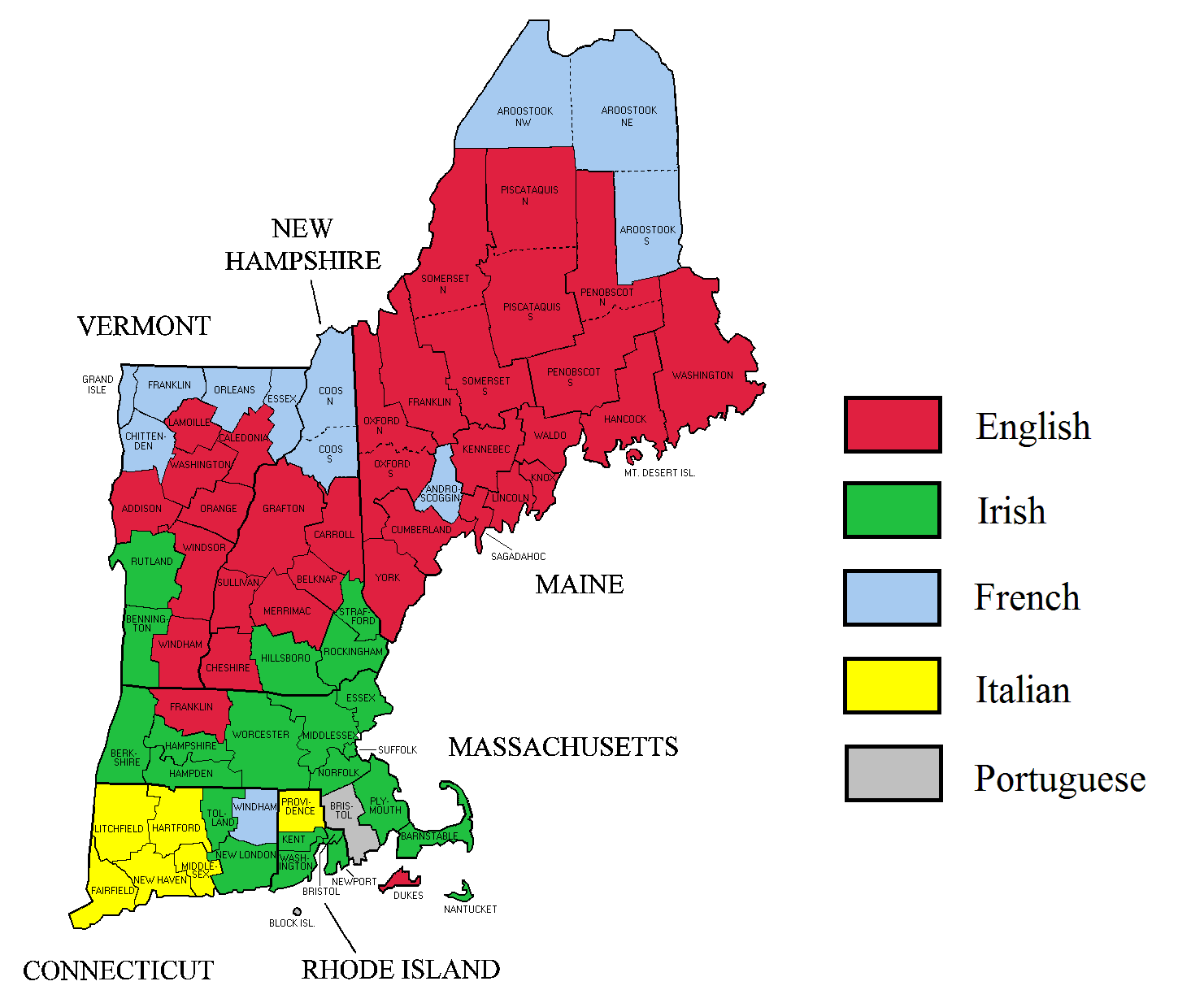
Largest self-reported ancestry groups in New England. Americans of Irish descent form a plurality in most of Massachusetts and Americans of English descent form a plurality in much of the central parts of Vermont and New Hampshire as well as nearly all of Maine.
Couples agriculture

“Lloyd and Barbara Wescott, 1942” (tempera on gessoed board), by Paul Cadmus (1904-1999), starting in April at the Bennington (Vt.) Museum.
Flu causing mass wild bird mortalities

Excerpted from EcoRI News
PROVIDENCE — This time of year isn’t supposed to be busy for Sheida Soleimani, the powerhouse artist, professor, and animal rehabilitator.
It’s not baby bird season, Soleimani explained, the time of year when worried good Samaritans swamp her clinic, Congress of the Birds, with calls about potentially failing fledglings.
But that rush is a few months away. Winter is a relatively quiet season, and Soleimani said she usually gets one or two calls on an average day. But this year, her phone is buzzing 15 to 20 times daily….
Most of the calls are about cases of bird flu, Soleimani told ecoRI News, or at least about birds who appear to be infected with the disease that has killed millions of animals around the country, including a flock in southern Rhode Island last month.
“What we are seeing is mass mortalities,” Soleimani said. “They’re falling out of the sky dying.”
But it’s not always like this
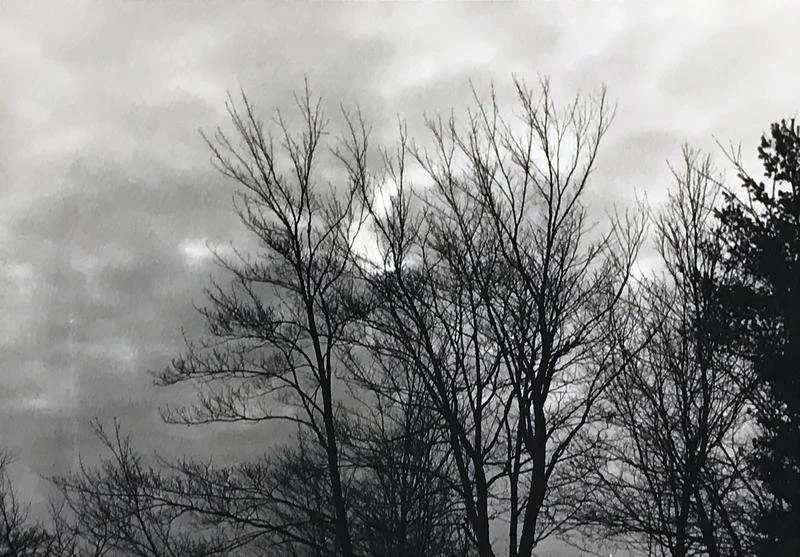
“(Winter Sky) Snow Clouds” (photo), by Bradbury Prescott (1922-2012), at the Farnsworth Art Museum, Rockland, Maine.
“
How do they evacuate?
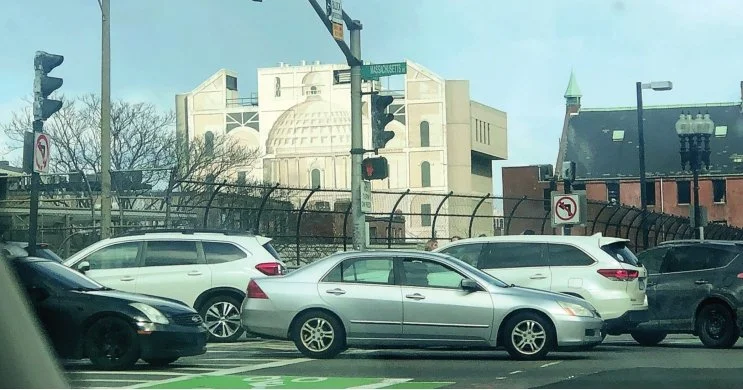
Boston is famous for traffic gridlock.
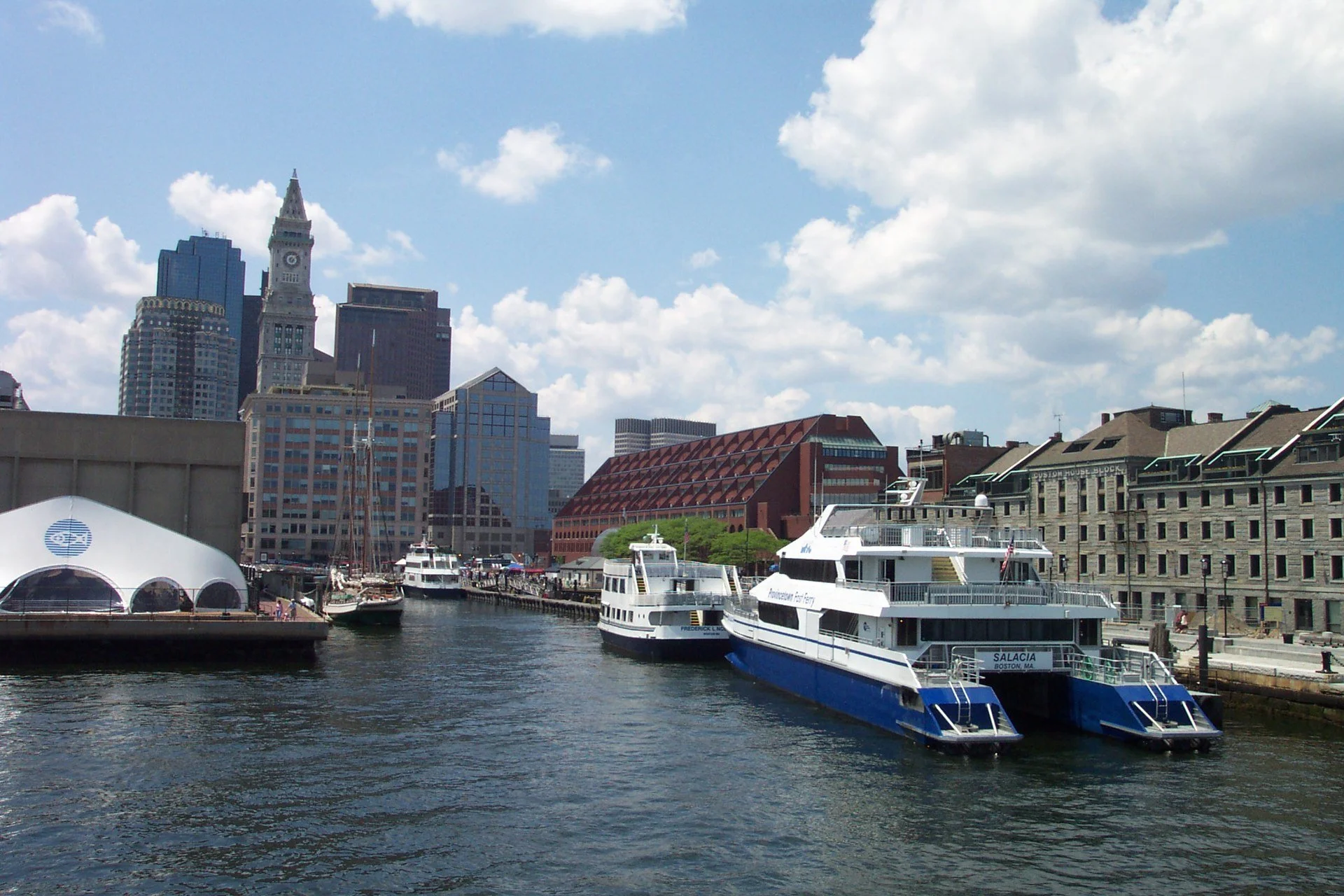
Long Wharf in downtown Boston was once the main commercial wharf of the city’s port, but is now used by ferries and cruise boats.
—Photo by Chris Wood
(New England Diary’s editor, Robert Whitcomb, is chairman of The Boston Guardian.)
Over the years, we have periodically looked at the city’s disaster planning with a focus on possible evacuations.
Although not subject to forest fires like in Los Angeles, mass relocations due to super storms, terrorism or other possible disasters are possibilities.
Long ago, the city’s planning to relocate many of its citizens ended at Boston’s boundaries with no coordination with our suburban neighbors. Other plans had designated some of our busiest streets as “evacuation routes” although they were already gridlocked during normal commute times.
Over three weeks ago, we assigned one of our best reporters, Brandon Hill, to review the city’s plans with particular emphasis on the recent increase in bike and bus lanes which have constricted vehicular traffic.
He was met with either silence or uncertainty about who to speak with by both the Wu administration’s Office of Emergency Management and her press office. It almost seemed like Hill was asking for the nuclear launch codes or Elon Musk’s attempt to access sensitive government files.
As government’s primary responsibility is the health and safety of its citizens, we are left more than a little concerned and perplexed. It almost seems like Mayor Wu’s attitude about our wellbeing begins and ends with prayer with nothing in-between.
Patriotic about what?

“Democracy of the Land: Freedom’’ (down feathers, LED lights, mixed media), by Jay Critchley, in his show “Democracy of the Land, Inc. — FLAGrancy,’’ at the Montserrat College of Art Gallery, in Beverly, Mass., through March 5.
What to do now
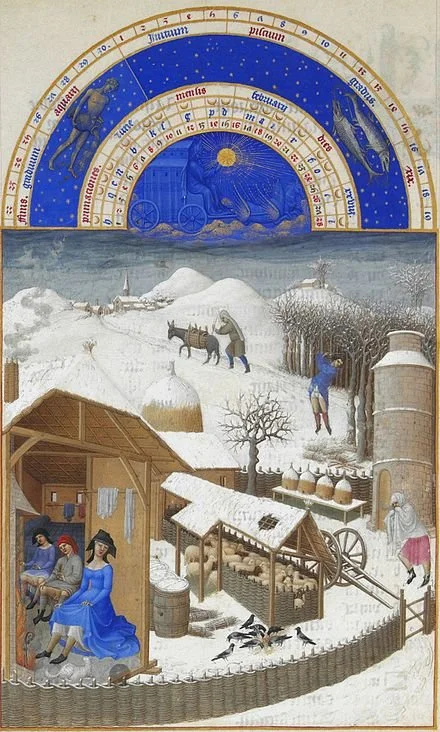
“February,’’ from Très riches heures du Duc de Berry
“Winter. Time to eat fat
and watch hockey. In the pewter mornings, the cat,
a black fur sausage with yellow
Houdini eyes, jumps up on the bed and tries
to get onto my head.’’
— From “February,’’ by Margaret Atwood (born 1939), Canadian novelist, poet and literary critic
Musings in the mess

February 8, 2025
By Denis O'Neill (essayist and screenwriter)
Musings 2025 ~ Musings 2023
Past as prologue. Permit me a brief book hustle. My latest tome - a gathering of wit and wisdom from these very pages in 2023 – is now available for purchase through The Common Press in Amherst, Mass. and Amazon Books.
One of the things the first three weeks of Donald Trump’s second administration has taught us is to pay attention when people tell you they could shoot someone on Fifth Avenue and their followers wouldn’t care. History is important. It is cyclical and repetitive. Just like human nature. George Santayana warned us: “Those who cannot remember the past, are condemned to repeat it.” Which is why this book - and my previous two in the Musings series (Pandemic Musings and Musings 2022) might be worth owning, particularly if you track politics, cultural shifts and world events.
“In the vein of celebrated English diarist Samuel Pepys, author O’Neill weaves his observations about contemporary politics, daily life and culture into an overview of America that is at once poetic, revealing, depressing and forever searching for people, events and behavior that define who we are.” ~ Kirkus Reviews
A few verses from “December 31 ~ The Year in Doggerel” “What a year for the rearview mirror,
The dumpster, the shredder, the bin. Forget about sloth and gluttony,
’23 feels like original sin.....
Our planet is warming like never before, We are frogs in a kettle slow boiling.
Mother Earth will give up If we don’t give in
to the science of heat trapping gasses. To solar and wind,
May conversion continue,
Turning petrol sugar to molasses....
I still believe in human kindness, More than ever, human touch.
And truth and science, And fairness and freedom,
Is that really asking too much?
And be sure to always speak your mind,
History warns us of silence.
Your voice in defense of what is right Can stifle future violence.
So shoot for bliss, and settle for joy, May the ponies you bet on run first. For the love of your friends,
And your lust for life,
May you never lose your thirst.”
Lurking

“Iceberg series No. 17” (cast resin, steel), by Mags Harries, in her show “Iceberg Series,’’ at Boston Sculptors Gallery, Feb. 27-March 3.
— Image Credit: Kathy Chapman
Chris Powell: Conn. policies that enlarge poverty; ‘sanctuary city’?
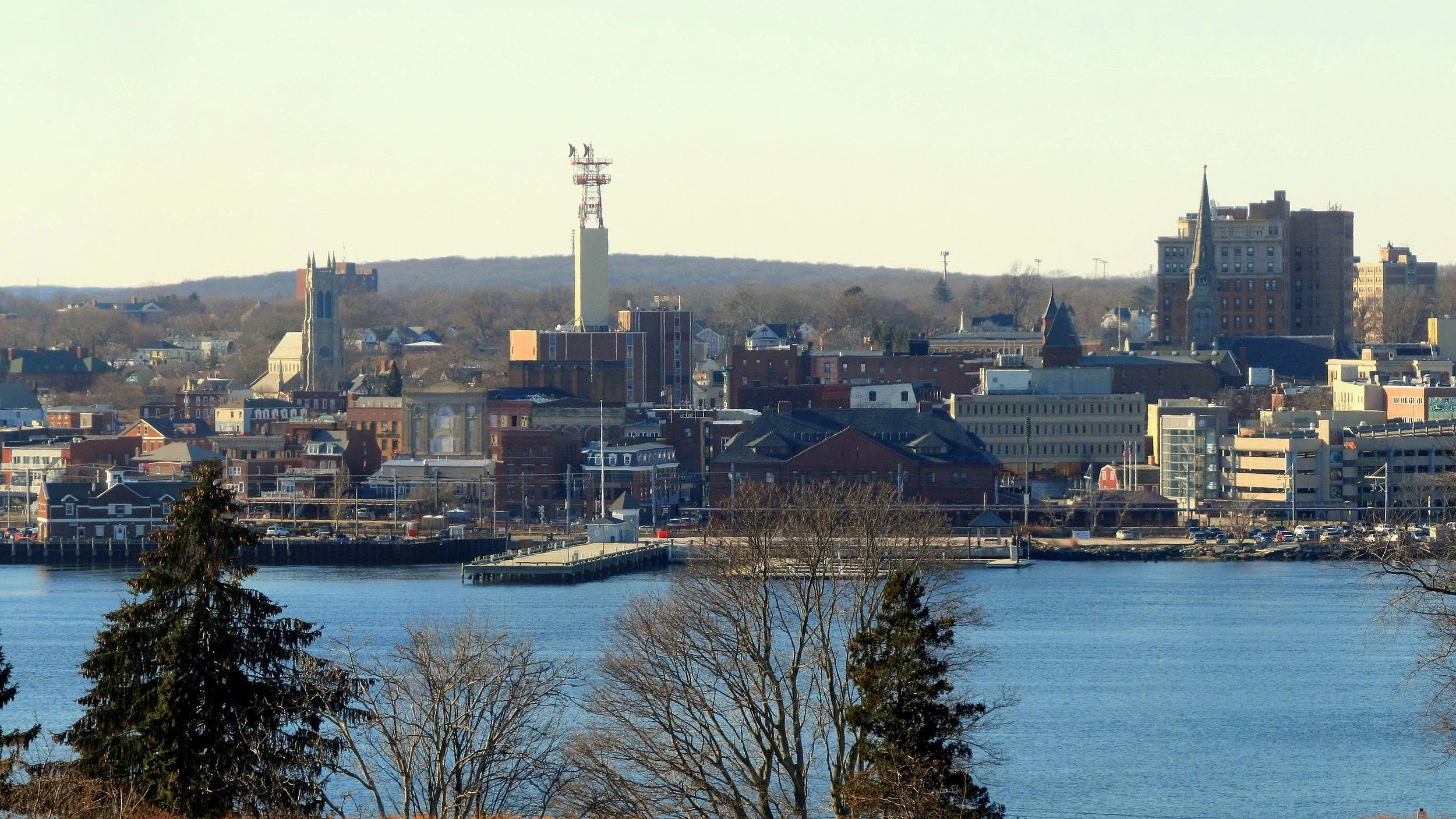
New London skyline from Fort Griswold.
Photo by Pi.1415926535
MANCHESTER, Conn.
Nearly everyone on Connecticut state government's payroll, directly or indirectly, is beseeching Gov. Ned Lamont and the General Assembly to loosen the "fiscal guardrails" that have constrained spending and have allowed state pension funds to grow slightly faster than their obligations.
Leading the clamor to spend more are social-service groups and their legislative allies. They want the state's Medicaid program to cover diapers. They want another $9 million for community food banks, contending that more than 10 percent of Connecticut's population is "food insecure." And they advocate a $600 "refundable tax credit" for low-income households, cash for people who don't pay income taxes.
They hold news conferences where they cheer and congratulate each other as if they don't understand the disaster behind their proposals: the explosion of poverty in a state that purports to be doing well.
The proposals indicate otherwise -- that more people can't support themselves and their children, even if for years now state government has not seemed to expect people to. Households headed by a single woman with little education and income and no significant job skills but with several young children to support are often cited in news reports as if their poverty is surprising.
Such poverty is surprising only insofar as Connecticut simultaneously glories in free, round-the-clock contraception and abortion. Indeed, the other week the governor grandly announced the state's first contraceptives vending machine.
But the cause of the worsening poverty seems not to interest advocates of the new spending. Nor do they seem to wonder why poverty has worsened despite government's longstanding programs to alleviate it.
State government's bookkeeping is well monitored by the auditors of public accounts, but its policies and programs are seldom audited for results. Appropriating and bestowing money have become ends in themselves.
Breaking away from Trumpian Republicanism, Wall Street Journal columnist Peggy Noonan, once a top aide to President Ronald Reagan, offered some advice to Democrats last week. "Most of all," she wrote, "make something work. You run nearly every great city in the nation. Make one work -- clean it up, control crime, smash corruption, educate the kids."
Noonan meant well but misunderstands the situation. For from the Democratic perspective, the cities they control work very well -- they create and sustain the hapless underclass that is the rationale for the government class and that produces the election pluralities on which the party of the government class relies. A self-sufficient population is not the policy objective; perpetual dependence on government is.
For what else can explain the 60-year decline of cities in Connecticut and nationally and the horrifying failure of their schools? After all this time the people in charge can't be so stupid to have missed this. They must be assumed to intend the most obvious results of their administration. Auditing the results would call those longstanding policies and programs into question and compel a change not just in policies and programs but a change in regime.
So results must not be calculated. For prosperity isn't political power in Connecticut anymore. Poverty is.
'‘SANCTUARY'‘ IN NEW LONDON: Now that the federal government is starting to much more seriously enforce immigration law again, some cities are declaring that they really aren't "sanctuary" cities after all, or at least that they don't want to be known as such, lest the Trump administration try to penalize them for obstructing enforcement.
Among these cities is New London, where Mayor Michael Passero recently told the city's newspaper, The Day, that while the city has a reputation as a "sanctuary" city, the City Council's 2018 resolution on immigration doesn't mention "sanctuary" at all and says only that the city will observe state and federal law and be a welcoming place.
In a technical sense the mayor is right. But then everyone in authority in New London seems to support Connecticut's "Trust Act," which forbids municipal police from most cooperation with federal immigration authorities. Since the "Trust Act" makes Connecticut a "sanctuary" state, all its municipalities are "sanctuary" cities. "Welcoming" is euphemism and no defense.]
Chris Powell has written about Connecticut government and politics for many years (CPowell@cox.net).
Allison Stanger: Replacing our republic with ‘network state’ dictatorship
Artificial intelligence icon. Elon Musk is heavily involved in this unregulated sector, which has formidable potential for exercising power.

An example paper printable Bitcoin wallet consisting of one Bitcoin address for receiving and the corresponding private key for spending.
MIDDLEBURY, VT.\
Elon Musk’s role as the head of the Department of Government Efficiency, also known as DOGE, is on the surface a dramatic effort to overhaul the inefficiencies of federal bureaucracy. But beneath the rhetoric of cost-cutting and regulatory streamlining lies a troubling scenario.
Musk has been appointed what is called a “special government employee” in charge of the White House office formerly known as the U.S. Digital Service, which was renamed the U.S. DOGE Service on the first day of President Donald Trump’s second term. The Musk team’s purported goals are to maximize efficiency and to eliminate waste and redundancy.
That might sound like a bold move toward Silicon Valley-style innovation in governance. However, the deeper motivations driving Musk’s involvement are unlikely to be purely altruistic.
Musk has an enormous corporate empire, ambitions in artificial intelligence, desire for financial power and a long-standing disdain for government oversight. His access to sensitive government systems and ability to restructure agencies, with the opaque decision-making guiding DOGE to date, have positioned Musk to extract unprecedented financial and strategic benefits for both himself and his companies, which include the electric car company Tesla and space transport company SpaceX.
One historical parallel in particular is striking. In 1600, the British East India Company, a merchant shipping firm, began with exclusive rights to conduct trade in the Indian Ocean region before slowly acquiring quasi-governmental powers and ultimately ruling with an iron fist over British colonies in Asia, including most of what is now India. In 1677, the company gained the right to mint currency on behalf of the British crown.
As I explain in my upcoming book “Who Elected Big Tech?” the U.S. is witnessing a similar pattern of a private company taking over government operations.
Yet what took centuries in the colonial era is now unfolding at lightning speed in mere days through digital means. In the 21st century, data access and digital financial systems have replaced physical trading posts and private armies. Communications are the key to power now, rather than brute strength.
A security officer blocks U.S. Sen. Ed Markey, right, from entering the U.S. Environmental Protection Agency headquarters on Feb. 6, 2025, in an effort to meet with DOGE staff. Al Drago/Getty Images
The data pipeline
Viewing Musk’s moves as a power grab becomes clearer when examining his corporate empire. He controls multiple companies that have federal contracts and are subject to government regulations. SpaceX and Tesla, as well as tunneling firm The Boring Company, the brain science company Neuralink, and artificial intelligence firm xAI all operate in markets where government oversight can make or break fortunes.
In his new role, Musk can oversee – and potentially dismantle – the government agencies that have traditionally constrained his businesses. The National Highway Traffic Safety Administration has repeatedly investigated Tesla’s Autopilot system; the Securities and Exchange Commission has penalized Musk for market-moving tweets; environmental regulations have constrained SpaceX.
Through DOGE, all these oversight mechanisms could be weakened or eliminated under the guise of efficiency.
But the most catastrophic aspect of Musk’s leadership at DOGE is its unprecedented access to government data. DOGE employees reportedly have digital permission to see data in the U.S. government’s payment system, which includes bank account information, Social Security numbers and income tax documents. Reportedly, they have also seized the ability to alter the system’s software, data, transactions and records.
Multiple media reports indicate that Musk’s staff have already made changes to the programs that process payments for Social Security beneficiaries and government contractors to make it easier to block payments and hide records of payments blocked, made or altered.
But DOGE employees only need to be able to read the data to make copies of Americans’ most sensitive personal information.
A federal court has ordered that not to happen – at least for now. Even so, funneling the data into Grok, Musk’s xAI-created artificial intelligence system, which is already connected with the Musk-owned X, formerly known as Twitter, would create an unparalleled capability for predicting economic shifts, identifying government vulnerabilities and modeling voter behavior.
That’s an enormous and alarming amount of information and power for any one person to have.
Candidate Donald Trump speaks at a key cryptocurrency industry conference in July 2024. AP Photo/Mark Humphrey
Cryptocurrency coup?
Like Trump himself and many of his closest advisers, Musk is also deeply involved in cryptocurrency. The parallel emergence of Trump’s own cryptocurrency and DOGE’s apparent alignment with the cryptocurrency known as Dogecoin suggests more than coincidence. I believe it points to a coordinated strategy for control of America’s money and economic policy, effectively placing the United States in entirely private hands.
The genius – and danger – of this strategy lies in the fact that each step might appear justified in isolation: modernizing government systems, improving efficiency, updating payment infrastructure. But together, they create the scaffolding for transferring even more financial power to the already wealthy.
Musk’s authoritarian tendencies, evident in his forceful management of X and his assertion that it was illegal to publish the names of people who work for him, suggest how he might wield his new powers. Companies critical of Musk could face unexpected audits; regulatory agencies scrutinizing his businesses could find their budgets slashed; allies could receive privileged access to government contracts.
This isn’t speculation – it’s the logical extension of DOGE’s authority combined with Musk’s demonstrated behavior.
Critics are calling Musk’s actions at DOGE a massive corporate coup. Others are simply calling it a coup. The protest movement is gaining momentum in Washington, D.C., and around the country, but it’s unlikely that street protests alone can stop what Musk is doing.
Who can effectively investigate a group designed to dismantle oversight itself? The administration’s illegal firing of at least a dozen inspectors general before the Musk operation began suggests a deliberate strategy to eliminate government accountability. The Republican-led Congress, closely aligned with Trump, may not want to step in; but even if it did, Musk is moving far faster than Congress ever does.
Protests have arisen nationwide against Elon Musk’s actions in the federal government. Drew Angerer/AFP via Getty Images
Taken together, all of Musk’s and Trump’s moves lay the foundation for what cryptocurrency investor and entrepreneur Balaji Srinivasan calls “the network state.”
The idea is that a virtual nation may form online before establishing any physical presence. Think of the network state like a tech startup company with its own cryptocurrency – instead of declaring independence and fighting for sovereignty, it first builds community and digital systems. By the time a Musk-aligned cryptocurrency gained official status, the underlying structure and relationships would already be in place, making alternatives impractical.
Converting more of the world’s financial system into privately controlled cryptocurrencies would take power away from national governments, which must answer to their own people. Musk has already begun this effort, using his wealth and social media reach to engage in politics not only in the U.S. but also several European countries, including Germany.
A nation governed by a cryptocurrency-based system would no longer be run by the people living in its territory but by those who could could afford to buy the digital currency. In this scenario, I am concerned that Musk, or the Communist Party of China, Russian President Vladimir Putin or AI-surveillance conglomerate Palantir, could render irrelevant Congress’ power over government spending and action. And along the way, it could remove the power to hold presidents accountable from Congress, the judiciary and American citizens.
All of this obviously presents a thicket of conflict-of-interest problems that are wholly unprecedented in scope and scale.
The question facing Americans, therefore, isn’t whether government needs modernization – it’s whether they’re willing to sacrifice democracy in pursuit of Musk’s version of efficiency. When we grant tech leaders direct control over government functions, we’re not just streamlining bureaucracy – we’re fundamentally altering the relationship between private power and public governance. I believe we’re undermining American national security, as well as the power of We, the People.
The most dangerous inefficiency of all may be Americans’ delayed response to this crisis.
Allison Stanger, a political scientist and economist, is a professor at Middlebury College.
She receives funding from the Berkman Klein Center for Internet and Society at Harvard University.
Green when we need it

“Valhalla” (acrylic on canvas) by Emilie Stark-Menneg, at Moss Gallery, Portland, Maine.
— Photo courtesy of Luc Demers.
Save clams by eating Green Crabs

Green Crab
From Robert Whitcomb’s “Digital Diary,’’ in GoLocal24.com.
European Green Crabs flourish in ocean waters warmed by climate change, are voraciously eating New England clams (especially the soft-shell ones) mussels, oysters, and lobsters, and damaging eelgrass beds and marshes, undermining entire wildlife coastal ecosystems.
But, as I have written, you can help by eating the crabs, which are very tasty. The more they’re harvested, the better. They are very popular amongst gourmands in Europe, by the way.
Hit this link from a Providence-based nonprofit.
And order some Green Crab stuff at this Rhode Island outfit:
Riverside softness

“Fog Along the Concord River” (archival pigment print from scanned color negative), by Suzanne Revy, in her show “A Murmur in the Trees,’’ opening Feb. 15 at the Danforth Art Museum, Framingham, Mass.
Barbara Kates-Garnick: How states could be hurt by Trump’s offshore wind-turbine freeze
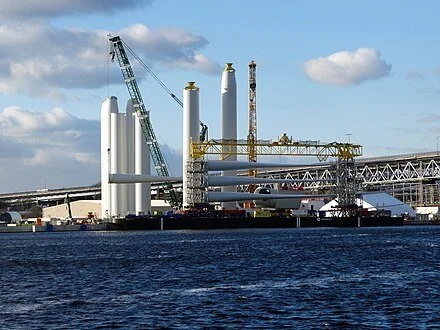
Turbine components for Revolution Wind at New London, Conn., last year.
MEDFORD, Mass.
A single wind turbine spinning off the U.S. Northeast coast today can power thousands of homes – without the pollution that comes from fossil fuel power plants. A dozen of those turbines together can produce enough electricity for an entire community.
The opportunity to tap into such a powerful source of locally produced clean energy – and the jobs and economic growth that come with it – is why states from Maine to Virginia have invested in building a U.S. offshore wind industry.
But much of that progress may now be at a standstill.
One of Donald Trump’s first acts as president in January 2025 was to order a freeze on both leasing federal areas for new offshore wind projects and issuing federal permits for projects that are in progress.
The U.S. Northeast and Northern California have the nation’s strongest offshore winds. NREL
The order and Trump’s long-held antipathy toward wind power are creating massive uncertainty for a renewable energy industry at its nascent stage of development in the U.S., and ceding leadership and offshore wind technology to Europe and China.
As a professor of energy policy and former undersecretary of energy for Massachusetts, I’ve seen the potential for offshore wind power, and what the Northeast, New York and New Jersey, as well as the U.S. wind industry, stand to lose if that growth is shut down for the next four years.
Expectations fall from 30 gigawatts by 2030
The Northeast’s coastal states are at the end of the fossil fuel energy pipeline. But they have an abundant local resource that, when built to scale, could provide significant clean energy, jobs and supply chain manufacturing. It could also help the states achieve their ambitious goals to reduce their greenhouse gas emissions and their impact on climate change.
The Biden administration set a national offshore wind goal of 30 gigawatts of capacity in 2030 and 110 gigawatts by 2050. It envisioned an industry supporting 77,000 jobs and powering 10 million homes while cutting emissions. As recently as 2021, at least 28 gigawatts of offshore wind power projects were in the development or planning pipeline.
With the Trump order, I believe the U.S. will have, optimistically, less than 5 gigawatts in operation by 2030.
That level of offshore wind is certainly not enough to create a viable manufacturing supply chain, provide lasting jobs or deliver the clean energy that the grid requires. In comparison, Europe’s offshore wind capacity in 2023 was 34 gigawatts, up from 5 gigawatts in 2012, and China’s is now at 34 gigawatts.
What the states stand to lose
Offshore wind is already a proven and operating renewable power source, not an untested technology. Denmark has been receiving power from offshore wind farms since the 1990s.
The lost opportunity to the coastal U.S. states is significant in multiple areas.
Trump’s order adds deep uncertainty in a developing market. Delays are likely to raise project costs for both future and existing projects, which face an environment of volatile interest rates and tariffs that can raise turbine component costs. It is energy consumers who ultimately pay through their utility bills when resource costs rise.
The potential losses to states can run deeper. The energy company Ørsted had estimated in early 2024 that its proposed Starboard Offshore Wind project would bring Connecticut nearly US$420 million in direct investment and spending, along with employment equivalent to 800 full-time positions and improved energy system reliability.
Massachusetts created an Offshore Wind Energy Investment Trust Fund to support redevelopment projects, including corporate tax credits up to $35 million. A company planning to build a high-voltage cable manufacturing facility there pulled out in January 2025 over the shift in support for offshore wind power. On top of that, power grid upgrades to bring offshore wind energy inland – critical to reliability for reducing greenhouse gas emissions from electricity – will be deferred.
Atlantic Coast wind-energy leases as of July 2024. Others wind energy lease areas are in the Gulf of Mexico, off the Pacific coast and off Hawaii. U.S. Bureau of Safety and Environmental Enforcement
Technology innovation in offshore wind will also likely move abroad, as Maine experienced in 2013 after the state’s Republican governor tried to void a contract with Statoil. The Norwegian company, now known as Equinor, shifted its plans for the world’s first commercial-scale floating wind farm from Maine to Scotland and Scandinavia.
Sand in the gears of a complex process
Development of energy projects, whether fossil or renewable, is extremely complex, involving multiple actors in the public and private spheres. Uncertainty anywhere along the regulatory chain raises costs.
In the U.S., jurisdiction over energy projects often involves both state and federal decision-makers that interact in a complex dance of permitting, studies, legal regulations, community engagement and finance. At each stage in this process, a critical set of decisions determines whether projects will move forward.
The federal government, through the Department of Interior’s Bureau of Offshore Energy Management, plays an initial role in identifying, auctioning and permitting the offshore wind areas located in federal waters. States then issue requests for proposals from companies wishing to sell wind power to the grid. Developers who win bureau auctions are eligible to respond. But these agreements are only the beginning. Developers need approval for site, design and construction plans, and several state and federal environmental and regulatory permits are required before the project can begin construction.
Trump targeted these critical points in the chain with his indefinite but “temporary” withdrawal of any offshore wind tracts for new leases and a review of any permits still required from federal agencies.
Jobs and opportunity delayed
A thriving offshore wind industry has the potential to bring jobs, as well as energy and economic growth. In addition to short-term construction, estimates for supply chain jobs range from 12,300 to 49,000 workers annually for subassemblies, parts and materials. The industry needs cables and steel, as well as the turbine parts and blades. It requires jobs in shipping and the movement of cargo.
To deliver offshore wind power to the onshore grid will also require grid upgrades, which in turn would improve reliability and promote the growth of other technologies, including batteries.
The U.S. has offshore wind farms operating off Virginia, Rhode Island and New York. Three more are under construction. AP Photo/Steve Helber
Taken all together, an offshore wind energy transition would build over time. Costs would come down as domestic manufacturing took hold, and clean power would grow.
While environmental goals drove initial investments in clean energy, the positive benefits of jobs, technology and infrastructure all became important drivers of offshore wind for the states. Tax incentives, including from the Inflation Reduction Act, now in doubt, have supported the initial financing for projects and helped to lower costs.
It’s a long-term investment, but once clear of the regulatory processes, with infrastructure built out and manufacturing in place, the U.S. offshore wind industry would be able to grow more price competitive over time, and states would be able to meet their long-term goals.
The Trump order creates uncertainty, delays and likely higher costs in the future.
Barbara Kates-Garnick is a professor of practice in energy policy at Tufts University, in Medford.
She receives funding as an outside director for Anbaric Transmission, which has no operating projects related to offshore wind. She has received funding for a research project through Tufts University jointly funded by the National Offshore Wind Research and Development Consortium and the Massachusetts Clean Energy Center. She serves on the board of several nonprofits that are not politically active organizations.