
Vox clamantis in deserto





Llewellyn King: Am I remembering too much?

Cocktail party in 1961
WEST WARWICK, R.I.
I am approaching what may be thought of as a significant birthday next month. I’m not sure what makes it significant except the number attached to it.
If we don’t know how old we are, most people, including the elderly, will think they are younger, even if they have arthritic knees. If they take a morning cocktail of pills, they will still think they are much younger than the calendar dictates.
So here is my guide to knowing empirically, how old you are. You are old if ….
You remember when all restaurants served half a grapefruit with a half a maraschino cherry placed in the middle.
You remember when restaurants had relish carts with things like watermelon pickles and herring in sour cream.
You remember a whole class of singers called crooners and you still get a bit weepy when you hear their songs.
You remember when men’s trousers had buttons instead of zippers.
You remember when women wore girdles with attachments for stockings.
You remember when cars had little arms for turn signals, called trafficators, that wouldn’t go up at speed.
You remember when airline tickets were as good as currency and could easily be exchanged or sold back.
You remember when flying was a pleasure, even in coach, and you felt pampered not herded.
You remember when hotel rooms were rented for fixed prices and those were posted.
You remember when sneakers were all white and for tennis.
You remember when men wore hats and baseball caps were worn just to play baseball.
You remember when women wore hats and gloves to church.
You remember when men wore suits to church or just put them on so their neighbors thought they had been at worship.
You remember when birth control, if available, was with condoms, known as rubbers and kept under the counter at drugstores.
You remember when drugstores also had lunch counters.
You remember soda fountains.
You remember when Coca-Cola only came in a 6-ounce bottle and tasted better because it had cane sugar and the bottle seemed to concentrate the carbonation. Also, it cost a dime.
You remember five and dime stores where some things really cost only a dime.
You remember when shopping centers were novel and a place to visit.
You remember when going to the movies was an occasion. An usher showed you to your seat with a flashlight and a popcorn, ice cream and candy vendor walked up and down the theater aisles.
You remember when cigarettes were offered at dinner and ashtrays were part of the table setting.
You remember when Americans didn’t drink wine and only glasses for hard liquor were on formal dinner tables.
You remember when ethnic food was Hunan Chinese, often called Polynesian, and French food wasn’t regarded as ethnic, simply hard to pronounce.
You remember a time when comfort wasn’t important to you, when you didn’t ask, “Are the beds comfortable?” And when on a road trip, you didn’t expect to sit in the front seat because “it is more comfortable.”
Recently, a woman — who had been to a few rodeos herself — looked at me and said, “You’ve got age on you.” I was about to remonstrate, but I realized that while her manners were wanting, her eyesight wasn’t.
Therefore, I shall be bowing to the calendar and, after next month, I will gladly let people hold doors for me, help me with grocery bags, and offer a chair when there is a lot of standing about going on.
My wife is taking me to Montreal for the big day, but I plan to treat it as nothing to do with moi. Other people get old. They always have -- as I remember.
Llewellyn King is executive producer and host of White House Chronicle, in PBS. His email is llewellynking1@gmail.com and he’s based in Rhode Island.

Michael Scott Bryant: When 'charisma,' er, Trumps all else

Trump at rally in Manchester, N.H., last January
SMITHFIELD, R.I.
Of all the questions confronting voters in the 2024 U.S. presidential election, few are as puzzling as the seemingly unwavering support for a political candidate deeply mired in embarrassing sex scandals and criminal business practices.
Such is the case with Donald Trump, whose behavior would have sunk the campaigns of most U.S. presidential candidates.
In the 1980s, for example, Democrat Gary Hart’s presidential ambitions went to ground over allegations of extramarital affairs on a boat aptly named “Monkey Business.” Over the past 20 years, two New York governors, Andrew Cuomo and Eliot Spitzer, both Democrats, resigned over charges of sexual misconduct. Democrat Al Franken’s career in the Senate was scuttled over charges of indiscretions during a USO tour.
But Trump’s convictions of financial fraud and being found culpable for sexual misconduct have not dampened the enthusiasm of supporters of Trump and his “Make America Great Again” movement.
Part of the reason may be explained by Max Weber, an early 20th century German sociologist and social theorist. At the center of Weber’s thinking about political authority was the word “charisma.”
In today’s street lingo, charisma has been shortened to “rizz” and defined by the Oxford English Dictionary as “style, charm or attractiveness, and the ability to attract a romantic or sexual partner.”
Nothing could be further from Weber’s understanding of charisma.
The religious roots of charisma
In his “Theory of Social and Economic Organization,” Weber goes back to the Christian roots of the word charisma to describe how social and political power achieved legitimacy within a society.
According to the Greek Bible, Jesus’ followers received spiritual gifts from God. Much later, derived from the Greek word “charis” – meaning “grace, kindness, favor – the word was brought over to English and referred to the gifts of healing, prophecy and other endowments of the Holy Spirit.
A portrait of the German sociologist Max Weber in the 1900s. Mondadori via Getty Images
For Weber, what makes people charismatic is the possession of such gifts, through which they become mediators between God and their communities.
These gifts of the spirit transform the believer into a prophet.
Weber made a crucial distinction between a priest and a prophet. The priest acquires power through official credentialing and the routine performance of functions such as liturgies and rituals prescribed by the religion.
In contrast with the priest, the prophet derives authority not from official mechanisms but directly from God. The prophet thus stands outside the framework of the official religion – and even beyond society and a political state.
What characterizes the modern-day prophet is his defiance of the regimented order of society and his call to heed a higher calling. The prophet is inherently subversive.
While not religious, as historian Lawrence Rees has pointed out, the political prophet is "quasi-religious,” and the followers of such a person “are looking for more than just lower taxes or better health care, but seek broader, almost spiritual, goals of redemption and salvation.”
‘A call to arms’
Throughout modern history, charismatic leaders have shown their extraordinary ability to elicit devotion to themselves and their causes.
Some have been great spiritual leaders – Russian writer Leo Tolstoy, Indian independence leader Mahatma Gandhi, Civil Rights Movement leader Rev. Martin Luther King Jr. and South African freedom fighter Nelson Mandela among them.
A portrait of German Nazi leader Adolph Hitler. Hulton-Deutsch Collection/CORBIS/Corbis via Getty Images
Others have been a scourge to humans – including Russian leader Josef Stalin, German dictator Adolf Hitler, Chinese Communist leader Mao Zedong and cult leader Jim Jones.
Of those charismatic “prophets,” none may have possessed more charisma than Hitler. He was the prototype of a charismatic leader, according to Weber’s definition.
Like the prophets of old, Hitler was an outsider who possessed remarkable gifts of oratory and uncanny good luck. Of his charismatic traits, none was more important than his ability to persuade. One early follower, Kurt Lüdecke, highlighted the power of a Hitler speech in 1922:
“When he spoke of Germany’s disgrace I felt ready to spring on an enemy. His appeal to German manhood was like a call to arms, the gospel he preached a sacred truth. He seemed another (Martin) Luther. I forgot everything but the man. Glancing around, I saw that his magnetism was holding these thousands as one.”
In his “Inside the Third Reich,” Albert Speer confessed that his decision to join Hitler’s movement was emotional rather than intellectual: “In retrospect, I often have the feeling that something swooped me up off the ground at the time, wrenched me from all my roots, and beamed a host of alien forces upon me.”
Speer was later convicted of war crimes and crimes against humanity.
Trump’s charisma
Weber’s concept of charisma helps us understand Trump’s appeal to his Christian followers.
Trump portrays himself as an outsider who will attack the decadent mainstream system – and his followers are willing to fight and die for him.
Indeed, the Jan. 6, 2021, rioters risked their freedom, their careers and, in at least one case, their lives for their leader. One of them, Ashli Babbitt, was fatally shot climbing through a shattered glass door inside the U.S. Capitol.
The list of lives and careers who were imprisoned as a result of service to Trump includes former Trump campaign manager Paul Manafort, ex-Trump “fixer” Michael Cohen and former Trump adviser Steve Bannon, among others.
Meanwhile, several ex-Trump lawyers have suffered or are facing disbarment and, in some cases, criminal charges related to their work for the Trump administration.
It’s my belief that Trump is not just an ordinary politician – people think he is a spiritual leader offering to bring them to the promised land.
Republican presidential nominee Donald Trump speaks at a campaign rally in Johnstown, Pa., on Aug. 30, 2024. Justin Merriman/Getty Images
Right-wing evangelicals such as Paula White, Tony Perkins and Hank Kunneman praise him as a man fulfilling God’s will through his actions.
Social media is filled with images of Trump being supported by Jesus, or even of Trump being crucified like Jesus.
And Trump himself has said that divine intervention saved him from an assassin’s bullets.
“And I’d like to think that God thinks that I’m going to straighten out our country,” Trump told Fox News host Mark Levin in September 2024. “Our country is so sick, and it’s so broken. Our country is just broken.”
A critical flaw
But the Achilles’ heel of the charismatic leader is lack of success.
In the case of Hitler, his battlefield failures in Dunkirk and Stalingrad during World War II punctured the charismatic balloon. But rebellions against his authority were fruitless, and Hitler was able to command obedience until his suicide in April 1945.
The need for continuous success is a cautionary tale for Trump, whose charisma appears to be ebbing.
Trump’s reputation as a winner took a blow with his loss to Joe Biden in the 2020 election. With Biden’s decision to drop out of the race, Vice President Kamala Harris has made the 2024 presidential campaign a much closer race.
If the erosion continues, Trump will likely confront the fates of all failed prophets – to be barred access to the levers of power they crave.
Michael Scott Bryant is a professor of History and Legal Studies at Bryant University, in Smithfield, R.I.
Disclosure statement
Michael Scott Bryant does not work for, consult, own shares in or receive funding from any company or organization that would benefit from this article, and has disclosed no relevant affiliations beyond their academic appointment.
Mother and daughter work it out
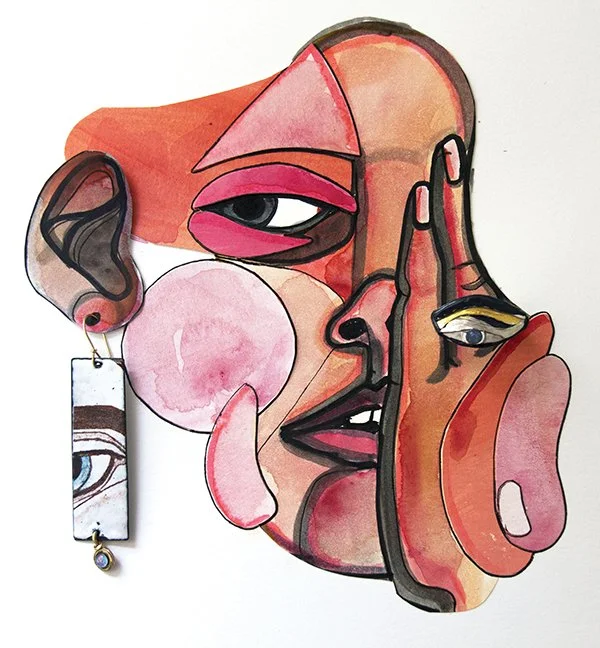
Collage featuring copper enameled decal and opal earring and 24k Kuemboo, opal sterling ring in the show "Layered Together,'' at the Gallery at WREN in Bethlehem, N.H.
The gallery says:
“This intergenerational display showcases the intertwined artistic journeys of mother and daughter Beth Simon and Ana Koehler. Beth’s distinctive crafted jewelry, alongside Ana’s evocative paintings of the female form, take center stage.’’
New England stone walls house many creatures

Excerpted/edited from an ecoRI News article by Colleen Cronin
LITTLE COMPTON, R.I.
A look at a stone wall on Roger and Gail Greene’s property — they guessed the structure dates back to the early 1800s or even late 1700s — suggests that every rock and cranny is a world unto its own.
A black cherry tree stretched its way up and out from underneath — a gift likely planted by a bird who had perched on its stones decades ago, Roger said. Minty green lichen made splotches on gray rocks. A pickerel frog with skin like a snake hopped its way through leaf litter and low grasses to a hiding space before an ecoRI News reporter could get a good photo.
Stone walls originally marked the boundaries of farms, but now they have become homes to many different types of creatures.

William Morgan: Ruminations on an old postcard from Maine

Porter Memorial Library, Machias, Maine. Hand-colored postcard.
Once again, an antique postcard yields memories as well as mysteries. My investment of $1.50 to buy an old card led to down-the-rabbit-hole ruminations.
Posted in Machias on Aug. 22, 1906 (Theodore Roosevelt was President); Maine had been a state for only 86 years. The sender, from what we can make out from the pencil scratches on the picture side of the card, was the sister of the recipient, Miss Edris Tillinghast. Tillinghast is a Rhode Island name, but Edris strikes one as one of those late Victorian family names, yet it is well enough known in Wales. Was Miss Edris visiting in Westerly? (Her address is in care of “Wm. Barnes, RFD” (Rural Free Delivery) – her family rusticating on a farm, perhaps)? Or was the sister traveling in far Downeast Maine?

Post card from Hugh C. Leighton Co., Portland, but printed in Germany
The Tillinghast sisters and their undocumented peregrinations may had faded into the mists of time, but the library building in the Washington County seat has remained pretty much unchanged. Chicago businessman and Machias native Henry Holmes Porter gave the money to erect the library in memory of his father, Rufus King Porter, in 1891.
The architect of the Porter Library was George Clough, who hailed from Blue Hill, Maine, and was a successful practitioner in Boston. He designed the Suffolk County Courthouse, on Pemberton Square, Boston, and he was that city’s first City Architect, a position to which he was elected in 1876 and served for seven years. He also designed the public libraries for the Maine towns of Rockland, Bucksport and Vinalhaven.
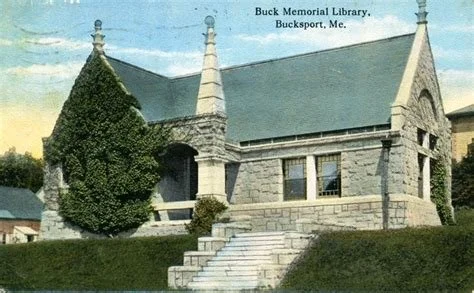
Postcard of Buck Memorial Library, Bucksport.
Clough’s inspiration for Machias was the Romanesque Revival-style libraries of Henry Hobson Richardson in such suburban Boston towns as Woburn, North Easton and Quincy. Richardson was best known as the architect of Trinity Church at Copley Square in Boston, but his small-town libraries are among his most satisfying works. Clough was one of many New England library builders who borrowed from the Richardsonian formula of monumental reading room, wing for the stacks and ceremonial civic entrance.

Crane Memorial Library, by Henry Hobson Richardson, in Quincy, Mass.
-- Photo by William Morgan
Providence-based writer and photographer William Morgan is the author of a number of books on New England architecture, including A Simpler Way of Life: Farmhouses of New York and New England and Monadnock Summer: The Architectural Legacy of Dublin, New Hampshire.

ADU’s in tight cities

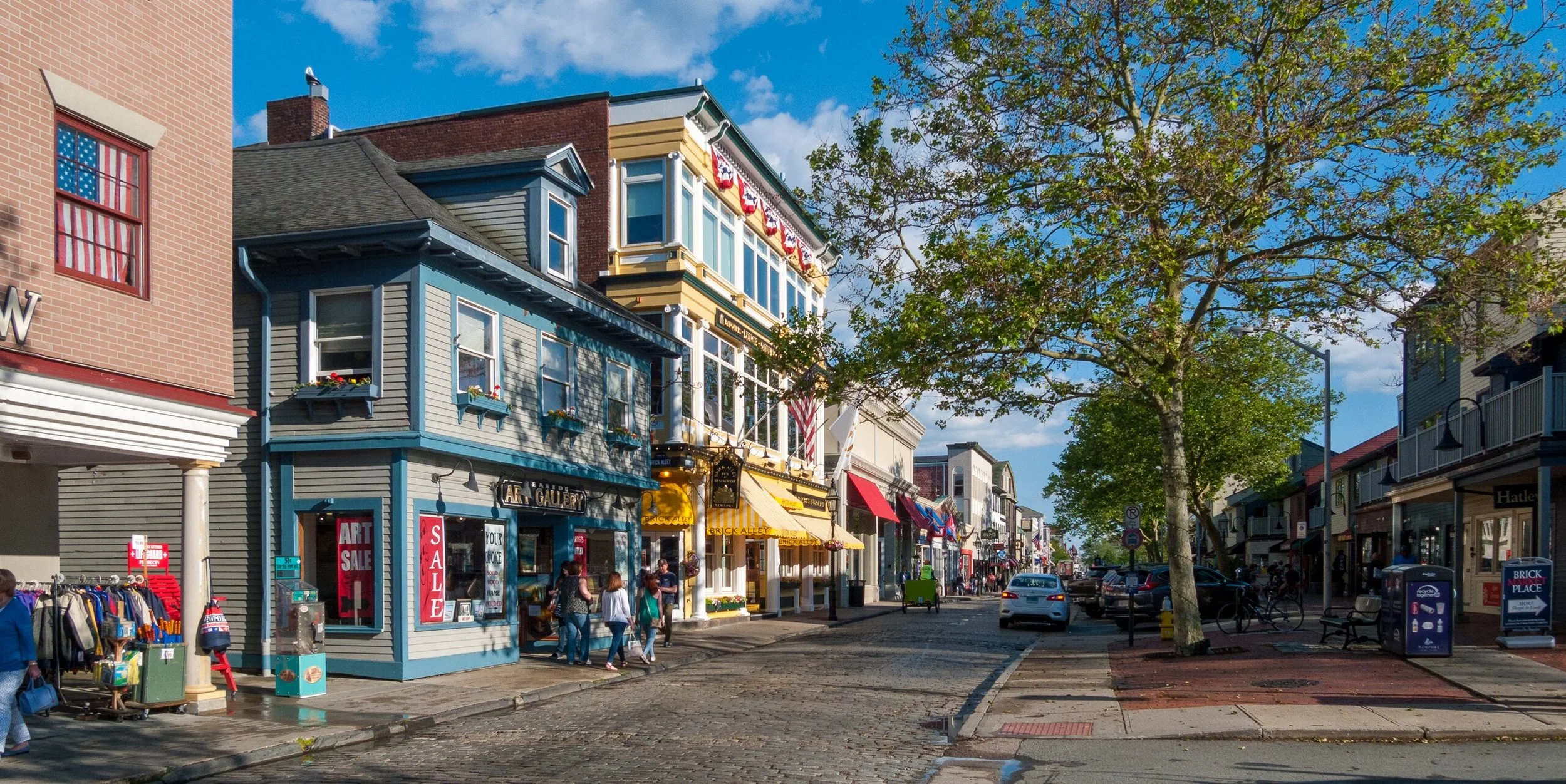
Thames Street, the best-known retail strip in Newport. (Photo by Kenneth C. Zirkel)
Adapted from Robert Whitcomb’s “Digital Diary,’’ in GoLocal24.com
Tight little Newport, R.I. and many other places, seek to address the housing shortage and cost by encouraging the construction of accessory dwelling units (ADUs) on owner-occupied residential property. This housing is generally supposed to be primarily for elderly and/or disabled people, and in The City by the Sea would be limited to one-bedroom and studio units of no more than 900 square feet and two-bedroom units at 1,200 square feet.
Certainly creating more space for the elderly, the fastest-growing part of the population, is a fine idea! Rhode Island is ranked as eleventh among the states in its percentage of people 65 and over. We’ll see if many much younger people end up living in the ADU’s, whatever the laws. Meanwhile, using them for short-term rentals – a temptation in mega summer resort city Newport – is banned. All this will be tough to monitor.
Then there’s the always tricky parking issue. While the new rules say that no additional parking would be required for a new ADU, currently required parking removed as part of building an ADU would have to be replaced.
I’ll be curious to see if many people without cars move into the ADU’s, opting to rely on bikes, Uber and Lyft, and public transit instead. Maybe many of them will be young adults.
In any event, increasing the supply of housing is essential, but tough. Too many people oppose greater density, even as the population swells. They want wide-open spaces in their neighborhoods.
‘Seducing guests’

“Self Portrait,’’ by Connecticut photographer Adrien Broom, in her show “Mystical Murmurs: An Enchanted Environment,’’ at the Florence Griswold Museum, Old Lyme, Conn., Sept. 28-Nov. 3
The museum explains:
“In this immersive exhibition contemporary artist, photographer, set designer, and filmmaker Broom (b. 1980) invites audiences to experience the mysterious world of the forest and imagine themselves at faerie-scale. Encounter a magical installation inspired by the natural environment and folklore. Drawing on medieval European folk beliefs and superstitions, visitors are enticed to step inside an oversized mushroom ring, triggering entrancing songs, and seducing guests to dance beyond time.’’

Chris Powell: What do college demonstrators in Conn. and elsewhere mean by ‘Free Palestine’?

Pro-Palestinian demonstration by students near Harvard University, in Cambridge, Mass.
MANCHESTER, Conn.
College is back in session and students are returning not just to their studies but also to protests on campus about the war in Gaza. At the University of Connecticut at Storrs, Yale University in New Haven, and other institutions, students are chanting and carrying signs reading "Free Palestine!"
Journalism not being what it used to be, since literacy and civic engagement aren't either, no one seems to be asking the students exactly what they mean by "Free Palestine!" and how that objective should be achieved.
So how do the student protesters define Palestine? Do they define it as most Palestinians themselves do, as encompassing the land "from the river to the sea" -- the land between the Jordan River and Mediterranean -- thus liquidating Israel, as Palestinians often have tried to do in war since the area was partitioned into Jewish and Arab sections by resolution of the United Nations in 1948, and as they are doing again now?
Do the student protesters define Palestine as something that leaves room for Israel -- a Palestine consisting of Gaza, which Israel evacuated in 2005, and the "occupied West Bank," the land between Jordan and Israel proper, most of which Israel agreed to evacuate during negotiations sponsored by President Bill Clinton in 2000?
If the student protesters define Palestine as the Clinton plan did, they might want to ask the people on whose behalf they're protesting why they can't accept such a compromise even now that the war that Gaza launched against Israel last October has brought catastrophic bloodshed and ruin to the territory. The students should explain why Palestinian irredentism is worth so much.
And what do the student protesters mean by "free"? Do they mean civil liberties -- speech, press, assembly, religion, due process of law, women's rights, and sexual orientation -- liberties enjoyed in the United States, Western Europe, and Israel, but not in Gaza and West Bank areas under Palestinian control, nor, indeed, anywhere in the Arab world? If that's what the student protesters mean, they should go to Gaza or the West Bank and try to exercise such freedoms there, after making provision for the transport home of their corpses.
Or do the student protesters understand "free Palestine" as most Palestinians appear to understand it -- a land free of Jews, a land free to attack a neighboring state and people, bombarding, murdering, raping, and kidnapping whenever the necessary strength has been regained during another "ceasefire"?
Yes, the war in Gaza is horrifying. But then wars against totalitarians seldom can be won politely. The war against the totalitarian aggressors of World War II, Germany and Japan, were won only by leveling both countries, killing millions of civilians, and then remaking the totalitarian societies through long military occupations.
If the student protesters think there is another way, they should spell it out and offer it to the warring parties. They may find, as Clinton did, that making peace requires more than pious hand-wringing on a peaceful campus far away from cutthroats whose hatred and brutality far surpass anything the students can imagine.
TREATMENT ISN'T ENOUGH: School officials and social workers report that Connecticut is facing an epidemic of mental illness among young people -- not just teens in high school but also children in elementary and middle school. There is clamor for state government to spend more for treatment and school mental-health clinics, as if that will solve the problem.
Little attention is being paid to the cause of the youth mental-illness epidemic. The recent virus epidemic and its disruption of school and home life is an easy explanation, but that epidemic is long over. Something else must be wrong. Child neglect was already bad when the virus struck. Because inflation soared during much of the time since the epidemic started, real incomes for many have fallen. That may have worsened neglect.
Treatment isn't enough. The General Assembly and Gov. Ned Lamont should strive to discern and eradicate the causes of youth mental illness.
Chris Powell has written about Connecticut government and politics for many years (CPowell@cox.net).
Where we all end up

"From the Wreckage" (collage, screenprint, cut book pages, acrylic paint, charcoal, paper bag, Sumi-e ink, sand), by Michele L'Heureux, at the Narrows Center for the Arts, Fall River, Mass.
-- Photo by the Artist

Llewellyn King: Coming soon — AI travel agents instead of human ones

Your agents? The word "robot" was coined by Karel Čapek in his 1921 play R.U.R. — standing for "Rossum's Universal Robots".
WEST WARWICK, R.I.
The next big wave in innovation in artificial intelligence is at hand: agents.
With agents, the usefulness of AI will increase exponentially and enable businesses and governments to streamline their operations while making them more dependable, efficient and adaptable to circumstance, according to Satya Nitta, co-founder and CEO of Emergence, the futuristic New York-based computer company.
These are the first AI systems that can both speak with humans and each other conversationally, which may reduce some of the anxiety people feel about AI — this unseen force that is set to transform our world. These agents use AI to perceive their environment, make decisions, take actions and achieve goals autonomously, Nitta said.
The term “situational awareness” could have been created for agents because that is the key to their effectiveness.
For example, an autonomous vehicle needs a lot of awareness to be safe and operate effectively. It needs every bit of real-time knowledge that a human driver needs on the roadway, including scanning traffic on all sides of the vehicle, looking out for an approaching emergency vehicle or a child who might dash into the road, or sensing a drunk driver.
Emergence is a well-funded startup, aiming to help big companies and governments by designing and deploying agents for their most complex operations.
It is perhaps easier to see how an agent might work for an individual and then extrapolate that for a large system, Nitta suggested.
Take a family vacation. If you were using an agent to manage your vacation, it would have to have been fed some of your preferences and be able to develop others itself. With these to the fore, the agent would book your trip, or as much of it as you wished to hand to the agent.
The agent would know your travel budget, your hotel preferences and the kinds of amusements that would be of interest to your family. It would do some deductive reasoning that would allow for what you could afford and balance that with what is available. You could discuss your itinerary with the agent as though it were a travel consultant.
Nitta and Emergence are designing agents to manage the needs of organizations, such as electric utilities and their grids, and government departments, such as education and health care. Emergence, along with several other AI companies and researchers, has signed a pledge not to work on AI for military applications, Nitta said.
Talking about agents that would be built on open-source Large Language Models and Large Vision Models, Nitta said, “Agents are building blocks which can communicate with each other and with humans in natural language, can control tools and can perform actions in the digital or the physical world.”
Nitta explained further, “Agents have some functional capacity. To plan, reason and remember. They are the foundations upon which scalable, intelligent systems can be built. Such systems, composed of one or more agents, can profoundly reshape our ideas of what computers can do for humanity.”
This prospect is what inspired the creation of Emergence and caused private investors to plow $100 million in equity funding into the venture, and lenders to pledge lines of credit of another $30 million.
Part of the appeal of Emergence’s agents is that they will be voice-directed and you can talk to them as you would to a fellow worker or employee, to reason with them, perhaps.
Nitta said that historically there have been barriers to the emergence of voice fully interfacing with computing. And, he said, there has been an inability of computers to perform more than one assignment at a time. Agents will overcome these blockages.
Nitta’s agents will do such enormously complex things as scheduling the inputs into an electricity grid from multiple small generators or calculating weather, currents and the endurance of fishing boats and historical fish migration patterns to help fishermen.
At the same time, they will be adjusting to changes in their environment, say, for the grid, a windstorm, or the fish are turning south not east, as expected, or if the wholesale price of fish has dropped to change the economics of the endeavor.
To laymen, to those who have been awed by the seeming impregnable world of AI, Emergence and its agent systems is reassuring because you will be able to talk to the agents, quite possibly in colloquial English or any other language.
I feel better about AI already — AI will speak English if Nitta and his polymaths are right. AI, we should talk.
Llewellyn King is executive producer and host of White House Chronicle, on PBS. His email is llewellynking1@gmail.com and he’s based in Rhode Island.
‘Comfort without answers’
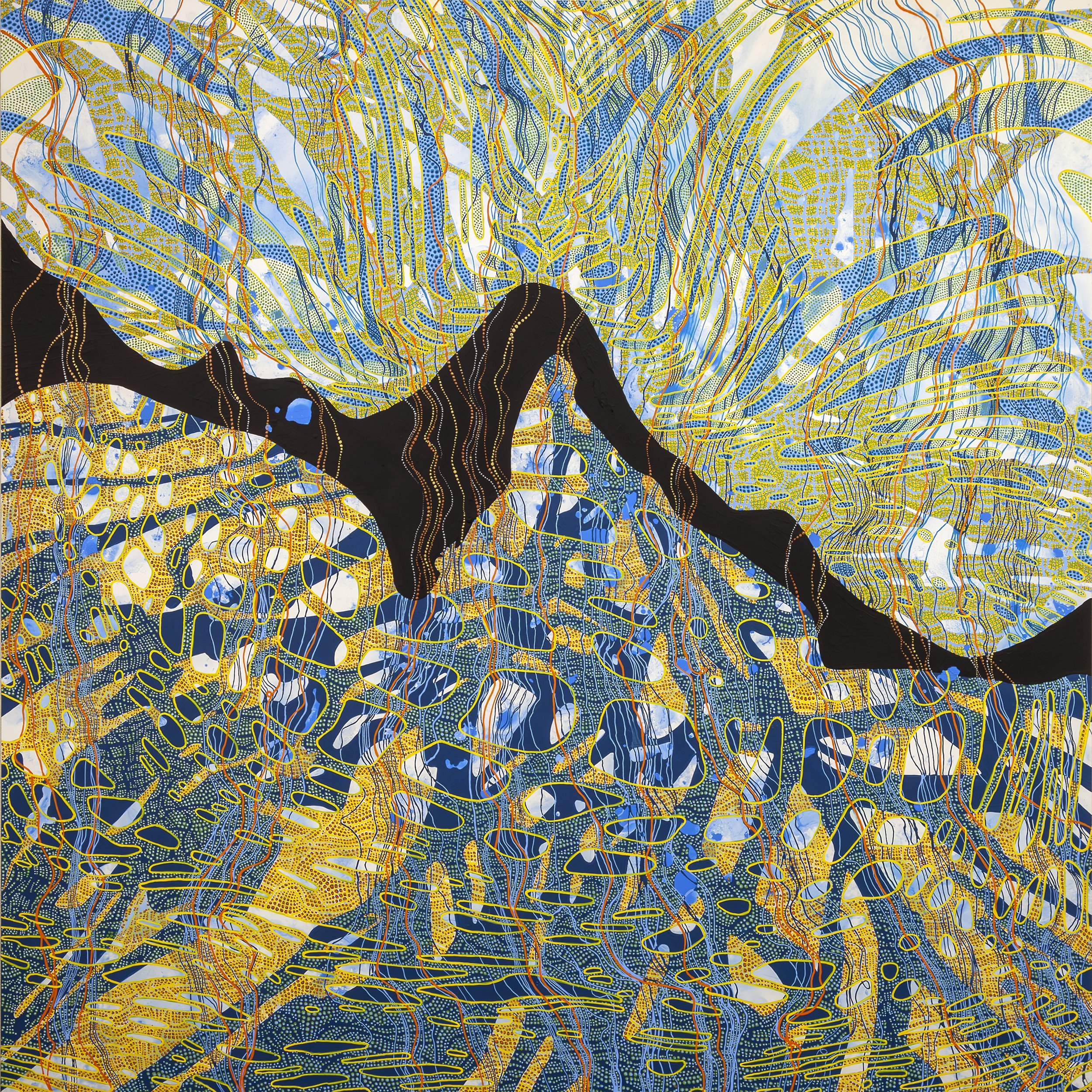
“Here Yet,’’ by Lynda Schlosberg, in her show “Somewhere in Between,’ at Kingston Gallery, Boston, through Sept. 29.
The gallery says:
“The paintings in ‘Somewhere in Between’ span the last three years of an ever-shifting existence. Floating in a state of limbo somewhere between life and death, between here and there, between then and now and what is yet to be. Traversing wandering threads of individual and connected lives as they pass through time and space. Exploring uncertainty of the unknown and seeking comfort without answers.’’
Fronting the opposition

Lobster boats

A shellfish farm in Maine, with fog behind the trees.
-- University of Oregon photo
There’s been quite a recent pattern on the New England coast of rich people trying to stop such newish developments as shellfish and seaweed aquaculture and wind turbines. They often do this by setting up nonprofit organizations on whose boards they stick lobstermen and other local salt-of-the-earth types as PR fronts, or if not on the boards, as spokespersons.
(Shellfish and seaweed farmers are, as a group, far from rich.)
Thus it is with Paul Coulombe, the owner of the Boothbay Harbor Country Club and Boothbay Harbor Oceanside Golf Resort, and a big promoter of luxury shoreline development. Mr. Coulombe, who made millions from the liquor business and was a big supporter of the eccentric former far-right Maine Gov. Paul LePage, has given several tens of thousands to an anti-aquaculture outfit called Protect Maine’s Fishing Heritage Foundation. Its funding and some of the characters behind it remain a bit murky, perhaps intentionally.
Sometimes people oppose newish and environmentally (mostly) beneficial projects because they just don’t want to look at them. In other cases, they think that the new sectors will, or at least might, hurt their businesses.

‘In the service of the sublime’

“Sucker for Sunsets” (retired blended synthetic hawser), by Alex Buchanan, in his show “Abberation’’, at the New Bedford Art Museum, through Oct. 27.
— Image courtesy of the New Bedford Art Museum
From the museum:
“The displays the work of former mariner Alex Buchanan, who takes rope, fishing nets and steel from clam cages and combines those materials with nautical knot tying to ‘[lift] them out of the realm of utilitarian activity transfiguring them in the service of the sublime,’ according to a curatorial statement. Buchanan's large-scale sculptures of rope, metal and other recycled materials ‘display a commanding technical bravura and an undeniable presence’ while also seeming soft, familiar and nostalgic for anyone who grew up in a coastal community.”
If not now, when?

“The time is now at hand when we shall see whether America has virtue enough to be free or not.”
— Josiah Bartlett (1729-1795), from New Hampshire, was a U.S. Founding Father, first governor of the Granite State and a physician. The quote above was spoken in 1776, before the Declaration of Independence.
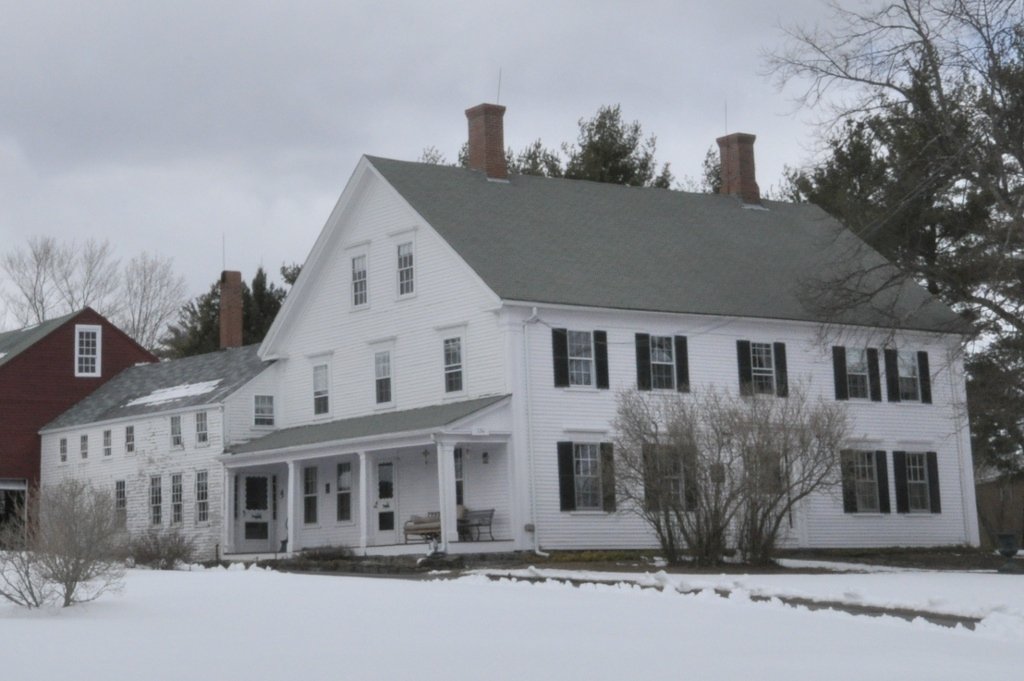
Josiah Bartlett House in Kingston, N.H., a National Historic Landmark, built in 1774
‘All song of the woods is crushed’
From the Nuremberg Chronicle of 1493
The line-storm clouds fly tattered and swift,
The road is forlorn all day,
Where a myriad snowy quartz stones lift,
And the hoof-prints vanish away.
The roadside flowers, too wet for the bee,
Expend their bloom in vain.
Come over the hills and far with me,
And be my love in the rain.
The birds have less to say for themselves
In the wood-world’s torn despair
Than now these numberless years the elves,
Although they are no less there:
All song of the woods is crushed like some
Wild, easily shattered rose.
Come, be my love in the wet woods; come,
Where the boughs rain when it blows.
There is the gale to urge behind
And bruit our singing down,
And the shallow waters aflutter with wind
From which to gather your gown.
What matter if we go clear to the west,
And come not through dry-shod?
For wilding brooch shall wet your breast
The rain-fresh goldenrod.
Oh, never this whelming east wind swells
But it seems like the sea’s return
To the ancient lands where it left the shells
Before the age of the fern;
And it seems like the time when after doubt
Our love came back amain.
Oh, come forth into the storm and rout
And be my love in the rain.
“A Line-Storm Song,’’ by Robert Frost (1874-1963). A “line storm” was a term once very common in New England that usually referred to a coastal storm (sometimes of tropical origin) coming up the coast in September or early October. People called them line storms because they came around the time that the sun “crossed the line,” that is, the fall equinox.
‘Almost a selfish act’
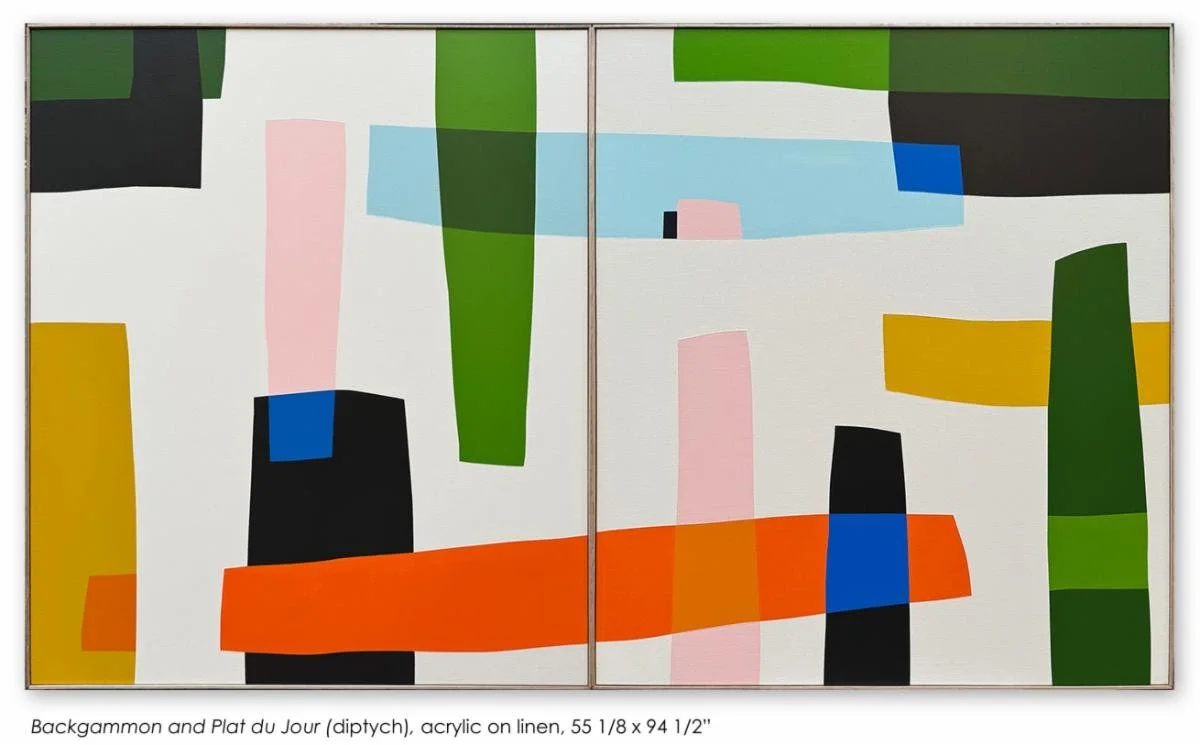
In Francois Bonnel's show "La Part Belle,'' at Lanoue Gallery, Boston, through Sept. 27.
Francois Bonnel is a contemporary French painter known for his minimalist, mid-century modern aesthetic.
His Web site says:
“For François Bonnel, ‘painting is pure pleasure, I don’t paint to convey a message or a philosophy, it’s almost a selfish act’. Inspired by his everyday environment and the music he listens to, musicality is often integrated into his work, forming a unique personal pictorial language that expresses his emotional memories through elements of form, colour, line and space”
Designing Springfield's downtown through the years
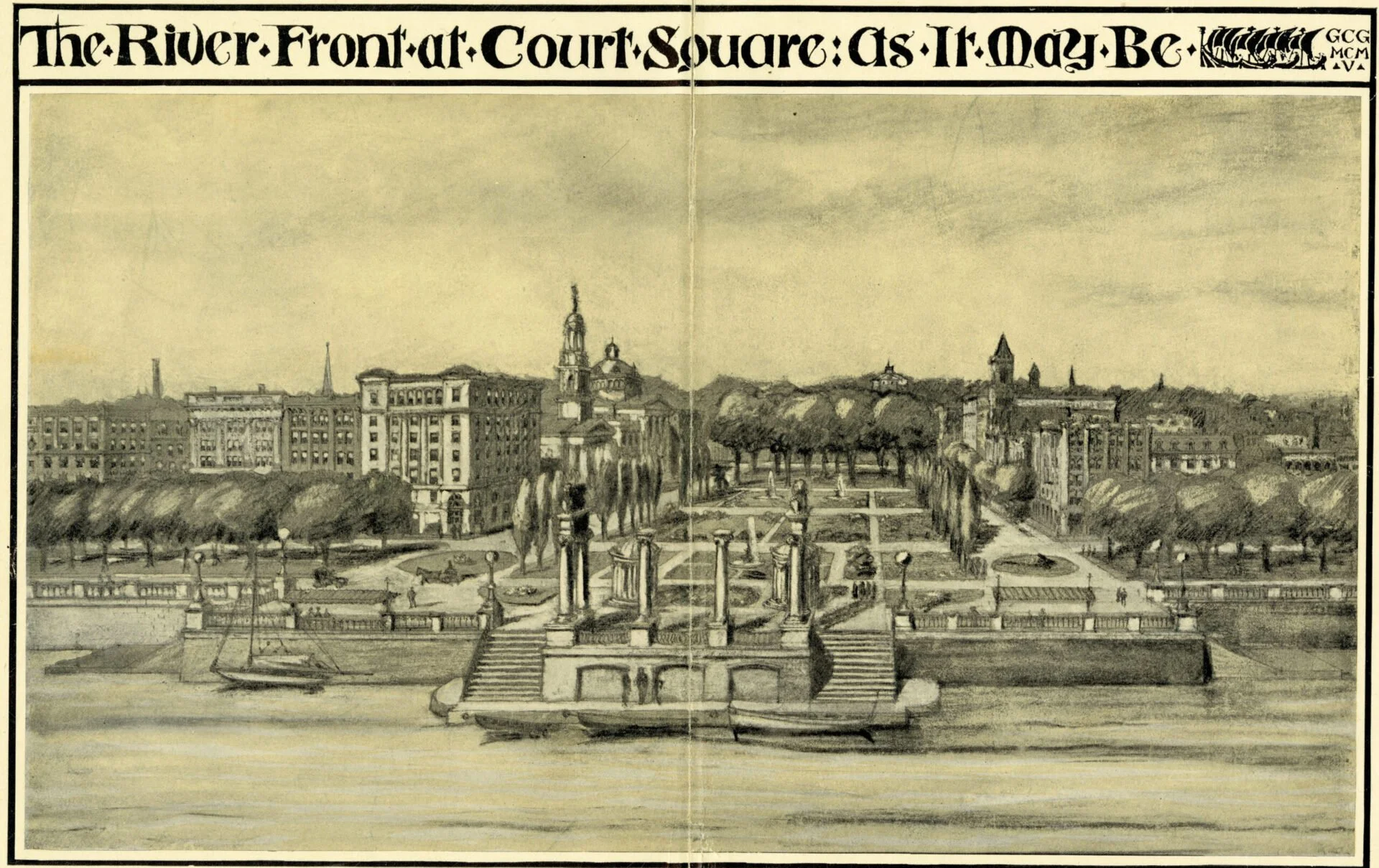
From the “Designing Downtown” show at the Wood Museum of Springfield (Mass.) History through March 30.
The museum explains:
“Explore the history of downtown Springfield through centuries of plans that were never brought to fruition. Maps, drawings, blueprints, and more documents created by local citizens and nationally known city planners offer a glimpse into Springfield as it could have been and, at the same time, how the modern city came to be.
“Visitors can recreate a 1908 vote on the design of City Hall and can explore renowned landscape designer Frederick Law Olmsted Jr.’s plan for a ‘Washington Mall’-inspired design for Court Square in expanded detail using touchscreen technology. Visitors will leave the exhibition with a new appreciation for the shape of Springfield, with an eye towards its future development as the city continues to expand.’’

UMaine is looking into creating public medical school to address rural physician shortage

Edited from a New England Council report
“The University of Maine System has announced it will work with a national consultant to examine the viability of launching the state’s first public medical school in response to a critical shortage of physicians in rural Maine.
“This concept has gained support from several associations, and UMS received state funding last year to undertake the study. The study comes as Maine’s only medical school—the University of New England’s College of Osteopathic Medicine—prepares to relocate from Biddeford to a newly expanded campus in Portland.
“‘The University of New England is always eager to partner with our colleagues at the University of Maine System and is proud of the mutually beneficial partnerships we have established with the system,’ said James Herbert, UNE’s president.’’
Read more in Mainebiz.
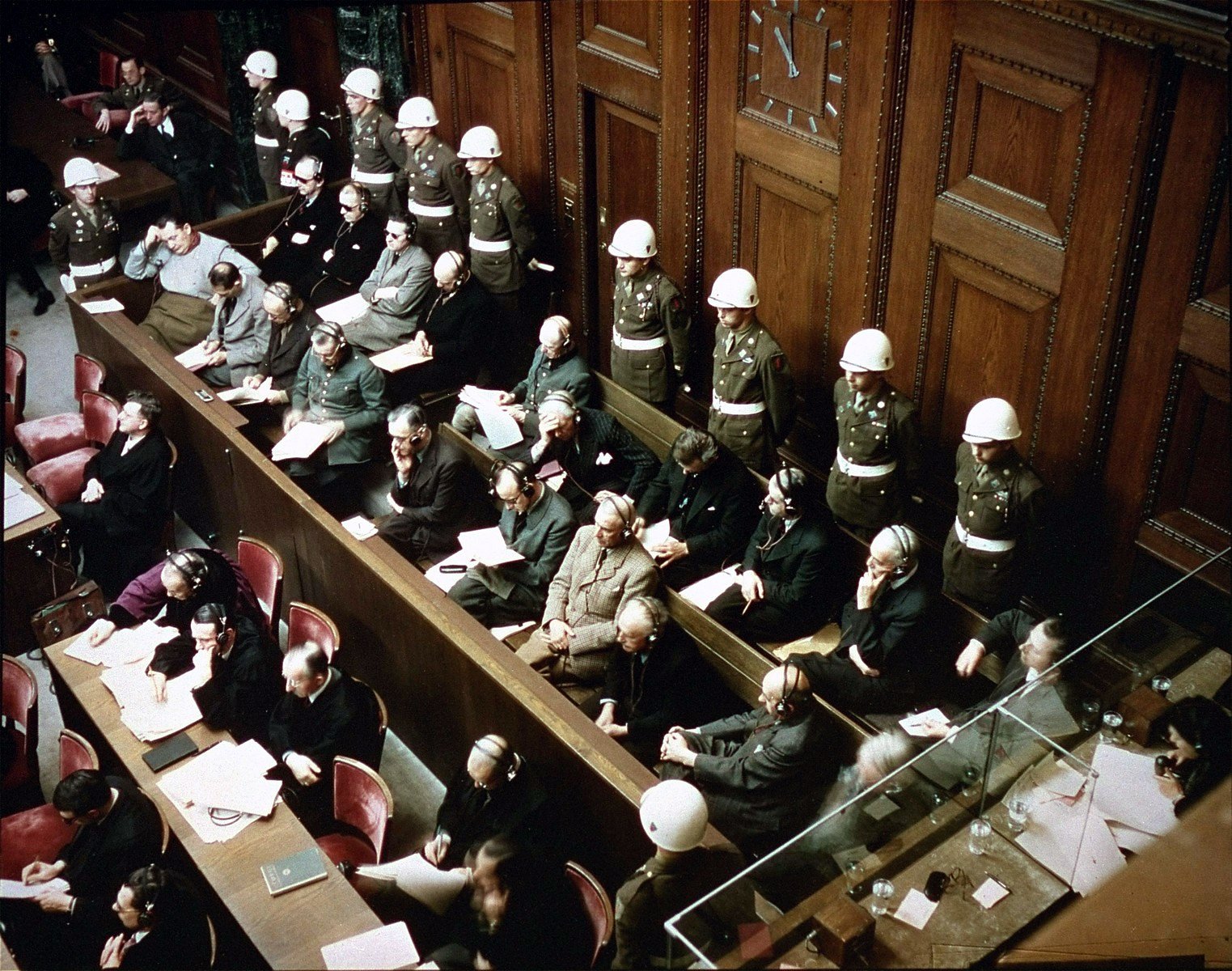
George J. Annas: Nuremberg code not just for Nazis
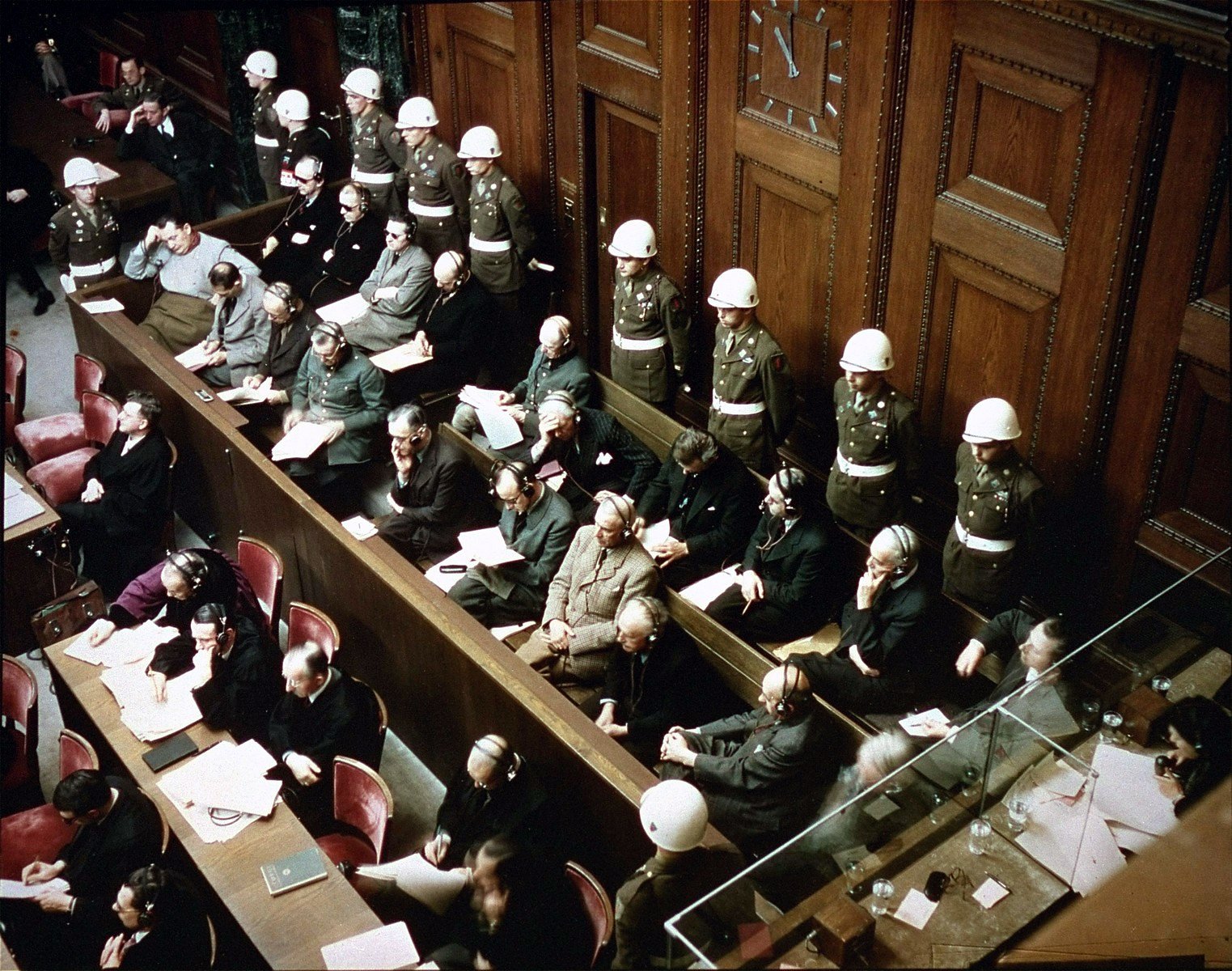
Nazi defendants at the Nuremberg trials
BOSTON
After World War II, Nuremberg, Germany, was the site of trials of Nazi officials charged with war crimes and crimes against humanity. The Nuremberg trials were landmarks in the development of international law. But one of them has also been applied in peacetime: the “Medical Trial,” which has helped to shape bioethics ever since.
Twenty Nazi physicians and three administrators were tried for committing lethal and torturous human experimentation, including freezing prisoners in ice water and subjecting them to simulated high-altitude experiments. Other Nazi experiments included infecting prisoners with malaria, typhus and poisons and subjecting them to mustard gas and sterilization. These criminal experiments were conducted mostly in the concentration camps and often ended in the death of the subjects.
Lead prosecutor Telford Taylor, an American lawyer and general in the U.S. Army, argued that such deadly experiments were more accurately classified as murder and torture than anything related to the practice of medicine. A review of the evidence, including physician expert witnesses and testimony from camp survivors, led the judges to agree. The verdicts were handed down on Aug. 20, 1947.
As part of their judgment, the American judges drafted what has become known as The Nuremberg Code, which set forth key requirements for ethical treatment and medical research. The code has been widely recognized for, among other things, being the first major articulation of the doctrine of informed consent. Yet its guidelines may not be enough to protect humans against new potentially “species-endangering” research today.
The code consists of 10 principles that the judges ruled must be followed as both a matter of medical ethics and a matter of international human rights law.
The first and most famous sentence stands out: “The voluntary consent of the human subject is absolutely essential.”
In addition to voluntary and informed consent, the code also requires that subjects have a right to withdraw from an experiment at any time. The other provisions are designed to protect the health of the subjects, including that the research must be done only by a qualified investigator, follow sound science, be based on preliminary research on animals and ensure adequate health and safety protection of subjects.
The trial’s prosecutors, physicians and judges formulated the code by working together. As they did, they also set the early agenda for a new field: bioethics. The guidelines also describe a scientist-subject relationship that obligates researchers to do more than act in what they think is the best interests of subjects, but to respect the subject’s human rights and protect their welfare. These rules essentially replace the paternalistic model of the Hippocratic oath with a human rights approach.
Four Polish women, including survivors of human experiments at concentration camps, arrive to serve as witnesses for the prosecution at the Doctors Trial. United States Holocaust Memorial Museum via Wikimedia Commons
Under President Dwight D. Eisenhower, who had been the commanding general in Europe, the U.S. Department of Defense adopted the code’s principles in 1953 – one sign of its influence. Its fundamental consent principle is also summarized in the U.N.’s International Covenant on Civil and Political Rights, which declares that “no one shall be subjected without his free consent to medical or scientific experimentation.”
Yet some physicians tried to distance themselves from the Nuremberg Code because its source was judicial rather than medical, and because they did not want to be linked in any way to the Nazi physicians on trial at Nuremberg.
The World Medical Association, a physicians group set up after the Nuremberg Doctors Trial, formulated its own set of ethical guidelines, named the “Helsinki Declaration.” As with Hippocrates, Helsinki permitted exceptions to informed consent, such as when the physician-researcher thought that silence was in the best medical interest of the subject.
The Nuremberg Code was written by judges to be applied in the courtroom. Helinski was written by physicians for physicians.
There have been no subsequent international trials on human experimentation since Nuremberg, even in the International Criminal Court, so the text of the Nuremberg Code remains unchanged.
New research, new procedures?
The code has been a major focus of my work on health law and bioethics, and I spoke in Nuremberg on its 50th and 75th anniversaries, at conferences sponsored by the International Physicians for the Prevention of Nuclear War. Both events celebrated the Nuremberg Code as a human rights proclamation.
Jadwiga Kaminska, who survived Ravensbruck concentration camp, testifies about the experimental operations she was forced to undergo there. Office of Military Government for Germany (U.S.) via Wikimedia Commons
I remain a strong supporter of the Nuremberg Code and believe that following its precepts is both an ethical and a legal obligation of physician researchers. Yet the public can’t expect Nuremberg to protect it against all types of scientific research or weapons development.
Soon after the U.S. dropped atomic bombs over Hiroshima and Nagasaki – two years before the Nuremberg trials began – it became evident that our species was capable of destroying ourselves.
Nuclear weapons are only one example. Most recently, international debate has focused on new potential pandemics, but also on “gain-of-function” research, which sometimes adds lethality to an existing bacteria or virus to make it more dangerous. The goal is not to harm humans but rather to try to develop a protective countermeasure. The danger, of course, is that a super harmful agent “escapes” from the laboratory before such a countermeasure can be developed.
I agree with the critics who argue that at least some gain-of-function research is so dangerous to our species that it should be outlawed altogether. Innovations in artificial intelligence and climate engineering could also pose lethal dangers to all humans, not just some humans. Our next question is who gets to decide whether species-endangering research should be done, and on what basis?
I believe that species-endangering research should require multinational, democratic debate and approval. Such a mechanism would be one way to make the survival of our own endangered species more likely – and ensure we are able to celebrate the 100th anniversary of the Nuremberg Code.
George J .Annas is director of the Center for Health Law, Ethics & Human Rights at Boston University.
George J. Annas does not work for, consult, own shares in or receive funding from any company or organization that would benefit from this article, and has disclosed no relevant affiliations beyond his academic appointment.
e
Dirty work



Patricia Rangel at work creating am abstract landscape. She's in the group show "Through Line,'' at the Lamont Gallery, in Exeter, N.H., Sept. 5-Nov. 23
The gallery says:
“Rangel responds to dirt as a material that can present vulnerability, failure, strength, and potential to promote growth and change. The structures she creates are composed of dirt and found materials from places that hold significance. For her, the intersecting and overlapping of lines in this work acts as a metaphor for navigating complex emotions and the potential and opportunity for growth.
xxx
“‘Through Line’ celebrates basic mark-making as a foundation for the remarkable. Each of the six artists on view explores line through the lens of their distinct practices and mediums, ranging from marker to string, chalk, and even dirt! Together, they apply their shared interest in using lines as the basis for their work to boldly illustrate how understated, rudimentary marks can be explored more deeply. Collectively, the artworks on view act as tributes to the mark, celebrating the multitude of ways lines can be made, manipulated, and made monumental.’’