
Chris Powell: More discipline would mean less racism in schools
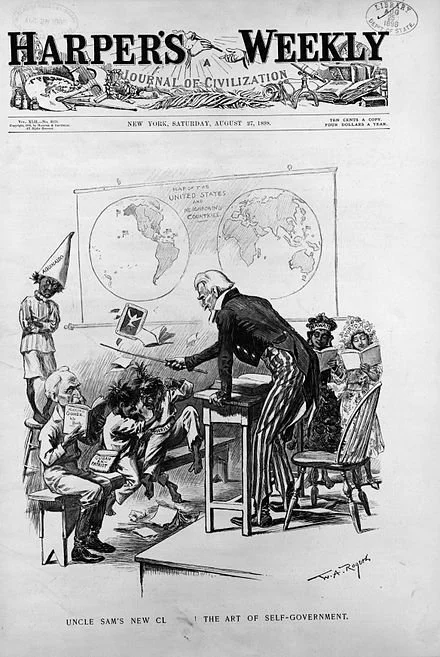
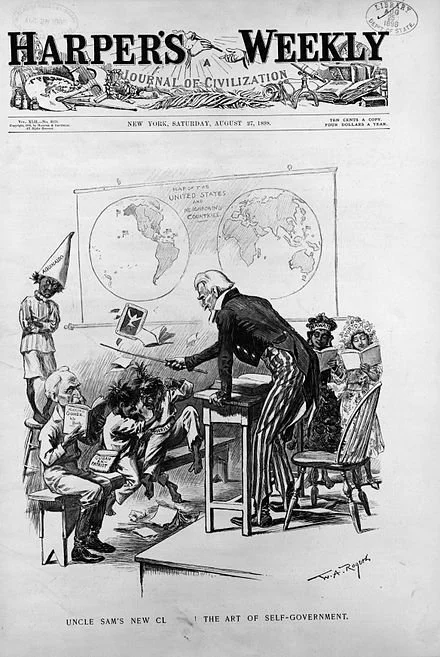
Harper's Weekly cover from 1898 shows a caricature of school discipline.
MANCHESTER, Conn.
Cromwell, Conn., lately has been convulsing over a student's at-first anonymous public complaints about racist or abusive conduct by other students in school.
What was the first action taken in response by the school administration and the town's Board of Education? Of course it was to hire a consultant -- an expert in "diversity, equity, and inclusion."
Cromwell's school officials may have been surprised to discover that children can be bratty and even vicious quite apart from anything related to "diversity, equity, and inclusion." Any personal characteristics can be targeted by childish brattiness and viciousness. Race is just one of many such opportunities.
Nobody who has spent time with children needs a "diversity, equity, and inclusion" consultant to know that. But such a consultant will just help school officials look sincere.
If school officials were ever really sincere about misbehavior by students, instead of hiring a consultant they might make it a practice to have every student interviewed confidentially every month by a teacher, administrator, or guidance counselor and asked about any problems they were having in school. At these interviews students would be instructed in or reminded of the necessity of decent behavior and the penalties for misconduct.
Each meeting would be summarized in writing by the interviewer and the student would be invited to add his own comment before both acknowledged the summary in writing and the summary was placed in the student's file. Specific complaints by a student would be promptly investigated. Due process would be provided and formal judgment issued, and upon any finding of misconduct, punishment imposed on the perpetrator.
Schools in Connecticut have a miserable reputation on their response to bullying, perhaps because discipline in school has become politically incorrect, which may be the precursor to much of the racism and misconduct being complained about lately.
But the problem of bratty and vicious kids and ineffective school administration is an old one, and the General Assembly may be even more oblivious to it than Cromwell seems to be.
After testimony from parents, teachers, psychiatrists, and others about hateful conduct among school children, the legislature's Committee on Children recently proposed legislation to appoint a "task force" to study it. Apparently the need for more discipline in school has not occurred to the committee.
Some Democratic legislators have soared beyond obliviousness on the issue. They have proposed legislation to prohibit colleges and universities from questioning applicants about any criminal records and discipline for misconduct in high school. That's the Democratic Party's approach to crime generally these days: to conceal it in support of claims that crime is down as society disintegrates.
One hardly needs to consult an expert in "diversity, equity, and inclusion" to figure out what will happen when word reaches high school students about the law forbidding colleges and universities from questioning applicants about their misconduct. Misconduct will be liberated.
It's still early in the legislative session and craziness like the college legislation may be weeded out. But given the legislature's far-left Democratic majority, it's just as likely that the college legislation will be amended to impose fines and prison time on any admissions officer who asks an applicant if he has murdered anyone lately.
MORE HIDDEN FEES: Connecticut Gov. Ned Lamont has a great idea. He wants the General Assembly to pass legislation to prohibit hidden fees on event tickets, hotel and short-term rental bills, and food and beverage sale and delivery services, "fees that are tacked on at the end of a consumer's transaction."
But why stop there? For the biggest perpetrator of hidden fees in Connecticut is state government itself.
It's not just the "public benefits" charges concealed in electricity bills -- transferring to paying customers the cost of electricity used by customers who don't pay, along with charges for government undertakings irrelevant to electrical generation.
It's also the wholesale tax imposed on fuels and the cost of state mandates on medical insurance, health care, and municipal government, costs passed along discreetly to customers and taxpayers.
Concert tickets are the least of the scam.
Chris Powell has written about Connecticut government and politics for many years (CPowell@cox.net).
Llewellyn King: Going dark? Crisis building in the U.S. electricity system
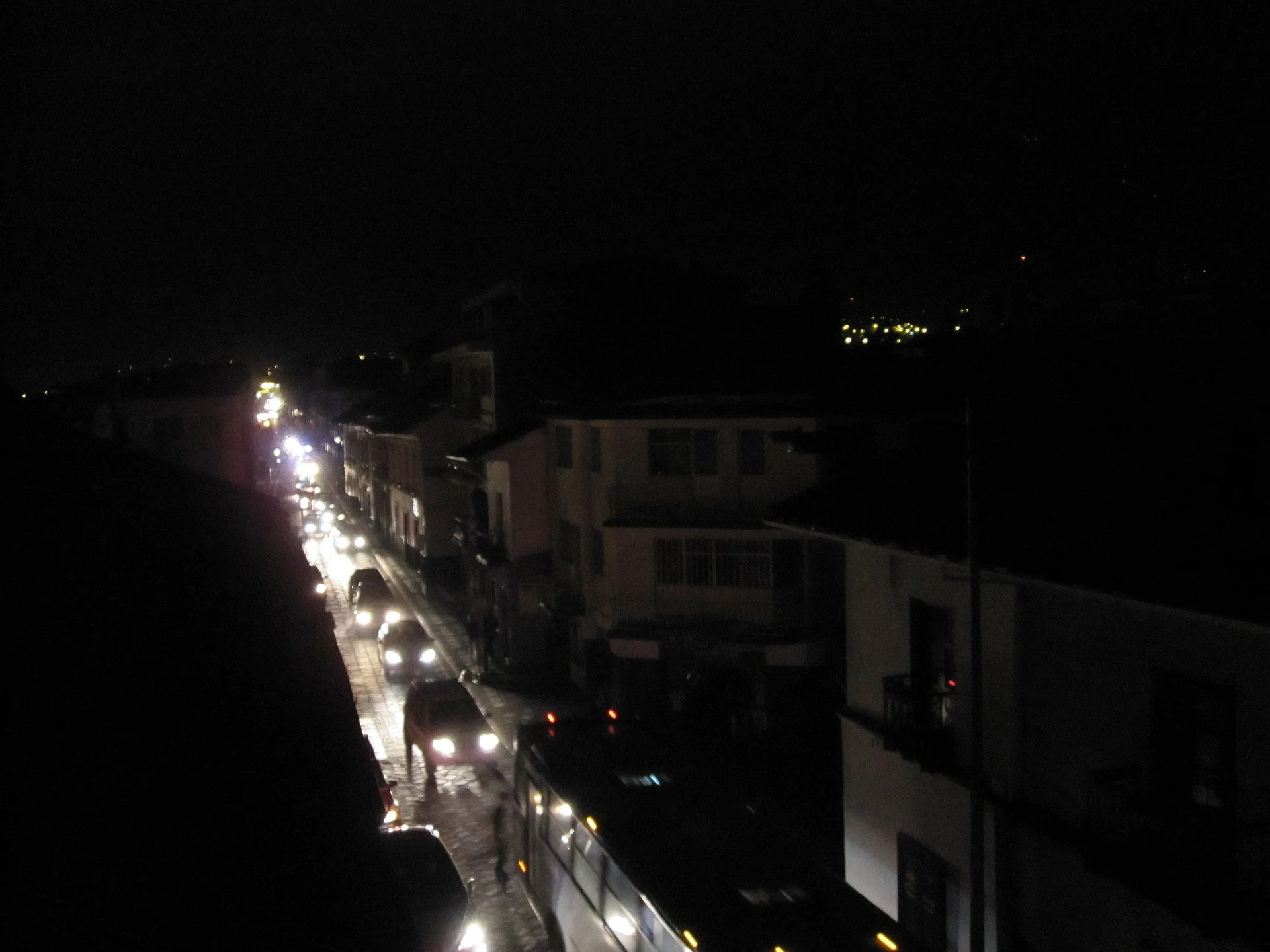
— Photo by Jen
WEST WARWICK, R.I.
There is a gathering storm over the nation's electric supply.
What has been described as the world’s biggest machine, the U.S. electricity system, is stressed — and that stress will increasingly affect reliability. That means sporadic blackouts, some extensive. While the nation won’t be plunged into total darkness, there will be regional difficulties, according to the industry’s own watchdog group, the North American Electric Reliability Corporation.
There are nearly 3,000 electric utilities in the United States and what is known as the grid is, in fact, three grids: the Eastern, the Western and Texas. The first two interconnect and flow power back and forth where possible, but Texas is separate — and not subject to the regulation by the Federal Energy Regulatory Commission.
There are three classifications of electric utilities: the big investor-owned companies such as Pacific Gas & Electric, ConEd, and the operating units of the giant Southern Co.; the 2,000 public power companies, usually municipally owned and a few, such as the Tennessee Valley Authority, federal government-owned, and the rural electric cooperatives, which can be quite large or very small. Together they operate the grids in surprising harmony and collegial cooperation.
The price of electricity is rising faster than general inflation, according to the Energy Information Administration — a sure sign of building pressure on the companies.
The causes of this stress are many. First, there is more demand for electricity across the board. That demand is rising at about 2 percent a year and the rate of increase may accelerate after 2026.
Contributing to the demand is the proliferation of data centers and their huge appetite for electricity – an appetite now fed by artificial intelligence and its increasing use everywhere.
Then there is the impact of environmentally driven demand: switching heavy industry from using fossil fuels to using electricity for high-energy uses like steel-making. This is set to grow.
In the same way, the use of electrified transportation is upping its share of electricity demand: It isn’t just Priuses and similar personal vehicles but big fleets, particularly for in-city deliveries. The U.S. Postal Service, Amazon and other fleet users are converting to electricity. Burns & McDonnell, the Kansas City, Mo.-based engineering, architecture, construction, environmental and consulting solutions firm, estimates half of intracity deliveries will be with electric vehicles by the end of the decade.
Increasingly, new homes will be all-electric — this as the future of natural-gas supplies is compromised by public policy.
Exacerbating instability in the electric sector has been the swing from fossil fuel generation — primarily coal and natural gas — to renewables. Those simply aren’t always available. The race is on for better batteries and storage of all kinds to smooth out the variability of wind and solar, especially wind.
Nonetheless, the pressure is constant to close coal and gas plants, which have always available generation, known in utility parlance as “dispatchable,” and account for 19 percent and 38 percent of generation respectively. It adds to the difficulties in keeping the lights on.
The dilemma was set out for me by Duane Highley, CEO of Tri-
State Generation & Transmission, based in Westminster, Colo. It provides power to 42 rural co-ops in four states.
Highley explained the new instability in industry like this, “The rapid rate of retirement of dispatchable generators has raised concerns among our membership about the reliability of the greater grid.”
He said that the industry can and is achieving rapid rates of emissions reduction but will still need “an appropriate amount of cost-effective dispatchable generation.”
Today, Highley said, this is provided by coal and natural gas. And this power will be needed to ensure a reliable and resilient grid as the demand for electricity increases.
“The traditional metrics utilities have used to model reliability can no longer demonstrate grid resilience as we rely more on intermittent weather-dependent resources.”
Tri-State, Highley said, is “working with its members on new reliability methodology to assure we have sufficient capacity, even with high levels of renewable generation.”
Electricity loss is a lethal matter.
In Texas 254 people, by official count, died when some of the grid went down during the blackout, caused by Ice Storm Uri, in 2021. And in last year’s heat dome over Arizona, the state estimates 654 people died from heat-related causes in Maricopa County alone.
Clearly, job one is to keep the lights on before we retire the tried-and-true generating plant of yesterday. Life depends on it.
Llewellyn King is executive producer and host of White House Chronicle, on PBS. His email is llewellynking1@gmail.com and he’s based in Rhode Island.
Ukrainian modern art and national identity
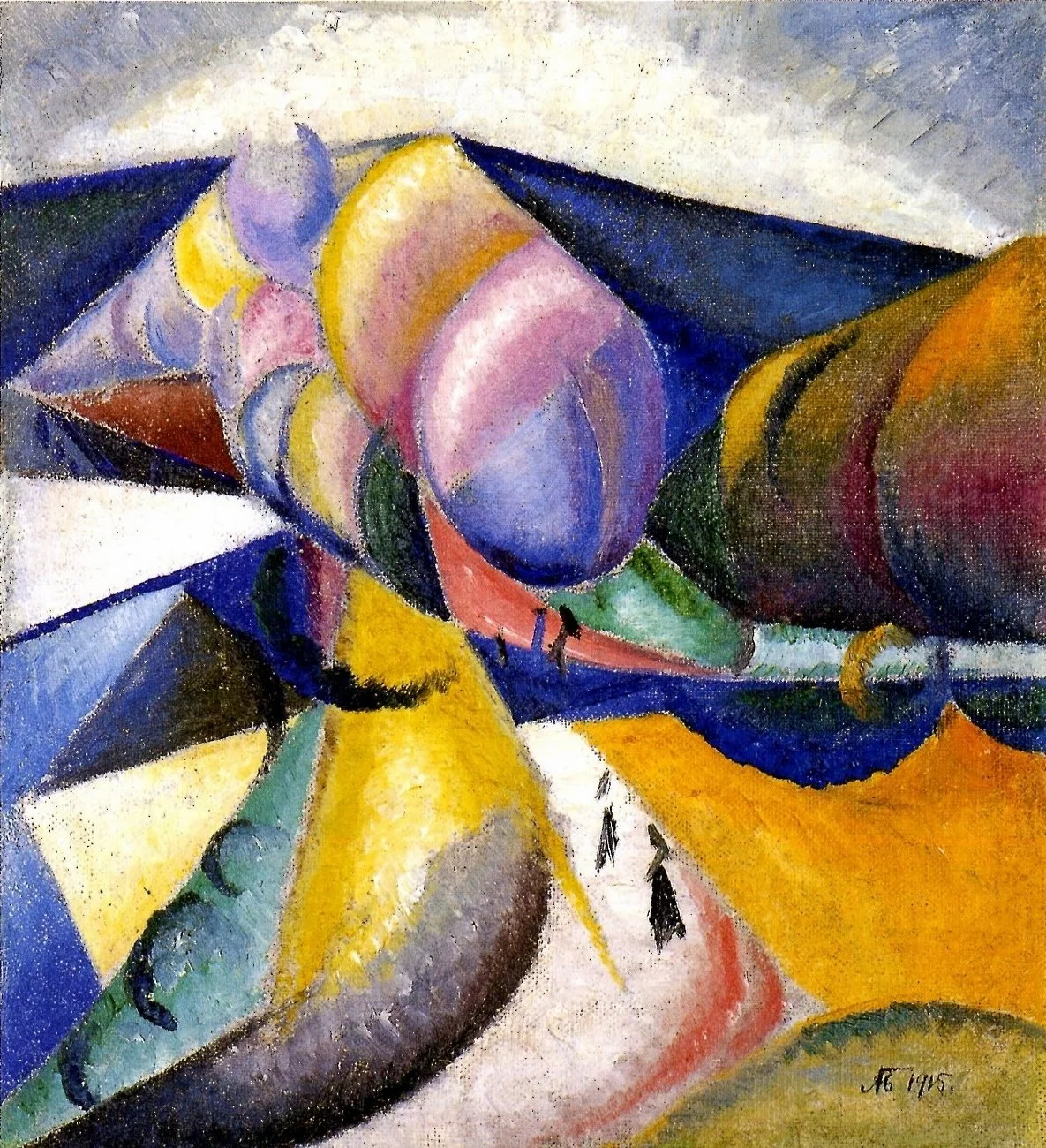
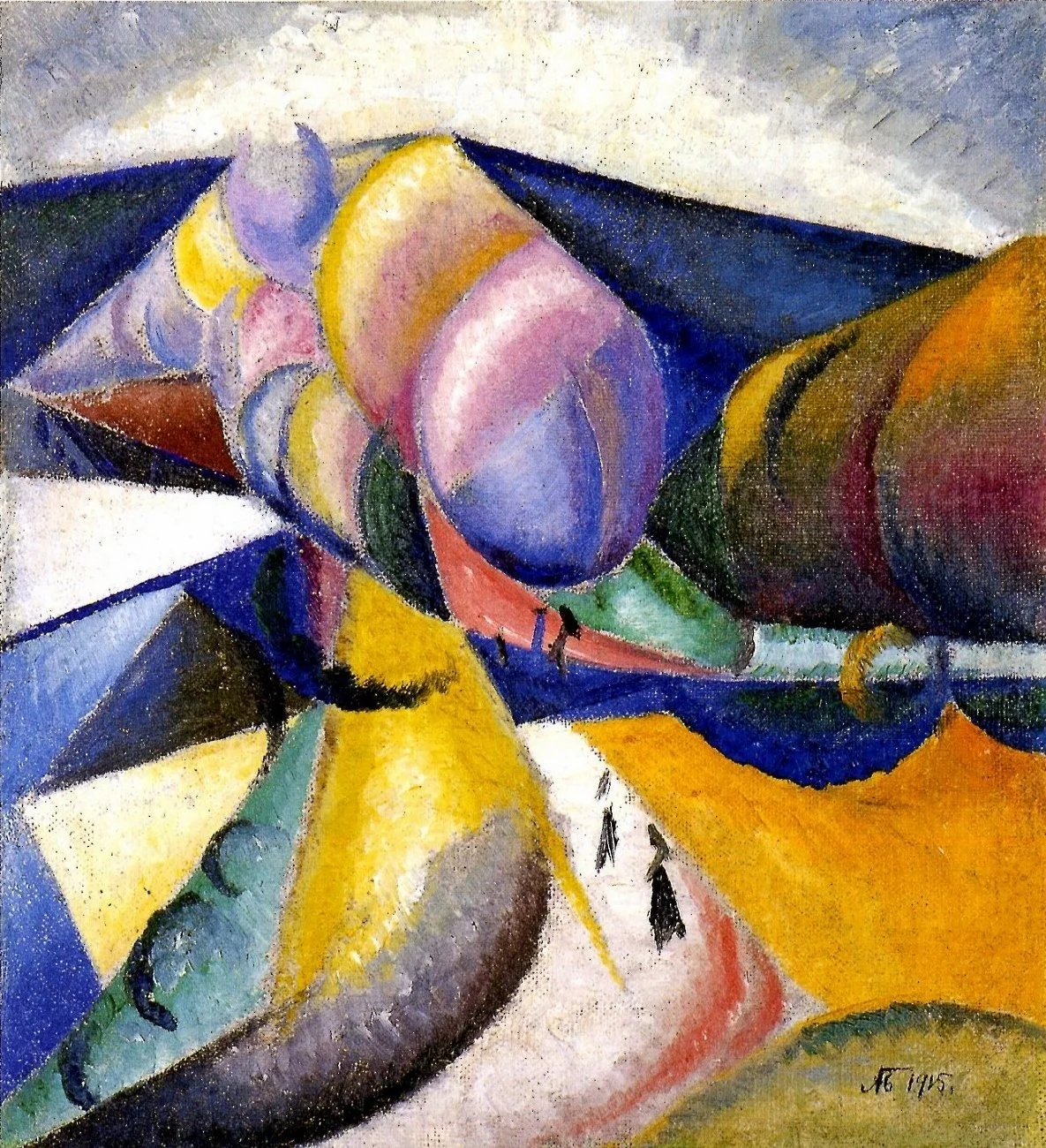
“The Caucuses (Geryusi)’’ (1915) (oil on canvas), by Oleksandr Bohomazov, in the show “The Juncture: Ukrainian Artists in Search of Modernity and Identity,’’ at the Mead Art Museum, at Amherst (Mass.) College, May 24-Oct. 13.
— Image courtesy of James Butterwick Gallery, London.
The museum says:
“This exhibition showcases the work of three leading modern artists from Ukraine who produced work during an astonishing period of the country’s cultural renaissance in the early 20th Century: Alexander Archipenko (1887–1964), Oleksandr Bohomazov (1880–1930), and Vasyl Yermilov (1894–1968). Modern and cosmopolitan by nature, their art also addresses the issues of national cultural identity at a time when their compatriots were trying to establish an independent Ukrainian state. The strikingly different fates of the three artists demonstrate the tectonic shifts and upheavals that their country underwent in the first half of the twentieth century. Their work—connected with Cubism, Futurism, Abstractionism, and Constructivism—reflects the stylistic diversity of the avant-garde landscape in Ukraine at that time. ‘‘
We’re mostly water anyway
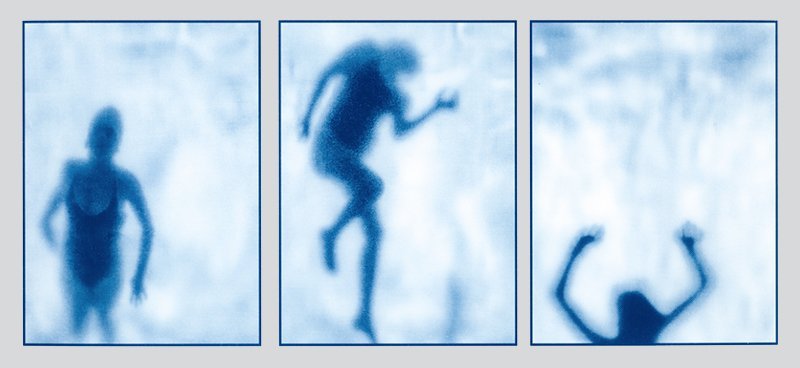
“Three Graces” (cyanotypes), by Newmarket, N.H.-based David Hiley in the group photography show “Diverse Visions,’’ at Bromfield Gallery, Boston, April 3-28.

Grief support for when pets are dying via UNE


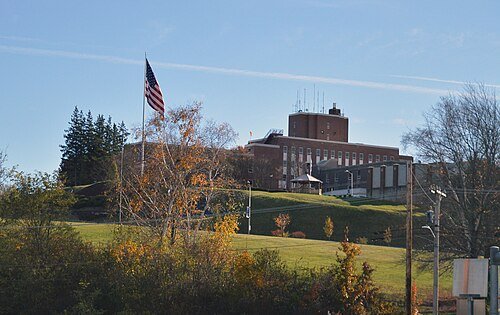
The University of New England’s Biddeford, Maine, campus.
Edited from a New England Council report
The University of New England has announced a new initiative in its online curriculum to include certification for students to work as end-of-life pet doulas. Pet doulas are non-medical-care providers who form companionships with pets, their human families, and veterinarians to guide all concerned through the pets’ dying process.
The fully online program is six weeks long and designed to provide students with expertise in advanced pet-care planning, grief support and emotional guidance. The course is open to participants from all backgrounds and will run from April 1 to May 12.
“It is important to acknowledge the loss people experience when their pet dies and give them the space for emotional expression and validation,” said Tracey Walker, the course instructor, “The more we can work to normalize talking about pet loss, death overall, and the deeply personal journey of grieving, the better we will be equipped to support each other when we need it most.”
Savoring ‘in-between times’

“Late Frost, Pines” (oil on panel), by Christina Beecher, in her show “Quiet Thaw,’’ at Galatea Fine Art, Boston.
“The transition from one season to the next is often overlooked and under-appreciated. Many of us tend to look forward to the warmth of summer, or the beginning of fall … all the while hurrying these changes and transitions in anticipation of what comes next. For me, the seasonal ‘in between’ times, particularly the unfreezing of winter ahead of the regrowth of spring, is of great interest. My goal in these works is to point out these ‘in between’ times as opportunities for calm reflection and quiet serenity.”
Amy Maxmen: The N95 mask debate: Is it profits before protection?

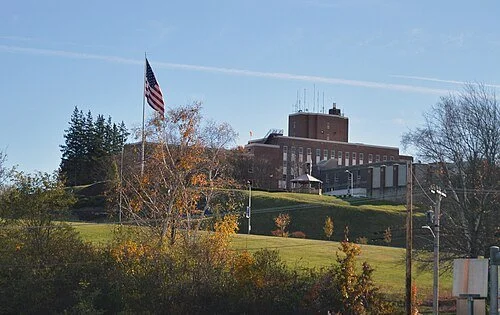
Soldiers’ Home, a state-owned veterans’ center in Holyoke, Mass., where at least 76 veterans died from covid and 83 employees were sickened by the coronavirus in early 2020.
From Kaiser Family Health News
Four years after hospitals in New York City overflowed with Covid-19 patients, emergency physician Sonya Stokes remains shaken by how unprepared and misguided the American health system was.
Hospital leadership instructed health workers to forgo protective N95 masks in the early months of 2020, as covid cases mounted. “We were watching patients die,” Stokes said, “and being told we didn’t need a high level of protection from people who were not taking these risks.”
Droves of front-line workers fell sick as they tried to save lives without proper face masks and other protective measures. More than 3,600 died in the first year. “Nurses were going home to their elderly parents, transmitting covid to their families,” Stokes recalled. “It was awful.”
Across the country, hospital leadership cited advice from the Centers for Disease Control and Prevention on the limits of airborne transmission. The agency’s early statements backed employers’ insistence that N95 masks, or respirators, were needed only during certain medical procedures conducted at extremely close distances.
Such policies were at odds with doctors’ observations, and they conflicted with advice from scientists who study airborne viral transmission. Their research suggested that people could get covid after inhaling SARS-CoV-2 viruses suspended in teeny-tiny droplets in the air as infected patients breathed.
But this research was inconvenient at a time when N95s were in short supply and expensive.
Now, Stokes and many others worry that the CDC is repeating past mistakes as it develops a crucial set of guidelines that hospitals, nursing homes, prisons, and other facilities that provide health care will apply to control the spread of infectious diseases. The guidelines update those established nearly two decades ago. They will be used to establish protocols and procedures for years to come.
“This is the foundational document,” said Peg Seminario, an occupational-health expert and a former director at the American Federation of Labor and Congress of Industrial Organizations, which represents some 12 million active and retired workers. “It becomes gospel for dealing with infectious pathogens.”
Late last year, the committee advising the CDC on the guidelines pushed forward its final draft for the agency’s consideration. Unions, aerosol scientists, and workplace safety experts warned it left room for employers to make unsafe decisions on protection against airborne infections.
“If we applied these draft guidelines at the start of this pandemic, there would have been even less protection than there is now — and it’s pretty bad now,” Seminario said.
In an unusual move in January, the CDC acknowledged the outcry and returned the controversial draft to its committee so that it could clarify points on airborne transmission. The director of the CDC’s National Institute for Occupational Safety and Health asked the group to “make sure that a draft set of recommendations cannot be misread to suggest equivalency between facemasks and NIOSH Approved respirators, which is not scientifically correct.”
The CDC also announced it would expand the range of experts informing their process. Critics had complained that most members of last year’s Healthcare Infection Control Practices Advisory Committee represent large hospital systems. And about a third of them had published editorials arguing against masks in various circumstances. For example, committee member Erica Shenoy, the infection-control director at Massachusetts General Hospital, wrote in May 2020, “We know that wearing a mask outside health-care facilities offers little, if any, protection from infection.”
Although critics are glad to see last year’s draft reconsidered, they remain concerned. “The CDC needs to make sure that this guidance doesn’t give employers leeway to prioritize profits over protection,” said Jane Thomason, the lead industrial hygienist at the union National Nurses United.
She’s part of a growing coalition of experts from unions, the American Public Health Association, and other organizations putting together an outside statement on elements that ought to be included in the CDC’s guidelines, such as the importance of air filtration and N95 masks.
But that input may not be taken into consideration.
The CDC has not publicly announced the names of experts it added this year. It also hasn’t said whether those experts will be able to vote on the committee’s next draft — or merely provide advice. The group has met this year, but members are barred from discussing the proceedings. The CDC did not respond to questions and interview requests from KFF Health News.
A key point of contention in the draft guidance is that it recommends different approaches for airborne viruses that “spread predominantly over short distances” versus those that “spread efficiently over long distances.” In 2020, this logic allowed employers to withhold protective gear from many workers.
For example, medical assistants at a large hospital system in California, Sutter Health, weren’t given N95 masks when they accompanied patients who appeared to have Covid through clinics. After receiving a citation from California’s occupational safety and health agency, Sutter appealed by pointing to the CDC’s statements suggesting that the virus spreads mainly over short distances.
A distinction based on distance reflects a lack of scientific understanding, explained Don Milton, a University of Maryland researcher who specializes in the aerobiology of respiratory viruses. In general, people may be infected by viruses contained in someone’s saliva, snot, or sweat — within droplets too heavy to go far. But people can also inhale viruses riding on teeny-tiny, lighter droplets that travel farther through the air. What matters is which route most often infects people, the concentration of virus-laden droplets, and the consequences of getting exposed to them, Milton said. “By focusing on distance, the CDC will obscure what is known and make bad decisions.”
Front-line workers were acutely aware they were being exposed to high levels of the coronavirus in hospitals and nursing homes. Some have since filed lawsuits, alleging that employers caused illness, distress, and death by failing to provide personal protective equipment.
One class-action suit brought by staff was against Soldiers’ Home, a state-owned veterans’ center in Holyoke, Mass., where at least 76 veterans died from Covid and 83 employees were sickened by the coronavirus in early 2020.
“Even at the end of March, when the Home was averaging five deaths a day, the Soldiers’ Home Defendants were still discouraging employees from wearing PPE,” according to the complaint.
It details the experiences of staff members, including a nursing assistant who said six veterans died in her arms. “She remembers that during this time in late March, she always smelled like death. When she went home, she would vomit continuously.”
Researchers have repeatedly criticized the CDC for its reluctance to address airborne transmission during the pandemic. According to a new analysis, “The CDC has only used the words ‘COVID’ and ‘airborne’ together in one tweet, in October 2020, which mentioned the potential for airborne spread.’”
It’s unclear why infection control specialists on the CDC’s committee take a less cautious position on airborne transmission than other experts, industrial hygienist Deborah Gold said. “I think these may be honest beliefs,” she suggested, “reinforced by the fact that respirators triple in price whenever they’re needed.”
Critics fear that if the final guidelines don’t clearly state a need for N95 masks, hospitals won’t adequately stockpile them, paving the way for shortages in a future health emergency. And if the document isn’t revised to emphasize ventilation and air filtration, health facilities won’t invest in upgrades.
“If the CDC doesn’t prioritize the safety of health providers, health systems will err on the side of doing less, especially in an economic downturn,” Stokes said. “The people in charge of these decisions should be the ones forced to take those risks.”
Amy Maxmen is a Kaiser Family Foundation Health News journalist.
David Warsh: The split records of Keynes and Friedman

SOMERVILLE, Mass.
From the beginning I have been convinced that Milton Friedman possessed a dual personality, somewhat like Doctor Jekyll and Mister Hyde: a strong economist by day, a weak citizen by night. Nothing I’ve read and written about in the last nine weeks has convinced me otherwise, not even Edward Nelson’s meticulous explication ofFriedman’s professional life from 1929 to 1972.
Instead, my suspicions have grown with the passage of time that with John Maynard Keynes, it was the other way around. What if Keynes was a weak technical economist, but a strong citizen by night? Turning things on their heads after seventy-five years requires time, a critical biography by a first-rate economist in the future, and, in my case, not much more than cheek. I’ll sketch the bare bones of the argument here, and hope to return to it someday.
This puts me up against the judgment of Nelson and, worse, of Friedman himself. In Newsweek magazine, in 1970, he wrote:
“Now John Maynard Keynes was one of the greatest economists of all time. I know many people who regard him as a devil who brought all sorts of evil things into this world – he was not that; he was like rest of us; he made mistakes. He was a great man, so when he made mistakes, they were great mistakes. But he was a great man.”
But I am a journalist, not an economist, and it’s the mistakes that interest me, one of them in particular: his diagnosis of the causes of the Great Depression. Keynes regarded it as, like any recession, a drop in aggregate demand, moving economic output below the production capacity of the economy. In such circumstances, he argued, governments should counter recessions through an expansionary fiscal policy that boosts aggregate demand.
Friedman and his research partner Anna Schwartz advanced a different explanation of the Great Depression in their A Monetary History of the United States 1867-1960. Ben Bernanke, a leading scholar of the decade of the 1930s, before he became a central banker, summarized their argument this way: “central bankers’ outmoded doctrines and flawed understanding of the economy had played a crucial role in that catastrophic decade, demonstrating the power of ideas to shape events.”
In 2007-08. Federal Reserve Chairman Bernanke, with the help of many others, forcefully demonstrated the power of better ideas. Together, they saved the world from a Second Great Depression.
Keynes may have had many brilliant ideas as an economist, but his single greatest success came as a journalist. The Economic Consequences of the Peace, his 1919 book, fiercely criticized the harsh reparations demanded of Germany in the wake of World War I, correctly foresaw the causes of World War II, and supplied the foundations of the 1947 Marshall Plan, aimed at the reconstruction of Germany, not punishment for its many sins.
My friend, Peter Renz like me, a non-economist, described the essence of Keynes this way: “a romantic figure. A polymath, brilliant as a writer, alive with charm as a lover, witty, political, a man of business and action.”
In this view, Keynes, born in 1883, was the last eminent Victorian of a certain sort. He was not included in that volume of portraits written by Keynes’s friend Lytton Strachey. Perhaps he, along with Friedman, will appear in a volume by some latter-day Strachey. (The figment of my imagination is the tenth good book). Meanwhile, I can’t do better than Wikipedia’s summary of the original:
“Eminent Victorians is a book by Lytton Strachey (one of the older members of the Bloomsbury Group), first published in 1918, and consisting of biographies of four leading figures from the Victorian era. Its fame rests on the irreverence and wit Strachey brought to bear on three men and a woman who had, until then, been regarded as heroes: Cardinal Manning, Florence Nightingale, Thomas Arnold and Gen. Charles Gordon. While Nightingale is actually praised and her reputation enhanced, the book shows its other subjects in a less-than-flattering light, for instance, the intrigues of Cardinal Manning against Cardinal Newman.”
And Friedman? He had two great successes as an economist. One of them should be clear by now. That single chapter of the Monetary History makes engrossing reading. It has its flaws – the significance it assigns to the 1930 failure of the grandly named Bank of the United States, a hastily assembled commercial bank in New York City, chartered in 1913, seems overblown – but overall, Friedman’s and Schwartz’s analytic narrative of the series of banking panics that unfolded 1930-33 is convincing.
Friedman’s other achievement is more diffuse but more important. He brought monetary analysis back into the big tent of economics that that had been dominated for more than a century by analysis of “real” goods and services by the forces of supply and demand. I keep on the shelf above my desk two little Cambridge Handbooks of 1922, Supply and Demand, by H. D. Henderson, and Money, by D. H. Robertson.
That was the situation before Keynes. In his General Theory, he sought to unite them, but the makers of macroeconomics who followed him somehow have failed to come up with an account of a business cycle without periodic financial crises.
“Monetarism,” a slogan that Friedman is said to have disliked, as opposed to “monetary theory,” doesn’t do much better, but at least it puts central banks back in the the story. As for rules as an alternative to occasional discretion, as a means of deflecting the occasional crisis? I doubt it.
And Friedman’s dark side? Nothing worse than being the most prominent spokesman for an exaggerated version of the common failing of today’s economics – its emphasis on the role of the individual, at the expense of attention to his/her/their entanglement in society (in Herbert Gintis’s phrase). British Prime Minister Margaret Thatcher famously proclaimed “There’s no such thing as society.” That’s bunk, even worse than macro without crises.
At least the tale of Jekyll and Hyde is the story one journalist has to tell.
David Warsh, a veteran columnist and an economic historian, is proprietor of Somerville-based economicprincipals.com, where this essay first ran.
Tentative early ‘spring’

— Photo by Greg Hume
“Two yellow dandelion shields do not make spring,
nor do the wild duck swimming by the shore,
so self-possessed, so white of side and breast,
nor, I suppose, the change in land-birds’ calls….’’
From “Night Wind in Spring,’’ by Elizabeth Coatsworth (1893-1986), Maine poet
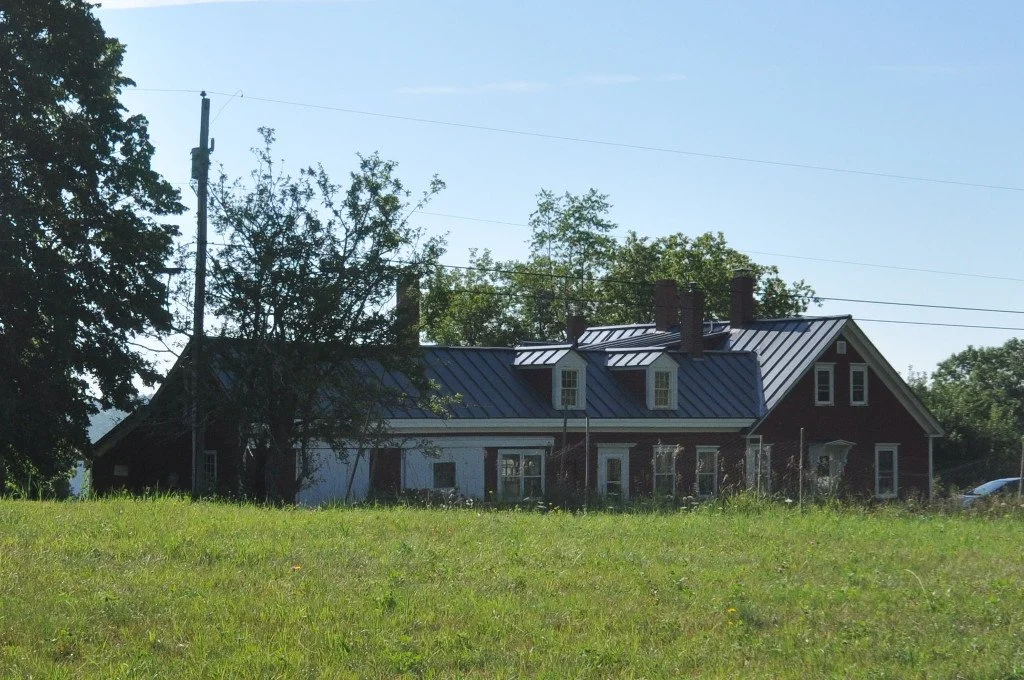
Chimney Farm, in Nobleboro, Maine, where Elizabeth Coatsworth lived with her husband, the famed writer Henry Beston.

‘The ongoing tension’

“Pangolin” (steel, paper, and credit cards), by Christy Rupp, in her show “Streaming: Sculpture by Christy Rupp,’’ at the Fairfield (Conn.) University Art Museum, through April 27.
— Courtesy of the artist
The museum says:
“Understood as one of the early pioneers in the field of ecological art activism, the artist, activist and thought-leader Christy Rupp has an international reputation. Streaming {features} a survey of Rupp’s intricate collages, wall installations and free-standing sculpture, which chronicle the ongoing tension between natural systems and the environment in transition, and call our attention to our interconnectedness with non-humans and habitat – transmuting detritus gathered from the waste stream through collage and sculpture to reveal what is hidden away from common view and understanding. Informed by science and the historical representation of natural history, the artwork in this exhibition examines the way we frame our opinions of nature, using irony and wit to represent the human impact on our natural habitat.’’
Mind-reading to smooth relations

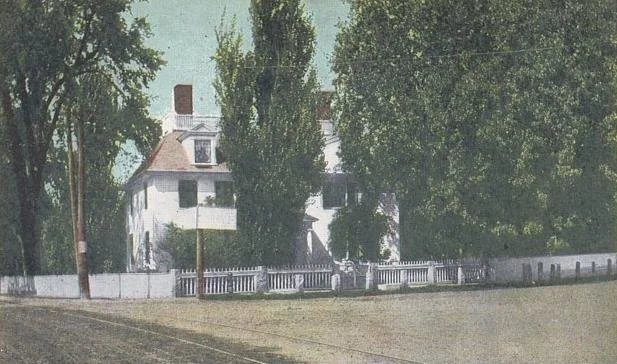
Colorized phot of Saran Orne Jewett’s house in South Berwick, Maine, taken in 1910.

Lookout Point, in Harpswell Maine.
— Photo by Kyle MacLea
“We were standing where there was a fine view of the harbor and its long stretches of shore all covered by the great army of the pointed firs, darkly cloaked and standing as if they waited to embark. As we looked far seaward among the outer islands, the trees seemed to march seaward still, going steadily over the heights and down to the water's edge.”
xxx
“Tact is after all a kind of mind-reading.’’
— Sarah Orne Jewett (1849-1909) in her novel Country of the Pointed Firs, like much of her work set on the southern coast of Maine
Tea time

“Wondergrrrl Teapot’’ (cast terracotta, underglazes, glazes), by Sarah Peters, in her show with Don Nakamura, titled “Bold Women and Vivid Dreams,’’ at the Cahoon Museum of American Art, Cotuit, Mass., through June 2.
— Image courtesy of Cahoon Museum of American Art
Chris Powell: A heavy discounting of outrageous crime in Conn.; teachers aren’t underpaid

MANCHESTER, Conn.
Next time the governor and state legislators boast about the decline in Connecticut's prison population, remember the recent report in the Hearst Connecticut newspapers about the state Board of Pardons and Paroles.
By a vote of 2-1 after a hearing in January, the board approved parole for a Bridgeport man who had served only 26 years of a 60-year sentence for an especially outrageous crime in 1995. He kidnapped a 16-year-old girl from her home in Pennsylvania and took her to Bridgeport, where he imprisoned her for weeks, molesting her, stabbing her, burning her with a cigarette, and mutilating her, carving his name into her chest with broken glass.
Of course the perpetrator already had an extensive criminal record. For years after his conviction he denied the crime and brought fruitless appeals. He accepted responsibility only when seeking parole.
Prosecutors opposed his application but the board granted it in large part because he had participated in various programs in prison. His victim said she did not oppose parole but is still recovering from her ordeal and just wanted it to be over.
Connecticut should want such hefty discounting of criminal justice to be over. But it won't be over any time soon.
While there is no constituency at the state Capitol for improving the ever-declining performance of students in Connecticut's public schools, there is a huge constituency for spending more money in the name of education even as student enrollment declines. That constituency is so large that no one at the Capitol dares to talk back to it even as it spouts nonsense.
More nonsense came the other day from Kate Dias, president of the state's largest teacher union, the Connecticut Education Association. "The critical thing to remember," Dias told education money seekers at the Capitol, "is we've never fully funded education."
But exactly what is "fully funded"? Dias didn't say, but "fully funded" seems to mean whatever the teacher unions want.
If education was "fully funded," Dias added, "my teachers wouldn't have a starting salary of $48,000. ... We've never actually done the really hard things that we need to do that would allow our teachers, our pre-K, everyone to make reasonable middle-class wages in Connecticut."
Teachers in Connecticut aren't middle class? According to the CEA's national affiliate, the National Education Association, the average teacher salary in Connecticut is $81,000, which doesn't count excellent benefits and much time off during the summer.
And if Dias is sore about an average starting salary of $48,000, that may be the fault of teacher unions themselves for negotiating contracts that allocate most increases in school spending to people who are already employed and union members. Why raise salaries for people who aren't paying union dues yet?
Where is the elected official or political candidate who dares to ask how increases in education spending correlate with student performance, or how student performance correlates with anything beyond family income and parenting? Any such elected official or candidate soon would find scores of teachers in his district vigorously supporting his opponent's campaign.
Indeed, that seems about to happen to state Sen. Douglas McCrory, D-Windsor, an administrator with the Capitol Region Education Council, who -- remarkably, since he is a Democrat -- may be the General Assembly's most vocal advocate of charter schools and school choice.
McCrory is being challenged for renomination by a school board member in his home town and by an official of a union that represents school employees in Hartford.
More than improving education, McCrory's opponents may want to make sure that schools don't ever have to compete for students -- that school choice is limited to families who can afford private schools.
Special interests are political machines that are very good at getting their people to vote. The public interest has no political machine.
Chris Powell has written about Connecticut government and politics for many years (CPowell@cox.net).
Mary Burke: The luck of the Irish has often evaded the Kennedy family

The Kennedy family on the beach in Hyannisport in 1931.
From article in The Conversation by Mary Burke

John F. Kennedy, whose ancestors left Ireland during the potato famine of the mid-19th century, was famously the first United States president of Catholic Irish descent.
When Americans narrowly elected Kennedy in 1960, anti-Catholic bias was still part of the mainstream culture.
I am a scholar of Irish literature and the author of “Race, Politics, and Irish America: A Gothic History,” a new book that describes how the Irish were long excluded in America.
So when Kennedy accepted shamrocks from the Irish ambassador to the U.S. on his first St. Patrick’s Day in the White House in 1961, it signaled the social and political arrival of the Irish American elite. It also was a pivotal moment, marking Irish Americans’ fulfilled dream of full assimilation into the U.S.
The dream soured when Kennedy was assassinated in Dallas in November 1963. That tragedy – and the many others that followed for the Kennedy family – began to be told by others in the Gothic story tradition, which hinges on nightmarish scenarios and the abuse of power.

Stick to intramural?


Adapted from Robert Whitcomb’s “Digital Diary,’’ in GoLocal24.com
So the Dartmouth College basketball team has voted to unionize by joining the Service Employees International Union, setting off a loud explosion in the cartel called the National Collegiate Athletic Association. The team’s theory is that playing on such teams helps promote the college’s PR, and thus finances, and so they should be paid as employees, even though Dartmouth, in Hanover, N.H., provides among the most generous financial aid of any such institution in America, and academics, not athletics, is primary at such “elite” colleges unlike, it seems, at many schools.
I wonder if forcing even fairly small private colleges, such as Dartmouth, to treat athletes as employees will lead some institutions to stop competing in some inter-collegiate sports, including basketball. That sport has never been very big at Dartmouth, by the way. So maybe the college will consign it to merely intramural competition. A reasonable decision.
‘Old toilers, soil makers’


“For a hundred and fifty years, in the pasture of dead horses,
roots of pine trees pushed through the pale curves of your ribs,
yellow blossoms flourished above you in autumn, and in winter
frost heaved your bones in the ground – old toilers, soil makers….’’
— From “Names of Horses,’’ by Donald Hall (1928-2018), Wilmot, N.H.-based poet and essayist
To read the whole poem, please hit this link.

1910 image
‘Visual life to my emotions’

“Hanging By a Thread” (acrylic paint and graphite on wood panel), by Royalton, Vt.-based artist Amy Schachter, in her show “Hiding in Plain Sight,’’ at Studio Place Arts, Barre, Vt., through April 20.
— Image courtesy of Studio Place Arts
She says:
“I aim to break down the figure into a series of interlocking shapes and lines in order to guide the viewer to use their imagination to complete the image and see what's not really there. For me, art is a conversation between line, form and color. I continually strive for balance, harmony and simplicity in my work.
“My work explores the human experience as told through a female lens. The imagery in my work typically depict women, open, exposed and vulnerable yet possessing an inner strength and fortitude as illustrated by the strong framework within each piece. A stance that takes on a personal significance for me. The thought-provoking imagery highlights a personal journey that explores powerful and opposing emotions and concepts such as resilience and fragility, perseverance and surrender, reality and fantasy. The creative process involved while expressing myself through art has given visual life to my emotions. It has provided me with a quiet language and a way to safely explore some of the darker corners of my mind. It allows me to take control of some of the messier things in life and approach them in a more positive way. The strength and wit expressed in my work provides a reminder that beauty can exist within chaos, as does light within darkness’’.
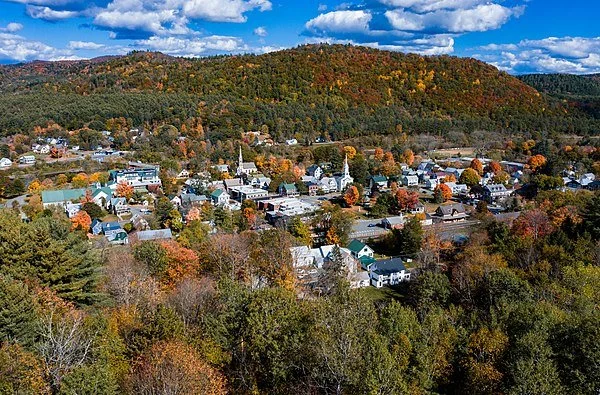
Royalton in the fall.
Llewellyn King: The little, and now thriving, island nation that pulls on our heartstrings

A wave of runners in the Holyoke, Mass., St. Patrick's Day Road Race pass the starting line.
WEST WARWICK, R.I.
Ready for craic on Sunday?
Craic, pronounced crack, is an Irish word that has seeped into English and means party or revelry.
Try as you may, you won’t avoid Sunday’s craic because on Sunday, it being March 17, untold hundreds of millions of people around the world will be wearing the green. In short, celebrating St. Patrick’s Day, the national day of the Irish, by putting on something green and taking a drink.
No other nation, let alone a small nation with a troubled history, can have such a claim on the heartstrings of the planet. For one day, we are all Irish — and many of us will go to a place where drink is sold to celebrate it. There isn’t a lot of preamble to St. Paddy’s Day – except for the arrival in the pubs of green-colored beer. Ugh!
The Irish diaspora, which reached its apogee during the Potato Famine of the mid-19th Century, sent the Irish to the far corners of the earth, especially to America, where they endured for some time in poverty but eventually prospered.
They brought with them their music, which influenced American Roots Music, like Bluegrass, Folk and Country, their towering literary talent, which gave us generations of writers.
And they got into politics, big time.
A documentary now in production and scheduled to be released in 12 episodes at the end of the year, From Ireland to the White House, traces the Irish ancestry of 24 U.S. presidents from Andrew Jackson (of Scots-Irish lineage) to Joe Biden.
Tony Culley-Foster, the U.S. representative of Tamber Media, the Dublin company producing the series, tells me the scholarship has been exacting in tracing the ancestry of the presidents. He said the 24 presidents on the list have been certified by the same independent historians and genealogists used by Clinton and Biden.
According to the U.S. Census Bureau, there are 31.5 million Americans who claim Irish heritage. So it has become important for presidents to make pilgrimages to Ireland — to wrap themselves in green.
From my experience in Ireland, the two taken mostly to heart as being of their own, were John Kennedy and Ronald Reagan and of those, Kennedy was the greater heartthrob for the Irish.
My late friend Grant Stockdale’s father was Kennedy’s ambassador to Ireland, and Grant spent his mid-teen years in Dublin at the U.S. Embassy in Phoenix Park. “I knew what it must be like to be royalty,” Grant told me.
But it isn’t just the presidency that has been shaped by Irish heritage. Irish names are to be found on every public service list, from the U.S. Congress to the local school board. There have been great senators, like Daniel Patrick Moynihan (D.-N.Y.) and great speakers of the House, such as the towering, Boston-Irish Tip O’Neill (D.). If it’s politics, it’s Irish.
In Britain, too, historically some of the greatest statesmen and orators in the House of Commons have been Irish, think Edmund Burke and Charles Parnell.
For me, Ireland’s gift to the world has been its contribution to English literature. Hundreds of great names come to mind. Try Oscar Wilde, Bram Stoker, Samuel Beckett and Edna O’Brien.
And the books keep coming, tumbling out of the most literary fertile minds on earth.
Two contemporary writers dominate my thinking: John Banville and Sally Rooney. Banville is prolific, profound and a joy to read, a master craftsman at the top of his form. Rooney is a kind of literary Taylor Swift, writing about the sex, love and isolation of young adults of her generation. I am keen to see how she evolves and if she will give joy for generations, as great writers do.
Literacy is part of the fabric of Irish life. An Irish person, far from literary circles, will ask you conversationally, “What is your book?” Translation: “What are you reading?” Ireland treasures books and reading is a national pastime.
Ireland’s literacy may have saved its economy. At a bleak period when, just 40 years ago, I heard many Irish leaders talk about “structural unemployment” of 22 percent, American scientific publishers found that highly literate women were a resource. That led to a boom in footnoting in Ireland, followed by American Express looking for accurate inputting and, suddenly, Ireland was transformed from one of the poorest countries of Europe to a boom nation and the Silicon Valley of Europe, as the computer giants moved in. A town known for its bookstores and fishing, Galway, became ground zero for computing in Ireland.
Craic has no discernible economic value except for the brewers and distillers, but it is such fun. As the Irish say, slainte (cheers)!
Llewellyn King is executive producer and host of White House Chronicle, on PBS. His email is llewellynking1@gmail.com, and he’s based in Rhode Island.
Trying to meld historic preservation, diversity and climate resilience in Boston
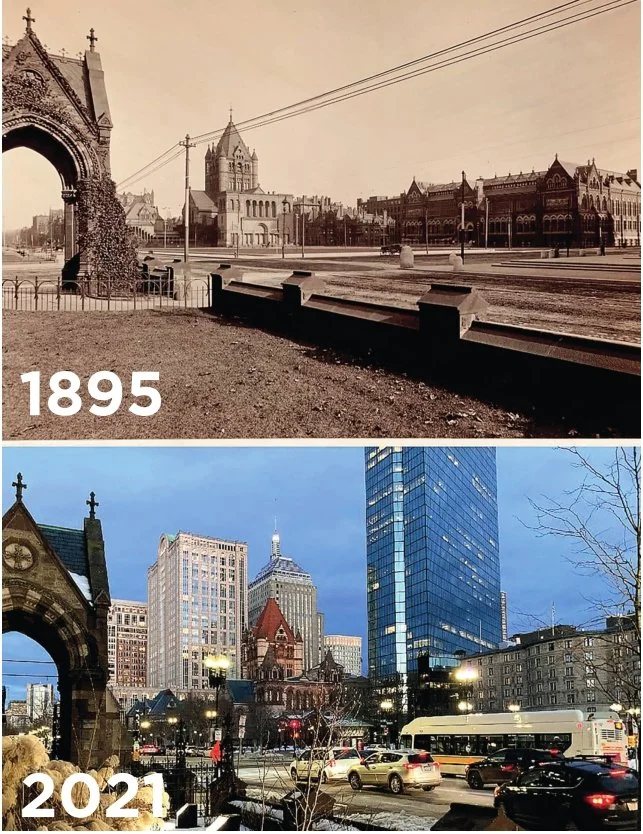
Edited from a Boston Guardian article
(Robert Whitcomb, New England Diary’s editor/publisher, is The Boston Guardian’s chairman.)
“The administration of Boston Mayor Michelle Wu wants to expand the city’s preservation policies to focus on diversity and climate resilience.
“The enhancements were explained at a citywide meeting by Murray Miller, director of the Office of Historic Preservation (OHP), a city entity established by Wu in 2022.
“The OHP comprises three bodies.
“Drawing most of the office’s resources, the Landmarks Commission works to protect Boston’s historic structures. It also oversees the ten local historic district commissions, each of which focuses on preserving a different Boston neighborhood. The office also includes the Commemoration Commission and the Archaeology Program.
“For much of the meeting, Miller presented the office’s strategic vision. Overall, he said he intends to expand the office’s purview beyond its traditional role as a regulator of landmarks.
“One of the office’s key focuses, he said, will be to tell the ‘full story’ of the city’s history. The office will devote more money to discovering and preserving historic sites connected to Boston’s Black, indigenous, immigrant and LGBTQ communities..
“Miller also highlighted climate resilience as an important mission for the office.
“Incentivizing developers to renovate existing structures could help increase resilience, he said, as could reworking Article 85, a part of Boston’s zoning code that allows applicants to request a demolition delay for potentially historic buildings.’’
To read the full article, please hit this link.

David Warsh: Thanks to them, we avoided a second Great Depression

SOMERVILLE, Mass.
A Monetary History of the United States 1867-1960 (National Bureau of Economic Research,1962), by Milton Friedman and Anna Schwartz, is a most intimidating book. A heavy-lifting 860 pages, packed full of tables and charts, some of them old-fashioned fold-outs. It introduces itself as an “analytical narrative” of changes of the stock of money in the U.S. over slightly less than a century.
It begins with a quotation from the great 19th Century economist Alfred Marshall, a sly swipe at the short equation-filled “papers” that, since the 30’s, had become standard:
“Experience in controversies such as these brings out the impossibility of learning anything from the facts till they are examined and interpreted by reason; and teaches that the most reckless and treacherous of all theorists is he who professes to let the facts and figures speak for themselves, who keeps in the background the part he has played, perhaps unconsciously, in selecting them and grouping them, and in suggesting the argument post hoc ergo propter hoc’’ {after this, therefore because of this.”]
One day in the late ‘70’’s, MIT graduate student Ben Bernanke went to see his adviser, Prof. Stanley Fischer. Bernanke had finished his field examinations; he was seeking a topic for a dissertation. At one point, Fischer handed him a copy of A Monetary History and said, “Read this. It may bore you to death. But if it excites you, you might consider doing monetary economics.”
The book fascinated him, Bernanke wrote in 21st Century Monetary Policy: The Federal Reserve from the Great Inflation to Covid -19 (Norton, 2022). “It got me interested not only in monetary economics, but also in the causes of the Great Depression of the 1930s, a topic I would return to frequently in my academic ‘writings.” Friedman and Schwartz had showed, he wrote, “that central bankers’ outmoded doctrines and flawed understanding of the economy had played a crucial role in that catastrophic decade, demonstrating the power of ideas to shape events.”
In 1983, Bernanke published ‘‘Non-monetary Effects of the Financial Crisis in the Propagation of the great Depression,” a comparative study – an analytic narrative of the macroeconomics of the Great Depression, “macroeconomics” being the research field that had been brought into existence by the event itself.
About the same time, Douglas Diamond and Philip Dybvig set out to describe, in a series of mathematical models, the purposes that banks serve in economies of all sorts, and then explored their mathematical model of the purposes that banks serve in economies and the circumstances that sometimes lead to their collapses via bank runs.
Thirty-nine years later, the three men were recognized with Nobel Memorial Prizes for their early work on central banking, the interplay of central banks, commercial banks, and “shadow” banks that had been at the heart of the global financial crisis of 2007-08 and the lengthy recession that followed.
A footnote in the Nobel Committee’s Scientific Background to the awards notes:
“Keynes (1936) argued that recessions were primarily due to drops in aggregate demand, moving economic output below the production capacity of the economy. According to this view, governments should counter recessions through an expansionary fiscal policy that boosts aggregate demand.”
In his General Theory of Employment, Interest, and Money, Keynes gives short shrift to central banking.
Between times, Bernanke, in particular, had led an interesting life. For a decade he taught at Stanford University’s Graduate School of Business, conducting further research on banking, financial markets, labor markets, and business cycles, before moving to Princeton University, in 1995.
In 2002, he was appointed to the seven-member Board of Governors of the Federal Reserve Board, and 2005, became chairman of President George W. Bush’s Council of Economic Advisers. A year later Bush nominated him to chair the Federal Reserve Board.
The president later joked that he had chosen Bernanke from among several other suitable candidates because he would sometimes come to White House briefings wearing white socks with his business attire. A more satisfying explanation was supplied by Wall Street Journal columnist Greg Ip, who later wrote that, beginning with the time he chaired Princeton’s economics department, Bernanke had developed a “knack for eliciting cooperation from those with bigger egos and sharper elbows.” An MIT professor recalled, “Until 2002, we hadn’t even known that he was a Republican.”
Also in 2002, as an expert on the Great Depression, Bernanke offered to a star-studded birthday party for Milton Friedman a short but incisive review of the reception of A Monetary History by the economics profession. He concluded, speaking directly to Friedman and Schwartz, “You were right, Milton, we did it. We’re very sorry. But thanks to you, we won’t do it again.”
In 2006, as Fed chairman, Bernanke began organizing behind the scenes the complicated web of emergency measures that ultimately enabled the Fed, in concert with the central banks of 10 other first-rank nations, to avoid turning a banking panic into a second Great Depression, as bad, perhaps even worse, than the first.
Not everyone agrees – see, for example, Paul Krugman – but if the Nobel Committee in 1976 had enjoyed the gift of perfect foresight, they might have stressed the contribution of A Monetary History more forcefully than they did in awarding Friedman the prize, and they might have offered a medal to Schwartz as well.
It could have gone better. As governor of Israel’s central bank, Stan Fischer, in different circumstances, avoided the mortgage collapse almost entirely – but the results of the Panic of 2008 in New York could have been worse – much, much worse – had Friedman and Schwartz not spent 12 years writing their old-fashioned 860-page book. A readable edition of the key chapter of the book The Great Contraction, about 1929-33, appeared 2008, with a new preface by Schwartz, and a new introduction by Peter Bernstein.
David Warsh, a veteran columnist and an economic historian, is proprietor of Somerville-based economicprincipals.com, where this essay originated.