
Vox clamantis in deserto

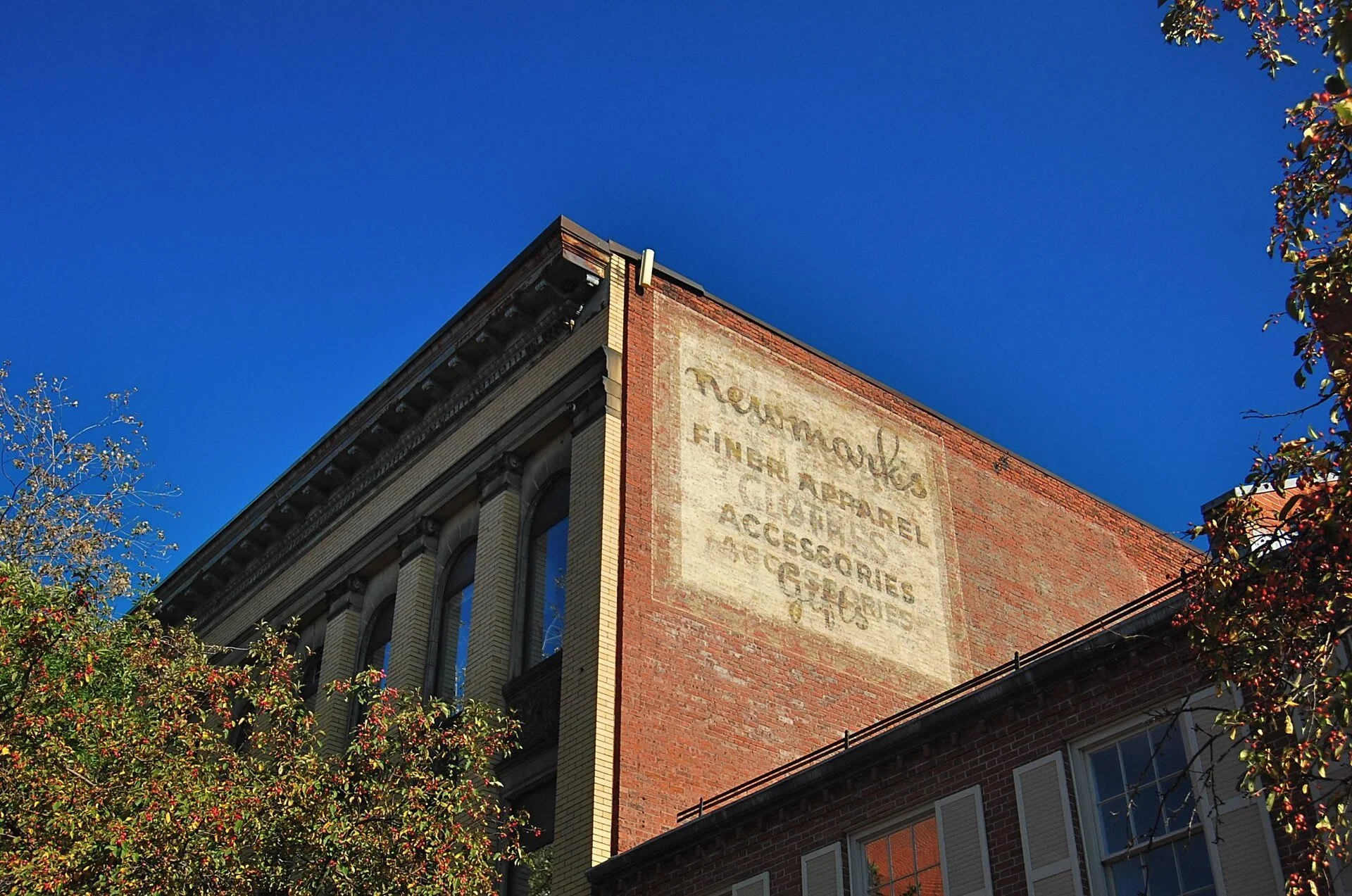



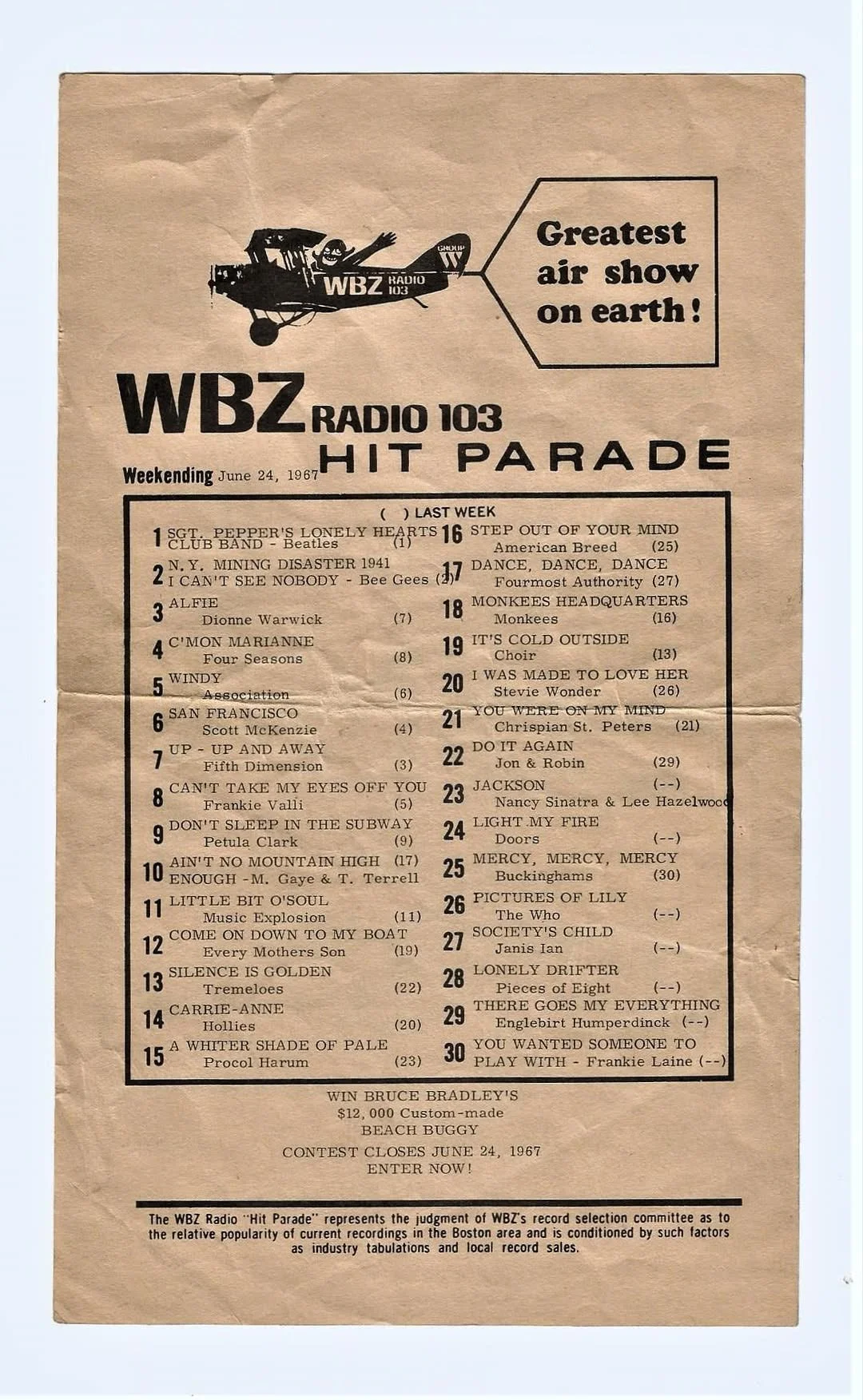

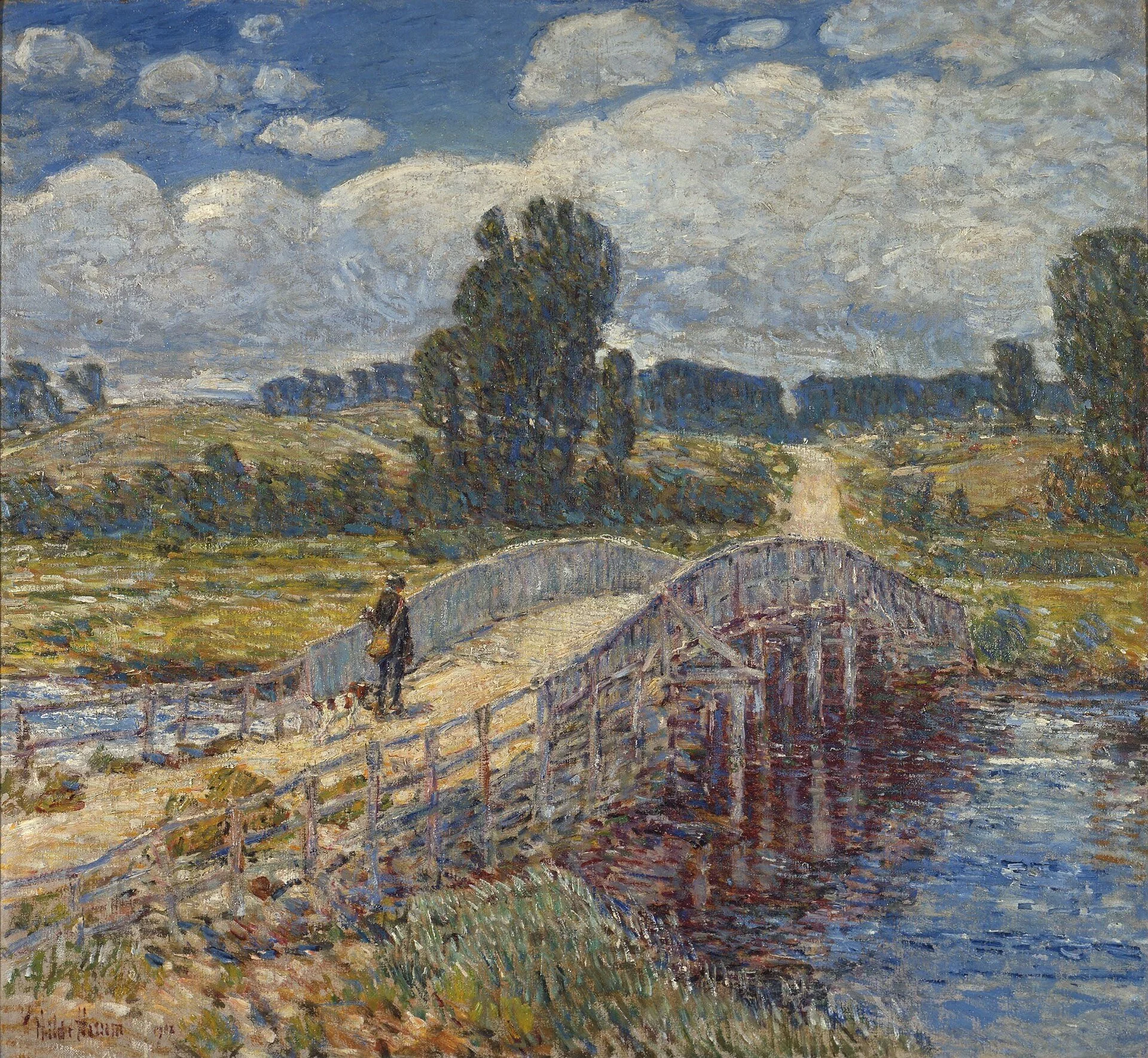

But it usually doesn't usually last long

“Infatuation” (acrylic, wallpaper on canvas), by Allison Bremner, at Bates College (Lewiston, Maine)) Museum of Art.
— Image courtesy of artist, who is of Alaskan Native American background.
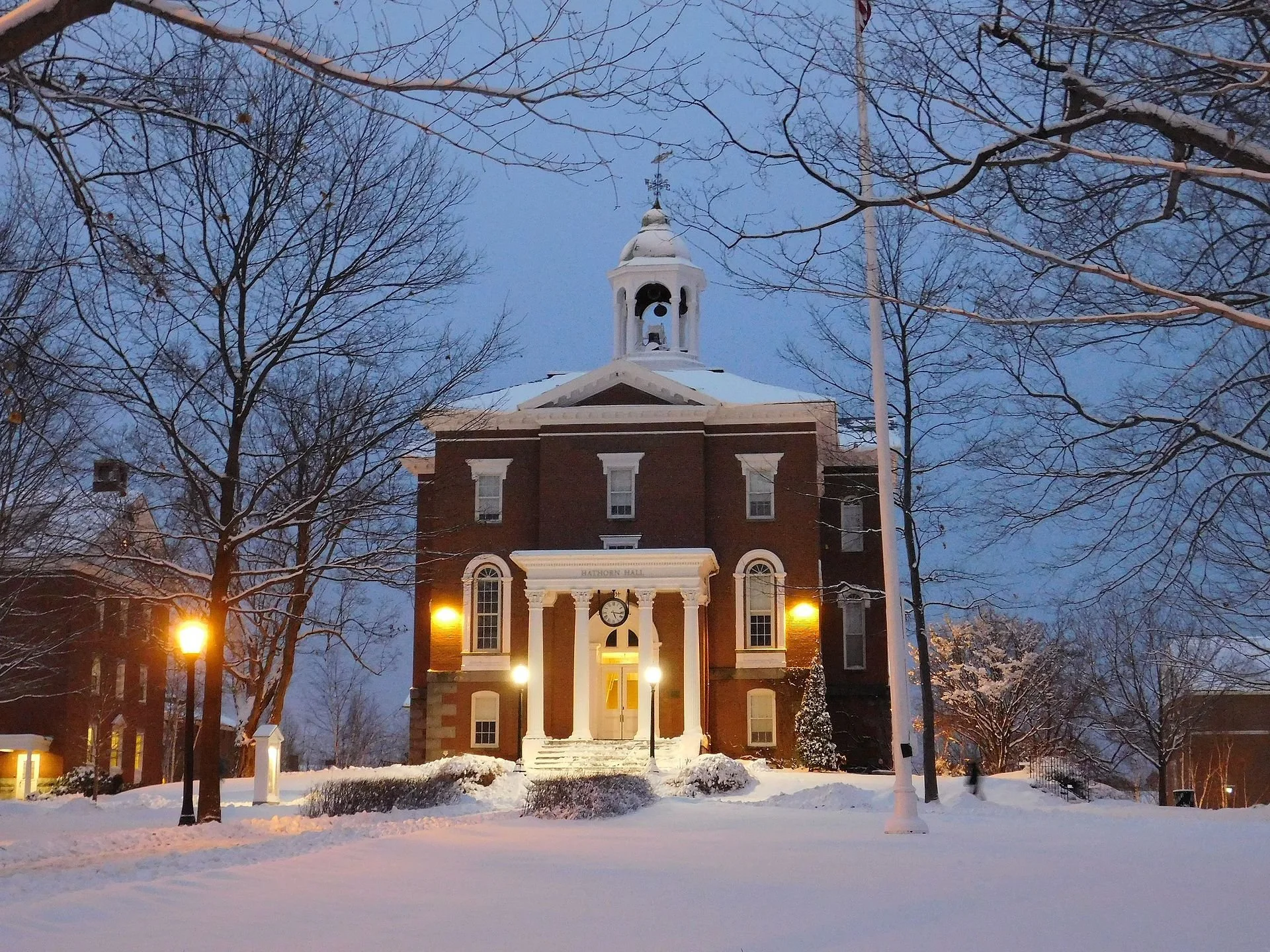
Hathorn Hall, at Bates College
— Photo by Odwallah
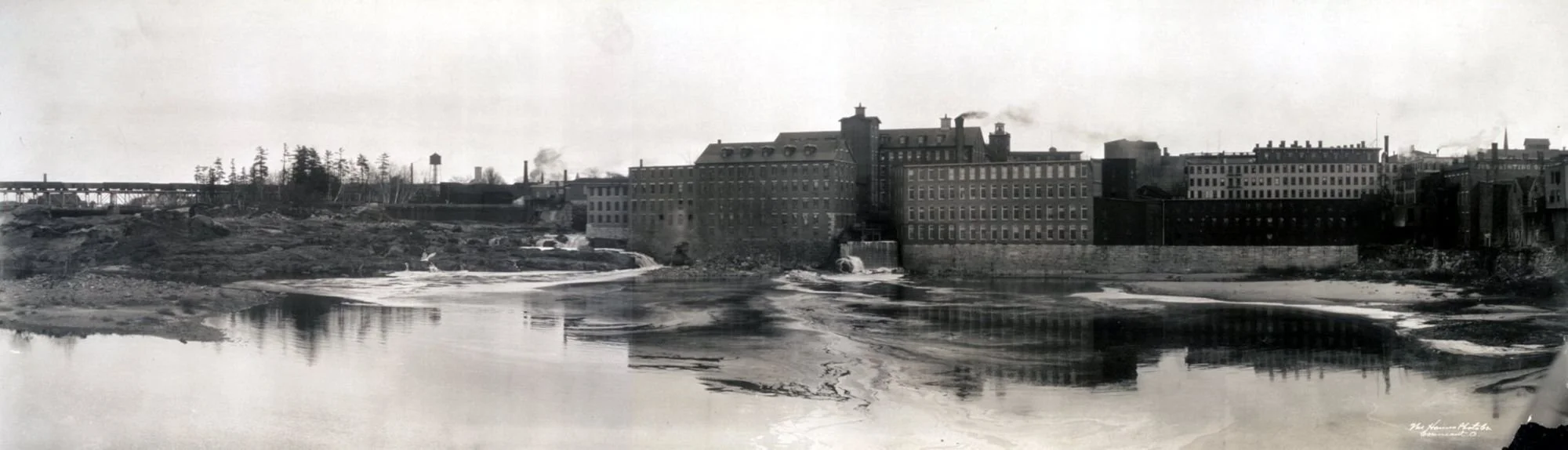
Textile mills in Lewiston along the Androscoggin River about 1910. The city became a major industrial center in the mid-19th Century, first with sawmills, then with textiles. Money from the latter helped found Bates College, in 1864. Many of the workers were of French-Canadian background, and French used to be widely spoken in the city.
Sadly, Maine’s second largest city, after Portland, became nationally know for Robert Card’s mass shooting there on Oct. 25. that killed 18 people in the normally peaceful place.
The horror, the horror
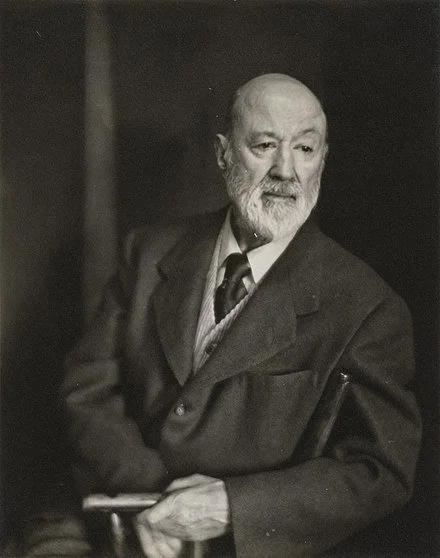
Charles Ives
“O Prejudice….You enter into the little boy of a New England town and make him stand and gape with the same horror at {the} man going into a Catholic church as the man going into a saloon.’’
— Charles Ives (1874-1954), famed American Modernist composer, insurance executive and native of Danbury, Conn. He’s a considered a father of estate planning.
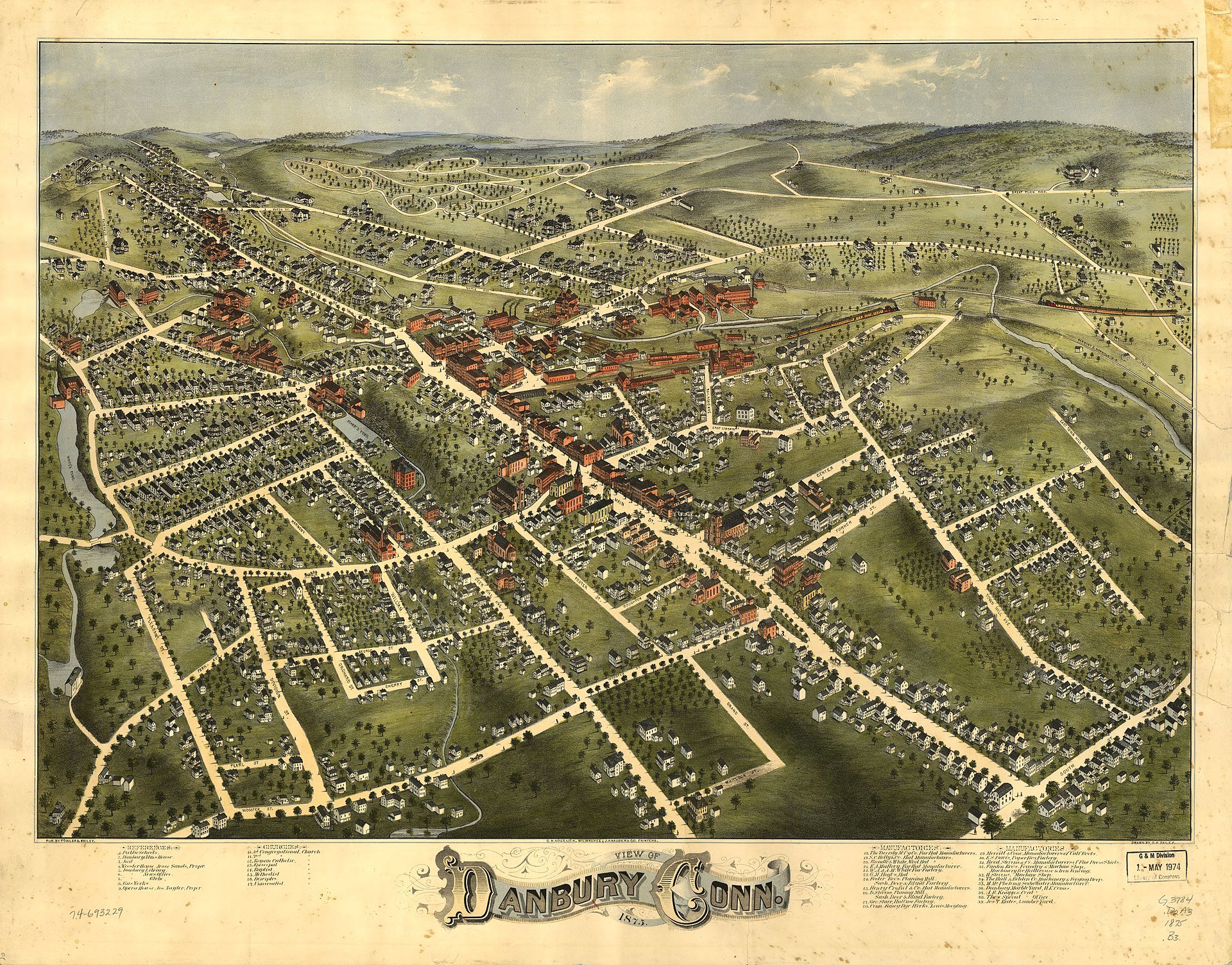
Danbury, Conn., the “Hat Capital of the World,’’ in 1879
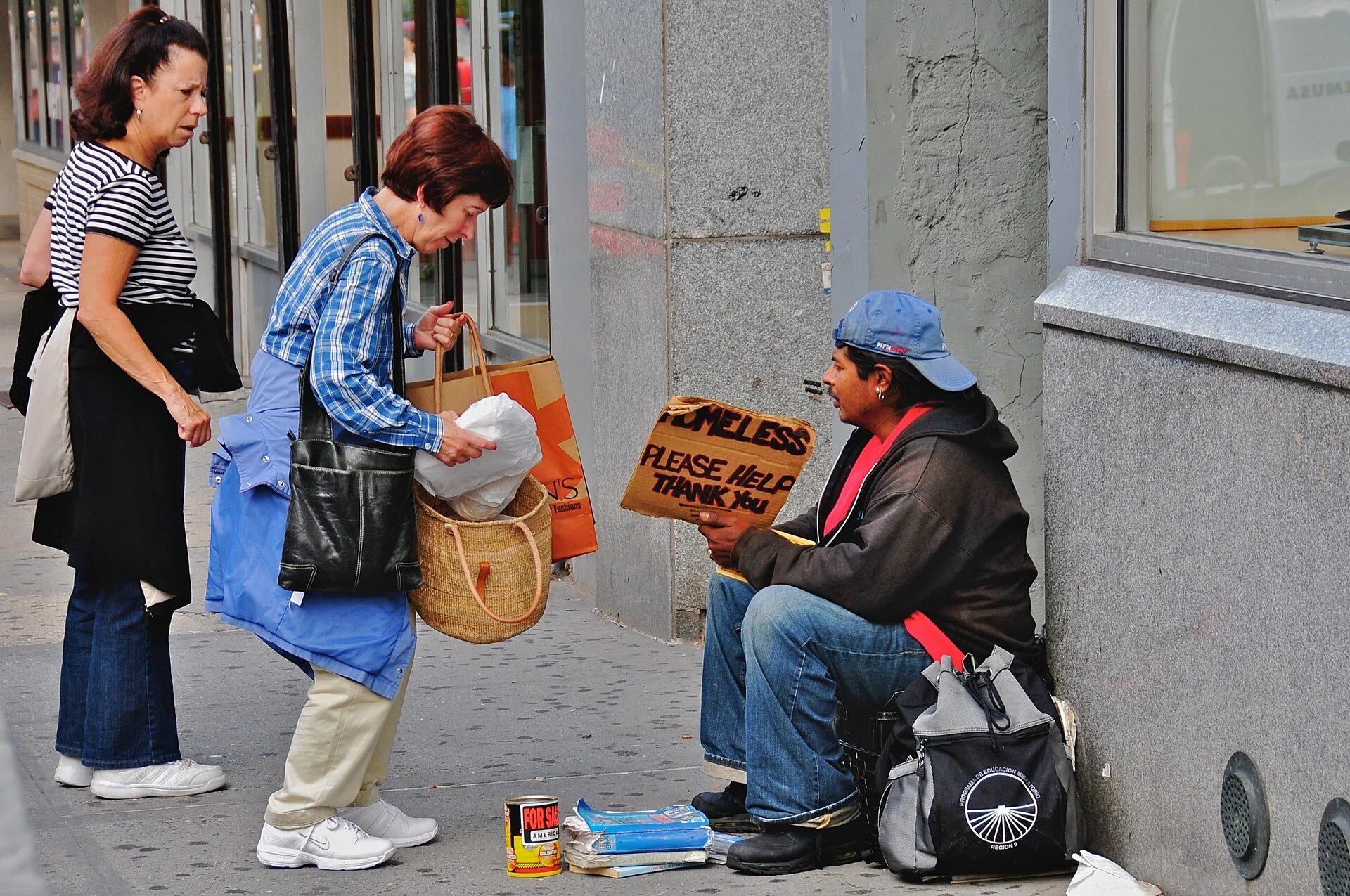
Homeless surge into the affluent Back Bay
- Photo by Ed Yourdon
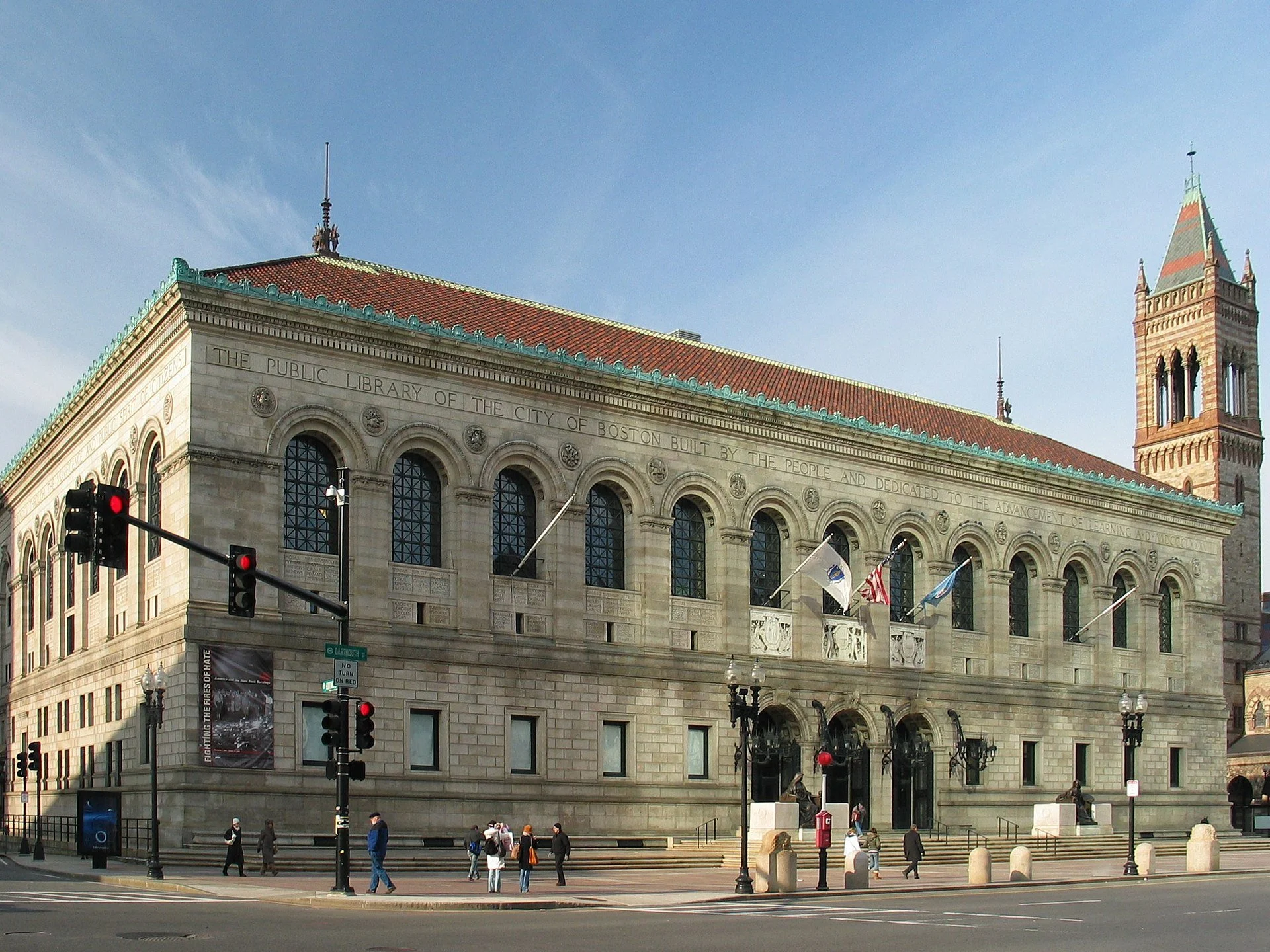
The Boston Public Library, on Copley Square. The peculiar lighting is from sunlight reflected off a high rise nearby. Homeless people have been congregating in increasing numbers on the square.
— Photo by Daniel Schwen
Excerpted from The Boston Guardian
“Back Bay landmarks were experiencing a surge in homeless occupancy even before the city cracked down this week on the South End encampment known as Mass & Cass, making stakeholders anxious about potential displacement.
“A range of factors have increased disruptions from unhoused Bostonians around heavily trafficked landmarks like the Boston Public Library (BPL), Prudential Center and Copley Square.
“With the city pledging to enforce anti-tent ordinances once and for all on the city’s largest encampment, civic and business groups in the Back Bay worry they’ll bear the brunt of the fallout.
“Meg Mainzer-Cohen, president of the Back Bay Association, says recent months have already seen a dramatic rise in homeless displacement to the Back Bay, a timeline that coincides with the spike in South End violence and the city’s warnings that it would soon disperse the encampment.
“‘In August things were very quiet, especially given the warm weather. By September, the situation had changed dramatically and we saw a major increase in people in need of services in the neighborhood,’ she said. ‘There’s a large presence in front of the library with a massive influx of people and what feels like an encampment.”’
To read the whole article, please hit this link.
Going medieval
Adapted from Robert Whitcomb’s “Digital Diary,’’ in GoLocal 24.com
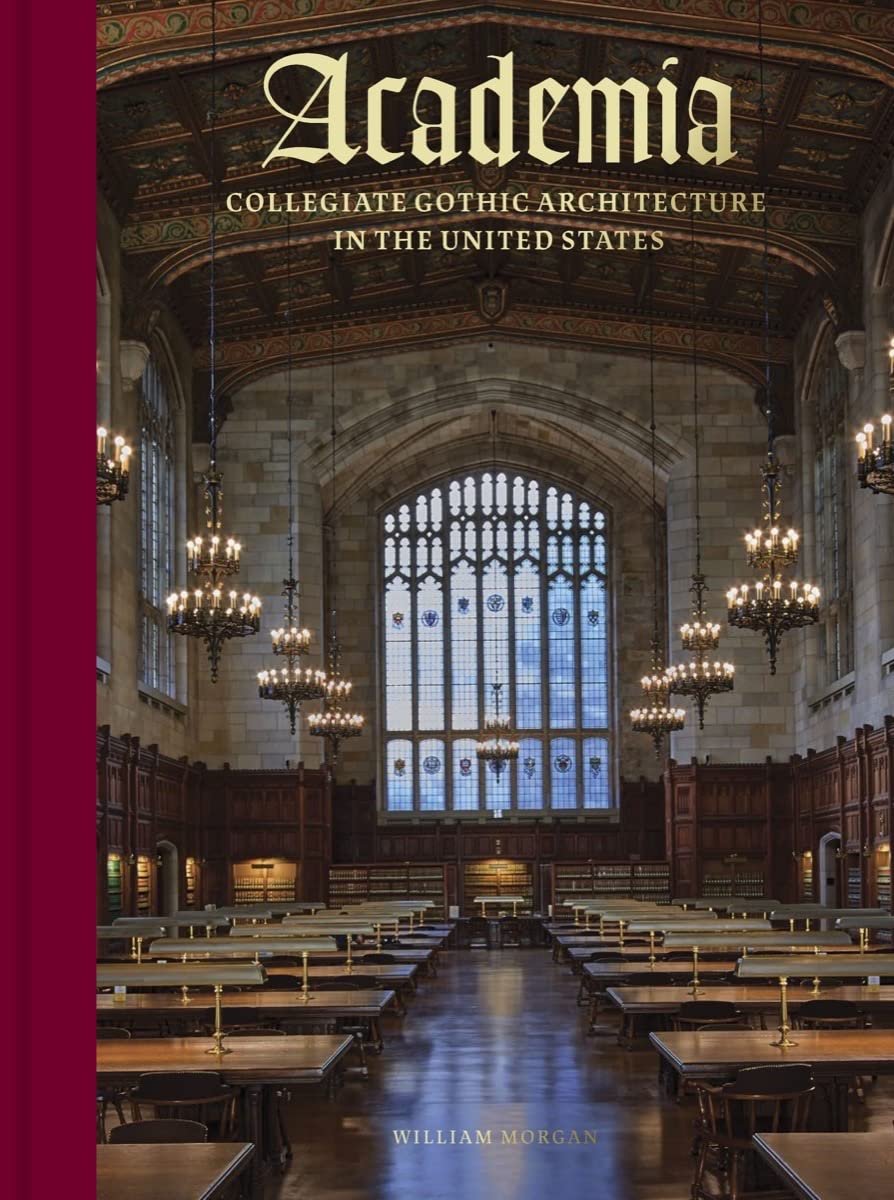
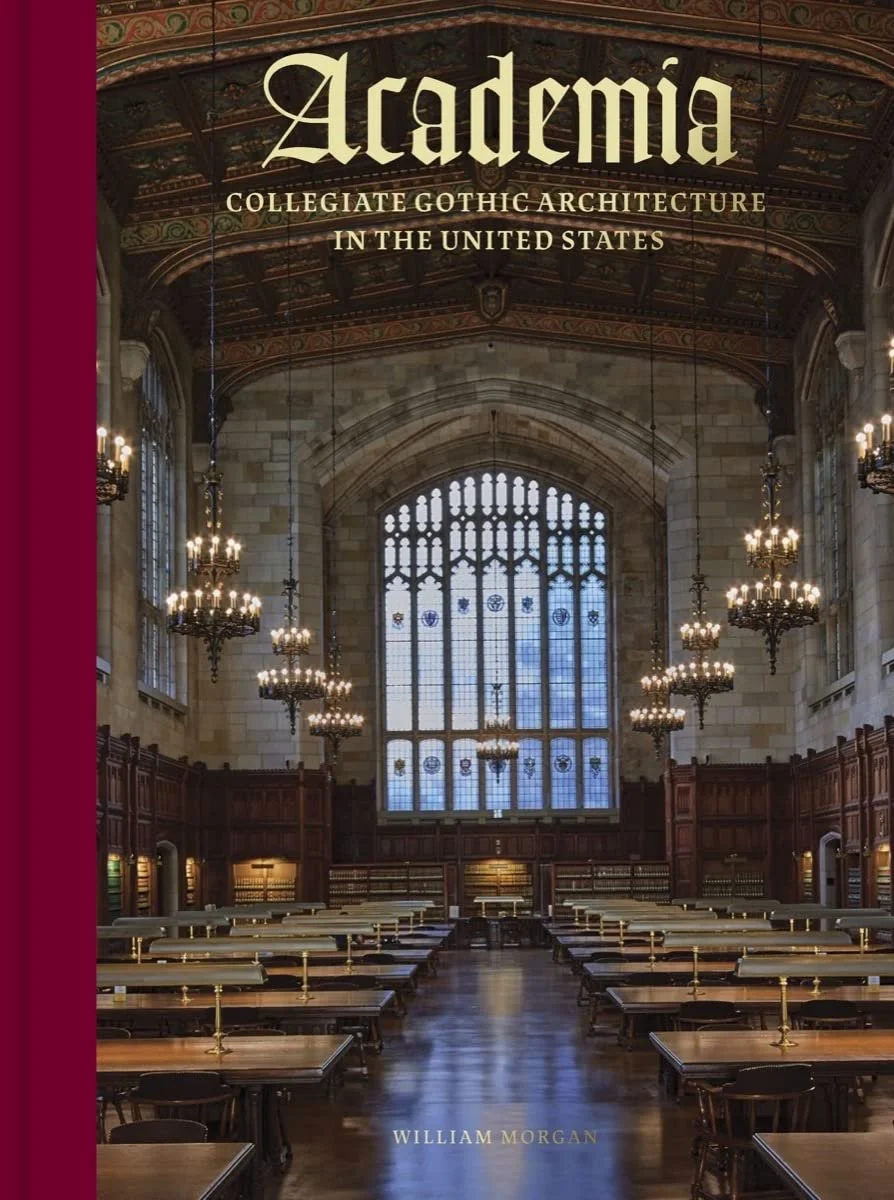
In reading William Morgan’s brilliantly written and gorgeously illustrated new book, Academia – Collegiate Gothic Architecture in the United States, you might recall Winston Churchill’s famous line: “We shape our buildings; thereafter they shape us.’’
I thought of this looking back at an institution I attended, a then-all-boys boarding school in Connecticut called The Taft School, founded by Horace Taft, the brother of President William Howard Taft. Its mostly Collegiate Gothic buildings made some of us students feel we were in a hybrid of a medieval church and a fort. This, I think, encouraged a certain personal rigor and seriousness of purpose, amidst the usual adolescent cynicism and jokiness.
The blurb from the publisher (Abbeville Press) summarizes well the book:
"Academia provides the ultimate campus tour of Collegiate Gothic architecture across the United States, from Princeton and Yale to Duke and the University of Chicago. It tells the surprising story of how the Gothic style of Oxford {whose origins go back to 1096} and Cambridge {founded in 1209} was adapted and transformed in the United States, to lend an air of history to the country’s relatively young college and prep school campuses. And it shows how Collegiate Gothic architecture, which flourished between the Gilded Age and the Roaring Twenties {into the Thirties, too}, continues to define the popular image of the college campus today—and even inspire new construction.’’
The style originally reflected a certain Anglophilia embraced by some American nouveau riche as they accumulated fortunes in a rapidly expanding economy. Rich donors, and the institutional architects they got hired, wanted to create buildings evoking kind of elite, aristocratic culture at certain old Protestant colleges and universities and private boarding schools. (Many of the latter were modeled on English boarding schools catering to the aristocracy.) There was often a lot of snobbery involved. But the style spread to other institutions, too, including businesses and government offices, around the country.
Some of this included fantastical (to the point of silliness) ornamentation and instant aging of stonework to suggest the wear of centuries on what were brand-new buildings, perhaps most flamboyantly at Yale. Get out those gargoyles!
The nearest major Collegiate Gothic campus to Providence is the Jesuits’ beautiful Boston College in Chestnut Hill, just outside of Boston.
Some institutions mostly stuck with the simpler and cheaper Georgian brick style (in New England that includes even mega-rich Harvard and merely rich Dartmouth and Brown) but Collegiate Gothic was a huge thing for decades, and much of it was beautiful. Even today, architects are designing, sometimes ingeniously, new applications of the style.
This book is about much more than architecture. It’s also about personalities, many of them colorful, class, including social climbing, Western civilization, economics, materials, politics and many other things.
One of the book’s joys is Mr. Morgan’s footnotes, which besides adding to the understanding of the main text, are often very entertaining, sometimes even hilarious.
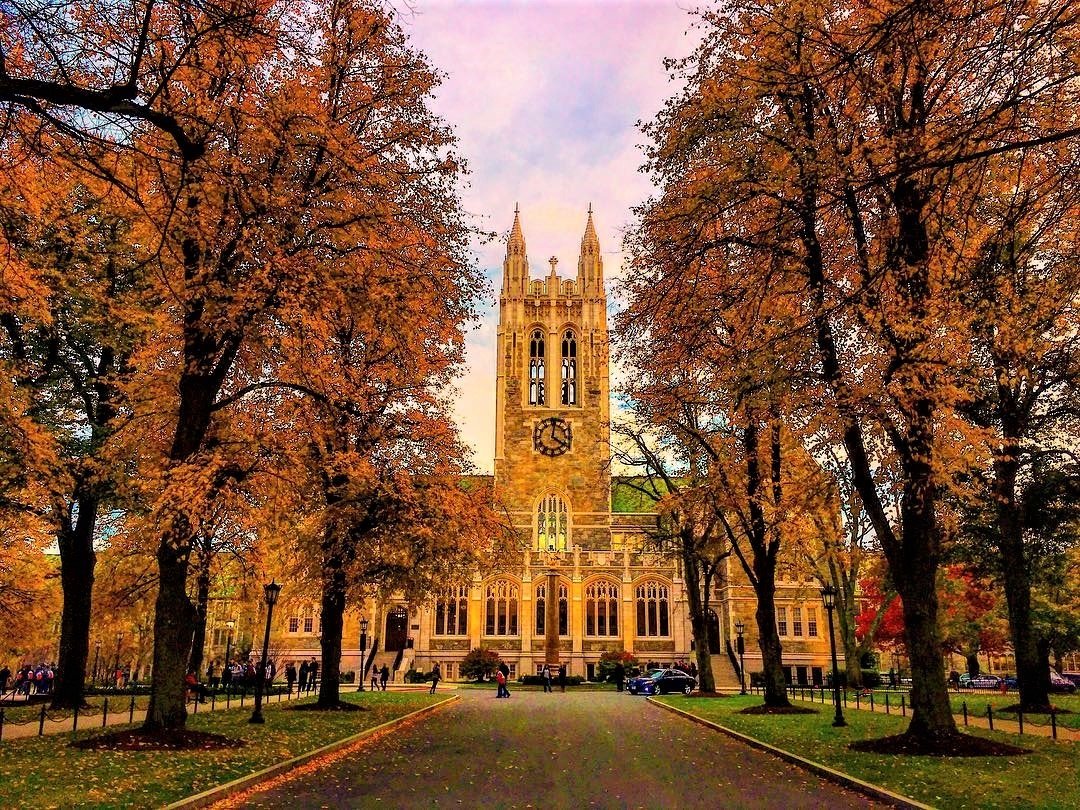
Gasson Hall, at Boston College, in the Chestnut Hill section of Newton, Mass., an example of high Collegiate Gothic architecture
— Photo by BCLicious
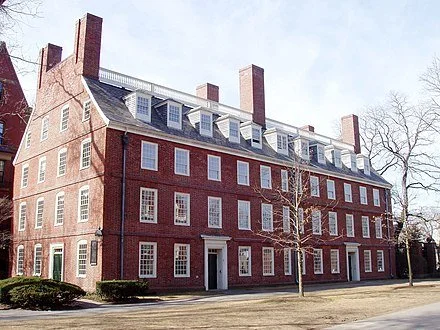
Massachusetts Hall at Harvard University, an example of the sort of Georgian Brick architecture that was the most common alternative on campuses to Collegiate Gothic.
‘Inter-species communication’

“Green Moth Observing Herself” (oil on paper, wire, clay, gouache, mirror), by western Massachusetts-based multimedia artist Ashley Eliza Williams, at MCLA Gallery 51, North Adams, Mass.
Ms. Williams writes:
“I am driven by a deep sense of wonder and curiosity about the non-human world. When I was a child I was extremely shy and I dreamed of being able to express myself with bioluminescence, or by quietly passing information through a network of fungal filaments, instead of with spoken words. These desires evolved into a fascination with alternative languages and non-human methods of connection.
“Today I study the sentience and sensory capabilities of rocks, squids, clouds, and other beings. I aim to weave stories about desire and longing. My work is a series of ‘communication attempts.’ Relationships between paintings and sculptures are inspired by interspecies communication, conversations between living and non-living things, and a desire to mitigate ecological and human loneliness. How fully can we understand a cloud, a tree, or a rock? Can we develop a vocabulary that enables us to do that?’’

Chris Powell: Regulations for social media can’t substitute for parents

—Graphic by Jason Howie
MANCHESTER, Conn.
According to a report issued the other day by Dalio Education, the Connecticut-based philanthropy, thousands of children and young adults in the state are "disconnected" -- uneducated, alienated, unemployed or even unemployable.
Meanwhile, Connecticut Atty. Gen. William Tong had the state join a national lawsuit against Meta, operator of the social-media companies Facebook and Instagram, alleging that thousands more of the state's children are too connected to social media. Instagram particularly, Tong and other attorneys general claim, has grabbed kids with "addictive platforms" that have caused a "youth mental health catastrophe."
The attorneys general assert that this attractiveness to children violates state consumer-protection laws and the federal Children's Online Privacy Protection Act.
But the essential claim of the lawsuits is just that the "platforms" are too interesting to kids. A statement from Tong's office condemns "features like infinite scroll and near-constant alerts," features that "were created with the express goal of hooking young users. These manipulative tactics continually lure children and teens back onto the platform."
But the only new element here is the technology being used in pursuit of an objective, not the objective itself, which is as old as storytelling: gaining and holding on to an audience. That was the objective of troubadors, fairs and theaters, and then newspapers, magazines, radio, and television, long before computers and the internet. Newspapers, magazines, radio and television still sensationalize to grab audiences to sell advertising, just as Facebook and Instagram do, though Facebook and Instagram may do it better because their subjects are the members of their audience themselves.
Kids spent much less time gossiping about each other before the advent of the telephone. Before television they were far less fascinated by violence and guns. Before welfare for childbearing outside marriage they were far better raised and educated and healthier mentally and physically.
Any "addiction" here is not physical, as with drugs, but psychological. People can walk away from Facebook and Instagram if they have something else to do. Indeed, most users of Facebook and Instagram do have other things to do -- like make a living.
It's just the nature of young people to be self-absorbed, neurotic, insecure and idle, more so if they live in homes with little parental supervision and in a society that demands no educational accomplishment from them.
Citing company documents obtained by The Wall Street Journal, the attorneys general cite the indifference of Facebook and Instagram to the neurosis that its "platforms" can induce in children, especially girls. Of course, children probably shouldn't be exposed to some things until they are older, if then. But if Facebook and Instagram are destroying young people, it couldn't happen if their parents didn't provide them with mobile phones and computers that allow internet access to those "platforms."
Attorney General Tong blames Facebook and Instagram for the inability of children to get enough sleep, as if children didn't lose sleep because of other obsessions long before social media. But if some children still aren't getting enough sleep, who should be called to account first? The distractions that interest the kids -- that is, themselves and their friends and acquaintances? Government? What about their parents?
Whether they are "disconnected" or too connected, children need constant attention from parents so they remain engaged with life without becoming alienated, neurotic, self-absorbed and obsessed. Is a government that increasingly throws gambling, marijuana and transgenderism at children, a government that lets just about any danger bypass immigration law and infiltrate the country, really fit to regulate children's use of social media even in their own homes, as the attorneys general suggest?
In the land of the First Amendment, is government really fit to prevent any particular mechanism of expression from reaching young people? If so, how would that be any different from the supposed "book banning" many of the attorneys general oppose?
Or might the country do better in regard to social media, "disconnection," and other troublesome issues if it stopped destroying the family with welfare policy and education with social promotion?
Chris Powell has written about Connecticut government and politics for many years (CPowell@cox.net).
In Conn., coastal beauty while moving, or stuck
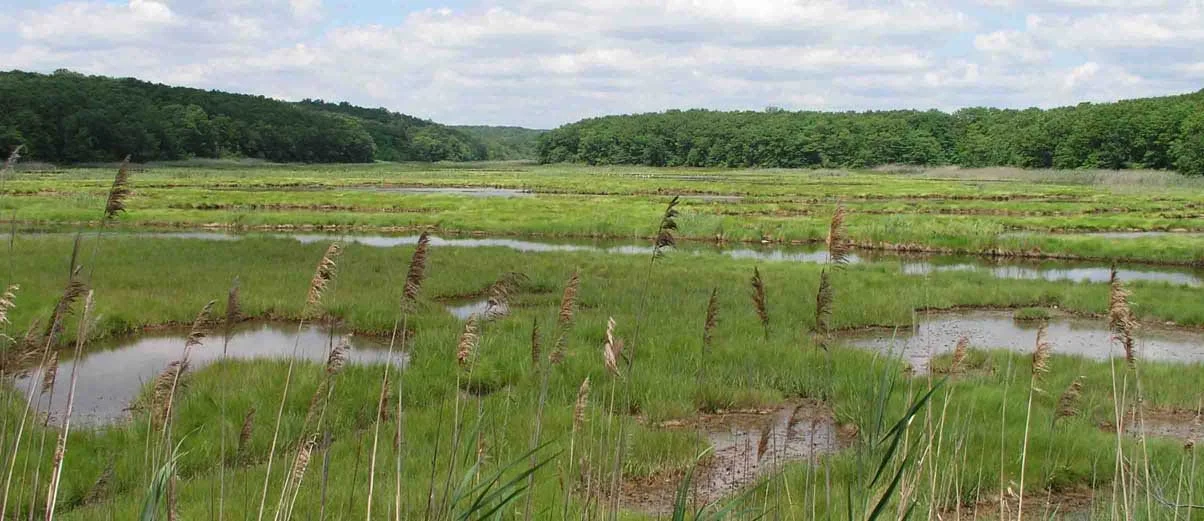
Coastal salt marsh in East Lyme, Conn., along Amtrak’s main Northeast Corridor route.
Adapted from Robert Whitcomb’s “Digital Diary,’’ in GoLocal24.com
I’ve been taking the train from Boston and Providence to New York for almost my whole life but am still mesmerized each trip by the beauty of the marshes along Connecticut’s Long Island Sound – ever changing in color, light, shadow, birds and boats. Lately, it helps offset some of the irritation from Amtrak’s endlessly terrible Internet service. Remember to sit on the Sound side of your train if you want broad water views, but sitting on the other side provides life-filled beauty, too.
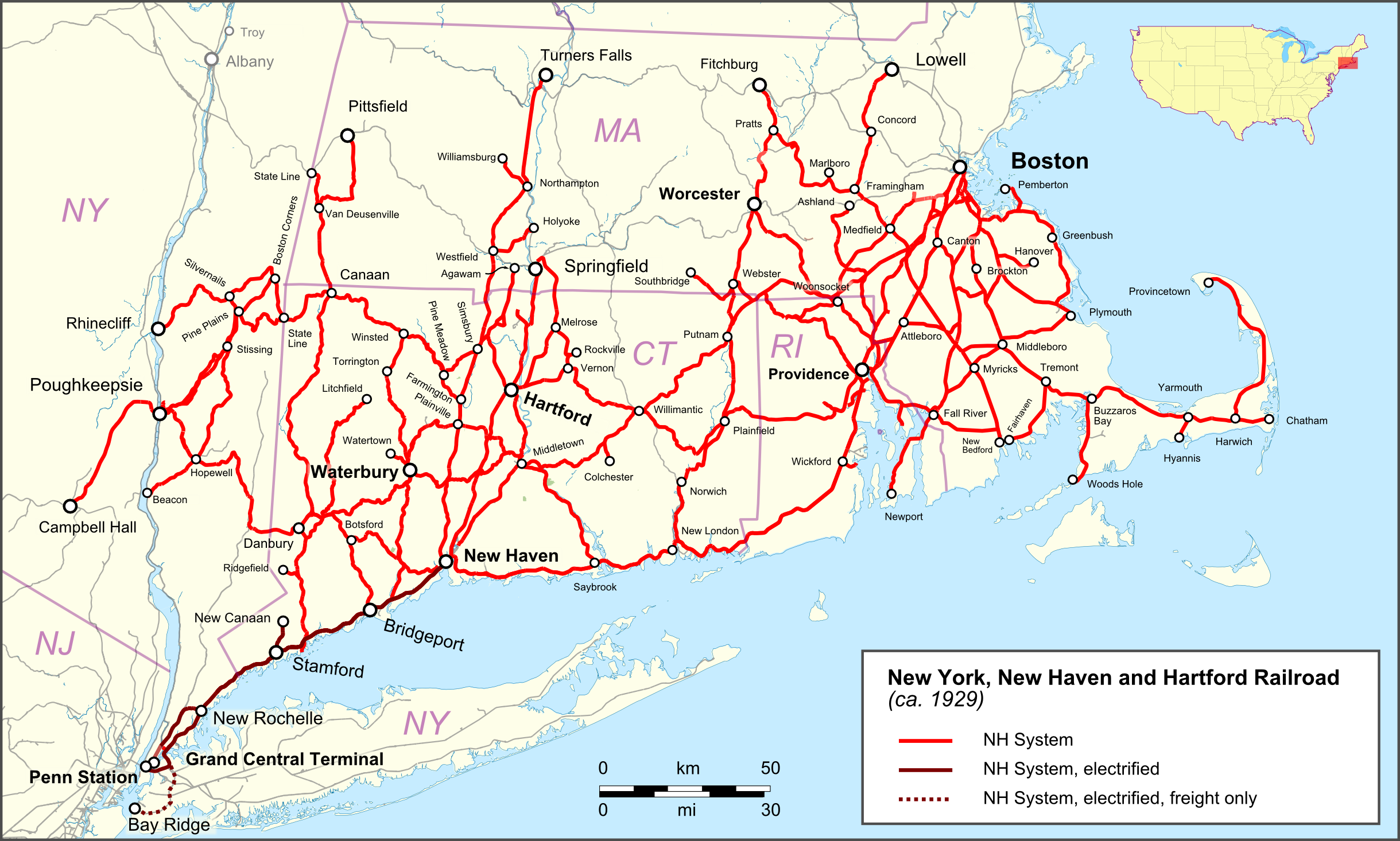
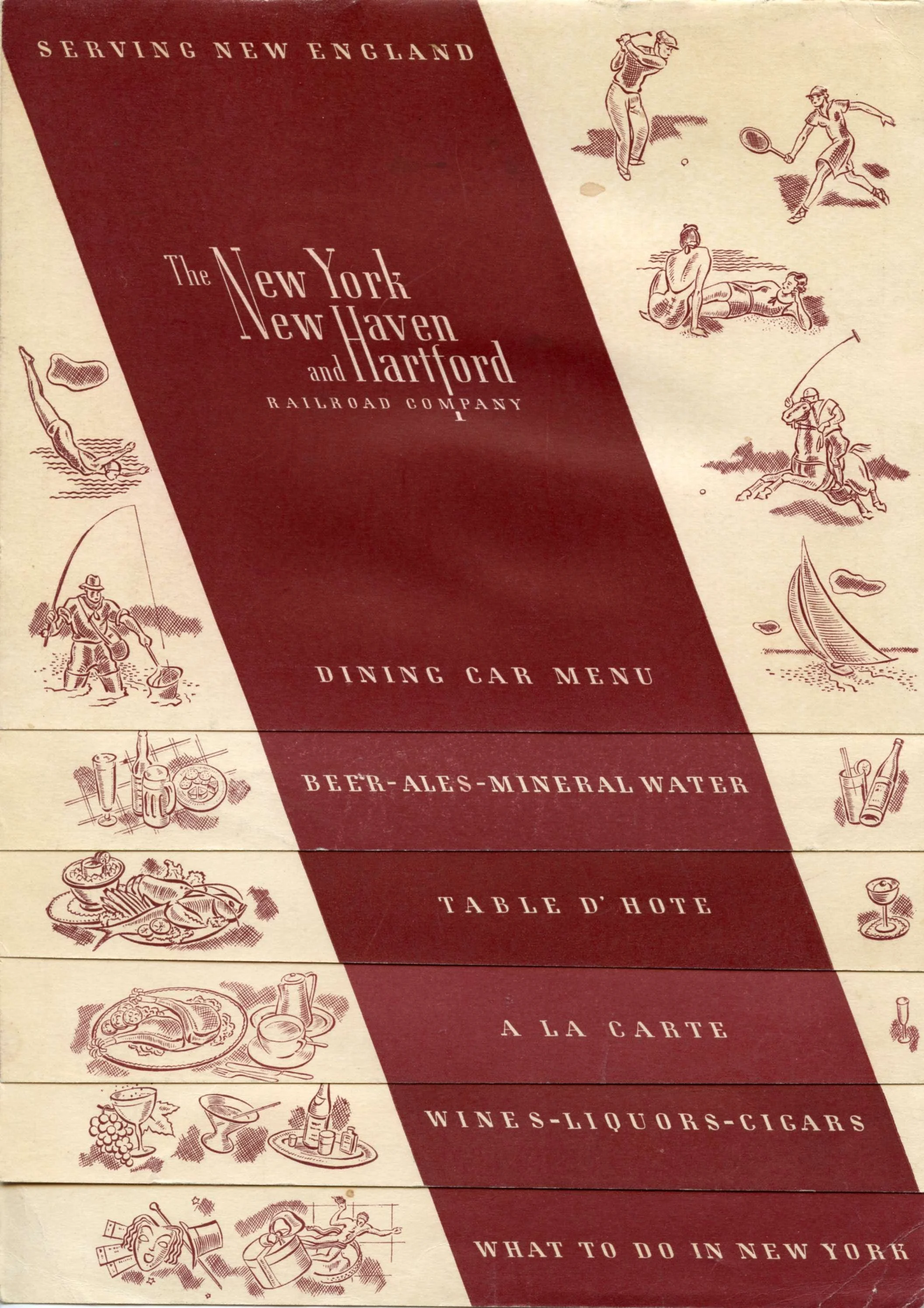
1929 map of New Haven Railroad service. New England Diary’s editor, Robert Whitcomb, frequently took the sometimes-bankrupt New Haven from Boston to New York. Its dining cars had fancier food than Amtrak has..

Llewellyn King: AI’s assault on journalism and many other jobs will intensify

AI robot at Heinz Nixdorf Museum, in Paderborn, Austria
—- Photo by Sergei Magel/HNF

Infographic published by the International Federation of Library Associations and Institutions.
This article is based on remarks the author made to the Association of European Journalists annual congress in Vlore, Albania, last month.
I am a journalist. That means, as it was once explained to me by Dan Raviv, of CBS News, that I try to find out what is going on and tell people. I know no better description than that of the work.
To my mind, there are two kinds of news stories: day-to-day stories and those that stay with us for a long time.
My long-term story has been energy. I started covering it in 1970, and, all these years later, it is still the big story.
Now, that story for me has been joined by another story of huge consequence to all of us, as energy has been since the 1970s. That story is artificial intelligence.
Leon Trotsky is believed to have said, “You may not be interested in war, but war is interested in you.” I say, “You may not be interested in AI, but AI is interested in you.”
Just as the Arab oil embargo of October 1973 upended everything, AI is set to upend everything going forward.
The first impact on journalism will be to truth. With pervasive disinformation, especially emanating from Russia, establishing the veracity of what we read — documents we review, emails we receive — will be harder. The provenance of information will become more difficult to establish.
Then, it is likely that there will be structural changes to our craft. Much of the more routine work will be done by AI — such things as recording sports results and sifting through legal documents. And, if we aren’t careful, AI will be writing stories.
One of the many professors I have interviewed while reporting the AI story is Stuart Russell, at the University of California at Berkeley, who said the first impact will be on “language in and language out.” That means journalism and writing in general, law and lawyering, and education. The written word is vulnerable to being annexed by AI.
The biggest impact on society is going to be on service jobs. The only safe place for employment may be artisan jobs — carpenters, plumbers and electricians.
Already, fast-food chains are looking to eliminate order-takers and cashiers. People not needed, alas.
The AI industry — there is one, and it is growing exponentially —likes to look to automation and say, “But automation added jobs.”
Well, all the evidence is that AI will subtract jobs almost across the board. Think of all the people around the world who work in customer service. Most of that will be done in the future by AI.
When you call the bank, the insurance agency, or the department store, a polite non-person will be helping you. Probably, the help will be more efficient, but it will represent the elimination of all those human beings, often in other countries, who took your orders, checked on your account, helped you decide between options of service, and to whom you reported your problems or, as often, voiced your anger and disappointment.
The AI bot will cluck sympathetically and say something like, “I am sorry to hear that. I will help you if I can, but I must warn you that company policy doesn’t allow for refunds.”
On the upside, research — especially medical research — will be boosted as never before. One researcher told me a baby born today can expect to live to 120 — another big story.
As journalists, we are going to have to continue to find out what is going on and tell people. But we will also have to find new ways of watermarking the truth. Leica, for instance, has come out with a camera that it says can authenticate the place and time that a photo was taken.
We are going to have to find new outlets for our work where people will know that it was written and reported by a human being, one of us, not an algorithm.
Journalists are criticized constantly for our failings, for allegedly being left or right politically, for ignoring or overstating, but when war breaks out, we become heroes.
I salute those brave colleagues reporting from Gaza and Ukraine. They are doing the vital work of finding out what is going on and telling us. Seventeen have been killed in Ukraine and 34 in Gaza. They are the noble of our trade.
On Twitter: @llewellynking2
Llewellyn King is executive producer and host of White House Chronicle, on PBS. He’s based in Rhode Island and Washington, D.C.
‘False binaries’

“Uncontrollable Drifting Inward and Outward Together (130lbs times two)” (gazed stoneware, rocks, hardware), by Brie Ruais, at the Worcester Art Museum.
— Image courtesy of the artist and Abertz Benda, New York | Los Angeles. Photo by Nash Baker.
The artist says:
“I see these as a balancing of opposites, a kind of turning of the cosmic sphere, night and day, sun and moon, dark and light; false binaries that suggest one can be had without the other, but they reaffirm each other, and coexist in balance (with effort).’’

The Star on the Sidewalk, in front of Worcester City Hall, indicates the spot of what is said to be the first reading in New England of the Declaration of Independence, in 1776.
FDR’s New Deal speech in Boston in the 1932 campaign
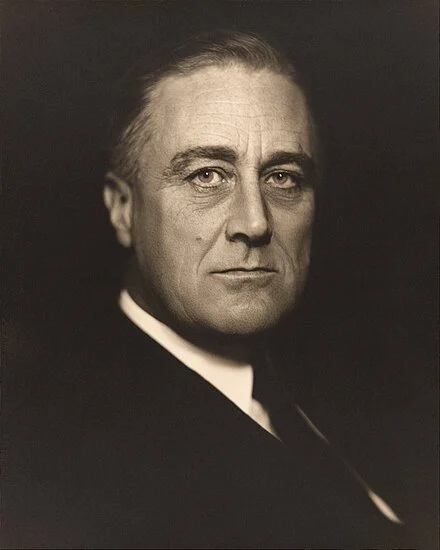
Franklin Roosevelt in the early 30’s. He had graduated from the Groton (Mass.) School and Harvard — thus his localizing remarks in the speech. He won Massachusetts in all four of his presidential campaigns.
Campaign speech by New York Governor and soon to be President Franklin Delano Roosevelt as the Great Depression deepened.
Boston, Massachusetts
October 31, 1932
Governor Ely, Mayor Curley, my friends of Massachusetts:
I am glad that a moment ago I had the privilege of standing under the flag of the Commonwealth of Massachusetts. There is a reason why I am particularly proud and happy of that. It is because, my friends, exactly one-half of me -- my mother's half -- comes from Massachusetts.
This trip to New England, I assure you, has brought back many happy memories. I have had a wonderful day from the early morning when I left the old school which I once attended and, where, I am told, I received some kind of culture, all the way up through Lawrence and Haverhill, and then on through New Hampshire and to Portland, Maine; and then this afternoon, coming back through the cities of Maine, New Hampshire and back into Massachusetts. I am more than ever convinced that those three States that I have visited today are going to be found in the Democratic column on November 8th.
I have met a multitude of old friends, with whom I have been associated in public life for more years than I care to tell you. If I were to start referring to each of them by name, I should have to call the roll of Massachusetts Democracy, and a good many of the Republicans as well. I appreciate the fact that today, a week before the election, we have a united party -- a party which, in securing a great victory on November 8th, will be supported not only by Democrats but by free-spirited Republican and independent voters. My only regret is that I could not have been here last Thursday night when Governor Smith was here. Anyway, the very day that he was here I had a good long talk with him, and I heard about the splendid and deserved welcome you gave him here in Boston.
Other memories, too, have come from far back beyond my earliest political experience. As a boy, I came to this State for education. To that education I look back with open and sincere pride and gratitude.
Then I came and lived not very far from here at a great institution for the freeing of the human mind from ignorance, from bigotry of the mind and the spirit. Knowledge -- that is, education in its true sense -- is our best protection against unreasoning prejudice and panic-making fear, whether engendered by special interests, illiberal minorities, or panic-stricken leaders who seek to perpetuate the power which they have misused.
I hope I have learned the lesson that reason and tolerance have their place in all things; and I want to say frankly that they are never so appropriate as when they prevail in a political campaign.
I say this with some feeling because I express widespread opinion when I note that the dignity of the office of President of the United States has suffered during the past week. The President began this campaign with the same attitude with which he has approached so many of the serious problems of the past three years. He sought to create the impression that there was no campaign going on at all, just as he had sought to create the impression that all was well with the United States, and that there was no depression.
But, my friends, the people of this country spoiled these plans. They demanded that the administration which they placed in power four years ago, and which has cost them so much, give an accounting. They demanded this accounting in no uncertain terms.
This demand of the people has continued until it has become an overwhelming, irresistible drift of public opinion. It is more than a drift. It is a tempest.
As that storm of approval for the Democratic policies has grown, several moods have come over the utterances of the Republican leader.
First, they were plaintively apologetic. Then the next move was indignation at the Congress of the United States. Finally, they have in desperation resorted to the breeding of panic and fear.
At first the President refused to recognize that he was in a contest. But as the people with each succeeding week have responded to our program with enthusiasm, he recognized that we were both candidates. And then, dignity died.
At Indianapolis he spoke of my arguments, misquoting them. But at Indianapolis he went further. He abandoned argument for personalities.
In the presence of a situation like this, I am tempted to reply in kind. But I shall not yield to the temptation to which the President yielded. On the contrary, I reiterate my respect for his person and for his office. But I shall not be deterred even by the President of the United States from the discussion of grave national issues and from submitting to the voters the truth about their national affairs, however unpleasant that truth may be.
The ballot is the indispensable instrument of a free people. It should be the true expression of their will; and it is intolerable that the ballot should be coerced -- whatever the form of coercion, political or economic.
The autocratic will of no man -- be he President, or general, or captain of industry -- shall ever destroy the sacred right of the people themselves to determine for themselves who shall govern them.
An hour ago, before I came to the Arena, I listened in for a few minutes to the first part of the speech of the President in New York tonight. Once more he warned the people against changing -- against a new deal -- stating that it would mean changing the fundamental principles of America, what he called the sound principles that have been so long believed in this country. My friends, my New Deal does not aim to change those principles. It does aim to bring those principles into effect.
Secure in their undying belief in their great tradition and in the sanctity of a free ballot, the people of this country -- the employed, the partially employed and the unemployed, those who are fortunate enough to retain some of the means of economic well-being, and those from whom these cruel conditions have taken everything -- have stood with patience and fortitude in the face of adversity.
There they stand. And they stand peacefully, even when they stand in the breadline. Their complaints are not mingled with threats. They are willing to listen to reason at all times. Throughout this great crisis the stricken army of the unemployed has been patient, law-abiding, orderly, because it is hopeful.
But, the party that claims as its guiding tradition the patient and generous spirit of the immortal Abraham Lincoln, when confronted by an opposition which has given to this nation an orderly and constructive campaign for the past four months, has descended to an outpouring of misstatements, threats and intimidation.
The administration attempts to undermine reason through fear by telling us that the world will come to an end on November 8th if it is not returned to power for four years more. Once more it is a leadership that is bankrupt, not only in ideals but in ideas. It sadly misconceives the good sense and the self-reliance of our people.
These leaders tell us further that, in the event of change, the present administration will be unable to hold in check the economic forces that threaten us in the period between Election Day and inauguration day. They threaten American business and American workers with dire destruction from November to March.
They crack the "whip of fear” over the backs of American voters, not only here but across the seas as well.
Ambassador Mellon, the representative of the United States at the Court of St. James's, an Ambassador who should represent the whole American people there -- every faith, the whole nation, Democrats, Republicans and Independents alike -- appeals to an English audience, on English soil, for the support of a party candidate 3000 miles away and invokes the same sinister threat and seeks to spread that threat to the rest of a civilized world.
I read somewhere in a history book about a Roman Senator who threw himself into a chasm to save his country. These gentlemen who represent us are of a new breed. They are willing to throw their country into a chasm to save themselves.
There is another means of spreading fear -- through certain Republican industrial leaders. I have said, without being controverted, that 5,000 men in effect control American industry. These men, possessed of such great power, carry likewise a great responsibility. It is their duty to use every precaution to see that this power is never used to destroy or to limit the sound public policy of the free and untrammeled exercise of the power of the ballot.
In violation of that duty, some of these 5,000 men who control industry are today invading the sacred political rights of those over whom they have economic power. They are joining in the chorus of fear initiated by the President, by the Ambassador, by the Secretary of the Treasury, and by the Republican National Committee.
They are telling their employees that if they fail to support the administration of President Hoover, such jobs as these employees have will be in danger. Such conduct is un-American and worthy of censure at the ballot box. I wonder how some of those industrial leaders would feel if somebody else's "baby had the measles.” In other words, would they agree that it would be equally reprehensible if any political leader were to seek reprisal against them -- against any coercing employer who used such means against political leaders? Let us fight our political battles with political arguments, and not prey upon men's economic necessities.
After all, their threats are empty gestures. You and I know that their industries have been sliding downhill. You know, and I know, that the whole program of the present administration has been directed only to prevent a further slipping downhill. You know, and I know, that therein lies the difference between the leaderships of the two parties.
You know, and I know, that the Democratic Party is not satisfied merely with arresting the present decline. Of course we will do that to the best of our ability; but we are equally interested in seeking to build up and improve, and to put these industries in a position where their wheels will turn once more, and where opportunity will be given to them to reemploy the millions of workers that they have laid off under the administration of President Hoover.
It is not enough merely to stabilize, to lend money! It is essential to increase purchasing power in order that goods may be sold. There must be people capable of buying goods in order that goods may be manufactured and sold. When that time comes, under our new leadership, these same gentlemen who now make their threats will be found doing business at the old stand as usual.
The American voter, the American working-man and working woman, the mill-worker of New England, the miner of the West, the railroad worker, the farmer, and the white-collar man will answer these silly, spiteful threats with their ballots on November 8th.
As I have pointed out before in this campaign, in a good many States and during many weeks, the fruits of depression, like the fruits of war, are going to be gathered in future generations. It is not the pinch of suffering, the agony of uncertainty that the grown-up people are now feeling that count the most; it is the heritage that our children must anticipate that touches a more vital spot. It is not today alone that counts. Under-nourishment, poor standards of living and inadequate medical care of today will make themselves felt among our children for fifty years to come….
It is the same for you -- workers in industry and in business. There are none of us who do not hope that our children can get a better break than we have had, that the chance for an education, for a reasonable start in life, may be passed on to our children, an opportunity for them built out of the hard work of our own hands. We want them to have opportunity for profitable character building -- decent, wholesome living -- good work, and good play. We want to know somehow that, while perfection does not come in this world, we do try to make things better for one generation to another….
Against this enemy every ounce of effort and every necessary penny of wealth must be raised as a defense. It is not that we lack the knowledge of what to do. The tragedy of the past years has been the failure of those who were responsible to translate high-sounding plans into practical action. There's the rub.
The present leadership in Washington stands convicted, not because it did not have the means to plan, but fundamentally because it did not have the will to do. That is why the American people on November 8th will register their firm conviction that this administration has utterly and entirely failed to meet the great emergency.
The American people are heart-sick people for "hope deferred maketh the heart sick.”
xxx
Now, my friends, we are considering unemployment tonight, and I am going to start by setting forth the positive policy which the President's Commission under the leadership of the Secretary of Commerce urged should be done. There is a lot of it which is still good.
It was a 5-point program. And as a program it was good.
First, it urged that government should reduce expenditures for public works during periods of prosperity, and that, during those periods, government should build up reserves with which to increase expenditures during periods of unemployment and industrial depression. But was that done? Not one penny's worth. No reserves were built up for the rainy day.
Second, the report said that the Federal Government should work with the railroads in the preparation of a long-time constructive program. Was that done? No. The Republican Administration did not give effect to this proposal. Instead of working with the railroads, to consolidate their lines and put them on a sound economical basis, the administration waited until the depression had laid them low, and then had nothing for them except to loan them more money, when they were already heavily in debt.
Third, the report proposed the setting up of safeguards against too rapid inflation, and consequently too rapid deflation of bank credit. As I have shown, the President and his Secretary of the Treasury went to the other extreme and encouraged speculation.
Fourth, the report recommended an adequate system of unemployment insurance. No one in the administration in Washington has assumed any leadership in order to bring about positive action by the States to make this unemployment insurance a reality. Someday, in our leadership, we are going to get it.
Fifth, it suggested an adequate system of public employment offices. But when Senator Wagner introduced a bill to establish Federal employment offices, President Hoover vetoed the measure that Secretary Herbert Hoover had sponsored. It seems to me, speaking in this great section of the country where there are so many business men, that business men who believe in sound planning and action, must feel that there is danger to the country in the continuance of a leadership that has shown such incapacity, such ineptitude, such heedlessness of common sense and of sound business principles. What we need in Washington is less fact finding and more thinking.
Immediate relief of the unemployed is the immediate need of the hour. No mere emergency measures of relief are adequate. We must do all we can. We have emergency measures but we know that our goal, our unremitting objective, must be to secure not temporary employment but the permanence of employment to the workers of America. Without long-range stability of employment for our workers, without a balanced economy between agriculture and industry, there can be no healthy national life.
We have two problems: first, to meet the immediate distress; second, to build up a basis of permanent employment.
As to "immediate relief,” the first principle is that this nation, this national government, if you like, owes a positive duty that no citizen shall be permitted to starve. That means that while the immediate responsibility for relief rests, or course, with local, public and private charity, in so far as these are inadequate the States must carry on the burden, and whenever the States themselves are unable adequately to do so the Federal Government owes the positive duty of stepping into the breach.
It is worth while noting that from that disastrous time of 1929 on the present Republican Administration took a definite position against the recognition of that principle. It was only because of the insistence of the Congress of the United States and the unmistakable voice of the people of the United States that the President yielded and approved the National Relief Bill this summer.
In addition to providing emergency relief, the Federal Government should and must provide temporary work wherever that is possible. You and I know that in the national forests, on flood prevention, and on the development of waterway projects that have already been authorized and planned but not yet executed, tens of thousands, and even hundreds of thousands of our unemployed citizens can be given at least temporary employment.
Third, the Federal Government should expedite the actual construction of public works already authorized. The country would be horrified if it knew how little construction work authorized by the last Congress and approved by the President has actually been undertaken on this date, the 31st of October. And I state to you the simple fact that much of the work for which congress has given authority will not be under way and giving employment to people until sometime next summer.
Finally, in that larger field that looks further ahead, we call for a coordinated system of employment exchanges, the advance planning of public works, and unemployment reserves. Who, then, is to carry on these measures and see them through? The first, employment exchanges, is clearly and inescapably a task of the Federal Government, although it will require the loyal and intelligent cooperation of State and local agencies throughout the land. To that Federal action I pledge my administration. The second, the advance planning of public works, again calls for a strong lead on the part of the government at Washington. I pledge my administration to the adoption of that principle, both as to enterprises of the Federal Government itself and as to construction within the several States which is made possible by Federal aid; and I shall urge upon State and local authorities throughout the nation that they follow this example in Washington. The third, unemployment reserves, must under our system of government be primarily the responsibility of the several States. That, the Democratic platform, on which I stand, makes entirely clear.
In addition to all this, there has been long overdue a reduction of the hours of work and a reduction of the number of working days per week. After all, the greatest justification of modern industry is the lessening of the toil of men and women. These fruits will be dead fruits unless men earn enough so that they can buy the things that are produced, so that they can have the leisure for the cultivation of body, mind and spirit, which the great inventions are supposed to make possible. That means that government itself must set an example in the case of its own employees. It means also that government must exert its persuasive leadership to induce industry to do likewise.
Here then is a program of long-range planning which requires prompt and definite action and the cooperation of Federal and State and local governments, as well as of forward-looking citizens of both parties throughout the land. The proposals are specific, they are far-reaching. To advocate a less drastic program would be to misread the lessons of the depression and to express indifference to the country's future welfare.
There is one final objective of my policy which is more vital and more basic than all else. I seek to restore the purchasing power of the American people. The return of that purchasing power, and only that, will put America back to work.
We need to restore our trade with the world. Under Republican leadership we have lost it, and the President of the United States seems to be indifferent about finding it again.
And now I am going to talk to a city audience about farming. I do not make one kind of speech to a farm audience and another kind of speech to a city audience. We need to give to fifty million people, who live directly or indirectly on agriculture, a price for their products in excess of the cost of production. You know how and why that affects us in the cities. To give them an adequate price for their products means to give them the buying power necessary to start your mills and mines to work to supply their needs. Fifty million people cannot buy your goods, because they cannot get a fair price for their products. You are poor because they are poor.
I favor -- and do not let the false statements of my opponents deceive you -- continued protection for American agriculture as well as American industry. I favor more than that. I advocate, and will continue to advocate, measures to give the farmer an added benefit, called a tariff benefit, to make the tariff effective on his products. What good does a 42-cent tariff on wheat mean to the farmer when he is getting 30 cents a bushel on his farm? That is a joke. The most enlightened of modern American businessmen likewise favor such a tariff benefit for agriculture. An excellent example is your own fellow Bostonian, Mr. Harriman, President of the Chamber of Commerce of the United States, who has recently proclaimed a plan for the restoration of agriculture not unlike my own.
The President of the United States does not favor a program of that kind, or, so far as I can make out, of any practical kind. He has closed the door of hope to American agriculture, and when he did that, he closed the door of hope to you also.
He says proudly that he has effectively restricted immigration in order to protect American labor. I favor that; but I might add that in the enforcement of the immigration laws too many abuses against individual families have been revealed time and time again.
But when the President speaks to you, he does not tell you that by permitting agriculture to fall into ruin millions of workers from the farms have crowded into our cities. These men have added to unemployment. They are here because agriculture is prostrate. A restored agriculture will check this migration from the farm. It will keep these farmers happily, successfully, at home; and it will leave more jobs for you. It will provide a market for your products, and that is the key to national economic restoration.
One word more. I have spoken of getting things done. The way we get things done under our form of government is through joint action by the President and the Congress. The two branches of government must cooperate if we are to move forward. That is necessary under our constitution, and I believe in our constitutional form of government.
But the President of the United States cannot get action from the Congress. He seems unable to cooperate. He quarreled with a Republican Congress and he quarreled with a half Republican Congress. He will quarrel with any kind of Congress, and he cannot get things done.
That is something that the voters have considered and are considering and are going to remember one week from tomorrow. You and I know, and it is certainly a fact, that the next Congress will be Democratic. I look forward to cooperating with it. I am confident that I can get things done through cooperation because for four years I have had to work with a Republican Legislature in New York.
I have been able to get things done in Albany by treating the Republican members of the Legislature like human beings and as my associates in government. I have said that I look forward to the most pleasant relations with the next Democratic Congress, but in addition to that let me make it clear that on that great majority of national problems which ought not to be handled in any partisan manner, I confidently expect to have pleasant relations with Republicans in the Senate and the House of Representatives as well as with Democrats.
After the fourth of March, we -- meaning thereby the President and the members of both parties in the Halls of Congress -- will, I am confident, work together effectively for the restoration of American economic life.
I decline to accept present conditions as inevitable or beyond control. I decline to stop at saying, "It might have been worse.” I shall do all that I can to prevent it from being worse but -- and here is the clear difference between the President and myself -- I go on to pledge action to make things better.
The United States of America has the capacity to make things better. The nation wants to make things better. The nation prays for the leadership of action that will make things better. That will be shown in every State in the Union -- all 48 of them -- a week from tomorrow. We are through with "Delay” we are through with "Despair”; we are ready, and waiting for better things.
Swimming amidst sculptures

From Caroline Bagenal’s exhibition “Swimming Sculptures’’ at Boston Sculptors Gallery, Nov. 9-Dec. 16.
The gallery says:
The show “comprises sculpture, embroidered photographs and video based on her experience of swimming in tidal rivers and lakes. With her uncanny sculptures attached to her body, Bagenal takes to the water and swims with them, activating and transforming the work as it marks the movements of her body and the water’s currents.”
“The swimming sculptures are made from recycled woven plastic, bubble wrap and other materials that float. They derive in part from the artist’s embroidered photographs, which function as part of her creative process—a kind of drawing with thread which she uses to imagine future sculptures.’’
A very Marine town

“I grew up in Boston in a very, very, very Marine town. So back in my neighborhood {Brighton} in Boston, a working-class neighborhood, when you got your draft notice, you went down, and you took your draft physical. And then, if you passed it, you joined the Marine Corps.’’
-John F. Kelly (born 1950), a retired Marine general, he served as White House chief of staff and secretary of homeland security in the Trump administration.

‘The love of bare November Days’

—Photo by Łukasz Smolarczyk
My sorrow, when she’s here with me,
Thinks these dark days of autumn rain
Are beautiful as days can be;
She loves the bare, the withered tree;
She walks the sodden pasture lane.
Her pleasure will not let me stay.
She talks and I am fain to list:
She’s glad the birds are gone away,
She’s glad her simple worsted grey
Is silver now with clinging mist.
The desolate, deserted trees,
The faded earth, the heavy sky,
The beauties she so truly sees,
She thinks I have no eye for these,
And vexes me for reason why.
Not yesterday I learned to know
The love of bare November days
Before the coming of the snow,
But it were vain to tell her so,
And they are better for her praise.
“My November Guest,’’ by Robert Frost (1874-1963)
Only constant is change

“At Day's End (Falmouth, Mass.), ‘‘ by Cataumet, Mass.-based photographer Bobby Baker

The Cataumet Schoolhouse in the Cataumet section of Bourne, Mass., on Cape Cod. Built in 1894, it served the town as a schoolhouse until 1934, and then as a community center until 1960. It is a well-preserved example of a 19th-Century one-room schoolhouse, and was listed on the National Register of Historic Places in 2019.
Don Pesci: In search of Anti-Semitism in Conn. and elsewhere
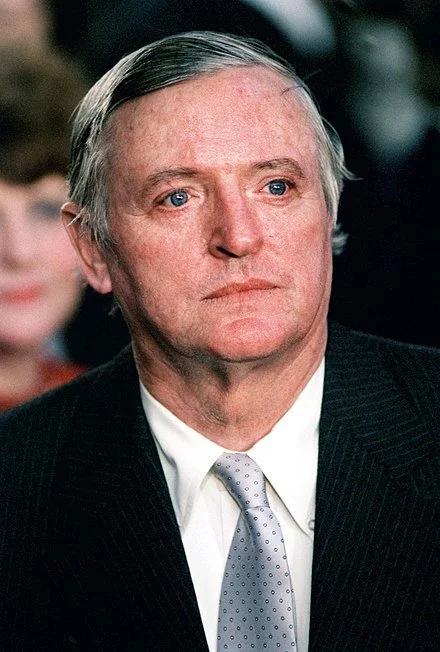
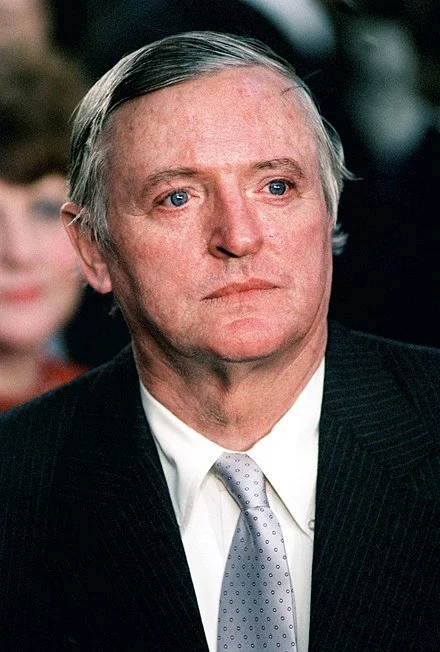
William F. Buckley Jr. in 1985
VERNON, Conn.
National Review, founded by the late William F. Buckley Jr. (1925-2008) in 1955, has been a stumbling block to neo-progressive Democrats for nearly seven decades. The mission of the magazine, Buckley announced at its founding, was to “stand athwart history, yelling Stop, at a time when no one is inclined to do so, or to have much patience with those who so urge it.”
Jack Fowler, now running for city clerk in Milford, Conn., has been associated with the magazine for more than three decades and served for a time as its publisher.
Fowler, along with Buckley and other non-far-right conservatives at National Review, cannot reasonably be accused of either anti-Semitism or unflinching support of former President Donald Trump.
Long before Trump threw his hat in the presidential-campaign ring, Buckley characterized Trump as a “vulgarian,” and National Review later took some kicks in the stomach for having devoted a whole issue of the magazine to a political polemic titled “Never Trump.”
In 1992, Buckley published what some consider the best view of modern anti-Semitism, In Search of Anti-Semitism.
John O’Sullivan, then publisher of National Review, characterized the book this way: “It is not a history of anti-Semitism, nor a social-psychological definition of anti-Semitism, not a survey of anti-Semitism in the world today.” The book is rather “an examination of how anti-Semitism is treated when it appears, or is alleged to appear, in the limited but influential milieu in which he [Buckley] happens to live: opinion magazines, op-ed pages, syndicated columns, television talk shows.”
The book may be considered especially relevant considering the current pro-Hamas protests, some of them patently anti-Semitic, among leftist outposts in ivy-league fever swamps, opinion magazines, op-ed pages, syndicated columns and television talk shows.
“The election for Milford city clerk,” a Hartford paper reports, “is traditionally a low-key, overlooked local contest for a job that includes approving items like marriage and dog licenses. But the campaign this year has exploded into charges and countercharges as Democrats are blasting Republican Jack Fowler for a series of controversial posts on a variety of subjects dating back to 2012.”
Opposition researchers likely associated with Connecticut’s mud-throwing Democrat Party have unearthed “a series of controversial tweets by Fowler that date back more than a decade and involve sharply criticizing another Milford Republican and making references to Jews.”
The tweet in question “written by Fowler, which came to light recently when retweeted to nearly 44,000 followers by Connecticut Democrats, states “Jewrack Jewbama. Jew Biden. Nancy Jewlosi. Hebrewllary Clinton. Yeah, you’re right now that I think about it.”
Fowler, the paper observes, “admits writing the posts but says they were either sarcastic, done in jest or responding to news events of the day that cannot be understood properly without knowing the original tweets that caused the response… Fowler says he was responding to another post, which has since been deleted, that had criticized National Review, which is a staunch defender of Israel. In addition, Fowler released a series of pro-Israel tweets that he wrote, along with three articles that he authored for the magazine on anti-Semitism.”
Defending himself from a charge of anti-Semitism, Fowler answered, “There is no question where I stand thoroughly, very publicly, repeatedly, voluminously over the years [on Israel]. To be accused to being anti-Semitic is reprehensible, especially by people who know it’s not true. … People who know me in Milford know this is B.S. This is the age we live in. It’s not to win an election. It’s to destroy the reputation of somebody.”
Given the prevailing circumstances in the hot war between Israel and Hamas, every rhetorician on planet earth would acknowledge that, if you are defending yourself against an unwarranted charge of anti-Semitism, you are losing the argument. Quite like a poisonous false charge of racism, the mere making of the charge itself is certain proof of culpability.
Fowler’s statement, even if made in jest, said state Democratic Party Chairperson Nancy DiNardo, is “inappropriate.” But it is seemingly appropriate to tat political opponents with anti-Semitism. Such ideological tattoos do not easily wear away, even if they are demonstrably false.
DiNardo, applying her pitch-brush more broadly, continued “I think it points to how bad the Republican Party is getting. They’re going to be extremists at every single level. It’s just not what the Connecticut voters stand for… He was the publisher of an ultraconservative, far-right magazine. Of all the candidates that the Republicans could have picked in Milford, and they picked him? That’s shocking to me. He’s not a good candidate to be running for this position.”
The easily shocked DiNardo very likely has never leafed through the non-far-right, non-ultraconservative National Review. She certainly has never read Buckley’s In Search of Anti-Semitism.
We have here reached a point –of no return? – in which ideologically polluted charges need not be proven before they are unjustly launched against political foes simply to win elections.
When Alice in Lewis Carroll’s Through the Looking Glass rebukes Humpty Dumpty for having used the same word to mean opposite things, Humpty Dumpty replies imperiously that the word he is using means exactly what he “chooses it to mean, neither more nor less. The only question is – who rules.”
In Connecticut, Democrats rule.
Don Pesci is a Vernon-based columnist.
Must be patrolled

“Island of Endangered Species” (oil, mixed media, fabric on panel), by Donald Saaf , his show “Peaceable Kingdom: The Art of Donald Saaf,’' at the Cahoon Museum of American Art, Cotuit, Mass., through Dec. 23. He lives in the Saxtons River section of Rockingham, Vt.
— Photo by Mr. Saaf
The museum says Mr. Saaf:
"{E{}xplores the subtle line between fine art and folk art in paintings that are heartwarming and approachable. His large-scale paintings and collages draw upon his memories of nature, family and community from his life in rural Vermont.’’
North of the immigration zone?

New Hampshire’s Franconia Range. The state’s, er, rigorous climate is uninviting for some immigrants.
“Immigration, of course, in New Hampshire is - it's not something that you see every day. It's not like talking about it in Texas, where people have a much more explicit sense of it.’’
Evan Osnos (born 1976), American journalist and book author

Sam Pizzigati: Time to close the huge IRS audit gap that favors the rich

IRS logo
Read about New England’s richest towns, and how they got that way.
Via OtherWords.org
BOSTON
In 2020, U.S. households annually making over $1 million faced fewer tax audits than households with incomes low enough to qualify for the Earned Income Tax Credit. That had never happened before.
In part, you can blame the Trump administration. But conservatives in Congress actually gave Trump his tax-cutting playbook, as a new Americans for Tax Fairness report makes clear.
Ever since 2010, these right-wing lawmakers have been squeezing the IRS budget, forcing the agency “to drastically pull back on auditing the ultra-wealthy.” Between 2010 and 2020, audits on millionaires dropped a whopping 92 percent.
The super rich have taken full advantage. Nearly a thousand taxpayers making over $1 million a year, Sen. Ron Wyden (D.-Ore.) points out, haven’t even bothered “to file tax returns over multiple recent years.”
Thanks to the Inflation Reduction Act President Biden signed, the IRS gained an $80 billion increase in funding last year. Wyden, who chairs the Senate Finance Committee, wants to see the IRS use that money to increase the audit rate on America’s richest.
But Republicans are pushing to chop IRS funding by $67 billion. That cut, Americans for Tax Fairness calculates, would leave the nation right back where the Trump gang left it: with millionaires getting audited less than 1 percent of the time.
We should be resisting those auditing cuts. And besides cracking down on tax cheats, we need to close the wide constellation of loopholes that help the richest Americans legally sidestep any significant tax bill.
One example? The abuse of nonprofit donations.
Most of us hear the word “nonprofit” and think of the Red Cross or some other familiar charity. These traditional charities fall under section 501(c)(3) of the U.S. tax code.
Other nonprofits — most notably those that come under the tax code’s 501(c)(4) — can engage in activities that have next to nothing to do with providing charitable services. They can own companies indefinitely, as Forbes details, and benefit private individuals. They can lobby lawmakers as much as they want and “get directly involved in politics.”
This flexibility that C4s offer became particularly attractive to America’s deepest pockets in 2015.
Lobbyists bankrolled by the billionaire Koch family wiggled into the tax law that year a charming little loophole that lets the rich take shares of stock they own that have appreciated handsomely and pass them to C4s — without having to pay either a gift tax or a capital-gains tax on the share transfer.
The C4s receiving these hefty gifts of shares, Forbes adds, “can then sell the stock, capital gains tax–free, or hold on to it indefinitely, reaping the dividends.”
Thanks to this loophole, note investigative journalists Judd Legum and Tesnim Zekeria, billionaires like Charles Koch can now use their allied C4s “to spend as much money as they want on political campaigns without disclosing their spending or paying taxes.”
Billionaires should be paying taxes like the rest of us to support schools, health care, and the like. Instead, this handy and inequitable loophole leaves billionaires with the wherewithal to buy still more private jets, trinkets, and mansions — and our democracy.
Blank political checks for billionaires like Charles Koch have no place in a country striving to become a more equal place. So let’s fund the IRS, close the loopholes, and conduct those audits. Now!
Sam Pizzigati, based in Boston, co-edits Inequality.org at the Institute for Policy Studies. His books include The Case for a Maximum Wage and The Rich Don’t Always Win.
‘A kiss that never ends’

“A Burst of Light (Red)’’ (hair, embodied knowledge, ancestral recall, audacity of survival, bobby pins), by Providence-based Nafis M. White, in the show “Paint the Town Red,’’ at Cade Tompkins Projects, Providence, Nov. 4-Dec. 31.
Edited from the gallery’s description:
“White dives into the depths of the autumnal energy, bathing the gallery in red in honor and celebration of the Goddess Sekhmet, the Warrior, the Sensualist, the Destroyer, the Lover, the Healer.
“In ‘Paint the Town Red,’ White premieres new paintings, works on paper, performance and new iconic Oculus works. As viewers go deeper into the sanctuary, the darkness surrounds, red lighting illuminating the pathways forward, Afro House pulsating through the space. What happens in the dark stains the lips of the revelers. ‘A kiss that never ends, effervescent energy that vibrates towards intellectual climax, this is what I'm after….catharsis, power, partnership and release,’ says White.
“Bodies of work on display also include ‘Hidden Topographies,’ which employs crewel embroidery and needlework to at once obscure and reimagined written text; and ‘God Helps Those Who Help Themselves,’ continuing White’s inquiry into the life story of Emmanuel ‘Manna’ Bernoon, a freed slave who founded Providence’s first restaurant, in 1736, an oyster and ale house. For this work, White sourced local oysters, cleaned and dried the shells and imbued them with gold leaf ‘to honor the beauty, resilience and legacy of a people.’’’

Apple agritourism

Text excerpted from a The New England Historical society article
“Trying to pick six historic apple orchards in New England may be a fool’s errand. As Maine apple expert John Bunker explains, the notion of a commercial orchard is relatively modern.
“‘At a certain point, everyone had an orchard,’ Bunker told the New England Historical Society. ‘Everyone lived on a farm, and every farm had an orchard.’
“In the 1920s, a New Hampshire farmer came up with the idea of bringing tourists from Boston to pick their own apples in the fresh air and sunshine. The idea took hold. Today, 200-year-old farms are weathering developers (if not the weather) by diversifying with farm-to-table meals, cider, kids’ play areas, ready-to-eat food, hayrides, sleigh rides, corn mazes and even seasoned firewood.
“Agritourism today is just as much a feature of the New England landscape as history tourism. Here, then, are six historic apple orchards, one in each New England state.’’
To read the whole article, please hit this link.