
Vox clamantis in deserto







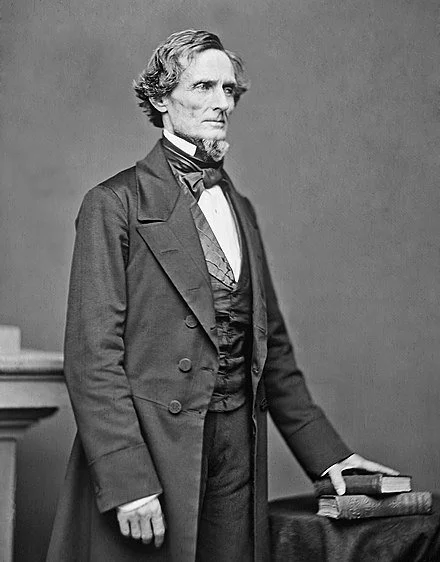
Jefferson Davis’s speech in Faneuil Hall, Boston, shortly before the Civil War

Jefferson Davis (1808-1889), president of the Confederate States of America, 1861-1865.
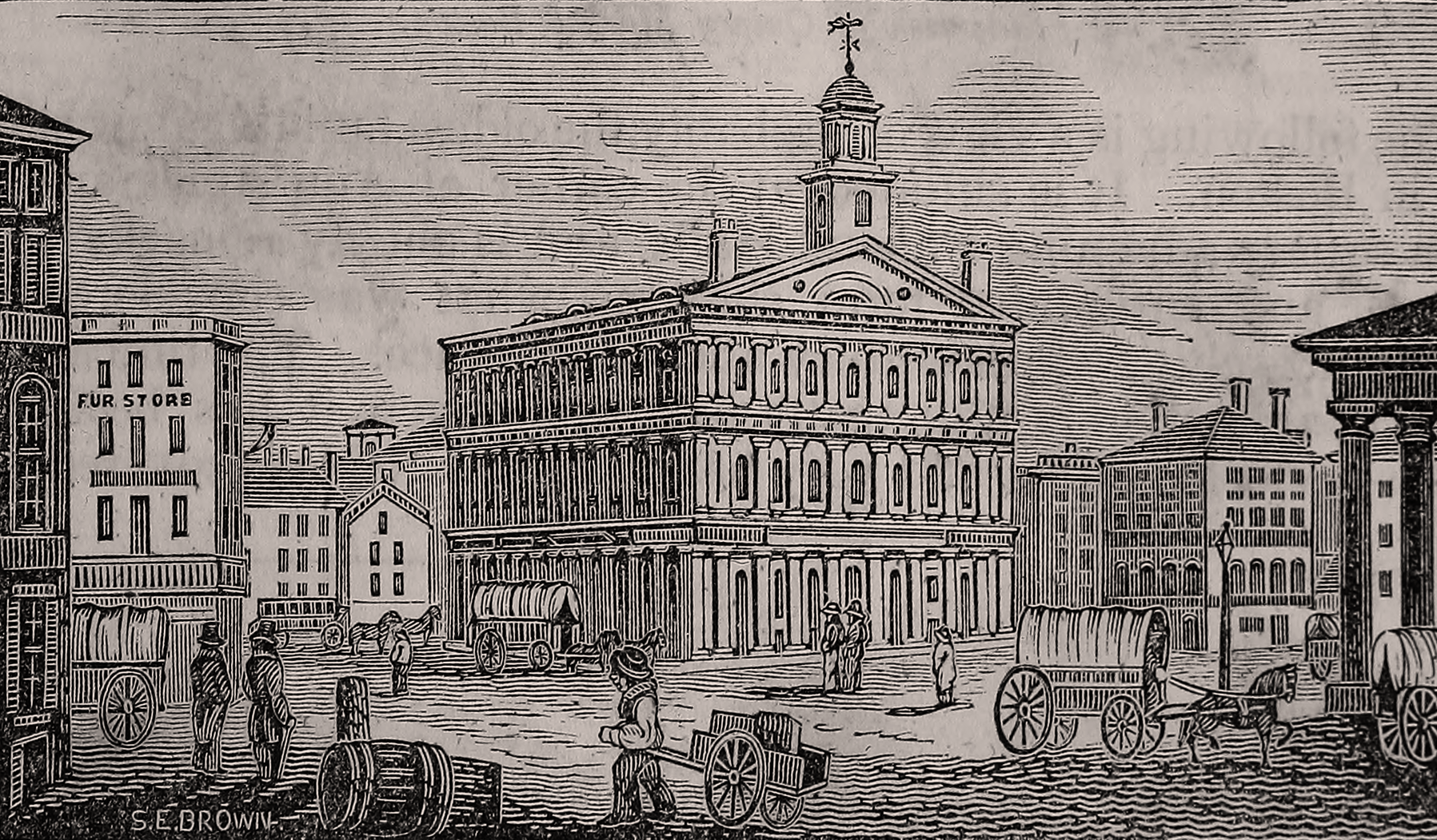
Faneuil Hall, in downtown Boston, in an 1839 engraving.
Faneuil Hall, October 11, 1858
Countrymen, Brethren, Democrats--Most happy am I to meet you, and to have received here renewed assurance--of that which I have so long believed--that the pulsation of the democratic heart is the same in every parallel of latitude, on every meridian of longtitude throughout the United States. But it required not this to confirm me in a belief so long and so happily enjoyed.-- Your own great statesman who has introduced me to this assembly has been too long associated with me, too nearly connected, we have labored too many hours, sometimes even until one day ran into another, in the cause of our country, for me to fail to understand that a Massachusetts democrat has a heart comprehending the whole of our wide Union, and that its pulsations always beat for the liberty and happiness of its country. Neither could I be unaware such was the sentiment of the democracy of New England. For it was my fortune lately to serve under a President drawn from the neighboring State of New Hampshire, [applause,] and I know that he spoke the language of his heart, for I learned it in four years of intimate connection with him, when he said he knew "no north, no south, no east, no west, but sacred maintenance of the common bond and true devotion to the common brotherhood." Never, sir, in the past history of our country, never, I add, in its future destiny, however bright it may be, did or will a man of higher and purer patriotism, a man more devoted to the common weal of his country, hold the helm of our great ship of State, than that same New Englander, Franklin Pierce. [Applause.]
I have heard the resolutions read and approved by this meeting; heard the address of your candidate for Governor; and these added to the address of my old and intimate friend, Gen. Cushing, bear to me fresh testimony, which I shall be happy to carry away with me, that the democracy, in the language of your own glorious Webster, "still lives," lives not as his great spirit, when it hung 'twixt life and death, like a star upon the horizon's verge, but lives like the germ that is shooting upward, like the sapling that is growing to a mighty tree, the branches of which will spread over the commonwealth, and may redeem and restore Massachusetts to her once glorious place in the Union.
As I look around me and see this venerable hall thus thronged, it reminds me of another meeting, when it was found too small to contain the assembly--that great meeting which assembled here, when the people were called upon to decide what should be done in relation to the tea-tax. Faneuil Hall, on that occasion, was found too small, and the people went to the Old South Church, which still stands--a monument of your early history. And I hope the day will soon come when many Democratic meetings in Boston will be too large for Faneuil Hall! [Applause.] I am welcomed to his hall, so venerable for its associations with our early history; to this hall of which you are so justly proud, and the memories of which are part of the inheritance of every American citizen; and feel, as I remember how many voices of patriotic fervor have here been heard; that in it originated the first movements from which the Revolution sprung; that here began that system of town meetings and free discussion which is the glory and safety of our country; that I had enough to warn me, that though my theme was more humble than theirs, (as befitted my poorer ability,) that it was a hazardous thing for me to attempt to speak in this sacred temple. But when I heard your statesman (Gen. Cushing) say, that a word once here spoken never dies, that it becomes a part of the circumambient air, I felt a reluctance to speak which increases upon me as I recall his expression. But if those voices which breathed the first instincts into the colony of Massachusetts, and into those colonies which formed the United States, to proclaim community independence, and asserts it against the powerful mother country,--if those voices live here still, how must they feel who come here to preach treason to the Constitution, and assail the Union it ordained and established? [Applause.] It would seem that their criminal hearts should fear that those voices, so long slumbering, would break their silence, that the forms which look down from these walls behind and around me, would walk forth, and that their sabres would once more be drawn from their scabbards, to drive from this sacred temple fanatical men, who desecrate it more than did the changers of money and those who sold doves, the temple of the living God. [Loud cheers.]
And here, too, you have, to remind you, and to remind all who enter this hall, the portraits of those men who are dear to every lover of liberty, and part and parcel of the memory of every American citizen. Highest among them all I see you have placed Samuel Adams and John Hancock. [Applause.] You have placed them the highest and properly; for they were the two, the only two, excepted from the proclamation of mercy, when Governor Gage issued his anathema against them and their fellow patriots. These men, thus excepted from the saving grace of the crown, now occupy the highest place in Faneuil Hall, and thus are consecrated highest in the reverence of the people of Boston. [Applause.] This is one of the instances in which we find tradition more reliable than history; for tradition has borne the name of Samuel Adams to the remotest corner of our territory, placed it among the household words taught to the rising generation, and there in the new States intertwined with our love of representative liberty, it is a name as sacred among us as it is amoung you of New England. [Applause.]
We remember how early he saw the necessity of community independence. How, through the dim mists of the future, and in advance of his day, he looked forward to the proclamation of that independence by Massachusetts; how he steadily strove, through good report and evil report, with the same unwavering purpose, whether in the midst of his fellow citizens, cheered by their voices, or whether isolated, a refugee, hunted as a criminal, and communing with his own heart, now under all circumstances his eye was still fixed upon his first, last hope, the community independence of Massachusetts! And when we see him, at a later period, the leader in that correspondence which waked the feelings of the other colonies and brought into fraternal association the people of Massachusetts with the people of other colonies-- when we see his letters acknowledging the receipt of the rice of South Caolina, the flour, the pork, the money of Virginia, Maryland, New York, Pennsylvania, and others, contributions of affection to relieve Boston of the sufferings inflicted upon her when her port was closed by the despotism of the British crown-- we there see the beginning of that sentiment which insured the co-operation of the colonies throughout the desperate struggle of the Revolution, and which, if the present generation be true to the compact of their sires, to the memory and to the principles of the noble men from whom they descended, will perpetuate for them that spirit of fraternity in which the Union began. [Applause.]
But it is not here alone, nor in reminiscenses connected with the objects which present themselves within this hall, that the people of Boston have much to excite their patriotism and carry them back to the great principles of the revolutionary struggle. Where in this vicinity will you go and not meet some monument to inspire such sentiments? On one side are Lexington and Concord, where sixty brave countrymen came with their fowling pieces to oppose six hundred veterans,--where peaceful citizens animated by the love of independence and covered by the triple shield of a righteous cause, finally forced those veterans back, and pursued them on the road, fighting from every barn, and bush, and stock, and stone, till they drove them to the shelters from which they had gone forth! [Applause.] And there on another side of your city stand those monuments of your early patriotism, Breed's and Bunker's Hill, whose soil drank the sacred blood of men who lived for their country and died for mankind! Can it be that any of you tread that soil and forget the great purposes for which those men bravely fought, or nobly died? [Applause.] While in yet another direction rise the Heights of Dorchester, once the encampment of the great Virginian, the man who came here in the cause of American independence, who did not ask "is this a town of Virginia?" but, "Is this a town of my brethren?" who pitched his camp and commenced his operations with the steady courage and cautious wisdom characteristic of Washington, hopefully, resolutely waiting and watching for the day when he could drive the British troops out of your city. [Cheers.]
Here, too, you find where once the Old Liberty Tree, connected with so many of your memories, grew. You ask your legend, and learn that it was cut down for firewood by the British soldiers, as some of your meeting houses were pulled down. They burned the old tree, and it warmed the soldiers enough to enable them to evacuate the city. [Laughter.] Had they been more slowly warmed into motion, had it burned a little longer, it might have lighted Washington and his followers to their enemies.
But they were gone, and never again may a hostile foe tread your shore. Woe to the enemy who shall set his footprint upon your soil; he comes to a prison or he comes to a grave! [Applause.] American fortifications are not intended to protect our country from invasion. They are constructed elsewhere as in your harbor to guard points where marine attacks can be made; and for the rest, the breasts of Americans are our parapets. [Applause.]
But, my friends, it is not merely in these military associations, so honorably connected with the pride of Massachusetts, that one who visits Boston finds much for gratification. If I were selecting a place where the advocate of strict construction of the Constitution, the extreme asserter of democratic state rights doctrine should go for his text, I would send him into the collections of your historical association. Instead of finding Boston a place where the records would teach only federalism, he would find here, in bounteous store, that sacred doctrine of state rights, which has been called the extreme and ultra opinion of the South. He would find among your early records that at the time when Massachusetts was undre a colonial government, administered by a man appointed by the British crown, guarded by British soldiers; the use of this old Faneuil Hall was refused by the town authorities to a British Governor, to hold a British festival, because he was going to bring with him the agents for collecting, and naval officers sent here to enforce, an unconstitutional tax upon your commonwealth. Such was the proud spirit of independence manifested even in your colonial history. Such the great stone your fathers hewed with sturdy hand, and left the fit foundation for a monument to state rights! [Applause.] And so throughout the early period of our country you find Massachusetts leading, most prominent of all the States, in the assertion of that doctrine which has been recently so much decried.
Having achieved your independence, having passed through the confederation, you assented to the formation of our present constitutional Union. You did not surrender your state sovereignty. Your fathers had sacrificed too much to claim as the reward of their trials that they should merely have a change of masters. And a change of masters it would have been had Massachusetts surrendered her State sovereignty to the central government, and consented that that central government should have the power to coerce a State. But if this power does not exist, if this sovereignty has not been surrendered, then, I say, who can deny the words of soberness and truth spoken by your candidate this evening, when he has plead to you the cause of State independence, and the right of every community to be the judge of its own domestic affairs? [Applause.] This is all we have ever asked--we of the South, I mean,--for I stand before you one of those who have been called the ultra men of the South, and I speak, therefore, for that class; and tell you that your candidate for Governor has asserted to-night everything which we have claimed as a right, and demanded as a duty resulting from the guarantees of the Constitution, made for our mutual protection. [Applause.] Nor is here alone in that such doctrine is asserted, the like it has been my happiness to hear in your daughter, the neighboring State of Maine. I have found that the democrats there asserted the same broad, constitutional principle for which we have been contending, by which we are willing to live, for which we are willing to die! [Loud cheers and cries of "good!"]
In this state of the case, my friends, why is the country agitated? What is there practical or rational in the present excitement? Why, since the old controversies, with all their lights and shadows, have passed away, is the political firmament covered by one dark pall, the funeral shade of which increases with every passing year?
Why is it, I say, that you are thus agitated in relation to the domestic affairs of other communities? Why is it that the peace of the country is disturbed in order that one people may assume to judge of what another people should do? Is there any political power to authorize such interference? If so, where is it? You did not surrender your sovereignty. You gave to the federal government certain functions. It was your agent, created for specified purposes. It can do nothing save that which you have given it power to perform. Where is the grant of the Constitution which confers on the federal government a right to determine what shall be property? Surely none such exists; that question it belongs to every community to settle for itself: you judge in your case; every other State must judge in its case. The federal government has no power to create or establish; more palpably still, it has no power to destroy property. Do you pay taxes to an agent that he may destroy your property? Do you support him for that purpose? It is an absurdity on the face of it. To ask the question is to answer it. The government is instituted to protect, not to destroy property. In abundance of caution, your fathers provided that the federal government should not take private property, even for its own use, unless by making due compensation therefor. One of its great purposes was to increase the security of property, and by a more perfect union of forces, to render more effective protection to the States. When that power for protection becomes a source of danger, the purpose for which the government was formed will have been defeated, and the government can no longer answer the ends for which it was established.
Why, then, in the absence of all control over the subject of African slavery, are you agitated in relation to it? With Pharisaical pretension it is sometimes said it is a moral obligation to agitate, and I suppose they are going through a sort of vicarious repentance for other men's sins. [Laughter.] Who gave them a right to decide that it is a sin? By what standard do they measure it? Not the Constitution; the Constitution recognizes the property in many forms, and imposes obligations in connection with that recognition. Not the Bible; that justifies it. Not the good of society; for if they go where it exists, they find that society recognizes it as good. What, then, is their standard? The good of mankind? Is that seen in the diminished resources of the country? Is that seen in the diminished comfort of the world? Or is not the reverse exhibited? Is it in the cause of Chrisitianity? It cannot be, for servitude is the only agency through which Christianity has reached that degraded race, the only means by which they have been civilized and elevated. Or is their charity manifested in denunciation of their brethren who are restrained from answering by the contempt which they feel for a mere brawler, whose weapons are empty words? [Applause.]
What, my friends, must be the consequences of this agitation? Good or evil? They have been evil, and evil they must be only, to the end. Not one particle of good has been done to any man, of any color, by this agitation. It has been insidiously working the purpose of sedition, for the destruction of that Union on which our hopes of future greatness depend.
On the one side, then you see agitation, tending slowly and steadily to that separation of the states, which, if you have any hope connected with the liberty of mankind, if you have any national pride in making your country the gratest of the earth, if you have any sacred regard for the obligation which the acts of your fathers entailed upon you,--by each and all of these motives you are prompted to united and earnest effort to promote the success of that great experiment which your fathers left it to you to conclude. [Applause.] On the other hand, if each community, in accordance with the principles of our government, whilst controlling its own domestic institutitons, faithfully struggles as a part of a united whole, for the common benefit of all, the future points us to fraternity, to unity, to cooperation, to the increase of our own happiness, to the extension fo our useful example over mankind, and the covering of that flag, whose stars have already more than doubled their original number, [applause,] with a galaxy to light the ample folds which then shall wave either the recognized flag of every state, or the recognized protector of every state upon the continent of America. [Applause.]
In connection with the idea, which I have presented of the early sentiment of community independence, I will add the very striking fact that one of the colonies, about the time that they had resolved to unite for the purpose of achieving their independence, addressed the colonial congress to know in what condition they would be in the interval between their separation from the government of Great Britain and the establishment of the government for the colonies. The answer of the colonial congress was exactly that which might have been expected--exactly that which state rights democracy would anser to-day, to such an inquiry--that they must take care of their domestic polity, that the congress "had nothing to do with it." [Applause.] If such sentiment continued--if it governed in every state--if representatives were chosen upon it--then your halls of legislation would not be disturbed about the question of the domestic concerns of the different states. The peace of the country would not be hazarded by the arraignment of the family relations of people over whom the government has no control. In harmony working together, in co-intelligence for the conservation of the interests of the country, in protection to the states and the development of the great ends for which the government was established, what effects might not be produced? As our government increased in expansion, it would increase in its beneficent influence upon the people; we should increase in fraternity; and it would be no longer a wonder to see a man coming from a southern state to address a Democratic audience in Boston. [Applause, cries of "good, good."]
But I have referred to the fact that, at an early period, Massachusetts stood pre-eminently forward among those who asserted community independence. And this reminds me of an incident, in illustration, which occurred when President Washington visited Boston, and John Hancock was Governor. The latter is reported to have declined to call upon the President, because he contended that every man who came within the limits of Massachusetts must yield rank and precedence to the Governor of the State; and only surrendered the point on account of his personal regard and respect for the character of George Washington. I honor him for it,-- value it as one of the early testimonies in favor of State Rights, and wish all our governors had the same high estimate of the dignity of the office of Governor of a State as had that great and glorious man. [Applause.]
Thus it appears that the founders of this government were the true democratic States Rights men. That Democracy was States rights, and States rights was Democracy, and it is to-day. Your resolutions breathe it. The Declaration of Independence embodies the sentiment which had lived in the hearts of the people for many years before its formal assertion. Our fathers asserted that great principle--the right of the people to choose the government for themselves--that government rested upon the consent of the governed. In every form of expression it uttered the same idea, community independence, and the dependence of the government upon the community over which it existed. It was an American principle, the great spirit which animated our country then, and it were well if more inspired us now. But I have said that this State sovereignty--this community independence--has never been surrendered, and that there is no power in the federal government to coerce a State. Does any one ask, then, how it is that a State is to be held to its obligations? My answer is: by its honor, and the obligation is the more sacred to observe every feature of the compact, because there is no power to force obedience. The great error of the confederation was that it attempted to act upon the States. It was found impracticable, and our present form of government was adopted, which acts upon individuals and does not attempt to act upon States.
The question was considered in the convention which framed the constitution, and after discussion the proposition to give power to the general government to enforce upon a resistant State obedience to the law was rejected. It was upon this ground of exemption from compulsion that the compact of the States became a sacred obligation; and it was upon this honorable fulfilment principally that our fathers depended for the security of the rights which the Constitution was designed to secure. [Applause.]
The fugitive slave compact in the Constitution of the United States implied that the States should fulfil it voluntarily. They expected the States to legislate so as to secure the rendition of fugitives.
And in 1788 it was a matter of complaint that the colony of Florida did not restore fugitive negroes from the United States who escaped into that colony, and a committee, composed of Hamilton, of New York, Sedgwick, of Massachusetts, and Madison, of Virginia, reported resolutions in the Congress instructing the committee for foreign affairs to address the charge d'affaires at Madrid to apply to his majesty of Spain to issue orders to his governor to compel them to secure the rendition of fugitive negroes to any one who should go there entitled to receive them. This was the sentiment of the committee, and they added, by way of example, as the States would return any slaves from Florida who might escape into their limits.
When the Constitutional requirement was imposed, who could have doubted that every State faithful to its obligations would comply without raising questions as to whether the institution should or should not exist in another community over which they had no control. Congress as at last forced by the failures of the States, to legislate on the subject, and this has been one of the causes by which you have been disturbed. You have been called upon to make war against a law which would never have been enacted, if each State had faithfully discharged the obligation imposed by the compact of the Constitution. [Cheers.]
There is another question connected with this negro agitation. It is in relation to the right to hold slaves in the Territories. What power has Congress to declare what shall be property? None, in the territory or elsewhere. Have the States by separate legislation the power to prescribe the condition upon which a citizen may enter on and enjoy the common property of the United States? Clearly not. Shall those who first go into the territory, deprive any citizen of the United States subsequently emigrating thither, of those rights which belong to him as an equal owner of the soil? Certainly not. Sovereignty jurisdiction can only pass to these inhabitants when the States, the owners of that territory, shall recognize the inhabitants as an independent community, and admit it to become an equal State of the Union. Until then the Constitution and laws of the United States must be the rules governing within the limits of a territory. The Constitution recognizes all property; gives equal privileges to every citizen of the States; and it would be a violation of its fundamental principles to attempt any discrimination. [Applause.] Viewed in any of its phases, political, moral, social, general, or local, what is there to sustain this agitation in relation to other people's negroes, unless it be a bridge over which to pass into office--a ready capital in politics available to missionaries staying at home--reformers of things which they do not go to learn--preachers without an audience--overseers without laborers and without wages-- warhorses who snuff the battle afar off, and cry: "Aha! aha! I am afar off from the battle." [Great laughter and applause.]
Thus it is that the peace of the Union is destroyed; thus it is that brother is arrayed against brother; thus it is that the people come to consider--not how they can promote each other's interests, but how they may successfully war upon them. And the politcal agitator like the vampire fans the victim to which he clings but to destroy.
Among culprits there is none more odious to my mind than a public officer who takes an oath to support the Constitution--the compact between the States binding each for the common defence and general welfare of the other--yet retains to himself a mental reservation that he will war upon the principles he has sworn to maintain, and upon the property rights the protection of which are part of the compact of the Union. [Applause.]
It is a crime too low to be named before this assembly. It is one which no man with self- respect would ever commit. To swear that he will support the Constitution--to take an office which belongs in many of its relations to all the States; and to use it as a means of injuring a portion of the States of whom he is thus the representative; is treason to every thing honorable in man. It is the base and cowardly attack of him who gains the confidence of another, in order that he may wound him. [Applause.]
But we have heard it argued--have seen it published--a petition has been circulated for signers, announcing that there was an incompatibility between the sections; that the Union had been tried long enough, and that it had proved to be necessary to separate from those sections of the Union in which the curse of slavery existed. Ah! those modern saints, so much wiser than our fathers, have discovered an incompatibility requiring separation in those relations which existed when the Union was formed. They have found the remnants only of a diversity which existed when South Carolina sent her rice to Boston, and Maryland and Pennsylvania and New York brought in their funds for her relief.
They have found the remnants only; for from that day to this the difference between the people has been constantly decreasing, and the necessity for union which then arose in no small degree from the diversity of product, and soil and climate, has gone on increasing, both by the extension of our own territory and the introduction of new tropical products; so that whilst the difference between the people has diminished, the diversity in the products has increased, and that motive for union which your fathers found exists in a higher degree than it did when they resolved to be united.
Diversity there is of occupation, of habits, of education, of character. But it is not of that extreme kind which proves incompatibility, or even incongruity; for your Massachusetts man, when he comes to Mississippi, adopts our opinions and our institutions, and frequently becomes the most extreme southern man among us. [Great applause.] As our country has extended--as new products have been introduced into it, the free trade which blesses our Union, has been of increasing value.
And it is not an unfortunate circumstance that this diversity of pursuit and character has survived the condition which produced it. Originally it sprang in no small degree from natural causes. Massachusetts became a manufacturing and a commercial State because of the connection between her fine harbor and water power, resulting from the fact that the streams make their last leap into the sea, so that the ship of commerce brought the staple to the manufacturing power. This made you a commercial and manufacturing people. In the Southern States great plains interpose between the last leaps of the streams and the sea. Those plains most proximate to navigation, were the first cultivated, and the sea bore their products to the most approachable water power, there to be manufactured. This was the first cause of the difference. Then your longer and more severe winters--your soil not as favorable for agriculture, also contributed to make you a manufacturing and commercial people.
After the controlling cause had passed away--after railroads had been built--after the steam engine had become a motive power for a large part of machinery, the characteristics orginally stamped by natural causes continued the diversity of pursuit. Is it fortunate or otherwise? I say it is fortunate. Your interest is to remain a manufacturing and ours to remain an agricultural people.
Your prosperity is to receive our staple and to manufacture it, and ours to sell it to you and buy the manufactured goods. [Applause.] This is an interweaving of interests, which makes us all the richer and all the happier.
But this accursed agitation, this offensive, injurious intermeddling with the affairs of other people, and this alone it is that will promote a desire in the mind of any one to separate these great and growing States. [Applause.]
The seeds of dissension may be sown by invidious reflections. Men may be goaded by the constant attempt to infringe upon rights and to traduce community character, and in the resentment which follows it is not possible to tell how far the case may be driven. I therefore plead to you now to arrest a fanaticism which has been evil in the beginning, and must be evil to the end. You may not have the numerical power requisite; and those at a distance may not understand how many of you there are desirous to put a stop to the course of this agitation. But let your language and your acts teach them to appreciate a faithful self-denying majority. I have learned since I have been in New England the vast mass of true State Rights Democrats are to be found within its limits--though not represented in the halls of Congress.
And if it comes to the worst; if, availing themselves of a majority in the two Houses of Congress, our opponents should attempt to trample upon the Constitution; to violate the rights of the States; to infringe upon our equality in the Union, I believe that even in Massachusetts, though it has not had a representative in Congress for many a day, the States Rights Democracy, in whose breasts beats the spirit of the revolution, can and will whip the Black Republicans. [Great applause.] I trust we shall never be thus purified, as it were, by fire; but that the peaceful progressive revolution of the ballot box will answer all the glorious purposes of the Constitutional Union. [Applause.]
I marked that the distinguished orator and statesman who preceded me in addressing you used the words national and constitutional in such relations to each other as to show that in his mind the one was a synonym of the other. And does he not do so with reason? We became a nation by the Constitution; whatever is national springs from the Constitution; and national and constitutional are convertible terms. [Applause.]
Your candidate for the high office of governor--whom I have been once or twice on the point of calling your governor, and whom I hope I may be able soon to call so, [applause]--in his remarks to you has presented the same idea in another form. And well may Massachusetts orators, without even perceiving what they are saying, utter sentiments which lie at the foundation of your colonial as well as your revolutionary history, which existed in Massachusetts before the revolution, and have existed since, whenever the true spirit which comes down from the revolutionary sires has been aroused into utterance within her limits. [Applause.]
It has been not only, my friends, in this increasing and mutual dependence of interest that we have formed new bonds. Those bonds are both material and mental. Every improvement in the navigation of a river, every construction of a railroad, has added another link to the chain which encircles us, another facility for interchange and new achievements, whether it has been in arts or in science, in war or in manufactures, in commerce or agriculture, success, unexampled success has constituted for us a common and proud memory, and has offered to us new sentiments of nationality.
Why, then, I would ask, do we see these lengthened shadows, which follow in the course of our political day? Is it because the sun is declining to the horizon? Are they the shadows of evening; or are they, as I hopefully believe, but the mists which are exhaled by the sun as it rises, but which are to be dispersed by its meridian splendor? Are they but evanescent clouds that flit across but cannot obscure the great purposes for which the Constitution was established?
I hopefully look forward to the reaction which will establish the fact that our sun is yet in the ascendant--that the cloud which has covered our political prospect is but a mist of the morning-- that we are again to be amicably divided in opinion upon measures of expediency, upon questions of relative interest, upon discussions as to the rights of the States, and the powers of the federal government,--such discussion as is commemorated in this historical picture [pointing to the painting]. There your own great Statesman, Webster, addresses his argument to our brightest luminary, the incorruptible Calhoun, who leans over to catch the accents of eloquence that fall from his lips. [Loud applause.]
They differed as Statesmen and philosophers; they railed not, warred not against each other; they stood to each other in the relation of affection and regard. And never did I see Mr. Webster so agitated, never did I hear his voice so falter, as when he delivered his eulogy on John C. Calhoun. [Applause.]
But allusion was made to my own connection with your favorite departed statesman. I will only say on this occasion, that very early in the commencement of my congressional life, Mr. Webster was arraigned for an offence which affected him most deeply. He was no accountant; all knew that there was but little of mercantile exactness in his habits. He was arraigned on a pecuniary charge--the misapplication of what is known as the secret service fund; and I was one of the committee that had to investigate the charge. I endeavored to do justice, to examine the evidence with a view to ascertain the truth. As an American I hoped he would come out without stain or smoke upon his garments. But however the fame of so distinguished an American Statesman might claim such hopes, the duty was rigidly to inquire, and rigorously to do justice. The result was that he was acquitted of every charge that was made against him, and it was equally my pride and my pleasure to vindicate him in every form which lay within my power. [Applause.] No man who knew Daniel Webster, would have expected less of him. Had our position been reversed, none such could have believed that he would with a view to a judgment ask whether a charge was made against a Massachusetts man or a Mississippian. No! it belonged to a lower, a later, and I trust a shorter lived race of statesmen ["hear," "hear"] to measure all facts by considerations of latitude and longitude. [Warm applause.]
I honor that sentiment which makes us oftentimes too confident, and to despise too much the danger of that agitation which disturbs the peace of the country. I honor that feeling which believes the Constitutional Union too strong to be shaken. But at the same time I say, in sober judgment, it will not do to treat too lightly the danger which has beset and which still impends over us. Who has not heard our Constitutional Union compared to the granite cliffs which face the sea and dash back the foam of the waves, unmoved by their fury. Recently I have stood upon New England's shore, and have seen the waves of a troubled sea dash upon the granite which frowns over the ocean, have seen the spray thrown back from the cliff, and the receding wave fret like the impotent rage of baffled malice. But when the tide had ebbed, I saw that the rock was seamed and worn by the ceaseless beating of the sea, and fragments riven from the rock were lying on the beach.
Thus the waves of sectional agitation are dashing themselves against the granite patriotism of the land. If long continued, that too must show the seams and scars of the conflict. Sectional hostility must sooner or later produce political fragments. The danger lies at your door, it is time to arrest it. It is time that men should go back to the origin of our institutions. They should drink the waters of the fountain, ascend to the source, of our colonial history.
You, men of Boston, go to the street where the massacre occurred in 1770. There learn how your fathers unfaltering stood for community right. And near the same spot mark how proudly the delegation of the democracy came to demand the removal of the troops from Boston, and how the venerable Samuel Adams stood asserting the rights of the people, dauntless as Hampden, clear and eloquent as Sidney.
All over our country these monuments, instructive to the present generation, of what our fathers felt and said and did, are to be found. In the library of your association for the collection of your early history, I found a letter descriptive of the reading of the address to his army by Gen. Washington during one of those winters when he sought shelter for the ill clad, unshod, but victorious army with which he achieved the independence we enjoy; he had built a log-cabin for a meeting house, and there reading his address, his sight failed him, he put on his glasses and with emotion which manifested the reality of his feelings, said, "I have grown gray in the service of my country, and now I am growing blind." Who can measure the value of such incidents in a people's history? It is a privilege to have access to documents, which cause us to realize the trials, the patient endurance, the hardy virtue and moral grandeur of the men from whom we inherit our political institutions, and to whose teachings it were well that the present generations should constantly refer.
If you choose still further to stretch your vision to South Carolina, you will find a parallel to that devotion to their country's cause which illustrates the early history of the Democrats of Boston. The prisoners at Charleston, when confined upon the hulks where they were exposed to the small pox, and, wasted by the progress of the infection, were brought upon the shore and assured that if they would enlist in his majesty's service they should be relieved from their present and prospective suffering, but if they refused the rations would be taken from their families, and themselves sent to the hulks and exposed to the infection. Emaciated as they were, distressed with the prospect of their families being turned into the street to starve, the spirit of independence, the devotion to liberty, was so warm within their breasts that they gave one loud hurrah for General Washington, and chose death rather than dishonor. [Loud applause.] And if from these glorious recollections, from the emotions they excite, your eye is directed to your present condition, and you mark the prosperity, the growth and honorable career of your country, I envy not the heart of that man whose pulse does not beat quicker, who does not feel within him the exultation of pride at the past glory and the future prospects of his country. These prospects are to be realized if we are only wise and true to the obligations of the compact of our fathers. For all which can sow dissension can stop the progress of the American people, can endanger the achievement of the high prospects which we have before us is that miserable spirit, which, disregarding duty and honor, makes war upon the Constitution. Madness must rule the hour when American citizens, trampling as well upon the great principles at the foundation of the Declaration of Independence and the Constitution of the United States, as upon the honorable obligations which their fathers imposed upon them, shall turn with internecine hand to sacrifice themselves as well as their brethren, upon the altar of sectional fanaticism.
With these views, it will not be surprising to those who differ from me, that I feel an ardent desire for the success of the State Rights Democracy, that convinced of the destructive consequences of the heresies of their opponents, and of the evils upon which they would precipitate the country, I do not forbear to advocate, here and elsewhere, the success of that party which alone is national, on which alone I rely for the preservation of the Constitution, to perpetuate the Union, and to fulfil the purposes which it was ordained to establish and secure. [Loud cheers.]
My friends, my brethren, my countrymen--[applause]--I thank you for the patient attention you have given me. It is the first time it has been my fortune to address an audience here. It will probably be the last. Residing in a remote section of the country, with private as well as public duties to occupy the whole of my time, it would only be under some such necessity for a restoration of health as has brought me here this season, that I could ever expect to make more than a very hurried visit to any other portion of the Union than that of which I am a citizen.
I will say, then, on this occasion, that I am glad, truly glad, that it has been my fortune to stay long enough among the New Englanders to obtain a better acquaintance than one can who passes in the ordinary way through the country, at the speed of the railroad tourist. I have stayed long enough to feel that generous hospitality which evinces itself to-night, which has showed itself in every town and village of New England where I have gone--long enough to learn that though not represented in Congress, there is within the limits of New England a large mass of as true Democrats as are to be found in any portion of the Union. Their purposes, their construction of the Constitution, their hopes for the future, their respect for the past, is the same as that which exists among my beloved brethren in Mississippi. [Applause.]
It is not a great while since one who was endeavoring to pursue me with unfriendly criticism opened an article with my name and "gone to Boston!"--He seemed to think it a damaging reflection to say of me that I had gone to Boston--I wish he could have been here to look upon these Democratic faces to-night, and to listen to your resolutions and the words of your Massachusetts speakers, he might have been taught that a man might go and stay at Boston and learn better Democracy than many have acquired in other places.
I shall gratefully carry with me the recollections of this and of other meetings witnessed since I have been among you. In the hour of apprehension I will hopefully turn back to my observations here--here in this consecrated hall, where men so early devoted themselves to liberty and community independence; and will endeavor to impress upon others who know you only as you are misrepresented in the two Houses of Congress, [applause,] how true and how many are the hearts that beat for constitutional liberty, and with high resolve to respect every clause and guaranty which the Constitution contains, are pledged to faithfully uphold the rights of any and every portion of the States, and of the people. [Tremendous cheering.]
Transcribed from Dunbar Rowland, ed., Jefferson Davis, Constitutionalist, Volume 3, pp. 315-32. Summarized in The Papers of Jefferson Davis, Volume 6, p. 587, at Rice University, Houston
Famed Boston restaurant to reopen
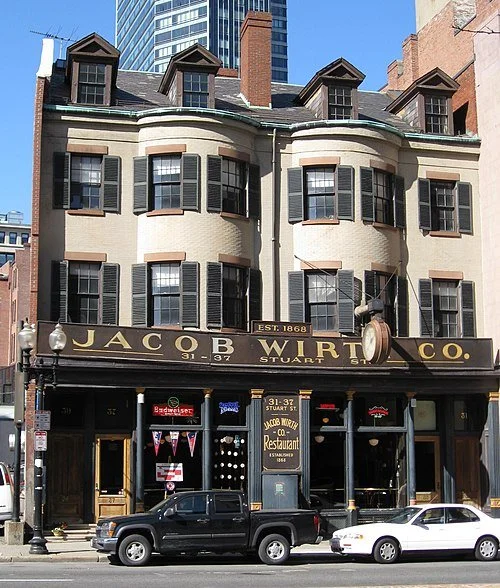
Jacob Wirth’s has long been New England most famous German restaurant. New England Diary’s editor well remembers lunching there in the late 1950s and early ‘60s. It had frequently swept-up sawdust on its floor to collect fallen food and spilled beer. Government health regulations later banned that. The restaurant had perhaps the greatest beer collection in the region.
Happy news from The Boston Guardian:
After years facing an uncertain future, Boston’s historic Jacob Wirth bar and restaurant will return to the Theater District in its former glory.
As first reported by the Boston Business Journal, real estate company City Realty Group acquired the Stuart Street property earlier this year and has spent months and millions of dollars on renovations for a tentative February 2024 opening.
The city landmark, first opened as a German American restaurant in 1868, closed its doors due to fire and water damage in 2018. It was one of the oldest continuously running restaurants in Boston before shutting down, second only to the Union Oyster House, founded in 1826..
Now Jacob Wirth is coming back under the same ownership that recently purchased Boston bars including the Tam on Tremont Street and Fours, rebranded to Scores, near TD Garden.
To read the whole Guardian story, please hit this link.
But no giant pumpkins
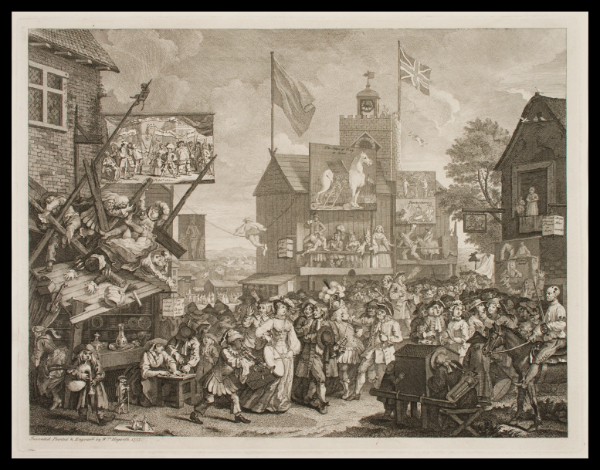
“Southwark Fair” (1737), (etching and engraving), by William Hogarth (1697-1764, British), in the show “Prints and People Before Photography, 1490-1825 ,’’ at the William Benton Museum, at the University of Connecticut, Storrs, through Dec. 17.
The museum says:
“The arrival of printmaking in early modern Europe led to new possibilities for mass communication and art collecting. Transportable, reproducible, and relatively inexpensive, prints contributed to the exchange of knowledge and ideas across international borders and among social classes. Prior to the invention of photography, it was prints that provided a window on the world, circulating images of other works of art, distinguished people, and noteworthy places and events. ‘‘
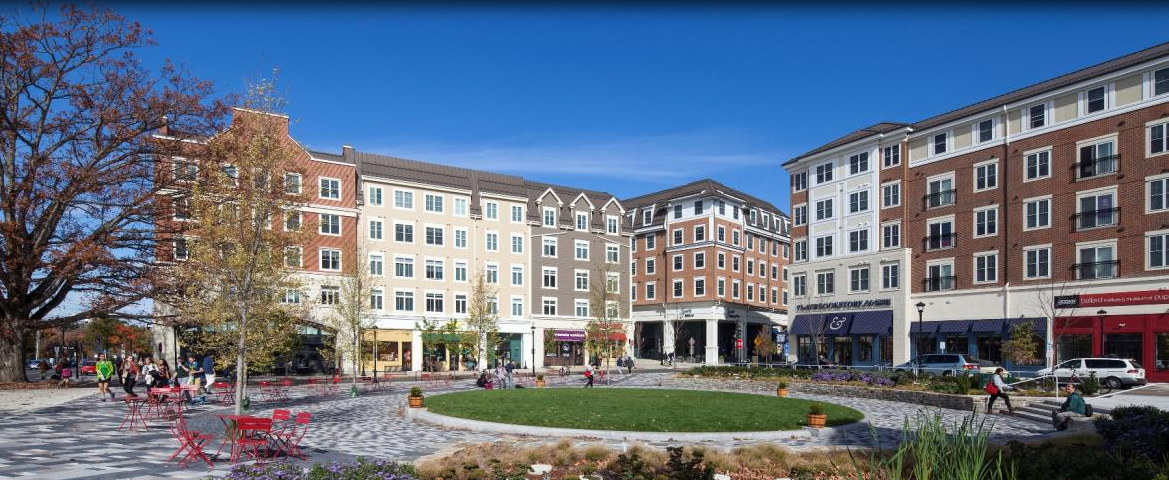
Downtown Storrs
— Photo by Le.kiff
'Still and cool'


Nuthatch
‘‘….I come back to my dooryard,
to my own wooden step.
“The last red leaves fall to the ground
and frost has blackened the herbs and asters
that grew beside the porch. The air
is still and cool, and the withered grass
lies flat in the field. A nuthatch spirals
down the rough trunk of the tree.’’
— From “Back From the City,’’ by New Hampshire-based poet Jane Kenyon (1947-1995)

Place and experience

“Our Time Here Is Brief”(monotype with gold foil), by Lynn Brofsky, at the Boston Printmakers 2023 North American Print Biennial, through Dec. 9.
She says:
“As the years go by, my images and subjects shift, mediums and techniques change and grow; I have found that more than anything, the driving force in my work is the relationship between place and human experience.
“I grew up in Colorado, where family road trips from Denver took us out to areas of farmland, mesas, deserts and forgotten towns populated with skeletal relics of industry. Embedded with ghosts of what they once were, their energy always spoke to me. This is what I come back to, our fragile existence, the way we relate, love, isolate and abandon ourselves and the places we live in.
“Moved by the sensuality of the human figure, asymmetry, architecture, landscape, growth and decay, and perceived connections, I attempt to relate my stories, my own narrative of contrasts.’’
Columbus Day in Victorian Salem
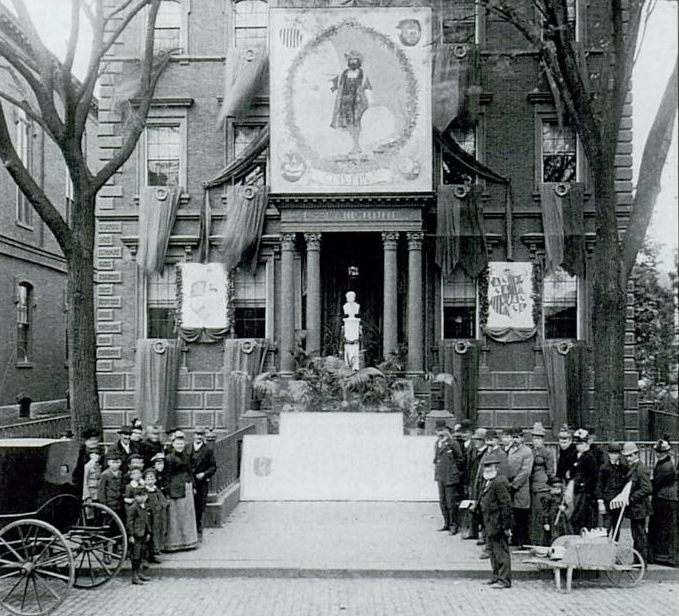
Columbus Day in 1892 at the John Tucker Daland House, in Salem, Mass., long before Native Americans and sympathizers were well organized to educate the general public on how Western Hemisphere indigenous people suffered in many ways in centuries of European colonialization started by the Italian explorer Christopher Columbus. 1892 was before the bulk of Italian immigration to America. Italian-Americans were naturally big fans of the holiday, but it didn’t become an official federal holiday until 1971. Southern New England, of course, drew large numbers of Italian immigrants.
The Daland House, an imposing, Italianate structure designed by architect Gridley James Fox Bryant, is at 132 Essex St. in the Essex Institute Historic District and now owned by the fabulous Peabody Essex Museum as home for the Essex Institute.
The three-story brick house was originally built for John Tucker Daland, a prosperous merchant. The Dalands lived in the house until 1885, when the Essex Institute acquired it. It was then remodeled as offices by architect William Devereux Dennis (1847–1913) and in 1907 connected to the adjacent Plummer Hall (former home of the Salem Athenaeum).
Might be a bonanza
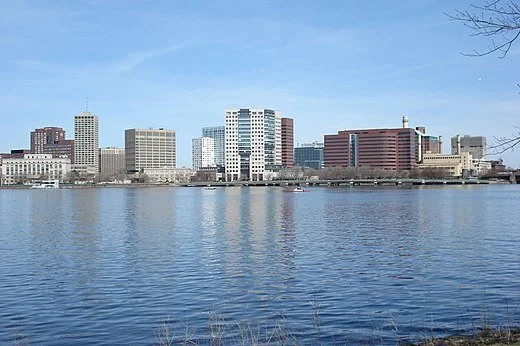
Kendall Square, Cambridge, as seen from across the Charles River in Boston.
Adapted from Robert Whitcomb’s “Digital Diary,’’ in GoLocal24.com
The other week I noted how Greater Boston’s universities and associated institutions have been crucial in enriching the region. We had another example of their ability to spark profitable business ventures with news that the Feds are setting up an “investor catalyst” center at Kendall Square, in Cambridge. Its neighbors, of course, include Harvard and MIT. Kendall Square has become something like the world’s bio-tech capital.
The center will use basic-research findings about such tough diseases as cancers and dementias to create new technologies, medicines and devices, and get them in the market by working with entrepreneurs and financial organizations.
This center, part of the new Advanced Research Projects Agency for Health (ARPA-H) will probably pump billions into the regional economy over coming years. Perhaps some Rhode Island institutions, especially Brown University and the University of Rhode Island, as well as Lifespan, Care New England and some Ocean State bio-tech businesses – established and startups -- can glom on to some of this activity.
The Worcester area will benefit — e.g., University of Massachusetts Memorial Medical Center, in Worcester — as will institutions farther away, such as Dartmouth-Hitchcock Medical Center, in Labanon, N.H., and Maine Medical Center, in Portland.

They want to know why you were out late

Work by New Hampshire-basedfartist Tim Campbell at the Hannah Grimes Art Center, Keene, N.H.
Barbara Gibbs wrote in the Laconia (N.H.) Daily Sun:
“Tim Campbell identifies with the term of outsider art, which was coined by an art critic in 1972 as an English synonym for ‘art brut’– French, meaning raw art or rough art. The critic, Roger Cardinal, used this term to describe art created outside the boundaries of official culture. The term outsider art is often applied more broadly to include self-taught or naïve art makers. Campbell's work reflects his sharp sense of humor, and interest in primitive folk art as well as contemporary political and religious imagery.’’
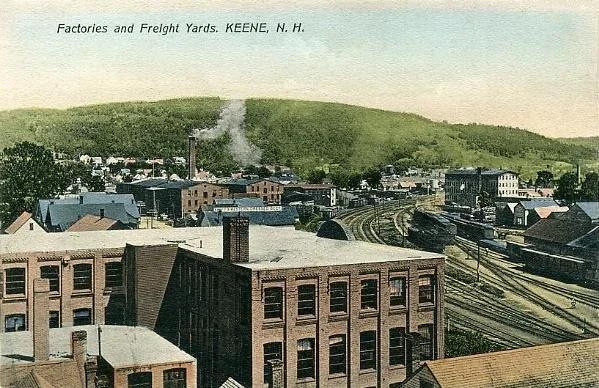
1907 postcard from when Keene was an important manufacturing town. Now it has mostly a service economy, including Keene State College and Antioch University New England.
'The ‘landscape’ of my mind'
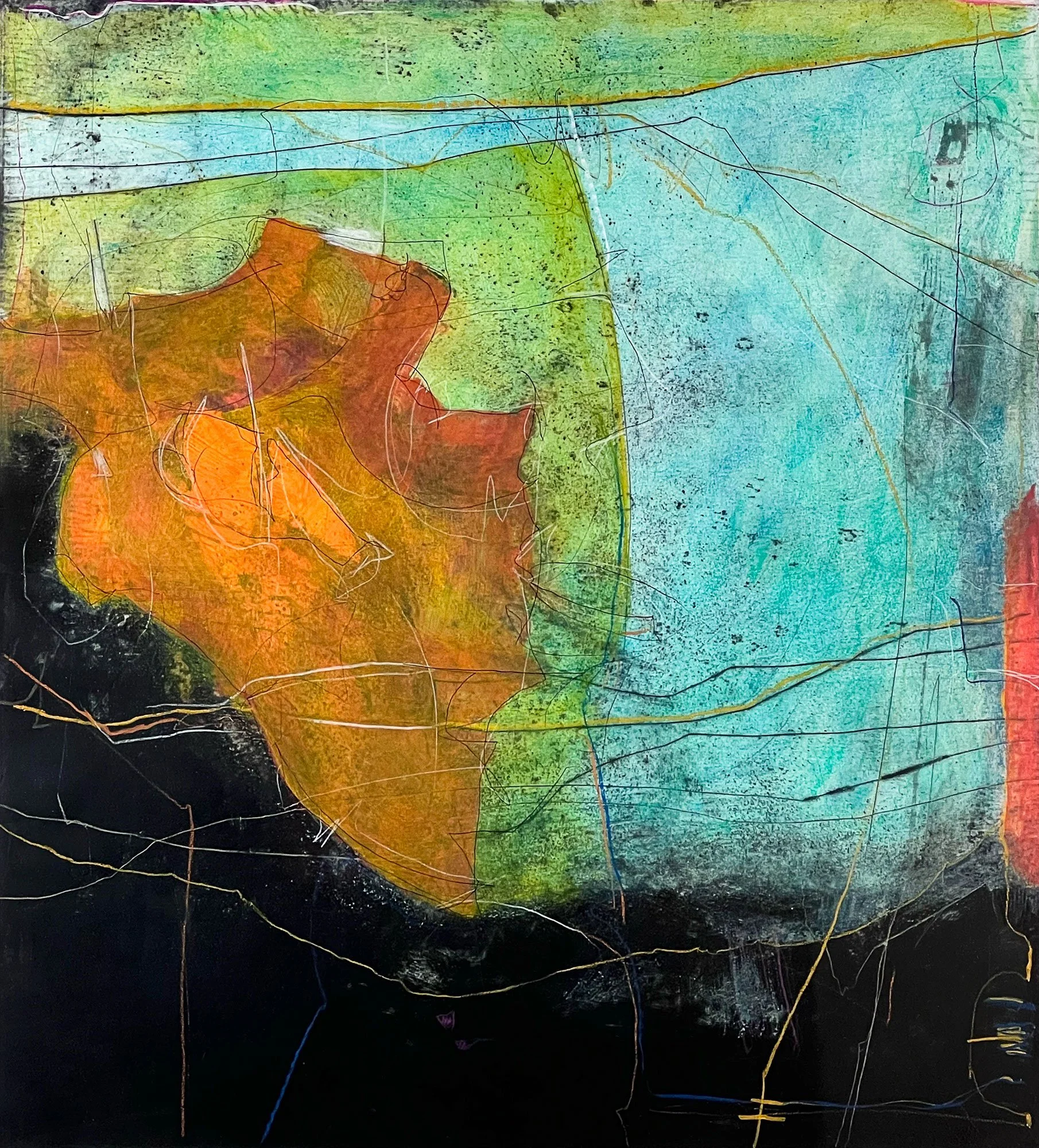
“Hairy Hare” (zinc etching and mixed media), by Dan Weldon, in his show “Dan Weldon: Solo 100, Oct, 21-Jan. 14, at Mitchell- Giddings Fine Arts, Brattleboro, Vt.
He says:
“I am an experimenter, explorer and a seeker of beauty. When I set out to work, there is no image in mind, but the vision unfolds as the work evolves. It usually begins with simple forms and marks with broad areas. It then becomes more refined and delicate and knits itself together through line.
”I am a process person, interested in employing materials and techniques to the ‘landscape’ of my mind. My drawings, paintings and prints evolve from the idea of linear pathways echoing from the tracks of animals in nature, fissures in rock palisades and the patterns created by my hands becoming ‘playful’ with my tools.
Learning to read a printing plate before inking, is like sensing the log before wielding the axe. So goes my act of creativity, being aware of what resonates in front of me and responding with marks, colors and textures. ‘‘
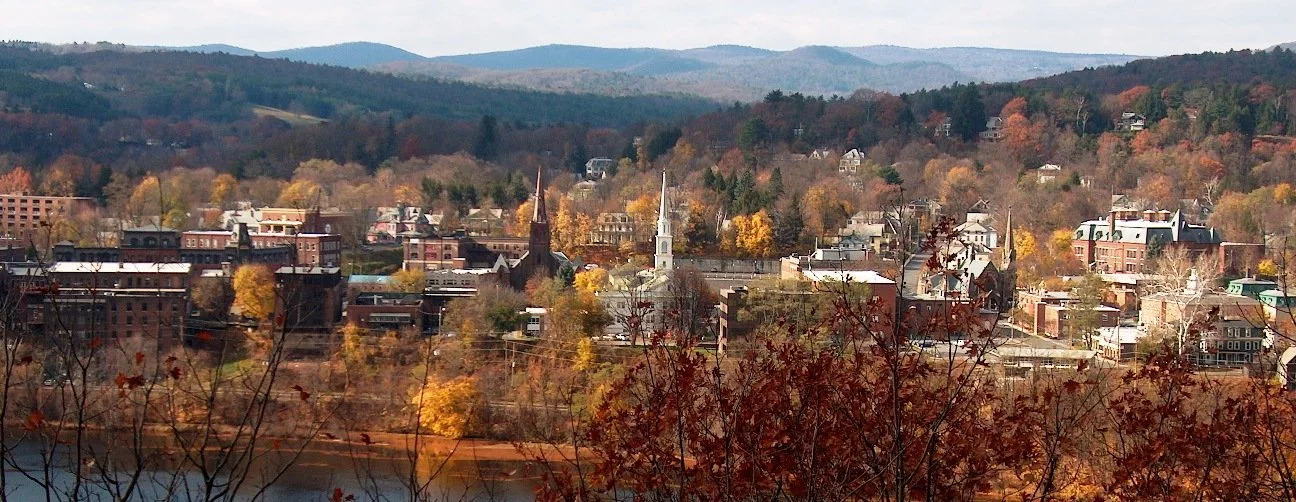
Downtown Brattleboro, as seen from a walking trail just across the Connecticut River, in New Hampshire, with the Green Mountains in the distance. There are many miles of scenic trails in and around the town, which has long been known as a arts center.
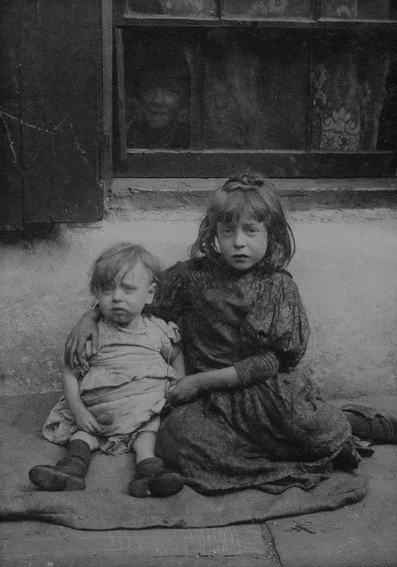
Chris Powell: Government underwrites lethal child-neglect culture
MANCHESTER, Conn.
Why did a 2-year-old boy fall to his death through a window of his third-floor apartment in Hartford in July?
A long report by the Connecticut Mirror the other day attempted to answer that question. It attributed the boy's death to "generational poverty" and, more so, to government's failure to make sure that the boy's mother had everything she needed to raise her five children, all under 13, on her own, since the children's father or fathers were not providers.
If only, the report lamented, government had given the woman free day care and longer classes about parenting and had applied current housing code standards to the family's apartment building, which was exempt because of its age.
Well, maybe.
But the report did not address the most compelling issue as it strove to acquit the woman of the manslaughter and risk-of-injury charges she faces for having left her children unattended in squalor as she went to work as a part-time taxi driver, purportedly expecting the 2-year-old's father to arrive soon to watch the children. It could not have been surprising that he was fatally late.
That is, how does a woman of limited education and job skills who can't support herself come to have five children but no husband or other committed helpmate in the state that gave rise to the constitutional right to contraception and sometimes seems to consider abortion the highest social good?
One pregnancy may be an accident. Five are not. Five children born to someone unprepared to support them is irresponsibility, though political correctness forbids any such acknowledgment.
xxx
But the Mirror report inadvertently hinted at an explanation.
First, the report said, the woman always wanted to be a mother. Of course, many people want to be parents, but some still know that parenthood imposes obligations of preparedness.
Second, and perhaps crucially, the report elaborated: "When she was in high school, she moved in with an older man. Her family sent her to Connecticut after graduation to get her away from him, but she had little beyond the clothes on her back when she moved. She lived in a homeless shelter for several months and rang the Salvation Army bell at Christmas to earn money to pay the security deposit for her first apartment. When she got pregnant with her first daughter, she qualified for a housing choice voucher. ...
“She paid $469 per month for the apartment, and her housing choice voucher covered the rest of the $1,550 rent.”
Of course in addition to that heavily subsidized housing there would be free medical insurance and food and other benefits. So who needs to be prepared, competent, self-supporting, and responsible and have a committed spouse when government will lavish money on irresponsibility that holds children hostage?
And so the disastrous cycle began again -- four more children without a spouse, more dependence on government, more child neglect, mental illness for one of the children, and the horrible death of the 2-year-old boy, following constant problems that prompted frequent visits by social workers from the state Department of Children and Families, on which Connecticut spends more than $800 million each year to minister to thousands of similarly dysfunctional households with similarly neglected children, without ever establishing as a matter of policy that this is no way to live since it imposes a catastrophic burden on both the children held hostage and society.
xxx
Few children monitored by DCF fall out of third-story windows, but some die after ingesting narcotics left within their reach, others suffer serious injuries at the hands of their reckless custodians, and many come to school far behind in social development or with learning disabilities and behavioral problems. The $800 million spent annually by DCF is only part of the cost of this lifestyle, a cost that extends to schools, courts, and prisons.
That is, what is called the child-protection system pays for and thus rationalizes, institutionalizes, and encourages child neglect.
While the poor may be demoralized, like everyone else they respond to financial incentives. They are not stupid. But government can be, and journalism doesn't always make it smarter.
Chris Powell has written about Connecticut government and politics for many years (CPowell@cox.net).
‘Beauty of impermanence’

Work by North Adams-based artist Tom Schneider in his show “Ecstatic Gates,’’ at Bromfield Gallery, Boston, through Oct. 29.
The gallery says:
“Tom Schneider’s current series, ‘Ecstatic Gates,’ is a collection of 13 wall sculptures. Each piece is a miniature shrine or chapel and expresses the ethereal duality of the eternal and finite.
“Inspired by the beauty of impermanence, each piece incorporates bones, natural fibers, and decaying wood grains. The shimmer of gold peeking through the doors offers the suggestion of what lies beyond our world.
“Schneider’s sculptures are influenced by the elegant lines of Asian architecture and the Japanese aesthetic of wabi-sabi. They thereby honor imperfection, transience, the rawness of the natural world, and the beauty found in small and humble things.’

The Hoosic River runs through North Adams and was essential to its growth, providing power for the mills that were built along its banks as well as those of its branches. Many artists can be found in surviving mill buildings today.

The Norad Mill, in North Adams. The woolen factory was built in 1863 in an Italianate style and was added to the National Register of Historic Places in 1985.
— Photo by Beyond My Ken

Susan Jaffe: Feds rein in Medical Advantage predictive software

From Kaiser Family Foundation Health News
Judith Sullivan was recovering from major surgery at a Connecticut nursing home in March when she got surprising news from her Medicare Advantage plan: It would no longer pay for her care because she was well enough to go home.
At the time, she could not walk more than a few feet, even with assistance — let alone manage the stairs to her front door, she said. She still needed help using a colostomy bag following major surgery.
“How could they make a decision like that without ever coming and seeing me?” said Sullivan, 76. “I still couldn’t walk without one physical therapist behind me and another next to me. Were they all coming home with me?”
UnitedHealthcare — the nation’s largest health-insurance company, which provides Sullivan’s Medicare Advantage plan — doesn’t have a crystal ball. It does have naviHealth, a care-management company bought by UHC’s sister company, Optum, in 2020. Both are part of UnitedHealth Group. NaviHealth analyzes data to help UHC and other insurance companies make coverage decisions.
Its proprietary “nH Predict” tool sifts through millions of medical records to match patients with similar diagnoses and characteristics, including age, preexisting health conditions, and other factors. Based on these comparisons, an algorithm anticipates what kind of care a specific patient will need and for how long.
But patients, providers, and patient advocates in several states said they have noticed a suspicious coincidence: The tool often predicts a patient’s date of discharge, which coincides with the date their insurer cuts off coverage, even if the patient needs further treatment that government-run Medicare would provide.
“When an algorithm does not fully consider a patient’s needs, there’s a glaring mismatch,” said Rajeev Kumar, a physician and the president-elect of the Society for Post-Acute and Long-Term Care Medicine, which represents long-term care practitioners. “That’s where human intervention comes in.”
The federal government will try to even the playing field next year, when the Centers for Medicare & Medicaid Services begins restricting how Medicare Advantage plans use predictive technology tools to make some coverage decisions.
Medicare Advantage plans, an alternative to the government-run, original Medicare program, are operated by private insurance companies. About half the people eligible for full Medicare benefits are enrolled in the private plans, attracted by their lower costs and enhanced benefits like dental care, hearing aids, and a host of nonmedical extras like transportation and home-delivered meals.
Insurers receive a monthly payment from the federal government for each enrollee, regardless of how much care they need. According to the Department of Health and Human Services’ inspector general, this arrangement raises “the potential incentive for insurers to deny access to services and payment in an attempt to increase profits.” Nursing home care has been among the most frequently denied services by the private plans — something original Medicare likely would cover, investigators found.
After UHC cut off her nursing home coverage, Sullivan’s medical team agreed with her that she wasn’t ready to go home and provided an additional 18 days of treatment. Her bill came to $10,406.36.
Beyond her mobility problems, “she also had a surgical wound that needed daily dressing changes” when UHC stopped paying for her nursing home care, said Debra Samorajczyk, a registered nurse and the administrator at the Bishop Wicke Health and Rehabilitation Center, in Shelton, Conn., the facility that treated Sullivan.
Sullivan’s coverage denial notice and nH Predict report did not mention wound care or her inability to climb stairs. Original Medicare would have most likely covered her continued care, said Samorajczyk.
Sullivan appealed twice but lost. Her next appeal was heard by an administrative law judge, who holds a courtroom-style hearing usually by phone or video link, in which all sides can provide testimony. UHC declined to send a representative, but the judge nonetheless sided with the company. Sullivan is considering whether to appeal to the next level, the Medicare Appeals Council, and the last step before the case can be heard in federal court.
Sullivan’s experience is not unique. In February, Ken Drost’s Medicare Advantage plan, provided by Security Health Plan of Wisconsin, wanted to cut his coverage at a Wisconsin nursing home after 16 days, the same number of days naviHealth predicted was necessary. But Drost, 87, who was recovering from hip surgery, needed help getting out of bed and walking. He stayed at the nursing home for an additional week, at a cost of $2,624.
After he appealed twice and lost, his hearing on his third appeal was about to begin when his insurer agreed to pay his bill, said his lawyer, Christine Huberty, supervising attorney at the Greater Wisconsin Agency on Aging Resources Elder Law & Advocacy Center in Madison.
“Advantage plans routinely cut patients’ stays short in nursing homes,” she said, including Humana, Aetna, Security Health Plan, and UnitedHealthcare. “In all cases, we see their treating medical providers disagree with the denials.”
UnitedHealthcare and naviHealth declined requests for interviews and did not answer detailed questions about why Sullivan’s nursing home coverage was cut short over the objections of her medical team.
Aaron Albright, a naviHealth spokesperson, said in a statement that the nH Predict algorithm is not used to make coverage decisions and instead is intended “to help the member and facility develop personalized post-acute care discharge planning.” Length-of-stay predictions “are estimates only.”
However, naviHealth’s website boasts about saving plans money by restricting care. The company’s “predictive technology and decision support platform” ensures that “patients can enjoy more days at home, and healthcare providers and health plans can significantly reduce costs specific to unnecessary care and readmissions.”
New federal rules for Medicare Advantage plans beginning in January will rein in their use of algorithms in coverage decisions. Insurance companies using such tools will be expected to “ensure that they are making medical necessity determinations based on the circumstances of the specific individual,” the requirements say, “as opposed to using an algorithm or software that doesn’t account for an individual’s circumstances.”
The CMS-required notices nursing home residents receive now when a plan cuts short their coverage can be oddly similar while lacking details about a particular resident. Sullivan’s notice from UHC contains some identical text to the one Drost received from his Wisconsin plan. Both say, for example, that the plan’s medical director reviewed their cases, without providing the director’s name or medical specialty. Both omit any mention of their health conditions that make managing at home difficult, if not impossible.
The tools must still follow Medicare coverage criteria and cannot deny benefits that original Medicare covers. If insurers believe the criteria are too vague, plans can base algorithms on their own criteria, as long as they disclose the medical evidence supporting the algorithms.
And before denying coverage considered not medically necessary, another change requires that a coverage denial “must be reviewed by a physician or other appropriate health care professional with expertise in the field of medicine or health care that is appropriate for the service at issue.”
Jennifer Kochiss, a social worker at Bishop Wicke who helps residents file insurance appeals, said patients and providers have no say in whether the doctor reviewing a case has experience with the client’s diagnosis. The new requirement will close “a big hole,” she said.
The leading MA plans oppose the changes in comments submitted to CMS. Tim Noel, UHC’s CEO for Medicare and retirement, said MA plans’ ability to manage beneficiaries’ care is necessary “to ensure access to high-quality safe care and maintain high member satisfaction while appropriately managing costs.”
Restricting “utilization management tools would markedly deviate from Congress’ intent in creating Medicare managed care because they substantially limit MA plans’ ability to actually manage care,” he said.
In a statement, UHC spokesperson Heather Soule said the company’s current practices are “consistent” with the new rules. “Medical directors or other appropriate clinical personnel, not technology tools, make all final adverse medical necessity determinations” before coverage is denied or cut short. However, these medical professionals work for UHC and usually do not examine patients. Other insurance companies follow the same practice.
David Lipschutz, associate director of the Center for Medicare Advocacy, is concerned about how CMS will enforce the rules since it doesn’t mention specific penalties for violations.
CMS’ deputy administrator and director of the Medicare program, Meena Seshamani, said that the agency will conduct audits to verify compliance with the new requirements, and “will consider issuing an enforcement action, such as a civil money penalty or an enrollment suspension, for the non-compliance.”
Although Sullivan stayed at Bishop Wicke after UHC stopped paying, she said another resident went home when her MA plan wouldn’t pay anymore. After two days at home, the woman fell, and an ambulance took her to the hospital, Sullivan said. “She was back in the nursing home again because they put her out before she was ready.”
Susan Jaffe is Kaiser Family Foundation reporter.
Llewellyn King: Artificial intelligence and climate change are making 2023 a scary and seminal year
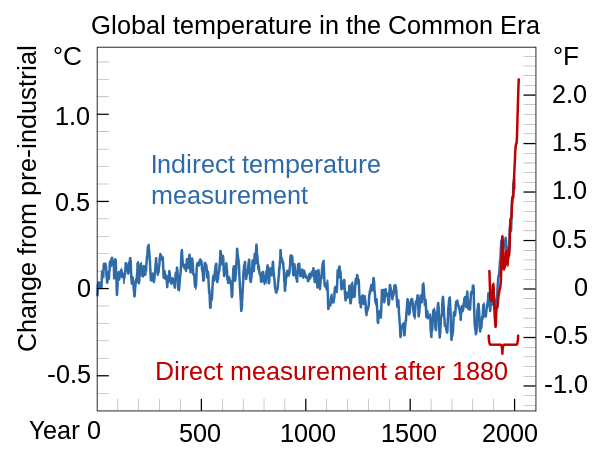
Global surface temperature reconstruction over the last 2000 years using proxy data from tree rings, corals and ice cores in blue. Directly observed data is in red.

The iCub robot at the Genoa science festival in 2009
— Photo by Lorenzo Natale

His job is probably secure.
WEST WARWICK, R.I.
This is a seminal year, meaning nothing will be the same again.
This is the year when two monumentally new forces began to shape the way we live, where we reside and the work we do. Think of the invention of the printing press around 1443 and the perfection of the steam engine in about 1776.
These forces have been coming for a while, they haven’t evolved in secret. But this was the year they burst into our consciousness and began affecting our lives.
The twin agents of transformation are climate change and artificial intelligence. They can’t be denied. They will be felt and they will bring about transformative change.
Climate change was felt this year. In Texas and across the Southwest, temperatures of well over 100 degrees persisted for more than three months. Phoenix had temperatures of 110 degrees or above for 31 days.
On a recent visit to Austin, an exhausted Uber driver told me that the heat had upended her life; it made entering her car and keeping it cool a challenge. Her car’s air conditioner was taxed with more heat than it could handle. Her family had to stay indoors, and their electric bill surged.
The electric utilities came through heroically without any major blackouts, but it was a close thing.
David Naylor, president of Rayburn Electric, a cooperative association providing power to four distribution companies bordering Dallas, told me, “Summer 2023 presented a few unique challenges with so many days about 105 degrees. While Texas is accustomed to hot summers, there is an impactful difference between 100 degrees and 105.”
Rayburn ran flat out, including its recently purchased natural gas-fired station. It issued a “hands-off” order which, Naylor said, meant that “facilities were left essentially alone unless absolutely necessary.”
It was the same for electric utilities across the country. Every plant that could be pressed into service was and was left to run without normal maintenance, which would involve taking it offline.
Water is a parallel problem to heat.
We have overused groundwater and depleted aquifers. In some regions, salt water is seeping into the soil, rendering agriculture impossible.
That is occurring in Florida and Louisiana. Some of the salt water intrusion is the result of higher sea levels and some of it is the voracious way aquifers have been pumped out during long periods of heat and low rainfall.
Most of the West and Florida face the aquifer problem, but in coastal communities it can be a crisis — irreversible damage to the land.
Heat and drought will cause many to leave their homes, especially in Africa, but also in South and Central America, adding to the millions of migrants on the move around the world.
AI is one of history’s two-edged swords. On the positive side, it is a gift to research and especially in life sciences, which could deliver life expectancy north of 120 years.
But AI will be a powerful disruptor elsewhere, from national defense to intellectual property and, of course, to employment. Large numbers of jobs, for example, in call centers, at fast-food restaurant counters, and check-in desks at hotels and airports will be taken over by AI.
Think about this: You go to the airport and talk to a receptor (likely to be a simple microphone-type of gadget on the already ubiquitous kiosks) while staring at a display screen, giving you details of your seat, your flight — and its expected delays.
Out of sight in the control tower, although it might not be a tower, AI moves airplanes along the ground, and clears them to take off and land — eventually it will fly the plane, if the public accepts that.
No check-in crew, no air-traffic controllers and, most likely, the baggage will be handled by AI-controlled robots.
Aviation is much closer to AI automation than people realize. But that isn’t all. You may get to the airport in a driverless Lyft or Uber car and the only human beings you will see are your fellow passengers.
All that adds up to the disappearance of a huge number of jobs, estimated by Goldman Sachs to be as many as 300 million full-time jobs worldwide. Eventually, in a re-ordered economy, new jobs will appear and the crisis will pass.
The most secure employment might be for those in skilled trades — people who fix things — such people as plumbers, mechanics and electricians. And, oh yes, those who fix and install computers. They might well emerge as a new aristocracy.
Llewellyn King is executive producer and host of White House Chronicle, on PBS. His email is llewellynking1@gmail.com and he’s based in Rhode Island and Washington, D.C.
‘Somatic responses’

Selections from Maggie Nowinski’s show “Cicatrix/In Bloom,’’ at Tremaine Art Gallery, at the Hotchkiss School, Lakeville, Conn., through Oct. 15
Maggie Nowinski is a Massachusetts-based multi-modal artist, teaching artist and curator Maggie Nowinski.
The gallery says: “Through her work, Nowinski ‘explores somatic responses to environment, internal and external passageways, and collected disturbances through imagined specimen drawings that depict abject human-botanical entities’ with line drawings, prints, found objects and sound.’’

The Litchfield Hills and Lake Wononscopomuc, as seen from the grounds of the Hotchkiss School, Lakeville, Conn.

Sam Pizzigati: Time for a general strike at hyper-rapacious Dollar General

— Photo by Mike Kalasnik

Dollar General headquarters, in Goodlettsville, Tenn.
Via OtherWords.org
BOSTON
President Biden recently walked a picket line in solidarity with striking auto workers. An amazing sight.
What could he do for an encore? He could stand before another major American corporation — Dollar General — holding a simple two-word placard saying “For Shame.”
Thanks to United Auto Workers members and the attention their strike has attracted, Americans now know a bit about the pressures that auto workers face. As a nation, unfortunately, we know next to nothing about life for Dollar General workers.
With more outlets than Walmart and Wendy’s combined, Dollar General has become “America’s most ubiquitous retailer,” Bloomberg reported recently, and may now be the “worst” retail employer in the country.
Bloomberg sums up Dollar General’s corporate ethos this way: “Build as many stores as possible, pack them with tons of stuff while using as little warehouse space as possible, and spend as little as possible on everything else.”
That means spending as little as possible on basic store upkeep.
Businessweek investigators have “found expired products on Dollar General shelves,” from chicken soup in Louisiana to doughnuts in Illinois. In one Oklahoma store, birds nested in the ceiling and pooped down on the merchandise.
And as little as possible on safety.
Government inspectors have reported “fire extinguishers blocked by boxes” and “shaky, leaning towers of product” as high as nine feet tall. The Occupational Safety and Health Administration last year tagged Dollar General a “severe violator” of federal workplace-safety law.
And, of course, Dollar General spends as little as possible on wages and workers.
One of every four Dollar General employees makes less than $10 an hour. Over half make under $12. Meanwhile entire stores go hours every day with only one employee responsible for an average of 7,500 square feet of retail space.
This brutal approach has paid off handsomely for investors and executives. Dollar General’s stock price has quintupled since 2009. And the company reports that its CEO, who hauls in $16.6 million a year, makes 935 more than a “median” Dollar General employee.
Officially, the typical Dollar General worker makes just $17,773 a year. But even that measly figure may be an overstatement.
Researcher Rosanna Weaver reports that the company recently changed its median-pay calculations by “annualizing” the wages of permanent employees who didn’t work a full year. Meanwhile, Dollar General actually understates CEO pay. The company’s executive compensation can run much higher than first reported once executives actually cash out their stock.
One example: After cashing out on a huge chunk of his stock awards, former CEO Todd Vlasos actually made nearly 4,500 times the annual pay of his 163,000 employees. He essentially made more in a single weekday — $328,000 — than his median employee could earn in 18 years.
All this “success” for Dollar General executives rests on a half-century of ever-greater American inequality. For two generations now, a shrinking share of U.S. income and wealth has gone into the pockets of America’s working families.
Thanks to this shrinking share, tens of millions of American families today couldn’t get by without the “bargain-basement” prices that dollar stores like Dollar General offer — at the expense of their customers’ health and safety and the economic security of their workers.
Moreover, that discounted food — often sold in “food-deprived areas” — comes highly processed, offers little in the way of nutritional value, and sits packaged within toxic, chemical-laden wrappings.
“Dollar General’s practices have an immense impact on communities across the country,” note advocacy attorneys Sara Imperiale and Margaret Brown, “especially communities of color and low-income communities.”
The U.S. economy isn’t delivering for American families — and that failure is delivering for corporate investors and executives. You’ll never find them doing their weekly food shopping at Dollar General.
How about a general strike against Dollar General?
Sam Pizzigati, based in Boston, co-edits Inequality.org at the Institute for Policy Studies. His books include The Case for a Maximum Wage and The Rich Don’t Always Win.
The soothing properties of water

“Pond Reflections,’’ by Susan Bailey, in the fall group show at Arts3Gallery, Manchester, N.H. She says: “Yes! I am often asked how I can paint realistic still lifes at the same time as abstracted landscapes”.

Seal of Manchester, N.H. Note the references to the city’s role as one of America’s first great industrial centers.

Lunching with The Prince

Adapted from Robert Whitcomb’s “Digital Diary,’’ in GoLocal24.com
The recent death at 75 of Gennaro Castellano, former captain of downtown Providence’s well known Capriccio restaurant, brought back cinematic memories of a few lunches I had there with Vincent “Buddy” Cianci in his heyday as mayor and “Prince of Providence’’ in the ’90’s. The lunches were very long, and he wasn’t averse to drinking stuff stronger than water during them. Considering that Cianci allegedly had a good-sized city to run, he seemed in no hurry to get back to work even as we approached 3 p.m. Indeed, it was I who became increasingly anxious to get back to my job running The Providence Journal’s commentary pages, with its not very forgiving deadlines.
Buddy would say as I kept looking at my watch: “Relax! Nice place, eh?”
The waiters were very able, if obsequious, as if they feared the mayor, with his semi-mobster persona. They probably had good reason to.
Of course, being mayor of a good-sized city has always involved various degrees of show business. Consider besides Buddy, such flamboyant examples as New York Mayors Jimmy Walker and Fiorello LaGuardia (see the musical Fiorello!) and Boston Mayor James Michael Curley (read the novel The Last Hurrah).
‘Tis only a mirage’


“But this beauty of Nature which is seen and felt as beauty, is the least part. The shows of day, the dewy morning, the rainbow, mountains, orchards in blossom, stars, moonlight, shadows in still water, and the like, if too eagerly hunted, become shows merely, and mock us with their unreality. Go out of the house to see the moon, and 'tis mere tinsel; it will not please as when its light shines upon your necessary journey. The beauty that shimmers in the yellow afternoons of October, who ever could clutch it? Go forth to find it, and it is gone; 'tis only a mirage as you look from the windows of diligence.’’
— Ralph Waldo Emerson (1802-1882), American essayist, poet, philosopher and a leader of the cultural luminaries based in Concord, Mass.

Hard work
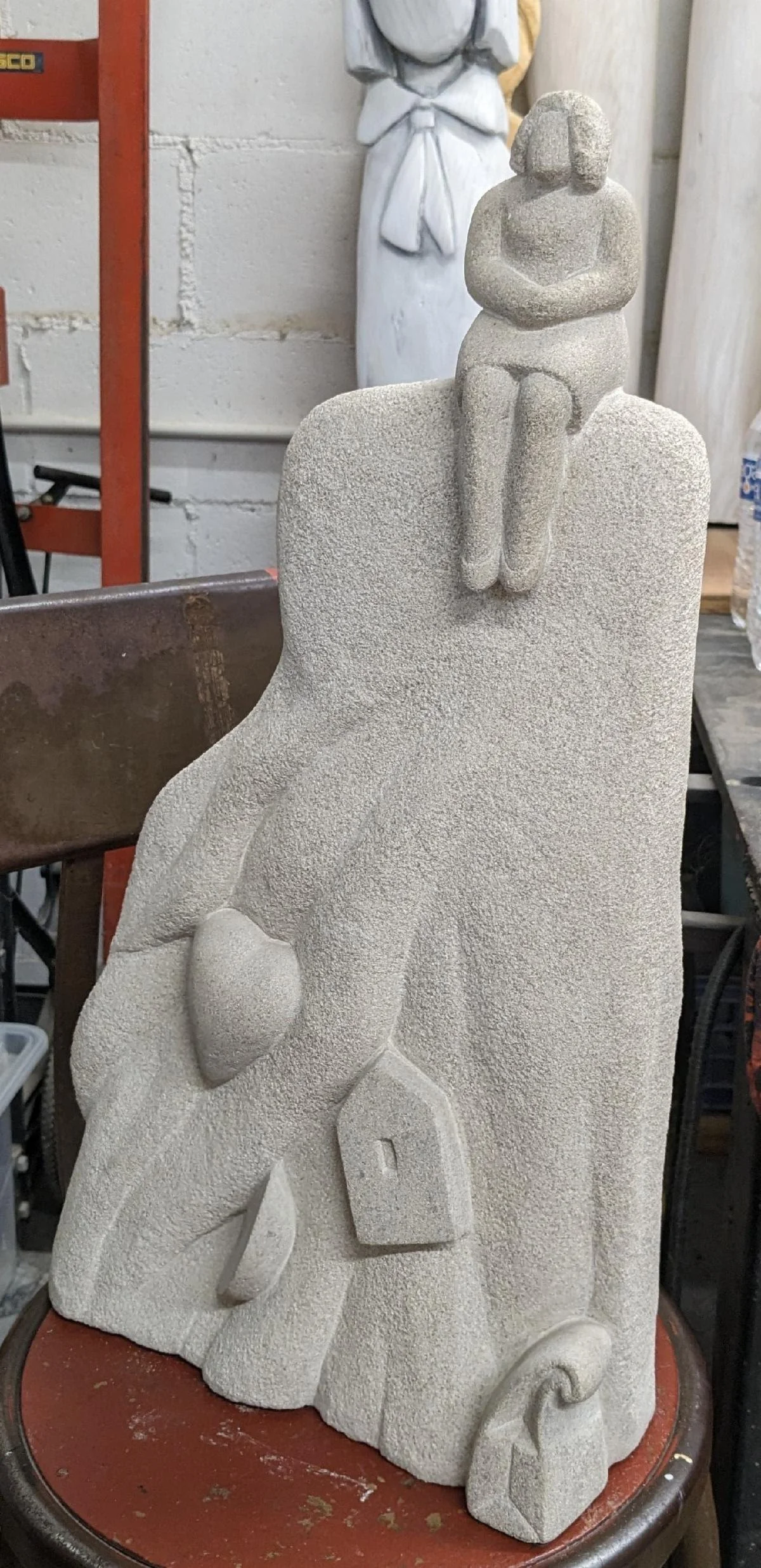
“Soledad/Solitude” (Indiana limestone), by Boston-based sculptor Nora Valdez, in the show “Rock Solid XXIII,’’ at Studio Place Arts, Barre, Vt. (“Granite Capital of the world”).
— Photo courtesy of Studio Place Arts
Studio Place’s exhibition features the work of 20 New England artists who have created a variety of stone artwork and assemblages. Each work highlights the unique qualities of stone as a medium.

The Barre World War 1 Memorial, "Youth Triumphant", by C. Paul Jennewein, one of the many local granite sculptures.
A beautiful exit

Near the mouth of the Goose River, at Rockport Harbor, Maine.

Autumn in Maine’s Hundred-Mile Wilderness
— Photo by Andythrasher
The blood of maples on the autumn sky,
And dead leaves drifting, drifting to the sea:
Now, to the year Time makes his old reply,
Nothing on earth shall live immortally.
The burst of glory on a dying face,
Of one who sees beyond, some haven far,
Lit with the spring-light of another place
And silver winds blown from another star.
Now beauty burns in gold on every hill
And changes not her warm imperial way:
There is no sadness here, whate'er men say—
Beauty departing is yet beauty still.
‘‘October on a Maine River,’’ by Kenneth Slade Alling