
Aliens in the sand
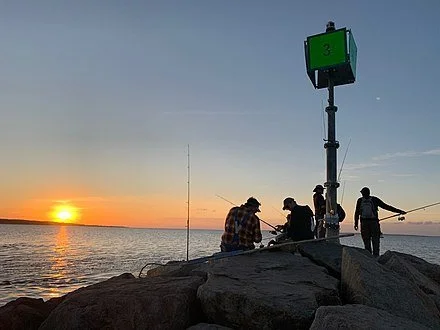
Sunset from Menemsha
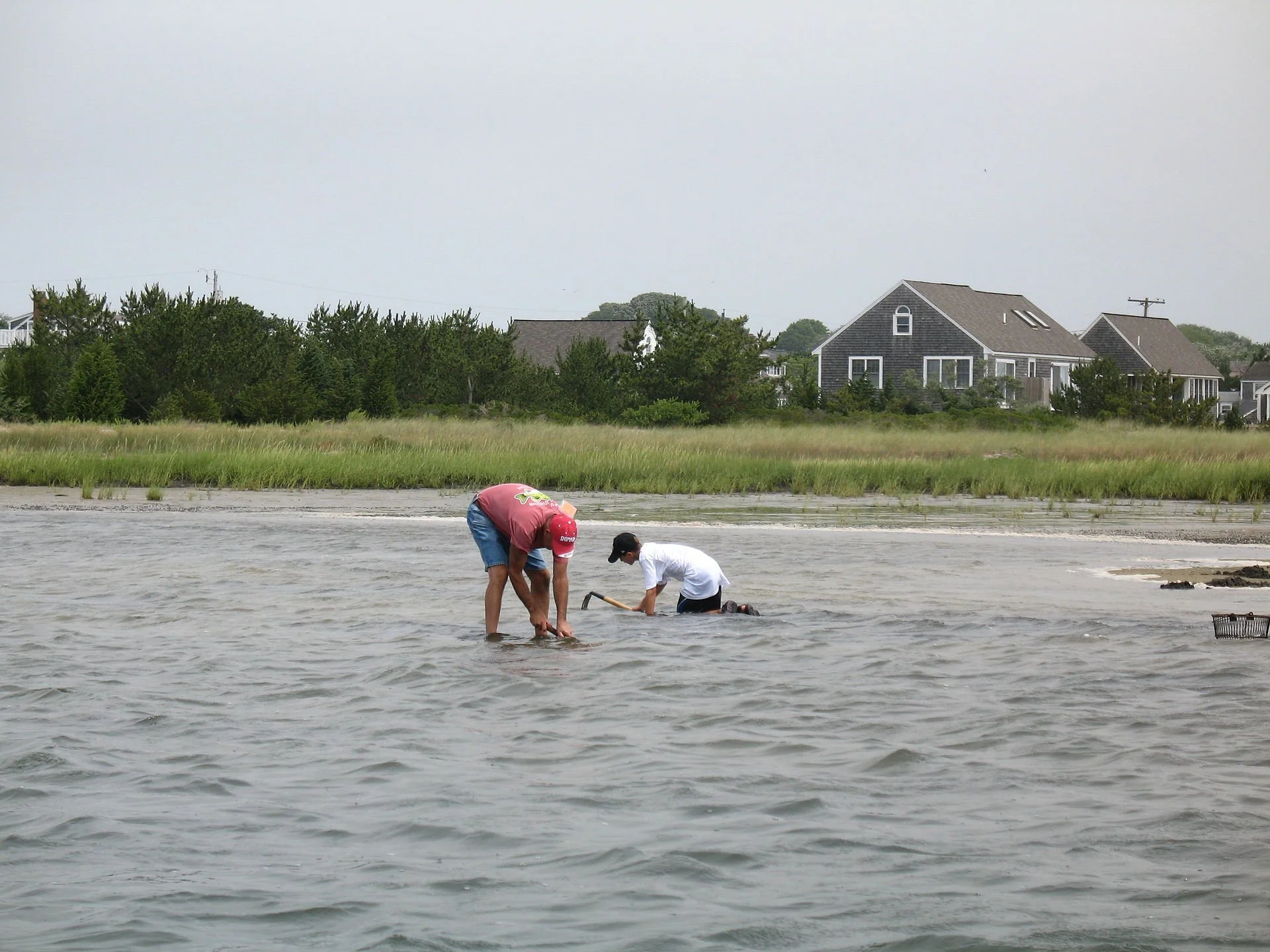
“Menemsha {on Martha’s Vineyard}: An old Native American word freely translated as ‘place where demented aliens gather to applaud the setting of the sun while eating supper in the sand.’’’
— Arnie Reisman, in On the Vineyard II (1990)
Embrace contradictions

From Joan Feirabend’s show “Multitudes,’’ at AVA Gallery and Art Center, Lebanon. N.H., Oct. 6-Nov. 4.
The gallery says:
“For thirty-two years, art has been Joan Feierabend’s daily practice, ‘I have long recognized that my paintings are wiser than I am. When a painting tells me where it wants to go, I do my best to follow.’ Working with multiple layers, she tinted each surface with color and removed paint by pressing a crumpled cloth onto the surface, creating a sort of ‘blot’– an interruption akin to the way unforeseen events can imprint a life. Each painting took many days of layering in this way. Materials used include acrylic paint, ink, pencil, colored pencil, charcoal, pastel, and gold leaf. Her tools were brushes, spatulas, pens, stencils, tape, sponges, wadded cloth, paper, and baby wipes.
“Fond of the verse, ‘I contain multitudes,’ in Walt Whitman’s poem, ‘Leaves of Grass', Feierabend believes this to be true of us all. ‘We all contain contradictions…the complexity that every human being brings to the art– including the artist, speaks to our unique selves.’ She recognizes that viewers may experience multitudes of contradictions while making selections as they will no doubt waver between the diverse choices offered.’’
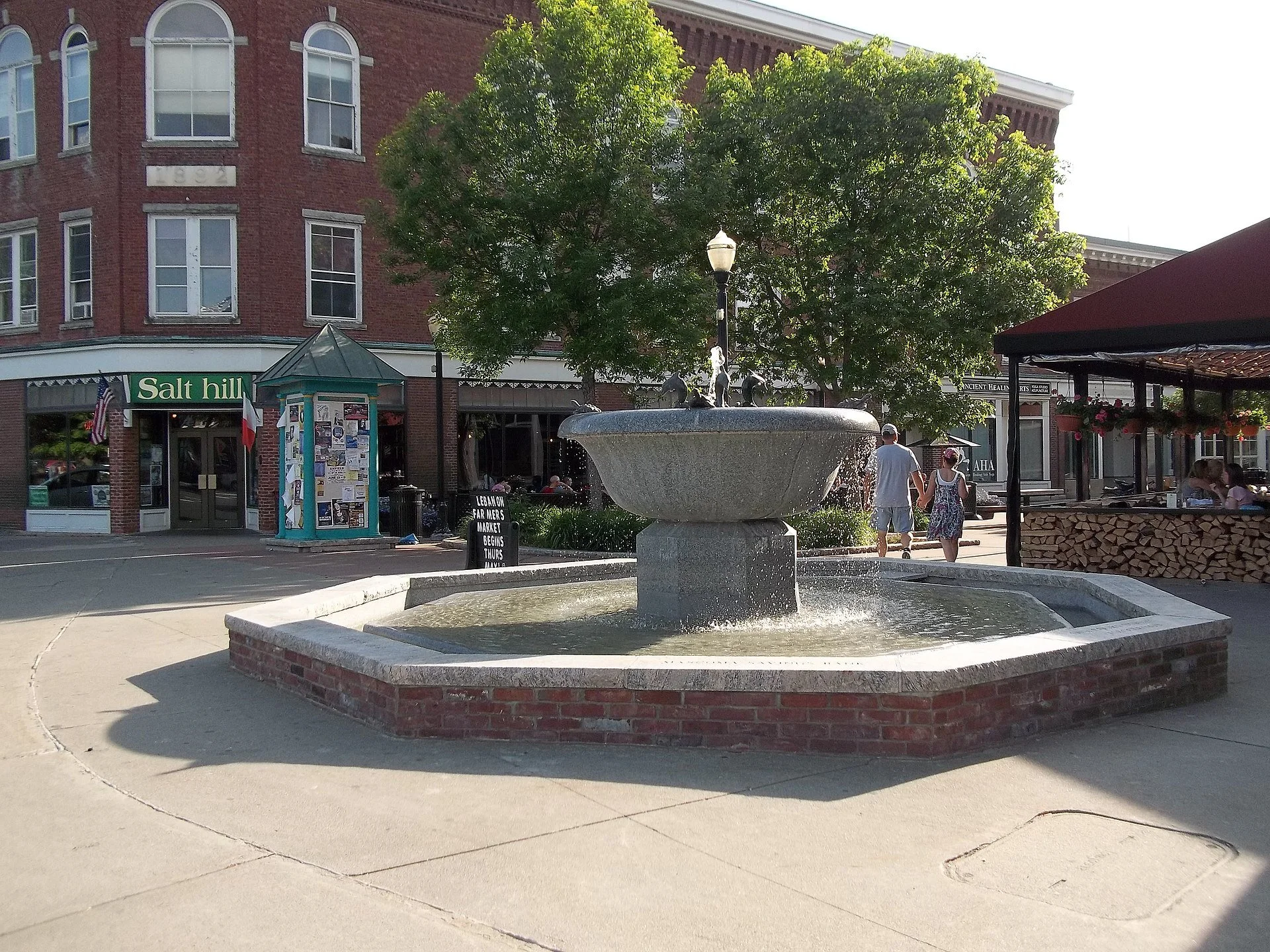
Fountain in downtown Lebanon
— Photo by Artaxerxes
David Warsh: Dorchester's weekly paper plows on through the decades
SOMERVILLE, Mass.
Rupert Murdoch is stepping down as chairman of Fox and News Corp, having built the little Australian newspaper he inherited at the age of 21 (The News of Adelaide, circulation 75,000) into a global multi-media complex of enormous political influence. He is to be succeeded by his elder son.
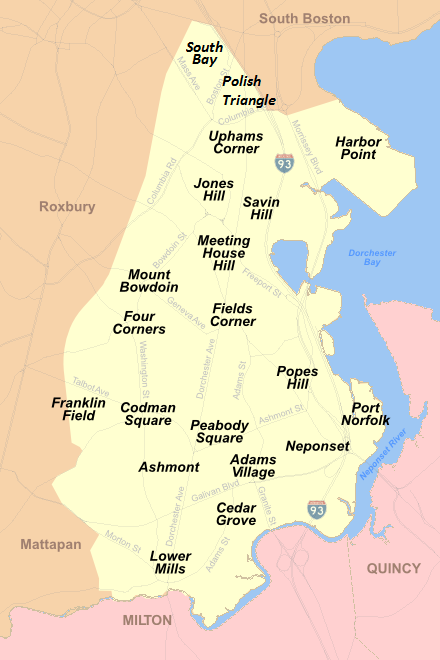
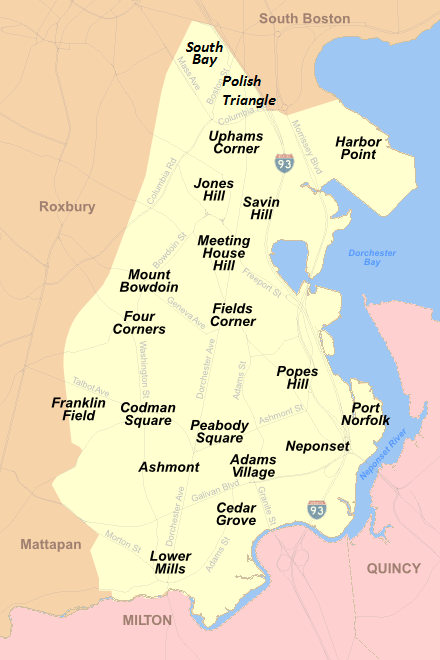
Myself, I have been preoccupied recently with the saga of The Dorchester Reporter, which celebrated the 40th anniversary of its founding with an ebullient party in Boston on Sept. 14.
That “every banker has one good idea” is an old-time industry joke. Ed Forry’s good idea was to get out of the business. In 1983, at age 39, with banking deregulation accelerating, he quit his $24,000-a-year job as a savings bank executive to found a community newspaper in Boston’s largest neighborhood. Dorchester was then recovering from a decade of white flight to the suburbs,
Forry had some experience to start with: confirmed in St. Gregory’s Parish, he had graduated from Boston College High School and Boston College. As a community activist, he had written a column for the Dorchester Argus-Citizen, with which Forry had created a profitable yearbook business. His wife, Mary Casey Forry, would be an all-in partner. The couple had two young children and $5,000 in the bank.
The Reporter circulated monthly for several years. At first, advertising paid the way. The monthly went weekly, paid subscriptions were introduced, circulation grew. There were hard times. In 1993, as recession lingered, Forry laid off the entire staff of nine. Mary Forry died in 2004. By then, son Bill had joined the business, to become, eventually, executive editor and publisher. He married Linda Dorcena Forry, a Haitian-American who won election to the Massachusetts House of Representatives in 2005, then moved on to the state Senate, where she held a seat until 2018. For an account of those first 25 years, read the story by Boston Globe columnist Jack Thomas.
What is the business worth today? Decent livings for its eight fulltime staffers, paid gigs for its regular lineup of columnists and critics, and opportunities for interns and freelance writers. The paper has disproportionate political influence —-Boston Mayor Michelle Wu and U.S. Sen. Ed Markey spoke at the party — and retained earnings, and has considerably enhanced Dorchester pride.
xxx
In 1963, at the opposite end of the enterprise spectrum, a married couple of lawyers from Brooklyn saw promises in the California building boom and purchased the Golden West Savings and Loan Association in Oakland. In a go-go market of 1968, they made a public offering, Over the next 40 years, Herbert and Marion Sandler ran the most successful residential-mortgage lender in the country, until they sold the firm in 2006 at the top of the market for $24 billion to a North Carolina bank. Widely blamed – in their view unfairly – for the subprime housing-mortage crisis, they commenced a long-planned entry into the philanthropy business.
Among many other overtures, they called Paul Steiger, who for 16 years had been editor of The Wall Street Journal, which was just the being acquired by Rupert Murdoch. The result, in short order, was ProPublica, with an annual budget of $10 million, for the practice of WSJ-style investigative journalism.
Steiger hired as his successor Stephen Engleberg, an 18-year veteran of The New York Times. Effective fund-raising raising increased the annual budget to $40 million. So with a staff of a hundred or so well-seasoned journalists, ProPublica has established itself as the most successful of philanthropically endowed news organizations that have arisen among the ruins of the old advertising-supported metropolitan print press.
What’s the second-best nonprofit news organization? National Public Radio, at least in my view. And though it is reasonably well endowed, it has recently beginning a new fund-raising campaign. Lacking the same marriage of top newspaper cultures, its enterprise ventures in news are somewhat lower-key. And lacking undisputed foundational principles, it is susceptible to the regular political tempests that afflict Washington D.C.
xxx
Now back to Murdoch. How did he do it? Mostly by buying newspapers properties in down markets, then building them up experimentally instead of stripping them down. Fox News, which he founded in 1996, with former Richard Nixon pollster Roger Ailes, was a particular success; MySpace, an early competitor to Facebook, didn’t fair nearly as well.
Murdoch, 92, and in good health, has put his first-born son, Lachlan, in charge of all of the empire. But further struggles maybe in store. The mogul has three other children; they are entitled to equal shares under terms of his will. The conglomerate can be disassembled and shared out. But the conglomerate’s Wall Street Journal will probably power on.
That in turn leads to The Washington Post. When Donald Graham sold his family-controlled newspaper to Amazon founder Jeff Bezos for $250 million, in 2013, it was for far less than might have been offered by other bidders. Why was that? Consider that as one of the world’s richest men, Bezos possessed both the means and the moxie to restore one of America’s three leading newspapers to robust good health. Yet it can’t have escaped Graham’s attention, either, that Bezos has four children. Thus the Post’s independence will be preserved well into the future. That seems to have been a central aim of the public-spirited Graham.
Finally, that leads back to Boston. When the New York Times Co, sold The Boston Globe to Boston Red Sox owner John Henry, in 2012, for $70 million, having mismanaged the property for more than a decade, the direction of the paper itself fell to Henry’s wife, Linda, a native Bostonian. She has managed to keep it not just afloat, but interesting. It is profitable, she says, though print circulation continues to decline.
At a Globe conference on the new business last week, she spoke proudly of new bureaus in Rhode Island and New Hampshire. We’re not interested in becoming a national [paper],” she told listeners, “but as there’s been a decline in smaller regional places, we’re trying to fill that gap.”
In Dorchester, meanwhile, the money comes from putting newsprint on the front porch. The Dorchester Reporter probably out-influences the old Boston Herald, once owned by News Corp and now operated out of suburban Braintree by Media News Group, and, at least in municipal politics, often rivals The Globe itself.
David Warsh, a veteran columnist and an economic historian, is proprietor of Somerville-based economicprincipals.com, where this column originated.
Economicprincipals.com is a reader-supported publication. To receive new posts and support Mr. Warsh’s work, consider becoming a free or paid subscriber.
Gone

Cellar hole in the former town of Dana, Mass.
“Back out of all this now too much for us,
Back in a time made simple by the loss
Of detail, burned, dissolved, and broken off
Like graveyard marble sculpture in the weather,
There is a house that is no more a house….’’
— From “Directive,’’ by Robert Frost (1874-1963). To read the whole poem, please hit this link.

Edited from a Wikipedia entry:
Site of what had been the town common of Dana. Formed from parts of Petersham, Greenwich and Hardwick, it was incorporated in 1801. The town was disincorporated on April 28, 1938, as part of the creation of the Quabbin Reservoir, the water supply of much of Massachusetts. Upon disincorporation, all of the town went to Petersham. The majority of the land of the former town is still above water.
— Photo by John Phelan
Stick to funerals
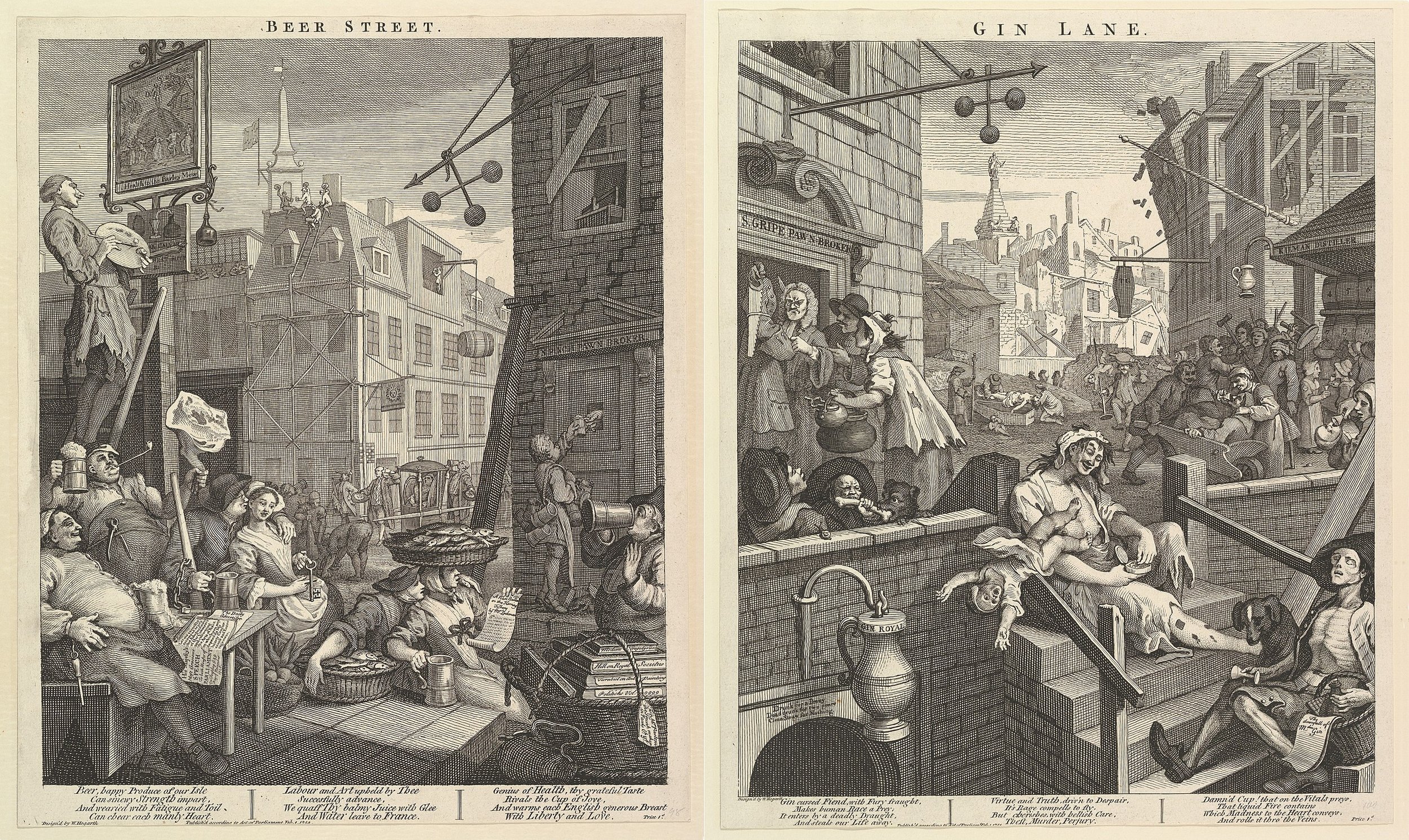
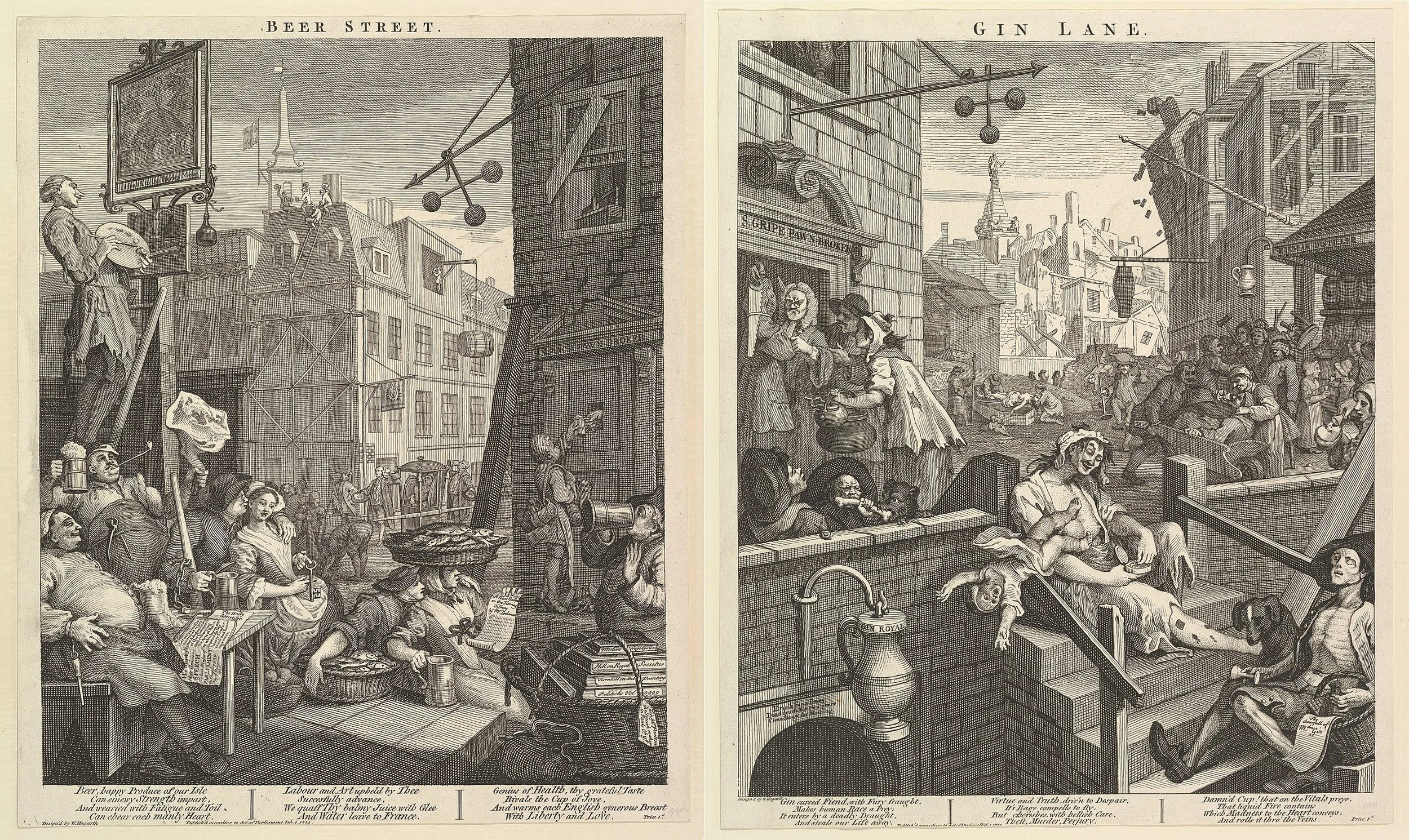
Beer Street and Gin Lane (1751), by English painter and engraver William Hogarth (1697-1764).
Adapted from Robert Whitcomb’s “Digital Diary,’’ in GoLocal24.com
The recent melee at a wedding party in Newport reminded me of why I prefer funerals to weddings: The attendees are more dignified, the music is better and the outcome is certain for the key protagonist – the deceased. Samuel Johnson said about second marriages that they’re the triumph of hope over experience; I suppose you could say the same thing about most legal contracts.
Hit these links for the Newport horror show:
https://www.golocalprov.com/news/editorial-kudos-to-newport-police-for-releasing-body-camera-footage
xxx
It takes a lot of work to keep in touch with old friends, and sometimes you find that they no longer have the interest or energy to be kept in touch with. And then they and you die.
Dispersal! Entropy!
Levant light in Middlebury

“Sphinx and Pyramids of Giza from an album entitled Egypt, Turkey, Greece, c. 1870‘‘ (albumen print), by an unknown photograper. Collection of Middlebury (Vt.) College Museum of Art, in the show there titled “The Light of the Levant: Early Photography and the Late Ottoman Empire’,’ through Dec. 10.
The museum says:
“This exhibition highlights the important role of the Levant region in early photography. In its broadest historical meaning, the area of the Levant, controlled by the Ottoman Empire during all or part of the nineteenth century, encompassed contemporary Greece, Turkey, and most of the Arab world.’’
“The region held a special role in the Euro-American imagination as a site of great antiquities, monumental architecture, religious importance, exotic otherness, and colonial ambitions. In addition, the region’s intense light rendered it a sought-out destination for many of photography’s earliest practitioners. As Louis Jacques Mandé Daguerre, the inventor of the earliest photographic technology, stated in 1839, ‘Nature’s image will reproduce itself still more quickly in countries where the light is more intense ….”’
Mixing it up in Lynn

Delightfully bizarre view of Lynn, Mass., in 1881. It was a major manufacturing center, especially of shoes.
“I grew up about 30 minutes north of Boston in a town {Lynn, Mass.) that was a virtual melting pot - I was exposed to all different backgrounds, cultures, and religions, fueling my personal interests in global issues.’’
—- Alex Newell, (born 1992) , actor and singer

Alex Newell in 2015
Connecting place to narrative

“Chicago” (oil on canvas), by Elizabeth Enders, in her show “A Different Time, A Different Place,’’ at the Lyman Allyn Museum, New London, Conn., Oct. 14-Jan 14. A New London native, she divides her time between Waterford, Conn., and New York City.
—Courtesy of the artist and the Betty Cuningham Gallery, New York.
The museum says:
“Exploring landscape, nature, and the role of place in the imagination, this exhibition presents the recent work of contemporary artist Elizabeth Enders (American, born 1939). In vibrant paintings and watercolors, Enders depicts abstracted landscapes, inviting viewers on a wide-ranging journey. Inspired by experiential knowledge and by places and events of the past and present, Enders renders volcanoes, rivers, oceans, deserts, fields, plants and tropical foliage, along with unusual monuments and structures found in places such as Egypt and Iceland. Such pieces consider how place is connected to meaning and narrative. ‘‘
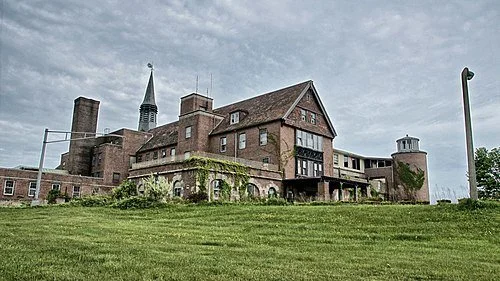
The historic and spooky Seaside Sanatorium, in Waterford

Chris Powell: City-operated supermarket in Hartford? UConn seems to condone rape

If only….
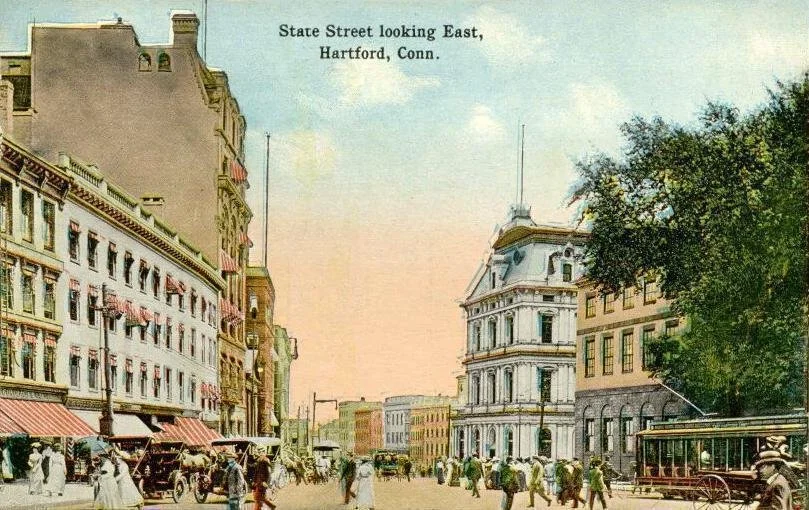
Hartford in 1914, during “The Insurance Capital of the World’s’’ economic heyday
MANCHESTER, Conn.
Hartford’s long descent from a prosperous hub of industry and finance (especially insurance) to a repository of poverty can be measured in several ways, but an especially telling one was publicized the other day as the City Council decided to hire a consultant to consider having city government operate a supermarket in the city, for profit or even at a loss.
Hartford is said to have become a "food desert," a place whose residents have to travel far to obtain fresh and nutritious food for preparation at home and so have to rely on less healthy items from neighborhood convenience stores. According to The Hartford Courant’s report on the supermarket initiative, in 1968 the city had 13 chain supermarkets but has only one today.
The idea of city government supermarkets is also being pursued in Chicago, where crime is exploding and destroying the city.
Like other businesses, supermarkets won’t operate where they can’t make money safely. They won’t operate where people don’t want or can’t afford fresh and nutritious food and where crime is common.
If, as the City Council’s initiative suggests, Hartford is, like Chicago, now so desperate that government must provide food directly to its residents, the problem goes far beyond a "food desert." The problem is demographic collapse under the pressure of poverty, welfare policy, family dysfunction and poor education -- and government in Connecticut does not seriously examine those things.
Hartford’s government can’t be blamed much here. Cities are the product of their demographics, and their demographics are largely the product of state and federal government policy, which long has been content to concentrate poverty in the cities, to minimize its impact on the middle and upper classes, rather than eliminate it. Indeed, Hartford may be doing all it can just by facilitating construction of middle-class housing downtown, since eventually a middle-class population with enough density might attract not only supermarkets but also other businesses basic to middle-class life.
But this will be a struggle even with a proper housing policy as long as the city’s schools serve mostly disadvantaged students and remain unattractive to people who want to avoid or escape the culture of poverty.
Would Hartford operate a supermarket professionally, or would such a supermarket become another mechanism of political patronage and graft? The less profit such a supermarket would have to make, the less professional it would be.
Middle-class places don’t need government supermarkets. Middle-class places can pretty much take care of themselves. So where is state government’s plan to make Connecticut’s cities middle-class again instead of just sustaining poverty there?
xxx
No one needs to be a feminist to deplore the University of Connecticut’s new association with the late professional basketball star Kobe Bryant. But it would be nice if a few feminists at least took notice\
Sports apparel manufacturer Nike announced the other day that it is renewing its “Kobe” brand of basketball shoes and other items, perhaps eventually including college basketball jerseys, and that six college basketball programs will promote the brand, UConn's among them
A statement from UConn’s athletic department, with which university President Radenka Maric concurred, said: "We are proud partners with Nike, whose support benefits hundreds of student-athletes at UConn every day. Kobe and Gigi Bryant" -- the star’s daughter, who was killed with him in a helicopter crash in 2020 -- "were tremendous fans of UConn basketball, and we're pleased to join Nike in honoring their memory in this way."
The problem is that in 2003 Bryant was charged with raping a young woman employee of a hotel in Colorado after luring her to his room. While he insisted that their encounter was consensual, the details he admitted about it were violent and disturbing. Eventually the woman declined to testify, so the charge against Bryant was dropped, whereupon she sued him. He apologized and settled the case for what was estimated at $2.5 million.
Money apparently excuses everything, even rape and even at UConn, which ordinarily prides itself on political correctness.
Chris Powell has written about Connecticut government and politics for many years. (CPowell@cox.net).
The great invasion


Text from article by Frank Carini in ecoRI news
A worldwide scientific intergovernmental group on biodiversity, which included a professor from the University of Rhode Island, provides evidence of the global spread and destruction caused by invasive alien species and recommends policy options to deal with the challenges of biological invasions.
The comprehensive report, released Sept. 4 by the Intergovernmental Science-Policy Platform on Biodiversity and Ecosystem Services for the United Nations, found the threat posed by invasive species introduced into new ecosystems is “enormous.”
In 2019, invasive species caused an estimated $423 billion in damages to nature, food sources, and human health. These alien invaders have also contributed to 60% of recorded animal and plant extinctions, and were the sole factor in 16% of extinctions, according to the report.
“This is the first global report on invasive alien species anywhere,” said Laura Meyerson, a URI professor in natural resources science and a contributing lead author on the report. “It’s truly an effort of scientists from around the world. The data touch on every world region, every biome and all major taxa — plants, vertebrates, invertebrates, micro-organisms, fungi.”
Invasive species pose to a threat biodiversity, ecosystem services, and human well-being. The report is designed to raise public awareness to “underpin action to mitigate the impacts of invasive alien species.”
To read the whole article, please hit this link.
Let them rest

“Forest in Autumn,’’ by Jean Courbet (1819-1877)

Fallen leaves in Harvard Yard, in Cambridge, Mass.
— Photo by David Adam Kess
I'll tell you how the leaves came down,"
The great Tree to his children said:
"You're getting sleepy, Yellow and Brown,
Yes, very sleepy, little Red.
It is quite time to go to bed."
"Ah!" begged each silly, pouting leaf,
"Let us a little longer stay;
Dear Father Tree, behold our grief!
'Tis such a very pleasant day
We do not want to go away."
So, for just one more merry day
To the great Tree the leaflets clung,
Frolicked and danced and had their way,
Upon the autumn breezes swung,
Whispering all their sports among--
"Perhaps the great Tree will forget
And let us stay until the spring,
If we all beg, and coax, and fret."
But the great Tree did no such thing;
He smiled to hear their whispering.
"Come, children, all to bed," he cried;
And ere the leaves could urge their prayer,
He shook his head, and far and wide,
Fluttering and rustling everywhere,
Down sped the leaflets through the air.
I saw them; on the ground they lay,
Golden and red, a huddled swarm,
Waiting till one from far away,
White bedclothes heaped upon her arm,
Should come to wrap them safe and warm.
The great bare Tree looked down and smiled.
"Good-night, dear little leaves," he said;
And from below each sleepy child
Replied, "Good-night," and murmured,
"It is so nice to go to bed."
“How the Leaves Came Down,’’ by Sarah Chauncey Woolsey (1835 -1905), an American children's author who wrote under the pen name Susan Coolidge. Born in Ohio into an old New England family, she spent most of her life in Newport, R.I.

Llewellyn King: The dangerous cheapening of the impeachment process

The impeachment trial of Bill Clinton, in 1999, with Chief Justice William H. Rehnquist presiding. The House managers are seated beside the quarter-circular tables on the left and the president's personal counsel on the right, much in the fashion of President Andrew Johnson's trial, in 1868.
WEST WARWICK, R.I.
Edmund Burke, the 18th-Century British statesman, argued during the celebrated impeachment of Warren Hastings, the governor of Bengal, that impeachment was essentially a political process, not a judicial one. Quite so.
The political dimension of impeachment is again on display in Washington, where the Republicans, driven by a faction of the party, are moving toward impeaching President Biden.
Historically, presidential impeachment has been reserved for actions that meet the undefined standard of “high crimes and misdemeanors.” It has been used with great restraint; until the impeachment of Bill Clinton, only Andrew Johnson had been impeached. The bar was lowered for the Clinton action then, and the attempt to impeach Biden is a further lowering — pointing up that it is, as Burke argued, a political process.
Impeachment is becoming a common political tactic not, as envisaged by the Founders, the ultimate censure, leading to a trial in the Senate and removal from office.
The two indictments of Donald Trump would seem to have met, to my mind, the constitutional standard and, had the Senate been in other hands, might have led to a trial and removal. It is argued that those indictments didn’t meet the standard and were no more than censure by another name, carried out along party lines.
The gravity of impeachment has been preserved since the beginning of the republic, but it is in danger.
Some aspects of the structure of the state should be out of reach to the political process most of the time. The U.S. Constitution guarantees that it can’t be easily amended or today it wouldn’t be recognizable, as every fashionable fixation would have been added. The mistake of Prohibition written again and again.
At the time that the Northern Ireland peace accords were being written, I was involved with a lively summer school in Ireland — which might be thought of as a think tank that meets once a year.
This organization, the International Humbert Summer School, studied Ireland’s relationship to the world, but became involved in the peace process. There were speakers from both the Unionists (pro-British) and Sinn Fein, the political wing of the IRA.
At one session, my role was to respond to the late Martin McGuinness, widely known as a top leader of the IRA, believed by the British to be a terrorist with blood on his hands.
Because I have a British accent, the organizers, John Cooney, the Irish historian and journalist, and Tony McGarry, a prominent local headmaster in Ballina, County Mayo, where we gathered, were nervous about what I might say to a man who was regarded with fear and awe as a killer.
Our event turned into a debate. McGuinness was sharp, had a good sense of humor and was open to ideas. Because the IRA had been engaged in armed struggle for so long, it hadn’t thought about constitutional arrangements in peace.
Thinking of the U.S. Constitution, I suggested to McGuinness that if a new constitution for Northern Ireland were to be written, it should sweep nothing under the carpet by ignoring it (as was the American case with slavery) and that when finished, it should be placed on “a high shelf” from which it couldn’t be easily taken down.
McGuinness agreed heartily, and this led to a discussion of constitutions and systems of government, and how the drafting could be perfected.
But my idea of a high shelf was what stuck with him.
So it is deeply disheartening to see impeachment treated as just another political tactic to be launched against any American president simply because the opposition party doesn’t like the president’s policies. But that is what is happening.
Incidentally, the impeachment of Warren Hastings, which dragged on for years and was enormously expensive, ended in acquittal before the House of Lords, proving Burke’s point that impeachment was a political process.
In the United States, for most of our history we have avoided keeping it out of the political maelstrom. It is a sad thing to see used now as a purely political tactic.
We have what is essentially a permanent campaign for the presidency. No sooner is one election certified then rumblings about the next one, with all the attendant speculation, begin.
Will presidential impeachment become part of the political process? And what if a Senate has the two-thirds majority to convict on political grounds? There is danger here.
At the end of our exchange, I wished the IRA leader “the best of British luck.” He laughed. No attempt to kneecap me followed.
Llewellyn King is executive producer and host of White House Chronicle, on PBS. His email is llewellynking1@gmail.com and he’s based in Rhode Island and Washington, D.C.
Visiting rights only
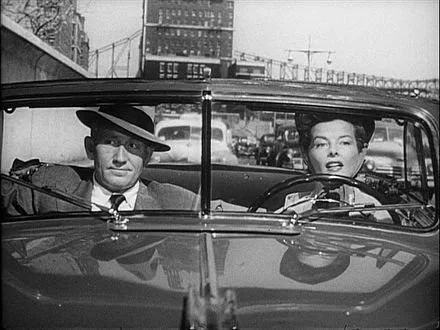
A shot from Adam’s Rib (1949), one of nine movies that Katherine Hepburn (1907-2003) made with her co-star here, Spencer Tracy (1900-1967), who was also her real-life romantic partner. She was from an affluent Connecticut family.
"I have always thought that marriage was a funny sort of institution. Sometimes I wonder if men and women really suit each other at all. It's inevitable that they should come together now and again, but how well suited are they to living in the same house? Perhaps they should live next door and visit every now and then."
— Katherine Hepburn

The former house of Katherine Hepburn, in the very hurricane-exposed Fenwick section of Old Saybrook, Conn.
All-in-one retailing
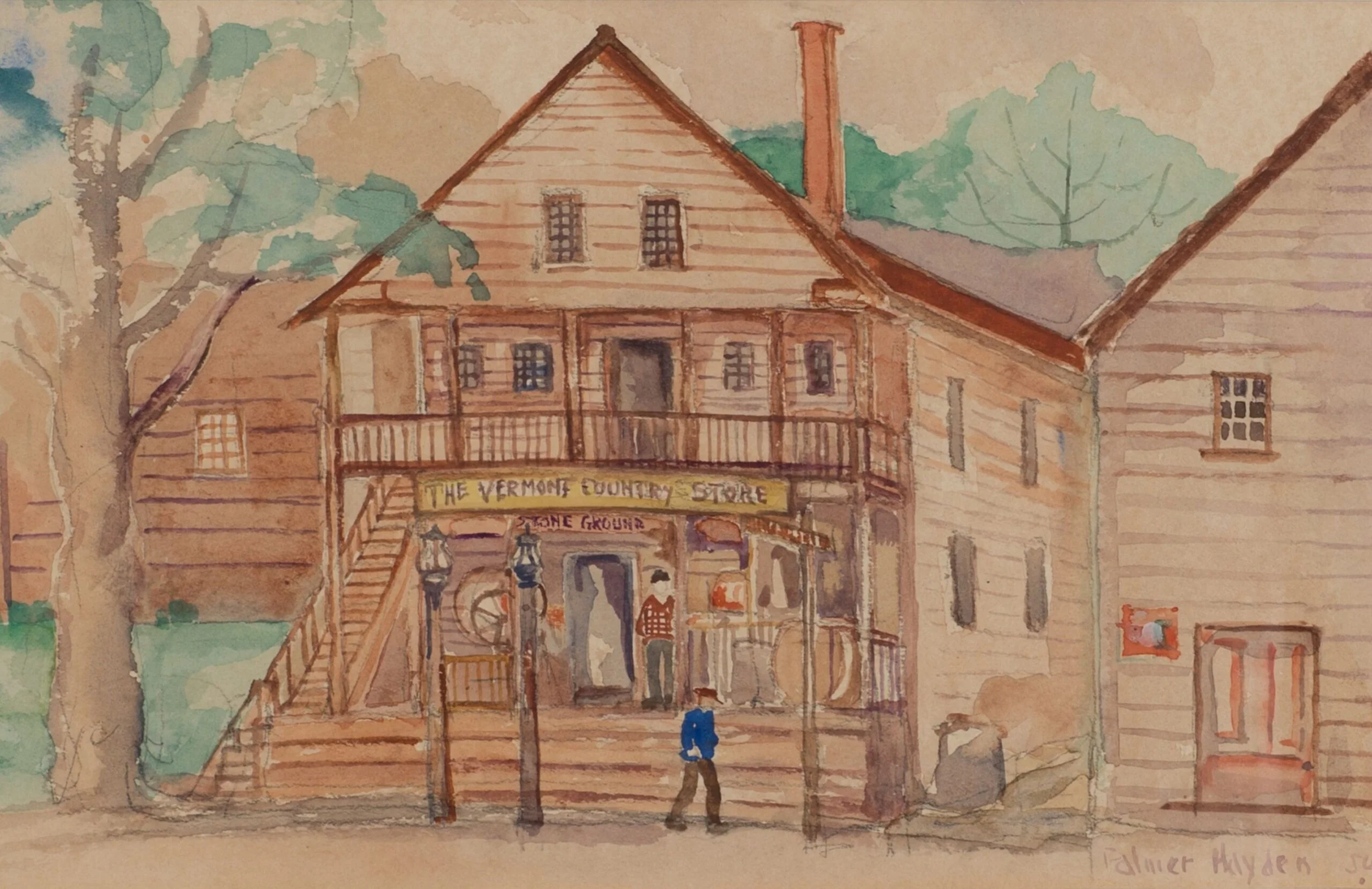
“Vermont Country Store”(watercolor) Palmer Hayden (1890-1973), in the show “For the Love of Vermont,’’ at the Southern Vermont Arts Center, Manchester, Vt., through Nov. 5
There’s a use for everything
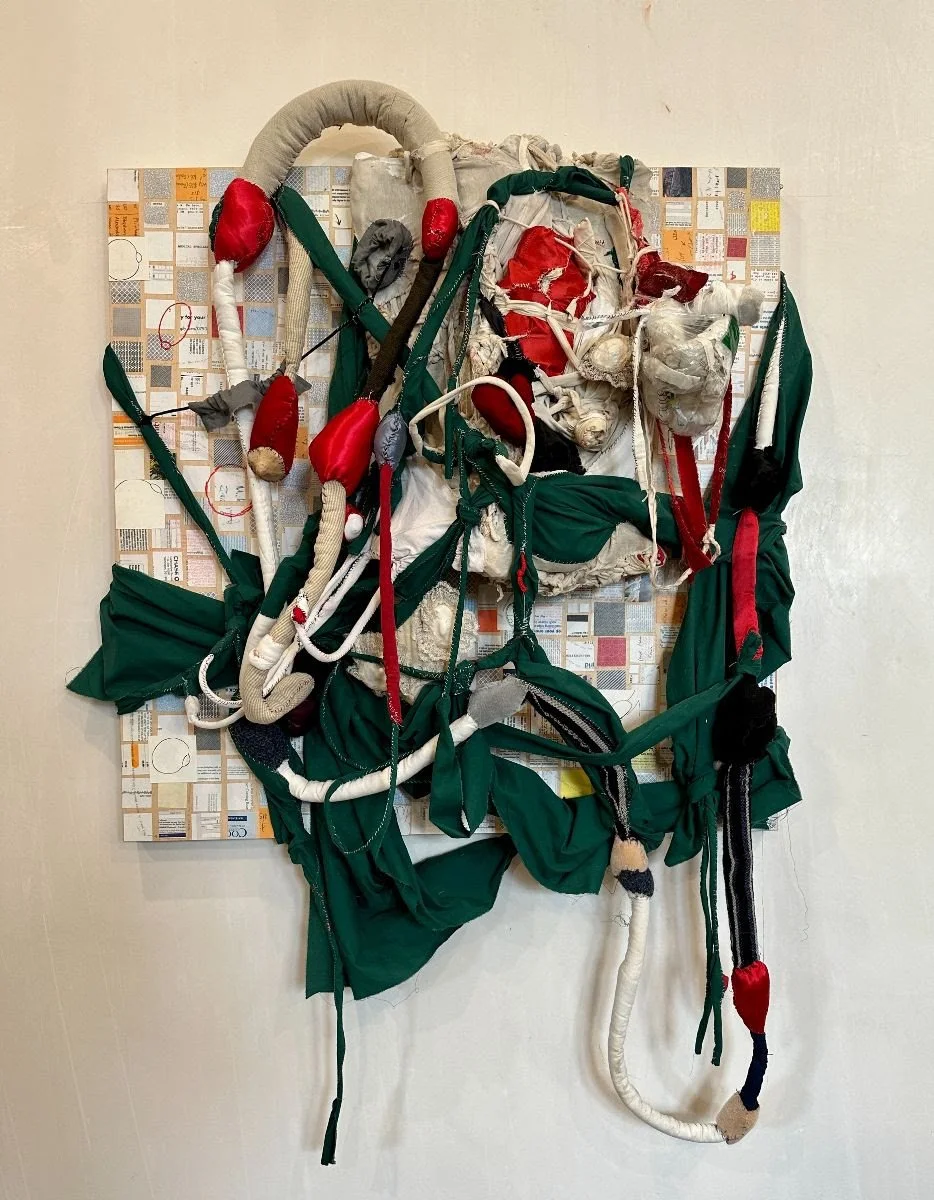
“What Remains’’ (mixed media)., by Massachusetts-based artist and fencing coach Elif Soyer, in her show “Making Meaning,’’ at Kingston Gallery, Boston, Nov. 29-Dec. 30.
"Everyday takes figuring out all over again how to f***ing live.”
(Calamity Jane/Deadwood)
The gallery says:
“‘Making Meaning’’’ is a conglomeration of old and new ideas and experiments, culminating in fabrications, layered with both time and materials. For Soyer, the Calamity Jane quote from her favorite character and all time favorite show is true for most of us. Soyer ponders this existential question often, especially in the studio where, for her, making art is making meaning out of the mundane, through work and invested time. Oscillating between the interior landscape of the human body and the exterior landscape of her immediate environment, through collecting, layering or other seemingly obsessive processes, Soyer’s work has always had a very strong tie to time.’’

An advocate for the insane
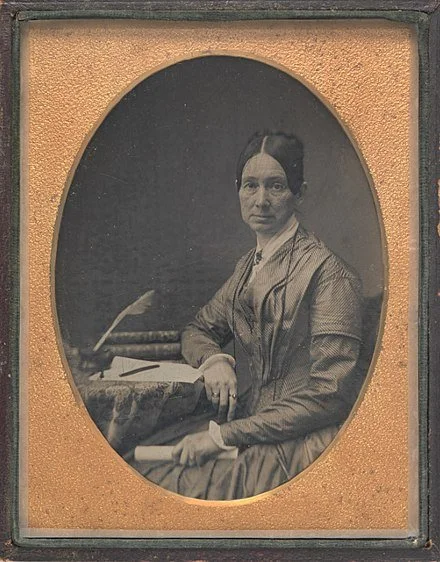
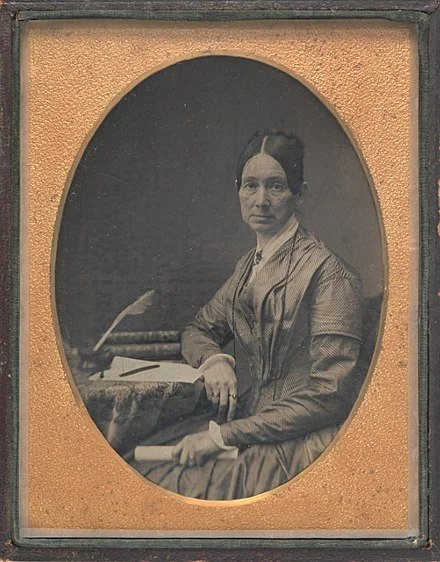
Half-plate daguerreotype of Dorothea Dix, c. 1849
• "I come to present the strong claims of suffering humanity. I come to place before the Legislature of Massachusetts the condition of the miserable, the desolate, the outcast. I come as the advocate of helpless, forgotten, insane men and women; of beings sunk to a condition from which the unconcerned world would start with real horror."
• "The tapestry of history has no point at which you can cut it and leave the design intelligible."
• "In a world where there is so much to be done, I felt strongly impressed that there must be something for me to do."
— Dorothea Dix (1802-1887), mental-health advocate, Civil War nurse and social reformer. She was born in Hampden, Maine, and raised in Worcester, Mass.
Hit this link on 19th Century Boston doctors appealing for a mental hospital.
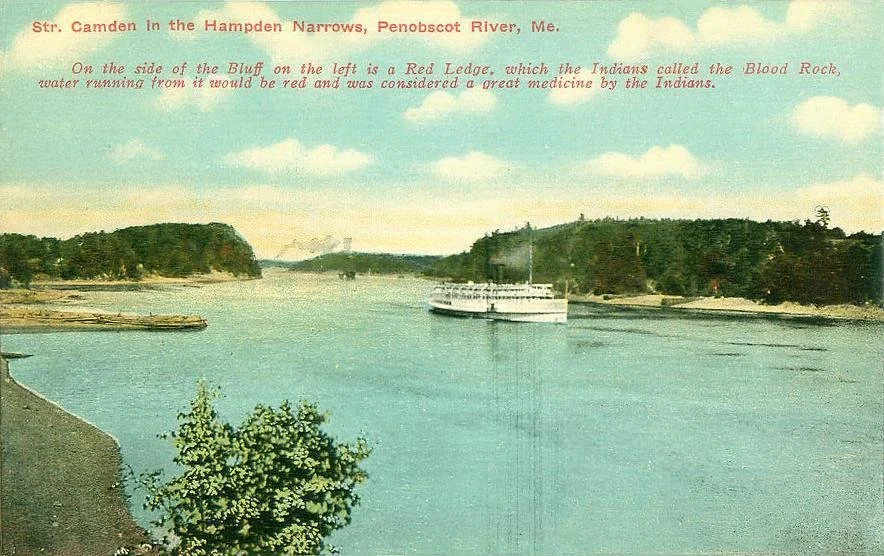
Hampden Narrows on the Penobscot River, c. 1910
From ‘the life she’s living’
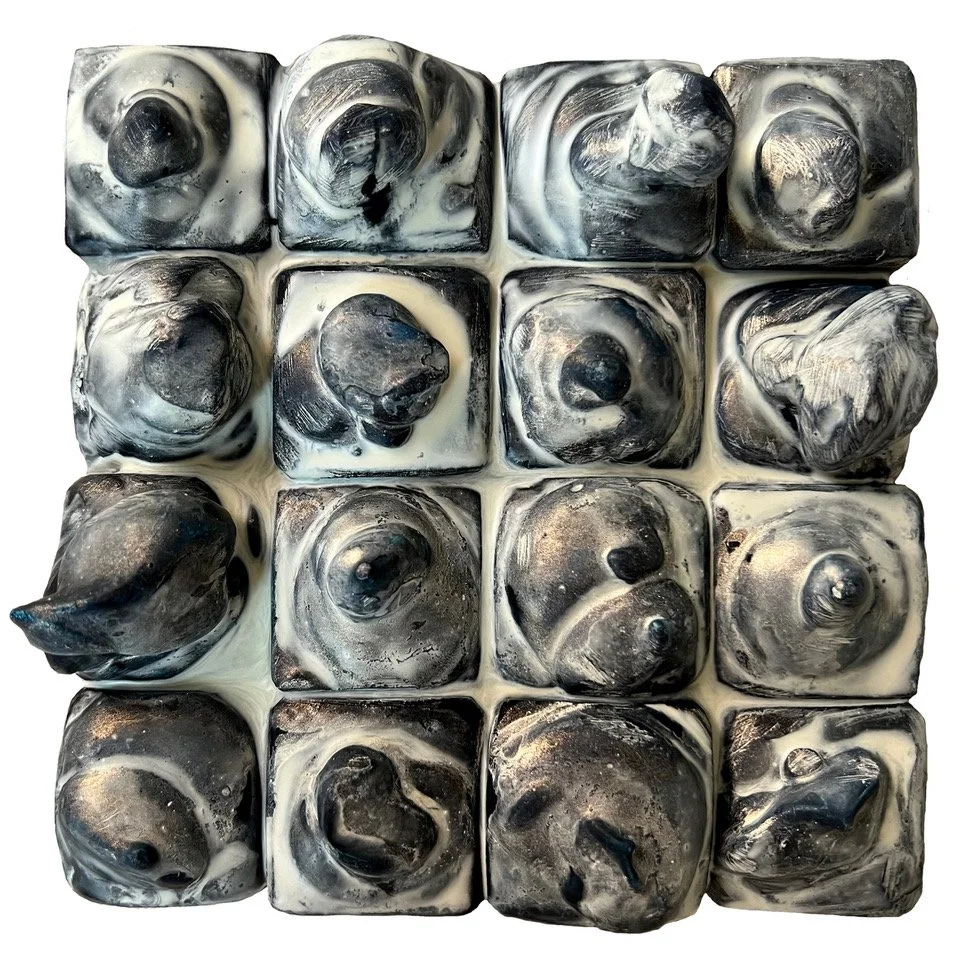
“Flesh Forms” (plaster of paris with encaustic), by Providence-based artist Angel Dean, in her “Flesh, Flora, and Flux’’ show, in the Providence Art Club’s Castelnovo Gallery, through Oct. 5.
Her artist statement says:
“Angel Dean is an artist who mainly works with encaustic media. Her work is personal and unconventional. By contesting the division between the realm of memory and the realm of experience, Dean makes work that is the by-product of the life she’s living.’’
“The advice I like to give young artists, or really anybody who’ll listen to me, is not to wait around for inspiration. Inspiration is for amateurs; the rest of us just show up & get to work. If you wait around for the clouds to part & a bolt of lightning to strike you in the brain, you are not going to make an awful lot of work. All the best ideas come out of the process; they come out of the work itself. Things occur to you.”
—- Chuck Close
First the hurricane, then the popcorn
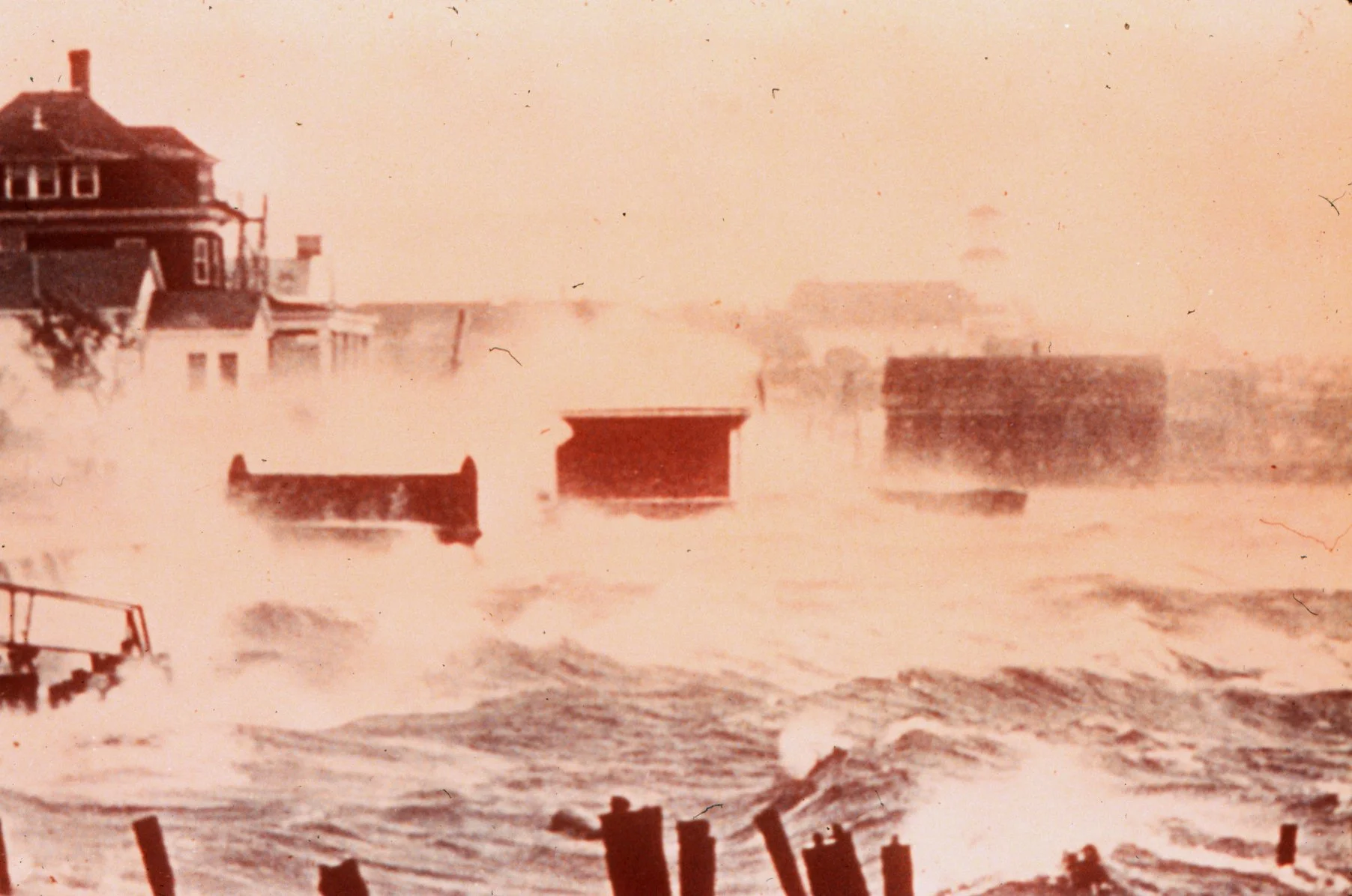
On the Connecticut coast during Hurricane Carol, on Aug. 31, 1954

Get out the popcorn
Adapted from Robert Whitcomb’s “Digital Diary,’’ in GoLocal24.com
The news-media hype last week about Hurricane Lee mostly reflects their craving for clicks/ratings from the drama associated with (mostly free) video. And I suspect that most people enjoy the excitement of a storm even if they’re in it, unless, of course, there’s some personal insult/expense, such as a tree falling on their house.
There was a minor hurricane called Belle back in 1976 that weakened and moved west of Rhode Island during our first residency in Providence. When it became clear that it wouldn’t amount to much, our next-door neighbor, the late great Luigi Bianco, whined in frustration: “But I want drama!”
Back in the ‘50’s, at our house on Massachusetts Bay, several hurricanes kept us well supplied with firewood from fallen trees and branches well into the ‘60s; we started to miss those storms when we ran low of firewood during the ‘60s tropical- storm shortage. The firewood was mostly for decorative fires during the holidays and to pop popcorn (to be soaked in butter and salt – no wonder we all got heart disease) -- and roast chestnuts. I still link the fires with watching home movies taken on a wind-up 8mm camera.

A new way of scaring away sharks from fishing operations?

Electromagnetic field receptors and motion-detecting canals in the head of a shark
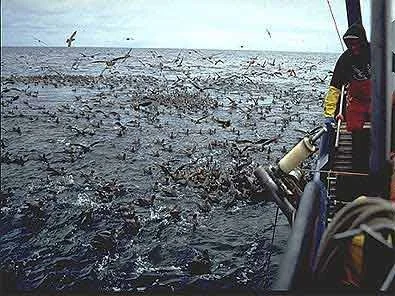
Seabirds attracted by longline fishing
Edited from a New England Council report:
“Students at the University of New England (UNE) are researching how electrical pulses can effectively protect sharks while saving fishermen time and money. (UNE has campuses in Portland and Biddeford, Maine.)
“The technology, which works by emitting small, erratic electrical impulses within the water, intends to scare away sharks, which can detect electrical fields, while leaving the intended catch unaffected. If the devices, which can be attached next to each fishing hook, are as effective as anticipated, they can significantly reduce shark bycatch on longline fishing equipment. This result would reduce waste and catch inefficiencies for fishermen and protect sharks from being caught unintentionally.
“Over the past decades, as fishing efforts have increased significantly, sharks and other marine life have seen their populations drop, in major part due to bycatch. The work by UNE students and faculty attempts to simultaneously minimize harm to wildlife, while boosting the sustainability and success of fishermen. While there is plenty of work left to be done before a final device is perfected, students understand how valuable this technology could become.
“‘[The fishermen] lose a lot of money, and they know it,’ Michael Nguyen, a second-year graduate student, told The Portland Press Herald. ‘We are still trying to work out specifics. This is a long way away from being integrated into any commercial fisheries, but there’s a lot of interest, a lot of need, especially now that they see the electrical field isn’t scaring away the tuna.’’’