
Vox clamantis in deserto









Chris Powell: Tesla’s special deal with the Mohegans; a school for the sexually uncomfortable

The Mohegan tribe’s casino complex, in Uncasville, Conn.
MANCHESTER, Conn.
Nothing may be more beautiful in politics than when influential but selfish special interests clash, catching squeamish elected officials in the middle, forcing them to choose sides on the basis of how much political harm each special interest could inflict on them. Choosing sides according to the public interest seldom occurs to elected officials, since they tend to equate the public interest with whatever gives them political advantage.
Such a clash was renewed in Connecticut the other day when automaker Tesla and the Mohegan Indian tribe announced that Tesla will start selling and delivering cars from a showroom on its reservation in the eastern part of the state.
This practice ordinarily would break state law, which prohibits automakers from selling cars directly and reserves that business for manufacturer-franchised and state-licensed auto dealers. Tesla doesn't use franchisees.
The law's purported premise is that dealers provide better consumer protection than manufacturers would. Of course, the law provides even better protection for auto dealer profitability.
But as a matter of federal law, Indian reservations have some sovereignty, and federal courts almost certainly would construe it in favor of Tesla's arrangement with the Mohegans, which is similar to arrangements Tesla has with Indian reservations in other states
Because of Connecticut’s law, state residents who want to buy Teslas have to leave the state, though Teslas can be viewed and leased at a Tesla showroom in Milford.
Tesla and the Connecticut Automotive Retail Association long have been tangling over the law. The General Assembly always has sided with the auto dealers, who have far more influence and thought they had won. Maybe now they have lost.
Gov. Ned Lamont and state legislators may resent the Mohegans for contravening state policy so dramatically, especially since the tribe usually portrays itself as a good partner with state government. More resentful still, the auto dealers now may propose legislation to wreck Tesla’s arrangement with the Mohegans, as by imposing a prohibitive fee on registering in Connecticut any vehicles for which there is no dealer franchise in the state.
But might car buyers in Connecticut, especially those with enough money to buy Teslas, be allowed to settle this issue for themselves?
New cars are expensive and people today tend to be attentive to their warranties. If car buyers are really so much more protected when buying from an auto dealer rather than direct from a manufacturer, the dealers association could advertise to that effect. Meanwhile, Tesla could advertise why people buying directly are adequately protected. Buyers could decide for themselves.
The world wouldn’t end, and state government could worry less about protecting the auto dealers and more about protecting state residents from failing schools and sewer systems, repeat criminal offenders, street takeovers by wild juveniles, crooked state troopers, grotesque cost-overruns on government construction projects, and other problems against which people can’t protect themselves.
xxx
As sexual discomfort and gender dysphoria seem to be exploding among young people, a teacher is planning to open a private school in Ansonia for seventh- and eighth-graders with such conditions. It didn't get enough enrollment to start with the current school year and it will be surprising if it succeeds.
For tuition is planned to be $20,000 a year while parents of the potential students already may face high medical bills. Transportation will be a challenge. People may be reluctant to commit to a school that may not be around for more than two years, with students risking having to transfer back to school systems they fled.
Competition in education is good but the reasons it is needed aren’t. The main justification claimed for the new school is that many young teens with sexual and gender discomfort are frequently bullied by their peers and school administrators fail to act against it. The remedy offered by the new school is essentially segregation, so no students distressed by matters of sexuality and gender will ever have to deal with students not like them, and vice-versa.
Will that solve problems or just postpone them to when they are even more traumatic?
Apparently it is too much to ask government to figure out why more young people are distressed.
Chris Powell has written about Connecticut government and politics for many years (CPowell@cox.net).
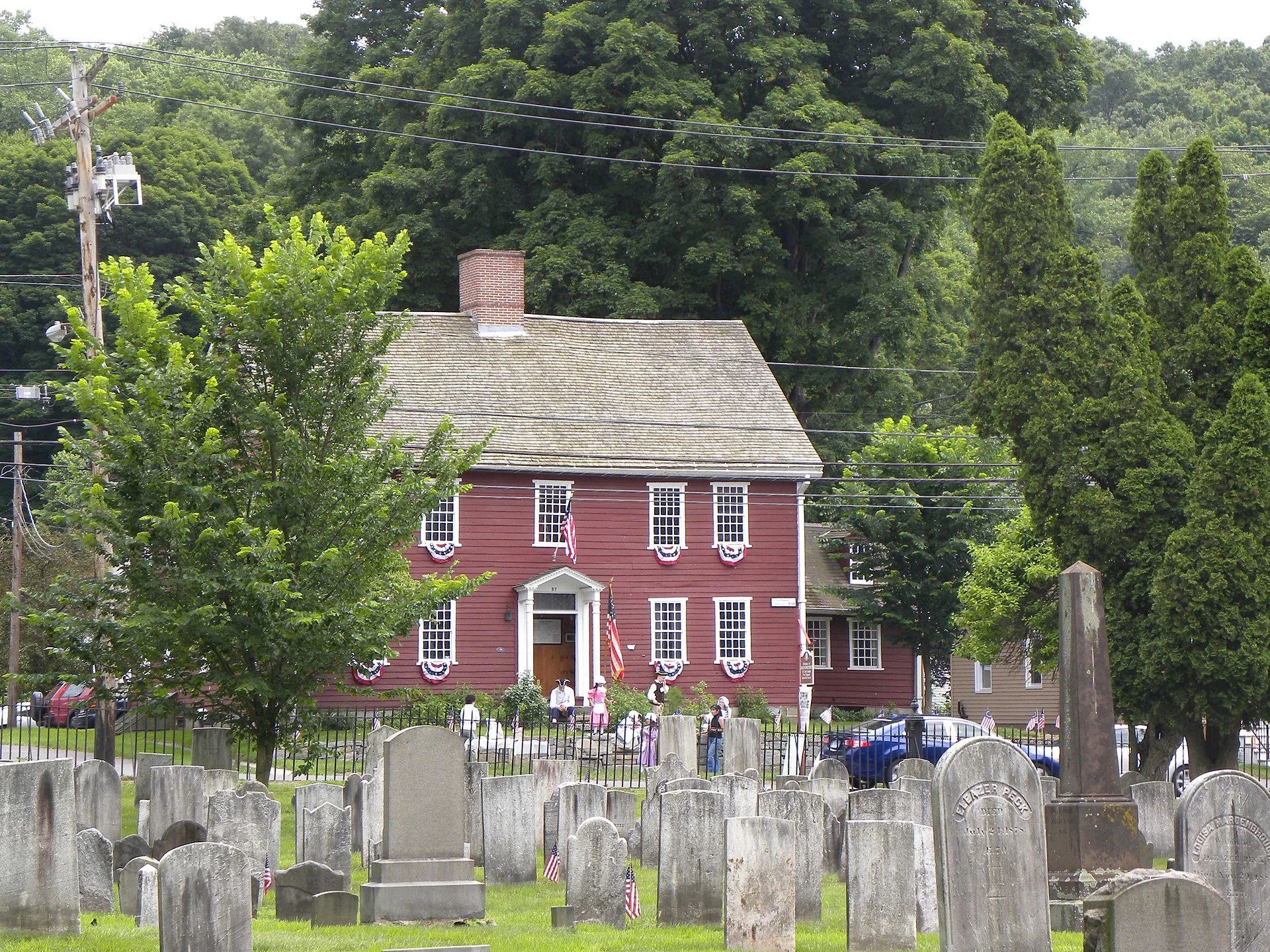
The David Humphreys home, built in 1698, at 37 Elm St., Ansonia, which with other communities in the Naugatuck River Valley became industrial powerhouses in the late 19th and early 20th centuries.
Friendship

“Combinatti #3 (bronze), by J.T. Gibson, in the group show “Lean on Me,’’ at Atelier gallery, in Newport (R.I.), through Oct. 16
The gallery says:
“The show highlights our appreciation for blacksmithing, forged steel, woodworking and cast bronze work both in Newport and in Santa Fe, N.M. Metal casting is a process in which hot liquid metal is poured into a mold to solidify — an art developed over 7,000 years ago during the Bronze Age.’’

Save The Bay Exploration Center and Aquarium, in Newport
—Photo by Kenneth C. Zirkel
Charles Sumner: Separate isn’t equal
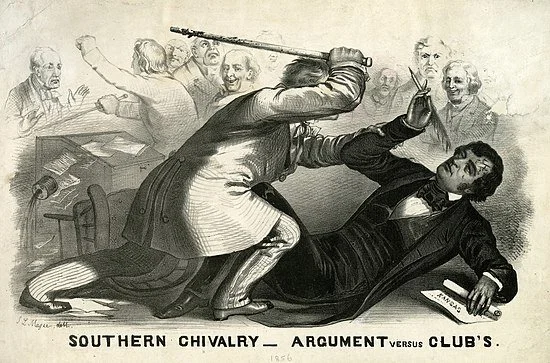
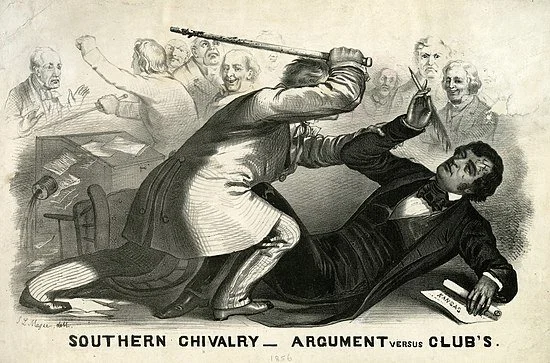
Lithograph of fanatical slavery defender South Carolina Rep. Preston Brooks' s 1856 attack on Charles Sumner in the Senate, which almost killed Sumner

Sumner's birthplace on Irving Street, Beacon Hill, Boston
Massachusetts lawyer, abolitionist and soon-to-be U.S. Sen. Charles Sumner in unsuccessfully arguing a case before the state’s Supreme Judicial Court in 1849:
May it please your Honors:
Can any discrimination on account of race or color be made among children entitled to the benefit of our Common Schools under the Constitution and Laws of Massachusetts? This is the question which the Court is now to hear, to consider, and to decide.
Or, stating the question with more detail and with more particular application to the facts of the present case, are the Committee having superintendence of the Common Schools of Boston intrusted with power, under the Constitution and Laws of Massachusetts, to exclude colored children from the schools and compel them to find education at separate schools set apart for colored children only, at distances from their homes less convenient than schools open to white children?
This important question arises in an action by a colored child only five years old who, by her next friend, sues the city of Boston for damages on account of a refusal to receive her into one of the Common Schools.
It would be difficult to imagine any case appealing more strongly to your best judgment, whether you regard the parties or the subject. On the one side is the city of Boston, strong in wealth, influence, character; on the other side is a little child, of degraded color, of humble parents, and still within the period of natural infancy, but strong from her very weakness and from the irrepressible sympathies of good men, which, by a divine compensation, come to succor the weak. This little child asks at your hands her personal rights. So doing, she calls upon you to decide a question which concerns the personal rights of other colored children; which concerns the Constitution and Laws of the Commonwealth; which concerns that peculiar institution of New England, the Common Schools; which concerns the fundamental principles of human rights; which concerns the Christian character of this community. Such parties and such interests justly challenge your earnest attention.
Though this discussion is now brought for the first time before a judicial tribunal it is no stranger to the public. In the School Committee of Boston for five years it has been the occasion of discord. No less than four different reports, two majority and two minority, forming pamphlets of solid dimensions devoted to this question, have been made to this Committee and afterwards published. The opinions of learned counsel have been enlisted. The controversy, leaving these regular channels, overflowed the newspaper press, and numerous articles appeared espousing opposite sides. At last it has reached this tribunal. It is in your power to make it subside forever.
THE QUESTION STATED.
Forgetting many of the topics and all of the heats heretofore mingling with the controversy, I shall strive to present the question in its juridical light, as becomes the habits of this tribunal. It is a question of jurisprudence on which you are to give judgment. But I cannot forget that the principles of morals and of natural justice lie at the foundation of all jurisprudence. Nor can any reference to these be inappropriate in a discussion before this Court.
Of equality I shall speak, not only as a sentiment, but as a principle embodied in the Constitution of Massachusetts and obligatory upon court and citizen. It will be my duty to show that this principle, after finding its way into our State Constitution, was recognized both in legislation and judicial decisions. Considering next the circumstances of this case, it will be easy to show how completely they violate Constitution, legislation, and judicial decisions,–first, by subjecting colored children to inconvenience, inconsistent with the requirements of Equality, and, secondly, by establishing a system of Caste odious as that of the Hindoos,–leading to the conclusion that the School Committee have no such power as they have exercised, and that it is the duty of the Court to set aside their unjust by-law. In the course of this discussion I shall exhibit the true idea of our Common Schools and the fallacy of the pretension that any exclusion or discrimination founded on race or color can be consistent with Equal Rights.
In opening this argument, I begin naturally with the fundamental proposition, which, when once established, renders the conclusion irresistible. According to the Constitution of Massachusetts all men without distinction of race or color are equal before the law. In the statement of this proposition I use language which, though new in our country, has the advantage of precision.
EQUALITY BEFORE THE LAW–ITS MEANING.
I might perhaps leave this proposition without one word of comment. The Equality of men will not be directly denied on this occasion, and yet it is so often assailed of late that I shall not seem to occupy your time superfluously, I trust, while endeavoring to show what is understood by this term when used in laws, constitutions, or other political instruments. Mr. Calhoun, in the Senate of the United States, and Lord Brougham, in his recent work on Political Philosophy, part II, cap. 4, characterize Equality as impossible and absurd. Had they chosen to comprehend the extent and application of the term thus employed, something if not all of their objection would have disappeared. That we may better appreciate its meaning and limitation, I am induced to exhibit the origin and growth of the sentiment, which, finally ripening into a formula of civil and political right was embodied in the Constitution of Massachusetts.
Equality as a sentiment was early cherished by generous souls. It showed itself in dreams of ancient philosophy, and was declared by Seneca, when in a letter of consolation on death, he said, “Prima enim pars Equitatis est Equalitas.” The first part of Equity is Equality. But not till the truths of the Christian Religion was it enunciated with persuasive force. Here we learn that God is no respecter of persons; that he is the Father of all; and that we are all his children and brethren to each other. When the Saviour taught the Lord’s Prayer he taught the sublime doctrine of Human Brotherhood enfolding the Equality of men.
Slowly did this sentiment enter the State. The whole constitution of government was inconsistent with it. An hereditary monarchy, an order of nobility, and the complex ranks of superior and inferior established by the feudal system all declare, not the Equality but the inequality of men, and all conspire to perpetuate this inequality. Every infant of royal blood, every noble, every vassal is a present example, that whatever may be the injunctions of religion or the sentiment of the heart men under these institutions are not born equal.
The boldest political reformers of early times did not venture to proclaim this truth, nor did they truly perceive it. Cromwell beheaded his king, but secured the supreme power in hereditary succession to his eldest son. It was left to his loftier contemporary, John Milton, in poetic vision, to be entranced “With fair Equality, fraternal state.”
Sidney, who perished a martyr to the liberal cause, drew his inspiration from classic and not from Christian fountains. The examples of Greece and Rome fed his soul. The English Revolution of 1688, partly by force and partly by the popular voice, changed the succession to the Crown, and, if we may credit loyal Englishmen, secured the establishment of Freedom throughout the land. But the Bill of Rights did not declare, nor did the genius of Somers or Maynard conceive the political axiom, that all men are born equal. It may find acceptance from individuals in our day, but it is disowned by English institutions.
I would not forget the early testimony of the judicious Hooker, who in his Ecclesiastical Polity, that masterly work, dwells on the equality of men by nature, or the subsequent testimony of Locke, in his Essay on Government, who, quoting Hooker, asserts for himself that “creatures of the same species and rank, promiscuously born to all the same advantages of nature and the use of the same faculties, should be equal one among another without subordination or subjection.” Hooker and Locke saw the equality of men in a state of nature; but it is difficult to find in them a practical guide.
It is to France that we must pass for the earliest development of this idea, its amplest illustration, and its most complete, accurate, and logical expression. In the middle of the last century appeared the renowned Encyclopedie, edited by D’Alembert and Diderot. This remarkable production, where science, religion, and government are discussed with revolutionary freedom, contains an article on Equality, first published in 1755. Here we find the boldest expression of this sentiment down to that time. “Natural Equality,” says this authority, ” is that which exists between all men by the constitution of their nature only. This Equality is the principle and the foundation of liberty. Natural or moral equality is then founded upon the constitution of human nature common to all men who are born, grow, subsist, and die in the same manner. Since human nature finds itself the same in all men, it is clear, that according to nature’s law, each ought to esteem and treat the others as beings who are naturally equal to himself; that is to say, who are men as well as himself.” It is then remarked that political and civil slavery is in violation of this Equality; and yet the inequalities of nobility in the State are allowed to pass without comdemnation. Alluding to these, it is simply said that they who are elevated above others ought to treat inferiors as naturally their equals, shunning all outrage and demanding nothing beyond what is due, but demanding with humanity what is incontestably due.
Considering the period at which this article was written we shall be astonished less by its vagueness and incompleteness than by its bravery and generosity. The dissolute despotism of Louis XV poisoned France. The antechambers of the King were thronged by selfish nobles and fawning courtiers. The councils of Government were controlled by royal mistresses. The King only a few years before, in defiance of Equality–but in entire harmony with the conduct of the School Committee in Boston–founded a military school, for nobles only, carrying into education the distinction of Caste. At such a period the Encyclopedia did well in uttering important and effective truth. The sentiment of Equality was fully declared. Nor should we be disappointed, that, at this early day, even the boldest philosophers did not adequately perceive, or if they perceived, did not dare to utter, our axiom of liberty.
Thus it is with all moral and political ideas. First appearing as a sentiment, they awake a noble impulse, filling the soul with generous sympathy, and encouraging to congenial effort. Slowly recognized, they finally pass into a formula to be acted upon, to be applied, to be defended in the concerns of life.
Almost contemporaneously with this article in the Encyclopedia our attention is arrested by a poor solitary of humble extraction, born at Geneva, in Switzerland, of irregular education and life, a wanderer from his birth-place, enjoying a temporary home in France–Jean Jacques Rousseau. Of audacious genius, setting at naught received opinions, his earliest appearance was by an eccentric Essay on the Origin of Inequality among Men, where he sustained the irrational paradox that men are happier in a state of nature than under the laws of civilization. This was followed by a later work on the Social Contract. In both the sentiment of Equality is invoked against abuses of society, and language is employed tending far beyond Equality in Civil and Political Rights. The conspicuous position since awarded to the speculations of Rousseau and their influence in diffusing this sentiment would make this sketch imperfect without allusion to him; but he taught men to feel rather than to know, and his words have more of inspiration than of precision.
The French Revolution was at hand. That great outbreak for enfranchisement was the expression of this sentiment. Here it received distinct and authoritative enunciation. In the constitutions of government successively adopted, amid the throes of bloody struggle, the Equality of men was constantly proclaimed. Kings, nobles, and all distinctions of birth passed away before this mighty and trimpuhant truth.
These Constitutions show the grandeur of the principle and how it was explained and illustrated. The Constitution of 1791 in its first article declares that: “Men are born and continue free and equal in their rights.” This great declaration was explained in the sixth article: “The law is the expression of the general will. It ought to be the same for all, whether it protects or punishes. All citizens being equal in its eyes, are equally admissible to all dignities, places, and public employments according to their capacity, and without other distinction than their virtues and talents.” At the close of the Declaration of Rights there is this further explanation: “The National Assembly, wishing to establish the French Constitution on principles which it has just acknowledged and declared, abolishes irrevocably the institutions which bounded liberty and equality of rights. There is no longer nobility, or peerage, or feudal rule, or patrimonial justices, or any titles, denominations and prerogatives thence derived, or any order of chivalry, or any corporations or decorations for which proofs of nobility are required, or which supposed distinctions of birth, or any other superiority than that of public functionaries in the discharge of their functions…”There is no longer, for any part of the nation, or for any individual, any privilege or exception to the law common to all Frenchmen.” These diffuse articles all begin and end in the Equality of men.
In fitful mood another Declaration of Rights was brought forward by Condorcet February 15, 1793. Here also are fresh inculcations of Equality. Article first places Equality among the natural, civil, and political rights of man. Article seventh declares: “Equality consists in this, that each can enjoy the same rights.” Article eighth: “The law ought to be equal for all,” whether it recompense, or punish, or repress.” Article ninth: “All citizens are admissible to all public places, employments, and functions. Free people cannot know other motives of preference than talents and virtues.” Article twenty-third: “Instruction is the need of all, and society owes it equally to all its members.” Article thirty-second: “There is oppression when the law violates the natural, civil, and political rights which it ought to guaranty. There is oppression when a law is violated by public functionaries in its application to individual facts.” Here again is the same constant testimony, reënforced by the accompanying report explaining the Constitution, where it is said: “All political power by inheritance is at the same time an evident violation of natural equality and an absurd institution, since it supposes the inheritance of qualities proper for the discharge of a public function. Every exception from the common law made in favor of an individual is a blow struck at the right of all.”* And in another part of the same report, the sovereignty of the people, equality among men, the unity of the Republic “are declared the guiding principles always present in the formation of the Constitution.
Next came the Constitution of June, 1793, announcing in its second article that the natural and imprescriptible rights of men are “Equality, liberty, safety, property.” In the next article we learn precisely what is meant by Equality when it says, “All men are equal by nature and before the law.” So just and captivating was this definition, which we encounter here for the first time, that it held its place through all the political vicissitudes of France, under the Directory, the Consulate, the Empire, the Restoration, and the Constitutional Government of Louis Philippe. It was a conquest, which, when achieved, was never abandoned. Every charter and constitution certified to it. The charter of Louis Philippe testifies as follows: “All Frenchmen are equal before the law, whatever may be their titles or ranks.” Nor was its use confined to France. It passed into other constitutions, and Napoleon, who so often trampled on the rights of Equality, dictated to the Poles the declaration that all persons are equal before the law. Thus the phrase is not only French but continental, although never English.
While recognizing this peculiar form of speech as more specific and satisfactory than the statement that all men are born equal, it is impossible not to be reminded that it finds a prototype in the ancient Greek language where, according to Herodotus, “the government of the many has the most beautiful name of all “isonomy” or Equality before the law. Thus, in an age when Equality before the law was practically unknown, this remarkable language, by its comprehensiveness and flexibility, supplied a single word, not found in modern tongues, to express an idea practically recognized only in modern times. Such a word in our own language, as the substitute for Equality, might have superseded criticism to which this declaration is exposed.
EQUALITY UNDER CONSTITUTION OF MASSACHUSETTS AND DECLARATION OF INDEPENDENCE.
The way is now prepared to consider the nature of Equality, as secured by the Constitution of Massachusetts. The Declaration of Independence, which followed the French Encyclopedia, and the political writings of Rousseau, announces among self-evident truths, “That all men are created equal, and that they are endowed by the Creator with certain unalienable rights; that among these are life, liberty, and the pursuit of happiness.” The Constitution of Massachusetts repeats the same truth in a different form, saying, in its first article: “All men are born free and equal, and have certain natural, essential, and unalienable rights, among which may be reckoned the right of enjoying and defending their lives and liberties.” Another article explains what is meant by Equality, saying, “No man, nor corporation, or association of men, have any other title to obtain advantages, or particular and exclusive privileges, distinct from those of the community, than what arises from the consideration of services rendered to the public; and this title being in nature neither hereditary nor transmissible to children, or descendants or relations by blood, the idea of a man being born a magistrate, lawgiver, or judge, is absurd and unnatural.” This language, in its natural signification, condemns every form of inequality in civil and political institutions.
These declarations, though in point of time before the ampler declarations of France, may be construed in the light of the latter. Evidently they seek to declare the same principle. They are declarations of Rights, and the language employed, though general in character, is obviously limited to those matters within the design of a declaration of Rights. And permit me to say, it is a childish sophism to adduce any physical or mental inequality in argument against Equality of Rights.
Obviously men are not born equal in physical strength, or in mental capacity; in beauty of form or health of body. Diversity or inequality, in these respects, is the law of creation. From this difference springs divine harmony. But this inequality is in no particular inconsistent with complete civil and political equality.
The equality declared by our fathers in 1776, and made the fundamental law of Massachusetts in 1780, was Equality before the law. Its object was to efface all political or civil distinctions, and to abolish all institutions founded upon birth. “All men are created equal,” says the Declaration of Independence. “All men are born free and equal,” says the Massachusetts Bill of Rights. These are not vain words.
Within the sphere of their influence no person can be created, no person can be born with civil or political privileges not enjoyed equally by all his fellow-citizens; nor can any institution be established recognizing any distinction of birth. Here is the Great Charter of every human being drawing the vital breath upon this soil, whatever may be his condition and whoever may be his parents. He may be poor, weak, humble, or black; he may be of Caucasian, Jewish, Indian, or Ethiopian race; he may be of French, German, English, or Irish extraction, but before the Constitution of Massachusetts all these distinctions disappear. He is not poor, weak, humble, or black–nor is he Caucasian, Jew, Indian, or Ethiopian– nor is he French, German, English, or Irish; he is a Man, the equal of all his fellow men. He is one of the children of the State, which, like an impartial parent, regards all its offspring with an equal care. To some it may justly allot higher duties, according to higher capacities, but it welcomes all to its equal, hospitable board. The State, imitating the divine justice, is no respecter of persons.
Here nobility cannot exist, because it is a privilege from birth. But the same anathema which smites and banishes nobility must also smite and banish every form of discrimination founded on birth;
EQUALITY BY LEGISLATION OF MASSACHUSETTS.
The Legislature of Massachusetts, in entire harmony with the Constitution, has made no discrimination of race or color in the establishment of Common Schools.
Any such discrimination by the Laws would be unconstitutional and void. But the Legislature has been too just and generous, too mindful of the Bill of Rights, to establish any such privilege of birth. The language of the statutes is general, and applies equally to all children, of whatever race or color.
The provisions of the law are entitled, Of the Public Schools, meaning our Common Schools. To these we must look to ascertain what constitutes a Public School. Only those established in conformity with the Law can be legally such. They may, in fact, be more or less public; yet if they do not come within the terms of the Law, they do not form a part of the beautiful system of our Public Schools; they are not Public Schools, or, as I prefer to call them, Common Schools. The two terms are used as identical; but the latter is that by which they were earliest known, while it is most suggestive of their comprehensive character. A “common” in law is defined to be “open ground equally used by many persons,” and the same word when used as an adjective is defined by lexicographers as “belonging equally to many or to the public,” thus implying Equality.
If we examine the text of this statute, we shall find nothing to sustain the rule of exclusion which has been set up. The first section provides that in “Every town containing fifty families, or households, there shall be kept in each year, at the charge of the town, by a teacher or teachers of competent ability and good morals, one school for the instruction of children in Orthography, Reading, Writing, English Grammar, Geography, Arithmetic, and Good Behavior, for the term of six months, or two or more such schools for terms of time that shall together be equivalent to six months.” The second, third, and fourth sections provide for the number of such schools in other towns having more than five hundred inhabitants. There is no language recognizing any discrimination of race or color. Thus in every town the schools, whether one or more, are “for the instruction of children” generally; not children of any particular class, or race, or color, but children–meaning the children of the town where the schools are.
The fifth and sixth sections provide a school, in certain cases, where additional studies are to be pursued, “which shall be kept for the benefit of all the inhabitants of the town.” The language here recognizes no discrimination among the children, but seems directly to exclude it.
In conformity with these sections is the peculiar phraesology of the memorable Colonial law of 1647, founding Common Schools, “to the end that learning be not buried in the graves of our forefathers.” This law obliged towns having fifty families, “forthwith to appoint one” within their limits “to teach all such children as shall resort to him, to write and read.” Here again there is no discrimination among the children. All are to be taught.
On this legislation the Common Schools of Massachusetts have been reared. The clause of the Revised Statutes and the statute appropriating small sums, in the nature of a contribution, from the school fund for the support of common schools among the Indians, do not interfere with this system. These have the anomalous character of all the legislation concerning the Indians. It does not appear, however, that separate schools are established by law among the Indians, nor that the Indians are in any way excluded from the Common Schools in their neighborhood.
I conclude on this head, that there is but one Public School in Massachusetts. This is the Common School equally free to all the inhabitants. There is nothing establishing an exclusive or separate school for any particular class, rich or poor, Catholic or Protestant, white or black. In the eye of the law there is but one class, where all interests, opinions, conditions, and colors commingle in harmony–excluding none, comprehending all.
EQUALITY UNDER JUDICAL DECISIONS.
The Courts of Massachusetts, in harmony with the Constitution and the Laws, have never recognized any discrimination founded on race or color, in the administration of the Common Schools; but have constantly declared the equal rights of all the inhabitants.
There are only a few decisions bearing on this subject, but they all breathe one spirit. The sentiment of Equality animates them. In the case of Commonwealth vs. Davis, while declaring the equal rights of all the inhabitants, in both grammar and district schools, the Court said:
“The schools required by the statute are to be maintained for the benefit of the whole town, as it is the wise policy of the law to give all the inhabitants equal privileges for the education of their children in the Public Schools. Nor is it in the power of the majority to deprive the minority of this privilege. Every inhabitant of the town has a right to participate in the benefits of both descriptions of schools, and it is not competent for a town to establish a grammar school for the benefit of one part of the town to the exclusion of the other, although the money raised for the support of schools may be in other respects fairly apportioned.”
Here is Equality from beginning to end.
In the case of Withington vs. Eveleth, the Court said they “were all satisfied that the power given to towns to determine and define the limits of school districts can be executed only by a geographical division of the town for that purpose.” A limitation of the district merely personal was held invalid. This same principle was again recognized in Perry vs. Doe, where the Court say, “Towns, in executing the power to form school districts, are bound so to do it as to include every inhabitant in some of the districts. They cannot lawfully omit any and thus deprive them of the benefits of our invaluable system of free schools.” Thus at every point the Court has guarded the Equal Rights of all.
The Constitution, the legislation, and the judicial decisions of Massachusetts have now been passed in review. We have seen what is contemplated by the Equality secured by the Constitution; also what is contemplated by the system of Common Schools, as established by the laws of the Commonwealth and illustrated by decisions of the Supreme Court. The way is prepared to consider the peculiarities in the present case, and to apply the principle thus recognized in Constitution, in Laws, and judicial decisions.
SEPARATE SCHOOLS INCONSISTENT WITH EQUALITY.
It is easy to see that the exclusion of colored children from the Public Schools is a constant inconvenience to them and their parents, which white children and white parents are not obliged to bear. Here the facts are plain and unanswerable, showing a palpable violation of Equality. The black and white are not equal before the law. I am at a loss to understand how anybody can assert that they are.
Among the regulations of the Primary School Committee is one to this effect: “Scholars to go to the school nearest their residences. Applicants for admission to our schools (with the exception and provision referred to in the preceding rule) are especially entitled to enter the schools nearest to their places of residence.” The exception here is “of those for whom special provision has been made” in separate schools; that is, colored children.
In this rule–without the unfortunate exception–is part of the beauty so conspicuous in our Common Schools. It is the boast of England that, through the multitude of courts, justice is brought to every man’s door. It may also be the boast of our Common Schools, that, through the multitude of schools, education in Boston is brought to every white man’s door. But it is not brought to every black man’s door. He is obliged to go for it–to travel for it–to walk for it–often a great distance. The facts in the present ease are not so strong as those of other cases within my knowledge. But here, the little child, only five years old, was compelled, if attending the nearest African School, to go a distance of two thousand one hundred feet from her home, while the nearest Primary School was only nine hundred feet, and, in doing this, she would pass by no less than five different Primary Schools, forming part of our Common Schools, and open to white children, all of which were closed to her. Surely this is not Equality before the law.
Such a fact is sufficient to determine this case. If it be met by the suggestion that the inconvenience is trivial, and such as the law will not notice, I reply that it is precisely such as to reveal an existing inequality, and therefore the law cannot fail to notice it. There is a maxim of the illustrious civilian Dumoulin, a great jurist of France, which teaches that even a trivial fact may give occasion to an important application of the law. Modica enim circumstantia facti inducit magnam juris diversitatem. Also from the best examples of our history we learn that the insignificance of a fact cannot obscure the grandeur of the principle at stake. It was a paltry tax on tea laid by a Parliament where they were not represented that aroused our fathers to the struggles of the Revolution. They did not feel the inconvenience of the tax; but they felt its oppression. They went to war for a principle. Let it not be said, then, that in the present ease the inconvenience is too slight to justify the appeal I make in behalf of colored children for Equality before the law.
Looking beyond the facts of this case it is apparent that the inconvenience from the exclusion of colored children is such as to affect seriously the comfort and condition of the African race in Boston. The two Primary schools open to them are in Belknap street and in Sun court. I need not add that the whole city is dotted with schools open to white children. The colored parents, anxious for the education of their children, are compelled to live in the neighborhood of the schools, to gather about them–as in Eastern countries people gather near a fountain or a well. The liberty of choosing their homes, which belongs to the white man, is not theirs. Inclination, or business, or economy may call them to another part of the city; but they are restrained for their children’s sake. There is no such restraint upon the white man, for he knows that wherever in the city inclination, or business, or economy may call him, there will be a school open to his children near his door. Surely this is not Equality before the law.
If a colored person, yielding to the necessities of position, removes to a distant part of the city, his children may be compelled daily, at an inconvenience which will not be called trivial, to walk a long distance for the advantages of the school. In our severe winters this cannot be disregarded in the case of children so tender in years as those of the Primary schools. There is a peculiar instance of hardship which has come to my knowledge. A respectable colored parent became some time since a resident at East Boston, separated from the mainland by water. Of course there are Common Schools at East Boston, but none open to colored children. This parent was obliged to send his children, three in number, daily across the ferry to the distant African School. The tolls amounted to a sum which formed a severe tax upon a poor man, while the long way to travel was a daily tax upon the time and strength of his children. Every toll paid by this parent, as every step taken by the children, testifies to that inequality which I now arraign.
This is the conduct of a colored parent. He is well deserving of honor for his generous efforts to secure the education of his children. As they grow in knowledge, they will rise and call him blessed; but at the same time they will brand as accursed that arbitrary discrimination of color in the Common Schools of Boston which rendered it necessary for their father, out of small means, to make such sacrifices for their education.
Here is a grievance, which, independent of any stigma from color, calls for redress. It is an inequality which the Constitution and the Laws of Massachusetts repudiate. But it is not on the ground of inconvenience only that it is odious. And this brings me to the next point.
SEPARATE SCHOOLS ARE IN THE NATURE OF CASTE.
The separation of children in the Schools, on account of race or color, is in the nature of Caste, and, on this account, a violation of Equality. The case shows expressly that the child was excluded from the school nearest to her dwelling–the number in the school at the time warranting her admission–“on the sole ground of color.” The first Majority Report presented to the School Committee, and mentioned in the statement of facts, presents the grounds of this discrimination with more fullness, saying, “It is one of races, not of color, merely. The distinction is one which the Almighty has seen fit to establish, and it is founded deep in the physical, mental, and moral natures of the two races. No legislation, no social customs, can efface this distinction.” Words could not be chosen more apt than these to describe the heathenish relation of Caste.
This term is from the Portuguese casta, which signifies family, breed, race, and is generally used to designate any hereditary distinction, particularly of race. It is most often applied in India; and it is there that we must go to understand its full force. A recent English writer says that it is “not only a distinction by birth, but is founded on the doctrine of an essentially distinct origin of the different races, which are thus unalterably separated. This is the very ground of the Boston School Committee.
This word is not now for the first time applied to the distinction between the white and black races. Alexander von Humboldt, speaking of the negroes in Mexico, characterizes them as a Caste. Following him, a recent political and juridical writer of France uses the same term to denote, not only the distinctions in India, but those of our own country,* especially referring to the exclusion of colored children from the Common Schools, as among “the humiliating and brutal distinctions” by which their Caste is characterized. It is, then, on authority and reason alike, that we apply this term to the hereditary distinction on account of color now established in the Schools of Boston.
Boston is set on a hill, and her schools have long been the subject of observation, even in this respect. As far back as the last century the French Consul there made a report on our “separate” school, and de Tocqueville in his masterly work testifies with evident pain that the same schools do not receive the children of the African and European. All this is only a reproduction of the Cagots in France, who for generations were put under the ban there–relegated to a corner of the church separate from the rest, and, even in the last resting place, where all are equal, these wretched people are separated by a line of demarkation from the rest. The Cagots are called an “accursed race,” and this language may be applied to the African under our laws. Strange that, here under a State Constitution declaring the Equality of all men, we should follow the worst precedents and establish among us a Caste.
Seeing the discrimination in this light, we learn to appreciate its true character. In India, Brahmins and Sudras, from generation to generation, were kept apart. If a Sudra presumed to sit upon a Brahmin’s carpet his punishment was banishment. With similar inhumanity here, the black child, who goes to sit on the same benches with the white child, is banished, not from the country, but from the school. In both cases it is the triumph of Caste. But the offense is greater with us, because, unlike the Hindoos, we acknowledge that men are born equal.
So strong is my desire that the court should feel the enormity of this system, thus legalized, not by the Legislature, but by an inferior local board, that I shall introduce an array of witnesses all testifying to the unchristian character of Caste, as it appears in India, where it is most studied and discussed. As you join in detestation of this foul institution, you will learn to condemn its establishment among our children.
I borrow these authorities from the work of Mr. Roberts, to which I have already referred, Caste opposed to Christianity, published in London, 1847. Time will not allow me to make comments. I can only quote the authorities and then pass on.
The eminent Bishop Heber, of Calcutta, characterizes Caste in these forcible terms:
“It is a system which tends, more than any else the devil has yet invented, to destroy the feelings of general benevolence, and to make nine tenths of mankind the hopeless slaves of the remainder.”
But this is the very system now in question here. Bishop Wilson, also of Calcutta, the successor of Heber, says:
“The Gospel recognizes no such distinctions as those of Castes, imposed by a heathen usage, bearing in some respects a supposed religious obligation, condemning those in the lower ranks to perpetual abasement, placing an immovable barrier against all general advance and improvement in society, cutting asunder the bonds of human fellowship on the one hand, and preventing those of Christian love on the other. Such distinctions, I say, the Gospel does not recognize. On the contrary, it teaches us that God ‘hath made of one blood all the nations of men.”
The same sentiment is echoed by Bishop Corrie, of Madras:
“Thus Caste sets itself up as a judge of our Saviour himself. His command is, ‘Condescend to men of low estate. Esteem others better than yourself.’ ‘No.’ says Caste. ‘do not commune with low men; consider yourself of high estimation. Touch not, taste not, handle not.’ Thus Caste condemns the Saviour.”
Here is the testimony of Rev. Mr. Rhenius, a zealous and successful Missionary:
“I have found Caste, both in theory and practice, to be diametrically opposed to the Gospel, which inculcates love, humility, and union; whereas Caste teaches the contrary. It is a fact, in those entire congregations where Caste is allowed, the spirit of the Gospel does not enter; whereas in those from which it is excluded, we see the fruits of the Gospel spirit.”
Another Missionary, Rev. C. Mault, follows in similar strain:
“Caste must be entirely renounced; for it is a noxious plant, by the side of which the graces cannot grow; for facts demonstrate, that where it has been allowed, Christianity has never flourished.”
So also does the Rev. John McKenny, a Wesleyan Missionary:
“I have been upward of twelve years in India, and have directed much of my attention to the subject of Caste, and am fully of opinion, that it is altogether contrary to the nature and principles of the Gospel of Christ, and therefore ought not be admitted into the Christian Church.”
So also the Rev. R. S. Hardy, a Wesleyan Missionary, and author of “Notices of the Holy Land:”
“The principle of Caste I consider so much at variance with the spirit of the Gospel, as to render impossible, where its authority is acknowledged, the exercise of many of the most beautiful virtues of our holy religion.”
So also the Rev. D. J. Gorgerly, of the same Society:
“I regard the distinction of Caste, both in its principles and operations, as directly opposed to vital godliness, and consequently inadmissible into the Church of Christ.”
So also the Rev. W. Bridgnall, of the same Society:
“I perfectly agree with a writer of respectable authority, in considering the institution of Caste as the most formidable engine that was ever invented for perpetuating the subjugation of men; so that, as a friend of humanity only, I should feel myself bound to protest against and oppose it; but in particular as a Christian. I deem it my obvious and imperative duty wholly to discountenance it, conceiving it to be utterly repugnant to all the principles and the whole spirit of Christianity. He who is prepared to support the system of Caste, is, in my judgment, neither a true friend of man, nor a consistent follower of Christ.”
So also the Rev. S. Allens, of the same Society:
“During a residence of more than nine years in Ceylon, I have had many opportunities of witnessing the influence of Caste on the minds of the natives; and I firmly believe it is altogether opposed to the spirit of Christianity; and it appears to me that its utter and speedy extinction cannot but be desired by every minister of Christ.”
So also Rev. R. Stoup, of the same Society:
“From my own personal observation, during a four-years’ residence in Ceylon, I am decidedly of opinion that Caste is directly opposed to the spirit of Christianity, and, consequently, ought to be discouraged in every possible way.”
I conclude these European authorities with the fulmination of Rev. Joseph Roberts, author of the work on Caste:
“We must, in everyplace, witness against it, and show that even Government itself is nurturing a tremendous evil, that through its heathen managers it is beguiled into a course which obstructs the progress of civilization,” which keeps in repulsion our kindlier feelings, which creates and nurses distinctions the most alien to all the cordialities of life; and which, more than any other thing, makes the distance so immense betwixt the governed and governors.”
There is also the testimony of native Hindoos converted to Christianity who denounce Caste as Jefferson denounced the whole brood of slavery. Listen to the voice of a Hindoo:
“Caste is the stronghold of that principle of pride which makes a man think of himself more highly than he ought to think. Caste infuses itself into and forms the very essence of pride itself.”
Another Hindoo speaks as follows:
“I therefore regard Caste as opposed to the main scope, principles, and doctrines of Christianity; for, either Caste must be admitted to be true and of divine authority, or Christianity must be so admitted. If you admit Caste to be true, the whole fabric of Christianity must come down; for the nature of Caste and its associations destroy the first principles of Christianity. Caste makes distinctions among creatures where God has made none.”
Another native expresses himself thus:
“When God made man, his intention was, not that they should be divided, and hate one another, and show contempt, and think more highly of themselves than others. Caste makes a man think that he is holier than another and that he has some inherent virtue which another has not. It makes him despise all those that are lower than himself, in regard to Caste, which is not the design of God.”
Still another native uses this strong language:
“Yes, we regard Caste as part and parcel of idolatry, and of all heathen abominations, because it is in many ways contrary to God’s word, and directly contrary to God himself.”
I hope that I have not occupied too much time with this testimony, which is strictly in point. There is not a word which is not plainly applicable to the present case. The witnesses are competent and in their words, as in a mirror, may be seen the true character of the discrimination which I now arraign before this court.
It will be vain to say that this distinction, though seeming to be founded on color, is in reality founded on natural and physical peculiarities, independent of color.
Whatever they may be, there are peculiarities of race, and any discrimination on this account constitutes the relation of Caste. Disguise it as you will, it is nothing but this hateful, irreligious institution. But the words Caste and Equality are contradictory. They mutually exclude each other. Where Caste is, there cannot be Equality. Where Equality is, there cannot be Caste.
Unquestionably there is a distinction between the Ethiopian and the Caucasian. Each received from the hand of God certain characteristics of color and form. The two may not readily intermingle, although we are told by Homer that Jupiter—
“did not disdain to grace The feast of Ethiopia’s blameless race.”
One may be uninteresting or offensive to the other, precisely as individuals of the same race and color may be uninteresting or offensive to each other. But this distinction can furnish no ground for any discrimination before the law.
We abjure nobility of all kinds; but here is a nobility of the skin. We abjure all hereditary distinctions; but here is an hereditary distinction, founded not on the merit of the ancestor, but on his color. We abjure all privileges from birth; but here is a privilege which depends solely on the accident whether an ancestor is black or white. We abjure all inequality before the law; but here is an inequality which touches not an individual, but a race. We revolt at the relation of Caste; but here is a Caste which is established under a Constitution declaring that all men are born equal.
Condemning Caste and inequality before the law, the way is prepared to consider more particularly the powers of the School Committee. Here it will be necessary to enter into details.
SCHOOL COMMITTEE HAVE NO POWER TO DISCRIMINATE ON ACCOUNT OF COLOR.
The Committee of Boston charged with the superintendence of the Common Schools have no power to make any discrimination on account of race or color.
It has been seen already that this power is inconsistent with the Constitution and Laws of Massachusetts, and with adjudications of the Supreme Court. The stream cannot rise higher than the fountain-head; and if there be nothing in these elevated sources from which this power can be derived it must be considered a nullity. Having seen that there is nothing, I might here stop; but I wish to show the shallow origin of this pretension.
Its advocates, unable to find it among express powers conferred upon the School Committee, and forgetful of the Constitution, where “either it must live or bear no life,” place it among implied or incidental powers. The Revised Statutes provide for a School Committee “who shall have a general charge and superintendence of all the Public Schools” in their respective towns. Another section provides that the “Committee shall determine the number and qualifications of the scholars to be admitted into the school kept for the use of the whole town.” These are all the clauses conferring powers on the Committee.
From these no person will imply a power to defeat a cardinal principle of the Constitution. It is absurd to suppose that the Committee in general charge and superintendence of schools, and in determining the number and qualifications of scholars, may ingraft upon the schools a principle of inequality, not only unknown to the Constitution and Laws, but in defiance of their letter and spirit. In the exercise of these powers they cannot put colored children to personal inconvenience greater than that of white children. Still further, they cannot brand a whole race with the stigma of inferiority and degradation, constituting them into a Caste. They cannot in any way violate that fundamental right of all citizens, Equality before the law. To suppose that they can do this would place the Committee above the Constitution. It would enable them, in the exercise of a brief and local authority, to draw a fatal circle, within which the Constitution cannot enter; nay, where the very Bill of Rights becomes a dead letter.
In entire harmony with the Constitution, the law says expressly what the Committee shall do. Besides the general charge and superintendence, they shall “determine the number and the qualifications of the scholars to be admitted into the schools;” thus, according to a familiar rule of interpretation, excluding other powers: Mentio unius est exclusio alterius. The power to determine the number is easily executed, and admits of no question. The power to determine the qualifications, though less simple, must be restrained to age, sex, and fitness, moral and intellectual. The fact that a child is black, or that he is white, cannot of itself be a qualification or a disqualification. Not to the skin can we look for the criterion of fitness.
It is sometimes pretended that the Committee, in the exercise of their power, are intrusted with a discretion under which they may distribute, assign, and classify all children belonging to the schools according to their best judgment, making, if they think proper, a discrimination of race or color. Without questioning that they are intrusted with a discretion, it is outrageous to suppose that their discretion can go to this extent. The Committee can have no discretion which is not in harmony with the Constitution and Laws. Surely they cannot in their mere discretion nullify a sacred and dear-bought principle of Human Rights expressly guarantied by the Constitution.
REGULATIONS OF COMMITTEE MUST BE REASONABLE.
Still further–and here I approach a more technical view of the subject–it is an admitted principle that the regulations and by-laws of municipal corporations must be reasonable, or they are inoperative and void. This has been recognized by the Supreme Court in two different cases, Commonwealth vs. Worcester, in Vardine’s case, In another case, City of Boston vs. Jesse Shaw, it was decided that a by-law of Boston prescribing a particular form of contribution toward the expenses of making the common sewers was void for inequality and unreasonableness. Assuming that this principle is applicable to the School Committee, their regulations and by-laws must be reasonable. Their discretion must be exercised in a reasonable manner. And this is not what the Committee or any other body of men think reasonable, but what is reasonable in the eye of the law. It must be legally reasonable. It must be approved by the reason of the Law.
Here we are brought once more in another form to the question of the discrimination on account of color. Is this legally reasonable? Is it reasonable in the exercise of a just discretion to separate descendants of the African race from white children merely in consequence of descent? Passing over those principles of the Constitution and those provisions of Law which of themselves decide the question, constituting as they do the highest reason, but which have been already amply considered, look for a moment at the educational system of Massachusetts, and it will be seen that practically no discrimination of color is made by Law in any part of it. A descendant of the African race may be Governor of the Commonwealth, and as such, with the advice and consent of the Council, may select the Board of Education. As Lieutenant Governor he may be ex officio a member of the Board. He may be Secretary of the Board, with the duty imposed on him by law of seeing “that all children in this Commonwealth who depend upon Common Schools for instruction may have the best education which those schools can be made to impart.” He may be member of any School Committee or teacher in any Common School of the State. As legal voter he can vote in the selection of any School Committee.
Thus, in every department connected with our Common Schools, throughout the whole hierarchy of their government, from the very head of the system down to the humblest usher in the humblest Primary school, and to the humblest voter, there is no distinction of color known to the Law. It is when we reach the last stage of all, the children themselves, that the beautiful character of the system is changed to the deformity of Caste, as, in the picture of the ancient poet, what above was a lovely woman terminated below in a vile, unsightly fish. And all this is done by the Committee, with more than necromantic power, in the exercise of a mere discretion.
It is clear that the Committee may classify scholars, according to age and sex, for the obvious reasons that these distinctions are inoffensive and especially recognized as legal in the law relating to schools. They may also classify scholars, according to moral and intellectual qualifications, because such a power is necessary to the government of schools. But the Committee cannot assume, à priori, and without individual examination, that an entire race are so deficient in proper moral and intellectual qualifications as to justify the degradation of all to a class by themselves. Such an exercise of discretion must be unreasonable, and therefore illegal.
SEPARATE SCHOOL NOT AN EQUIVALENT FOR COMMON SCHOOL.
But it is said that the Committee, in thus classifying the children, have not violated any principle of Equality, inasmuch as they provide a school, with competent instructors, for colored children, where they have advantages equal to those provided for white children. It is argued that in excluding colored children from Common Schools open to white children, the Committee furnish an equivalent.
To this there are several answers. I shall touch them only briefly, as the discussion, through which we have now traveled, substantially covers the whole ground.
1. The separate school for colored children is not one of the schools established by the law relating to Public Schools. It is not a Common School. As such, it has no legal existence, and, therefore, cannot be a legal equivalent. In addition to what has been already said, bearing on this head, I call attention to one other aspect. It has been decided that a town can execute its power to form a School District only by a geographical division of its territory; that there cannot be what the Court call a personal limitation of the district, and that certain individuals cannot be selected and set off by themselves into a District. The admitted effect of this decision is to render a separate school for colored children illegal and impossible in towns divided into districts. They are so regarded in Salem, Nantucket, New Bedford, and in other towns of this Commonwealth. The careful opinion of a member of this Court, who is not sitting in this case, given while at the bar, (Hon. Richard Fletcher,) and extensively published, is considered as practically settling this point.
But there cannot be one law for the country and one for Boston. It is true that Boston is not divided strictly into geographical districts. In this respect its position is anomalous. But if separate colored schools are illegal and impossible in the country, they must be illegal and impossible in Boston. It is absurd to suppose that this city failing to establish School Districts and treating all its territory as a single district, should be able to legalize a Caste school, which otherwise it could not do. Boston cannot do indirectly what other towns cannot do directly.
This is the first answer to the allegation of equivalents.
2. The second is that, in point of fact the separate school is not an equivalent. We have already seen that it is the occasion of inconvenience to colored children, which would not arise if they had access to the nearest common schools, besides compelling parents to pay an additional tax, and inflicting upon child and parent the stigma of Caste. Still further, and this consideration cannot be neglected, the matters taught in the two schools may be precisely the same; but a school exclusively devoted to one class, must differ essentially in spirit and character from that Common School known to the law, where all classes meet together in Equality.
It is a mockery to call it an equivalent.
3. But there is yet another answer. Admitting that it is an equivalent, still the colored children cannot be compelled to take it. Their rights are Equality before the law; nor can they be called to renounce one jot of this. They have an equal right with white children to the Common Schools. A separate school, though well endowed, would not secure to them that precise Equality which they would enjoy in the Common Schools. The Jews in Rome are confined to a particular district called the Ghetto, and in Frankfort to a district known as the Jewish Quarter. It is possible that their accommodations are as good as they would be able to occupy if left free to choose throughout Rome and Frankfort; but this compulsory segregation from the mass of citizens is of itself an inequality which we condemn. It is a vestige of ancient intolerance directed against a despised people. It is of the same character with the separate schools in Boston.
Thus much for the doctrine of equivalents as a substitute for equality.
DISASTROUS CONSEQUENCES OF POWER TO MAKE SEPARATE SCHOOLS.
In determining that the Committee have no power to make this discrimination, we are strengthened by another consideration. If the power exists in the present case it cannot be restricted to this alone. The Committee may distribute all the children into classes, according to mere discretion. They may establish a separate school for Irish or Germans, where each may nurse an exclusive nationality alien to our institutions. They may separate Catholics from Protestants, or, pursuing their discretion still further, may separate different sects of Protestants, and establish one school for Unitarians, another for Presbyterians, another for Baptists, and another for Methodists. They may establish a separate school for the rich, that the delicate taste of this favored class may not be offended by the humble garments of the poor. They may exclude the children of mechanics, and send them to separate schools. All this, and much more, can be done in the exercise of that high-handed power which makes a discrimination on account of race or color. The grand fabric of our Common Schools, the pride of Massachusetts–where, at the feet of the teacher, innocent childhood should come, unconscious of all distinctions from birth–where the equality of the Constitution and of Christianity should be inculcated by constant precept and example–will be converted into a heathen system of proscription and Caste. We shall then have many different schools, representatives of as many different classes, opinions, and prejudices; but we shall look in vain for the true Common School of Massachusetts. Let it not be said that there is little danger that any Committee will exercise a discretion to this extent. They must not be intrusted with the power. Here is the only safety worthy of a free people.
BY-LAW VOID.
The Court will declare the by-law of the School Committee unconstitutional and illegal, although there are no express words of prohibition in the constitution and laws.
It is hardly necessary to say anything in support of this proposition. Slavery was abolished in Massachusetts, under the declaration of rights in our Constitution, without any specific words of abolition in that instrument, or in any subsequent legislation. The same words, which are potent to destroy slavery, must be equally potent against any institution founded on inequality or Caste. The case of Boston vs. Shaw, to which reference has been already made, where a by-law of the city was set aside as unequal and unreasonable, and therefore void, affords another example of the power which I now invoke. But authorities are not needed. The words of the Constitution are plain, and it will be the duty of the Court to see that they are applied to the discrimination now in question.
The Court might justly feel delicacy if they were called to revise a law of the legislature. But it is simply the action of a local committee that they are to overrule.
They may also be encouraged by the circumstance, that it is only to the Schools of Boston that their decision can be applicable. Already the other towns have voluntarily banished Caste. Banishing it from the schools of Boston, the Court will bring them into much desired harmony with the schools of other towns, and with the whole system of Common Schools. I am unwilling to suppose that there can be any hesitation or doubt. If any should arise, there is a rule of interpretation which I invoke. According to familiar practice, every interpretation is made always in favor of life or liberty. So here, the Court should incline in favor of Equality, that sacred right which is the companion of these other rights. In proportion to the importance of this right, will the Court be solicitous to vindicate and uphold it. And in proportion to the opposition which it encounters from prejudices of society, will the Court brace themselves to this task. It has been pointedly remarked by Rousseau, that “It is precisely because the force of things tends, always to destroy Equality, that the force of legislation should always tend to maintain it.” In similar spirit, and for the same reason, the Court should always tend to maintain equality.
ORIGIN OF SEPARATE SCHOOLS.
In extenuation of the Boston system, it is sometimes said that the separation of white and black children was originally made at the request of colored parents. This is substantially true. It appears from the interesting letter of Dr. Belknap, in reply to Judge Tucker’s queries on Slavery in Massachusetts, at the close of the last century, that at that time no discrimination on account of color existed in the Common Schools of Boston. “The same provision,” he says, “is made by the public for the education of the children of the blacks, as for those of the whites. In this town, the Committee who superintend the free schools have given in charge to the schoolmasters to receive and instruct black children as well as white.” Dr. Belknap adds that he had not heard of more than three or four who took advantage of this privilege, though the blacks in Boston probably exceeded one thousand. It is to be feared that the inhuman bigotry of Caste–sad relic of the servitude from which they had just escaped!–was at this time too strong to allow colored children kindly welcome in the free schools, and that, from timidity and ignorance, they hesitated to take a place on the same benches with the white children. Perhaps the prejudice was so inveterate that they could not venture to assert their rights. In 1800 a petition from sixty-six colored persons was presented to the School Committee, requesting the establishment of a school for their benefit. Private munificence came to the aid of the city, and the present system of separate schools was brought into being.
These are interesting incidents belonging to the history of the Boston Schools, but they cannot in any way affect the rights of colored people or the powers of the Committee. These rights and these powers stand on the Constitution and Laws. Without adopting the suggestion of Jefferson, that one generation cannot by legislation bind its successors, all must agree that the assent of a few to an unconstitutional and illegal course nearly half a century ago, when their rights were imperfectly understood, cannot alter the Constitution and the Laws so as to bind their descendants forever in the thrall of Caste. Nor can the Committee derive from this assent, or from any lapse of time, powers in derogation of the Constitution and the Rights of Man.
It is clear that the sentiments of the colored people have now changed. The present case, and the deep interest which they manifest in it, thronging the court to hang on this discussion, attest the change. With increasing knowledge they have learned to know their rights and feel the degradation to which they are doomed. Their present effort is the token of a manly character which this Court will cherish and respect. The spirit of Paul now revives in them, even as when he cried, “I am a Roman citizen.”
EVILS OF SEPARATE SCHOOLS.
But it is said that these separate schools are for the benefit of both colors and of the Public Schools. In similar spirit Slavery is sometimes said to be for the benefit of master and slave and of the country where it exists. There is a mistake in the one case as great as in the other. This is clear. Nothing unjust, nothing ungenerous can be for the benefit of any person or anything. From some seeming selfish superiority, or from the gratified vanity of class, short-sighted mortals may hope to draw permanent good; but even-handed justice rebukes these efforts and redresses the wrong. The whites themselves are injured by the separation. Who can doubt this? With the law as their monitor they are taught to regard a portion of the human family, children of God, created in His image, coequals in His love, as a separate and degraded class; they are taught practically to deny that grand revelation of Christianity, the Brotherhood of Man. Hearts while yet tender with childhood are hardened and ever afterward testify to this legalized uncharitableness. Nursed in the sentiment of Caste, receiving it with the earliest food of knowledge, they are unable to eradicate it from their natures, and then weakly and impiously charge upon our Heavenly Father the prejudice derived from an unchristian school. Their characters are debased, and they become less fit for the duties of citizenship.
The Helots of Sparta were obliged to intoxicate themselves that by example they might teach the deformity of intemperance. Thus sacrificing one class to the other both were degraded–the imperious Spartan and the abased Helot. The School Committee of Boston act with a similar double-edged injustice in sacrificing colored children to the prejudice or fancied advantage of white.
A child should be taught to shun wickedness, and, as he is yet plastic under impressions, to shun wicked men. Horace was right, when speaking of a person morally wrong, false, and unjust, he calls him black and warns against him:
“Hic niger est, hunc tu, Romane, caveto.”
The Boston Committee adopt the warning, but apply it not to the black in heart, but the black in skin. They forget the admonition addressed to the prophet: “But the Lord said unto Samuel, look not on his countenance, for the Lord seeth not as man seeth; for man looketh at the outward appearance, but the Lord looketh at the heart.” The Committee look only on the outward appearance without looking at the heart, and then fancy that they are doing right!
Who can say that this does not injure the blacks? Theirs, in its best estate, is an unhappy lot. A despised class, blasted by prejudice and shut out from various opportunities, they feel this proscription from the Common Schools as a peculiar brand. Beyond this, it deprives them of those healthful animating influences, which would come from participation in the studies of their white brethren. It adds to their discouragements. It widens their separation from the community, and postpones that great day of reconciliation which is sure to come.
The whole system of Common Schools suffers also. It is a narrow perception of their high aim, which teaches that they are merely to furnish an equal amount of knowledge to all, and, therefore, provided all be taught, it is of little consequence where, and in what company. The law contemplates not only that all shall be taught, but that all shall be taught together. They are not only to receive equal quantities of knowledge, but all are to receive it in the same way. All are to approach the same common fountain together; nor can there be any exclusive source for any individual or any class. The school is the little world where the child is trained for the larger world of life. It is the microcosm preparatory to the macrocosm, and, therefore, it must cherish and develop the virtues and the sympathies needed in the larger world. And since, according to our institutions, all classes, without distinction of color, meet in the performance of civil duties, so should they all, without distinction of color, meet in the school–beginning there those relations of Equality which Constitution and Laws promise to all.
As the State derives strength from the unity and solidarity of its citizens without distinction of class, so the school derives strength from the unity and solidarity of all classes beneath its roof. In this way the poor, the humble, and the neglected share not only the companionship of the more favored, but enjoy also the protection of their presence, which draws toward the school a more watchful superintendence. A degraded or neglected class, if left to themselves, will become more degraded or neglected. “To him that hath shall be given;” and the world, true to these words, turns from the poor and outcast to the rich and fortunate. Happily our educational system, by the blending of all classes, draws upon the whole school that attention which is too generally accorded only to the favored few, and thus secures to the poor their portion of the fruitful sunshine. But the colored children, placed apart in separate schools, are deprived of this peculiar advantage.
Nothing is more clear than that the welfare of classes, as well as of individuals, is promoted by mutual acquaintance. The French and English, for a long time regarded as natural enemies, have at last, from more intimate communion, found themselves natural friends. Prejudice is the child of ignorance. It is sure to prevail where people do not know each other. Society and intercourse are means established by Providence for human improvement. They remove antipathies, promote mutual adaptation and conciliation, and establish relations of reciprocal regard. Whoso sets up barriers to these, thwarts the ways of Providence, crosses the tendencies of human nature, and directly interferes with the laws of God.
DUTY OF THE COURT.
May it please your Honors: Such are some of the things which I have felt it my duty to say in this important cause. I have occupied much time, but I have not yet exhausted the topics. Still, which way soever we turn, we are brought back to one single proposition–the Equality of men before the law. This stands as the mighty guardian of the colored children in this case. It is the constant, ever present, tutelary genius of this Commonwealth, frowning upon every privilege of birth, every distinction of race, every institution of Caste. You cannot slight it, or avoid it. You cannot restrain it. God grant that you may welcome it. Do this, and your words will be a “charter and freehold of rejoicing” to a race which, by much suffering, has earned a title to much regard. Your judgment will become a sacred landmark, not in jurisprudence only, but in the history of Freedom, giving precious encouragement to the weary and heavy-laden wayfarers in this great cause. Massachusetts through you, will have fresh title to regard, and be once more, as in times past, an example to the whole land.
Already you have banished Slavery from this Commonwealth. I call upon you now to obliterate the last of its footprints, and to banish the last of the hateful spirits in its train. The law interfering to prohibit marriages between blacks and whites has been abolished by the Legislature. Railroads which, imitating the Boston schools, placed colored people apart by themselves, are compelled, under the influence of an awakened public sentiment, to abandon this regulation and to allow them the privileges of other travelers. Only recently I have read that his Excellency, our present Governor, took his seat in a train by the side of a negro. In the Caste schools of Boston the prejudice of color seeks its final refuge. It is for you to drive it forth. You do well when you rebuke and correct individual offenses; but it is a higher office to rebuke and correct a vicious institution. Each individual is limited in influence; but an institution has the influence of numbers organized by law. The charity of one man may counteract or remedy the uncharitableness of another; but no individual can counteract or remedy the uncharitableness of an established institution. Against it private benevolence is powerless. It is a monster which must be hunted down by the public and by the constituted authorities. And such is the institution of Caste in the Common Schools of Boston, which now awaits a just condemnation from a just Court.
One of the most remarkable expositions of slavery is from the pen of Condorcet in a note to the “Thoughts” of Pascal. Voltaire in his later commentary on the same text speaks of this “terrible” note and adopts its conclusion. In the course of this arraignment the philosopher, painting the character of the slave master says, “Such is the excess of his stupid contempt for this wretched race that returning to Europe he is indignant to see them clothed as men and placed by his side.” Thus the repugnance of the slave-master to see the wretched race placed by his side is adduced as crowning evidence of the in humanity of slavery. But this very repugnance has legal sanction among us, and you are to determine whether it shall be longer permitted. Slavery in one of its enormities is now before you for judgment. Do not hesitate to strike it. Let the blow fall which shall end its domination here in Massachusetts.
The civilization of the age joins in this appeal. Allow me to remind you that this prejudice of color is peculiar to our country. You do not forget that two youths of African blood only recently gained the highest honors in a college at Paris, and on the same day dined with the King of France, the descendant of St. Louis, at the Palace of the Tuileries. And let me add, if I may refer to my own experience, that at the School of Law in Paris, I have sat, for weeks, on the same benches with colored persons, listening, like myself, to the learned lectures of Degerando and of Rossi–nor do I remember, in the throng of sensitive young men, any feeling toward them except of companionship and respect. In Italy, at the Convent of Pallazuola, on the shores of the Alban Lake, and the very site of the ancient Alba Longa, where I was once a guest, I have seen, for days, a native of Abyssinia, only recently from his torrid home, and ignorant of the language spoken about him, mingling with the Franciscan friars, whose visitor and scholar he was, in delightful and affectionate familiarity. Do I err in saying that the Christian spirit shines in these examples?
And, finally, this Christian spirit I invoke. Where this prevails there is neither Jew nor Gentile, Greek nor barbarian, bond nor free; but all are alike. From this we derive new and solemn assurance of the Equality of man, as an ordinance of God. Human bodies may be unequal in beauty or strength; these mortal cloaks of flesh may differ, as do these worldly garments; these intellectual faculties may vary, as do opportunities of action and advantages of positions; but amid all unessential differences there is essential agreement and equality. Dives and Lazarus were equal in the sight of God. They must be equal in the sight of all just institutions.
This is not all. The vaunted superiority of the white race imposes corresponding duties. The faculties with which they are endowed, and the advantages they possess, must be exercised for the good of all. If the colored people are ignorant, degraded, and unhappy, then should they be especial objects of your care. From the abundance of your possessions you must seek to remedy their lot. And this Court, which is parent to all the unfortunate children of the Commonwealth, will show itself most truly parental, when it reaches down, and, with strong arm of law, elevates, encourages, and protects our colored fellow-citizens.
Soothing wave action

“Jerri” (oil on canvas), by Kathleen Jacobs, on the show “Making Their Mark: 7 Women in Abstraction,’’ at Heather Gaudio Fine Art, Greenwich, Conn., Sept. 21-Nov. 4
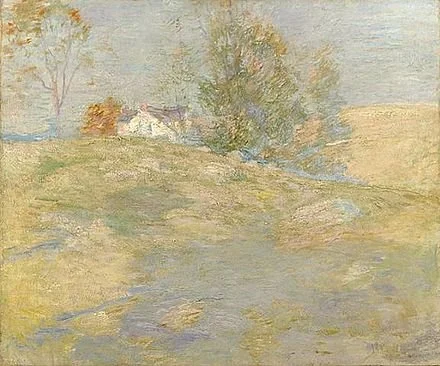
“Artist's Home in Autumn, Greenwich, Connecticut’’ (c. 1895), by John Henry Twachtman

Marjorie Kelly: Fearsome ‘financialization’ drags down America

— Photo by Ingfbruno
Via OtherWords.org
BOSTON
It’s been been 15 years since the collapse of Lehman Brothers.
The investment firm’s startling downfall marked the beginning of a historic Wall Street crash that swiftly wiped out over $7 trillion in home equity and $2.8 trillion in retirement portfolios.
Wall Street hasn’t fundamentally changed its behavior. Since then, Big Finance has engineered an even more entrenched system of creating wealth mostly for the ultra-rich while spinning out crisis after crisis for the rest of us.
That system has led to insecure, low-wage contract jobs replacing stable work, staggering debt mounting for college graduates, and monopolies crushing family businesses. It’s entrenched a political system captured by billionaires and huge corporations and left society struggling to meet the challenge of climate change.
This anniversary is an opportunity to take a step back and look at the overarching problem here: “financialization.” While we used to have an economy that manufactured stuff, now it manufactures debt.
Before 2008, big banks financialized mortgages. Now they’re financializing houses, buying up single family homes and charging high rents, scrimping on maintenance, and pursuing aggressive evictions.
The same is happening from health care to the local news, as private equity firms buy up vital businesses, cut staff and services to pad profits, and then sell their assets for scrap when the businesses predictably fail.
The latest Wall Street game is to turn the planet into a new asset class, creating “natural asset companies” to monetize “ecosystem services” from water, forests, coral reefs and farms.
What drives financialization is what I call “wealth supremacy” — a bias ingrained in our economic system that tells us wealthy people matter most. It suggests the core aim of our economy should be delivering ever-increasing gains to their investment portfolios.
This bias is embodied in a series of myths. There’s the myth that no amount of wealth is ever enough. Another is that only shareholders and executives should have a say in corporations, while workers are disenfranchised and dispossessed.
Then there’s the myth of the free market, which tells us corporations and capital must be able to move freely throughout the world, while the freedom of people — democracy — must be subordinated.
Recognizing wealth supremacy helps us see our task: to build an economic system designed not for maximum investment returns, but for life to flourish. My organization, the Democracy Collaborative, calls it a “democratic economy” — and it’s rising all around us.
For starters, corporations don’t have to be owned by shareholders or executives. They can be owned by workers themselves.
Already workers in the U.S. own some 6,000 companies. Employees at worker-owned companies like the New York City-based Cooperative Home Care Associates and the San Francisco-based waste disposal and recycling company Recology enjoy more stable jobs and double the retirement savings of employees at conventional firms.
Nor do big banks need to do all the banking.
Roughly 1,000 community development financial institutions provide fair loans to marginalized communities typically shunned by Wall Street banks. For example, River City Credit Union in San Antonio, Texas helps immigrants set up bank accounts so they don’t have to rely on predatory payday lenders and check-cashing storefronts.
And what if more of us owned our utilities?
Eighty-five percent of Americans already get their water from public utilities instead of for-profit companies. Now there’s a growing movement from Ann Arbor, Mich., to Maine and New York for publicly and cooperatively owned energy utilities. Such companies could be more willing than for-profit utilities to transition quickly from fossil fuels and make investments to prevent sparking wildfires.
The models and pathways we need exist around us. But making the rapid, systemic change we need requires letting go of the myth that wealth-maximizing capitalism is the only system possible.
It’s not. And if we want to keep our society standing, we need to topple wealth supremacy.
Marjorie Kelly is Distinguished Senior Fellow at The Democracy Collaborative and an advisory committee member of Massachusetts Public Banking. Her new book is Wealth Supremacy: How the Extractive Economy and the Biased Rules of Capitalism Drive Today’s Crises.
Will Morgan: A mystery photo and missing memory


Half a dozen years ago, our current president published a book about his son’s death from glioblastoma. Titled Promise Me, Dad: A Year of Hope, Hardship, and Purpose, started with Beau Biden’s plea to his father not to let grief overcome him. (The loss of the Delaware senator’s wife and daughter in a car accident in 1972 almost derailed Biden’s life, including his political career.)
I found an autographed copy of the book, simply inscribed “Joe Biden,’’ in Savers in Boston’s West Roxbury for $4.49. The forgotten best seller did, nevertheless, offer a treasure, the mystery photo above.
There are almost no clues as to the identity of this young girl and, presumably, her younger brother. It’s printed on Kodak Xtralife II paper, but who uses prints in this age of computers and online libraries? The buildings look recent – faux Georgian – although the cobblestone street could be European.
Looking at the lass’s auburn hair and complexion, we could guess that these children are Irish.
There’s a story here, at least in our imaginations. But, promise me, Dad, that you will date your photos and tell us why images like this represent a memory worth keeping.
An architectural and photo historian, William Morgan is a frequent contributor to New England Diary. His latest book, Academia: Collegiate Gothic Architecture in the United States, will be published in October.

John O. Harney: My new parcels of volunteer life

The author overseeng coneflowers at the Rose Kennedy Greenway
Inspired by the story of George Orwell caring for his roses while writing masterpiece essays, I looked forward to a retirement spent partly watching over the plants on Boston’s Rose Kennedy Greenway. Sure, I got a bit stressed over whether the fading white blooms I saw were Virginia Sweetspire Itea Virginica or Witch Alder Fothergilla. As I had earlier over whether the purple perennials were Salvia or Veronica. But for the most part, my most stressful dilemma would be choosing which dim sum joint to hit near the Greenway’s Chinatown “parcel.”
As for my own essays, never brilliant like Orwell’s, they’ve slowed to a crawl since the beginning of this year, when after 30-plus years, I left the editorship of The New England Journal of Higher Education and began volunteering in phenology at the Greenway. (Regrettably, I may have planted a kiss of death on the journal, where you’ll see few new postings since my departure.)
Fearing America’s increasing flirtations with nationalism and Us vs. Them politics, I also began volunteering in English language teaching at the Immigrant Learning Center, in Malden, Mass.
On the Greenway
Early on, a Greenway staff member gave me her cell number in case I needed help ID’ing plants or, she quipped, if I needed to report anything unusual on the Greenway, “like a body.” A staffer mentioned during an earlier volunteer pruning day, “the Greenway is enjoyed by all kinds of people so watch out for needles as you clean up around plants.”
Then Greenway retirement gig also reminded of my work days, attending economic conferences at the Federal Reserve Bank of Boston, directly across the street from Parcel 22. That Dewey Square stretch of gardens was then housing Boston’s version of the Occupy Wall Street movement. (Sometimes, feeling out of place in my ill-fitting suit, I wished that I was helping their cause rather than returning to my office.) By now, though, the whiff of rebellion had yielded to a riot of pink and white Coneflowers Echinacea and a Boxwoody imperial fragrance in the parcel near the Fed.

Sunflowers on the Greenway
Earlier in the summer, the Greenway folks worked with local nonprofit groups from Roxbury to plant massive stands of Sunflowers, the unofficial flower of my daughter-in-law’s war-torn Ukraine. In August, the Sunflowers bloomed gloriously around the vent and mural on Parcel 22. But more recently, it looked like some force had crashed into the middle of the main patch, pushing the Sunflower stocks outward like the Tunguska event in Siberia.
Nearby, I’m fascinated by the Pawpaw tree because of my childhood memory of a nursery rhyme that went: “Where, oh where oh where is Johnny [personalized for me], way down yonder in the Pawpaw patch.”
I’m also drawn to the paver my kids and I placed at the corner of Milk Street for my wife, saying “Joanne Harney We Love You.” I still check on the paver when I go to visit my “parcels.” And it looks sharp, as if a good angel has been coming along and buffing it. A half-joke in my house was that we could all meet there in case of disaster (though the urban location 500 feet or so from a rising sea may not be a safe haven forever).
I am also heartened by the Greenway’s small steps in food equity. In the edible garden, a sign reads:
ATTENTION GARDEN VISITORS: Please help us share the harvest!
The produce grown here is specifically cultivated and donated to our local homeless shelters.
Kindly refrain from picking the food to ensure it reaches those in need.
Your cooperation will help us make a difference in our community.
I’ve noted the ferny asparagus and carrots as well as strong corn and tomatillos. One day, a woman emerged from near a small houseless encampment and asked me if there was any mint in the garden. I said I thought there was some in Parcel 22, to which, she seemed relieved, saying that her husband, who camps out with her, eats it from time to time. A staffer suggested some of the Milkweeds in the gardens were planted secretly by visitors hoping to encourage Monarch Butterflies on the Greenway.

Ricinus
But I assume all know the stay clear of the purplish-leaved Ricinus growing in a galvanized bucket on Parcel 22 … host of the castor bean but also of famously deadly ricin.
My confines became Pearl, Congress and Purchase streets and Atlantic Avenue. The key reference points in my geographic descriptions were: the restaurant Trade, the Brazilian consulate with its national flag, the Native American Land Acknowledgment, the various Greenway maintenance sheds (and hangouts for the houseless), the Fed, the Red Line plaza, the Purchase Street tunnel (a reminder that the Greenway sits just a matter of a few feet over an interstate highway) and my favorite landmark, the Japanese Umbrella Pine in Parcel 21.
At the Immigrant Learning Center
Given America’s xenophobia, I also wanted to use my newly found time to help marginalized people in immigrant communities. I had tried to cover their predicament editorially in the journal. But retirement brought a new commitment. Reasoning that my decades of editing was something like teaching English, I applied for volunteer teaching of adults at the Immigrant Learning Center.
It has been a great pleasure to work with new immigrants from Haiti, Vietnam, China, Syria, Rwanda and elsewhere. When I helped one Syrian student read a children’s book about Winnie the Pooh, the description of the One Hundred Acre Wood reminded me of the Greenway work.
Many of the countries of origin of students at the center share a history of exploitation by the U.S., where these innocents fervently want to settle.
I have covered a few subjects probably too subtly for non-English speakers. Holidays, for example. I explained that Memorial Day was a day to remember people who had died. Sure, it was originally people who died in wars, but really anyone who’s died. Back to my old view that people who resisted the Vietnam War were as worthy of honor on Veterans Day as those who served.
Of Juneteenth, I tried to explain that while Americans say that they believe all are created equal, the concept of slavery clearly ran counter to that. And I reminded the many Haitians in the class that Haiti was among the many countries that abolished slavery before the U.S. I also mentioned to the Haitian students that I was rooting for the Haiti women’s national soccer team in the World Cup. To which, I was asked to explain the meaning of “rooting for.”
The immigrant lessons also teach much about the U.S. economy. One exercise focuses on occupations such as dishwasher, house cleaner, delivery driver and “manager.” One student noted getting a pay raise of 50 cents per hour—a modest honor. In one lesson, my lead teacher, himself a Haitian immigrant, drilled students on the difference between odd from even numbers … somewhat unimportant I thought until he noted smartly that Americans increasingly were getting shot knocking on the wrong doors.
Too much analytics
My aversion to analytics—clearly taking over the worlds of higher education and journalism that I recently fled—hobbles me even in volunteer life.
The Greenway folks prefer describing bloom progress with number rankings rather than comments. To make matters worse, the rankings are not the usual, 1 is best and 5 is worst, or vice versa. Instead, 3 is the best. It is peak flowering, then 4 is much less and 5 about done. 1 signifies just starting to bloom and 2 is progressing. Even an amateur like me can take a stab at peak flowering, but discriminating between 1 and 2 and between 4 and 5 is much tougher. And what to think of the Lamb’s Ear whose foliage graced two large banks in Parcel 21 but only shot out one flower on my watch.
The ranking snafu is familiar to anyone pestered by evaluation requests whenever you buy a product or service these days. As a former writer and editor, I’m happier with my rough notes than my arbitrary rankings.
I tell myself I may be a small part of a grand repository of plant info, or at least some effort to introduce identifying plant tags, which the Greenway lacks. Or an “interactive bloom tracker,” which sees to be always out of order when I try it. Of course, the data may be going into a black hole. But for me, the exercise is worth it.
The immigration educators understandably discourage use of synonyms, puns and anecdotes that may just confuse new English learners. All tough for a guy who considered himself “thoughtful,” but may have really been “wordy” and “unfocused.”
Bravery and bathos

“Intrepid” (oil on masonite), by Lyndeborough, N.H.-based artist Susan Q. Brown, at the Conant Gallery at Lawrence Academy, Groton, Mass.
Her Web site says:
Her Web site says her figurative and abstract work … evokes the natural landscape and human forms to explore separation and interconnectedness using color, grids, and unexpected imagery that viscerally stimulates the viewer to perceive/experience something new to them. While Susan works from her impressions of the natural world, she also draws upon pillars of art history, such as ancient works by Buddhist and Indian artists in the East and Western contemporary masters like Agnes Martin and Hilma af Klint.’’

Lyndeborough Town Hall, built in 1846
Our ‘precarious place’

“In the Wind ‘‘ (oil, acrylic and collage on stretched canvas), by Anne Sargent Walker, in her show “Out on a Limb,’’ at Kingston Gallery, Boston, Oct. 4-29
She says:
“My mixed media paintings explore the beauty, complexity and fragility of the natural world and our complicated relationship with it. The surface content of birds, flora and other creatures often degrades, peels back, dissolves or drips to reveal layers underneath, suggesting the planet’s warming, loss of habitat, species, the earth itself and of course us.
‘‘‘Out on a Limb’ refers to the precarious place we have arrived at. Mass extinction of species is at hand. Invasive species threaten our landscapes, A warming climate is making habitat for both humans and animals unlivable. There is good news too, but we must make changes now.’’
'Hope and trust'

Portsmouth Harbor Lighthouse is a historic lighthouse within Fort Constitution, in New Castle, N.H., now best known as a rich summer-resort town.
“Lighthouses, from ancient times, have fascinated and intrigued members of the human race. There is something about a lighted beacon that suggests hope and trust and appeals to the better instincts of mankind.’’
— Edward Rowe Snow (1902-1982), New England coastal historian, in his book Famous Lighthouses of New England (1945)

David Warsh: Secular time and political time

SOMERVILLE, Mass.
So Joe Biden is sticking with his bid for a second term. Labor Day was the president’s last chance to bow out. I expect Biden to win. Get ready for the hardest four years in the White House since Lyndon Johnson lived there, 1965-1969.
That is the implication of a view of American history as a recurring sequence of lengthy political change: breakthroughs, followed by breakups, followed by breakdowns. Over the years, there have been all kinds of cycle theories about U.S. political change. An unusually fully-elaborated version is associated with Yale theorist Stephen Skowronek.
Skowronek distinguishes between what he calls secular time and political time. The latter is time in the system, the medium through which presidents must reckon with commitments their predecessors have made. Secular means the president’s own time in office, for better or worse. Since presidential leadership is what organizers, journalists, and voters care about, secular time is the way our clocks tick.
Thus five major systems, described by their ideological commitments and coalition support, have unfolded in the years since the American Civil War: the presidencies of Abraham Lincoln to Grover Cleveland, 1861- 1897; William McKinley to Herbert Hoover, 1897-1933; Franklin Roosevelt to Lyndon Johnson, 1933-1968, Richard Nixon to George H.W. Bush, 1969-93; and Bill Clinton to Joe Biden, 1993-2025.
Underneath all this is the machinery of constitutional democracy, which is manipulated by actors to determine the outcomes: the federal system, with its regional governments; the three branches of national government, with their various checks and balances; the coalitions of interests, old and new, that constantly shift back and forth; and, finally, “presidential definition” in public opinion, a concept more elusive than the rest.
What enables a president to set an agenda that lasts thirty years?
Luck and timing, of course. There may be a sense that “it’s time for a change.” If a candidacy succeeds, gradually choices are made. These may meet with success among voters. If they do, a two-term president’s successors are constrained. Otherwise, a one-term president goes home.
In Clinton’s case, “presidential definition” turned on his decisions to balance the budget, ignore China and to expand NATO to the borders of Russia. Presidents since then have paid less attention to the budget constraint, continued to cooperate with China in varying degrees, but they have continued to attempt to expand NATO, which has led to the war in Ukraine.
Much of this happened on Barack Obama’s watch, when Hillary Clinton and John Kerry, two failed presidential candidates, served successively as secretary of state. Donald Trump’s presidency led to four years of vamping, thanks to his conflicts with both Russian and Ukrainian interests. Then Biden, who as vice president oversaw Ukrainian policy for eight years as vice president, as president promoted his team of advisers and pressed ahead. It is his war to win, or, more likely, to lose.
So, after the thirty years that began with the election of Bill Clinton, Biden is probably a breakdown president,. His age is a problem. There is his relationship with his son Hunter. “Bidenomics” offers little hope of coming to grips with America’s looming fiscal crisis.
What next? Forget about Trump. I expect a traditional Republican candidate to emerge from the embers of Biden’s presidency, as Lincoln emerged from the ashes of James Buchanan’s single term in office, to end the Andrew Jackson-Buchanan system, 1832-1861 and found the modern GOP. Virginia Gov. Glenn Youngkin, an up-to-date version of former GOP presidential nominee Mitt Romney, is the most obvious possibility today, but things will shift around a good deal in the next five years.
By 2028, climate change and fiscal crisis probably will be the central issues, replacing the war in Ukraine, threats to Taiwan and the composition of Trump’s Supreme court. Mitch McConnell, Samuel Alito and Clarence Thomas will matter less. The rising generations will matter more.
How to follow developments? Continue to read the four great English-language newspapers – The New York Times, The Washington Post, The Wall Street Journal and the Financial Times. The long swings will continue. America will be all right.
David Warsh, a veteran columnist and an economic historian, is proprietor of Somerville-based economicprincipals.com.
The sense of ‘nowness’

“Between Gatsby and Clue’’ (oil painting detail), by Lakeville, Mass.-based painter Joseph Fontinha, in his joint show, “Everywhen,’’ with Tatiana Flis, at Fountain Street Gallery, Boston, through Oct. 1.
The gallery says he:
“{W}orks to have each mark in a painting carry its thematic content. This quality draws the viewer into the moment being portrayed with all of its energy and physicality. This sense of ‘nowness’ points to the many possibilities inherent in every moment. Fontinha is intentional about conveying truths that he feels can only be communicated through oil paint. Unlike the highly negotiated spaces captured in his videos and interactive installations, his paintings focus on the standardization of perception. This opportunity to detangle images through durational viewing allows for a deep and resonant experience.’’

Assawompset Pond, in Lakeville.
— Photo by ToddC4176

Elisabeth Rosenthal: Primary- care crisis intensifies

These measurements of health-care service levels for specific areas of the U.S. came out in June 2020 through the Health Resources and Services Administration (HRSA), an agency of the Department of Health and Human Services (HHS).

States in red have Rhode Island-based CVS’s Minute Clinics, which are cutting into traditional primary-care practices.
“We have a specialty-driven system. Primary care is seen as a thankless, undesirable backwater.”
— Michael L. Barnett, M.D., health-systems researcher and primary-care physician in the Harvard Medical School system
I’ve been receiving an escalating stream of panicked emails from people telling me their longtime physician was retiring, was no longer taking their insurance, or had gone concierge and would no longer see them unless they ponied up a hefty annual fee. They have said that they couldn’t find another primary-care doctor who could take them on or who offered a new-patient appointment sooner than months away.
Their individual stories reflect a larger reality: American physicians have been abandoning traditional primary- care practice — internal and family medicine — in large numbers. Those who remain are working fewer hours. And fewer medical students are choosing a field that once attracted some of the best and brightest because of its diagnostic challenges and the emotional gratification of deep relationships with patients.
The percentage of U.S. doctors in adult primary care has been declining for years and is now about 25 percent — a tipping point beyond which many Americans won’t be able to find a family doctor at all.
Already, more than 100 million Americans don’t have usual access to primary care, a number that has nearly doubled since 2014. One reason our coronavirus vaccination rates were low compared with those in countries such as China, France, and Japan could be because so many of us no longer regularly see a familiar doctor we trust.
Another telling statistic: In 1980, 62 percent of doctor’s visits for adults 65 and older were for primary care and 38 percent were for specialists, according to Michael L. Barnett, a health-systems researcher and primary- care doctor in the Harvard Medical School system. By 2013, that ratio had exactly flipped and has likely “only gotten worse,” he said, noting sadly: “We have a specialty-driven system. Primary care is seen as a thankless, undesirable backwater.” That’s “tragic,” in his words — studies show that a strong foundation of primary care yields better health outcomes overall, greater equity in health-care access, and lower per-capita health costs.
One explanation for the disappearing primary-care doctor is financial. The payment structure in the U.S. health system has long rewarded surgeries and procedures while shortchanging the diagnostic, prescriptive and preventive work that is the province of primary care. Furthermore, the traditionally independent doctors in this field have little power to negotiate sustainable payments with the mammoth insurers in the U.S. market.
Faced with this situation, many independent primary-care doctors have sold their practices to health systems or commercial management chains (some private-equity-owned) so that, today, three-quarters of doctors are now employees of those outfits.
One of them was Bob Morrow, who practiced for decades in the Bronx. For a typical visit, he was most recently paid about $80 if the patient had Medicare, with its fixed-fee schedule. Commercial insurers paid significantly less. He just wasn’t making enough to pay the bills, which included salaries of three employees, including a nurse practitioner. “I tried not to pay too much attention to money for four or five years — to keep my eye on my patients and not the bottom line,” he said by phone from his former office, as workers carted away old charts for shredding.
He finally gave up and sold his practice last year to a company that took over scheduling, billing and negotiations with insurers. It agreed to pay him a salary and to provide support staff as well as supplies and equipment.
The outcome: Calls to his office were routed to a call center overseas, and patients with questions or complaining of symptoms were often directed to a nearby urgent care center owned by the company — which is typically more expensive than an office visit. His office staff was replaced by a skeleton crew that didn’t include a nurse or skilled worker to take blood pressure or handle requests for prescription refills. He was booked with patients every eight to 10 minutes.
He discovered that the company was calling some patients and recommending expensive tests — such as vascular studies or an abdominal ultrasound — that he did not believe they needed.
He retired in January. “I couldn’t stand it,” he said. “It wasn’t how I was taught to practice.”
Of course, not every practice sale ends with such unhappy results, and some work out well.
But the dispirited feeling that drives doctors away from primary care has to do with far more than money. It’s a lack of respect for nonspecialists. It’s the rising pressure to see and bill more patients: Employed doctors often coordinate the care of as many as 2,000 people, many of whom have multiple problems.
And it’s the lack of assistance. Profitable centers such as orthopedic and gastroenterology clinics usually have a phalanx of support staff. Primary-care clinics run close to the bone.
“You are squeezed from all sides,” said Barnett.
Many ventures are rushing in to fill the primary-care gap. There had been hope that nurse practitioners and physician assistants might help fill some holes, but data shows that they, too, increasingly favor specialty practice. Meanwhile, urgent-care clinics are popping up like mushrooms. So are primary-care chains such as One Medical, now owned by Amazon. Dollar General, Walmart, Target, CVS Health and Walgreens have opened “retail clinics” in their stores.
Rapid-fire visits with a rotating cast of doctors, nurses, or physician assistants might be fine for a sprained ankle or strep throat. But they will not replace a physician who tells you to get preventive tests and keeps tabs on your blood pressure and cholesterol — the doctor who knows your health history and has the time to figure out whether the pain in your shoulder is from your basketball game, an aneurysm, or a clogged artery in your heart.
Some relatively simple solutions are available, if we care enough about supporting this foundational part of a good medical system. Hospitals and commercial groups could invest some of the money they earn by replacing hips and knees to support primary care staffing; giving these doctors more face time with their patients would be good for their customers’ health and loyalty if not (always) the bottom line.
Reimbursement for primary-care visits could be increased to reflect their value — perhaps by enacting a national primary care fee schedule, so these doctors won’t have to butt heads with insurers. And policymakers could consider forgiving the medical school debt of doctors who choose primary care as a profession.
They deserve support that allows them to do what they were trained to do: diagnosing, treating, and getting to know their patients.
The United States already ranks last among wealthy countries in certain health outcomes. The average life span in America is decreasing, even as it increases in many other countries. If we fail to address the primary care shortage, our country’s health will be even worse for it.
Elisabeth Rosenthal is a KFF Health News reporter.
Elisabeth Rosenthal: erosenthal@kff.org, @RosenthalHealth
‘She lights her fire’
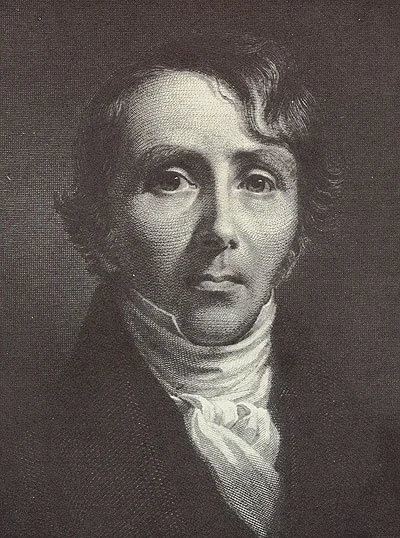
William Ellery Channing
“I sing New England, as she lights her fire
In every Prairie’s midst; and where the bright
Enchanting stars shine pure through Southern night,
She still is there, the guardian on the tower,
To open for the world a purer hour.”
― William Ellery Channing (1780-1842), Boston-based Unitarian minister and theologian. Late in life he became an avid abolitionist. For many years, he was the minister at the now-long-gone Federal Street Church.
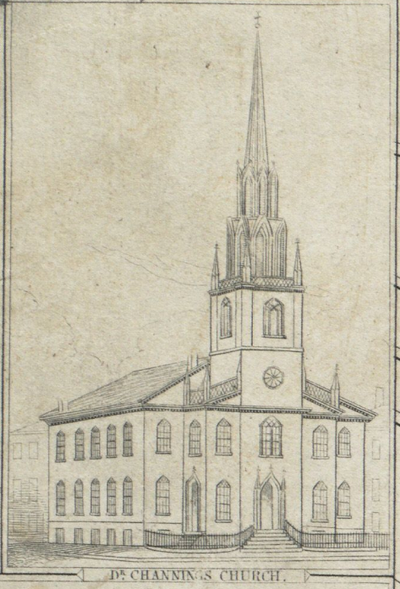
Federal Street Church, built in 1809
Art inflation

From Claire Ashley’s show “Radiant Beasts,’’ at the Lamont Gallery, at Phillips Exeter Academy, Exeter, N.H., through Nov. 18
The gallery explains:
‘Claire Ashley’s large-scale inflatables explode the possibilities of painting. Her practice devours the traditional mediums of sculpture, installation, painting, and costume, spitting back hybrid ‘bodies’ that are moveable, wearable, and deliciously preposterous. Made from PVC-coated canvas tarps, spray paint, and small blower fans, Ashley’s work is a complex, humorous mash-up of fine art meets bouncy house.
“The artist resists and pushes against the traditional norms of painting, disrupting the straight edges and flat, fixed nature of the discipline by creating bulbous, malleable inflatables that alter themselves to fit new environments. Displayed as site-conscious interventions that shape shift as they playfully wedge into and squish between architectural spaces, this exhibition expands beyond the walls of Lamont Gallery. Ashley’s monumentally scaled works emerge inside academic buildings and spill out onto campus, surprising the viewer and prompting questions such as, what the object is, how it appeared, and where it came from.’’

Chris Powell: Government and other villains in Conn'.s medical-insurance price surge


Logo for Connecticut’s health-insurance marketplace
MANCHESTER, Conn.
Who and what are to blame for the soaring cost of medical insurance in Connecticut? A couple of weeks ago, a hearing held by the state Insurance Department heard opinions in response to more requests from medical insurers for premium increases, this time averaging 20 percent for individual policies and 15 percent for small group plans.
Of course, the country's general inflation rate is a big part of the problem. But the costs of medical insurance are especially complicated, since for many years government's intervention, necessary as it may be, has turned medicine into a carnival of cost-shifting, so much so that people can hardly know the real cost of what they're getting and who is really paying.
Elected officials blame insurers, who blame hospitals and doctors, who blame insurers and government. They're all correct, though exactly how much each is to blame isn't clear.
But start with government because of its direct accountability to the public and because government is the biggest purchaser of medical insurance -- for its employees, for the poor via Medicaid and for the elderly via Medicare.
Government's payments for Medicaid and Medicare patients are sharply discounted from rates paid by other patients. The point of this discounting was to shift costs to those other patients and hide them. Exactly how much costs are shifted is debated. But if government paid more for the poor and elderly, hospitals and doctors could charge other patients less and insurers could reduce their rates -- at least theoretically.
But saving money in medicine and medical insurance may require competitive markets even as those sectors have greatly consolidated.
Most Connecticut hospitals are now owned by two chains -- Hartford HealthCare and Yale New Haven Health -- and hospitals have been acquiring or partnering with physician practices, further diminishing competition. This consolidation has been attributed to the growing burden of government regulation and the desire of doctors to do less paperwork and more patient care.
Meanwhile, insurance companies have merged and gotten bigger or left the medical insurance business. Only three insurers are selling individual medical policies on Connecticut’s Affordable Care Act exchange in Connecticut, and one insurer has reported big losses in the last two years. That company may not be looting its customers as much as the haters of insurance companies like to believe. But if medical insurers really have excess profits, government could always tax them away.
How hard are medical insurers negotiating with hospitals and doctors? At the recent hearing, state Atty. Gen. William Tong complained that insurers are not negotiating costs but rather building their rates on mere estimates of annual cost increases. Presumably state law could require insurers to seek specific rates from hospitals and physicians for a year or two in advance, if hospitals and physicians were willing and able to provide them and stick to them. They're probably not.
Also driving up medical-insurance costs are state government mandates for coverage that insurers must provide. Not all are necessities. Many are mainly matters of legislators seeking to gratify one constituency or another. Could state government reduce its medical insurance mandates? Not without a lot of shrieking.
(Meanwhile, state government's medical insurance for its employees and retirees spends $1 million a year for erectile -dysfunction drugs.)
Maybe the best suggestion at thd hearing was made by state government's departing health-care advocate, Ted Doolittle, who said that insurance companies are serving as a "stalking horse for the hospitals," the biggest parties in interest. Doolittle said hospitals should be interrogated just as closely as insurers and the hospitals raising costs most should be identified.
There's a lot of money in medicine and insurance, with many executives paid spectacular salaries, and the search for medical and medical-insurance coverage efficiencies is a largely political matter. So it should be the General Assembly's job more than the Insurance Department's.
Indeed, for just presiding over soaring medical-insurance costs, government is most to blame for them. But then, which legislators have the courage to risk offending not just two huge industries but also their many constituents who are patients?
Chris Powell has written about Connecticut government and politics for many years (CPowell@cox.net.)
Frank Carini: In search of dragons and damsels

Dragonflies during migration
— Photo by Shyamal
From ecoRI.org
SOUTH KINGSTOWN, R.I. — Virginia Brown and Nina Briggs have been hunting dragons for three decades. They have spotted thousands. Capturing one is a bit more difficult. They can be up in a tree out of reach or hidden in leaf litter below. Catching one by hand is toilsome.
These dragons, glistening in shades of black, blue, brown, green, red, and yellow, are some of the most colorful creatures on the planet, with intricate patterns of stripes and spots. To Brown and Briggs, they are also some of the most elegant insects on Earth.
These aerial assassins have been around for about 300 million years. They survived the asteroid that killed the dinosaurs. They have, so far, survived humankind’s destructive nature.
They can be found buzzing around in the swampy wilds of Rhode Island. In the summer, these winged acrobats perform stunts above and around ponds, lakes, streams, bogs, marshes, and rivers.
On a recent Saturday morning at the Great Swamp Management Area off Great Neck Road here,where the two conservationists guide public “hunts,” the longtime Rhode Island residents took this ecoRI News reporter on a 2-hour adventure in search of dragonflies and damselflies. See Brown’s book about these creatures.
My guides noted their favorite insects demonstrate charismatic behavior, possess an ancient evolutionary history, and play an important role in the ecology of aquatic habitats.
Virginia Brown, whose hat aptly captures her fondness for dragonflies and damselflies, has a keen eye for finding her favorite insects. To read the whole article, please hit this link.
Frank Carini is senior reporter and co-founder of ecoRI News

Damselfly
Pre-nap snack

“Even, Bird’s Milk’’ (oil), by John Asimacopoulos, at the Guild of Boston Artists
John Asimacopoulos’s bio at the Academy of Realist Art, Boston, reads:
That he “started as a student at the Academy of Realist art in September 2015, after making the decision to switch from a medical career to pursue an artistic one. His studies did not go to waste though, as they gave him knowledge, and appreciation of the human body, especially through his study of clinical anatomy, which included dissection. John applied what he learned, and started teaching artistic anatomy, and figure drawing in 2018. He has won numerous awards, including two Art Renewal Center scholarships in 2017, and 2018, the John F. and Anna Lee Stacey Scholarship Fund, as well as the Head Start Student Competition in 2017. He is currently working on the still life, and figure painting part of the program.’’
Despite the golden weather


Asters, those late summer beauties in New England
It seems so strange that I who made no vows
Should sit here desolate this golden weather
And wistfully remember—
A sigh of deepest yearning,
A glowing look and words that knew no bounds,
A swift response, an instant glad surrender
To kisses wild and burning!
Ay me!
Again it is September!
It seems so strange that I who kept those vows
Should sit here lone, and spent, and mutely praying
That I may not remember!
— “Again It Is September!,” by Jessie Redmond Fauset (1882-1961)

Llewellyn King: Is Biden perilously trying to hide his age?
“Old Age’’, by Robert Smirke (1752-1845), British painter

WEST WARWICK, R.I.
Is Joe Biden hiding in plain sight?
Is his most extensive public effort these days fending off signs of age, hiding his infirmities, and clinging to the hope that he can still win in the election just over a year from now?
Sotto voce, the savants of the Democratic Party worry and complain in private that Biden is too old and infirm and should move over before it is too late. In public, they point to the health of the economy, receding inflation and the high employment rate, and foreign-policy wins.
But indeed, the Joe Biden of today isn’t the Joe Biden of yesterday.
The Biden we in the corps knew over the years in Washington was accessible, friendly, keen to please — and he talked. How he talked. Biden would give a speech, but he didn’t stop. He seemed to tack a second speech onto the first.
Biden didn’t change the course of history with his eloquence, nor set the audience to thinking in ways they hadn’t previously, but he was easy to take.
Now, he seems to approach the podium with caution, reading the speech with a just-get-me-through-this stoicism. The man who used to love the microphone appears to fear it.
Likewise, the man who used to enjoy the cut and thrust of interacting with the press eschews press conferences. He doesn’t hold them.
This absence of press conferences isn’t unimportant. They are messy and unruly, but they are where the acuity of the leader is tested and on display. They are where we might get a look at how he might be in negotiation with foreign leaders.
Press conferences are part of the democratic process, where the president reports to the public through the press. Like question time in the British House of Commons, they are where we see the president in action.
Boastful press releases — which every administration puts out — are no substitute. The nation deserves to see the president in action. Everything else is curated image-building by the White House staff.
A few questions tacked on ritually to the end of joint appearances with foreign heads of state aren’t a substitute. They are Potemkin affairs.
Republicans would love to bear down more on Biden’s age, but dare not. Their frontrunner, Donald Trump, is 77 — only three years younger than Biden; and, at 81, the Republican leader in the Senate, Mitch McConnell, is showing signs of health challenges linked to age.
Trump’s age is less discussed because his epic legal problems distract from whether he also might be too old.
The sad end of Winston Churchill’s political career should be a warning for all who cling to office too long.
The Conservative Party under Churchill lost the election immediately after World War II but was returned to office in 1951, and Churchill became prime minister for the second time. He was about to turn 77. Health warnings were ignored by his party and by his family.
The infirmities of age got in the way. Churchill was often confused, and new issues baffled him, said his friend the publisher Lord Beaverbrook.
According to historian Roger Scruton, during Churchill’s second administration, the seeds of what would haunt Britain later were sown: He failed to arrest the open border flow of immigrants from the former empire or to check the growth of trade-union power.
When Churchill, retired in 1955, his longtime deputy, Anthony Eden, took over and led the disastrous attempt to seize the Suez Canal in 1956.
Biden’s uncertain future is exacerbated by the seeming shortcomings of Vice President Kamala Harris. Despite attempts to bolster her, such as referring in press releases to the Biden-Harris administration, she is reportedly inept.
She is known to have had difficulty with her staff. In public, she appears frivolous, laughing inappropriately and showing little grasp of issues. She has left no mark on significant assignments handed to her by Biden, including immigration, voting rights and the influence of artificial intelligence.
No wonder a late-August poll from The Wall Street Journal showed 60 percent of eligible voters think that Biden isn’t “mentally up for the job of president.” In a CNN poll, 73 percent of Americans say they are seriously concerned that Biden’s age might negatively affect his current physical- and mental-competence level.
Churchill’s sad political decline shows even great men grow old. Biden can be seen on television going here and there: a blur of travel. But is this a man in hiding from a truth — his age?
On Twitter: @llewellynking2
Llewellyn King is executive producer and host of White House Chronicle, on PBS. He’s based in Rhode Island and Washington, D.C.