
Vox clamantis in deserto







Llewellyn King: To stressed out wait staff — please don’t ask me


The White Horse Tavern, in Newport, R.I., built before 1673, is believed to be the oldest tavern building in the United States.

Union Oyster House, in Boston, opened to diners in 1826, and is among the oldest operating restaurants in the United States. It’s the oldest known to have been continuously operating since it was opened.
Sometimes I dine in fancy restaurants with starched white tablecloths, napkins and professional waiters; waiters who don’t ask me throughout the meal, “How is your food so far, sir?” To pestering waiters, I want to say, “If I am capable of ordering a meal, I am also capable of calling you to the table and telling you if the soup is cold, the fish is old, or the bread is stale.”
That is an occasional indulgence and reminds me of the time when, between journalistic gigs, I worked at a high-end restaurant in New York. It even featured a big band, Les Brown and His Band of Renown.
My wife and I frequently dine somewhere local, usually a pub-type eatery. After a while, you learn what they are good at and order accordingly. You are resigned to vinyl tablecloths and flimsy paper napkins.
And I resign myself to being asked at least three times some variant of “How is it so far?” The answer, which like other diners I never have the moral courage to voice, should be, “Go away! You are spoiling my dinner with an insincere inquiry about the comestibles. I am eating, aren’t I?”
Maybe these waiters should ask the chef how the food is for starters — it is too late by the time it gets to the table.
The other dinner-spoiling intrusion, if you don’t have a professional, is the young waiter who wants you to be their life coach. It begins something like this, “I am not really a waiter. I am studying sociology. Do you think I should switch my major to journalism?”
I am tempted to reply, “I don’t know anything about sociology and it is damn hard to make a living in journalism these days. But there is a huge shortage of plumbers. You might try an apprenticeship somewhere and give up college.”
Give up waiting tables, too, I hope.
Please don’t misunderstand; I love restaurants. It cheers me up to eat out. I rank towns with a vibrant restaurant culture as high on the quality-of-life scale.
I am writing this from Greece, where a cornucopia of restaurant choices beckons everywhere, from avgolemono soup to taramasalata. I am all in.
When your mouth is full, the awful business of asking you how the chef’s skills are that day doesn’t seem to be part of the continental culture. That, I find, is an egregious weakness of the English-speaking nations.
But the business of interrogating you about your breakfast, lunch or dinner isn’t confined to when you are at the table. If you make a reservation online, using one of the booking services, you will be pursued afterward, sometimes for days, by annoying questions about the restaurant’s food and ambiance, and the service.
The multiple-choice questions follow a formula like this, “On a scale of one to 10, how would you rate your dining experience?” How do you explain that you loved the meal except for flies diving into your plate? Is that a one because of the flies, or a 10 because of the food? Splitting the difference with a five explains neither the failure nor the success.
A restaurant in Washington, D.C., once specialized in delicious roast beef sandwiches. They were the creation of the man who owned the restaurant, and he had cuts of beef, a sauce and rolls all made for the purpose.

But once I can remember, there was a distinct problem: A rat appeared next to a colleague when he was tucking into the sandwich.
How do you rate that dining experience when Yelp sends its questionnaire? Do you rate the food as a resounding 10 but the ambiance as one? How would the number-crunchers rate that in the overall dining experience?
Knowing how they like to seek averages, my suspicion is the roast beef eatery would have rated a five.
I read somewhere that during the Siege of Paris in 1870-71, an entrecote (a sirloin steak) was a slice of a rat. For years, I wondered about that place in Washington and its excellent roast beef sandwiches.
I would rather eat with an annoying server than a fraternizing rodent. Bon appetit!
On Twitter: @llewellynking2
Llewellyn King is executive producer and host of White House Chronicle, on PBS.


An unhearing God

St. Francis Hospital in Hartford, where famed poet Wallace Stevens is said to have converted to Catholicism in his last days.
“If there must be a god in the house, let him be one
That will not hear us when we speak: a coolness,
“A vermilioned nothingness, any stick of the mass
Of which we are too distantly a part.’’
— From “Less and Less Human, O Savage Spirit,’’ by Wallace Stevens (1879-1955), Hartford-based poet, insurance company executive and lawyer.
‘Hazy images reveal stories’
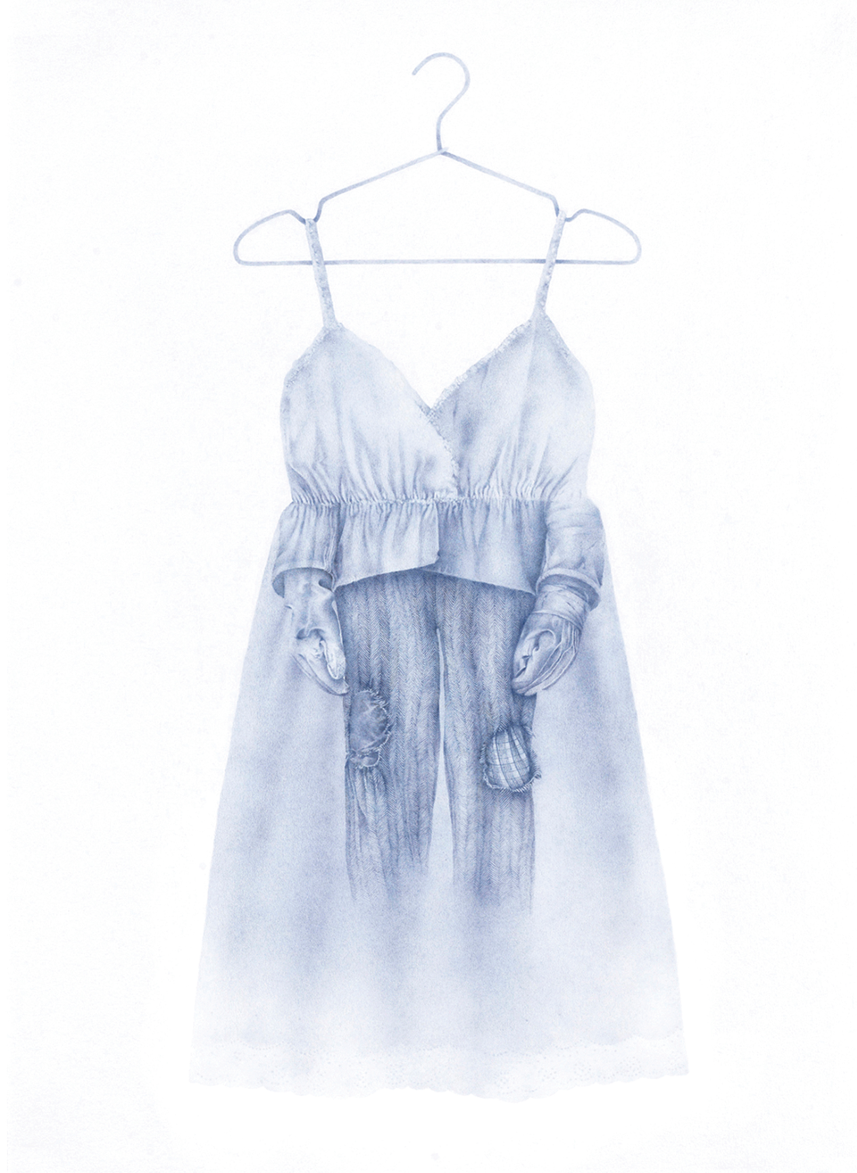
“Labor” (colored pencil on paper), by Azita Moradkhani, at Samson Projects, Boston, through May 21.
The gallery says:
“Azita Moradkhani was born in Tehran where she was exposed to Persian art, as well as Iranian politics, and that double exposure increased her sensitivity to the dynamics of vulnerability and violence that she now explores in her art-making
“Moradkhani’s work in drawing and sculpture has focused on the female body and its vulnerability to different social norms. It examines the experience of finding oneself insecure in one’s own body. As Wangechi Mutu says, ‘females carry the marks, language, and nuances of their culture more than the male. Anything that is desired or despised is always placed on the female body.’ In her drawings, the incorporation of unexpected images within intimate apparel intends to bring humor, surprise and a shock of recognition. Layers of hazy images reveal stories, with the hope of leaving a mark on the audience. Two worlds–birthplace and adopted home–live alongside each other in her work, joining intimately at a single point.’’

Chris Powell: Legislator’s drinking problem isn’t the biggest scandal; sneaky fuel tax; a No Labels presidential candidate?

1994 federal government poster
MANCHESTER, Conn.
By now nearly everyone who pays attention to Connecticut news knows of the state legislator who last year stood up to speak at the Capitol when she was drunk and lapsed into incoherence and who, a few weeks ago, was driving drunk when she crashed her car nearby.
The legislator has become so well known in large part because television stations have delighted in broadcasting video of her failing a sobriety test and getting arrested. There was nothing remarkable about the video. It was just like all failed sobriety-test videos except for the office of the person being arrested. She was hardly known statewide before her public intoxication; she was what in Parliament would be called a back-bencher. But now she is famous for being humiliated, and her legislative committee assignments are suspended.
Of course, she should have gotten treatment for her drinking problem before crashing her car and putting others at risk. But after the crash she quickly apologized publicly and began treatment. Beating an addiction is not easy; all may hope that she succeeds.
But the repeated broadcast of her arrest was only prurient and may not make it easier for her. It was as if the TV stations thought that she was Donald Trump.
Yes, after a long career as a grifter and four years of unprecedentedly disgraceful conduct in the nation's highest office, Trump may be irremediable. But the state legislator is just an ordinary person without bad intent who has a character weakness shared by many others, including others in elected office. There are many other things that Connecticut should be more ashamed of, but viewers of the state's TV news probably don't know.
xxx
HIDDEN TAXES AGAIN: Connecticut Gov. Ned Lamont and Democrats in the General Assembly are trying again to raise fuel taxes surreptitiously.
They are pushing legislation to authorize the commissioner of the state Department of Energy and Environmental Protection to commit the state to interstate agreements requiring fuel businesses to buy and compete for a limited number of "carbon credits."
The cost to the businesses would be passed along in higher prices to retail fuel customers, who would blame energy producers and distributors, not the real culprit, state government.
The "carbon credits" scheme might be less objectionable if the legislature had to vote on such interstate compacts directly as ordinary legislation, if the governor had to sign it before it took effect, and if in doing so they were candid with the public about the inevitable result and explained why higher fuel costs were worth the supposed progress against "climate change."
But no. The Democrats want to pander to the climate extremists in their party without taking responsibility with everyone else.
If the governor and legislators want to raise fuel prices, they don't need any interstate compact. They can just raise fuel taxes in the open, as they have done before, though such taxes in Connecticut are already high.
xxx
FIND AN ALTERNATIVE: According to The Washington Post, the No Labels political organization, which includes former Connecticut U.S. Sen. Joe Lieberman, aims to try to put its own candidate for president on the ballot in all 50 states in 2024.
No such candidate has been designated but the idea is to draw the likely major-party candidates in 2024 -- President Biden for the Democrats and former President Trump for the Republicans -- back toward the political center and away from their pandering to the left and right. Such movement might cause No Labels to endorse one or the other, refraining from offering its own candidate.
Biden supporters are said to be most afraid of the No Labels plan. One says: "The only way you can justify this is if you believe it doesn't really matter if it is Joe Biden or Donald Trump."
No, there is plenty of other justification. A third-party candidate can be justified if people believe, as many well may, that Biden and Trump are equally catastrophic, if in different ways.
To ensure its victory in 2024 one of the two major parties needs only to nominate a presidential candidate who is competent, moderate, relatively honest, sane and sentient.
But the parties don't yet seem to have noticed that Biden and Trump aren't.
Chris Powell (CPowell@JournalInquirer.com) is a columnist for the Journal Inquirer, in Manchester, Conn.
Only way to start it
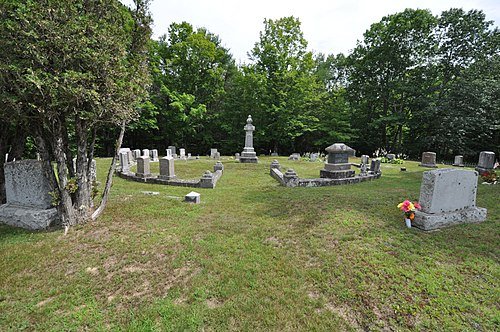
Kent Burying Ground, in Fayette, Maine. Established in 1880 by Elias Kent, it is unusual for its layout of concentric rings around a central monument.
Edwin Valentine Mitchell (1890-1960) in his book It’s an Old State of Maine Custom, recalls the story of the tourist being shown around town by a local who remarks to his guide how very old the townspeople seem:
“‘Seems as if everybody we meet is old,’ says the tourist.
“‘Yes,’ the guide admits, ‘the town does have a lot of old folks.’
“‘I see you have a beautiful cemetery over there,’ remarks the tourist a bit later.
“‘Yup,’ is the laconic answer. ‘We had to kill a man to start it.”’

Abenaki water

‘‘Water is Life,’’ by Francine Poitras Jones, in the group show “Nebizun: Water Is Life,’’ at the Bennington (Vt.) Museum through July 16.
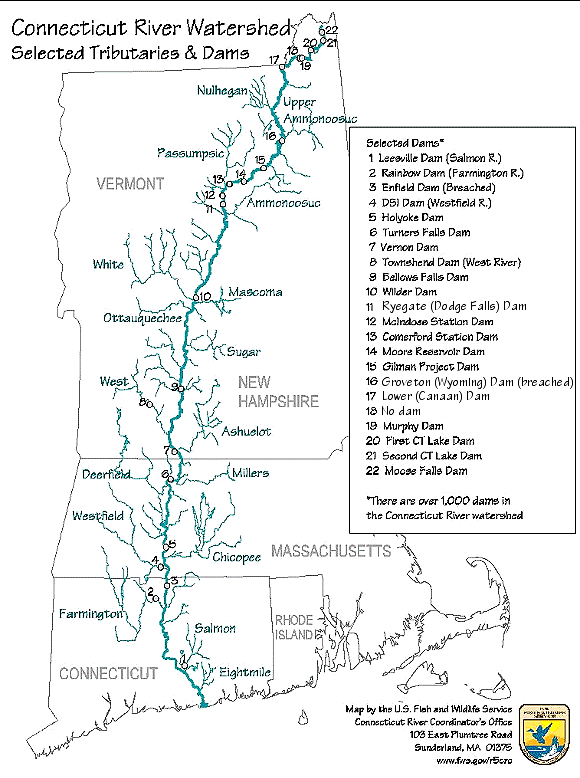
The exhibition showcases the work of Abenaki artists of the Champlain Valley and Connecticut River Valley. Nebizun is the Abenaki word for water. The museum says the show "draws its inspiration from Native American grandmothers who have been doing water walks to pray for the water.’’

Satellite view of the Champlain Valley.
‘Great when you’re dejected’

Ogden Nash (1902-1971) and Dagmar (1921-2001), actress and television personality, on the TV game show Masquerade Party, in 1955. Nash graduated from and taught for a year at St. George’s School, in Middletown, R.I.
A Tribute to Ogden Nash
Time for fanfare, time for flash,
Time to honor Ogden Nash.
Lively, innovative, clever—
Humdrum absolutely never.
Nash is great when you’re dejected,
Since he’s apt to lift your spirits with a bouncy ending that is hardly what you expected.
— Felicia Nimue Ackerman is a Providence-based poet and a professor of philosophy at Brown University. (First appeared in Light, with a slightly different title)
John S. Long: These small geese prepare for an amazing journey

A Brant Goose
Brant Geese, our faithful winter visitors, will soon be flying to the northern coast of Greenland for breeding season. Many Brant use Narragansett Bay as their winter residence. Near the end of this month, these diminutive waterfowl (smaller than Canada Geese) will make an amazing journey of more than 2,500 miles across the frigid Bay of Fundy, the Gulf of Saint Lawrence, the Labrador Sea and Baffin Bay.
Here along Narragansett Bay, rafts of Brant feed on eel grass, often staying close to shore, where they create a cacophony of gabble. As I recently watched them on Gaspee Point, in Warwick, R.I., the chilly wind was rattling through leafless trees behind me. Brant swim close and parallel to shore because they need sandy grit to aid their digestion of eel grass. Their white rumps bob like corks, and they never seem to tire from swimming directly into waves.
As I looked far to the east, the tugboat Morgan Reinauer was pushing a barge from Perth Amboy, N.J., north toward Providence, where it would soon dock at the Motiva terminal, near Corliss Cove, close to Allens Avenue.
John S. Long lives in Warwick, R.I.
Mounts to go missing in the emulsion
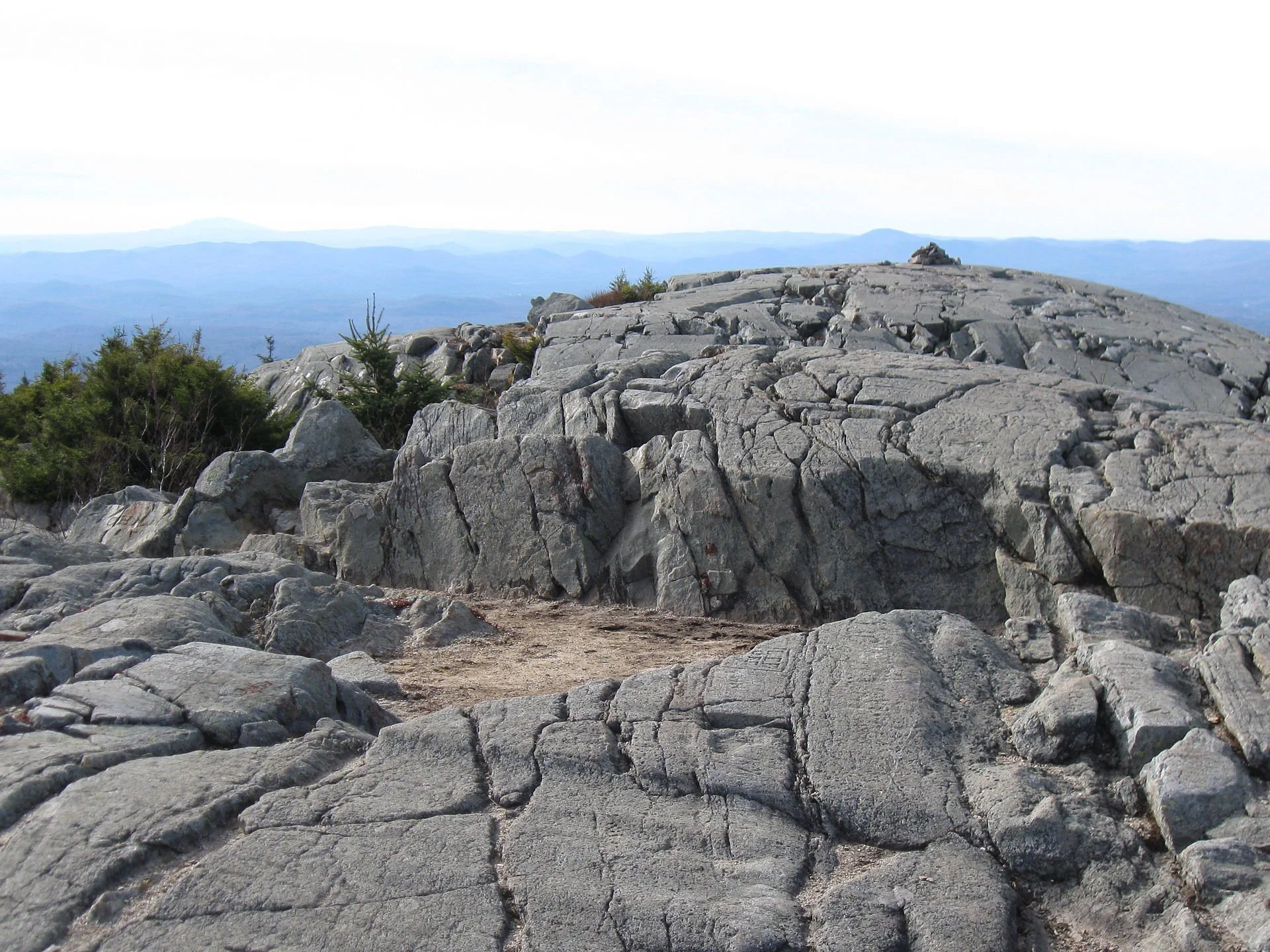
At the summit of Mt. Kearsarge, in Merrimack County, N.H.
“In fifteen years
Monadnock and Kearsarge
…will turn
invisible….’’
— From “Scenic View,’’ by New Hampshire-based poet and essayist Donald Hall (1928-2018)

Mount Monadnock, as painted by Richard Whitney in “Monadnock Orchard’’
‘Wages will be low’
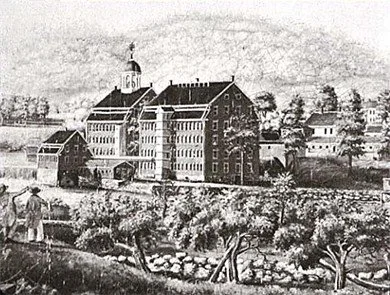
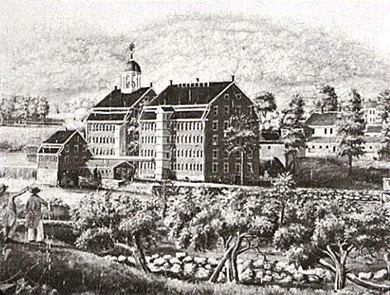
The Boston Manufacturing Company, shown in this engraving, made in 1813–1816, was based in Waltham, Mass. The company was an early developer of the New England textile industry by building water-powered textile mills along suitable rivers and developing mill towns around them. The building here was said to be the first integrated spinning and weaving factory in the world.
“But the time will come when New England will be as thickly peopled as old England. Wages will be as low, and will fluctuate as much with you as with us. You will have your Manchesters and Birminghams; and, in those Manchesters and Birminghams, hundreds of thousands of artisans will assuredly be sometimes out of work. Then your institutions will be fairly brought to the test.”
— Thomas B. Macaulay (1800-1859), English historian and politician.
Jump through anyway

“Flag to the Abyss” (detail), by Sarah Stefana Smith, in her show “Willful Matters,’’ at Burlington (Vt.) City Arts through May 6.
—Photo courtesy Burlington City Arts.
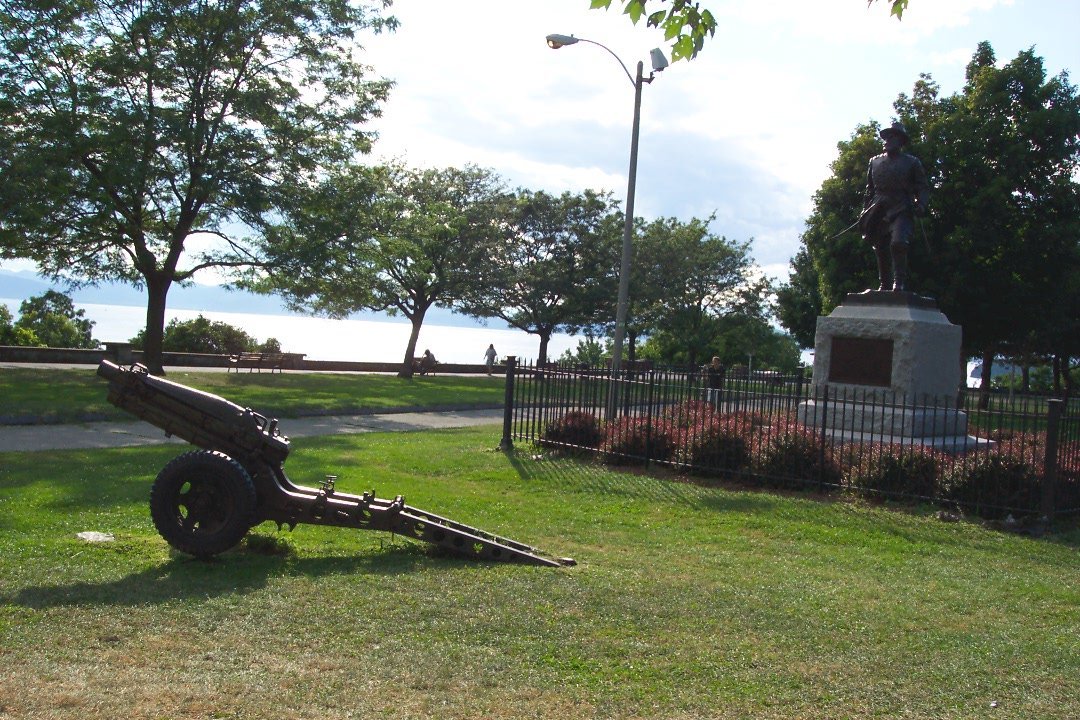
Battery Park, which overlooks the Burlington waterfront and Lake Champlain
— Photo by Tania Dey
‘Elegies to the once useful’

“Heavy Light” (pewter candlestick, aluminum cannister, plaster wrap, acrylic paint, Sculptamold, joint compound, Aqua-Resin), by Boston artist Laura Evans, at Boston Sculptors Gallery, through May 7.
She says:
“My sculptures hover between mundane, recognizable objects and mysterious abstracted forms that reference the body’s fragility and tenuousness. My recent work combines common household items, found objects and hand-built forms. Some have handles and imply function, but these are elegies to and celebrations of once useful, but discarded objects, subject to the effects of time. Humor and gravity, weight and levity, amusement and confusion, often coexist in my sculptures. I directly manipulate my materials, using simple hand tools, which allows me to create intimate and closely observed surfaces and forms that have life.’’

Llewellyn King: Biden needs to recognize the perils of old age

Stained glass window of Methuselah in the southwest transept of Canterbury Cathedral, in Kent, England. He was said in the Bible to have reached the age of 969, making him the oldest person in the Good Book.
Read about The New England Centenarian Study.
WEST WARWICK, R.I.
The case for Joe Biden to accept the inevitable dictates of his age and not run again is persuasive. Too much rests on the health and fitness of the president to turn it into a kind of roulette: When will his number come up?
Worse, what if Biden fails mentally and stays in office incognizant of his condition? Being the president of the United States is the most demanding and most responsible job in the world.
Winston Churchill got a second term as prime minister of Great Britain in 1951, and lots of stuff went wrong, from immigration policy to the growth of unchecked union power. History’s greatest prime minister had lost his acuity.
As I am older than Biden, I can say that he should quit. I love to work, but there’s the rub: Not all people and all work are created equally. What I do isn’t critical and doesn’t decide the nation’s future or war and peace.
No one would suggest that an artist toss the easel at a predetermined retirement age. Noel Coward, the great English entertainer, said, “Work is more fun than fun.” That depends on the work.
Age is a complex equation for society, and retirement is a nettlesome problem. France is in revolt over President Emmanuel Macron’s move to raise the retirement age to 64 from 62. Very reasonable, most Americans say.
The issue in France is simple: The French can’t afford huge state pensions any longer. There aren’t enough people at work to pay for those who have retired on their nearly full salaries. You can vote the population rich, but you can’t vote in new, young taxpayers to keep them rich. When the Social Security System falters in the next decade, America may be staring at the same sums as Macron.
Mandatory retirement is a crude way to manage the retirement dilemma. Some workers are genuinely unable to work into their 70s and 80s because their bodies, their minds or both are worn out. Others are at their most productive.
My father’s mind was fine, but he was a mechanic who had done everything from building steel structures to working in mines to repairing cars. His body failed around the age of 6o. He had been doing manual work since he was 13 but at 60 he couldn’t bend, twist, delve, lift, climb, stretch, grab or do many of the myriad things he had done all his life to earn a living. He had to work in a school and then a shop; he loved the school but not the shop. But he had to work. That is what he did: He got up every day and went to work.
He had worked so long and so hard, primarily self-employed, that he hadn’t had time to learn leisure — to play golf, to watch ballgames, to read for recreation, or even to learn how to socialize. That came with work or didn’t happen; friends were people at work.
A friend of mine, a nuclear engineer, reached mandatory retirement age and fell apart, much as my father nearly did. He, too, had no interests outside of his family and work and was lost in the post-job world.
Something of this same problem exists for people leaving the military. Their life is the military, and then, at an early age, there is no more of that life, their life.
When it comes to Biden, things are quite different.
I know the president slightly, and I like him. He loves the job. He has been at or near the peak of power for a long time. When his term ends, on Jan. 20, 2025, he should adjourn to his beach house in Delaware and write his memoirs.
Maybe someone will teach Biden how to play boules, a European form of bowls played by older people in parks. French boules aficionados would be happy to teach him the game. The French have a lot of time in retirement to perfect their play and travel to beach destinations. They would love to bring their skill to Rehoboth Beach, Del. Maybe I should join them.
On Twitter: @llewellynking2
Llewellyn King is executive producer and host of White House Chronicle, on PBS. He’s based in Rhode Island and Washington, D.C.
White House Chronicle
InsideSources

How many will board these new and long-delayed trains?

Adapted from Robert Whitcomb’s “Digital Diary,’’ in GoLocal24.com
Will the return, after many decades, of passenger rail service between Boston, Fall River and New Bedford and intermediate spots late this year be a big boost to the long economically challenged old mill towns? Both Fall River and New Bedford are often lumped together, though they’re different in many ways, especially in that New Bedford is a big fishing port and the former whaling capital, as well as an arts center, and hilly Fall River is more physically dramatic.
Commuter service could enable some folks who otherwise would be stuck trying to find “affordable” housing in pricey Greater Boston to find much cheaper digs in those cities and, we hope, add new economic and other energy to urban parts of the South Coast in general. Could it even lure more than a few Boston area businesses to set up shop there?
The current MBTA plan for South Coast Rail calls for three morning peak commuting trains and three late-in-the day peak commuting trains to both New Bedford and Fall River. The trips from the cities to South Station in Boston are projected to take about 90 minutes, which could sometimes be faster than driving. The service will mean six morning and evening trains to Taunton and Middleboro; all the trains will make those stops. During off-peak periods, trains will run every 3 to 3½ hours.
Frequency, reliability and marketing are key to winning over enough drivers to mass transit. I’m not sure that the planned schedules would be frequent enough. Yes, taxpayers will heavily subsidize the service -- as they do the highways. The train service, if it’s promoted enough, might, over the years, gradually lighten traffic on those roads a bit.
Frank Carini: The staggering hypocrisy of the anti-offshore wind farm crowd

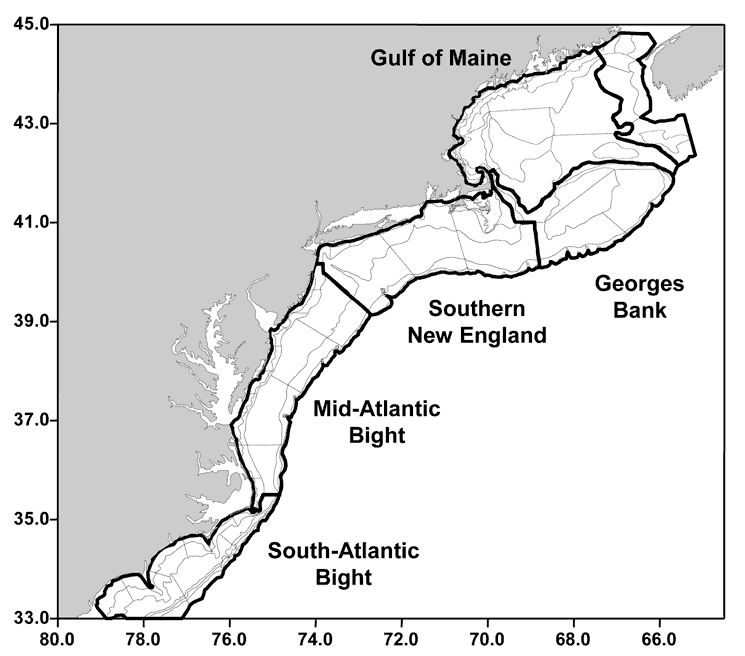
From Frank Carini’s column “Whale of a Tale: Local Anti-Wind Crowd Spins Yarns,’’ in ecoRI News (ecori.org)
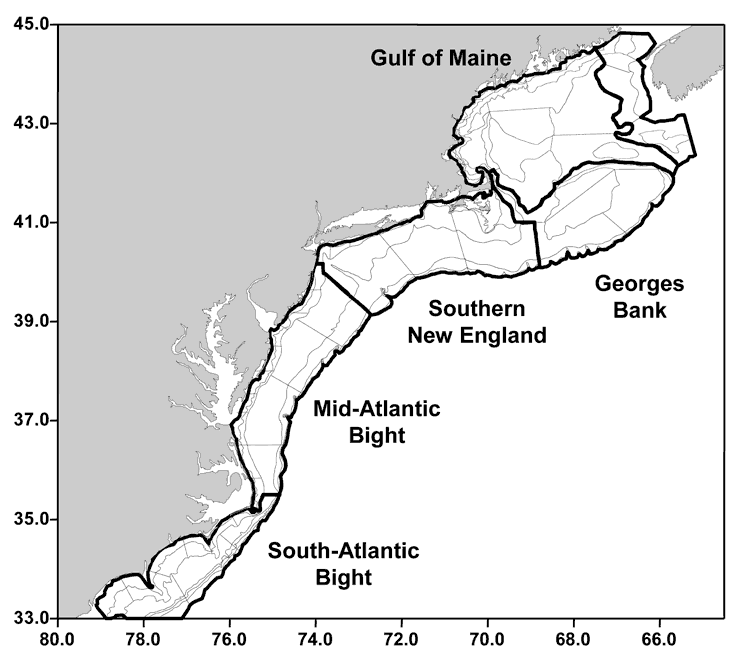
”No energy source is benign. From installation to operation, they all come with consequences — environmental, societal, and cultural. Some more than others. Legitimate concerns (e.g., not infringing upon whale migration corridors) must be studied, discussed, mitigated, and/or avoided. Renewable energy shouldn’t be called clean, but it is a whole lot cleaner than fossil fuels….
“The concerns of southern New England’s anti-offshore wind crowd, however, never spill over to the polluting gas and oil platforms that mar many of the waters off the U.S. coast, especially in the Gulf of Mexico. Probably because there are no such rigs in Rhode Island Sound.
“They don’t mention sonar {which can disturb marine mammals} is used to detect leaks from offshore fossil fuel infrastructure. They fail to note ocean military training drills use sonar, and live munitions. They disregard the fact the primary causes of mortality and serious injury for many whales, most notably the North Atlantic right whale, are from entanglements with fishing gear and vessel strikes.
“Even though data show that North Atlantic right whale mortalities from fishing entanglements continue to occur at levels five times higher than the species can withstand, the anti-wind crowd isn’t calling for fishing gear to be pulled from local waters or the use of ropeless fishing technology made mandatory. They aren’t demanding vessels be equipped with technology that monitors the presence of whales in shipping lanes.
“They ignore the fact the development of offshore wind is the most scrutinized form of renewable energy. After reading this column, they will allege I and/or ecoRI News are in the pocket of Big Wind. We’re not. (A few wind energy companies have advertised with us, but they didn’t spend nearly enough to bankroll a golden parachute, or even a reporter’s salary for a month.)
“The anti-wind crowd doesn’t offer any real solutions to drastically reduce the amount of heat-trapping, polluting, and health-harming greenhouse gases that humans are relentlessly spewing into the atmosphere.’’
To read the full column, please hit this link.
Cheated again

"I am afraid the poor Indians will never stand a good chance with the English in their land controversies, because they are very poor, they have no money. Money is almighty now-a-days, and the Indians have no learning, no wit, no cunning: the English have all."
— Samson Occom (1723-1792), a member of the Mohegan tribe in Connecticut, \ was a minister, teacher and missionary who was instrumental in raising the money in London that ended up helping to found Dartmouth College, in Hanover, N.H. But the fundraising, to his surprise and dismay, was actually a kind of bait-and-switch operation.

In Columbia, Conn., the Moor’s Indian Charity School building, built in 1754 but later altered in Greek Revival style. The school was the predecessor of Dartmouth College.
‘Mystery unfolding before me’
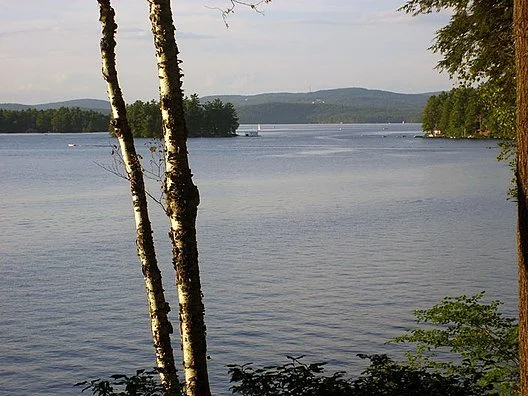
On Lake Sunapee, N.H.
”Talismanic rosary in hand,
I watch the breath of morning rise.
Warm mists, drifting upward
from the cold waters of the deep lake,
ascend into heaven. New clouds,
baby clouds form, from water to air,
a mystery unfolding before me.’’
— From “Metanoia,’’ by Newbury, N.H.-based poet Dianalee Velie. Read the whole poem here. Newbury is on Lake Sunapee.

The Puritans didn’t like it but we moved on

On the Easter Bunny Express of the Railroad Museum of New England, in Thomaston, Conn.
From the New England Historical Society:
“Easter Sunday traditions in New England have long included dying eggs, wearing new clothes, baking hot cross buns and attending sunrise services. They are based on pagan superstitions, which of course is why the Puritans didn’t celebrate the holiday. (The Puritans didn’t like Christmas, either.) For the early Puritans, celebrating the Lord’s Day 52 times a year was quite enough.
“Others brought traditions from Europe. Germans believed, for example, that rabbits laid beautifully colored eggs on Easter.
“Franco-Americans rose before the sun came up to fetch water, which they called Peau de Paques (Easter skin) from a stream. They believed it had miraculous qualities, staying pure indefinitely. They washed with it, drank it and saved it.’’
Spring break: Should we fly or take the boat?

“Worldly Birds” (encaustic, collage), by Nancy Whitcomb