
Treasure your enemies
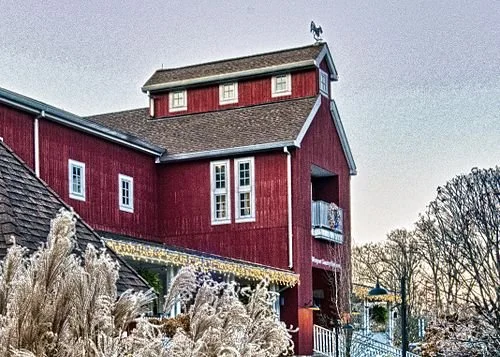
The Westport (Conn.) Country Playhouse, founded in 1931. It became a nonprofit in 1973. For many years it was supported by movie star and philanthropist. Paul Newman (1925-2008) and his actress wife, Joanne Woodward (born 1930), who were long-time residents of the affluent New York suburb, eschewing life in Hollywood. She served as its artistic director from 2000 through 2005, following an 18-month, multimillion-[dollar renovation. Paul Newman remained a part-owner of a restaurant next to the theater until his death.
“A man with no enemies is a man with no character.’’
— Paul Newman
Ex-river
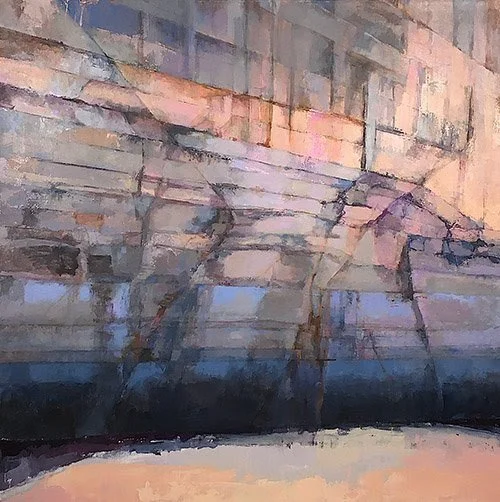
“Canyon Waterlines” (acrylic on canvas), by Newton, Mass.-based artist Patty Stone, in the show “New Works by Gallery Artists,’’ at Bromfield Gallery, Boston, all this month. The show includes paintings, drawings, sculptures, prints and artists books.
‘Nature’s boldest sketch’

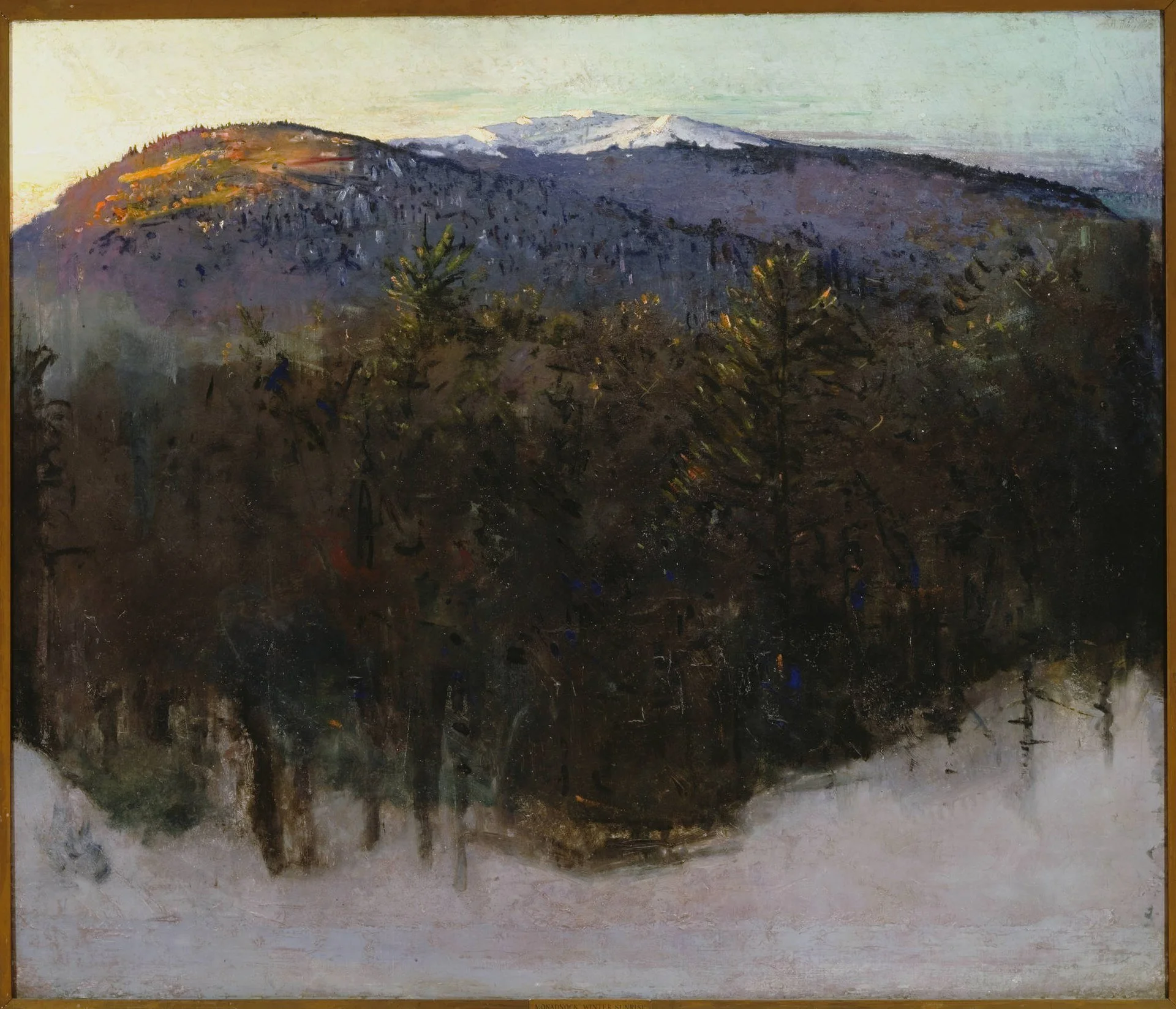
“Monadnock, Winter Sunrise” (1919), by Abbott Handerson Thayer. Kiping would have seen and admired Mt. Monadnock by looking straight east toward southwest New Hampshire.

“Naulakha,’’ aka the Rudyard Kipling House, in Dummerston, Vt.
“Thirty below freezing! It was inconceivable till one stepped out into it at midnight, and the first shock of that clear, still air took away the breath as does a plunge into sea-water. A walrus sitting on a woolpack was our host in his sleigh, and he wrapped us in hairy goatskin coats, caps that came down over the ears, buffalo robes and blankets, and yet more buffalo-robes till we, too, looked like walruses and moved almost as gracefully. The night was as keen as the edge of a newly-ground sword; breath froze on the coat-lapels in snow; the nose became without sensation, and the eyes wept bitterly because the horses were in a hurry to get home; and whirling through air at zero brings tears. But for the jingle of the sleigh-bells the ride might have taken place in a dream, for there was no sound of hoofs upon the snow, the runners sighed a little now and again as they glided over an inequality, and all the sheeted hills round about were as dumb as death. Only the Connecticut River kept up its heart and a lane of black water through the packed ice; we could hear the stream worrying round the heels of its small bergs. Elsewhere there was nothing but snow under the moon—snow drifted to the level of the stone fences or curling over their tops in a lip of frosted silver; snow banked high on either side of the road, or lying heavy on the pines and the hemlocks in the woods, where the air seemed, by comparison, as warm as a conservatory. It was beautiful beyond expression, Nature’s boldest sketch in black and white, done with a Japanese disregard of perspective, and daringly altered from time to time by the restless pencils of the moon.
“In the morning the other side of the picture was revealed in the colours of the sunlight. There was never a cloud in the sky that rested on the snow-line of the horizon as a sapphire on white velvet. Hills of pure white, or speckled and furred with woods, rose up above the solid white levels of the fields, and the sun rioted over their embroideries till the eyes ached. Here and there on the exposed slopes the day’s warmth—the thermometer was nearly forty degrees—and the night’s cold had made a bald and shining crust upon the snow; but the most part was soft powdered stuff, ready to catch the light on a thousand crystals and multiply it sevenfold. Through this magnificence, and thinking nothing of it, a wood-sledge drawn by two shaggy red steers, the unbarked logs diamond-dusted with snow, shouldered down the road in a cloud of frosty breath.’’
— From In Sight of Monadnock, by the great English novelist, poet and short-story writer Rudyard Kipling (1865-1936), who lived in the Brattleboro, Vt., area in 1892-1896. He wrote some of most famous works there, including The Jungle Book and Captains Courageous, and loved many aspects of living in The Green Mountain State. But a dispute with his crazy American brother-in-law and Kipling’s sensitivity to some Americans’ anti-British emotions sadly drove him to return to England.
Chris Powell: Conn. politicians strike hypocritical poses about distant police outrages; Afghans blew their chance to defeat Islamo-Fascism

MANCHESTER, Conn.
Connecticut’s population is barely growing (only 0.1 percent in 2022) and its economy growing very slowly, but its elected officials are as busy as ever deploring the awful things happening elsewhere in the country, and they may be thankful for the distraction. In recent days mass shootings in California and murderous misconduct by police in Tennessee have prompted Connecticut's leaders to issue proclamation after proclamation deploring the incidents, as if their constituents had any doubt about their feelings, or thought that those feelings might make any difference.
Connecticut's leaders seemed to feel the need to strike a pose -- to gain publicity for their self-righteousness.
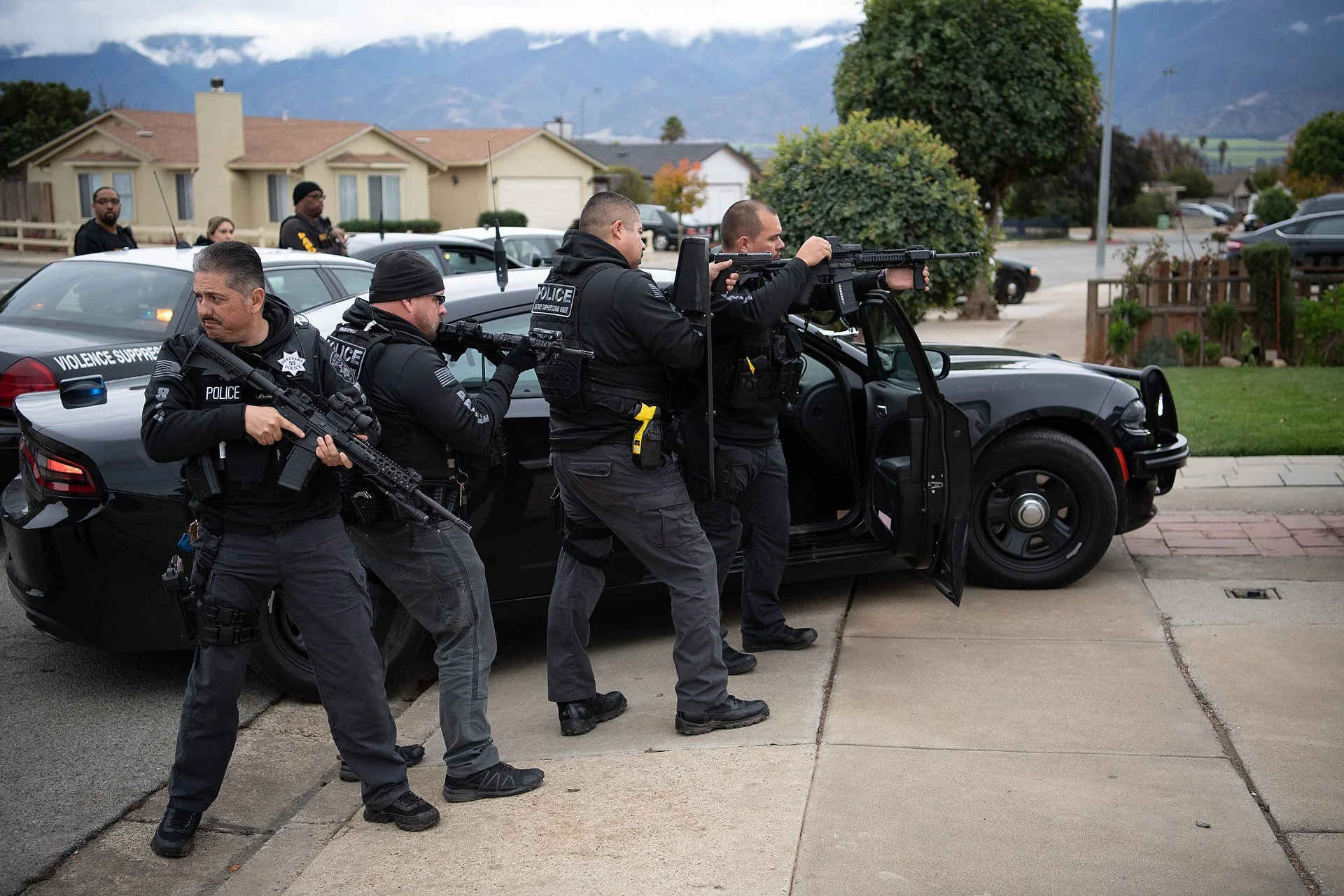
The people who do the hiring for the Memphis Police Department may have a lot to answer for, but then Connecticut has enough of its own police misconduct to answer for, misconduct captured on body-camera video just as it was captured the other day in Memphis.
A Connecticut state trooper is facing a charge of manslaughter for repeatedly shooting a young man, Mubarek Soulemane, three years ago as he sat quietly in a car that had been stopped on a highway in West Haven after a wild chase.
Five New Haven officers are facing charges of reckless endangerment and cruelty for dragging and dumping Randy Cox, whose neck had been broken during an abrupt stop in a police van last June.
The execution in West Haven and the rough treatment of the man in police custody in New Haven evoked from Connecticut's leaders only a fraction of the indignation they have mustered for the police misconduct a thousand miles away in Tennessee.
And while elected officials should avoid prejudicing proceedings in criminal justice, Connecticut's elected officials might do well to show more awareness of the social disintegration that police officers confront every day -- social disintegration that has made recruiting officers critically difficult, especially in the cities, which have the worst crime.
As Connecticut's elected officials were fulminating about the mass shootings in California and the police riot in Memphis, two 16-year-olds were shot on the streets of Hartford. The incident passed without official comment and nearly without any notice at all by news organizations, this kind of thing long having become typical of Connecticut's cities, too common to deplore. Besides, any elected official who deplored what has become so common might be obliged to fix responsibility for it, a search that would lead him to some of his own constituents.
Better to deplore California and Tennessee, since nobody there votes here.
xxx
Afghanistan and especially its women are getting sympathy around the world as the theocratic fascists again ruling the benighted place, the Taliban, are banning women from education and service with the international charitable organizations that are trying to prevent starvation and disease in the country.
But disgraceful as the Taliban regime is, sympathy for the Afghans is misplaced. For Afghanistan's men and women alike had their chance during the Western world's 20-year attempt at nation building there.
While some Afghans showed courage in pursuit of a more democratic society, most Afghans, including most Afghan women, were indifferent. Many Afghan women now realize that they won't have much of a future without education, but they can do nothing about it -- unless, of course, they want to pick up a gun, learn how to use it, and fight a revolution.
Few want to do that. Instead many will try to leave the country. Some will head for the United States, and a few may deserve consideration.
But most Afghans now deserve to live under the oppression they refused to fight, and the United States should not make that oppression any easier for the oppressors with financial or material assistance of any kind. Neither should the United States intervene to help overthrow the Taliban. No, Afghanistan should be left in peace to evolve gradually in its misery.
If Afghan women want a better life, they will have to contend for it themselves over the long term, just as women in Iran, Saudi Arabia, Pakistan, and other women-oppressing theocracies will have to.
No one will be liberating them but themselves.
Chris Powell (CPowell@JournalInquirer.com) is a columnist for the Journal Inquirer in Manchester.
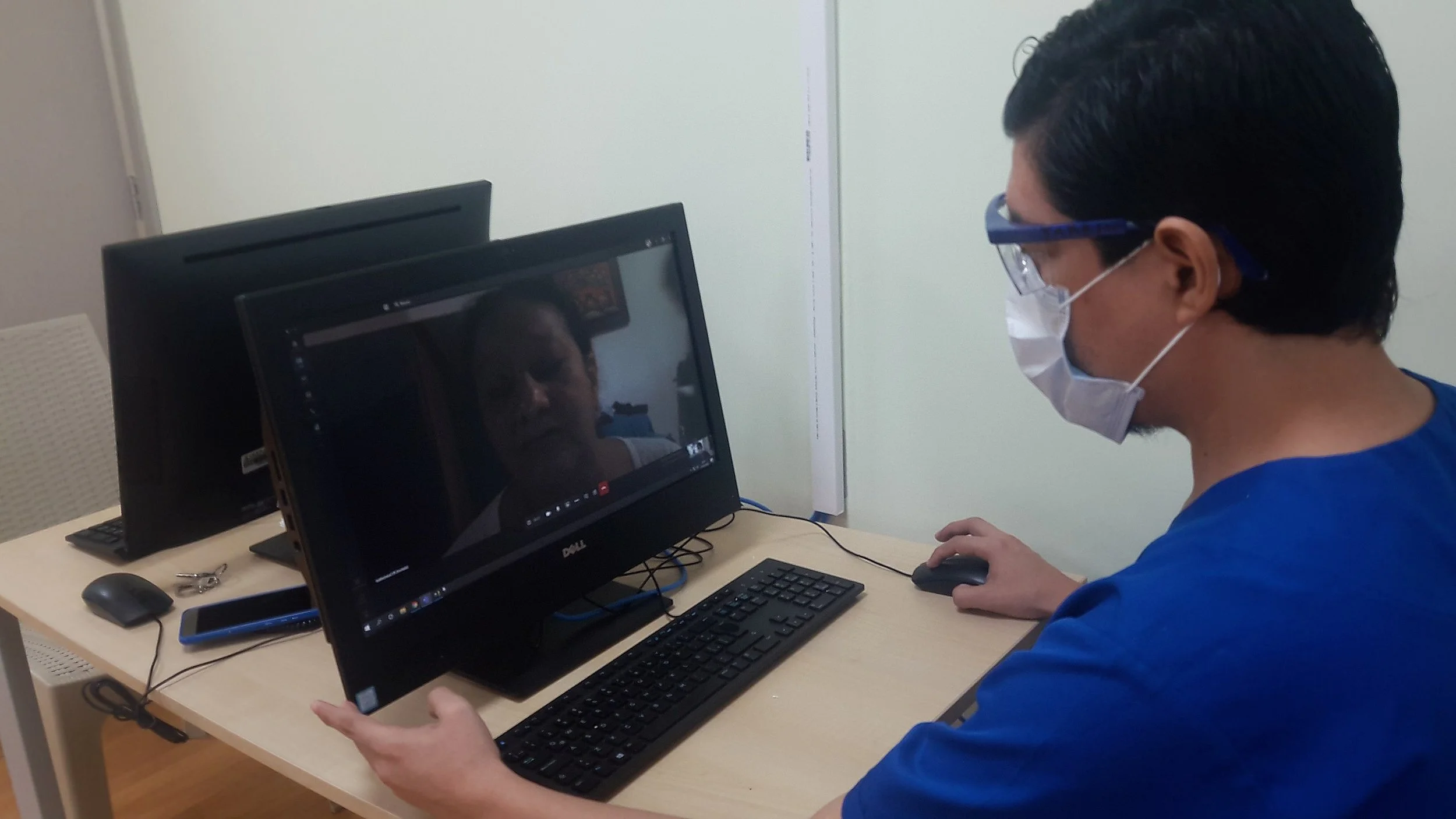
Sarah Jane Tribble: It can be telehealth vs. no care
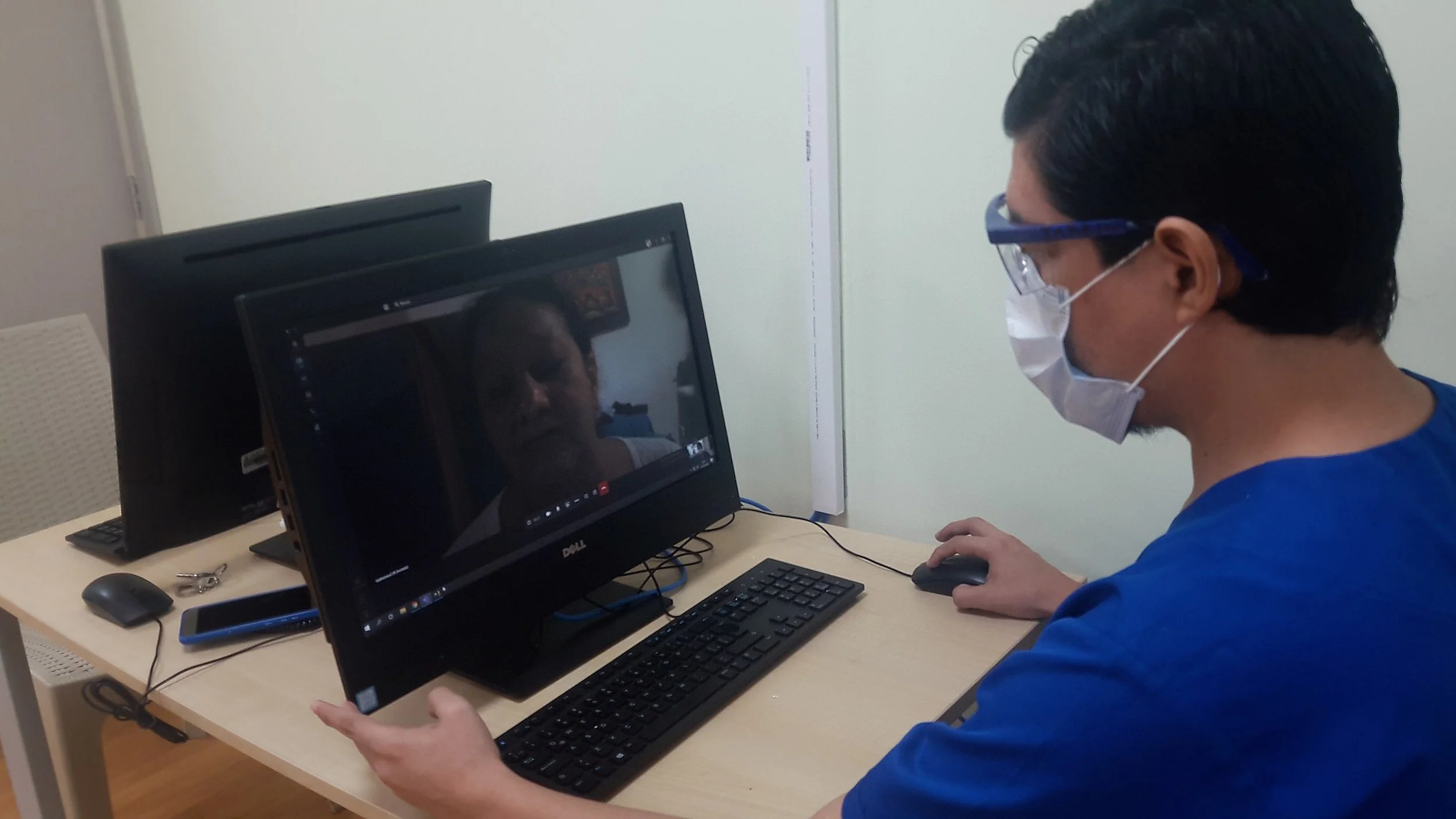
— Photo by Ceibos
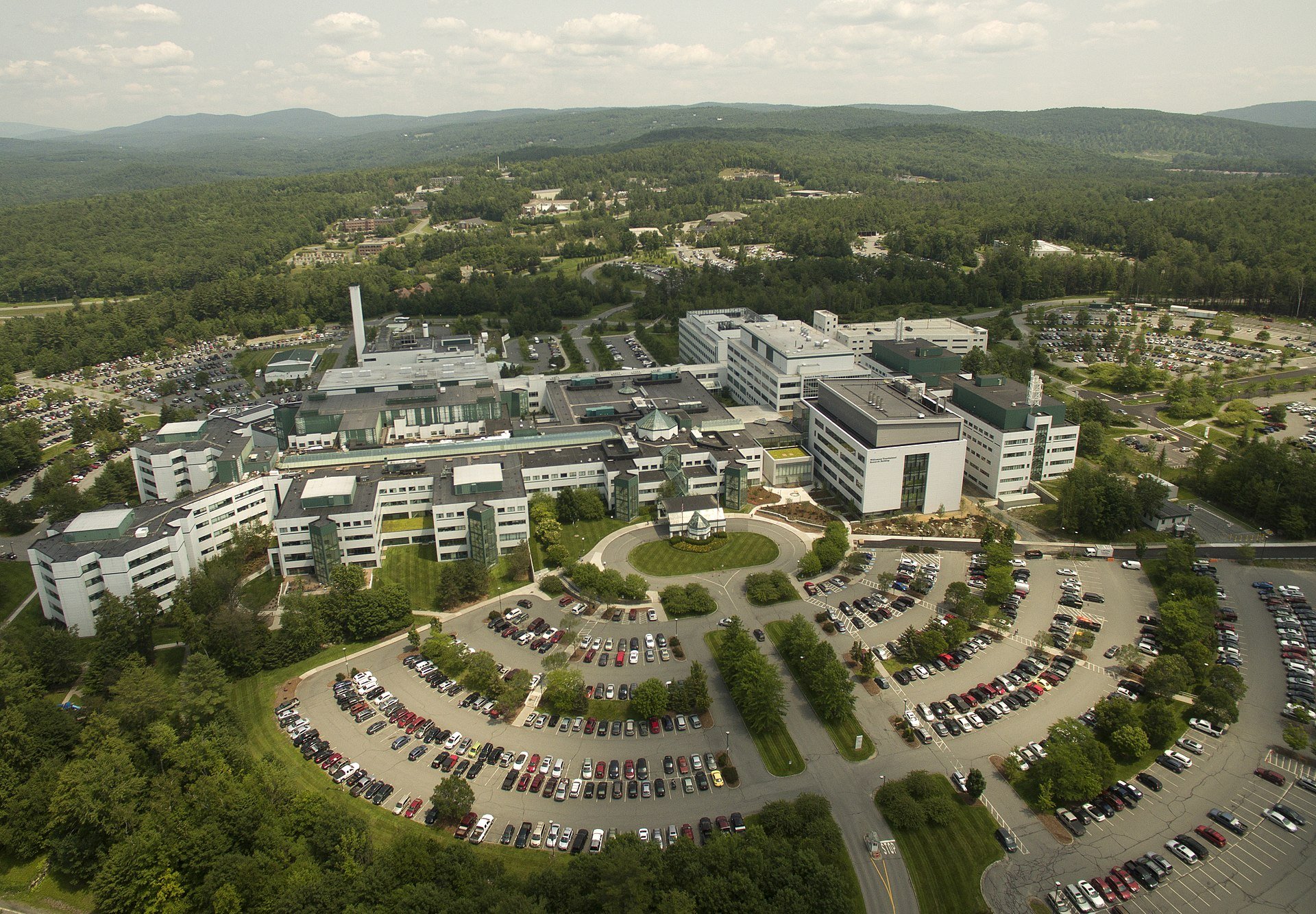
Dartmouth-Hitchcock Medical Center, in Lebanon, N.H.
— Photo by Jared C. Benedict
When the COVID-19 pandemic hit, Dr. Corey Siegel was more prepared than most of his peers.
Half of Siegel’s patients — many with private insurance and Medicaid — were already using telehealth, logging onto appointments through phones or computers. “You get to meet their family members; you get to meet their pets,” Siegel said. “You see more into their lives than you do when they come to you.”
Siegel’s Medicare patients weren’t covered for telehealth visits until the pandemic drove Congress and regulators to temporarily pay for remote medical treatment just as they would in-person care.
Siegel, section chief for gastroenterology and hepatology at Dartmouth-Hitchcock Medical Center, in Lebanon, N.H., is licensed in three states and many of his Medicare patients were frequently driving two to three hours round trip for appointments, “which isn’t a small feat,” he said.
The $1.7 trillion spending package that Congress passed in December included a two-year extension of key telehealth provisions, such as coverage for Medicare beneficiaries to have phone or video medical appointments at home. But it also signaled political reluctance to make the payment changes permanent, requiring federal regulators to study how Medicare enrollees use telehealth.
The federal extension “basically just kicked the can down the road for two years,” said Julia Harris, associate director for the health program at the Washington, D.C.-based Bipartisan Policy Center think tank. At issue are questions about the value and cost of telehealth, who will benefit from its use, and whether audio and video appointments should continue to be reimbursed at the same rate as face-to-face care.
Before the pandemic, Medicare paid for only narrow uses of remote medicine, such as emergency stroke care provided at hospitals. Medicare also covered telehealth for patients in rural areas but not in their homes — patients were required to travel to a designated site such as a hospital or doctor’s office.
But the pandemic brought a “seismic change in perception” and telehealth “became a household term,” said Kyle Zebley, senior vice president of public policy at the American Telemedicine Association.
The omnibus bill’s provisions include: paying for audio-only and home care; allowing for a variety of doctors and others, such as occupational therapists, to use telehealth; delaying in-person requirements for mental health patients; and continuing existing telehealth services for federally qualified health clinics and rural health clinics.
Telehealth use among Medicare beneficiaries grew from less than 1% before the pandemic to more than 32% in April 2020. By July 2021, the use of remote appointments retreated somewhat, settling at 13% to 17% of claims submitted, according to a fee-for-service claims analysis by McKinsey & Co.
Fears over potential fraud and the cost of expanding telehealth have made politicians hesitant, said Josh LaRosa, vice president at the Wynne Health Group, which focuses on payment and care delivery reform. The report required in the omnibus package “is really going to help to provide more clarity,” LaRosa said.
In a 2021 report, the Government Accountability Office warned that using telehealth could increase spending in Medicare and Medicaid, and historically the Congressional Budget Office has said telehealth could make it easier for people to use more health care, which would lead to more spending.
Dr. Corey Siegel and his colleagues at Dartmouth-Hitchcock Medical Center see remote care as a tool for helping chronically ill patients receive ongoing care and preventing expensive emergency episodes. It “allows patients to not be burdened by their illnesses,” he says. “It’s critical that we keep this going.”
Advocates like Zebley counter that remote care doesn’t necessarily cost more. “If the priority is preventive care and expanding access, that should be taken into account when considering costs,” Zebley said, explaining that increased use of preventative care could drive down more expensive spending.
Siegel and his colleagues at Dartmouth see remote care as a tool for helping chronically ill patients receive ongoing care and preventing expensive emergency episodes. It “allows patients to not be burdened by their illnesses,” he said. “It’s critical that we keep this going.”
Some of Seigel’s work is funded by The Leona M. and Harry B. Helmsley Charitable Trust.
For the past nine months, Dartmouth Health’s telehealth visits plateaued at more than 500 per day. That’s 10% to 15% of all outpatient visits, said Katelyn Darling, director of operations for Dartmouth’s virtual care center.
“Patients like it and they want to continue doing it,” Darling said, adding that doctors — especially psychologists — like telehealth too. If Congress decides not to continue funding for remote at-home visits after 2024, Darling said, she fears patients will have to drive again for appointments that could have been handled remotely.
The same fears are worrying leaders at Sanford Health, which provides services across the Upper Midwest.
“We absolutely need those provisions to become permanent,” said Brad Schipper, president of virtual care at Sanford, which has health plan members, hospitals, clinics, and other facilities in the Dakotas, Iowa, and Minnesota. In addition to the provisions, Sanford is closely watching whether physicians will continue to get paid for providing care across state lines.
During the pandemic, licensing requirements in states were often relaxed to enable doctors to practice in other states and many of those requirements are set to expire at the end of the public-health emergency.
Licensing requirements were not addressed in the omnibus, and to ensure telehealth access, states need to allow physicians to treat patients across state lines, said Dr. Jeremy Cauwels, Sanford Health’s chief physician. This has been particularly important in providing mental health care, he said; virtual visits now account for about 20% of Sanford’s appointments.
Sanford is based in Sioux Falls, S.D., and Cauwels recalled one case in which a patient lived four hours from the closest child-adolescent psychiatrist and was “on the wrong side of the border.” Because of the current licensing waivers, Cauwels said, the patient’s wait for an appointment was cut from several weeks to six days.
“We were able to get that kid seen without Mom taking a day off to drive back and forth, without a six-week delay, and we were able to do all the things virtually for that family,” Cauwels said.
Psychiatrist Dr. Sara Gibson has used telehealth for decades in rural Apache County, Arizona. “There are some people who have no access to care without telehealth,” she said. “That has to be added into the equation.”
Gibson, who is also medical director for Little Colorado Behavioral Health Centers in Arizona, said one key question for policymakers as they look ahead is not whether telehealth is better than face-to-face. It’s “telehealth vs. no care,” she said.
Sarah Jane Tribble is a Kaiser Health News reporter.
Those nuns


Adapted from Robert Whitcomb’s “Digital Diary,’’ in GoLocal24.com
For the first time in quite a while, I encountered a nun, in a traditional habit, the other day, at the main Providence Post Office. She had a beatific smile.
When I was growing up in the Boston area, or even when I lived and worked in New York City, it seemed that nuns in habits were everywhere, connected to parishes, teaching school, acting as nurses and so on. Whether or not you agreed with their theology, they had edifying roles in society. A few, especially in some parochial schools, were battle-axes but most were kindly. I miss them. Of course, we used to call them penguins.
There are far fewer nuns these days but more than you might think because many have stopped wearing habits.
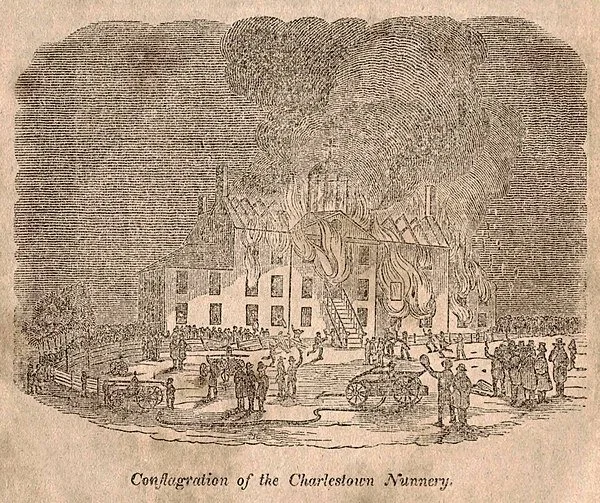
The Ursuline Convent riots took place on Aug. 11 and 12, 1834, in what is now Somerville, Mass. During the anti-Catholic riot, a convent of Roman Catholic Ursuline nuns was burned down by a Protestant mob.
Separated, 'haunted' art in Amherst
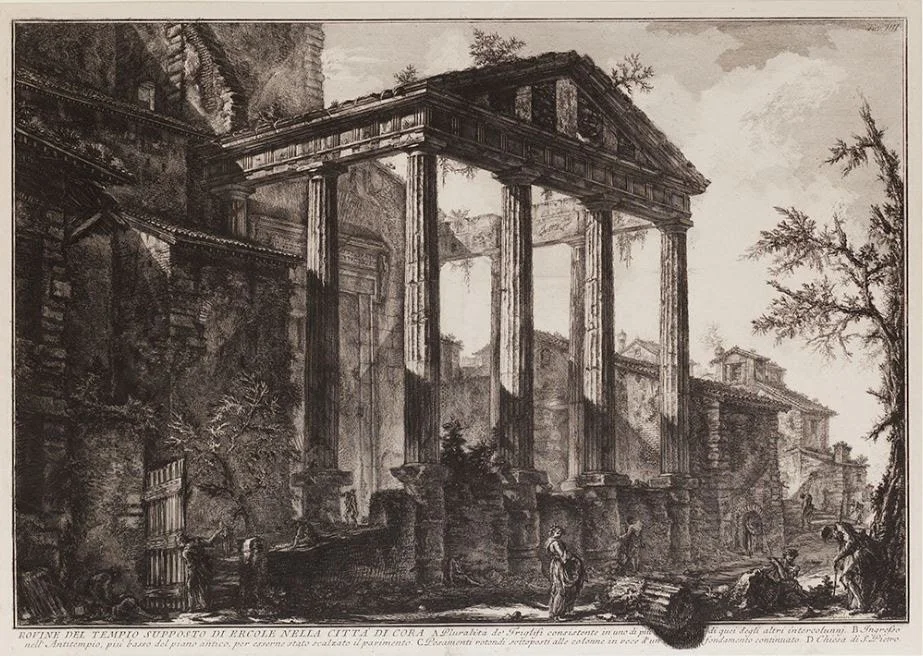
“Ruins of the Supposed Temple of Hercules in the City of Cori (Rovine del Tempio supposto di Ercole nella cita di Cora)” (1769 etching), by Giovanni Battista Piranesi, (Italian, 1720-1778), in the show “Architectural Ghosts,’’ at the Mead Art Museum, Amherst, Mass., through June 25.
The show presents architectural drawings, sculptures and other subjects in the museum's collection. From 8th Century Assyrian reliefs to 20th Century Yoruba and Dogon doors, everything in this show has been "separated from their original architectural surroundings and cultural moments," bringing a "haunted" and "ghostly" sense to these works of art.

Llewellyn King: My brief for America’s embattled police

Los Angeles Police Department officers arresting suspects during a traffic stop. Such stops can be life-threatening for the police.
— Photo by Jim Winstead
WEST WARWICK, R.I.
Police excess has gained huge attention after the death of George Floyd, in Minneapolis in 2020, and the alleged beating death of Tyre Nichols, in Memphis, last month. But police excess isn’t new.
A friend of mine, who had been drinking and could be quite truculent when drunk, was severely beaten in the police cells in Leesburg, VA., a couple of decades ago. I have never seen a man so badly hurt in a beating -- and I have done my share of police reporting.
That he provoked the police, I have no doubt. But no one should be beaten by the police anywhere, ever, for any amount of provocation. I might mention that my friend -- and the officers who might have killed him -- were white.
I used to cover the Thames Police Court, in the East End of London. That was before immigration had changed the makeup of the East End. It was then, as it had been for a long time, solidly white working class.
Every so often, a defendant would appear in the dock showing signs that he had been in a fight. One man had an arm in a sling, another had a black eye, a third had bruises on his face. One thing was common: If they looked beaten-up, they would be charged with “resisting arrest,” along with such other charges as drunkenness and petty larceny.
In the press benches, we shrugged and would just say something like, “They worked that bloke over.” We never thought to raise the issue of police brutality. It was just the way things were.
At least nowadays, when social norms don’t allow for police hitting suspects, there is a slight chance of redress. Although I would wager that nearly all police violence goes unreported, and the “blue wall” closes tightly around it.
People in uniform, men and women, hold dominion over a prisoner. If there is ethnic bias or verbal provocation, bad things can and do happen.
Yet I hold a brief for the police. Policing is dangerous and heartbreaking work, especially in the United States where guns are everywhere, Also it is shift work, itself a stressing factor.
Wearing the blue isn’t easy, and abuse and danger go with the job. Sean Bell, a former British policeman, now a professor at the Open University, described the police workload in the United Kingdom this way, “Those in the policing environment can become a human vacuum for the grief, sorrow, distress and misfortune for the victims of crime, road crashes and the plethora of other incidents dealt with time after time.”
Many of the incidents of American police being shot and police exceeding their authority have as their genesis at a traffic stop, as with Tyre Nichols. These are a cause of fear for both the police and criminals. It is where the rubber meets the road of law enforcement.
We motorists form our opinions of the police largely through traffic stops, which we rail against. But to the police, they are a life-threatening hazard as they approach a car that may have a crazed or dangerous criminal driver with a gun. They face danger and tragedy in plain sight.
The only thing that police officers are more wary of than traffic stops are domestic-violence calls. They are the worst, officers in Washington have told me.
Yet the traffic stop is an essential police tool, partly for controlling traffic but importantly for arresting criminals, fugitives and drug transporters. It is how the police work within the constitutional prohibition on illegal search and seizure.
People who have control of other people — drill sergeants, wardens and the police — are in a position to abuse, and some do. A uniform and authority can bring out the inner beast. Remember what went on in Abu Ghraib prison, in Iraq?
Following the two terrible incidents of police excess, Floyd and Nichols, all the solutions seem inadequate. But when out on the streets or in our homes, most of us are vitally aware that we feel secure because a call to 911 will bring the law — the men and women in blue who guarantee our safety and well being.
What to do about police violence? Vigilance is the first line of defense, but appreciating the police as well as holding them to account helps. Not many police officers feel appreciated, and that isn’t good for them or for society.
“The policeman’s lot is not a happy one!” So wrote British dramatist W.S. Gilbert in The Pirates of Penzance, an 1879 comic opera, one of his collaborations with composer Arthur Sullivan.
And Gilbert and Sullivan had never dreamt of a traffic stop.
Llewellyn King is executive producer and host of White House Chronicle, on PBS. His email is llewellynking1@gmail.com and he based in Rhode Island and Washington, D.C.

Boston has the oldest municipal police department in America.
‘Purely to the heavens’

Typical New England-style church steeple.
— Photo by Mangoe
“In this wind to wrench the eye
And curdle the ear,
The church steeple rises purely to the heavens;
The sky is clear.’’
— From “Fiend’s Weather,’’ by Louise Bogan (1897-1970), a native of Livermore Falls, Maine, and a U.S. poet laureate
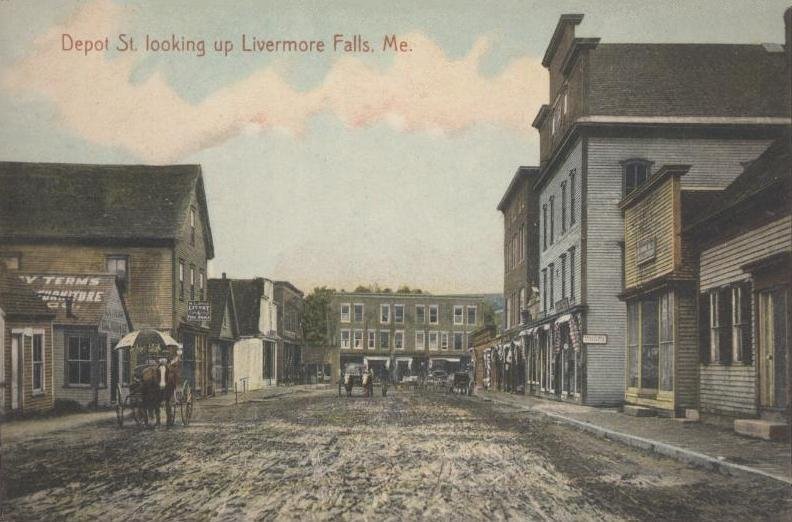
Depressing Depot Street in Livermore Falls in 1909, when the place was a busy mill town like so many others in New England.

Schoolhouses are our fortifications

Statue of Horace Mann outside the Massachusetts State House. In 1852, the state enacted the nation’s first mandatory public school attendance law, in large part because of Mann’s campaigning for it
“Education is our only political safety. Outside of this ark all is deluge.”
“Forts, arsenals, garrisons, armies, navies, are means of security and defense, which were invented in half-civilized times and in feudal or despotic countries; but schoolhouses are the republican line of fortifications, and if they are dismantled and dilapidated, ignorance and vice will pour in their legions through every breach.”
— Horace Mann (1796-1859), American education reformer, slavery abolitionist and Whig politician best known for his commitment to promoting public education. He was born in Franklin, Mass.
From the time he was 10 to when he reached 20, he had no more than six weeks' schooling during any year, but he made copious use of the Franklin Public Library, founded in 1790 as the first public lending library in America. At the age of 20, he enrolled at Brown University and graduated in three years as valedictorian. Franklin was named after Benjamin Franklin (1707-1790), who gave the town 116 books, which of course ended up in its its library.
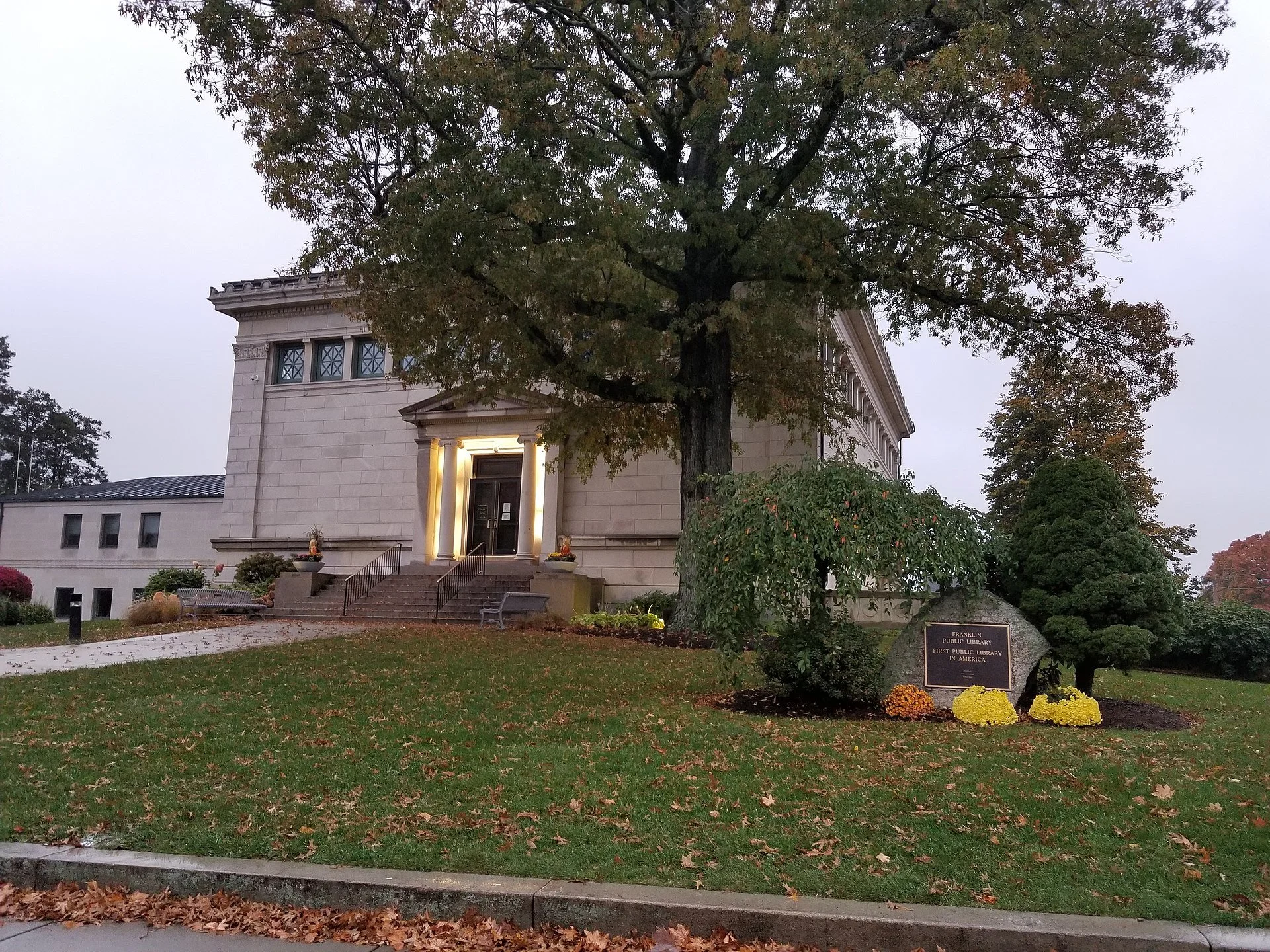
The current Franklin Public Library, opened in 1904.
— Photo by Swampyank

Notating the landscape

“Winter Rill” (acrylic on canvas), by Anni Lorenzini, in her show “In Sight: Notating the Landscape,’’ at Galatea Fine Art, Boston, Feb. 3-26. She lives part of the year Waterford, Vt.
She writes:
"'All I could see from where I stood...' Here poet Edna St. Vincent Millay pinpoints the artists' charge; to paint what you see as you see it.
“I notate the landscape with random strokes, smears and smudges. These tangled dots develop into intricate patterns that form the earth and sky. I respond to the intimate structure of each landscape painting as I learn to paint with my chosen tools.
“I apply paint with everyday household tools like sponges, rags and squeegees. These tools come from my life, providing an authentic means for artistic expression as I live on this fragile and beautiful earth."
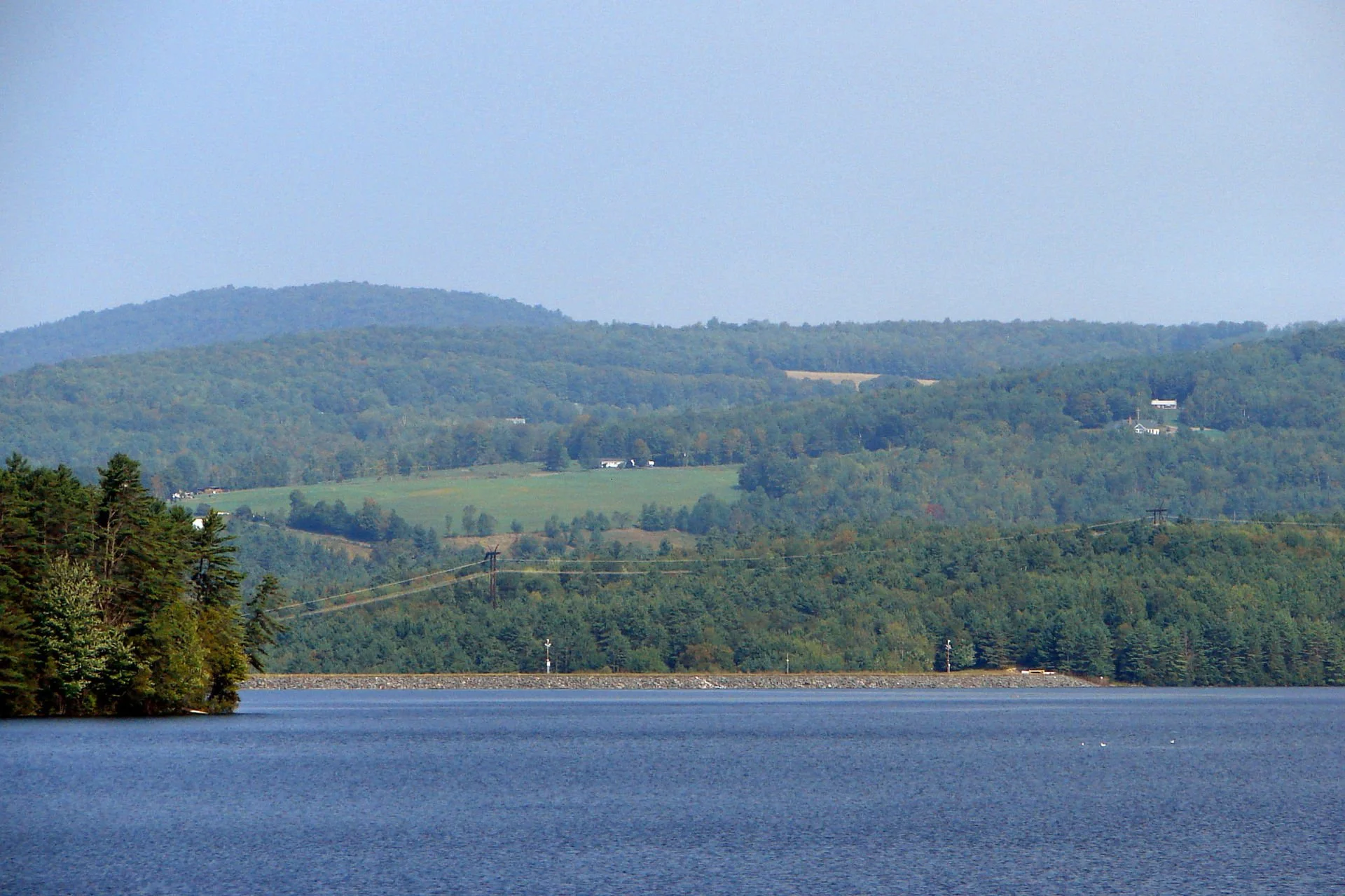
Waterford, Vt., seen across Moore Reservoir
— Photo by P199
R.I. bumblebee survey helps track species decline

Bumblebee in flight. It has its tongue extended and a laden pollen basket.
Photo by Pahazzard
From ecoRI News (ecori.org)
The brilliant blue morning sky was made more vibrant by the contrasting field of goldenrod in the Great Swamp Management Area, in southern Rhode Island, where Katie Burns stood. Alone in the cacophony of insect song, she quietly let her eyes adjust to the unique movements of the different pollinators around her before spotting a particular flight pattern. She swept her net through a swath of goldenrod, catching a bumblebee, and crooned to the insect as if it were a puppy as she coaxed it into a specimen jar and pointed out its identifying characteristics.
“One of the ways I can tell this one is a male is because he has a little mustache,” she said. “See?” And he did, indeed, have a little mustache that matched the earthy yellow of his stripes. She opened the jar and he flew off to return to his breakfast, seemingly unaffected by his brief capture.
“That bumblebee was an unwitting volunteer for the Rhode Island Bumblebee Survey (RIBS), a Rhode Island Pollinator Atlas project led and developed by Burns. The Atlas, backed by the Rhode Island Department of Environmental Management (DEM), Burns’ employer, will provide entomologists with baseline data. It will inventory the bee, butterfly and hoverfly species that currently live in Rhode Island, assess what resources are important to them, and pinpoint their preferred habitats so that scientists can track population declines and protect pollinators’ chosen dwellings.
There are an estimated 250 species of bees in Rhode Island, and Burns is starting her project focusing on one genus in the bee family: the bumblebee.
“Historically, there were 11 species of bumblebee in Rhode Island,” Burns said. “But currently, we can only find six.”
A combination of factors affected the other five. Some of the southernmost populations vanished as climate change made Rhode Island less habitable. Others struggle because of a lack of food sources.
“Bees we see disappearing are closely co-evolved with a flower species,” Burns said. “Their relationship is like that of puzzle pieces. And because they have such a specific niche, loss of resources can really affect them.”
She’s curious to see if this research will find the missing species in tiny pockets of the state. “Maybe they’ve found their niche on Block Island,” she said. “But we have to know who’s out there before we can help them.”
To gather data for the survey, Burns is relying on a group of volunteer community scientists — members of the public who are not necessarily professional scientists, but gather data for scientific studies. Each volunteer is responsible for a 1-hectare region in one of the 5-kilometer-by-5-kilometer squares making up an imaginary grid that overlays the state.
“It’s the same grid that the Rhode Island Breeding Bird Atlas used for their data collection,” Burns said, emphasizing her imitation was more than just flattery. “Using their grid is a move toward interspecies stewardship. If you have a healthy pollinator population, you’ll get more plant material, more seeds, more fruit, more food for birds. It’ll be interesting to see the food webs when these grids overlap.”
Volunteers are tasked with conducting a 45-minute survey in their chosen hectare once a month. “It’s 45 minutes divided by the number of people surveying the hectare,” Burns clarified. “So do it with a friend.” She also advises volunteers to choose a spot they already feel a kinship to — a place where they like to walk their dog or hike.
“Being part of a project like this helps people solidify their sense of place. When we know our neighbors, our community is stronger. But communities are made up of more than people,” Burns said. “They’re made up of plants and foxes and bunnies and bees. By learning how to identify some of the species in your backyard, it helps you feel connected.”
Volunteers begin each session with a habitat assessment before starting a timer and catching every bee they see. Those bees go into a cooler where they sleep through an unexpected artificial winter until volunteers can take photos of them. Then the bees warm up and fly off.
One of the 5 kilometer by 5 kilometer grids lands on Providence College, and biology Prof. Rachael Bonoan and a group of her students claimed it.
“During the school year, when I’m bogged down in teaching, it’s nice to have an excuse to go outside once a month,” Bonoan said. “But the biggest benefit was that this was an opportunity for me to teach my students survey methods and bumblebee identification while contributing to a larger body of research.”
Bonoan and her students were part of Burns’s pilot program, which ended in October. The program had 14 active volunteers, and Burns said she learned a lot through the experience. “My lovely volunteers, bless them, have been very patient with me,” she said with a laugh.
“The biggest thing I learned is how important on-the-ground training is,” Burns said. “I’ve been doing this work for 10 years, so it’s easy for me to say, ‘Go catch bees!’ But the response is, ‘You want me to catch something that can sting me and put it in a vial?’”
Community scientists have little to fear, however. Neither Bonoan nor Burns had experience with the business end of a bumblebee during their research.
Burns interrupted her description of the volunteer program to talk to an insect and burst a couple of jewelweed pods, in a charming display of her love for nature. “You don’t have to be an expert to enjoy nature,” she said. “I just want to encourage curiosity in people.”
Burns believes that it’s a mistake to rely solely on institutions and agencies to protect the environment. “We’re not being set up for success,” she said. “That’s why I like doing public engagement. And I try to make learning experiences as joyful and accessible as possible.”
A self-professed “theater nerd” in school, she brings many of the skills she learned on the stage to her work. “I’ve done comedy routines, podcasts, Soapbox Science — where a group of women scientists would go into public places, stand on soapboxes and just start talking — and PechaKucha,” she said.
At a late summer PechaKucha Night, a speaking event that highlights community members’ contributions to the state, Burns shared the stage with local artist, educator, and children’s entertainer Ricky Katowicz. “I was so impressed with her style of presenting,” Katowicz said. “She showed a lot of love for what she does.“ The pair teamed up to do a bug-themed show, appropriately called “Bugs,” in October.
“Katie has a very commanding presence,” Katowicz said. “When she talks, people listen.”
Burns has to make people listen because the things she says about the path we are on are important.
“The most immediate repercussion of pollinator decline is a loss of plant diversity, which may not be the end immediately,” she warned. “But if we have fewer plants for pollinators and fewer pollinator species, if a disease takes out a big species, like honeybees, we’d have a problem. Would there be anything left to pollinate crops?”
In the fruit orchards of southwest China, heavy use of pesticides has decimated local pollinator populations. Some farmers have to hand-pollinate their fruit trees, using paintbrushes and little pots of pollen. “It sounds like ‘Black Mirror’ stuff,” she said. “But it’s real and here and happening now. It’s a glimpse of what the future could be without our pollinators.”
Burns has some advice for those who want to help steer us onto a new path. Mow less. Reduce pesticide use. Plant native food species. Plant native wildflowers. Turn off outdoor lights at night so moths and beetles don’t get disoriented.
“Embrace a messier lifestyle,” said Burns, describing the winter yards most attractive to pollinators. “If you’re really brave, leave all your fall leaves where they landed. Hollow plant stems and leaf litter provide a perfect winter habitat for dormant pollinators.”
It’s an incredible exercise of imagination to look at a dead winter field and picture how much life exists there — the butterfly larvae hiding in the skeletons of summer plants and tiny creatures tucked under a blanket of leaves.
“These miniature worlds that surround us so often go unnoticed, but once you see them you can’t look away,” Burns said. “These thriving communities are just as fascinating as our own. And what a privilege it is to recognize and be part of that world.”
Burns is seeking to recruit between 60 and 70 volunteer community scientists to help her collect data for The Rhode Island Bumblebee Survey in 2023. The data collection season will run from April to October. For information on volunteering, go to https://forms.office.com/g/6XUxyP3rGc.
Of two minds

“To Center,’’ by Newton, Mass.-based Delanie Wise, in the group show “Stirring + Layering,’’ at Boston Sculptors Gallery, Feb. 1-26.
The gallery says:
The fractured figurative work of Delanie Wise delves into our individual and collective experiences, as well as the congruity of opposing forces. Wise’s ceramic sculptures, while not definitively self-portraits, reflect her own sensibilities yet posit her life experiences are more universal than unique. A bust depicts a woman literally of two minds—her head neatly bisected, while another figure is part woman, part vase, trapped in her vessel. Or is she a magical genie emerging?’’
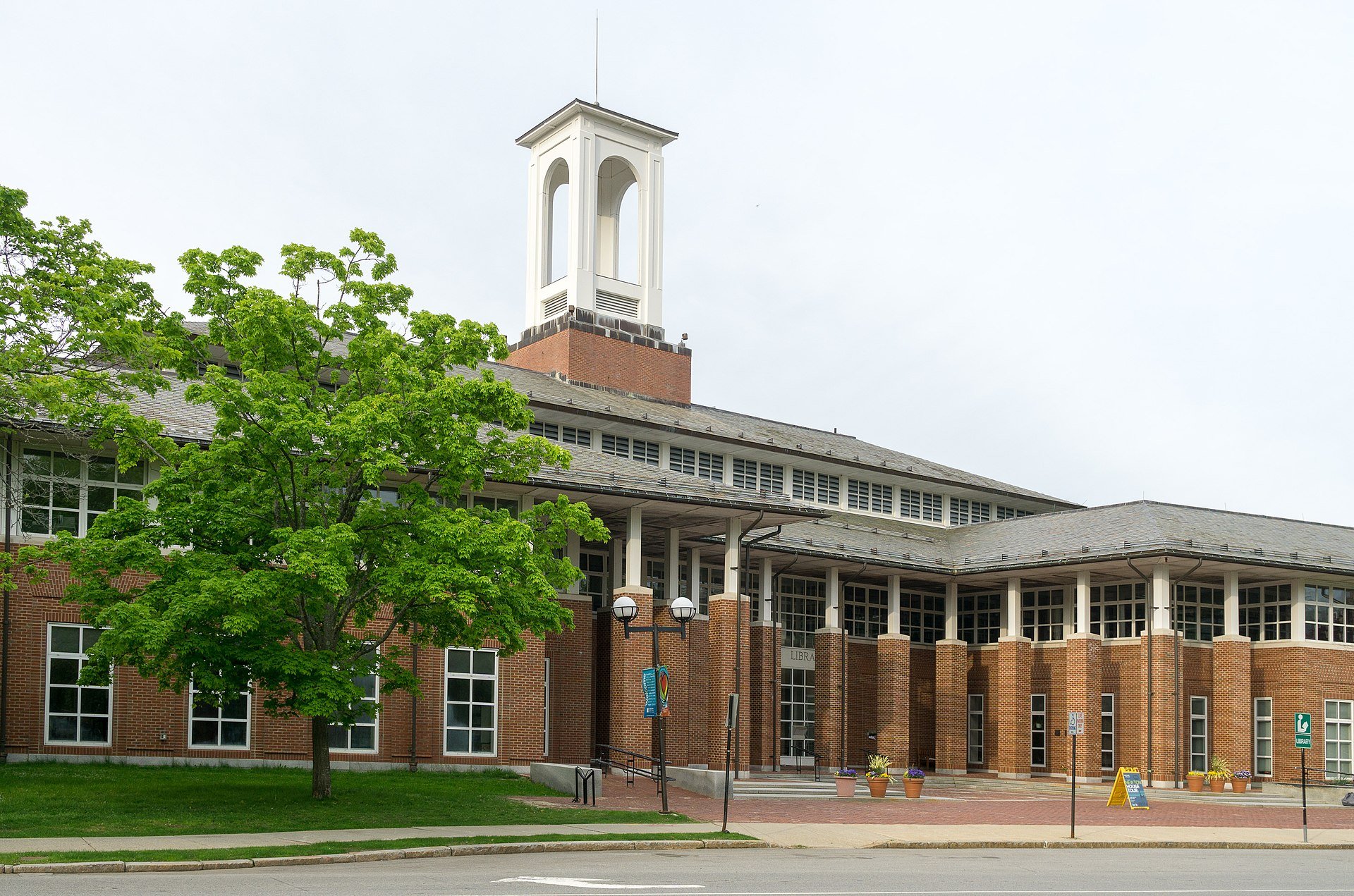
The Newton Public Library. The city is nationally known for its fine public schools and the generally high level of literacy, general knowledge and civic engagement of its residents.,
— Photo by Kenneth C. Zirkel
Chris Powell: Rent control worsens housing shortage; teacher union greed
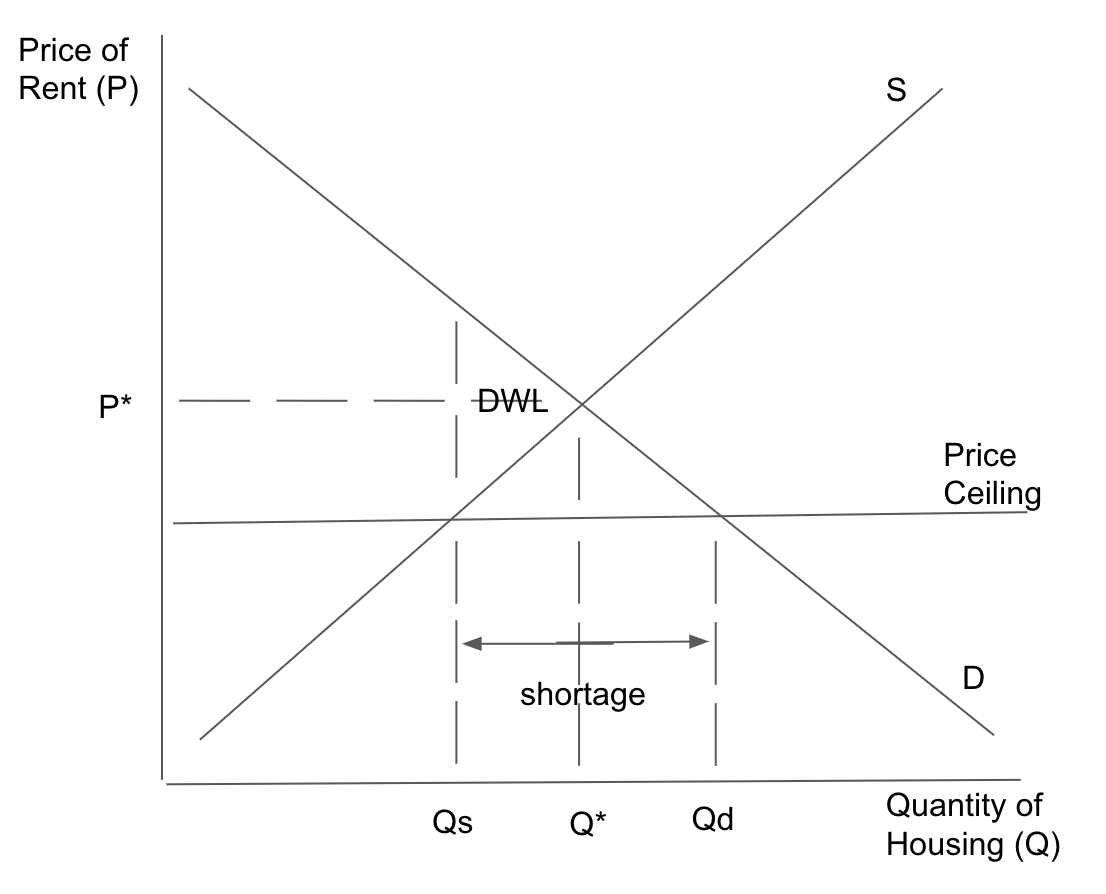
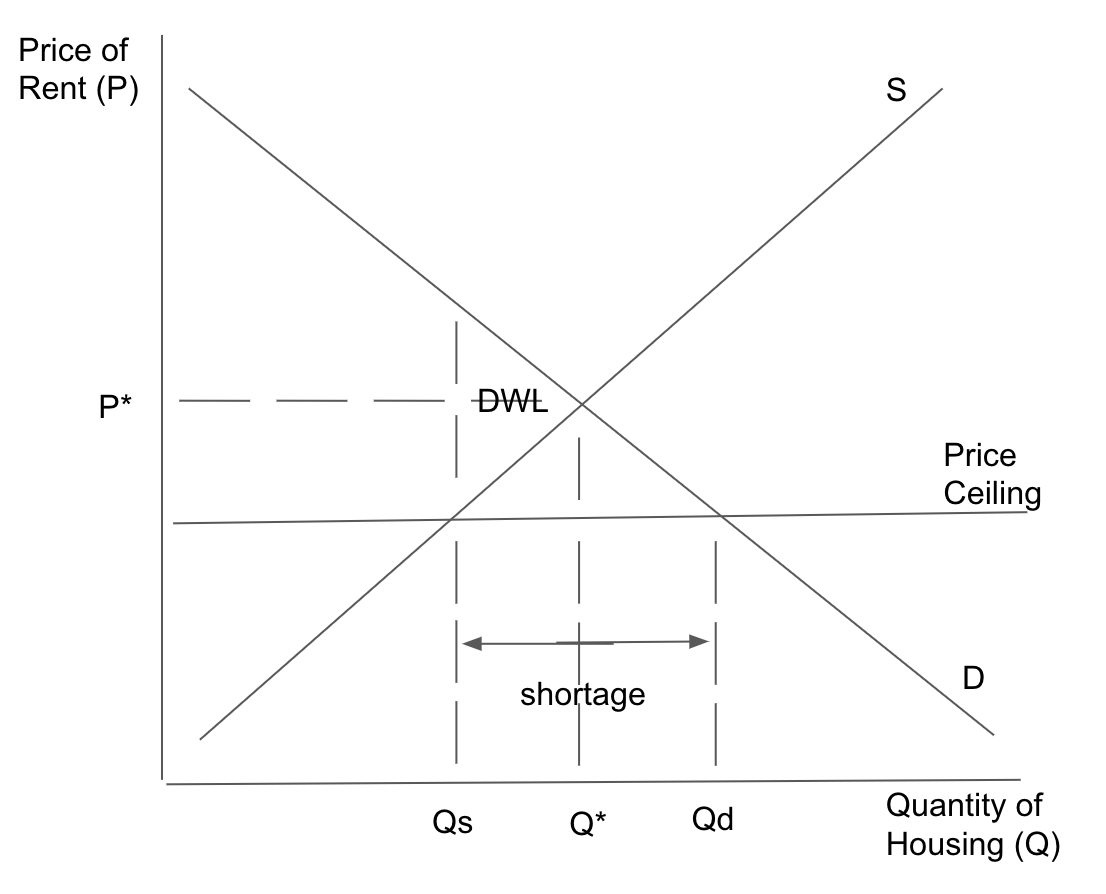
A price ceiling will create a shortage in between Qs and Qd.
— Photo by Karinnna13
MANCHESTER, Conn.
Connecticut may have had its "All power to the Soviets!" moment the other day as more than 200 people summoned by the Democratic Socialists of America gathered on the Internet to call for a law to limit residential rent increases to 2½ percent annually. Five Democratic state legislators have co-sponsored the legislation and thus have tainted themselves with its demagogic scapegoating, its accusation that landlords are uniquely responsible for inflation.
"Our rent increases every year and our incomes do not," a tenants union activist said -- an excellent point immediately discredited by the failure to acknowledge the wider world.
That is, real wages throughout the country long have been falling behind inflation in all important respects -- not just the cost of housing but also food, electricity, gasoline, medicine, education and other essentials.
So where is the legislation to limit those costs?
Such legislation can't be introduced without exposing the scapegoating being done to the landlords, nor without revealing that a substantial percentage of inflation is caused by government itself as its creation of money far outstrips the production of goods and services.
While Connecticut has a severe shortage of inexpensive rental housing, the rent-control legislation has just struck a powerful blow against efforts to get more such housing built or renovated.
For what housing developer or landlord will want to risk his money building or renovating apartments when state government may prohibit him alone from fully protecting himself against inflation?
Under the rent-control legislation, everyone else in commerce will remain free to raise prices by any amount to cover himself against inflation, and apartment tenants will be free to demand higher wages in any amount. But the rental-housing business will be strictly limited to price increases far below the inflation rate.
The result of this will be still more scarcity inflating housing prices. Under rent control housing providers will be effectively expropriated by inflation.
That's "democratic socialism" for you -- diverting the blame from government without ever solving the problem government itself caused. Whom will the "democratic socialists" scapegoat next?
xxx
Guess how Connecticut's teacher unions want the state budget surplus distributed.
It's not to do anything compelling. No, the teacher unions want to use the surplus to increase their members' pay, which is already nearly the highest in the country.
Connecticut does have a problem with teachers, as it does with police officers. As social disintegration worsens, especially in the cities, fewer people want to teach where as many as half the students are chronically absent and many misbehave, and fewer people want to work in law enforcement where respect for law has collapsed.
As a result many teachers and police officers in the cities have been leaving for jobs in the suburbs, where social disintegration isn't as bad and they are paid more for easier work.
But that is no reason to increase compensation for teachers generally. It is a reason to increase salaries for teachers where more teachers are most needed particularly -- and not just in the cities but in particular subjects.
Typically, teacher union contracts won't allow that. So any new state money addressing the teacher shortage should be exempt from union contract restrictions.
Any new money also should come with audit requirements to determine if the money improves student performance, which is so bad in the cities that no additional spending is likely to accomplish anything unless it hires parents for the kids.
xxx
The Board of Education in Bridgeport, whose schools long have been in turmoil and whose students perform terribly, wants to hire a public-relations company. According to the Connecticut Post, the company would "manage the district's reputation, provide risk mitigation and consultation services, develop a crisis response plan, and train administrators in crisis communications."
It's as if the board has never heard that to change the image, it's necessary to change the reality. But then all Connecticut seems to have given up on changing the cruel reality of its cities.
Chris Powell (CPowell@JournalInquirer.com) is a columnist for the Journal Inquirer, in Manchester.

And where is the classic winter?

“New England Light” (acrylic on panel), by Linda Hefner, in the Duxbury (Mass.) Art Association’s “Annual Winter Juried Show,’’ through March 28.
She writes:
“Classic New England architecture is a dying breed. My work celebrates the endangered beauty of old New England barns, schoolhouses, and grange halls, and by extension, the rural communities that depended upon them for daily survival. I build my paintings up slowly and meticulously, focusing on accuracy and fine detail as well as on the play between light and shadow. These wonderful handmade buildings have so much beauty and strength, and I want to invite viewers to share in that with me and to appreciate these monuments of a vanished time before they’re gone.’’
A leaden state
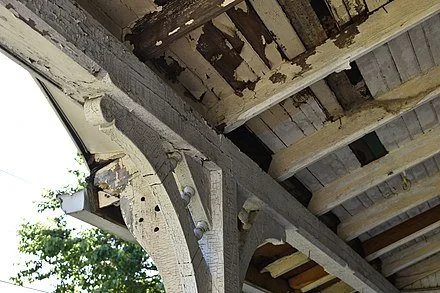
Cracking peeling lead paint.
“New Hampshire has one of the oldest housing stocks in the nation, which puts us all at a heightened risk of lead poisoning” {from lead paint}.
— Chris Sununu (born 1974), New Hampshire’s current governor

—Photo by Thester11
Is it worth it?
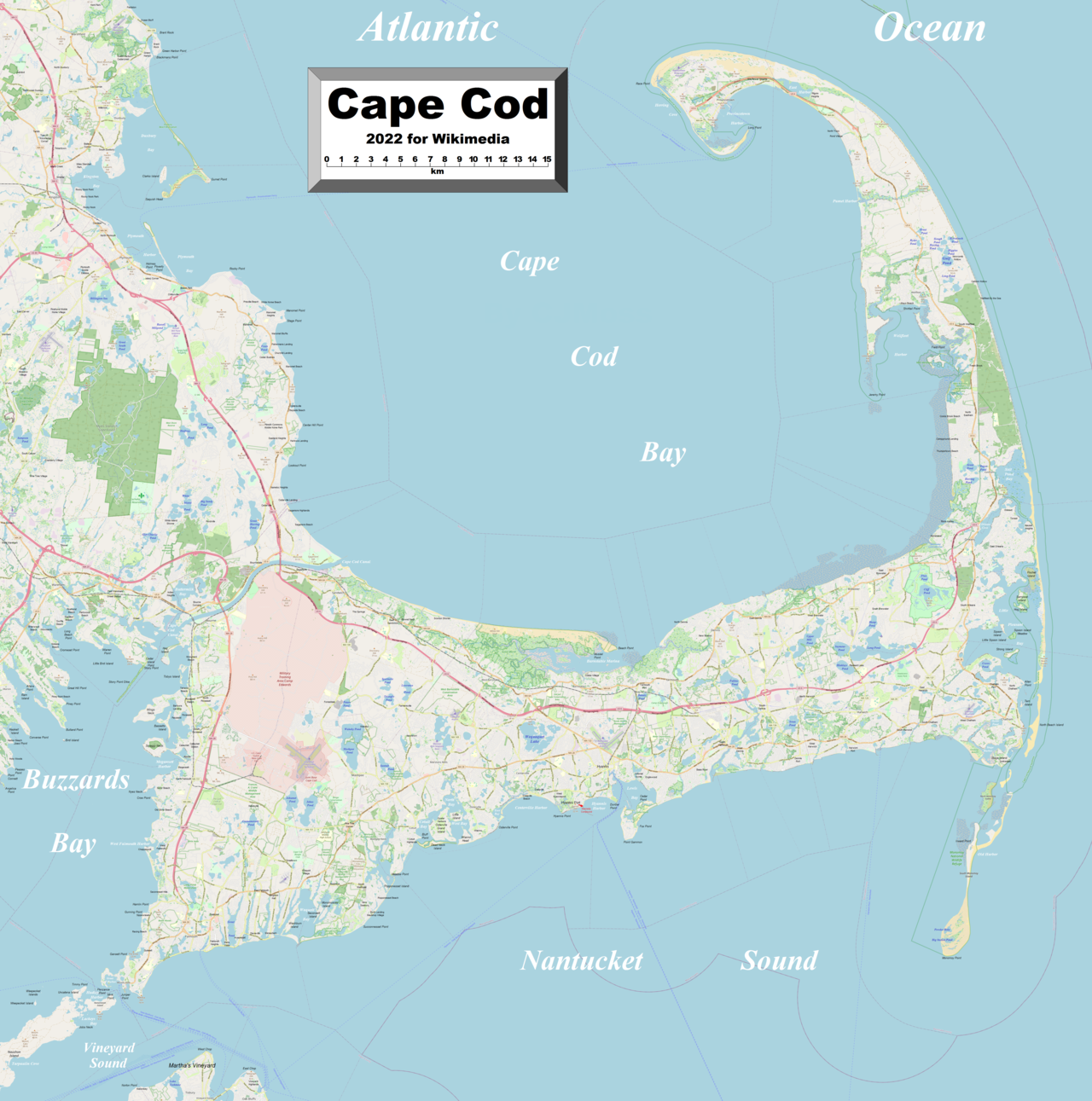
—Map by Kelisi
Adapted from Robert Whitcomb’s “Digital Diary,’’ in GoLocal24.com
“Yet each man kills the thing he loves….”
-- Oscar Wilde (1854-1900), Anglo-Irish playwright and poet
Poor old Cape Cod, once rural and now exurban and suburban.
There’s not enough money at the moment to replace the old (from the 1930s) and too narrow Sagamore and Bourne bridges. And pollution from septic systems, fertilizers and pesticides (lawns and golf courses are major sources) kills life in many freshwater ponds. There are 42 golf courses on the skinny glorified sand bar we call Cape Cod!
What to do? Year-round passenger-train service to reduce car traffic to and fro and on the peninsula? (This would be via the charming railroad bridge over the Cape Cod Canal.) A Barnstable County-wide bond issue to pay to extend sewerage? Close some golf courses

Llewellyn King: Big tech media monopolize ads, ravage journalism and act as global censors

At a Google advertising seminar in London in 2010
— Photo by Derzsi Elekes Andor
WEST WARWICK, R.I.
The Department of Justice has filed suit against Google for its predatory advertising practices. Bully!
Not that I think Google is inherently evil, venal or greedier than any other corporation. Indeed, it is a source of much good through its awesome search engine.
But when it comes to advertising, Google, and the others with high-tech media platforms, most notably Facebook, have done inestimable damage. They have hoovered up most of the available advertising dollars, bankrupting much of the world’s traditional media and, thereby, limiting the coverage of the news — especially local news.
They have ripped the heart out of the economics of journalism.
Like other Internet companies, they treasure their own intellectual property while sucking up the journalistic property of the impoverished providers without a thought of paying.
While I doubt thatr the DOJ suit will do much to redress the advertising imbalance (Axios argues that the part of Google the DOJ wants divested only accounts for 12 percent of the company’s revenue), it will keep the issue of what to do about big tech media churning.
The issue of advertising is an old conundrum, written extra-large by the Internet.
Advertisers have always favored a kind of first-past-the-post strategy. In practice this has meant in the world of newspapers that a small edge in circulation means a massive gulf in advertising volume.
Broadcasting, through the ratings system, has been able to charge for the audience it gets, plus a premium for perceived audience quality — 60 Minutes compared to, say, Maury, which was canceled last year.
But mostly, it is always about raw numbers of readers, listeners and viewers. In a rough calculation, first past the post has meant 20 percent more of the audience turns into 50 percent more of the available advertising dollars.
I would cite The New York Times's leverage over the old New York Herald Tribune, The Baltimore Sun’s edge over the old News-American, and The Washington Post’s advantage over the old Evening Star. The weaker papers all in time folded even when they had healthy circulations, just not healthy enough.
Google, Facebook, Twitter, etc.,with their massive reach are killing off the traditional print media and wreaking havoc in broadcasting. This calls out for redress but it won’t come from the narrow focus of the DOJ suit.
The even larger issue with Google and its compatriots is freedom of speech.
The Internet tech publishers, for that is what they are, Google, LinkedIn, Twitter, Facebook and others, reserve the right to throw you off their sites if you indulge in speech that, by contemporary standards, incites hate, violence or at least social disturbance.
Conservatives believe that they are victimized, and I agree. Anyone whose speech is restricted by another individual or an institution is a victim of prejudice, albeit the prejudice of good intent.
Recently, I was warned by LinkedIn that I would be barred from posting on the site because I had transgressed — and two transgressions merit banning. The offending item was an historical piece about a World War II massacre in Greece. The offense may have been a dramatic photograph of skulls, taken by my wife, Linda Gasparello, displayed in the museum at Distomo, scene of a barbarous genocide.
I followed the appeal procedure against the two-strikes-you’re-out rule, but I have heard nothing. I expect the censoring algorithms have my number and are ready to protect the public from me next time I write about an ugly historical event.
The concept of “hate speech” is contrary to free expression. It calls for censorship even though it professes otherwise. Any time one group of people is telling another, or even an individual, what they can say, free speech is threatened, the First Amendment compromised
The problem isn’t what is called hate speech but lying — a malady that is endemic in the political class.
The defense against the liars who haunt social media is what some find hateful speech: ridicule, invective, irony, satire, and all the other weapons in the literary quiver.
The right to bear the arms of free and open discourse shouldn’t be infringed by the social media giants.
Llewellyn King is executive producer and host of White House Chronicle, on PBS. His email is llewellynking1@gmail.com, and he’s based in Rhode Island and Washington, D.C.
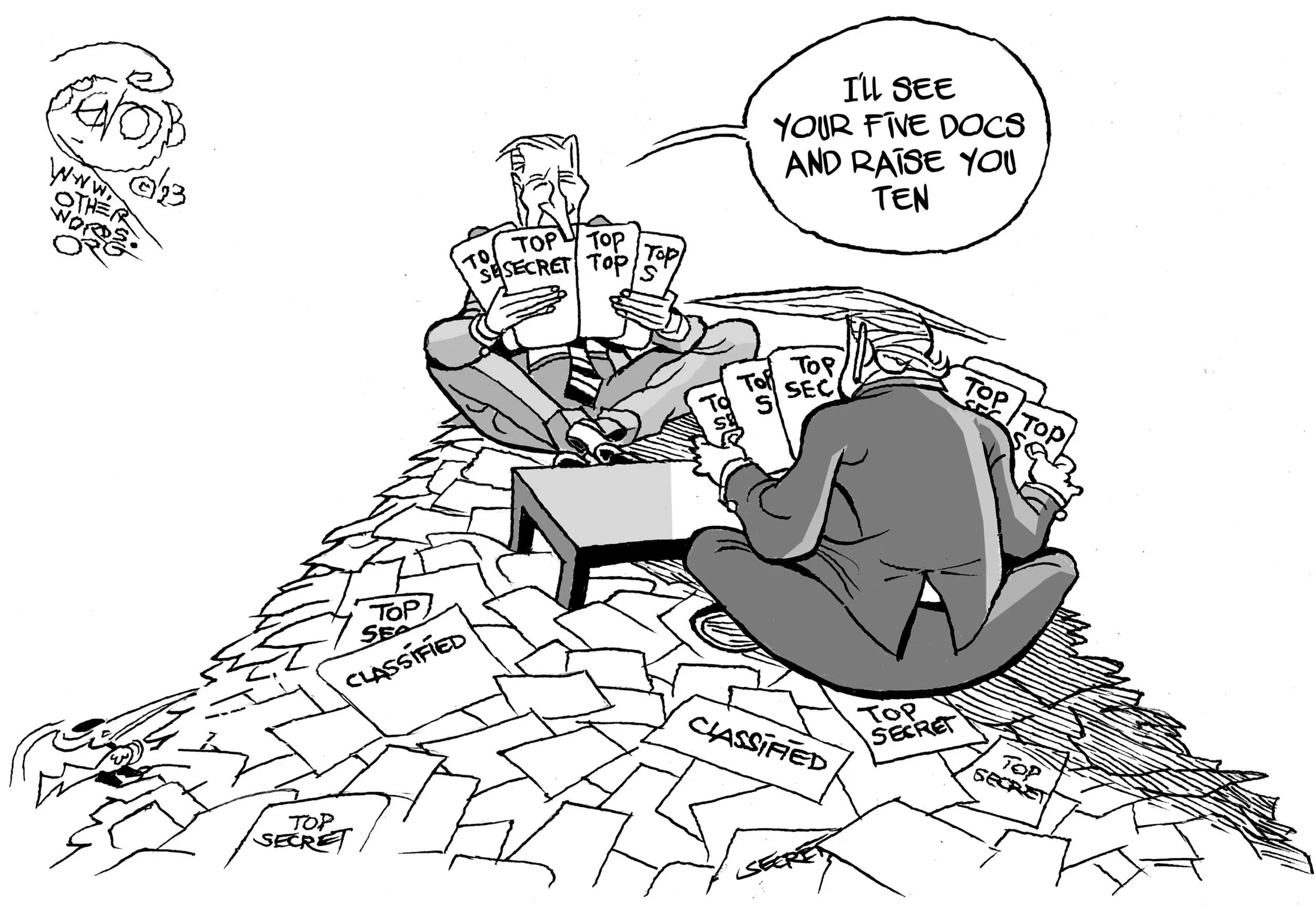

Sam Pizzigati: The best case yet for raising taxes on billionaires

“Spirit of Ecstasy,” the bonnet ornament sculpture on Rolls-Royce cars, for which there were record sales last year.
— Photo by Jed
Via OtherWords. org
BOSTON
Sometimes the daily news about our billionaires just doesn’t make sense.
Last year, for instance, ended with a torrent of news stories about how poorly the world’s billionaires fared in 2022. Bloomberg tagged the 12 months that had just gone past “a year to forget,” with almost $1.5 trillion “wiped from the fortunes of the richest 500 alone.”
All global billionaires taken together, Forbes chimed in, lost $1.9 trillion in 2022. Some 148 of the world’s 2,671 billionaires even lost their billionaire status.
The year’s biggest billionaire losers? Some of America’s deepest pockets.
Larry Page saw his Google-driven fortune drop $40 billion. Mark Zuckerberg watched $78 billion evaporate off the wealth Facebook created for him. And Amazon’s Jeff Bezos had to swallow a minus $80 billion.
But honors for the biggest nosedive of all have to go to Elon Musk. The world’s richest man at the start of 2022, Musk ended the year losing both his top slot and some $115 billion from his personal fortune.
So did all these losses have our billionaires shaking in their boots? Did they start tightening their belts a bit in 2022? Spend less on the world’s most fabulously expensive luxuries?
Not exactly. In fact, not all.
The world’s most celebrated purveyors of pure extravagance actually registered record years in 2022. Rolls-Royce had its best-ever annual sales total, selling a record 6,021 “motor cars,” up 8 percent over 2021.
“Our clients,” Rolls-Royce’s CEO crowed on New Year’s Day, “are now happy to pay around half a million Euros for their unique motor car,” a sum equal to about $540,000 in the United States, the company’s single largest market.
“Our order book stretches far into 2023 for all models,” the Rolls-Royce chief added. “We haven’t seen any slowdown in orders.”
Lamborghini had an even better 2022, with 9,233 vehicles sold — a 10-percent jump over last year. The company’s biggest market? The United States. Americans drove off Lamborghini lots with 2,771 new cars in 2022. The automaker’s most popular model runs about a quarter-million.
Realtors who cater to the ultra-rich set had an equally boffo year in 2022.
In a down real-estate market, the highest of high-end residences still pulled in mega sums at closing time. The year’s top 10 home sales in the United States, notes the luxury-oriented Robb Report, “totaled roughly $1.165 billion, proving that, impending recession or not, luxury real estate will always be traded.”
How can all this luxury be? How can the richest of the rich be spending fantastic sums in a year when they’re seeing fantastic falls in their personal net worths?
Simple. In the realms of the super rich, losing a billion — or even many billions — makes no difference whatsoever in real daily life. Net worth down a few billion? You can still afford anything your heart could possibly desire.
No one alive today needs fortunes worth dozens of billions to live astoundingly large. A mere billion would suffice. So, truth be told, would a mere tenth of a billion. In the day-to-day lives of billionaires, a few billions or so have no practical significance — except when it comes to increasing their political power at the expense of the rest of us.
Taxing those billions to support the common good, on the other hand, could make an immeasurable difference in the lives of millions — and our democracy.
We need more than a dip in grand concentrations of private wealth. We need a world without billionaires.
Sam Pizzigati, based in Boston, co-edits Inequality.org at the Institute for Policy Studies. His books include The Case for a Maximum Wage and The Rich Don’t Always Win.