
Llewellyn King: Woe Britannia!
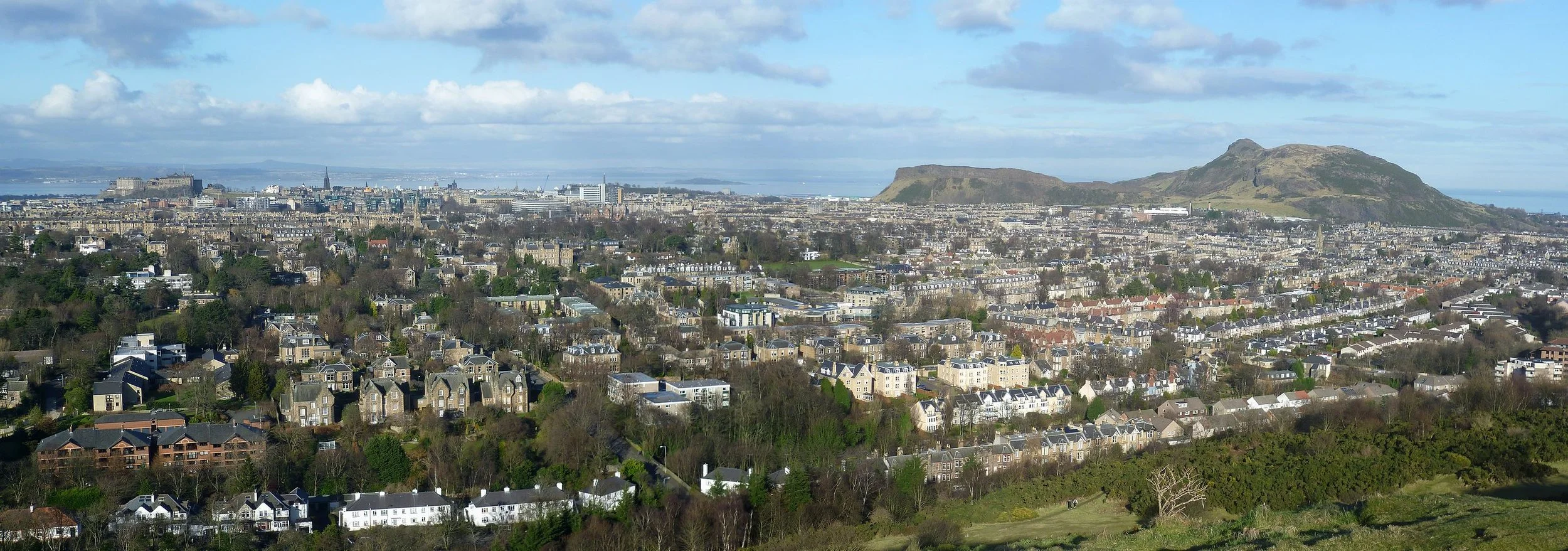
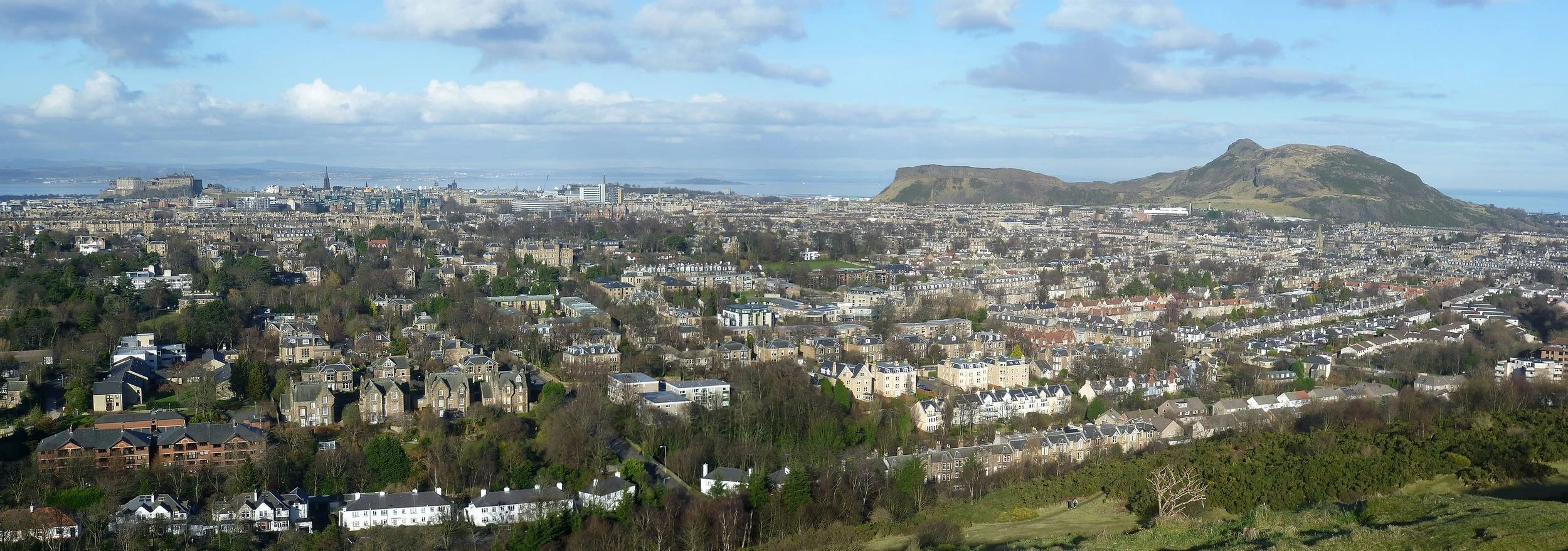
View of Edinburgh from Blackford Hill
— Photo by Kim Traynor
EDINBURGH
These are trying times for the British, as I am finding on a visit to Scotland with a brief foray south into England. All isn’t right with their world, and there are expectations that the winter will be the hardest to bear since the long-ago days of the end of World War II.
The price of everything is up, with inflation at 10 percent and predicted to top that by as much as double.
Compounding there is a sense that nobody is in charge. The new prime minister, Liz Truss, has had a disastrous beginning with a revolt of the rank and file of her own Conservative Party. She has had to eat her words and, according to the New Statesman, has had the worst imaginable beginning for a new prime minister.
Truss seems to have abandoned traditional conservative principles and that, together with her own wobbly trajectory, has the party worried.
The centerpiece of doubt about the prime minister is a mini-budget that her chancellor of the exchequer, Kwasi Kwarteng, introduced just after she was elected to the leadership. It called for more spending and a cut in the top income tax rate from 45 percent to 40 percent.
This was supposed to encourage business, but even diehard conservatives couldn’t justify a lot of new spending -- needed to ease the burden of energy costs -- while slashing revenue. Rather than making business happy, the proposal sent the pound into freefall and the markets into turmoil.
Truss did a U-turn, a maneuver, according to her many critics, that she has done often in her career.
Another misstep happened as the Conservatives were assembling in the central English city of Birmingham for their annual party congress: The prime minister refused to guarantee that social spending would be linked to the cost of living.
Complex social obligations in Britain are lumped together under the rubric benefit. “No, no, no,” cried the party, including members of the cabinet. Benefit had to be indexed to the cost of living.
But not all of the mess is of Truss’s making. Things were in sorry shape when the previous prime minister, the notoriously articulate but incompetent Boris Johnson, was sacked by the party.
The economy was faltering, labor unrest was building and such issues as education, health care, immigration and the Northern Irish border were demanding strong, deft leadership.
The result has been that the Tories, as the Conservatives are called, are between 14 and 30 points behind the opposition Labor Party in the polls, and they are expecting a drubbing in the next election in two years, unless Truss can pull things together. The somber mood in Birmingham suggests that gloom will turn to doom.
The Truss government is set to massively subsidize heating costs this winter, which promises real hardship across the board, from pubs which are closing at a record rate to middle-class households now digging out the woolies.
The primary fuel for making electricity and for home heating is natural gas, and the price of that has soared over historical levels because of Russia’s war in Ukraine. The subsidy isn’t disputed, but it will take British borrowing to new levels even as interest costs are soaring -- an ugly combination.
Another open issue is how to fix Britain’s beloved National Health Service, which has fallen into an institutional disrepair. Waiting lists are longer than they have ever been even for minor procedures and successive management shakeups haven’t solved the problems. Yet the health service remains the most popular government program in Britain, and Truss will have to produce something more than Band-aids for the NHS if its failures aren’t to be, albeit unfairly, laid to Truss.
Another headache for the embattled prime minister is that organized labor is on the march again. Strikes, euphemistically called industrial action, in Britain are back. The railroads are being hit, and there is some sense that the bad old days when Britain was the Sick Man of Europe, before Margaret Thatcher, may be returning.
There is a backstory that isn’t being aired much in the largely Conservative British newspapers: the huge, self-inflicted wound of Britain’s withdrawal from the European Union, known as Brexit. Its effects are everywhere and there is a complicity in not pointing this out: We voted for it, and we own it. It wasn’t a party vote, so Brexit remains a common guilt.
Long after Truss has gone, Brexit will remain the guiding fact of Britain’s place in the world. A place less certain than at any time in its long history.
Llewellyn King is executive producer and host of White House Chronicle, on PBS. His email is llewellynking1@gmail.com and he’s based in Rhode Island and Washington, D.C.
And October alchemy

“Earthly Alchemy’’ (encaustic monotype, ink, pencil, oil pastel on Kitakata), by Worcester-based painter Donna Hamil Talman.
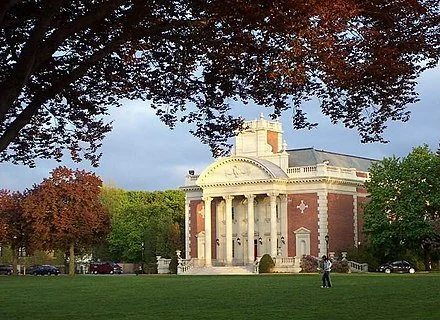
Warner Memorial Theater, at Worcester Academy. Opened in 1932, it was designed by Drew Eberson. The prep school’s famous alumni include computer/lyricist Cole Porter.
Argon art; this old house

“Portrait of Joan” (hand-blown and colored glass tubing, argon gas with mercury transformer), by Laddie John Dill, at the Armenian Museum, Watertown, Mass., in the show “On the Edge: Los Angeles Art 1970’s-1990’s’’
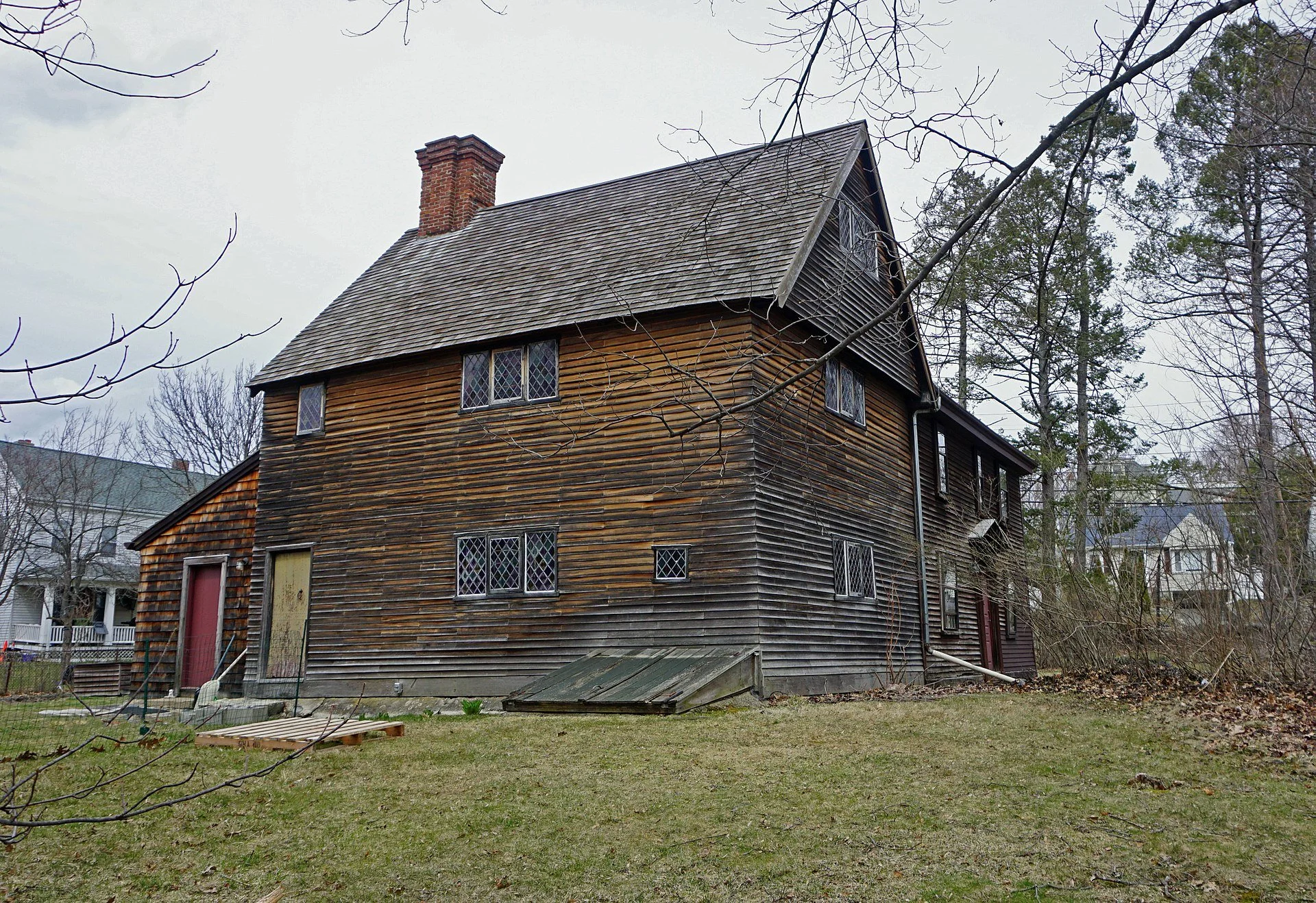
Abraham Browne House, in Watertown, built around 1694. It is now a nonprofit museum operated by Historic New England.
The house was originally a simple one-over-one dwelling and features steep roofing and casement windows, recalling many 17th Century English dwellings. During restoration work in 1919, details of 17th Century finish were found. The ground floor has one large room, which was used for as a sort of living room as well as for cooking and sleeping.
The building may be one of fewer than a half-dozen houses in New England to retain this profile.
— Photo by Wayne Marshall Chase
Mary Lhowe: Going for ‘green burials’
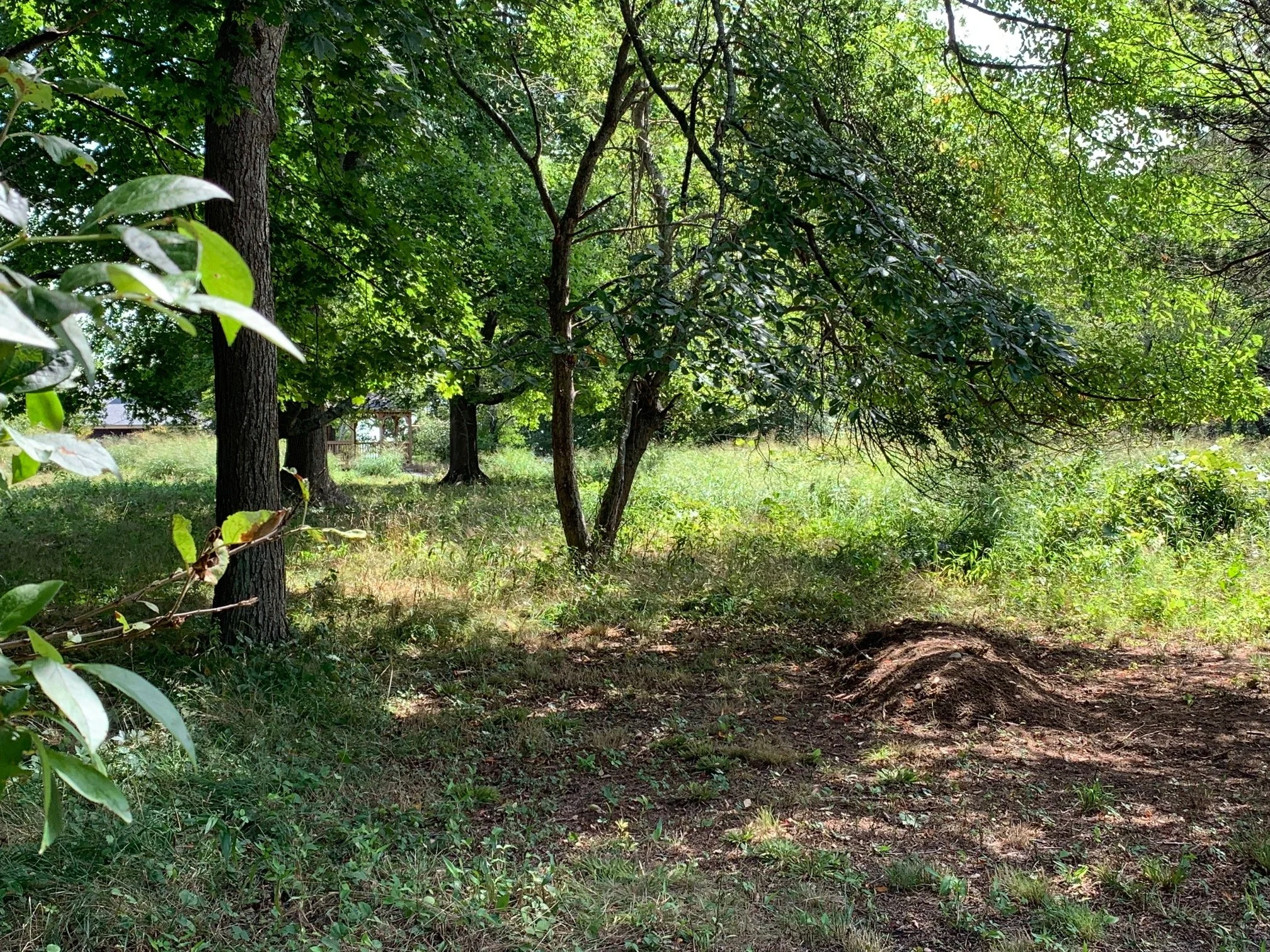
Recent gravesites at Prudence Memorial Park. Soil taken from a grave is mounded on top to create a level surface after settling takes place. The soil is initially removed from the grave and separated by layers, and returned in the same pattern, leaving plant-nourishing topsoil on top.
— Mary Lhowe/ecoRI News photo
From ecoRI News (ecori.org)
You couldn’t possibly count the number of places in Rhode Island where you can walk in pure silence except for leaf rustle, moving among drowsing wildflowers, and around shrubs and trees situated by the hand of nature, the landscape free of human objects except for a sliver of a path.
But you can count the number of natural outdoor places that also serve as a functioning cemetery: there is one. It is Prudence Memorial Park, on Prudence Island, a place set aside and developed specifically for green burials, an eco-friendly way to bury the dead that is gaining acceptance across the country.
A green — also called “natural” — burial is one that prohibits embalming with dangerous chemicals, such as formaldehyde. Containers for the body are a simple fabric shroud or a casket of biodegradable material like pine or wicker with no metal fastenings, exotic woods, glues, varnish, or metal fixtures. Finally, in a green burial, there is no concrete underground cement vault or grave liner that the casket sits inside, as in a conventional burial.
That is the basic definition, but a purist definition may go farther. In a green burial, washing and shrouding of the body may be done by family members or friends. Family members may dig the grave by hand. A green burial may take place on private property.
One main driver of green burials is concern for the health of the environment, and also for workers in the funeral industry. Standard embalming fluids contain formaldehyde, which inevitably leach into the ground from the body, and also enter septic systems or sewers straight from a funeral home’s work rooms. These fluids also have been implicated in higher rates of serious illness among funeral home workers. Similarly, varnishes and metal parts of caskets degrade and leach into groundwater.
The exotic hardwoods for fancy caskets are harvested from sometimes-depleted tropical forests and transported around the world at a high cost of fuel. The cement for making underground vaults is a high-polluting material, because of the effects of mining, manufacturing, and transportation.
Green burials are chosen not only by people who want to protect the environment. Some families are turned off by what they see as the excess and expense of fancy caskets and elaborate staging of conventional funerals. Some are looking for an avenue for family members to play a bigger role in the moment, including washing and dressing the body. Some crave quietness and intimacy.
Before green burial started to become known and requested — in the past 10 to 20 years — people sometimes chose cremation because they see it as a cleaner alternative to a full-dress funeral with embalming, tropical-wood casket, and underground vaults. In fact, cremation is a polluting process, in view of the carbon dioxide emissions from the burning. Emissions also contain pollutants from the body, such as mercury from dental fillings and medicines in the tissues.
Ed Bixby, president of the board of the nationwide Green Burial Council (GBC), said lots of ordinary people, not necessarily environmentalists, are asking about green burial. He said families say, “I want something simpler; I want something that feels good; I want my family involved. I want a memorable experience with my loved ones.”
Green burials are conducted by funeral homes across the country, including in Rhode Island. Despite the DIY quality of a green burial, funeral homes are usually enlisted to help with things like securing death certificates and permits, submitting obituaries, hosting a memorial ceremony, finding a biodegradable casket, and arranging for flowers, music and transportation.
In Rhode Island, green burials are done at Swan Point Cemetery in Providence, at Arnold Mills Cemetery in Cumberland, and at Prudence Memorial Park. The first two are “hybrid” facilities, in that they are traditional cemeteries that, in recent years, adapted plots and practices for green burials. Only Prudence is a conservation burial ground.
The park was created and opened for service in 2019 by a three-generation Prudence Island woman who saw a need, pulled on her first pair of work gloves, and went to it.
Island Afterlife
At 5 1/2 square miles, Prudence Island, at the geographical center of Narragansett Bay, is the third largest of the islands in the bay, with only about 150 year-round residents. For people who don’t own boats, the Portsmouth island can be reached only by ferry from Bristol. The island has no businesses, except a small general store.
Robin Weber’s grandfather bought a summer house on Prudence Island, but she and her brother are the first generation to live there year-round. She worked for 20 years as stewardship coordinator for the Narragansett Bay National Estuarian Research Reserve, headquartered on the island.
Also, the island has no cemetery, which Weber has long thought of as a critical omission.
“Prudence Island is a tight community; if you love it, it really is home,” she said. Lots of people who love Rhode Island and Narragansett Bay would like to use the island or its nearby waters as a final resting place for their body or ashes.
For years, Weber had no luck persuading a local conservation group to solve the lack of a cemetery. In 2018, she said, five lots forming a 3.3-acre plot of wooded land on the island came up for sale. She bought it and began taming the property, adding mulch and a modest shed for gatherings and storage, and removing nuisance plants. It began doing business as a burial ground in 2019.
The memorial park has mulched paths, a few wooden benches, and a gazebo. There are no grave markers apart from fieldstones that lie flat on the ground. Weber owns a Victoria-era caisson for transporting caskets or shrouded bodies. Since 2019, the memorial park has hosted two burials and Weber has pre-sold 30 plots. She said interest in the property is coming from both Rhode Islanders and out-of-state people. All are welcome.
Weber calls the practices of contemporary traditional funerals “grossly wasteful,” but she also loves the idea of green funerals because they are “participatory. It is a healthier way for most people.”
At one of the burials there, she said, kids in the family decorated the cardboard casket with photos and flowers. Another group took an active role in filling the grave.
Weber believes green funerals will become more popular in the future. “There is a kind of cultural denial of the reality that bodies decompose when we die,” she said. “We have managed to pretend it doesn’t happen. But in a green burial, over time, people will give back to the Earth by letting the nutrients in their bodies be taken up by the trees and shrubs.”
Swan Point Cemetery, in Providence, opened a green burial section called The Ellipse in 2019, based on requests from families, said Anthony Hollingshead, president of Swan Point Cemetery. The Ellipse has 148 grave spaces, and half of them have been sold. The area is grassy, bordered by large, old rhododendrons. There are no memorials on the graves; instead, names, along with birth and death dates, are inscribed on three ledger stones in the center of the space.
People like the green option because it feels “like a return to nature,” Hollingshead said. “Families don’t strongly oppose the traditional burial, but they like the wicker caskets. They like the idea of a peaceful area under a tree. They like that this is plain, not ornate. They seem to be people who have a bit more concern for the environment. This is a very popular option.”
Past to Present to Past
Green burials have been gaining popularity for about two decades, but they actually resurrect the practices of an earlier America, say, before the Civil War. Jimmy Olson, a funeral director in Sheboygen, Wis., and spokesperson for the National Funeral Directors Association, traced the history of contemporary funeral practices.
In pre-1860 America, Olson said, most people lived on farms and in towns. Burial grounds were on the family farm property or in a graveyard located cheek-to-cheek with the local church. “People lived at the homestead; everyone walked wherever they went; and people died at home,” Olson said. At the time of death, family members prepared the body, held services at home or in a local church, dug the grave, and buried their loved ones.
During the Civil War, people wanted their men’s and boys’ bodies returned from the battlefield for burial. This was the start of embalming, in which blood and fluids are drained from the body and replaced with chemicals that prolong preservation. Early embalming fluids contained arsenic, a poison that, to this day, still leaches from some Civil War-era graveyards. (Funeral professionals don’t miss any chance to point out that Abraham Lincoln was the first president to be embalmed.)
Today, embalming is used to slow down decomposition and to restore a fuller and healthier appearance to the dead person’s face during funeral services. A side effect is preservation of the body, but funeral home directors quickly note that decomposition will inevitably happen.
Around the time of World War I, Olson continued, as the country became more industrialized, cemeteries turned to backhoes and similar heavy equipment to dig graves. Old burial sites sink and create a wavy, uneven ground surface. Cemetery managers — not legislators — began requiring underground cement vaults to enclose the casket to prevent sinking of the ground.
Flat and level ground made possible by vaults allows backhoes, mowers, and trucks to move unhindered through conventional — sometimes called “lawn” — cemeteries. That is the vaults’ only purpose. Funeral professionals always note that cement vaults will eventually fail and allow water and fluids to move in and out.
The cement used in vaults is a major polluter during every stage, from manufacturing to transportation. Vaults can weigh 2,000 to 23,000 pounds. A 2019 study by the Centers for Disease Control and Prevention’s National Center for Health Statistics reported that the cement in a single vault releases 1,860 pounds of carbon dioxide into the environment. The Green Burial Council says that, in the United States, vault manufacturing requires production of 1.6 million tons of reinforced concrete annually.
The result of all of this: underground pollution and waste of resources. And, for some people, funerals that feel like a production, not a quiet celebration of a life.
Olson said up to the past decade or so, as green burials have become more recognized and available, the funeral industry offered only two stark and not fully satisfying options: a full funeral or cremation. The latter has become more popular, rising to about 55% to 65% of all end-of-life methods, according to Olson and other professionals. He said cremation flipped to a majority choice about five years ago.
Cremation, which one funeral director called the “McDonald’s” of funerals, is dirty. Natural gas is used to burn the body, and 250 pounds of carbon are released into the air by a single cremation. Emissions also include volatile organic compounds, particulates, sulfur dioxide, and heavy metals.
Tom Olson (no relation to Olson of Wisconsin) is director of the Olson & Parente Funeral Home, in Providence. “More and more people are not going for the [conventional] funeral. Families are looking for something more meaningful, smaller, and more progressive. People looking at green burial are more educated and conscious of the environment. It is more important for them to do what feels right than to follow what their parents did.”
He said Olson & Parente has done “a lot” of green burials.
Mark Russell, owner of the Monhan Drabble Sherman Funeral Home in East Providence, said, “It is a philosophical way out.” He noted his company has done only a handful of green burials in the past five years, since Swan Point opened its facility.
Costs
Anyone who believes a green burial will be cheap way out will soon be disabused of that idea. An eco-friendly way of living, buying an electric vehicle, for instance, can be expensive, and that is no less true in death.
Bixby, of the Green Burial Council, offered a few price comparisons. He said a conventional funeral costs about $12,000. A cremation costs about $3,000 to $3,500. A green burial costs about $4,500 to $6,000. Of course, these figures vary somewhat by region. Other funeral directors generally agreed with Bixby’s estimates.
In a green burial, the major reductions in cost are the embalming, the cement vault, and the exotic-wood casket; eco-friendly caskets in pine or commercially made shrouds also may cost in the hundreds of dollars. Funeral homes are used in almost all green burials.
Prudence Memorial Park charges $1,500 for burial rights and $500 to open and close the grave. These charges are for graves that may be reopened and reused after 60 years. Perpetual rights, for grave spaces that will never be reused, is $2,250 for burial rights. These charges do not include funeral home services.
At Swan Point, in Providence, a space for a basic conventional double-depth burial — that is, for two caskets, one on top of the other, presumable for married couples — costs $4,300, according to Hollingshead. A green burial costs $4,825. The higher charge is because green plots, in the absence of cement vaults, may settle. They may require more inspections, and more filling and reseeding.
(The gradual settling of graves is the reason that you see, say, in movies of the Old West, a curved mound of dirt piled above the grave. The mounded dirt is taken from the grave, and it will eventually sink into the ground.)
A green burial at Arnold Mills Cemetery, in Cumberland, costs $2,100, said cemetery association president Karl Ikerman. One factor is that a green burial plot requires 100 square feet, under Green Burial Council regulation, which is three times the normal space.
“Funeral homes have no need to feel competition from green burials,” Bixby said. “Green will never grow unless the funeral industry is included. People are asking for this.”
Hollingshead, of Swan Point, agreed. “We want whatever makes the family comfortable.”
The Power Of Dirt
The Green Burial Council was formed in 2005, largely to educate people about end-of-life choices. The council gets plenty of questions about whether bodies in the ground will pollute soil or water resources.
In a green burial the grave is 3½ to 4 feet deep, allowing an 18- to 24-inch “smell barrier” of soil between the body and the surface. This depth allows optimal decomposition. In fact, in such a burial, soil is removed and replaced into the grave in specific layers, allowing layers to return to where they started, including the placement of plant-nourishing topsoil on top.
The council assures questioners that animals cannot smell or be attracted to bodies underneath 24 inches of soil.
Asked if bodies can contaminate groundwater in the absence of embalming, a heavy casket, and vault, the council states: “With burial 3½ deep, there is no danger of contamination of potable water that is found about 75 feet below the surface. Mandatory setbacks from known water sources also ensure that surface water is not at risk.”
The council emphasized, “soil is the best natural filter there is, binding organic compounds and making them unable to travel. Microorganisms in the soil break down any chemical compounds that remain in the body.”
A closing comment is reserved for the writer Mark Twain, from an 1879 essay in which he defiantly confesses his various misdeeds: “The rumor that I buried a dead aunt under my grapevine was correct. The vine needed fertilizing, my aunt had to be buried, and I dedicated her to this high purpose.”
Mary Lhowe is an ecoRI News contributor.
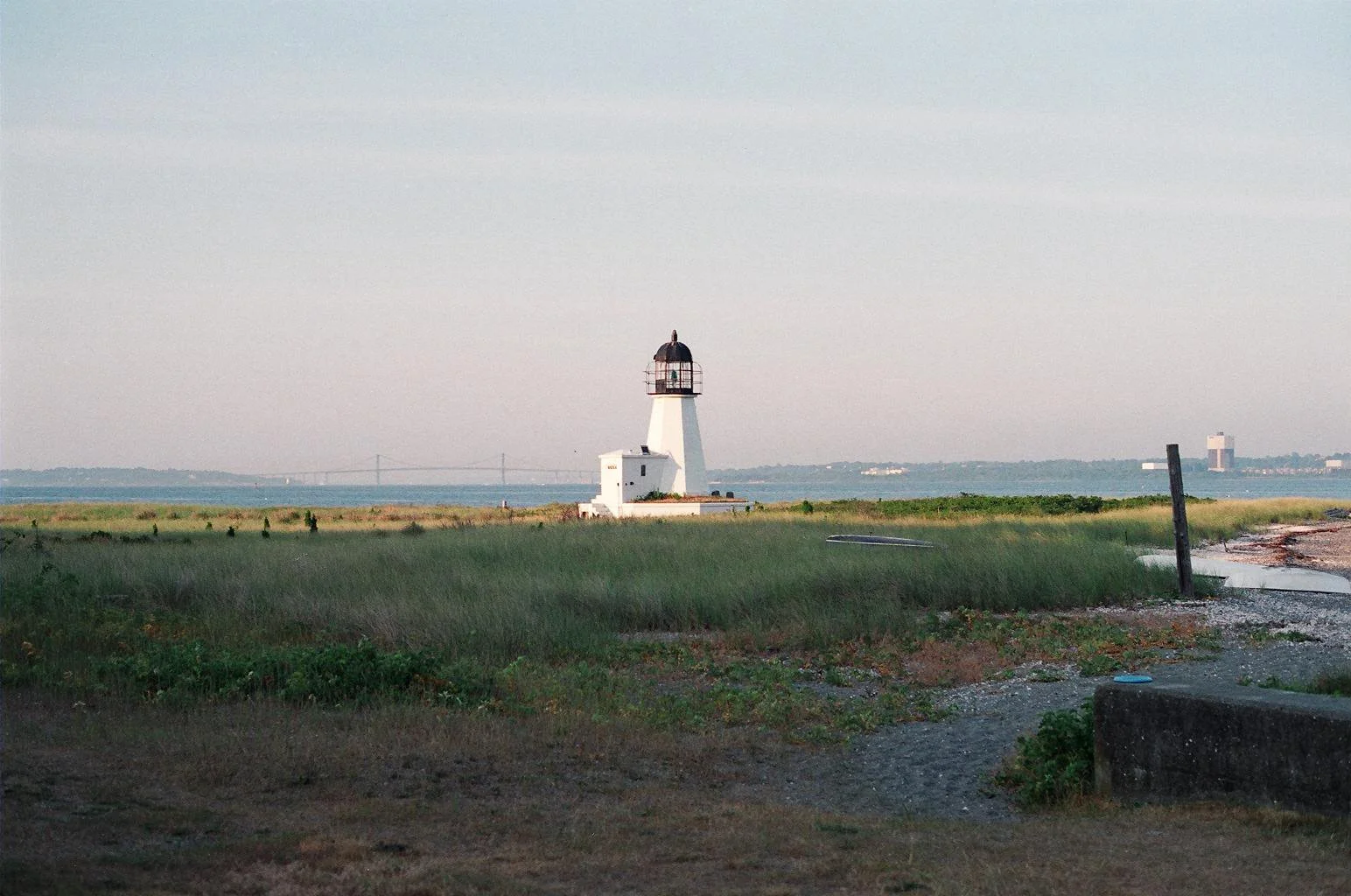
Prudence Island Light, with the Mt. Hope Bridge in the background
— Photo by Juni0r75
‘Desire and remains’

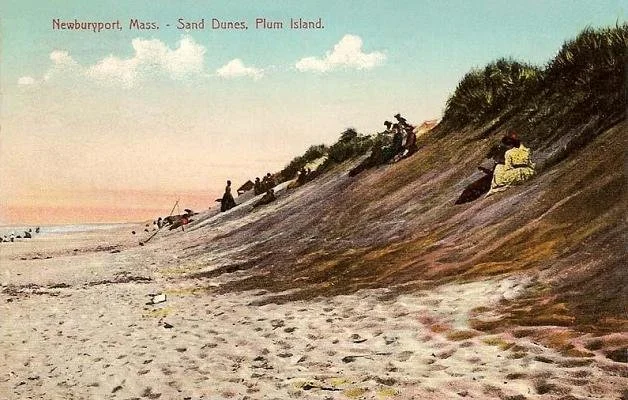
Sand dunes on Plum Island, on Massachusetts’s North Shore.
“Long waves of form, and what if under a sandhill
Socrates finds a bird? If Plato finds a lobster claw?….
And the sand — the sand is a flatbed of desire and remains.’’
— From “A Path among the Dunes,’’ by Marvin Bell (1937-2020), American poet and teacher

Climbing Moosilauke: Pride goeth before the fall
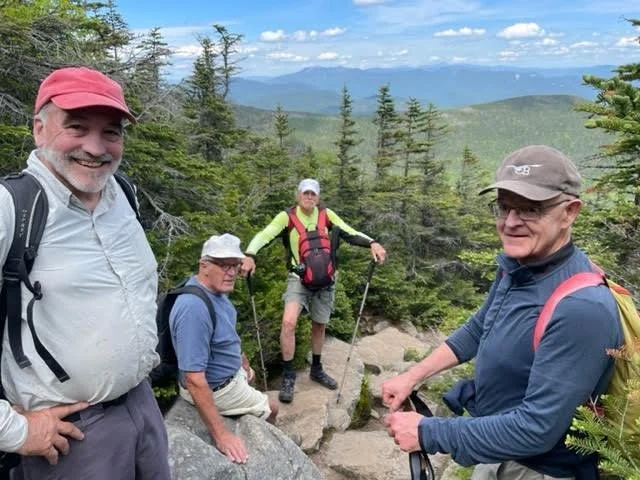
On the mountain: From left, college classmates Win Rockwell, Josh Fitzhugh, Chris Buschmann and Bob Harrington.
— Photo by Jane Andrews
Truth be told, I prefer paddling to hiking, and one thing I’ve learned from the former is that sometimes it’s good to go with the flow. So when two classmates from my Dartmouth College days invited me to join them at our 52th reunion (the big 50th, in 2020, was cancelled because of COVID) and hike up to the top of Moosilauke Mountain, in New Hampshire, I said sure, count me in.
I had another, nostalgic reason for going besides friendship and bravado. Thirty three years ago, when my father was 75, he hiked up and down Moosilauke with a little help from his two sons. Both my father and my older brother were also Dartmouth graduates. “If he could do it, so can I,” went the message in my mind. The fact that, at 74, I was a year younger compensated in my mind for the other fact: I have early-stage Parkinson’s disease. (Symptons of Parkinson’s include tremor and instability.)
Now Moosilauke, elevation 4,803 feet, is sometimes called Dartmouth’s Mountain,” partly because the college owns quite a bit of the land surrounding the peak, partly because it used to hold ski races down its flank in the 1920s and 1930s, and partly because it has a timbered lodge at its base that welcomes students, faculty, alumni and sometimes even celebrities alike into what for many is iconic about Dartmouth: its connection to the wilderness of northern New Hampshire. Recently, the lodge has been extensively rebuilt using massive timbers, and, of course, New Hampshire granite.
I met my classmates, Win Rockwell and Bob Harrington, and Bob’s partner, Jane Andrews, at a park-n-ride near my home in Vermont at 7 A.M. and we drove over to the base lodge, arriving at 9.
It was a warm June day, with the sky almost cloudless. I had grabbed a coffee and roll for breakfast on our way, and the lodge had packed us a bag lunch consisting of cheese, tomato, bread, peanut butter and jelly sandwichs and brownies. I had two 8-ounce water bottles. In my knapsack I carried warmer clothing for the top in case I needed it. (In my father’s climb, one obstacle was snow at the top. The temperature in the White Mountains can sometimes rapidly drop 50 degrees at the summits, with wind gusts of 40 miles an hour or more.) It was warm enough for shorts. I had climbing boots but very light socks, which were intended to give my toes more room. (I like the boots but sometimes my toes banged into the leather.) I suffer from peripheral neuropathy in both feet, but the tingling I usually experience had not previously bothered me walking.
After discussion amongst my friends, I also decided to take a pair of bamboo cross-county ski poles to assist in balance and motion if necessary. Many people now hike with poles, some extendable, regardless of age.
We left on the main trail from the lodge at 10 a.m. The straightest route to the summit (the route we took) is about 3.5 miles up the Gorge Brook trail, with an elevation climb of 2,933 feet. Hikers in good condition traveling in dry conditions should be able to make it to the peak and back in about 3 hours, with a 20-minute break at the summit.
As we started our hike, I tried to recall my last outing three and a half decades ago. The trail seemed a bit rockier this time and I didn’t recall hearing the water tumble over rocks in the nearby brook. At first all seemed fine. Gradually, however, I felt more and more as though I was walking in the brook, not because the going was wet but because I was having to step rock to rock rather than walk on soil or gravel. In places the soil had eroded so much that the college (through the Dartmouth Outing Club, I believe) had placed large flat stones in a kind of stairway, with the rises varying from 6 inches to a foot and a half.
We stopped after about a mile to eat some of our provisions and enjoy the view to the north. I felt fine if a bit tired. We were passed periodically by younger hikers, some alone and many with dogs. At about the two-mile mark I began to ask hikers coming down the time to the summit. “Oh, it’s not too far,” was a common response.
At about 2.5 miles in I started having balance issues. Now, though I have Parkinson’s, I had not had before one of the common symptoms, instability. Mostly I have a slight tremor in my right hand and some slurring of speech. I tend to walk slowly with a forward hunch. I’m a former soccer fullback, downhill skier and amateur logger, and I’m still in decent shape. But here on Moosilauke, I found myself losing my balance to the rear. In short, I kept falling backwards! My poles helped a bit, but sometimes I found myself having to take two steps back. Then, in one fall, I slammed my left temple hard into a rock in part of the trail that was mostly boulders.
Now you’ve done it, I said to myself, fearing a subdural hematoma, swelling, loss of consciousness and death. Luckily, my friends came to my rescue, checked my vision and saw no bleeding. I had no headache. We continued, but more slowly, with one classmate walking just behind me. I thought of the old Dartmouth song that refers to its graduates having the granite of New Hampshire “in our muscles and our brains.” It’s a good thing, I thought.
At about the two-mile point of the hike, there is a false summit. You are above the tree line and the view opens up. Solid granite outcroppings replace the big boulders we had been walking on. Thinking that we were close to the top, I exulted until, looking again, I saw another rise ahead. “Is that where we have to go?” I asked wearily. “’Fraid so,” said Win, whose father had hiked all over these mountains as a student at Dartmouth in the 30s. “I think I better turn back,” I responded to the general agreement of my team. It was about 2:30 p.m.
Bob agreed to monitor me down the trail, although that meant he lost his opportunity to reach the summit. The other two, Win and Jane, seemed very fresh and expressed their desire to push on and catch up to us on the way down.
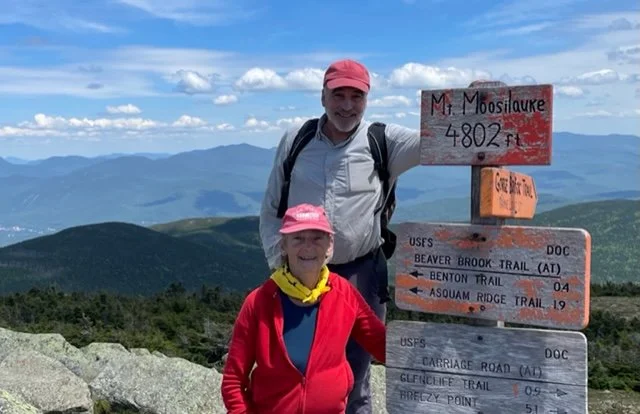
Bob Harrington and Jane Andrews made it to the top.
Now most hikers learn quickly that “down” does not necessarily mean “easier.” While I need to lift 219 pounds (my weight) with each step going up, I need to stop the inertia force of 219 pounds going down. In addition, at least for me, on rocky terrain I fear falling downhill more than I fear falling uphill. Gravity will aggravate the momentum falling downhill, I reason.
For me and Bob, then, the trip to the lodge became slower and slower. My legs were weakening and I was becoming very careful about each step. The routine was the same: Get yourself steady, examine the terrain ahead, identify a landing spot, plant poles, transfer weight to the downhill foot in a kind of leap of faith, say a small prayer when you succeeded, repeat.
At about 4 p.m., Jane and Win caught up with us on their downhill journey. Bob and I were only about a mile into our descent. We were stopping every 100 yards or so to let me rest. The decision was made to send Bob and Jane back to the lodge for possible assistance while Win would try to assist me. (We were joined about then by another Dartmouth graduate and his wife, Rick and Lucie Bourdon, who altered their plans to help both physically and emotionally in what was increasingly becoming an ordeal for all of us.)
It’s worth noting here a word about Moosilauke. When the mountain was first developed, in the early 1900’s, a cabin was built at the peak for overnight lodging. (It burned to the ground in 1942.) To help construct and provision that cabin, a dirt road was constructed to the peak. With the destruction of the cabin, that road got less and less traffic and is now mostly overgrown. You can hike on that road, but it is not much easier than the other trails. You also need to be at the peak or the base lodge to access that “carriage road,” so we had no choice but to go down the way we had come up.
In short, once you climb up on Moosilauke, the only way down is to walk, or be carried. Despite my wish as expressed during the descent, there is no zip line or chair lift for exhausted duffers like me. I stopped and sat on rocks or tree stumps with increasing frequency. (“Josh you are doing fine,” Lucie would say. “You have a team behind you!”) At one point Win and I decided that it was better to bushwack off the trail than struggle rock by rock while on it. At least then when I fell the branches and moss- covered rocks I hit were softer than the rocks in the trail, and saplings sometimes provided handholds to brake my descent.
Thankfully, this was one of the longest days of the year and the weather was clear and mild. Nevertheless, by 7 p.m. it was getting dark and we were still a half mile from the lodge. There was still a steep rocky trail ahead. I stumbled off the trail near the brook that I had heard on the way up. Losing my balance I fell, and could not get up. The muscles in my legs were too tired. After Win (who is probably 60 pounds lighter than me) dragged me to a soft spot off the trail, I remember saying, “You guys will have to figure out what to do. I’m done.” I stretched out, closed my eyes and tried to sleep.
By this point, Lucie and Rick had gone on ahead to report my condition and check on help. It began to rain and Win loaned me a parka. It wasn’t expected to be a cold night, and so I said, “Just get me a tarp and my sleeping bag at the lodge. I’ll just spend the night here!” “No way,’’ said Win.
It was dark by the time that two Dartmouth students, Alex Wells ’22 and Jules Reed ’23, arrived. Both were working in the kitchen at the lodge, but had hiking experience, and they had head-mounted flashlights. After they lifted me by my shoulders, I slung one arm over each of their necks. Then, like some six-legged decrepit spider, or a drunken Rockettes threesome, we inched our day down the trail with each of us simultaneously deciding which rock to step upon. When either of them tired, Win took their place.
Forty minutes later we could see the lights from the lodge, and closer still, the lights from the cabin I was sleeping in. No dinner for me, I told them, just get me to my bunk and bring me a bottle of wine. They did and I collapsed in bed, thankful to have made it down and for the help that made that possible. The next morning I learned that Win had used the lodge’s one telephone (there is no cell service at Moosilauke) to call my wife and leave a message. “First of all, let me tell you that Josh is okay,” he had begun.
Postscript
Decades ago, while in high school, I would occasionally quote Socrates, the Greek philosopher, who had said, “the unexamined life is not worth living.” When I have encountered traumatic moments in my life, I have sought to learn from the experience. This was no different. What caused my collapse on the mountain? Should I ever hope to hike again? Could others learn from my ordeal?
Looking back, I clearly should have prepared more for this hike, by taking some shorter hikes with lesser elevations, by having boots that fit better, by using proper hiking poles rather than old, bamboo cross-country poles, and by having a better breakfast and more robust lunch. I should have taken more water and less cold-weather gear in my backpack.
Maybe with Parkinson’s I should not have gone at all. The stress of the climb certainly exacerbated my instability, and my condition put a big burden on my friends. For them, it turned what could have been a delightful summer hike into a memorable, anxious ordeal. Of course, it also reaffirmed the value of friends and the Dartmouth “family.” I would have stayed on that mountain were it not for my saviors.
I do think that the college shares some responsibility for the episode. While I did not inquire, there were no notices that I saw of trail conditions or warnings that the Gorge Brook trail might be unsuitable for people over the age of 70 or suffering from ambulatory instability. Stating the obvious perhaps would be a caution that climbing the mountain is not the hardest challenge; you still have to get down!
In the years since I last climbed Moosilauke, with my father and brother, the trail to the summit has deteriorated greatly from the flow of rain and melting snow. Rather than relocating the trail, the college has sought to remedy it by making a staircase in many locations This works for those with strong knees, hips and ankles but for those like me, hundreds of 12-inch risers exhaust quite a bit of energy both going up and coming down. A better solution to trail washout might be to deposit 1-or-2-inch crushed stone in the interstices between the larger boulders to create a kind of stone path to the summit. This would be difficult and expensive and certainly change the nature of the hike, but it also would improve accessibility and safety, in my humble opinion. If this is feasible I’d be happy to contribute. I have a debt to repay.
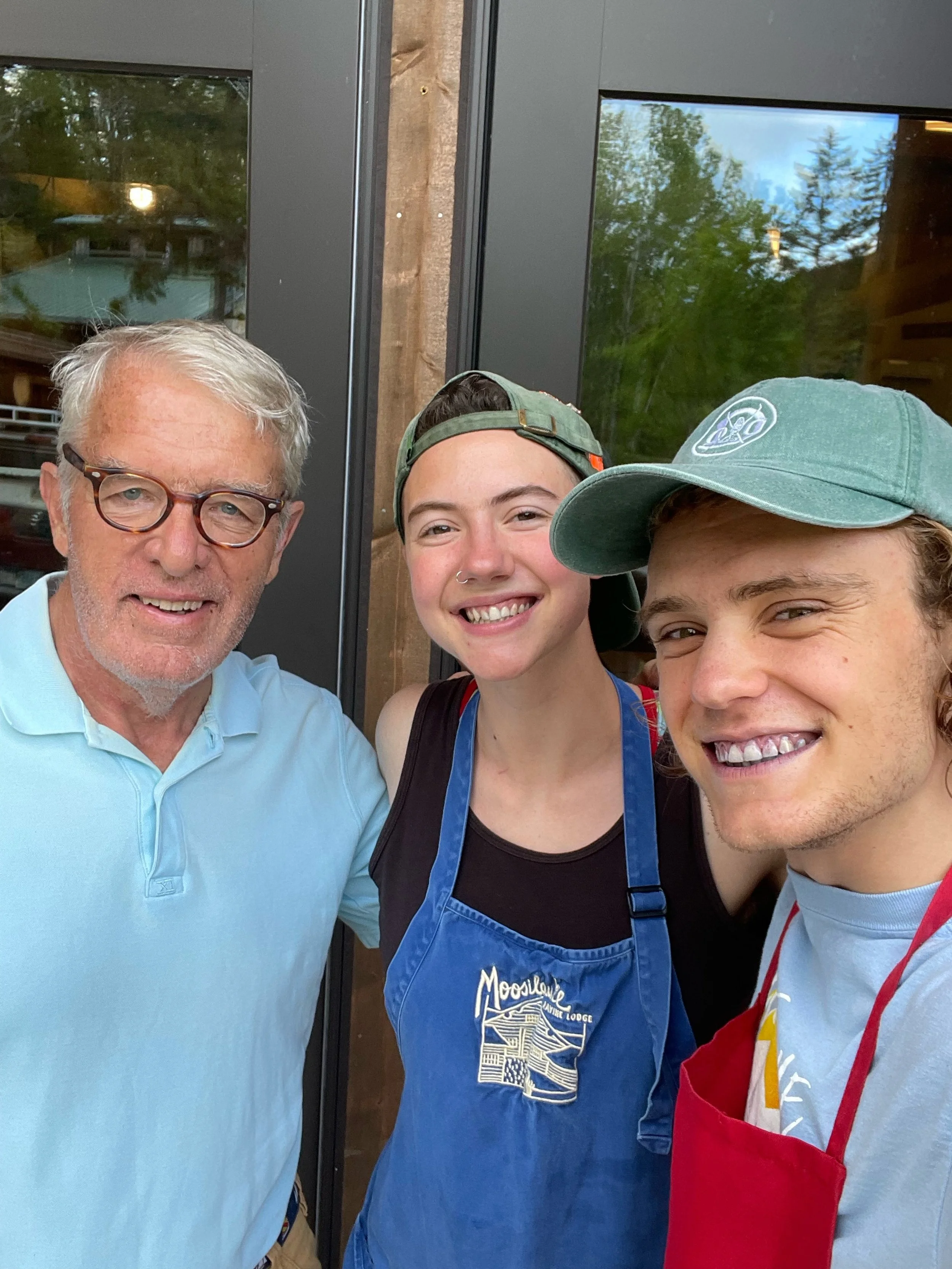
From left, Josh Fitzhugh and Good Samaritans Jules Reed and Alex Wells with me after my misadventure.
John H. (“Josh”) Fitzhugh is a writer, former insurance-company CEO, former newspaper editor and publisher and former legal counsel to two Vermont governors. He lives in Vermont, Florida and on Cape Cod.
Self-portraits and world portraits
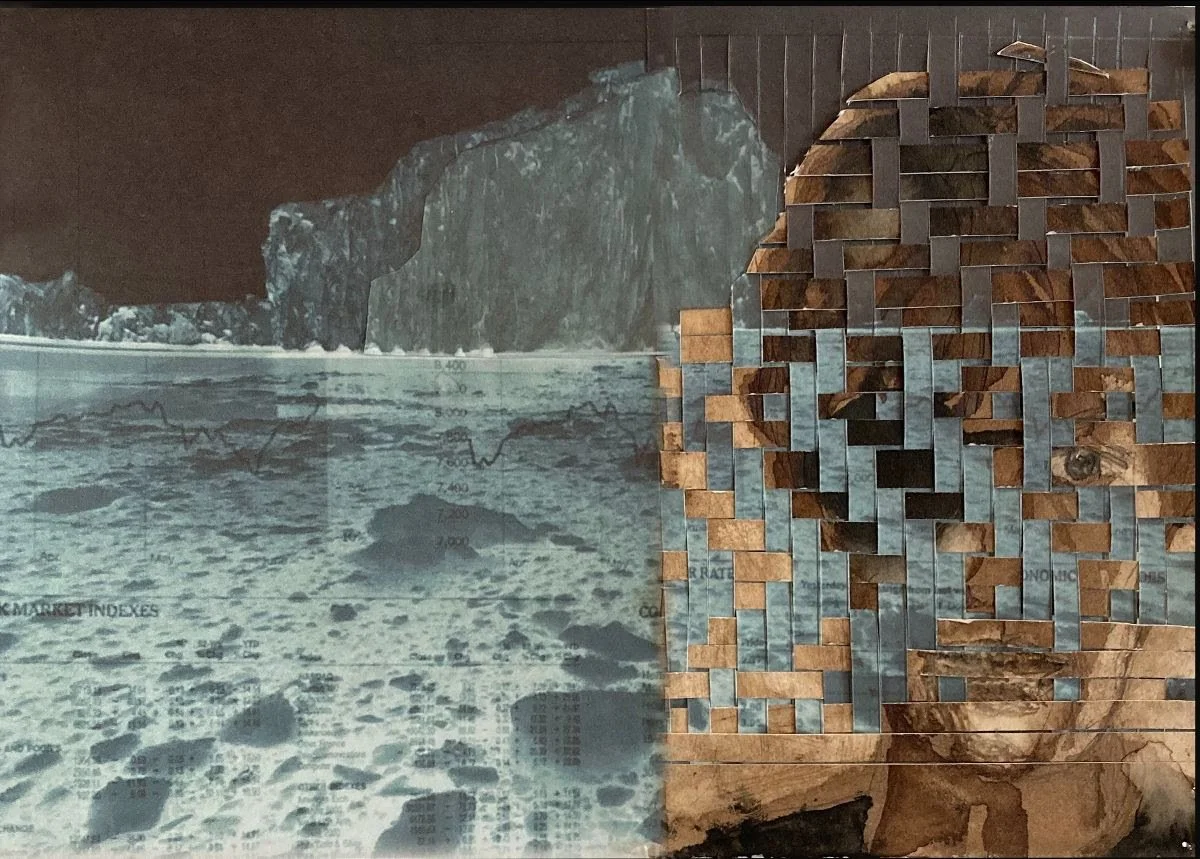
“Portrait 1 (ink on paper, digital print), by Ellen Driscioll, in her show “Splinter,’’ at Kingston Gallery, Boston, Oct. 5-Oct. 30.
The gallery says: “‘Splinter’ is an intimate and probing array of self-portraits that create intricate matrices, interlacing her inner life with maps, charts, and images of an outer world undergoing constant change. While recovering from a rare brain tumor that initially rendered her unable to walk or see and prompted visual hallucinations, Driscoll began to draw herself in the starkest and most self-revealing manner. Over time, Driscoll began to interweave the self-portraits with images of melting glaciers, oil refineries, forest thickets, and birds, reflecting the artist’s long artistic preoccupation with global warming and environmental degradation. In each image, Driscoll’s face indelibly captures a vivid sense of a world and self, both intertwined and slipping away.”

David Warsh: The mid-terms, ‘national conservatism’, U.K. confusion, Anglo-Saxon invasion

Ohio Democratic Congressman and U.S. Senate candidate Tim Ryan
SOMERVILLE, Mass.
The way I see it, the United States and its NATO allies goaded Vladimir Putin into a war that Russia cannot hope to win and which Putin is determined not to lose. What will happen next? The U.S. mid-term congressional elections, that’s what.
Interesting election campaigns are unfolding all across the nation. I take everything that Republican Party strategist Karl Rove says with a grain of salt, but suspect he is correct when he predicts the GOP will pick up around 20 seats in the House in November, enough to give Trumpist Republicans a slender majority there for the next two years. The Democrats likely will control the Senate, setting the stage for the 2024 presidential election.
To my mind, the most interesting contest in the country is the Senate election involving 10--term Congressman Tim Ryan and Hillbilly Elegy author J. D. Vance, a lawyer and venture capitalist. That’s because, if Ryan soundly defeats Vance, he’s got a good shot at becoming the Democratic presidential nominee in 2024. Ryan and Vance have agreed to two debates, Oct. 10 and 17.
By ow, it goes practically without saying that President Joe Biden will not run for re-election on the eve of turning 82. Ryan, who will be 51 in 2024, challenged House Speaker’s Nancy Pelosi’s leadership of the Democratic Party party in 2016, and sought the party’s presidential nomination in 2020.
A demonstrated command of the battleground states of the Old Northwest – Ohio, Pennsylvania, Michigan and Wisconsin – would make Ryan a strong contender against Florida Gov. Ron DeSantis, the likely Republican nominee.
It was a turbulent week. Having proclaimed Russia’s annexation of four Ukrainian regions, Putin delivered what Robyn Dixon, Moscow bureau of The Washington Post, described as “likely the most consequential” of his 23 years in office. But rather than a clarion call to restore Russian greatness as he clearly intended,” she wrote, “the address seemed the bluster and filibuster of a leader struggling to recover his grip — on his war, and his country.”
A starling miscalculation by Britain’s new Conservative Party government threatened to destabilize global financial markets. And the costs of gradual global warming continue to make themselves clear.
In the midst of all this, an old friend called my attention to two essays that seemed to take antithetical views of the prospects. The first, “How Europe Became So Rich’’, by the distinguished economic historian Joel Mokyr,
Many scholars now believe, however, that in the long run the benefits of competing states might have been larger than the costs. In particular, the existence of multiple competing states encouraged scientific and technological innovation…. [T]he ‘states system’ constrained the ability of political and religious authorities to control intellectual innovation. If conservative rulers clamped down on heretical and subversive (that is, original and creative) thought, their smartest citizens would just go elsewhere (as many of them, indeed, did).
Mokyr concluded, “Far from all the low-hanging technological fruits having been picked, the best is still to come.”
The second, “Seven Years of Trump Has the GOP taking the Long View’’, by long-time newspaper columnist Thomas Edsall, cites the success of Viktor Orban in governing Hungry, and then examines various signs of the vulnerability of the liberal state in America. These include the durability of the Trump base, and an incipient “National Conservatism” project, created in 2019 by the Edmund Burke Foundation, since joined by an array of scholars and writers associated with such institutions, magazines and think tanks as the Claremont Institute, Hillsdale College, the Hoover Institution, the Federalist, the journal First Things, the Manhattan Institute, the Ethics and Public Policy Center and National Review.
What characterizes national conservatism? Commitments to the infusion of religion and traditional family values into the government sphere, Edsall says, and, perhaps especially, opposition to “woke progressivism,” Conservative Conference chairman Christopher DeMuth puts it this way: Progressives promote instability and seek “to turn the world upside down:”
[M]ayhem and misery at an open national border. Riot and murder in lawless city neighborhoods. Political indoctrination of schoolchildren. Government by executive ukase. Shortages throughout the world’s richest economy. Suppression of religion and private association. Regulation of everyday language — complete with contrived redefinitions of familiar words and ritual recantations for offenders.
All I could do in reply was to take comfort in evidence that borders have been open to chaotic traffic for a very long time, across barriers more intimidating than the Rio Grande River, resulting in successful assimilation. Science magazine (subscription required) reported last month that new archaeological evidence tends to support the traditional view of “How the Anglo-Saxons Settled England”.
An 8th Century (C.E.) history written by a monk named Bede asserted that Rome’s decline in about 400 C.E. opened the way to an invasion from the east. Tribes from what is today northwestern Germany and southern Denmark “came over into the island, and [the Angles, Saxons, and Jutes] began to increase so much, that they became terrible to the natives.”
For a time, archaeologists doubted Bede’s account, preferring to think that only a relatively small bands of warrior elites could have successfully imposed their culture on the existing population. “Roman Britain looks very different from the Anglo-Saxon period 200 years later,” one archaeologist acknowledged to Science. But DNA samples from the graves of 494 people who died in England between 400 and 900 show they derived more than three-quarters of their ancestry from northern Europe.
The results address a long-standing debate about whether past cultural change signals new people moving in or a largely unchanged population adopting new technologies or beliefs. With the Anglo-Saxons, the data point strongly to migration, says University of Cambridge archaeologist Catherine Hills, who was not part of the research. The new data suggest “significant movement into the British Isles … taking us back to a fairly traditional picture of what’s going on.”
That doesn’t mean that the migration was especially turbulent, as when the Vikings began raiding a few centuries later, leaving relatively few genetic traces behind. Language changed relatively quickly after the Anglo-Saxons began arriving, a sign that people were talking, not fighting. Integration and intermarriage persisted for centuries. Indeed, archaeologists discovered “one high status woman in her 20s with mixed ancestry was laid to rest near modern Cambridge under a prominent mound with silvered jewelry, amber beads, and a whole cow.” That suggests more complexity than simple conquest, one archaeologist told Science.
Same as it ever was, in other words – all but the cow.
David Warsh, a veteran columnist and an economic historian, is proprietor of Somerville-based economicprincipals. com

Pandemic of plastic pollution


Polystyrene foam beads on a beach.
-- Photo by G.Mannaerts

Adapted from Robert Whitcomb’s “Digital Diary,’’ in GoLocal24.com
Plastic pollution very seriously threatens our ecosystems.
Thus it was good to learn that the University of Rhode Island has won a $1 million contract to research the effects of this growing and still inadequately understood pollution in the water and on land that kills wild animals and harms human health. To get some sense of how serious this problem has become, just walk on a beach.
The reputation of URI’s Graduate School of Oceanography is the major reason the university won this contract.
Hit this link for an article about international plastic pollution of the ocean.
No they don’t

Preparing johnnycakes, which are made with corn meal.
— Photo by Douglas Perkins
“A true Rhode Island Yankee will have jonny-cakes with all three meals: with bacon and eggs in the morning; with pork chops and boiled potatoes at noon; and with Yankee pot roast for supper.’’
— Donald J. Boisvert, in 500 tomato plants in the Kitchen (2001)
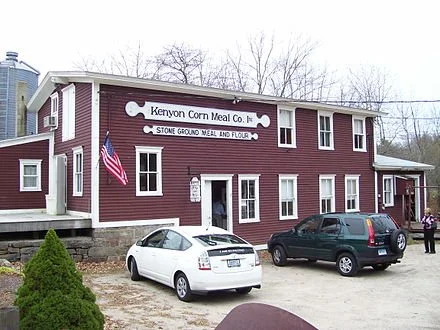
Kenyon Corn Meal Co., a grist mill in Usquepaug, R.I. The building shown was built in 1886, and the enterprise dates from 1696.
‘Decomposition and rebirth’
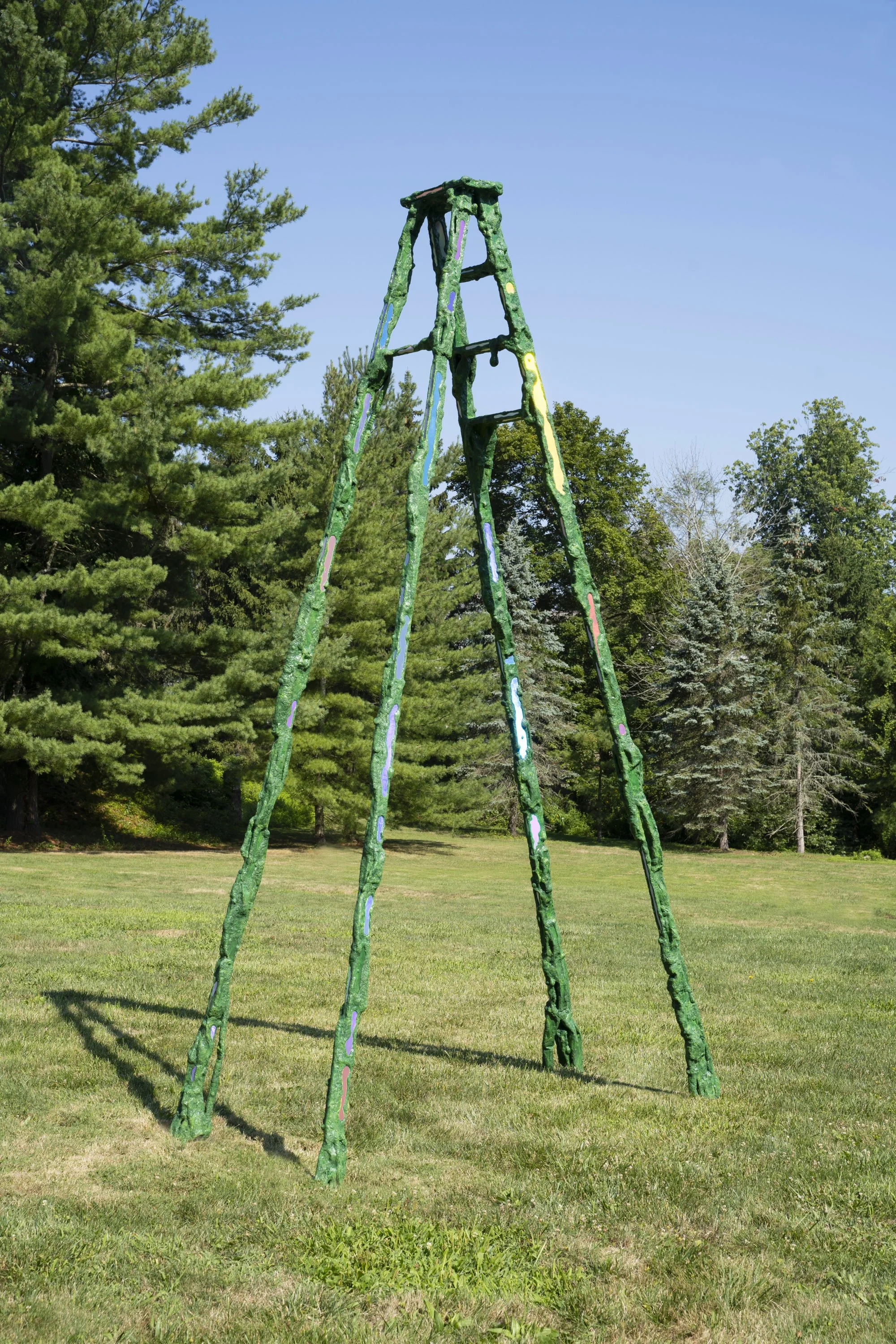
“Last Steps,” by David Shaw, in Ridgefield, Conn., in the The Aldrich Contemporary Art Museum’s Main Street Sculpture program through next April 23.
The museum says:
“Shaw’s recent work explores the indistinct boundaries that separate nature, technology, and consciousness. ‘Last Steps,’ which takes the form of a step ladder, is in a process of decomposition as well as rebirth, with gleams of spectral light appearing in gaps in the moss-like growth that has enveloped it, suggesting an alternate reality or a regenerative possibility lurking beneath the surface.”
“The artist’s use of the ladder form—but with missing rungs—speaks of the challenges we face as a civilization as we try to heal what has been lost.’’
Shaw says: “As we begin to embrace our responsibilities to the natural world, ‘Last Steps’ is both an image of our frustrated, unattainable, and perhaps misguided desire for progress, and a symbol of hope that the world wants to rebuild, that life wants to continue.”
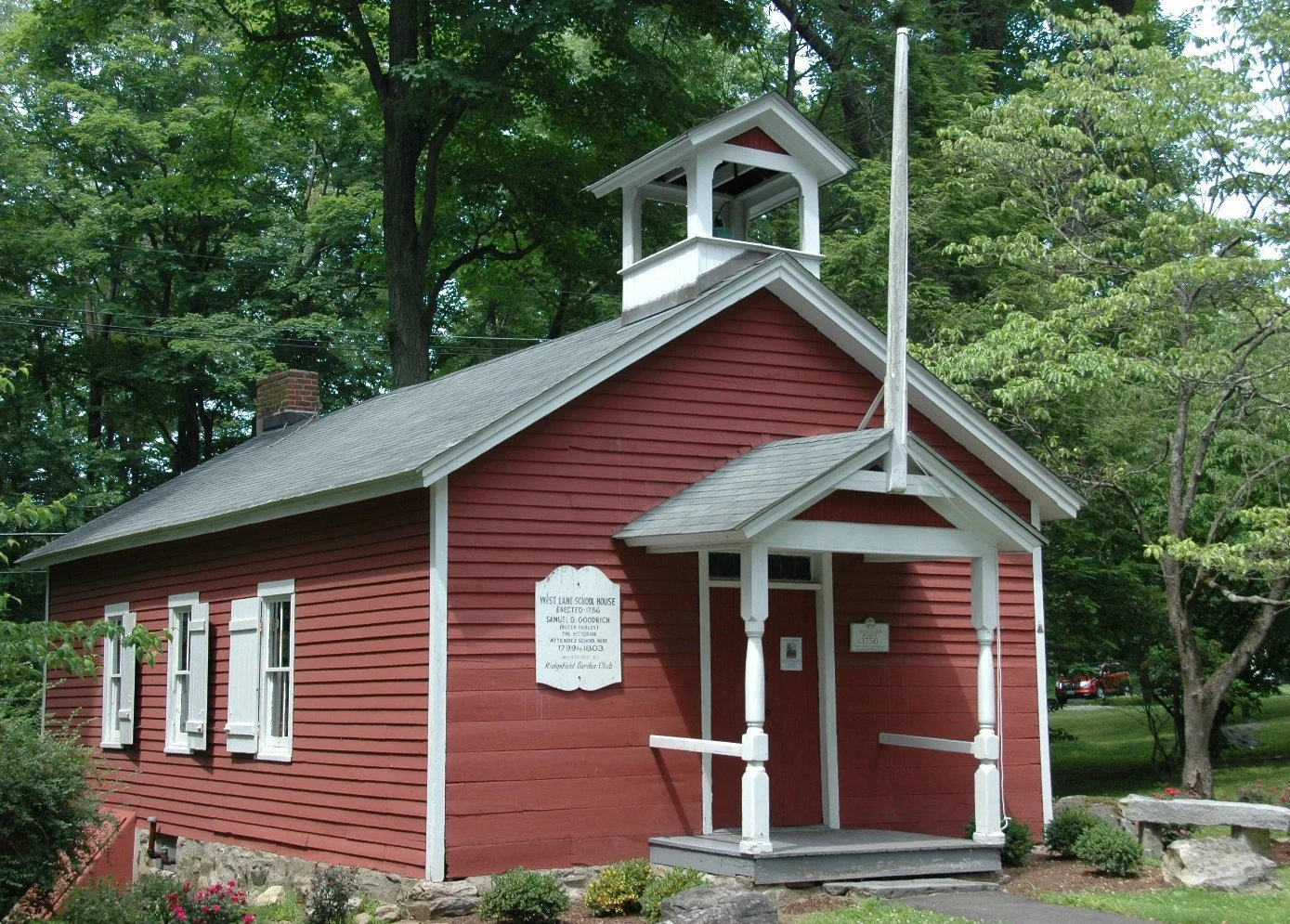
Ridgefield’s Peter Parley Schoolhouse (c. 1750), also known as the Little Red Schoolhouse or the West Lane Schoolhouse, is a one-room schoolhouse in use by the town until 1913. The site and grounds are maintained by the Ridgefield Garden Club. The building is open certain Sundays and displays the desks, slates, and books the children used.

Chris Powell: Woke schools hate being public

Southington (Conn.) High School’s eerie logo.

MANCHESTER, Conn.
Maybe that assistant principal in Greenwich who was recently caught admitting that he hires only young liberals as teachers, the better to propagandize students into voting Democratic, wasn't such an outlier. The more recent incident at Southington High School, where an English teacher was caught inflicting political propaganda on students, suggests that Connecticut may actually be the center of the campaign to dump education for indoctrination.
The teacher distributed to students a packet titled "Vocabulary for Conversations about Race, Gender, Equality and Inclusivity." It contained a glossary of terms involving transgenderism and racism, topics with which public schools are increasingly obsessed to the detriment of education. The glossary had no relation to material being taught in the teacher's English classes but supposedly was meant to help if discussion ever turned to the glossary's subjects.
Another section of the packet revealed that its objective indeed was to turn discussion to those subjects for indoctrination purposes. It said: "You can know in your heart that you don't hate anyone but still contribute to their oppression. No individual is personally responsible for what white people have done or the historical decisions of the American government, but you are responsible for whether you are upholding the systems that elevate white people over people of color."
That is: You kids may be oppressors too without even knowing it -- yet.
While Southington School Superintendent Steven Madancy told a Board of Education meeting that he supports his teachers, in an open letter to the town he admitted that the English teacher had gone too far. "As a result of our comprehensive review," the superintendent wrote, "the teacher now realizes that the sources utilized to develop these supplemental materials may not have been neutral in nature and recognizes the bias and controversial statements that some took issue with."
So the teacher had been counseled not to do stuff like this again, which ordinarily might be enough. But instead things got worse.
The school board's chairwoman, Colleen Clark, chided those who complained about the propagandizing. "I resent that a personnel matter regarding one of our teachers and our schools has been turned into a political platform by those who have noneducational agendas," Clark said.
But those who complained about the English teacher's manifesto weren't the ones injecting politics into the schools; that was done by the teacher. (Since this is "public" education, despite the misconduct involved, the teacher has not been identified.)
Besides, since nearly everything in public education is to some degree a personnel matter, democracy inevitably makes public education political.
The situation got still worse with an open letter to the Southington board from 60 members of the faculty of Southern Connecticut State University, who called the board's review of the teacher's conduct "a politically motivated attack on free speech."
But the teacher's freedom of speech wasn't attacked. The teacher was faulted for commandeering the school curriculum, which is for the school administration, the school board, and, ultimately, the public to determine.
That is exactly what the Southern professors meant to deny. They continued: "We strongly support parental rights in the home. But few parents are experts in education. … Parents … should not determine which texts are read and what language is introduced in order to make sense of those texts.
“To permit parents -- or students -- to object to what they perceive as ‘divisive' texts is to descend down the slippery slope of allowing a relatively small but vocal group of parents and students to circumscribe and dictate the nature of public education.”
That is, the public has no right to review "public" education, which should be left to those who suppose themselves to be experts.
Instantly the Southern professors had turned from purported defenders of free speech to resentful opponents. For the critics of the teacher's manifesto didn't "circumscribe and dictate the nature of public education." They exercised free speech in pursuit of their equally constitutional right to petition the government for a redress of grievances.
Once again those who dominate "public" education in Connecticut have revealed that they don't think it should be public at all.
Chris Powell is a columnist for the Journal Inquirer in Manchester. CPowell@JournalInquirer.com)

The Southington Congregational Church.
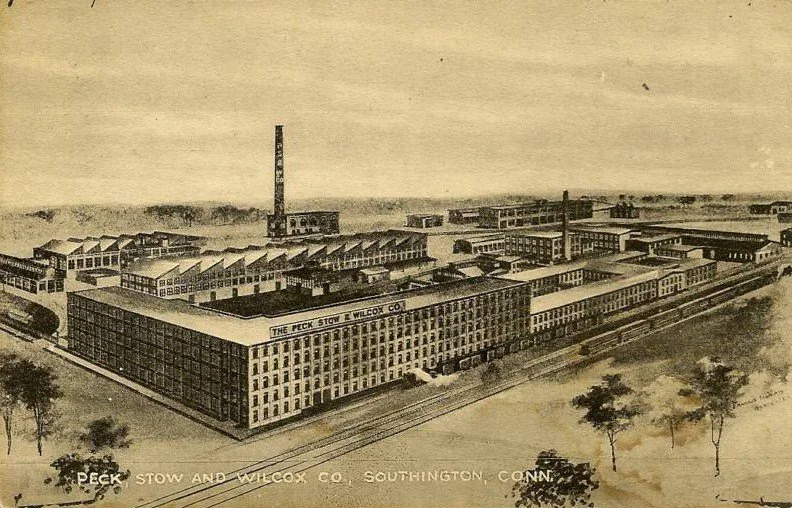
Long-gone tool factory in 1910.
Commuters

— Photo by Schnäggli
“As if a cast of grain leapt back to the hand,
A landscapeful of small black birds, intent
On the far south, convene at some command
At once in the middle of the air, at once are gone….’’’’
— From “An Event,’’ by Richard Wilbur (1921-2017), a two-time Pulitzer Prize winning poet and teacher who spent most of his life in New England.
Fun house

“Time for You and Joy to Get Acquainted” (wooden armature, fabric, polyfoam), by JooYoung Choi, in the show “State of the Art,’’ at the Currier Museum of Art, Manchester, N.H., Oct. 20-Feb. 12.
This piece of art is from the Crystal Bridges Museum of American Art, Bentonville, Ark.
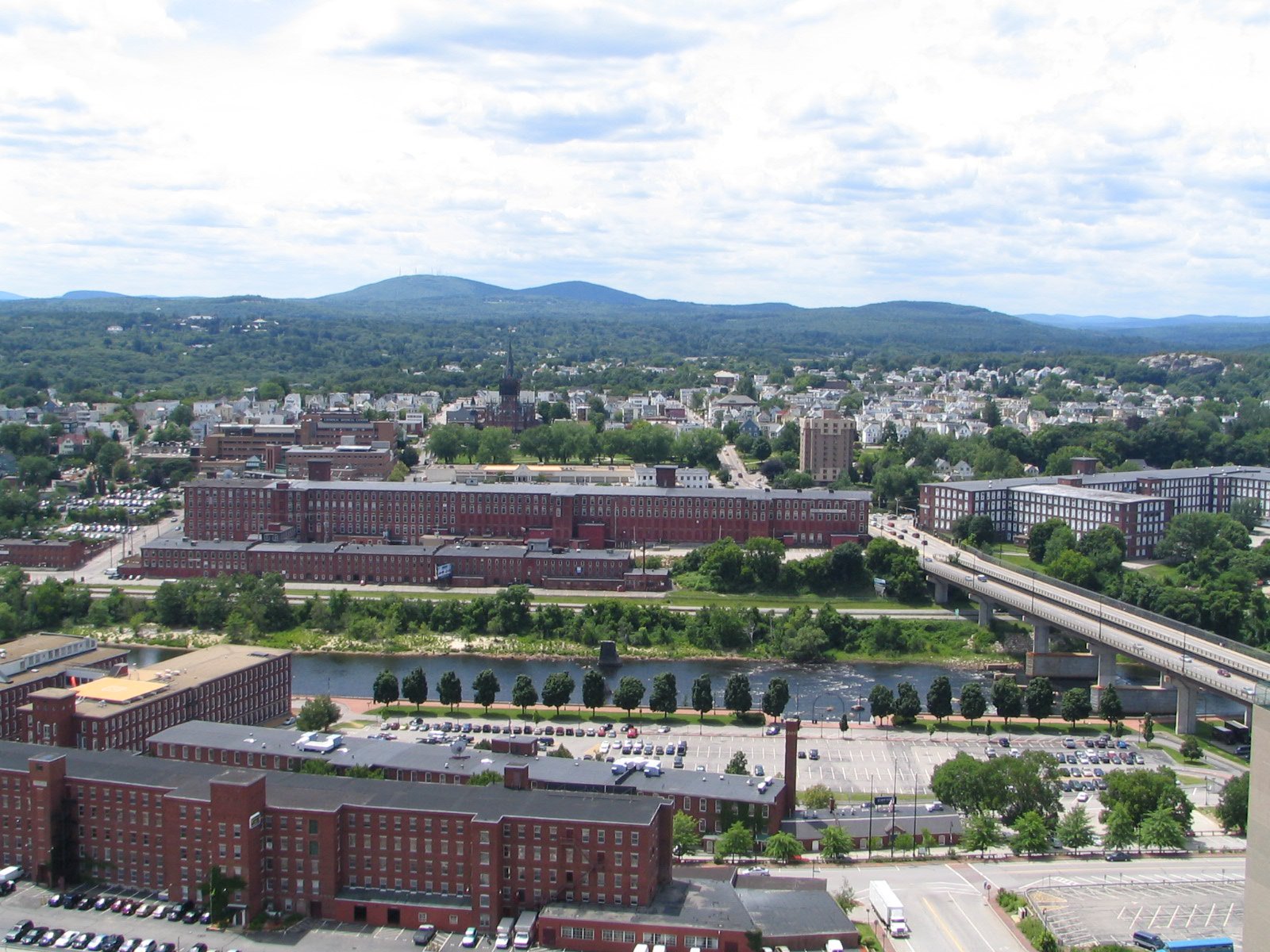
Huge buildings in Manchester along the Merrimack River that comprised the Amoskeag Manufacturing Co. complex. The company grew in the 19th Century into the largest cotton-textile facility in the world.
At least it’s ‘systematic’

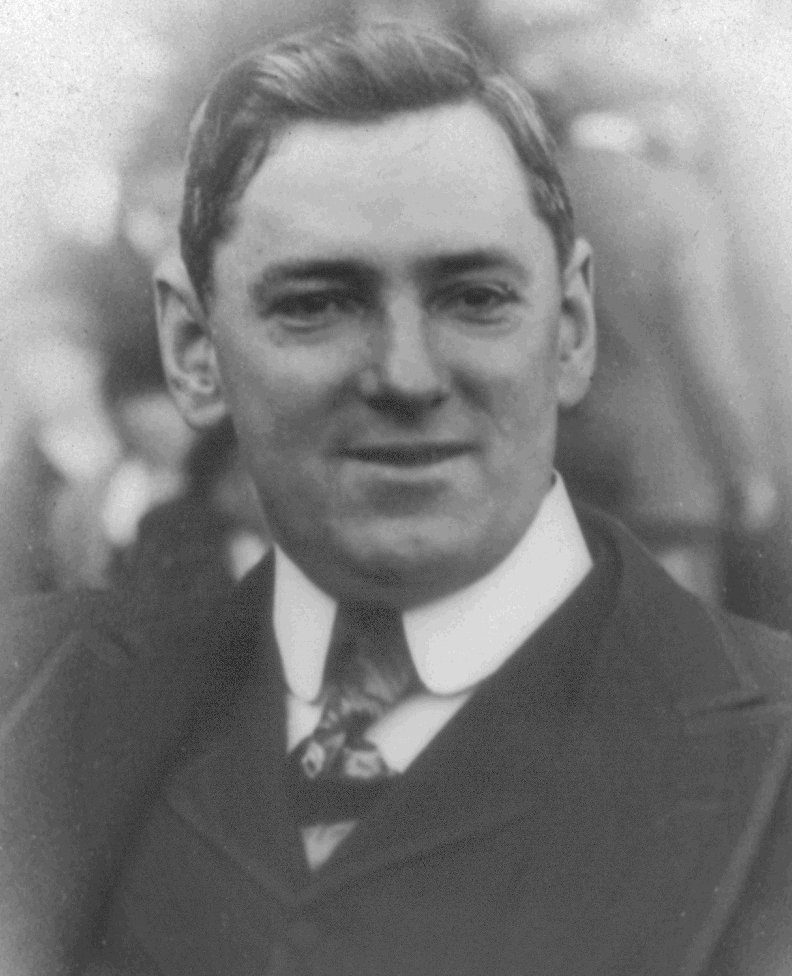
The corrupt and highly entertaining James Michael Curley (1874-1958), who in his terms as Boston’s mayor skillfully appealed to the resentments of city’s Irish-American residents about the “Boston Brahmin” WASP elite. He was the basis of Edwin’s O’Connor’s great novel The Last Hurrah.
Editor’s note: My paternal grandfather first met Curley in 1930, when they had a conversation of about 10 minutes. He next encountered him in 1949. Curley asked after my grandmother and her two children by name and other related family stuff. Like most great pols, he had a capacious memory for personal information about current and potential voters.
“Politics, as a practice, whatever its professions, had always been the systematic organization of hatreds, and Massachusetts politics had been as harsh as the climate. The chief charm of New England was harshness of contrasts and extremes of sensibility —a cold that froze the blood, and a heat that boiled it —so that the. pleasure of hating—oneself if no better victim offered —was not its rarest amusement; but the charm was a true and natural child of the soil, not a cultivated weed of the ancients. The violence of the contrast was real and made the strongest motive of education. The double exterior nature gave life its relative values. Winter and summer, cold and heat, town and country, force and freedom, marked two modes of life and thought, balanced like lobes of the brain. Town was winter confinement, school, rule, discipline; straight, gloomy streets, piled with six feet of snow in the middle; frosts that made the snow sing under wheels or runners; thaws when the streets became dangerous to cross; society of uncles, aunts and cousins who expected children to behave themselves, and who were not always gratified; above all else, winter represented the desire to escape and go free. Town was restraint, law, unity. Country, only seven miles away, was liberty, diversity, outlawry, the endless delight of mere sense impressions given by nature for nothing, and breathed by boys without knowing it.’’
Henry Adams (1838-1918), in The Education of Henry Adams (1918). He was a member of the famous Boston] area-based Adams political family that started with President John Adams.

N.E. clean-energy update

2007 U.S. Department of Energy wind resource map of Rhode Island
Adapted from Robert Whitcomb’s “Digital Diary,’’ in GoLocal24.com
I wonder how Newporters and tourists will respond to the sight on the horizon of 100 offshore wind turbines to be put up by Revolution Wind about 15 miles south of Little Compton. And there are other big offshore “wind farms’’ in the works south of New England. The Revolution Wind turbines will be the closest to Rhode Island.
There will be complaints from some folks who don’t want to look at them, even from a distance, but most people will get used to them fast, as they generally do with big new infrastructure. And many think that the giant turbines, of the sort that have long been spinning along the coasts of Europe, are beautiful. (Thank God the Europeans have been much more decisive than us in putting up wind farms, thus reducing their reliance on Russian fossil fuel, which is used to finance Putin’s mass murder and torture in Ukraine.)
Some yachtsmen will complain about the wind farms, saying that they’ll cramp their summer racing and cruising, as will some fishermen. But many of the latter may come to appreciate that wind-turbine supports act as reefs that attract fish.
In any event, I’m sure that some boat-owning entrepreneurial types will sell tickets to take tourists from Newport to see these things close up, with blades rotating to a height of 873 feet as they cleanly, if eerily, generate electricity.
xxx
Connecticut has opened its first electric-car-charging operation on its stretch of Route 95 (aka the Connecticut Turnpike), at its Madison service plaza. And more are coming.

“Seaglider’’
— Regent picture
Finally, the folks at Regent tell me that its electric “seaglider” achieved its first series of flights on Aug. 14 on Narragansett Bay, “proving its full ‘float, foil, fly’ mission—making it the first craft to take off from a controlled hydrofoil to wing-borne flight.’’
The demonstrator is a quarter-scale prototype for its 12-passenger seaglider, Viceroy.
The company calls the seaglider “a new category of electric vehicle that operates exclusively over the water, is the first-ever vehicle to successfully use three modes of maritime operation—floating, foiling and flying—marking a major step forward in maritime transportation.’’
Regent is now focusing on developing its “full-scale, 65-foot wingspan prototype, with human-carrying sea trials expected to begin in 2024.’’
Hit this link for a video. (No, Regent doesn’t pay me.)
Soft to rough

“Charlotte” (Italian marble,) by Scott Boyd, in the show “Rock Solid XXII,’’ through Oct. 29, at Studio Place Arts, Barre, Vt., in the heart of Vermont’s granite quarrying and finishing region. (Think of the Rock of Ages Corporation’s gravestone and other products.) The state is also the source of high-grade marble.
— Photo courtesy: Studio Place Arts.
The gallery says that the exhibit “showcases the work of 20 sculptors whose work in stone is able to bring out all of the qualities of the medium — from delicate flowing sculptures that turn stone into something that looks as soft as silk to rough pieces that emphasize the rugged nature of the material.’’
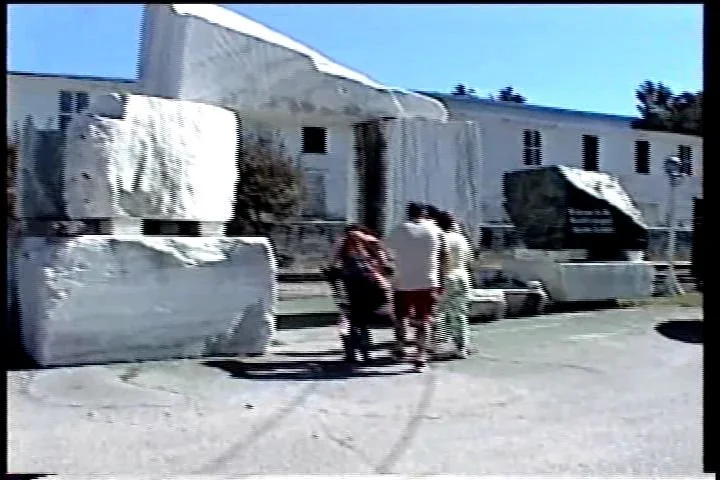
The entrance to the Vermont Marble Museum, in Proctor. The Green Mountain State has been a major source of marble as well as granite.
— Photo by GK tramrunner
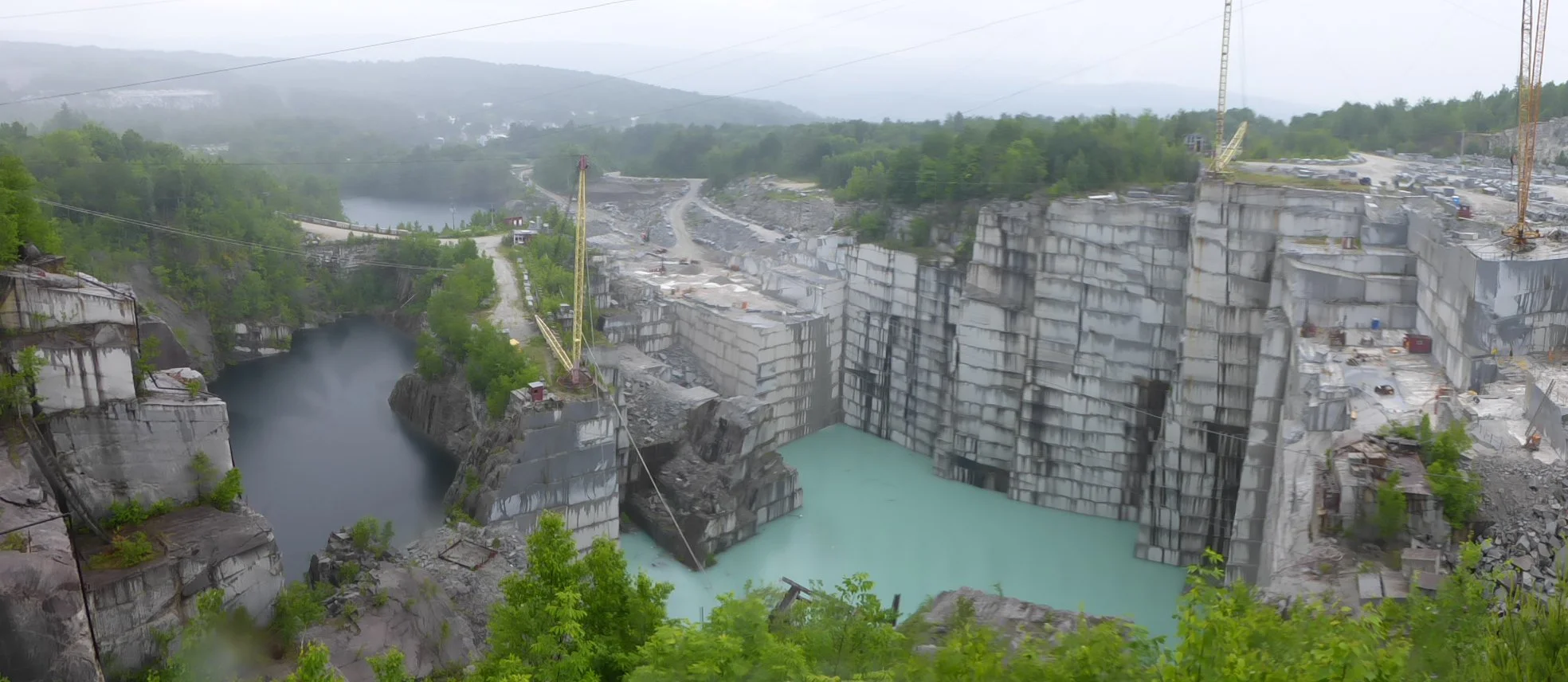
Rock of Ages granite quarry
— Photo by Z22
Llewellyn King: Remembering a real hero in these carping times

Chuck Yeager in front of the Bell X-1, which, as with all of the aircraft assigned to him, he named “Glamorous Glennis” (or some variation thereof) after his wife.
WEST WARWICK, R.I.
Winston Churchill used to advise young people to read “Bartlett’s Familiar Quotations,” the oft-updated compilation of brief quotes from just about anyone who said something memorable. Of course, Churchill added more than a few of his own. He may have added more to the storehouse of aphorisms than any writer since Shakespeare.
But others have been no slouches. If you want to go back a bit, Napoleon wasn’t unquotable, and such writers as George Bernard Shaw and Oscar Wilde were prolific with wit and wisdom served up in brevity. Mark Twain was a treasury of quotable sayings all by himself. In our time, Steve Jobs made some pithy additions and Taylor Swift, in her lyrics, has some arresting and quotable lines.
The quote to me is distilled wisdom in a few words, often funny, whether it came from Dorothy Parker, Abraham Lincoln or the Beatles. A picture may be worth a thousand words, a quote believed to have been first formulated by the Norwegian playwright Henrik Ibsen, but a well-chosen aphorism is worth many more than a thousand words.
So, it is thrilling to know that Victoria Yeager, widow of Chuck Yeager, aviation’s greatest hero, has collected his sayings into a book, 101 Chuck Yeager-isms: Wit & Wisdom from America’s hero.
Yeager came from the small town of Hamlin, W. Va. Even today it has a population of just over 1,000. Being from one of West Virginia’s famous hollows, Yeager said of it, “I was born so fer up a holler, they had to pipe daylight in.”
When the town erected a statue of Yeager, he said, “There wasn’t a pigeon in Hamlin until they erected a statue of me.”
The journey began modestly with Yeager joining the U.S. Army as a private after high school and led on to his success as fighter ace with 11.5 kills – one involved another U.S. aircraft and, hence, the half -- but Victoria Yeager told me that here were more not officially recognized. He may have shot down as many as 15 German aircraft over Europe, she said.
He was shot down himself over France in 1944; Germans watched his parachute float down and went out to find him. Yeager said, “There ain’t a German in the world that can catch a West Virginian in the woods.” And they didn’t.
In an interview for White House Chronicle, on PBS, Victoria told me that Yeager always insisted that there be fun in everything, whether it was aerial fighting, flying through the sound barrier, or flying aircraft that might kill him. “You gotta have fun in life, whatever I did, I always included fun,” he said.
Yeager, Victoria said, maintained critical aircraft like the X-1, in which he broke the sound barrier, himself. That way he knew and there would be no excuses. He said, “In the end, or at the moment of truth, there are only excuses or results.”
Victoria told me that the impression given in the movie The Right Stuff of Yeager as a reckless daredevil who rode a horse up to his aircraft, took off, and broke the sound barrier was pure Hollywood. Yeager was a consultant to Tom Wolfe during the writing of his book The Right Stuff to ensure accuracy. In fact, Victoria said, it was on the ninth flight that he broke the sound barrier. It is true that the horizontal stabilizer on the plane wasn’t working, but Yeager was able to control the plane with a manual trim tab, she added.
Yeager fought in World War II because, as he saw it, it was his duty to fight, as he saw it. After being shot down he wanted to keep fighting; and when the military wanted to send him home, he appealed the decision all the way up to Dwight Eisenhower, then the supreme allied commander in Europe, and won the right to fly in combat again. He said of duty, “You’ve got a job to do, you do it, especially in the military, when I was picked to fly the X-1, it was my duty to fly it, and I did.”
Yeager’s philosophy may have been summed up in this quote, “You do what you can for as long as you can, and when you finally can’t, you do the next best thing; you back up, but you don’t give up.”
That is the spirit that kept Yeager flying for pleasure up to close to his death, at 97.
In our carping, whining, blaming times, it is a tonic to read the thoughts and something of the life of a real hero. Thank you, Victoria Yeager, for assembling this book.
Llewellyn King is executive producer and host of White House Chronicle, on PBS. His email is llewellynking1@gmail.com and he’s based in Rhode Island and Washington, D.C.
Linda Gasparello
Co-host and Producer
"White House Chronicle" on PBS
Mobile: (202) 441-2703
Website: whchronicle.com
Providence College’s new school
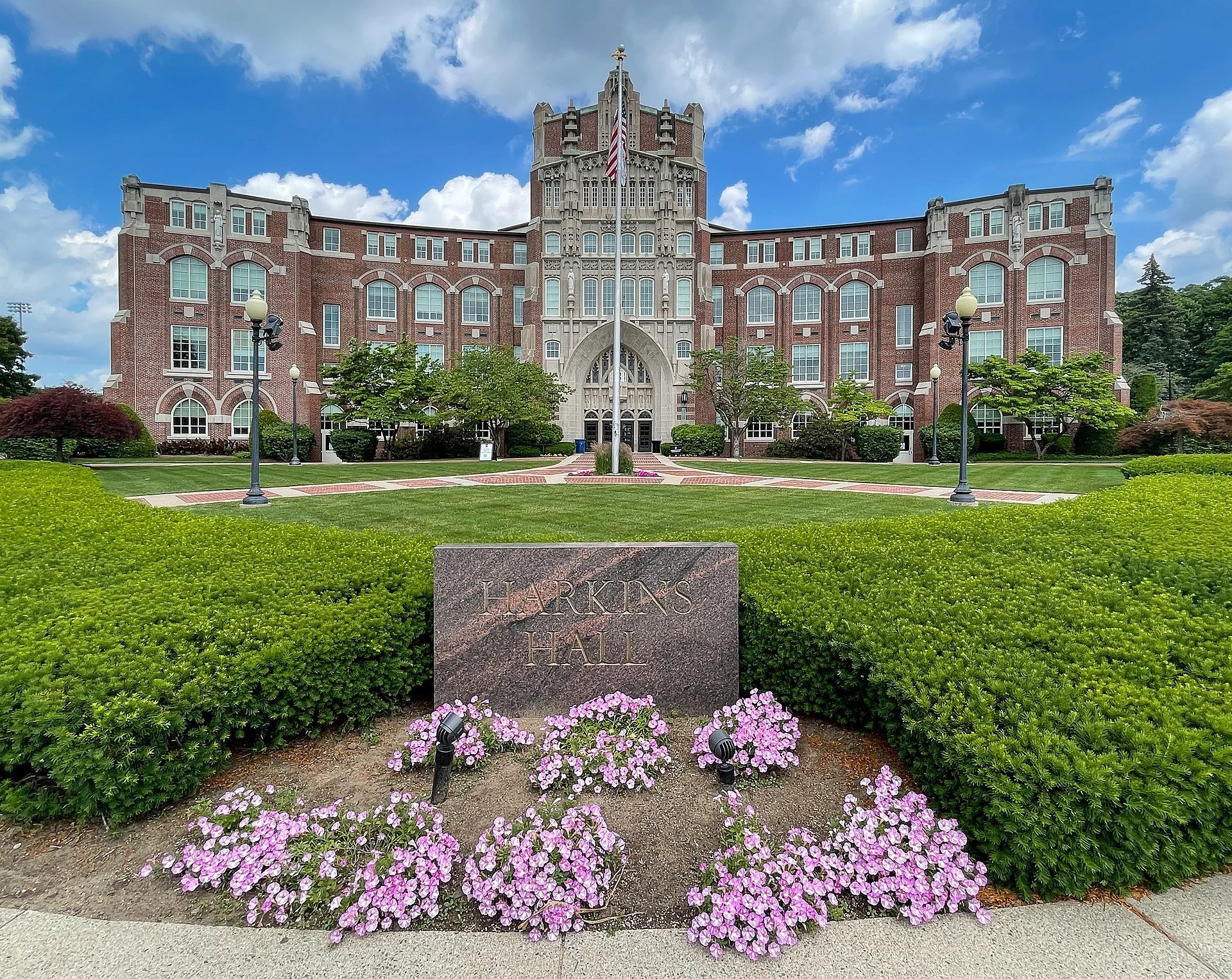
Harkins Hall (1919) at Providence College, designed by Matthew Sullivan in the Collegiate Gothic style
— Photo by Kenneth C. Zirkel
Edited from a New England Council (newenglandcouncil.com) report
BOSTON
“New England Council member Providence College has opened its fifth school, the School of Nursing and Health Sciences. This new school will achieve a goal set by PC’s president, the Rev. Kenneth Sicard, in his inaugural address, on Oct. 1, 2021.
“The new school will expand Providence College’s academic programs in a field that’s crucial to address the shortage of health-care workers in New England and the rest of the United States. In keeping with the college’s liberal-arts tradition, the curriculum included input from faculty from multiple disciplines. Community members wanted to ensure that the new cohort of students will think critically while studying health care to gain skills to help not only the physical but the mental and spiritual well-being of their future patients. The new school will allow students to step outside their normal course load to be able to study abroad, explore dual-language courses and complete immersive community experiences. PC will begin admission to the new school in the fall semester of 2023.
“Christopher Reilly, chairman of the college’s board of trustees, said, ‘These academic initiatives will enhance Providence College’s impact on society in ways that honor the institution’s mission and heritage. They will create exciting opportunities for our students, guided by our faculty, to prepare for lives of meaningful service in assistance to our neighbors and our communities.”’
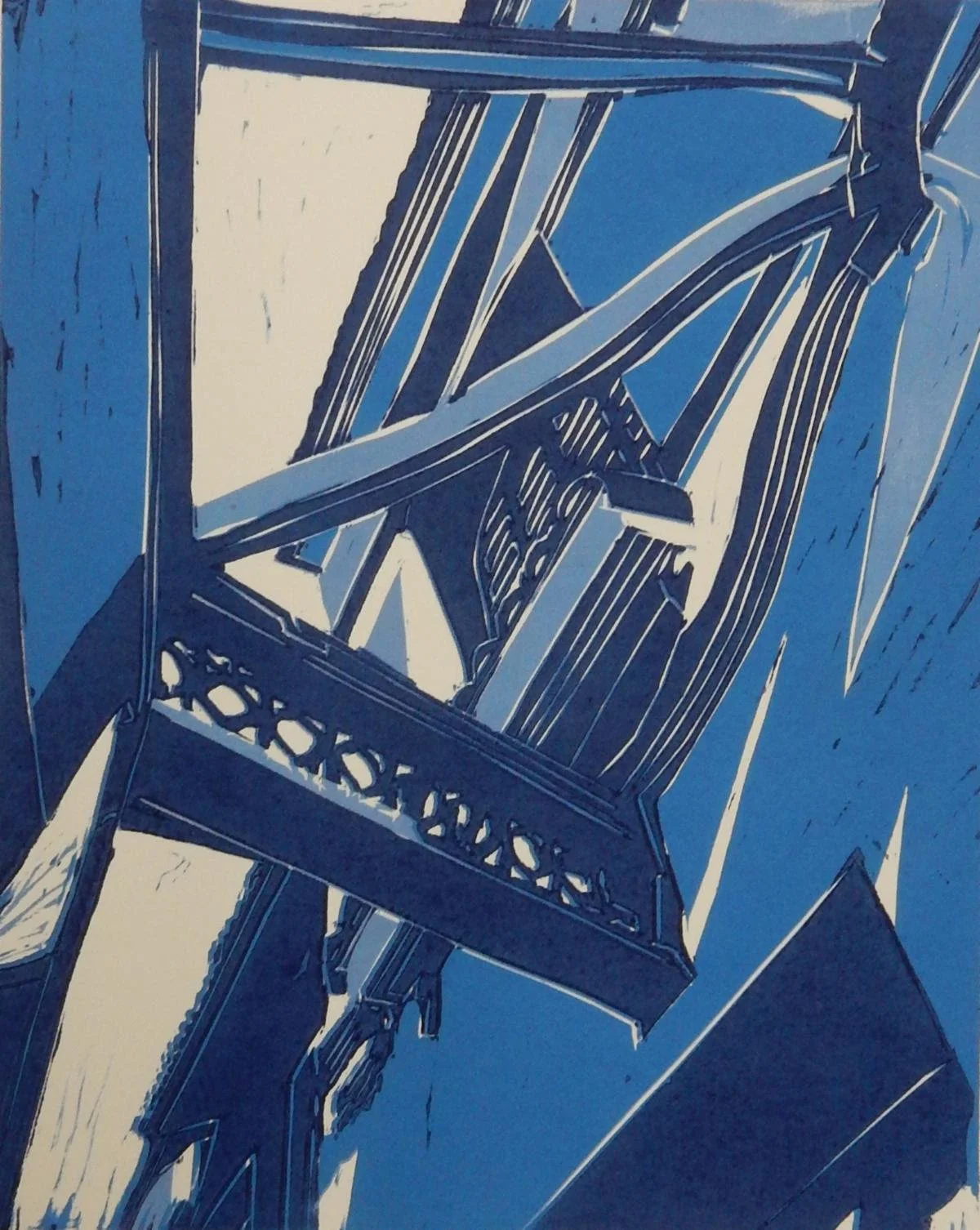
Vertigo on the Merrimack
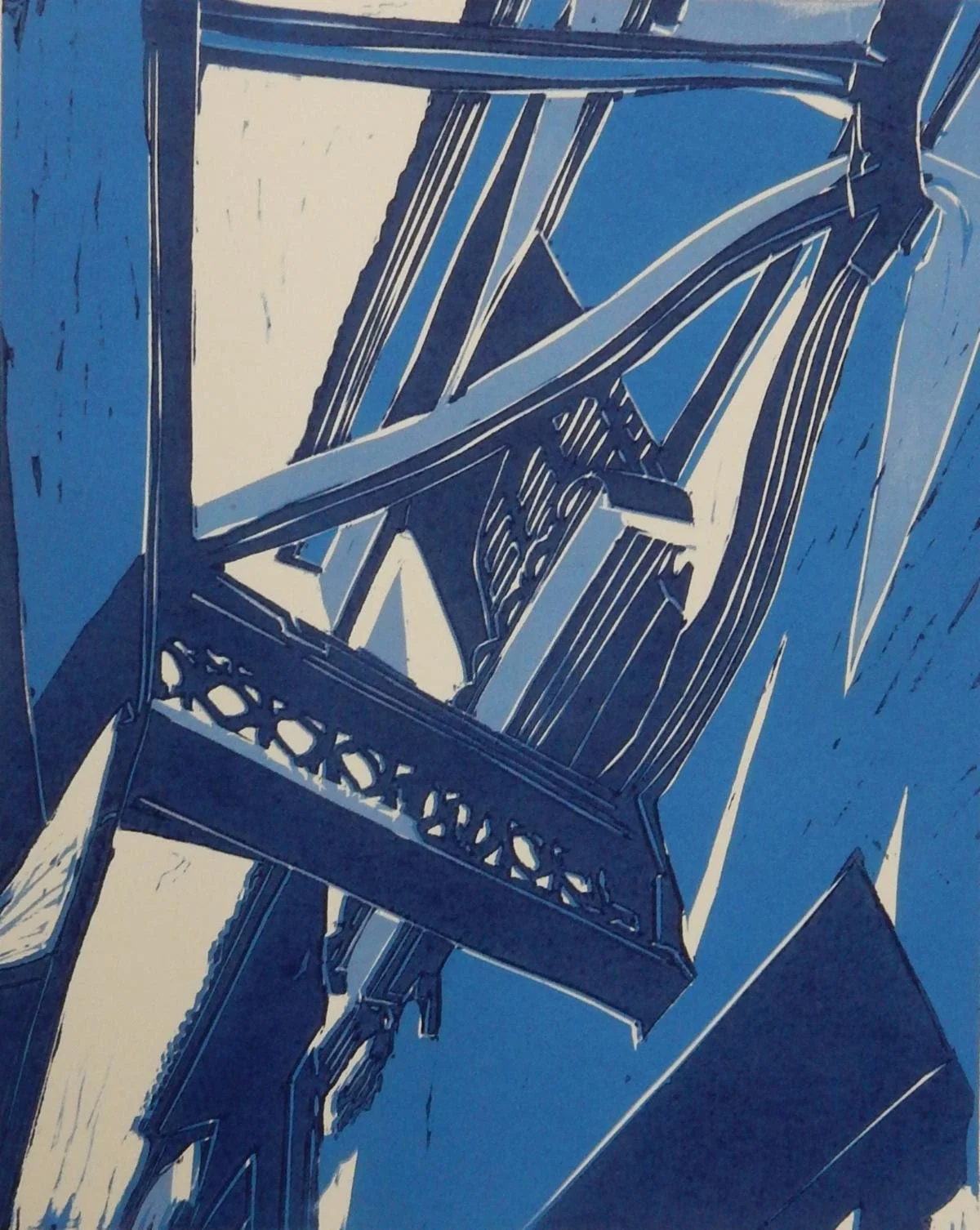
“Palms” (print), by Tewksbury, Mass.-based artist Diane Francis, in the show “Printmaking: From Silly Putty to Silkscreen,’’ at the Arts League of Lowell (Mass.) through Oct. 30.
— Photo courtesy: Arts League of Lowell.
The gallery says that the show features the work of printmakers who span the gamut of styles and techniques. Each artist in the show brings their own spin to the centuries-old medium.

Lowell in 1876, in its industrial heyday.

Tewksbury Hospital is a National Register of Historic Places-listed site on an 800+ acre campus in Tewksbury. The centerpiece of the hospital campus is the impressive 1894 Richard Morris Building ("Old Administration Building") above.
The Massachusetts Department of Public Health runs a 350-bed facility at Tewksbury Hospital, providing medical and psychiatric services to adult patients with chronic conditions. The Public Health Museum in Massachusetts now occupies the Richard Morris Building.
In addition to the hospital and museum, the campus also hosts eight residential substance-abuse programs. Five state agencies have regional offices at Tewksbury, including the Massachusetts Department of Mental Health and the Massachusetts Department of Public Safety. The campus also hosts several non-profit and for-profit private entities, including the Lahey Health Behavioral Services' Tewksbury Treatment Center, Casa Esperanza's Conexiones Clinical Stabilization Services (CSS), the Lowell House's Sheehan Women's Program, the Lowell House Recovery Home, the Middlesex Human Service Agency and the Strongwater Farm Therapeutic Equestrian Center.