
Vox clamantis in deserto






Its very own dialect

A footbridge over an 18th Century dam across Spot Pond Brook, in Stoneham’s Spot Pond Archeological District, an archaeological area in the Virginia Woods section of the Middlesex Fells Reservation, a state park. The district has mill sites dating from the 17th to the 19th centuries. At the area’s manufacturing height, in the mid-19th Century, the Hayward Rubber Works was in the area, giving it the name "Haywardville". One of the state reservation’s trails runs through the area, and a park pamphlet provides a self-guided tour connecting the major remnants of the industries that once flourished there.

As you’d guess, Stoneham, like quite a few other Boston communities, was once a shoe-making center.
“I grew up in Stoneham, a little suburb of Boston. It's pronounced 'Stone 'em’ because Massachusetts doesn't bend to the will of 'how letters are supposed to be said.”’
Josh Gondelman (born 1985), American author, comedy writer, producer and stand-up comedian
A giant of the religion biz
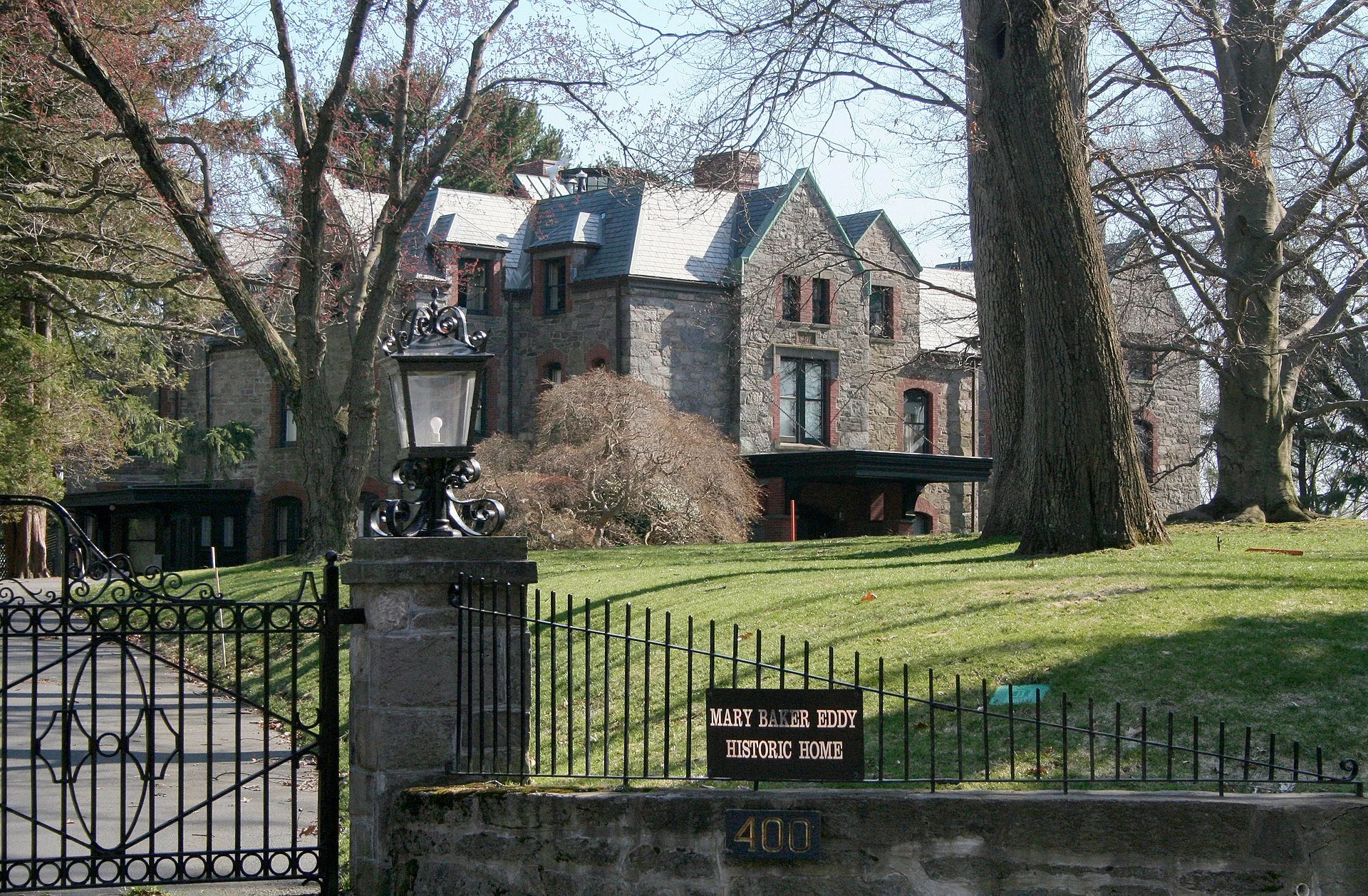
The last home of Mary Baker Eddy, at 400 Beacon St., in the Chestnut Hill section of Newton, Mass.
— Photo by Thomas Kelley
“Spirit is the real and eternal; matter is the unreal and temporal.
— Mary Baker Eddy (1821-1910), inventor of Christian Science, in her book Science and Health with Key to the Scriptures.
Like many Red State TV evangelists now, hard-working New Englander Mary Baker Eddy learned how to make a killing in the religion industry, in her case becoming a multimillionaire off real estate and other investments, publication sales and high-fee instructional programs.
History's overwhelming baggage
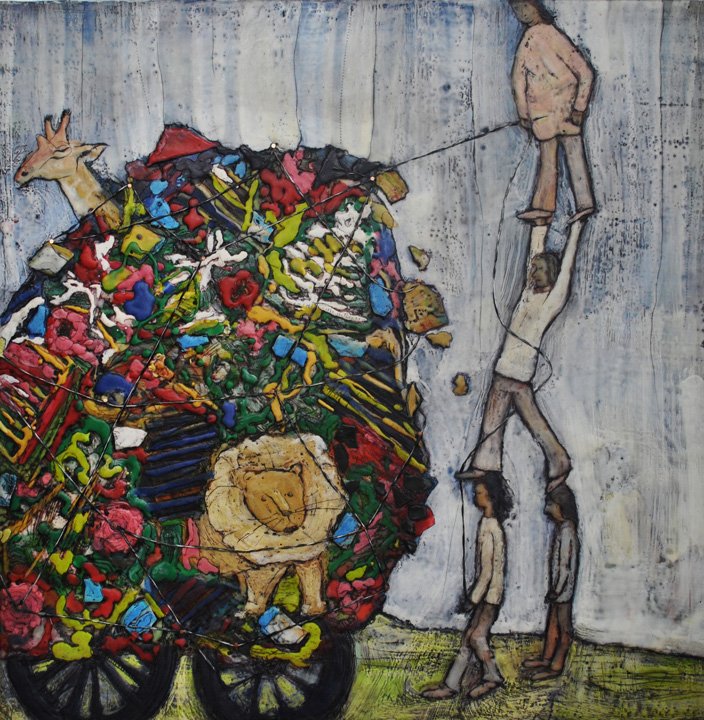
“What We Carry: Peace Interrupted” (encaustic on panel), by Manchester, Maine-based painter Helene Farrar. This painting was shown at The Maine Jewish Museum.
“A certain stage of its changing’
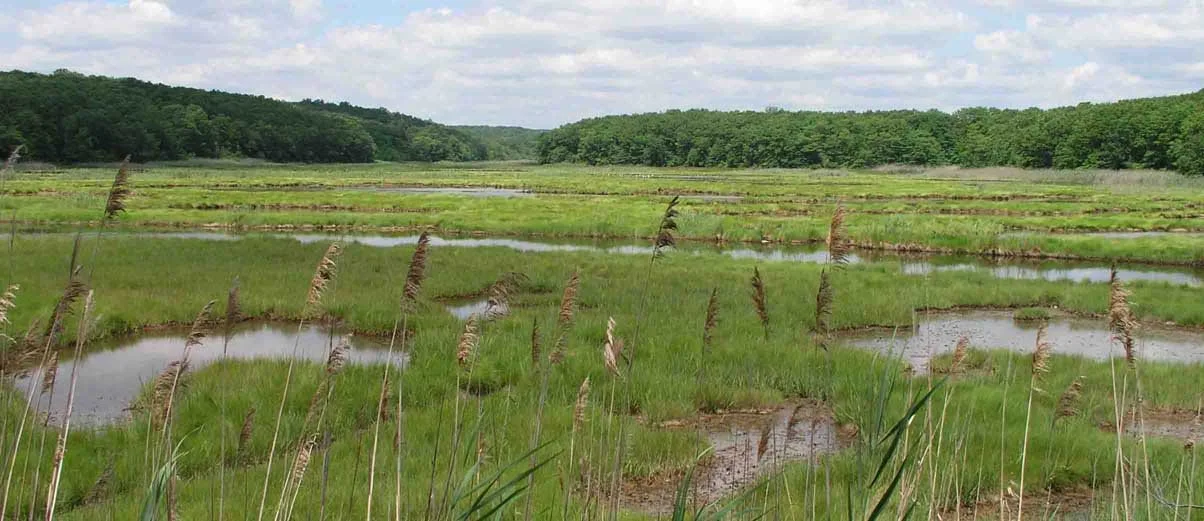
— Photo by Alex756

“The afternoon almost gone. The tide
at a certain stage of its changing.
The shore giving way to the tide,
the day giving way to week’s end.
Between us and the sea: an inlet
too small to wade, a clump of marshgrass….”
— From “Where Tide,’’ by Philip Booth (1925-2007), a Maine and New Hampshire-based poet and teacher

Llewellyn King: Wireless charging on a huge scale a Holy Grail of EV world

The primary coil in the charger induces a current in the secondary coil in the device being charged.
WEST WARWICK, R.I.
It is a dream still associated with the Serbian-American inventor Nikola Tesla: broadcasting electricity, making it available to users without a wire.
Tesla took his plans for sending electricity through the air to the grave with him, having been one of the architects of alternating current which was the building block of the electrified world.
But Tesla’s dream has never died and, in fact, is alive and well and making progress -- although not on the universal scale envisioned by Tesla or his followers, who look on his scheme for electricity broadcast from towers, like radio, as a Holy Grail.
His dream was as improbable as it was alluring.
But on a more down-to-earth level, inductive charging – wireless power transfer -- is surging. It has two distinct visions: One is to make wireless charging a reality for small devices. If airport terminals were wired for charging as they are for WiFi, there would be no more sitting on the floor by a plug. The other is for electric vehicles.
Ahmad Glover, the enthusiastic president of WiGL, a small wireless electric transmission company, told me the military is extremely interested in wireless charging. Glover, an Air Force veteran, said the goal is to have forward bases equipped, during operations and in warfighting situations, so that troops can charge their electronics without plugging in. “The less a soldier has to carry the better, “ he said.
Glover, who has worked with engineers from MIT and with Atlantic University, and has a contract with the Air Force, sees a day when charging is essentially automatic. The source of the power could be from a solar charger carried by a soldier in the battlefield rather than from the grid or the forward base generator. Glover believes the work he is doing will keep U.S. troops discreetly in touch wherever, whenever. He is working on beams and omnidirectional area chargers.
The big marquee application for wireless charging is in transportation. Here, most obviously, inductive charging has applications in public transport. The charger consists of an electromagnetic field radiating from a plate to a receiver under the vehicle. When the vehicle is positioned over the plate, charging takes place. This is known as a static system.
Mobile inductive charging, known as dynamic charging, where a moving vehicle can pick up a charge from the roadway, has been promoted overseas. But there is research money in the federal budget for inductive charging development in the United States.
The big advantage of static charging is that vehicles can be lighter and, therefore, cheaper. Taxis, trolleys, light rail, and buses could have smaller, lighter batteries as they will be charged regularly at predictable places, like traffic lights.
South Korea has been developing a charging system for buses where they get a charge every time they stop at a bus stop.
With abundant wind and hydro, Norway is headed for a carbon-free economy. By law, all new cars must be electric by 2025; accordingly, they are working to install inductive charging plates for taxis at their stands. A taxi driver will pull into a stand -- still common in Europe -- and while waiting for the next fare, the car will charge. If the taxi is on the stand long enough, it gets fully charged. Otherwise, it just gets a boost.
The advantages of inductive charging are multiple. First, batteries can be smaller and cheaper, and the vehicle lighter. For utilities, the load is spread over the day, coinciding with the abundance of solar generation.
The ultimate dynamic inductive dream is that cars will refuel as they speed down the highway. Italy has an experimental program installing charging coils in tarmac. Sweden is relatively far along with a similar experiment, and the United Kingdom is funding research.
Nikola Tesla’s dream is turning into reality.
Llewellyn King is executive producer and host of White House Chronicle, on PBS. His email is llewellynking1@gmail.com and he’s based in Rhode Island and Washington, D.C.
‘Homage to the ordinary’

“Apple Tree,’’ by Jay Wu, in his show “To the Delicate,’’ at Galatea Fine Art, Boston, Sept. 2-Oct. 2.
He writes in his artist startment:
“I never have much to say about my work. They are not really about anything other than maybe an attempt to offer homage to the ordinary objects and places that are special to me. I feel that I have already projected myself into the work during the process of making and therefore find it difficult or unnecessary to supplement the work with words afterward. Thus, instead of having a statement about the work, it is more about the need and the want behind the work.’’
When I sit in front of you, I could not help but look at you with awe, thus I look at you timidly as if I am on a mission to get it right. No longer am I painting with a theme in mind or a statement to make, but with the hope and yearning to offer the proper love and respect.

Martha Bebinger: Dangerous tranquilizer on the street in Mass. and elsewhere

As a veterinary anesthetic, xylazine is administered once for intended effect before surgical procedures (trade name: Rompun)
— Photo by Zemxer
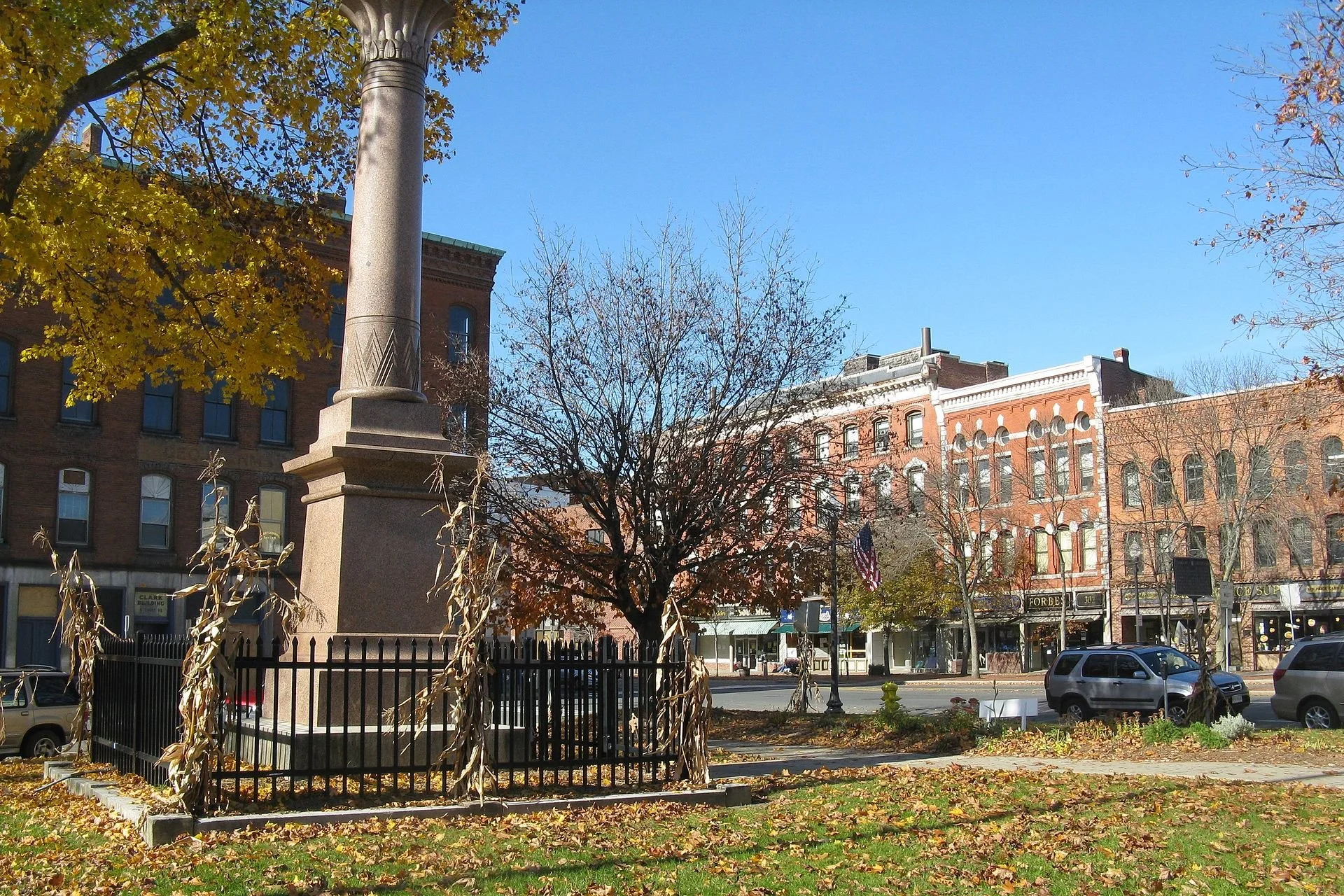
The Civil War Memorial on Court Square, in Greenfield.
— Photo by John Phelan
GREENFIELD, Mass.
Approaching a van that distributes supplies for safer drug use here, a man named Kyle noticed an alert about xylazine.
“Xylazine?” he asked, sounding out the unfamiliar word. “Tell me more.”
A street-outreach team from Tapestry Health Systems delivered what’s becoming a routine warning. Xylazine is an animal tranquilizer. It’s not approved for humans but is showing up in about half the drug samples that Tapestry Health tests in the rolling hills of western Massachusetts. It’s appearing mostly in the illegal fentanyl supply but also in cocaine.
“The past week, we’ve all been just racking our brains — like, ‘What is going on?’” Kyle said. “Because if we cook it up and we smoke it, we’re falling asleep after.”
Kyle’s deep sleep could also have been triggered by fentanyl, but Kyle said one of his buddies used a test strip to check for the opioid and none was detected.
Xylazine, which is also known as “tranq” or “tranq dope,” surged first in some areas of Puerto Rico and then in Philadelphia, where it was found in 91% of opioid samples in the most recent reporting period. Data from January to mid-June shows that xylazine was in 28% of drug samples tested by the Massachusetts Drug Supply Data Stream, a state-funded network of community drug-checking and advisory groups that uses mass spectrometers to let people know what’s in bags or pills purchased on the street.
Whatever its path into the drug supply, the presence of xylazine is triggering warnings in Massachusetts and beyond for many reasons.
As Xylazine Use Rises, So Do Overdoses
Perhaps the biggest question is whether xylazine has played a role in the recent increase in overdose deaths in the U.S. In a study of 10 cities and states, xylazine was detected in fewer than 1% of overdose deaths in 2015 but in 6.7% in 2020, a year the U.S. set a record for overdose deaths. The record was broken again in 2021, which had more than 107,000 deaths. The study does not claim xylazine is behind the increase in fatalities, but study co-author Chelsea Shover said it may have contributed. Xylazine, a sedative, slows people’s breathing and heart rate and lowers their blood pressure, which can compound some effects of an opioid like fentanyl or heroin.
“If you have an opioid and a sedative, those two things are going to have stronger effects together,” said Shover, an epidemiologist at UCLA’s David Geffen School of Medicine.
In Greenfield, Tapestry Health is responding to more overdoses as more tests show the presence of xylazine. “It correlates with the rise, and it correlates with Narcan not being effective to reverse xylazine,” said Amy Davis, assistant director for rural harm-reduction operations at Tapestry. Narcan is a brand name of naloxone, an opioid overdose reversal medication.
“It’s scary to hear that there’s something new going around that could be stronger maybe than what I’ve had,” said May, a woman who stopped by Tapestry Health’s van. May said that she has a strong tolerance for fentanyl but that a few months ago, she started getting something that didn’t feel like fentanyl, something that “knocked me out before I could even put my stuff away.”
A Shifting Overdose Response
Davis and her colleagues are ramping up the safety messages: Never use alone, always start with a small dose, and always carry Narcan.
Davis is also changing the way they talk about drug overdoses. They begin by explaining that xylazine is not an opioid. Squirting naloxone into someone’s nose won’t reverse a deep xylazine sedation — the rescuer won’t see the dramatic awakening that is common when naloxone is administered to someone who has overdosed after using an opioid.
If someone has taken xylazine, the immediate goal is to make sure the person’s brain is getting oxygen. So Davis and others advise people to start rescue breathing after the first dose of Narcan. It may help restart the lungs even if the person doesn’t wake up.
“We don’t want to be focused on consciousness — we want to be focused on breathing,” Davis said.
Giving Narcan is still critical because xylazine is often mixed with fentanyl, and fentanyl is killing people.
“If you see anyone who you suspect has an overdose, please give Narcan,” said Dr. Bill Soares, an emergency room physician and the director of harm reduction services at Baystate Medical Center, in Springfield, Mass.
Soares said calling 911 is also critical, especially when someone has taken xylazine, “because if the person does not wake up as expected, they’re going to need more advanced care.”
‘Profound Sedation’ Worries Health Providers
Some people who use drugs say xylazine knocks them out for six to eight hours, raising concerns about the potential for serious injury during this “profound sedation,” said Dr. Laura Kehoe, medical director at Massachusetts General Hospital’s Substance Use Disorders Bridge Clinic.
Kehoe and other clinicians worry about patients who have been sedated by xylazine and are lying in the sun or snow, perhaps in an isolated area. In addition to exposure to the elements, they could be vulnerable to compartment syndrome from lying in one position for too long, or they could be attacked.
“We’re seeing people who’ve been sexually assaulted,” Kehoe said. “They’ll wake up and find that their pants are down or their clothes are missing, and they are completely unaware of what happened.”
In Greenfield, nurse Katy Robbins pulled up a photo from a patient seen in April as xylazine contamination soared. “We did sort of go, ‘Whoa, what is that?’” Robbins recalled, studying her phone. The image showed a wound like deep road rash, with an exposed tendon and a spreading infection.
Robbins and Tapestry Health, which runs behavioral and public health services in western Massachusetts, have created networks so clients can get same-day appointments with a local doctor or hospital to treat this type of injury. But getting people to go get their wounds seen is hard. “There’s so much stigma and shame around injection drug use,” Robbins said. “Often, people wait until they have a life-threatening infection.”
That may be one reason amputations are increasing for people who use drugs in Philadelphia. One theory is that decreased blood flow from xylazine keeps wounds from healing.
“We’re certainly seeing a lot more wounds, and we’re seeing some severe wounds,” said Dr. Joe D’Orazio, director of medical toxicology and addiction medicine at Temple University Hospital in Philadelphia. “Almost everybody is linking this to xylazine.”
Martha Bebinger is a correspondent for Boston-based WBUR
This article is part of a partnership that includes WBUR, NPR and KHN.

Bee Sculpture "My Name is Life" in front of the Second Congregational Church, in Court Square, Greenfield. Pleasure without drugs.
— Photo by Eleanor.Bel.Cher
Polar Beverages joins national campaign against packaging waste

Orson the Bear, Polar Beverages’ mascot
From The New England Council (newenglandcouncil.com)
BOSTON
New England Council member Polar Beverages, based in Worcester, has joined a national partnership called the Farm Powered Strategic Alliance. The partnership aims to avoid or eliminate food waste, and repurpose what can’t be eliminated into renewable energy via farm-based anaerobic digesters. Polar Beverages is the newest member of the movement which was founded by four food manufacturing companies in 2020.
The two-year alliance is based in Wellesley, Mass., with each member working to do their part to reduce food waste and repurpose non-repurposed materials into renewable energy. The intention of the alliance is to offer a circular approach to reducing emissions of carbon dioxide and serve as a guide for creating a business with a carbon-neutral footprint.
Throughout the years, Polar has transitioned its approach to undertake sustainable manufacturing practices including, upgrading its packaging, cutting water usage and reducing miles driven for product delivery. As a result, Polar has avoided wasting 31 percent of potential wasted packaging material, reduced its water usage by 50,000 gallons a day, and cut miles driven by delivery trucks by 3.5 million over the last three years. The alliance has encouraged Polar to take on another sustainable practice by repurposing wastewater. Now, the wastewater generated from manufacturing will be recycled and turned into anaerobic digesters to be used on six different New England dairy farms.
The executive VP of Polar, Chris Crowley, said, “[w]e couldn’t be more thrilled to join the FPSA and further our commitment to being stewards of the environment.”
The New England Council would like to commend Polar Beverages for its commitment to promoting sustainable practices in New England.
Thoughts on summer as it ebbs (?)

“Summer Dreaming” (encaustic painting), by Nancy Whitcomb
(The trick is to get across the Cape Cod Canal bridges.)
Adapted from Robert Whitcomb’s “Digital Diary,’’ in GoLocal24.com
Like many GoLocal readers, I’ve spent much of my life near beaches. To me, they’ve mostly become places to simply walk on, especially in the off-season, to clear one’s head and maybe spot some interesting wildlife, dead or alive.
Where I lived during much of my youth, in Cohasset, on Massachusetts Bay, there’s a mix of sandy gray beaches and very uncomfortable stony strands (recalling Maine) and summertime water that, at least back then, was sometimes much too cold to comfortably swim in, especially on the hottest days, when the southwest wind blew the warm surface water seaward. I came to think that these beaches were mostly good for clambakes, fireworks and letting our dogs run on them. (No enforced leash laws in our town then.) All too often, bunker oil dumped from ships going into Boston Harbor (see below) would coat the beaches, which were also popular teen drinking places at night.
In West Falmouth, on Buzzards Bay, where our paternal grandparents lived, it was quite different, with the usual sou’wester pushing the 77-degree surface water (already fairly warm because of eddies from the Gulf Stream and the shallowness of the bay) toward the soft beach, which included a private club with a simple gray-shingled building that had to be rebuilt after major hurricanes and a tennis court that had to be frequently swept of the sand that blew in from the sand dunes that bordered it.
It had/has a swimming dock that was a centerpiece of kids’ activities there. (There were also some board games in the clubhouse for rainy days and some mildewed books, heavy on potboilers.) Do they worry about sharks swimming near the beach now? We never did.
I never much enjoyed sitting or lying on beaches, with the sand getting into your hair, eyes, swimming suit, sandwiches and potato salad. And no matter how much you rinsed your feet, the grains would stick in your sneakers and end up on the floor in the car and back home. And then there were the flying rats known as seagulls, which would swoop down and steal your lunch and maybe leave a deposit on your head. And sometimes, layers of biting-insect-luring seaweed would cover the lower beach.
Still, the sound of the waves was soporific and being able to look at a far horizon, with its many sailboats, helped put troubles into perspective. And there’s no doubt that being in the sun felt good (for a while), though at the risk of burns and skin cancer (which I’ve had plenty of). Few people thought about that more than 50 years ago. I remember my parents saying “You sure look healthy!’’ when looking at my red face.
The best part of that beach to me became the porch, where I’d read for hours sitting in a rocking chair and taking swigs of the Orange Crush I bought at the club’s little snack bar. There in the shade and a cooling breeze I’d enjoy the views and sounds of the beach without much of the mess, though on a gusty day sometimes sands would blow in there, too.
Does going to beaches tend to make people more environmentalist? We now occasionally use, for a modest annual fee, a beautiful beach, along a cattle farm and tidal river, in South Dartmouth, Mass. It has no facilities except a couple of Port-a-Johns, which, helpfully, tends to discourage day-long visits.
Most importantly, it’s set up in part as a nature preserve – the threatened Piping Plovers, etc. This role tends to make members talk about conservation a lot as they gaze at the low hills of the Elizabeth Islands across usually hazy Buzzards Bay.
Then there were the French beaches where, when we lived and worked in that nation, we were surprised/titillated by how much Western traditions governing public nudity have changed in some places and how waiters would bring food and drinks to you right onto the beach.
We found the most ominous beaches in Florida, with the poisonous Portuguese Man O’War with their lovely blue balloon sails that you wanted to pop, the certainty that there were indeed sharks off the beach commuting up the Gulf Stream, and the brown, wrinkled and irascible retirees. Worse, though mostly on the Gulf of Mexico side, were the toxic red tides, which polluted the air several blocks inland.
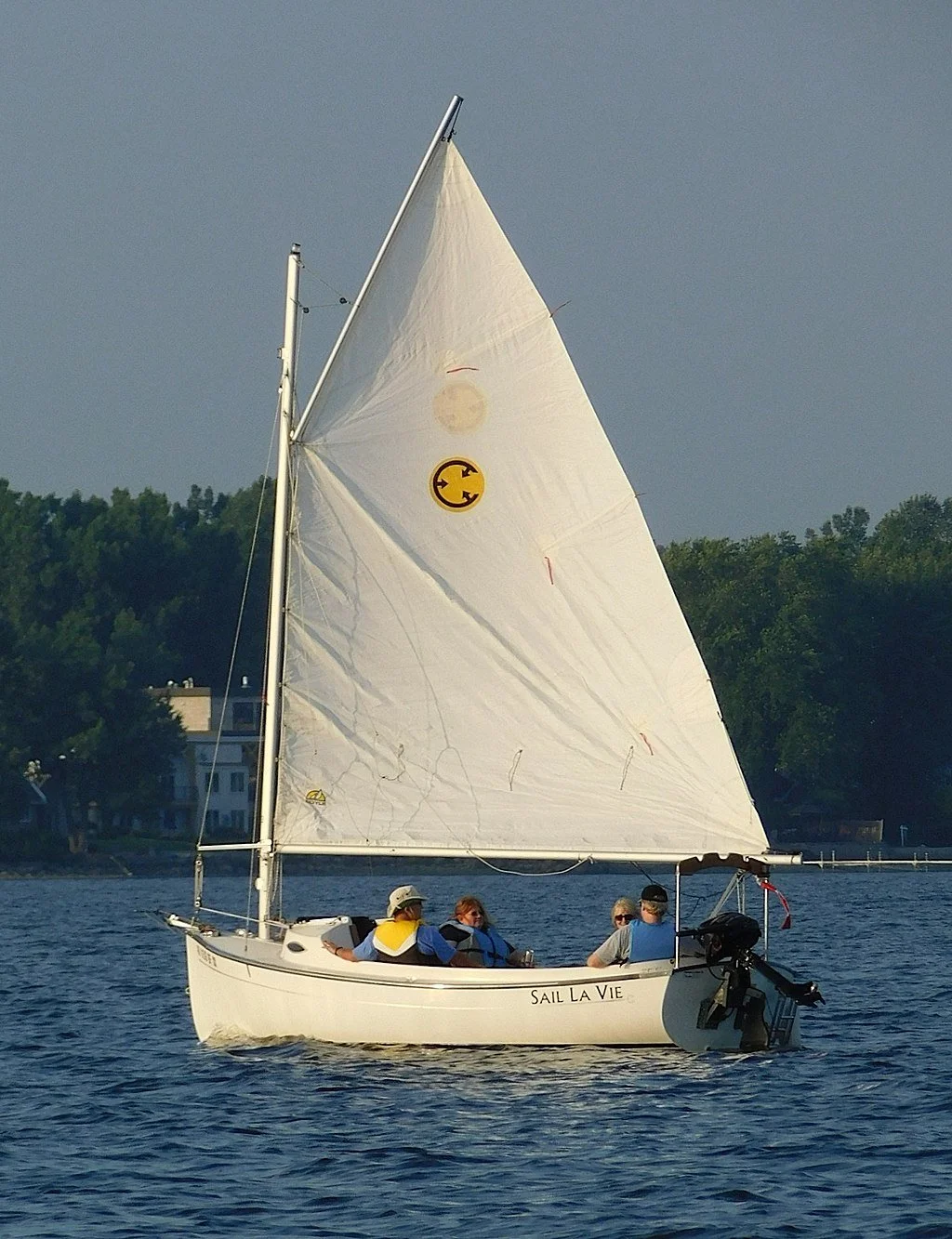
We always had small boats – rowboats, small sailboats, up to 17 feet long, even a canoe. We had an outboard motor or two to stick on sterns when needed, but these could be pesky to get going. The boats were practical possessions since we lived up a hill from a harbor. (The canoe was used on a nearby mill pond.)
Before fiberglass, the boats meant a lot of springtime work sanding and caulking the wooden bottoms before applying anti-fouling copper paint. Then we had to carefully maneuver a trailer to launch the sailboats in June and then reverse the process in late September. As the years rolled by, this got tedious.
The channel from the harbor out to the bay, which at Cohasset was really more the open ocean, was narrow, with ever shifting sandy shoals on one side and mussel beds (where we got our bait) on the other and sometimes was quite laborious to get through by sail.
In mid-summer heat waves you had to voyage out at least a mile, to the vicinity of the famous Minot’s Light, to get the real air-cooling effect. You’d hope that ships hadn’t recently dumped a lot of bunker oil, which could cover miles of water and give off a very noxious smell. Thank God for the EPA!
Then back to the small harbor, which became increasingly crowded with large and small pleasure boats over the years, I suppose because of growing local affluence as this small town became an all-out suburb. No longer were lobster and other commercial fishing boats numerous.
It was soothing to go sailing alone, which, if the breeze were a steady 10 to 20 knots, would put you in a ruminative mood. Sometimes you’d throw out an anchor and fish for mackerel, hoping that you wouldn’t get a dogfish instead.
It was also often fun to have small parties on the boats, except when the wind and social energy flagged and there you were – sometimes trapped for hours – in a small cockpit. Eventually, the claustrophobia might force you to use the outboard to motor in.
I still like to go out on boats once or twice a summer if I have a pretty good idea of when I’ll get back to shore. But with the expense and time involved in owning a boat, I’d just as soon have it someone else’s.
xxx
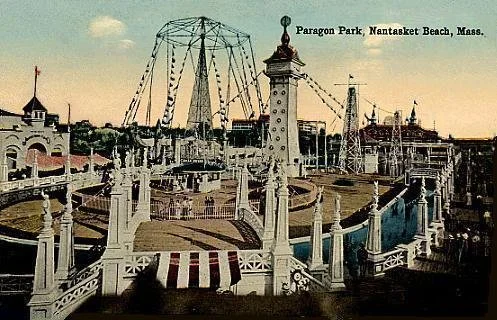
Paragon Park, in Hull, in 1914
There was a now long-gone amusement park, called Paragon Park, along a rather polluted strand called Nantasket Beach, in Hull, Mass., that we’d be taken to about once a year, often around my birthday. There was a lethal roller-coaster, a fun house with sloppily made monsters and, my favorite, something called “The Rotor.” This giant infernal cylindrical device, into which you’d walk, would spin you around at such velocity that you’d be stuck to the walls. (Sounds like astronaut training.)
Inevitably, a kid would get sick and upchuck the junk food (cotton candy, popcorn and hot dogs, etc., of indeterminate origin). Perhaps for the same reason that I very rarely get seasick, I didn’t suffer this misfortune.
Then there were the games (with prizes “Made in Japan,’’ back when that phrase meant cheap instead of high quality), which usually involved throwing a ball at something as a bored attendant (usually an older teen doing this as a summer job) looked on with a frown or a rictus smile.
Paragon Park was notably garish but, especially when you’re young, “kitsch is everything you really like,’’ in the immortal words of our late musician friend with the wonderful name of Page Farnsworth Grubb, who ended his years in Iowa. Despite what you might think from his name, he was about the least pretentious person you could meet. By the way, if you want pretentious, look at the marketing for “The Preserve,” in Richmond, R.I.

Tips for New England gardeners in drought


From ecoRI News (ecori.org)
For backyard gardeners, mild droughts and water-ban restrictions common during the summer can be a cause for concern. Kate Venturini Hardesty, a program administrator and educator with the University of Rhode Island’s Cooperative Extension, offers some tips for gardeners who are feeling the heat.
Let your lawn rest.
“Your lawn is on summer vacation,” she said. “Lawns are meant to go dormant in July and August. Many turf types are perennial species, so they rely on a break, much like the herbaceous perennials in our gardens. When we don’t allow them to rest, they’re weaker, just like you and I without a good night’s sleep. Refraining from watering the lawn saves a tremendous amount of water.”
While this may mean that your lawn is brown instead of a vibrant green, it will be beneficial for its overall health.
Don’t mow your lawn too low.
Mowing your lawn too far down will also have a negative impact on it. You don’t want to be the golf course of your neighborhood — the taller your grass is, the healthier it will be.
“The higher your mower is set, the deeper the roots are able to go underground to access soil moisture,” she said.
Water your crops and gardens as early in the day as possible.
“Don’t water any time but the morning,” she said. “It gives the plants some time to actually absorb the water before it evaporates.”
If you water at noon, you’ll lose a bunch of water to evaporation. If you water in the evening after the sun has set, you run the risk of causing fungal issues for your plants.
Know what plants are best for your garden.
When it comes to designing and planning your gardens and landscaping, it’s critical that you know which plants are the best suited for your space. Plants that are native to your area will generally do best because they evolved and are able to adapt to the way your local climate is changing on both the micro and macro levels.
The types of plants that are best to plant vary from garden to garden based on a variety of factors, including sun exposure, solid health, and drainage. Before you plant, do your research.
“A simple site assessment exercise can help you gather information about available sunlight and water, wind exposure, drainage and soil health,” she said. “The more information you have, the easier it is to choose plants that can tolerate the climate on your site.”
Venturini Hardesty said that, on average, New England tends to get about 45 inches of rain annually. If the average rain per week is about an inch, that leaves about seven weeks without rain, which happens to be almost the full length of the months of July and August.
The shifts that climate change will bring to backyard gardeners – and crop growing and planting as a whole – will need to be dealt with on a regional level, not in individual backyards, she said.
‘As if digging a grave’
— Photo by Caroline Culler
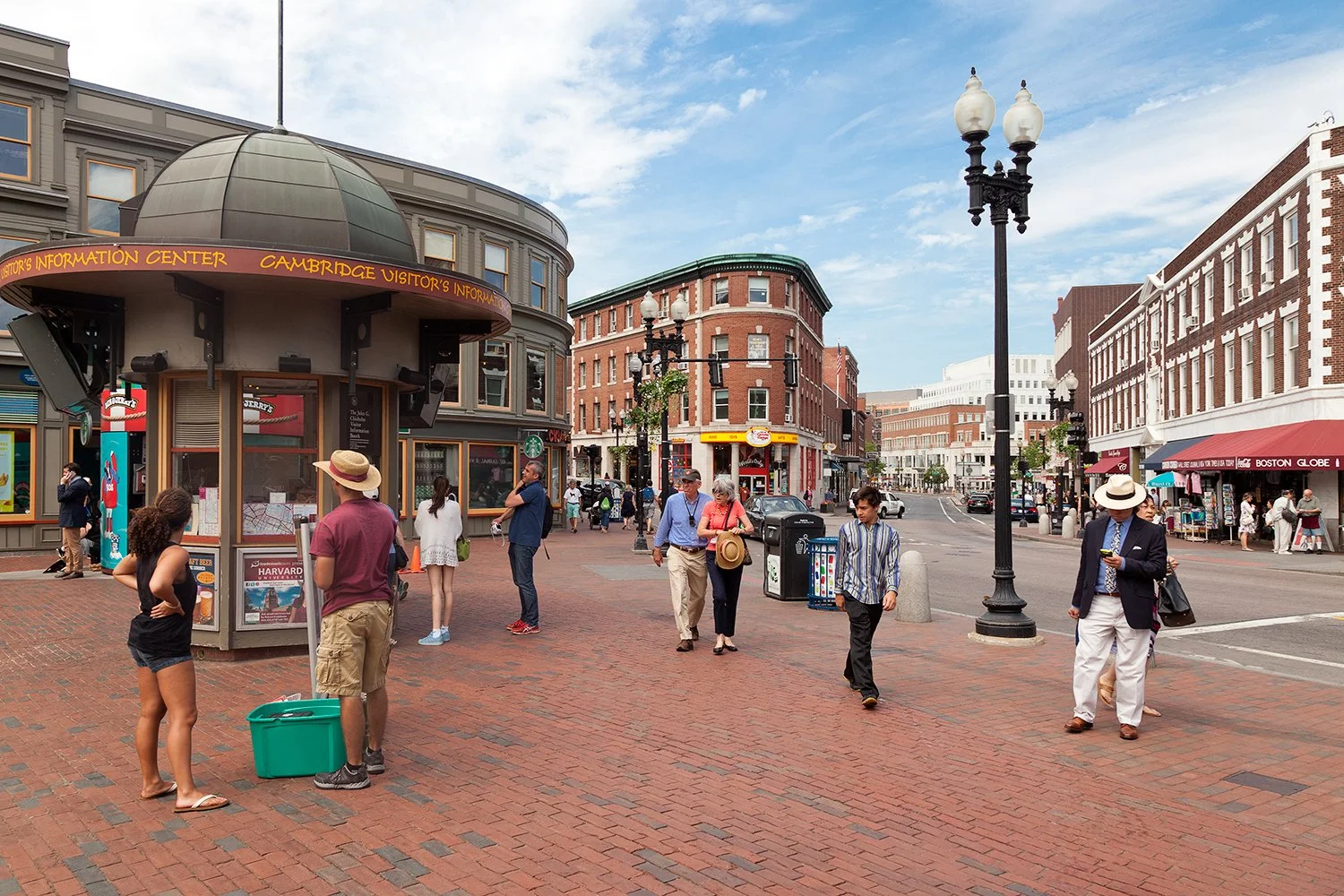
“….The tiny dormer windows like the ears of a fox, like the
long row of teats on a pig, still
perk up over the Square, though they're digging up the
street now, as if digging a grave,
the shovels shrieking on stone like your car
sliding along on its roof after the crash….’’
— From “Cambridge Elegy,’’ by Sharon Olds (born 1942), American poet and teacher
Beach flag

“Flag 09” (white sand and red dirt) by Tim Sauter, at the Cape Ann Museum, Gloucester, Mass., in his show “American Flags’,’’ Aug. 13-Sept. 25. He lives in the Lanesville section of Gloucester.
The museum says: “‘Americans Flags’ was created by artist, designer and professor in the practice of design at Olin College of Engineering {in Needham, Mass.} Tim Ferguson Sauder. The exhibit explores our American identity through the creation of flags built using marks collected from the different people and places that make up our country.’’
Take it easier with the fertilizing and watering

“Lost in the Garden” (encaustic painting), by Providence-based artist Nancy Whitcomb.
‘Utterly without pretense’
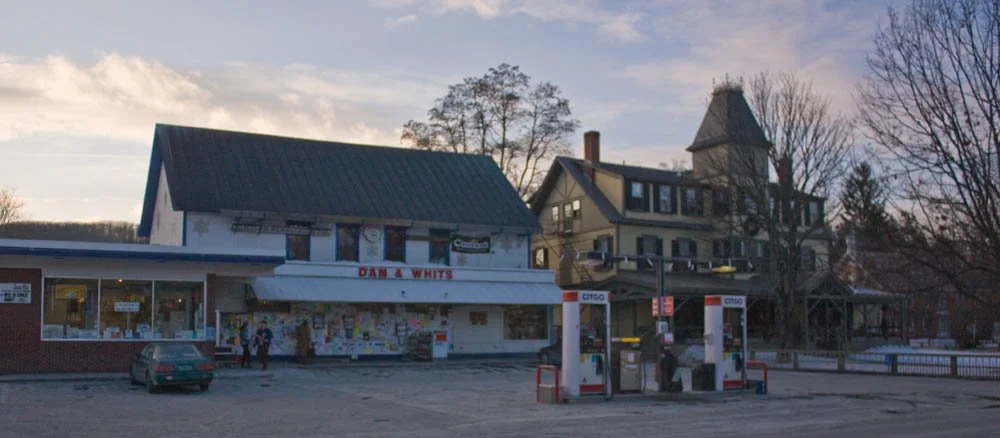
Dan & Whit’s, the famous general store in Norwich, Vt., where Peter Welch lives when not in Washington.
“I represent a rural state and live in a small town. Small merchants make up the majority of Vermont’s small businesses and thread our state together. It is the mom-and-pop grocers, farm-supply stores, coffee shops, bookstores and barber shops where Vermonters connect, conduct business and check in on one another.”
— Peter Welch (born 1947), Vermont’s sole member of the U.S. House.
xxx
“Vermonters are not only charmless of manner, on the whole; they are also, as far as I can judge, utterly without pretense, and give the salutary impression that they don't care ten cents whether you are amused, affronted, intrigued, or bored stiff by them. Hardly anybody asked me how I liked Vermont. Not a soul said 'Have a nice day!'‘'
“Vermonters, it seems to me, are like ethnics in their own land. They are exceedingly conscious of their difference from other Americans, and they talk a great deal about outsiders, newcomers, and people from the south.”
— Jan Morris (1926-2020), British historian, author and famed travel writer
Prepare for flowery language

“Flower Portrait (Markia)”, by Jee Hwang, in the “SALLY Project,’’ at Brickbottom Artists Association, Somerville, Mass., Sept. 8-Oct. 15.
The “Sally Project’’ is is an interdisciplinary, community–centered project, created by Sasha Chavchavadze and JoAnne McFarland, that focuses on using art to activate the public memory of women, like Sally Hemings (Thomas Jefferson’s slave and mistress), whose lives have been forgotten.

David Warsh: Bitter times —John Kerry, the Vietnam War, me and The Boston Globe

Logo of the controversial anti-Kerry Vietnam veterans group in the 2004 presidential candidate
SOMERVILLE, Mass.
What does a top newspaper editor owe his publisher? The press critic A. J. Liebling famously wrote: “Freedom of the press is guaranteed only to those who own one.” Tired of arguing with a friend about the implication of that dictum, I threw up my hands a year ago and walked away. Since then, interest in the question has been rekindled. I decided to re-engage
The particular case that interests me has to do with the role of The New York Times in the 2004 presidential election. It was then that the first collision occurred between mainstream news media and crowdsourcing on the internet: The derisive Swift Boat Veterans for Truth vs. the John Kerry campaign. Did the presidency hang in the balance? There is no way of knowing. George W. Bush received 50.7 percent of the popular vote, against 48.3 percent for Kerry; in the Electoral College, the margin was slightly wider, 286 to 251.
In at least in one respect, crowdsourcing seemed to have won its contest that year. More news about dissension within the Swift Boat ranks appeared first on the Web during the second half of the year, rather than in newspapers. As Jill Abramson notes in Merchants of Truth: The Business of News and the Fight for Facts (Simon & Schuster, 2019), the newspaper business changed after that.
I followed what happened in 2004 because eight years earlier, I had become involved in what turned out to have been its quarter-final match. In 1996, Kerry, the junior U.S. senator from Massachusetts, was running for re-election to a third term against a popular two-term governor, William Weld. Kerry decisively defeated Weld, sought the Democratic vice-presidential nomination in 2000, then secured the Democratic Party’s nomination in 2004 to run against Bush.
Until 1996, Kerry was known to the national public mainly as a critic of the Vietnam War. The ‘80s, which began with the Soviet Union’s invasion of Afghanistan and Ronald Reagan’s election to his first term, had changed attitudes toward America’s experience in Vietnam. Though first elected in 1984 – on, among other things, a promise to stop U.S .atrocities in Nicaragua, – Kerry’s 1996 senatorial campaign was the first one in which he sought to tell the story of his war in Vietnam. He gave highly personal accounts of his service to Charles Sennott, of The Boston Globe, and to James Carroll, of The New Yorker, which appeared a month before the election. In reading them, I was struck by certain inconsistencies in the senator’s accounts – in particular, by the relatively short time he had spent in Vietnam.
I was then a columnist on the business pages of The Globe, writing mostly about economics and its connection to politics, but for a year (1968-69), as a second-class petty officer in the U.S. Navy, I had been a Pacific Stars and Stripes correspondent, based in Saigon, and, for a year after that, a stringer for Newsweek magazine.
After Kerry boasted of his service and disparaged Weld for not having gone to that fight, I wrote a column on Monday for Tuesday, Oct. 22, that was headlined “The war hero.” In the course of my reporting, a member of Kerry’s Swift Boat crew, who had been put in touch with me by the campaign, confided in the course of a long conversation a detail that hadn’t appeared before. A second veteran, a former Swift Boat officer-in-charge, phoned the paper to offer additional details. I requested permission to draft a follow-up column, and received it.
A year ago, I told my story about how that second column came to be written. Below, I put into the record a parallax account of the key events of that week, in the form of a November 1996 letter from former Boston Globe editor Matthew Storin to a strident critic of The Globe’s coverage of Kerry in this instance. I include the letter to which he was responding as well below. They are long and painful to read, and unless you, too, are interested in 2004, you can skip them.
I am writing all of this now for two reasons. I learned last year that having retired from the newspaper business, Marty Baron is writing a book. Collision of Power: Trump, Bezos, and The Washington Post (Flatiron) is said to be about his eight years as executive editor of The Post, beginning just after Amazon founder Jeff Bezos purchased the paper from the Graham family. That makes Baron an expert on the central topic here; all the more so since in 2011, he was considered one of the three likeliest candidates to replace executive editor Bill Keller in the top news job at The Times, according to Jill Abramson, who ultimately got the job. I am eager to see what Baron says about The Globe’s 2004 book about Kerry, so I decided to put on the table the first of the cards that I possessed.
I also want to express the conviction that the resounding success of the tactics Kerry employed in 1996 probably cost him the presidency in 2004. During the week in the fall of ‘96 that we waited for the campaign’s reply to questions raised by “The war hero” column, we accumulated several new bits and pieces of information. Had his staff kept its promises, we would have asked questions about them, but I doubt that I would have written a second column, and certainly not the second column that appeared. Probably we would have waited until after the election, perhaps long after the election, to begin to resolve the questions. Meanwhile, Kerry might have learned how to talk about the issues that would be so starkly raised in 2004.
Instead, a hastily arranged Sunday rally, as Storin’s letter makes clear, was the equivalent of an ambush. Kerry and others, including Adm. Elmo Zumwalt, Commander of Naval Forces in Vietnam when Kerry had been there, assembled from around the country and appeared in the Boston Navy Yard to fiercely denounce the second column, barely 12 hours after it appeared in print. The effects were blistering. With the election 10 days away, The Globe covered the rally and otherwise put the story aside.
I received a copy of Storin’s letter to the critic soon after the election, via interoffice mail. In the five years I remained at The Globe, I was never asked by senior editors about what I had learned. The news business was different in those days. Newspapers were still regnant, but their owners embraced differing principles and possessed different points of view. The Globe had been purchased by New York Times Co., in 1993. Under a standstill agreement, the paper was still managed by the Taylor family in 1996, as it had been for 125 years. Even then, the implications of the sale were beginning to come clear. NYT Co. president Arthur O. Sulzberger, Jr. fired Benjamin Taylor as. Globe publisher in 1999, and replaced Storin with Baron in mid-2001.
Kerry considered questions about his experiences in Vietnam, asked in the rough and tumble of the news cycle, to be illegitimate; I and my editors considered them appropriate in the circumstances. None of us, I think, would have felt any compulsion to publish that second column had the campaign kept its promises. We’ll never know. But in refusing to respond, and attacking instead, Kerry had effectively ruled the questions out of bounds.
Kerry’s success in 1996 may have bred over-confidence going forward. The next eight years produced little news on these matters. The historian Douglas Brinkley wrote his campaign biography, Tour of Duty: John Kerry and the Vietnam War (William Morrow, 2004). By the time it appeared, a whole new wing of the news industry had gained an audience – Rush Limbaugh, the Drudge Report, the Fox News Network, Bill O’Reilly and Andrew Breitbart.
When the same ambush tactics the Kerry campaign employed against The Globe were used against him in May 2004 by the organization calling itself Swift Boat Veterans for Truth, it was too late to disarm. Kerry toughed it out. Bluster and evasion had become a habit.
. ••
“November 6, 1996
“John M. Hurley, Jr., 78 Longfellow Road, Wellesley. MA 02181
““William 0. Taylor, Chairman; Benjamin B. Taylor, President; Matthew V. Storin, Editor: The Boston Globe
Gentlemen: ‘
“What has happened to The Boston Globe? What has happened to the proud, 124-year tradition of impeccable journalistic standards?
“David Warsh has disgraced himself. He has shamed The Boston Globe, he has stained the profession you cherish.
“I am a Vietnam veteran, a 26-year friend of John Kerry, and a 4-decade long fan of the Boston print media. (My father was a Boston news photographer for 43 years – 29 with The Boston Post, 2 freelancing, 12 with the Globe – and he instilled in his children an unyielding admiration for the Boston print media.)
“But in 40-plus years of close observation of Boston newspapers, I have never seen a more despicable, more vicious, more baseless attack than David Warsh’s columns on John Kerry.
“Without any foundation whatsoever, without a single witness contradicting events that took place 27 years ago, without a shred of physical or documentary evidence, Warsh levels the single, most vile hatchet job that I have ever seen.
“Where is Warsh’s evidence to contradict these witnesses, where is the substantiation for his vicious speculation? There is none. Not one word. He speculates about the most heinous war clime imaginable – the commission of murder in order to secure a medal – and offers nothing in support of his speculation. Not a single witness. Not a statement. Not a document. Nothing. It is simply Warsh’s own personal, vicious speculation.
“Even a ‘decorations sergeant,’ if he has an ounce of objectivity, if he has an ounce of integrity, is capable of putting this incident into the context of a firefight: incoming B-40s. enemy fire, from both shorelines, third engagement of the day. stifling heat. deafening noise. screaming, shouting, adrenaline-driven chaos. Sheer mind-numbing chaos. Kerry and his crew were trained to do one thing in order to save their lives: react, react, REACT. Lay down a base of fire, or die. It was that simple. Even a ‘decorations sergeant’ understands that. But if you have no objectivity, if you have no integrity, you don’t put the incident into context. you write of war crimes instead.
“And what of that dead VC? According to Warsh, he was Just a tourist on holiday. ‘The one thing that seemed hard to abide was a grandstander. A Silver Star for finishing off an unlucky young man?’ SAY … THAT .., AGAIN. ‘A Silver Star for finishing off an unlucky young man?’
“A VC soldier … in the midst of a firefight … armed with a B-40 rocket … aimed at the crew of a U.S. Navy swift boat – and Warsh sides with the dead VC. An unlucky young man, finished off for the sake of a Silver Star by a grandstander.
“Who does David Warsh think he is? What right does he have to casually, callously, with utter disregard for the facts presented to him destroy a person’s reputation. Their character. their integrity, their honor?
“And you let him do it. Twice.
“Where are your journalistic standards. Where is your outrage. Where is your moral indignation. Where is your decency. Where ls your fairness? Do you really believe that Warsh’s vicious conjecture rises to the level of fair, objective comment? Are Warsh’s columns the stuff of which you want your newspaper judged?
“John Kerry’s honor, his crew’s honor, is intact. What of the Globe’s?
“It is important to point out that Warsh’s reporting is replete with errors. Warsh engages in the vilest character assassination imaginable, and he doesn’t even get basic facts right. In any newsroom I have ever visited ‘getting the story right’ is worn like a badge of honor. Warsh didn’t even try.
“Relying solely on personal conjecture (‘What’s the ugliest possibility? ….’) and vicious innuendo (‘Tom Bellodeau (sic) says he was awarded a Bronze Star … but I have been unable to find a copy of the citation.
“Warsh proceeds to trash the honor of Kerry, his crew, and indeed every veteran who has ever been awarded a medal for bravery.
“There is not one word of substantiation in Warsh’s diatribe. There is no foundation, no witness, no evidence, no document that contradicts what has been said or written about Kerry’s war record. Yet Warsh dangles before the reader the most heinous speculation imaginable: that Kerry murdered a wounded, helpless enemy soldier in order to win a Silver Star for himself. An unspeakable crime, yet Warsh offers nothing to substantiate it. The allegation is solely Warsh’s own vicious, character-assassinating conjecture.
“And you let him publish it. Twice.
“Warsh advances his vicious speculation even though there are rock-solid statements and documents to the contrary, statements and documents that completely contradict his spurious, hate-filled conjecture:
“Belodeau told Warsh: ‘When I hit him, he went down and got up again. When Kerry hit him, he stayed down.’
“Medeiros told the Globe’s Barnicle: ‘I saw a man pop-up in front of us. He had a B-40 rocket launcher, ready to go. He got up and ran for the tree line. I saw Mr. Kerry grab an M-16 and chase the man. Mr. Kerry caught the man in a clearing in front of the tree line and he dispatched the man just as he turned to fire the rocket back at the boat…I haven’t seen or talked with Mr. Kerry since 1969, but I admired him them and I admire him now. He saved our lives.’
“Kerry’s Silver Star citation, awarded for ‘conspicuous gallantry and intrepidity in action,’ signed by Admiral Elmo Zumwalt, states that the enemy soldier had a B-40 rocket launcher ‘with a round in the chamber.’
“Warsh quoted Kerry (from the Carroll piece): ‘It was either going to be him or it was going to be us. It was that simple. I don’t know why it wasn’t us – I mean to this day. He had a rocket pointed right at our boat.’
“Warsh misspelled Tom Belodeau’s name 13 times.
“Warsh referred to Belodeau as the ‘rear gunner’: Belodeau was the forward gunner.
“Warsh reports that Keny was assigned to a boat ‘whose skipper had been killed’; the skipper was not killed, he was wounded, and is alive today.
“Warsh refers to ‘heavy 50 mm machine guns’: they are .50-caliber machine guns. ‘50 mm machine guns’ are laughable; a reporter with even a cursory attempt at accuracy would have caught the error instantaneously.
“Warsh asks: ‘But were there no eyewitnesses?’ There were at least three: Tom Belodeau, Mike Medeiros. John Kerry. All were quoted in the Globe. But Warsh decided that from a distance of 27 years he knew better than they what happened that day. He ignored what they said, he opted instead to write his own personal, vicious, unsubstantiated conjecture.
“When you engage in character assassination. you have an absolute obligation to ‘get it right.’ Warsh didn’t even try. Why was he in such a hurry to get his hate-filled column into the paper?
“You have always been an aggressive, but responsible newspaper. You have never, until now, stooped this low. So, how did these columns happen? How did they get into your newspaper?
“Your journalistic integrity has been trashed by David Warsh, and the editors that OK’d these columns for publication. These columns were not a close call. These columns were flagrantly out of line. 124 years of journalist integrity has been trashed. It will take you years, if not decades. to recover from the stain of these columns.
“Hang your head in shame, Boston Globe. Hang your head in deep, deep shame.
/s/ John Hurley
“P.S. to Mr. Storin:
“And what of you, Mr. Storin?
“Did Warsh act entirely on his own? Does the Globe’s policy of complete freedom to its columnists mean that no editor even questioned Warsh about the foundation of his columns? Even when Warsh’s columns are totally outside his field of expertise? Did no editor request even minimal substantiation of his vicious speculation: a witness, a document, a statement? Anything at all?
“Does the Globe’s policy of complete freedom to its columnists extend to baseless, personal character assassination? Did you and the editors that work for you fail to see a pattern of vicious, personal attacks by Warsh?
“‘… there is,” Warsh wrote, ‘a good, strong, dispassionate reason to prefer Bill Weld to John Kerry.’ Fair enough. He’s entitled to endorse whomever he wants to. But then the pattern of attacks began:
“Warsh, Oct. 15, 1996: ‘he was acquired by John Heinz’s widow in a tax-exempt position-for dollars swap.’
“Warsh, Oct. 22, 1996: ‘The one thing that seemed hard to abide was a grandstander. A Silver Star for finishing off an unlucky young man?’
“Warsh, Oct. 27, 1996: ‘What’s the ugliest possibility? That behind the hootch, Kerry administered a coup de grace to the Vietnamese soldier – a practice not uncommon in those days but a war crime nevertheless, and hardly the basis for a Silver Star.’
“A recurring pattern of vicious, unsubstantiated personal attacks. Is this what constitutes fair and objective comment under the Globe’s current journalistic standards?
“The very day Mike Medeiros was quoted in the Globe saying Kerry ‘saved our lives,’ you gave Warsh additional space, and let him – without a single witness, without a single document, without a single supporting statement – viciously speculate about a war crime, for the very act that Medeiros said saved their lives. A war crime? Admiral Zumwalt, the highest ranking Naval officer in Vietnam, stated that John Kerry’s heroism that day was worthy of the Navy Cross, the second highest medal for bravery that our country awards. (But Zumwalt recommended a Silver Star instead, because he wanted to expedite the awards ceremony and boost the morale of his troops who were taking heavy casualties at the time).
“Every witness that has spoken, every document that exists. every shred of evidence that has been found states that Kerry acted selflessly, with extraordinary heroism. Yet Warsh, without foundation, without any substantiation whatsoever, conjectures about a war crime. And you print it. Is that the journalistic standard by which you want your reading public, your fellow journalists across the country, your publishers, to judge you and The Boston Globe?
“To top off this lame, pathetic performance by you and your editors, you go on television and dismiss Warsh’s columns, saying, ‘I thought in the long run it might be favorable for Kerry.’
“Vicious, unfounded character assassination ‘might be favorable’? Ludicrous, laughable, stupid, sick.
“The basic test of character, Mr. Storin – for a man or a newspaper – is to be able to say, in the face of adversity, ‘We were wrong, extremely wrong.’ “You, The Boston Globe, and David Warsh have failed that test, egregiously.’’
“November 13, 1996
“Mr. John M. Hurley, Jr., 78 Longfellow Road, Wellesley, MA 02181
“Dear Mr. Hurley:
“Your thoughtful letter was very painful to read. You made some very harsh charges, most of which I feel were not in the same context with the decision that I was faced with in allowing publication of the David Warsh column. Nearly three decades after a signal event in the career of our junior US Senator, I had a column with a seemingly new version of events and no one willing to come forward to explain it, despite our holding the column for three days. In the midst of an election campaign, to kill such a column under those circumstances was something I could not defend.
“Here is the chronology of events that led to my decision:
1. “Warsh says he has turned up this odd statement by Belodeau that does not appear to square with the previous He writes a first version of the column that lands on our desks on Wednesday. Because we are getting closer to the election, we consider publishing it on the following day, rather than waiting until the next of his regular column dates.
2. “I telephoned John Marttila, one of Kerry’s senior advisers, and urge him to have the senator talk to Warsh. I assume the discrepancy can be straightened out. John indicates that it is next to impossible to reach the senator, who is on his way to the debate in Springfield.
3. “I tell my editing colleagues Wednesday night that we must hold the column until we are able to (a.) reach Belodeau for additional clarification and (b.) reach Senator Kerry.
4. “Tom Vallely calls me Thursday morning and discusses the Warsh I tell him what Belodeau has said (or perhaps he already knew), and he says, in pretty much these exact words, “We have no problem with that. We have no problem with that/ and explains that the guy Belodeau hit got back up and appeared still able to fire his weapon. Frankly, I am relieved to hear this because it’s a plausible explanation and we can avoid even addressing the issue anew. Vallely says he will produce “his (Kerry’s) commanding officer. I got the impression that Tom would also help get Belodeau back to Warsh and possibly the senator himself, though on the latter point I may have been mistaken. I think Tom might have said earlier that the senator would not talk to Warsh. I had to leave for a journalism conference on Long Island, but at this point I am confident that the column will not be a problem.
5. “Late Friday, I ask to have the column faxed to me. I am very surprised to learn that neither Belodeau nor Kerry has offered anything to Warsh and that the officer has said he was not an eye witness. The New Yorker quote is also puzzling to me. Yet I feel that Warsh deals with the incident with some caution, offering two possibilities. It’s an effort to examine an important incident in the military career of a major public figure who has chosen for some reason — and that is fully his right — to not answer the columnist’s questions.
“From the remove of hindsight, it is now obvious that Senator Kerry chose prior to publication to use the column (of which through Vallely and others he probably had accurate knowledge) to his own advantage. Not only is that his privilege, but it appears to have been good politics. In any event, it probably would not have been possible to get Admiral. Zumwalt here between early Sunday morning and the late afternoon press conference, so that is my assumption.
“Frankly, the column probably would have disappeared without a trace otherwise. After reading it on Friday, I told our executive editor, Helen Donovan, ‘I think this is worth 1,000 votes for Kerry.’ Given your letter, you are probably incredulous at that, but I felt it humanized the senator in a way that has often not been the case in his career. Of course, I saw the negativity in it, but I thought readers would make their own judgments about the issues – as they do with all our opinion columns.
“As to an apology, I would first like to outline what the paper has done in print. We published the story of the press conference on page one Monday, including Belodeau’s explanation for his remark and his account of the battle as well as the testimony of Medeiros, whom our reporter spoke to by telephone. Obviously this piece was presented more prominently than the original column. We then published an op-ed piece by James Carroll, criticizing us in very harsh terms. It is part of our culture to publish a column such as Carroll’s just as it is to publish a column such as Warsh’s. William Safire writes a half dozen speculative columns a year that are as harsh to Bill Clinton as Warsh’s was to Senator Kerry. When was the last time you saw an op-ed piece in the Times that criticized the Times? Finally, we published a piece by our Ombudsman that, like Carroll, said the column should not have been published.
“I personally may regret that the column ran, but, given the same set of circumstances again, I would not kill the column. I have to make those decisions in the context of columns we have run in the past and might run again in the future. We were in the middle of a tough campaign, Belodeau had made a statement that seemed at odds with anything previously published, and despite waiting three days, no one had come forth on behalf of Senator Kerry to explain it. I agree that it’s a sign of character to admit when you are wrong and, in some ways, that would be easier to explain than what I am trying to say here. I believe David Warsh may address his own personal feelings in a future column and, possibly, in a conversation with Senator Kerry if that is possible.
“It pains me to read that Senator Kerry feels this was a low point in his life. I am certain of one thing: It would have been avoided if he had given a statement to Warsh as we had asked. His failure to respond — even if he wanted to call a press conference in advance — took out of my hand a major argument for changing or killing the column (though I believe Warsh would have treated the subject much differently). Your citation of the Medeiros quote is interesting. The campaign obviously chose to make Medeiros available to another columnist, rather than reply directly to Warsh. That’s another legitimate political decision by the Kerry campaign, but it didn’t help with the decision I had to make on Friday evening (deadlines are earlier for Warsh’s column than for Barnicle’s). I understand that the senator and some of his advisers felt wary of dealing with Warsh, but Tom Vallely and John Marttila knew that I had personally involved myself in the issue and could have phoned me back at any time between Thursday morning and Friday night. Though I was out of town, I was easily reachable.
“I do regret — and they are inexcusable — the relatively minor but not insignificant “inaccuracies in Warsh’s column that you cited.
“In closing, I would like to note that you are a longtime friend of Senator Kerry. I understand you may have even played a role in the campaign’s effort to deal with the Warsh column. I am neither a friend nor supporter of John Kerry nor Bill Weld. I do everything in my power, in terms of social relationships, to put myself in a position to make dispassionate decisions as a journalist. I accept that you are upset with us, but I hope you will sometime reread your letter and recognize that you made some emotional charges that were not justified.
“Sincerely
/s/ Matthew V. Storin’’
David Warsh, a veteran columnist and an economic historian, is proprietor of Somerville-based economicprincipals.com, where this column originated.

More, more, more!

A CVS kiosk set up in Quincy Market, in downtown Boston.
— Photo by Whoisjohngalt
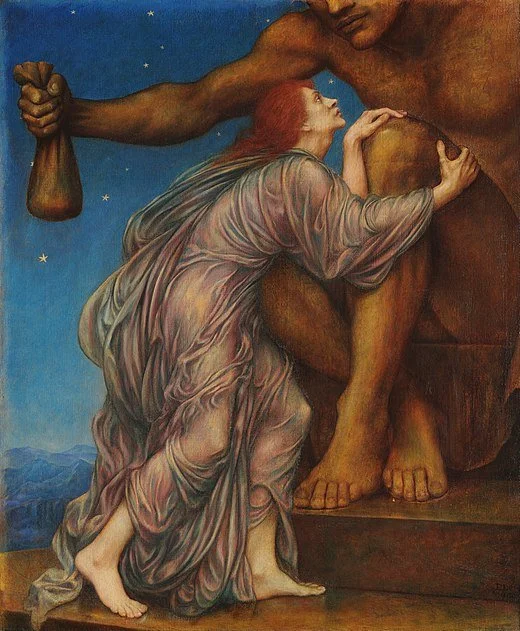
“The Worship of Mammon (1909)’’, by Evelyn De Morgan
Adapted from Robert Whitcomb’s “Digital Diary,’’ in GoLocal24.com
CVS’s chief executive officer, Karen Lynch, made 458 times the Woonsocket, R.I.-based company’s average employee’s wages in 2021, when her compensation exceeded $20 million while the average CVS worker made $45,010. Cut Ms. Lynch’s taxes some more!
An Economic Policy Institute report in 2021 showed that from 1978 to 2020, the pay of CEO’s of big public companies grew by 1,322 percent, far outstripping stock-market growth as measured by Standard & Poor’s (817 percent). It also exceeded corporate-earnings growth of 341 percent between 1978 and 2019, the latest data available. Meanwhile, compensation of the typical worker grew by just 18 percent from 1978 to 2020.
Where’s the evidence that corporate execs are better these days than they were 40 years ago and thus deserve these gargantuan pay days?
Behind a lot of this extreme compensation is the simple fact that the boards of big companies consist mostly of other very rich corporate execs who serve on multiple boards and give each other huge pay packages with the expectation that they’ll be taken care of in return.
Another is the media creation of the CEO of a big company as a genius superstar worthy of extracting vast sums from the economy.
Of course as they get richer and richer, they get more and more control of the political system, which they use to expand their wealth and power (especially via the GOP/QAnon Party) even further.
Hit these links:
https://www.epi.org/publication/ceo-pay-in-2020/
https://www.golocalprov.com/business/cvss-ceo-lynch-makes-458-times-the-average-cvs-employee
https://www.epi.org/publication/ceo-pay-in-2020/
And:
https://www.salon.com/2022/07/19/just-27-billionaires-spent-90-million-to-buy-congress-report_partner/
https://americansfortaxfairness.org/wp-content/uploads/BBER-FINAL-WITH-LINKS.pdf
Silence or arousing cries
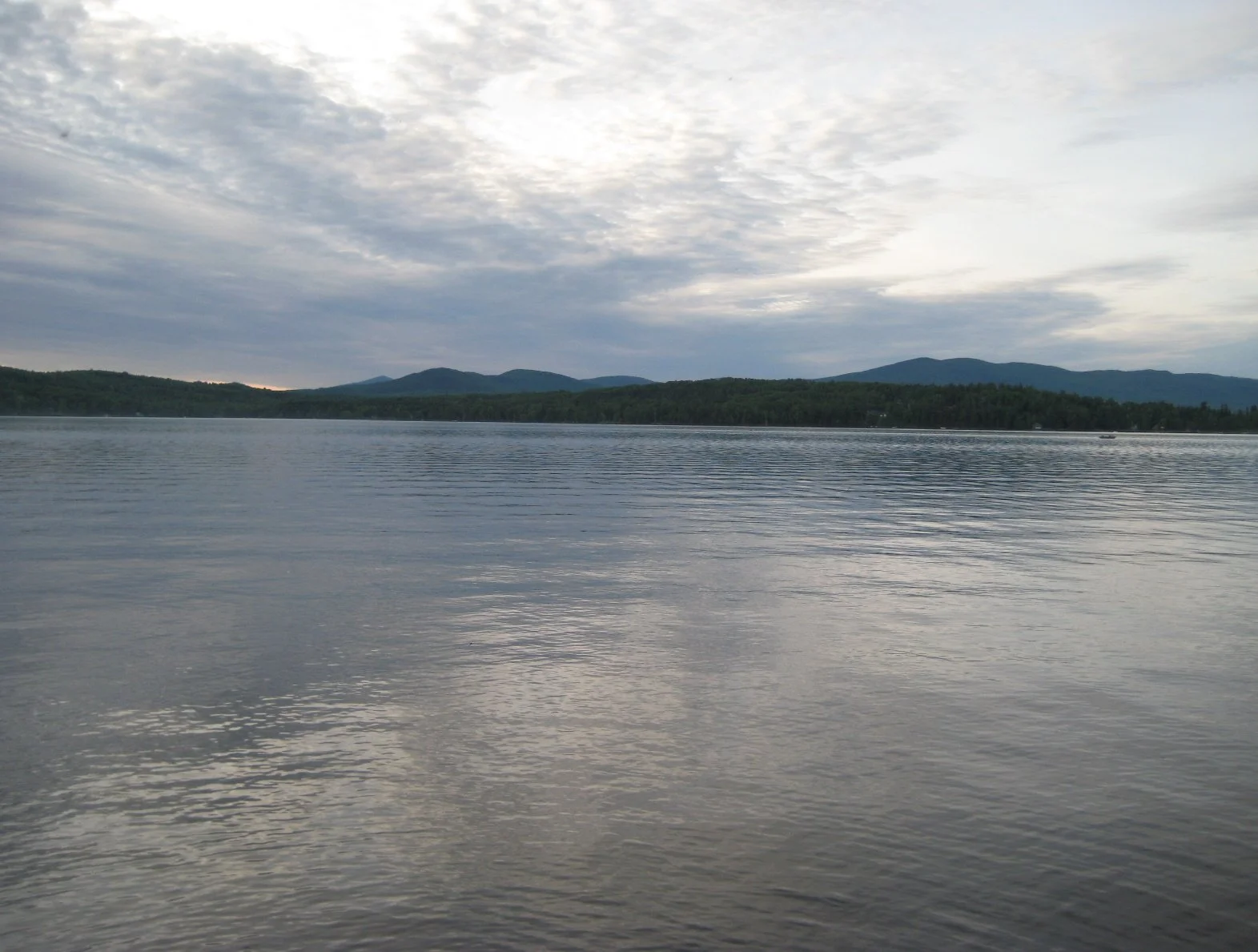
Rangeley Lake, Maine, from its southern edge.
— Photo by Dudesleeper
“Maine lakes may still be observed during moments of soundlessness. — in the pure luxury of quiet. Yet for those who long to hear those rare sounds once more, there is always the hope that there will be loons calling — breaking the silence with their wild arousing cries.’’
— Lee Kingman, in “Meditation in Maine,’’ in New England: The Four Seasons (1980)

Varieties of loons (called divers in Britain).
Memories of just people

“Self-Portrait 2021-22” (acrylic paint, fabric, paper, markers on canvas), by Bob Dilworth, in his current show, “Another Place,’’ at Cade Tompkins Projects, in Providence.
Chris Powell: Feel guilty about the present, not the past
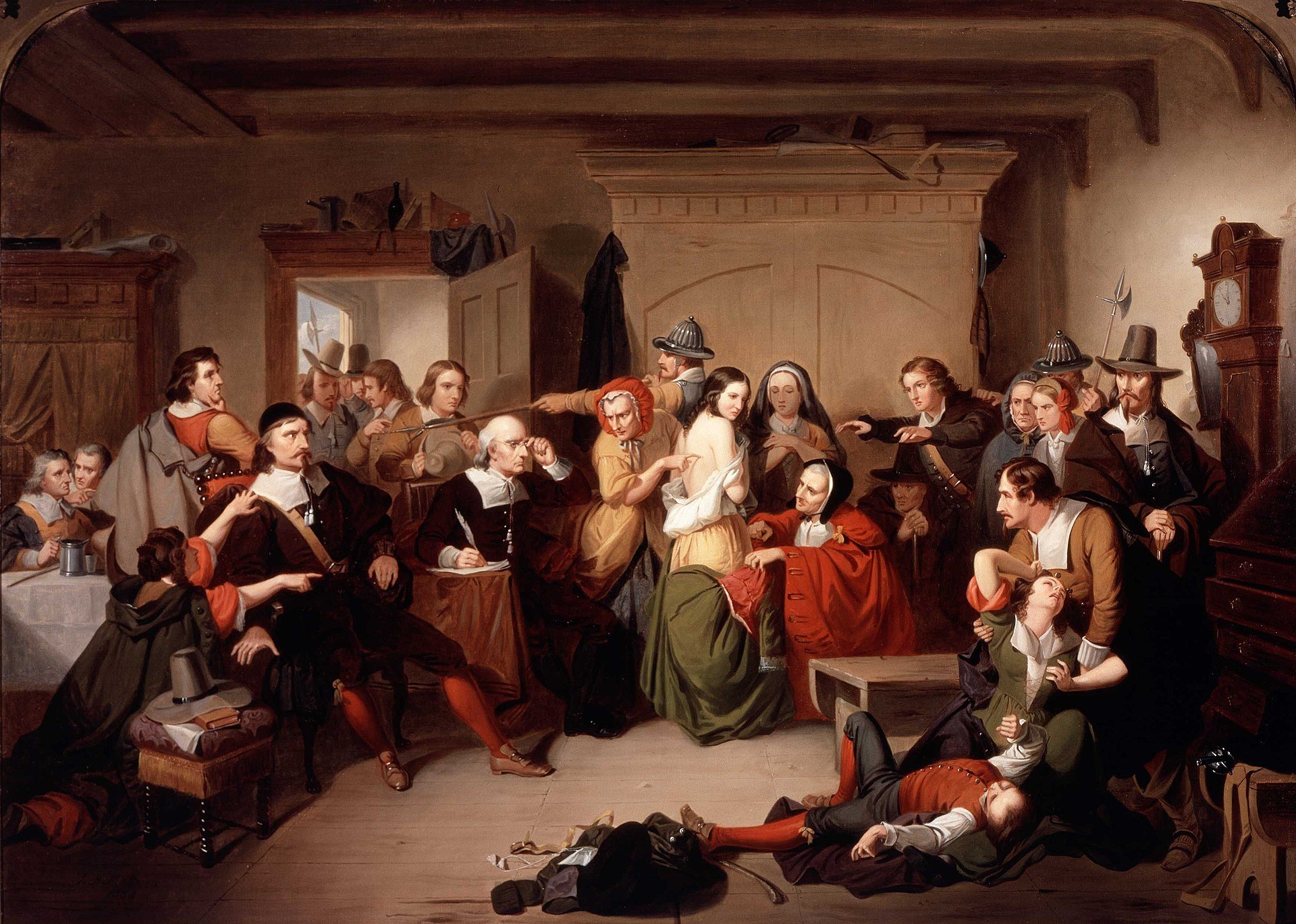
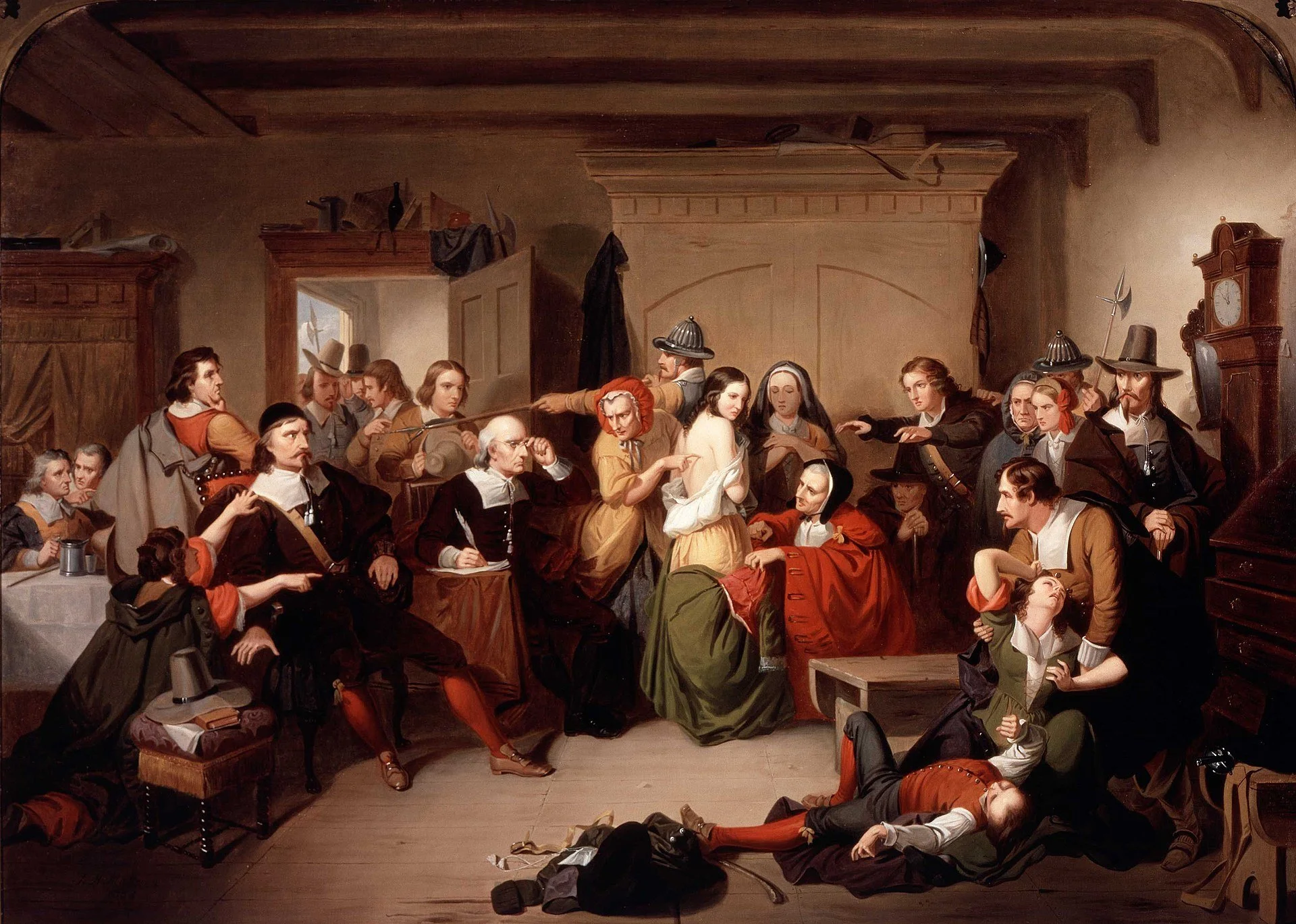
“Examination of a {New England} Witch,” by Tompkins Harrison Matteson (1813-1884), at the Peabody Essex Museum, in Salem, Mass.
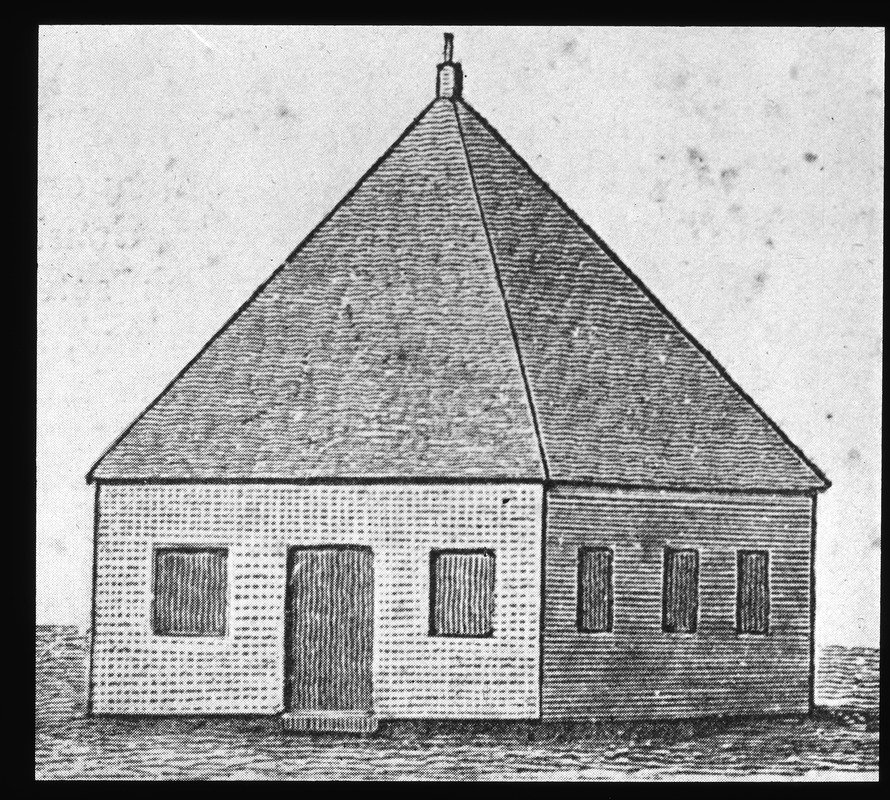
The First Meeting House, in Hartford, built in 1635, in the neighborhood where executions for witchcraft took place.
MANCHESTER, Conn.
Guilt tripping through American history has become almost as popular for vacationers as Florida. It's a vacation from current political reality.
In Connecticut the latest guilt trip involves the executions carried out here in the 1600s by the earliest European colonists against 11 of their number accused of witchcraft. The first known witchcraft execution in North America was that of a Windsor woman who was hanged in Hartford in 1647. This was just eight years after the Connecticut colony had distinguished itself more favorably by adopting the Fundamental Orders, a constitution establishing a government and taking more small steps toward democracy.
Until recently Connecticut preferred to remember the heroic virtues of its founders -- their setting out on their own, crossing the ocean, and starting up all over again from nothing. But their failings, even their witchcraft hysteria, are not really cause for the everlasting shame pursued by today's guilt tripping, which takes people and events out of the context of their time and ignores what used to be called the ascent of man, the long and bumpy journey from primitiveness to civilization.
For of course hundreds of years ago people saw the world in a more primitive way, without the understanding provided by modern science and communications. The fear arising from their lack of understanding, combined with the severity of their Puritan religion, made witchcraft seem a plausible explanation for the frequent calamities they suffered, and an accusation of witchcraft quickly became a convenient mechanism for intimidating or expropriating others -- much as accusations of racism are exploited today.
A group called the Connecticut Witch Trial Exoneration Project has been clamoring for a formal acquittal of the victims of the witchcraft hysteria. The state's pardon law can't help because it can be applied only to the living, so maybe it could be amended. Or maybe the General Assembly could pass a resolution of apology.
But why bother? Is there anyone in the state or even the country who has heard of the old witchcraft hysteria and who doesn't know that it was all a horrible misapprehension and injustice and who doesn't either shudder or laugh at it? Could anyone unaware of it come upon it without instantly recognizing it as such?
Meanwhile there are many criminal convictions throughout the country about which serious doubts have arisen, and a far more relevant project, the Innocence Project, has used DNA evidence and other investigation to exonerate hundreds of wrongly convicted people, including some in Connecticut -- people who are still alive and thus in infinitely more need of exoneration than the supposed witches of old. The Innocence Project estimates that as many as 10 percent of prisoners held in the United States are innocent. (Also unjustly, many repeat criminal offenders stalk society because the criminal-justice system fails to put them away for good no matter how much harm they keep doing.)
Many wrongly accused people have been convicted on the basis of false confessions, extracted from them by intimidation and threats by police and prosecutors, just as false confessions were sweated or even beaten out of people accused of witchcraft.
That's why any formal exoneration of the victims of the witchcraft hysteria won't do much more than make people feel guilty about a wrong done long ago for which they bear no responsibility even as it distracts them from current wrongs for which everyone remains responsible.
OUTRAGEOUS INEPTNESS: Connecticut has all sorts of outrages that should be addressed before bothering with the flaws of ancient ancestors. Another such outrage arose three weeks ago in Stonington, where, according to The Day of New London, two municipal public-works employees were caught on surveillance video planting drug syringes in a gazebo in a town park, and doing it on the job, no less.
Police said the employees aimed to create the false impression that the park is overrun by drug addicts and crime.
But Stonington First Selectwoman Danielle Chesebrough says the employees will not be disciplined because their dangerous and deceitful stunt violated no town government policy.
Indeed, all Connecticut often seems to lack a policy ensuring that government serves the public rather than its own employees.
Chris Powell is a columnist for the Journal Inquirer, in Manchester.