
Vox clamantis in deserto








'Joy's trick'

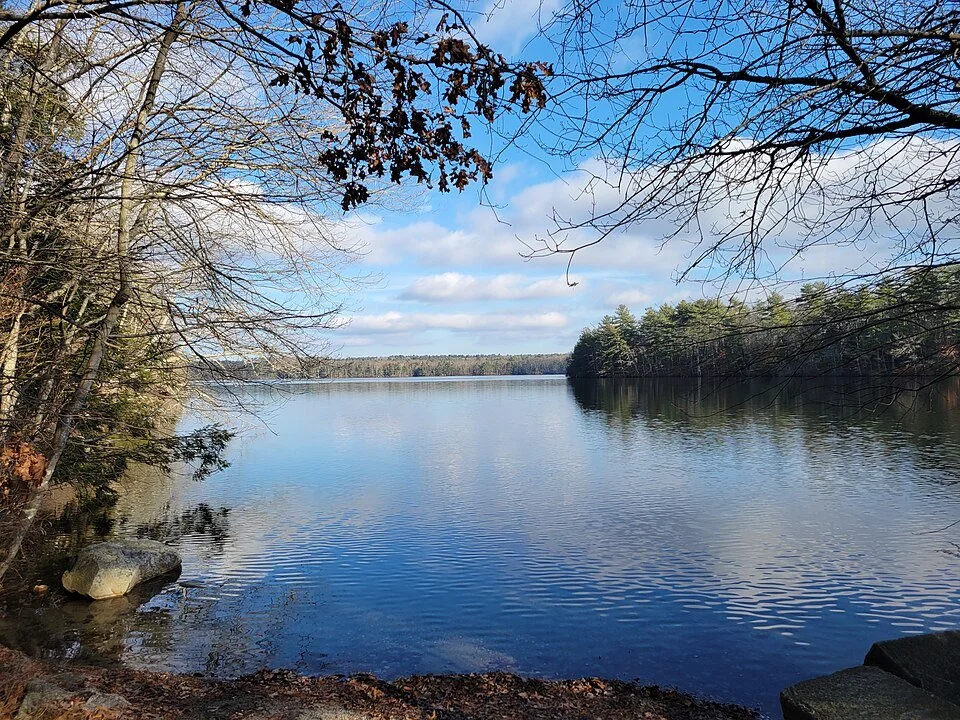
“Joy’s trick is to supply
Dry lips with what can cool and slake,
Leaving them dumbstruck also with an ache
Nothing can satisfy.’’
— From “Hamlen Brook,’’ by Richard Wilbur (1921-2017), famed American poet who spent most of his life in New England. Hamlen Brook runs through the Wilbur property in the western Massachusetts “Hill Town” of Cummington.
David Warsh: Reviewing ‘The Decider’s’ disasters
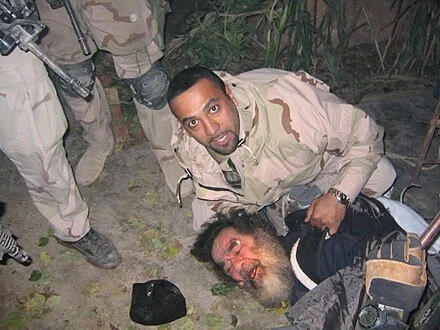
Saddam Hussein being pulled from his hideaway by U.S. troop in Operation Red Dawn, Dec. 13, 2003.
The CIA already had won its war against al-Qaeda before the Bush administration, preparing to invade Iraq, decided to occupy Afghanistan. The result was a second Vietnam War, proceeding from the same combination of good intentions and wicked ignorance as the first.
SOMERVILLE, Mass.
Three new books stand out against the backdrop of events of this month: First Casualty: The Untold Story of the CIA Mission to Avenge 9/11, by Toby Harnden; The Afghanistan Papers: A Secret History of the War, by Craig Whitlock, of The Washington Post, based on a secret 2015 government study obtained by The Post after a three-year legal battle, and After the Apocalypse: America’s Role in a World Transformed, by Andrew Bacevich.
{Editor’s note: Mr. Bacevich is a professor emeritus of international relations and history at Boston University. He is also a retired U.S. Army colonel. He is a former director of Boston University's Center for International Relations. }
Harnden is a veteran British journalist. He is, I think, substantially correct about the beginnings of the American misadventure in Afghanistan. The CIA knew what it was doing with its minimally invasive horseback strike against al-Qaeda; the rest of the intervention there was a colossal blunder.
To judge from the early reviews, Post reporter Whitlock has done a splendid job of documenting the parallels of institutional reasoning that led, first to the occupation of South Vietnam, and then, decades later, Afghanistan.
Look for both Harnden’s and Whitlock’s books to attract attention. But the publication dates of both books are still a week and a half away., And Bacevich’s summing-up is too far-reaching to consider in the heat of the moment.
So instead I read last week several chapters of To Start a War: How the Bush Administration Took America into Iraq (2020), by Robert Draper, a writer at large for The New York Times Sunday Magazine and National Geographic Magazine. I wanted to be reminded: How did the US get out of the much bigger mess that it made in Iraq with so much less drama?
We know a great deal about how we got into Iraq. Coming long after Rise of the Vulcans: The History of Bush’s War Cabinet (2004), by James Mann, and Bob Woodward’s Plan of Attack: The Definitive Account of the Decision to Invade Iraq (2004); seven years after Peter Baker’s Days of Fire: Bush and Cheney in the White House. (2013); not to mention Draper’s own initial assessment, Dead Certain: The Presidency of George Bush (2007), which had its beginnings in a Texas Observer profile that helped launch then-Governor Bush’s presidential bid
Draper’s book is probably the last word on the decision-making that led to the war. He finds, even more persuasively than his predecessors, that there was “no ‘process’ of any kind” in making the decision to go to war, or in the thinking-through of what might happen once war had begun. The self-proclaimed “Decider” simply made up his mind, and improvised thereafter. No Iraqi connection to 9/11 has subsequently been discovered. No “weapons of mass destruction” were found. Hopes rode initially on killing Saddam and his sons on the first night of the invasion with a stealth-bomber raid that turned out to have been based on faulty intelligence. After the bombs dropped a few hours too late, chaos ensued.
Draper attaches a good deal of importance to Bush’s thinking with respect to Saddam’s presumed attempt to assassinate his father with a car bomb when the former president visited Kuwait in 1993, two years after the first war with Iraq. I was disappointed by Draper’s chapter on the role of the press in supporting the war, “Truth and the Tellers.” Both The Times and The Wall Street Journal aggressively backed the Bush administration’s charges and plans. But he realistically hints at the in-house pressures, quoting national- security specialist James Risen, who was then working for The Times: “It’s like any corporate culture, where you know what management wants, and no one has to tell you.” I looked back at what I written, both at the time and a year later, and winced.
But it was Draper’s last chapter, “The Day After,” that riveted my attention. In January, 2007, Bush announced a “surge” – 20,000 additional troops to join the 150,000 or so already in Iraq. The next year was the deadliest for U.S. forces since 2004, but the level of violence gradually dropped and the additional troops were withdrawn. The last combat troops left Iraq in 2010. Some 4,400 American soldiers were killed in Iraq; 32,000 were wounded. Of the 1.5 million who served there, 300,000 returned home suffering from post-traumatic stress disorders. But Draper notes:
The toll was heaviest for the liberated. An estimated 405,000 Iraqis would die as a result of the 2003 invasion. Instead of Saddam, Iraq now had other forces of Sunni brutality. First there was Zarqawi, the leader of al-Qaeda in Iraq; and later would come the Islamic State, commonly known as ISIS. Though participatory democracy had more or less taken root, the dominant motif in Iraq was not freedom, as Bush had hoped, but rather violence, instability, and unending recrimination.
What replaced preoccupation with Iraq? The Financial Crisis of 2008, of course.
The conventional story is that President Obama inherited the disaster and somehow saved the day by obtaining the passage of a 2009 stimulus measure. In fact, it was Federal Reserve Board Chairman Ben Bernanke and Treasury Secretary Henry Paulson, who led central bankers around the world in devising an effective lending response to the global panic. Both were Bush appointments in his second term, and it was Bush himself who took the lead in announcing Emergency Economic Stabilization measures of 2008.
The pell-mell retreat from Afghanistan and slow-motion disaster in Iraq are blows to American prestige comparable to the fall of Saigon, in 1975, the overthrow of the Shah of Iran, in 1979, and the Cuban Revolution, in1959. But they were not the End-of-Times battles of evil and good envisaged in Revelation, the last book of the Bible, from which we inherited the word “Apocalypse.” Something like an Apocalypse threatened in 2008. Thanks to American leadership and global teamwork, a Second Great Depression didn’t occur. We are still a long way from understanding the history of the last 50 years.
David Warsh, a veteran columnist and an economic historian, is proprietor of Somerville-based economicprincipals.com, where this essay first ran.
Mass. medical schools join to fight racism in health care

Headquarters, in Waltham, of the Massachusetts Medical Society (MMS), the oldest continuously operating state medical association in the United States. Incorporated on Nov. 1, 1781, by an act of the Massachusetts General Court, the MMS is a non-profit organization with more than 25,000 physicians and medical students as members. Its New England Journal of Medicine is among the most prestigious and influential such publications in the world.
From The New England Council (newenglandcouncil.com)
BOSTON
“The University of Massachusetts Medical School, in Worcester, and the Massachusetts Medical Society are joining other medical schools in the state to combat racism in the health-care industry and medicine. The schools released a set of principles targeting racism in medical schools and other health-care organizations.
The schools, including the Boston-based Harvard Medical School, Boston University Medical School and Tufts University Medical School, also in Boston, outlined their long-term goals in a set of four principles. The first principle relates to the need to acknowledge and learn, including from a historical standpoint, as racism in medical practice has had a longstanding presence. The second point calls on institutional leaders to visibly commit to dismantling racism, and the third call for confronting practices and policies devaluing staff and patients of color. The last of the four principles emphasizes a culture of empathy and recognition of the intersectionality of oppression.
“‘It is mission critical for the Medical Society, the DPH (Massachusetts Department of Public Health) and our state’s medical schools to lead in supporting the next generation of physicians and their patients,’ said the Medical Society’s president, Dr. Carole Allen. ‘This document outlines important steps to address systemic racism as it manifests in health care.”’

'Dip one's toes in'

“Poseidon’s Pocket” (collagraph), by Massachusetts artist Vivian Berman (1928-2016), at the Art Complex Museum, Duxbury, Mass.
The museum says:
“Berman used silk scraps, aluminum foil, and matte acrylic medium to create a variety of textures within the single image. The print conveys such an authentic impression of the sea, one is tempted to dip one’s toes in! The artist’s abstract renderings of the sea, sky, and landscape often conveyed a sense of solitude.
…. Berman was among a small group of artists who studied with Donald Stoltenberg (1927-2016), a printmaker who explored collagraph methods in the late 1960s. These artists advanced the medium and helped it to gain recognition as a fine-art form.’’

The Art Complex Museum

Powder Point Bridge, in very sandy Duxbury
— Photo by John Phelan -
‘In chilly solitude’
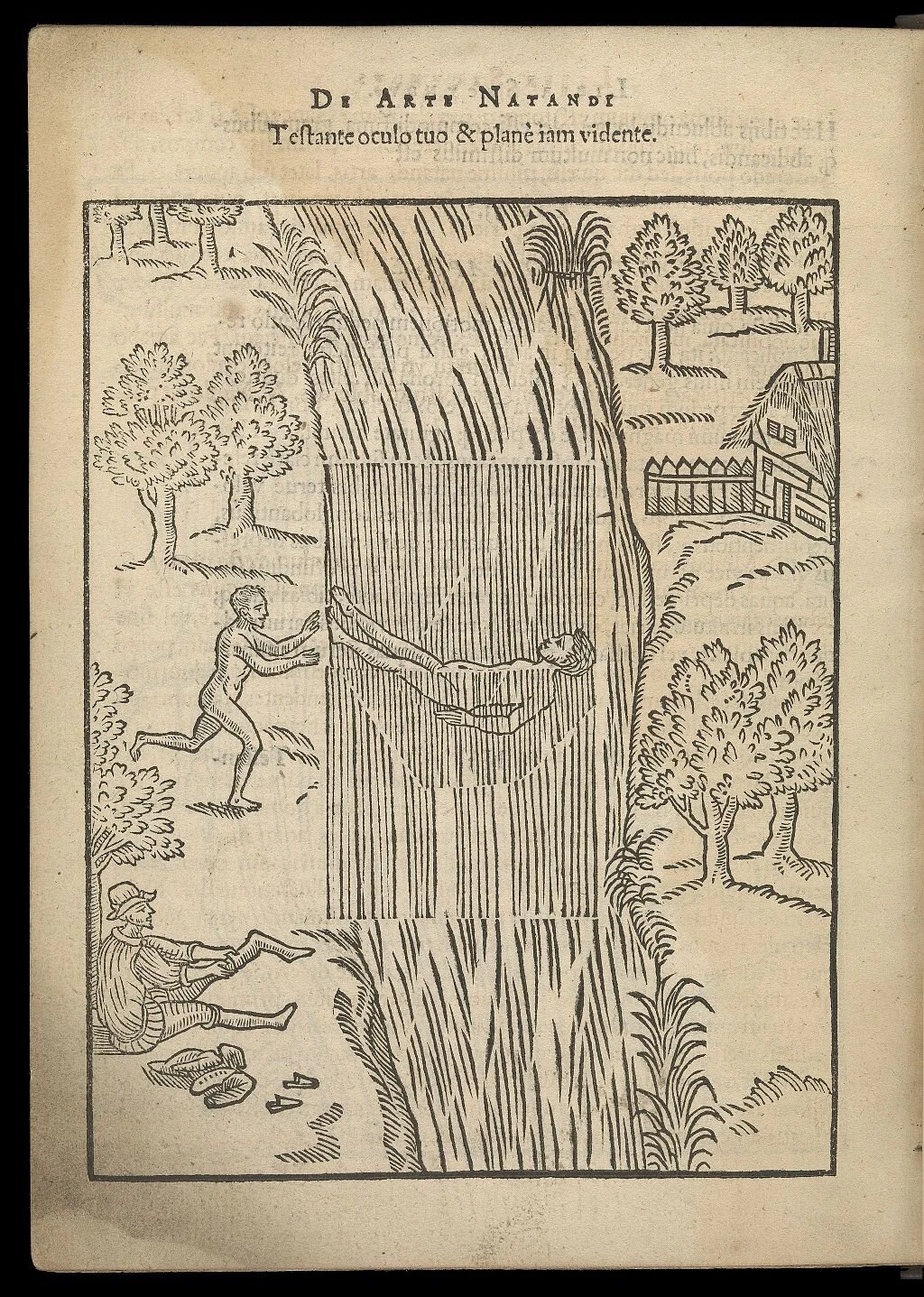
Illustration from Everard Digby's “The Art of Swimming (De Arte Natandi)” (1587).
“Into my empty head there come
a cotton beach, a dock wherefrom
I set out, oily and nude
through mist, in chilly solitude’’
— From “Morning Swim,’’ by Maxine Kumin (1925-2014), U.S. poet laureate in 1981-1982. She lived in Warner, N.H.

— Photo by Richard Palmer


Chris Powell: Day of deliverance from tribalism is coming

Census outreach flyers hang at Sure We Can - redemption center in Brooklyn last year.
— Photo by Wil540
MANCHESTER, Conn.
How strange that Connecticut and the country are being condemned as "structurally" and "systemically" racist even as the latest U.S. Census finds that they are more multiracial and multiethnic than ever and demographers expect that the country soon will have a nonwhite majority.
These trends do not suggest oppression. Rather they suggest acceptance and equality. They provide hope that within the lifetimes of today's young people the current obsessions with race and ethnicity will seem quaint and people will see each other first as people -- and maybe as Americans too.
Lincoln foresaw that day, as did the country's founders, the proclaimers of the Declaration of Independence.
In Chicago campaigning for the Senate shortly after Independence Day in 1858, Lincoln noted that half the people in the country then were not descendants of those who had fought the Revolution but instead were recent immigrants.
"If they look back through this history to trace their connection with those days by blood," Lincoln said, "they find they have none. They cannot carry themselves back into that glorious epoch and make themselves feel that they are part of us.
"But when they look through that old Declaration of Independence they find that those old men say that 'we hold these truths to be self-evident, that all men are created equal,' and then they feel that that moral sentiment taught in that day evidences their relation to those men, that it is the father of all moral principle in them, and that they have a right to claim it as though they were blood of the blood and flesh of the flesh of the men who wrote that Declaration -- and so they are."
The day of deliverance from tribalism has been a long time coming and it is not here yet, but the U.S. Census shows that it is coming.
Racial and ethnic composition aren't the important things about this country. What is important is the commitment to a democratic and secular culture and to the objective of raising everyone to economic self-sufficiency, reducing the extremes of wealth and poverty so that everyone has a vital stake in that democratic and secular culture.
The census suggests that race and ethnicity will be taking care of themselves, that the country may be more integrated in those respects than some think it is. Economic inequality has become the bigger challenge.
xxx
Not that the United States ever should have cared much about Afghanistan, but how was that country to resist a return of the theocratic fascism of the Taliban when the United States planned to evacuate so many Afghans who didn't want to live under theocratic fascism and most Afghans didn't care much about how they would be governed?
The rationale offered for this evacuation was that these Afghans were helping the United States. To the contrary, the United States was helping them build a country without theocratic fascism.
That effort, costing thousands of American lives and trillions of dollars, failed mainly because most Afghans themselves are indifferent to how they are governed. As soon as the U.S. and NATO troops began to withdraw from the country, Afghan soldiers deserted or surrendered and Afghans who desire freedom failed to mobilize.
If the Afghans themselves cared so little about their freedom, why should the United States have cared more?
The Sept. 11, 2001, terrorist attacks on the United States were not the consequence of the sanctuary that Afghanistan provided to some of the terrorists. They were the consequence of the failure of the United States to enforce its own immigration law, to pursue intelligence that a spectacular attack was being planned, and to maintain security in air travel.
Who rules in Afghanistan now will be far more a problem for Russia, China, Pakistan, and Iran than for the United States.
But the United States still fails to enforce immigration law. Even as the federal government and state governments are busy devising social controls in the name of reducing the spread of the COVID-19 virus, the country's southern border is wide open, with the Biden administration admitting thousands of immigration lawbreakers even when they are known to be infected.
The United States can let the Taliban have Afghanistan, but one of these days it should control its own borders.
Chris Powell is a columnist for the Journal Inquirer, in Manchester, Conn.
Folksy?
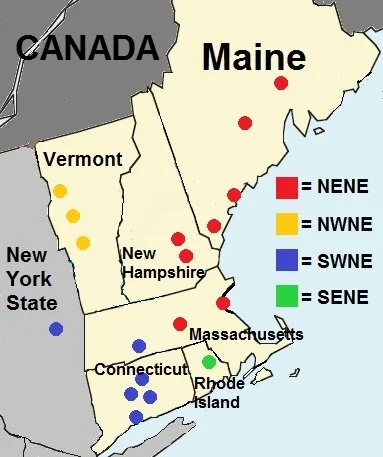
Northeastern (NENE), Northwestern (NWNE), Southwestern (SWNE), and Southeastern (SENE) New England English represented here, as mapped by the Atlas of North American English on the basis of data from important cites and towns.
— Graphic by Wolfdog
“There are areas of New England, plenty of them, with quaintness to spare, with color-changing leaves and folksy folks full of folksy homespun wisdom accompanied by folksy accents.”
— A Lee. Martinez (born 1973), Texas-based fantasy and science fiction author.
Who was he?
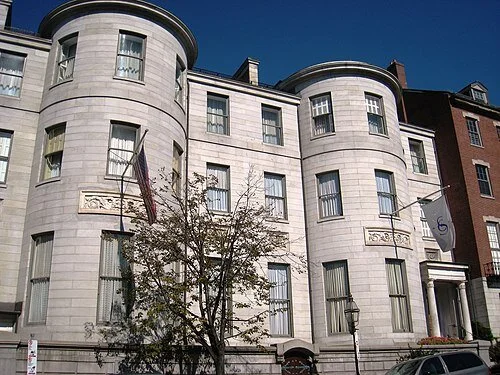
The Somerset Club on Beacon Street, Boston, long a social center for Boston Brahmins.
“It used to be said that, socially speaking, Philadelphia asked who a person is, New York how much is he worth, and Boston what does he know. Nationally it has now become generally recognized that Boston Society has long cared even more than Philadelphia about the first point and has refined the asking of who a person is to the point of demanding to know who he was. Philadelphia asks about a man's parents; Boston wants to know about his grandparents.’’
Cleveland Amory (1917-1998), in his book The Proper Bostonians (1947). Amory was a reporter, editor, social historian, essayist, TV critic and animal-rights crusader. He came from a Boston Brahmin family.

Thomas A. Barnico: Should Feds dictate rules on campus sexual misconduct? Beware

“My Eyes Clear Away Clouds” (collage), by Timothy Harney, a professor at the Montserrat College of Art, in Beverly, Mass.
From The New England Journal of Higher Education, a service of The New England Board of Higher Education (nebhe.org)
BOSTON
The U.S. Department of Education is poised to reverse Trump-era rules governing claims of sexual misconduct on campus. One could forgive weary college counsel for a case of vertigo: The Trump rules themselves reversed the Obama rules, and Biden’s 2021 nominee to enforce the rules—Catherine Lhamon—held the same office at the Education Department under Obama. In three years, the election of 2024 may bring yet another volte-face at the department. Even those who support the likely Biden changes may wonder: Is this any way to run a government?
As they ponder that question, frustrated counsel should note the primary source of the problem: the desire by serial federal officials to dictate hotly contested standards of student conduct for millions of students in thousands of colleges in a nation of 330 million people.
Some issues are better left to the provincials. As Duke Law professors Margaret Lemos and Ernest Young argue: “Federalism can mitigate the effects of [national] political polarization by offering alternative policymaking venues in which the hope of consensus politics is more plausible.” Delegation to state or local governments or, in education, to private actors, can “operate as an important safety valve in polarized times, lowering the temperature on contentious national policy debates.”
Of course, as Lemos and Young admit, “a federalism-based modus vivendi is unlikely to satisfy devoted partisans on one side or another of any divisive issue.” Such conflicts pit competing and compelling interests against one another.
In the Title IX context, parties fiercely debate the adequacy of protections for complainants and respondents alike: Does the respondent have a right to confront and cross-examine the complainant? Does the respondent have a right to counsel in their meeting with student affairs personnel? Do colleges and universities have to abide by a common definition of “consent” to intimacy in their student conduct manuals?
And, in polarized times, many will be unsatisfied with a patchwork of rules that apply state-by-state or college-by-college. Lost in this good-faith debate is the point that, even for issues with national effects, an oscillating national rule can cause more instability than an entrenched array of differing local rules.
Noted diplomat and scholar George F. Kennan aptly described the problem in Round the Cragged Hill: “The greater a country is, and the more it attempts to solve great social problems from the center by sweeping legislative and judicial norms, the greater the number of inevitable harshnesses and injustices, and the less the intimacy between the rulers and ruled. … The tendency, in great countries, is to take recourse to sweeping solutions, applying across the board to all elements of the population.” Central dictates, Kennan said, often show “diminished sensitivity of … laws and regulations to the particular needs, traditional, ethnic, cultural, linguistic and the like, of individual localities and communities.”
Of course, changes in administrations often bring changes in policy. Elections matter, and victors arrive with fresh ideas and an appetite for change. This is a highly democratic impulse; as U.S. Chief Justice William Rehnquist wrote: “A change in administration brought about by the people casting their votes is a perfectly reasonable basis for an executive agency’s reappraisal of the costs and benefits of it programs and regulations.”
Sometimes, such reappraisals will follow a reversal in the public current of the times. Where the new current runs strong and fast—and newly elected officials carry a decisive electoral mandate—a sweeping national solution may reflect a consensus view. But when electoral margins are slim, dangers lurk. When national executive and legislative power repeatedly changes hands by slim margins, policy changes may reflect not strong new currents but more of a series of quick, jolting bends.
The shifting procedural rights of the complainants and respondents in the Title IX misconduct hearings more resemble the latter. The abruptness of such changes grows when the commands flow not from a congressional act but by “executive order,” administrative “guidance,” or “Dear Colleague” letters that lack the procedural protections of a statute passed by both houses of Congress. Moreover, too-frequent changes in rules—whatever their procedural sources—have long been seen to create uncertainty, undermine compliance and lessen respect for law.
The options for beleaguered college counsel are few. Education Department rules apply to colleges because colleges desire federal funds. Few colleges wish to turn off the spout of the federal Leviathan. The masters they acquire are both the sovereign Leviathan of Hobbes and the whale dreamed by Herman Melville in Moby-Dick: a giant of the deep that pulls colleges to and fro, as if dragging them in a whaleboat on a “Nantucket Sleigh Ride.”
In our modern form of the tale, the whaleboat is the college, and the harpoon is its application for federal funding. The harpoon hits its rich federal target, but the prize brings conditions, represented by the attached rope. “Hemp only can kill me,” Ahab prophesizes. “The harpoon was darted; the stricken whale flew forward; with igniting velocity the line ran through the groove;—ran foul.” The rope—initially coiled neatly in a corner of the whaleboat—runs out smoothly until spent. Then it tangles, converting itself to a weapon more deadly than the harpoon. Bound by the rope—the conditions on federal funding—the college descends into the vortex.
Biden’s likely Title IX rules on student misconduct will pull college administrators to and fro again, whalers on a new, hard ride. The day that the federal government withdraws from the field seems distant; like Ahab, Education Department officials of both parties seem “on rails.” In the meantime, college counsel should brace for the latest chase and hope that they—like Ishmael—will live to tell the tale.
Thomas A. Barnico teaches at Boston College Law School. He is a former Massachusetts assistant attorney general (1981-2010).

“Nantucket Sleigh Ride”: Illustration of the dangers of the "whale fishery" in 1820. Note the taut ropes on the right, lines leading from the open boats to the harpooned animal.

Grace Kelly: Trying to protect the precious ecosystems/buffers that are salt marshes

The Jacob’s Point Preserve at the border of Bristol and Warren is one of Rhode Island’s healthier salt marshes.
— Photo by Joanna Detz/ecoRI News
From ecoRI News (ecori.org)
“To stand at the edge of the sea, to sense the ebb and flow of the tides, to feel the breath of a mist moving over a great salt marsh, to watch the flight of shore birds that have swept up and down the surf lines of the continents for untold thousands of years, to see the running of the old eels and the young shad to the sea, is to have knowledge of things that are as nearly eternal as any earthly life can be.” — Rachel Carson
Rhode Island’s salt marshes are magical places. They are where land meets sea, liminal areas where you can hear both the chirping of crickets and the caw of seagulls. Oysters and mussels sit warm in the brackish mud.
The Jacob’s Point Preserve on the Bristol-Warren line is one of these special places. It is the flagship property of the Warren Land Conservation Trust.
It was a breezy but warm fall morning and Scott Ruhren, senior director of conservation for the Audubon Society of Rhode Island, walked along the boardwalk that leads toward the 37.6-acre marsh, which sits between the East Bay Bike Path and the Warren River.
As we walked, he pointed out various native and invasive plants, the skeletons of tupelo trees that remain after a 10-mile brushfire ripped through the marsh in 2008, and an old farming path that tramples through the rushing phragmites.
When we meandered into the coastal flatlands of the marsh, Ruhren stepped off the path and headed over to a patch of rusty-red sea pickle. “This is edible,” he said, picking a few ends of the succulent plant. “It has a salty flavor, and turns this beautiful red in the fall.”
Seaside goldenrod bends in the ocean breeze, and Ruhren spotted what he thought could be the elusive and endangered saltmarsh sparrow flitting through cordgrass.
“This is one of the spots they’re doing incredibly well,” he said. “But if the salt marshes go away and sea level rises faster, it could disappear. It’s a sad story.”
But the saltmarsh sparrow isn’t the only species in danger if sea levels continue their accelerated rise. You see, salt marshes are more than just diverse brackish ecosystems. They are more than stinky, slimy, mucky patches of water-land. They are also natural buffers that protect land from sea. They’re priceless.
“From a sea-level rise standpoint, they absorb tons of energy,” Ruhren said. “We have a couple coastal refugees around the state and after big storms like Sandy or Irene, people always think the salt marshes are going to be wiped out, but the natural salt marshes survive those events better than human landscapes. For example, when Misquamicut was wiped out, a lot of the buildings were gone, but the marsh itself absorbed the impact. So, it’s like the first line of defense for the inland habitats.”
But this defense is at risk. As sea levels rise and as human development hardens the land along the coast, salt marshes are running out of room to adapt. They are on a path toward functional extinction. As they drown, the vital services they provide — habitat, storm buffering and carbon sequestration — will also disappear.
In fact, the loss of coastal wetlands is one of the biggest causes of permanent landscape alteration in the United States. Rhode Island, for example, has already lost more than 50 percent of its original salt marsh habitats during the past two centuries because of human activities.
“We’re dealing with two things with salt marshes in Rhode Island,” Ruhren said. “It’s all the manmade issues and disturbances, and then the lack of sediment building up in the marsh like it normally would, which is compounded by more frequent storms and sea-level rise.”
Salt marshes are getting squeezed out, with sea water encroaching on one side and humans on the other. And Jacob’s Point, while a relatively healthy example of a salt marsh, has a history of human-induced degradation.
“The path that the Warren Land Trust uses to get out to the water was actually built by a landowner who lived up hill, and he used to bring a seaplane in and bring in supplies that way,” Ruhren said. “That path led to a lot of the problems on the marsh because there were stone culverts — probably early 20th Century — and one by one the stone culverts started to collapse … and created an impoundment on the south side of the marsh. And what you want in a salt marsh is that twice day flushing of the salt water. If you don’t get that, you start to get the degradation.”
Development in and around salt marshes impairs their ability to naturally move when waters rise.
Another sign of human meddling that could have impacts in the future is the sprawling private neighborhood development up the hill from the salt marsh. Also called Jacob’s Point, it’s an example of the hardening of the shoreline, an area once wild being taken over by cookie-cutter houses with manicured, chemical-green lawns.
It’s quite the contrast to the wild, unkempt scraggle of the salt marsh below.
“I always like to use Connecticut as an analogy,” Ruhren said. “When you drive up [Interstate] 95, they pretty much have a hardened shoreline all the way up. We’re trying to avoid that.”
To combat the further loss of these important coastal ecosystems, various state agencies have worked together to assess and save salt marshes. In 2016, the Coastal Resources Management Council (CRMC) released a Rhode Island Salt Marsh Monitoring and Assessment Program (SMMAP) that “presents a strategy for developing a comprehensive, statewide monitoring and assessment program.”
In essence, SMMAP is triage for salt marshes.
“A lot of the salt marshes have been assessed to try to determine which ones are worth saving,” Ruhren said. “Because one that is so horribly degraded, well, it doesn’t pay to work on it.”
Besides building modern culverts and enhancing marsh elevation with dredge materials, the best way humans can reverse the wrong we have wrought on salt marshes — and in the process help our species survive — is simple: preserve land.
“Ideally the best thing to do is to save land, and land right from the marsh, which is not always possible because it’s such a built-up shoreline,” Ruhren said. “That allows for salt marsh migration, because salt marshes naturally move, and with sea-level rise, if they don’t have a place to move inland, they’re just going to be squashed and shrink and shrink more.”
Editor’s note: Grace Kelly was a ecoRI News staffer when she filed this story.
Shrivel season

American elm tree known as "Ed Cotton's elm," at the corner of Old South Street and Conz Street in Northampton, Mass. This tree dates back to the late 1800s.
— Photo by Msact
“The elm leaves shrivel on the twig
and the sun beats through and our time is big….
—From “The Long Hot Summer,’’ by Archibald MacLeish (1892-1982) poet, playwright, lawyer and government official. He spent his final decades in Conway, Mass.
Dynamic wooden shapes

“Plaid Flannel” (carved polychromed sugar maple), by Vermont artist Clark Derbes, in his show “Time Travelers and Portals,’’ at the Hall Art Foundation, Reading, Vt., Aug. 28-Nov. 28.
The show’s organizers say: “Derbes first cuts blocks of wood from a variety of tree species, including elm, poplar and maple. Continuing to carve each block into a unique and dynamic shape, he meticulously chisels, paints, sands and burnishes each piece in order to achieve a variety of complex geometric visual systems, planes, patterns and patinas.”
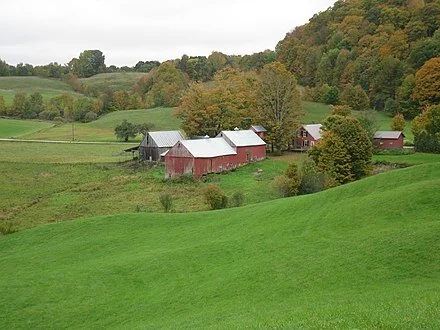
The much-photographed Jenne Farm, in Reading
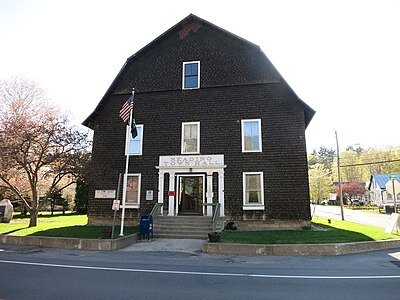
Reading Town Hall and post office.
Susan Jaffe: Designating 'essential support' people for nursing-home residents
From Kaiser Health News (kaiserhealthnews.org)
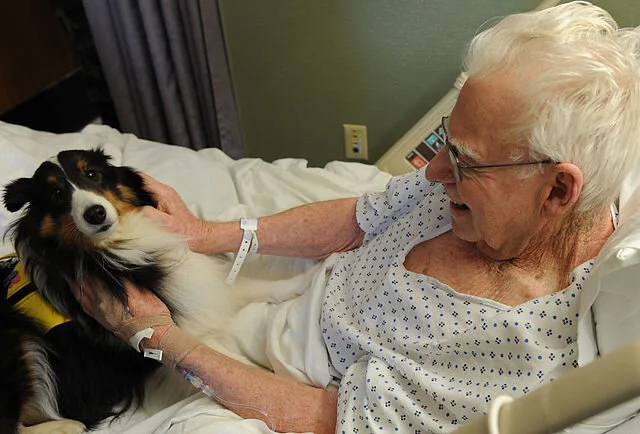
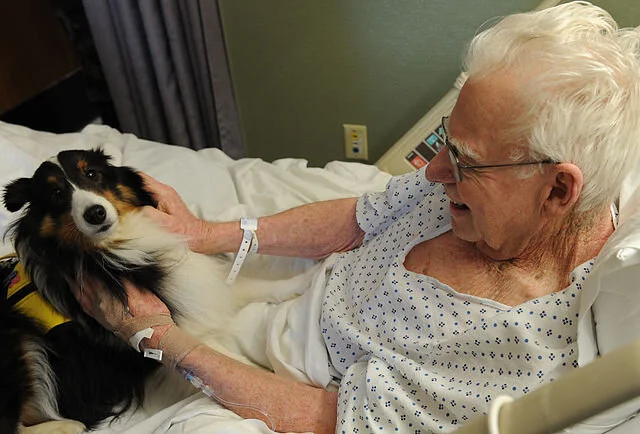
After COVID-19 hit Martha Leland’s nursing home — Sheridan Woods Health Care Center, in Bristol — it logged 28 fatalities; last year, she and dozens of other residents contracted the disease while the facility was on lockdown.
“The impact of not having friends and family come in and see us for a year was totally devastating,” she said. “And then, the staff all bound up with the masks and the shields on, that too was very difficult to accept.” She summed up the experience in one word: “scary.”
But under a law that Connecticut enacted in June, nursing-home residents will be able to designate an “essential support person” who can help take care of a loved one even during a public health emergency. Connecticut legislators also approved laws this year giving nursing-home residents free internet access and digital devices for virtual visits and allowing video cameras in their rooms so family or friends can monitor their care.
Similar benefits are not required by the Centers for Medicare & Medicaid Services, the federal agency that oversees nursing homes and pays for most of the care they provide. But states can impose additional requirements when federal rules are insufficient or don’t exist.
And that’s exactly what many are doing, spurred by the virus that hit the frail elderly hardest. During the first 12 months of the pandemic, at least 34 percent of those killed by the virus were residents of nursing homes and other long-term care facilities, even though they make up fewer than 1 percent of the American population. The vaccine has since reduced virus-related nursing-home deaths to about 1 in 4 covid-related fatalities in the United States, which have risen to more than 624,000, according to The New York Times’s case tracker.
“Part of what the pandemic did is to expose some of the underlying problems in nursing homes,” said Nina Kohn, a professor at Syracuse University School of Law and a distinguished scholar in elder law at Yale Law School. “This may present an opportunity to correct some of the long-standing problems and reduce some of the key risk factors for neglect and mistreatment.”
According to a review of state legislation, 23 geographically and politically diverse states have passed more than 70 pandemic-related provisions affecting nursing home operations. States have set minimum staffing levels for nursing homes, expanded visitation, mandated access for residents to virtual communications, required full-time nurses at all times and infection control specialists, limited owners’ profits, increased room size, restricted room occupancy to two people and improved emergency response plans.
The states’ patchwork of protection for nursing home residents is built into the nation’s nursing home care regulatory system, said a CMS spokesperson. “CMS sets the minimum requirements that providers need to meet to participate with the Medicare/Medicaid programs,” he said. “States may implement additional requirements to address specific needs in their state — which is a long-standing practice — as long as their requirements go above and beyond, and don’t conflict with, federal requirements.”
Julie Mayberry, an Arkansas state representative, remembers a nursing home resident in her district who stopped dialysis last summer, she said, and just “gave up” because he couldn’t live “in such an isolated world.”
“I don’t think anybody would have ever dreamed that we would be telling people that they can’t have someone come in to check on them,” said Mayberry, a Republican and the lead sponsor of the “No Patient Left Alone Act,” an Arkansas law ensuring that residents have an advocate at their bedside. “This is not someone that’s just coming in to say hello or bring a get-well card,” she said.
When the pandemic hit, CMS initially banned visitors to nursing homes but allowed the facilities to permit visits during the lockdown for “compassionate care,” initially if a family member was dying and later for other emergency situations. Those rules were often misunderstood, Mayberry said.
“I was told by a lot of nursing homes that they were really scared to allow any visitor in there because they feared the state of Arkansas coming down on them, and fining them for a violation” of the federal directive, she said.
Jacqueline Collins, a Democrat who represents sections of Chicago in the Illinois Senate, was also concerned about the effects of social isolation on nursing home residents. “The pandemic exacerbated the matter, and served to expose that vulnerability among our long-term care facilities,” said Collins, who proposed legislation to make virtual visits a permanent part of nursing home life by creating a lending library of tablets and other devices residents can borrow. Gov. J.B. Pritzker is expected to sign the measure.
To reduce the cost of the equipment, the Illinois Department of Public Health will provide grants from funds the state receives when nursing homes settle health and safety violations. Last year, Connecticut’s governor tapped the same fund in his state to buy 800 iPads for nursing home residents.
Another issue states are tackling is staffing levels. An investigation by the New York attorney general found that covid-related death rates from March to August 2020 were lower in nursing homes with higher staffing levels. Studies over the past two decades support the link between the quality of care and staffing levels, said Martha Deaver, president of Arkansas Advocates for Nursing Home Residents. “When you cut staff, you cut care,” she said.
But under a 1987 federal law, CMS requires facilities only to “have sufficient nursing staff to attain or maintain the highest practicable … well-being of each resident.” Over the years, states began to tighten up that vague standard by setting their own staffing rules.
The pandemic accelerated the pace and created “a moment for us to call attention to state legislators and demand change,” said Milly Silva, executive vice president of 1199SEIU, the union that represents 45,000 nursing home workers in New York and New Jersey.
This year states increasingly have established either a minimum number of hours of daily direct care for each resident, or a ratio of nursing staff to residents. For every eight residents, New Jersey nursing homes must now have at least one certified nursing aide during the day, with other minimums during afternoon and night work shifts. Rhode Island’s new law requires nursing homes to provide a minimum of 3.58 hours of daily care per resident, and at least one registered nurse must be on duty 24 hours a day every day. Next door in Connecticut, nursing homes must now provide at least three hours of daily direct care per resident next year, one full-time infection control specialist and one full-time social worker for every 60 residents.
To ensure that facilities are not squeezing excessive profits from the government payment they receive to care for residents, New Jersey lawmakers approved a requirement that nursing homes spend at least 90 percent of their revenue on direct care. New York facilities must spend 70 percent, including 40 percent to pay direct-care workers. In Massachusetts, the governor issued regulations that mandate nursing homes devote at least 75 percent on direct-care staffing costs and cannot have more than two people living in one room, among other requirements.
Despite the efforts to improve protections for nursing home residents, the hodgepodge of uneven state rules is “a poor substitute for comprehensive federal rules if they were rigorously enforced,” said Richard Mollot, executive director of the Long Term Care Community Coalition, an advocacy group. “The piecemeal approach leads to and exacerbates existing health care disparities,” he said. “And that puts people — no matter what their wealth, or their race or their gender — at an even greater risk of poor care and inhumane treatment.”
Susan Jaffe is a reporter at Kaiser Health News.
Jaffe.KHN@gmail.com, @SusanJaffe
'The very heart'

“View from Mount Holyoke, Northampton, Massachusetts, after a Thunderstorm—The Oxbow {of the Connecticut River},’’ by Thomas Cole, in 1836
“They came singly and in groups, in small companies and in larger bands; and rapidly homes and farms doted the valley, villages were built, and in an amazingly short time the wilderness had been conquered and tamed and the Connecticut Valley became the garden spot, the very heart of all New England.’’
— A. Hyatt Verrill (1871-1954) inventor, writer, editor and zoologist, in The Heart of Old New England
Llewellyn King: A life in journalism: fascination and panic

WEST WARWICK, R.I.
A young man asked me for advice on a career in journalism. The following is the letter I sent to him.
For advice about a career in journalism, I may not be the person to ask
I dropped out of school at 16 because I wanted to be a journalist. I wanted to know the great figures of my time and to travel the world. Journalism has not let me down.
To me, newspapering is almost a sacred calling. You can air injustice and celebrate genius. It is true, personal freedom: You always, at heart, work for yourself within a framework of your employment. You can talk to anyone in any office in any country and expect to be allowed an audience.
In the end, it is between you and the reader. We need income to practice our trade, but our communic is always between the writer and the reader.
The commodity is news. It is news in the humblest local paper or The Washington Post. Jack Cushman, who worked for me as the editor of Defense Week, and who became a star at The New York Times, told me once, "You used to tell me when I was writing a story, 'Come on, Cushman, you won't write it better in The New York Times.' You know what? I don't."
The message is: Be defined by what you write, not for whom you write it. But, of course, we all want to succeed and the measure of success can be where we work; that, I grant, and I have been a pursuer of good jobs everywhere, having worked for Time and Life as a very young stringer in Africa, the Daily Mirror and the BBC in London, The Herald Tribune in New York, and The Washington Post in Washington.
I am so much a journalistic romantic, I still get a thrill seeing my byline in any paper, big or small.
The work is simpler than people let on. Dan Raviv, then with CBS Radio, defined it for me this way, and I have never heard it said better, "I try to find out what is going on and tell people." Quite so.
I don't draw a line between magazines and newspapers, print and broadcast, or the Internet: The work is the same. The key of C, in which it is all centered, is still the newspaper, but that is changing. The struggle for accuracy, fairness and getting at the news never changes.
My first wife, the brilliant English journalist Doreen King, said that to succeed you need the "inner core of panic." That is fear that you made a mistake in a story: got a number wrong (billions not millions, for example), that you misspelled a name, and that you didn't fully understand what you were told in your reporting. The public doesn't know that we really struggle to get it right, often without the luxury of time -- an unending struggle.
Writing columns is something of an art, and some have it and some don't. A column is a newspaper within a newspaper; your own space to give evidence and share ideas. They are a fantastic form of journalism, but they aren't for everyone. To be a reporter you need news judgment. What is news? It is indefinable but if you don't have it, try something else. A test of news judgment is to watch the Sunday morning talk shows and write a mock story. Then survey what the other outlets have picked on and see if you found the same things newsworthy. You will know soon enough if you have news judgement.
I have been writing columns since the very beginning of my career. A young woman, who worked for me on The Energy Daily, was one of the finest reporters I have ever known. But when she was appointed the editorial page editor of a newspaper, she found it hard. Opinion didn't come easily to her. Facts were her domain. She moved to Europe, where she worked for a business information service and flourished. Her meticulous reporting was what was needed there.
If, like me, you have opinions about everything, then writing columns comes easily and the rest is technique. Read how others handled their material. Not what they opined, but how they managed it.
I don't hold that there is any difference between the needs of newspapers and magazines. I believe that news services or newspapers give you a grounding in the disciplines of writing that are very useful in magazine writing.
Journalism can be a hard life. A lot of journalists have money problems, drink to excess, and are known to have messy private lives. But, by God, we tell the world what is going on, and that is to be part of something huge and fabulous. It is a life of sheer adventure. I am glad of it.
Llewellyn King is executive producer and host of White House Chronicle, on PBS. His email is llewellynking1@gmail.com and he’s based in Rhode Island and Washington, D.C.
Magic mushrooms

“Adventure Time” (C2 paint), by Natalia Rak, at 94 Washington St., Providence, part of the Avenue Concept, which supports public art in the urban setting by means of murals, sculptures and programs.

Chris Powell: When in doubt punt to avoid irritating public

MANCHESTER, Conn.
Gov. Ned Lamont seems to realize that Connecticut probably won't stand for another catastrophic lockdown in the name of controlling COVID-19, a virus that 99.8 percent percent of afflicted people survive. But rather than acknowledge this plainly and caution people that they must take the primary responsibility for protecting themselves, the governor has passed the buck to the state's 169 municipal governments.
The governor is putting them in charge of determining whether and where people should be required to wear masks again. This may lead to giving local officials the authority to set other rules of virus safety.
With the cities lagging badly in virus vaccinations, their mayors seem eager to order masks back on, which will push retail and restaurant business out of the cities and into the suburbs, as if city businesses can afford it.
Local option on virus safety makes little medical sense. Crowds in a suburb may pose no less risk than crowds in a city. But henceforth the resentment felt about the virus epidemic and government's regulations about it may be directed at mayors and town councils instead of the governor.
Lamont is a Democrat and Republicans long have wanted the General Assembly to end his emergency authority to rule by decree, and now, with his epidemic management no longer so successful, the governor may be happy to go along. Call it decentralization, with potentially different rules in 169 little republics and thousands of offices, stores, and restaurants.
Treatments vs. Vaccines
While the government and the medical establishment keep insisting that the virus vaccines are absolutely safe, every week brings word of a new side-effect unknown when the vaccines were authorized for emergency use and said to be so safe. The other week the vaccines were linked to eye problems.
Meanwhile the virus is mutating into "variants," more vaccinated people are becoming infected if not seriously ill, and there are signs that the vaccines may lose effect with time, perhaps as little as six months, thereby requiring frequent booster shots or entirely new shots each year, like ordinary flu shots.
So maybe eventually the government and medical authorities will start wondering whether the approach to the virus should shift to treatment and away from vaccination.
After all, doctors and hospitals have learned to treat virus patients with far more sophistication than shoving ventilators down their throats, as was the practice at the beginning of the epidemic. Does anyone remember the clamor a year and a half ago for production of millions more ventilators? They turned out to kill as many patients as they saved and the clamor stopped.
For there are effective treatments for COVID-19, and two more were announced the other week by Israeli scientists.
The first was about a study validating use against the virus of the anti-parasite drug ivermectin. Its efficacy has been established by other studies but U.S. authorities seek to suppress it lest it interfere with the vaccine campaign.
The second announcement revealed that a medicine based on the CD24 molecule, found naturally in the human body, cures 93 percent of seriously ill virus patients in less than five days.
These treatments appear to be inexpensive and unlike the vaccines have no side-effects. Also unlike the vaccines, there's no big money in them, which may be their weakness.
“Equity’ Isn’t Fair
Government in Connecticut has a funny idea of what it calls "equity.”
Marijuana-retailing permits are to be reserved for "communities" that disproportionately suffered from the futile "war on drugs." But those "communities" also disproportionately profited from the contraband drug trade. For every drug dealer who was prosecuted there were several who made a lot of money and were never caught.
So where is the patronage for people who, despite the futility of the "war on drugs," obeyed the law and forfeited their chance to profit from contraband?
And to overcome skepticism about the COVID-19 vaccines, government is offering prizes and cash bounties to people who accept vaccination after rejecting it so long.
So where are the prizes and bounties for the people who, heeding government's urging, got vaccinated as soon as they could?
"Equity" sounds mainly like a way of discouraging questions.
Chris Powell is a columnist for the Journal Inquirer, in Manchester.
Mission creep?

The Chinese Tea House at Marble House, in Newport, modeled on 12th Century Chinese Song Dynasty temples.
— Photo by Ekem
From Robert Whitcomb’s “Digital Diary,’’ in GoLocal24.com
That the Preservation Society of Newport County runs restaurants at its Breakers Welcome Center and the Chinese Tea House at Marble House and has made some other changes to sex up tourism at the city’s famous mansions continues to rankle some Newporters, who noted that it’s the Preservation Society, not the development society.
I was down in Newport on a lovely day the other week, and it was hopping with people on tours and some just wandering around looking dazed. Compared to, say, New York City, I saw few people wearing masks.
It’s too bad that Route 114, a main drag through Portsmouth and Middletown heading to Newport, is one of the uglier commercial strips in America and yet so close to beautiful natural and manmade sites. One wonders what sort of dubious zoners’ and politicians’ wheeling-dealing went into allowing such a long and depressing stretch.
Planting many more trees along the way would help camouflage some of its horrors. And maybe as the World Wide Web continues to kill brick-and- mortar stores, some of the land can be allowed to revert to open space and housing. The road is a real downer for those expecting beauty to and from The City by the Sea.
Fragrant and full of life

“Maine #20 —Freeport Sunset’’ (oil on linen), by James Mullen, at Alpers Fine Art, Andover, Mass. Freeport’s marshes are less famous than L.L. Bean, which is based in Freeport.