
Llewellyn King: The disappointing Kamala Harris

WEST WARWICK, R.I.
Kamala Harris shone in the Senate when she was asking questions in hearings. That is where the idea that she might have presidential possibilities flourished. Democrats, observing her surefootedness, were led to think, “Here is the next Barack Obama.”
But the shine is off Harris and the tarnish is setting in.
When Harris ran for president, the only evidence of that hearing-room confidence was when she attacked front-runner Joe Biden in the Democratic debates. She implied that he was the proprietor of old ideas and hinted that he wasn’t up to date on matters of race.
So, it was extraordinary that Biden chose Harris to be his running mate. There were other strong contenders among those who had sought the Democratic nomination, and many more who hadn’t run for president. Sen. Amy Klobuchar (D.-Minn.) should have been chosen: a tough, well-qualified woman of her times.
Biden, in choosing Harris, heard the music of diversity, which has been turned up of late. He felt the need to make history and to show that he was in accord with the values of today.
But he must have had some dealings with Harris when he was vice president; observed her in action in the Senate and heard about the difficulty she had organizing her small Senate staff. He must have done the political equivalent of due diligence. And he must have been cognizant of the damage that Sarah Palin did to John McCain’s candidacy in 2008.
Whereas Obama appeared not to think of himself as being of color, Harris clings to it. Her journey intrigues her; Obama’s didn’t intrigue him. He travelled it with purpose and dignity.
Now it must worry the president to learn, as the rest of us have, that Harris seems to have no ideas. Her public remarks are flip at worst and off-the-shelf liberal at best.
What does she see as the future for America? This isn’t laid out or even discernible. We need to know her vision because she is vice president to an old man – the metaphorical heartbeat away.
Harris and Biden have chosen to believe that solidarity at the top is an important message, hence the frequent references in White House announcements to the “Biden-Harris Administration.” In public, Harris is often at Biden’s side. But she often seems to be standing there as his girl Friday, not as the second-in-command.
In his well-reported piece in The Atlantic, Edward-Isaac Dovere hunted for the real Harris and didn’t appear to find her. He notes that she asks good, hard questions, like a good prosecutor, but as she dodges reporters, they aren’t able to ask good, hard questions of her.
It isn’t a given Democrats will back Harris if Biden turns out to be a one-term president, which given his age, 78, is a reasonable supposition. But ditching her would be hard because it might cost the party its progressive wing and keeping her might cost them as dearly in the center.
Republicans are salivating at the thought of running against Harris. She is the bright sun in their darkening sky.
The immigration assignment seems to have been thrust on Harris. It is unlikely she sought it. She doesn’t appear to have grasped it with relish. Save for brief visits to Guatemala and Mexico, she has done and said little.
Harris is finally looking at the chaos on the border herself. She needs to present a better idea than championing what amounts to nation-building in Central America. That has been tried and tried again and failed.
She isn’t going to solve the pain inherent in the immigration challenge, but it is a wonderful opportunity for her to give us her view of America, and what we might expect from a President Harris. Another assignment that could be thrust upon her.
Llewellyn King is executive producer and host of White House Chronicle, on PBS. His email is llewellynking1@gmail.com and he’s based in Rhode Island and Washington, D.C.
'An ideal pursuit'
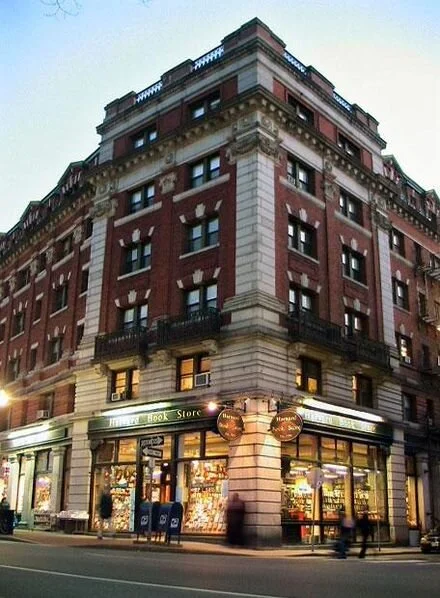
The Harvard Book Store, in Cambridge
“History ... with its long, leisurely, gentlemanly labors, the books arriving by post, the cards to be kept and filed, the sections to be copied, the documents to be checked, is the ideal pursuit for the New England mind.‘‘
—- Elizabeth Hardwick ( 1916-2007), American literary critic, novelist, and short story writer
In the South Shore breeze
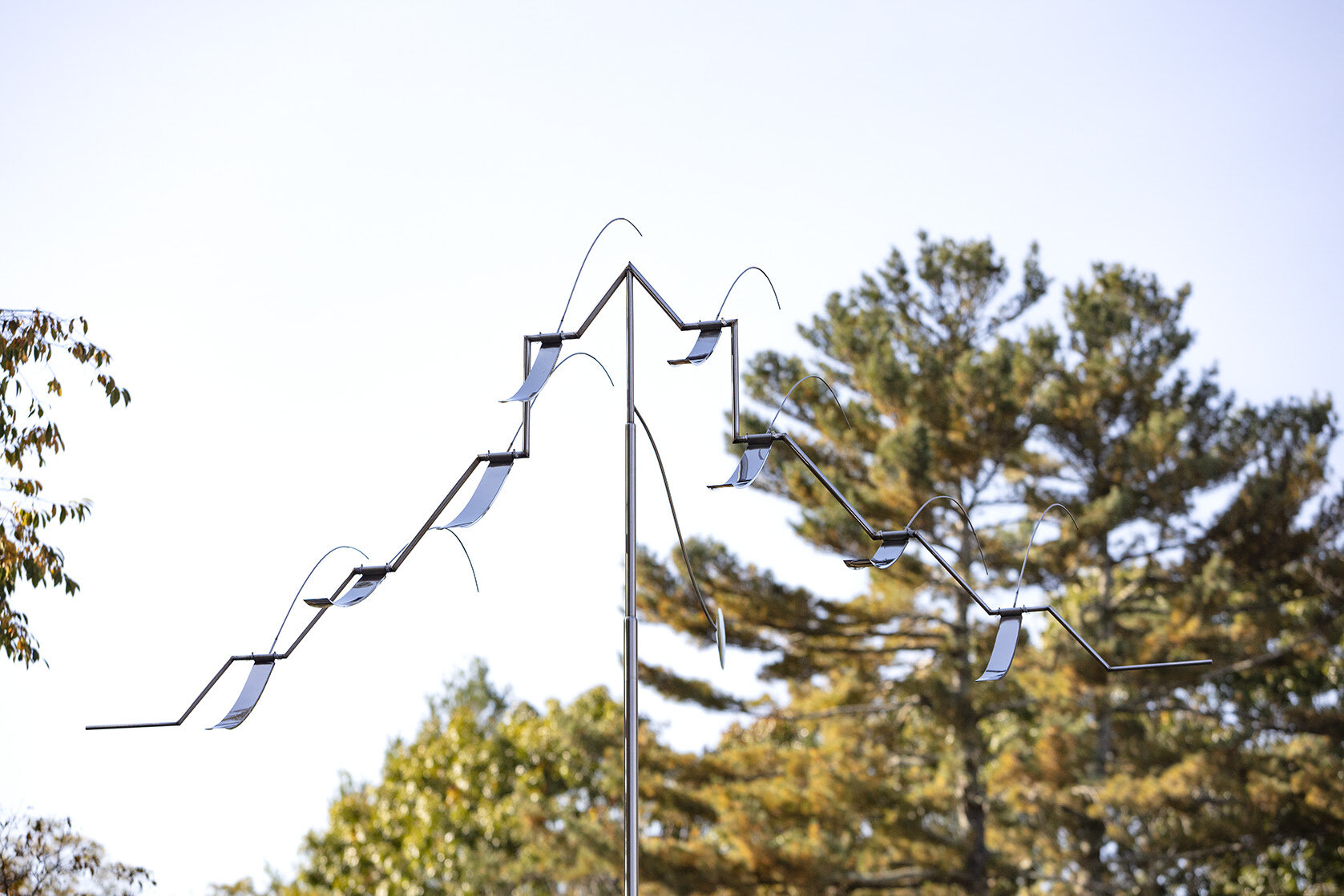
“Wind Sculpture” (stainless steel and gold-plated stainless steel), by Michio Ihara, at the Art Complex Museum, Duxbury, Mass.

Peter Certo: Filibustering away democracy

From OtherWords.org
The American political system is complicated, but fixing it doesn’t have to be.
Voters of all stripes broadly agree on the kinds of changes they’d like to see. We need less money in politics. It should be easier to vote — early, in person, or by mail. And voters should be able to pick their own representatives, not the other way around.
The For the People Act, which passed the House earlier this year, would do all of these things. It includes new ethics rules for members, protects and expands the right to vote, and would restrict the extreme partisan gerrymandering that’s become commonplace. No wonder it’s popular — around two-thirds of Americans tell pollsters they support it.
It’s also, for now, doomed. And with a wave of voter-suppression laws, new gerrymandering schemes, and ongoing efforts to discredit the 2020 election results still underway, that’s a very dangerous development for our democracy.
Explaining why reveals some truly absurd things about our system. For one thing, the law just “failed” by a party-line Senate vote of 50-50 — 50 Democrats for, 50 Republicans against.
Ordinarily, 50 votes should be enough to pass something in the Senate when the vice president supports it, as Kamala Harris does. But thanks to an arcane Senate tactic called the filibuster, opponents of legislation can force supporters to come up with 60 votes, instead of a simple majority.
It gets even more absurd when you realize that those 50 Democrats represent over 40 million more Americans than those 50 Republicans. And with the filibuster, Republicans representing just 20 percent of us can easily stop legislation that overwhelming majorities support.
The filibuster is how Republicans are holding up everything from universal background checks on gun purchases to popular laws that would protect the environment, the right to form unions, or now voting rights.
Republicans are champions of the filibuster now, but it was only a few years ago that they weakened it so they could pack the Supreme Court with unpopular nominees like Brett Kavanaugh, who was credibly accused of sexual assault.
Meanwhile, in states across the country, filibuster-free Republican legislatures are pushing hundreds of laws that will make it much harder to vote — or even, in some cases, let those same lawmakers overrule decisions made by voters.
Now that they’re in power, the Democrats could get rid of the filibuster. Hundreds of historians and political scientists, alarmed by the state-level onslaught against democracy, have warned that they’ll need to do just that. So too have hundreds of faith, labor, voting rights, and environmental groups.
Kill the filibuster and pass the For the People Act, they urge, or our democracy may not survive.
But a small number of Democrats — notably Senators Kyrsten Sinema (D-Ariz.) and Joe Manchin (D-W.V.) — have steadfastly refused. In high-profile op-eds, they’ve called the filibuster essential to democracy and bipartisanship.
These claims are absurd. Plainly, the filibuster is enabling an extremely partisan assault on our democracy. If you commit to bipartisanship with a party that’s waging an all-out war on democracy, the only bipartisan thing you’ll win is its demise.
For now, pro-democracy groups are stepping up their pressure campaigns.
The Poor People’s campaign is marching on Manchin and Senate GOP leader Mitch McConnell. Others are targeting the Senate’s Democratic leaders, who are only in power because an extraordinary mobilization last year helped them win the Senate despite the map being tilted toward Republicans by over 40 million people.
But the truth is, the movements and the voters have done their part to protect our democracy. If senators don’t do theirs, they may well deserve to lose — but not if they take our democracy with them. Tell your senators: End the filibuster, pass the For the People Act.
Peter Certo is the editorial manager of the Institute for Policy Studies and editor of OtherWords.org
Good start without you
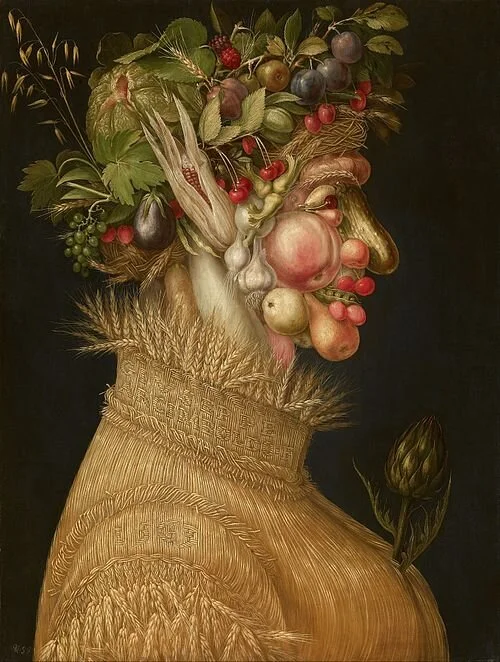
“Summer,’’ by Giuseppe Arcimboldo, 1573
“This could be a good day. It starts
without you, as usual; you haven’t seen
dawn for years. By noon it hits half-
boiling & the air breaks down….’’
—From “Whatever You Want,’’ by Kevin Young (born 1970), a New England-educated poet and director of the Smithsonian Institution’s National Museum of African American History and Culture.
Impressionist

Pin oak leaves
“In New England, the pin oak thrives, its leaves tipping to a thorny point in a good-natured impression of its evergreen neighbor, the holly bush.’’
— Hope Jahren, American geo-biologist

But this gold can't stay

“Carl’s Path” (oil on canvas), by Joel Babb, at the Bates College Museum of Art, Lewiston, Maine.

Chris Powell: Of old massacres and current mayhem

Statue of Major John Mason at the Connecticut Capitol
MANCHESTER, Conn.
While bullets flew and people fell all around Hartford, some within sight of the state Capitol dome, the General Assembly deliberated its state budget legislation and then, as part of the budget, voted to remove from the Capitol's façade the statue of Major John Mason, without whom Connecticut and the rest of New England might not have survived and developed into a prosperous English colony.
The idea is to relocate the statue to the grounds of the Old State House, a few blocks away, and attach a plaque that will note, among other things, Mason's involvement in the battle that ended in the massacre of much of the Pequot tribe in Mystic in 1637.
Since many noncombatants were killed, that massacre is probably the worst thing ever to have happened in Connecticut. But relations between the English and some Indian tribes already had become genocidal on both sides. Indeed, the English in the Boston area were invited to settle in Connecticut by tribes looking for allies against the Pequots, who were oppressing them and whose very name meant "destroyers." To a great extent the Pequots brought destruction on themselves.

Bas relief at the Connecticut Capitol of fighting in the Pequot War of 1636-1638
But political correctness wants to magnify the offenses of the prevailing culture's antecedents, taking them out of the context of their time. So Mason's statue must be relocated, just as another statue of him is to be relocated from the town green to the historical society in Windsor, the town he helped found.
There might be a fair discussion here, but the affectation of morality about statues at the Capitol when the adjacent city and Connecticut's other two major cities, New Haven and Bridgeport, are exploding in mayhem is too exquisite. The legislature's recent session seems not even once to have taken note of this mayhem. While the legislature rushed toward its midnight adjournment on June 16 two people were murdered in separate incidents in Hartford, one of them a beloved grandmother killed by bullets tearing through the walls of her apartment as she was making dinner inside.
To distract from the city's social disintegration, Hartford Mayor Luke Bronin blamed the latest atrocity on the "assault weapon" from which the fatal shots were fired. But the city's social disintegration is not so easily concealed. Lately it also has included raucous and unauthorized street parties disrupting the city's south side and overwhelming the police, as well as the Police Department's difficulty in keeping up with the turnover caused by the demoralization of its officers.
The shots also keep flying and people keep falling in New Haven and Bridgeport, which nevertheless are deliberating how to replace their own recently removed statues of Columbus.
Meanwhile Democratic leaders at the Capitol are calling the new state budget "transformational." Relocating a statue while ignoring the mayhem, the budget might better be called oblivious.
xxx
On balance the recent legislative session seems to have gone well for Connecticut Gov. Ned Lamont, but advocates of freedom of information and the rights of crime victims may not be favorably impressed by his handling of the legislation that will erase thousands of criminal records, including some serious felonies.
The governor signed the bill but then sent a letter to the legislature urging it to amend the new law to prevent some of those felonies from being erased. Of course the normal procedure for a governor who has objections to legislation is to negotiate them before a bill is passed or to veto the bill and explain his objections, thereby preserving his leverage.
With other issues Lamont has not hesitated to suggest he would use his veto. His expressing his objections to the conviction-erasure bill after he signed it into law rather than before is not likely to persuade legislators to make changes, nor provide much consolation to those who rights are erased along with the convictions.
xxx
Just as the governor admits that he has enjoyed ruling by emergency decree for 15 months during the virus epidemic, most members of the General Assembly seem to have enjoyed excluding the public from the legislative halls during their recent session.
With the epidemic fading fast, the Capitol should be reopened to the public. If concern continues, the unvaccinated can be asked to wear masks.
Chris Powell is a columnist for the Journal Inquirer, in Manchester.
A busy and early summer place

Architectural drawing of the Pavilion Hotel, in Gloucester, Mass., designed by S.C. Bugbee, for Sidney Mason, and built in 1849. The drawing is at the Cape Ann Museum, Gloucester. The long-gone hotel was the first big summer resort hotel on Cape Ann, serving the era’s growing bourgeoisie as New England’s economy boomed. Finished version below.

William Morgan: Joy and sadness with an old knife

My wife, Carolyn, is a potter and a gourmet cook. She depends upon and thus respects her tools, but they are to be used, not objects to be displayed. The tarnished copper pots hanging in a row from a beam above the stove are not there to impress; once in a while I might polish one to a shine, but the pots are there to be worked. The knives on Carolyn's wall rack are beautiful to her. She recalls every country auction where she acquired each pitted and stained Sabatier, and knows how each knick was earned. But these blades still need to be used to slice and chop; they are there to serve.
There is one tool, however, that does not get used. Framed, it occupies a place of honor on our kitchen wall. When we first found this in an antique shop on Wickenden Street in Providence we thought that it was a super-realist still life of a knife. The dealer had no recollection of where he picked this up, but it has a framer's sticker from Springfield, Mass.
A faded typewritten note in Hebrew taped to the back revealed something of its history. Two Hebrew-literate friends gave us this translation:
With G-d's Help.
Tuesday - 8th of the Hebrew Month of Av 1948.
To my esteemed and dearest Avraham May Your Light Shine
Shalom & Blessings
This knife is a gift from your father, of Blessed Memory, that I received from him at the time of my completion of Rabbinic Ordination.
Your father, of Blessed Memory, used this knife to slaughter poultry at the office of slaughter on 19 Franziskaner Street that he inherited from your grandfather Reb Gershon (of Blessed Memory).
And at the opportunity of this pleasant visit it seemed fitting to give this present to one with a delicate and appreciative palate - that it should be your inheritance from your father of Blessed Memory, and that this knife is a symbol of a bygone and disappeared era.
With a warm handshake of appreciation and to your refined wife regards and all the best
Missing you and your family

Where was Franziskaner Street? There may have been hundreds of streets by that name in Germany and parts of Poland and the Ukraine. (Franziskaner is a German word referring to Franciscan monks.) Did Avraham's father escape and did he grab the poultry knife as storm troopers pounded on his father's door? Three years after the concentration camps were liberated, and in the year of the creation of the State of Israel, the knife came to the grandson, now safely in America.
There is both joy and sadness in the knife's coming into our house. How could this tool be anything other than a treasure to be venerated? What descendant could not hold on to this link to past? Yet families can fade into oblivion, while the artifacts of their lives end up in auctions and yard sales. So often the excitement of discovering a discarded gem is tempered by the knowledge that it may well mark the end of a family line.
Reb Gershon's blade for butchering poultry has a special place just above our kitchen table, where we will remember him. Growing up in in rural North Carolina, my wife vividly recalls her mother dispatching chickens with a similar tool. So the knife is a special bond between the butcher shop on Franziskaner Street and our kitchen.

William Morgan, based in Providence, writes on architecture and other topics, mostly design-related.
Twain on cats and summering in Dublin, N.H.

Dublin town center in 1906
Twain summered in Dublin in 1905 and 1906. He loved the area.
From a letter he wrote on Oct. 9, 1905.
“Last January, when we were beginning to inquire about a home for this summer, I remembered that Abbot Thayer had said, three years before, that the New Hampshire highlands was a good place. He was right - it was a good place. Any place that is good for an artist in paint is good for an artist in morals and ink.
“Paint, literature, science, statesmanship, history, professorship, law, morals - these are all represented here, yet crime is substantially unknown.
“The summer houses for these refugees are sprinkled a mile apart among the forest-clad hills, with access to each other by firm smooth country roads which are so embowered in dense foliage that it is always twilight in there and comfortable. The forests are spiderwebbed with these good roads, they go everywhere. But for the help of guide boards, the stranger would not arrive anywhere.
“The village — Dublin — is bunched together in its own place but a good telephone service makes it markets handy to all those outliars. I have spelt it that way to be witty. The village executes orders on the Boston plan — promptness and courtesy.
“The summer homes are high perched, as a rule, and have contenting outlooks. The house we occupy has one. {Mt.} Monadnock, a soaring double hump, rises into the sky at its left elbow - that is to say, it is close at hand. From the base of the long slant of the mountain the valley spreads away to the circling frame of the hills, and beyond the frame the billowy sweep of remote great ranges rises to view and flows, fold upon fold, wave upon wave, soft and blue and unworldy, to the horizon fifty miles away.
“In these October days Monadnock and the valley and its framing hills make an inspiring picture to look at, for they are sumptuously splashed and mottled and betorched from skyline to skyline with the richest dyes the autumn can furnish. And when they lie flaming in the full drench of the midafternoon sun, the sight affects the spectator physically, it stirs his blood like military music. ...
It is claimed that the New Hampshire highlands is exceptionally bracing and stimulating, and a fine aid to hard and continuous work. It is a just claim, I think. I came in May and wrought 35 successive days without a break. It is possible that I could have done it elsewhere. I do not know. I have not had any disposition to try it before. I think I got the disposition out of the atmosphere this time. I feel quite sure, in fact, that this is where it came from.’’
Tweet
Pin
Share

Don Pesci: ‘Equity’ and legal equality in Conn. pot bill

— Photo by Biswarup Ganguly
VERNON, Conn.
Connecticut Democrats, who dominate the state’s General Assembly, have passed a nearly 300-page pot bill.
Some Republicans thought that the bill might easily have been reduced to a single sentence, something of this sort: “All laws in the state illegalizing the sale and use of pot in small quantities are now repealed.” The repeal of such laws would improve crime statistics in the state and reduce incarceration rates as well. If you decriminalize the use of pot, you may no longer arrest and incarcerate those who cannot then break a repealed law.
Here is Bridgeport Rep. Steven Stafstrom, who helped to shepherd the preference-laden bill through the state House, celebrating the imminent demise of the war on drugs: “Connecticut’s time has finally come. We take the next step in recognizing the war on drugs has failed us, and the criminalization of cannabis was the wrong course of action for our state and for our nation.”
Actually, Stafstrom may not favor ending the war on some drug dealers – those who deal in heroine, opium, cocaine, methamphetamine, LSD, phencyclidine, Psilocybin, ketamine, MDMA, Rohypnol (date rape drug), fentanyl, opioids and, of course, flavored cigarettes aimed at school kids. But why quibble with one so passionately convinced that the future holds promise for former criminals who wish to turn their lives around as soon as they can procure from the state a license to sell pot.
New Haven Democrat Juan Candelaria also celebrated the passage of the pot bill, which contained, Candelaria said, one of the nation’s strongest “social equity provisions.”
That provision became a bone of contention in the state House among progressive Democrats. Initially the House pot bill gave licensing preferences to those living in cities, including former felons who managed to stay on the right side of the law years after the completion of their sentences. In giving licensing preference to former felons who resided in cities, the initial bill was inequitable by design.
In its course through the legislative sausage machine, some pixie broadened the licensing preference to include any former felon who met the strictures of the new pot bill – even a millionaire’s son or daughter in Greenwich who once had been nabbed for drug possession.
This, said other Democratic legislators, as well as Gov. Ned Lamont, violated the spirit of the bill backed by the governor and majority of Democrats in the General Assembly who could be relied upon to push the bill forward over the objections of minority party Republicans in the legislature. The extension of the equity provision beyond city limits was destroying a prearranged legislative deal among majority House Democrats.
Lamont then announced that he would not sign a bill that awarded preference in licensing to non-urban geographic areas. Any expansion of equity to the children of millionaires, or even middle-class drudges who had been nabbed under the now discarded “war on drugs” regimen, Lamont’s chief of staff, Paul Mounds, huffed, would result in “equity in name only” and open “the floodgates for tens of thousands of previously ineligible [petitioning] applicants to enter the adult-use cannabis industry.”
By adding an amendment that had expanded equity provisions to non-city dwellers, the amenders had thoughtlessly destroyed an inequitable provision designed to give licensing preferences to former urban lawbreakers. By enlarging equity, Lamont’s mouthpiece said, the amenders might have opened the door for a person from a wealthy community who was once caught with a single joint to become an “equity applicant.”
“Equity,” we should all understand going forward, is not “equality under the law.” Equality under the law means that no one is above or below the law, that the protections provided by law should apply equally to all. Equity is a political attempt that should be resisted by any court in the nation that has built its house on the firm foundational principle of law itself as enshrined in both statutory and constitutional law. To put it in other words, equality under the law is non-discriminatory; and equity is discriminatory, usually in an arbitrary manner. The drug law that had in the past treated both the millionaire’s son and the non-millionaire’s son in an equal manner assured both that the law would apply equally to everyone.
Now that pot laws in Connecticut are being effectively repealed, a licensing law that applies equally to a millionaire’s son and to the son of a non-millionaire in an urban area, architects of equity tell us, is no assurance of equity. And indeed, since equity relies in this instance upon invidious discrimination, equality under the law must be given the boot.
The pot bill is nearly 300 pages long because the bill attempts to enforce equity rather than legal equality. And in so doing the new pot bill must turn the law, the market place, sociological structures and the human conscience upside down. That the General Assembly may with impunity turn the world on its head in this fashion means – if it means anything at all – that we have bid goodbye to liberty, justice, democratic government, and equality under the law.
Don Pesci is a Vernon-based columnist.
SHARE
SHARE
Abstracted walk in the woods

“Lookout” (acrylic on canvas), by Liz Hoag at Edgewater Gallery, Middlebury, Vt.
The gallery says:
“Hoag [based in Westbrook, Maine} is inspired by her walks in the Maine woods and is known for her abstracted tree-filled landscapes that give the viewer a glimpse of the hidden vignettes that exist in the forest but are often overlooked. She begins her compositions with dark canvas and builds light tones on top of the dark creating the positive space in the composition. The result is a painting that conveys the beauty of light filtering through trees and the serenity one feels on a walk in the woods.’’

This sign and gazebo are across the street from the Westbrook Public Library. The mural was a project of Westbrook Arts & Culture, painted by aerosol artist Mike Rich and funded by the Warren Memorial Foundation and several Westbrook businesses. See the old mill building in the distance.
Westbrook is an old mill town and now mostly just seen as a suburb of Portland.
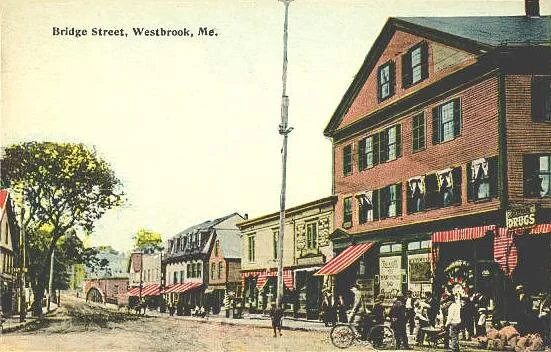
Bridge Street in Westbrook in 1912
Sounds from the field

“Franconia Notch” (oil painting, left), by George Albert Frost (1843-1907); Franconia Notch in 2004 (right)
“There was a sound of grouse from the field
of grouse or a box guitar
And the way the storm idled over the mountain
revealing the mountain dissolving in light….’’
— From ‘‘Five Nights in the North Country Solstice,’’ by Kathy Fagan, an American poet. She was the poet-in-residence at The {Robert} Frost Place, in Franconia, N.H. , in 1985.
'The amount of maniacs'

Doyle's Cafe, in Boston’s Jamaica Plain neighborhood. It’s a well-known watering hole.
— Photo by John Phelan
"It’s just a really interesting place to grow up. The sports teams, the colleges, the racial tension, the state workers, the boozing, the anger. All of that stuff. I don’t think I ever appreciated the amount of maniacs that live in Massachusetts until I left. When I lived here, I took it for granted that everyone was kind of funny and a bit of a character."
— Bill Burr (born in 1968), stand-up comedian who grew up in the inner Boston suburb of Canton

Arthur Allen: Some experts skeptical about vaccinating kids against COVID-19

Tufts Children’s Hospital, in downtown Boston
Lucien Wiggins, 12, arrived at Tufts Children’s Hospital, in Boston, by ambulance June 7 with chest pains, dizziness and high levels of a protein in his blood that indicated inflammation of his heart. The symptoms had begun a day earlier, the morning after his second vaccination with the Pfizer-BioNTech mRNA shot.
For Dr. Sara Ross, chief of pediatric critical care at the hospital, the event confirmed a doubt that she’d been nursing: Was the country pushing its luck by vaccinating children against COVID at a time when the disease was relatively mild in the young — and skepticism of vaccines was frighteningly high?
“I have practiced pediatric ICU for almost 15 years and I have never taken care of a single patient with a vaccine-related complication until now,” Ross told KHN. “Our standard for safety seems to be different for all the other vaccines we expose children to.”
To be sure, cases of myocarditis such as Lucien’s have been rare, and the reported side-effects, though sometimes serious, generally resolve with pain relievers and, sometimes, infusions of antibodies. And a COVID infection itself is far more likely than a vaccine to cause myocarditis, including in younger people.
Lucien went home, on the mend, after two days on intravenous ibuprofen in intensive care. Most of the 800 or so cases of heart problems among all ages reported to a federal vaccine-safety database through May 31 followed a similar course. Yet the pattern of these cases — most occurred in young males after the second Pfizer or Moderna shot — suggested that the ailment was caused by the vaccine, rather than being coincidental.
At a time when the vaccination campaign is slowing, leading conservatives are openly spreading disinformation about vaccines, and scientists fear a possible upsurge in cases this fall or winter, side-effects in young people pose a conundrum for public health officials.
On June 11, the Centers for Disease Control and Prevention’s vaccine advisory committee is set to meet to discuss the possible link and whether it merits changing its recommendations for vaccinating teenagers with the Pfizer vaccine, which the Food and Drug Administration last month authorized for children 12 and older. A similar authorization for the Moderna vaccine is pending, and both companies are conducting clinical trials that will test their vaccines on children as young as 6 months old.
At a meeting last week of an FDA advisory committee, vaccine experts suggested that the agency require the pharmaceutical companies to hold larger and longer clinical trials for the younger age groups. A few said FDA should hold off on authorizing vaccination of younger children for up to a year or two.
Interestingly, Lucien and his mother, Beth Clarke, of Rochester, N.H., disagreed. Her son’s reaction was “odd,” she said, but “I’d rather him get a side-effect [that doctors] can help with than get COVID and possibly die. And he feels that way, which is more important. He thinks all his friends should get it.”
Data regarding covid’s impact on the young are somewhat messy, but at least 300 COVID-related deaths and thousands of hospitalizations have been reported in children under 18, which makes COVID’s toll as large or larger than any childhood disease for which a vaccine is currently available. The American Academy of Pediatrics wants children to receive the vaccine, assuming tests show it is safe.
But healthy people under 18 have generally not suffered major COVID effects, and the number of serious cases among the young has tumbled as more adults become vaccinated. Unlike other pathogens, such as influenza, children are generally not infecting older, vulnerable adults. Under these circumstances, said Dr. Cody Meissner — who as chief of pediatric infectious diseases at Tufts consulted on Lucien’s case — the benefits of covid vaccination at this point may not outweigh the risks for children.
“We all want a pediatric vaccine, but I’m concerned about the safety issue,” Meissner told fellow advisory commission members last week. An Israeli study found a five- to 25-fold increase in the heart ailment among males ages 16-24 who were vaccinated with the Pfizer shot. Most recovered within a few weeks. Two deaths occurred in vaccinated men that don’t appear to have been linked to the vaccine.
Young people could experience long-term effects from the suspected vaccine side-effect such as scarring, irregular heartbeat or even early heart failure, Meissner said, so it makes sense to wait until the gravity of the problem becomes clearer.
“Could the disease come back this fall? Sure. But the likelihood I think is pretty low. And our first mandate is do no harm,” he said.
Ross said the biggest pandemic threats to children that her ICU has witnessed are drug overdoses and mental illness brought on by the shutdown of normal life.
“Young children are not the vectors of disease, nor are they driving the spread of the epidemic,” Ross said. While eventually everyone should be vaccinated against COVID, use of the vaccines should not be expanded to children without extensive safety data, she said.
The government could authorize childhood vaccination against COVID without recommending it immediately, noted Dr. Eric Rubin, an advisory committee member who is editor-in-chief of the New England Journal of Medicine. “In September, when kids are back in school, people are indoors, and the vaccination rates are very low in certain parts of the country, who knows what things are going to look like? We may want this vaccine.”
Moderna and Pfizer this summer began testing their vaccines in younger kids. A Pfizer spokesperson said the company expects to give about 2,250 children ages 6 months-11 years vaccine as part of its trial; Moderna said it would vaccinate about 3,500 children in the 2-11 age range.
Some members of the FDA advisory committee proposed that up to 10,000 kids be included in each trial. But Marion Gruber, leader of the FDA’s vaccine regulatory office, pointed out that even trials that large wouldn’t necessarily detect a side-effect as rare as myocarditis seems to be.
At some point, federal regulators and the public must decide how much risk they are willing to accept from vaccines versus the risk of a COVID virus that continues to spread and mutate around the world, said Dr. Paul Offit, director of the Vaccine Education Center at Children’s Hospital of Philadelphia.
“We’re going to need a highly vaccinated population for years or perhaps decades,” Offit said at the meeting. “It seems hard to imagine that we won’t have to vaccinate children going forward.”
Ross argued that it makes more sense to selectively vaccinate children who are most at-risk for serious covid disease, such as those who are obese or have diabetes. Yet even to raise questions about the vaccination program can be a freighted decision, she said. While authorities have a duty to speak frankly about the safety of vaccines, there is also a responsibility not to frighten the public in a way that discourages them from seeking protection.
A 10-day pause in the Johnson & Johnson vaccination campaign in April, while authorities investigated a link to an occasionally fatal blood-clotting disorder, led to a major decline in public confidence in that vaccine, although as of late May authorities had detected only 28 cases among 8.7 million U.S. recipients of the vaccine. Because of the declining appetite for the Johnson & Johnson vaccine, millions of doses are in danger of passing their use-by date in refrigerators around the country.
Focusing too much attention on potential harms from the Pfizer and Moderna vaccines for children could have a tragic result, said Dr. Saad Omer, director of the Yale Institute for Global Health and an expert on vaccine hesitancy. “Very soon we could be in a situation where we really need to vaccinate this population, but it will be too late because you’ve already given the message that we should not be doing it,” he said.
Eventually, perhaps next year, K-12 mandates might be called for, said Dr. Sean O’Leary, a professor of pediatric infectious diseases at the University of Colorado. “There’s so much misinformation and propaganda spreading that people are reticent to go there, to further poke the hornet’s nest,” he said. But once there is robust safety data for children, “when you think about it, there’s no logical or ethical reason why you wouldn’t.”
Arthur Allen is a Kaiser Health News reporter.
But just water vapor

“Forbidding & Sublime”” (oil painting), by Linda Pearlman Karlsberg, at Alpers Fine Art, Andover, Mass.
Self-complacent city

“Boston is a curious place….When a society has reached this point, it acquires a self-complacency which is wildly exasperating. My fingers itch to puncture it.; to do something which will sting it into impropriety.’’
Henry Adams (1838-1918), famed historian, autobiographer and descendent of Presidents John Adams and John Quincy Adams
Leave it to those species

Lobstermen in Casco Bay, Maine
As a child of Maine, he knew better than to learn to swim in the water {there}; the Maine water, in Wilbur Larch’s opinion, was for summer people and lobsters.’’
— John Irving, in his (1985) novel Cider House Rules
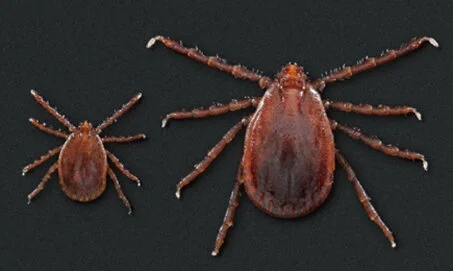
Brian P.D. Hannon: Invasive ticks in the Northeast

An Asian longhorned tick nymph, left, and an adult female.
— Centers for Disease Control and Prevention (CDC) photo
From ecoRI News (ecori.org)
This year’s tick season has brought an unwelcome development beyond the usual concerns about the disease-bearing arachnids with the confirmation of what one scientist said is a new invasive species in the Northeast.
The Asian longhorned tick, which poses a threat to livestock, was found in April to have moved to the Rhode Island mainland after an initial discovery on one of the state’s islands last year.
“This is truly an invasive species,” said Thomas Mather, a professor of public health entomology at the University of Rhode Island.
The ticks pose a risk to livestock because they attach themselves to various warm-blooded animals to feed. If too many attach to one animal, the loss of blood can kill the animal.
Mather said he found four Asian longhorned ticks about a month ago in South Kingstown while looking for the common blacklegged ticks known to bedevil outdoor enthusiasts and pet owners with the threat of Lyme disease and other infections transmitted through their bites as they hatch and grow to maturity in spring and summer.
Tick season is now in full swing .
“We’ve been seeing sporadic nymphs since April,” said Mather, noting these efficient carriers of disease will continue to spread as temperatures rise. “Somewhere around the week before Memorial Day they start to reach their peak numbers.”
The Rhode Island Department of Environmental Management (DEM) announced in late September that the Asian longhorned tick had been detected on Block Island, about nine miles off the mainland. But Mather’s recent discovery was the first on the state’s mainland and the presence of both nymphal and adult-stage ticks indicates that they have been present for at least one life cycle, he said.
Known by the scientific name Haemaphysalis longicornis, the Asian longhorned tick was first detected in the United States in 2017. As of early October 2020, the tick was known to be in Northeast states, including Rhode Island, Connecticut, Delaware, New York, New Jersey and Pennsylvania. Other states where the tick appears include Arkansas, Kentucky, Maryland, North Carolina, South Carolina, Ohio, Tennessee, Virginia and West Virginia, according to the U.S. Centers for Disease Control and Prevention (CDC).
Mather said the Asian longhorned tick differs in a few key ways from the blacklegged ticks, which are better known as deer ticks for their habit of using white-tailed deer as hosts.
The Asian longhorned tick can be found in batches of thousands in grass, shrubbery or on animals. But they don’t require the same high levels of humidity needed for survival by other tick varieties, Mather said.
“They don’t mind being out in the open” said Mather, noting that the arachnids can live in sunny areas beyond the moist lawn edges, fallen leaves or high grass areas normally targeted by homeowners or professional pest controllers applying insecticides.

Adult blacklegged tick (aka deer tick)
— CDC photo
Ticks feed on blood, with the blacklegged strain preferring white-tailed deer and white-footed mice, which are a primary source of tickborne Lyme disease. Up to 70 percent of white-footed mice in Rhode Island carry the Lyme bacterium Borrelia burgdorferi, Mather said.
The parasites transmit infections by exchanging blood with those they bite, whether animals or humans. The longer they remain attached, the more blood and germs they pass, making their quick removal paramount to avoiding Lyme disease, which causes headaches, fatigue, swollen lymph nodes, muscle and joint aches, fever and chills.
“It takes some time for the Lyme disease-causing bacteria to move from the tick to the host,” according to the CDC. “The longer the tick is attached, the greater the risk of acquiring disease from it.”
The first known instance of an Asian longhorned tick biting a person was in June 2018 in Yonkers, N.Y., which was reportedly confirmed by the CDC. As testing continues in the United States, “it is likely that some ticks will be found to contain germs that can be harmful to people. However, we do not yet know if and how often these ticks are able to pass these germs along to people and make them ill,” the CDC reported.
“This tick is a little weird. Happily, though, it doesn’t seem to like to bite people,” said Mather, who noted the Asian longhorned isn’t believed to be a Lyme disease carrier.
Deer ticks are among the most prevalent types in Northeast and Mid-Atlantic states, along with larger dog ticks, although only the former carry Lyme disease.
Ticks can also transfer anaplasmosis and babesiosis, blood infections with symptoms including fever, chills and sweats, fatigue and gastrointestinal ailments such as nausea and vomiting. One in four ticks in Rhode Island carry the germ causing Lyme disease, but Mather warned vaccination strategies focusing on Lyme prevention alone can cause a false sense of security and possibly result in the other infections being overlooked.
Climate change has no direct effect on ticks, because they are affected by humidity levels rather than temperature. Without enough humidity, ticks will dry up like a plant without enough water, but they can survive in varying climates.
“These ticks are in Duluth, Minnesota,and Florida,” Mather said. Yet he explained the changes in global climate can impact ticks – hurting or helping them – by altering the number of animals on which they feed. “The change that we’re finding is more related to the presence or absence of reproductive hosts.”)
Mather said Rhode Island also has experienced an increase in lone star ticks. Lone star ticks, which have moved northward in the United States for a decade, were previously only found off Rhode Island’s shore on Prudence Island, but now have infested Conanicut Island, Mather said.
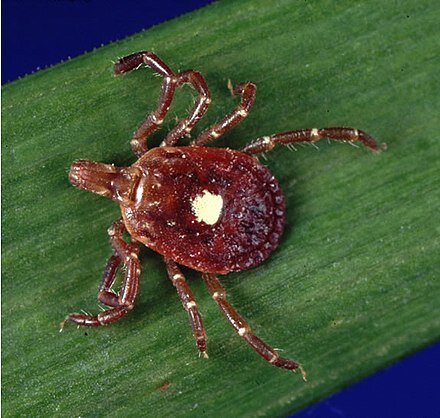
A lone star tick
The lone star tick is a “very aggressive biter but it won’t carry or transmit the Lyme disease germ,” said Mather, who added there is still a danger of the parasites transmitting anaplasmosis and babesiosis.
Mather said lone star tick bites can also produce a red-meat allergy. Ticks taking in blood from an animal can ingest a specific sugar — galactose-α-1,3-galactose, also known as alpha-gal — found in red meat and then transfer the material to humans. The resulting symptoms, including rash, hives, nausea and difficulty breathing, can take hours to first appear and possibly months to fully develop, making the bite, rather than the existing allergy — referred to as Alpha-gal syndrome — appear to be the cause of the adverse reaction.
The University of Rhode Island’s TickEncounter website provides abundant information about the arachnids and the harmful infections they transmit, as well as tools for sharing tick locations, strategies to avoid bites and blog posts by experts.
People who plan to be in tick habitats should wear clothing treated with the tick-killing chemical permethrin and use tactics to prevent the insects from reaching skin such as tucking pant legs into socks. Daily tick checks are also important, especially in hiding spots including the backs of knees, inside armpits and around waistbands.
Regardless of the type of tick encountered, Mather echoed the CDC warning about removing the parasites as quickly as possible.
“The longer a tick is attached, the more likely it’s going to deliver an infectious dose,” he said.