
Vox clamantis in deserto






‘A sense of ocean and old trees’
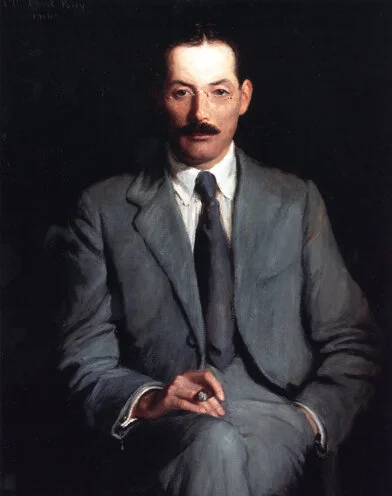
“Edwin Arlington Robinson (1916),’’ by Lilla Cabot Perry, in the Colby College Special Collections, Waterville, Maine
She fears him, and will always ask
What fated her to choose him;
She meets in his engaging mask
All reasons to refuse him;
But what she meets and what she fears
Are less than are the downward years,
Drawn slowly to the foamless weirs
Of age, were she to lose him.
Between a blurred sagacity
That once had power to sound him,
And Love, that will not let him be
The Judas that she found him,
Her pride assuages her almost,
As if it were alone the cost.—
He sees that he will not be lost,
And waits and looks around him.
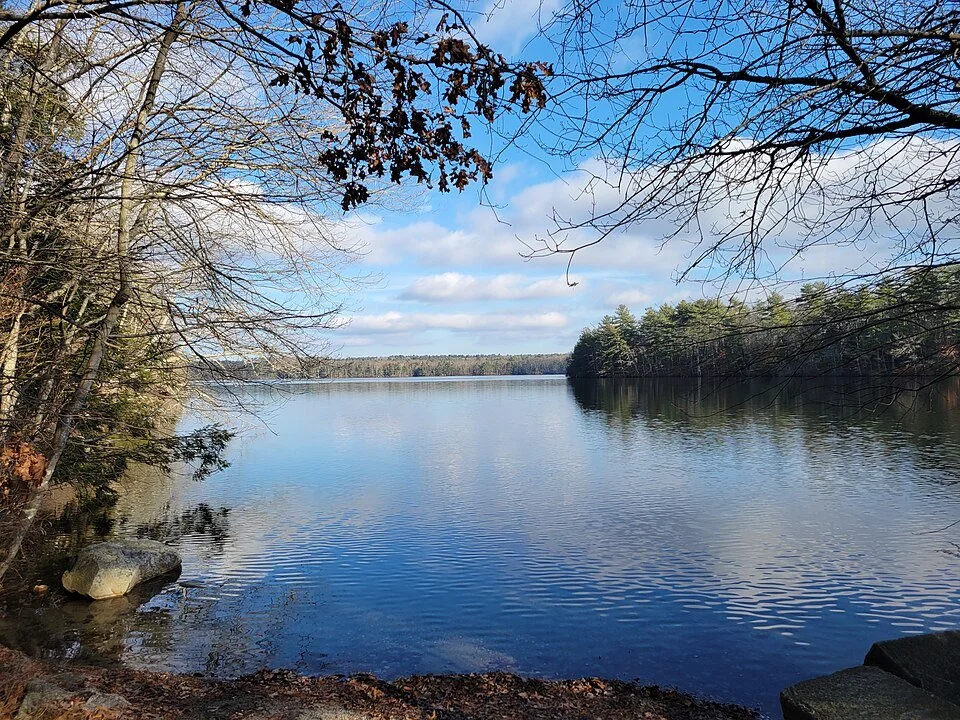
A sense of ocean and old trees
Envelops and allures him;
Tradition, touching all he sees
Beguiles and reassures him;
And all her doubts of what he says
Are dimmed with what she knows of days—
Till even prejudice delays
And fades, and she secures him.
The falling leaf inaugurates
The reign of her confusion;
The pounding wave reverberates
The dirge of her illusion;
And home, where passion lived and died,
Becomes a place where she can hide,
While all the town and harbor side
Vibrate with her seclusion.
We tell you, tapping on our brows,
The story as it should be,—
As if the story of a house
Were told, or ever could be;
We’ll have no kindly veil between
Her visions and those we have seen,—
As if we guessed what hers have been,
Or what they are or would be.
Meanwhile we do no harm; for they
That with a god have striven,
Not hearing much of what we say,
Take what the god has given;
Though like waves breaking it may be,
Or like a changed familiar tree,
Or like a stairway to the sea
Where down the blind are driven.
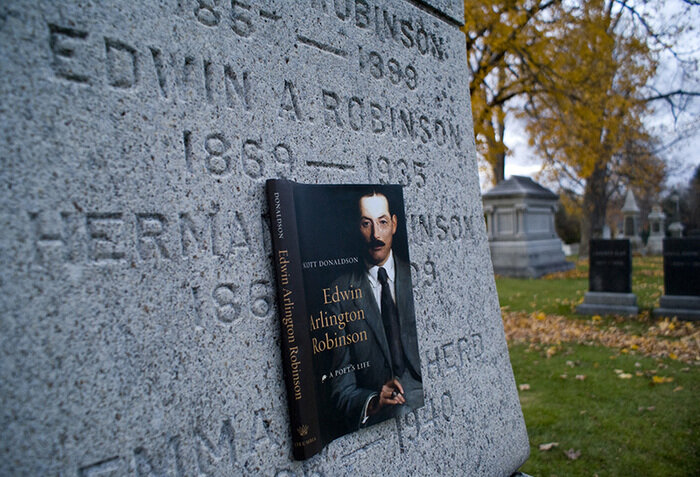
“Eros Turannos,’’ by Edwin Arlington Robinson (1869-1935), who was born in the Alna, Maine, village of Head Tide, but grew up — generally unhappy — in Gardiner, Maine. The three-time winner of the Pulitzer Prize for Poetry spent much time at the famous McDowell Colony, an artist residency in Peterboro, N.H. He died in New York and is buried in the family plot in Oak Grove Cemetery in Gardiner.
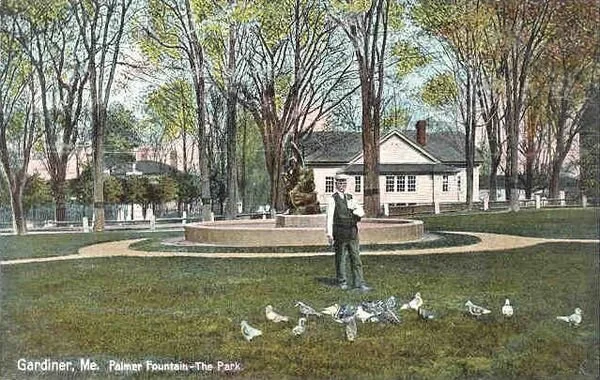
Gardiner’s Park and Palmer Fountain in 1909. Melted down for the World War I war effort, the bronze statue was later replaced.
Safely anonymous nudity

'‘Finsta Self’' (oil on paper), by Eben Haines. at the Corey Daniels Gallery, Wells, Maine
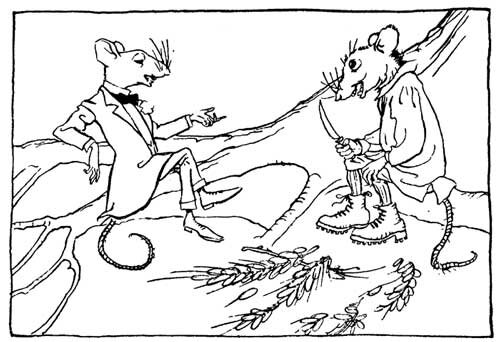
Don Pesci: The City Mouse fatalistically faces the spreading stupidity pandemic
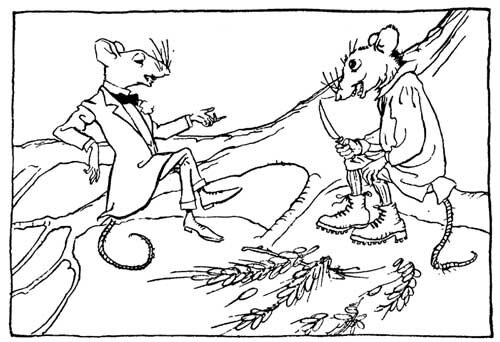
1912 Drawing derived from the Aesop’s Fables tale “The Town Mouse and The Country Mouse,’’ by Arthur Rackham
VERNON, Conn.
The merry month of May has burst upon Connecticut. The City Mouse went to lunch in Hartford with one of her lady friends – sans mask, while they were eating – and a conversation arose concerning the age-old quarrel between city and country.
The City Mouse is a no-nonsense character, a quality disappearing quickly in our homogenously progressive Connecticut culture -- Connecticulture? -- and differences of opinion clouded the air.
The City Mouse was not surprised that Yale law students had launched a lawsuit against a wealthy suburb because, the students asserted, Woodbridge had, through its zoning regulations, frustrated the construction of low-rent housing in what had been historically a predominantly middle-class municipality. If the suit were to be decided in favor of the Yale students, a certain percentage of low-income housing would be required in all Connecticut municipalities, not solely in Woodbridge.
“Law students will be law students,” the City Mouse said, “but the zoning regulations in Woodbridge are not racist. They regulate lot size, which has attracted middle-class homeowners to Woodbridge. How many Yale students finding employment opportunities in Connecticut’s Gold Coast, or in an increasingly impoverished New York City, have over the past few decades settled in Woodbridge rather than, say New Haven? How many of New York's tax-tortured residents have moved to New Haven rather than Woodbridge or other Connecticut Gold Coast communities? The students’ attack upon zoning regulations in Woodbridge is what it appears to be on its face – an assault upon representative municipal governance first by the courts and, at some point in the near future, by a compliant progressive legislature.”
Their server, Brian, approached to refill their wine glasses. He was a young man – well educated, both could see – who was working his way through college. He had been at a Connecticut university for a couple of years, gliding through on a partial scholarship, and both had talked with him at length before.
“Brian,” Lady Friend said, “your restaurant appears to be reviving now that Coronavirus restrictions have been lifted. Good for you, right?”
“Yes. There’s plenty of work. But a different problem has cropped up.”
“Ah,” Lady Friend asked, “What is it?”
This question caused some unease. Brian, suitably masked, looked cautiously over his shoulder, then ventured in a whisper, “The restaurant is having a problem securing help.”
“From state and federal government, you mean?”
“No, everyone there wants to undo the harm they’ve done through shutdown regulations. Help… you know, servers, dishwashers and the like.”
Looking conspiratorially over her shoulder, The Country Mouse said, “Well, no slur intended on you, Brian, but you don’t need a Harvard education to serve food and wash dishes. And there is a huge untapped, unemployed population in Hartford that has not graduated from Yale or Harvard law schools and may be tapped to work in restaurants -- so, what’s the problem?”
“They have other means.”
“I don’t understand,” said Lady Friend.
And here, the City Mouse broke in. “Brian is suggesting that welfare payments and superior benefits keep the unemployed on the public payroll.”
“Is that it?” Lady friend asked, a note of quiet desperation in her voice.
“That’s it,” Brian said, and sped off to another table.
“I can’t imagine,” the City Mouse said, with a sardonic trill in her voice, “what the solution to that problem might be, apart from bringing restaurants onto the public dole. State support of restaurants could be sold on the supposition that restaurants might be better managed by legislators rather than restaurant owners. But you and I know -- don’t we? -- that it would drive up the cost of everything. Just look at the spikes over the past five decades in welfare costs, state employee salaries and pensions and so called ‘fixed costs,’ which cannot legislatively be unfixed without unseating certain legislators.”
“Imagine that,” said Lady Friend, “you solve one problem, and another knocks you on the head.”
“Like sowing dragon’s teeth,” the City Mouse mused.
The problem has been solved, I reported to The City Mouse. On May 3, the Hartford City Council proposed an equitable solution: “City exploring universal basic income.”
The lede to the story in a Hartford paper ran as follows: “The city of Hartford is considering experimenting with a universal basic income [UBI], starting with designing a pilot program that would give no-strings-attached monthly payments to participating city residents.”
The program would “target single, working parents, with a goal of learning whether extra, guaranteed income improves recipients’ physical and emotional well-being, job prospects and financial security.”
The lessons apparently already have been learned by the City Council.
The story bulges with approving quotes from a University of Connecticut economist, the council president, various council members, all Democrats, and a solitary Working Families Party member. Those outside Connecticut should know that the state’s Working Party lives in the basement of the state’s progressive Democrat Party.
A 2018 study of a similar UBI program in Alaska, the paper reported, found that “it did not increase unemployment as some critics feared and had actually increased part-time work.”
“So, no need to worry anymore,” I teased The City Mouse.
Her response, delivered with a painful sigh: “If only stupidity were as easy to dispose of as Coronavirus.”
Don Pesci is a Vernon-based columnist.

Summer as verb
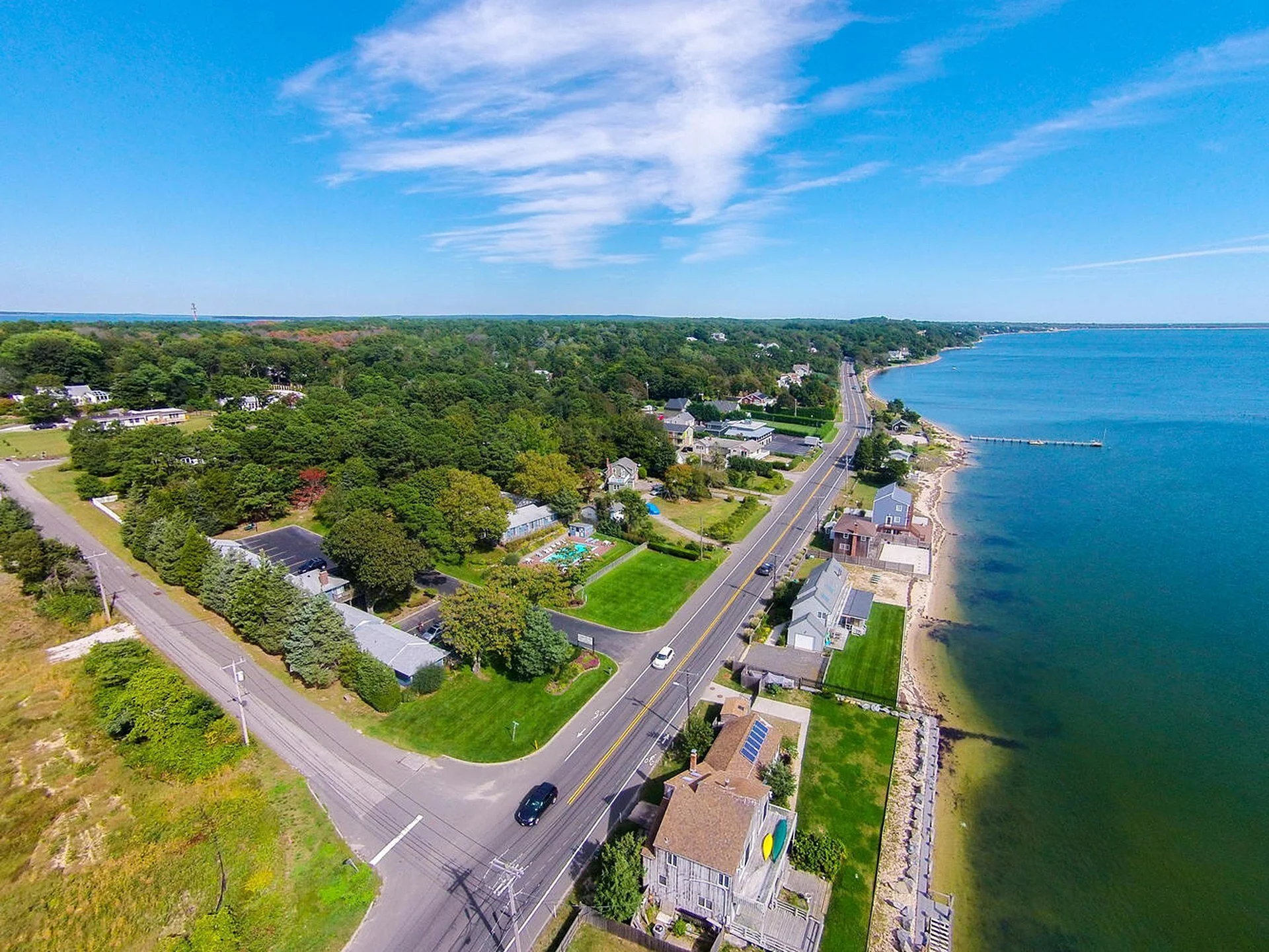
View of summer houses in Hampton Bays, on Long Island
— Photo by Masterchief1307
“When I left the State of Maine for college, I met my first really rich friends, and I discovered summer could be a verb.’’
— Alexander Chee (born 1967 in Rhode lsland but spent much of his youth in Maine), novelist, poet and nonfiction writer. He now teaches at Dartmouth College.

They come and they go and they come back

2020 U.S. Census enumerator’s kit
From Robert Whitcomb’s “Digital Diary’’ in GoLocal24.com
The 2020 U.S. Census figures, in general, weren’t surprising. Population growth slowed to 7.4 percent in the stretch since 2010, the lowest since the Great Depression, when the population only rose 7.3 percent. The Sunbelt continued to draw many new residents, though not as fast as most demographers had predicted. So the Sunbelt’s megastates – Texas and Florida – picked up congressional seats – Texas two and Florida one; the economic dynamo North Carolina also got one new seat. (I don’t include California in the Sunbelt. It lost a seat.)
The big news around here (which surprised me) was that Rhode Island held onto enough people to retain its two congressional seats. Massachusetts will keep its nine seats and Connecticut its five. I attribute much of Rhode Island’s minor triumph to the great wealth-and-job-creation machine of Greater Boston, which spills into Rhode Island.
The Census data let New England maintain its 21 seats in the U.S. House, where for the first time in a half-century none of the region’s six states lost a seat!
Indeed, I wouldn’t be surprised if the more attractive and prosperous parts of the North, especially New England, see substantial population increases in the next decade as the Sunbelt problems cited below lead to some reverse migration, spawned by our relatively moderate weather (and lots of freshwater) and our rich technological, health-care and education complexes, beauty, generally low crime rates and sense of community and history. In any event, I doubt that the population of the country as a whole, or the economy, will surge in the Twenties, which unlike the last century’s Twenties, probably won’t be “roaring’’ for long. The demographics, including our low birth rate, don’t suggest a long-term national boom (or crash) is coming.
The assumption has been that the Census data will give the increasingly far-right Republican Party yet more clout. Maybe in the short run, but the folks moving into Sunbelt states from the Northeast, Rust Belt and California include many liberals who continue to want the sort of Democratic Party-promoted public services they had back north and in California. Thus, especially in Sunbelt metro areas, Democrats are fairly steadily increasing their share of the electorate. Strange political times! The Democrats have been moving toward European-style social democracy while parts of the GOP embrace neo-fascism.
The migration to the Sunbelt, although it’s slowing, is putting ever-increasing strains on its states’ generally thin social services and inadequate public infrastructure, as witness the Texas power-grid collapse in February.
The Sunbelt increasingly faces the heavy traffic, soaring home prices and other aspects of density that metro areas of the Northeast and California have long had to deal with. Addressing them will require major political and policy changes. The low taxes (except sales taxes), cheap real estate and wide open roads will not continue in large parts of the Sunbelt.
And this comes as the South faces the nation’s worst effects (with the possible exception of California) of global warming – including stronger hurricanes and other storms, more floods, more droughts and longer heat waves. God help Florida and the Gulf Coast as the seas keep rising.
The climate crisis has already turned away some people from the South, even as it requires very expensive infrastructure work to address. That means higher taxes, which the GOP hates more than anything else, especially when they’re imposed on the wealthy. The two most important Republican constituencies are the very rich (many of them via inheritance) and rural and exurban voters.
So I think that the Sunbelt will become increasingly politically competitive. The Census figures strongly suggest that. And New England will do all right, with or without “climate refugees.’’
Going forward, the New England states would do well to cooperate in formulating tax and other policies so as not to cannibalize themselves in marketing the compact region to business and individuals, especially to those in the Sunbelt and the Mountain States, the other high-growth region, that might be having second thoughts about where they’ve moved to in recent years.
The joy of junk mail
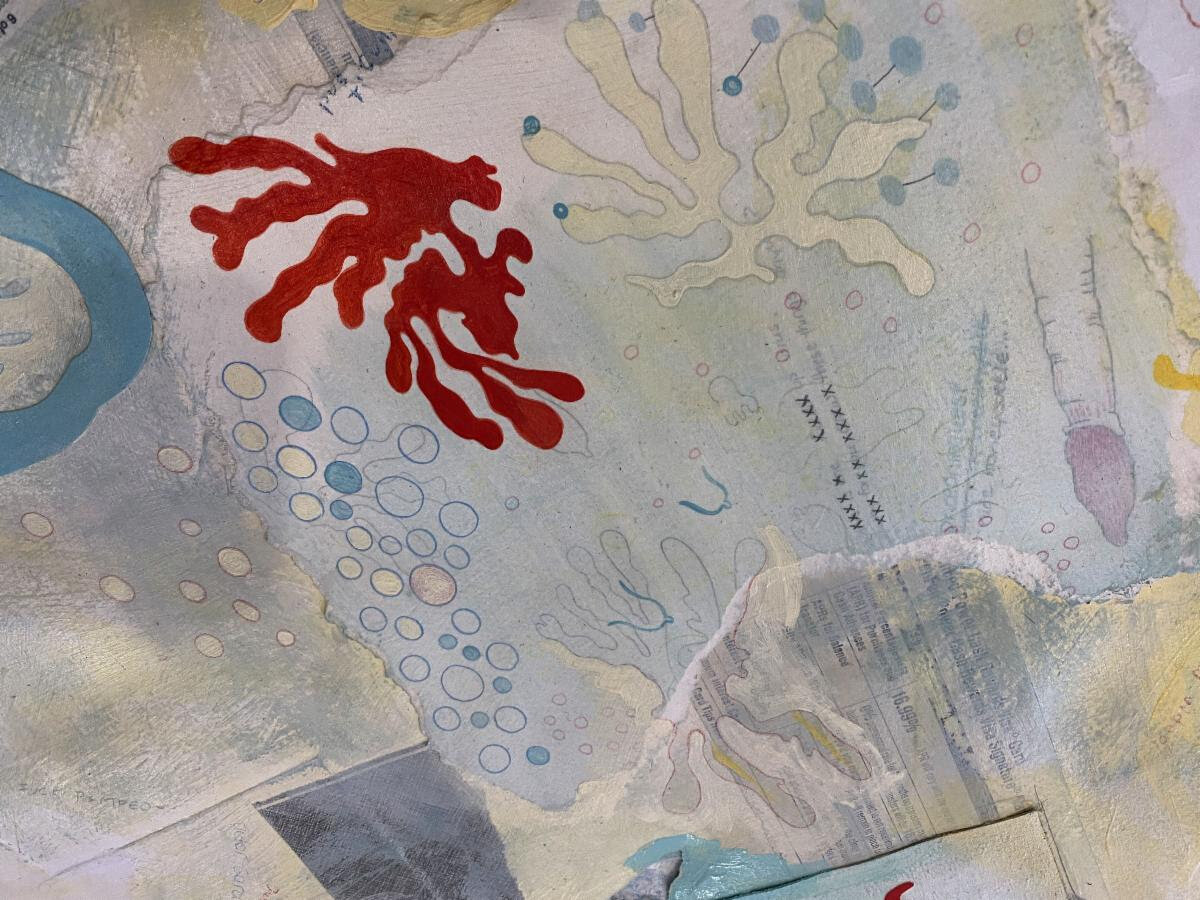
“Fish” (detail), by Elif Soyer, in her show “Bycatch,’’ at Kingston Gallery, Boston, May 5-30.
The gallery says:
“The work in ‘Bycatch’ began as Elif Soyer’s ongoing attempt to journal while repurposing mounds of unsolicited junk mail, layering the mundane over the mundane. Soyer says she recognized mid-way through hanging her previous shows, ‘Balance Due’ and ‘Daily,’ that this theme was one that she would keep drawing on while incorporating ‘refuse’ from previous projects. Paper, pencil, acrylic, cloth, string, tempera, pen, watercolor, junk mail, and bills produce textured and subtle imagery suggestive of, variously, lichen, ear canals, viruses, eyeballs, branches, phrases, fish, neurons and plants, familiar motifs from the artist’s canon.
“Says Soyer: ‘The materials, the drawing, writing, and painting are informed by the way I see: space filled with layers and layers, textures, forms and contrast yet always space - the eye takes in so much, the net captures what was not intentionally looked for as well as my original focus. My friends and family say that my untraditional aesthetic must be influenced by my bi-cultural Turkish/American upbringing, surrounded by mosaics, textiles, and tapestries rich in contrast. My bycatch collects clashing materials that co-exist just the same, and eventually manage to coalesce into their own environment.”’
Acting like idiots sells
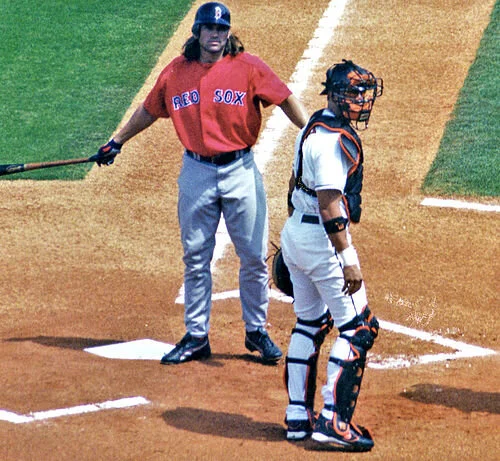
Johnny Damon at bat for the Red Sox in spring training in 2005
“We’ve got the long hair, we’ve got the cornrows, we’ve got guys acting like idiots. And I think the fans out there like it.’’
— Johnny Damon, former outfielder for the Boston Red Sox, which he played for in 2002-2005
For an NRA meeting

“Still from 'Hand Catching Lead'‘ (two-color lithograph/screenprint), by Richard Serrra, in his show “Richard Serra: Selected Prints,’’ at Heather Gaudio Fine Art, New Canaan, Conn., starting May 8.
The gallery says:
“In collaboration with master printers Gemini G.E.L., the exhibition will include monochromatic works from different series executed in the last 15 years. Serra’s explorations with printmaking have been an extension of the artist’s practice of working in monumentally-scaled sculpture. Since 1972, he has been working with Gemini to create and invent new techniques in the medium, leading to a varied output of complexly surfaced prints.’’

David Warsh: The Blake Bailey case and the logic of woke

Blake Bailey in 2011
SOMERVILLE, Mass.
“Society is a game with rules, people are players in this game, and politics is the arena in which we affirm and change these rules. Unlike the rules in standard game theory, however, social rules are continually contested by players allying to scrap old rules and create new rules to serve their purposes.”
That framing, by Herbert Gintis, in the first paragraph of Individuality and Entanglement (2017), struck me as particularly apt when I read it. It’s been useful to me ever since in understanding matters large and small.
Take the case of Blake Bailey’s biography of the novelist Philip Roth, now withdrawn from print. Its publisher, W.W. Norton, returned the manuscript to the possession of its author, along with that of Bailey’s memoir, The Splendid Things We Planned, which Norton published in 2014.
Ten days ago, The New York Times reported that accusations of sexual assault and other bad behavior by Bailey, 57, had led the publisher to stop shipping and promoting the book, which had just that week reached the Times’s best-seller list.
Two days after that, Terry Pristin, a former reporter for The Times, in a letter published on the paper’s editorial page, wrote, “If Blake Bailey, Philip Roth’s biographer, is credibly accused of rape and attempted rape, let him be prosecuted to the full extent of the law. But why punish the rest of us? Don’t prevent me from reading a biography that no less a writer than Cynthia Ozick has labeled a ‘narrative masterwork.’”
The difference between the front-page treatment the story received initially, and the less prominent play, on page B4 in the business section, of the news that the publisher had taken out of print its editions of both books, reflected contesting opinions about the story’s significance, perhaps even within the newspaper. Then again, the second story, being a follow-up and so subsidiary to the first story, may have reflected nothing more than classic journalistic procedure.
Bailey has adamantly denied the charges.
The most interesting details had to do with the timing of the allegations, their nature, and the manner in which they were communicated to the publisher. Most of these were spelled out with clarity in The Times’s account.
It was apparently in 2018, that a publishing executive, Valentina Rice, using a pseudonymous email account, wrote to Julia A. Reidhead, the president of Norton, accusing Bailey of non-consensual sex three years earlier, when both had been overnight guests at the home of a Times book critic and his wife. She also emailed a Times reporter, who responded, but Ms. Rice decided not to pursue it further and did not reply.
“I have not felt able to report this to the police but feel I have to do something and tell someone in the interests of protecting other women,” she wrote to the publisher, adding: “I understand that you would need to confirm this allegation which I am prepared to do, if you can assure me of my anonymity even if it is likely Mr. Bailey will know exactly who I am.”
The publisher did not respond to her note, Rice told The Times. But a week later Rice received an email from Bailey, who said that Norton had forwarded her complaint.
“I can assure you I have never had non-consensual sex of any kind, with anybody, ever, and if it comes to a point I shall vigorously defend my reputation and livelihood,” he wrote in the email, which Rice shared with The Times, though it is not clear when. “Meanwhile, I appeal to your decency: I have a wife and young daughter who adore and depend on me, and such a rumor, even untrue, would destroy them.”
In other words, Rice wrote Norton just as the Me Too movement gathered steam. It was some months after The Times and The New Yorker had published the stories about powerful Hollywood sexual predators for which they were awarded the 2018 Public Service Pulitzer Prize.
What was the president of Norton thinking? What did Blake Bailey think to himself? What did the publisher and author think might or might not happen when the biography eventually appeared? Litigation and much shoe-leather reporting seem sure to ensue. We can hope that eventually a satisfying reconstruction will appear, along the lines of other careful post-mortems of furiously contested events: Sanford Ungar’s The Papers and the Papers: An Account of the Legal and Political Battle over the Pentagon Papers (1974); Janet Malcolm’s The Journalist and the Murderer (1990), about the strategies of authors dealing with sensational events (in this case, the murder of a Green Beret physician’s daughters and pregnant wife); Devlin Barrett’s October Surprise: How the FBI Tried to Save Itself and Crashed an Election (2020), about FBI decision-making in the last months of the 2016 presidential election. I should mention how proud I am that that Norton published my Knowledge and the Wealth of Nations: A Story of Economic Discovery (2006). Like many others, I consider the company to be among the very best in the industry.
In the meantime, the story of the Roth biography is one more illustration of how culture changes and why: social rules are contested by allies who, often successfully, seek to scrap old rules and create new ones to serve their purposes. Call me cynical, but I believe that the relevance of stories about movie mogul Harvey Weinstein’s predatory behavior was driven home by Donald Trump’s election to the presidency, despite plentiful evidence of his sexual misconduct. Heightened attention to racial inequities, exemplified by the Black Lives Matter movement, was stoked even more by the murder of George Floyd.
There are times when the law is not enough.
David Warsh, a veteran columnist and an economic historian, is proprietor of Somerville-based economicprincipals.com, where this piece first appeared.

Editor’s note: Roth lived for many years in Warren, Conn., in a 1790s farmhouse. For a look:
http://www.klemmrealestate.com/properties_details_pk.php?For%20Sale-2255
Bailey’s other books include {John} Cheever: A Life, about that great short-story writer and novelist, who though he lived most of his life in and around New York, never ceased to be a New Englander.

Frank Carini: The vast poisoning that goes with maintaining lawns
From ecoRI News (ecori.org)
The amount of pollution, from noise to air to water, created to maintain green carpets and immaculate yards is jarring. Lawn mowers, weed whackers, leaf blowers, pesticides, herbicides, fungicides and fertilizers. Much of this effort is powered by or made from fossil fuels.
Lawn-care equipment is typically powered by two-stroke engines. They are cheap, compact, lightweight, and simple. They are also highly polluting, generating up to 5 percent of the country’s air pollution, according to the Environmental Protection Agency (EPA).
Each weekend for much of the year, according to estimates, some 54 million Americans mow their lawns. All this weekend grass cutting uses some 800 million gallons of gasoline annually. That doesn’t include the gas used to trim around trees and fences and to blow grass clippings around.
Those 800 million gallons also don’t include the gas used for lawns mowed during the week or by landscaping companies. It doesn’t include the oil that is also burned by these cheap engines. It doesn’t include grass cut on golf courses and along median strips and other public spaces covered by green carpets devoid of diversity.
A 2011 study showed that a leaf blower emits nearly 300 times the amount of air pollutants as a pickup. The EPA has estimated that lawn care produces 13 billion pounds of toxic pollutants annually.
This equipment is also noisy. Leaf blowers emit between 80 and 85 decibels, but cheap or mid-range ones can emit up to 112 decibels. Lawn mowers range from 82 to 90 decibels. Weed whackers can emit up 96 decibels of noise.
Electric lawn equipment is gaining in popularity and will slowly lessen the amount of fossil fuels burned to cut millions of acres of grass — a 2005 study found that about 40 million acres in the continental United States has some form of lawn on it. Electric equipment is also quieter than its gas-powered counterparts.
Much of the 90 million pounds or so of fertilizer dumped on lawns annually are fossil-fuel products. Nitrogen fertilizer, for instance, is made primarily from methane.
As stormwater carrying nitrogen and phosphorus from fertilizer runs off into streams and rivers and eventually into larger waterbodies such as Narragansett Bay, it impacts ecosystems and fuels algal blooms, some toxic, that suck oxygen from water.
On Rhode Island’s Aquidneck Island, for example, stormwater runoff carrying these nutrients is stressing coastal waters and contaminating the reservoirs that feed the Newport Water System.
The amount of toxic chemicals applied to lawns and public grounds annually to jolt grass to life and kill pests is staggering. This copious amount of poison, about 80 million pounds annually, is marked by white and yellow flags warning us not to let children or pets onto these monolithic spaces whose appearance trumps their health and that of the surrounding environment.
These warning flags are planted because of the 30 commonly used lawn pesticides 17 are probable or possible carcinogens; 11 are linked to birth defects; 19 to reproductive impacts; 24 to liver or kidney damage; 14 possess neurotoxicity; and 18 cause disruption of the endocrine (hormonal) system. Another 16 are toxic to birds; 24 are toxic to aquatic life; and 11 are deadly to bees.
Of course, these poisons don’t just kill or harm their intended targets.
While these chemicals hang around “feeding your lawn” or killing life, they are breaking down and working their way into the environment — until another application is applied, sometimes just a few weeks later, and the cycle repeats.
Poisons from these artificial fertilizers and the various -cides applied to lawns can seep into groundwater — contaminating drinking-water supplies — or turn to dust and ride the wind. They cling to people and pets who walk, run, and lie on treated grass. They get kicked up during youth sporting events.
These chemicals can be inhaled like pollen or fine particulates, causing nausea, coughing, headaches, and shortness of breath. For asthmatic kids, they can trigger coughing fits and asthma attacks.
Two of the most common pesticides, glyphosate used in Roundup and 2,4-dichlorophenoxyacetic acid (2,4-D) in Weed B Gon Max, have been linked to a number of health issues, including developmental disorders and cancer. The latter is a neurotoxicant that contains half the ingredients in Agent Orange, according to Beyond Pesticides, a Washington, D.C.-based nonprofit.
The Natural Resources Defense Council (NRDC) has called 2,4-D “the most dangerous pesticide you've never heard of.”
Developed by Dow Chemical in the 1940s, the NRDC says this herbicide helped usher in the green, pristine lawns of postwar America, ridding backyards of vilified dandelion and white clover.
Researchers have observed apparent links between exposure to 2,4-D and non-Hodgkin's lymphoma and sarcoma, a soft-tissue cancer, according to the NRDC. It notes, however, that both of these cancers can be caused by a number of chemicals, including dioxin, which was frequently mixed into formulations of 2,4-D until the mid-1990s.
In 2015, the International Agency for Research on Cancer declared 2,4-D a possible human carcinogen.
Last year Bayer paid nearly $11 billion to settle a lawsuit over subsidiary Monsanto’s weedkiller Roundup, which has faced numerous lawsuits over claims it causes cancer.
Lawns are one of the most grown crops in the United States, but unless you are a goat or a dog with an upset stomach their nutritional value is zero. Yet the collective we continues to spend about $36 billion a year on lawn care.
Instead of putting public health at risk and degrading the environment with a chemically treated lawn, create a yard with a diverse mix of native trees, shrubs, and plants; it is cheaper to maintain, easier to take care of, environmentally beneficial, and more interesting.
Native plants support native wildlife and insects, are accustomed to the weather and soil, and are pest resistant. They support the pollinators of our food crops, clean the air and water, and help regulate the climate. They also make good natural buffers, which capture rainfall and filter stormwater runoff.
Frank Carini is editor of ecoRI News.

The first gasoline-powered lawn mower, 1902
‘Burning into retinas'

Sugar maple in May
“Who knows
What it is that’s keeping the trees from appearing to us
The way they appear to the lifelong blind stricken
Unexpectedly with sight, blots and flashes of scarifying
green burning into retinas.’’
“Spring Morning,’’ by Tom Sleigh (born 1953), American poet and professor at Dartmouth College and elsewhere
Llewellyn King: Interconnectivity at the heart of the revolution that’s upon us

Visualization from the Opte Project of the various routes through a portion of the Internet
WEST WARWICK, R.I.
When we look back on the convulsion that is going to reset America — the great technology-driven revolution that will extend to nearly every corner of American life — it may be named for President Joe Biden, but it won’t be his revolution. It is innovation’s revolution. He will help finance it and smooth it out, but it is already happening and is accelerating.
Biden’s typically soft speech to Congress (no stemwinder he) was a wish list of things dear to him, but also an acknowledgement of what already is in motion.
Technology is rampant and government’s role should be to provide partnership and, above all, standards, according to two savants of the tech world, Jeffrey DeCoux, chairman of the Autonomy Institute, and Morgan O’Brien, a visionary in U.S. wireless telecommunications, now executive chairman of Anterix, a company providing private broadband wireless networks to utilities. Above all, they said in an interview with me for the PBS program White House Chronicle, standards for the new technology are essential.
Partial interconnection with different appliances, from road sweepers to drone delivery vehicles speaking only to identical devices, will be self-defeating. The internet without international standards would have failed.
Biden is set to preside over the greatest industrial leap forward since steam provided shaft horsepower to make factories a reality. If Congress allows, the Biden administration will finance much of the upgrading of the old infrastructure. It also will be called upon to be part of the new infrastructure, the technological one. That will be expensive; both DeCoux and O’Brien warned that it will take huge sums of money to build out complete 5G broadband networks, which will carry the load of interconnectivity.
For the nation to leap forward, these networks need to bring 5G broadband to every corner of it, O’Brien said. It can’t be allowed to serve only those places where population density makes it profitable.
In his speech to Congress, Biden laid out a revolutionary abstract for the future of the nation. The human side of the Biden infrastructure plan -- things like day care, free community college, better health care, prescription drug pricing -- is the true Biden agenda.
The technology revolution is seen by the president not for what it is, a resetting of everything in America, but rather as a way to job creation. It will create jobs, but that isn’t the driving force. The driver is and has been innovation: science helping people. That, in turn, will bring about a surge of productivity and prosperity and with that, new jobs, quality jobs – robots will soon be flipping hamburgers and painting houses.
This other agenda, the one that will make the fundamental difference between the nation of today and the nation of tomorrow, is the technological revolution. The evolutionary forces for this upheaval have been gathering since the microprocessor started things moving in the 1970s.
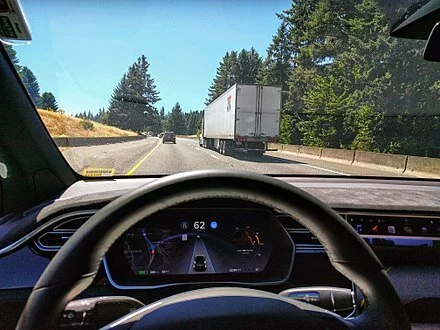
At the core of the coming changes is interconnectivity. That is what will craft the future. Cars on highways will be connected with each other through thousands of sensors, and these will speed traffic and enhance safety both for those with drivers and new autonomous ones. Likewise, drones will deliver many goods and they will need to be interconnected and have superior flight management. Every aspect of endeavor will be involved, from managing railroads to increasing electricity resilience and the productivity of the electric infrastructure.
In an interview on the Digital Roundtable, a webinar from Texas State University, this past week, Arshad Mansoor, president of the Electric Power Research Institute, said improved interconnectivity could increase available electricity from dams and power plants often without new construction. He explained that interconnectivity wouldn’t only be essential to managing diverse generating sources, like wind and solar, but also in wringing more out of the whole system.
Technology has gotten us through the pandemic. Most obviously in the huge speed at which vaccines were developed, but also in our ability to meet virtually and the effectiveness of online ordering and delivery.
By nature, and by record, Biden is a get-along-go-along politician, a zephyr, as we heard in his address to Congress. But history looks as though it will cast him as a transformative president, a notable leader presiding over great winds of change.
Llewellyn King is executive producer and host of White House Chronicle, on PBS. His email is llewellynking1@gmail.com and he’s based in Rhode Island and Washington, D.C.
Autopilot system in Tesla car
'Its own excuse for being'

Rhodora, a common flowering shrub of the New England
In May, when sea-winds pierced our solitudes,
I found the fresh Rhodora in the woods,
Spreading its leafless blooms in a damp nook,
To please the desert and the sluggish brook.
The purple petals fallen in the pool
Made the black water with their beauty gay;
Here might the red-bird come his plumes to cool,
And court the flower that cheapens his array.
Rhodora! if the sages ask thee why
This charm is wasted on the earth and sky,
Tell them, dear, that, if eyes were made for seeing,
Then beauty is its own excuse for Being;
Why thou wert there, O rival of the rose!
I never thought to ask; I never knew;
But in my simple ignorance suppose
The self-same power that brought me there, brought you.
“The Rhodora: On Being Asked, Whence Is The Flower,’’ by Ralph Waldo Emerson (1803-1882)
Impressionist loyalty

“Spruce in Snow” (circa 1912, oil on canvas), by Alice Ruggles Sohier, in the show (with the work of Frederick A. Bosley) “Twilight of American Impressionism’’ at the Portsmouth (N.H.) Historical Society.
The two were painting at a time when realistic art was falling out of fashion in favor of more abstract art. Regardless, Sohier and Bosley painted impressionist works until their deaths, in the mid-20th Century.
Chris Powell: The best reason to raise taxes on the rich
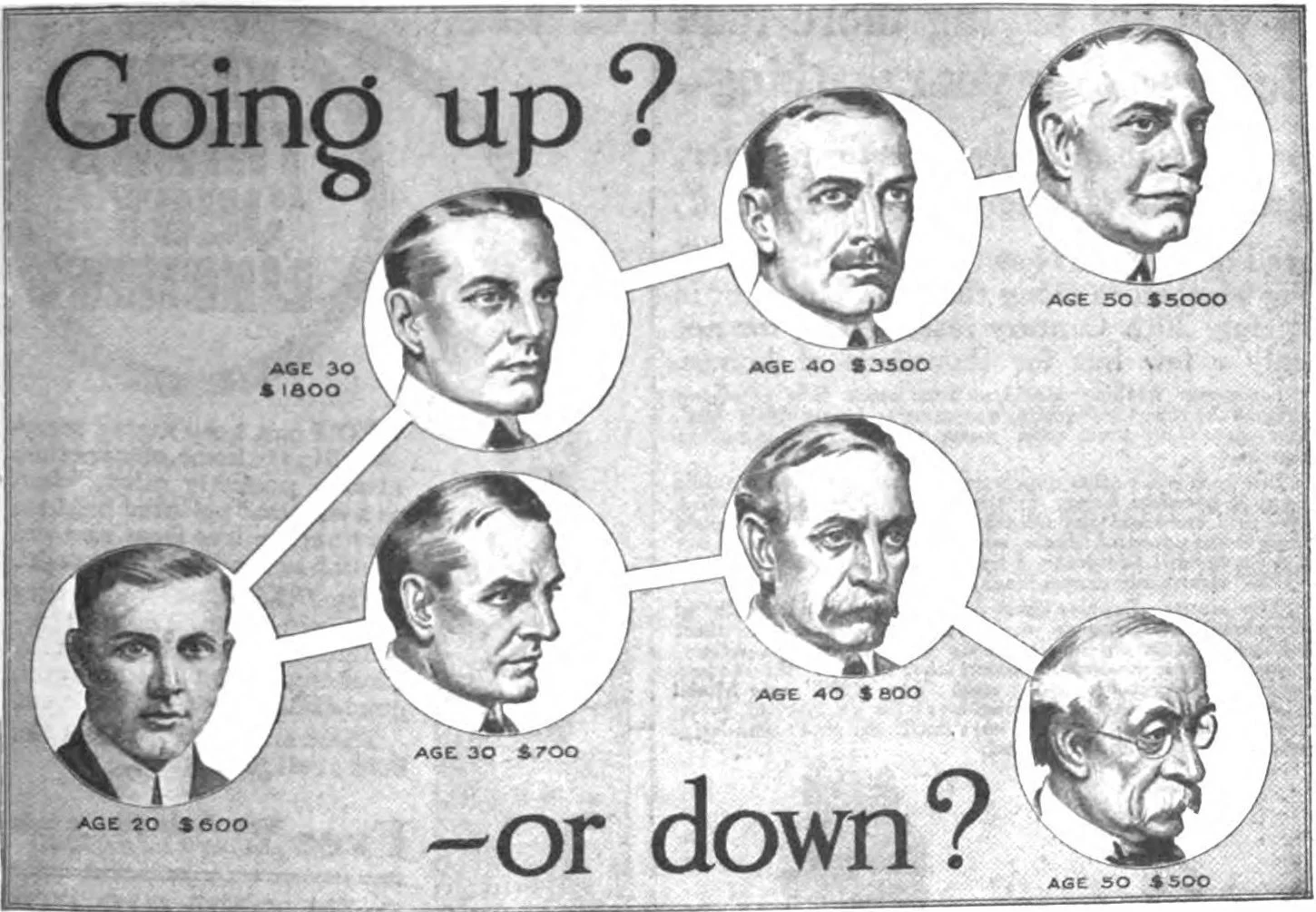
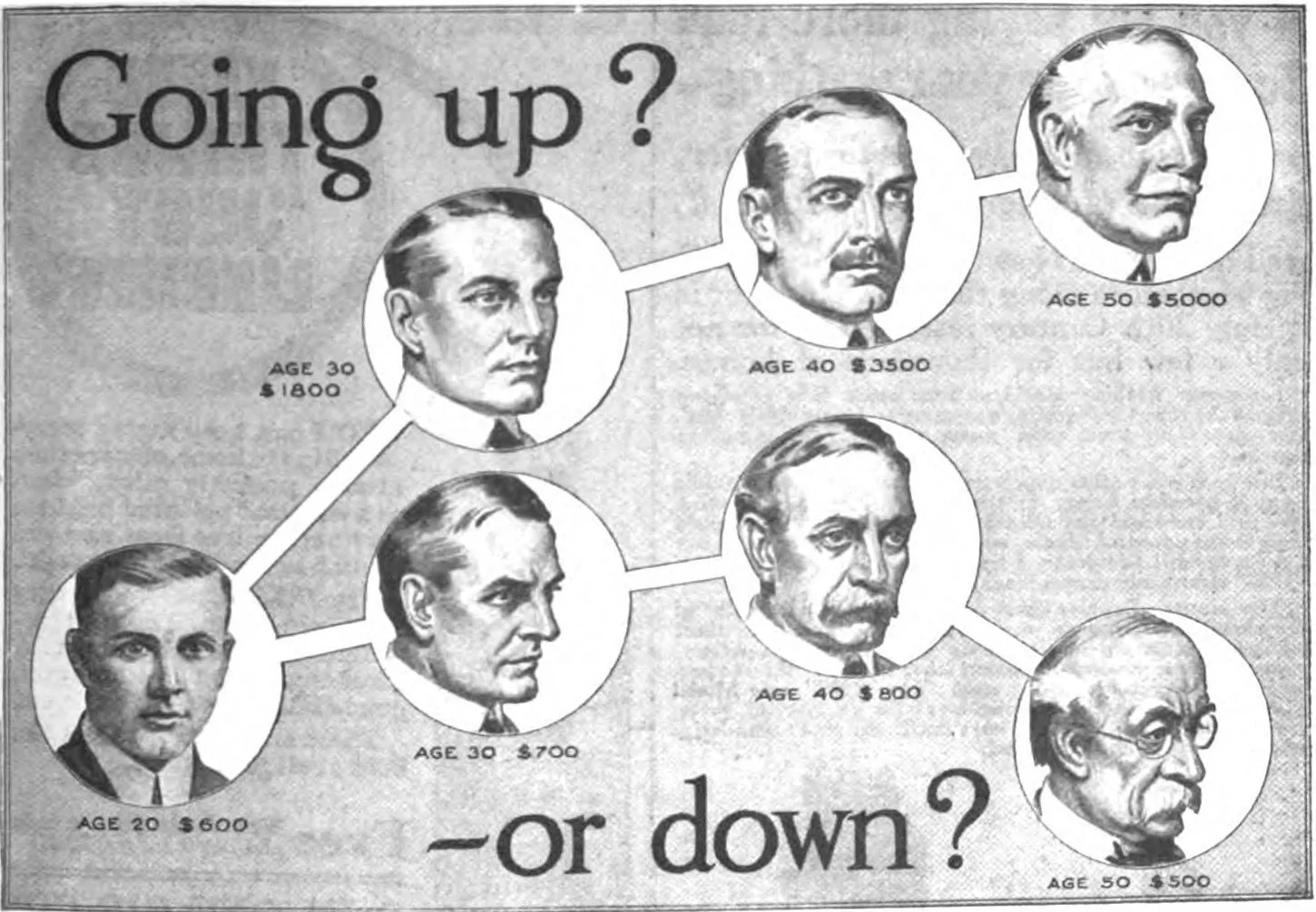
Illustration from a 1916 advertisement for a U.S. vocational school. Education has been seen as a key to higher income, and this advertisement appealed to Americans' belief in the possibility of self-betterment, and addressing the great income inequality existing during the Industrial Revolution.
MANCHESTER, Conn.
While there is a compelling reason to raise taxes on the rich, it's not the reason motivating many Democrats in the Connecticut General Assembly, who would increase both state income and capital-gains taxes on the rich and impose a special state property tax on their expensive homes.
These Democratic legislators want mainly to increase state government's political patronage, the compensation of government employees and the dependence of the poor on government. Connecticut's quality of life seldom improves from their legislation. The state's problems are never alleviated, much less solved, while state government keeps manufacturing poverty.
Besides, state government is already rolling in federal "stimulus" money, with $6 billion of it waiting to be allocated by Gov. Ned Lamont and the legislature. Properly allocated, that largesse should keep state government manufacturing poverty quite without any new taxes for years.
Nor is the reason offered by Democrats in Congress for raising federal taxes on the rich any good -- to increase the government's revenue.
For the virus epidemic already has pushed the federal government into implementing Modern Monetary Theory, which holds that government can create and disburse infinite money without levying taxes, constrained only by depreciation of the currency. The trillions of dollars recently created may go onto the government's books as debt, but that debt will never be repaid and instead will be monetized by the government's purchase of its own bonds. Indeed, as MMT notes, the debt is already treated as money when it is in private hands.
As anyone who goes grocery shopping, puts gasoline in his car and pays electricity, insurance and tax bills knows, inflation is already roaring and making a joke of the official price data.
The single compelling reason to raise taxes on the rich is to diminish income inequality a little after it has been increased so much by the federal government's policy of inflating asset prices during the economic depression caused by the epidemic -- a policy of directing far more money to the financial markets and thus to the ownership class, people who own stocks and bonds, than to the laboring class, tens of millions of whose members lost their jobs because of government policy and crashed into poverty.
But this effort to reduce wealth inequality should be undertaken at the federal level, not by state government in Connecticut -- at least not yet. That's because Connecticut is already a high-tax state whose economy has been weak for many years, and raising state taxes would disadvantage Connecticut even more relative to other states.
Money will go where it is treated best, and until the dislocations of recent months that drove thousands of people out of the New York City area, Connecticut was losing population relative to the rest of the country, losing mainly the prosperous people who pay taxes.
Connecticut's effort to reduce wealth inequality should concentrate on reducing the poverty the state manufactures with its welfare and education policies.
xxx
Many people in Connecticut, including some state legislators, argue that medical care is or should be a human right and that, as a result, state government should extend Medicaid insurance to the tens of thousands of people living in the state illegally. The cost is estimated at nearly $200 million per year.
These people are not entirely without medical care. They can pay for it themselves or present themselves at hospital emergency rooms when they are sick or injured and hospitals must treat them for free if they are indigent.
Of course, such medical care falls far short of comprehensive. But if comprehensive medical care is a human right, is living in Connecticut a human right too? If so, most people in Central America might insist on living in the state. Extending Medicaid to immigration lawbreakers would be a powerful incentive for more lawbreaking, which is already rampant.
So in addressing the Medicaid extension issue, Connecticut can't help addressing the illegal immigration issue as well. Extending Medicaid will be, in effect, more nullification of federal immigration law, just as the state's pending legalization and commercialization of marijuana, sensible as such policies may seem, will be more nullification of federal drug law.
Chris Powell is a columnist for the Journal Inquirer, in Manchester, Conn
Trying to save what we inherited

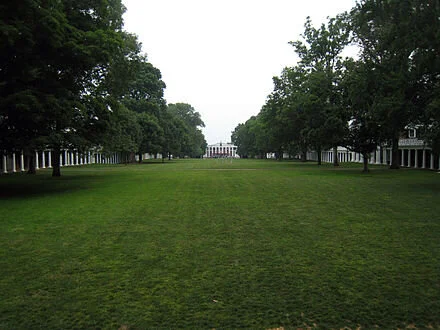
The "grass ramp" from the entrance to the lily pond at the Connecticut College Arboretum
“What I have done in life has not been motivated by an effort to save myself from unpleasant experiences in the next, but rather, at least in part, by a desire to preserve the beauty and biological integrity of the earth we have inherited.’’
— Richard H. Goodwin (1910-2007), botanist and conservationist, co-founder and twice president of The Nature Conservancy and long-time professor and director of the arboretum at Connecticut College, in New London
—
George McCully: America’s crisis of knowledge
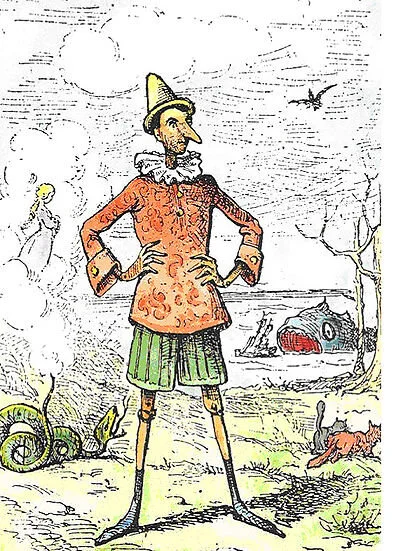
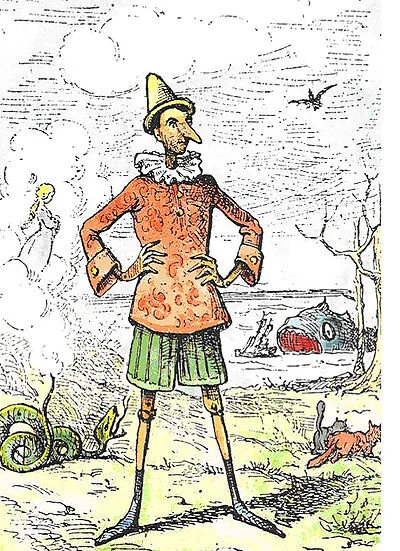
Pinoccchio
From The New England Journal of Higher Education, a service of The New England Board of Higher Education (nebhe.org)
There has been a growing consensus among authorities, especially in the Trump era, that the U.S. is in an epistemological crisis that threatens our democracy.
Former President Obama, for example, in a recent Atlantic interview, said: “If we do not have the capacity to distinguish what’s true from what’s false, then by definition the marketplace of ideas doesn’t work. And by definition, our democracy doesn’t work. We are entering into an epistemological crisis.”
If this is true, it is an issue which the academic and journalistic communities—i.e. those in charge of the public’s knowledge and education nationwide—need to address.
There are plenty of indications that Obama was right. The 2020 election intensified this awareness. David Brooks, in his New York Times column of Nov. 27, wrote that “77 percent of Trump backers said Joe Biden had won the presidential election because of fraud. Many of these same people think climate change is not real. Many of these same people believe they don’t need to listen to scientific experts on how to prevent the spread of the coronavirus. We live in a country in epistemological crisis, in which much of the Republican Party has become detached from reality.”
On that same day, Michael Gordon, in an op-ed for The Washington Post, wrote: “Journalism is important, and there should be more of it. An informed electorate, in the long run, will have better democratic outcomes. But the urgent problem of American politics is not an insufficient airing of policy disagreements; it is that policy views have become a function of cultural identity. A matter such as climate disruption, for example, attracts comparatively little informed and reasoned disagreement. Climate skepticism has become a tenet of populism—a revolt against elitist scientists and liberal politicians seeking excuses for social and economic control. The denial of climate change has become a cultural signifier, the policy equivalent of a gun rack in a truck.”
Multidimensional crisis
The crisis has several dimensions beyond the intellectual one. Robin Givhan, in her Washington Post column on Feb. 17, 2021, reported: “Surveys have shown that political polarization along educational lines has deepened. The gap between college-educated voters and non-college-educated voters has grown steadily over the past 60 years. The 2020 presidential election hinged on the diploma divide, which in turn, contributes to differences in income, household wealth, jobs, place of residence, cultural values and access to opportunity. … For the past four decades, incomes rose for college degree holders even as they fell for those without one, generating frustration, resentment and anger. With nearly three-quarters of new jobs requiring a bachelor’s degree, excluding nearly two-thirds of adults, earnings are linked to learning in ways that weren’t true during the 1950s and 1960s.”
There is also a technological dimension. Whereas it used to be thought that the internet would enhance democracy, we have seen an opposite effect. Thomas Edsall, in The New York Times, also on Feb. 17, wrote that “a decade ago, the consensus was that the digital revolution would give effective voice to millions of previously unheard citizens. Now, in the aftermath of the Trump presidency, the consensus has shifted to anxiety that such online behemoths as Twitter, Google, YouTube, Instagram and Facebook have created a crisis of knowledge—confounding what is true and what is untrue—eroding the foundations of democracy.”
Nathaniel Persily, a Stanford University law professor, summarized the dilemma in his 2019 report, “The Internet’s Challenge to Democracy: Framing the Problem and Assessing Reforms.” He wrote that “in a matter of just a few years the widely shared utopian vision of the nternet’s impact on governance has turned decidedly pessimistic. The original promise of digital technologies was unapologetically democratic: empowering the voiceless, breaking down borders to build cross-national communities, and eliminating elite referees who restricted political discourse. Since then that promise has been replaced by concern that the most democratic features of the internet are, in fact, endangering democracy itself. Democracies pay a price for Internet freedom, under this view, in the form of disinformation, hate speech, incitement and foreign interference in elections.”
He continued, “Margaret Roberts, a University of California-San Diego political scientist, says bluntly, ‘The difficult part about social media is that the freedom of information online can be weaponized to undermine democracy.'” In an email to Edsall, she wrote, “Social media isn’t inherently pro[-] or anti-democratic, but it gives voice and the power to organize to those who are typically excluded by more mainstream media. In some cases, these voices can be liberalizing, in others illiberal.” We are reminded that while Franklin Roosevelt used radio for fireside chats to promote his liberal agenda, Hitler was using it to promote his fascism.
Today, the new technology is more dangerous, because with AI, it becomes progressively easier to disguise mis- or disinformation as authentic news, and to scrape data from users’ devices to then target the citizens most likely to be vulnerable to dissuasion. Training in “media literacy” or how to discern authentic from fraudulent communication especially on the web, has been a growing field for decades, and will continue to be so as technology advances. But communications techniques and evaluation of sources are less our concern here than epistemology per se, and, in particular, reliance upon trusted sources, which most people use as their criterion for recognizing truth.
The truth is out there?
What is to be done? First, let us understand that the principal constituency bearing civic responsibility for the health and welfare of public intelligence, has to be scholars and educators, including journalists; and that in these roles, our professional and technical focus must be less on the economic, technological or even psychological and moral dimensions of the epistemic (i.e. relating to knowledge) crisis than on its epistemological (i.e. the study or science of knowledge) core.
We notice that the journalistic discussions quoted above focus on trust as the main issue—i.e., whom people should or want to believe in matters of science, public policy or politics and how trustworthiness has been subverted by political, economic and technological developments. While it is probably true that this is how most people actually know and think, as scholars we do not and, in fact, are trained not to trust even one another, because trust is an invalid and unreliable criterion of truth. From our professional perspective, public trust itself is intrinsic to the public’s epistemological crisis.
Another intrinsic element of that core obviously is inadequate factual knowledge or sheer ignorance of how and why our government works. On our watch over the past 50 years, there has been a steady erosion in the teaching of civics and history. While we spend about $50 per student annually on science and math education, only about five cents is allocated to civics education. Ten states currently have no civics requirement in schools. Large numbers of Americans cannot even name the three branches of government, never mind the value for democracy of checks and balances, or how elections are essential for peaceful transfers of power. This past year we have seen how misunderstanding of governmental politics has fed distrust, non-participation and polarization. The federal government is aware of this and has developed a purportedly high-quality K-12 civics and history program called “Educating for American Democracy,” but it has not been funded for implementation. While this initiative might help to address the knowledge issue,it does not address the crisis in epistemology—confusion about how to know and recognize truth.
Many years ago, on my first day at Brown University, the freshman class assembled in Sayles Hall to be welcomed by the university’s president, Barnaby Keeney (later the founding director of the National Endowment for the Humanities). He told us that one of the most essential and valuable skills we would learn in college—central to every scholarly discipline as the most reliable way to think about the world—was “to think on the basis of evidence.” That simple phrase—this was the first time I had heard it—blew me away, and has stuck with me for life.
Several years later, while studying history in graduate school at Columbia University, I recall discussions we often had with fellow students in one of the nation’s leading schools of journalism. They were being taught to build their stories around “balance” among various contending points of view, as a “fair” way to report to the public on current events. We history students considered this absurd, ridiculous and misleading to the public, implying that all points of view are equally valid and significant. We were right, but we see today that “balance” has set the modern standard in journalism, still practiced and still, as predicted, pernicious and dangerous. I have been amazed at how leading journalists these days struggle to articulate the challenge of ascertaining truth, treating it as discovering whom to trust. They rarely use the word “evidence”—a rare exception is Lester Holt of NBC Nightly News, who said recently in accepting the Edward R. Murrow Award for Lifetime Achievement in Journalism, “I think it’s become clearer that fairness is overrated,” and he advocated that reporters not give “unsupported arguments” equal coverage.
Follow the evidence
About the only venue where “evidence” has been determinative in current politics is our court system, wherein attempts by Trumpists to quash results of the last presidential election on grounds of corruption were summarily rejected by 63 courts at all levels nationwide for their total “lack of evidence.” The words were quoted by reporters of those decisions, and gradually the criterion of “evidence” has begun to be used comfortably by leading journalists, though we do not know if they appreciate its epistemological value—in fact, necessity in determining truth.
But the health of our democracy cannot safely rely solely on our judiciary and the best of journalism, which brings us back to the issue of our proper civic responsibilities, as scholars and teachers, for the health of public thought and discourse. What can we do to help resolve our national epistemological crisis, to protect our democracy?
First, we need to promote, for all courses and disciplines in all colleges and universities, explicitly and emphatically, that the best—i.e., surely, most reliable—way to think about the world is “on the basis of evidence.” We must work to help make it consciously automatic and habitual for all who are in or have been to college.
Second, and this is critically important, there is no reason “thinking on the basis of evidence” cannot also be taught as the explicit standard and simple lesson throughout secondary schools nationwide. We need to promote this pedagogy in every way we can, including in the media, to eliminate the apparent political divide between citizens who have been to college and those who have not. There is no justification for this particular separation in our body politic.
Third, we need to promote at every opportunity stronger academic, journalistic and media offerings in American history and civics, to combat the widespread ignorance that has also undermined our politics.
Fourth and finally, we need to promote to journalists their need to habitually ask, as the first question after hearing any political opinion or unsupported assertion, “What’s your evidence?”, and if none is forthcoming, to report that fact—that non-event as an event, that the dog didn’t bark, as it were—an integral part of their stories. This past year, it took far too long for that to happen with countless baseless assertions about the election. Journalism is a teaching profession; its responsibility is to provide the first or early accounts of current history for public use and information. Journalistic “fairness” should be to truth in public record, not to all sides of contentions in controversies.
We cannot and do not expect epistemological problems, much less crises, to be successfully resolved for all parties in any specific time frame. All I am advocating here is a concerted effort on the part of as many of us as possible to achieve a better—more constructive—balance in public discourse, between efforts to promote respect for truth, and efforts to promote partisanship with no respect for truth. I have attempted to identify the main parties responsible for truth in civic and political packaging—i.e., scholars, educators and journalists—who are all our public’s teachers. These responsible parties must work much harder to promote “thinking on the basis of evidence” rather than trusting people or institutions as a way of learning truth, on which the health of our democracy necessarily depends.
George McCully, a historian, has been a former professor and faculty dean at higher- education institutions in the Northeast, then professional philanthropist and founder and CEO of the Catalogue for Philanthropy.
Keeps them moving

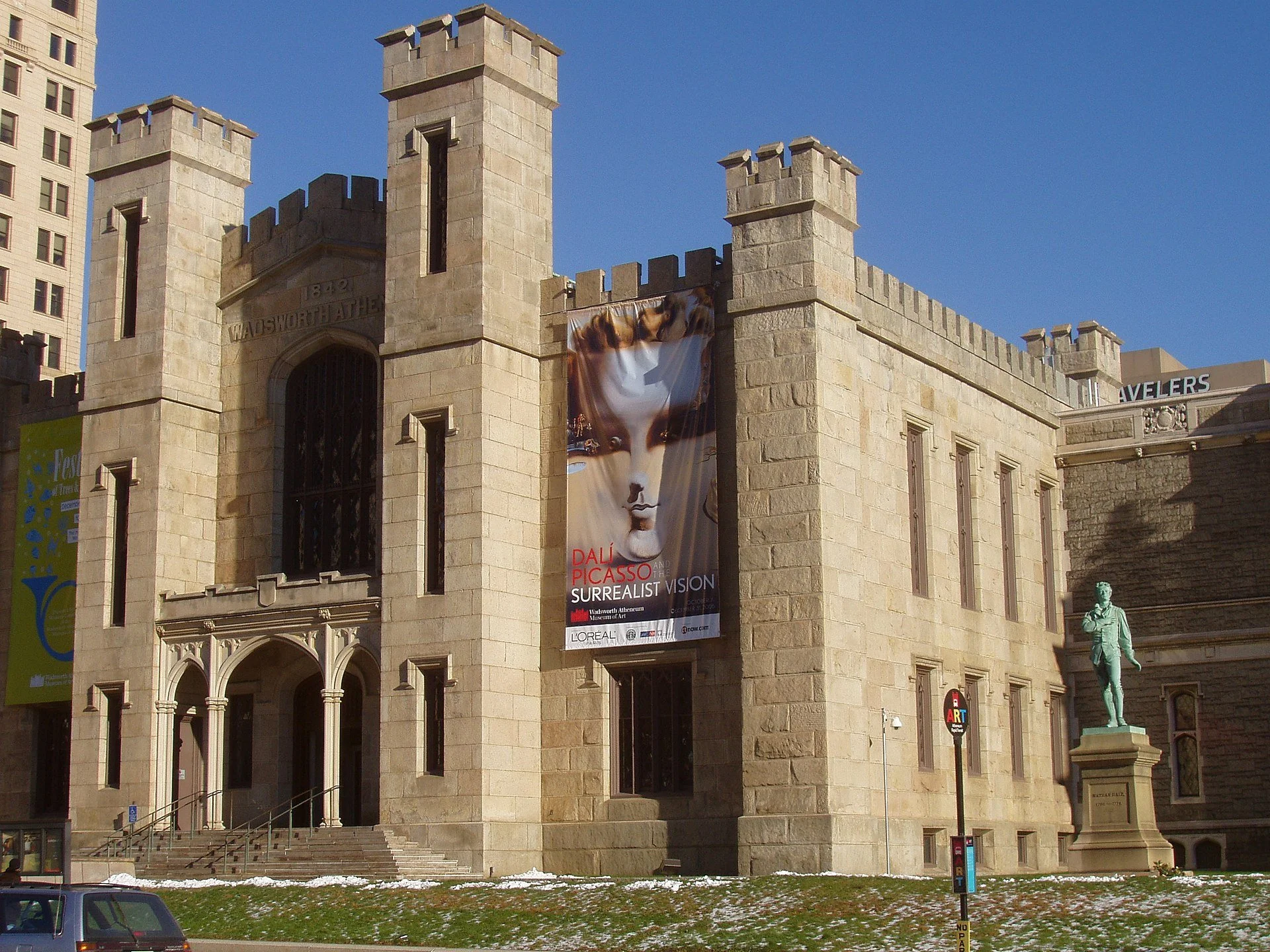
“Geisha-Revue, The Dance on the Volcano’’ (1911/13, oil on canvas), by Georg Tappert, at the Wadsworth Athenaeum Museum of Art, Hartford. It’s part of the show “The Dance on the Volcano: German Expressionism at the Wadsworth,’’ through May 30.

Jim Hightower: Wall Street moves in on water

— Photo by José Manuel Suárez
From OtherWords.org
Oh great — here comes a new stealth attack on the fragile, life-sustaining natural resources of Planet Earth. This latest assault by Wall Street alchemists would redefine one of our most basic resources: water.
Everyone knows that water is “invaluable” — it’s literally life, requiring a constant intake by each of us, or we quickly die. But the Wizards of Wall Street want to reduce potable H2O from its environmental, humanitarian and spiritual essence to just another perishable economic good that they can market-price and sell to the highest bidder — turning our water into speculators’ gold.
This contrivance has opened the door for financial manipulators who’ve quietly been devising razzle-dazzle schemes to allow rich global investors to play in water. They’re now pushing water futures, automated split-second trading, “water grabbing” ventures, hedging schemes, and other financialization hustles to maneuver the monetary value of this essential resource.
To see this ethically debased future, look to an outfit with the ominous acronym of WAM (Water Asset Management).
WAM is buying up water rights in low-income farming communities in places like Arizona, then literally moving the “commodity” to rich suburban developments that will pay more. WAM profiteers call water peddling “the biggest emerging market on Earth… a trillion-dollar market opportunity.”
They even boast that the crises of “drought, flood, and fire” caused by climate change creates a market volatility that will provide “an unprecedented period of transformation and investment opportunity for the water industry,” allowing investors to “thrive and prosper.”
We need to force a public discussion about this crucial question of environmental and existential ethics: Is access to an affordable supply of clean water to be a human right for all — or will we let it become a wet dream for rich speculators.
OtherWords columnist Jim Hightower is a radio commentator, writer, and public speaker.