
Vox clamantis in deserto









'Where the corn flowers were'
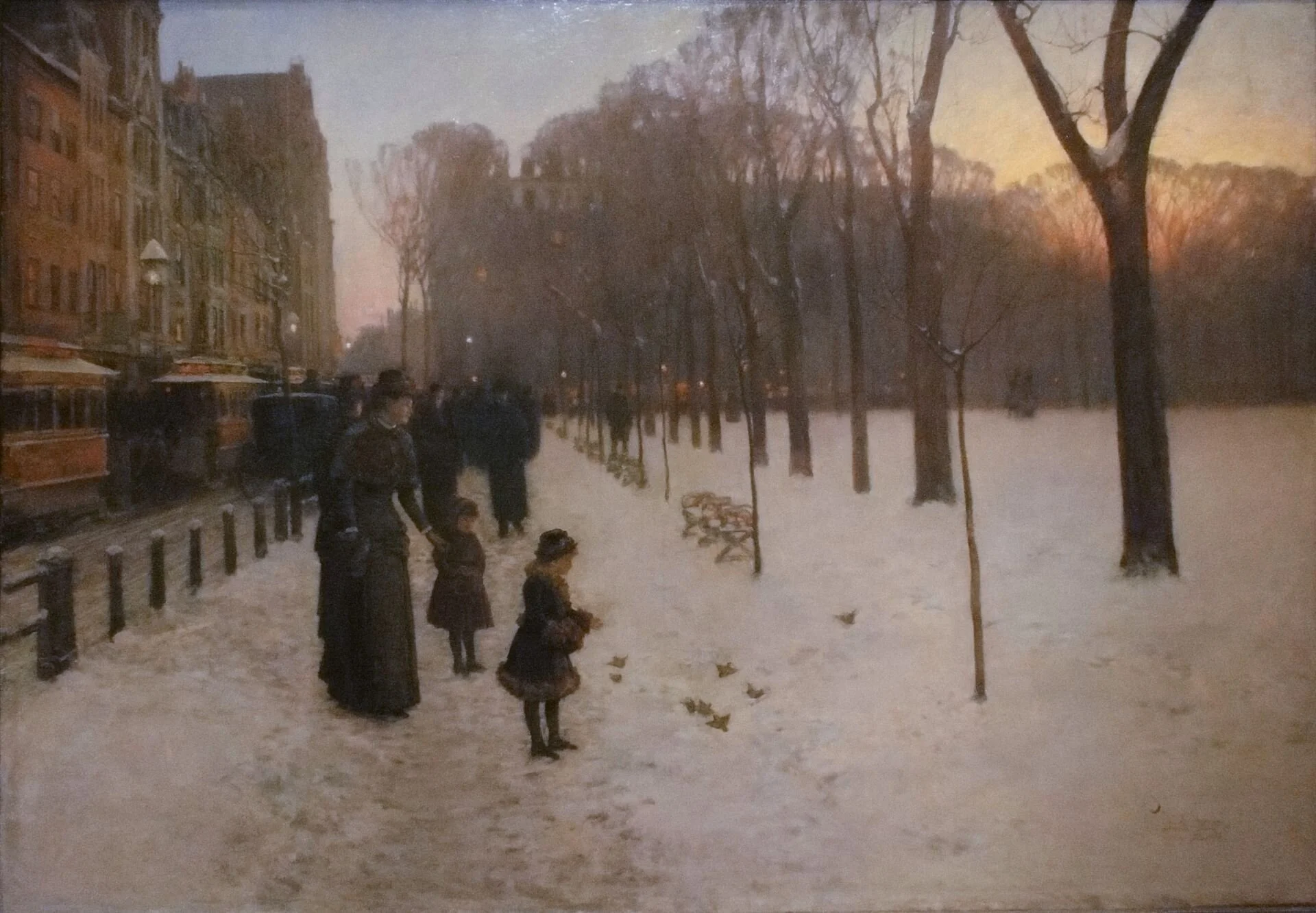
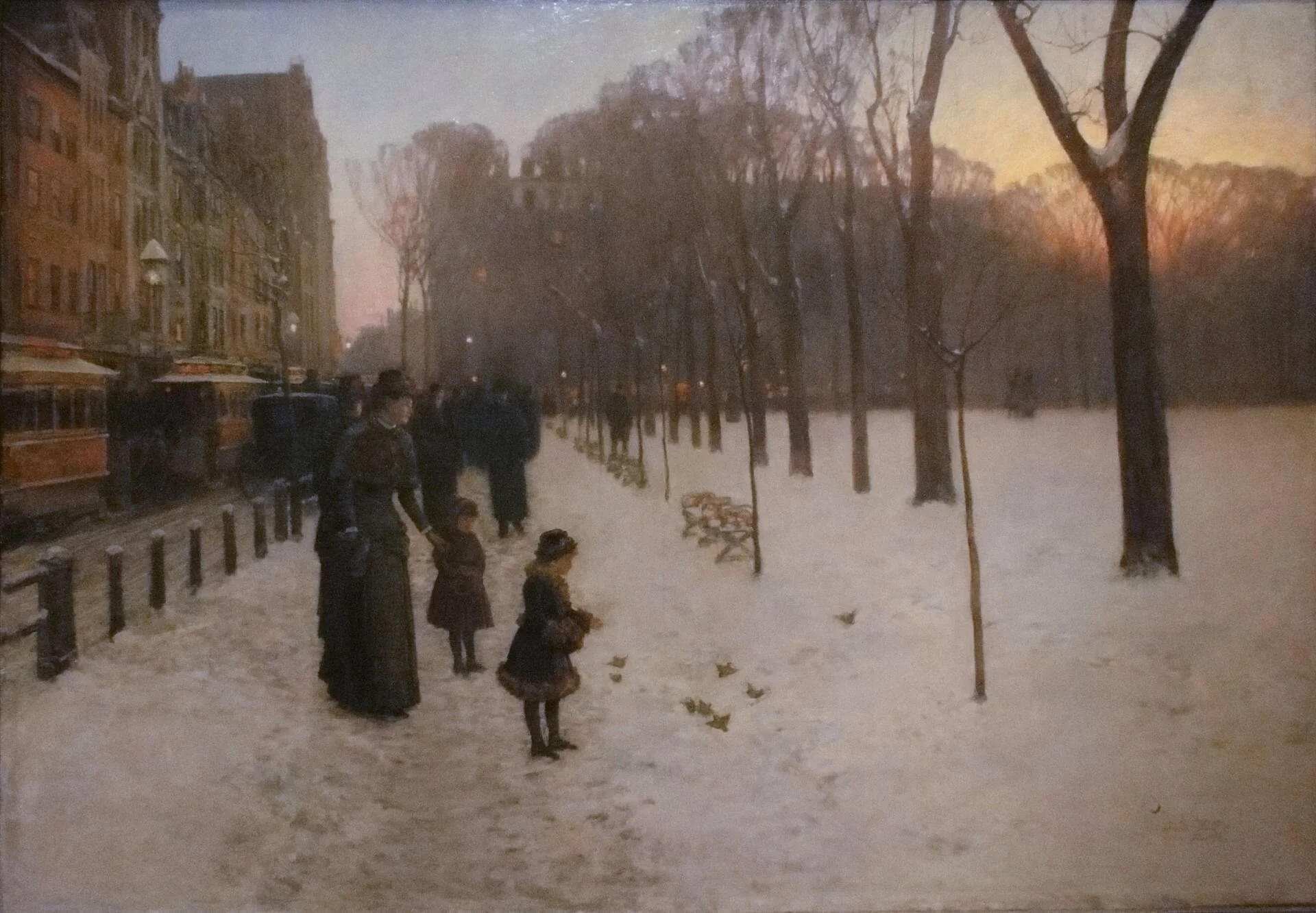
“Boston Common at Twilight” (1885–86) (oil on canvas), by Childe Hassam, at the Museum of Fine Arts, Boston
A silence slipping around like death,
Yet chased by a whisper, a sigh,
a breath; One group of trees, lean,
naked and cold,
Inking their cress 'gainst a
sky green-gold;
One path that knows where the
corn flowers were;
Lonely, apart, unyielding, one fir;
And over it softly leaning down,
One star that I loved ere the
fields went brown.
— “A Winter Twilight,’’ by Angelina Weld Grimke (1880-1958), a Boston poet
Chris Powell: New Haven police chief retires at 49 to pension bonanza; vaping vs. marijuana

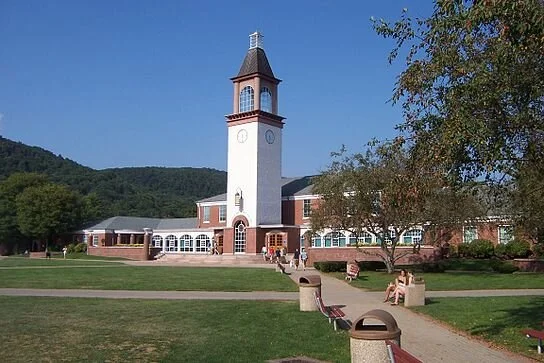
Tony Reyes to go from the mean streets of New Haven to the relatively bucolic precincts of Hamden, Conn. Here we see Quinnipiac University’s Arnold Bernhard Library and clock tower, focus of main campus quadrangle.
MANCHESTER, Conn.
Everyone agrees that Tony Reyes has been a great police chief in New Haven, having been appointed in March 2019 after nearly two decades of rising through the ranks of the police department. But the city will lose him in a few weeks as he becomes police chief at Quinnipiac University next door, in Hamden. This is being called a retirement, but it is that only technically. In fact it is part of an old racket in Connecticut's government employee pension system, an abuse of taxpayers.
Typically police personnel qualify to collect full state government and municipal pensions after 20 years, no matter their age. Reyes is only 49, so he easily has another 15 years of working life ahead of him even as he collects a hefty pension from New Haven.
The chief's salary is $170,000 and so his city pension well may be half of that each year. After a week of requests City Hall was unable to provide an estimate of the pension, but then maybe city officials were too busy helping their Climate Emergency Mobilization Task Force figure out how to remove carbon from the atmosphere. In the meantime maybe the U.S. Environmental Protection Agency can handle New Haven's pensions.
Nor would Quinnipiac disclose what it will pay Reyes, though the university is a nonprofit institution of higher education whose tax exemption comes at the expense of federal, state and Hamden property taxpayers. But since a Quinnipiac vice president is paid nearly $600,000 a year, Reyes probably won't starve there.
In the absence of accountability from city government or the university, here's a guess: Reyes will draw an annual pension from New Haven of $80,000 a year while Quinnipiac pays him $150,000 a year. After 15 years at Quinnipiac, Reyes may get another annual pension of $80,000, plus $30,000 a year in ordinary Social Security, for total retirement income at age 65 of close to $200,000 annually -- as if half that wouldn't be lovely.
Pensions are ordinarily understood to be to support people whose working capacity is ended or substantially diminished. But pensions in state and municipal government in Connecticut often provide luxury lifestyles during second careers and after. Meanwhile mere private-sector workers are lucky to conclude their careers with enough Social Security and savings to scrape by on their way to the hereafter.
This scandal could be remedied easily, with enormous savings and greater retention of the best personnel. State and municipal legislation and contracts could restrict government pension eligibility to the customary retirement age of 65 or to the onset of disability before that. But that would require elected officials who had the wit to alert the public to how it is being exploited and the courage to stand up to the government employee unions.
It also would require news organizations to report the scandal in the first place. But it seems that not even New Haven's own news organizations have inquired about the police chief's pension bonanza.
xxx
The new session of the General Assembly will be intriguing for many reasons, maybe most of all for plans to legalize and tax marijuana while outlawing flavored "vaping" products and prohibiting the sale of tobacco products in stores within five miles of schools, which might limit tobacco sales to kiosks in the middle of a few state forests.
Both campaigns seem to be originating with liberal Democratic legislators. The House chairman of the Public Health Committee, Rep. Jonathan Steinberg, D.-Westport, an advocate of outlawing flavored vaping products, says, "There's plenty of documentation about how exposure to addictive products at a young age makes it hard for people to extricate themselves."
Of course, marijuana also can lead to addiction to other drugs. Some people deal with and outgrow dope smoking, but some don't.
Drug criminalization long has failed and probably has done more damage than illegal drugs themselves. But it is silly to pretend that outlawing "vaping" products will protect kids any more than outlawing marijuana has done.
Contraband laws just create black markets that make the law futile. If Connecticut opts for legal marijuana while prohibiting "vaping" products, it will be only because legislators believe that there's much more tax revenue in the former than the latter.
Chris Powell is a columnist for the Journal Inquirer, in Manchester, Conn.

Sarah Anderson: The inglorious return of the three-martini lunch

Via OtherWords.org
While the world is reeling from the pandemic and American democracy faces a profound crisis, corporate lobbyists have been focused on making taxpayers subsidize lavish lunches for wealthy executives.
Their work paid off in the 11th-hour COVID-19 relief deal Congress passed late last year. Buried in the details of this modest aid plan is a provision to give executives unlimited tax deductions for their business meals for two years.
That’s how it worked back in the 1970s, when presidential candidate George McGovern had this to say about it: “There’s something fundamentally wrong with the tax system,” he said, “when it allows a corporate executive to deduct his $20 martini lunch while a working man cannot deduct the price of his bologna sandwich.”
President Reagan, of all people, actually agreed with McGovern. His 1986 tax overhaul, best remembered today for lowering overall rates, reduced the deductibility of business meals from 100 to 80 percent. In 1993, the Clinton administration pushed that deductibility rate down to 50 percent, where it has stayed ever since.
Now corporate lobbyists have managed to restore that 1970s-era perk — claiming, of course, that bigger tax write-offs for business meals would help struggling restaurants and the people they employ.
That’s the same argument they used in their opposition to the Clinton-era reform. It was flawed then and it’s even more preposterous now.
Back in 1993, the National Restaurant Association predicted that if businesses were able to write off only half the cost of their business meals (instead of 80 percent), restaurant industry sales would plummet by $3.8 billion and 165,000 jobs would be lost in just the first year.
The opposite occurred. In the year after the reform went into effect on Jan. 1, 1994, sales at full-service restaurants grew by 3.5 percent, outstripping overall U.S. economic growth, according to Census and Labor Department data. And instead of the NRA’s predicted loss of 165,000 jobs, full-service restaurant payrolls grew by 132,300. That was a 4-percent increase, compared to only 3.5 percent growth in national employment.
Today, when the real problem is a public-health crisis that’s keeping people at home, it’s even more laughable that lowering taxes on business meals will do anything to help struggling restaurant owners and employees.
In this time of crisis, any taxpayer support for corporations should require executives to treat their workers well, trim their own fat paychecks — and pay for their own lunch.
Sarah Anderson directs the Global Economy Project at the Institute for Policy Studies.
What a drip!

"Ayeka," by Leslie Zelamsky, in the group show “Space and Surface Together,’’ at Fountain Street Fine Art, Boston, through Feb. 4.
The gallery says:
“Since Impressionism many of the best landscape painters have combined illusions of depth with the purpose to elaborate the surface of the support; in other words, the goal has been to make works that are compelling two dimensional structures as well as convincing three dimensional illusions. The landscapes in this exhibition succeed in both of these ambitions. While nature is described or evoked with real success by space, color, light, atmosphere and marks that suggest natural growth, the artists also employ gesture, composition, and sometimes the purity of flat forms to make the surfaces of their paintings fresh with impulse and spontaneity or impressively orchestrated by pattern or design. The result of course is imagery that is doubly rich and attractive.’’
Regional characteristics

“If someone in a Home Depot store offers you assistance and they don't work there, you live in New England. If you've worn shorts and a parka at the same time, you live in New England. …If vacation means going anywhere south of New York City for the weekend, you live in New England. If you measure distance in hours, you live in New England…. If you know several people who have hit a deer more than once, you live in New England. If you have switched from 'heat' to 'A/C' in the same day and back again, you live in New England . … . ... If the speed limit on the highway is 55 mph you're going 80 and everybody is passing you, you live in New England . … If you know all four seasons: almost winter, winter, still winter and road construction, you live in New England … If there's a Dunkin’ Donuts on every corner, you live in New England.’’
— Jeff Foxworthy (born 1948), comedian, actor, writer and producer from the State of Georgia

‘Tonight I will bark’

The great Overdog
That heavenly beast
With a star in one eye
Gives a leap in the east.
He dances upright
All the way to the west
And never once drops
On his forefeet to rest.
I'm a poor underdog,
But to-night I will bark
With the great Overdog
That romps through the dark.
‘‘Canis Major,’’ by Robert Frost

Canis Major as depicted in Urania's Mirror, a set of constellation cards published in London, c.1825. Next to it are Lepus and Columba (partly cut off).
David Warsh: Aaron Burr, the Gunpowder Plot and our current scoundrel-in-chief

Vice President Aaron Burr in 1802
SOMERVILLE, Mass.
Donald Trump has begun appearing in the rear-view mirror. I have compared Trump to Aaron Burr, the scoundrel who sought to overturn the 1800 presidential election in the early days of the Republic. Hit this link for an explanation of what he did.
Later, starting in 1804, Burr sought to invent around U.S. elections altogether, hoping to foment a breakaway-nation that he could govern in the Spanish Southwest.
No other episode in American history comes close. But after following news about the Jan. 6 assault on the Capitol, I’m inclined to believe that the history of England offers a more illuminating comparison. I’ve been thinking about Guy Fawkes and the 17th Century Gunpowder Plot.
The background was the Protestant Reformation, which had begun in Germany, in 1517, with Martin Luther. Starting in 1533, King Henry VIII withdrew Britain its allegiance to the Roman Catholic Church. Catholics, especially Jesuit priests, had a hard time of it under Henry’s daughter Queen Elizabeth I. Elizabeth’s Catholic cousin, Mary, Queen of Scots, was executed for treason in 1587.
Elizabeth died childless, in 1603, without having named an heir. Queen Mary’s son, Elizabeth’s nephew, peacefully acceded to the throne as James I of England and James VI of Scotland. But repression of Catholics continued, and in 1605 a group of English Catholics plotted to blow up the House of Lords during the opening of Parliament, on Nov. 5. Betrayed by a letter of seemingly mysterious provenance, one of the plotters, Guy Fawkes, was discovered guarding 36 barrels of gunpowder in the basement the night before, quite enough to demolish the building. The plotters were captured and, one way or another, put to death, including some Catholic clergy linked to the plot.
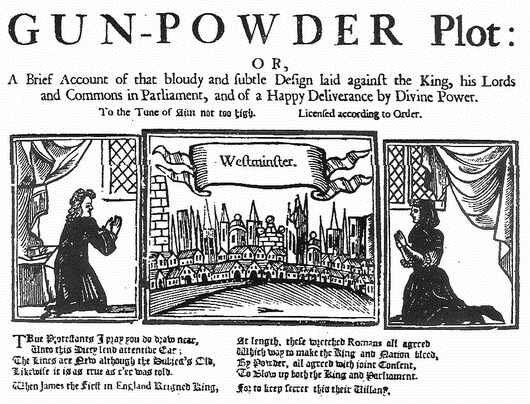
The world was smaller then. Passions ran deeper. Globalization had only just begun. But it is hard to think of any other episode in Anglo-American history whose rhetorical aim resembled more closely that of the mob that descended on the U.S. Capitol on Jan. 6, having been dispatched on their mission by President Trump.
One group of skirmishers came within seconds of sighting Vice President Pence as he, along with his wife and daughter, was spirited out of the Senate chamber and into a hideaway, according to a Jan. 16 story in The Washington Post. The gunpowder plotters intended to kill King James and install his nine-year-old daughter on the throne as Catholic monarch. The Capitol Hill mob vigorously denounced Pence as a traitor for his failure to overturn the presidential-election results. A mock gallows was installed on the western approach to the Capitol.
Persecution of Catholics continued but was mild relative to the century before for the remainder of the reign of James I – he died in 1625 – but anti-Catholic sentiment persisted in England for two centuries, through a not-unrelated civil war and a very-related “Glorious Revolution.”
No one knows what might be the long-term effects of the assault on the Capitol. My hunch is that it will be remembered as thoroughly repugnant and rejected and condemned until it is forgotten. For a higher-resolution characterological account of the Trump story, see “What TV Can Tell Us about How the Trump Show Ends,” by Joanna Weiss. The Trump presidency resembled an antihero drama, Weiss says, more closely than reality TV, the saga of Tony Soprano her chief case in point.
With this emergency behind, I am returning this weekly to my main concern, economics, meanwhile finishing a book on the last hundred years of its textbook versions. As for my plans to shift to the Substack publishing platform, they are postponed; Economic Principals will move at the end of the year, by which time the book will have begun wending its way its way to the press. Luck be a lady this year!
David Warsh, a veteran columnist and an economic historian, is proprietor of Somerville, Mass.-based economicprincipals.com, where this column originated.

Rachel Bluth: CVS comes under fire for low nursing-home vaccination rates

CVS store in Coventry, Conn.
— Photo by JJBers
The effort to vaccinate some of the country’s most vulnerable residents against COVID-19 has been slowed by a federal program that sends retail pharmacists into nursing homes — accompanied by layers of bureaucracy and logistical snafus.
As of Jan. 14, more than 4.7 million doses of the Pfizer-BioNTech and Moderna covid vaccines had been allocated to the federal pharmacy partnership, which has deputized pharmacy teams from Deerfield, Ill.-based Walgreens and Woonsocket, R.I.-based CVS to vaccinate nursing home residents and workers. Since the program started in some states on Dec. 21, however, they have administered about a quarter of the doses, according to the Centers for Disease Control and Prevention.
Across America, some nursing-home directors and health-care officials say the partnership is actually hampering the vaccination process by imposing paperwork and cumbersome corporate policies on facilities that are thinly staffed and reeling from the devastating effects of the coronavirus. They argue that nursing homes are unique medical facilities that would be better served by medical workers who already understand how they operate.
Mississippi’s state health officer, Dr. Thomas Dobbs, said the partnership “has been a fiasco.”
The state has committed 90,000 vaccine doses to the effort, but the pharmacies had administered only 5 percent of those shots as of Jan. 14, Dobbs said. Pharmacy officials told him they’re having trouble finding enough people to staff the program.
Dobbs pointed to neighboring Alabama and Louisiana, which he says are vaccinating long-term care residents at four times the rate of Mississippi.
“We’re getting a lot of angry people because it’s going so slowly, and we’re unhappy too,” he said.
Many of the nursing homes that have successfully vaccinated willing residents and staff members are doing so without federal help.
For instance, Los Angeles Jewish Home, with roughly 1,650 staff members and 1,100 residents on four campuses, started vaccinating Dec. 30. By Jan. 11, the home’s medical staff had administered its 1,640th dose. Even the facility’s chief medical director, Noah Marco, helped vaccinate.
The home is in Los Angeles County, which declined to participate in the CVS/Walgreens program. Instead, it has tasked nursing homes with administering vaccines themselves, and is using only Moderna’s easier-to-handle product, which doesn’t need to be stored at ultracold temperatures, like the Pfizer vaccine. (Both vaccines require two doses to offer full protection, spaced 21 to 28 days apart.)
By contrast, Mariner Health Central, which operates 20 nursing homes in California, is relying on the federal partnership for its homes outside of L.A. County. One of them won’t be getting its first doses until next week.
“It’s been so much worse than anybody expected,” said the chain’s chief medical officer, Dr. Karl Steinberg. “That light at the end of the tunnel is dim.”
Nursing homes have experienced some of the worst outbreaks of the pandemic. Though they house less than 1 percent of the nation’s population, nursing homes have accounted for 37 percent of deaths, according to the COVID Tracking Project.
Facilities participating in the federal partnership typically schedule three vaccine clinics over the course of nine to 12 weeks. Ideally, those who are eligible and want a vaccine will get the first dose at the first clinic and the second dose three to four weeks later. The third clinic is considered a makeup day for anyone who missed the others. Before administering the vaccines, the pharmacies require the nursing homes to obtain consent from residents and staffers.
Despite the complaints of a slow rollout, CVS and Walgreens said that they’re on track to finish giving the first doses by Jan. 25, as promised.
“Everything has gone as planned, save for a few instances where we’ve been challenged or had difficulties making contact with long-term care facilities to schedule clinics,” said Joe Goode, a spokesperson for CVS Health.
Dr. Marcus Plescia, chief medical officer at the Association of State and Territorial Health Officials, acknowledged some delays through the partnership, but said that’s to be expected because this kind of effort has never before been attempted.
“There’s a feeling they’ll get up to speed with it and it will be helpful, as health departments are pretty overstretched,” Plescia said.
But any delay puts lives at risk, said Dr. Michael Wasserman, the immediate past president of the California Association of Long Term Care Medicine.
“I’m about to go nuclear on this,” he said. “There should never be an excuse about people not getting vaccinated. There’s no excuse for delays.”
Bringing in Vaccinators
Nursing homes are equipped with resources that could have helped the vaccination effort — but often aren’t being used.
Most already work with specialized pharmacists who understand the needs of nursing homes and administer medications and yearly vaccinations. These pharmacists know the patients and their medical histories, and are familiar with the apparatus of nursing homes, said Linda Taetz, chief compliance officer for Mariner Health Central.
“It’s not that they aren’t capable,” Taetz said of the retail pharmacists. “They just aren’t embedded in our buildings.”
If a facility participates in the federal program, it can’t use these or any other pharmacists or staffers to vaccinate, said Nicole Howell, executive director for Ombudsman Services of Contra Costa, Solano and Alameda counties.
But many nursing homes would like the flexibility to do so because they believe it would speed the process, help build trust and get more people to say yes to the vaccine, she said.
Howell pointed to West Virginia, which relied primarily on local, independent pharmacies instead of the federal program to vaccinate its nursing home residents.
The state opted against the partnership largely because CVS/Walgreens would have taken weeks to begin shots and Republican Gov. Jim Justice wanted them to start immediately, said Marty Wright, CEO of the West Virginia Health Care Association, which represents the state’s long-term care facilities.
The bulk of the work is being done by more than 60 pharmacies, giving the state greater control over how the doses were distributed, Wright said. The pharmacies were joined by Walgreens in the second week, he said, though not as part of the federal partnership.
“We had more interest from local pharmacies than facilities we could partner them up with,” Wright said. Preliminary estimates show that more than 80% of residents and 60% of staffers in more than 200 homes got a first dose by the end of December, he said.
Goode from CVS said his company’s participation in the program is being led by its long-term-care division, which has deep experience with nursing homes. He noted that tens of thousands of nursing homes — about 85 percent nationally, according to the CDC — have found that reassuring enough to participate.
“That underscores the trust the long-term care community has in CVS and Walgreens,” he said.
Vaccine recipients don’t pay anything out-of-pocket for the shots. The costs of purchasing and administering them are covered by the federal government and health insurance, which means CVS and Walgreens stand to make a lot of money: Medicare is reimbursing $16.94 for the first shot and $28.39 for the second.
Bureaucratic Delays
Technically, federal law doesn’t require nursing homes to obtain written consent for vaccinations.
But CVS and Walgreens require them to get verbal or written consent from residents or family members, which must be documented on forms supplied by the pharmacies.
Goode said consent hasn’t been an impediment so far, but many people on the ground disagree. The requirements have slowed the process as nursing homes collect paper forms and Medicare numbers from residents, said Tracy Greene Mintz, a social worker who owns Senior Care Training, which trains and deploys social workers in more than 100 facilities around California.
In some cases, social workers have mailed paper consent forms to families and waited to get them back, she said.
“The facilities are busy trying to keep residents alive,” Greene Mintz said. “If you want to get paid from Medicare, do your own paperwork,” she suggested to CVS and Walgreens.
Scheduling has also been a challenge for some nursing homes, partly because people who are actively sick with covid shouldn’t be vaccinated, the CDC advises.
“If something comes up — say, an entire building becomes covid-positive — you don’t want the pharmacists coming because nobody is going to get the vaccine,” said Taetz of Mariner Health.
Both pharmacy companies say they work with facilities to reschedule when necessary. That happened at Windsor Chico Creek Care and Rehabilitation in Chico, Calif., where a clinic was pushed back a day because the facility was awaiting covid test results for residents. Melissa Cabrera, who manages the facility’s infection control, described the process as streamlined and professional.
In Illinois, about 12,000 of the state’s roughly 55,000 nursing home residents had received their first dose by Sunday, mostly through the CVS/Walgreens partnership, said Matt Hartman, executive director of the Illinois Health Care Association.
While Hartman hopes the pharmacies will finish administering the first round by the end of the month, he noted that there’s a lot of “headache” around scheduling the clinics, especially when homes have outbreaks.
“Are we happy that we haven’t gotten through round one and West Virginia is done?” he asked. “Absolutely not.”
Rachel Bluth is a Kaiser Health News correspondent.
Rachel Bluth: rbluth@kff.org, @RachelHBluth
KHN correspondent Rachana Pradhan contributed to this report.
From 'Fantasy to Reality': The Florentine effect

”A Rising Up” (acrylic on sculptured board), by Norman Finn, in his show “Virtue Voyage From Fantasy to Reality … With a Possible Return,’’ at Galatea Fine Art, Boston, Feb. 5-28.
He says:
"Somehow or other through a quirk of fate, I became involved in the footwear industry, triggering a career fusing the shoe business with my artistic ability. The end result was a successful women’s fashion designer, a creative designer for my own company, and my own footwear firm working on three continents.
My art world was shaped when as a family we lived in Florence, Italy where I worked as a designer and was exposed to the wonders of the Renaissance. Italian paintings and a collection of Buddhas became an integral part of my life.
My painting style is evolving daily as the experience of my fashion background appears on every canvas.
The pandemic brought me confusion and peace at the same time. The world was upside down but I found solace in my studio painting fantasy and reality.’’
Philip K. Howard: The administrative state is paralyzing American society

VERNON, Conn.
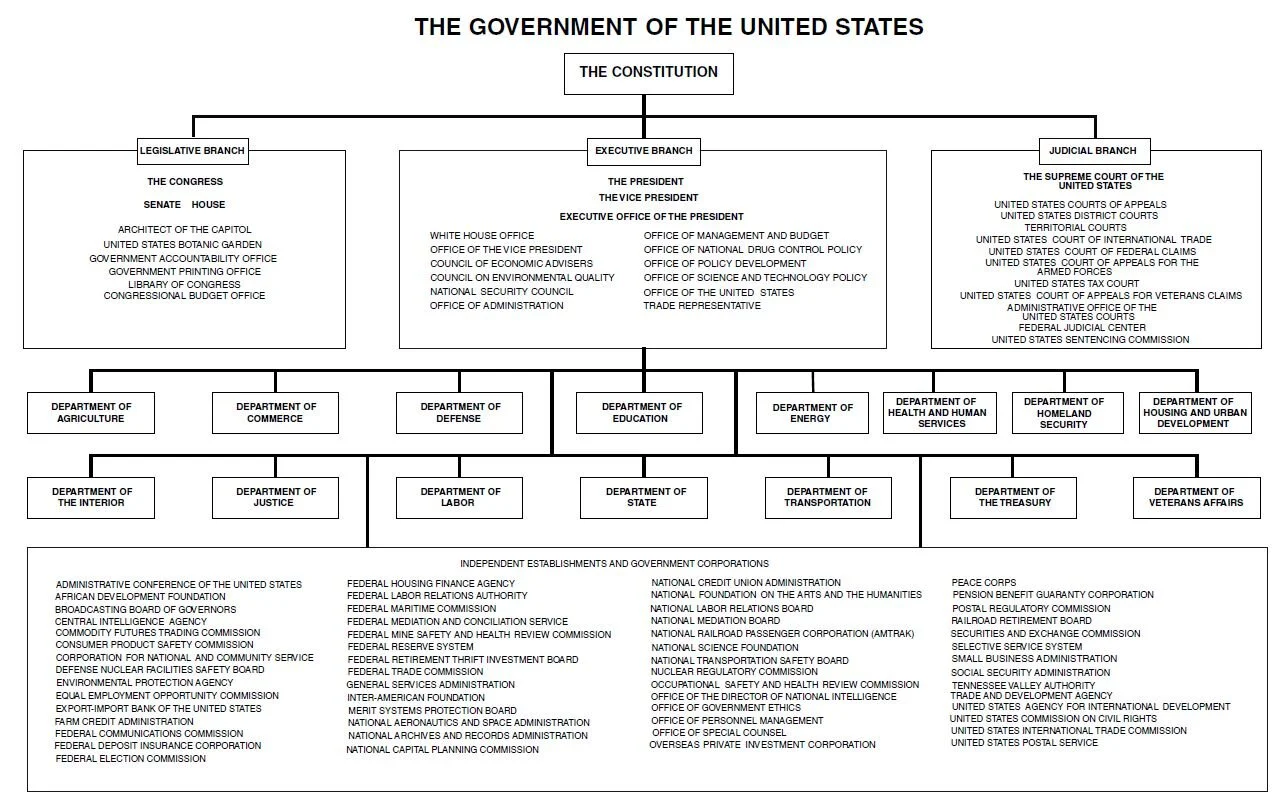
Philip K. Howard’s powers of concision are remarkable. In a very readable Yale Law Journal piece, “From Progressivism to Paralysis,” Howard, founder of the nonprofit and nonpartisan reform group Common Good (commongood.org), writes:
"The Progressive Movement succeeded in replacing laissez-faire with public oversight of safety and markets. But its vision of neutral administration, in which officials in lab coats mechanically applied law, never reflected the realities and political tradeoffs in most public choices. The crisis of public trust in the 1960s spawned a radical transformation of government operating systems to finally achieve a neutral public administration, without official bias or error. Laws and regulations would not only set public goals but also dictate precisely how to implement them. The constitutional protections of due process were expanded to allow disappointed citizens, employees, and students to challenge official decisions, even managerial choices, and put officials to the proof. The result, after fifty years, is public paralysis. In an effort to avoid bad public choices, the operating system precludes good public choices. It must be rebuilt to honor human agency and reinvigorate democratic choices.”
The gravamen of the article is that progressive precisionism causes paralysis because laws and regulations must be general and non-specific enough to allow administrative creativity. And, a correlative point, administrators should not be permitted to arrogate to themselves legislative or judicial functions that belong constitutionally to elected representatives.
Why not? Because in doing so the underlying sub-structure of democratic governance is subtly, and sometimes not so subtly, fatally undermined. The authority of governors rests uneasily upon the ability of the governed to vote administrators and representatives in and out of office, a necessary democratic safeguard that is subverted by a permanent, unelected administrative state that, like a meandering stream, has wandered unimpeded over its definitional banks.
Detecting a beneficial change in the fetid political air, Howard warns, “Change is in the air. Americans are starting to take to the streets. But the unquestioned assumption of protesters is that someone is actually in charge and refusing to pull the right levers. While there are certainly forces opposing change, it is more accurate to say that our system of government is organized to prevent fixing anything. At every level of responsibility, from the schoolhouse to the White House, public officials are disempowered from making sensible choices by a bureaucratic and legal apparatus that is beyond their control.”
And then he unleashes this thunderbolt:
“The modern bureaucratic state, too, aims to be protective. But it does this by reaching into the field of freedom and dictating how to do things correctly. Instead of protecting an open field of freedom, modern law replaces freedom.
“The logic is to protect against human fallibility. But the effect, as discussed, is a version of central planning. People no longer have the ability to draw on ‘the knowledge of the particular circumstances of time and place,’ which Nobel economics laureate Friedrich Hayek thought was essential for most human accomplishment. Instead of getting the job done, people focus on compliance with the rules.
“At this point, the complexity of the bureaucratic state far exceeds the human capacity to deal with it. Cognitive scientists have found that an effect of extensive bureaucracy is to overload the conscious brain so that people can no longer draw on their instincts and experience. The modern bureaucratic state not only fails to meet its goals sensibly, but also makes people fail in their own endeavors. That is why it engenders alienation and anger, by removing an individual’s sense of control of daily choices.”
Indeed, as a lawyer (sorry to bring the matter up), Howard probably knows at first hand that complexity, which provides jobs aplenty for lawyers and accountants, is the enemy of creative governance. The way to a just ordered liberty is not by mindlessly following ever more confusing and complex rules – written mostly by those who intend to preserve an iron-fisted status quo – but by leaving open a wide door of liberty in society for those who are best able to provide workable solutions to social and political problems.
Howard, I am told by those who know him well, is not a “conservative’’ in terms of the current American political parlance. For that matter, besieged conservative faculty at highbrow institutions such as Yale are simply exceptions that prove the progressive rule; such has been the case before and since the publication of Yalie William F. Buckley Jr.’s book, God and Man at Yale.
But I am also assured that Howard is an honest and brave man.
In an era in which democracy is being throttled by a weedy and complex series of paralytic regulations produced by the administrative state, any man or woman who can write this – “It is better to take the risk of occasional injustice from passion and prejudice, which no law or regulation can control, than to seal up incompetency, negligence, insubordination, insolence, and every other mischief in the service, by requiring a virtual trial at law before an unfit or incapable clerk can be removed” -- is worth his or her weight in diamonds.
Don Pesci is a Vernon-based columnist.
All wet in the Whaling City
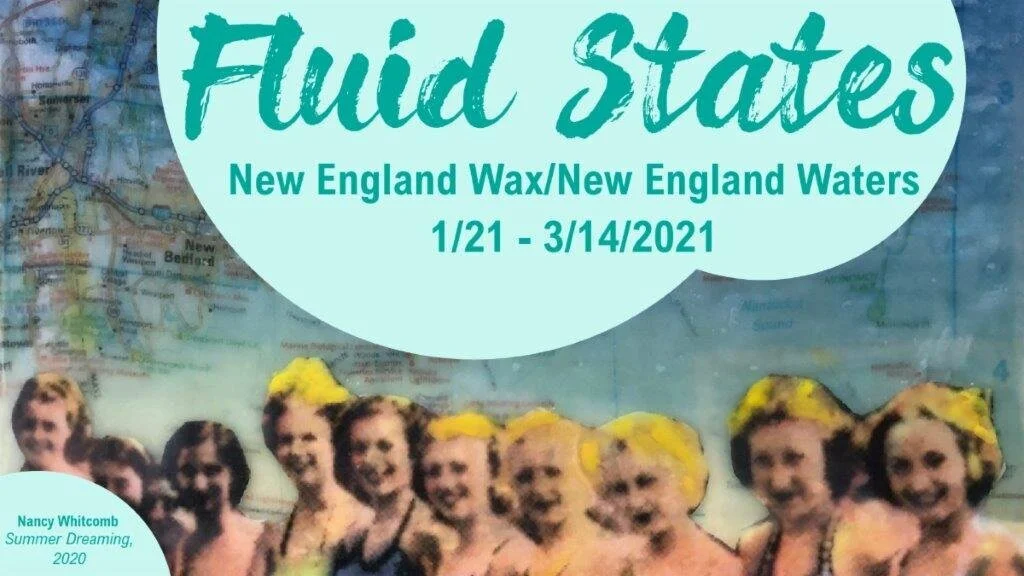
Fluid States: New England Wax/New England Waters exhibition at the New Bedford Art Museum
CONTACT: Julia Zimmerman, jzimmerman@newbedfordart.org
The New Bedford Art Museum will be showing the work of members from the New England Wax (N.E.W.) organization in an exhibition titled Fluid States: New England Wax/New England Waters from January 21 through March 14, 2021. Fluid States will look at the importance of water, both salt and fresh, and its essential contributions to life in New England; its coast and ports, fishing grounds, and leisure areas. Fluid States will also explore the ecological richness – and fragility – of New England’s watery ecosystem.
Jurors Jamie Uretsky, Curator at New Bedford Art Museum, and Julia Zimmerman, Curatorial Assistant, will be choosing artwork for this exhibit from the work of N.E.W. members who reside throughout New England. New England Wax is a professional organization founded in 2006 and dedicated to promoting excellence in fine art made with encaustic and cold wax mediums, to raising awareness of the wax mediums for artistic expression, and to challenging its members to continue to grow as artists. Wax, utilized as an art material with a long history, shares many properties with water itself: fluidity, translucency, malleability, delicacy and fragility, all themes that will be explored in depth in the exhibition.
The New Bedford Museum of Art is dedicated to engaging a diverse audience in relevant exhibitions and exemplary education and creative experiences as a vital and innovative center for the arts. The museum is located at 608 Pleasant Street, New Bedford, MA 02740. For additional information about the Fluid States exhibition or current information about visiting the museum, please check the museum’s website www.newbedfordart.org, email info@newbedfordart.org, or call 508.961.3072.
For additional information about New England Wax, visit their website www.newenglandwax.com, or contact Nancy Whitcomb at nswhitcomb5@gmail.com.
More land bordering S.E. Mass. BioReserve to be protected
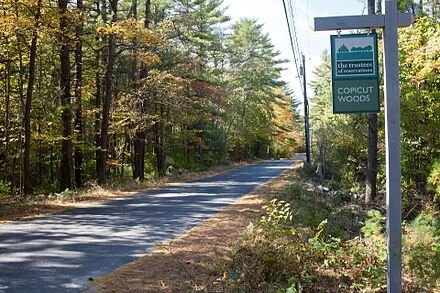
In the Southeastern Massachusetts BioReserve
By ecoRI News staff
More than 50 acres of woods and wetlands that border the massive Southeastern Massachusetts BioReserve and drain toward the East Branch of the Westport River will be permanently protected from development through a partnership between the City of Fall River and the Buzzards Bay Coalition.
The land, now owned by the city and on which the Buzzards Bay Coalition will hold the conservation restriction, sits in the northwestern edge of the Buzzards Bay’s watershed — the area in which streams and groundwater flow toward the bay — and it feeds Copicut Reservoir and North Watuppa Pond, the source of Fall River’s drinking-water supply.
The woodlands also provide habitat for several threatened species, including the eastern box turtle and the marbled salamander, and offer public access to the extensive trail network that runs throughout the Bioreserve and its associated properties.
“The Bioreserve is one of the largest tracts of contiguous forest in eastern Massachusetts, and much of it drains toward Buzzards Bay and the Westport River,” said Mark Rasmussen, president of the Buzzards Bay Coalition. “Keeping it natural helps to preserve water quality for Fall River’s residents and for the people, plants, and animals who live around the bay.”
The newly protected lands comprise two properties — the 38-acre former Costa-Mello farm off Yellow Hill Road and the 16-acre Desmarais property off Indian Town Road — both of which connect to The Trustees of Reservations’ 516-acre Copicut Woods property and the city of Fall River’s massive Watuppa Reservation, which covers 4,800 acres.
The two properties were originally identified for future preservation during the city of Fall River’s first Open Space and Recreation Plan, which was completed in 1997. More recently, the city used Community Preservation Act money to buy the land, which had been placed on the market for sale and development.
Michael Labossiere, the watershed forester for the city of Fall River, said the extension of the 13,600-acre expanse of the Bioreserve to these new properties is good news for the environment, for wildlife, and for people who live in the region.
“More and more people are beginning to find the Southeastern Massachusetts Bioreserve and visiting to discover it for themselves,” he said. “And their reaction is always the same: ‘it’s beautiful, it’s peaceful, it’s quiet. It’s a place where I can get my exercise; I can bring my family.’ Adding these new properties to the Bioreserve is good for our residents, it’s good for the environment and it protects our water supply.”
Recent improvements to existing paths on the two properties already connect to the trail systems at Watuppa Reservation and at Copicut Woods. Additional improvements, such as the addition of small parking areas, may be made in the future as usage of the area grows.

Overview of American madness metastasizing with crazed conspiracy theories; see disturbing video here

Logo of QAnon, the crazed far-right conspiracy theory, which has many followers and has become part of the Republican Party coalition.

Engraving of the eighth print of A Rake's Progress, depicting inmates at Bedlam Asylum, by William Hogarth
This piece includes two fervent Rhode Island Trumpists, Anne Armstrong (whose AKAs include Anna Winograd Vrankar) and Alan Gordon, who were in Washington on Jan. 6 to demand the overturning of the free and fair 2020 election so that their leader could stay in office. She asserted to me (Robert Whitcomb) that they were not in the riot at the Capitol itself.
Ms. Armstrong was ordained a minister by a mail-order and Internet operation called World Christianship Ministries. She and Mr. Gordon operate “The Healing Church of Rhode Island’’ in rural gun-and-Trump-besotted West Greenwich, R.I. (at 99 Hudson Pond Road, to be exact). They are both QAnon fans. Given the incendiary nature of QAnon lies, it’s easy to see how some adherents could become violent. We hope that federal and state officials can keep track of the more crazed QAnon believers.
QAnon is an easily disproven far-right conspiracy theory alleging that a cabal of Satan-worshipping cannibalistic pedophiles is running a global child sex-trafficking ring and has been plotting against Donald Trump, who has been fighting the cabal.
All Americans should look at this video to see what fellow cultists of Armstrong and Gordon did at the Capitol that day. They won’t forget it. And this.
Below can be found some entertaining but also disturbing stuff in the links provided. It gives some local sense of the madness that has overtaken so much of America.
First, for some context, use these links:
https://harpers.org/archive/1964/11/the-paranoid-style-in-american-politics/
and:
https://www.nytimes.com/2021/01/14/opinion/facebook-far-right.html
and:
https://www.nytimes.com/2021/01/09/magazine/trump-coup.html
and:
https://theconversation.com/how-to-spot-a-conspiracy-theory-expert-guide-to-conspiracy-theories-part-one-133802
And:
https://www.washingtonpost.com/investigations/2021/01/16/video-timeline-capitol-siege/?arc404=true
https://www.bbc.com/future/article/20161026-how-liars-create-the-illusion-of-truth
https://www.scientificamerican.com/article/the-shared-psychosis-of-donald-trump-and-his-loyalists/?fbclid=IwAR1THagB-MzvOpEBPc4zdMItlxeo
https://www.cnn.com/2021/01/20/tech/qanon-believers-inauguration-reaction/index.html?
https://www.theatlantic.com/ideas/archive/2021/01/conservatism-reaches-dead-end/617629/?surface=meter_limit_reached&article_url=https%3A%2F%2Fwww.theatlantic.com%2Fideas%2Farchive%2F2021%2F01%2Fconservatism-reaches-dead-end%2F617629%2F&fbclid=IwAR03wWVJSXHbzhmROsW6ZgH0_AbsIJdcSKXQ79vOHxIkKKlCm1uBV4B8_Yk
Contrary to a couple of news reports, such as The Daily Mail report here, Alan Gordon and Anne Armstrong are not married to each other but live on the same spread as their church business in West Greenwich, R.I. Ms. Armstrong says she has a husband and seven children.
Also, extremists (including Ms. Armstrong) make references to the alleged (and bogus) conspiracy of the “Illuminati”.
Hit this link for background on that conspiracy trope, often used by anti-Semites.
https://www.ucl.ac.uk/european-institute/news/2019/sep/jacob-rees-moggs-alarming-cry-illuminati
And these links, some of which have entertaining pictures:
https://www.eastbayexpress.com/oakland/cult-of-cannabis/Content?oid=31505241https://turtleboysports.com/totally-sane-wizards-accuse-rhode-island-pd-of-sex-trafficking-special-needs-kids-are-begging-to-be-infecte
https://www.academia.edu/38062539/Clergyman_to_jail_self_CIA_plot_alleged
https://www.facebook.com/AnneArmstrongRI/posts/2672468839689031
https://www.youtube.com/watch?v=U8vvE0g-dxg
http://thehealingchurchri.com/
https://www.bostonherald.com/2020/02/10/pro-pot-christian-sect-boards-trump-train/
https://www.tmz.com/2018/10/24/rhode-island-candidate-alan-gordon-n-word-marijuana/
https://ecf.rid.uscourts.gov/cgi-bin/show_public_doc?2015cv0215-23
https://ballotpedia.org/Anne_Armstrong
https://www.facebook.com/AnneArmstrongRI/
https://twitter.com/AvengingAnnieRI/status/1350288973181181952
https://www.washingtonpost.com/news/volokh-conspiracy/wp/2016/01/08/and-here-you-thought-you-knew-what-i-n-r-i-meant/
https://patch.com/rhode-island/coventry/boy-could-one-thing-have-gone-right-alan-gordon
https://merryjane.com/news/marijuana-church-our-lady-guadalupe
https://www.facebook.com/AnneArmstrongRI/posts/hey-qanon-obama-got-fakenewsd-too-the-video-that-got-qd-out-today-was-edited-to-/2125350864400834/
https://www.washingtonpost.com/politics/fbi-warning-inauguration-qanon/2021/01/18/293284b6-59c8-11eb-b8bd-ee36b1cd18bf_story.html
https://www.facebook.com/AnneArmstrongRI/posts/hey-qanon-obama-got-fakenewsd-too-the-video-that-got-qd-out-today-was-edited-to-/2125350864400834/https://independent.academia.edu/AlanGordon3
https://www.facebook.com/AnneArmstrongRI/

Bridgewater (Mass.) State Hospital for the Criminally Insane
Jill Richardson: To battle Trumpism, address country’s long economic stagnation

Mosquitoes — and neo-Fascists? — breed in stagnant water.
Via OtherWords.org
Donald Trump won’t be around forever. But the political crises his attacks on democracy have caused will outlive his one-term presidency.
For one thing, the nearly 150 congressional Republicans who supported his attempted coup will probably remain in office, even though the 14th Amendment bans anyone “engaged in insurrection or rebellion against the [the United States]” from office.
For another, Trump’s attempts to discredit the results of the election — which began before the 2016 election and have continued ever since — have convinced a significant portion of Republicans to doubt President-elect Biden’s legitimacy. Sixty court rulings to the contrary, including many by Trump-appointed judges, have done little to change their minds.
The irony is that, if anything, our election system is rigged against Democrats. Gerrymandering, the Electoral College and voter suppression all enable Republicans to win power far above their actual popular support. Still, Joe Biden and Kamala Harris pulled off a large enough victory to win anyway.
But, given that some Republicans are so committed to denial that they are willing to throw away our democracy, what do we do now? How do we make sure the threat to our democracy — and many lives — stops here?
Clearly, there needs to be accountability for the perpetrators of the coup attempt itself. But we also need to take a hard look at some of the social conditions that foster the far-right radicalization that sustained it.
According to sociologists Rory McVeigh and Kevin Estep, Trump originally found his strongest support in communities with a low percentage of college graduates. And within these communities, support for Trump went up even more when the community had high unemployment and low median income.
That doesn’t mean that Trump supporters are all working-class or low-income. As other studies have pointed out, many of Trump’s earliest supporters were quite well-to-do. And many other wealthy Republicans simply went along to preserve their power (or tax cuts). Shame on them. They can’t say nobody saw it coming.
Still, there’s no question that some struggling communities proved fertile ground for Trumpism.
President Obama came into office on the heels of an economic collapse that hurt people who never went to college the most, but he presided over a recovery that helped them the least. And even before the crash, these communities had lost jobs due to a host of establishment-friendly economic policies — sometimes called “neoliberal globalization” — like free trade and financial deregulation.
Neoliberal globalization was mostly supported by both parties — with a few exceptions.
On the left, critics like Bernie Sanders promised a progressive vision for reform. But on the right, Donald Trump scapegoated immigrants and promised to bring back manufacturing jobs.
In this, Trump was following a tried-and-true playbook for right-wing populist demagogues. As social scientist Ruth Wodak explains, he appealed to his base as the “true” Americans and gave them scapegoats to blame with simple solutions to complex problems. He told them not to trust the establishment — and he offered himself as the savior who would fix their problems.
McVeigh and Estep point out that historically, white nationalist movements have gained traction in the U.S. when certain white Americans felt they were losing political and economic power and social status all at once.
The second rise of the KKK — in the 1920s — bears the most similarity to the present day. Then as now, a changing economy and political climate had disadvantaged a group of white Christians who were previously better off. In both cases, they turned their animosity to immigrants.
Of course, this is no cure at all. In the end, Trump did plenty to hurt immigrants but failed completely to bring back manufacturing jobs. Instead, he mismanaged a pandemic that’s killed hundreds of thousands and only deepened pre-existing inequalities in our country.
The question now is how to put the genie back in the bottle. The Biden administration has its work cut out for it — from ending the pandemic to promoting racial justice and strengthening our democratic institutions following this four-year assault on them.
But we should add to that pile: addressing the economic stagnation that paved the way for Trumpism. Better jobs and opportunities won’t cure racism — that’s a whole other task — but they make it more difficult to weaponize.
White nationalism has always been a part of our history. It just goes dormant and rears its head again when conditions allow it. It’s threatened our democracy before, during the Civil War and many times since.
We must not allow it to do so again.
Jill Richardson is a sociologist.
pursuing a PhD in sociology at the University of Wisconsin-Madison. This op-ed was distributed by OtherWords.org.

Happy memories of way back in Washington, long before the neo-Fascist invasion
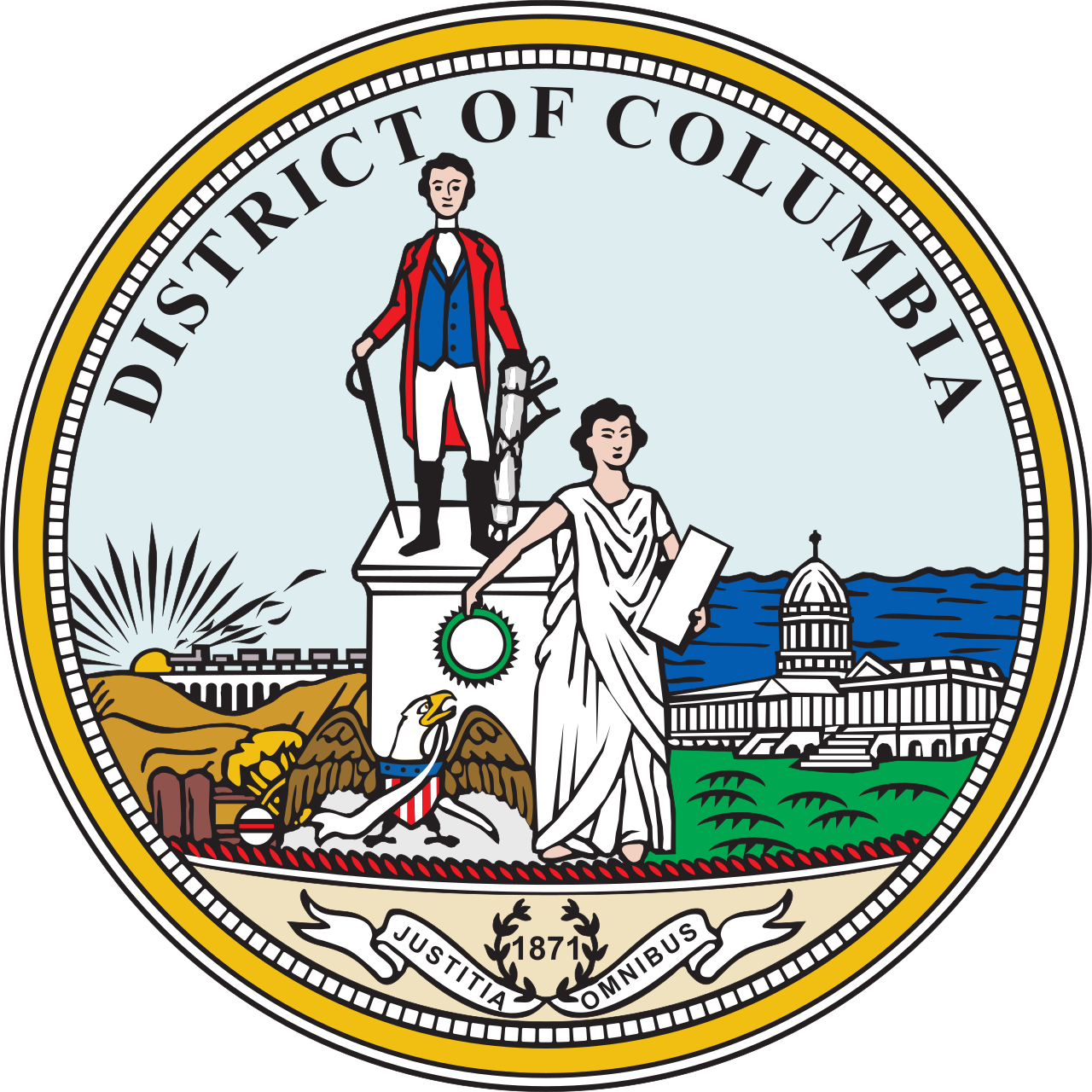
From Robert Whitcomb’s “Digital Diary,’’ in GoLocal24.com
“This is what you’ve gotten, guys.”
-- Utah Sen. Mitt Romney, during the Jan. 6 assault on the Capitol, yelling at Sen. Ted Cruz and some other neo-Fascist GOP colleagues in the Capitol who were leading the lie-and-demagoguery-filled attempt to overturn Biden’s election.
Trump's acting defense secretary, Christopher Miller, presumably at the order of Trump, had refused until it was too late to authorize the use of National Guard to defend the Capitol, making its storming easier. And the Capitol Police acted (intentionally?) hapless. Were Russia-connected agents involved? How much of this attack was closely coordinated with Trump and his henchmen? Questions, questions….
Watching the ignoramuses, Nazis, gun fetishists, KKK-style white racists, QAnons and simply suckers, and all of them traitors, crashing into the Capitol at their fuhrer’s command on Jan. 6 in Washington took me back to a quieter, easier time in that city, in the late ‘50s and early ‘60s, when I’d visit friends there. The District then still often had the air of a sometimes sleepy Southern town, and there was far, far less security. The assassinations, riots and terrorist attacks, especially, of course, 9/11, that would come in future years would lead to much tighter restrictions in public buildings, including those hideous barriers in front of the White House on Pennsylvania Avenue.
But back then you could wander around with considerable freedom. I remember one in particular, in 1961, with my friend Al d’Ossche, a native of New Orleans (where he learned to become a terrific performer of jazz and other music) who had moved to Washington and quickly learned its byways. We’d wander the Capitol building and nip into the offices of senators and congresspeople, often chatting with them and their staffers.
I particularly remember meeting in the hall with Arizona Sen. Barry Goldwater, the libertarian/conservative from Arizona (where he took many beautiful photos) and New York Sen. Jacob Javits, who was a member of that now mostly extinct species (Nelson) “Rockefeller Republican’’. Javits grew increasing grouchy by being held up by a couple of kids as Goldwater continued to talk with us, maybe because I told him I had read his book The Conscience of a Conservative. I wonder if they missed an (unimportant) vote on the Senate floor as a result.
On another trip in those years, I dropped by the office of my old-fashioned Yankee Republican congressman from southeastern Massachusetts, Hastings Keith. He asked me: “What do you actually know about how Congress really works?’’ Then, without waiting, he explained how it did. And, God knows, in those days Congress often worked pretty well because Democrats and Republicans were frequently more than happy to work together. For that matter, unlike now, they also often socialized together, including with their families.
On that and other trips, I found it easy to wander through assorted grand buildings housing federal departments with virtually no security apparent. One was the White House, where the man in the guard house (a Marine, I think) waved us through. We explained to a guide in the public part of the mansion that we wanted to look at the official – and large -- official portrait of Harry Truman, which Al’s maternal grandmother, Greta Walker, had painted. The guide led us there and showed us some parts of the White House that were then off-limits to the general public.
Truman is my favorite Democratic president. My least favorite are the genocidal Andrew Jackson – crook, slaveowner and mass murderer of Native Americans, whose portrait Trump appropriately hung in the Oval Office -- and the extreme racist prig Woodrow Wilson, whose ignorance of Europe and rigidity in dealing with the Senate about the League of Nations killed American participation in it. That was a factor in creating the conditions that led to World War II.
Al also showed me such exotic (for back then in America) private-sector sights as the mosque at the Islamic Center of Washington and the National Press Club, with its always crowded bar, which, sadly, we were a tad too young to patronize. Mid-day drinking by journalists, politicians, lobbyists, PR people and other very-Washingtonian groups was far more common then. D.C.’s boozing culture started to go into sharp decline in the ‘80s. It was great unhealthy fun while it lasted.
Inspired by old maps

“Stretched Marker” (woven silk yardage), by Liz Collins, in the “current “Stretching Boundaries’,’ show at the Addison Museum of American at Phillips Academy, Andover, Mass.
The gallery says:
“An extraordinary collection of antique maps at Phillips Academy, dating from the Age of Discovery, has brought together six diverse artists who were invited to view, study and interact with the documents and create works in response to them. The artists — Sonny Assu, Andrea Chung, Liz Collins, Spencer Finch, Josh T. Franco and Heidi Whitman — produced installations that reflect each artist’s unique perspectives on the historical documents.’’
'The Old England of New England'
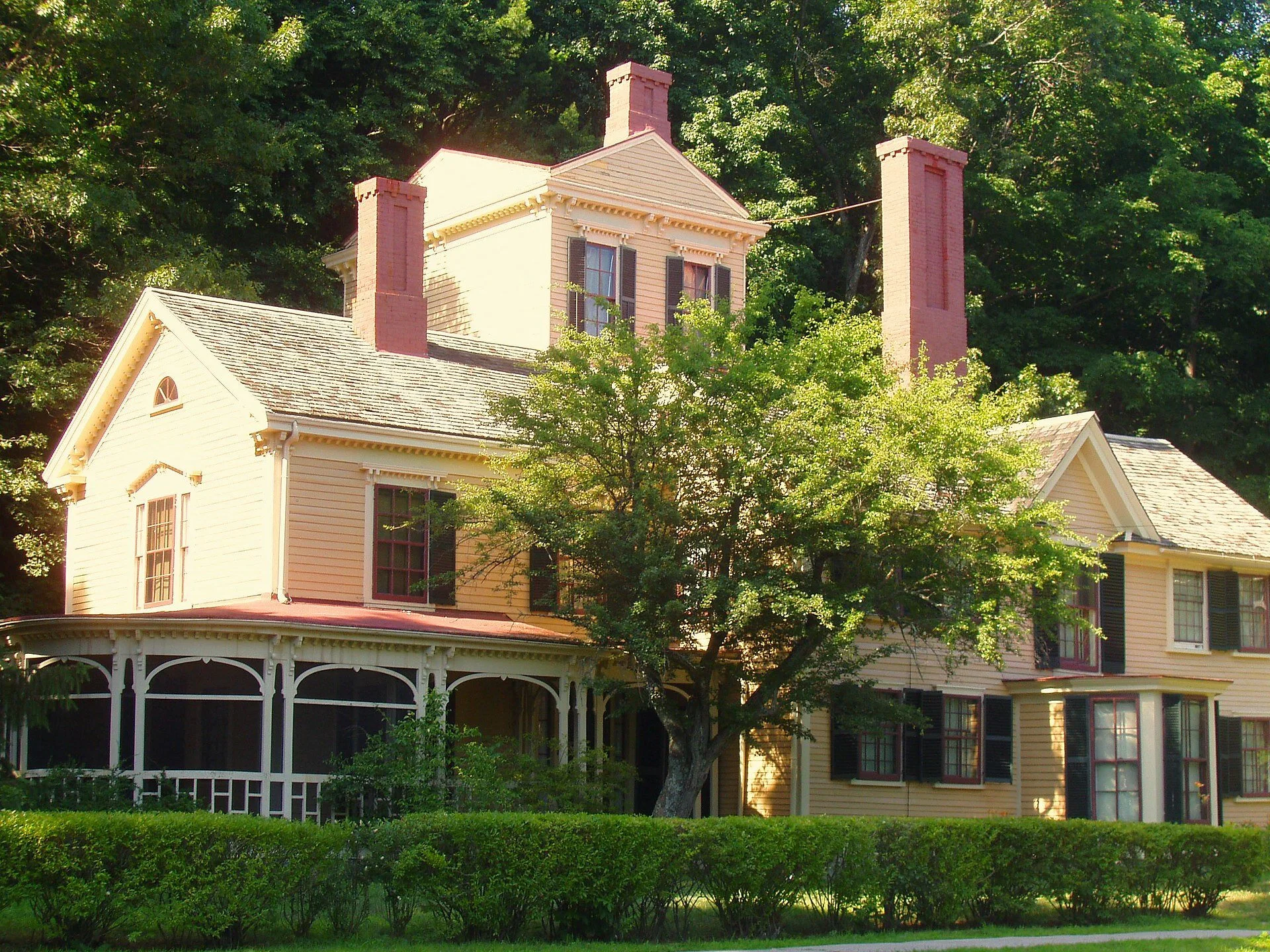
The Wayside, in Concord, Mass., home in turn to the Alcott family, novelist Nathaniel Hawthorne and writer and publisher “Margaret Sidney’’ (a nom de plume )— real name was Harriett Lothrop.
—- Photo by Dadero
“I perceive that I am neither a planter of the backwoods, pioneer, nor settler there, but an inhabitant of the Mind, and given to friendship and ideas. The ancient society, the Old England of New England, Massachusetts for me.”
— Amos Bronson Alcott (1799-1888), an American teacher, writer, philosopher and reformer, father of writer Louisa May Alcott (Little Women, etc.) and member of the famous literary community of Concord, Mass.
'Eccentrics sanctuary'
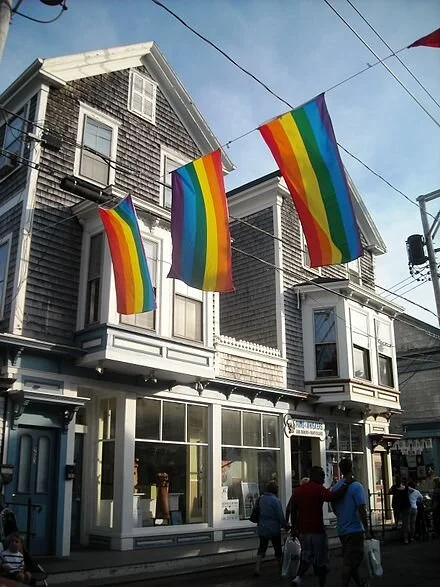
On Commercial Street in Provincetown
“Provincetown is, has always been, an eccentrics’ sanctuary, more or less the way other places are bird sanctuaries or wild game preserves. It is the only small town I know of where those who live unconventionally seem to outnumber those who live within the prescribed boundaries of home and licensed marriage, respectable jobs and biological children. It is where people who were the outcasts and untouchables in other towns can become prominent members of society.’’
-- Michael Cunningham (born 1952) is a novelist and screenwriter.
Needed over Washington

“On Fire” ( mixed media) by Peter Campbell, in the Attleboro Art Museum members show
'Like a sound'

— Photo by User:Fir0002
Dark hills at evening in the west,
Where sunset hovers like a sound
Of golden horns that sang to rest
Old bones of warriors under ground,
Far now from all the bannered ways
Where flash the legions of the sun,
You fade—as if the last of days
Were fading, and all wars were done.
“Dark Hills,’’ by Edward Arlington Robinson (1869-1935), a Maine native and one of the most celebrated New England poets

Edward Arlington House, in Gardiner, Maine, where he spent his unhappy childhood