
Vox clamantis in deserto


Needed over Washington
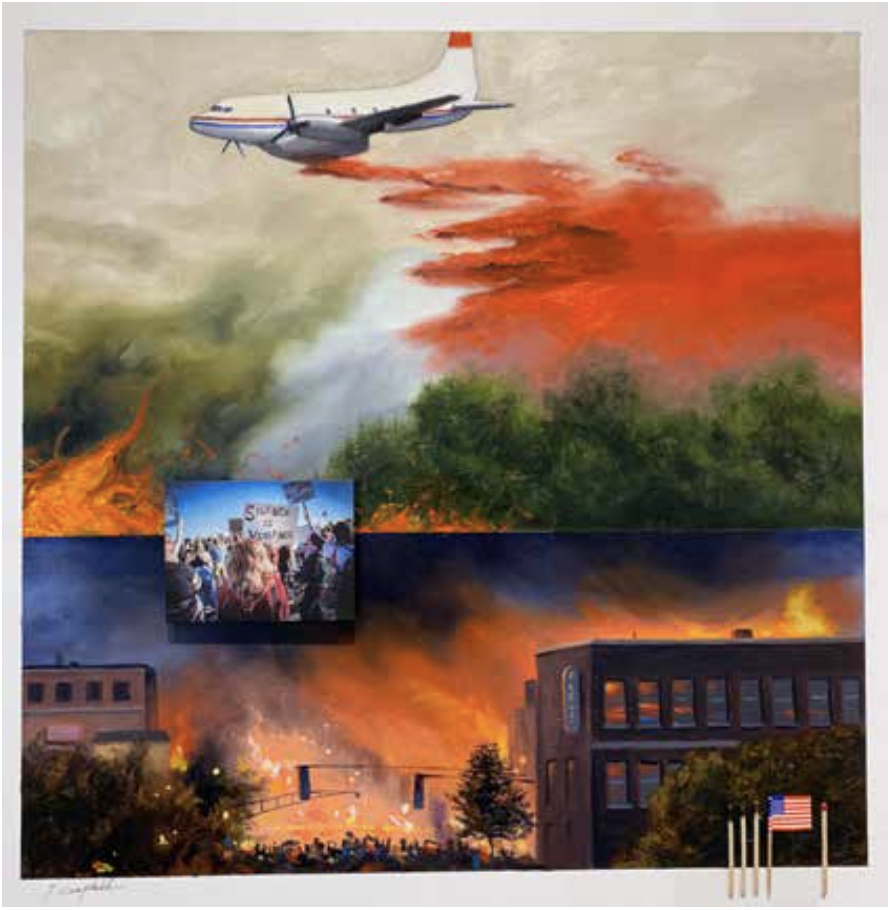
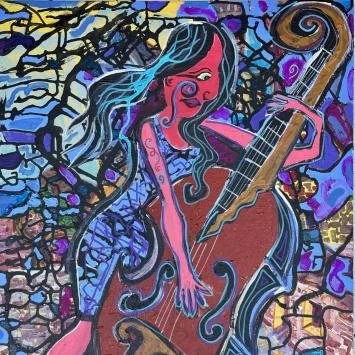
“On Fire” ( mixed media) by Peter Campbell, in the Attleboro Art Museum members show
'Like a sound'

— Photo by User:Fir0002
Dark hills at evening in the west,
Where sunset hovers like a sound
Of golden horns that sang to rest
Old bones of warriors under ground,
Far now from all the bannered ways
Where flash the legions of the sun,
You fade—as if the last of days
Were fading, and all wars were done.
“Dark Hills,’’ by Edward Arlington Robinson (1869-1935), a Maine native and one of the most celebrated New England poets

Edward Arlington House, in Gardiner, Maine, where he spent his unhappy childhood
Coming soon: Applied Science Zoom Summits hosted by UMass
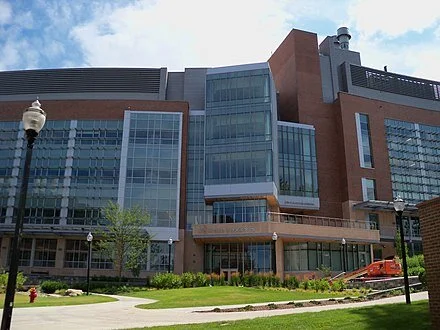
Life sciences laboratory building at UMasss Amherst
From The New England Council (newenglandcouncil.com)
The University of Massachusetts will host a series of Applied Science Zoom Summits in late January – early February 2021. Through these virtual programs, UMass aims to engage the business community in the broad range of research conducted by the university system that is relevant to innovation across many industries in throughout New England and beyond. The mission is to start a conversation about translational research they have underway on their five campuses and the “next frontiers” ripe for exploration in the academy and in industry.
Interested New England Council members are invited to participate in the following Applied Science Zoom Summits:
Advanced Manufacturing – Monday, January 25, 2021
Aerospace, Defense, Undersea Technology and Remote Sensing – Tuesday, January 26, 2021
Sustainability and Climate Resilience: Coastal Communities, Energy, and Transportation—Friday, January 29, 2021
Artificial Intelligence, Robotics, Data Science—Monday, Feb 8, 2021
Data-Driven and Technology-Informed Precision Health – Wednesday, Feb 10, 2021
Applied Life Sciences – Thursday, Feb 11, 2021
At these 90-minute summits, each held from 3:30-5:00 p.m., UMass scientists will explore the most advanced research underway in these fields with an emphasis on the problems they solve and the applications they have to industry. After a plenary session, the audience will be able to join break out sessions to discuss the “grand challenges” in each field that will occupy science and industry in next 5-10 years.
Please use the links above for more information on each session, and to register. The New England Council is grateful to UMass for extending the invitation to our members and encourage you to take advantage of the opportunity to participate in these important discussions.

Llewellyn King: Internet companies and freedom of speech
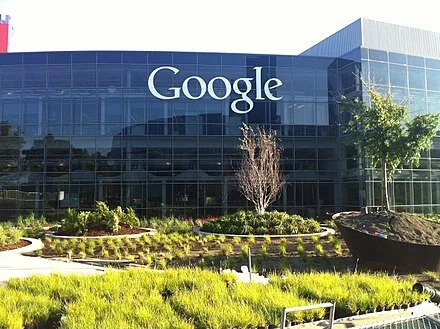
Google headquarters, in Mountain View, Calif.
WEST WARWICK, R.I.
H.L. Mencken, journalist and essayist, wrote in 1940, “Freedom of the press is limited to those who own one.”
Twenty years later, the same thought was reprised by A.J. Liebling, of The New Yorker.
Today, these thoughts can be revived to apply, on a scale inconceivable in 1940 or 1960, to Big Tech, and to the small number of men who control it.
These men -- Jack Dorsey, of Twitter, Mark Zuckerberg, of Facebook, and Sundar Pichai, of Alphabet Inc., and its subsidiary Google -- operate what, in another time, would be known as “common carriers.” Common carriers are, as the term implies, companies that distribute anything from news to parcels to gasoline. They are a means of distributing ideas, news, goods, and services.
Think of the old Western Union, the railroads, the pipeline companies or the telephone companies. Their business was carriage, and they were recognized and regulated in law as such: common carriers.
The controversial Section 230 of the Communications Decency Act recognizes the common carrier nature of Big Tech internet companies by exempting them from libel responsibility. It specifically stated that they shouldn’t be treated as publishers. Conservatives want 230 repealed, but that would only make the companies reluctant to carry anything controversial, hurting free speech.
I think that the possible repeal of 230 should be part of a large examination of the inadvertently acquired but vast power of the Internet-based social-media companies. It should be part of a large discussion embracing all the issues of free speech on social media which could include beefed-up libel statutes -- possibly some form of the equal-time rule which kept network owners from exploiting their power for political purposes in days when there were only three networks.
President Trump deserves censure, which he has gotten: He has been impeached for incitement to insurrection. I take second place to no one in my towering dislike of him, but I am shaken at the ability of Silicon Valley to censor a political figure, let alone a president.
That Silicon Valley should shut out the voice of the president isn’t the issue. It is that a common carrier can dictate the content, even if it is content from a rogue president.
This exercise of censor authority should alarm all free-speech advocates. It is power that exceeds anything ever seen in media.
The heads of Twitter, Facebook and Alphabet are more powerful by incalculable multiples than were Joseph Pulitzer, William Randolph Hearst and Henry Luce, or is Rupert Murdoch. They can subtract any voice from any debate if they so choose. That is a bell that tolls for all. They have the power to silence any voice by closing an account.
When Edward R. Murrow talked about the awesome power of television, he was right for that time. But now technology has added a multiplier of atomic proportions via the Internet.
The internet-based social media giants didn’t seek power. They are, in that sense, blameless. They pursued technology, then money, and these led them to their awesome power. What they have done, though, is to use their wealth to buy startups which offer competition.
Big Tech has used its financial clout to maintain its de facto monopolies. Yet unlike the newspaper proprietors of old or Murdoch’s multimedia, international endeavors today, they didn’t pursue their dreams to get political power. They were carried along on the wave of new technologies.
It may not be wrong that Twitter, Facebook and others have shut down Trump’s account when they did, at a time of crisis, but what if these companies get politically activated in the future?
We already live in the age of the cancellation culture with its attempt to edit history. If that is extended to free speech on the Internet, even with good intentions, everything begins to wobble.
The tech giants are simply too big for comfort. They have already weakened the general media by scooping up most of the advertising dollars. Will the freedom of speech belong to those who own the algorithms?
Llewellyn King is executive producer and host of White House Chronicle, on PBS. His email is llewellynking1@gmail.com. He’s based in Rhode Island and Washington, D.C.
Linda Gasparello
Co-host and Producer
"White House Chronicle" on PBS
Mobile: (202) 441-2703
Website: whchronicle.com
Thanks!1940, “Freedom of the press is limited to those who own one.”
Twenty years later, the same thought was reprised by A.J. Liebling of The New Yorker.
Today, these thoughts can be revived to apply, on a scale inconceivable in 1940 or 1960, to Big Tech, and to the small number of men who control it.
These men -- Jack Dorsey of Twitter, Mark Zuckerberg of Facebook, and Sundar Pichai of Alphabet Inc., and its subsidiary Google -- operate what, in another time, would be known as “common carriers.” Common carriers are, as the term implies, companies which distribute anything from news to parcels to gasoline. They are a means of distributing ideas, news, goods, and services.
Think of the old Western Union, the railroads, the pipeline companies, or the telephone companies. Their business was carriage, and they were recognized and regulated in law as such: common carriers.
The controversial Section 230 of the Communications Decency Act recognizes the common carrier nature of Big Tech internet companies by exempting them from libel responsibility. It specifically stated that they shouldn’t be treated as publishers. Conservatives want 230 repealed, but that would only make the companies reluctant to carry anything controversial, hurting free speech.
I think the possible repeal of 230 should be part of a large examination of the inadvertently acquired but vast power of the internet-based social media companies. It should be part of a large discussion embracing all the issues of free speech on social media which could include beefed-up libel statutes -- possibly some form of the equal-time rule which kept network owners from exploiting their power for political purposes in days when there were only three networks.
President Donald Trump deserves censure, which he has gotten: He has been impeached for incitement to insurrection. I take second place to no one in my towering dislike of him, but I am shaken at the ability of Silicon Valley to censor a political figure, let alone a president.
That Silicon Valley should shut out the voice of the president isn’t the issue. It is that a common carrier can dictate the content, even if it is content from a rogue president.
This exercise of censor authority should alarm all free-speech advocates. It is power that exceeds anything ever seen in media.
The heads of Twitter, Facebook and Alphabet are more powerful by incalculable multiples than were Joseph Pulitzer, William Randolph Hearst and Henry Luce, or is Rupert Murdoch. They can subtract any voice from any debate if they so choose. That is a bell that tolls for all. They have the power to silence any voice by closing an account.
When Edward Murrow talked about the awesome power of television, he was right for that time. But now technology has added a multiplier of atomic proportions via the internet.
The internet-based social media giants didn’t seek power. They are, in that sense, blameless. They pursued technology, then money, and these led them to their awesome power. What they have done, though, is to use their wealth to buy startups which offer competition.
Big Tech has used its financial clout to maintain its de facto monopolies. Yet unlike the newspaper proprietors of old or Murdoch’s multimedia, international endeavors today, they didn’t pursue their dreams to get political power. They were carried along on the wave of new technologies.
It may not be wrong that Twitter, Facebook, and others have shut down Trump’s account when they did, at a time of crisis, but what if these companies get politically activated in the future?
We already live in the age of the cancellation culture with its attempt to edit history. If that is extended to free speech on the internet, even with good intentions, everything begins to wobble.
The tech giants are simply too big for comfort. They have already weakened the general media by scooping up most of the advertising dollars. Will the freedom of speech belong to those who own the algorithms?
Llewellyn King is executive producer and host of “White House Chronicle” on PBS. His email is llewellynking1@gmail.com.
Linda Gasparello
Co-host and Producer
"White House Chronicle" on PBS
Mobile: (202) 441-2703
Website: whchronicle.com
Thanks!
Coast painting
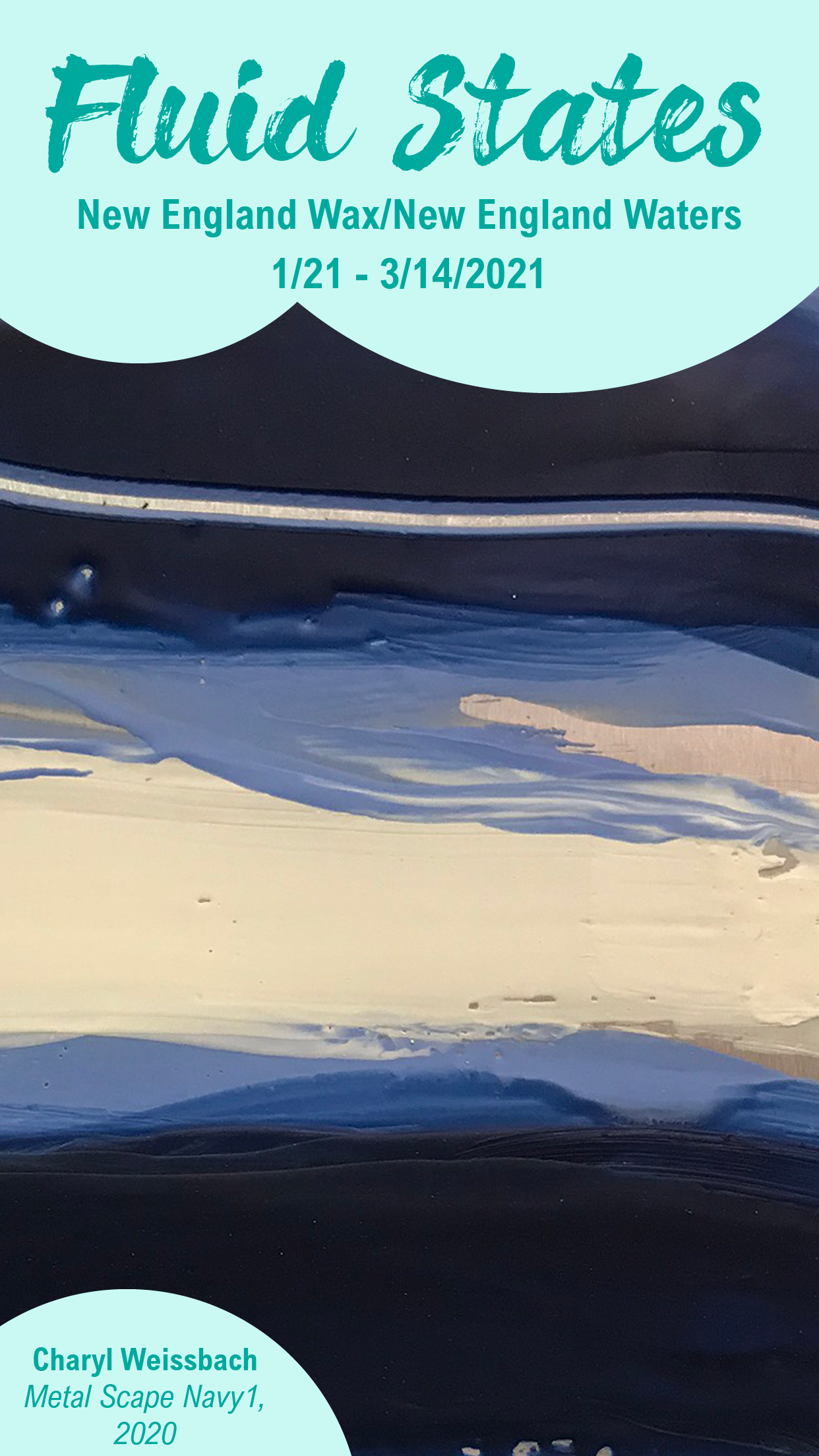
“Metal Scape Navy 1’ (encaustic painting), by Charyl Weissbach, in the show at The New Bedford Art Museum, Jan. 21-March 14. Her studio is in Boston’s SoWa arts district.
(Timed-Ticket Reception: 3/13/2021, 12-2 PM)
Featuring: Willa Vennema, Stephanie Roberts-Camello, Pamela Dorris DeJong, Lola Baltzell, Nancy Whitcomb, Lia Rothstein, Deborah Peeples, Kay Hartung, Marina Thompson, Angel Dean, Lelia Stokes Weinstein, Ruth Sack, Sarah Springer, Charyl Weissbach and Camille Davidson
“Fluid States: New England Wax/New England Waters’’ highlights encaustic artworks inspired by New England’s historic and awe-inspiring coasts. Themed around the fluidity seen in both wax and water, “Fluid States’’ explores New England’s ecological richness and fragility. Protecting our water and the life that depends on it is an urgent necessity. In this exhibition, the artists address this urgency as they work to express water’s sheer beauty through innovative approaches to an ancient medium.
The blessings of January

The Mt. Hope Bridge, connecting the Rhode Island mainland with Aquidneck Island
From Robert Whitcomb’s “Digital Diary,’’ in GoLocal24.com
It’s good that in January in these parts you see the underlying structures of many things, the skeletons of them, so to speak, with the leaves off the deciduous trees and other vegetation reduced, too. More architecture than painting. Another nice thing is that the colors of birds, e.g., cardinals, stand out more vividly against the brown, gray and white of January than they do in greener times.

Marshes in Sandwich, Mass.
— Photo by Andrewrabbott
I love the sere of coastal marshes at this time of year, especially at sunrise and sunset.
Of course, it’s also good to know that winter will end in a few weeks.
January always seemed to me a quiet time in which you can catch your breath, before obligations start piling up again later in the winter – tax returns, etc. It’s a good time to catch up on sleep.
We send out a lot of New Year’s cards well into this month. They arrive more reliably at their destinations than Christmas cards, especially this past holiday season, what with the pandemic and damage to the U.S. Postal Service by the Trump regime under its corrupt postmaster general, Louis DeJoy. (Being corrupt and slavishly, even criminally, loyal have often seemed to be the main requirements for high-level employment in this destructive regime.)
Driving to Newport on a bright winter’s day, with shimmering views from the bridges of the Ocean State’s archipelago, is exhilarating, as is sitting with an old friend at the all-weather patio of a mostly empty restaurant on the Newport waterfront with the light pouring in. But let’s hope that the eatery is crowded come spring.
'Foundation of all free government'
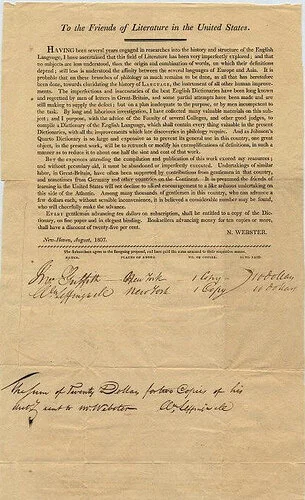
“To the Friends of Literature in the United States,’’ Webster's prospectus for his first dictionary of the English language, 1807–1808
“The foundation of all free government and all social order must be laid in families and in the discipline of youth. Young persons must not only be furnished with knowledge, but they must be accustomed to subordination and subjected to the authority and influence of good principles. It will avail little that youths are made to understand truth and correct principles, unless they are accustomed to submit to be governed by them.”
― Noah Webster. (1758-1843) an American lexicographer, textbook pioneer, English-language spelling reformer, political writer, editor and prolific author. Webster's name has become synonymous with "dictionary" in the United States, especially the modern Merriam-Webster dictionary that was first published in 1828 as A Dictionary of the English Language. He was born in Hartford and died in New Haven. He’s an example of the New England enthusiasm for education that goes back to Puritan times.
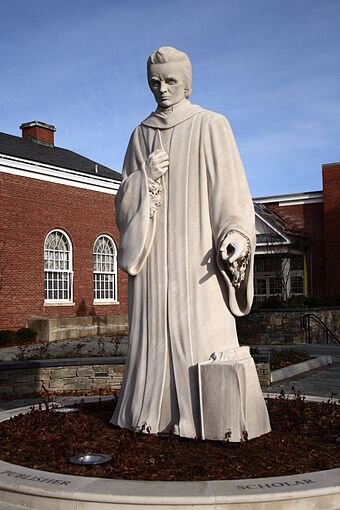
A 1932 statue of Webster by Korczak Ziółkowski stands in front of the public library of West Hartford, Conn.
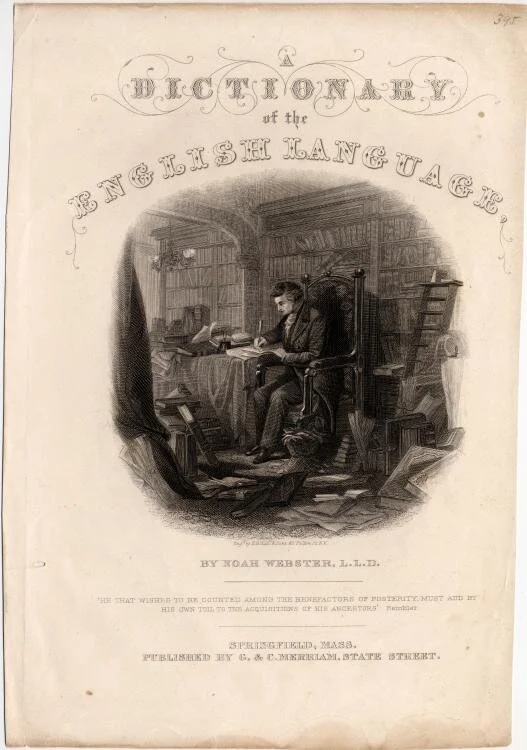
Title page of Webster's Dictionary of the English Language, c. 1830–1840
Get out your flood insurance
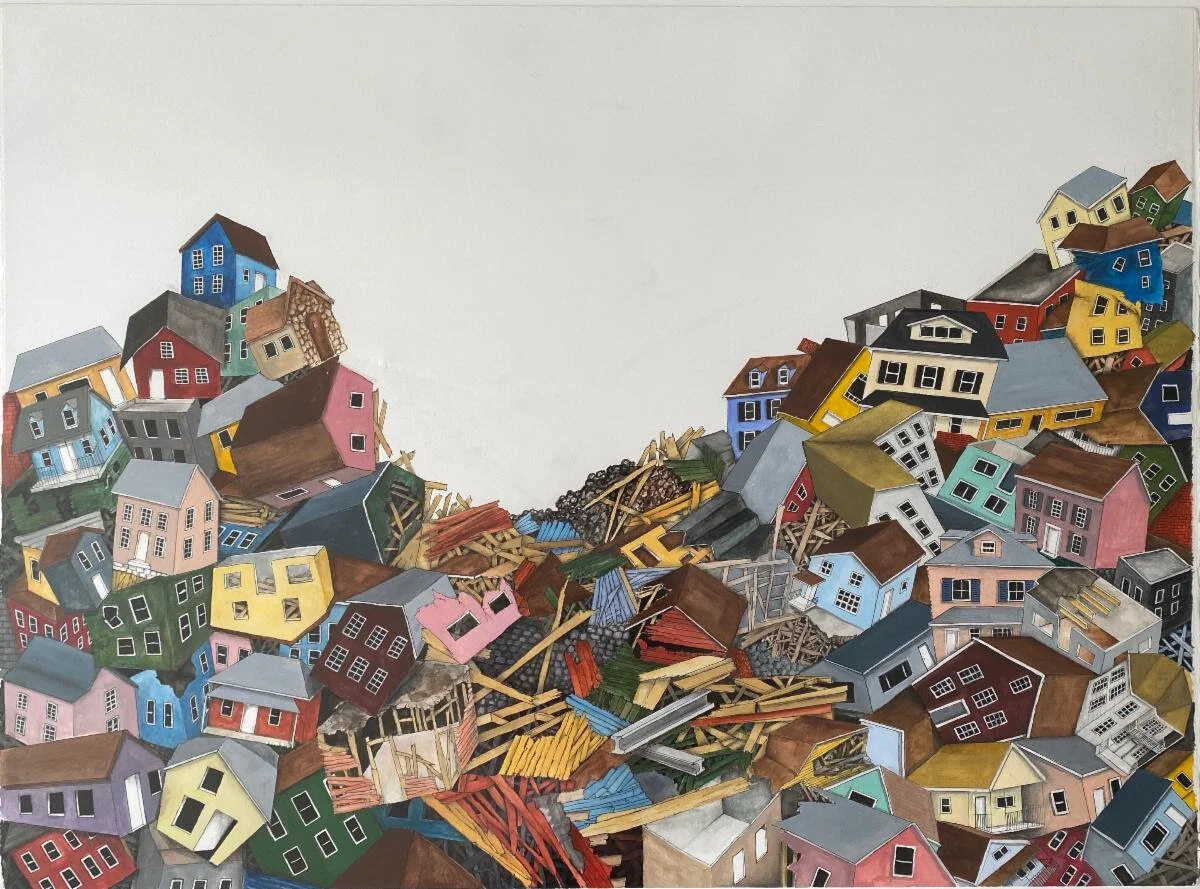
“Hireath 1 ‘‘ (ink, charcoal, and gouache on paper) by Vermont-based artist Susan Greer Emmerson, in her show “Unraveling,’’ at Kingston Gallery, Boston, March 3-28.
The gallery says:
“The home, as a physical and metaphorical space, seemingly exists as a constant. It is a place of return, respite, and stability even when the outside world is in chaotic flux. Emmerson (a former surgeon), however, sees the safety of home as an illusion. In her solo exhibition, paintings on paper of brightly colored houses are violently crushed together in torrential waves, evoking the physical destruction of man-made climate disasters. Other structures are in piles of debris, still retaining their original form, but gone from their foundation and neighborhoods. “
Says Emmerson, “This past year has changed the relationship many have with home. For some, it has been a site of confinement, of forced isolation and loneliness. It has been a place to grieve normalcy and human lives.” It has also been a space that has been stable one month and gone the next, either by destruction or mass evictions. Emmerson’s work evokes the Welsh word “hiraeth”, the profound homesickness and nostalgia for a home you cannot return to, or one that may never have existed.
View select high-resolution images here.
Image credit: Susan Greer Emmerson, Hireath 1 (2020) ink, charcoal, and gouache on paper, 22” x 30”, 2020, courtesy of the artist.
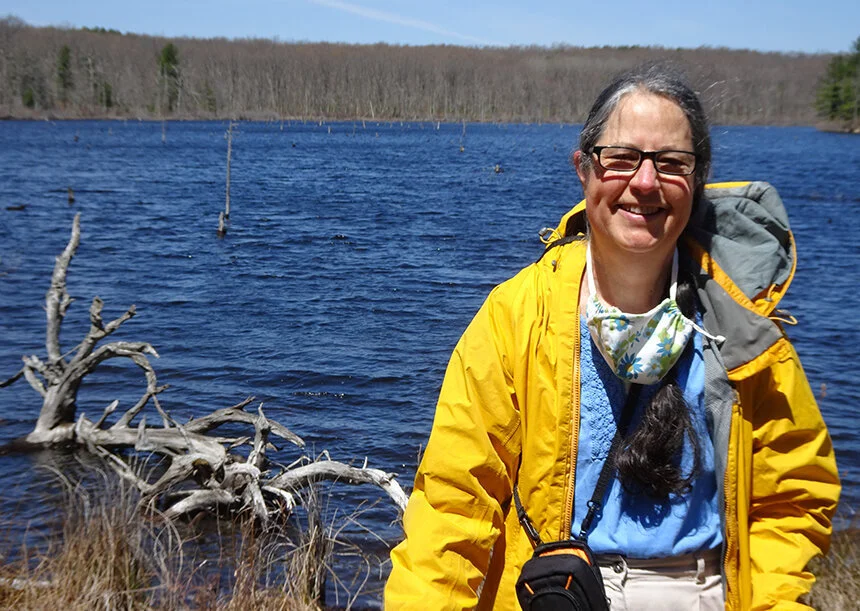
Grace Kelly: Book author touts easy, healing walks
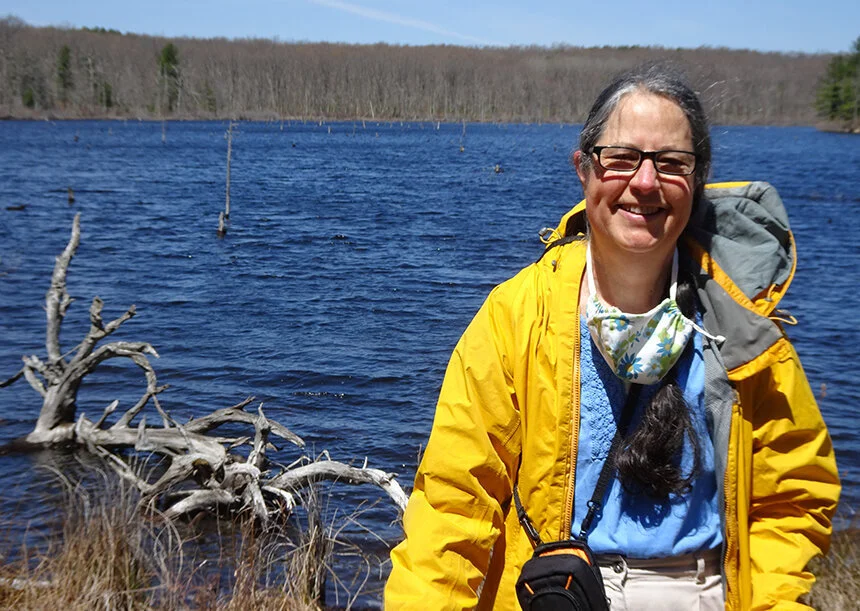
Marjorie Hollman Turner
From ecoRI News (ecori.org)
Thirty years ago Marjorie Turner Hollman found her right side paralyzed after brain surgery. She was unable to drive in the seven years of recovery that followed and turned to writing and taking walks down her dead-end road for solace.
When she met her second husband, an avid outdoorsman, she slowly began to move beyond handicap-accessible walks to what she now calls “easy walks.”
“If I had not found myself on a hospital bed paralyzed after brain surgery, I wouldn’t be doing easy walks,” said Turner Hollman, who lives in Bellingham, Mass., which is just over the Rhode Island border near Cumberland. “I have healed to the extent that I am able to walk with support, meaning hiking poles, and I’m very selective of where I choose to walk. I’m not your Appalachian Mountain Club material.”
Over the years, Turner Hollman sought out more of these easy walks, which she defines as “walks that don’t have too many roots, don’t have too many rocks, are relatively level … with something of interest along the way.”
In essence, walks that children, people with mobility issues, and those new to the outdoors can enjoy. Anyone, really.
And as Turner Hollman started her easy walks, she began to chronicle them — and the natural world around her — first for her local newspaper and later on her blog. Then, the questions came pouring in.
“I started having people find my Web site and they kept asking the question, Where’s Joe’s Rock?’” Turner Hollman said. “Well, it’s in Wrentham [Mass.] on Route 121 right near the Cumberland line, and after about the 500th time somebody came to that article, I said, ‘Well I think there’s a need here.’”
Turner Hollman wrote her first book, Easy Walks in Massachusetts, in 2014 to provide a one-stop-shop resource for anyone else in the state looking for easy walks. But the process was far from easy, since a lot of the walks she enjoyed weren’t in any guidebooks.
“At the time, they didn’t have any guides for outdoor things here. We’re not the Cape, we’re not in the White Mountains, we don’t have that cache,” she said. “Today, a lot of town offices have put up maps of their conservation areas, but when I started writing these in 2013, there were next to none. I visited town halls and said, ‘Help me!’ or called and said, ‘Do you have properties that kind of fit this?’ I did a lot of legwork.”
Since then, she’s written another three “easy walks” books, one of which was done in conjunction with the Ten Mile River Watershed Council, an organization with offices in Rumford, R.I., and Attleboro, Mass. This two-state watershed contains one of her favorite easy walks, Hunts Mills, which has a man-made dam and waterfall and trails that loop through the woods.
“It’s stunning and incredibly accessible,” Turner Hollman said. “You can even just sit in your car and watch the falls … it’s this hidden away little spot. It’s just a gem.”
In her most recent book, Finding Easy Walks Wherever You Are, Turner Hollman takes the principles of seeking out and enjoying easy walks to a broader level, providing tips and perspectives that anyone can use to seek out a special place to walk anywhere.
“There are plenty of places, but people don’t know how to find them because a lot of the time they’re off the beaten track,” she said. “I encourage people to consider places like, for example, your local cemetery to visit respectfully, understanding its first purpose is not a walking place … but they’re wonderful places to walk and often have paved roadways through them.
“So that’s a lot of what I talk about in finding easy walks wherever you are. It’s providing ideas that people maybe don’t think about.”
The book is also a culmination of Turner Hollman’s personal experience and belief that anyone, regardless of ability, can go on a walk.
“What I’ve learned in sharing Easy Walks is that many people can enjoy these outings, regardless of ability,” she wrote in a blog post from 2015. “Rather than my disability creating a barrier, I’ve found that working with, in spite of, and because of my disability has enriched my life, and the lives of many others. … These days I’m even more determined to search out and point others to places they can enjoy together.”
Grace Kelly is a journalist with ecoRI News.
Mitchell Zimmerman: Of the Nazis and Trump's Fascist mob

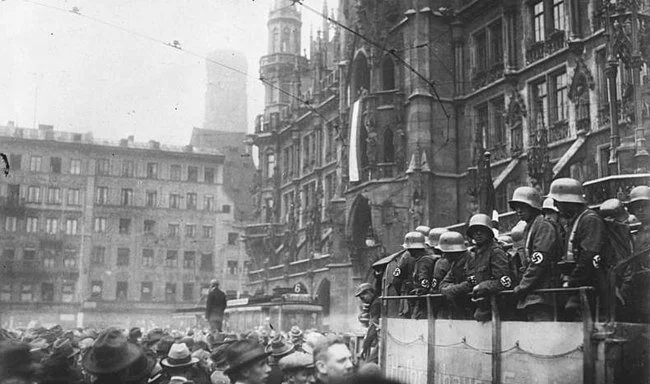
Nazis during the Beer Hall Putsch

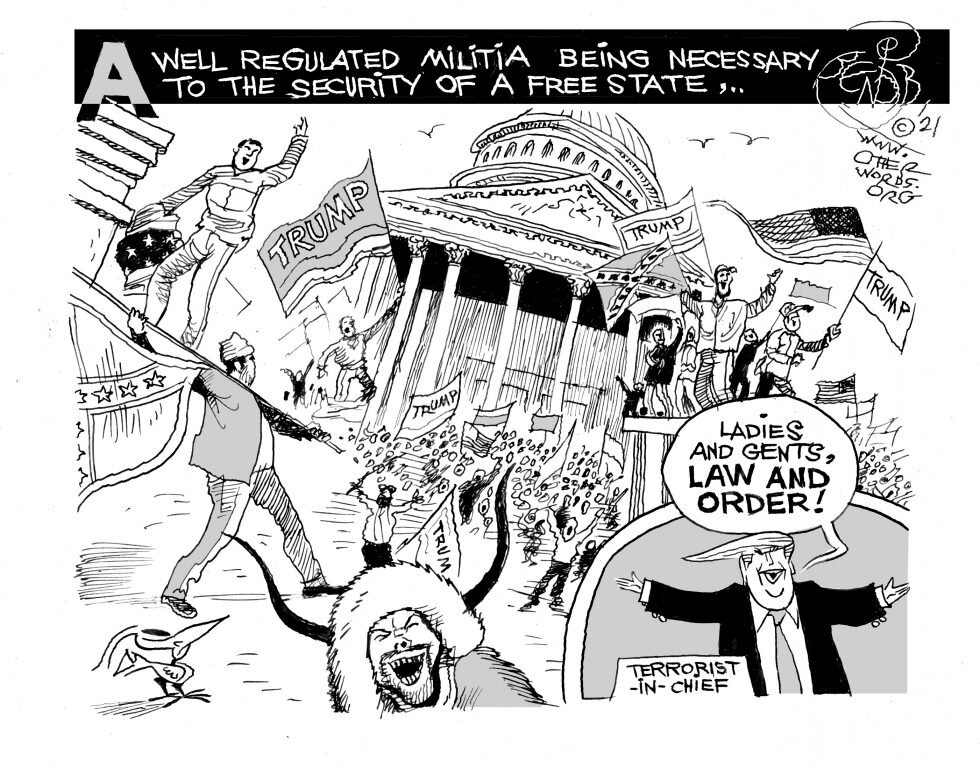
Trump’s fascist mobs, inspired by nonstop lies, invade the Capitol
From OtherWords.org
In 1923, Hitler and the Nazis stormed a beer hall in Munich, Germany, whence they planned to overthrow German democracy. The putsch failed ignominiously, and Hitler was briefly jailed.
That, of course, was not the end of Adolf Hitler. America needs to remember that history if we want to preserve our democracy from the right-wing forces rallied by Donald Trump today.
As Congress gathered to formalize Trump’s election defeat, he and his extremist followers launched their own beer hall putsch. “We will not take it anymore,” Trump told them. “You’ll never take back our country with weakness, you have to show strength.”
With these words, Trump unleashed the frenzied horde.
They breached the barriers around the Capitol and fought their way in, brutally killing a police officer and assaulting many others. They broke into offices, smashed windows, looted, and forced Congress to cease its operations. Outside, they built a gallows.
Many rioters carried weapons and some had plastic handcuffs. Their obvious goal: to take hostages and force Congress to award Trump a second term. A total (so far) of five deaths.
Trump is responsible, but not him alone. The mob he sent had accomplices: a second mob of Republican officials who laid the groundwork by enabling Trump’s lies.
The second mob includes the eight Republican senators and 139 House Republicans who voted against certifying Joe Biden’s election, as well as the 17 Republican attorneys general who supported a bogus lawsuit to throw out the election.
Finally, it includes the Republican office holders who refused to tell their voters the truth: Trump lost. There was no “steal,” as 60 court rulings — including many by Trump-appointed judges — unanimously concluded.
These Republican politicians knew this, but they still insisted that Trump be installed as president, confirming their opposition to elections and hostility to constitutional democracy.
The second mob misled Republican voters so well that 45 percent of them actually support the criminal attack on the Capitol. Those tens of millions of people represent a potential mass base for fascism.
So, what should we do?
First, Trump should be impeached, removed, and charged with inciting a riot and other crimes. And criminal charges are obviously in order for the terrorist violence committed by the first mob. Experts also suggest expelling members of the second mob from Congress or boycotting them from public life.
Accountability is vital. But the Democrats who will now control Congress and the White House must also double down on efforts to restore and strengthen American democracy.
They should act swiftly to limit the power of money in politics, restore the Voting Rights Act, and eliminate needless obstacles to voting. And Washington, D.C., should be admitted as a state, so its citizens have full voting rights and powers.
Finally, the Democratic Party must fight to enact bold programs to deal with the massive problems Americans face — from climate change to the pandemic to the declining living standards of working Americans.
Half-hearted steps will only leave ordinary Americans feeling that that government does not work, priming the pump for more right-wing radicalization. But a full-throated campaign for real, understandable change — even against Republican obstruction — can help voters understand that democracy can work for them when it isn’t hijacked by the super-rich and their servants.
The assault on the Capitol has uncovered the true nature of right-wing Republican politics in America: a thinly veiled war on constitutional democracy and majority rule. The way to prevent the next authoritarian coup attempt is to build a robust democracy that demonstrates it is responsive to the needs and interests of real people.
A slap on the wrist for the coup plotters and a swift return to the status quo isn’t enough, as the beer hall putsch should have taught us. We need a real commitment to reverse the erosion of our democracy.
Mitchell Zimmerman is a lawyer, social activism and author of the thriller Mississippi Reckoning.

Don't burn it for electricity!

In Beartown State Forest, in The Berkshires

The Sandwich Range, in the White Mountain National Forest
From Robert Whitcomb’s “Digital Diary,’’ in GoLocal24.com
I like to sit by a crackling log fire as much as the next person. Indeed, we recently bought a backyard fire pit as a way to expand our winter living space in these times of pandemic claustrophobia. Even a lot of people burning logs in fire pits or fireplaces produce relatively minor pollution. It’s a compact, sensual, aesthetic experience.
Of course, with most fireplaces, having a fire loses your house more warmth than it gains, as it draws heat from the house up the chimney. Still, it’s very pleasant, if you can sit close enough to it.
In any event, Massachusetts Gov. Charlie Baker’s administration is wrong to let wood-burning electric-power plants that now don’t meet state environmental standards get subsidies from rate payers. Yes, New England has lots of wood, but burning it in large quantities to generate electricity would mean much higher carbon emissions in the region, worsening global warning. Cutting down a lot more trees would obviously reduce forests’ ability to absorb carbon dioxide and emit oxygen, as well as harm wildlife and increase erosion by water.
Such clean-energy sources as solar, wind and geothermal are becoming cheaper and more efficient by the year. They’re the way to go. Burning wood to generate electricity is a terrible idea.
By the way, I remember that back in the days before Jiffy Pop and microwave stoves, how much fun it was to pop corn by putting the seeds in a screened frame over the fire and constantly shaking and flipping it. It took close attention but the popcorn you got seemed tastier than what you get now, or maybe that’s just misleading nostalgia. Of course, we soaked the product in butter and sprinkled on lots of salt: a slow-motion heart-disease developer.
xxx
Another sign that Massachusetts will continue to be a very rich state: Despite the pandemic and the national recession, it caused state tax revenues rose 8.8 percent in December from the year-earlier, pre-COVID month!
Lonely in the universe
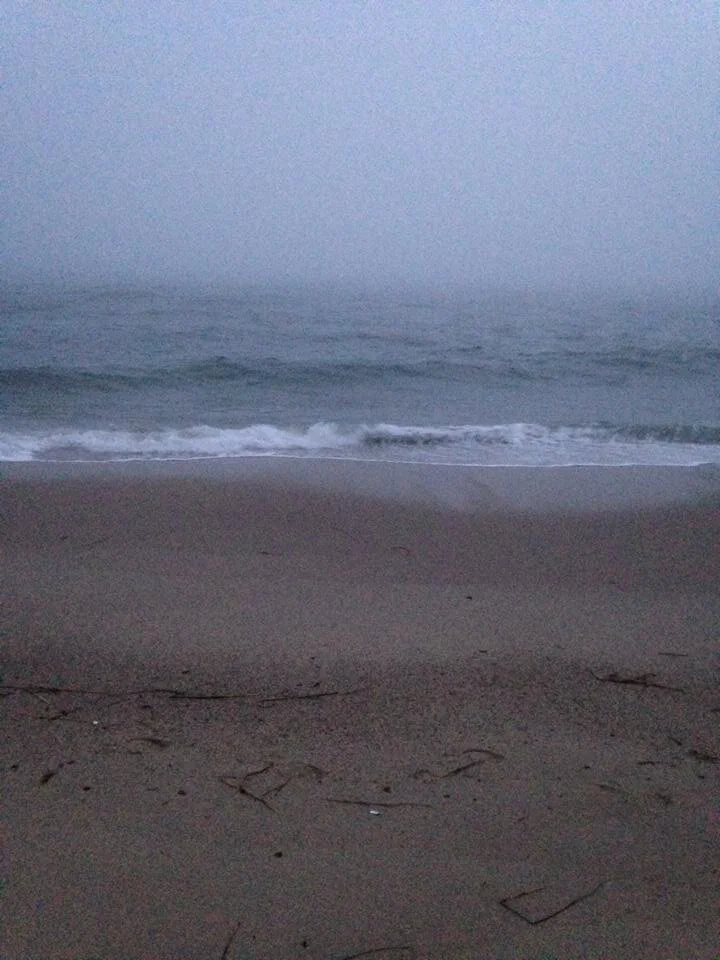
Tideline in North Truro
Photo by Hqfrancis
….this is just one sea
on one beach on one
planet in one
solar system in one
galaxy. After that
the scale increases, so
this not the last word,
and nothing else is talking back.
It’s a lonely situation.’’
— From The Sea Grinds Things Up,’’ by Alan Dugan (1923-2003), a Pulitzer Prize-winning poet. He lived in Truro, on Outer Cape Cod. The town, as with Provincetown, just to the north, has long drawn artists of various kinds, along with other exotic tribes, such as New York City psychoanalysts.
Rae Ellen Bichell: Live free and die in your county if you wish, but not in my hospital
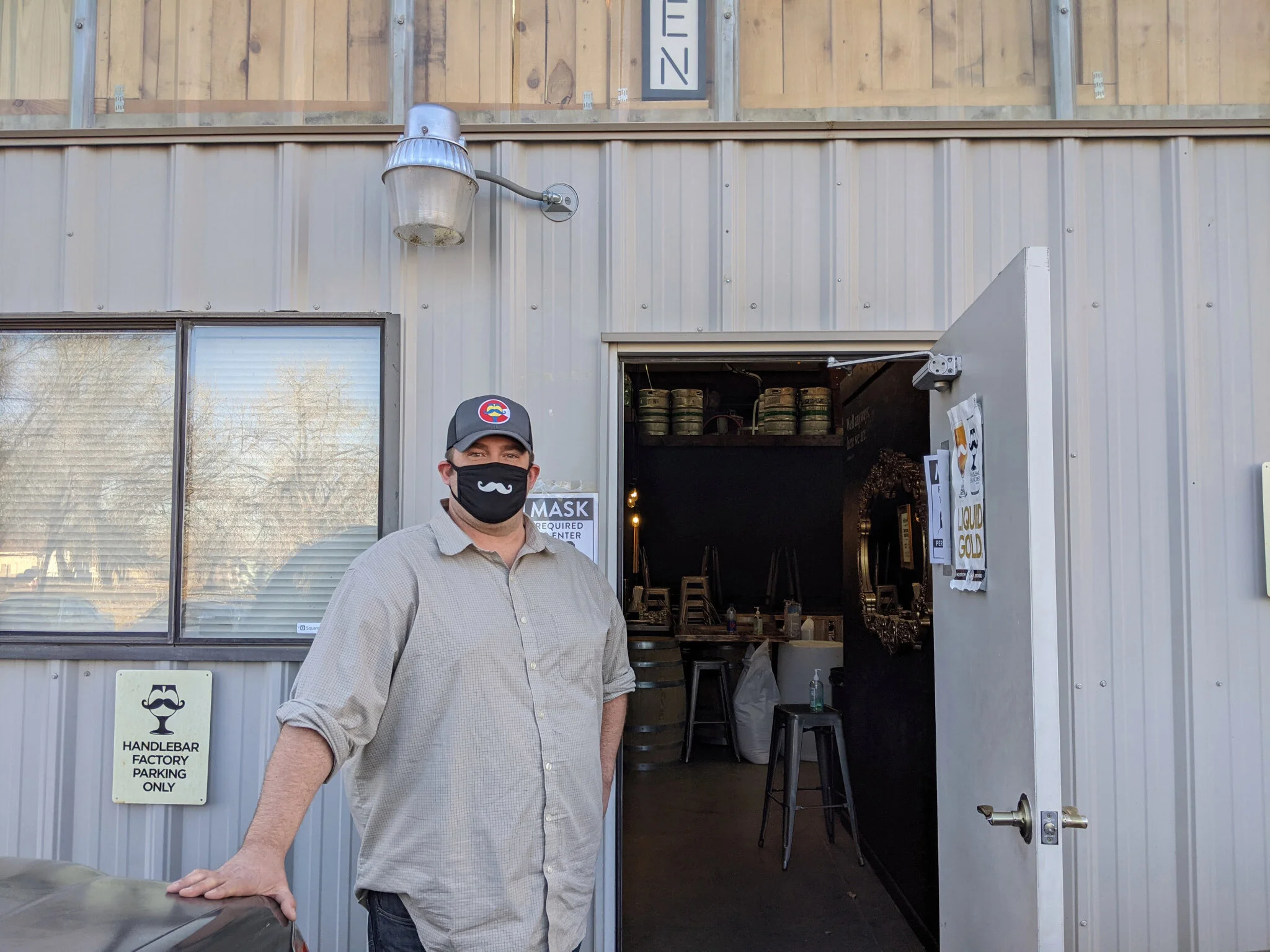
Adam Baker, chief operating officer of The Old Mine, a cidery and restaurant that has a taproom called the Handlebar Factory, stands at the empty taproom on a December afternoon. The taproom is in Boulder County, where indoor dining is not allowed. The restaurant, just a short walk away, is in Weld County, where officials have said they “will not enforce a rule demanding restaurants close their indoor dining areas.” The company decided to follow the more restrictive guidelines of Boulder County, regardless of the restaurant’s location.
— Photo by Rae Ellen Bichell, Kaiser Health News
ERIE, Colo.
Whenever Larry Kelderman looks up from the car he’s fixing and peers across the street, he’s looking across a border. His town of 28,000 straddles two counties, separated by County Line Road.
Kelderman’s auto-repair business is in Boulder County, whose officials are sticklers for public health and have topped the county website with instructions on how to report COVID violations. Kelderman lives in Weld County, where officials refuse to enforce public health rules.
Weld County’s test positivity rate is twice that of its neighbor, but Kelderman is pretty clear which side he backs.
“Which is worse, the person gets the virus and survives and they still have a business, or they don’t get the virus and they lose their livelihood?” he said.
Boulder boasts one of the most highly educated populations in the nation; Weld boasts about its sugar beets, cattle and thousands of oil and gas wells. Summer in Boulder County means concerts featuring former members of the Grateful Dead; in Weld County, it’s rodeo time. Boulder voted for Biden, Weld for Trump. Per capita income in Boulder is nearly 50% higher than in Weld.
Even their COVID outbreaks are different: In Boulder County, the virus swirls around the University of Colorado. In Weld County, some of the worst outbreaks have swept through meatpacking plants.
The town of Erie, Colorado, straddles two counties with opposite views on how to approach COVID-19. (Rae Ellen Bichell/KHN)
It’s not the first time County Line Road has been a fault line.
“I’ve been in politics seven years and there’s always been a conflict between the two counties,” said Jennifer Carroll, mayor of Erie, once a coal mining town and now billed as a good place to raise a family, about 30 minutes north of Denver.
Shortly before the coronavirus hit Colorado, Erie’s board of trustees extended a moratorium on new oil and gas operations in the town. Weld County was not pleased.
“They got really angry at us for doing that, because oil and gas is their thing,” Carroll said.
Most of the town’s businesses are on the Weld side. To avoid public health whiplash, Carroll and other town leaders have asked residents to comply with the more restrictive stance of the Boulder side.
The feud got ugly in a dispute over hospital beds. At one point, the state said Weld County had only three intensive care beds, while Weld County claimed it had 43.
“It made my job harder, because people were doubting what I was saying,” said Carroll. “Nobody trusted anyone because they were hearing conflicting information.”
Weld’s number, it turned out, included not just the beds in its two hospitals, but also those in 10 other hospitals across the county line, including in the city of Longmont.
Longmont sits primarily in Boulder County but spills into Weld, where its suburbs taper into fields pockmarked with prairie dog holes. Its residents say they can tell snow is coming when the winds deliver a pungent smell of livestock from next door. Longmont Mayor Brian Bagley worried that Weld’s behavior would deliver more than a stench: It might also deliver patients requiring precious resources.
“They were basically encouraging their citizens to violate the emergency health orders … with this cowboy-esque, you know, ‘Yippee-ki-yay, freedom, Constitution forever, damn the consequences,’” said Bagley. “Their statement is, ‘Our hospitals are full, but don’t worry, we’re just going to use yours.’”
So, “for 48 hours, I trolled Weld County,” he said. Bagley asked the city council to consider an ordinance that could have restricted Weld County residents’ ability to receive care at Longmont hospitals. Bagley, who retracted his proposal the next day, said he knew it was never going to come to fruition — after all, it was probably illegal — but he wanted to prove a point.
“They’re going to be irresponsible? Fine. Let me propose a question,” he said. “If there is only one ICU bed left and there are two grandparents there — one from Weld, one from Boulder — and they both need that bed, who should get it?”
Weld County commissioners volleyed back, calling Bagley a “simple mayor.” They wrote that the answer to the pandemic was “not to continually punish working-class families or the individuals who bag your groceries, wait on you in restaurants, deliver food to your home while you watch Netflix and chill.”
“I know we’re all trying to get along, but people are starting to do stupid and mean things and so I’ll be stupid and mean back,” Bagley said during a Dec. 8 council meeting.
In another Longmont City Council meeting, Bagley (who suspects the commissioners don’t know what “Netflix and chill” typically means) often referred to Weld simply as “our neighbors to the East,” declining to name his foe. The council shrugged off his statement about withholding medical treatment but demanded that Weld County step up to fight the pandemic.
“We would not deny medical care to anybody. It’s illegal and it’s immoral,” said council member Polly Christensen. “But it is wrong for people to expect us to bear the burden of what they’ve been irresponsible enough to let loose.”
“They’re the reason why I can’t be in the classroom in front of my kids,” said council member and teacher Susie Hidalgo-Fahring, whose school district straddles the counties. “I’m done with that. Everybody needs to be a good neighbor.”
County Line Road is not just a street cutting through Erie, Colorado. It represents a fault line between local governments with very different views on the pandemic. (Rae Ellen Bichell/KHN)
Josh Kelderman works with his father, Larry, at the family’s auto repair business, Integrity Products, on the Boulder County side of Erie, Colorado. Weld County is just across the street. (Rae Ellen Bichell/KHN)
The council decided Dec. 15 to send a letter to Weld County’s commissioners encouraging them to enforce state restrictions and to make a public statement about the benefits of wearing masks and practicing physical distancing. They’ve also backed a law allowing Democratic Gov. Jared Polis to withhold relief money from counties that don’t comply with restrictions.
Weld County Commissioner Scott James said his county doesn’t have the authority to enforce public health orders any more than a citizen has the authority to give a speeding ticket.
“If you want me as an elected official to assume authority that I don’t have and arbitrarily exert it over you, I dare you to look that up in the dictionary,” said James, who is a rancher turned country radio host. “It’s called tyranny.”
James doesn’t deny that COVID-19 is ravaging his community. “We’re on fire, and we need to put that fire out,” he said. But he believes that individuals will make the right decisions to protect others, and demands the right of his constituents to use the hospital nearest them.
“To look at Weld County like it has walls around it is shortsighted and not the way our health care system is designed to work,” James said. “To use a crudity, because I am, after all, just a ranch kid turned radio guy, there’s no ‘non-peeing’ section in the pool. Everybody’s gonna get a little on ’em. And that’s what’s going on right now with COVID.”
The dispute is not just liberal and conservative politics clashing. Bagley, the Longmont mayor, grew up in Weld County and “was a Republican up until Trump,” he said. But it is an example of how the virus is tapping into long-standing Western strife.
“There’s decades of reasons for resentment at people from a distance — usually from a metropolis and from a state or federal governmental office — telling rural people what to do,” said Patty Limerick, faculty director at the Center of the American West at the University of Colorado-Boulder, and previously state historian.
In the ’90s, she toured several states performing a mock divorce trial between the rural and urban West. She played Urbana Asphalt West, married to Sandy Greenhills West. Their child, Suburbia, was indulged and clueless and had a habit of drinking everyone else’s water. A rural health care shortage was one of many fuels of their marital strife.
Limerick and her colleagues are reviving the play now and adding COVID references. This time around, she said, it’ll be a last-ditch marriage counseling session for high school classes and communities to adopt and perform. It likely won’t have a scripted ending; she’s leaving that up to each community.
Rae Ellen Bichell is a Kaiser Health News reporter.
Rae Ellen Bichell: rbichell@kff.org, @raelnb
Our water wonders
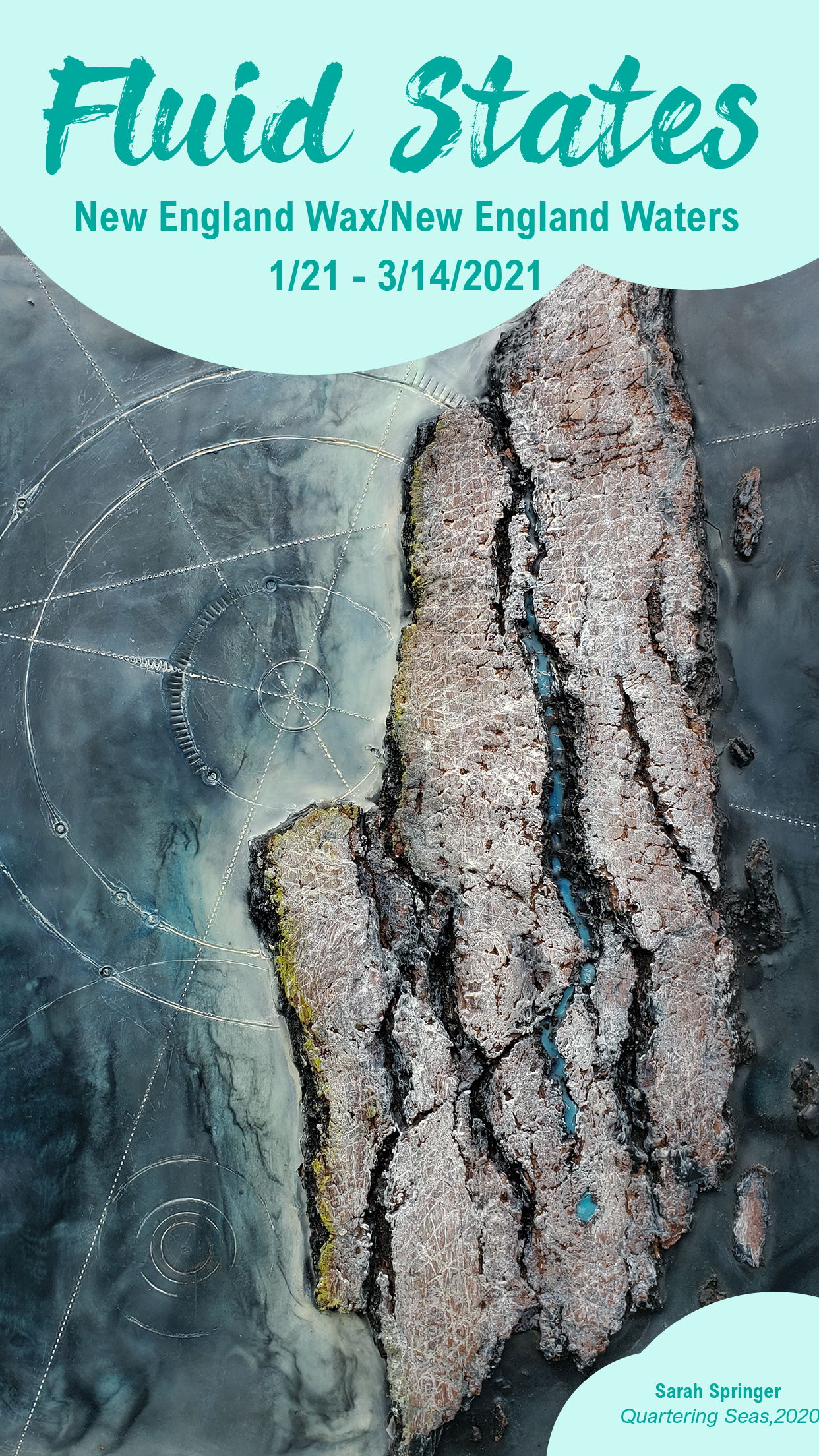
At The New Bedford Art Museum, Jan. 21-March 14
(Timed-Ticket Reception: 3/13/2021, 12 – 2 PM)
Featuring: Willa Vennema, Stephanie Roberts-Camello, Pamela Dorris DeJong, Lola Baltzell, Nancy Whitcomb, Lia Rothstein, Deborah Peeples, Kay Hartung, Marina Thompson, Angel Dean, Lelia Stokes Weinstein, Ruth Sack, Sarah Springer, Charyl Weissbach and Camille Davidson
“Fluid States: New England Wax/New England Waters’’ highlights encaustic artworks inspired by New England’s historic and awe-inspiring coasts. Themed around the fluidity seen in both wax and water, Fluid States explores New England’s ecological richness and fragility. Protecting our water and the life that depends on it is an urgent necessity. In this exhibition, the artists address this urgency as they work to express water’s sheer beauty through innovative approaches to an ancient medium.
New England Wax (N.E.W.), founded in 2006 by Kim Bernard, is a professional organization of artists living and working in the six New England states. Since its inception, N.E.W. has sought to provide opportunities to exhibit, share technical information and aesthetic ideas, and build a network of like-minded artists working in the ancient medium of encaustic. The mission of N.E.W. is to promote excellence in fine art made with encaustic, educate the general public and collectors, raise awareness of the medium, and challenge its members to grow as artists.
All democracies commit suicide
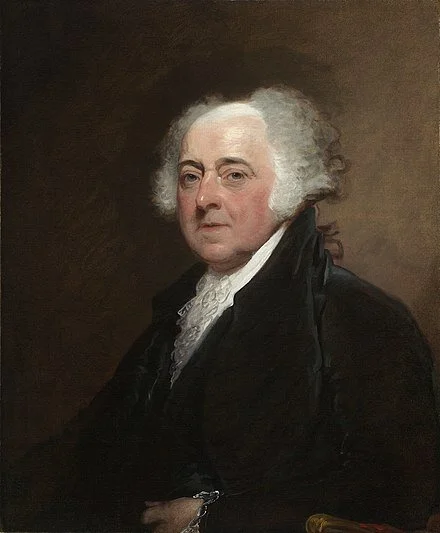
Remember, democracy never lasts long. It soon wastes, exhausts, and murders itself. There never was a democracy yet that did not commit suicide.”
— John Adams (1735-1826), one of the most important American Founding Fathers and the second president
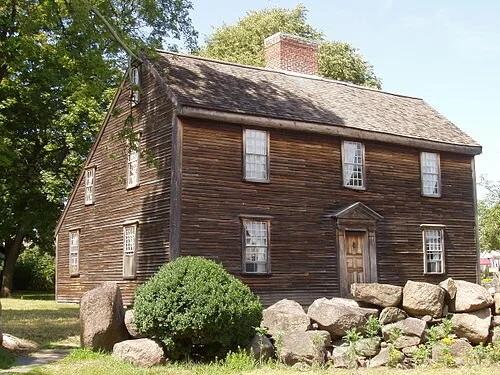
John Adams’s birthplace, at the Adams National Historical Park, in Quincy, Mass.

Urban uplift

Downtown Providence in 1844
Adapted from Robert Whitcomb’s “Digital Diary,’’ in GoLocal24.com
Providence officials, aided by professional planners, are trying to envisage how to improve the city’s downtown by stitching it together more tightly after car-dependent, suburban impulses have tended to fragment it.
Manuel Cordero, co-founder of the nonprofit DownCity Design, said “The idea is to create spaces that are welcoming and vibrant, and to address some of the longstanding issues, such as lighting and accessibility, to create a better set of interconnected spaces for our downtown.’’
Of course, every city needs to try to implement the best design ideas to adjust to changing demographics, technology, architecture, engineering and economics. But that might be even trickier than usual now because of the uncertainties of COVID-19. How might the pandemic permanently change how we live in, work in and visit cities?
To read ecoRI News’s report on this, please hit this link
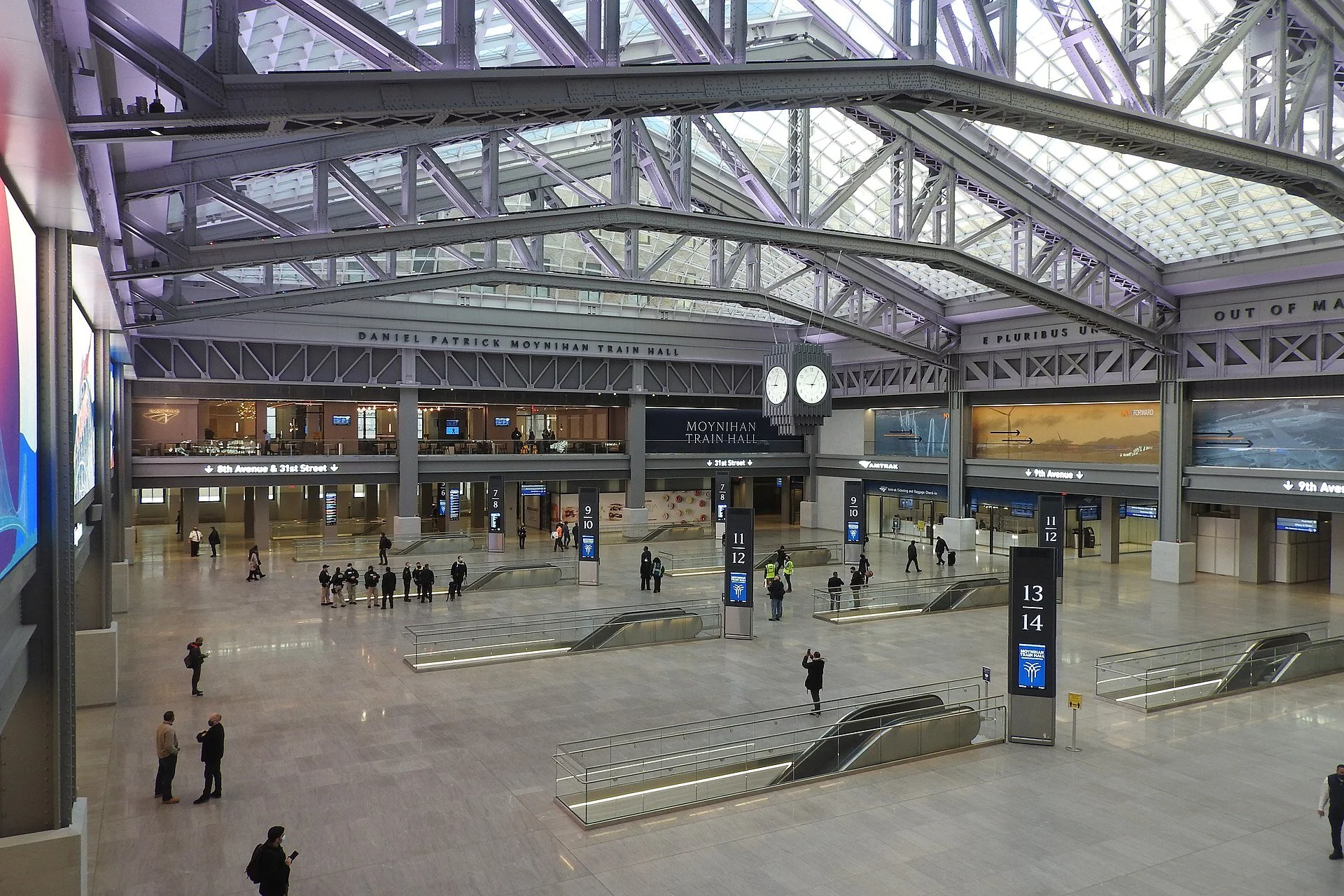
The new Amtrak train hall in the Pennsylvania Station complex.
— Photo by Jim.henderson
One very good piece of urban news, especially for those of us in the Northeast Corridor: A new, natural-light-filled train hall opened Friday in New York’s Penn Station complex. It has 92-foot-high ceilings and glass skylights and recalls the glorious masterpiece that was the Beaux-Arts Pennsylvania Station, opened in 1910 and torn down in ‘60’s. It was replaced by the hideous cavelike, dank, dark and overcrowded Penn Station that we all hate – the busiest train station in America.
The new hall is in the James A. Farley Post Office building, across Eighth Avenue from the main Penn Station, which is under Madison Square Garden.
The facility will only serve Amtrak and Long Island Railroad passengers, at least initially. Subway and other riders/victims must continue to use the old station. But more changes are planned in the passenger-rail complex – by far America’s busiest – in coming years.
What a nice way for New York City, which suffered much from the COVID catastrophe in 2020, to start the new year. And maybe it will inspire the political will to fix a lot more of America’s decayed transportation infrastructure. Big things can still be done, even in mostly gridlocked America, with strong and brave leadership.
The Yale architectural historian Vincent Scully (1920-2017) famously bemoaned the destruction of the 1910 Pennsylvania Station: “Through Pennsylvania Station one entered the city like a god. Perhaps it was really too much. One scuttles in now like a rat.”
Safer than in person
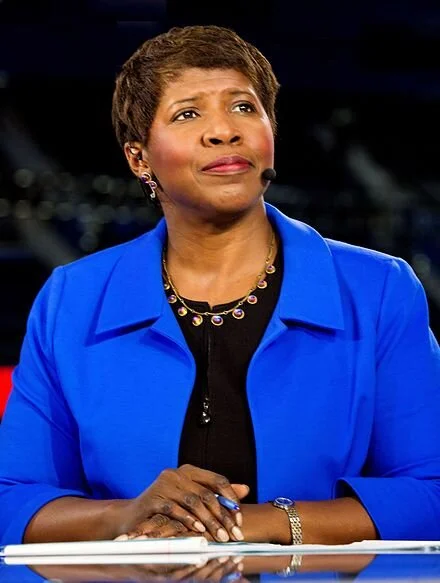
“I learned how to cover race riots by telephone. They didn't pay me enough at my first newspaper job to venture onto the grounds of South Boston High School when bricks were being thrown. Instead, I would telephone the headmaster and ask him to relay to me the number of broken chairs in the cafeteria each day.’’
— Gwen Ifill (1955-2016), best known for her work as a PBS journalist, on her reporting of the Boston school-desegregation crisis for the old Boston Herald American in the late ‘70s. She graduated from Springfield Central High School and Simmons College, in Boston.
Better have that rash looked at
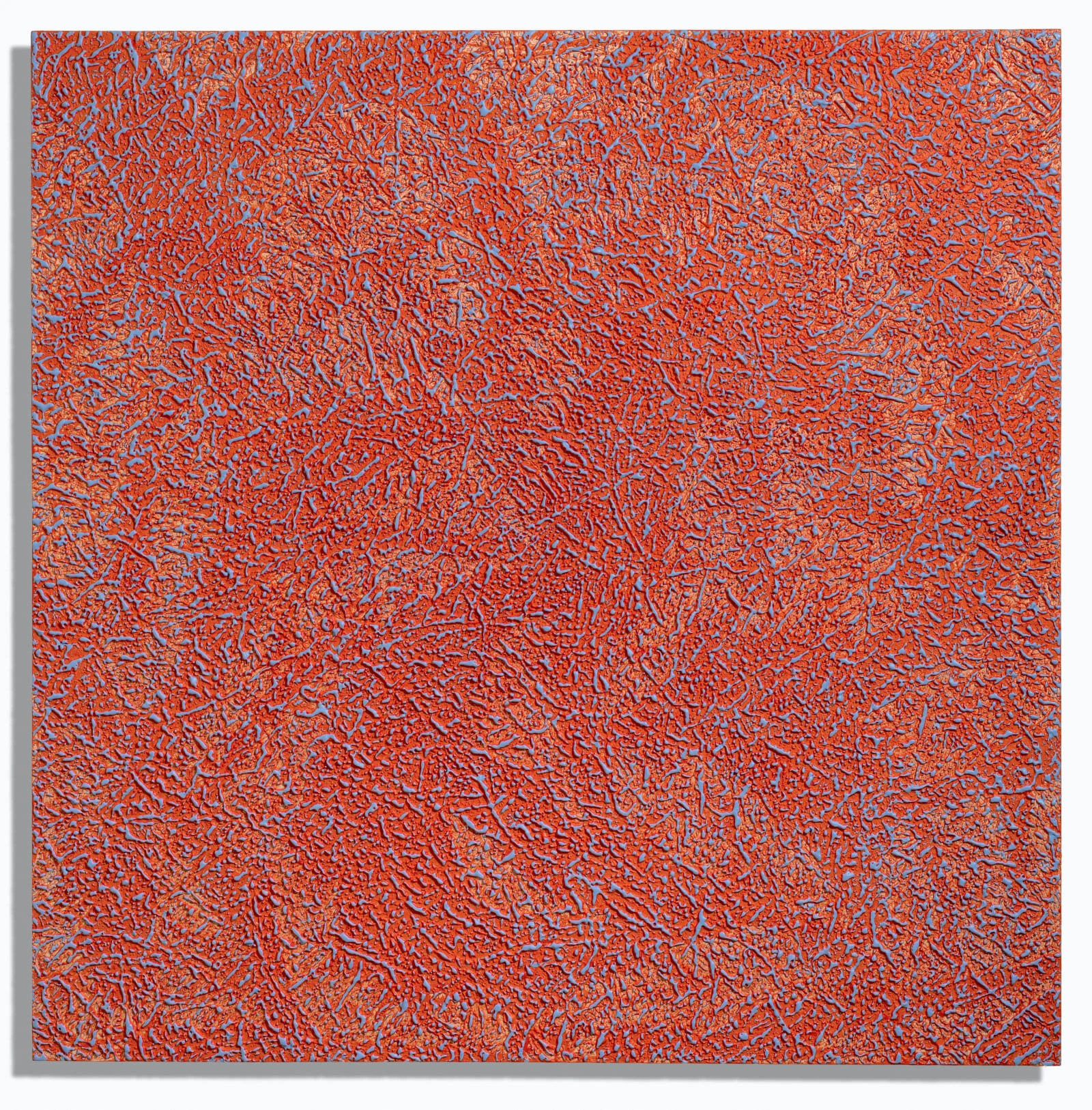
Encaustic painting from Martin Kline’s show “Allover,’’ at Heather Gaudio Fine Art, New Canaan, Conn., Jan. 23-March 6.
The gallery says:
“Throughout the course of his career, Kline has examined systems of historicism and presentation, his focused and disciplined approach creating bodies of works in series, each with their distinctive visual language. Among his many investigations, Kline has looked to notions of authenticity, sincerity and originality, and, as he states, there comes a point when an artist ‘cannot escape Jackson Pollock’ For this exhibition, Kline presents his newest group of paintings entitled “Allover,’ inspired by the drip technique he used in “Dream of Pollock’’ (for Kirk Varnedoe) back in 2007.
The multi-colored “Allover’’ series consists of, for the most part, strictly monochromatic abstractions. Created in a looser, automatist fashion, these paintings have a more fluid sensibility, with random thread-like rivulets of pigment networked in and out of broader, purposeful bands of color. Unlike previous series, these paintings lack compositional focal points, nor do they possess narrative characteristics seen in his Hammocks assemblages. The viewer’s eye is free to wander all over and engage with the painted surface indiscriminately.
”While Kline may be revisiting the spontaneous technique for which Pollock became famous, the approach to painting with the panel positioned horizontally has been very much decidedly his own from early on. Kline has mostly worked on his surfaces laid horizontally, typically on a tabletop—his signature additive approach to painting requiring the pull of gravity to fasten the pigments in situ while drying. For the most part, Kline’s hand has had a direct touch through the use of a paintbrush on the paper, panel or canvas. In the Allover paintings, Kline is still working horizontally but he has severed the traditional anatomical connection, distancing himself from the surface even more by placing the panels on the floor. This increased space relinquishes control for the drips and pours to act more randomly and allow for elements of surprise to occur. Most of the panels in this series lack confining frames and the sides are free of splashed pigments that reveal the process. The resulting suggestion is that the drips and thicker gestures of color travel beyond the picture plane. It is as if the viewer is getting a snapshot, a window into elements that exist outside the painting’s boundaries.’’
Squeeze out some more

Looking toward Calais, Maine, across the St. Croix River from St. Stephen, New Brunswick
“In Maine, there is a deeply ingrained sense that you can always get a little more use out of something.’’
— Tim Sample (born 1951), in Maine Oddities, Curiosities and Roadside Attractions, longtime New England regional humorist
He lives in Calais, Maine, far Downeast.
On June 16, 1809, Plantation Number 5 PS was incorporated as Calais, named after Calais, France, in honor of French help during the American Revolution. The St. Croix River provided the mill town with water power for sawmills, clapboard and shingle mills, two planing mills, a saw factory, two axe factories and four grain mills! There were foundries, machine shops, granite works, shoe factories and a tannery. Other businesses produced bricks, bedsteads, brooms, carriages and plaster. Not bad for a community that now has only about 3,100 people! There’s still a lot of fishing in the area but most of the other industry is long gone.
Calais and the neighboring Canadian town of St. Stephen have long been remarkably friendly. Consider that during the War of 1812, the British military provided St. Stephen with a lot of gunpowder for protection against the enemy Americans across the St. Croix River in Calais, but St. Stephen's town elders gave the gunpowder to Calais for its Fourth of July celebrations.
Calais hosted the first railroad built in Maine, the Calais Railroad, incorporated by the state legislature on February 17, 1832 and built to transport lumber from a mill on the St. Croix River.
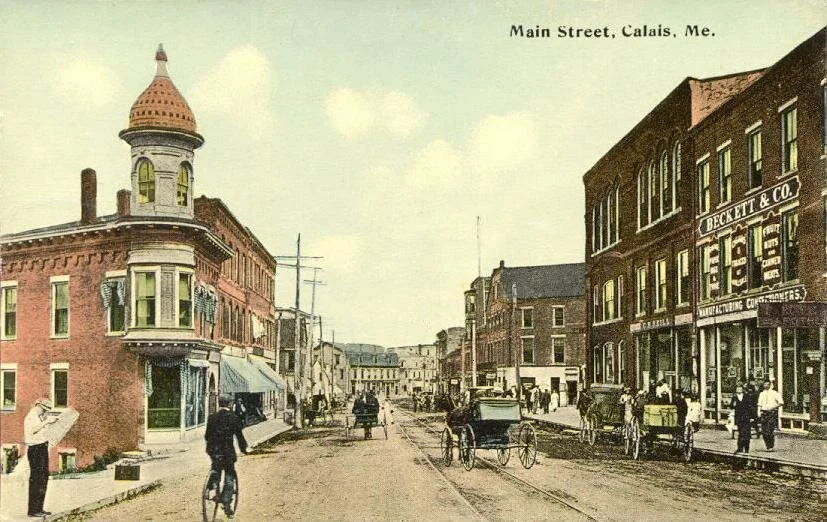
Main Street in Calais in 1913 — more prosperous than now
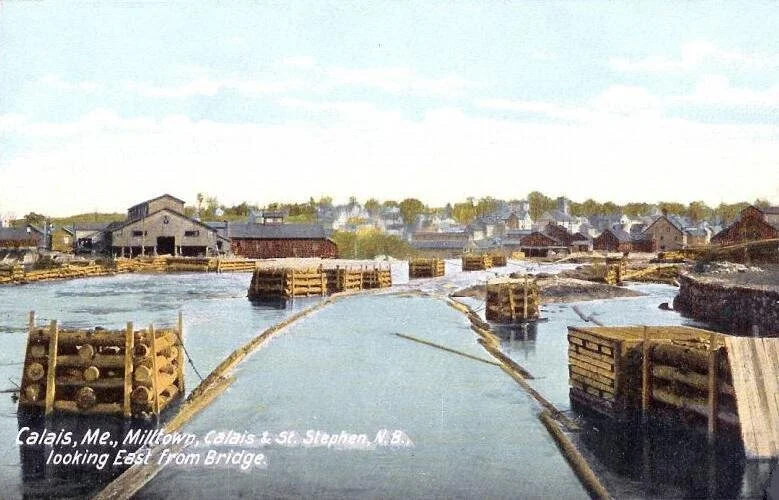
1908 postcard. Note the lumber being transported.
—