
America the Dizzy in 2020
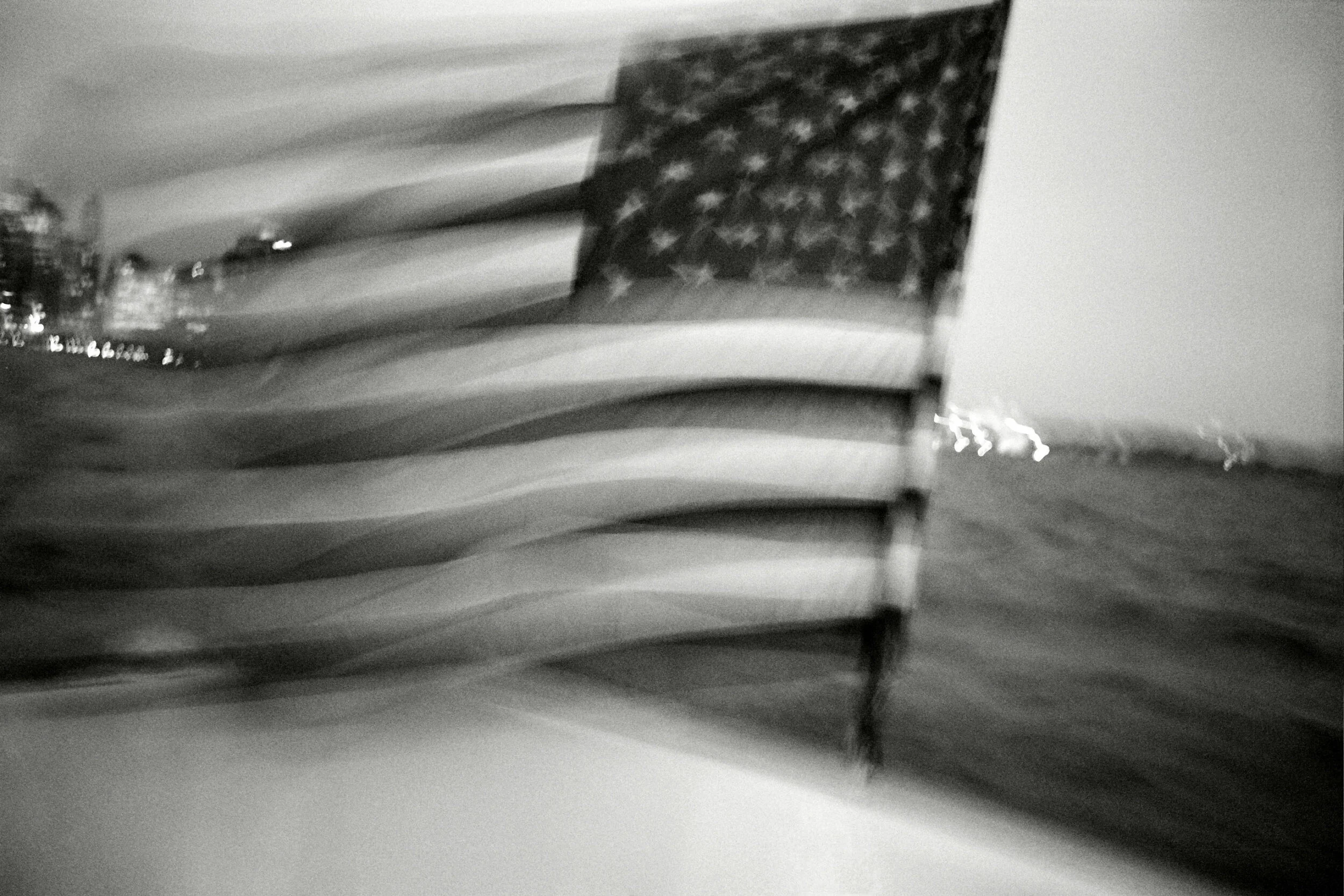
On a launch in New York Harbor
— Photo by Philip K. Howard, New York-based photographer, civic reformer, lawyer, arts leader and author.
See:
https://philipkhoward.com/
A 'flat push'

“Outside the snow comes rolling in
from the flats of Quebec. It’s the flat push
on things I fear. The north glass
rattles and bulges….’’
— From “Storm,’’ by John Engels (1931-2007), a Vermont poet. He taught at St. Michael’s College, in Colchester, just north of Burlington.
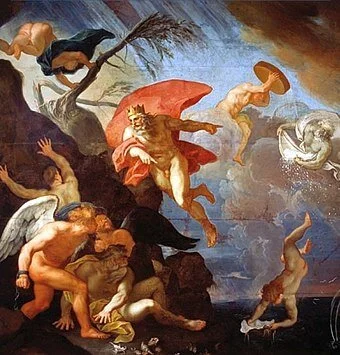
“Allegory of Winter,’’ by Jerzy Siemiginowski-Eleuter (1683)
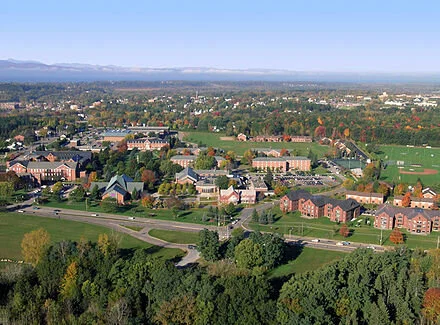
St. Michael’s College
Blessings of age

Maple between spruce trees
“I am in love with the world. And I look right now, as we speak together, out my window in my studio and I see my trees and my beautiful, beautiful maples that are hundreds of years old, they’re beautiful. And you see I can see how beautiful they are. I can take time to see how beautiful they are. It is a blessing to get old. It is a blessing to find the time to do the things, to read the books, to listen to the music.”
— Maurice Sendak (1928-2012), children’s author. He lived in Ridgefield in western Connecticut. The town hosts the Aldrich Museum of Contemporary Art. (See picture below.)


Sugar maple in early summer

Aldrich Museum of Contemporary Art
Finding genetic variations in severity of COVID-19 symptoms

— Photo by Tim Pierce
Here’s the latest roundup of COVID related developments in the region from The New England Council (newenglandcouncil.com):
“Researchers at Beth Israel Deaconness Medical Center have shed light on COVID-19 symptom severity with new research. The study, published in the New England Journal of Medicine, reveals the role of genetic variations in the severity of COVID-19 symptoms. Read more here. And:
Mass General Brigham has joined with news publications as well as hospitals and health systems across the country to urge people to continue to wear masks during this critical period. Read more here.
Harvard University Medical School researchers have created a new tool for the creation of new adult cells for research. The new Human TFome systems will allow cells to be customized by researchers to the disease they are studying. Read more here.’’
The joy and pathos of life
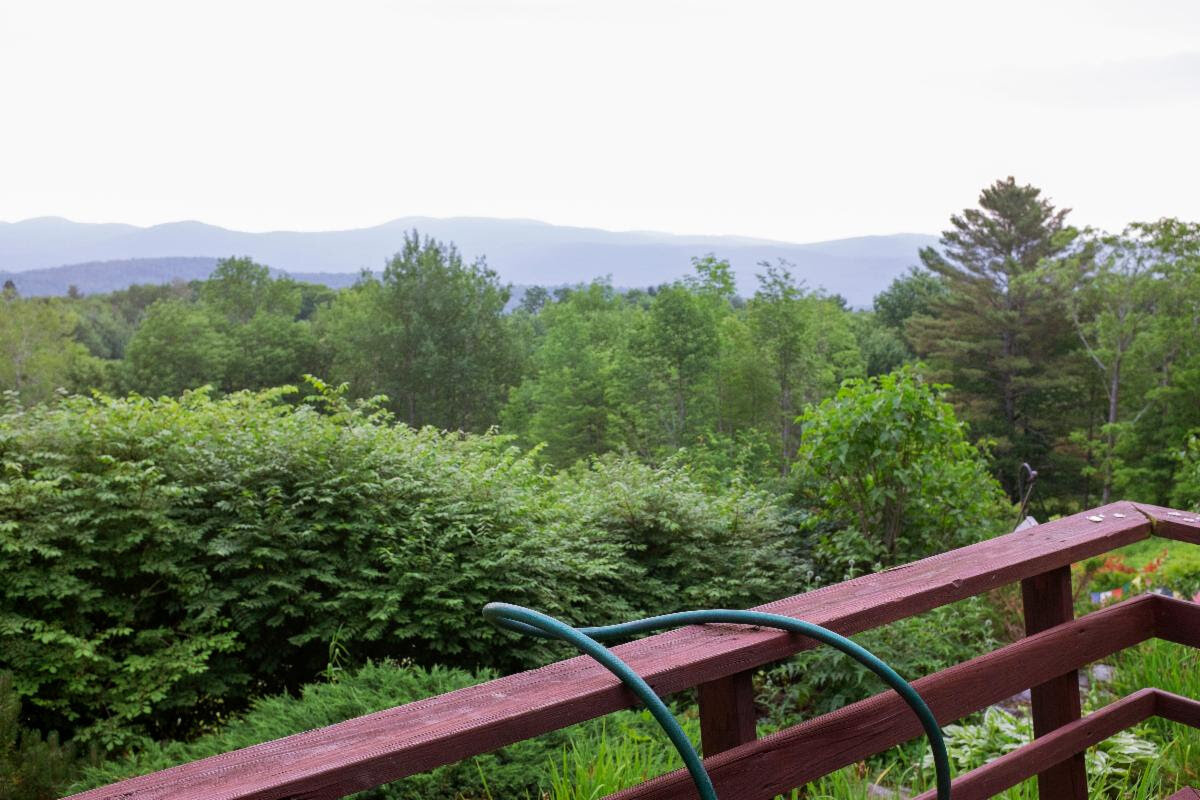
“Garden hose and deck, Ryegate VT, July, 2019” (archival digital print) in Mary Lang’s show “Small Moments of Sad-Joy,’’ at Kingston Gallery, Boston, Dec. 8-Jan. 17.
The gallery says:
“Mary Lang reflects on the Japanese phrase ‘Mono no Aware,’ the pathos of things, in her newest collection of photographs. A garden hose draped over a railing, a field of Queen Anne’s lace at dusk, the arc of a sprinkler all speak to the entrenched feeling of wistful sadness. That fundamental reality builds its foundation on uncertainty. These photographs are not from distant or grandiose places but show quiet, fleeting moments in her backyard, around the corner from her house, and at friends’ yards in Upstate New York and Vermont. Lang borrows the term ‘sad-joy’ from Chӧgyam Trungpa, to describe the joy of being alive while still in touch with the suffering and impermanence of the world. In this exhibition, Lang asks the viewer to consider, feel, and marvel at the pathos of things.’’
Mainiac chronicler
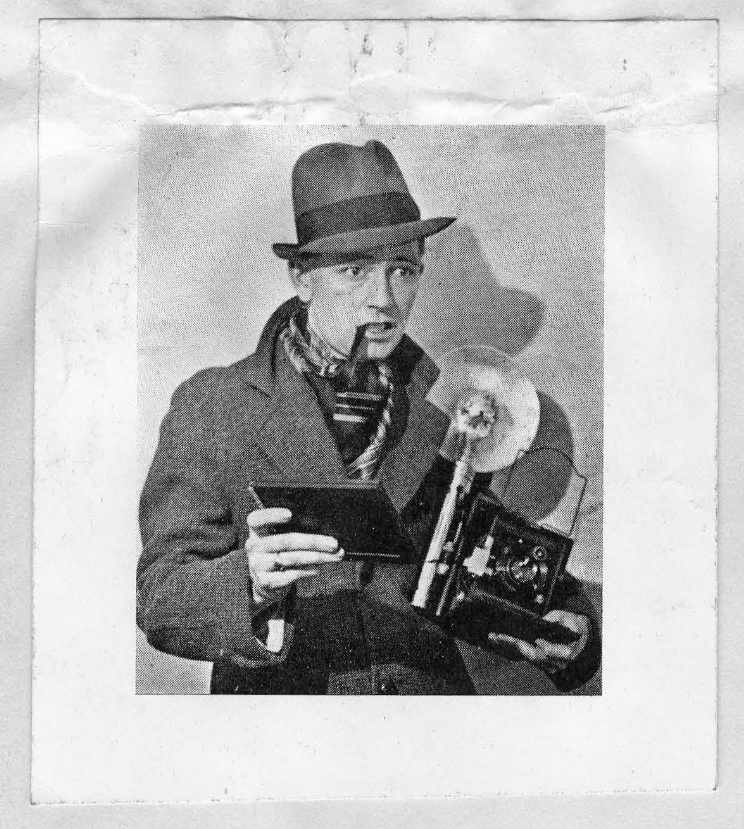
John Gould
From Robert Whitcomb’s “Digital Diary,’’ in GoLocal24.com
John Gould (1903-2008) was a Maine-based newspaper reporter, essayist, raconteur and book author. He was usually engaging and often very funny. You see this in his 1978 book This Trifling Distinction: Reminiscences from Down East. It made me nostalgic for the fun, sometimes crazy, days of newspapers in their golden years, small town and big city. And as the book cover notes, “In Gould’s Maine everybody is either an author or a character.’’
'A local abstraction;'

Mist upstream of the Bissell Bridge, between Windsor and South Windsor, Conn
”It is the third commonness with light and air,
A curriculum, a vigor, a local abstraction . . .
Call it, one more, a river, an unnamed flowing….’’
— From “The River of Rivers in Connecticut,’’ by Wallace Stevens (18790-1955). It’s “about” the Connecticut River. Like many in the Nutmeg State in his lifetime, he was an insurance executive.

“View of the City of Hartford, Connecticut,’’ by William Havell, a 19th Century painter
Better than Chartres
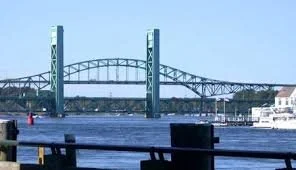
The Piscataqua River Bridge, which connects Portsmouth, N.H., and Kittery, Maine, and on E.B. White’s route from New York City, where he worked off and on for decades.
“What happens to me when I cross the Piscataqua and plunge rapidly into Maine at a cost of seventy-five cents in tolls? I cannot describe it. I do not ordinarily spy a partridge in a pear tree, or three French hens, but I do have the sensation of having received a gift from a true love. And when, five hours later, I dip down across the Narramissic and look back at the tiny town of Orland, the white spire of its church against the pale-red sky stirs me in a way that Chartres could never do. It was the Narramissic that once received as fine a lyrical tribute as was ever paid to a river—a line in a poem by a schoolboy, who wrote of it, ‘It flows through Orland every day.’ I never cross that mild stream without thinking of his testimonial to the constancy, the dependability of small, familiar rivers.”
E.B. White in “Home-Coming,’’ in Essays of E.B. White (1899-1985) (Harper & Row, 1977). He was a famed essayist and author of the children’s books Charlotte’s Web and Stuart Little. He and his wife had a small farm in Brooklin, Maine, on the Blue Hill Peninsula, first as a summer place and then mostly year-round.

The Rockbound Chapel, in Brooklin.

The book was inspired by White’s life on his farm in Brooklin.
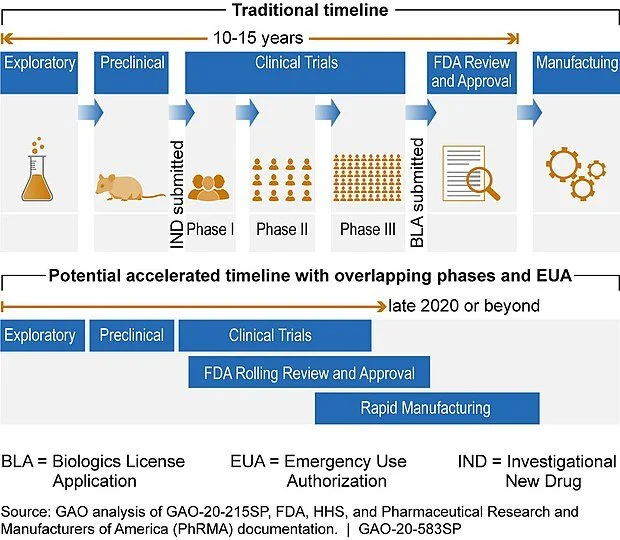
David Warsh: A great victory in vaccine making and marketing
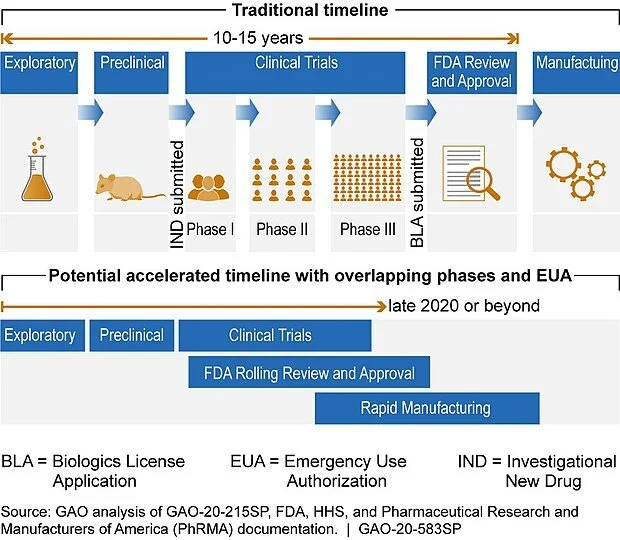
U.S. Government Accountability Office diagram comparing a traditional vaccine-development timeline to an expedited one
SOMERVILLE, Mass.
I often struggle to explain why I consider the Financial Times the best newspaper that I read. But my conviction begins with the consideration that the FT shows for my time and attention, as if it expects I have other things to do (in my case also reading The New York Times, The Washington Post and The Wall Street Journal). There are no “jumps,” all stories in the daily report end on the page where they begin. The front page displays just two stories (along with many teases of stories elsewhere in the paper); then come three pages of general news from around the world, followed by several pages of company and markets news; two pages of market data set in small type; a page of arts criticism, a full-page story (“The Big Read”); an editorial and letters page with four columns opposite, and, of course, the second most widely read page of the section, the “Lex” column of edgy newsy tidbits on the back. It is a thrifty package.
My deeper admiration, however, has to do to with the news values that the paper displays throughout. Last week presented a prime example. It takes a good deal of self-confidence to run out a story under the headline, “Trump vaccine chief proves critics wrong on Warp Speed: Industry veteran navigated political hurdles to boost drug companies’ fight against virus.”
But reporters Hannah Kuchler and Kiran Stacey had delivered a persuasive story. Since the article itself remains behind the FT paywall, I quote more extensively than I might otherwise to convey the gist. They began:
Sitting in the shadow of the brutalist health department building in Washington, with only a leather jacket for protection against an autumnal breeze, Moncef Slaoui cuts a defiant figure. Six months after the former GlaxoSmithKline executive left the private sector to become President Donald Trump’s coronavirus vaccine tsar, Mr Slaoui feels his decision has been vindicated, and critics of the ability of Operation Warp Speed to develop a vaccine in record time have been proved wrong.
“The easy answer for experts was to say it was impossible and find reasons why the operation would never work,” he told the Financial Times. But the vaccine push is now hailed as the bright spot in the Trump administration’s Covid-19 response, as products from Pfizer and BioNTech, Moderna, and AstraZeneca and Oxford university move closer to approval.
The next day, Karen Weintraub, of USA Today, produced an in-depth profile of Slaoui, a Moroccan-born Belgian-American vaccine developer and retired drug company executive. It is fascinating reading. But the authority of the FT account derived from the three experts the reporters quoted zeroing in on the management tool that Slaoui used to achieve his results, known as advance market commitments. or AMCs (and from a little Reuters sidebar that listed some of the spending on pre-approved doses by the U.S. government’s Biomedical Advanced Research and Development Authority (BARDA):
The central achievement of Operation Warp Speed had been accelerating investment in manufacturing, said Angela Rasmussen, a virologist at the Columbia University School of Public Health. “Normally, that would be a huge investment for a vaccine manufacturer to make, and potentially be a huge loss for them if they developed a vaccine that never went on to the market,” she said.
Even Pfizer, which did not take direct investment from Operation Warp Speed, benefited from having a $2bn pre-order for when its vaccine gets approved, said Peter Bach, director of the Center for Health Policy and Outcomes at Memorial Sloan Kettering. “Even if J&J or someone else beat them to the punch, they were going to get paid,” he said.
Stéphane Bancel, chief executive of Moderna, the lossmaking biotech which took about $2.5bn in government funding from different bodies, said the money was “very helpful”, covering the costs of trials and helping it to buy raw materials. “The entire planet is going to benefit from it,” he told the FT. “We are going to file [for approval] in the UK based on the US data paid for by the US government. We’re going to file in Europe and hopefully have a vaccine available in France and Spain and Italy, all paid for by the US government.”
Part of the charm of the story turns on its rarity; it hadn’t been easy for mainstream media to find nice things to say about the Trump administration. The road to Slaoui’s hiring probably leads back to Vice President Mike’s Pence’s appointment in February as head of the White House Coronavirus Task Force. As former governor of Indiana, Pence’s connections with the pharmaceutical industry are tight; Indianapolis is home to major firms, including Eli Lilly and Purdue Pharma. Much remains to be learned.
But the mechanism known as advanced market commitment is of comparatively recent origin. It is the discovery, if that is the word, of University of Chicago economist Michael Kremer, in a series of papers he wrote while teaching at the Massachusetts Institute of Technology and Harvard University some 20 years ago, culminating in the publication, in 2004, of Strong Medicine: Creating Incentives for Pharmaceutical Research on Neglected Diseases, with his wife, Rachel Glennerster, in 2004.
The new mechanisms they advocated were similar to those that in the 18th Century gave rise to the development of the naval chronometer, necessary to determining longitude at sea. Governmental “pull” methods could complement the inherently risky “push” of private research and development. AMCs – legally binding commitments to buy specified quantities of as yet unavailable vaccines at specified prices – were the most promising of the lot for bringing into existence medicines that otherwise might not pay. I wrote in 2004 that the general line of argument of the book was “one more example of why, more than ever, governments today need talented and sophisticated regulators. Technology policy has become as important as monetary policy – in some respects, maybe more so.” (I am told that governmentally guaranteed long-term purchase contracts were the backbone of creating the Indonesia-Japan LNG trade, and developing so-called private power generation in the U.S.)
I asked Kremer last week if he had been involved in the Warp Speed journey, The answer was no. He and co-authors had spoken to staff at the Council of Economic Advisers in the run-up to the creation of Operation Warp Speed. They had co-authored an op-ed article in The New York Times last May. But they had not met with Slaoui. He seems to have imbibed the basic idea as long ago as 2013, when he organized a session on the industry’s stock of common knowledge for the Aspen Ideas festival
Kremer was recognized with a Nobel Prize in economics, with two others, in 2018, for work on policy evaluation, including the work on vaccines. But I was struck when Wall Street Journal editorial-page columnist Daniel Henninger suggested last week that the scientists at the pharmaceutical companies who developed vaccines against COVID-19 were “the obvious recipient for 2021’s Nobel Peace Prize.”
There’s no doubt that we owe a considerable debt of gratitude to the scientists. But it was the administration’s Operation Warp Speed that organized their successful quests. A Peace Prize for the swift development of vaccines is a very good idea, not for President Trump or for Vice President Pence, nor even, to make a needed point, for Moncef Slaoui. It is a pretty thought, but remember that Russian and Chinese scientists also produced vaccines. Let the Norwegian parliament figure it out!
David Warsh, an economic historian and a veteran columnist, is proprietor of Somerville-based economicprincipals.com, where this column first appeared.
Their little aerial game

Dropping sticks is a game
the summer crows have learned to
play, flying from May
to September, one above the other.
The higher lets his toy fall through the
air to the other of the pair,
who returns the favor. We gulp
to see these evening acrobats climb so
high, printed black against the sky
above the blacker hills.
They become absorbed in their little
game. It seems so tame:
one drops a stick, the other catches it,
what more is there to
say? Just that every day
my heart drops with it
through the empty air, till a strange
and gay and capricious bird, unknown to
me, catches that heart, and it soars again.
“Dropping Sticks,’’ by Frank Robinson, an Ithaca, N.Y.-based poet, art historian and a former director of the Johnson Museum of Art at Cornell University and the Museum of Art at the Rhode Island School of Design

“American Crow,’’ by John Jacob Audubon
Not enough in Newport
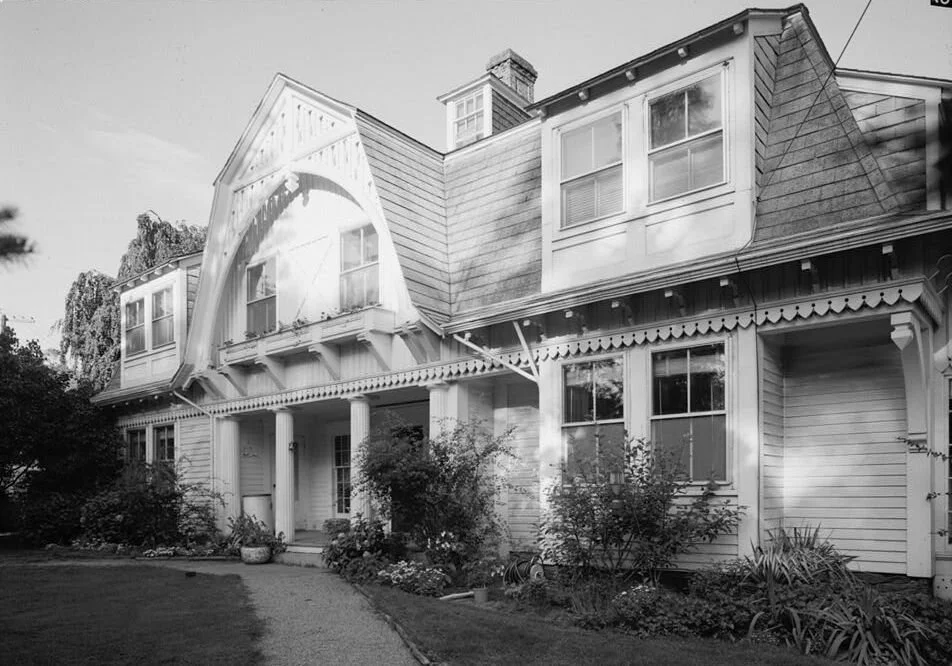
“Hypotenuse", which was the Newport home of Gilded Age architect Richard Morris Hunt (1827-1895)
“To me Newport could never be a place charming by reason of its own charm. That it is a very pleasant place when it is full of people, and the people are in spirits and happy, I do not doubt. But then the visitors would bring, as far as I am concerned, the pleasantness with them”
~ Anthony Trollope (1815-1882), British novelist and civil servant
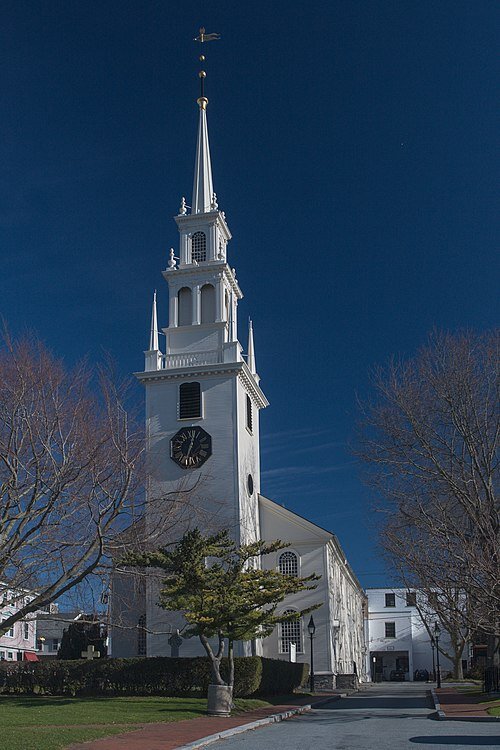
Famed Trinity Church in Newport, designed by Richard Munday and built in 1725-26. It hosts the oldest Episcopal parish (founded in 1698) in Rhode Island.
“I once knew an Episcopalian lady in Newport, Rhode Island, who asked me to design and build a doghouse for her Great Dane. The lady claimed to understand God and His Ways of Working perfectly. She could not understand why anyone should be puzzled about what had been or about what was going to be.
And yet, when I showed her a blueprint of the doghouse I proposed to build, she said to me, “I’m sorry, but I never could read one of those things.”
“Give it to your husband or your minister to pass on to God,” I said, “and, when God finds a minute, I’m sure he’ll explain this doghouse of mine in a way that even YOU can understand.”
~ Kurt Vonnegut, (1922-2007), American novelist, in Cat’s Cradle
Lost, found and reworked

Detail of one of Rebecca McGee Tuck’s sculptures of found objects in her current show at Fountain Street Fine Art, Boston. She tells the gallery:
“The inspiration for all of my work comes from found objects that I collect or that friends and family have found and have thought to give to me. I like to call these emotional artifacts. An entire sculpture can be inspired by one small item. I love to fabricate stories about the history of the objects. The best day in my studio is when I completely lose myself in the back story of my work. I may begin with a photograph or an old crinkly sewing pattern, but I will end the day with a sculptural narrative.’’
See:
https://www.rebeccamcgeetuck.com/blog
and:
https://www.fsfaboston.com/
Inconvenient state lines

Adapted from Robert Whitcomb’s “Digital Diary,’’ in GoLocal24.com
Within states and regions, such as New England, that population profiles don’t follow state lines makes coherent and effective policies difficult to put together, especially in matters such as public health, for which the states have primary responsibility. While states may impose various (mostly unenforceable) rules to try to control the spread of COVID-19, those rules may have little relationship with where and how people live.
Consider that western Massachusetts is far less economically and travel-wise connected with Greater Boston than are Rhode Island and southeastern New Hampshire, with their many commuters in and out of “The Hub.’’ And yet Massachusetts policymakers can’t impose rules that fully address that.
New York Gov. Andrew Cuomo has gone further than any other governor in facing the fact that diseases don’t obey state borders by trying to collaborate closely with New Jersey and Connecticut in testing, quarantine and travel rules. He’s accepting the obvious: Southern New York State and much of the Garden and Constitution states are all in the same dense Greater New York City region.
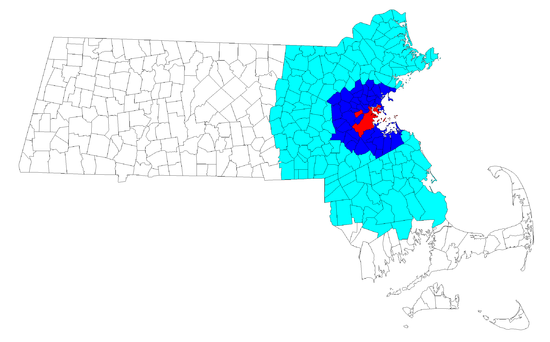
Light blue represents the area known as Greater Boston, dark blue represents the Metro-Boston area and red represents the City of Boston proper.

Roger Foo: Genetic research holds out new hope in battle against heart disease

SINGAPORE
Many of us remember what we were doing on the day of a significant global event. The day that airliners were flown into the World Trade Center and the Pentagon. The day that the Berlin Wall came down. The day that a tsunami hit the shores of Indonesia.
As a physician, I remember one day during my ward rounds in 2000 when then-British Prime Minister Tony Blair and then U.S. President Bill Clinton announced that the full human genome was finally sequenced. While it was inspiring to hear that the “blueprint” of humans was now known, I still had sick patients on my list yet to be seen and discharged. For them, the relevance of the discovery could not have felt more remote.
Not every advance is momentous. Most ground-breaking changes cannot be pinpointed to a single press conference. They are instead the result of many smaller, incremental advances, as we cardiologists would be soon be reminded.
Around the time we first understood the human-genome sequence, we discovered that humans have virtually the same number of coding genes (roughly 20,000) as a worm or fish.
What makes us different are the 3 billion remaining base pairs of the non-coding genome. In these, we find what are called gene regulatory elements. They are more easily visualized as “switches” that control when and how much our genes are expressed.
The blueprint of the human genome can be thought of as a songbook. Different musical notes are sung by different cells, often in unison. And so, we have lung cells performing differently from heart or liver cells even though they all have the same blueprint. The circuitry involved is intricate.
Despite this complexity, now is a fantastic time to be working in genomic research. Technological advances reveal how different sections of the genome and its switches underpin cellular functions throughout the body. With technology, doctors can sequence our patients’ genomes at accessible cost, control their gene expression and even edit their blueprint. This lets us target the root cause of diseases.
Indeed, such technology has already informed life-saving new therapies for cancer. When cardiologists watched Mr Blair’s and Mr. Clinton’s 2000 announcement, it kindled hopes for new cures and therapies. Now, we’re finally moving closer to such solutions for complex and multifactorial heart diseases.
For example, mapping out the genes that cause high cholesterol has had a huge impact. We now think that it may be possible to safely edit such genes in adult genomes, giving people a reduced risk or even lifelong protection against heart disease. In the meantime, suppressing gene expression related to heart disease using twice-yearly injections of gene-targeting medicines will be far more effective than the daily oral doses of statins that patients currently take.
A new generation of medicines is emerging as a result of our ever-deepening understanding of the genomic map. Targeting genomic switches in order to reprogram gene expression would reverse the course of disease rather than simply slow its progression. The latter is what nearly all medicines today do.
The future of cardiology glows with excitement as we pursue a solution to the scourge of heart disease, which blights the lives of many – particularly those at elevated risk, such as the elderly and sufferers of metabolic diseases and diabetes. These risk factors are at an all-time global high. For cardiology, the next generation of ground-breaking medicines is firmly on its way and could not be welcomed sooner.
Roger Foo , M.D., is Sheikh Zayed bin Sultan Al Nahyan Professor in Medicine at the National University of Singapore.

Human genes by function of the transcribed proteins, as number of encoding genes and percentage of all genes
‘Unlearn us bustle’

“…the calm of the pond, and the guilt of the ocean
hushing secrets along dorchester’s shores. beantown,
the best to keep the kept. slades on tremont and bintou’s
in roslindale. home is the booth we plop into, the cafes
where the cashier craft meals that fill us. dear city,
southwest corridor thumming from the subway racing
against air. patron saint of travelers, plague of trolleys,
hold us still at lights, unlearn us bustle and hand us
patience. ..’’
— From “Boston Ode,’’ by Porsha Olayiwola, Boston’s poet laureate
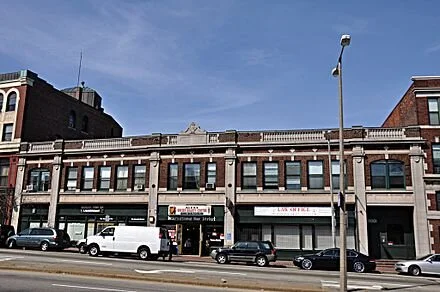
The Uphams Corner section of Dorchester, with a typical urban streetscape found in the neighborhood
Chris Powell: Running empty trains won't increase production; some people seem to be enjoying their pandemic lockdowns

— Photo by Chianti
MANCHESTER, Conn.
While Connecticut Gov. Ned Lamont remarked the other day that state government doesn't have enough money to rescue every business suffering from COVID-19 pandemic, most people think that the federal government has infinite money and can and should make everyone whole.
Sharing that view, Connecticut U.S. Sen. Richard Blumenthal this week went to the railroad station in West Haven to join Catherine Rinaldi, president of the Metropolitan Transit Authority, in calling for an emergency $12 billion federal appropriation for the MTA, which runs the Metro-North commuter railroad line from New Haven to New York City. Metro-North has lost 80 percent of its passengers and fares because of business curtailments and the shift to working from home.
There are two problems with the appeal from Blumenthal and Rinaldi.
First, there is no need to keep Metro-North operating on a normal schedule when most passengers are missing. Except for railroad employees, no one is served by running empty trains.
Indeed, curtailment of commuter-rail service might make time to renovate the tracks and other facilities. Rather than furloughing railroad employees, hundreds of them might be reassigned temporarily to collect the trash that litters the tracks between New Haven and New York. The savings on electric power from running fewer trains still would be huge.
The second problem is that the federal government's power of money creation is infinite only technically. While nothing in law forbids the federal government from spending any amount, money is no good by itself. It has value only insofar as it has purchasing power -- only insofar as there are things to be purchased, only insofar as there is production and with so many people out of work or working less during the epidemic, production has fallen measurably. Operating empty trains won't increase production, but spending $12 billion to operate them may worsen the devaluation of the dollar, whose international value recently has fallen substantially amid so much money creation.
So it might be far better to add that $12 billion to public-health purposes.
The $12 billion desired by the MTA is only a tiny part of the largess imagined by the incoming national administration and many members of Congress who will be returning to Washington next month. They are contemplating another trillion dollars in bailouts, and that's just for starters. Such is the damage done to the national economy by the epidemic and government's often clumsy responses to it.
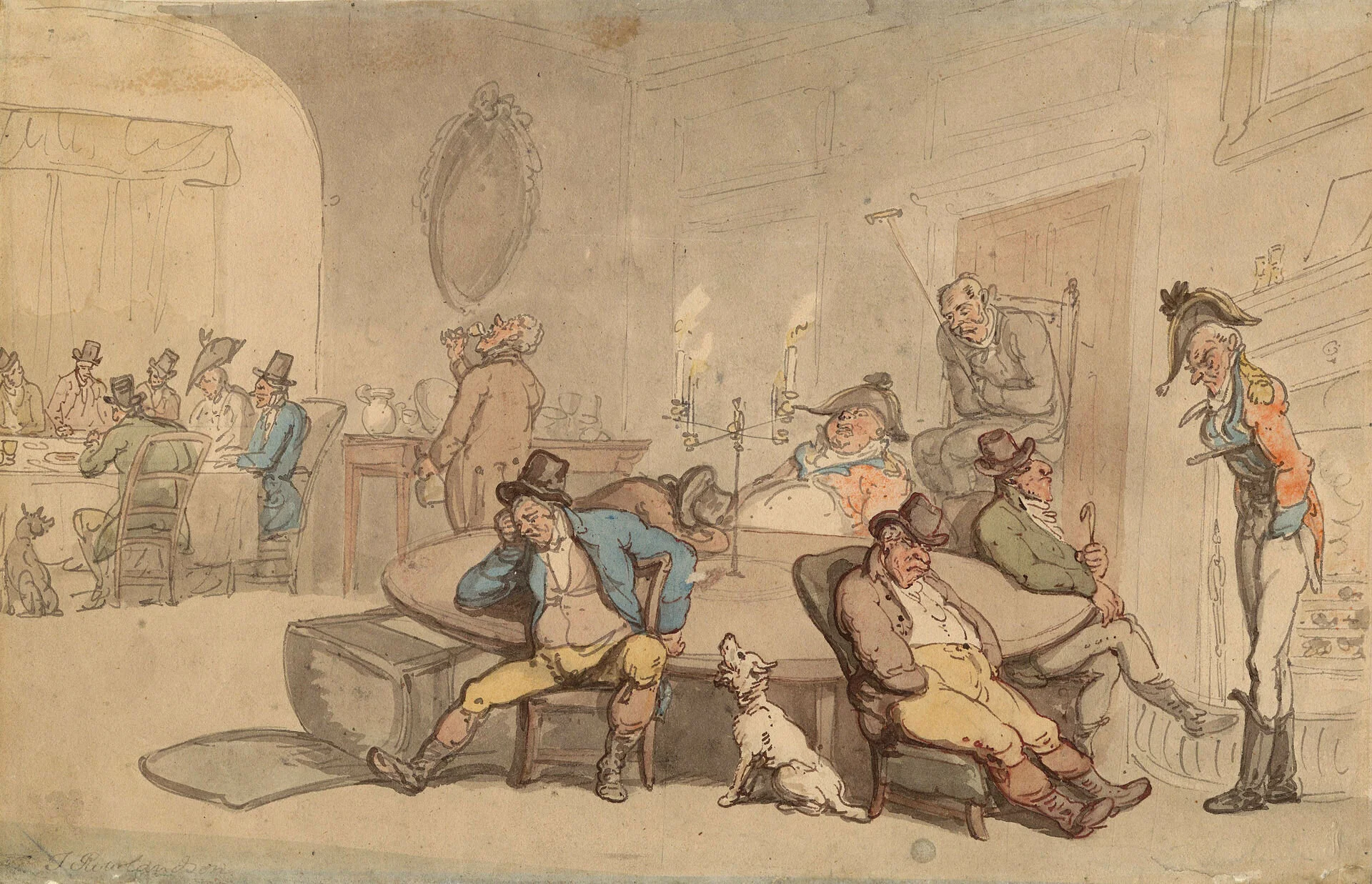
“Scene in club lounge,’’ by Thomas Rowlandson (1757-1827)
Amid all the seemingly free money, some people are starting to enjoy lockdowns or at least finding them tolerable, especially those who, like many government employees, get paid as usual whether they work or not.
This week two Hartford City Council members, Wildaliz Bermudez and Josh Mitchtom, called on the governor to use the state's $3 billion emergency reserve to pay everybody to stay home for a month and to stop most commercial operations in the name of slowing the spread of the virus. Bermudez and Mitchtom seemed unaware that the emergency reserve is already expected to be consumed by the huge deficits pending in next year's state budget. The reserve won't come close to covering all the shortfalls.
But then getting paid for doing or accomplishing nothing is a way of life in Hartford, encouraged by state government's steady subsidy of so many failures in the city.
Last week a group of 35 doctors went almost as far as those Hartford council members, urging the governor to close gyms and restaurants and to prohibit all “unnecessary” gatherings so as to stop the virus and prevent medical personnel from being overwhelmed. It didn't seem to bother the doctors that those businesses and their employees already have been overwhelmed by commerce-curtailment orders, suffering enormous losses, including business capital and life savings. The doctors are inconvenienced now and may be more so but they won't be losing their life savings and livelihoods.
The governor is trying to strike a balance among all these interests. Every day presents him with another difficult judgment call that upsets someone. He may be realizing that Connecticut is just going to have to tough it out and accept some casualties all around.
Chris Powell is a columnist for the Journal Inquirer, in Manchester.

When utopian libertarians took on a N.H. town

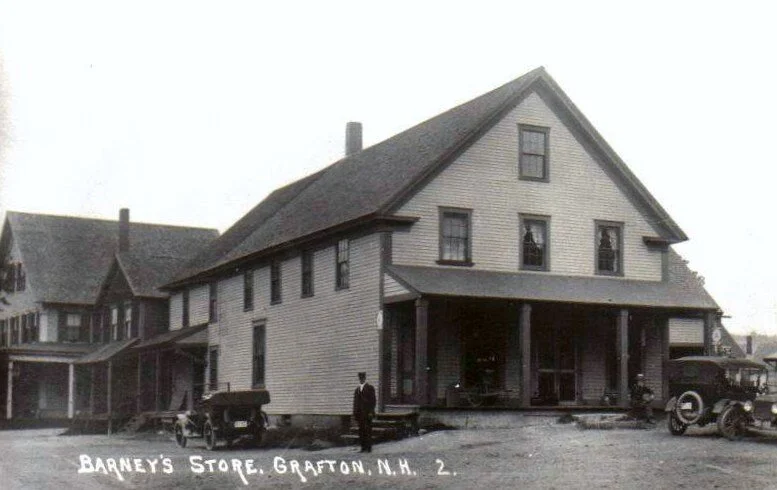
In continuous operation since the 1840s, this store is now known as the Grafton Country Store. Image c. 1919
“The four libertarians who came to {Grafton} New Hampshire had thinner wallets than…other would-be utopians, but they had a new angle they believed would help {in 2004} them move the Free Town Project out of the realm of marijuana-hazed reveries and into reality. Instead of building from scratch, they would harness the power and infrastructure of an existing town—just as a rabies parasite can co-opt the brain of a much larger organism and force it work against its own interests, the libertarians planned to apply just a bit of pressure in such a way that an entire town could be steered toward liberty.”
― Matthew Hongoltz-Hetling, in A Libertarian Walks Into a Bear: The Utopian Plot to Liberate an American Town (published September 2020)
Grafton, in the “Live Free or Die State,’’ was once a libertarian hub of the Free State Project, founded in 2001, with part of the town’s appeal its absence of zoning laws and a very low property-tax rate. But as of 2019, Grafton itself had the 16th highest property-tax rate in New Hampshire. That’s in part because of more affluent and well-educated people moving into a county best know for the Ivy League institution Dartmouth College, in Hanover, and the Dartmouth-Hitchcock Medical Center, in Lebanon. These newcomers demand better services, especially in public education.
The “Free Town Project” was begun by members of the Free State Project to encourage libertarians to move to Grafton. Although the Free Town Project died after conflict between organizers from outside and local residents, many libertarians continued to move to the town. Indeed, Grafton has remained a center of libertarian activism with a strong focus on homesteading, marijuana legalization and agorism, which is a social philosophy that advocates a society in which all relations between people are based on voluntary exchanges.
Originally granted its charter in 1761, Grafton takes its name from Augustus FitzRoy, 3rd Duke of Grafton, a relative of colonial governor Benning Wentworth.
Up to the 20th Century, Grafton’s economic base was subsistence dairy, sheep and other farming, small-scale manufacturing and mining, of all things, with several mica mines and granite quarries, most notably Ruggles Mine.

The Ruggles Mine back when it was a tourist attraction. Sam Ruggles (1770-1843) started the first commercial mica mine in the United States at the site that bears his name.
The United Mica Company operated this mill between 1909 and 1916. Image c. 1909
Stand-in for spring

“Vintage Bouquet (Pink, White & Blue Flowers)” (mixed media on canvas), by Emily Filler, at Lanoue Gallery, Boston, for December
Season's greetings?

Overkill?
— Photo by V Smoothe
From Robert Whitcomb’s “Digital Diary,’’ in GoLocal24.com
This holiday season is bizarre, sad and frustrating. But holiday dynamics are always changing anyway with social/demographic/economic change. The thing I’ve most noticed is how the composition of holiday gatherings has changed since the heyday of the American nuclear family, back in the ‘50s -- two parents married to each other living together with a bunch of kids.
Families are smaller, relatives are more dispersed, fewer people get married, there are now many more open gay relationships and a higher percentage of people at holiday feasts are friends, not family members. Or, I suppose you could say, the definition of “family’’ has changed for many people.
All this has made the holidays more socially interesting, if more unpredictable. Meanwhile, I’m looking forward to seeing, in 2021, if the pandemic permanently changes how we celebrate the holidays, beyond our collective efforts to make Amazon’s Jeff Bezos a trillionaire. I’m guessing that there will be a huge pent-up demand for in-person gatherings. But some may decide that they prefer virtual communication after all.
Something else I’ve noted is while the holidays are still romanticized – after all, they’re an escape -- there’s bit more realism around. Consider the reminders at Thanksgiving of how the Native Americans said to have joined in the “First Thanksgiving” feast had been traumatized by the English bringing highly infectious diseases to the “Indians,’’ who had no immunity. You never read that when I was a kid. And there are many more warnings about excessive drinking over the Christmas holidays. It used to be that the drunk at a Christmas party with a lampshade on his head tended to be seen as funny and part of the general jollity of the season; now he’s seen as sad.
We’re going into the darkest time of the year, made darker of course by the pandemic. The brevity of daylight depressed me more a few years ago. But an aspect of aging is that time seems to go by faster and faster. Remember the old line “After a certain age, we seem to be having breakfast every 15 minutes”? So I’m now more aware that the days will get longer in a few weeks, though we won’t notice it much until late January, and that we’re moving ever closer to spring. The old leaves are off the trees, making room for the new ones.
Tom Finneran, the former speaker of the Massachusetts House, among other big jobs, had some good advice in a GoLocal column as we enter the cold season: Read catalogs that remind you of happier times to come (if we’re lucky and careful) and escape in your mind to late next spring and summer, when vaccines, we hope, start to liberate most of us. Mr. Finneran mentions gardening, beekeeping (a surprise from this tough guy!) and travel.
Think of the corny lines from the ‘30s song “These Foolish Things”: “An airline ticket to romantic places. Still my heart has wings…’’ or lines from “Let’s Fly Away,’’ the ‘50s song made famous by Frank Sinatra: “Once I get you up there, where the air is rarefied We'll just glide, starry-eyed….’’
Yes, it’s a good time to day dream.
To read the Finneran column, please hit this link.
Keep the same tune

“Tell yourself
as it gets cold and gray falls from the air
that you will go on
walking, hearing
the same tune….’’
— From “Lines in Winter,’’ by Mark Strand (1934-2014), a Canadian-American poet. He won a Pulitzer Prize for his 1998 collection Blizzard of One: Poems.