
Vox clamantis in deserto

And October is apple month

“Still Life with Apples” (oil on canvas) by William Meyerowitz (1896-1981) at the Cape Ann Museum, Gloucester, Mass.
This from the museum:
"Who could know better than the people of Cape Ann how to cook fish?" That's how the 1958 Cape Ann Cook Book begins, and at the Cape Ann Museum, we couldn't agree more. In CAM Connects we take a look at not only the fish that made Gloucester famous, but the food that inspired artists and residents in our area to share their takes! We also tour an early 19th Century kitchen and delve into the history of Victorian trade cards and their relationship to food.’’
Organ under siege

“Fragile” (mixed media relief), by Vivian Pratt, in the group show "Breathe" at Bromfield Gallery, Boston, through Nov. 1. The show explores the many cultural and aesthetic meanings of breath, which, given COVID-19, seems particularly important now.
'Homely as a house'

”A moose has come out of
the impenetrable wood
and stands there, looms, rather,
in the middle of the road.
It approaches; it sniffs at
the bus’s hot hood.
Towering, antlerless,
high as a church,
homely as a house
(or, safe as houses).
A man’s voice assures us
Perfectly harmless....”
— From “The Moose,’’ by celebrated poet Elizabeth Bishop (1911-1979), who was born in Worcester and died in Boston
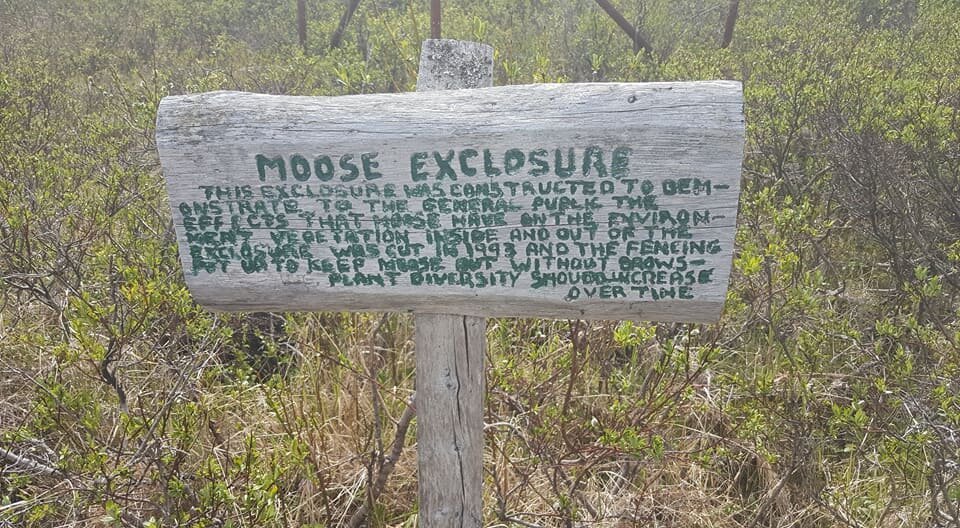
Photo by Beeblebrox
Don Pesci: The coronavirus, King Ned and the Conn. economy

VERNON, Conn.
While Connecticut’s Democratic-dominated General Assembly was napping, Raytheon, formerly United Technologies (UTC), announced it was cutting 15,000 commercial aerospace jobs. The cuts will affect Pratt & Whitney and Collins Aerospace. Raytheon CEO Greg Hayes, who moved UTC’s headquarters to the Boson area following UTC’s merger with Raytheon, figures that it will take at least three years for the air travel business to recover.
According to the report, Raytheon had seen “aircraft and pentagon orders surging” before the move. The company said it had “planned to hire 35,000 workers over five years.” And now? Raytheon’s defense sector, Hayes said, is still strong – owing to Trump military procurements. However, as of Sept. 4, commercial air traffic was down about 45 percent globally. To save costs, airlines are “deferring maintenance,” which hurts Pratt & Whitney, based in East Hartford, Congressman John Larson’s bailiwick.
Two questions present themselves: 1) Are the airline restrictions that Gov. Ned Lamont deployed in Connecticut at least partly responsible for the job losses related to a reduction of airline traffic? And 2) Will politicians such as Larson suffer because of these policies?
The answer to 1) is: A policy that discouraged air travel through the imposition of unusual restrictions – passengers coming from restricted states were required to self-quarantine for 14 days if they had not submitted to a Coronavirus test – certainly does not help. And the answer to 2) is: Nothing short of a nuclear winter in gerrymandered districts such as Larson’s 1st District and Rosa DeLauro’s 3rd District may interrupt their political careers, although this year DeLauro, a fashion maven who has spent nearly 40 years in Congress, has a worthy opponent in Republican Margaret Streicker.
The Lamont directives are not only unusual; they interrupt normal business activity, do not provide uniform continuity of political action, may be unconstitutional, and are whimsical and palliative rather than curative.
The real cure for political action that hurts entrepreneurial activity in Connecticut – how is any restaurant to survive when it is being ordered to reduce its seating by half? – is to put a halter on runaway gubernatorial directives. And this cannot be done in the absence of a General Assembly that has been put in “park” for the last half year. There are some faint indications that, at some point down the road -- possibly after the 2020 elections, during which all the seats in the General Assembly will once again be secure in Democratic hands -- the state may return to some sort of normalcy. The real threat facing Democrats is not that the Coronavirus will mutate into the Red Death, but rather that Democrats, who have refashioned Connecticut into a quasi-socialist wonderland, may lose their majority status in both houses of Connecticut's recumbent General Assembly.
The signs of the times, at least in Connecticut – no longer the pearl in New England’s crown -- suggest a continuation of ruinous business policies. Connecticut’s General Assembly – more properly a fistful of Democratic legislators, a rump legislature – has just extended Lamont’s extraordinary powers by five months. Those powers allow Lamont to open and shut Connecticut’s entrepreneurial valves at will, and businesses, we know, react with horror at uncertainty.
We may well ask for whom is this a problem? Qui bono? Who profits by it -- certainly not representative government? Among Connecticut journalists, only Chris Powell, for many years the managing editor of the Journal Inquirer, in Manchester, seems to be troubled by Connecticut’s highly unorthodox political arrangement. Powell suspects that Democratic-run government, rather than democratic government, is the principal beneficiary of the new, now nearly year-long constitutional re-configuration.
The extension of arbitrary gubernatorial directives allow Democrats to claim hero status at both ends of the politically caused pandemic. Through the imposition of fickle gubernatorial powers, the governor saves us from a fate worse than death; and, by calibrating the business closures, he appears to be saving us from the economic pandemic he and his Democrat do-nothing compatriots in the General Assembly have caused. The German critic Karl Krauss once described Freudian psychology as “the disease it purports to cure.” Similarly, the inscrutable and lawless Lamont business shutdown is the disease he and other heroic Democrat legislators are now purporting to cure – by partly opening the businesses they have closed through dubious constitutional means.
Lamont is not up for re-election in 2020, but all the members of Connecticut’s General Assembly will be on the political chopping block next month.. So Lamont is content to take the political thwacks for the time being; the memories of average Connecticut voters are short-lived, and any autocratic directive issued by Lamont, both in the recent past and for the un-foreseeable future, will not bear the fingerprints of Democrat legislators, many of whom will be left unpunished in the coming elections.
It is doubtful that any directive issued by “King Ned” will benefit anyone but autocratic politicians. All such directives destroy creative solutions by restricting normal business decisions to a governor who cannot be corrected by either the legislative or judicial branches of government. A deliberative legislature may produce far superior solutions than those forcibly imposed by Lamont and his close advisers on the entire state, no corner of which is now represented by members of the General Assembly pretending that they are doing their jobs.
Most recently, the Hartford Symphony has furloughed all of its musicians; restaurants are closing; the workforce at Pratt & Whitney will be reduced; principals and superintendents of public schools lack uniform direction from a government that appears to be operating on the throw of dice; and at some point down the line an exhausted public, frustrated and powerless, will turn against its self-appointed benefactors.
There are two incalculable benefits in hitting bottom: 1) the bottom marks the end of the downward fall, and 2) those who hit bottom know that the way up lies in an opposite direction.
Don Pesci is a Vernon-based columnist.
Roger Warburton: What lobsters tell us about climate change
If present trends continue, by the end of the century, the cost of global warming could be as high as $1 billion annually for Providence County, R.I., alone, according to data from a 2017 research paper. That’s about $1,600 per person per year. Every year.
But, before we talk about the future, let’s discuss the economic damage that has already occurred in Rhode Island because of warming temperatures.
Like rich Bostonians, Rhode Island’s lobsters have moved to Maine. In 2018, Maine landed 121 million pounds of lobsters, valued at more than $491 million, and up 11 million pounds from 2017. It wasn’t always so.
Andrew Pershing, an oceanographer with the Gulf of Maine Research Institute, has noted that lobsters have migrated north as climate change warms the ocean. In Rhode Island, for instance, days when the water temperature of Narragansett Bay is 80 degrees or higher are becoming more common. From 1960 to 2015, the bay’s mean surface water temperatures rose by about 3 degrees Fahrenheit, according to research data.
A 2018 research paper Pershing co-authored said ocean temperatures have risen to levels that are favorable for lobsters off northern New England and Canada but inhospitable for them in southern New England. The research found that warming waters, ecosystem changes, and differences in conservation efforts led to the simultaneous collapse of the lobster fishery in southern New England and record-breaking landings in the Gulf of Maine.
He told Science News last year that with rocky bottoms, kelp and other things that lobsters love, climate change has turned the Gulf of Maine into a “paradise for lobsters.”
However, in the formerly strong lobster fishing grounds of Rhode Island, the situation is grim. South of Cape Cod, the lobster catch fell from a peak of about 22 million pounds in 1997 to about 3.3 million pounds in 2013, according to the 2018 paper published in Proceedings of the National Academy of Sciences.
Lobsters provide interesting lessons on the impact of the climate crisis.
A conservation program called V-notching helped protect Maine’s lobster population. “Starting a similar conservation program earlier in southern New England would have helped insulate them from the hot water they’ve experienced over the last couple of decades,” Malin Pinsky, a marine scientist with Rutgers University, told Boston.com two years ago.
Rhode Island’s lack of conservation efforts in the face of the growing climate crisis contributed to the collapse of its lobster fishery. Doing nothing or too little in the face of a changing climate can be economically devastating.
Another existing, and growing, threat to the economic health of Rhode Island comes from Lyme disease, which has increased by more than 300 percent across the Northeast since 2001. A changing climate is a big reason why. There is a growing body of evidence showing that climate change may affect the incidence and prevalence of certain vector-borne diseases such as Lyme disease, malaria, dengue, and West Nile fever, according to a 2018 study.
Chronic Lyme disease is more widespread and more serious than generally realized. There are some 20,000 cases annually in the Northeast and each averages about $4,400 in medical costs. Most Lyme disease patients who are diagnosed and treated early can fully recover. But, an estimated 10 percent to 20 percent suffer from chronically persistent and disabling symptoms. The number of such chronic cases may approach 30,000 to 60,000 annually, according to a 2018 white paper.
As the lobsters and the ticks vividly demonstrate, prevention is cheaper than cure. The longer we wait, the more painful, and expensive, the consequences will be.
The aforementioned 2017 study Estimating Economic Damage from Climate Change in the United States by world-renown economists and climate scientists projects the impact of climate change for every county in the United States. The results for Rhode Island and its neighbors are summarized in the map to the right, which depicts the estimated economic damage, in millions of dollars annually for each county in Rhode Island, Massachusetts, and Connecticut.
The data make clear that the economic damage will not be uniformly distributed. Some counties, such as Providence County, will be hit much harder than others. It also may seem that the southern counties will suffer much less. But that isn’t quite true, as graph below shows. The damage per person per year is projected to be substantial.
The total economic damage to Rhode Island, by 2080, could result in a 2 percent decline in gross domestic product (GDP). To put that in context, during the Great Recession of 2008-2010, there was only one year of GDP decline: minus 2.5 percent in 2009. By 2010, GDP had bounced back to positive growth, at 2.6 percent.
Therefore, the impact of a 2 percent hit to Rhode Island’s GDP from the climate crisis could look like the recession of 2009, only becoming permanent, continuing year after year. Also, it won’t all happen in 2080, the damage will continually get worse.
The economic damage is projected to come from more frequent and intense storms; sea-level rise; increased rainfall resulting in more flooding; higher temperatures, especially in the summer; drought that leads to lower crop yields; increased crime.
In addition, essential infrastructure will be impacted, including water supplies and water treatment facilities. Ecosystems, such as forests, rivers, lakes and wetlands, will also suffer, and that will impact human quality of life.
In the coming two weeks, we will describe how each Rhode Island county faces different levels of the above threats. As a result, each county needs to develop appropriate mitigation strategies.
The damages from the climate crisis will place major strains on public-sector budgets. However, much of the economic damage will be felt by individuals and families through poorer health, rising energy costs, increased health-care premiums, and decreased job security.
As always, prevention is cheaper, and more effective, than cure. Inaction on climate change will be the most expensive policy option.
The lobsters should teach us a valuable lesson: conservation measures based on sound scientific and economic principles could have helped mitigate losses caused by the climate crisis.
Roger Warburton, Ph.D., is a Newport ,R.I., resident. He can be reached at rdh.warburton@gmail.com.
Ready to play offense

“Motherland” (after calendar painting by Jesudoss), (archival inkjet print), by N. Pushpamala, at the Smith College Museum of Art, in Northampton, Mass. It’s in the museum’s centennial exhibit SCMA “Then\Now\Next’’ online.
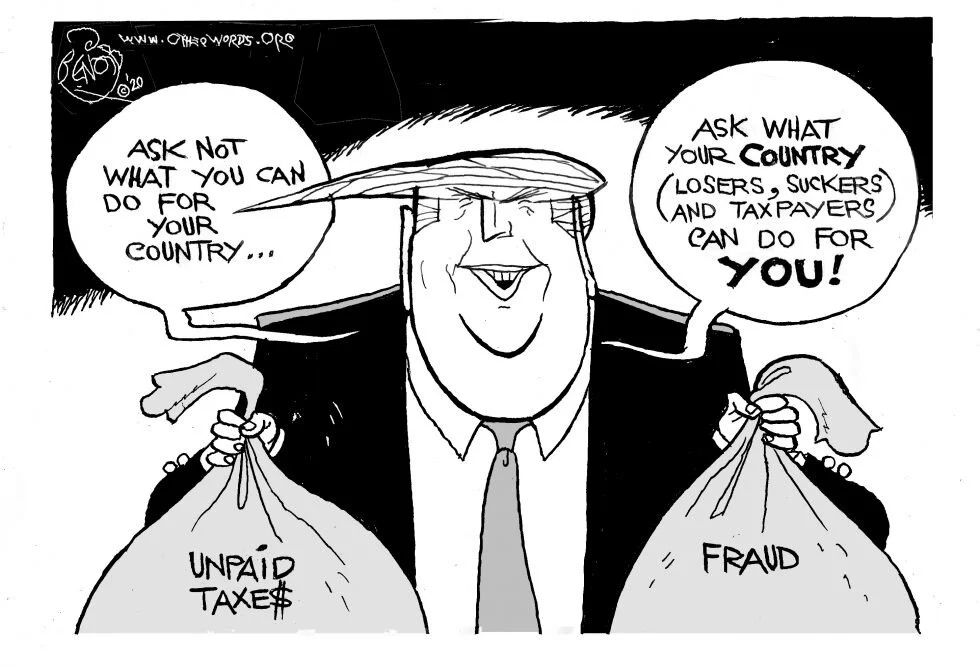
Chuck Collins: How you pay taxes and they don’t
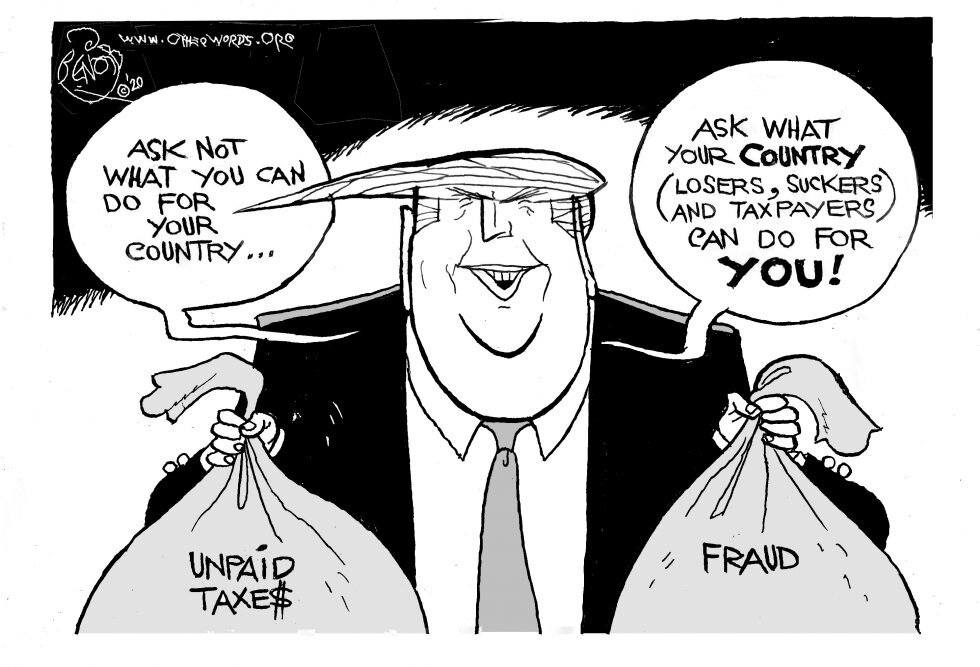
Via OtherWords.org
BOSTO
My daughter, a librarian in Tucson, paid more taxes in 2017 than Donald Trump. So did my neighbor Rita, a teacher, and her son Tony, who stocks grocery shelves in Leland, Mich.
I also pay more in taxes than the president of the United States. And, probably, so do you.
We now understand why Trump was the first presidential candidate since the 1970s not to divulge his tax returns.
In 2016 and 2017, the billionaire paid just $750 each year in taxes to the U.S. Treasury. In 10 out of 15 years between 2001 and 2017, Trump paid zero taxes.
The average middle class household paid approximately three times as much in federal taxes as Trump did in 2017, an average of $2,200 based on an income of roughly $60,000. Any individual earning over $25,000 most likely paid more than the president.
It’s not that Trump wasn’t paying taxes at all. In 2017, Trump paid $156,824 in taxes in the Philippines and $145,500 in India. He just wasn’t paying them to support veterans, build roads, or protect seniors in this country.
The other secret Trump doesn’t want you to know is that his image as a wealthy successful business mogul is a mirage.
Over the decades, Trump personally lobbied Forbes Magazine to report that he was wealthier than he really is. Two decades of tax returns, however, reveal he is a man in deep financial doo-doo. He may even owe more than he owns.
Trump’s real estate and resort businesses are mostly money losers, contributing to hundreds of millions of tax-deductible business losses each year.
On top of these losses, Trump deducts tens of millions in lavish personal living expenses — such as $70,000 in hair styling, consulting fees to his children, and mansion retreats — to reduce his tax obligations.
Only someone with Trump’s army of tax attorneys and wealth managers could pull off these loopholes. Trump’s assets are spread over 500 different corporate shells, enabling limitless shifting and gaming of income and taxes.
Trump takes advantage of the fact that there are two tax systems in America: one set of rules for the super-rich and another set of rules for everyone else.
Most of us get our incomes from paychecks and government agencies that know exactly how much we are paid and often withhold our taxes before we even see the money.
People with incomes over $2 million and assets over $20 million get most of their income from investments, ownership of assets, and businesses. There are endless games they can play to manipulate their income. And they can afford to hire accountants and tax lawyers to maneuver their taxes downward.
If you lose money, you grow poorer. But when the super-rich create paper losses to offset their taxes, they’re still rich. And like Trump, they aren’t sacrificing anything in terms of their cushy standard of living.
These tax shenanigans are all the more unseemly in the face of a pandemic that’s destroyed the wealth, health, and livelihoods of millions. Tens of millions of families have lost jobs, savings, home equity, and any other economic security they may have had.
They will not be “carrying over” these losses into future years and virtually eliminating their taxes for a decade, as Trump did.
Instead, they’ll pay income taxes on unemployment insurance, stimulus checks, and any paycheck they’ve been able to eke out. There will be no deductions for haircuts or consulting contracts for their children.
Trump’s taxes reveal the real truth. He’s more about the art of the deduction than the art of the deal.
If there’s a silver lining, it’s that Trump’s tax manipulations reveal where the weak spots are in the current system. Congress should restore fairness and integrity to a tax system that has been pillaged by the super-rich.
Chuck Collins directs the Program on Inequality at the Institute for Policy Studies.
Remembering the sweet pollution of yesteryear

From Robert Whitcomb’s “Digital Diary,’’ in GoLocal24.com
I suppose fewer folks than usual will be driving around New England looking at foliage this fall because of states’ COVID restrictions, which among other things, make it more difficult to get rooms in hotels or inns and and tables in restaurants. Many have closed for good. Too bad, those lurid leaves are our region’s greatest natural show, except for maybe a big bad blizzard or heavy-duty hurricane, and bright foliage can last for several weeks, not a few hours, unlike a big storm.
Oh well, our terrible drought means that the colors won’t be as bright this year anyway….
Northern New England has the greatest foliage festival. I particularly remember from back in the ‘60s, when I lived up there, the spectacular shows on Route 100, which goes up through the middle of Vermont, and the Kancamagus Highway, in the White Mountains.
By the dreaded Election Day, on Nov. 3 this year, leaves will cover the ground, which reminds me of the sweet smoke that used to fill the air from burning the leaves we’d rake into big piles. The yearly smoke produced a feeling of mellowness and nostalgia. Now such outdoor burning is generally banned because of the serious air pollution it causes. (I remember, too, the air pollution from wood stoves during the energy crises of the ‘70s.) Now, too many people, or the people they hire (including very hard-working illegal aliens), use also polluting (emissions and shrieking noise) leaf blowers, not rakes, to collect the leaves. An improvement?
The disappearance of leaf-burning reminds me of the exit of other unhealthy but pleasant activities, such as smoking a cigarette after a meal and one or two cocktails before dinner. These habits tended to shorten lives, and so it’s good they have faded. But I’ve seen no explosion in general happiness as a result.
If you do go leaf-peeping, watch out for slippery fallen leaves if we finally get some rain, as well as rutting deer and moose.
'Thought and sight remain'

Japanese maple
“Your death, near now, is of an easy sort.
So slow a fading out brings no real pain.
Breath growing short
Is just uncomfortable. You feel the drain
Of energy, but thought and sight remain:
Enhanced, in fact….’’
— From “Japanese Maple,’’ by Ciive James (1939-2019), an Anglo-Australian writer
Extreme PC on the half shell

Oysters and mussels
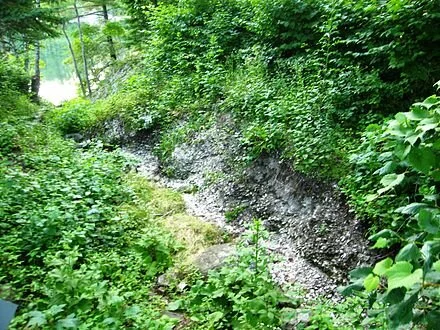
The Whaleback Shell Midden, along the Damariscotta River, in Maine, contains the shells from oysters harvested for food dating from 2,200 to 1,000 years ago.
From Robert Whitcomb’s “Digital Diary’’ in GoLocal24.com
Here’s an example of the sort of political correctness/hyper-sensitivity that drives people into the toxic arms of Trump & Co.:
A couple of us are working on a little book about oyster farmers on the Maine Coast. We wanted to get a couple of pictures of middens, piles of shells left by Native Americans. So we asked a University of Maine project for permission to buy rights to use a couple of their photos. At a staffer’s request, we sent that person the only reference in the book to the middens:
"The central story of the Pine Tree State’s oysters begins on the Damariscotta River, which is really mostly an estuary and which for millennia has been a superb source of oysters. The Wabenaki Indians left huge piles (aka 'middens’) of oyster shells, some as high as 30 feet, that can still be seen on the banks of the Damariscotta. It might be the best environment in which to grow oysters on the planet.'
The staffer wouldn’t cooperate, saying that “Unfortunately, there are misconceptions involving Indigenous use of the coast. I work with the tribes here in the State, and they and I are sensitive about how images and information regarding their lifeways are used.’’
This was accompanied by a list of things, with a couple of the staffer’s factual errors, the staffer presumed we didn’t know about Maine but in fact knew well. My project partner is a Mainer, by the way. The all-too-common arrogance found on the Isle of Academia.
This little tiff also reminded me of the intensely bureaucratic nature of so much of higher education, as I learned in teaching gigs and otherwise dealing with that sector.
In any event, we found the photos we needed in the real world.
Pictures of the shifting
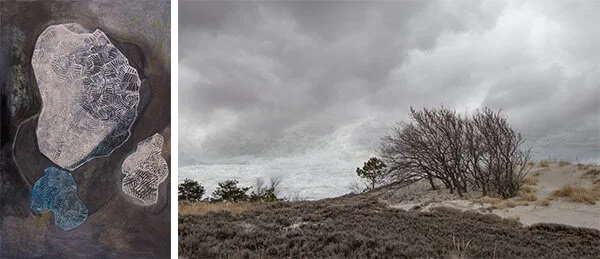
Left: "Fragnet” (oil and graphite powder on canvas), by Kathline Carr; right: “Crane Beach” (photo), by Vicki McKenna, in their show together “Geographies of a Shifting World,’’ at Fountain Street Fine Art, Boston, through Oct. 25
The gallery says:
The two “share an interest in elemental landforms and geological processes. Carr’s drawings, paintings, and monotypes are in conversation with McKenna’s photography-based prints. They implicitly share an interest in human interaction with the natural world. Their current work has a common focus of climate change. Carr utilizes multiples and repetitious mark-making allowing patterns, gestures, and forms to represent her feelings of despair and hopelessness about current climate. McKenna’s photo illustrations combine multiple images intended to collapse present and future into one image that suggests the result of sea-level rise.’’
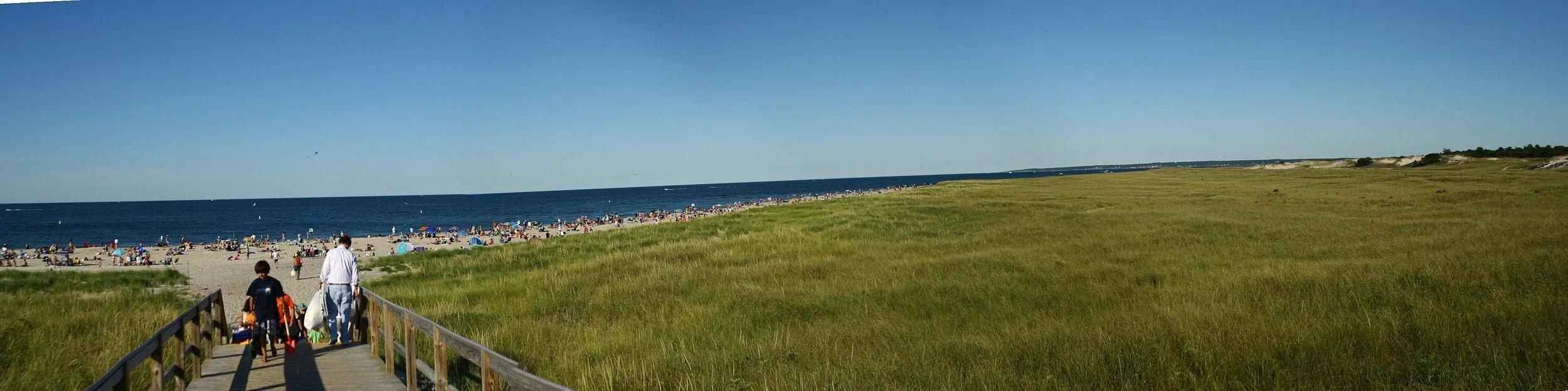
Panorama of Crane Beach in September 2007
— Photo by Thomas Steiner
Crane Beach is a gorgeous 1,234-acre state-owned conservation and recreation property in Ipswich, Mass., just north of Cape Ann. It has a four-mile-long sandy beachfront, dunes and a maritime pitch pine forest. Five and a half miles of hiking trails through the dunes and forest are accessible from the beachfront.
The land was given by the Crane family, whose fortune was from plumbing supplies. (One of the family bought my great-great grandfather’s house in Woods Hole, on Cape Cod. — Robert Whitcomb.)
Philip K. Howard: Misdiagnosing what has led to failed state America
People want answers for what went wrong with America’s response to the COVID-19 pandemic—from lack of preparedness, to delays in containing the virus, to failing to ramp up testing capacity and the production of protective gear. But almost nowhere in the current discussion can one find a coherent vision for how to avoid the same problems next time or help restore a healthy democracy.
Bad leadership has been identified as a primary culprit. The “fish rots from the head,” as conservative columnist Matthew Purple puts it. There’s plenty to blame President Trump for, but stopping there, as, say, former New York Times critic Michiko Kakutani does, ignores many bureaucratic failures. Cass Sunstein gets closer to the mark by focusing on how red tape impedes timely choices, but even he sees the bureaucratic structures as fundamentally sound and simply in need of some culling. Sunstein suggests that “it might be acceptable or sensible to tolerate a delay” in normal times, but not in a pandemic. Tech investor Marc Andreessen sees a lack of national willpower, an unwillingness to grab hold of problems and build anew. Prominent observers such as Francis Fukuyama, George Packer and Ezra Klein blame a broken political system and a divided culture; they offer little hope for redemption, even with new leadership.
All misdiagnose what caused government to fail here, and they confuse causes with what are more likely symptoms. Fukuyama rightly identifies a critical void in American political culture: the loss of a high “degree of trust that citizens have in their government,” which countries such as Germany and South Korea enjoy. But why have Americans lost trust in their government?
No doubt, after this is all over, a report will catalog the errors and misjudgments that let COVID-19 shut down America. The report will likely begin years back, when officials refused to heed warnings about pandemic planning. It will further expose President Trump, who for almost two months said that the coronavirus was “totally under control.” Errors of judgment like these are inevitable, to some degree—they happened before and after Pearl Harbor and 9/11, too—and with luck, they will inform future planning. The light will then shine on the operating framework of modern government, revealing not mainly errors of judgment, or cultural divisions, but a tangle of red tape that causes failure. At every step, officials and public-health professionals were prevented from making vital choices by legal obstacles.
Andreessen is correct that Americans have lost the spirit to build, but that’s because we’re not allowed to build. A governing structure that takes upward of a decade to approve an infrastructure project and ranks 55th in World Bank assessments for “ease of starting a business” does not encourage individual and institutional initiative. Of course Americans don’t trust government—it gets in the way of their daily choices, even as it fails to meet many national needs.
Our response to the COVID-19 missteps should not be to wring our hands about our miserable political system, or about the cynicism and selfishness that have infected our culture. We should focus on why government fails in making daily choices. What many Americans see clearly—but most public intellectuals cannot see—is a system that prevents people from acting on their best judgment. By re-empowering officials to do what they think is right, we may also reinvigorate American culture and democracy.
The root cause of failed government is structural paralysis. What’s surprising about the tragic mishaps in dealing with COVID-19 is how unsurprising they were to the teachers, nurses and local officials who are continually stymied by bureaucratic rules. A few years ago, a tree fell into a creek in Franklin Township, N.J., and caused flooding. A town official sent a backhoe to pull it out. But then someone, probably the town lawyer, pointed out that a permit was required to remove a natural object from a “Class C-1 Creek.” It took the town almost two weeks and $12,000 in legal fees to remove the tree.
In January, University of Washington epidemiologists were hot on the trail of COVID-19. Virologist Alex Greninger had begun developing a test soon after Chinese officials published the viral genome. But while the coronavirus was in a hurry, the Food and Drug Administration (FDA) was not. Greninger spent 100 hours filling out an application for an FDA “emergency-use authorization” (EUA) to deploy his test in-house. He submitted the application by e-mail. Then he was told that the application was not complete until he mailed a hard copy to the FDA Document Control Center.
After a few more days, FDA officials told Greninger that they would not approve his EUA until he verified that his test did not cross-react with other viruses in his lab, and until he agreed also to test for MERS and SARS. The Centers for Disease Control (CDC) then refused to release samples of SARS to Greninger because it’s too virulent. Greninger finally got samples of other viruses that satisfied the FDA. By the time they arrived, and his tests began, in early March, the outbreak was well on its way.
Regulatory tripwires continually hampered those dealing with the spreading virus. Hospitals learned that they couldn’t cope except by tossing out the rulebooks; other institutions weren’t so lucky. For example, after schools were shut down, needy students no longer had meals. Katie Wilson, executive director of the Urban School Food Alliance and a former Obama administration official, secured an agreement in principle to transfer federal meal funding to a program that provides meals during summer months. But red tape required a formal waiver from each state, which in turn required formal waivers from Washington. The bureaucratic instinct was relentless: school districts in Oregon were first required to “develop a plan as to how they are going to target the most-needy students.” Meantime, the children got no meals. New York Times columnist Bret Stephens, interviewing Wilson, summarized her plea to government: “Stop getting in the way.”
What’s needed to pull the tree out of the creek is no different than what’s needed to feed school kids: responsible people with the authority to act. They can be accountable for what they do and how well they do it, but they can’t succeed if they must continually pass through the eye of the bureaucratic needle.
Reformers are looking in the wrong direction. Electing new leaders won’t liberate Americans to take initiative. Nor is “deregulation” generally the solution for inept government; the free market won’t protect us against pandemics. The only solution is to replace the current operating system with a framework that empowers people again to take responsibility. We must reregulate, not deregulate.
American government rebuilt itself after the 1960s on the premise of avoiding human error by replacing human choice. That’s when we got the innovation of thousand-page rulebooks dictating the one-correct-way to do things. We mandated legal hearings for ordinary supervisory choices, such as maintaining order in classrooms or evaluating employees. We replaced human judgment with rules and objective proof. Finally, government would be pure—almost like a software program. Just follow the rules.
For 50 years, legislative and administrative law has piled up, causing public paralysis and private frustration. Almost no one has questioned why government prevents people from using their common sense. Conservatives misdiagnose the flaw as too much government; liberals resist any critique of public programs, assuming that any reform is a pretext for deregulation. In the recent Democratic presidential debates, no one asked how to make government work better.
Experts have it backward. Polarized politics, they say, causes public paralysis. While hyper-partisanship certainly paralyzes legislative activity, the bureaucratic idiocies that delayed everything from COVID-19 testing to school meals had nothing to do with politics. Paralysis of the public sector came first, leading to polarized politics.
By the 1990s, broad public frustration with suffocating government fueled the rise of Newt Gingrich. The growth of red tape made it hard to make anything work sensibly. Schools became anarchic; health-care bureaucracy caused costs to skyrocket; getting a permit could require a decade; and Big Brother was always hovering. Is your paperwork in order? Americans kept electing people who promised to fix it—the “Contract with America,” “Change we can believe in,” and “Drain the swamp”—but government was beyond the control of those elected to lead it. What happens when politicians give up on fixing things? They compete by pointing fingers—“It’s your fault!”—and resort to Manichean theories and identity-based villains. Public disempowerment breeds extremism.
A functioning democracy requires the bureaucratic machine to return to officials and citizens the authority needed to do their jobs. That necessitates a governing framework of goals and principles that re-empowers Americans to take responsibility for results. Giving officials, judges, and others the authority to act in accord with reasonable norms is what liberates everyone else to act sensibly. Students won’t learn unless the teacher maintains order in the classroom. New ideas by a teacher or parent go nowhere if the principal lacks the authority to act on them. To get a permit in timely fashion, the permitting official must have authority to decide how much review is needed. To enforce codes of civil discourse—and not allow a small group of students to bully everyone else—university administrators must have authority to sanction students who refuse to abide by the codes. To prevent judicial claims from becoming weapons of extortion, judges must have authority to determine their reasonableness. To contain a virulent virus, public-health officials must have authority to respond quickly.
Giving officials the needed authority does not require trust of any particular person. What’s needed is to trust the overall system and its hierarchy of accountability—as, for example, most Americans trust the protections and lines of accountability provided by the Constitution. There’s no detailed rule or objective proof that determines what represents an “unreasonable search and seizure” or “freedom of speech.” Those protections are nonetheless reliably applied by judges who, looking to guiding principles and precedent, make a ruling in each disputed situation.
The post-1960s bureaucratic state is built on flawed assumptions about human accomplishment. There is no “correct” way of meeting goals that can be dictated in advance. Nor can good judgment be proved by some objective standard or metric. Judgments can readily be second-guessed, as appellate courts review lower-court decisions, but the rightness of action almost always involves perception and values. That’s the best we can do.
The failure of modern government is not merely a matter of degree—of “too much red tape.” Its failure is inherent in the premise of trying to create an automatic framework that is superior to human choice and judgment. We thought that we could input the facts and, as Czech playwright and statesman Vaclav Havel once parodied it, “a computer . . . will spit out a universal solution.” Trying to reprogram this massive, incoherent system is like putting new software onto a melted circuit board. Each new situation will layer new rules onto ones already short-circuiting.
Nothing much will work sensibly until we replace tangles of red tape with simpler, goal-oriented frameworks activated by human beings. This is a key lesson of the COVID-19 crisis. It’s time to reboot our governing system to let Americans take responsibility again.
Philip K. Howard, a New York-based lawyer, civic leader and photographer, is founder of Common Good. His latest book is Try Common Sense: Replacing the Failed Ideologies of Right and Left. This piece first ran in City Journal.
Another New England college now calls itself a university
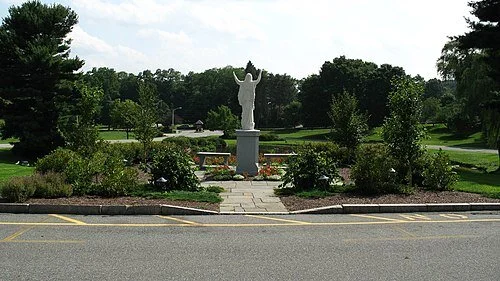
Main entrance to Assumption University
From The New England Council (newenglandcouncil.com)
“Assumption University, in Worcester, celebrates its new university status with a new Alma Mater sign.
“Assumption University invited the entire community to its virtual unveiling ceremony, which included a Mass and debut of the Alma Mater, following a performance from the Assumption University Chorale. The ceremony marked the formal transition from college the university.
“We are pleased the Commonwealth has affirmed our belief that Assumption is a comprehensive institution with exemplary undergraduate, graduate and continuing education programs,” said College President Francesco C. Cesareo, Ph.D. “Despite the challenges facing the higher education industry, through the devoted and energetic work of many throughout the campus community, we find ourselves at the cusp of yet another significant moment in the storied history of this institution that was founded in 1904 by the Augustinians of the Assumption.”
xxx
With the transition from Assumption College to Assumption University this year, Assumption reorganized into five schools: College of Liberal Arts and Sciences, Grenon School of Business, School of Nursing, School of Health Professions and School of Graduate Studies.
xxx
Two well known New England universities — Dartmouth College and Boston College — stubbornly resist dropping “College” for “University.’’
Musical instrumentation in Bennington
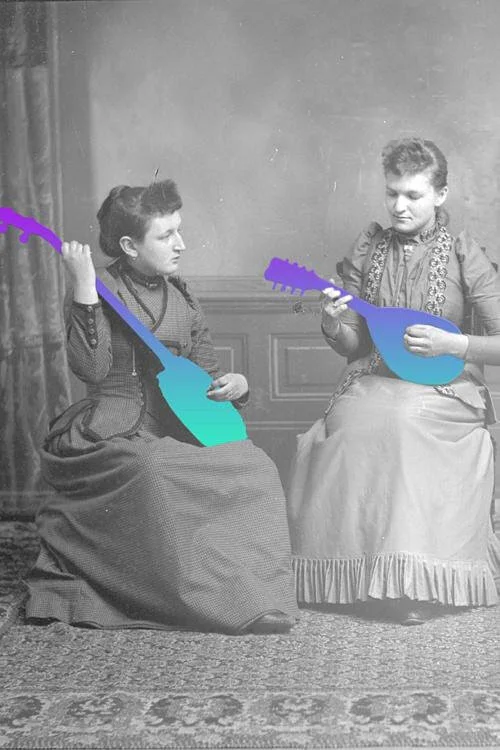
Promotional picture for exhibition of musical instruments at the Bennington (Vt.) Museum through Dec. 31. The museum says:
“Each musical instrument in the Bennington Museum collection has its own unique story, but has remained silent for decades. The exhibit explores the histories and traditional sounds of the instruments and provides opportunities to hear them brought back to life in new compositions.’’
David Warsh: Best books
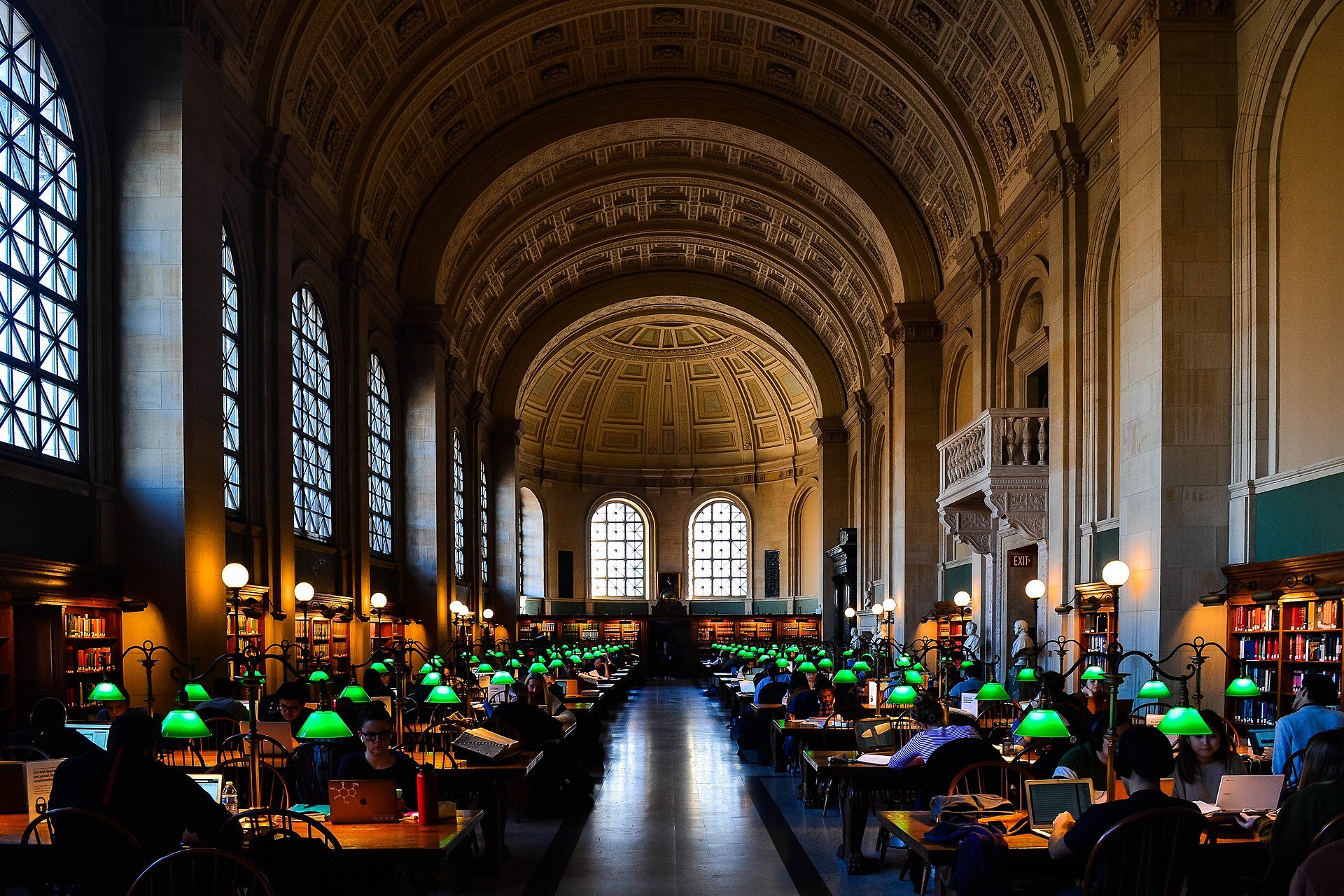
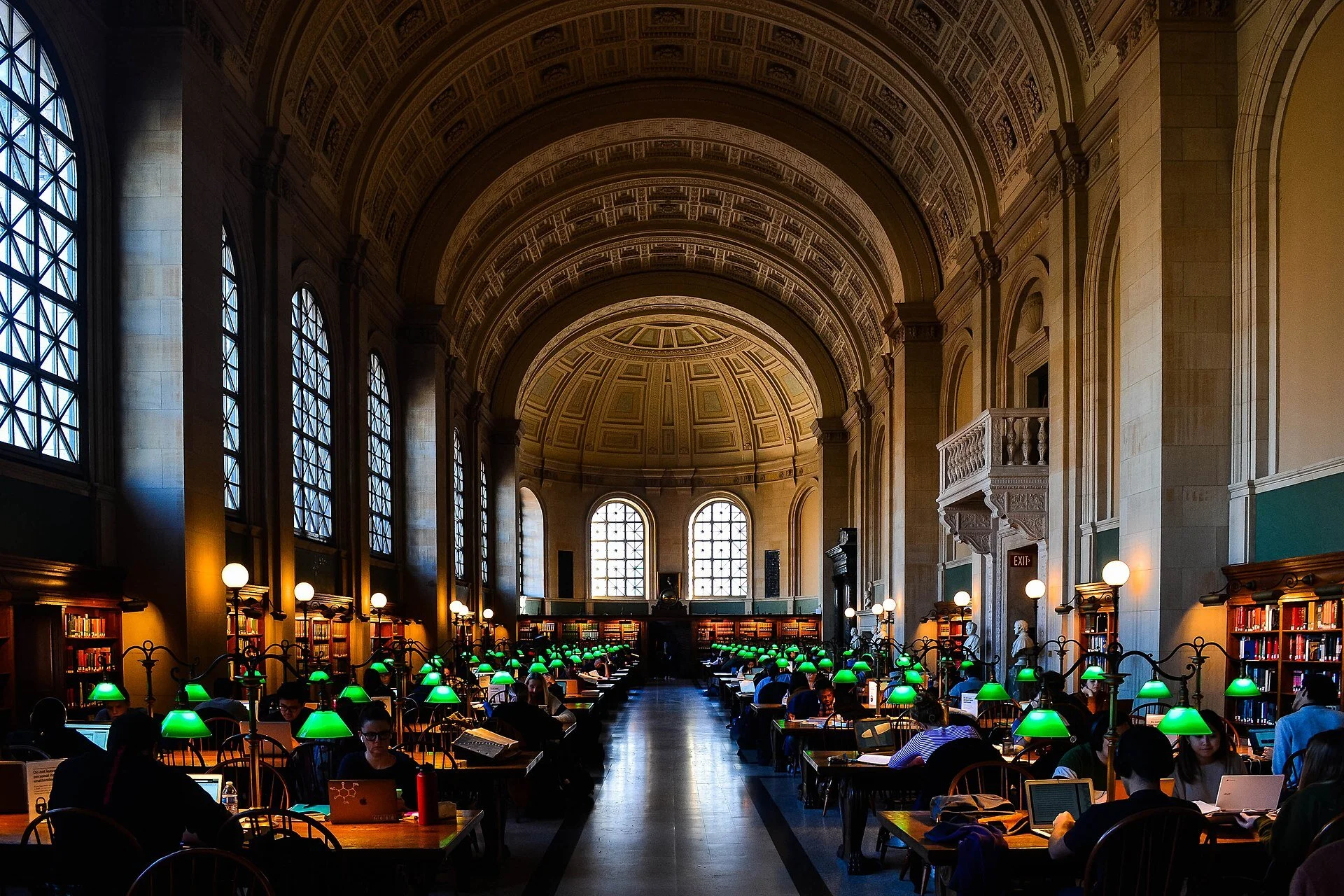
The main reading room of the Boston Public Library
— Photo by Hari Krishnan
SOMERVILLE, Mass.
There was for many years a photo on a hallway wall of our family home of an aged woman avidly reading in a canopied four-poster bed. The caption was a line from Henry David Thoreau: “Read the best books first, or you may not have a chance to read them at all.”
October Surprise: How the FBI Tried to Save Itself and Crashed an Election (Public Affairs), by Devlin Barrett, arrived last week, a day ahead of schedule. I read the first 20 pages standing up. I sat down and resumed reading, finishing the 325-page book the next day.
As a Wall Street Journal reporter covering the Justice Department, Barrett wrote two stories that may have affected the outcome of the election (neither of them available any longer for free on the Web). The first surfaced details of an unsuccessful bid for a Virginia state Senate seat by Dr. Jill McCabe, wife of Deputy FBI Director Andrew McCabe, in which her campaign received a large contribution from then-Virginia Gov. Terry McAuliffe, a longtime friend of Bill and Hillary Clinton. The second disclosed the existence of an ongoing FBI investigation of the Clinton Foundation. Between the first and the second, FBI Director James Comey notified Congress that he had reopened the Clinton e-mail investigation.
Donald Trump won the election by a razor-thin margin. A couple of months later, Barrett moved to The Washington Post, where he continued to cover the growing turmoil at the FBI, often with fellow reporter Matt Zapotosky.
In 2017, Comey was fired, former FBI director Robert Mueller was hired as special counsel to investigate links between the Trump campaign and Russia. Investigation of the leaks to Barrett began. Senior FBI investigator Peter Strzok was dismissed from the Mueller task force, after a series of texts he exchanged with FBI attorney Lisa Page was uncovered. Eventually the inspector general of the Justice Department went to work on the case. The running narrative of the Strzok-Page text eventually was published.
Barrett has weaved all these complicated elements into a spell-binding account that is in equal measure knowledgeable, intelligible, and fair-minded. Not since All the President’s Men, by Carl Bernstein and Bob Woodward, has there been anything like it. In October Surprise, it is an intelligence service and law-enforcement agency, not a presidency, that comes apart. And Barrett, like Woodward and Bernstein, is coy about his most important sources. In the end, though, Barrett’s is the more thorough explanation.
That said, it is more than a little confusing to read so soon before the 2020 election, since it has almost entirely to do with the Justice Department and the FBI, and little to do with the broad choices now facing American voters. That’s why it’s a book, not a newspaper story. For that reason, it will take some time for the book to arrive at the center of public discussion. (The Post ran an excerpt from it on the front page, followed by a review.) Moreover, Barrett’s conclusion, that the harm arose from the FBI trying to save itself, failed to persuade me. But what a stupendous achievement is his untangling of the web of alarms and confusions!
xxx
What are the best business books of today? Of the newspapers and reviews I read to keep up with general-interest publishing in and around economics, the most useful by far is the Financial Times. Book reviews appear without warning throughout the week. The weekend edition’s Life and Arts section is almost always ahead of the curve. There are special sections in summer, autumn, and winter, in which staffers survey new books on their beats.
And then there is the annual FT McKinsey Best Business Book contest, an international agenda-setting device. You can test your sophistication against its long lists here, or catch up in a hurry on what you have missed.
Now in its 17th year, the FT prize has become a reliable indicator of cosmopolitan fashion in ideas, “making sense of the near future,” as a panel discussion put it last week. (For a time Goldman Sachs was sponsor.) To make its point, the contest offers big prizes, £30,000 to the winner, £10,000 each for five runners-up. A panel of though-leader judges, chaired by incoming FT editor Roula Khalaf, assures global reach: Mitchell Baker, chairwoman of the Mozilla Foundation; Mohamed El-Erian, economic advisor at Allianz; Herminia Ibarra, of London Business School; Randall Kroszner, of the University of Chicago’s Booth School of Business; Dambisa Moyo, economist and board member, 3M Company and Chevron; Raju Narisetti, of McKinsey & Co., and Shriti Vadera, chair-elect of UK’s Prudential PLC.
Fifteen titles were named to a long list. The judges chose six, which were announced last week:
Deaths of Despair and the Future of Capitalism, by Anne Case and Angus Deaton, Princeton University Press (UK) & (US)
No Filter: The Inside Story of How Instagram Transformed Business, Celebrity and Our Culture, by Sarah Frier, Random House Business (UK); Simon & Schuster (US)
No Rules Rules: Netflix and the Culture of Reinvention, by Reed Hastings and Erin Meyer, WH Allen, Penguin Random House (UK); Penguin Press (US)
Reimagining Capitalism: How Business Can Save the World, by Rebecca Henderson, Penguin Business, Penguin Random House (UK); PublicAffairs (US)
If Then: How the Simulmatics Corporation Invented the Future, by Jill Lepore, John Murray Press (UK); W.W. Norton (US)
A World Without Work: Technology, Automation and How We Should Respond, by Daniel Susskind, Allen Lane (UK); Metropolitan Books (US)
The winner will be announced Dec. 1 at a ceremony in London.
Judges haven’t shied from books on weighty topics. Capitalism in the twenty-first century, by Thomas Piketty, won in 2016, Crashed: How a Decade of Financial Crisis Changed the World, by Adam Tooze, made the long list in 2018. Adaptive Markets: Financial Evolution at the Speed of Thought, by Andrew Lo, and The Great Leveler: Violence and the History of Inequality, by Walter Scheidel, made the short list in 2017. The Rise and Fall of American Growth, by Robert Gordon, made the short list in 2016, while Bourgeois Equality: How Ideas, Not Capital or Institutions, Enriched the World, by Deirdre McCloskey, made the long list.
There have been interesting omissions. Three in particular stand out, because they represent an unusual degree of convergence on the importance to economics, at least as it has long been understood, of institutions and culture. The three books are:
A Culture of Growth: The Origins of the Modern Economy, by Joel Mokyr, of Northwestern University.
The Narrow Corridor: States, Societies, and the Fate of Liberty, by Daron Acemoglu and James Robinson, of the Massachusetts Institute of Technology and the University of Chicago, respectively
The Decline and Rise of Democracy: A Global History from Antiquity to Today, by David Stasavage, of New York University.
No selecting mechanism is perfect, or even near perfect. And global thought-leaders don’t have time for heavy lifting. The Best Book prize is as well-focused on the news frontier as any other forward-looking instrument we possess.
David Warsh, an economic historian and veteran columnist, is proprietor of Somerville-based economicprincipals.com, where this essay first ran.

Get me back east
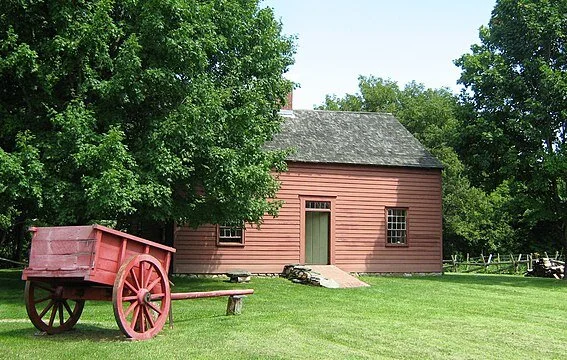
The Ethan Allen Homestead, in Burlington, Vt.
“….Before the grandest vista
I’ll ever witness, what I wanted most
desperately was to trim the hedge and mow
the grass at Thirty-Four North Williams Street,
Burlington, Vermont Oh Five Four Oh One’’
— From “Idaho Once,’’ by David Huddle
Chris Powell: How much can Connecticut bear?

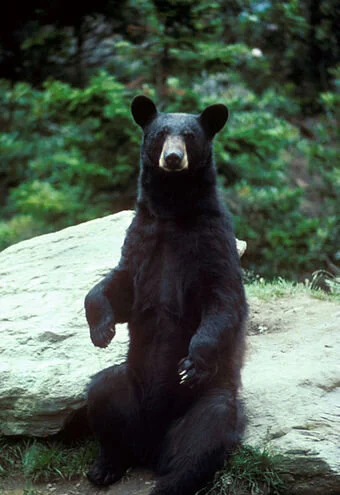
A black bear, of the only bear species found in New England
Connecticut's bear population, estimated at 800, is growing "exponentially," a newspaper reported the other day. This was a bit hyperbolic, since after 800 the next level in an exponential series is 800 times 800 -- 640,000 -- and the bear population will not be increasing that quickly.
But 640,000 bears in Connecticut will be the inevitable outcome unless the state's largely indifferent policy toward them is radically changed. That policy is simply to advise the public not to feed the animals -- to secure trash cans, outdoor grills and bird feeders and to hope the bears stop breaking into houses and attacking domestic animals. If that policy was accomplishing anything, there wouldn't be 800 bears in the state already and their population wouldn't be growing, "exponentially”"or just fast. So in another 10 years or so this policy is bound to leave most towns with many bears bumping into each other as they are shooed away from one neighborhood to the next.
State government's animal-control people are tiring of anesthetizing tagging and relocating troublesome bears, increasingly inclined to tell frantic callers just to let the animals move along and frighten someone else. But as the bear population grows, the animal-control people may be compelled to do a lot more relocations, even as the remote forests to which the bears are taken fill up with them and make them even more eager to return to less competitive neighborhoods.
The alternative to having bears everywhere is for state government to authorize a bear-hunting season, maybe even paying bounties to hunters. But just musing about hunting bears makes certain wildlife lovers hysterical.
Bears are cute -- at a safe distance anyway. A few may contribute some excitement to Connecticut's ordinarily placid suburban atmosphere. But a dozen or more in every town will not be cute. They will cause perpetual panic and frequent damage and injury.
Connecticut already is full of deer, which are cute too and often a delight to see with their fawns. Bucks, while rarely seen, can be majestic.
But deer are not a delight when they dart in front of cars and get hit, damaging vehicles and injuring their occupants, or when they munch on plantings, gardens, orchards, and farm fields.
So Connecticut has some deer-hunting seasons, and there is little clamor to repeal them. Don't try telling farmers how cute deer are. Having worked so hard to get the earth to produce, farmers can obtain state permits to shoot deer on their property year-round to protect the fruit of their labor.
Enacting a bear-hunting season would eliminate the need for much more hunting in the future and thus be far kinder to the animals in the long run. But does Connecticut have any elected officials with the courage to admit that you can't always be friends equally with people and animals?
It's not just bears. How many coyotes, bobcats, weasels and such does Connecticut really want to endure? Nature is not always warm and cuddly. It often has sharp claws and teeth.
But since Connecticut is not very good at facing up to policy failures and the special interests behind them, dozens of bears in every town may be necessary before the General Assembly and the governor enact something more in the public interest than laissez-bear.
Chris Powell is a columnist for the Journal Inquirer, in Manchester, Conn.
'Turnpikes to free thought'

Cobblestoned Acorn Street, on Beacon Hill
“Boston is full of crooked little streets but I tell you that Boston has opened and kept open more turnpikes that lead straight to free thought and free speech and free deeds than any other city of live men or dead men.’’
— Oliver Wendell Holmes (1809-1894), physician, poet and essayist and father of famed Supreme Court Justice Oliver Wendell Holmes Jr.
xxx

A Little, Brown and Co. insignia used in 1906. Little Brown was founded in Boston and stayed there until the late 20th Century. It has published many famous New England and other authors since its founding, and it helped make Boston for many years the leading book-publishing city in America and Boston a literary mecca.
"The assertion that Boston was the literary center during the period in which American literature acquired a shelf of its own in the library of the race is hardly open to dispute."
— M.A. DeWolfe Howe (1864-1960), author and editor
Watch out for the glare

“FaceSwipeStill2,’’ by Joseph Fontinha, at Fountain Street Fine Art, Boston