
Vox clamantis in deserto






'On its hinge'
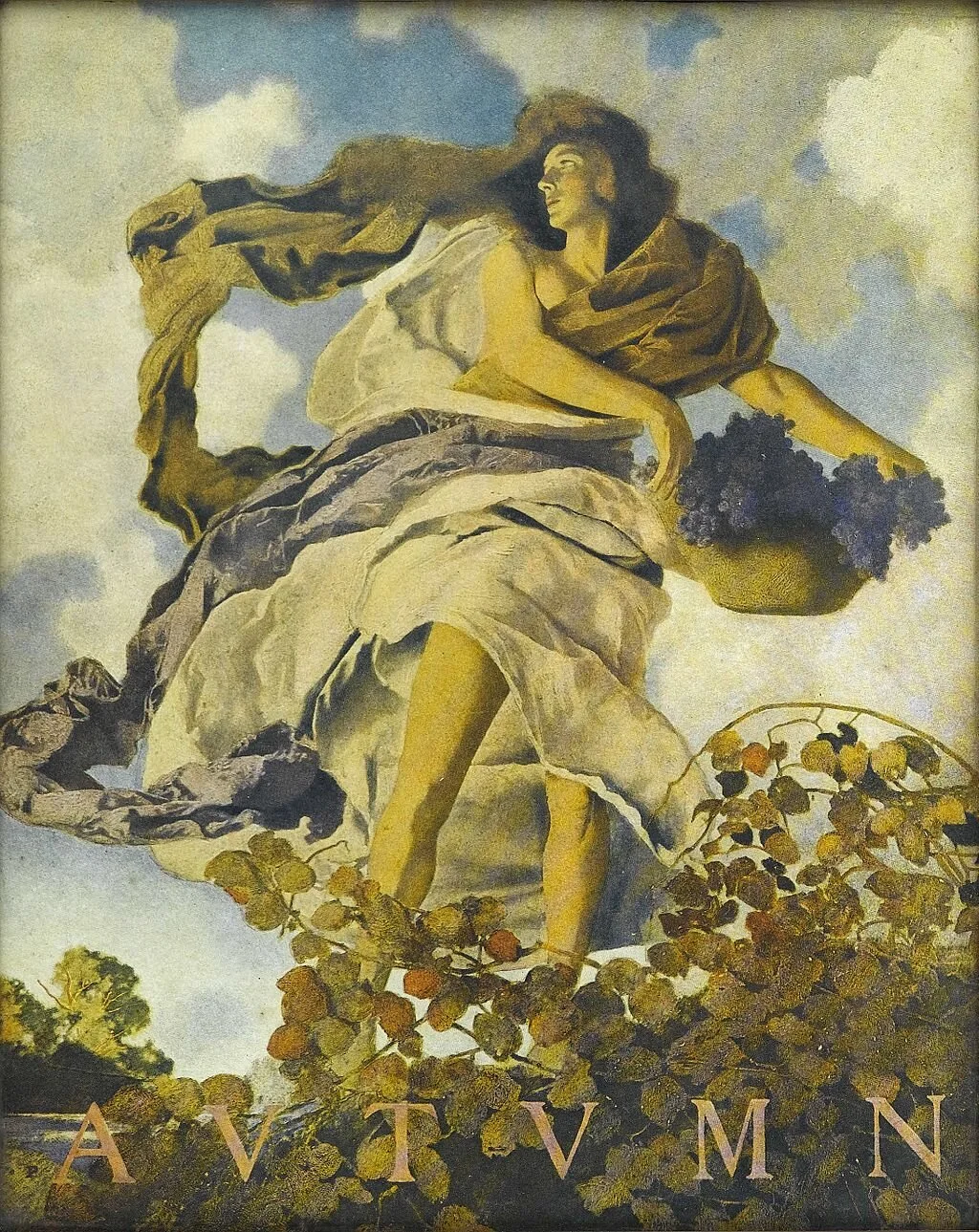
This 1905 print by Maxfield Parrish illustrated John Keats's poem “Autumn’’. Parrish spent much of his life in Plainfield, N.H., near the site of the famous art colony in Cornish, N.H.
“An agitation of the air,
A perturbation of the light
Admonished me the unloved year
Would turn on its hinge that night.’’
— From “End of Summer,’’ by Stanley Kunitz (1905-2006). The Worcester native was a celebrated poet and teacher who for much of his later life moved back and forth between homes in New York City and Provincetown. The autumn equinox comes on Tuesday, Sept. 22, this year.

Grace Kelly: Of seals, great white sharks and people

Great white shark
Via ecoRI News (ecori.org)
In the waning days of July, Julie Dimperio Holowach was swimming off the coast of Harspwell, Maine, with her daughter. What was a fun day in the surf and sun turned tragic when she was bitten by a great white shark and died as a result of her injuries.
The ensuing talk in the press and by New England beachgoers centered upon the rising seal population and its role in attracting sharks to local waters. Culling was discussed, and one headline read, “More Seals Means Learning To Live With Sharks In New England,’’ painting a picture that it’s the rotund sea mammal’s fault we’ve entered Jaws 2.0.
But the relationship among sharks, seals and humans is more nuanced and complex.
Of sharks, seals and humans, a John Steinbeck quote from Of Mice and Men seems appropriate: “Maybe ever’body in the whole damn world is scared of each other.”

Gray seal
Of seals
The return of gray seals to New England waters, after they were hunted to dangerously low numbers, is often blamed when a shark attack happens.
In Inuit folklore, seals were created from the fingers of Sedna, the goddess of sea animals. In one version of the legend, Sedna angers her father by rejecting her suitors and marrying a dog. Enraged, he casts her over the side of his kayak and cuts off her fingers as she tries to clamber back into it. Her fingers became the first seals, and Sedna becomes ruler of all creatures of the deep.
Other groups have their own legends about pinnipeds that slide through the water like fish but can also maneuver their way on land.
And in New England, two breeds of pinnipeds — gray seals and harbor seals — have a deep relationship with the region’s land and sea.
“There were a lot of gray seals and harbor seals all through historic times up through early 1900s,” said Kimberly Murray, a research biologist and seal research coordinator at National Oceanic and Atmospheric Administration’s Northeast Fisheries Science Center. “In fact, there was so many of them that there was a bounty for them in Maine and Massachusetts in the late 1800s, early 1900s. We don’t know exactly how many there were; I think … that it’s estimated something like 75,000 to 135,000 seals of both species were taken for the bounty, so there were a lot.”
While the presence of seals in this area has long roots, so does the history of humans hunting them, with seal meat even served at the first Thanksgiving.
“Seals and sea lions have historically been hunted,” said Monica DeAngelis, a marine-mammal biologist at the Naval Undersea Warfare Center, in Newport, R.I. “That was sort of the beginning of the relationship. Native Americans hunted them for subsistence and then European settlers, the early ones, used them for oil and meat, and for their pelt.”
Seal numbers declined steadily over the years, with people even picking them off for sport with guns in Narragansett Bay. The hunting and decimation of their numbers continued until the 1970s, when the Marine Mammal Protection Act was enacted, in 1972, and the Endangered Species Act was enacted, in 1973, both during the Nixon administration.

Harbor seal rests on the bank of the lower Connecticut River near Long Island Sound.
“They were really hunted down to low levels,” Murray said. “And there were a couple factors that allowed them to come back and recover. One of those was laws that were enacted in the state of Massachusetts in the ’60s and then the federal Marine Mammal Protection Act in 1972. These protective laws pretty much banned hunting.”
Today, gray and harbor seal populations continue to reclaim the territory they fled along the coast of New England, where they haul out to breed, molt, and have their pups.
The population of gray seals, specifically, comes from a larger colony up near Nova Scotia, and have been steadily repopulating a territory that they had to leave to survive.
“There’s estimated to be a quarter-million of gray seals in Canada, and they move around a lot,” Murray said. “We know that the animals that have come down to the U.S. starting in the late ’80s, early ’90s, are coming from that source population. They are able to return to a territory they used to occupy, and that’s why I think people get really surprised because they didn’t know they were here before.”
But not everyone is happy about the return of the seals. Besides competing with fishermen for various fish stocks, the newly healthy seal population has sparked the idea that with more seals comes more of their scariest predators: sharks.
Of sharks
Humans have long held a fascination with the wonders — and horrors — of the sea, and sharks are no exception.
“There are some cultures that revere the shark and worship the shark and there are others that are frightened of it,” said Gregory Skomal, a senior scientist for the Massachusetts Division of Marine Fisheries.
An illustration from the 16th-Century epic poem “History and True Novel of the Duke of Lyon de Bourges,” depicts a shark as a scaly, fanged monster with red eyes terrorizing the crusader Olivier de Bourges, who swings his axe at the beast as it devours his helmet.
Locally, more than a few historical records describe sharks as “monsters” and “man-eaters,” and a few vigilantes have even killed sharks as revenge for attacks. And the shark that lingers in man’s memory as the most fearsome of them all? The white shark, colloquially known as the great white.
“Here in New England and as far north as Newfoundland, white sharks are very well documented historically over the last several hundred years or so,” Skomal said.
But it was one summer, the summer of ’75, when the biggest and baddest of white sharks came to town. Its name was Jaws.
“Whenever you hear about a shark attack … you immediately think of Jaws,” said Marc Lapadula, a senior lecturer in film studies at Yale University. “People saw that film and they were terrified. People left their seats. I was there, I was 15 in 1975.”
Lapadula lectures on films that changed America, and noted that Jaws scared people so badly that during that summer many people avoided dipping so much as a toe in the briny blue.
.
“It was so scary to people that I had friends who had summer homes at Bethany Beach or Rehoboth Beach, Del., or Ocean City, Md., and that entire summer they would not go in the water,” he said.
Bradley Wetherbee, an assistant professor in the Department of Biological Sciences at the University of Rhode Island, has spent nearly 30 years of his life studying sharks. To him, the perceptions of white sharks, and even the spotlight on this one breed of shark, is overkill.
“There are a lot of people out there who only know one species — great white sharks — and they know one thing about them, which is that they bite people, they kill people,” he said. “If one person sees a white shark up there in the Cape, it’s in the news. People are fascinated with them.”
But there’s much more to sharks than their unfounded reputation as cold-blooded, doll-eyed killers. Indeed, with more than 500 different species of shark known to man, the white shark is just one of many fascinating creatures.
Wetherbee is quick to defend the cartilaginous fish in all its varied forms. One of his focuses is on mako sharks, which don’t have nearly the cult following that white sharks possess.
“Everything about makos is fast,” he said. “Their tail, muscles, everything. They’d swim circles around white sharks.”
But it’s great whites that are almost always at the forefront of the human mind when a shark attack occurs. According to the Florida Museum’s International Shark Attack File, white sharks are part of the “Big Three” when it comes to attacks.
“The white, tiger and bull sharks are the ‘Big Three’ in the shark attack world because they are large species that are capable of inflicting serious injuries to a victim, are commonly found in areas where humans enter the water, and have teeth designed to shear rather than hold,” according to the project’s Web site.
“When a white shark attacks, it attacks to kill,” Skomal said. “Their strategy during a predation event is to ambush. A seal at the surface is a very formidable predator itself, and in order for a shark to kill a seal, it has to ambush it with speed, stealth and strength. Power. So, if the shark is making a mistake and it thinks that person is a seal, it’s still going to strike with force, and it does so in a way that creates an amazing amount of traumatic injury.”
But Skomal noted that immediately after attacking a human, the shark usually realizes its mistake.
“Very rarely if ever do they consume the person because they realize, almost immediately, that they made a mistake, that this is not their normal food,” he said.
Of humans
While calls to cull growing seal populations have sprung up as a way to mitigate the few shark attacks that occur each year, for many experts, the dilemma of the interaction among seals, sharks and humans isn’t so cut and dry.
“White sharks are known predators of seals; that’s what they augment their diet with as they get larger, when they get to be over nine feet in length. They’re built to kill seals and that’s what they do,” Skomal said. “So it makes perfect sense that as the seal population rebounds and they are recolonizing areas, white sharks are going to take notice and begin targeting those animals, and because those animals tend to be piled up close to shore, the chances of [humans] encountering a white shark are a bit higher.”

Sunset on Race Point in the Cape Cod National Seashore. That more and more people seek to spend time on the seashore means more encounters with seals and sharks.
— Photo by SeduisantRedux
But part of what is happening, and part of the animal equation that is often left undiscussed, is the human element.
Visiting the seashore wasn’t always a relaxing leisure activity. Up until the 1880s, the seaside was a wild place where shipwrecks occurred, storms destroyed buildings, pirates lied in wait to attack, and where monsters lurked in the dark waters. It wasn’t until the 1860s that the beach became a place popularly known for its curative qualities. Coupled with the Industrial Revolution and the birth of easy and increasingly affordable transportation in the form of automobiles, a jaunt to the seaside became accessible to more people.
That trend continues today.
In 2018, nearly 4 million people visited the Cape Cod National Seashore. Compared to the 30,000 to 50,000 seals estimated to be on the Cape in 2017 and the 147 white sharks identified in 2016, humans are the species present in the largest numbers.
And while we fear sharks and blame seals, we’ve had our own terrible impacts on both species throughout history, from hunting seals to the brink of extinction to the more recent overfishing of sharks.
“It appears that the white shark population, which was quite healthy, was overexploited during the ’70s, ’80s and ’90s,” Skomal said. “During that time, there was a massive increase in shark landings driven by seafood markets and demand for shark fins. Then, in 1997, the U.S. government, followed by states, implemented regulations that protected white sharks: You could no longer target or land white sharks to keep. So … the population appears to be rebounding back to historical levels. But we don’t think it’s there just yet.”
While humans have attempted to correct the wrongs we’ve wrought throughout history when it comes to species decimation, the urge to control our environment still sits deep in the marrow of our bones. But like Captain Ahab hunting his white whale in Moby Dick, sometimes the desire for control ends with our own demise.
“When you have an ecosystem that’s well-balanced, that speaks wonders to the health of the ocean,” said DeAngelis, the marine-mammal biologist at the Naval Undersea Warfare Center. “And when you have a healthy ocean, you have healthy environment for the rest of us, for humans. I would be very concerned if all of a sudden all of the sharks disappeared, all of the seals disappeared, because that means something is going on with the ocean. It's a delicate balance, and humans have kind of tried to play God.”
Grace Kelly is a journalist with ecoRI News.

Llewellyn King: Biden elicits little excitement even among Democrats
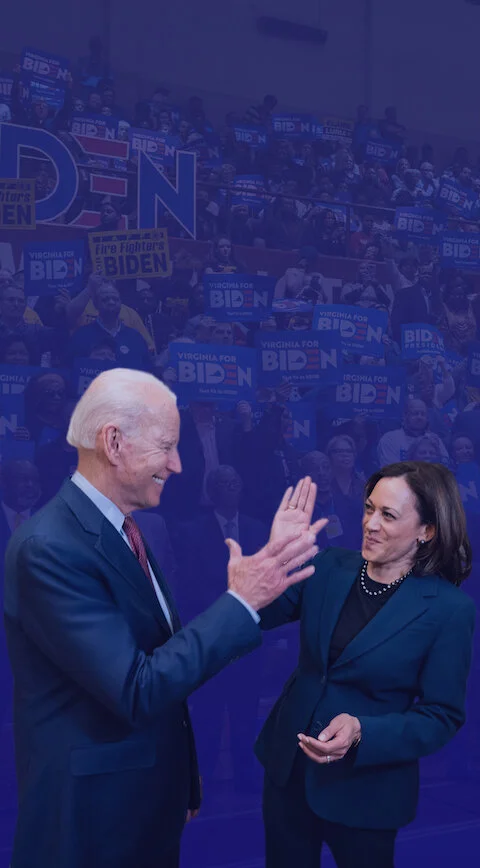
Joe Biden and his running mate, Kamala Harris
WEST WARWICK, R.I
Four years ago, Democrats slouched to the polls and voted, holding their noses figuratively. Somehow the party had come up with a presidential candidate that even many Democrats didn’t like very much: Hillary Clinton.
Pitted against a risible president, Donald Trump, who is a climate-change-doubting, class-dividing, race-baiting, immigrant-bashing, law-bending, treaty-tearing, dictator-loving, truth-challenged, dissembling incompetent, this time, it should be an easy White House win for the Democrats.
This time, there should be white-hot passion for Democratic challenger Joe Biden, the candidate who would restore our moral base, our international standing, salve our wounds, and give us a sense that the nation is moving forward to a sunlit future. But there is no surge of feeling, zero passion.
Biden is the candidate who would deal with the COVID-19 pandemic and the environmental catastrophe that is unfolding with pestilences of a biblical scale: serial hurricanes striking the Gulf Coast and wildfires from hell in the West. He is the man who should give us confidence in our systems, from health care to voting, to the rule of law at the Justice Department. But there is no surge, no passion.
Instead, the closest thing to enthusiasm I find among voters is resigned, faint praise. “He’s a decent man,” I’ve been told over and again. I’ll have a struggle in not offering the next Democrat who tells me in a woeful voice that Biden’s “a decent man” a physical rebuke.
One may discount the great man or woman view of history, but there is no great argument for the “decent man” view of history. You can have decent men who were great, Truman and Reagan, but you can’t move the needle of history with flaccid decency.
Poor old Joe Biden -- yes, he is old for the job — he’ll be 78 on Nov. 20 -- is defined mostly by having been there, like the TV-watching gardener played by Peter Sellers in the movie Being There. He was in the Senate for a long time, he was vice president to Barack Obama for two terms. He clears the being-there bar, but it is a low bar, very low.
No one is passionately against Biden. Trump’s attempts to paint him as a socialist ogre about to take us to Stalinism have fallen flat. Flat because they are unbelievable, and they are unbelievable because that isn’t Biden.
Biden has always been the quintessential man of the center of the situation. The pressure on his left wing, coming from Senators Bernie Sanders, of Vermont, and Edward Markey, of Massachusetts, and the group around Rep. Alexandria Ocasio-Cortez, of New York, is going to be a problem and a discomfort for Biden. He must also wonder where in that world his vice-presidential pick, California Sen. Kamala Harris, so far defined more by her ethnicity than her philosophy, will fit.
If, as still expected but not guaranteed, Biden makes it across the threshold in this election, his greatest strength will be his address book. His best strategy will be to use surrogates to fight his political wars. That means a strong Cabinet and a great White House staff.
Given Biden’s limitations, his chief of staff will be a critical player. He needs to give his Cabinet secretaries their heads. One of the many weaknesses of the Trump administration has been the pusillanimous nature of the Cabinet: Men and women who see the role only as pleasing the capricious and solipsistic president -- a chorus of lickspittle people singing hymns of praise to the chief.
Biden doesn’t need to point up Trump’s weaknesses: They are manifest. He needs to point up his own strengths beyond his affability and, yes, beyond his decency.
I’ve been watching Biden for years, nodding “hello” to him, and sometimes talking with him, the way it goes for reporters and politicians in Washington. I get the distinct feeling Biden isn’t the man he was eight years ago, when he would’ve been a more appealing candidate within his limitations. He seems diminished, his fire reduced to an ember.
As it is Democrats and renegade Republicans, needs must, will slouch to the polls to vote against Trump. Few in their hearts will be voting for Biden. There is a passion deficit.
Llewellyn King is executive producer and host of White House Chronicle, on PBS. His email is llewellynking1@gmail.com and he’s based in Rhode Island and Washington, D.C.
Website: whchronicle.com

John Maguire: More affirmative action, not less, needed in elite college admissions

From The New England Journal of Higher Education, a service of The New England Board of Higher Education (nebhe.org)
This essay is a sequel to “The Human Dimensions of Enrollment Management,” published in The New England Journal of Higher Education on June 30, 2020. In that article, my unusual focus (as a trained theoretical physicist) was on integrity, not science, as the single most important factor in enrollment- management success. Early in my supervision of enrollment management (from a faculty position in the physics department at Boston College), I encountered serious challenges to that fundamental principle of integrity:
• In my first year (1972) on the job as dean of admissions at BC, one day was disrupted by a loudmouth self-proclaimed wealthy Texan in an ostentatiously large cowboy hat. He barged into my office, opened a checkbook and guaranteed me, and/or anyone I designated, “any amount necessary” to secure his son’s admission to Boston College. I evicted him summarily from our office and denied his son the right to apply.
• An influential alum (“Triple Eagle”) and BC administrator’s daughter appealed her rejection on the margin from the highly selective BC School of Nursing. The director of admissions offered the young woman a “Summer Challenge” of passing three courses (with B-‘s or better). Tragically, she received two A-‘s and a C+ and was never enrolled in the School of Nursing. That candidate was my daughter.
• In the late ’70s , the chairman of the Boston College Board of Trustees insisted to the president that his daughter be provisionally admitted to BC, despite her questionable credentials. The president requested that I “make this one exception to avoid a major political risk.” I reluctantly agreed—and the chairman’s daughter flunked out after one semester. Both the chairman and the president agreed thereafter to make the Admissions Office the final arbiter in all cases, even at the risk of losing millions of contributed dollars for new buildings and endowment.
• For at least five years into my tenure as leader of BC Admissions, I tolerated (even countenanced) the admission of virtually all wealthy Phillips Andover Academy seniors, even those in the bottom tenth of their class—while rejecting all but a handful of applicants, many in the top tenth of their classes, in low-income places such as Chelsea, Mass.
In an attempt to advance the principle of “affirmative action,” we completely reversed our strategy, rejecting many wealthy Andover applicants in favor of needy Chelsea applicants, with great results: More top Andover students began applying and gritty Chelsea students succeeded well beyond what their SATs might have predicted. Careful science-based research at BC documented the weak relationship between our ideal redefinition of “quality” (courageous, never-give-up grit, achievement against odds, work ethic—not wealth, social status) and test scores.
I take obvious pride in these displays of integrity by our enrollment team, which have served Boston College—and later other Maguire Associates client institutions—very well over these past 40-plus years.
These examples stand in stark contrast to the much-publicized multiple scandals of “Varsity Blues,” in which status-seeking celebrities are too often willing to write hundreds of thousands of dollars in checks, risk prison and disgrace, and dishonor their most sacred duty to (in the words of Crosby, Stills, and Nash) “teach your children well” about integrity and honesty.
At the highest levels of American leadership, there are now documented examples of secret payments to stand-in SAT test-takers to gain undeserved university admissions and to assist with writing assignments to cover up laziness and corruption—and nonstop braggadocio about fraudulent academic achievements. And too often the names of wealthy criminals remain on buildings and academic departments!
More recently, to underscore the offenses of the entitled well-to-do people whom I confronted earlier in my career—and who continue to seek unfair advantage in Varsity Blues pursuits—expensive legal actions on behalf of disproportionately “entitled well-to-do’s” are accusing Harvard and now Yale of law-violating affirmative action in attempting to do what Boston College accomplished quietly with the Chelsea/Phillips Andover case study. (I sometimes wonder how BC might have fared if a court action had been taken on behalf of Andover rejects losing seats to applicants from Chelsea.)
The great irony in evaluating the honorable ethical defenses (specifically, of white and Asian-American admission percentages, already among the highest in New England) that both Harvard and Yale have put forth is that (in my opinion) a stronger case can be made that too little “affirmative action” is being sought among highly endowed ultra-wealthy Ivies and NESCAC (New England Small College Athletic Conference) institutions. (The Ivy League schools are Harvard, Yale, Dartmouth, Brown, Princeton, Cornell, Columbia and the University of Pennsylvania.)
The following graph (prepared by me using firsthand data) presented at our 2017 Maguire Associates Tokyo Keynote (“The History and Future of Enrollment Management”) to a national group of Japanese universities is most revealing:

Under 20 percent, and in some cases under 10 percent, of family incomes at elite colleges and universities, are below the national median. And even more telling, of the 80 percent to 90 percent above the national median income, many are triple and more above that median. These institutions, with well under 5 percent of the total national college and university enrollment, control over two thirds of all endowment funds! (Note: Billion Dollar Club refers to the Ivies; the Selective Liberal Arts Colleges are generally NESCAC schools.)
Let me reintroduce the single most relevant and controversial commentary I have produced on this singularly important subject. The 2008 editorial, published in the Chronicle of Higher Education, entitled “‘Have Not’ Colleges Need New Ways to Compete With Rich Ones” needs to be revisited in light of the Harvard/Yale challenges from those accusing them of “too much” affirmative action. We wrote over 10 years ago:
“What we now have is a kind of caste system in American higher education: Brahmin institutions (among which the Ivies are among those at the top) —by virtue of their implicit endowment-supported, non-need-based discount—are able to have their pick of the best candidates in every category of students, including minority students. Hidden from view, expanding year by year, that implicit discount is constantly widening the gap between the haves and have-nots.”
“Roughly 50 institutions now control more than half of college and university endowment money while educating fewer than 2 percent of the nation’s students—a 2 percent that is disproportionately drawn from wealthy families.”
“To put it bluntly, the massive endowments of elite universities confer on them an unassailable competitive advantage in the form of a hidden discount that forces the less well-endowed institutions to deploy merit aid in a scramble for a diminished pool of the best and most-diverse students.”
“The wealthiest institutions would argue, of course, that because they are blessed with the luxury of more aid dollars they are already doing their share. And, in fairness, some of them are reexamining their policies to try to attract more low-income students.”
“Let’s face it, serving the have-not students has become, by default, the disproportionate responsibility of the have-not private institutions and the public four-year and community colleges.”
“We need to be open to new ideas, however unworkable they may, at first glance, appear.”
My point in describing the work we conducted at a now-elite university (Boston College) and in the quoted commentary above is that a stronger case can be made that America’s most elite institutions could and should be doing more—not less—in supporting affirmative action. In the Chronicle article, we advocated “offering donors bigger tax breaks for gifts to private institutions with smaller endowments.” Perhaps the ultimate “pipe dream” (our words in 2008!) that we proposed in the Chronicle piece was our “call for universities with huge endowments to share the wealth by partnering with less well-endowed institutions to extend the benefits of a high-quality education to a broader array of students.”
While I served as a trustee at two separate low-endowment institutions, their outstanding leaders actually did approach (regrettably, unsuccessfully thus far) institutions with multibillion-dollar endowments in pursuit of innovative partnerships that could become win/wins.
I proudly congratulate my own alma mater, Boston College, for investing tens of millions of dollars in creating the Pine Manor Institute for Student Success to dramatically enhance BC’s already above-average diversity—while creating the most possible positive outcome for its financially challenged neighbor, Pine Manor College. More such partnership initiatives should be pursued by the most elite institutions. It may be past time to revisit those “pipe dream” partnerships.
A wonderful example: Brown University has gifted $10 million to the public school system in its home city of Providence. This is perhaps a challenge to, say, Harvard and Yale to invest (even more?) in boosting education in their home cities of Cambridge and New Haven. Let us all continue to brainstorm on other innovative strategies for increasing educational equality.
John Maguire is founder and chairman of Concord, Mass.-based Maguire Associates, a higher-education consulting firm.
‘Fresh Fields’ in Old Lyme

“Dogwood Blossoms” (oil on canvas, 1906), by Willard Metcalf, in the show “Fresh Fields: American Impressionist Landscapes from the Florence Griswold Museum,’’ at the museum, in Old Lyme, Conn., through Nov. 1.
The museum says the show “celebrates landscapes, specifically landscapes created by artists who visited the town of Old Lyme. Paintings, drawings, archival materials and photographs come together to reveal the history and ecology of Old Lyme, as well as draw attention to the continuing research on the area's landscape that informed the development of the museum’s Artists' Trail.’’
See:
https://florencegriswoldmuseum.org/

The Florence Griswold House, part of the museum
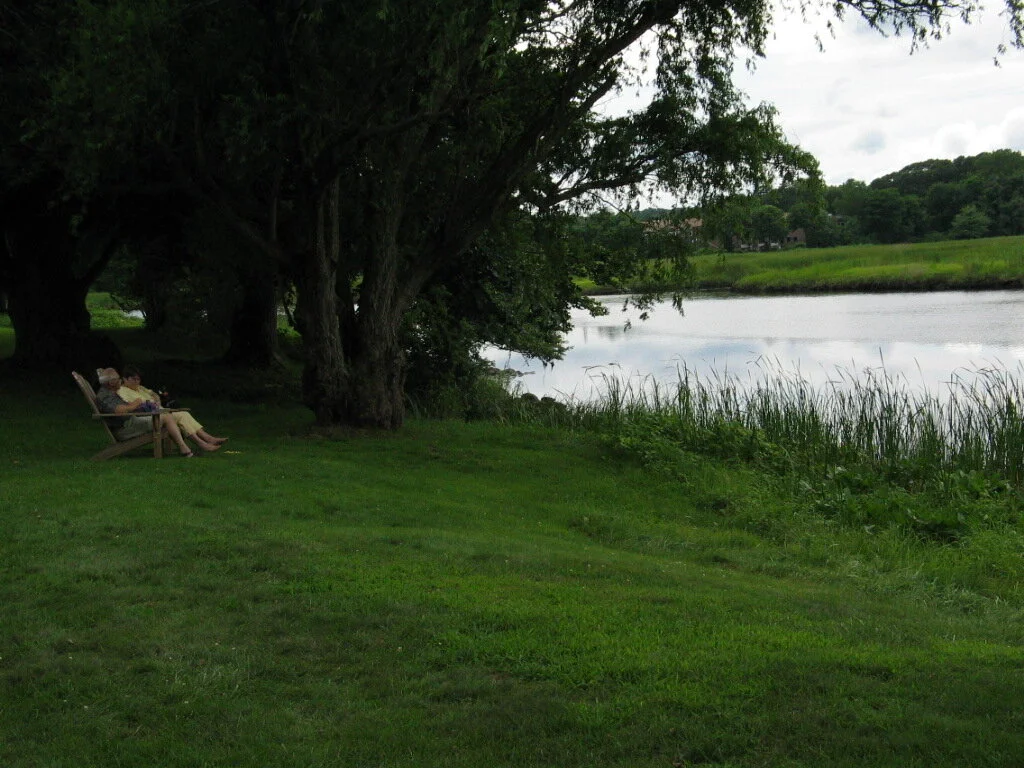
Relaxing behind the Florence Griswold Museum
—Photo by GK tramrunner229
Then you're swallowed

— Photos by Samuel Wantman

“Maine is not a death cult. I mean, it is, but it’s a slow one. It creeps in like the tide, and without you even noticing, the ground around you is swallowed by water until it’s gone.’’
John Hodgman, in Vacationland: True Stories From Painful Beaches
Hospital efficiencies of scale and rich exiting execs

From Robert Whitcomb’s “Digital Diary,’’ in GoLocal24.com
The financial losses stemming from the COVID-19 pandemic will apparently speed up something that has often seemed inevitable over the past two decades, in fits and starts, for years: a merger of Rhode Island’s two big hospital groups – Lifespan and Care New England (CNE) – which include Brown University’s Warren Alpert Medical School teaching hospitals. The two groups have been swimming in deep red ink in recent years, which has only worsened in the pandemic, and so naturally they seek more efficiencies of scale, and to reduce wasteful redundancies, in Rhode Island’s health-care “system’’.
Such a merger, in creating a much more powerful entity, might keep the Ocean State’s health-care system out of the control of Boston-based hospital giants, particularly Mass General Brigham (formerly Partners HealthCare). But an unsettling question will be whether the new Rhode Island entity will use monopoly pricing power to jack up its prices, big time.
State regulators will have their hands full in dealing with such a behemoth. And it will be interesting to see the bright golden parachutes of hospital executives made redundant by the union of these “nonprofits’’ as the parachutes waft them down to the ground in, say, Palm Beach. Since Lifespan is bigger than CNE, and therefore would in effect be the purchaser, I assume that the execs of the latter would be more likely to go.
But then, there will probably be lots of layoffs of those with administrative jobs if the merger goes through, as seems very likely
On a happier side, a merger would probably strengthen Brown’s medical and public health schools, including their research capabilities, by uniting them with a stronger organization.
Still, given the size and fame of the medical center in Boston, only about 50 miles away, even the big new Rhode Island group will probably be hard-pressed to compete with “The Hub’’ in some specialties.

Mitchell Zimmerman: COVID crisis shows endless liar Trump only cares about Trump

Via OtherWords.org
“Captain,” said the first mate, “we just crashed into an iceberg — the hull’s been breached!”
“An iceberg. Deadly stuff,” said the captain. “Still, let’s play it down.”
“What are your orders? We must warn the passengers.”
“I’ll make an announcement… Attention all passengers, this is your captain speaking. We’ve encountered some ice, but we have it very well under control. We’re doing a great job. No need for you to change your routines. Over and out.”
“Should we ready the lifeboats?” asked the mate.
“Nah. Let’s just show confidence. I don’t want to create a panic.”
The deceiving and self-flattering captain of the scenario, leading his passengers into disaster, seems fictitious. But he’s all too real: except for the references to ice, everything the captain says above are things that President Trump has actually said about COVID-19.
Tragically, that’s America in the age of pandemic. Over 6.5 million cases of coronavirus. Around a thousand deaths per day. An economy in ruins.
But Captain Trump is still at the helm — and Americans are still needlessly dying — because he still prefers “playing it down” to uniting us behind the tough but necessary measures that are called for.
For months, Trump urged resistance to the precautions epidemiologists recommended, crusaded against the lockdown, and minimized the lethal threat, even claiming the coronavirus was “totally harmless” in 99 percent of cases.
He knew this was false: “This is deadly stuff,” he privately told journalist Bob Woodward in February.
Even as Trump publicly ridiculed the use of masks and encouraged followers to defy social distancing, he knew the virus was spread through the air. “It goes through air,” he told Woodward. “You just breathe the air and that’s how it’s passed.”
Trump claimed publicly that coronavirus was “like the regular flu,” but he told Woodward that he knew otherwise. It’s “more deadly than even your strenuous flu,” Trump told the journalist — more than five times as deadly.
Trump and his falsehoods are responsible for most of America’s 200,000 coronavirus deaths to date. How could it be otherwise? How could anyone think thwarting the epidemic response prescribed by doctors, scientists, and public health leaders would not have deadly consequences?
Turn back to January.
A dozen presidential briefings warned Trump of the coming pandemic. The Health and Human Services Department secretary twice told Trump the contagion was looming. Trump’s trade adviser wrote a memo in January warning of a “full-blown pandemic, imperiling the lives of millions of Americans.”
Trump claims he refused to act because he feared panic.
Avoiding panic is all very well. But if you’re telling passengers they don’t need to get in the lifeboats, you’re responsible when they start drowning. In reality, Trump cared more about not “panicking [the stock] market” — which he saw as key to his re-election — than about the lives that would be lost.
By late February a White House task force recommended aggressive steps, including stay-at-home orders. But when a Centers for Disease Control leader warned the public that a pandemic was imminent and “disruption to everyday life might be severe,” Trump threatened to fire her.
“The risk to the American people remains very low,” Trump proclaimed instead.
It was mid-March before Trump yielded to reality.
The cost of Trump’s delay? Columbia University epidemiologists concluded in May that had the lockdowns begun just two weeks earlier, “the vast majority of the nation’s deaths — about 83 percent — would have been avoided.”
But they weren’t. And the 1 million people who were needlessly infected, thanks to Trump’s indifference, then went on to infect others, and those in turn still others. Meanwhile the president kept up his campaign against the steps needed to bring the pandemic under control.
No precise reckoning is possible, but there’s no doubt a majority of our cases and deaths might have been avoided but for Trump’s lies, neglect, and sabotage.
Mitchell Zimmerman is an attorney, longtime social activist, and author of the anti-racism thriller Mississippi Reckoning.
Colors of summer and fall, too

"Thermos Cluster," by Jill Pottle, in the group show “Colors of Summer Memories,’’ at Fountain Street Fine Art, Boston, and curated by Marygrace Gladden
The gallery says the show “encourages the viewer to recall the emotions and feelings of summer. The season is often associated with warm colors as the temperatures rise and the sun shines differently than any other time of year. Summer of 2020 has led to a halt in normality as the pandemic stopped many seasonal activities that would have been taking place. COVID-19 has society spending their summers in new ways with many people spending more time at home, in their personal spaces. For some, being confined to their home led to renovations as well as new discoveries within the interior spaces in which they inhabit. The warm summer colors, along with the unique familiarity of our homes at this time have created summer memories that will remain at arm's length as the winter months draw near.’’
See:
https://www.fsfaboston.com/
Chris Powell: Postal Service realities; bring back postal banking?
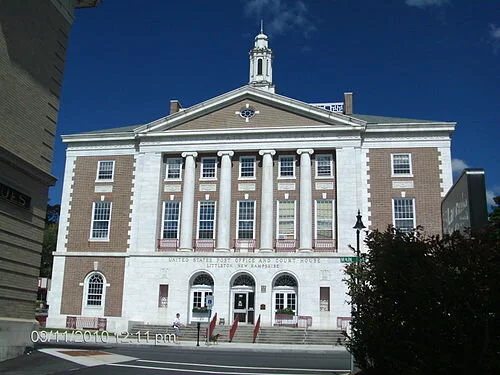
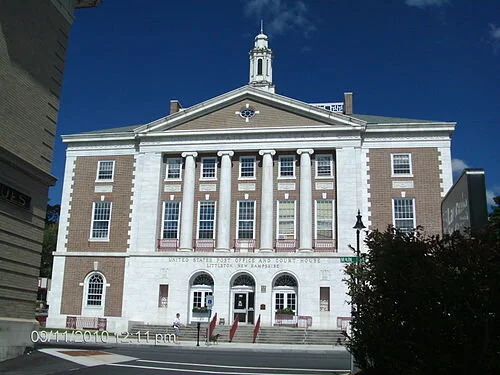
The Littleton (N.H.) Main Post office, opened in 1933. It’s surprisingly grand for a town with only about 6,000 residents. It’s on the National Registry of Historic Places.
MANCHESTER, Conn.
Maybe someday when the United States has a president who is not crazy or senile, a Senate majority leader who isn't his tool, and a House speaker who doesn't think that those who disagree with her are enemies of the state, the country can have a serious discussion about fixing the U.S. Postal Service.
President Trump recently suggested that he wanted to cut off money for the Postal Service to hamper the voting by mail desired by Democratic leaders. The postmaster general, a big donor to the president's campaign who is invested in companies that compete with the USPS, had ordered economy measures that raised suspicion about his motives. But he has postponed those measures until after the election.
Since throwing fantastic amounts of money at everything has become national policy, the other day the Democratic majority in the House passed an emergency appropriation of $25 billion for the Postal Service with barely a thought about the service's inefficiencies and potential.
Just as the president seems to want to weaken the USPS for partisan reasons, the Democrats seem to want to keep it operating just as it is because it employs about 600,000 people, most of them belonging to a union that supports Democrats. In the Democratic view, delivering the mail efficiently seems to be secondary.
The Postal Service long has been losing big money. It has not come close to covering its costs for the last 13 years, during which its losses have totaled $78 billion. Its unfunded pension and retirement medical insurance liabilities are worse.
In 1971 the USPS was taken out of the regular government and made a supposedly independent agency in the hope that regular business practices would be applied and improve efficiency. But this didn't accomplish much. Mainly postage prices rose as government's direct subsidies were withdrawn, and the Postal Service's financial position worsened.
{Editor’s note. Much of the Postal Service’s financial woes stem from a 2006 law passed by the Republican-run Congress in a lame-duck session that mandated that the USPS pre-fund its employee-pension and retirement costs, including health care, not just for one year but for the next 75 years—a crippling requirement not imposed any other enterprise. The year that mandate passed, the Postal Service had a $900 million profit.}
Customer services have been expanded but mail volume has fallen sharply, first because of the Internet and lately because of the virus epidemic, so the Postal Service doesn't make full use of its vast infrastructure.
Its defenders, mainly Democrats, note that the USPS was never supposed to earn a profit but to knit the country together. It has done that well. But some of its defenders imply that because it wasn't meant to make money, it's all right for it to lose any amount of money -- that its primary purpose now is not delivering the mail but employment and that postal employment is the best use of the money being spent to cover losses.
Republicans are suspected of wanting to privatize the Postal Service or cripple it by repealing its monopoly on delivery of first-class mail. Certainly private companies might do better with such mail in some respects, but the law requires the USPS to serve all people in the country at the same rates -- to make not just the less expensive deliveries of densely populated areas but the more expensive deliveries in the remote countryside. The Postal Service is a great gift to rural areas, the country's breadbasket.
Urban areas also might find the USPS more of a gift if postal banking was restored. From 1911 to 1967 the Postal Service office offered modest savings accounts. While their appeal diminished with federal bank deposit insurance, which came because of the Great Depression, the Postal Service still sells money orders and might offer not just savings accounts again but also basic banking services to poor people whose patronage commercial banks find unprofitable and who use expensive payday lenders and check-cashing services.
Of course, the Postal Service probably would not break even in the banking business either, but helping the poor save and learn banking would elevate them and give commercial banks some much-needed competition.
In any case the USPS has a big underused infrastructure even as it still knits the country together. But like nearly everything else in government, its employment costs are excessive. If actual governing ever resumes in Washington, improving the Postal Service while making it break even should be high on the agenda.
Chris Powell is a columnist for the Journal Inquirer, in Manchester, Conn.
Breakthrough on Nantucket
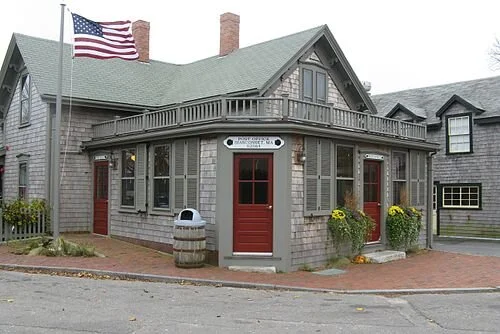
Post office in the Nantucket village of Siasconset, on the eastern end of the town/island. Nicknamed “Sconset,’’ it’s where Alice Killer spent a few cold-weather months in 1962-63 as she sought to better understand herself and change her life.
From Robert Whitcomb’s “Digital Diary,’’ in GoLocal24.com
Philosopher, with a PhD, and writer (mostly as a kind of memoirist) Alice Koller, who died July 21 at 94, was the author of two books that continue to have a following. These are An Unknown Woman and The Stations of Solitude. Parts of them recall, slightly, Thoreau’s Walden.
Ms. Koller may have often been an impossible person to be around for long. And so her painfully reached decision, in lieu of the suicide she considered, to hereafter live, but alone, and stop wasting time and energy trying to meet her own outdated or false expectations, and those of others, was good for all concerned. She came to the decision in winter of 1962-63 while living alone, except for her German Shepherd puppy, on the easternmost shore of Nantucket, an experience that’s the core of An Unknown Woman. That dog, Logos, and her two other dogs that followed played key roles in her life, becoming her family.
Her rigorous self-analysis as she explored the sources of her misery has lessons for everybody seeking to live with more integrity, independence and creativity, though few will want to emulate her life, which had much poverty and other challenges, some caused by things out of her control and some by her own eccentricity and willfulness. Oddly, her self-involvement doesn’t come across as narcissism but rather as honest, hard-working attempts, informed by curiosity, to come to terms with the reality of her past and present.
Ms. Koller was also a fine writer about nature – the landscapes, creatures and weather -- in the various places she lived, from the moors and beaches of Nantucket to the woodsy exurban towns where she mostly lived afterwards.

One of “Sconset’s’’ old cottages. At least one of them dates back to the late 17th Century.
Liminality and simultaneity
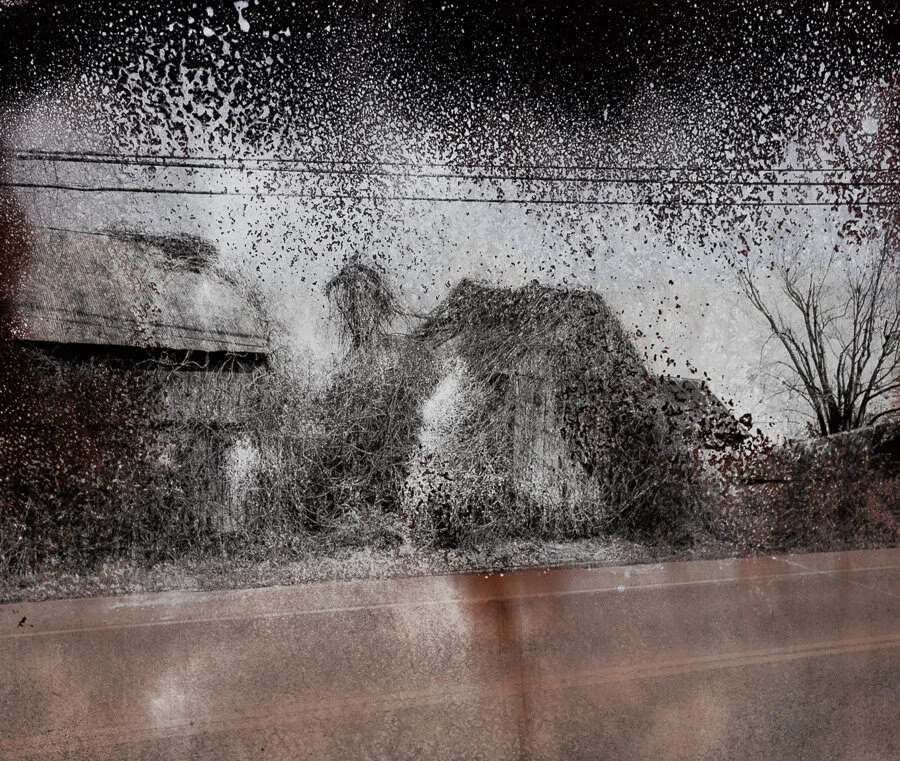
“Consumed Structure With Road III,’’ by Denny Moers, in his monoprint show “Within a Liminal Space,’’ at Periphery Space @ Paper Nautilus, Providence, through Nov. 1.
The gallery says:
“‘Within a Liminal Space’ explores the tension between the known and the unknown. From the Latin root limen, meaning threshold, liminal is a transitional place separating the familiar from the unrecognizable. This area can be uncomfortable for many, but it is an area that artists know intimately. Whereas some photographers might anxiously move the paper in the chemical bath, anticipating the images they think will appear, Moers thrives in this space, embracing the process, accepting the uncertainty.
“Looking at Moers's photographs as liminality, another word comes to mind – simultaneity. The hazy, mirage-like images in contrast with a hard edge of color remind me of a past I can't quite bring into focus and a future that is sharply taking shape. He shows us a road that shines slick with color in the foreground while the trees and barn in the background are seen in black and white as nature envelopes them. These images are intriguing and mysterious, full of meaning, waiting to be understood.’’
David Warsh: Time to build new public data infrastructure
SOMERVILLE, Mass.
“Philosophy? Philosophy? I’m a Christian and Democrat — that’s all.’’ Franklin D. Roosevelt responding to the question “What is your philosophy?” as quoted in Freedom From Fear: The American People in Depression and War 1929-1945, by David Kennedy.
It’s a commonplace that every new presidential administration arrives as a policy omnibus, with all kinds of venturesome policy entrepreneurs aboard. Campaign managers, financial backers, friends of the president and vice president, Cabinet members, Congressional committee chairpersons and their staffers, lobbyists, opinion shapers in the media – all bring agendas and, in the pell-mell of the first hundred days, seek to put them in motion.
It will be decades before we know what the Trump presidency was all about. But Biden, if he wins, will take office, with only one certainty. The Democrats will once again be the party of Innovation. Starting with candidate Barry Goldwater in 1964, the Republican Party managed to wrest away the mantle of change: deregulation, globalization, supply-side economics, all that. But after the monumental stumble that has been the Trump presidency, the GOP must rebuild itself as the party of conservatism or go out of business.
Trump himself may have arrived with a headful of ideas, but in the event he is defeated after a single term he is headed for obloquy greater than that of Herbert Hoover as a president who didn’t show up. Should Trump win a second term, of course, that’s another story.
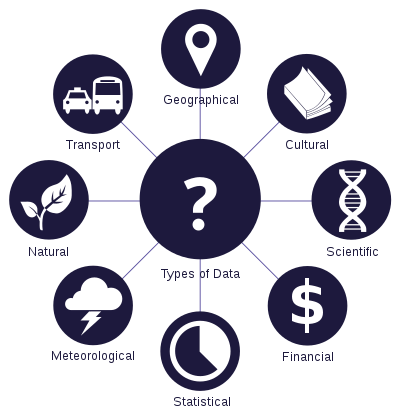
Green New Deal? Tax restructuring? Pandemic crisis management? Health care and Social Security repair? Immigration status reform? Supreme Court appointments? Which of a thousand possibilities will blossom into fact? There is no way of knowing today. As a gauge of the Biden administration’s long-term success, however, consider a modest suggestion. What about commissioning a National Data Service to stand with the Army, Navy, Marine Corps, Air Force, Coast Guard, Space Force, Public Health Service and National Oceanic and Atmospheric Administration, as the nation’s ninth uniformed officer corps?
The pre-history of the Space Force is instructive. As far back as 1961, then Defense Secretary Robert McNamara designated the Air Force as the lead military service for space. But not until 1982 was an Air Force Space Command created, in connection with the Reagan administration’s Strategic Defense Initiative, a satellite-based laser weapons system abandoned after some testing. Satellite reconnaissance became part of the War on Terror after 9/11. And in March 2018, President Trump embraced the independent Space Corps idea in a public speech. He signed a statute in December 2019 establishing it. Around 16,000 active-duty Air Force personnel and civilians are assigned to it.
Public data collection in the United States is a much older service. Article I, Section 2 of the Constitution requires the enumeration of the nation’s population for purposes of establishing representation in Congress. The first Census was conducted in 1790, and at ten-year intervals ever since. New statistical agencies were added as needs arose, for banking, agriculture, labor, safety, manufacturing, transportation, health, medicine, and so on. When the War Department (as what is now the Defense Department was previously called) needed planning data for World War II, the Commerce Department turned to the National Bureau for Economic Research, where Simon Kuznets was developing National Income Accounts. Most countries have a single statistical agency; the U.S. has 13 major agencies and hundreds of smaller programs.
The current system has needed an overhaul since the mid-1990s, when Janet Norwood, then Commissioner of the Bureau of Labor Statistics, wrote Organizing to Count: Change in the Federal Statistical System. Today it is judged to be broken. Old-fashioned survey techniques are outdated in the age of the Internet. Concerns for privacy and confidentiality have sent costs soaring. The 2020 Census is expected to cost $48 a head to collect in constant dollars, as opposed to $5.50 in 1960. And political meddling has become a problem in the last four years. Manipulation of pandemic statistics has made headlines in recent months. And, having failed to exclude non-citizens by requiring them to identify themselves as such, the Trump administration decided to end the Census four weeks early, in August.
A high-level blueprint for building a new public data infrastructure appeared over the summer. Democratizing Our Data: A Manifesto (MIT Press), by Julia Lane, of New York University. A native New Zealander, now a U.S. and U.K. citizen as well, Lane earned a PhD from the University of Missouri in the 1980s, taught, worked for the World Bank for a decade, taught again for another 10 years at American University, managed the economics department at the University of Chicago’s National Opinion Research Center, and rotated through four years at the National Science Foundation as a senior program director. She subsequently founded a series of programs for the American Institutes for Research, and eventually the Coleridge Initiative, a rapidly growing research and training collaborative, before settling down as a high-end professor at New York University’s Wagner School of Public Policy. “It’s a golden moment,” she writes, to rethink the system, retaining its best aspects – trust, professionalization, continuity – while designing new systems of measurement, putting them to work, and making them widely available
Will it happen? It’s a long road, a matter for experts backed by diverse constituencies in government and private enterprise. But if ever a highly technical program was worth setting out, manifesto-fashion, in a short and readable book, it is this one. An age of Big Data is upon us. Shouldn’t a government run by a Party of Innovation bend to the task of creating a National Data Service?
David Warsh, a veteran columnist and an economic historian, is proprietor of Somerville-based economicprincipals.com, where this essay first ran.
More than basic black

“After the Storm” (acrylic on canvas), by Tim Forbes, in his show “NOIR: Works on Canvas & Paper,’’ at Lanoue Gallery, Boston, through Oct. 11. He’s based in Blue Rocks, Nova Scotia. (See below.) Hit these links:
lanouegallery.com
and
https://lanouegallery.com/artist/Tim_Forbes/biography/


Suresh Garimella: UVM's role in helping Vermont recover from COVID crisis

Named for U.S. Sen. Justin Smith Morrill, Morrill Hall at the University of Vermont was built in 1906-07 as the home of the UVM Agriculture Department and Agricultural Experiment Station.
Via The New England Journal of Higher Education, a service of The New England Board of Higher Education (nebhe.org)
BURL.INGTON, Vt.
Gracing the back wall of my office at the University of Vermont is an antique wooden desk that’s more than 150 years old. While it’s an undeniably handsome piece of 19th Century craftmanship, it serves much more than a decorative purpose.
As the desk of Vermont Sen. Justin Smith Morrill, the author of the Morrill Act of 1862, which established the country’s first land-grant universities, it is my lodestar, a vivid reminder of UVM’s status as one of the nation’s earliest land grants and of the solemn responsibilities that come with that designation.
Count me as a true believer in the land-grant mission and among its greatest fans. The first land grants, so called because the U.S. government donated federal land to each state to establish a university, were a brand new idea: higher education for everyday people focused on the practical subjects of agriculture and the mechanical arts, whose purpose was to improve the economic and cultural well being of the people in their state.
Why am I so passionate about UVM’s land-grant mission? Because Vermont, as much as any state in the nation, faces a series of daunting challenges—from population decline to stagnant economic growth—that a land-grant university like UVM is powerfully equipped to address.
In the middle of a pandemic that has rendered these challenges even more acute, there is another reason to believe in the land-grant mission. Land grants like UVM have a key role to play in helping their states recover economically from the ravages of COVID-19.
The economic impacts of the pandemic are indeed unprecedented. In the second quarter of 2020, the national economy shrank at an annualized rate of nearly one-third. Millions of jobs were lost in New England. And in Vermont, despite the state’s lowest-in-the-nation infection rate, unemployment in July was 8.3 percent, and the state has the highest budget deficit in its history.
How can land-grant universities help spur economic recovery in their states? In Vermont, we’re looking at bringing the power of the university to bear on these challenges in a number of ways.
We’ll take full advantage of one of UVM’s most important resources: our bright and capable students. In a post-COVID economy, employers—from tech firms to media companies to nonprofits—will be in dire need of eager-to-learn, dependable, qualified employees. To meet this need, we’ll significantly enhance our internship programs, so more students, beginning in their first year, can be exposed to career options in the state by interning with a Vermont employer. Just as important, we plan an active outreach and education campaign to employers, so they know how to connect with and engage our talented students.
We’ll harness the strength of another great university resource: the talents of our faculty, who last year brought over $180 million in research funding to the university. In the coming months, with support from our faculty, we will help businesses around the state apply for federal Small Business Innovation Research (SBIR) and Small Business Technology Transfer (STTR) grants, proven ways to help businesses grow.
We plan a concerted and sustained effort to attract our out-of-state alumni, a high percentage of whom are entrepreneurs, back to Vermont, a state they love, providing them with technical assistance so they can relocate their companies, envision new ways of working from home or start new businesses here.
We’ll mobilize the intellectual firepower of our faculty to help policymakers craft local and state programs that address socioeconomic challenges the state is facing, which hold back wellbeing and prosperity. In a survey of food insecurity in the state, for instance, faculty learned that some Vermont residents were stockpiling food and depriving those in need—a problem that informed policy can alleviate.
We’ll deploy the pedagogical and human development expertise of faculty in our College of Education and Social Services to help Vermont’s K-12 teachers better engage primary school students as they emerge from a remote learning environment and better understand how distance learning, enhanced internship and place-based learning opportunities can help keep college-bound high school students on track.
For many of these efforts, we’ll coordinate with UVM Extension. In an expansion of their traditional role, Extension faculty and staff will act as our on-the-ground implementation agents for community economic development.
As important as these programs are in spurring economic recovery, their impact would be muted without another initiative just funded by the state: UVM’s new Office of Engagement.
The office will function as the front door to the university, with staff who field inquiries from businesses and residents across the state, connecting them with appropriate resources and expertise at UVM.
While the university has a critical role to play in Vermont’s post-COVID recovery, its role in promoting the state’s well being stretches far beyond the current crisis.
Boosting the health, quality of life and prosperity of Vermont and Vermonters is one of the three core imperatives in the university’s recently released strategic vision, Amplifying Our Impact.
The strategic vision continues UVM’s long tradition of engagement with the state. During my tenure, we will become even more deeply engaged with issues of concern throughout Vermont.
The historic wooden desk I keep close by will continue to inspire me. With the help of this daily reminder, I will ensure that UVM’s land-grant mission—to help the state confront both our current challenges and those to come, shaping a bright future for all Vermonters—remains a top priority for Vermont’s university.
Suresh Garimella is president of the University of Vermont.

UVM seal
'Meant to be'

“When fall comes to New England
And the wind blows off the sea
Swallows fly in a perfect sky
And the world was meant to be.’’
— From song “When Fall Comes to New England,’’ by Cheryl Wheeler
'Summer people and lobsters'

Old Orchard Beach, Maine, long a favorite resort area for French Canadians, but not this year.
“As a child of Maine, he knew better than to learn to swim; the Maine water, in Wilbur Larch’s opinion, was for summer people and lobsters.’’
From John Irving’s Cider House Rules (1985)

Finally out of the house

“September smiled at her wonderful friends in all their colors and bright eyes and gentle ways. “You know, in Fairyland-Above they said that the underworld was full of devils and dragons. But it isn’t so at all! Folk are just folk, wherever you go, and it’s only a nasty sort of person who thinks a body’s a devil just because they come from another country and have different notions.”
― Catherynne M. Valente
Photo by Fiona Gerety, Wickenden Street, Providence, RI.
September 13, 2020
'The world itself'
“The most beautiful thing in the world is, of course, the world itself.’’
— Wallace Stevens (1879-1955), Hartford-based poet, lawyer and insurance executive
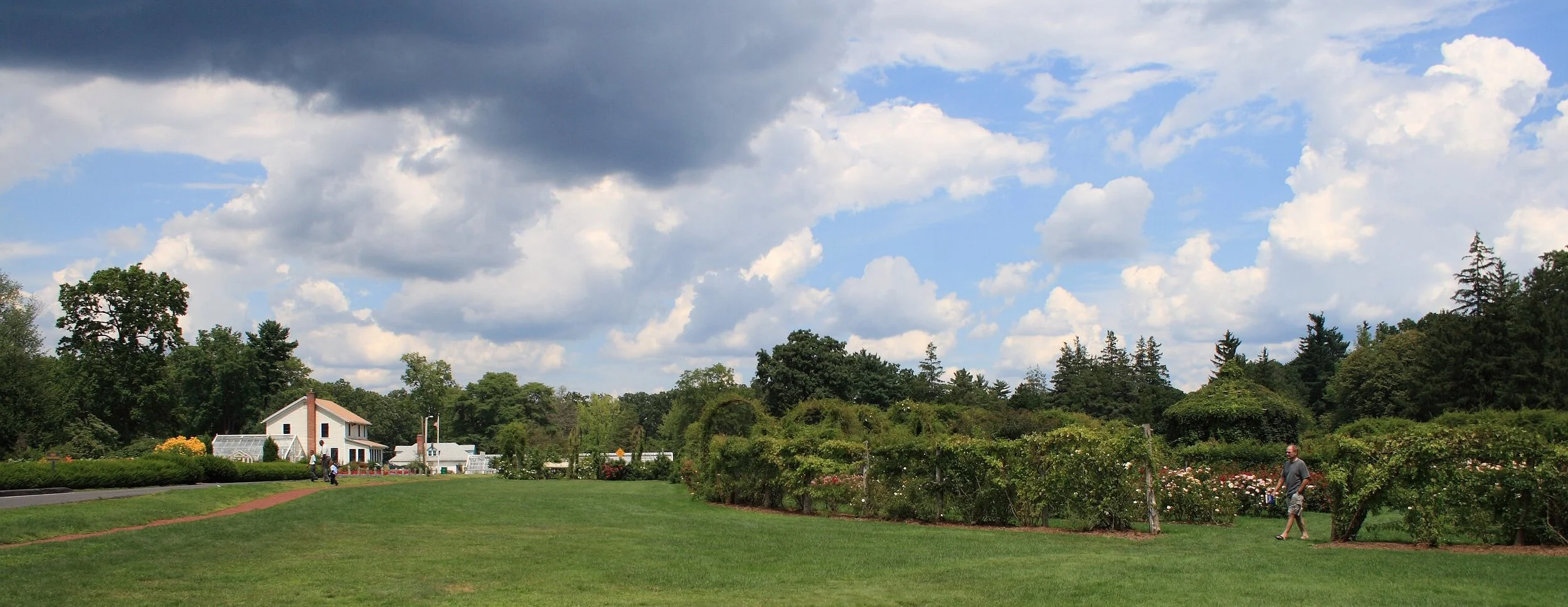
Mr. Stevens enjoyed wandering in Elizabeth Park. With more than a hundred acres of gardens, lawns, greenhouses and a pond, the park often appeared in his poems, including "The Plain Sense of Things," which includes the lines:
“Yet the absence of the imagination had
Itself to be imagined. The great pond,
The plain sense of it, without reflection, leaves,
mud, water like dirty glass, expressing silence…’’

— Photo by Ragesoss
The Rose Garden at Elizabeth Park in West Hartford, Conn., with a greenhouse in the background on the left. Part of the park is in Hartford.