

'Wider sunrise in the dawn'

An altered look about the hills;
A Tyrian light the village fills;
A wider sunrise in the dawn;
A deeper twilight on the lawn;
A print of a vermilion foot;
A purple finger on the slope;
A flippant fly upon the pane;
A spider at his trade again;
An added strut in chanticleer;
A flower expected everywhere;
An axe shrill singing in the woods;
Fern-odors on untravelled roads, —
All this, and more I cannot tell,
A furtive look you know as well,
And Nicodemus' mystery
Receives its annual reply.
— Poem on April, by Emily Dickinson

Amherst in the year that lifelong resident Emily Dickinson (born 1830) died.
Easier than Walt Disney World

Adapted from Robert Whitcomb’s “Digital Diary,’’ in GoLocal24.com
In a happy reminder of summer, there’s an elderly Cape Cod couple’s uber-charming and kitschy (36-hole) Sandwich Mini Golf, on what used to be a cranberry bog. Construction started on the course back in 1950.
"Even in the winter, he’s repainting," Sylvia Burke said of her husband, Maurice (“Mo’’), who started construction on the course in 1950, when he was 15, reported WBUR’s Gary Waleik back in 2016. "In the evening hours, he’ll be busy carving signs. Every sign that’s on the mini golf is all hand-carved by him." There’s a Mo’s Mountain on the course, by the way. The attraction is squeezed between scenic Route 6 A and a salt marsh. (Salt marshes are the defining characteristic of the Cape Cod Bay side of the peninsula.) A brook flows under the course’s bridges, around a simulated giant lily pad and past a white whale and a lighthouse – all very Cape Coddish.
“I love Sandwich Mini Golf because each time I play there, I feel like a kid. My wife and children seem to love it as much as I do. It’s one of our very happy places,’’ Mr. Waleik wrote.
To read his story, please hit this link.
To see the Sandwich Mini Golf Web site, hit this link.
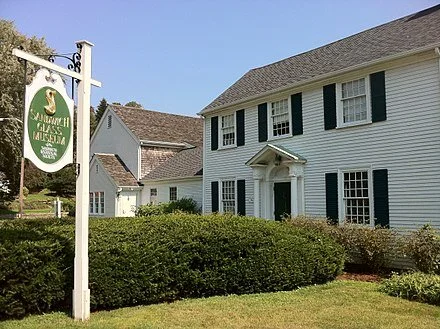
Sandwich was a famous early glass-making center (lots of sand with which to make it) — “Sandwich Glass’’ — and one of America’s earliest Quaker centers.

Boardwalk in Sandwich marshes
House walls instead

“The Peaceful Use of Walls” #2 (encaustic on panel), by Willa Vennema. She lives most of the year in Portland but summers with her family on Swan’s Island, south of Mount Desert Island, where most of Acadia National Park is.
She says:
“My most recent series of work is entitled ‘The Peaceful Use of Walls.’ This series was in response to the controversy over President Trump’s desire to build a multibillion-dollar wall on our boarder with Mexico. I do not believe a huge wall is the answer to our immigration problems. This series depicts a hopeful, nurturing and peaceful alternative for the use of walls—houses.’’
She’s a member of New England Wax.
See her video by hitting this link.

Squirrels and season

“Squirrels from treetops listen to
pine wind song. Such overtures of
the season come again and again….’’
-- From “Squirrels in Wind Pine,’’ by David Kherdian, who lives in Florence, a village in Northhampton, Mass. Because it had a thriving silk industry in the 19th Century, the village was named in 1852 after Florence, Italy, for its own thriving silk trade.
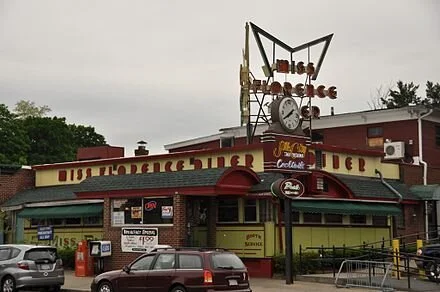
A classic breakfast-all-day diner in Florence
...And a refuge for rich New Yorkers fleeing (they hope) COVID-19

Gingerbread cottages in Oak Bluffs, on The Vineyard
“Once one puts in any amount of time here, one becomes gradually addicted. Eventually, living on the (Martha’s) Vineyard becomes a passionate obsession, a religion, a personal identity and a raison d’’etre.’’
— Peter Simon (1947-2018) in On the Vineyard II (1990)

The famous colorful clay cliffs on Gay Head
'Joy shivers in a corner'

“Northeaster,’’ by Winslow Homer (1836-1910). Much of his work was inspired by the New England coast.
Here where the wind is always north-north-east
And children learn to walk on frozen toes,
Wonder begets an envy of all those
Who boil elsewhere with such a lyric yeast
Of love that you will hear them at a feast
Where demons would appeal for some repose,
Still clamoring where the chalice overflows
And crying wildest who have drunk the least.
Passion is here a soilure of the wits,
We're told, and Love a cross for them to bear;
Joy shivers in the corner where she knits
And Conscience always has the rocking-chair,
Cheerful as when she tortured into fits
The first cat that was ever killed by Care.
“New England,’’ by Edwin Arlington Robinson (1869-1935). The famed poet grew up on the Maine Coast.

April 3 update from N.E. Council on COVID-19 response

Harvesting cranberries in the fall in southeastern Massachusetts
Ocean Spray is raising wages and making donations to farm regions in the crisis
April 3 update from The New England Council (newenglandcouncil.com):
As our region and our nation continue to grapple with the Coronavirus Disease (COVID-19) pandemic, The New England Council is using our blog as a platform to highlight some of the incredible work our members have undertaken to respond to the outbreak. Each day, we’ll post a round-up of updates on some of the initiatives underway among Council members throughout the region. We are also sharing these updates via our social media, and encourage our members to share with us any information on their efforts so that we can be sure to include them in these daily round-ups.
You can also check our COVID-19 Virtual Events Calendar for information on upcoming COVID-19 related programming – including Congressional town halls and webinars presented by NEC members.
Medical Response
Boston Convention & Exposition Center Become Commonwealth’s First Field Hospital – Amid predictions that Massachusetts cases of COVID-19 could arrive next week, Governor Charlie Baker (R-MA) announced that the Boston Convention and Exhibition Center (BCEC)—owned by the Massachusetts Convention Center Authority—will become the commonwealth’s first field hospital. Officials plan for 1,000 beds total, split evenly between the city’s homeless population and overflow patients from area hospitals. WBUR has more.
Partners HealthCare Brings Mask Sterilizer to Massachusetts – Confronting an impending shortage of protective equipment and other personal protective equipment for healthcare workers, Partners HealthCare has entered into a partnership to bring a machine that can sterilize up to 80,000 respirator masks a day to Massachusetts. The device, described as a “game changer” for the region’s response, could reduce strain on dwindling supplies and possibly serve all hospitals in New England, according to the Massachusetts Health & Hospital Association. Read more in NBC.
Sanofi Prepares to Produce Millions of Doses of Potential Treatment – Should a now-famous malaria drug prove effective in combatting the coronavirus, Sanofi has confirmed it has the potential to produce hundreds of millions of doses of hydroxychloroquine. In addition, the pharmaceutical company has ensured its supply chain remains stable. Read more in The Wall Street Journal.
Economic/Business Continuity Response
Duane Morris Offers Guidance on Employment Retention Assistance – A guide to the options businesses have for assistance under the recent stimulus package provided by Duane Morris gives the business community clarity on eligibility, the scope of the package, and limitations of assistance. Read the guide in Forbes.
Ocean Spray Increases Wages, Donates Meals to Farmer Regions – To support its employees who continue to work despite personal safety concerns, Ocean Spray is increasing wages and providing an extra week of vacation to front-line employees. In addition to the wage increases, the company also plans to donate 100,000 meals to its farm regions across the country. Fox Business has more.
Dell Provides Resources for Remote Work Transition – As businesses of all types and sizes navigate an abrupt transition to remote work, Dell is offering a host of online materials to support and expedite the move. Webinars from senior executives on employee flexibility and posts highlighting the importance of cybersecurity are just some of the services Dell is offering for the business community. More can be found here.
Community Response
American Hospital Association Successfully Urges Administration for Direct Assistance to Hospitals – After pressure from lawmakers and healthcare organizations across the country, including a letter from the American Hospital Association (AHA), the Trump Administration is now planning to pay hospitals to treat uninsured patients with COVID-19. The letter from AHA calls for direct aid as well as the expansion of infrastructure investment assistance, among other things. The Wall Street Journal
Endicott College President Profiled on Leading a College Through Crisis – NEC Board Member Steven DiSalvo, president of Endicott College, was profiled in the Boston Business Journal highlighting his leadership during a pandemic that has sent his students home and grinded daily operations to a halt. DiSalvo discussed the school’s commitment to fully pay employees through June, and the potential benefits the switch to online learning could provide for its online graduate offerings. Read the profile here.
Stay tuned for more updates each day, and follow us on Twitter for more frequent updates on how Council members are contributing to the response to this global health crisis.

College Hall at Endicott College, in Beverly, a former industrial town part of which is a rich Boston suburb with old Brahmin as well as new money.
Danger! Don't eat!

“Climbing Oysters” (watercolor and pastel), by Carolyn Newberger, in her two-person show, “Nature and Abstraction,’’ with Philip Gerstein at Galatea Fine Art, Boston, now closed to the public.
Chris Powell: Too much stress from 'high-stakes' school testing? Get used to it!

“Anxiety’’ (1894), by Edvard Munch
Parents and educators alike increasingly complain that "high-stakes” testing in school causes too much stress for students and fails to provide a complete measure of their learning.
A few weeks ago at a meeting of the New Haven Public School Advocates organization, a city Board of Education member and pediatrician, Tamiko Jackson-McArthur, said the prospect of final exams and mastery tests gives students headaches and insomnia. "High-stakes testing does not take into account the social well-being of children,” Jackson-McArthur said, adding that she does not permit her children to take such tests. She echoed calls for less formal and more opinion-based measures of learning.
Of course, there now may be far more stress on everybody than an occasional test imposes, what with school suspended everywhere amid the virus epidemic and children stuck at home all day with parents or relatives, who in turn are stuck with them all day. But if those “high-stakes” tests are abolished and there are no test scores, just a teacher's evaluation of whether a student did well with book reports or a science fair project, the tendency may be to conclude that, as in Lake Wobegon, all students are above average.
For without "high-stakes” tests there will be no verifiable and comparable measures of learning in basic subjects. Teachers are already under great administrative and political pressure not to fail anyone, and Connecticut's main educational policy long has been social promotion. School systems no longer have the political strength to uphold standards.
While students may get anxious as a "high-stakes” test approaches, why shouldn't they become so? Life itself sometimes involves high stakes and requires an ability to handle stress. Gaining that ability is what growing up is about, since Mommy and Daddy won't be around forever.
Besides, in a system of social promotion, how much stress can there really be? It may be impossible for any Connecticut student to get to third or fourth grade without realizing that his learning or lack of it has no bearing on his advancement. By high school most students have realized that not only will they be graduated even if they learn nothing but also, if they desire it, they will be promoted to a community college or state university where they can take remedial high school courses, just as most freshmen in Connecticut's community colleges and state universities do.
Mastery tests, college entrance examinations, and other standardized tests are not perfect but they are probably the most comprehensive educational measures possible. These measures long have been conveying poor performance, and if the risk of stress to students is to be eliminated, what incentive will many students have to perform any better?
That so many high school and even college graduates these days are skilled for little more than menial employment argues powerfully for more anxiety in education, not less.
Of course, it is easy for those who have already endured the trials of school and growing up to disparage the anxiety of today's students. But not all of today's grown-ups are as educated as they should be.
They may remember Alice Cooper singing (screaming, really) decades ago, "School's out forever!” Amid the virus shutdown they may wonder: Why couldn't they have done it before we got too old to enjoy it
Chris Powell is a columnist for the Journal Inquirer, in Manchester, Conn.
Partly non-virus-related!
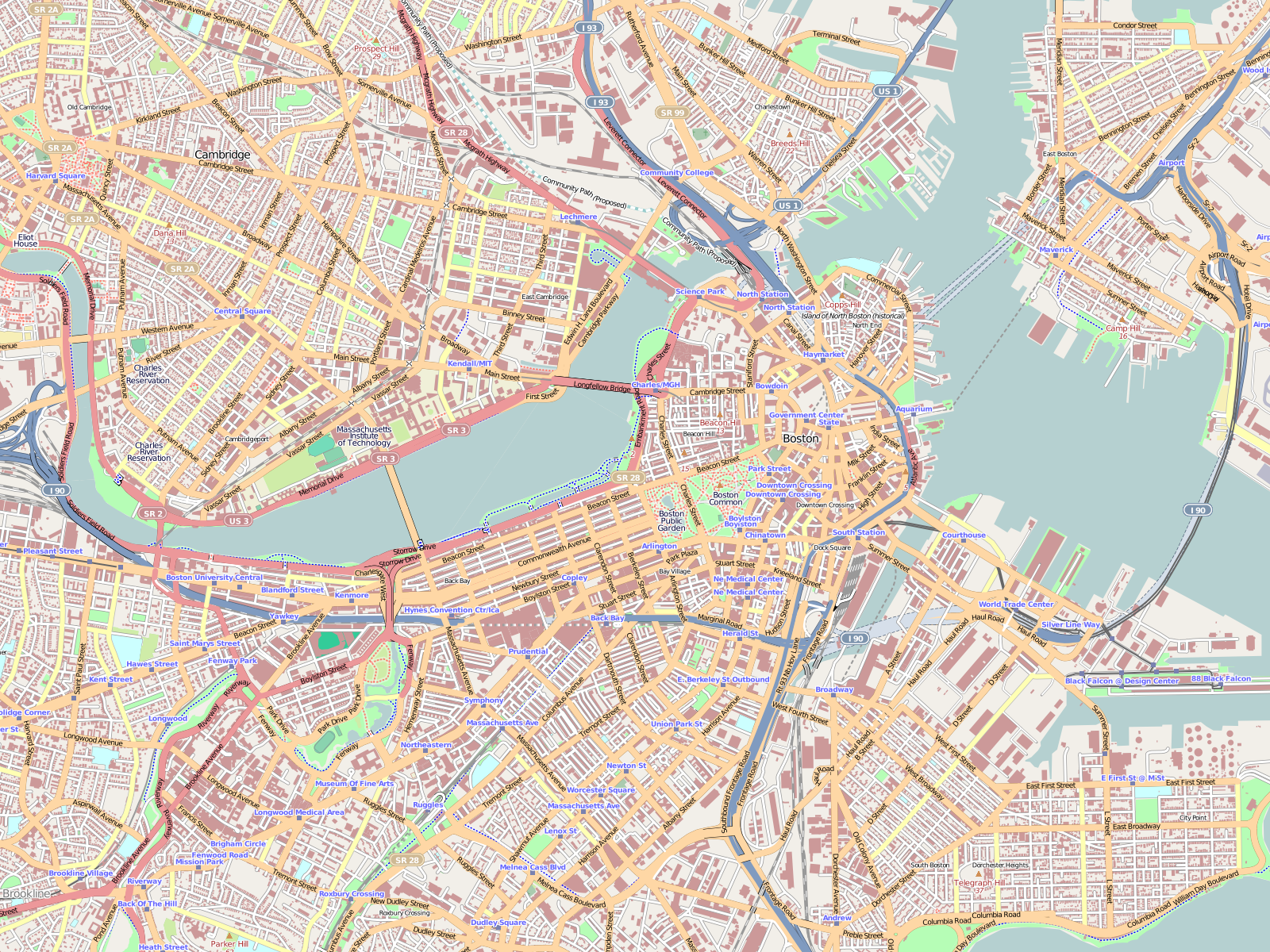
Adapted from Robert Whitcomb’s “Digital Diary,’’ in GoLocal24.com
With many newspapers shrinking unto death, all they seem to have room for is COVID-19 stuff; there are many other important things happening around the world that aren’t being reported. As the late Bill Kreger, a news editor to whom I reported at The Wall Street Journal once observed: “Sometimes the most important story starts out at the bottom of Page 37.’’ What might we be missing?
Well, The Boston Guardian reports that property and violent crime is down in its circulation area (the Back Bay, Beacon Hill , downtown and Fenway) this year. But maybe that’s a virus-related story? As newly unemployed people run out of money will property crimes increase?
Then there’s an inspiring little item from the March 24 Wall Street Journal: Voters in Mexican border city of Mexicali have admirably told the U.S. company Constellation Brands not to complete a $1.4 billion brewery there because the facility would take so much water that it could jeopardize the irrigation-dependent agriculture in the region.
In other heartening, if mostly symbolic, news, the U.S. has indicted Venezuelan dictator Nicolas Maduro and some sidekicks for drug trafficking and is offering $15 million to those who aid his capture. Don’t expect Maduro to appear any time soon in a federal court, but the move is apt to make him nervous.
And there’s the important unhappy news that the world’s greatest coral reef, Australia’s Great Barrier Reef, had just suffered another mass bleaching caused by global warming, whose associated increase in carbon dioxide makes sea water more acidic. For more information, please hit this link.

Update from New England Council on region's response to COVID-19 crisis

Headquarters building of the Stop & Shop supermarket chain, in Quincy, Mass. The company is donating food to health-care workers.
Update from The New England Council (newenglandcouncil.com):
As our region and our nation continue to grapple with the Coronavirus Disease (COVID-19) pandemic, The New England Council is using our blog as a platform to highlight some of the incredible work our members have undertaken to respond to the outbreak. Each day, we’ll post a round-up of updates on some of the initiatives underway among council members throughout the region. We are also sharing these updates via our social media, and encourage our members to share with us any information on their efforts so that we can be sure to include them in these daily round-ups.
You can also check our COVID-19 Virtual Events Calendar for information on upcoming COVID-19 related programming – including Congressional town halls and webinars presented by NEC members.
Here is the April 2 roundup:
Medical Response
Northeastern University Models Used in White House Response to Virus – The White House coronavirus response team has been using models produced by the Network Science Institute (NSI) at Northeastern University to project how varying mitigation strategies could “flatten the curve” of COVID-19. The models allow policymakers and members of the response team to visualize the effects of policies being considered, such as specific travel restrictions and staggered school closings. Read more.
Boston Scientific Begins Work to Produce Ventilators, Protective Equipment – To confront the growing need for medical equipment, Boston Scientific is collaborating with public and private partners to bring necessary devices to market. From making more affordable and portable ventilators to producing face shields and reusable protective equipment, the company continues to use innovation to address some of the most pressing problems facing healthcare workers. Read more.
Abiomed Expands Remote Training for Medical Providers – Medical device manufacturer Abiomed is expanding its utilization of its online physician community to provide expanded physician education and training. The company has plans to launch its largest interactive educational site in its history in April. More information can be found here.
Economic/Business Continuity Response
Proctor & Gamble Increases Production During Crisis – In the wake of shortages of some of its most common products—including napkins, paper towels, and diapers—P&G has increased production of all paper goods at its factories. The company is also manufacturing face masks to help alleviate the increasing demand of protective equipment. USA Today has more.
M&T Bank Provides Hardship Assistance – M&T Bank has created an impact form for its clients to identify their need for a variety of assistance options, including late fee suppression and changes to loan payment plans. In addition to case-by-case measures, the bank is offering unsecured personal loans, suspending negative credit reporting, and more. More information can be found here.
Community Response
Stop & Shop Donates Daily Meals to Healthcare Workers, $500,000 for Research – Using its expansive food production and delivery network, Stop & Shop (owned by Ahold Delhaize) will provide 5,000 meals daily to health-care providers in the greater New York City and Boston areas. In addition to the daily meals, the grocer is providing $500,000 to Boston Children’s Hospital for research on a potential vaccine. Read the press release here.
DraftKings Announces New Charity Initiative, $500,000 Donation – DraftKings has created its own charity initiative, #DKRally, to mobilize sports fans to donate to relief efforts. In addition to an initial $500,000 donation, the betting service will match up to a total of $1 million from contributors. The donations to the initiative will be distributed to United Way to support relief efforts across the country. US Betting Report has more.
Holy Cross Student-Run Nonprofit Raises Over $23,000 for Response Fund – Working for Worcester, a student-run nonprofit founded at the College of the Holy Cross, has raised more than $23,000 for the Worcester Together COVID-19 emergency response fund. The money was raised in just five days as part of a blitz from the school’s alumni and students. The Worcester Together fund provides money for immediate needs and to support local community organizations. The Worcester Business Journal
Stay tuned for more updates each day, and follow us on Twitter for more frequent updates on how Council members are contributing to the response to this global health crisis.

Elms' gorgeous tunnels

Lafayette Street in Salem, Mass., from a 1910 colorized postcard — an example of the high-tunneled effects of American Elms planted along streets in New England towns. Most of them were gone by the 1950s.
“The elms of New England! They are as much a part of her beauty as the columns of the Parthenon were the glory of its architecture.”
— Henry Ward Beecher (1813-87)
Then came Dutch Elm Disease
'Bright with April's buoyancy'

On the summit of Monadnock
Photo by Shiva shankar,
Cloud-topped and splendid, dominating all
The little lesser hills which compass thee,
Thou standest, bright with April’s buoyancy,
Yet holding Winter in some shaded wall
Of stern, steep rock; and startled by the call
Of Spring, thy trees flush with expectancy
And cast a cloud of crimson, silently,
Above thy snowy crevices where fall
Pale shrivelled oak leaves, while the snow beneath
Melts at their phantom touch. Another year
Is quick with import. Such each year has been.
Unmoved thou watchest all, and all bequeath
Some jewel to thy diadem of power,
Thou pledge of greater majesty unseen.
— “Monadnock in Early Spring,’’ by Amy Lowell (1874-1925)
And that was before they cleaned it up

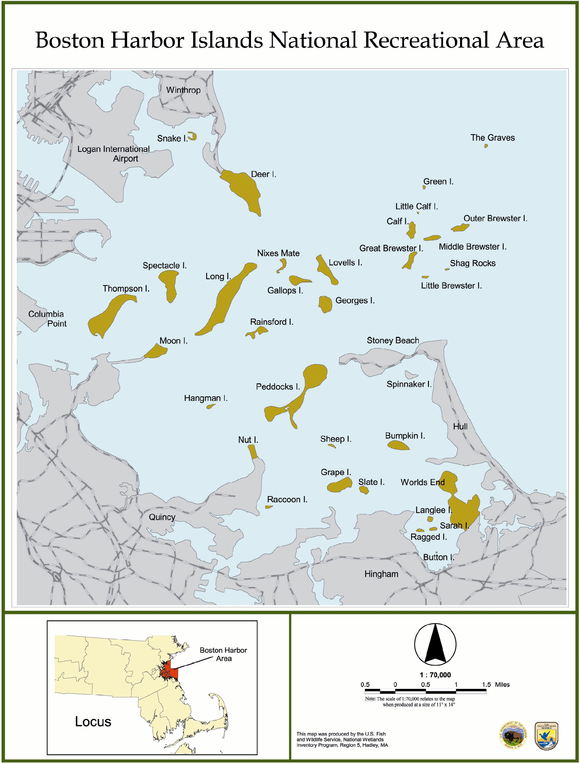
Spectacle island in Boston Harbor. Behind it is Thompson Island.
— Photo by Don Searls
“America, the new world, compares in glamour and romance with the old, and Boston Harbor is one of the most delightful places in America.
— From The Islands of Boston Harbor (1935), by Edward Rowe Snow (1902-82), historian and prolific author.

Edward Rowe Snow memorial plaque on Georges Island, in Boston Harbor

Georges Island is dominated by Fort Warren, built in 1833-61.
Time to repurpose?

“Inside Bunker Door,’’ by Roy DiCosta, in the show “Obsolete Military Structures,’’ at 6 Bridges Gallery, Maynard, Mass. Only visible now on its Web site.
The gallery says that since 2002, Mr. DiTosti “has been venturing through Massachusetts and Florida photographing old military facilities, bunkers and forts, some dating back to the 1800s or World War II. Some of these structures have been repurposed while others sit abandoned, growing moss and collecting dust. Yet the buildings offer an intriguing glimpse into the past where war was a tangible, ever-present struggle. Those who saw these structures in their heyday likely could not have conceived of a future where they were allowed to go empty and rust over. Now, however, the buildings stand as pieces of history and reminders of a fraught and bloody past. There are lessons to be found in each decaying structure, lessons that Mr. DiTosti's photography aims to uncover for the viewer to learn. There's even a level of familiarity in the old buildings when juxtaposed with today's quiet, empty streets in the face of a different sort of war, one against disease. ‘‘
New England Council update on region's COVID-19 response

New England has no official flag, but there have been many historical and modern banners used to represent the New England Colonies and then the six states of New England. There are some variations, but common designs include a colored field (usually red) with a pine tree. The eastern white pine is the most common symbol of New England and harkens back to the tree's former importance in shipbuilding in particular and and New England's maritime culture in general.
Update from The New England Council (newenglandcouncil.com). Kudos to the Council for performing this service.
BOSTON
As our region and our nation continue to grapple with the Coronavirus Disease (COVID-19) pandemic, The New England Council is using our blog as a platform to highlight some of the incredible work our members have undertaken to respond to the outbreak. Each day, we’ll post a round-up of updates on some of the initiatives underway among Council members throughout the region. We are also sharing these updates via our social media, and encourage our members to share with us any information on their efforts so that we can be sure to include them in these daily round-ups.
You can also check our COVID-19 Virtual Events Calendar for information on upcoming COVID-19 related programming – including Congressional town halls and webinars presented by NEC members.
Here is the April 1 roundup:
Medical Response
Anthem Blue Cross Blue Shield in New Hampshire Enters Partnership to Increase Testing – To supplement the efforts to expand testing in New Hampshire, Anthem Blue Cross Blue Shield in New Hampshire (BCBS) is partnering with ConvenientMD to open a COVID-19 testing site in Portsmouth, NH. The support provided by BCBS will expand testing in the state and aid efforts to identify positive cases. SeacostOnline has more.
UMass Holds Commencement Early to Send Doctors to Front Lines of Pandemic – On Tuesday, the University of Massachusetts held a virtual commencement for its medical school for its 135 students. As they spread out across the country for their residencies, the newly-minted doctors head to the center of the pandemic, as they pledged, over video, to “turn to our calling.” The Boston Globe
Dartmouth-Hitchcock Launches Clinical Trial for Potential Treatment – Operating at incredible speed, Dartmouth-Hitchcock has begun two therapeutic trials of the now-famous drug remdesivir in just six days. Now one of the nearly 100 clinical sites around the world testing the drug’s efficacy on COVID-19 symptoms, Dartmouth-Hitchcock’s trials focus on both moderate and severe symptoms and remdesivir’s ability to prevent progression of the virus. Read more in the Manchester Ink Link.
Economic/Business Continuity Response
Rockland Trust Offers Flexibility, Support for Customers Community – Joining other institutions in a joint client-community response, Rockland Trust is providing both flexibility and support for both personal and business customers. For personal banking customers, the bank is increasing ATM withdrawal limits, waiving late charges on payments, and issuing a 90-day foreclosure moratorium on residential loans. Rockland Trust is also offering assistance with access to government-sponsored support and loan payment relief for its business users. The bank has also committed $500,000 to support relief efforts. Read more in Yahoo Finance.
Massachusetts Technology Collaborative to Oversee Manufacturing Emergency Response Team – Governor Charlie Baker (R-MA) of Massachusetts has chosen the Massachusetts Technology Collaborative to lead the new Manufacturing Emergency Response Team (MERT), an effort by the state to utilize its manufacturing industry to produce more necessary equipment to combat the pandemic. The agency will oversee MERT and coordinate the need for supplies with the almost 200 manufacturers who have been in contact with agency. The Boston Business Journal has more. Those interested in donating to or collaborating with the Manufacturing Emergency Response Team can do so here.
Community Response
Boston College High School Praised for Virtual Learning Transition – Featured in a Boston Globe article for moving “seamlessly in delivering daily, high-quality academic online lessons,” Boston College High School is continuing to provide an excellent education (that still begins at 8 AM daily) and ample resources for its students as they adjust to remote instruction. Read the article here.
Travelers Makes $5 Million Donation – Insurance company Travelers has donated $5 million to COVID-19 relief efforts. The largest-ever charitable donation by the company to a crisis, the money will be distributed in three parts among North America, the United Kingdom, and Ireland to aid families and communities. The Hartford Business Journal has more.
United Way Support Fund Distributes $378,000 to Relief Organizations –Less than two weeks since launching a fundraising effort to support those affected by the pandemic, United Way of Massachusetts Bay and Merrimack Valley announced over $378,000 in donations. Distributed to 36 community-based nonprofits across the region, the money will help those in need meet basic needs as they navigate an evolving pandemic and economic uncertainty. Read more.
Edesia Provides Support Worldwide to Those Most Affected by Virus – Continuing a tradition of global leadership in promoting food security, Edesia has committed to providing thousands of care packages, snack boxes, and meals to organizations and families across all ages and around the world. Aiming to assist both local and global communities, the organization has also pledged 115,000 boxes of its world-renowned, lifesaving products to children from Venezuela to Yemen to Nigeria.
Cooperative Credit Union Association Donates $25,000 to Support MA Coalition for the Homeless – On behalf of all Massachusetts credit unions, the Cooperative Credit Union Association has committed $25,000 to the Massachusetts Coalition for the Homeless. People experiencing housing, income, or food insecurity are the most vulnerable to the pandemic, as they often lack resources to adequately self-quarantine or socially distance. The donation will be used to support not only the homeless population, but also families and unaccompanied youth. Read the release here.
Stay tuned for more updates each day, and follow us on Twitter for more frequent updates on how Council members are contributing to the response to this global health crisis.
Llewellyn King: Lessons from the Energy Crisis to address the COVID-19 challenge

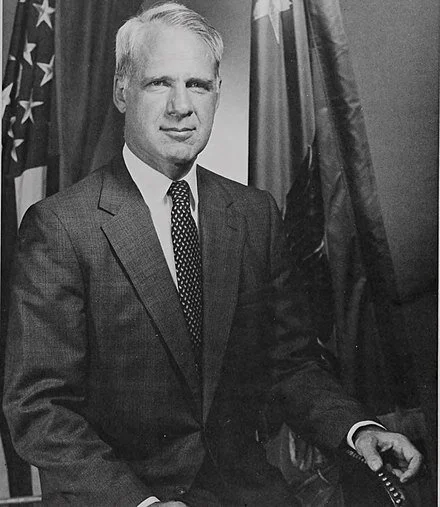
James Schlesinger (1929-2014), the first U.S. energy secretary and a leader in confronting the Energy Crisis of the 1970s.
There are lessons to be learned in the COVID-19 crisis from the Energy Crisis, which broke in the winter of 1973 and extended into the early 1980s. Projections were dire. At a session of the Aspen Institute’s energy section one year, we looked at how the country could deal with an economic downturn to a negative growth rate of 23 percent. Aspen may want to look at that again.
In Washington, first under President Nixon, then under presidents Gerald Ford and finally under Jimmy Carter, there was what might be called mobilization. It had two aspects: one was intellectual and the other was scientific. The brainy one was centered in the Federal Energy Office, which attracted some extraordinarily gifted economists, geologists and managers. The rest of the government, from the Interior Department to the State Department, was also in the game.
Particularly there was mobilization of the system of national laboratories where, to my mind, the scientific muscle of the country could be found then and now. They had been primarily nuclear labs, led by the three big players in the atomic arsenal: Los Alamos, Lawrence Livermore and Sandia.
Everything was tried and not everything worked. Who remembers in situ coal gasification, ocean thermal gradients, magnetohydrodynamics, hot rocks, low-head hydro or wave power?
In the mix were solar, wind and efforts to loosen oil in tight formations. These were the winners, but it was not clear at all then.
Gifted leadership emerged first at the Federal Energy Office, then at the successor to the Atomic Energy Commission, the Energy Research and Development Administration. Under Carter, all the energy agencies were rolled into the Department of Energy with its first secretary, a star in the Washington firmament, James Schlesinger.
That kind of mobilization is needed now, talent plus science.
The national labs, 17 strong, have some biological capability -- several having had some role in the Human Genome Project, and others looking at the treatment of cancer with radiation.
The COVID-19 virus will not be defeated just by medical science but by the whole panoply of science, including what might at first sound like kooky ideas. I recall the derision that greeted solar and wind concepts back in 1974. Now they are mother’s milk in the energy mix.
One of the highest challenges facing hospitals and medical facilities is to save the lives of their staff with superior sanitation of protective gear like respirators, the now well-known N95 masks and the ambient air itself.
I was excited to learn about a McLean, Va.-based company, airPHX, which has an off-the-shelf, air-scrubbing system using a cold plasma as the scrubbing agent. The units are about the size of a computer and each unit – they operate continuously from a three-prong plug — will clean the air of a 15,000-square-foot room, according to the company’s CEO William Pommerening.
The airPHX units, which were developed to combat mold, odors and pathogens in gyms and elsewhere, are in production on a modest scale, but this is set to ramp up with a new contract manufacturer in Tennessee.
Pommerening told me that he believes his machines will effectively destroy the COVID-19 virus both in the air and on surfaces. He said, “We have lab testing showing efficacy on over 30 health care-associated pathogens including bacteria, viruses and mold showing a 4 log [a technical measure in sanitation which equates to 99.99 percent effectiveness] reduction, or greater, in surface organisms in 30 minutes.” This, he said, included testing on a sister virus to COVID-19. For the air, the effectiveness was between 92 percent and 96 percent, he said. New masks are rated at 95 percent, hence their N95 designation.
If this proves out, it will be a boon across the spectrum of indoor trouble spots and will one day have a wide application in workplaces and recreation areas.
In my view, it needs government scientific review to confirm the data. But it is as promising as anything I have heard of, including hydrogen peroxide and ultraviolet light.
The need to be sure is paramount.
Llewellyn King is executive producer and host of White House Chronicle, on PBS. His email is llewellynking1@gmail.com. He’s based in Rhode Island and Washington, D..C.
And toxic now

“Vapors” (woodcut), by Patrick Casey, at Galatea Fine Art, Boston. Gallery is closed for the time being for the obvious reason.
Dense with people -- and hospitals

The National Emerging Infectious Diseases Laboratories (NEIDL) building, in Boston’s South End, where they’re working on the COVID-19 challenge
Adapted from an item in Robert Whitcomb’s “Digital Diary,’’ in GoLocal 24.com
Much has been made of the dangers of living in cities in times of epidemics because of the density. Quite a few people, mostly rich folks, have, for example, left New York in the past couple of weeks to “shelter in place’’ in rural and/or summer resort places – angering many of the locals. But too little has been made of cities’ advantages during such times.
The biggest is having lots of hospitals and other health-care facilities, and thus lots of health-care professionals, of which there are obviously far fewer in exurban and rural areas. Indeed, many rural hospitals have been closed in recent years. (So have some urban hospitals, such as Pawtucket’s Memorial Hospital. Can and should Memorial be reopened? Its closure has put intense pressure on nearby Miriam Hospital.) The fragmented, inefficient and astronomically expensive U.S. health-care system is a mess. The failure to have adequate testing systems and equipment in place to address the current crisis is yet another symptom of how disordered it is.
COVID-19 will be popping up big time in plenty of rural areas soon enough.
The failure to have enough testing kits, and protective gear for health-care professionals, has resulted in a huge undercount in the number of people with COVID-19. So many of us have it now, but have no, or mild, symptoms. Development of extensive “herd immunity’’ through mass exposure, is probably well underway. The surge in reported cases probably mostly just reflects belated testing. Speaking of “reported” cases, don’t believe numbers from China (or Russia).
Ironically, as my friend Vermont insurance executive Josh Fitzhugh noted: “New York City may be one of the first places that could reopen for business because most residents will have been infected and either recovered or unfortunately passed away.’’
In any event, with our health-care “system’s’’ inadequacies, we must focus even more on the most vulnerable populations – the immuno-compromised and the elderly – and limit our ambitions regarding the wider population. Eventually herd immunity will bring the pandemic to heel, although there will be, as with flu epidemics, recurrent waves of sickness. But a vaccine, and better treatments, will probably be available within a year or so to stop or at least mitigate such epidemics. Be it “by Easter,’’ as per Trump, or later, when social-distancing rules are to be loosened, they should be eased gradually, not all at once, so that the sudden resulting increases in real or suspected cases don’t further overwhelm health-care personnel and institutions.
Throughout the crisis, the core emphasis should be on tracking cases by testing so that medical resources can be most effectively geographically deployed and the most at-risk populations isolated. Then whack-a-mole, maybe for years
Meanwhile, watch this this extended interview by an old friend at The Press and the Public Project with Dr. John Ioannidis of Stanford University. Dr. Ioannidis cautions that we do not have reliable data to make long-term decisions about COVID-19, and that an extended lockdown could have far graver effects than the disease itself.
Dr. Ioannidis is C.F. Rehnborg Chair in Disease Prevention, Professor of Medicine, of Health and Research Policy, of Biomedical Data Science, and of Statistics, and is the Co-Director of the Meta-Research Innovation Center at Stanford.
To see/hear the interview, please this link.
By the way, some major work on researching COVID-19 to develop a vaccine is being done at Boston University’s National Emerging Infectious Diseases Institute in Boston’s South End and elsewhere in Greater Boston. Yes, it’s supposed to be a very secure location though it unsettles some of the neighbors. To read more, please hit this link.