









Those old wavering boundaries

1794 map of York, Maine
From Robert Whitcomb’s “Digital Diary,’’ in GoLocal24.com
There’s an entertaining boundary dispute underway between Kittery and York, Maine, that reminds us how old New England is. The origins of the dispute go back to at least 1653, when Puritan invaders from Massachusetts drew a straight line to mark part of the two towns’ boundary with each other.
But, reports The Boston Globe, “property {ownership} changes and long-forgotten handshakes had incorporated wobbles and bumps into what became an accepted, meandering boundary from Brave Boat Harbor to the present-day Town of Eliot, which borders both Kittery and York.’’]
The argument commenced in 2018, when York developer Duane Jellison had bought property on Route 1 that he believed “was evenly divided between York and Kittery. His surveyor concluded, instead, that the majority of the property is in York,’’ The Globe said.\
I suspect that there are grounds for similar disputes all over New England, especially those parts settled by Europeans (and taken from the Indians) in the 17th and 18th centuries. Let the litigation spread, giving us all some fascinating history lessons
To read The Globe’s story, please hit this link.
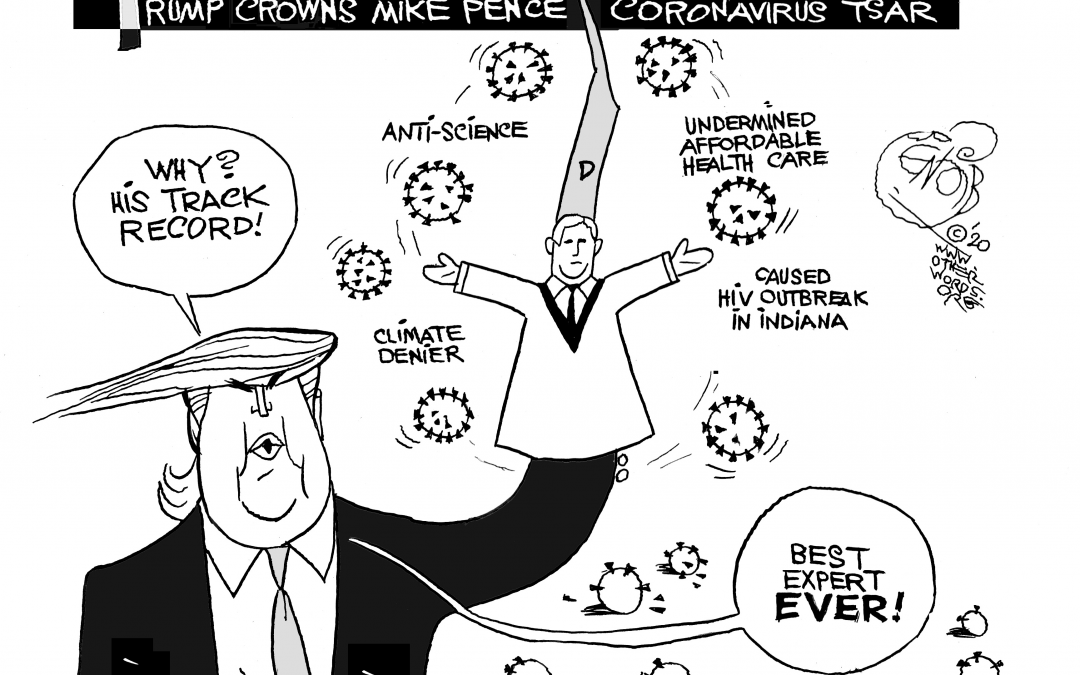
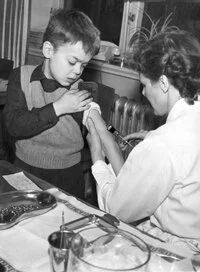
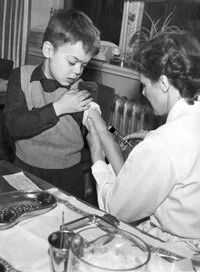
Patty Wright: Maine keeps new law that ends nonmedical exemptions for vaccinations
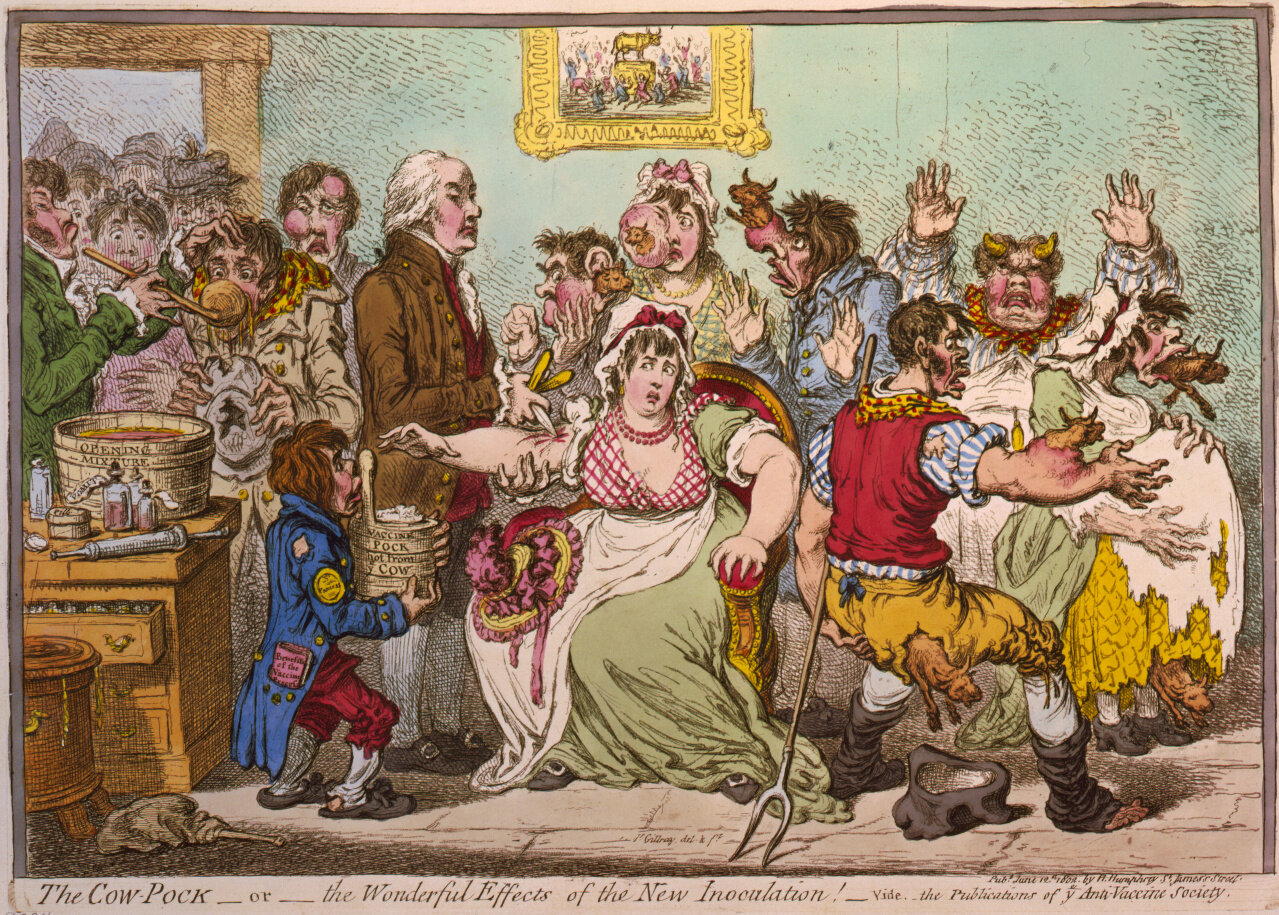
James Gillray's “The Cow-Pock—or—the Wonderful Effects of the New Inoculation!,’’ an 1802 caricature of vaccinated patients who feared it would make them sprout cowlike appendages.
Maine voters on Super Tuesday decided to affirm, by a huge 74 percent majority, a new law that eliminates religious and philosophical exemptions for childhood vaccines.
Molly Frost of Newcastle wanted the new law to stay. Her 11-year-old son, Asa, has a compromised immune system. He was diagnosed with Hodgkin’s lymphoma at age 5. The cancer has gone in and out of remission, Frost said, relapsing three times. Asa’s treatment has included several rounds of chemotherapy, radiation and, most recently, a stem-cell transplant.
“He at this point has no immunity against any of the things he was vaccinated for in the past and could get very sick from those diseases were he to catch them,” she said.
That worries Frost, especially because her family lives in a coastal county where vaccine-exemption rates are at least 9 percent — among the state’s highest rates. She was glad when the Maine legislature passed the law last year intended to protect kids like her son. It aims to boost immunization rates of kids entering school by eliminating nonmedical exemptions. It’s not in effect yet, but if opponents have their way Tuesday, it never will be.
“It’s a huge infringement on personal freedoms,” said Cara Sacks, co-chair of the group that put the repeal on the ballot. “On medical freedom in particular.”
The repeal group included such parents as Angie Kenney who wanted to keep the philosophical exemption for vaccines. Kenney has used the philosophical exemption to refuse immunizations for her kids — ever since her older daughter had an adverse reaction after receiving the chickenpox vaccine at 18 months old.
“She could not crawl,” Kenney said. “She couldn’t walk. She couldn’t even feed herself. And this went on for almost a year.”
Her daughter was diagnosed with ataxia, a brain injury listed by the Centers for Disease Control and Prevention as a rare adverse event after chickenpox vaccination. Kenney said she received a payment from the National Vaccine Injury Compensation Program. Her daughter has recovered and is now a teenager. But Kenney also has a 4-year-old and doesn’t think the state should force her to get either girl vaccinated: “I am not sacrificing my child for the greater good of the community.”
Across Maine, though, physicians and health organizations say the new law is needed to protect public health because more and more parents are using exemptions.
More than 5 percent of kindergartners in Maine now have nonmedical exemptions, more than double the national average. That has pushed vaccination rates for many diseases below 95 percent — the critical threshold to achieve herd immunity and avoid spreading a disease to kids with compromised immune systems, like Asa Frost. Pediatrician Dr. Laura Blaisdell said she has daily conversations with parents about vaccines but has felt helpless as she’s witnessed immunization rates drop.
“We have gotten to a point where there are no other solutions,” Blaisdell said.
Maine has the second-highest rate of pertussis in the country. And Blaisdell said she worries that outbreaks of measles in other states could easily arrive through the millions of tourists who visit each summer.
“That sort of traffic is exactly the sort of traffic that diseases like measles would just love,” she said.
More than $1 million was spent on the referendum battle. The campaign to preserve Maine’s new law received its initial support largely from doctors, nurses and health organizations. In the latest campaign filings, the group got a $500,000 boost from pharmaceutical companies Pfizer and Merck & Co. The trade organization Biotechnology Innovation Organization, which represents the biotech industry, also contributed $98,000.
The campaign to repeal the law, Yes on 1 for Maine, adopted “Reject Big Pharma” as its primary slogan. Much of the early support came from individual donations and chiropractors. More recently, the Organic Consumers Association contributed $50,000. The Minnesota-based group has been criticized for stoking vaccine fears and causing a measles outbreak in the state’s Somali community three years ago.
The backlash that has erupted over Maine’s new law doesn’t surprise Alison Buttenheim, an assistant professor of health policy at the University of Pennsylvania who studies vaccine hesitancy and state exemptions. She said when states eliminate entire categories of exemptions, some people perceive that as parental rights being sacrificed for public health.
“And you sort of wonder, could Maine have taken a different policy step? Maybe making those exemptions harder to get and accomplish the same goal of coverage and disease protection without having to go through a big repeal effort.”
Maine joins four other states that don’t allow any nonmedical exemptions for vaccinations: California, New York, Mississippi and West Virginia.
Patty Wright is a reporter with Maine Public Radio.
This story is part of NPR’s reporting partnership with Maine Public Radio and Kaiser Health News.
Of fading old clubs and three martinis

The 10th hole at the Metacomet Golf Club
From Robert Whitcomb’s “Digital Diary,’’ in GoLocal24.com
Nearby, in East Providence, and on higher ground, is the lovely Metacomet Golf Club, which has been in a financial crisis, and apparently is being sold to a development company called Marshall Development. That firm plans to turn the site into a mixed-use property. Might that include a gated community? How about with a nine-hole golf course? A three-hole one? A putting green?
Metacomet encompasses 105 acres – lots of open land to play with!
Fewer people seem to have the time or the inclination these days to spend the hours necessary to play 18 holes anyway. And golf is a very expensive sport.
Further, the population is aging. Even with golf carts, there are more and more people for whom even golf is physically too much.
And America has a housing shortage. A lot of that land now taken up by golf courses is enticing to build on. After all, the land is mostly open.
Other old clubs, usually originally created primarily for men, also are struggling. Fewer successful people can, or want to, take the time for a leisurely lunch, and it’s long been unfashionable to drink at lunch. That activity used to be major attraction of club lunches. But tax changes under Reagan and Bill Clinton reduced the deductibility of what used to be called “the three-martini business lunch.’’

I remember with a pang the boozy “business” lunches I had in New York and Paris; I usually drank little or nothing, but most of my table mates knocked back the stuff. One of these people offered me a job, which I took. Later on, one of my bosses in Paris insisted on my joining him for frequent vinous lunches at a restaurant near the office to “plan.’’ I’d be lucky to escape in two hours to rush back to my deadline work. Toward the end of the meal, the very patient waiter would ask my boss “Another Irish {coffee), monsieur?’’=
When back in the early ‘70s, I was briefly an intern at Business Week magazine, in New York, two editors took me to lunch several times at a famous restaurant called Sardi’s. They always ordered a bottle of wine, and one of them a cocktail. Then, after an hour-and-half lunch, we’d straggle back to the office, where one of them, the executive editor, would light his pipe and run the daily editors meeting with great skill and astonishing memory for economic data. The other went to sleep in his office.
But the most impressive three-martini lunch man I broke bread with was a college classmate and an account executive for a big ad agency who seemed to spend most of his waking hours in overpriced Manhattan restaurants. He often paid for our lunches on his expense account, although as a young newspaper editor I was in little position to help his agency. “Let’s just call it business development,’’ he told me.
It was all very unhealthy but often great fun.
Old clothes

”…they {beech trees} still wear last summer’s leaves
the lightest brown almost translucent
how their stubbornness has decorated
the winter woods."
”A Walk in March,’’ by Grace Paley (1922-2007), of New York and Vermont
Tim Faulkner: Two-way electricity trading between N.Y., New England and Quebec
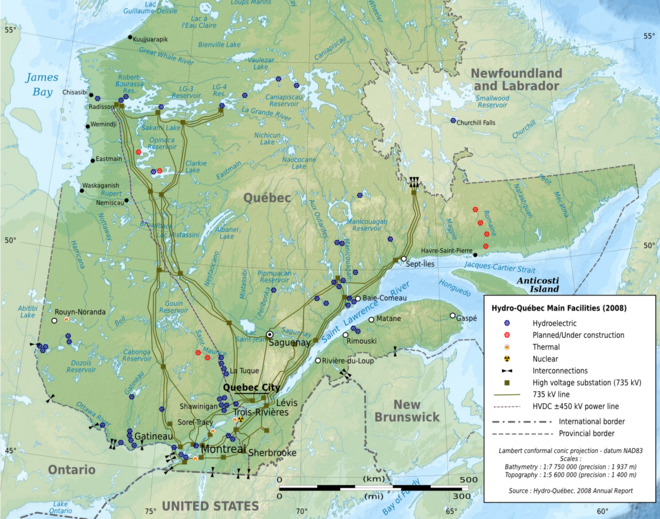
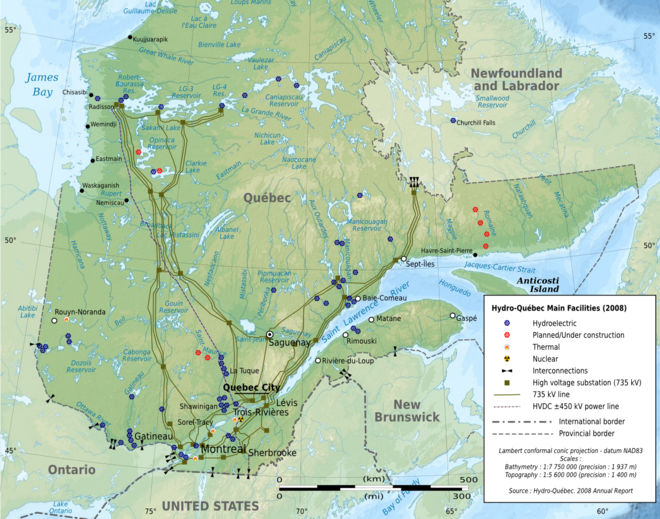
A 2008 map of Hydro Quebec facilities
From ecoRI News (ecori.org)
An MIT study claims that hydropower from Quebec can provide stored energy and solve the intermittency issues afflicting wind and solar power. Researchers at the MIT Center for Energy and Environmental Policy Research illustrate how “two-way” electricity trading between New England, New York and Quebec can reduce energy-system costs, decrease natural-gas use, and limit the need for emerging technologies such as carbon capture and sequestration.
To get there, 4 gigawatts of new transmission lines must built between New England and Quebec so that existing hydropower reservoirs can send power on demand.
Meanwhile, attorneys general from Rhode Island and Massachusetts signed on to a letter in support of a 2018 rule by the Federal Energy Regulatory Commission that requires utilities to include energy storage in wholesale electricity markets. The rule is being appealed by utilities through groups such as the American Public Power Association over anticipated cost increases. The states say the rule would create billions in economic and environmental benefits.
Mayflower Wind record price
The 804-megawatt Mayflower Wind project being developed by Royal Dutch Shell and EDP Renováveis in the wind-energy zone south of Martha’s Vineyard and Nantucket was recently awarded a power-purchase contract of 5.8 cents per kilowatt-hour from the Massachusetts utilities that will be buying the electricity. The price agreement offered by Eversource, National Grid, and Unitil needs to be approved by the Massachusetts Department of Pubic Utilities.
The record low price is less than the previous low of 6.5 cents for the 800-megawatt Vineyard Wind project.
More than $70 billion of potential investments in offshore wind facilities are proposed between North Carolina and Maine, but all await the outcome of an overdue federal environmental review on the Vineyard Wind project by the federal Bureau of Ocean Energy Management.
Public comment for offshore wind
The public has until March 16 to comment on a Coast Guard proposal for the layout and navigable shipping routes for the seven leased wind areas in federal waters. The Massachusetts and Rhode Island Port Access Route Study recommends spacing of 1 nautical mile between the turbines. Developers generally favor the layout, while the commercial fishing industry prefers 4-mile transit corridors and a design that limits radar interference.
Tim Faulkner is an ecoRI News journalist.
David Warsh: The social pathologies of 'carry trades'
SOMERVILLE. Mass.
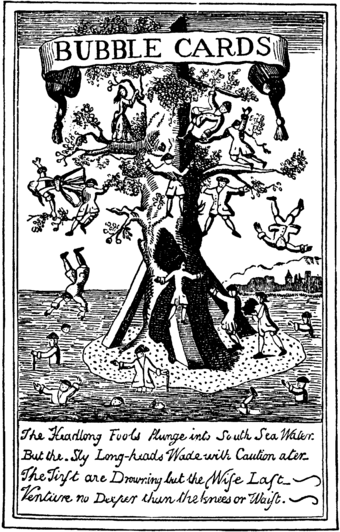
The first time I heard the term “carry trade” was in June 2007. I was standing by an elevator bank as bond trader Dan Fuss explained to a cluster of anxious money managers the essence of Bear Stearns’s bailout of a pair of its hedge funds announced earlier that day.
It had been a carry trade, Fuss told them, harder to understand than a classic currency carry because it involved mortgage market derivatives, but otherwise no different in its fundamental structure: borrow at low rates in one market in order to invest in high-yielding assets in another, and hope that nothing changes.
But things had changed. With doubts proliferating about the funds’ underlying assets, which happened to be subprime mortgages, overnight lenders were putting up rates and investors were withdrawing their money. Bear had no choice but to close the funds and absorb their losses. Seven months later, the firm itself failed and was merged out of existence.
Looking back, I see how wise was Fuss in his concise description that day, though I noted yesterday that Bethany McLean and Joe Nocera took 10 pages in All the Devils Are Here: The Hidden History of the Financial Crisis (2010) to explain in detail how Bear’s High-grade Structured Credit Strategies Enhanced Leverage Limited Partnership had come to grief. The episode was the first hint of events that 15 months later would culminate in the Panic of 2008.
I remembered my innocence as I spent part of last week reading The Rise of Carry: The Dangerous Consequences of Volatility Suppression and the New Financial Order of Decaying Growth and Recurring Crisis, by Tim Lee, Jaimie Lee, and Kevin Coldiron (McGraw-Hill, 2020). It is quite a good book, clear and strongly argued, likely to command a wide audience among financial cognoscenti, Silicon Valley guru Tim O’Reilly’s online learning club, for instance. Sufficiently confident are the authors of the freight-train qualities of their argument, with its 39 figures and tables, that they reserve their punchline for the very last paragraph.
That argument is this: Carry trades, when they can be arranged, are especially attractive to well-to-do investors because they resemble selling insurance. They deliver a flow of income or accounting profits eventually punctuated by large losses when unforeseen events occur. These surprises may not threaten a strong and well-managed balance sheet when they occur, but they will certainly be dangerous to those who have underestimated the risks. Carry trades flourish when “nothing happens,” the authors say. Let underlying asset prices, currencies, or commodities begin to fluctuate and things get interesting. Volatility is the enemy of carry.
Central banks were invented to manage the risks of carry trading – after all, the whole idea of banks is to borrow short in order to lend long. But as the global economy has grown, so has the “moneyness” of all the other financial instruments with which central banks are today concerned. Central banks have become the foe of pooled risk. When credit arrangements are threatened by volatility, central banks are expected to “supply liquidity” – that is, to serve as lenders of last resort.
The more carry, the more vulnerable is the economy to unanticipated shocks of one sort or another, the authors say, and therefore more prone to requiring periodic bailouts. They note that carry trades today can be arranged “by writing insurance or credit default swaps, buying higher-yielding equities or junk debt on margin, taking out buy-to-rent mortgages to finance property investments, writing put options on equities or equity indexes, or buying exchange-traded funds” that do the same. But that’s not all, the authors say:
Carry trade can also include dealings such as companies issuing debt to buy back their own equity, or private equity leveraged buyouts, plus a whole gamut of more complex financial strategies and financial engineering. In all cases the carry trader is thus explicitly or implicitly betting that underlying capital values will not wipe out his or her income return; the carry-trader is betting that asset price volatility will be low or will decline.
In other words, carry trades have found their way into every nook and cranny of present-day finance, and central banks are committed to keeping volatility low, lest these arrangements fail en masse. Whatever the business cycle was, it has come to be dominated, since 1987, by long and tame business expansions, threatened at intervals by potentially catastrophic crises. And with each such subsequent government intervention, insiders are rescued, outsiders (like the widely resented Bear Stearns) are permitted to fail, the rich grow richer and inequality increases, according to the authors. Carry, they say, is about power.
The opportunity to decisively lean against carry was lost in 2008, the authors conclude, when governments chose not to allow banks to suffer catastrophic losses. What lies ahead, they say, is more of the same: carry bubbles and carry crashes, financial concentration, growing inequality, fewer opportunities for workers, more nationalism and populism. Properly examining the fire-or-ice possibilities discussed in the last chapter of the book, “Beyond the Vanishing Point” (at which carry trades eclipse all other possibilities), would take a month of Sundays. It is for sustained discussion of this sort that book clubs and online learning venues exist. And then there is that last paragraph.
Ultimately the verdict of history will likely be that the post-Bretton Woods experiment with fiat money failed. But technologies that have emerged could possibly provide the basis for future, workable monetary systems. Whatever it is that eventually arises from the ashes of the present monetary system, we have to hope it will be more effective in restraining the rise of carry.
It may turn out to be so. But for all its learnedness about the logic of cumulative advantage, The Rise of Carry leaves out a great deal in the realm of democratic politics and taste-making that is important, especially the effects of continuing technological and climate change on attitudes toward taxation and income distribution. Independent central banking, financial regulation, and antirust policy will continue to be tested, along with all other democratic institutions. But surely it is too soon to judge the modern experiment in self-government a failure.
The Panic of 2008 was only the first modern encounter – or perhaps the second or third – with the consequences of rapid economic growth. Experience – as in Surviving Large Losses: Financial Crises, the Middle Class, and the Development of Capital Markets, by Philip Hoffman, Gilles Postel-Vinay, and Jean-Laurent Rosenthal – remains a great teacher.
David Warsh is a Somerville-based economic historian and veteran columnist. He is proprietor of economicprincipals.com, where this column first ran.

A way to enjoy driving on Memorial Drive

View of Boston's Back Bay skyline, at night across the Charles River from Memorial Drive in Cambridge, just south of the Longfellow Bridge.
— Photo by Eric Hill
I love driving through Western Massachusetts, out through the Berkshires, when the road is empty and it's a nice day. I don't like driving home on Memorial Drive at 5:45 or 6:45 at night when it's crowded and stressful. I think that's true of most people, and the goal of automated driving is to take the stressful part of driving out of the task.
— Karl Iagnemma, a Massachusetts-based American writer and research scientist and CEO of Cambridge-based self-driving technology company NuTonomy.
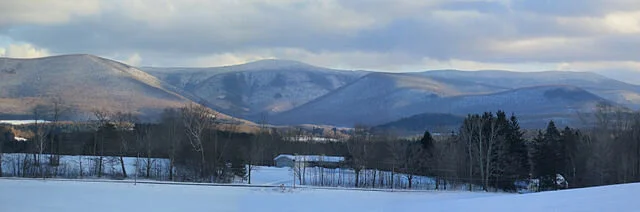
Mt. Greylock, in The Berkshires

'Ambrosial odor'

A sugar shack in late winter or early spring, when maple syrup is made
“{An} ancient wooden shack {stands} among magnificent old maple trees. When we first came in sight of it, it looked as though it were on fire, for the steam from the boiling sap was pouring out through every crack. It was indeed a stirring place — men and boys hallooing in the woods as they chopped fuel for the fire, and drove the sledges down the mountainside with barrels of sap, or ran in and out of the sugarhouse. As we came nearer we caught the ambrosial odor of the steaming syrup.’’
— From The Countryman’s Year (1936), by Ray Standard Baker (1870-1946), writing as David Grayson. A journalist , historian and book author, he moved to Amherst., Mass, in 1910. He lived there for the rest of his life. Among his many jobs was serving as President Wilson’s press secretary during the negotiations for the Treaty of Versailles, in 1919.
He wrote in the book:
“It is not limitation of life that plagues us. Life is not limited: it is the limitation of our awareness of life.”
'Silent, and soft, and slow'

Out of the bosom of the Air,
Out of the cloud-folds of her garments shaken,
Over the woodlands brown and bare,
Over the harvest-fields forsaken,
Silent, and soft, and slow
Descends the snow.
Even as our cloudy fancies take
Suddenly shape in some divine expression,
Even as the troubled heart doth make
In the white countenance confession,
The troubled sky reveals
The grief it feels.
This is the poem of the air,
Slowly in silent syllables recorded;
This is the secret of despair,
Long in its cloudy bosom hoarded,
Now whispered and revealed
To wood and field.
— “Snow-Flakes,’’ by Henry Wadsworth Longfellow (1807-82)
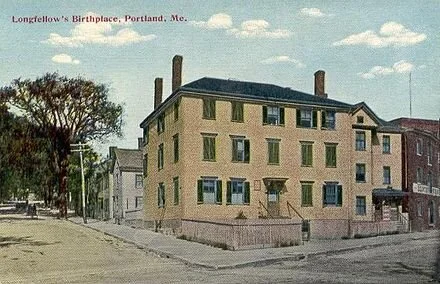
Birthplace of Henry Wadsworth Longfellow, Portland, Maine, c. 1910; the house was demolished in 1955.
Llewellyn King: A prize is needed for ideas on dealing with nuclear waste

Places in Continental United States where nuclear waste is stored
A “scram” is the emergency shutdown of a nuclear power plant. Control rods, usually boron, are dropped into the reactor and these absorb the neutron flux and shut it down.
President Trump, a supporter of nuclear power, has in a few words scrammed the whole nuclear industry, or at least dealt its orderly operation a severe blow.
Scientists see nuclear waste as a de minimus problem. Nuclear-power opponents — who really can’t be called environmentalists anymore — see it as a club with which to beat nuclear and stop its development
The feeling that nuclear waste is an insoluble problem has seeped into the public consciousness. People, who otherwise would be nuclear supporters, ask, “Ah, but what about the waste?”
For its part, the nuclear industry has looked to the government to honor its promise to take care of the waste, which it made at the beginning of the nuclear age.
In the early days of civilian nuclear power — with the startup of the Shippingport Atomic Power Station, in Pennsylvania, in 1957 — the presiding theory was that waste wasn’t a problem: It would be put somewhere safe, and that would be that.
Civilian waste would be reprocessed, recovering useful material like uranium and isolating waste products, which would need special storage. The most worrisome nuclear byproducts are gamma, beta and X-ray emitters, which decay in about 300 years.
The long-lived alpha emitters, principally plutonium, must be put somewhere safe for all time. Plutonium has a half-life of 240,000 years. It’s pretty benign except that it’s an important component of nuclear weapons.
If you get it in your lungs, you’ll almost certainly get lung cancer. Otherwise, people have swallowed it and injected it without harm. It can be shielded with a piece of paper. I have handled it in a glovebox with gloves that weren’t so different from household rubber ones.
But it’s plutonium that gives the “eternal” label to nuclear waste.
Enter President Jimmy Carter in 1977. He believed that reprocessing nuclear waste — as they do in France, Russia, Japan and other countries — would lead to nuclear proliferation. Just months in office, Carter banned reprocessing: the logical step to separating the cream from the milk in nuclear waste handling.
Since then, it’s been the policy of succeeding administrations that the whole, massive nuclear core should be buried. The chosen site for that burial was Yucca Mountain, in Nevada. Some $15 billion to $18 billion has been spent readying the site with its tunnels, rail lines, monitors and passive ventilation.
In 2010 Sen. Harry Reid (D-Nev.) — then the majority leader in the Senate — said no to Yucca Mountain. It’s generally believed that Reid was bowing to casino interests in Las Vegas, which thought this was the wrong kind of gamble.
The industry had pinned all its hopes on Yucca Mountain being revived under Trump: He had promised it would be. Then on Feb. 6, and with an eye to the election (he failed to carry Nevada in 2016), Trump tweeted, “Nevada, I hear you and my administration will RESPECT you!
In the Department of Energy, which was promoting Yucca Mountain, gears are crashing, rationales are being torn up and new ones thought up, even as the nuclear waste continues to pile up at operating reactors. No one has any idea what comes next.
Time, I think — after watching nuclear-waste shenanigans since 1969 — to take a very fresh look at nuclear- waste disposal. Most likely, a first step would be to restart reprocessing to reduce the volume.
I’ve been advocating that to leave the past behind, a prize, like the XPRIZE — maybe one awarded by the XPRIZE Foundation — should be established for new ideas on managing nuclear waste. The prize must be substantial: not less than $20 million. It could be financed by companies like Google or Microsoft, which have lots of money, and a declared interest in clean air and decarbonization.
The old concepts have been so tinkered with and politicized that nuclear waste is now a political horror story. Make what you will of Trump being on the same side of nuclear-waste management as presidents Carter and Barack Obama.
On Twitter: @llewellynking2
Llewellyn King is executive producer and host of White House Chronicle, on PBS.

Containers or low-level nuclear waste
Campus expansionism
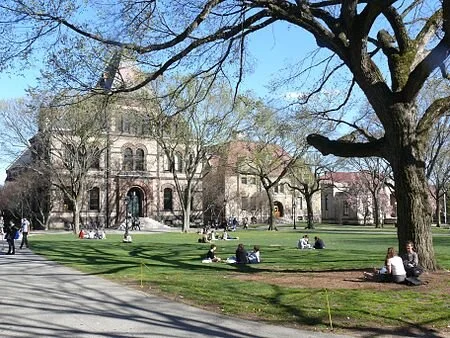
On the Brown campus
From Robert Whitcomb’s “Digital Diary,’’ in GoLocal24.com
Brown University wants to build two dorms, housing a total of 375 undergraduate students, at the southern end of its main campus, on Providence’s College Hill. This would require tearing down three undistinguished houses, a small commercial strip and a police substation, all properties owned by Brown.
Presumably there would be some pushback from neighbors concerned about, for example, even tighter parking on neighborhood streets, which are increasingly monopolized by Brown-connected people, but I’d be very surprised if the project didn’t happen. Colleges and universities, especially rich “elite’’ ones such as Brown, are constantly trying to expand and they usually get their way.
Despite the complaints that Brown doesn’t pay property taxes (it does fork over some payments in lieu of taxes to the city -- $6.7 million a year at last count) and more generalized complaints about its power and huge footprint, the fact is that its presence, along with that of the Rhode Island School of Design, are key factors in making the College Hill/East Side of Providence so attractive. Brown has some facilities and activities that local residents can enjoy; it ensures that there are many physicians and other health-care professionals (and the Brown teaching hospitals they help staff) and other useful experts close by, and includes a large, generally beautiful, almost parklike campus – a lovely amenity to have near the middle of a city. Indeed, some of those complaining all the time about Brown live on the East Side/College Hill because Brown is there, whether or not they work there
An old joke is that “Providence is Fall River with Brown.’’ Well, as a state capital and former industrial and foreign-trade center, it was always much more than that, but certainly Brown has had something to do with keeping Providence viable as a mid-size city as its old industrial base shrank. Brown’s expansion is, all in all, good for the city, though taxpayers would like it to chip in more money in lieu of taxes. And no, I didn’t go to Brown.
In general, having a college or university brings wealth and energy to their hosting communities, albeit with some irritations and costs.
To read more about Brown’s latest expansion plans, please hit this link.
A Nantucket origin story
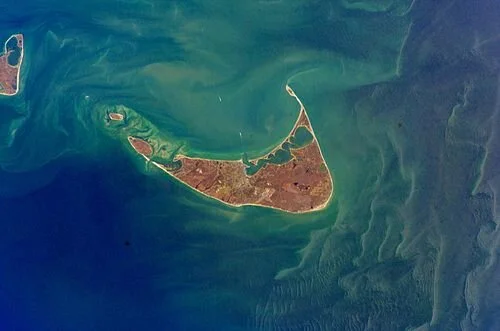
Nantucket from a satellite. Martha’s Vineyard’s Chappaquiddick Island is on the left.
“Look now at the wondrous traditional story of how this island {Nantucket} was settled by the red-men. Thus goes the legend. In olden times an eagle swooped down upon the New England coast, and carried off an infant Indian in his talons. With loud lament the parents saw their child borne out of sight over the wide waters. They resolved to follow in the same direction. Setting out in their canoes, after a perilous passage they discovered the island, and there they found an empty ivory casket --the poor little Indian's skeleton.’’
-- From Moby-Dick (1851), by Herman Melville (1819-91)
Chris Powell: Conn. Democrats' hypocrisy on military spending

Connecticut's members of Congress, all Democrats, are upset -- some almost apoplectic -- about President Trump's using his emergency power to divert military appropriations away from nuclear submarine and jet-fighter procurement to help finance the wall he is having built along the border with Mexico.
Sen. Richard Blumenthal says, "This is about appealing to President Trump's political base" -- as if in opposing the diversion the senator and his colleagues in Connecticut's delegation aren't appealing to their political base, the military contractors and subcontractors in the state that make submarines and jet fighters.
Sen. Chris Murphy says, "The president is stealing money from programs that keep us safe during real national emergencies to fund his stupid border wall." But how persuasive is any member of Congress from a military contracting state like Connecticut when he is just defending appropriations for his own constituents? Has any member of Congress from Connecticut ever opposed an appropriation for military contracting that was to have been spent in the state?
As for keeping the country safe during "real national emergencies," how about that "emergency" with Afghanistan, now in its 20th year? How many more years of that "emergency" will be required before Connecticut's congressmen acknowledge that it is not an "emergency" at all but just another discretionary war of nation building, less of an emergency than the illegal immigration Trump's border wall addresses?
To his credit Murphy lately has led the effort to stop the president from waging war on Iran without the approval of Congress. But the long war in Afghanistan, having achieved nothing but death, seems to have escaped the senator's notice. Where is the legislation to terminate appropriations for that war? Why does that war keep getting a pass from Connecticut's delegation, if not because of the delegation's reluctance to jeopardize the state's military contracting?
Besides, the delegation shares the blame for diversion of the sub and jet-fighter money. For politics is compromise, the president's discretion to move military money around in emergencies he declares and defines has been the law for many years, and Democrats have yet to want much compromise with Trump over illegal immigration.
Indeed, most leading Democrats in Connecticut want as much illegal immigration as they can get, since it proletarianizes the country, increasing the population's dependence on government welfare programs, and increases the number of Democratic-leaning legislative districts, since illegal immigrants cluster overwhelmingly in Democratic urban areas, where, though they aren't supposed to vote, they still are counted toward formation of new congressional and state legislative districts.
That is, the more illegal immigrants, the more Democrats in Congress and the General Assembly.
Silly as the Democrats consider the border wall, by appropriating directly for it and giving Trump what he wanted they might have guaranteed their wildest dreams of military contracting and even have achieved at last the naturalization of the innocent young people, the "Dreamers," brought into the country illegally by their parents and now living in limbo. But blocking immigration law enforcement comes first for Connecticut Democrats, even ahead of more weapons.
Somehow the country will manage with fewer jet fighters and subs, especially if Congress goes beyond posturing against a hypothetical war and terminates one that is only too real.
Chris Powell is a columnist for the Journal Inquirer, in Manchester, Conn.
Staring at 'nonspectacular' flora

“Inside/Outside’’ (oil on canvas) , by Maria Napolitano, in her March 2-May 3 show “Garden Fragments,’’ at Periphery Space at Paper Nautilus, Providence. She explains:
“The work in this show invites you to stop and take a closer look at the ordinary and non-spectacular flora that surround most of our lives. To do this, I mix up painterly, cartoony and diagrammatic approaches which I use to draw attention to the fragile relationship we have with our ecosystem. Whether it be based on the dried remnants of last year’s garden or visual memories I collect from a winter walk in the park, I combine observation and imagination to provide an insight into my everyday interaction with nature. “
Try trains again
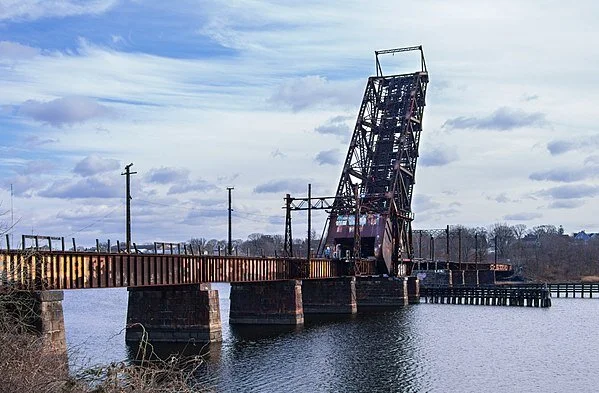
Providence’s infamous stuck-up bridge over the Seekonk River
From Robert Whitcomb’s “Digital Diary’’ in GoLocal245.com
Architectural historian and critic William Morgan’s recent entertaining GoLocal column with zany ideas (ski jump!) on what to do with the abandoned railroad bridge over the Seekonk River at the head of Narragansett Bay served to remind many of us that a light-rail line from Providence down through East Providence, Barrington, Warren and Bristol would make a lot of sense. And maybe it could eventually be extended across to Aquidneck Island via a railroad bridge next to the Mount Hope Bridge.
After all, it’s a densely populated strip with distinct town centers (for stations). It would make a lot of environmental and economic sense to lay down the line even if that meant putting it where the East Bay Bike Path (formerly a rail route!) is now. You can move a lot more people by train than by bike, and do it in all weather.
In any event, we need to better knit together the improving post-industrial waterfront of East Providence with Providence’s eastern shore.
To read Mr. Morgan’s column, please hit this link.
Maybe Mr. Morgan could do another essay on Providence’s “Superman Building,’’ this one with some fantastical suggestions – e.g., hanging gardens, a recirculating waterfall, an aviary at the top….
Hit this link to read his last column on that Art Deco skyscraper.
Racism left out of history books

“Exodus of Confederates from Atlanta, ‘‘ from "Harper's Pictorial History of the Civil War (Annotated)" (offset lithography and silkscreen on Somerset Textured paper), a show by Kara Walker, at the New Britain (Conn.) Museum of American Art, through April 19.
The museum says: “Kara Walker is New York-based artist whose work has appeared worldwide, tackling complex social issues such as race, gender, sexuality and violence. She's known for her use of silhouetted figures in her prints. In “Harper's Pictorial History of the Civil War (Annotated),’’ she combines her signature prints with enlarged woodcut plates from the book Harper's Pictorial History of the Civil War to illustrate a different side of the Civil War: the perspective of African Americans of the era and the racism they experienced that were left out of history books.
Don Pesci: Using Conn. tolls as an escape hatch

Connecticut Gov. Ned Lamont threw up his hands in a gesture of surrender and took a pause in his ceaseless efforts to rig Connecticut with a new revenue source – tolls – so that his comrades in the General Assembly would not have to apply themselves diligently during the next decade to balancing chronic deficits through spending cuts. A new revenue source would buy progressives in the legislature about ten years of business-as-usual slothfulness. It is their real hedge against spending reductions.
“I think it’s time,” Lamont said at a hastily called news conference, “to take a pause” and -- he did not say -- to resume our tireless efforts next year, after the November 2020 elections have been put to bed. The specter always hanging over the struggle for and against tolls always has been the upcoming elections, when all the members of Connecticut’s General Assembly will come face to face with the voter’s wrath. The prime directive in state politics is to get elected and stay elected, without which all ideas, hopes, dreams, and the vain strutting of one’s hour upon the political stage, are evanescent puffs of smoke.
“Gov. drops tolls plan” ran the front page, above the fold headline in a Hartford paper, underscored with a sub-headline, “Democratic Senate leaders are still open to a vote on controversial legislation.” The word “controversial” in that headline is a massive understatement. The best laid toll plans of Lamont and leading Democrats in the General Assembly were torn asunder by a volcanic eruption of disgust and dismay that Speaker of the House Joe Arsimowicz and President of the Senate Martin Looney seem convinced will disappear within the following year. Their experts no doubt have counseled them that the lifespan of political memories in Connecticut is exceedingly short; by November, all the Sturm und Drang over tolls will have been dumped onto the ash heap of ancient history.
No one will recall these bitter fighting words from Lamont, “If these guys [Lamont’s Democrat co-conspirators who had been giving him assurances that there were enough votes in the General Assembly to pass his re-worked toll plan] aren’t willing to vote and step up, I’m going to solve this problem. Right now, we’re going to go back to the way we’ve done it for years in this state when we kept kicking the can down the road."
By the expression “kicking the can down the road” Lamont meant to indicate that the Democratic-dominated legislature and preceding governors had not, unlike him, attacked transportation issues, not to mention massively dislocative state workers’ pension obligations, with energy and dispatch. We are back to borrowing money to pay for transportation and road repair because – Lamont did not say – his Democrat comrades in the General Assembly had in the past raided dedicated funds, transportation funds among them, in order to move from laughably insecure “lockboxes” to the General Slush Fund monies necessary to patch massive holes in budget appropriations and expenditures caused by inordinate spending.
The real political division in Connecticut is not, and perhaps never has been, between Democrats and Republicans. The dissevering line runs between progressive politicians who, victims of their own past successes, are not discomforted by ever-increasing taxes and spending – which go together, like the proverbial horse and carriage – and those who are beginning to suspect that the usual political bromides only sink the state further in a mire of political corruption and anti-democratic but successful political verbiage that makes no sense when examined closely. In the post income tax period, Connecticut entered into a perilous and fatally repetitious Groundhog Day, and those who might have opened the eyes of the public, reporters and commentators, were fast asleep.
Tolls are, in fact, an escape hatch for politicians who want to deceive their real employers, voters, into swallowing the fiction that less money for the masses and more for the politicians will usher in a progressive Eden, whereas inordinate revenue infusions only relieve politicians of the brutal necessity for spending cuts.
The general perception among all groups opposed to tolls and other revenue boosters appears to be: not one cent more in net revenue. For the benefit of the real state, not Connecticut’s administrative apparatus, the General Assembly must show in an indisputable and public manner that it intends to inaugurate real, lasting, spending reforms. The General Assembly is making a serious political mistake if it assumes that all the ruckus of the past year surrounding tolls is only about tolls. It is about the General Assembly and present and past governors who have closed their eyes and ears to the havoc they have caused and the wounds and injuries they have visited upon our beloved state.
Don Pesci is a Vernon, Conn.-based columnist.