
Vox clamantis in deserto



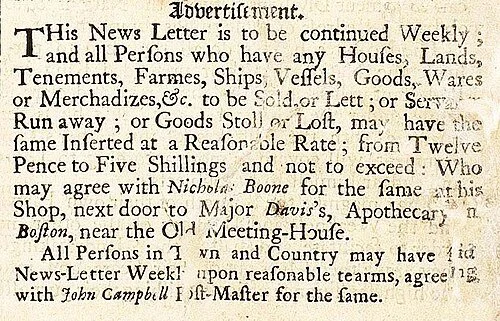

Another old writer gives up
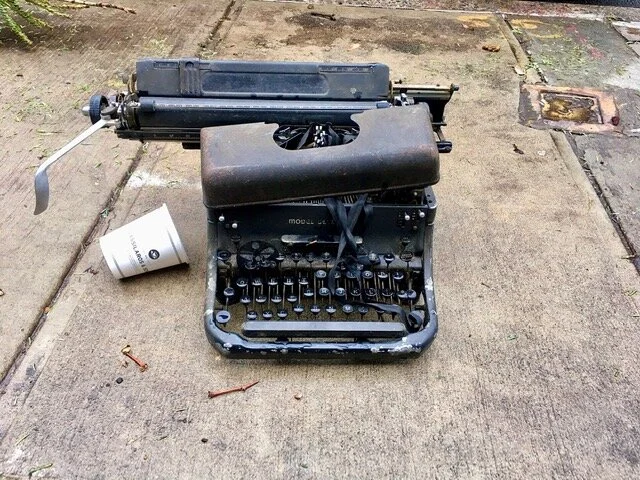
A sad scene on West 83rd Street in Manhattan
— Photo by Maryalice Huggins
Get together
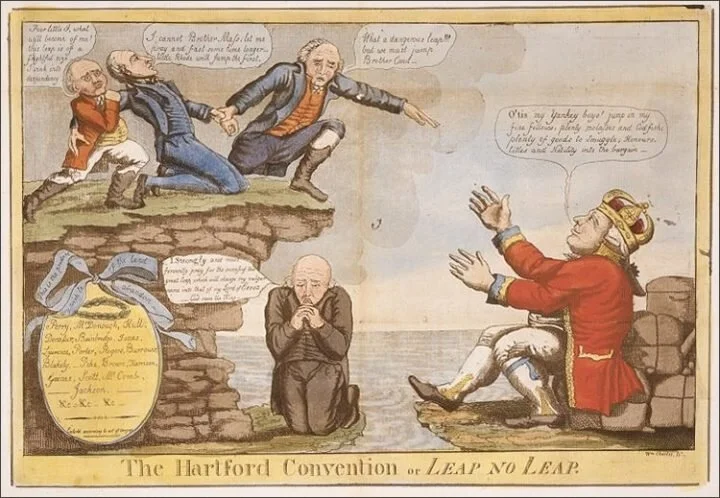
Political broadside about the Hartford Convention satirizing the Federalists’ deliberations and depicting Great Britain’s King George III promising resumed trade and "titles and Nobility into the bargain" as incentives to leap into his arms
From the White House Historical Association:
“The Massachusetts legislature released an invitation on October 5, 1814 for a convention of the New England states to meet in Hartford, Connecticut ‘to lay the foundation for a radical reform in the National compact.’ Angered by the destructive wartime loss of their trade {in the War of 1812} and fearing a British assault on Boston, New England governors had refused to adhere to President Madison's requests for militia forces. The governors wanted the soldiers close to home to deal with British raids along the coast or a potential attack on New England.
“The convention met at Hartford's Old Statehouse on December 15, 1814, with 26 delegates from five states present. James Madison and others had concerns the convention might be a first step toward separation from the Union or a separate New England peace with Great Britain.
“Although the Hartford Convention did not consider secession or a separate peace, Democratic-Republicans labeled it treasonous, and news of the U.S. victory at New Orleans and Treaty of Ghent rendered the convention's work powerless. Under a hail of derision and withering blasts of denunciation for its supposed disloyalty, the national Federalist Party, with its stronghold in New England, began to disintegrate.’’
From Robert Whitcomb’s “Digital Diary,’’ in GoLocal24.com
It still looks as if Rhode Island will lose a congressional seat as a result of the 2020 U.S. Census. This loss of political clout will make it all the more important that the state’s officials collaborate more closely with, particularly, Massachusetts and Connecticut, but also with Maine, New Hampshire and Vermont, to promote regional interests.

Garden-variety humor and bribery

The old Boston Garden, built in 1928 and torn down in in 1998, three years after its successor arena, TD Garden, was opened.
New England Diary editor Robert Whitcomb and two fellow reporters from the Boston Herald Traveler were each given $50 to take to a Bruins game in The Garden in 1971 with which to bribe the police there to let us in although the fire-code-approved crowd capacity had long been exceeded when we arrived. The air was blue with cigarette and cigar smoke.
The bribes worked and wrote a scandal story about it, but the publisher, fearing retribution, killed the story.

TD Garden. Now, if they’d only connect by train South and North Stations it would be a lot easier for some of us to get there. The arena is built right over North Station. and it houses the Sports Museum of New England.
“The old Boston Garden seats, some of which are placed here, were, as we remembered not much fun to sit in. The museum displays a sense of humor, by placing one seat behind a pole, symbolizing the 1,895 such seats.’’
— Jim Sullivan, on the Sports Museum of New England, in the April 11, 2002 Boston Globe article “Take Me Out To’’
Checkerboard crisis

The Hancock Tower, in Boston’s Back Bay, in 1974, showing the plywood over where many windows had popped out because of an engineering flaw in the window installation. The problem was obviously fixed and the building opened in 1976. The 62-story, 790-foot skyscraper remains the tallest building in New England.
The North Woods in wax

“Tree Variation #6 ‘‘ (encaustic on panel), by Helene Farrar. She is a member of New England Wax, which promotes the art of encaustic painting, which uses bee’s wax.
From her bio:
“Hélène Farrar has taught and worked in the visual arts for twenty years while actively exhibiting in commercial, nonprofit and university galleries in New England, New York City, Pennsylvania, Italy, and England. Farrar has a BA in Studio Art from the University of Maine and a Masters of Fine Art Degree in Interdisciplinary Arts from Goddard College in Vermont.
“Hélène currently owns and operates her own private art school in Maine out of her ‘Farmhouse’ studio, where she holds varied workshops and classes. Her paintings have most recently been accepted into curated exhibits at the Fuller Craft Museum, the Saco Museum, the University of New England Art Gallery, and Twiggs Gallery in New Hampshire.
“Farrar is represented by Archipelago Fine Arts in Rockland, and the Center for Maine Craft in West Gardiner. Her work as an educator has brought her across the state of Maine including the Haystack Mountain School of Craft. She taught at the 2019 International Encaustics Conference.’’
Looking at Iranian general's assassination in a very different light

In the Iranian parliament.
— Photo by Mahdi Sigari
Trita Parsi is founder and current president of the National Iranian American Council and author of Treacherous Alliance and A Single Roll of the Dice. He regularly writes articles and appears on TV to comment on foreign policy. He has comments below on the intensifying U.S.-Iran standoff.
He’ll, of course, have a lot to say about U.S. Iranian relations when he speaks to the Providence Committee on Foreign Relations (thepcfr.org) on April 29.
His comments on Jan. 5:
Much has happened in the past 24 hours. Below are the five most important developments of today following the assassination of Qassem Soleimani.
https://responsiblestatecraft.org/2020/01/05/trump-faces-swift-backlash-for-killing-soleimani-as-iraqi-parliament-votes-to-expel-u-s-troops/\
1. Iraqi prime minister says Soleimani was in Iraq for a mediation effort
Iraqi Prime Minister Adil Abdul-Mahdi has made some shocking revelations that put the assassination of Soleimani in a completely different light. He told the Iraqi parliament on Sunday that he “was supposed to meet Soleimani on the morning of the day he was killed, he came to deliver me a message from Iran responding to the message we delivered from Saudi to Iran.”
If this account is true, Trump — perhaps deliberately — acted to scuttle an effort to reduce tensions between Iran and Saudi Arabia
But it also shows that as the United States was signaling that it would not go to war with Iran — as Trump did earlier this summer — this compelled Saudi Arabia and the UAE to begin quiet negotiations with Iran to resolve their tension. As long as the Saudis and the Emiratis felt they could push the U.S. to go to war with Iran, they had no interest in diplomacy with Iran. The U.S.’s military protection of these countries essentially disincentivized them from pursuing peace.
In the past few months, under the impression that Trump had opted against war, they began careful diplomacy with Tehran. The U.S. should have welcomed this development. But the killing of Soleimani may have at the same time killed that effort and once again given Saudi Crown Prince Mohammed bin Salman and the Emiratis a license to continue recklessness and destabilization.
2. Soleimani’s death has unified Iran
Rather than being a blow to Iran, the assassination of Soleimani has fueled nationalist sentiments in Iran and unified the political elite as well as the country. The crowds of mourners in the cities where his casket has been taken were in the hundreds of thousands, if not millions.
Only a few months ago, there were widespread protests against the Iranian government, which were met with brutal force and repression. Now, Iranians are protesting alongside the government, not against it.
3. Iraqi Parliament voted to expel U.S. forces
The Iraqi parliament on Sunday voted to expel all U.S. military forces from Iraq, as a direct consequence of the Soleimani assassination. Iraqis have tried to walk a fine balance between the U.S. and Iran, but the assassination made that balance untenable. Iraqis don’t want their country to become the arena for a U.S.-Iran war, and the U.S. military presence made that risk all too likely.
While many will point out that this is a victory for Soleimani and Iran, it is also important to note that this is also what the American public wants. In fact, this is what Trump promised them he’d do.
The U.S. military presence in Iraq does not add to U.S. national security. Instead, it increases the threat of what would be a disastrous U.S.-Iran war. The U.S. does not need to have 5,000 troops in Iraq to assist in the fight against ISIS. Trump should welcome the vote and bring American military servicemen and women home to be with their families.
4. Pompeo’s absurd claim that war with Iran started with the nuclear deal
“This war kicked off when the JCPOA was entered into,” Secretary of State Mike Pompeo told CNN’s Jake Tapper on Sunday, referring to the Joint Comprehensive Plan of Action. This is an astonishing statement. In Pompeo’s view, the U.S. and the entire international community (save Israel, Saudi Arabia, and the UAE) entering an agreement to block Iran’s path to a nuclear bomb was tantamount to starting a war.
What threatens Pompeo is not war. It’s peace. He is doing everything he can to ensure that tensions with Iran don’t get resolved. For him, the “war” to start a war with Iran started when the U.S. embarked on a path of resolving its tensions with Iran.
5. Iran announces further reductions in its commitments to the JCPOA
Iran has announced the fifth reduction of its commitments to the JCPOA. This is not tantamount to Iran quitting the JCPOA, as it has left the door open to recommit itself to all of the restrictions of the nuclear agreement if the U.S. lifts sanctions on Iran. (Those sanctions, it should be mentioned, are a violation of the JCPOA as well as the United Nations Security Council Resolution that embodies the JCPOA). Nevertheless, this is a step that will further increase tensions.
Dissolving scallops

An Atlantic Bay scallop, photographed at the Marine Biological Laboratory, in Woods Hole, Mass.
— Photo by Rachael Norris and Marina Freudzon
From Robert Whitcomb’s “Digital Diary,’’ in GoLocal124.com
Ocean acidification caused by the man-made increase in atmospheric carbon dioxide may well mean that many more scallops than now will not make it beyond the larval stage, or if they do they’ll be small because the acidity dissolves shells. The fishing port of New Bedford hauls in hundreds of millions of dollars worth of scallops a year. Maybe its fishermen will become another source of lobbyists against American myopia about global warming.
To read more, please hit this link.
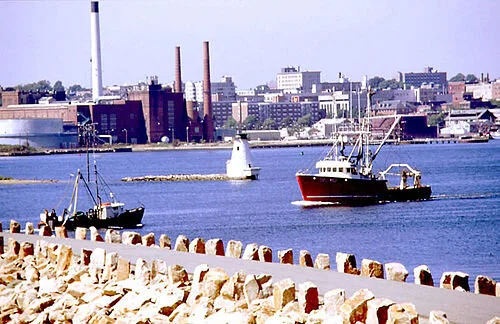
New Bedford Harbor: In the 19th Century New Bedford’s big “fishing’’ industry was whaling (though of course whales aren’t fish). Now the port’s biggest crop is scallops, most taken from Georges Bank.

'And the being lost'

“The liberal arts lie eastward of this shore.
Choppy the seas at first. Then the long swells
And the being lost. Oh, the centuries of salt
Till the surf booms and comes more land.’’
— From “The Seven Sleepers,’’ by Mark Van Doren (1894-1972), a once famous poet, teacher, critic and essayist. He lived much of his time in Cornwall, Conn., in the Litchfield Hills, a locale about which he often wrote.
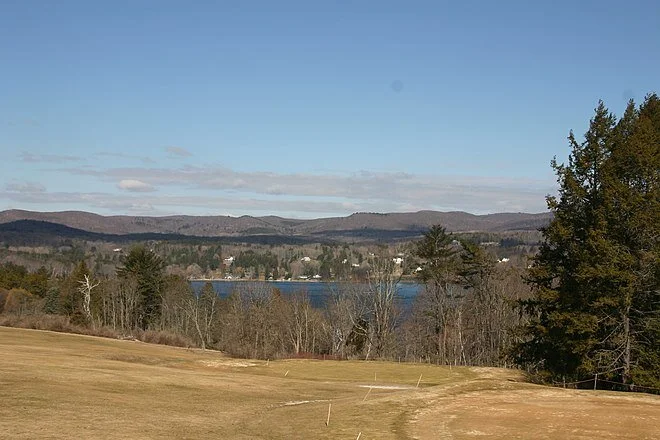
In the Litchfield Hills
Pig pretty in pink

“Evolution of Form (This Little Piggy Went to Market)” (paper-mache clay, mediums), by Kathleen Volp, in Boston Sculptors Gallery’s “RING: Boston Sculptors Annual Member Show,’’ Jan. 29-Feb. 23.
Fishing for summer

“Bait, Rope and Knife (The Duck Boat)’’ (watercolor monoprint), by Stella Ebner, in her show at Cade Tompkins Projects, Providence, through Jan. 23
What about in 50 years?
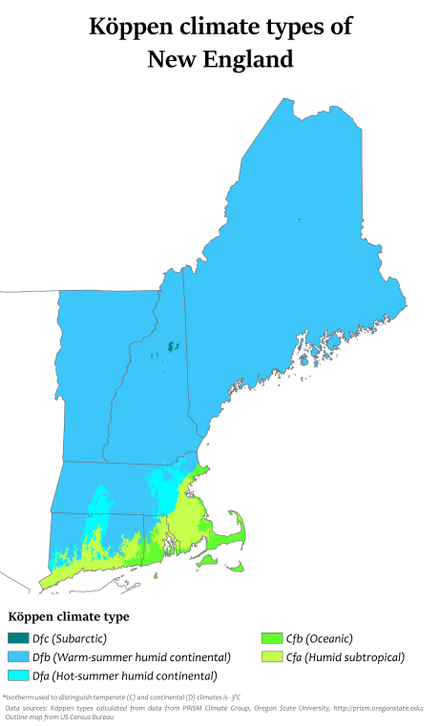
“Nowhere else in the United States of America does the wheel of the seasons turn more brilliantly than in New England. Winter’s blankets of white, the long awaited buds of spring accompanied by the run of maple sap, summer’s bouquets, and the magnificent palette of autumn: all are feasts for the senses, and lead to the characteristic New England feeling of existing in tandem with, and often at the mercy of, the great forces of nature.’’
— From The Most Beautiful Villages of New England (1997), by Tom Shachtman
Alone together
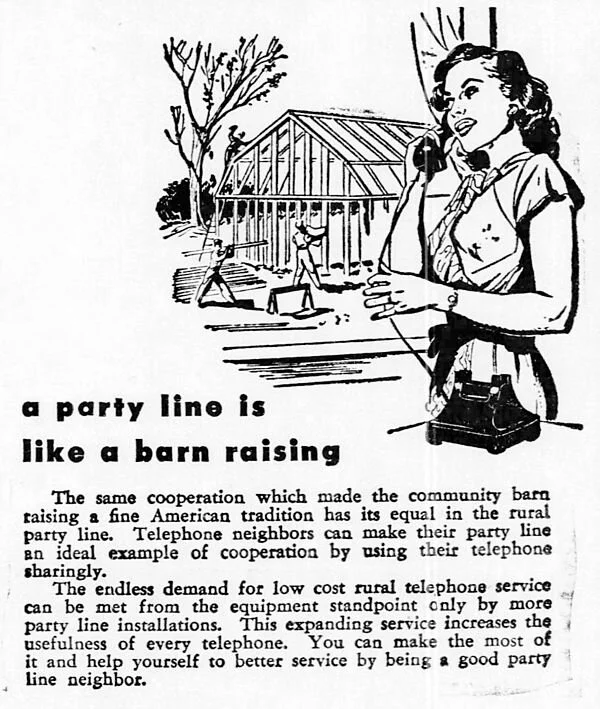
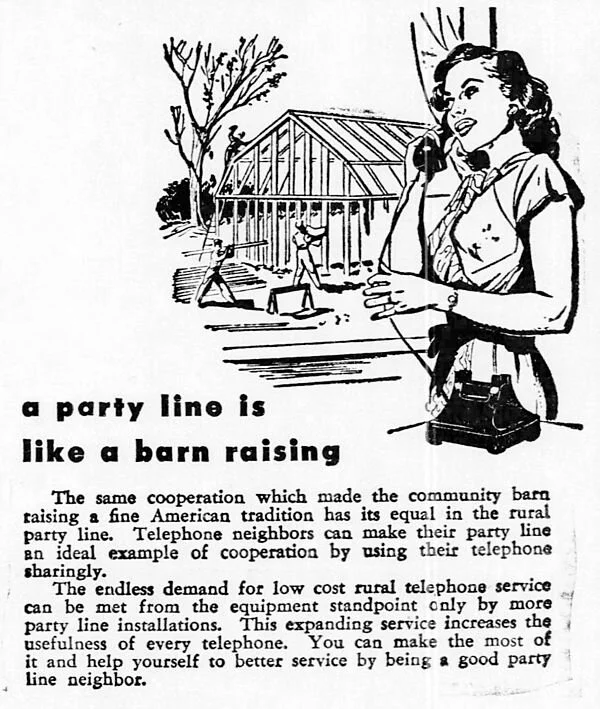
As upgrades made party-lines more popular in the 1940s, local telephone companies ran frequent ads to instill community spirit and personal courtesy in party-line subscribers.
From Robert Whitcomb’s “Digital Diary,’’ in GoLocal24.com
“Think how we spend our leisure time now compared to 10 years ago: alone with our Netflix, Instagram, Spotify. No wonder our mental health is eroding and we seem to hate everyone else.’’
-- Gerard Baker in his Dec. 20-21 essay in The Wall Street Journal, “Farewell to the 2010s, the Uneasy Decade of Populism’’
A few years ago, we had a nice family to lunch. They’re a very internationalized crew. Anyway, what struck me in almost comic form was that they were spending much of the meal on their new smart phones, making global travel plans and otherwise communicating with the wide world. (The very ugly table around which we sat, by the way, has quite a history: It was made in a French military prison in Lebanon in the 1920s. My wife bought it off the daughter of the French army officer in charge of the prison.)
I thought of that meal the other day when I came upon a story in The Atlantic magazine about land line phones. Before smart phones, most households had one or at the most two phones. Families had to share them, and the phones were generally in such public places as the living room, the kitchen or the front hall. So there was much less privacy than with cell phones and so more communal family knowledge. Now, phones tend to keep us separated. But then, this is part of a broader tendency to eschew physical person-to person communication in favor of communication via screens. By making it easier to avoid having to become habituated to real, face-to-face contact, these digital devices seem to lead to more and more people being anxious when, for instance, being interviewed in person (not on Skype!) for jobs. HR people tell me that some young job applicants avoid looking at their interviewers in the eyes.
I’m old enough to remember when small towns (including the one I lived in, Cohasset, Mass.) had “party lines’’ that enabled operators of what was called “The Phone Company” (a tightly regulated monopoly) to monitor phone calls and do such things as telling pranksters (usually kids) to hang up, or to call an ambulance. It was truly a community service. It wasn’t always a very efficient system but it could be pretty entertaining, and some family disasters were averted through the heroic efforts of operators at their switchboards.=
A cousin of this phenomenon is the dearth of working people taking the time (or being allowed to take the time) to go to lunch with workmates and others; rather, they eat their lunches at their desk. Thus another opportunity for maintaining social skills falls by the wayside.
Maybe a nice New Year’s Day resolution would have been to spend a bit more time with people in the flesh. But cellphones and computers are engineered to be addictive….
To read the article in The Atlantic, please hit this link.
'Like seams of lead'

“Still life with mackerel, lemon and tomato,’’ by Vincent Van Gogh (1886)

“They lie in parallel rows,
on ice, head to tail,
each a foot of luminosity
barred with black bands,
which divide the scales’
radiant sections
like seams of lead
in a Tiffany window.’’
— From ‘Display of Mackerel,’’ by Mark Doty, formerly of Provincetown
Tax-hating New Hampshire bets on more betting

Regarding New Hampshire, whose lottery, started in the 1960s, launched America’s ever-growing state-sponsored gambling sector. The Granite State will do everything it can to avoid imposing broad-based taxes. “Live Free and Bet!”
From The New England Council (newenglandcouncil.com ):
“New Hampshire state officials have approved a contract with DraftKings allowing the company to provide sport betting within the state. Based in Boston, DraftKings is a sports-tech and media entertainment platform with daily fantasy sports contests and sports betting.
“Gov. Chris Sununu signed a bill in July 2019 authorizing sports betting in the state. DraftKings was selected through a competitive bidding process, offering the best financial package, a highly rated mobile sports app, and a fast implementation timeline. Under the contract, approved by the New Hampshire Executive Council in late November, the New Hampshire Lottery will receive 50 percent of gaming revenue from the sports betting sales. In effort to continue to work closely with the state lottery, DraftKings has plans to open an office in New Hampshire. The state’s launch of the mobile sports betting is expected to occur this month.
“‘We are partnering with a world-class company to provide a first-rate customer service experience,’ Governor Sununu said. ‘With today’s vote, everyone will now be able to bet on Tom Brady and the New England Patriots in time for this year’s Super Bowl.’
“‘Our best-in-class mobile sportsbook and several retail locations throughout the state are sure to be a hit with all types of customers as legalized sports betting continues to expand across the country,’ said Matt Kalish, DraftKings co-founder and chief revenue officer.’’

Chris Powell: To fix higher education, fix lower education

Got any ideas that public schools could use to engage alienated students who are at risk of never getting much of an education or dropping out of high school? The Partnership for Connecticut, the organization created by billionaire couple Ray and Barbara Dalio and state government, wants to hear from you. The partnership especially wants to hear from schools about any programs and practices they use that really work.
Of course the inquiry is good but it's a little strange that it didn't start with the state Education Department and the General Assembly's Education Committee. For the problem of alienated students is an old one. But then maybe the partnership realizes that the Education Department and state legislators see education as mainly a matter of appropriating more money every year with most of it used only to increase staff compensation. At least the Education Department and legislators don't seem to have offered any more relevant ideas yet.
It's also a little strange that the Dalios would pledge $100 million over five years and state government would match it without knowing exactly how it would be spent. Could not inquiries about what works with disengaged students have been made and some conclusions drawn before appropriating all that money? Couldn't a few hearings have been held first?
Or was part of the idea of the Partnership for Connecticut to give educators more visions of sugarplums during the holidays?
Instead of searching for ways of remediating the failure of education with alienated students, the partnership might better start by investigating the causes of that alienation. After all, alienation extends far beyond students at special risk of dropping out of high school, since fully half of Connecticut's students graduate without ever mastering the basics.
Indeed, at this month's meeting of the partnership's board of directors, a few members mused about the main cause of educational failure -- that many students lack parents and a stable home life. Looking into this might be worth spending some money as long as the Education Department and the legislature won't do it.
While some teachers and school administrators may be mediocre, as some people in all occupations are, what if this widespread failure in education actually has little to do with education itself?
As the Partnership for Connecticut was announcing its search for ideas to engage alienated students, the Board of Regents for the state colleges and university system was implementing its own idea for improving education: free community college. Free for students anyway.
But free community college may not be as good for students as the board thinks, and at least the board admitted that the plan is also meant to stop the community college system's decline in enrollment and thereby preserve the jobs and compensation of its employees.
The problem with public higher education in Connecticut is lower education. Most students in public higher education must take remedial high school courses because of their social promotion. Their primary education was free and they did not value it, perhaps because schools long ago stopped requiring students to value it by taking it seriously, advancing them even as they showed contempt for it.
"What we obtain too cheap, we esteem too lightly," Tom Paine wrote to exhort his countrymen to civic virtue 2½ centuries ago. "It is dearness only that gives everything its value."
So how much value should students ascribe to free community college when so much of it is only remedial free high school and elementary school
Chris Powell is a columnist for the Journal Inquirer, in Manchester, Conn.
Llewellyn King: U.S. takes shenanigans from Zambia lying down

Victoria Falls, Zambia’s most famous site
What does it matter if a U.S. ambassador runs afoul of the administration in a piddling African country where the inhabitants suffer chronic poverty and bad government?
It so happens it matters a lot.
Here is the story: One of our most experienced ambassadors, Daniel Lewis Foote, with a distinguished diplomatic career, often in hot spots like Afghanistan, Iraq and Haiti, criticized the administration and the justice system of Zambia, a landlocked country in Southern Africa, for sentencing a gay couple to prison for 15 years for having sex. Zambians, who are committed Christians with a fundamentalist slant, were approving. Foote said he was horrified.
The president of Zambia, Edgar Lungu, joined the fray. Homosexuality he told a British interviewer, was unbiblical and unchristian. Foote, who felt that he had been badly treated as a diplomat since his arrival in 2017, was having difficulty in meeting with Lungu despite the $500 million a year that the United States gives Zambia in debt-free assistance.
Then Foote, who also had been seething, apparently, over blatant corruption by Lungu and his family, published on the Internet a strong indictment of the Lungu administration.
That was too much for the Zambian government.
The government made the dispute with the United States public and stirred up the people. Lungu said Foote had to go and, amazingly, the State Department agreed without struggle and Foote was ordered back to Washington.
In his statement, Foote had laid out the situation clearly, “My job as U.S. ambassador is to promote the interests, values and ideals of the United States. Zambia is one of the largest per capita recipients of assistance in the world, at $500 million each year. In these countries where we contribute resources, this includes partnering in areas of mutual interest and holding the recipient government accountable for its responsibilities under this partnership.”
Lungu’s response to Foote’s statement was clear, too, “We do not want him here.”
And the State Department conveniently obliged, even while regretting that the government in Lusaka, Zambia’s capital, had effectively declared Foote “persona non grata.”
The effect across Africa and in other small nations may be to embolden them to silence ambassadors. Lungu has kicked sand in the eyes of the mighty United States and we have run. American values will not be on the table.
Tibor Nagy, the assistant secretary of state for Africa, tweeted lamely, “Dismayed by the Zambian government’s decision requiring our Ambassador Daniel Foote’s departure from the country.”
Yes, there is room for dismay; and it is dismay with the way this issue has been handled in Washington. A stellar career ambassador appointed by President Trump has been pushed out of his post by a government that has been dependent on foreign aid both in cash and advice. Foote also pointed out in his statement that the “American people have provided more than $4 billion in HIV/AIDS support in the last 15 years. Working closely with the Ministry of Health, we currently have well over 1 million Zambians on life-changing antiretroviral medicine, touching close to half of the families in the country.”
If things had gotten too sticky for Foote to continue in Lusaka, he could have been reassigned and a new ambassador appointed. One way or another, he should not have been put in the position of leaving at the behest of Lungu, who is trying to drive Zambia back toward the kind of authoritarian government that has bedeviled it since independence from Britain in 1964.
During the height of the Cold War, Zambia had some strategic importance to the United States as a major producer of copper. Since then the economic fortunes of Zambia have risen and fallen with the copper price and attempts to diversify the economy have faltered. Tourism, dependent largely on the Victoria Falls and recreation on the world’s largest water impoundment, the Kariba Dam, called Lake Kariba, is faltering because of persistent drought leading to historical low flows in the Zambezi River.
Over the years Zambia has done better than, say, neighbor Zimbabwe, where bad government has destroyed the once-prosperous country and reduced it to a kind of subsistence existence without so much as a national currency. Zambia has never been as rich as Zimbabwe was at its independence in 1980, but it has managed somehow to survive.
In his statement, Foote saluted the warmth and friendliness of the Zambian people. In my experience, he is right. I lived in Zambia for a while many years ago and the people were tops. As a very young journalist, I interviewed Zambia’s first president, Kenneth Kaunda, when he was a young independence leader. He is now 95.
Kaunda, too, was to have his problems with diplomats. He curbed the press, but he loved press conferences and he ordered the diplomatic corps to show up and ask friendly questions. That did not go too well either.
Llewellyn King is executive producer and host of White House Chronicle, on PBS. His email is llewellynking1@gmail.com. and he’s based in Rhode Island and Washington, D.C. He grew up in what was then called Southern Rhodesia, a British colony, but is now called Zimbabwe.
Linda Gasparello
Co-host and Producer
"White House Chronicle" on PBS
At PCFR, Dr. Fine and beyond

The next dinner of the Providence Committee on Foreign Relations (thepcfr.org; pcfremail@gmail.com) comes on Wednesday, Jan. 8, with Michael Fine, M.D., the speaker. He'll talk about his novel Abundance, set in West Africa, and the challenges of providing health care in the developing world. He’s also a short story writer and essayist.
Dr. Fine has been an advocate for communities, health-care reform and the care of under-served populations worldwide for 40 years. He is a former director of the Rhode Island Department of health.
His career as a community organizer and family physician has led him to some of the poorest places in the United States, as well as dangerous, war-ravaged communities in third-world countries. He is a former director of the Rhode Island Department of health.
Please let us know if you're coming to the Jan. 8 event by registering on our Web site, thepcfr.org, or emailing us at pcfremail@gmail.com. You may also call (401) 523-3957.
Please go to thepcfr.org, or email to pcfremail@gmail.com or call (401) 523-3957 for information on how to join the PCFR. (It’s very simple.)
xxx
And for the rest of the PCFR season, subject to the vagaries of weather, flu epidemics and so on:
On Wednesday, Feb. 5: We will welcome Cornelia Dean, book author, science writer and former science editor of The New York and internationally known expert on coastal conditions. She’ll talk how rising seas threaten coastal cities around the world and what they can do about it.
xxx
On March 18 comes Stephen Wellmeier, managing director of Poseidon Expeditions. He’ll talk about the future of adventure travel and especially about Antarctica, and its strange legal status.
xxx
News to come about an early-April speaker
xxx
On Wednesday, April 29 comes Trita Parsi, founder and current president of the National Iranian American Council, author of Treacherous Alliance and A Single Roll of the Dice. He regularly writes articles and appears on TV to comment on foreign policy. He, of course, has a lot to say about U.S. Iranian relations.
xxx
On Wednesday, May 6, we’ll welcome Serenella Sferza, a political scientist and co-director of the program on Italy at MIT’s Center for International Studies, who will talk about the rise of right-wing populism and other developments in her native home of Italy.
She has taught at several U.S. and European universities, and published numerous articles on European politics. Serenella's an affiliate at the Harvard De Gunzburg Center for European Studies and holds the title of Cavaliere of the Ordine della Stella d'Italia conferred by decree of the President of the Republic for the preservation and promotion of national prestige abroad.
xxx
On Wednesday June 10, the speaker will be Dr. Elizabeth H. Prodromou, who directs the Initiative on Religion, Law, and Diplomacy, and is visiting associate professor of conflict resolution, at The Fletcher School of Law and Diplomacy at Tufts University. She titles her talk "God, Soft Power, and Geopolitics: Religion as a Tool for Conflict Prevention/Generation". She was originally scheduled for Dec. 5 but had to postpone because of illness.
In a Berkshires schoolhouse, a sudden knowledge of bigotry

Marker at the site of the long demolished house in Great Barrington, Mass., where W.E.B DuBois (1868-1963) spent his early childhood.
Great Barrington, in the Berkshires, is the birthplace of W.E.B. DuBois, — co-founder of the NAACP; editor of its journal; author of The Souls of Black Folk, as well as founding works of black history, sociology and political theory; essayist; novelist, and civil-rights campaigner.
From The Souls of Black Folk (1903), Ch. “Of Our Spiritual Strivings”:
“It is in the early days of rollicking boyhood that the revelation first bursts upon one, all in a day, as it were. I remember well when the shadow swept across me. I was a little thing, away up in the hills of New England, where the dark Housatonic winds between Hoosac and Taghkanic to the sea. In a wee wooden schoolhouse, something put it into the boys’ and girls’ heads to buy gorgeous visiting-cards–ten cents a package–and exchange. The exchange was merry, till one girl, a tall newcomer, refused my card — refused it peremptorily, with a glance. Then it dawned upon me with a certain suddenness that I was different from the others; or like, mayhap, in heart and life and longing, but shut out from their world by a vast veil. I had thereafter no desire to tear down that veil, to creep through; I held all beyond it in common contempt, and lived above it in a region of blue sky and great wandering shadows. That sky was bluest when I could beat my mates at examination-time, or beat them at a foot-race, or even beat their stringy heads. Alas, with the years all this fine contempt began to fade; for the words I longed for, and all their dazzling opportunities, were theirs, not mine. But they should not keep these prizes, I said; some, all, I would wrest from them. Just how I would do it I could never decide: by reading law, by healing the sick, by telling the wonderful tales that swam in my head, — some way.’’
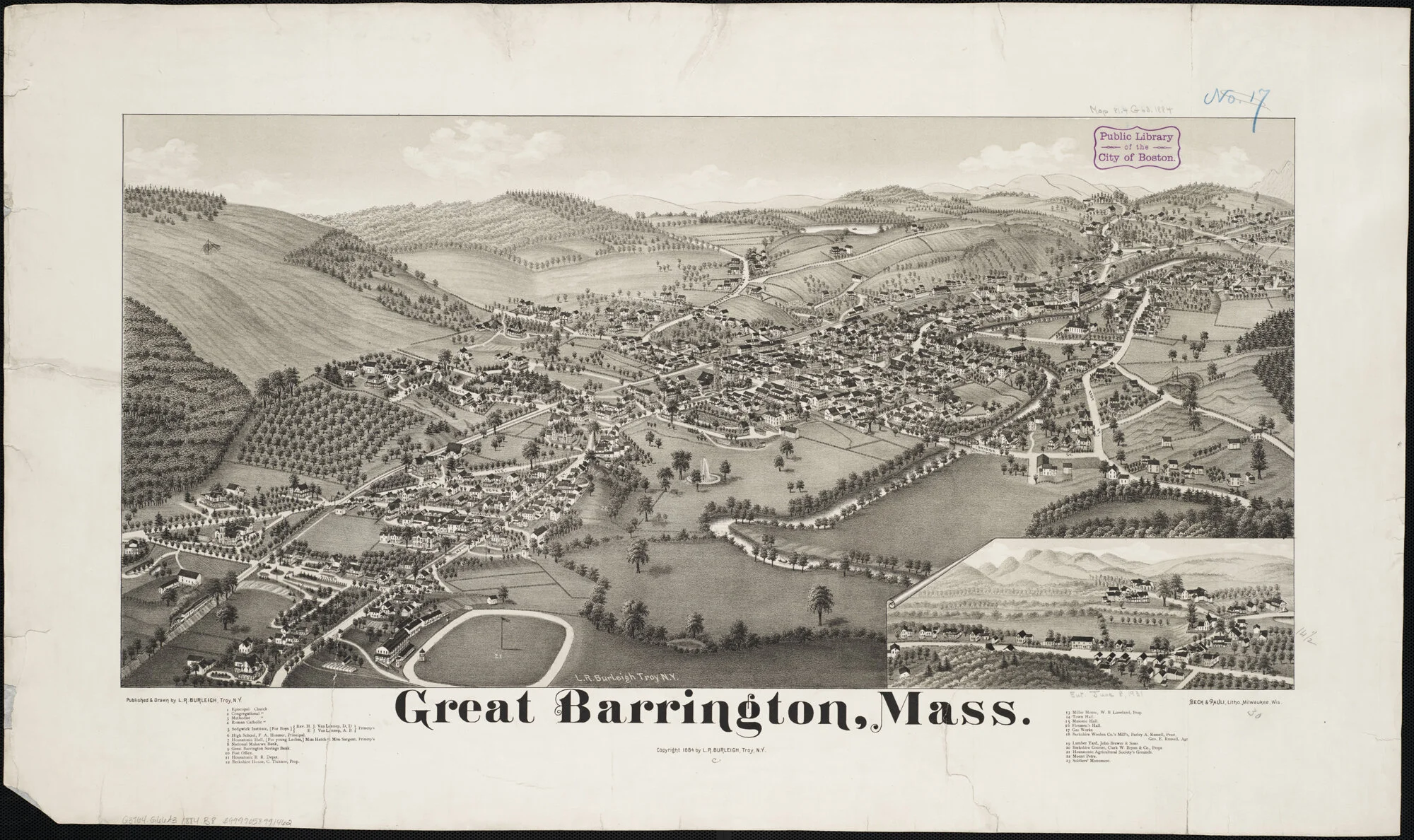
- From L.R. Burleigh

The lovely downtown of Great Barrington in the spring. There are lots of nice restaurants and art galleries..
— Photo by Anc516
o
Pay the companies bribes AFTER they create jobs?
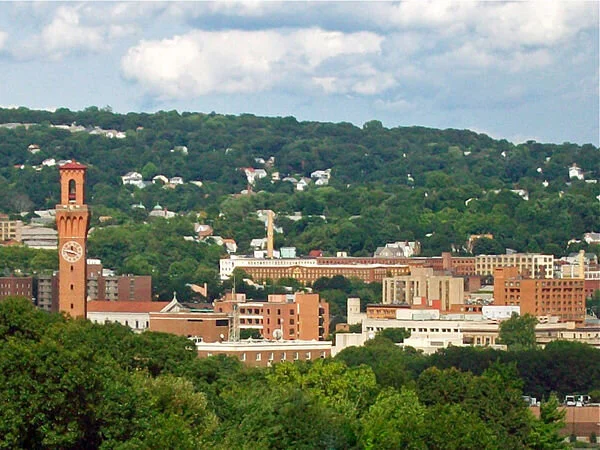
Waterbury, Conn., once famous for the manufacture of brass products, clocks and watches. But as with all of the state’s cities, most manufacturing has departed, taking a lot of well-paying blue-collar jobs with it. The train station’s Italianate tower is at the left.
From Robert Whitcomb’s “Digital Diary,’’ in GoLocal24.com
David Lehman (perhaps unfortunately a former Goldman Sachs partner) has some interesting ideas about how to boost still rich Connecticut’s economy and, particularly, how to lift its troubled cities. Gov. Ned Lamont, a Democrat, has named Mr. Lehman to be commissioner of the Nutmeg State’s Department of Economic and Community Development. He may have some lessons for Rhode Island and Massachusetts.
Some of his ideas are predictable, such as improving commuter rail service and the roads, more and closer partnerships with colleges and universities and boosting job-training for growing occupations, such as health care, software and engineering.
But what has jumped out is that instead of handing out tax breaks and other financial incentives to get companies to move to, or expand in, the Nutmeg State, he’d have the state hand out these goodies only after they created well-paid jobs. Bloomberg News noted that would be a gamble in the current relentless arms race among states and localities to lure jobs. But Connecticut, with its location between the two thriving (at the moment) economic powerhouses of New York and Boston, might be better placed than most states to succeed with this new strategy.
Mr. Lehman also wants to encourage a resurgence of the state’s cities, which, with exceptions in some parts of them (e.g., the area around Yale in New Haven) are in poor shape. He wants policies that would double the populations of its cities -- which now range from 100,000 and 150,000 -- over a 25-year period. He told Bloomberg: “We’ve got the suburban and rural thing covered.’’ New economic growth will be “in these higher density transit-oriented developments.” Note that as in Massachusetts (and a lesser extent in Rhode Island) the growing emphasis is on using mass transit to maintain and spur prosperity.
Back when I lived in Connecticut, in the ‘60s, its cities still had large and stable middle-class populations, in large part because of a still thriving industrial sector. Mr. Lehman will be a hero if he can bring the middle class back to these places.
Meanwhile, the rhetoric continues about masses of millionaires said to be fleeing Connecticut and other high-tax states to move to Florida. Of course, some people do move because of taxes but the phenomenon is exaggerated (I know a bunch of these folks.) As this commentary from the left-leaning Institute on Taxation and Economic Policy notes:
“most millionaires are married, are more likely to have children, and are economically and socially tied to where they made their money. {In Connecticut’s case many in nearby Manhattan} They benefit from where they are living because they have ‘home field advantage’: they know the area, have connections, and most are ‘working rich’ and moving could actually set them back in their career and productivity. There is a reason they chose to live there in the first place, whether that be career opportunities, the education and public services offered, or overall quality of life. By the time they are making enough to think about moving to save on their taxes they are already deeply embedded into their communities and living comfortably enough that the state tax savings at stake would not fundamentally change their quality of life even if they somehow did find a way to continue earning a very large income in a new locale.’’
“The people who do tend to move most frequently are young college graduates and the lowest income residents looking for higher pay and a better quality of life, and state tax rates are not central in these groups’ decision making.’’
Of more interest to me is what the long-term impact of all these people moving to Florida will be on the Sunshine State’s taxes. Will a growing demand for services lead it to impose an income tax to pay for them? And what will be the effect of rising seas from global warming on property values (and property-tax collections) there?
To read more about Mr. Lehman’s plans, please hit this Bloomberg link.
To read more about high-end tax refugees, please hit this link.
Being cool in Vermont

The Mad River, in Vermont
“I'm from Vermont, where to be stylish and cool is to have a dirty pair of hiking boots and know how to change a tire, hang drywall, and bale hay. Those people are my home, and every time I come home, it reminds me that there's something to be said for being in the spotlight, but it can never be a whole part of me.’’
— Grace Potter, singer, songwriter and actress. She’s from Waitsfield, in the Mad River Valley.

Downtown Waitsfield, Vt. It’s busier in the winter because of two nearby ski areas, Mad River Glen (whose motto is “Ski It If You Can’’) and the much bigger and fancier Sugarbush.
For three decades, the nonprofit Friends of the Mad River, created to protect the recreational, ecological and aesthetic resources of the Mad River Valley, has performed water-quality monitoring, river restoration, land conservation, public education and outreach on behalf of the watershed.

At the vertiginous Mad River Glen

The huge and rather fancy Sugarbush resort