
Vox clamantis in deserto







Don Pesci: The moral deracination of the West

Members of Bound4LIFE in Washington, D.C., symbolically cover their mouths with red tape in anti-abortion demonstration.
Leftists are winning the culture war, the war on Western Civilization, because rootless politicians have shown themselves unwilling to enter the lists and do battle with the new morality.
For this reason, American culture is being redefined – reinvented, as the leftists would have it – by social anarchists with knives in their brains. It has become fashionable among New York leftist politicians to wink at, and even to publicly celebrate, infanticide. No assault on traditional sensibilities, it would seem, is beyond the pale.
Daniel Patrick Moynihan’s notion that third trimester abortion is too close to infanticide to be tolerated by men and women of conscience is now regarded as embarrassingly quaint by New York’s smart set, among whom are Gov. Andrew Cuomo and New York City Mayor Bill de Blasio, not his birth name.
Moynihan was a sociologist, the author of “The Moynihan Report,” a professor at Harvard University, a top adviser to President Nixon, and a four-term U.S. senator representing New York. He was also a proud liberal. Today, it is very nearly a philological sin to call the new moralists “liberal” in the sense in which liberalism had been embraced by Moynihan or, here in Connecticut, by such prominent governors as Abraham Ribicoff and Ella Grasso.
In Europe, the moral deracination – which, of course, marches under the banner of moral rectitude – has proceeded at an alarming rate. The Netherlands in 2005 stole a march on other morally backward-looking states by becoming the first country to decriminalize euthanasia for infants with presumed “hopeless prognosis and intractable pain. “ Nine years later, Belgium amended its 2002 Euthanasia Act to extend the rights of euthanasia to minors.
People living in the United Sates have always fancied that, though conjoined historically to Europe by history and ties of affection, there was an ocean separating us. Modern communications have removed this cultural prophylactic. Historical differences also have served as a barrier to disruptive ideas that in Europe plunged France into a bloody revolution centered on fatal utopian ideas.
Under Hitler, Mussolini and Stalin – socialists all – fascism and the totalist state were necessary and indispensable political instruments in creating what all three thought of as “the new man,” a mechanist free at last of a Western culture that had imprisoned humankind in religious and cultural chains. In a future shaped by mechanistic ideology, politics and brute force, the very nature of man would be irreversibly altered. This is, as Roger Scruton points out in his brief and indispensable history of the conservative movement in the Western world, Conservativism: an Invitation to the Great Tradition, the original sin of socialism, the absurd notion that the world may be made over anew by a transcendent state. For Mussolini, the fascist administrative state was a secular god clothed in omnipotence and omnipresence. “Everything in the state; nothing outside the state; nothing above the state” – such was the fascist definition of social bliss.
History, tradition, subsidiary political organizations such as family and church, a constitutional state, a media determined to declare the truth at all costs, modesty in politics, the good manners of polite society, respect for women, personal honor, the protections a state holds out to “the least among us” -- the infirm, the aged, the poor, victims of unfettered abortion – all these blessings were, in effect, walls and barriers that prevented a false god, the omnipotent and omnipresent state, from clawing away from us our God-given rights and responsibilities with its mechanical, inhuman talons.
U.S. Sen. Dick Blumenthal, for two decades Connecticut’s attorney general/regulator-in-chief, regards any limitation of abortion, however practical or reasonable, as proceeding from immoral premises, and he continues to insist falsely that regulations concerning third trimester abortion deprive women of a right to unfettered abortion. Limiting abortion to the first two trimesters of a pregnancy does not remove a presumed right to abortion; it simply designates the time frame in which an abortion may be legally appropriate.
At the end of May, Connecticut Gov. Ned Lamont and Lt. Gov. Susan Bysiewicz sent a missive to women who own businesses in Alabama, Georgia and Missouri pronouncing themselves “appalled at… actions that erode the ability of women to make informed decisions about their health and bodies” and inviting women who own businesses in such states “to relocate your operations to a state that supports the rights of women and whose actions and laws are unwavering in support of tolerance and inclusivity.” The carefully constructed sales pitch does not once mention the word “abortion.”
Indeed, any discussion of unregulated abortion on demand, at any time for any reason, is delicately dropped from the polite conversations of the political new moralists. But the euphemisms – “informed decisions” about “health and bodies” – serve to cinch the point without discomforting women, also concerned about their health and the bodies of their unborn children, whose birth decisions may have been informed by the prevalence of ultra-sound images that show late term fetuses bearing a striking resemblance to newly born children, Moynihan’s enduring point.
The new moralists have not yet raised abortion to the level of a new secular sacrament, but the Orwellian letter from Connecticut’s governor and lieutenant governor suggest that the state’s discarded motto “Still Revolutionary” may in the near future be replaced by a new sales pitch to states considering relocation – “Connecticut: The Abortion State.”
Don Pesci is a Vernon, Conn.-based columnist.
'Experiment of Green'

— Photo by Inajeep
Emily Dickinson (1830-1886)
A little Madness in the Spring
Is wholesome even for the King,
But God be with the Clown –
Who ponders this tremendous scene –
This whole Experiment of Green –
As if it were his own!
Poem 1333, by Emily Dickinson (1830-1886)
'Closer to bronze'

Green crab
''Not, exactly, green:
closer to bronze
preserved in kind brine,

something retrieved
from a Greco-Roman wreck,
patinated and oddly

muscular....''
— From “A Green Crab’s Shell,’’ by Mark Doty.
Editor’s note: Green crabs are devastating parts of the New England shellfish industry.

More strangeness in Providence

“Stages: Strange Familiar Worlds,’’ by Keri King, at AS220 Project Space, Providence, June 1-29
Doosan fuel-cell projects in Connecticut

Fuel cell
From The New England Council (newenglandcouncil.com)
Doosan Fuel Cell America,Inc. is demonstrating that fuel-cell companies can profitably operate and play an important role in the energy industry. With several projects in the pipeline, Doosan has seen revenues jump from $124.8 million in 2015 to $204.6 million in 2017.
One of Doosan’s upcoming projects in Connecticut is a state-awarded 20-megawatt development that will power a data center in New Britain and is expected to begin operation in 2020. Doosan will also provide fuel cells that will power water-treatment facilities in Bristol and Fairfield. The most active market for the technology is South Korea, where Doosan exports a significant amount of its products.
Speaking of the Korean market, Michael Coskun, Doosan’s general manager of sales and business development, said, “Most of the business is being driven by Korea sales. They have a very aggressive renewable portfolio standard, and I think we’re uniquely positioned to serve that market.”
3 New England states ranked in the 10 'best'
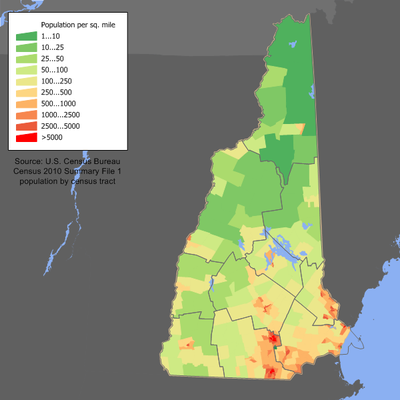
Population-density map of New Hampshire, ranked second-best state in the Union, with Washington State first.
From Robert Whitcomb’s Digital Diary, in GoLocal24.com
The sort of ratings done by the likes of U.S. News & World Report are flawed because they’re always comparing, in varying degrees, apples and oranges, but they can suggest some interesting things.
Consider, for instance, U.S. News’s latest rankings of the states, which evaluate the states’ economies, including business climate, health care, education, transportation infrastructures, environmental protection and so on.
The “best’’ were, in order: Washington, New Hampshire, Minnesota, Utah, Vermont, Maryland, Virginia, Massachusetts, Nebraska and Colorado. The “worst’’ were: Louisiana, Alabama, Mississippi, West Virginia, New Mexico, Arkansas, Alaska, Oklahoma, South Carolina and Pennsylvania (the middle of Pennsylvania topographically and socio-economically resembles West Virginia).
Note that despite the endless GOP promotion of the low-tax (except for regressive sales taxes), low-regulation mostly Southern states as wonderful places to move to, the 10 “best’’ were mostly dominated by Democrats. Exceptions are Mormon-dominated Utah and traditionally very Republican Nebraska. Then there are the moderate Republican governors of Massachusetts, New Hampshire and Maryland, with legislatures controlled by the Democrats. The 10 “best’’ states’ leaders tend to believe in strong social safety nets, well-funded education, hardy environmental protections and so on. Among the Republican-dominated 10 “worst’’ states, there are Pennsylvania and Louisiana, with GOP-run legislatures and Democratic governors, and New Mexico, with a Democratic governor and legislature. The “worst’’ states tend to favor big-business interests above all.
The 10 “best’’ generally have high per-capita incomes, the “worst’’ low ones.
Long Democratic-dominated (it would be better off with a vibrant two-party environment) and too-small Rhode Island, which lacks the great economic engines of such high-tech centers as Massachusetts and Washington State, was ranked 26th – second worst in New England. Maine, which was presided over by a right-wing Republican governor from 2011 to this year, was 32nd. Connecticut was ranked as 21st best; it’s sort of two states – rich along the coast and in Litchfield County, much poorer in other areas.
The Trump-loving Deep South remains the poorest part of America. Do many voters there vote against their own economic self-interest because of politicians’ use of such conservative social issues as gun rights and abortion?

Llewellyn King: Monetizing your home via selling electricity to neighbors

— Photo by Andrew Glaser
SAN MARCOS, Texas
Uber isn’t finished yet — or, to be precise, the technology that enabled ride sharing, Airbnb and bicycle and scooter sharing is on the march.
It’s a simple idea, yet fiendishly brilliant: central computer control of an archipelago of often personally owned objects. So it was that private cars were monetized, and spare rooms and vacant apartments started adding to the family income.
Next up may be your roof: It could work if you have a solar panel installed or plan to install one. Rather than, as at present, selling surplus power to the local utility, you may simply sell it to a neighbor or someone else in proximity. This is happening in Australia where electricity shortages have led to radicalization of old concepts of the generation and supply of electricity.
Uber roofs was one of many ideas about the future of electricity at the Digital 360 Summit here: a gathering of those hoping to have a role in the future of the urban and suburban space with transformative digital technologies. It all comes under the rubric of smart cities.
No one is quite sure how all this will work, but an awesome assembly of companies who gathered here on May 21 and 22, tells its own tale. They include AT&T, General Motors, Siemens, National Grid, Sempra Energy, Edison Energy, SAS, Cisco Systems and Oracle.
The event is the brainchild of Andres Carvallo, who heads the management consultants CMG, in collaboration with Texas State University, itself committed to incubating innovative technologies.
All in all, when the mighty gather, it’s reasonable to believe mighty things are afoot: American city infrastructure is in the early throes of change.
The key to it all is the electric supply and the future shape of utilities, and how they manage the changes coming at them. This even as they spend billions of dollars to upgrade their systems. Tom Kuhn, president of the Edison Electric Institute, says the infrastructure investment by the investor-owned electric utilities was nearly $1 trillion over the past decade.
Yet that doesn’t mean that the ground isn’t shifting. It is.
In the urban space, we’re seeing an extraordinary assemblage of disparate interests bent on having a piece of the action. Even activists from the Green New Deal see things going their way.
They applaud the emergence of dispersed generation and micro-grids. These are the result of carbon-free generation with wind and solar. It’s these microgrids which could make the Uber roof a possibility. Also, it’s these microgrids that the utilities must accommodate to make sure that if they generate, they pay their share of the electric grid through a standby fee. The grid is like the highway system: It’s there for us whether we drive or fly.
But green enthusiasm doesn’t end with dispersed generation. The Green New Dealers are passionate about smart buildings and making more of the old stock “smart” while having high standards for new buildings. So are the technologists, armed with sensors and data.
Another mighty upheaval is the electrification of transport. Everyone agrees it’s coming, but the issue of charging is still open: Will companies, already up and running, like ChargePoint, inherit that business? Will the utilities, as some have, move into charging or will municipalities, again as some have, get involved? Fast charging, which can fuel an electric car in 30 minutes with direct current, is expensive. Slower charging can take hours and doing it at home from the household supply can take all day or all night.
I was struck by an entrepreneurial startup in San Francisco, ChargeWheel, which offers a truck-mounted charger that will come to you if you’re stuck, or just want to avoid the hassle of finding a station and waiting.
The utilities with smart meters command a lot of vital data which will shape the digitization of the cities. But no firm can think its space in the digital future is reserved for it, including utilities.
Meanwhile some people will want to turn their roofs into generating stations and, who knows, suburbanites might want to offer charging in their driveways. Uberization knows no frontiers.
The scramble is joined.
Llewellyn King is executive producer and host of White House Chronicle, on PBS. His email is llewellynking1@gmail.com
'Anything But Flat'

“Do Women Need Support?’ ‘ (bras made of Encaustiflex and painted with encaustic paint.), by Nancy Whitcomb, in the “Encaustic Juried Show: Anything But Flat,“ at Truro Center of Castle Hill for the Arts, Truro, Mass., through June 6.
To see information on the show, please hit this link.
Maybe, May Mobility

From Robert Whitcomb’s “Digital Diary,’’ in GoLocal24.com
May Mobility’s year-long free shuttle small-bus service between the Rhode Island State House and Providence’s hip Olneyville neighborhood is getting underway. These vehicles have attendants who can override the vehicles’ computers, just to be super safe, but the buses are supposed to be self-driving – i.e., ‘’autonomous.’’ The company calls its “Little Rhody’’ pilot project the first attempt at autonomous public transit in the country; it will serve as a research project that will probably get a lot of national attention.
I assume that the ultimate plan is to have no attendants (or maybe call them emergency drivers) – perhaps another scary sign to people contemplating becoming bus, cab or Uber/Lyft drivers for want of other job options.
After all, how long could such a service continue if attendants must be paid to travel around with so few passengers per vehicle? These mini-buses carry only six passengers. I assume that there will eventually be a modest charge for these rides. But when will many passengers feel safe to travel in buses without attendants, even if data show that they’re much safer than vehicles driven by people?
In any event, it’s an exciting project. If people flock to it, it could revolutionize urban and even suburban travel by getting more people out of their cars, and it could be a boon to further redevelopment of Olneyville while reducing the necessity of having so many wind-swept parking lots.
But watch out for the tolls
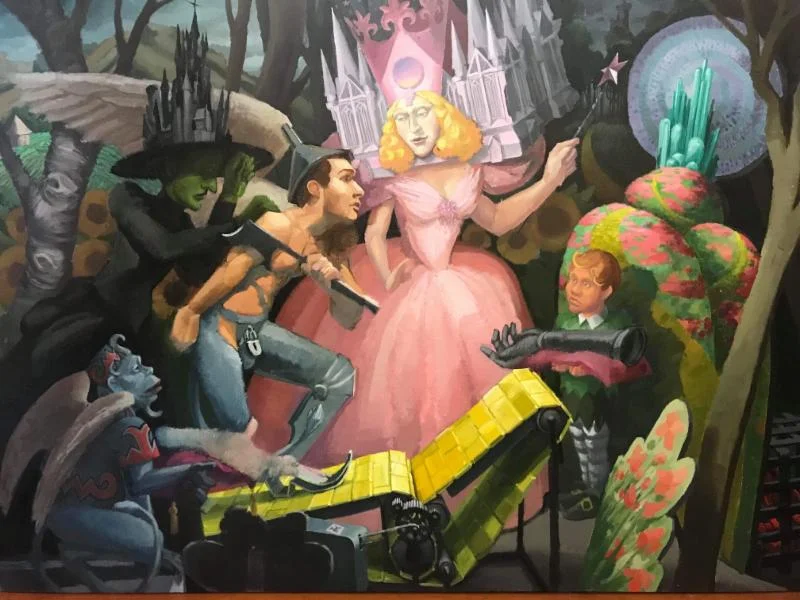
“Follow the Yellow Brick Road’’ (oil on acrylic) by Nate Devarie, in the show “What color…the rainbow,’’ at Brickbottom Gallery, Somerville, May 30-June 29.
Jim Hightower: Made in America in China

Via OtherWords.org
What’s the matter with Donald and The Trumpeteers? Why won’t they stand up for the American workers and business owners who make their products right here in the United States?
Oh, yeah, I know they talk a good game. Trump himself even issued a bold, star-spangled executive order promoting the purchase of “American-made goods” produced by American labor.
We consumers respond positively to that pitch, generally preferring to buy everything from mattresses to hockey pucks that are manufactured here at home.
For example, take Patriot Puck. What’s not to like about this corporation, which literally wraps its hockey pucks in American flag packaging and proudly advertises that they are “the only American-made hockey puck”?
Well, sadly, one thing not to like is that the puck-seller’s pitch was a lie. Its product actually turned out to be made in China. Such a deceptive sales scam is not just unethical — it’s a federal crime.
Saddest of all, though, is that when honest competitors and defrauded consumers protested the firm’s blatant deceit, Trump’s Federal Trade Commission appointees proved to be Made-in-America wimps.
Far from standing up for U.S. workers, they coddled the job-stealing culprit. They assessed no fines, required no admission of the obvious corporate crime, and let it keep all the profits it pocketed from the fraud. They didn’t even make “Patriot” Puck notify customers of its false marketing scam.
Instead, Trump’s regulatory “toughies” insisted that the threat of future fines would keep such outlaws in check.
Seriously? The real crime here is our that our nation’s president is mocking the plight of America’s manufacturing workers by making a spectacle of standing up for them — then kowtowing to corporations that flagrantly violate Made-in-America laws. It’s a shameful political fraud.
OtherWords columnist Jim Hightower is a radio commentator, writer, and public speaker.
Mass. Technology Collaborative seeks to diversify state's talent pool

The MIT Media Lab, in Cambridge, Mass., houses researchers develops novel uses of computer technology.
From The New England Council (newenglandcouncil.com)
The Massachusetts Technology Collaborative (MassTech) has announced that it is developing programs to diversify the industry talent pool in state civic groups, businesses, and nonprofits. MassTech’s “Tech Talent Diversity Initiative” will aim is to diversify the pool of candidates hired for internships, apprenticeships, and entry-level positions.
Organizations that increase the proportion of workers hired from underrepresented populations will be eligible for grants. The Tech Talent Diversity Initiative intends to streamline identification and recruitment for diverse candidates, support candidates’ successful work experience, and improve workplace practices in raising diverse participation and retention rates.
Damon Cox, Assistant Secretary of Technology, Innovation, and Entrepreneurship for Massachusetts, said, “We have a very real need for tech workers in this state, including over 9,000 job openings in the cybersecurity sector alone. . . In 2017, women held 49% of the total jobs in Massachusetts, but only 28% of computer, engineering and science jobs. When we look across gender and race stats, we see great opportunity to improve.”
The Council applauds Massachusetts Technology Collaborative’s efforts to increase diversity the tech industry, and create a workforce that is more representative of the Commonwealth’s residents
'Dream of summer'

Magnolia bloosom
“The dream of summer looks bright
The symphony of spring's light
Brings magnolias alive.
Buds open toward a blue sky.
Tha silver moon was in flight.
Woven nests are birds' delight.’’
— From “Spring in New England,’’ by Gayle Sweeney
Boston's 'classical tone'

The Boston Athenaeum, built in 1847.
"There is about Boston a certain reminiscent and classical tone, suggesting an authenticity and piety which few other American cities possess."
—E.B. White (1899-1985), essayist and children’s book writer, who moved to Maine from New York City.
Conn. mulls new tax system
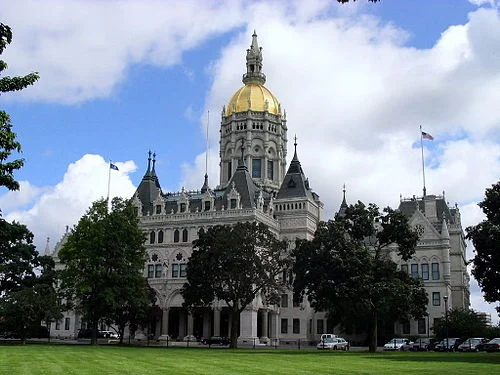
The Connecticut State Capitol
From Robert Whitcomb’s “Digital Diary,’’ in GoLocal24.com
Connecticut Gov. Ned Lamont and that state’s legislative leaders are considering replacing most of the state income tax with a payroll tax, though apparently not this year.
It would be a complex plan but the core of it seems to be to have employers pay a 5 percent state payroll tax on all wages and salaries. The assumption is that employers would cut pay by 5 percent to make themselves whole. This, it is argued, would end up reducing the amount that employees must pay in federal income tax and Social Security and Medicaid taxes. Behind this is, among other things, the state trying to find ways to offset the effects of the $10,000 limit on state and local tax deductions (targeting mostly Democratic-run states) set by the Republican tax law of 2017 as well as to replace most of the Connecticut income tax.
Officials in neighboring states will, I assume, be watching to see what, if anything, happens with these Connecticut tax-reform ideas. In any case, the 2017 tax law will force numerous adjustments in state and local taxes in various places over the next few years.
Look, don't board

“The Red Canoe’’ (collagraph/linocut monoprint), by Leslie Kramer, in the show “Printmakers of Cape Cod: Floating Worlds,’’ at The Art Complex Museum, Duxbury, Mass., through Aug. 11.

Neeta Fogg/Paul Harrington/Ishwar Khatiwada: Measuring the GEAR UP program for R.I. students
From The New England Journal of Higher Education, a service of The New England Board of Higher Education (nebhe.org)
‘The federally financed GEAR UP (Gaining Early Awareness and Readiness for Undergraduate Program) was organized two decades ago with the purpose of increasing high school completion and college enrollment among low-income students. The College Crusade of Rhode Island’s GEAR UP program was designed as a long-term effort to buttress student success by providing various kinds of educational and social service supports beginning in the sixth grade and continuing through high school completion.
Back in 2015, the authors completed the first study in the nation that measured the net impact study of a GEAR UP program. That study track a cohort of entering sixth-graders who participated in the College Crusade GEAR UP program relative to a comparison group selected with the rigorous Propensity Score Matching (PSM) method that creates a comparison group with traits equivalent to the participant group at the time of sixth grade entry into the program. This baseline equivalency at the time of program entry means that differences in outcomes that occur between the participant and matched comparison groups are attributable to participation in the GEAR UP program.
That longitudinal impact study found substantial and statistically significant gains for a single cohort of GEAR UP program participants relative to the comparison group on the likelihood of completing high school on time and immediately enrolling in college in the fall following high school completion, providing evidence that the College Crusade of Rhode Island was able to substantially improve these two important educational outcomes of GEAR UP participants.
While high school completion and college enrollment have remained high priorities for the nation’s education system, in recent years, much greater attention has been focused on college retention and completion. This raises the question about the lasting effects of participation in the College Crusade’s GEAR UP program. Do the gains that the program provided in the sixth through 12th grades persist for participants once enrolled in college? At the time that these cohorts of students were participating in the College Crusade GEAR UP program, participants who were enrolled in college did not receive any systematic support from the College Crusade. This created the opportunity for us to examine whether the sizable impacts of GEAR UP participation in middle school and high school persist beyond high school completion and immediate college enrollment or do they fade out after entry into college.
Enough time has now elapsed for three cohorts of College Crusade GEAR UP participants to have completed their first year of college, providing an opportunity to measure the impact of participation in the College Crusade GEAR UP program beyond initial college enrollment.
The effects of participation in the College Crusade GEAR UP program are cumulative; that is, we found that the program was able to increase the likelihood of on-time grade attainment for participants relative to the matched comparison group for each year after initial enrollment in the sixth grade. The cumulative effects of these positive outcomes in each successive year for participants relative to comparison group students become quite sizable as students progress from middle school to college.
The chart below illustrates the divergent educational pathways of College Crusade participants and their matched comparison group counterparts. Beginning in the eighth grade, a gap emerges between participants and comparison group students in the likelihood of staying on track; and the size of this gap continues to grow in each successive grade/year. By the time of high school graduation, the gap had grown to 9.3 percentage points in favor of GEAR UP participants; 77% of the three cohorts of participating students had graduated from high school on time compared with just 67% of their counterparts in the matched comparison group. During the fall term following their expected on-time high school graduation, 56% of the three sixth grade participant cohorts had enrolled in college, compared with 42% of the three 6th grade comparison group cohorts.
Eight years after the beginning of sixth grade when these three cohorts of participants had enrolled in the College Crusade GEAR UP program, 40% had returned to college after the freshman year, relative to 30% among their matched comparison group counterparts.
This means that the cumulative impact of the College Crusade’s GEAR UP program was to increase the relative likelihood of a low-income sixth grader in Rhode Island to progress through middle and high school and complete a year of college by 35%.
The Pathway from Sixth Grade to One Year of College Retention, Combined Sixth Grade Cohorts, 2007-08, 2008-09 and 2009-10

These findings reveal that the College Crusade’s GEAR UP program had a cumulative effect that reached beyond its formal goals of high school completion and college enrollment. The cumulative gains for participants relative to the comparison group increased each year though high school graduation and college entry. Beyond that, despite no formal GEAR UP services for participants once enrolled in college, the gains to their earlier participation in the program continued. No evidence of a fade out of the substantial positive effects of GEAR UP participation is found one year after participants had exited the program.
The first year results are promising, but the kinds of obstacles to degree attainment that low-income college students confront are associated with complex academic, social and financial issues that are somewhat different from the barriers that these students face in completing high school and initially enrolling in college Will these cumulative one-year college retention gains persist through college completion with no fade out effects? Stay tuned.
Neeta Fogg is research professor at the Center for Labor Markets and Policy at Drexel University. Paul Harrington is director of the center. Ishwar Khatiwada is an economist there.
These findings reveal that the College Crusade’s GEAR UP program had a cumulative effect that reached beyond its formal goals of high school completion and college enrollment. The cumulative gains for participants relative to the comparison group increased each year though high school graduation and college entry. Beyond that, despite no formal GEAR UP services for participants once enrolled in college, the gains to their earlier participation in the program continued. No evidence of a fade out of the substantial positive effects of GEAR UP participation is found one year after participants had exited the program.
The first year results are promising, but the kinds of obstacles to degree attainment that low-income college students confront are associated with complex academic, social and financial issues that are somewhat different from the barriers that these students face in completing high school and initially enrolling in college Will these cumulative one-year college retention gains persist through college completion with no fade out effects? Stay tuned.
Neeta Fogg is research professor at the Center for Labor Markets and Policy at Drexel University. Paul Harrington is director of the center. Ishwar Khatiwada is an economist there.
David Warsh: Our two show-biz presidents
SOMERVILLE, Mass.
Over the course of 230 years, citizens of the United States have elected only two professional entertainers to the presidency: Ronald Reagan and Donald Trump. Both possessed an actor’s gifts: good looks; physical presence; a communicative face, in one man an infectious grin, in the other a much-photographed glower.
True, they took very different paths to the office. Reagan began as film actor, union president, and pitchman for General Electric Co. He turned to professional politician in his fifties, winning two terms as governor of California. Trump, a real estate developer and marketer, became a television personality in his fifties. Beginning in 2004, he played a puffed-up, airbrushed version of himself for 14 seasons on The Apprentice.
True, too, Reagan and Trump have left very different marks on the office. Reagan started out shakily, with Alexander Haig, Donald Regan, James Watts, and Ann Gorsuch, and wound up surrounded by good men, including Nichols Brady, James Baker and George Shultz. After being forced to fire National Security Adviser-designate Michael Flynn, Trump started out with some good men around him, Jim Mattis, H.R. McMaster, Rex Tillerson, and Gary Cohn surrounded by the likes of John Bolton and William Barr.
But the most important attribute they have in common is often overlooked. Their success as entertainers in an age of new media made them shrewd judges of what their respective audiences expected of them.(Reagan was host of a popular weekly drama series, General Electric Theater, from 1954 until 1962, and honed his speaking skills visiting company installations.) Reagan proved able to expand his base dramatically and became a transformational president (Barack Obama agrees.) Trump himself is apt to catastrophically fade, once deprived of his props. But the legacy of the campaign he ran in 2016 is likely to dominate politics for another 20 years.
I count three major issues in 2016 (leaving aside the hate-mongering of lock her her up): immigration, trade and foreign wars. Forging a new consensus on those issues will be an issue for several presidential cycles. For a sensible survey of the often irreconcilable rights and responsibilities of the three basic constituencies – the would-be migrants, the polity they seek to join and those who are being left behind – see Exodus: How Migration is Changing Our World (Oxford. 2013), by Paul Collier, a distinguished development economist. (I haven’t read Refuge: Rethinking Refugee Policy in a Changing World [Oxford, 2017].) Earlier Collier wrote the best-seller The Bottom Billion: Why the Poorest Countries Are Failing and What Can Be Done about It (Oxford, 2008).
For a somewhat sterner view, read The Great Escape: Health, Wealth, and the Origins of Inequality (Princeton, 2013), by Angus Deaton, a Nobel laureate in economics. Or wait for The Narrow Corridor: States, Societies, and the Fate of Liberty, by Daron Acemoglu and James Robinson, in September. Then ask yourself if you think the U.S. is substantially different from Canada and Australia, where so-called “merit systems” prevail for allocating immigrant positions. Trump proposed something of the sort last week, a plan prepared by his son-in-law and a principal adviser, Jared Kushner.
Similarly, global trade will resume, but the contest with China for dominance won’t go away. The bad feelings on both sides from having come to the brink of a long-lasting trade war will take many years to subside. No one, not even William Overholt, author of a series of prescient books about the sleeping giant, most recently China’s Crisis of Success, can confidently predict the path relations will take. They’ll develop against the backdrop of whatever U.S. Trade Rep. Robert Lighthizser and his Chinese counterpart manage to achieve.
As for foreign wars, Trump’s relative caution with respect to North Korea, Venezuela, and Iran gives the lie to his habitual braggadocio. Don’t expect future presidents to be any more willing to intervene abroad militarily. Read America’s War for the Greater Middle East: A Military History (Random House, 2017), by Andrew Bacevich, if you doubt it. Perhaps all will campaign on promises to repair America’s seriously damaged diplomatic and intelligence services.]
Ronald Reagan’s presidency offered a genuine buoyancy. Trump offers mainly jingoism, chicanery and abuse. But both men sensed that voters were nearing a turning point in the zig-zag of American history. Sooner or later, legitimate Republican conservatives will turn on their usurper and his enablers. But for the present, Trump’s GOP is the party of innovation, even if it means trying to recapture the past.
Whether or not Trump is re-elected depends mainly on whom the Democrats nominate to run against him, and how that candidate chooses to run. Never mind the evangelicals. He or she can win with only a small portion of Trump voters in a Democratic coalition. In contrast, Reagan won a second term by a landslide, 525 to 13 electoral votes.
David Warsh, an economic historian and veteran columnist, is proprietor of Somerville-based economicprincipals.com, where this essay first appeared.
'Deviled by stone'
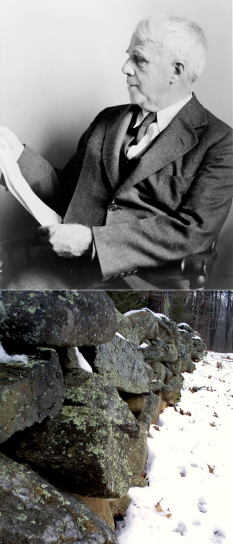
Robert Frost’s poetry gave New England’s stone walls an almost mythological significance. He wrote about this stone wall, on his farm in Derry, N.H., in his famous poem “Mending Wall.”
Credit: top: Library of Congress/New York World-Telegram & Sun Collection; bottom: CCA 3.0.
“Stone upon stone
this weathered wall of stone
was built by men deviled by stone'
from poor fields yielding mostly stone’’
— From “A Farm in the Green Mountains (Thinking of Robert Frost)’’, by Dave Etter