
Vox clamantis in deserto









'In The Kitchen With Dinah'

Stages of Freedom, a bookstore at 10 Westminster St. in downtown Providence, presents “Someone’s in the Kitchen with Dinah: An Exhibit of African Kitchen Collectibles’’.
The exhibit, which is free and open to the public, runs through Saturday, March 30. Stages of Freedom’s hours are Tuesdays-Fridays 10 a.m. to 5 p.m. and Saturdays and Sundays 12-5 p.m.
The exhibit spans 100 years of collectibles depicting African Americans in both negative and
positive images. Drawn from Onna Moniz-John’s collection, the exhibit includes dishes, advertising, food containers, dish towels and much more.
Known now as Black memorabilia, many of these items were created in Japan, Germany and the United States for nationwide markets.
The items are a physical reminder of entrenched racism in our country and how African Americans have been denigrated through such stereotypical images as watermelon-eating, pitch-black complexions and exaggerated features.
Stages of Freedom is dedicated to presenting African American events for the entire community.
Contact is Ray Rickman (401) 421-0606; stagesoffreedom@aol.com
Dems should pray for a moderate
From David Warsh, proprietor of economicprincipals.com
To describe Martin F. Nolan, former Washington bureau chief and editorial page editor of The Boston Globe, as “an American journalist” is like calling Cyrano’s nose ‘big,’ though the rest of Nolan’s Wikipedia page gives a pretty good sense of the man. He wrote last week to say,
“I agree that Nancy Pelosi is fully qualified to run and win a presidential race. But several things, historical and personal:
“Speakers do not flourish in the Electoral College. Ask Henry Clay, Schuyler Colfax and John Garner. Old Cactus Jack did become FDR's VP, thanks to a delegate deal worked out at the 1932 Dem convention by William Randolph Hearst.
“Nancy is not interested in VP. Also, she has been so successful as Speaker that her likely successors resemble the junior varsity. Take Steny Hoyer and Jim Clyburn, please.
“Nancy is my Congresswoman and I've known her a long time. She is a protégé of the Burton family – Phillip, Sala and John – as powerful in SF as the D'Alesandros in Baltimore [Pelosi’s father, Thomas d’Alesandro Jr. was mayor of that city]. In 2016, she worked hard for Hillary perhaps hoping that her happy reward would be the US Embassy in Rome.
“If the Dems are lucky, a plethora of socialist lefties will allow a traditional moderate to prosper. Sherrod Brown won in Ohio, which bodes well for Dem success in Pennsylvania and Michigan, states taken for granted in 2016 by the Clinton campaign.
“Warning: a President Pence will not be easy to defeat,"
Llewellyn King: Penn. school may be nurturing new kind of lawyer

SAN ANTONIO
Disruption equals opportunity. That was the message that came across loud at a conference here organized by CPS Energy, the local gas and electric utility, on smart cities — a revolution that is underway and surging.
Simply, smart cities are convergence of digital technologies, from street lights to driverless vehicles. Cities — there are more than 19,000 of them in the world — represent a great new vista of business opportunity for new entrepreneurs.
Coincidentally, a small but distinguished law school in Carlisle, Pennsylvania, is, in its way, seeking to upend the traditional expectations of law students by teaching them law plus innovation and entrepreneurism.
Dickinson Law, founded in 1834 and is now part of The Pennsylvania State University, but operates autonomously, is seeking to turn out a new kind of lawyer: One who is interested in becoming an entrepreneur rather than simply practicing law.
The program is the concept of Samantha Prince, assistant professor of legal writing and entrepreneurship, who had been an entrepreneur as well as a lawyer. She told me that she wanted the Dickinson Law students to realize what a useful and versatile tool a law degree is, and how it can offer those who have one a wide range of opportunities beyond the traditional practice of law.
Prince, with the energetic support of dean Gary Gildin, told me many students have not come to Dickinson Law straight out of college but have had work experience, which makes them more open to a wider range of possibilities.
A partner at one of the large law firms in Washington told me that she wishes her education at one of the nation’s top law schools had been just a little less academic and broader. She said the curriculum was fascinating, but much of it was arcane and directed to the study of the history of law and its seminal turning points. No thought was given to the idea that she might want to use her legal knowledge in any other way than to practice law, probably in a big firm. That she has done.
Lawyers, of course, have always been entrepreneurial. But Prince says that has been in the confines of the profession.
Prince wants her students to think about — at least some of them — how they can use their legal knowledge to start a business, pulling together investors, creators and visionaries.
The faculty at Dickinson Law wants to see some students take their chances and test their mettle in the marketplace. One problem: The study of law is a study of what can go wrong, and new business is a belief in what might go right.
Prince’s students have something of an advantage as they tend to be older and to have had real-life experience. Already some of them are thinking of law differently: Zachary Gihorski wants to use his legal training to lead and shape the future of agriculture; Christian Wolgemuth wants to enter cybersecurity practice and eventually become an entrepreneur; and Ana Anvari wants to serve health care businesses by advising them on health care regulation and helping them to start up or expand their businesses.
Those who are thinking of self-employment may find the new vitality in cities a place of opportunity. The cities are going to be wide open to everything from better electric vehicle charging to automated garbage collection, to repair and maintenance of the automated systems, to restaurants delivering meals by drone. If you can think of it, it will probably be needed.
Although the big tech companies, from Google to Tesla, AT&T to Verizon and Amazon to IBM, are salivating over the new smart city opportunities. History teaches that great fortunes are made by new players when, so to speak, the ground shifts.
The ground is shifting in cities like San Antonio, Chula Vista, Calif., Boston and Houston.
Smart cities represent a huge entrepreneurial chance for smart people — lawyers and otherwise.
On Twitter: @llewellynking2
Llewellyn King is executive producer and host of White House Chronicle, on PBS.
And the unreality of 'reality'

From Kathryn Geismar’s show “The Myth of Gravity’’ at Bromfield Gallery, Boston, through March 31. The paintings explore the relationship between beauty and loss.
Mass. takes careful approach to luring sexy companies

“The Amazon Spheres’’ at the company’s headquarters, in Seattle.
Adapted from Robert Whitcomb’s “Digital Diary,’’ in GoLocal24.com
Amazon already has thousands of employees in tech center Greater Boston and will probably add several thousands more, perhaps mostly along the South Boston waterfront, in the wake of the apparent demise of an Amazon “second headquarters’’ in New York City. But this won’t be due to the sort of massive incentives the “populist’’ reaction to which blew up the Amazon-New York deal.
As seen in the deal crafted by Massachusetts Gov. Charlie Baker (a highly successful former businessman and top-notch numbers cruncher) and the generally economically reality-based Boston Mayor Marty Walsh to lure General Electric headquarters, Massachusetts has been quite conservative in crafting incentive packages. Shirley Leung had an interesting column on the GE deal. To read it, please hit this link.
Rhode Island might also get some Amazon jobs — probably design-related — because of the New York news.

Sam Pizzigati: Economic Inequality helps launch helicopter parents

Anxious parents taking the family house to their kids college?
Via OtherWords.org
A good many of us aging Baby Boomers are having trouble relating to the “helicopter parents” of our modern age — those moms and pops constantly hovering over their kids, filling their schedules with enrichment activities of every sort, worrying nonstop about their futures.
Back in the middle of the 20th Century, Baby Boomers didn’t grow up like that. We lived much more “free-range” childhoods. We pedaled our bikes far from hearth and home. We organized our own pick-up games. We spent — wasted! — entire summers doing little bits of nothing.
We survived. So did our parents. So why do parents today have to hover so much?
The standard explanation: Times have changed. Yes, today’s parents take a more intense approach to parenting. But they have no choice. The pressures of modernity make them do it.
Economists Matthias Doepke of Northwestern University and Fabrizio Zilibotti of Yale have followed all the debate over helicopter parenting, and they’re not jumping on this blame-modernity bandwagon. If the pace and pressures of our dangerous digital times are driving parents to hover, the pair points out, then we ought to see parents helicoptering across the developed world.
We’re not.
In fact, researchers have found significant differences in parenting styles from one modern industrial nation to another. Parents in some nations today have parenting styles as relaxed as anything aging baby boomers experienced back in the 1950s. In other nations, by contrast, parents seem as intense as today’s helicoptering norm in the United States.
How can we account for these differences?
Doepke and Zilibotti have a compelling explanation. Levels of helicopter parenting, they note, track with levels of economic inequality. The wider a society’s income gaps, the more parents hover.
The two countries most notorious for their helicopter parenting, China and the United States, just happen to sport two of the world’s deepest economic divides. And those more relaxed parenting days of mid-20th century America? They came at a time when the United States shared income and wealth much more equally than the United States does today.
What’s going on here? Why should economic inequality have any impact on parenting styles?
In severely unequal nations, the evidence suggests, childhoods have become high-stakes competitions. Only the “winners” go on to enjoy comfortable lives when they grow up. You either make it into the ranks of your nation’s elite or you risk struggling on a treadmill that never ends.
In more equal societies, you don’t have to matriculate at the “best” schools or score a high-status internship to live a dignified life. In societies with income and wealth more evenly distributed, broad swatches of people — not just elites — live comfortably. That leaves parents, as Doepke puts it, “more room to relax and let the kids just enjoy themselves.”
Parents in highly unequal nations can’t afford to relax. They have too much to do. They have to shape their kids into winners. But the competition their children face will always be rigged, because the already affluent in deeply unequal societies have more time and money to invest in that shaping.
Researchers Doepke and Zilibotti call for greater public investments in social services — like quality child care — to narrow the competitive advantage that wealth bestows upon affluent American families.
The investments they recommend would certainly help ease the pressure on working households. Would they be enough to get our parents more relaxed? Not likely, not so long as rewards keep concentrating in the pockets of the few at the expense of the many.
Our helicopter parents, in short, don’t need fixing. Our economic system does.
Sam Pizzigati is an associate fellow at the Institute for Policy Studies and a co-editor Inequality.org, which ran an earlier version of this piece. His latest book is The Case for a Maximum Wage.
At PCFR: The Royals; Fleeing Central America; Brazil's new strongman; Threatening Taiwan

"A Good Riddance" cartoon from Punch, Vol. 152, 27 June 1917, commenting on King George V’s order to relinquish all German titles held by members of his family.
Mark your calendars for some exciting upcoming talks at the Providence Committee on Foreign Relations (thepcfr.org; pcfremail@gmail.com). Consult thepcfr.org for information on how to join the organization and other information about our organization.
Our speaker on Thursday, March 14, will be Miguel Head, now a fellow at Harvard’s Shorenstein Center. He spent the past decade as a senior adviser to the British Royal Family. He joined the Royal Household as Press Secretary to Prince William and Prince Harry before being appointed in 2012 as their youngest ever Chief of Staff.
Previously, Mr. Head was Chief Press Officer at the UK Ministry of Defense, and worked for the Liberal Democrat party in the European Parliament. While at the Shorenstein Center, Mr. Head is doing research into how social inequalities in Britain are fomenting the politics of division (which helped lead to the Brexit vote) and how non-political leadership, working collaboratively with traditional and digital media, can play a role in bringing disparate communities together. At the PCFR, he’ll talk about those things as well comment on the past and current role of the Royal Family, and, indeed, life with the Royals.
xxx
At the April 4 Providence Committee on Foreign Relations (thepcfr.org) dinner, James Nealon, the former U.S. ambassador to Honduras, will talk about Central America in general and Honduras in particular, with a focus on the conditions leading so many people there to try to flee to the United States – and what the U.S. can and should do about it.
A career Foreign Service officer, Nealon held posts in Canada, Uruguay, Hungary, Spain, and Chile before assuming his post as Ambassador to Honduras in August 2014; Nealon also served as the deputy of John F. Kelly, while Kelly was in charge of the United States Southern Command.
After leaving his ambassadorship in 2017, Nealon was appointed assistant secretary for international engagement at the Department of Homeland Security by Kelly in July. During his time as assistant secretary, Nealon supported a policy of deploying Homeland Security agents abroad. He resigned his post on Feb. 8, 2018, due to his disagreements with the immigration policy of Donald Trump, and, specifically, the withdrawal of temporary protected status for Hondurans.
xxx
Then, on April 10, the speaker will be Prof. James Green, who will talk about the political and economic forces that have led to the election of Brazil’s new right-wing president, Jair Bolsonaro – and hazard some guesses on what might happen next.
Professor Green is the Carlos Manuel de Céspedes Professor of Latin American History, director of Brown’s Brazil Initiative, Distinguished Visiting Professor (Professor Amit) at Hebrew University, in Jerusalem, and the Executive Director of the Brazilian Studies Association (BRASA), which is now housed at the Watson Institute at Brown.
Green served as the director of the Center for Latin American and Caribbean Studies at Brown University from 2005 to 2008. He was president of the Brazilian Studies Association (BRASA) from 2002 until 2004, and president of the New England Council on Latin American Studies (NECLAS) in 2008 and 2009.
Additional speakers for the season will be announced soon. They will include a June event on Taiwan’s tense relations with expansionist China.
Expectation and prognostication

In New Britain, Conn., after the Great Blizzard of March 11-14 1888.
"March is the month of expectation,
The things we do not know,
The Persons of Prognostication
Are coming now.
We try to sham becoming firmness,
But pompous joy
Betrays us, as his first betrothal
Betrays a boy."
- Emily Dickinson, XLVIII
UMass Boston to lease Accordia space for mixed-use development
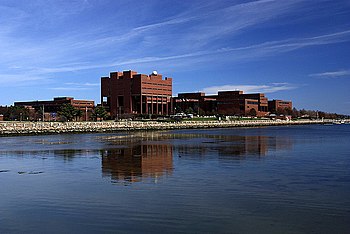
View of part of the UMass Boston campus, which is on Boston Harbor.
This is from The New England Council (newenglandcouncil.com)
“UMass Boston announced that its board of trustees and building authority have unanimously agreed to lease the Bayside Expo Center site to Accordia Partners. This deal will see the 20-acre site developed into 3.5 million square feet of mixed-use space.
“At $235 million, the partnership between UMass Boston and Accordia Partners will provide funding for the school as well as the opportunity to develop the space. The university will engage its community to determine the priorities for the development of the site. The space will include academic, life-science, residential, and retail space, and will create public access to the waterfront.
“Interim Chancellor Katherine Newton said, ‘Part of what I hope we can do is to see what kinds of industries arrive at Bayside and then build academically toward them, so that there’s a natural bridge between our students, faculty and those industries. . . We’re not going to make any decisions right now about what’s going to be teed up.”’
Bygone colleges

From Chantal Zakari’s show “Congent Message,’’ at the Kingston Gallery, Boston, through March 31
The gallery says that her show “hails from the future with nostalgic postcards of defunct colleges. Through the use of a rough halftone pattern the images of a bygone era blur and disintegrate into painterly abstraction. This collection of postcards includes stories about Alliance College, now a state prison, Virginia Intermont College, whose campus has been bought by a Chinese university, and Mt. Ida College, in Newton, Mass.,embroiled in a feud about how public funds should be spent.
“‘Cogent Message’ is also the title of an encyclopedic photobook in the show, where idyllic images retrieved from schools’ marketing campaigns emerge from the white background of corporate letterheads. Interspersed with school logos we see part time faculty who barely make ends meet, students starting life in debt and staff suddenly finding themselves unemployed.’’
Trying to get college kids to love downtown Worcester
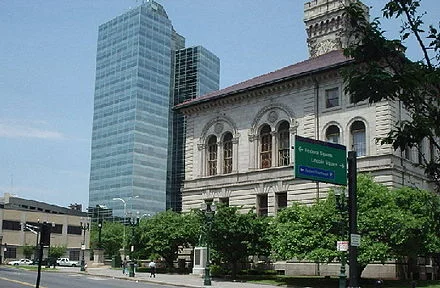
In downtown Worcester. City Hall, built in 1898, during the city’s industrial heyday.
From Robert Whitcomb’s “Digital Diary,’’ in GoLocal24.com
‘The Worcester Telegram ran a story Feb. 16 headlined “Area college students shy away from downtown, other city attractions’’.
A big problem for Worcester is that its colleges are not virtually downtown, unlike in Providence, most notably with Brown University and the Rhode Island School of Design. And Johnson and Wales University is actually downtown, as are some URI and Roger Williams University units. This long-term presence has helped prop up Providence’s core even as some big old companies left town. The city’s very scenic location at the head of Narragansett Bay helps, too. And Worcester’s altitude and inland location make winter walking and driving there more problematical than in Rhode Island’s capital.
Worcester’s colleges are more on the periphery, making excursions to the old industrial city’s (sort of the Pittsburgh of New England) downtown more daunting. It will take a lot more marketing to get a lot more college kids in downtown Worcester, even as Providence’s downtown remains crowded with them.
It's too bad that “Downcity’’ Providence is no longer the company-headquarters place it was decades ago, but at least its college students are there in droves, spending money making the downtown safer. Crowded cities are usually safer cities.
I doubt that the arrival of the soon-to-be named something-else Pawtucket Red Sox will draw many college students, though maybe more than the terrific Worcester Art Museum.
To read The Telegram’s story, please hit this link.
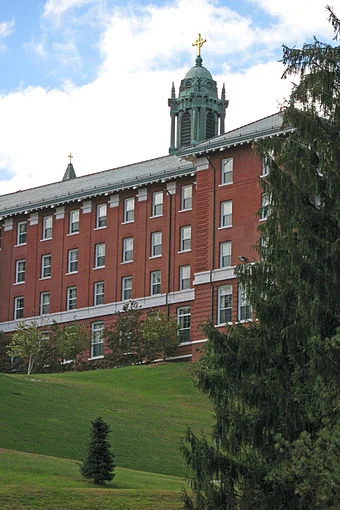
Alumni Hall, on the hilly campus of the College of the Holy Cross, in Worcester.

Chris Powell: Trump's border wall beats Conn. AG's demagogic posturing

President Trump looking at new border wall prototypes in San Diego, in March 2018.
Connecticut Atty. Gen. William Tong has joined a lawsuit with 15 other states against President Trump's declaration of a federal emergency, which the president plans to use to justify spending otherwise-appropriated money to complete a wall across the Mexican border. Tong says that he aims to protect the U.S. Constitution and the state, but, accusing the president of "racism and hate," he is engaging mainly in the demagogic posturing that characterized his recent campaign.
Tong notes that Congress has refused to authorize spending for the wall and that diverting funds to build it could hamper federal projects in Connecticut. Further, the attorney general and other Democratic officials in Connecticut and nationally argue that illegal immigration is not really an emergency.
But federal law authorizes such money transfers upon an emergency declaration and leaves the president to define emergencies. So even legal analysts who disdain Trump expect the lawsuit against the declaration to fail at the Supreme Court.
Besides, those who object to Trump's emergency declaration long have gotten far too comfortable with illegal immigration.
Illegal immigration was supposed to have been stopped by the Simpson-Mazzoli Act of 1986, which bestowed a grand amnesty on illegal immigrants in exchange for more border security, but the border security never materialized. So today the foreign-born proportion of the U.S. population is higher than ever; the country's illegal population is estimated at 11 million; most illegals intercepted at the border enjoy the government's hapless practice of "catch and release"; most of those released never appear for court proceedings, instead disappearing into the ever-growing communities of illegals throughout the country, like New Haven, one of the first "sanctuary cities"; and there is less assimilation and more separatism by immigrants.
While Tong postures against "racism and hate," his party's legislators in the General Assembly are advancing legislation to require medical insurers to sell policies to illegal immigrants, which will be more facilitation of illegal immigration and more nullification of federal law on top of the driver's licenses and tuition discounts Connecticut already offers illegals.
Yes, there may be better measures than a wall for stopping illegal immigration -- like requiring all employers to use the "e-Verify" system of confirming eligibility for employment, and imposing serious penalties on employers of illegals.
But most Democrats oppose such measures and anything that might substantially reduce illegal immigration. And while Democrats in Congress complain about the cost of Trump's wall, every month they happily sneeze away far more money on the futile 18-year military adventure in Afghanistan. Trump's wall won't be perfectly effective, but it will be far more effective and humane than what the Democrats condone in Afghanistan.
Despite the attorney general's demagoguery, there is nothing racist or hateful in controlling immigration so the country knows what it is getting -- whether it is getting people of decent character and skills, people who want to live in a democratic and secular society rather than a totalitarian and theocratic one, people who want to become Americans and help build the country, or people who just want to undercut wages in menial work and wire the money back across the border or exploit the country's generous welfare system.
So even if illegal immigration isn't an emergency, at least Trump sees it as a problem. His wall beats the Democrats' nullification.
Chris Powell is a columnist for the Journal Inquirer, in Manchester, Conn.
Newport event on smart cities and the Fourth Industrial Revolution

Street lamps in Amsterdam have been upgraded to allow municipal councils to dim the lights based on pedestrian use.
From Llewellyn King, long-time contributor to New England Diary and host of White House Chronicle, on PBS
Dear Friends,
I will be speaking about smart cities and the Fourth Industrial Revolution at The Pell Center, Salve Regina University, Newport, RI, at 10 a.m. on Friday, April 5.
There is no charge, and refreshments will be served before the lecture. You are most welcome to bring a guest/s.
Here is the registration link, please feel free to share it:
https://www.eventbrite.com/e/smart-cities-gateway-to-the-fourth-industrial-revolution-tickets-57413347869

The Pell Center for International Relations and Public Policy building, in a former Gilded Age mansion.
I would be honored and delighted if you would attend.
Cheers,
Llewellyn
Executive Producer and Host
White House Chronicle, on PBS;
Columnist, InsideSources Syndicate;
Commentator, SiriusXM Radio;
Founder/Host, ME/CFS Alert on YouTube

Larry Ellison High School?

Larry Ellison’s Beechwood estate, in Newport.
From Robert Whitcomb’s “Digital Diary,’’ in GoLocal24.com
Jim Gillis of the Newport Daily News created a bit of a flap in his Feb. 14 column, headlined “Spare Change: Here’s an idea for moneybags Larry Ellison’’. Mr. Gillis was responding to news that the Oracle mogul Ellison, ranked the fifth-richest person in America, with a fortune of over $62 billion, has bought a fourth estate in the City by the Sea, this one called Seacliff. His most important Newport property is the old Astor estate called Beechwood, on which he’s spent $100 million to turn it into an art museum.
Mr. Gillis suggests -- partly in jest? -- that a better use of Mr. Ellison’s money would be for him to spend $120 million to build a new high school to replace Newport’s aging Rogers High School. He writes:
“Heck, lots of multi-billionaires own mansions. How many build their own schools? Sure, the city would operate the place. All you need do is bankroll construction. Hey, maybe other local celebrity rich folk like Jay Leno and Judge Judy might chip in a few shekels.
“The high school has been named for William S. Rogers since before any of us were alive, predating the current location.
“We love tradition here. But for $120 million, I suppose Larry Ellison High School sounds pretty good.’’
To read Mr. Gillis’s column, please hit this link:
https://www.newportri.com/news/20190214/spare-change-heres-idea-for-moneybags-larry-ellison
Well, Larry Ellison and other new and long-entrenched Newport celebrities do pay lots of property taxes. And, God bless ‘em, the three folks whom Mr. Gillis mentioned at least made made their own money rather than being the beneficiaries of inheritance (what the late, crude Providence Mayor Vincent Cianci called “the lucky sperm club’’). And they can spend their money any damn way they want.
But wouldn’t it be nice if more very rich people contributed to public services rather than seeming to want to wrap themselves more tightly in glamour and prestige by giving money to, say, already rich museums and private colleges?
For example, MarketWatch reported that “20 colleges {most of them elite private institutions} that received the most money in donations during the last fiscal year accounted for about 28% of the total $46.73 billion donated to universities during that period. They serve just 1.6% of the nation’s 19.9 million undergraduate students. That’s based on an analysis of the annual Voluntary Support for Education survey, published by the Council for Advancement and Support of Education, a membership association for professionals working in development, alumni relations and related fields for educational institutions.’’
Drawing out emotions

“In Trouble’’ (drawing), by David Andrews, in his show “David Andrews: Feelings of…’’ at the Augusta Savage Gallery, at UMass Amherst, through March 28. The drawings are said to confront rage, fear and confusion with hope, forgiveness and liberation.
25 'healthy food' groups get grants

From The New England Council (newenglandcouncil.com)
Harvard Pilgrim Health Care has awarded 25 ‘‘healthy food’’ nonprofit organizations with grants to support their programs. The Harvard Pilgrim Health Care Foundation, which issued the grants, has awarded nearly $620,000 to groups in Connecticut, Maine, Massachusetts and New Hampshire.
In 2016, Harvard Pilgrim Health Care Foundation launched the Healthy Food Fund program, and has since awarded grants totaling $4.6 million across New England. These funds support volunteer-based community food programs that bring fresh, local food to low-income families. These organizations include Gardening the Community, Healthy Acadia, New Hampshire Food Bank, and New Haven Farms.
Karen Voci, president of Harvard Pilgrim Health Care Foundation, outlined, “Our goal for this next phase of the Harvard Pilgrim Healthy Food Fund is to mobilize the energy of local community members and corporate volunteers to grow, glean and provide more free, fresh produce for low-income families across New England, creating a movement of ‘neighbors feeding neighbors.’’’

Former adviser to British Royal Family and scholar of the sociology of what led to Brexit will speak at March 14 PCFR

British Royal Family Coat of Arms.
Mark your calendars for some exciting upcoming talks at the Providence Committee on Foreign Relations (thepcfr.org; pcfremail@gmail.com). Consult thepcfr.org for information on how to join the organization and other information about the organization.
Our speaker on Thursday, March 14, will be Miguel Head, now a fellow at Harvard’s Shorenstein Center. He spent the past decade as a senior adviser to the British Royal Family. He joined the Royal Household as Press Secretary to Prince William and Prince Harry before being appointed in 2012 as their youngest ever Chief of Staff.
Previously, Mr. Head was Chief Press Officer at the UK Ministry of Defense, and worked for the Liberal Democrat party in the European Parliament. While at the Shorenstein Center, Mr. Head is doing research into how social inequalities in Britain are fomenting the politics of division (which helped lead to the Brexit vote) and how non-political leadership, working collaboratively with traditional and digital media, can play a role in bringing disparate communities together. At the PCFR, he’ll talk about those things as well comment on the past and current role of the Royal Family, and, indeed, life with the Royals.
xxx
At the Thursday, April 4 ,Providence Committee on Foreign Relations (thepcfr.org) dinner, James Nealon, the former U.S. ambassador to Honduras, will talk about Central America in general and Honduras in particular, with a focus on the conditions leading so many people there to try to flee to the United States – and what the U.S. can and should do about it.
A career Foreign Service officer, Nealon held posts in Canada, Uruguay, Hungary, Spain, and Chile before assuming his post as Ambassador to Honduras in August 2014; Nealon also served as the deputy of John F. Kelly, while Kelly was in charge of the United States Southern Command.
After leaving his ambassadorship in 2017, Nealon was appointed assistant secretary for international engagement at the Department of Homeland Security by Kelly in July. During his time as assistant secretary, Nealon supported a policy of deploying Homeland Security agents abroad. He resigned his post on Feb. 8, 2018, due to his disagreements with the immigration policy of Donald Trump, and, specifically, the withdrawal of temporary protected status for Hondurans.
xxx
Then, on Wednesday, April 10, the speaker will be Prof. James Green, who will talk about the political and economic forces that have led to the election of Brazil’s new right-wing president, Jair Bolsonaro – and hazard some guesses on what might happen next.
Professor Green is the Carlos Manuel de Céspedes Professor of Latin American History, director of Brown’s Brazil Initiative, Distinguished Visiting Professor (Professor Amit) at Hebrew University, in Jerusalem, and the Executive Director of the Brazilian Studies Association (BRASA), which is now housed at the Watson Institute at Brown.
Green served as the director of the Center for Latin American and Caribbean Studies at Brown University from 2005 to 2008. He was president of the Brazilian Studies Association (BRASA) from 2002 until 2004, and president of the New England Council on Latin American Studies (NECLAS) in 2008 and 2009.
Speakers for May and June will be announced soon.
Work ethic

‘‘Well, while I'm here, I'll do the work’’ (ALEPH) (acrylic/rag paper), by Tasha Robbins. (Photo by James Stark.) This is in her show “Malachim, Coming Out of Darkness,’’ at the Hampden Gallery at University of Massachusetts at Amherst.
The gallery says that Robbins's work is “an abecedarian adventure in paint and a personal meditation on the letters of the Hebrew Alphabet.’’

Review of the mid-term elections in New England

From The New England Journal of Higher Education, a service of The England Board of Higher Education (nebhe.org)
Editor’s Note: New England and the nation have long suffered from an underrepresentation of women and people of color in higher elected offices. In the 2018 midterms, that began to change. Below, Carolyn Morwick, director of government and community relations at NEBHE and former director of the Caucus of New England State Legislatures, takes a state-by-state look at New England elections and some key issues. Also see From the Corner Office: New England Governors Budgets and Turning Points: Reflections on What the Historic 2018 Midterm Elections Could Mean for New England and Electing a Reflection of America. — John O. Harney
Connecticut
Four of Connecticut’s five U.S. House members easily won re-election in their respective districts, while voters in Connecticut’s 5th congressional district elected Jahana Hayes, a 2016 “Teacher of the Year” award recipient to replace Elizabeth Esty who resigned last year. Hayes is the first African-American to represent Connecticut in the U.S. House. A native of Waterbury, she enrolled at Naugatuck Valley Community College, earned her four-year degree at Southern Connecticut State University and eventually her masters’ and advanced degrees from the University of Saint Joseph and University of Bridgeport while working to support her young family.
U.S. Sen. Chris Murphy, a Democrat, easily won his second six-year term.
Under Connecticut law, there is no term limit on the office of governor. Outgoing Gov. Dannel Malloy was eligible to run for a third term but chose not to. Malloy will be succeeded by Democrat Ned Lamont who edged out Republican Robert Stefanowski by 40,000 votes.
In the Connecticut General Assembly, the balance of power has shifted slightly with House Democrats gaining seats in the November elections. Democrats control the House with a 92-59 margin. In the Senate, Democrats now have a 23-13 majority. House and Senate leaders are in agreement that the agenda for 2019 will likely address paid family medical leave, an increase in the minimum wage and implementing tolls including a proposal by Lamont to impose a toll on out-of-state trucks.
In other election news, William Tong became the first Asian-American elected to serve as attorney general. Tong is a native of Connecticut, born to Chinese immigrant parents. He served in the Connecticut House and was House chair of the Judiciary Committee. He is the first Asian-American elected to a statewide office.
Democrat Shawn Wooden was elected state treasurer. He will replace Denise Napier who served for 20 years in that post. Wooden is a partner in the law firm of Pitney Day and heads the firm’s public pension plan investment practice.
In the Legislature, the Senate re-elected Martin Looney as Senate president and Bob Duff as Senate majority leader, while the House re-elected Rep. Joseph Aresmowicz speaker and Rep. Matthew Ritter as House majority leader. Republicans re-elected Len Fasano the post of Senate minority leader and House Republicans chose Rep. Themis Klarides as House minority leader
Connecticut voters approved two amendments to the state constitution by wide margins. In Connecticut, the only way voters can ask the state to do something is by amending the state constitution. One amendment would create a transportation “lockbox,” which would protect funds for highway and mass transit. The other amendment would protect public lands.
Maine
In Maine’s 1st congressional district, Democratic Rep. Chellie Pingree easily won re-election with 59% of the vote. In the 2nd congressional district, Jared Golden, also a Democrat, won a very close race. For the first time in Maine, “rank choice voting” determined the outcome of this election, giving the edge to Golden.
So far, Maine is the only state in the U.S. to use rank choice voting. If one candidate receives an outright majority of the votes, he or she wins. Ranked choice voting lets voters rank their choices based on individual preference. First choices are counted, and if no candidate has a majority of the vote, an “instant runoff” occurs in which the candidate with the least support is eliminated. Voters that picked the eliminated candidate as their first choice have their vote counted for their next choice. In a three-person race, the winner is the candidate with the majority of support in the final round of tabulation. In a race with more than three candidates, the process is repeated until one candidate has a majority.
U.S. Sen. Angus King, an Independent, won re-election with 54% of the vote.
Former Attorney General Janet Mills defeated Republican Shawn Moody to become Maine’s first woman governor with 51% of the vote. In addition, Democrats swept both branches of the Maine state Legislature. A record 60 women will now serve in the 151-member House of Representatives.
Lawmakers re-elected Rep. Sara Gideon to a second term as speaker of the House. Rep. Matt Moonen was elected House Majority Leader and Rep. Kathleen Dillingham was elected House Minority Leader. In the Senate, where Democrats now outnumber Republicans 21 to 14, Troy Jackson was elected Senate president with Sen. Nate Libby chosen to be majority leader. Sen. Dana Dow was elected to be Senate minority leader.
With a new Democratic governor in place, Jackson and Gideon are optimistic about bipartisan support for rural broadband network initiatives, finding ways to allow local communities to pursue a local option sales tax and increasing ways to work together on the opioid crisis. Jackson is interested in addressing student debt reform by establishing incentives for out-of-state students to attend one of Maine’s public higher education institutions. Students would receive student debt relief by staying in Maine and becoming part of Maine’s workforce.
Jackson would also like to see a Medicaid buy-in option to provide low-income Mainers with access to affordable health care. He also wants to build a prescription drug importation plan to give Mainers and local pharmacies the ability to purchase
Among ballot questions, Maine voters defeated a question to adopt payroll and non-wage income taxes for home care program initiative.
Voters passed a wastewater infrastructure bond issue for $30 million general obligation bonds, a transportation bond issue for $106 million in general obligation bonds, a University of Maine System bond issue for $49 million in general obligation bonds for construction and remodeling of existing and new facilities within the University of Maine System, and a Maine Community College System bond issue for $15 million renovation and expansion of instructional laboratories, information technology infrastructure, and heating and ventilating systems at Maine’s seven community colleges.
Massachusetts
While all members of the Massachusetts delegation to the U.S. House easily won re-election, the big news was the election of the first African-American from Massachusetts to serve in the U.S. House of Representatives. In the September primary election, Ayanna Pressley, a Democrat and former member of the Boston City Council, defeated long-time Democratic Congressman Michael Capuano of Somerville. Next year will be the first time that Massachusetts will send three women to the U.S. House of Representatives.
U.S. Sen. Elizabeth Warren, a Democrat, cruised to a big win with 60% of the vote, defeating Republican state Rep. Geoff Diehl. Warren also declared herself a candidate for the 2020 presidential election, along with another New Englander, Independent U.S. Sen. Bernie Sanders of Vermont.
Voters gave Gov. Charlie Baker the nod for a second term by a margin of 67% in defeating his Democratic challenger, Jay Gonzalez, former secretary of administration and finance to former Gov. Deval Patrick.
The Massachusetts Legislature continues to have a supermajority with Democrats in control. Women made some gains in the midterm elections and hold 29% or 57 of the 200 seats in the House and Senate. Prior to the November election, members of the Massachusetts state Senate elected Democratic Sen. Karen Spilka to be Senate president. Robert DeLeo was re-elected House speaker.
Massachusetts voters defeated a question to change patient-to-nurse limits. Voters approved a question establishing a 15-member citizens’ commission to advocate for certain amendments to the U.S. Constitution regarding political spending and corporate personhood and approved a question prohibiting discrimination based on gender identity in public places.
New Hampshire
In New Hampshire’s 2nd congressional district, Rep. Annie Kuster easily won re-election for a fourth term with 55% of the vote. In the 1st congressional district, voters elected their first LGBTQ representative, Democrat Christopher Pappas, who beat Republican Eddie Edwards 54% to 45%. Pappas replaces Carol Shea Porter who decided not to seek re-election. He formerly served three terms as an executive councilor.
Despite the strong showing of Democrats in down-ballot races, Republican Gov. Chris Sununu was easily re-elected for a second term, besting state Sen. Molly Kelly, 52% to 45%.
In addition to the Blue wave that upended the majority in both the House and Senate, the race that generated the most interest was the election of secretary of state. Bill Gardner eventually won his 22nd term in office by just four votes. Both Gardner and his opponent, Colin Van Ostern, are Democrats. Van Ostern, a former gubernatorial candidate, ran a campaign based on modernizing the Secretary of State’s Office. The nation’s longest secretary of state, Gardner will begin his 42nd year overseeing New Hampshire elections.
Democrats swept out Republicans in the House and Senate. Democrats hold a 233 to 167 majority. Rep. Steve Shurtleff was elected to be the new speaker. Rep. Douglas Ley is the new house majority leader and Rep. Dick Hinch is the new house minority leader. In the Senate where Democrats now have a 14-10 majority, Sen. Donna Soucy was chosen to be the new Senate president. Sen. Dan Feltes was elected Senate majority leader and former Senate President Chuck Morse was chosen as the new Senate minority leader.
Shurtleff’s top priority as speaker is the opioid crisis. His other priorities include aid for school construction, preventing downshifting to local property taxpayers and strengthening the state’s mental health system. He also says he wants to work with the governor on passing a paid family medical leave bill.
Senate President Soucy’s priorities are part of her “Opportunity Agenda” which includes property tax relief, mental health, behavioral health, the opioid crisis and making sure people have the skills they need. She also mentioned a state version of pre-existing conditions, a new bill for paid family leave and a Senate redistricting bill.
New Hampshire voters approved a question, authorizing residents to sue their state, county or local governments, including their school boards, and another authorizing individuals to live free from governmental intrusion regarding private or personal information.
Rhode Island.
Democratic U.S. Sen. Sheldon Whitehouse won a third term, beating back a challenge from Republican Robert Flanders. Both Democratic congressmen, David Cicilline and James Langevin, won their re-election bids. Cicilline holds among the highest positions on the Democrats leadership team.
Gov. Gina Raimondo easily won re-election with a decisive 53% of the vote. She beat her opponent Cranston Mayor Alan Fung for the second time with a well-organized get-out-the- vote effort. She is also the new chair of the Democratic Governors Association for 2019. Her leadership was key in establishing tuition-free access at Rhode Island Community College.
In the Rhode Island General Assembly, Democrats picked up four more seats in the House while the Senate essentially stayed the same. Speaker Nicholas Mattiello was re-elected speaker and Sen. Dominick Ruggerio was re-elected as Senate president. Peter Neronha, a former U.S. attorney in Rhode Island, is the new attorney general.
Rhode Island voters approved a school buildings bond measure.
Vermont
The state’s sole member of Congress, U.S. Democratic Rep. Peter Welch, also coasted to victory. Independent U.S. Sen. Sanders easily won re-election for another six-year year term.
In the race for governor, Phil Scott earned a second term, beating Democratic challenger Christine Halquist, who became the first transgender woman to win the primary.
Despite Scott’s win, Republicans in the Vermont General Assembly took a big hit. They lost 10 seats in the House and, as a result, lost their ability to uphold the governor’s veto. Republicans now have 43 seats in the House, while Democrats and Progressives hold 102 seats. In the Senate where Democrats and Progressives already held a big majority, they now hold 24 of the 30 seats.
The veto-proof majorities of Democrats and Progressives in both branches bode well for their legislative agenda, which includes paid family medical leave, a $15 minimum wage and funding for clean-water projects. Up for debate will be forced mergers in Vermont’s school districts and a pro-choice amendment to the state constitution and establishing a state cannabis market.
Exhaustion

“Guardian’’ (ceramic), by Kyungmin Park, in the show “Ceramic Sculpture Culture,’’ at the Heftler Visiting Artist Gallery, at Endicott College, Beverly, Mass. through May 24.