
Vox clamantis in deserto




Environmental factors in decline of shellfish along East Coast

Bay scallop.
Via ecoRI News (ecori.og)
Researchers studying the sharp decline between 1980 and 2010 in documented landings of the four most commercially important bivalve mollusks — eastern oysters, northern quahogs, soft-shell clams and northern bay scallops — have identified the causes.
Warming ocean temperatures associated with a positive shift in the North Atlantic Oscillation (NAO), which led to habitat degradation including increased predation, are the key reasons for the decline of these four species in estuaries and bays from Maine to North Carolina, according to the National Oceanic and Atmospheric Administration (NOAA).
The NAO is an irregular fluctuation of atmospheric pressure over the North Atlantic Ocean that impacts both weather and climate, especially in the winter and early spring in eastern North America and Europe. Shifts in the NAO affect the timing of species’ reproduction and growth, the availability of phytoplankton for food, and predator-prey relationships, all of which contribute to species abundance. The findings appear in Marine Fisheries Review.
“In the past, declines in bivalve mollusks have often been attributed to overfishing,” said Clyde Mackenzie, a shellfish researcher at NOAA Fisheries’ James J. Howard Marine Sciences Laboratory, in Sandy Hook, N.J., and lead author of the study. “We tried to understand the true causes of the decline, and after a lot of research and interviews with shellfishermen, shellfish constables, and others, we suggest that habitat degradation from a variety of environmental factors, not overfishing, is the primary reason.”
Mackenzie and co-author Mitchell Tarnowski, a shellfish biologist with the Maryland Department of Natural Resources, provide details on the declines of these four species. They also note the related decline by an average of 89 percent in the numbers of shellfishermen who harvested the mollusks. The landings declines between 1980 and 2010 are in contrast to much higher and consistent shellfish landings between 1950 and 1980.
Exceptions to these declines have been a sharp increase in the landings of northern quahogs in Connecticut and American lobsters in Maine. Landings of American lobsters from southern Massachusetts to New Jersey, however, have fallen sharply as water temperatures in those areas have risen.
“A major change to the bivalve habitats occurred when the North Atlantic Oscillation index switched from negative during about 1950 to 1980, when winter temperatures were relatively cool, to positive, resulting in warmer winter temperatures from about 1982 until about 2003,” Mackenzie said. “We suggest that this climate shift affected the bivalves and their associated biota enough to cause the declines.”
This graph shows the rise and fall of soft-shell clam landings from 1950 to 2005. (Clyde Mackenzie)
Research from extensive habitat studies in Narragansett Bay and in the Netherlands, where environments including salinities are very similar to the northeastern United States, show that body weights of the bivalves, their nutrition, timing of spawning, and mortalities from predation were sufficient to force the decline. Other factors likely impacting the decline were poor water quality, loss of eelgrass in some locations for larvae to attach to and grow, and not enough food available for adult shellfish and their larvae.
“In the Northeast U.S., annual recruitments of juvenile bivalves can vary by two or three orders of magnitude,” said Mackenzie, who has been studying bay scallop beds on Martha’s Vineyard with local shellfish constables and fishermen monthly during warm seasons for several years.
In late spring to early summer of this year, a cool spell combined with extremely cloudy weather may have interrupted scallop spawning, leading to what looks like poor recruitment this year. Last year, Nantucket and Martha’s Vineyard had very good harvests due to large recruitments in 2016.
“The rates of survival and growth to eventual market size for shellfish vary as much as the weather and climate,” Mackenzie said.
Weak consumer demand for shellfish, particularly oysters, in the 1980s and early 1990s has shifted to fairly strong demand as strict guidelines were put in place by the Interstate Shellfish Sanitation Conference in the late 1990s regarding safe shellfish handling, processing, and testing for bacteria and other pathogens.
Enforcement by state health officials has been strict. The development of oyster aquaculture and increased marketing of branded oysters in raw bars and restaurants has led to an increase in oyster consumption in recent years.
Since the late 2000s, the NAO index has generally been fairly neutral, neither very positive nor negative. As a consequence, landings of all four shellfish species have been increasing in some locations. Poor weather for bay scallop recruitment in both 2017 and 2018, however, will likely mean a downturn in landings during the next two seasons.
New England's dignified 19th Century architecture
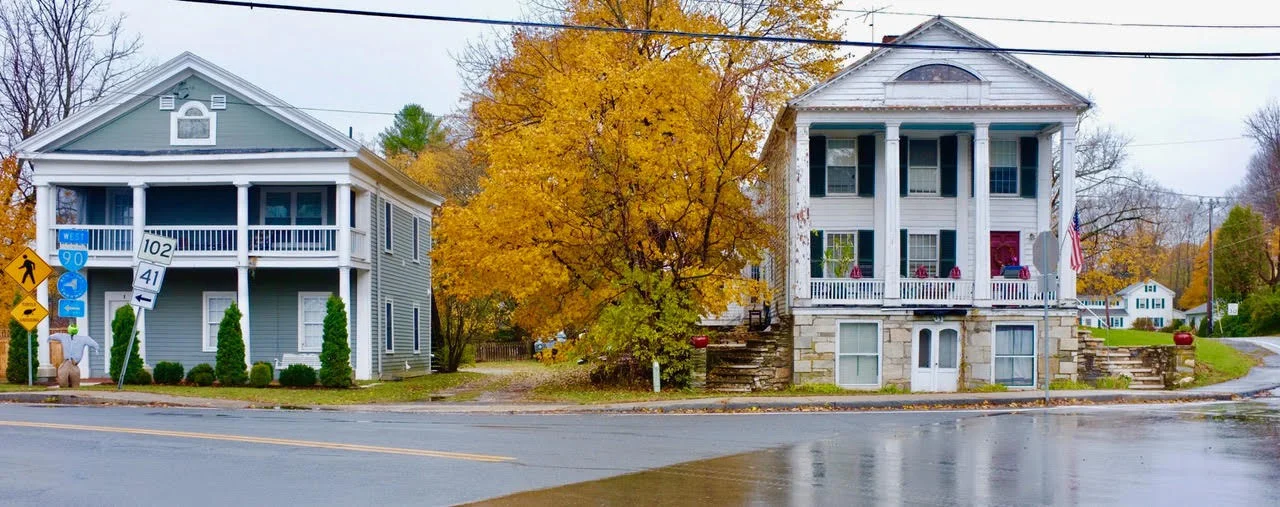
Proper buildings in West Stockbridge, Mass., in the Berkshires.
— Photo by William Morgan
West Stockbridge is a rich town, with many property owners from New York City with weekend places there.
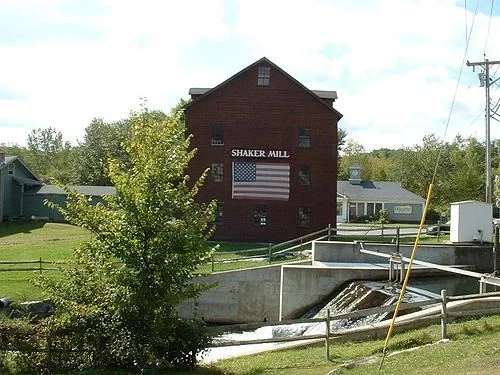
Shaker Mill, on the Williams River, in West Stockbridge.
They want it real

“Because the people of New Hampshire take their responsibilities as citizens of the Republic seriously, they keep it interesting for candidates who, believe it or not, can get a little tired of the mannered, predictable, and unimaginative qualities that typically afflict modern political campaigns.’’
— The late Sen. John McCain, who ran in the New Hampshire presidential primary in 2000 and 2008.
Street life

“Police Drawings’’ (mixed media, life-size and variable dimensions), by Mira Cantor, in her show “Promiseland,’’ at Kingston Gallery, Boston, through Dec. 2.
Rethink ideas about New England's 'viewshed'
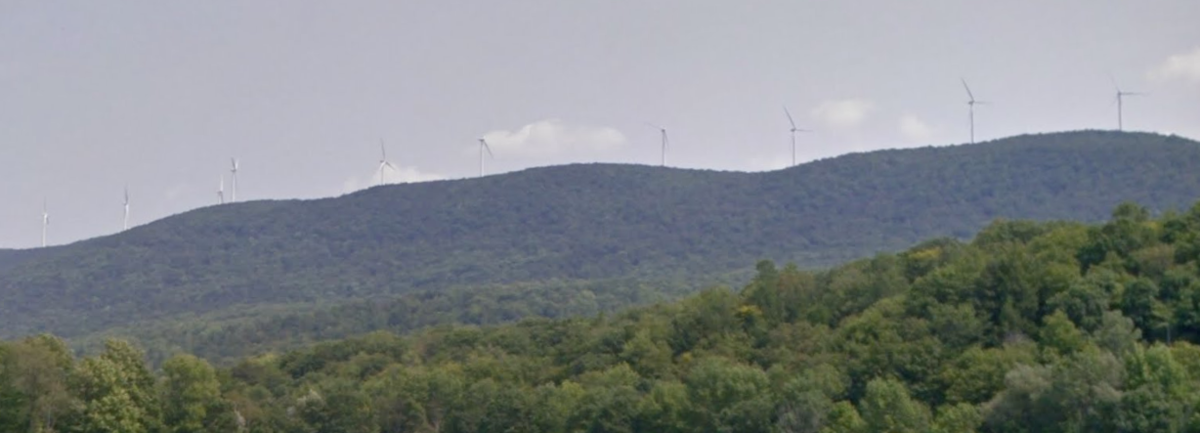
Berkshire Wind Power Project, in Hancock, Mass.
From Robert Whitcomb’s “Digital Diary,’’ in GoLocal24.com
New Englanders might want to read an interview in the New England News Collaborative with Philip Warburg, who used to run the Conservation Law Foundation, authored Harvest the Sun: America’s Quest for a Solar-Powered Future and recently wrote an article headlined “What Red State Kansas Can Teach Blue State Massachusetts about Renewable Energy’’.
He cites a “wind technology training program {in a rural county in Kansas} at the community college. It started in about 2007 with some 5 students, today it’s got 150 students. And they find jobs immediately on graduating from their 2-year certificate program. In fact, they’ve expanded now to include solar technology, so it’s been renamed a renewable energy technology program. Again, not something you would necessarily expect at a community college in the middle of Kansas farm country, but in fact, it provides local employment for a lot of people … and it’s really seen as a huge economic boon.’’
Of course, densely populated and wooded southern New England doesn’t have the wide-open spaces of Kansas but it does have a treasure in offshore wind and more than adequate solar energy (we’re at the latitude of Portugal) to justify major education programs for people going into the wind and solar industries. Let them do their part to weaken the likes of Saudi Arabia.
On wind power in New England, he writes:
“I think we have to think in a more expansive way about what it means to integrate renewables into our landscape. So it might mean more wind turbines, for example, in the Berkshire Mountains or in the White Mountains or in parts of Maine. And I think we can also learn from Kansas in looking off of our shore and saying well actually we can develop wind power on a very large, you could say industrial, scale without creating the kind of reactions we got from vacationers on the Cape … to the Cape Wind project.’’
He may be too hopeful about affluent New Englanders’ tolerance of changes to their “viewsheds.’’ And yet:
“If we took a longer historical view of the New England landscape … we might be more forgiving of the introduction of technologies like wind and solar. If you look at New England’s landscape during the 19th century, it was largely a farmed landscape. We now have reforested New England because farming just doesn’t make that much economic sense on a large scale in New England…. So we’re very attached to thinking of New England as pristine forests, when in fact they’re not pristine forests.’’
To read the whole interview, please hit this link.
The peace of tyranny

At the Nazis’ 1934 Nuremberg Rally.
A country that is truly free
Has citizens who disagree.
There isn't any culture war
In Orwell's 1984.
—Felicia Nimue Ackerman

Chris Powell: Raising tobacco-purchase age would do little for city kids

Why do officials in politically correct cities like Hartford, New Haven and Bridgeport put so much effort into posturing on issues over which they have no serious jurisdiction? Maybe it's to console themselves for their ineffectuality with important matters like the worsening poverty, ignorance, and demoralization of their constituents.
Last week Hartford was at it again as its City Council prepared an ordinance raising to 21 the age for purchasing tobacco products. A week earlier Bridgeport had adopted an ordinance purporting to outlaw homemade plastic guns.
Even as Hartford prepared the tobacco ordinance, several of its high school students got sick in school after consuming marijuana-laced brownies given to them by other students. Marijuana possession by minors is illegal but of course it has been decades since that prohibition deterred anyone, and now both Connecticut and the country are starting to figure that the prohibition might as well be repealed and marijuana sold legally and taxed.
So why does Hartford think that raising the age for tobacco purchases will accomplish anything? Why does Hartford think that minors won't continue to purchase tobacco through older friends, as they do with alcoholic beverages?
And what about the bigger question of the age of majority? How sensible is society when it proclaims 18-year-olds mature enough to vote, serve in the military, and make contracts but not mature enough just to smoke and drink?
Poor judgment will always be part of youth. But an ordinance purporting to protect kids against tobacco in a city where most kids have no father in their home and many have no real parent at all is worse than poor judgment. It's a sick joke by shameless adults.
xxx
VINDICATING THE FLAG: Another flag-salute case has arisen from a public school in Waterbury.
Twenty-five years ago the city's school system tried to punish a black high school student who, calling herself a Communist, refused to salute the flag at the start of the school day. She beat the school system in a lawsuit because school administrators somehow had overlooked or deliberately disregarded a renowned U.S. Supreme Court decision from 1943 forbidding schools from coercing students into making expressions of belief. That decision upheld freedom of conscience, which the country then was defending at profound cost in a world war.
In the new Waterbury case some nonwhite students allege that a teacher has been mocking and shaming them for refusing to rise for the Pledge of Allegiance to the flag, which they say is their way of protesting racial discrimination.
A trial may be needed to determine exactly what has been happening but there should be no doubt about the long-established right not to salute the flag -- just as there should be no doubt that the right not to salute the flag is a powerful reason for saluting it.
Of course the country has not achieved perfect justice. But it never will. It can only keep improving. With its proclamation of "liberty and justice for all," the Pledge of Allegiance will always be largely aspirational. But the heroes of the civil rights revolution 50 years ago accepted this and always carried the flag into the struggle. They succeeded and changed the country and thereby vindicated the flag.
A good teacher would explain this to his students as he acknowledged their right not to salute the flag. If they still refused to salute, he would let them be undisturbed, since, after all, their liberty still would be pretty good advertising for the country.
Chris Powell is a columnist for the Journal Inquirer, in Manchester, Conn.
Waste is forever
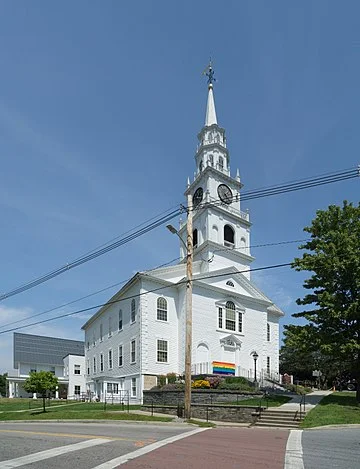
Rater typical New England Congregation Church, in the college town of Middlebury. Vt.
“Sign at a New England church: ‘Will the last person to leave please see that the perpetual light is extinguished?’’’
— Dave Barry
Beech trees

“The ten hours' light is abating,
And a late bird flies across,
Where the pines, like waltzers waiting,
Give their black heads a toss.
Beech leaves, that yellow the noon-time,
Float past like specks in the eye;
I set every tree in my June time,
And now they obscure the sky.
And the children who ramble through here
Conceive that there never has been
A time when no tall trees grew here,
A time when none will be seen.’’
— “At Day-Close in November,’’ by Thomas Hardy
Animated storytelling in New Bedford

From “SEED, the Untold Story’’ (a still from animation), in Hayley Morris’s show at the New Bedford Art Museum, Nov. 11-Jan. 13. The Fiber Optic Center New Media Gallery at the museum is showcasing Hayley Morris. The museum says that she’s an animation director who uses “mixed media and stop-motion animation techniques to tell stories that unfold through layered textures, hand- crafted details and inventive storytelling. Morris has created work for a broad range of clients in the film, music and video industry. Her animation studio, Shape & Shadow, is in Providence.
Llewellyn King: Internet of Things and climate change rushing at us

The votes that will be cast on Election Day might be the most important votes cast in a long while, but they’re unlikely to change our lives as dramatically as two great tsunamis that are hurtling toward us.
Change Agent Tsunami One is being driven by science. If you thought that the Digital Revolution had reached its apex with the smartphone, or perhaps Instagram, get back to thinking room.
The Internet of Things is on the march and nothing appears to be able or wants to stop it.
Soon you’ll have “smart cities.” In the beginning, these will be the result of evolutionary change. Things like 5G, the next generation of mobile technology, and Wi-Fi using “short towers” — in fact, a lot of small towers — will make Wi-Fi available to everyone in a city.
Then things speed up.
Already, the Digital Revolution is responsible for these lifestyle changers: barcodes, Uber and Lyft, urban bicycle systems and, yes, those scooters that are whizzing around many cities. Oh, throw in Airbnb.
In store is automated transportation with autonomous electric cars and trucks, automated package delivery by drone. Electric small aircraft and automated pilotless air taxis will take you from your home to the airport. Keeping all these moving objects from knocking into each other or into us will take further electronic wizardry.
All of this will come under the rubric of smart cities. The only impediment to this stunning new world of efficiency and convenience is a cyberattack that takes down the electric grid for days, weeks or longer. Every horror that can be conceived would be unleashed: no communications, no food, no gas, no money, no sewage and no water. We’d all be reduced to the state of primitive man without the skills of the Stone Age.
In its way, cyberattack is a greater threat than anything posed by the arsenals of China and Russia. We might perish without a bang, just a whimper. An ignoble but terrible exit.
Change Agent Tsunami Two is climate change. This has all the makings of a global catastrophe. Low-lying countries might not be able to mocytunt the defenses needed just to deal with ocean rise. They’d have move to higher ground in other countries.
Especially vulnerable is the East Coast of the United States. While the Trump administration may be in formal denial, the agencies of government are preparing within their ability to go against the politicians. National labs have maps and charts of the devastation that would result from a sea rise of several feet. I saw the first of these maps myself at the Lawrence Livermore National Laboratory in California decades ago. I thought they were fanciful. Now I think they were prescient.
The Navy is particularly alarmed because, as Axios has reported, the sea rise along the East Coast is likely to be worse than in other parts of the world, due to tidal and other geographical factors. Particularly, the Navy is worried about bases in low-lying coastal cities such as Norfolk, Va., and is looking at scenarios as to where these could be relocated efficiently and in time.
Other climate change horrors include tropical bugs in northern climes, mutating viruses, more storms, droughts and tens of millions of people driven from their homes, i.e. refugees.
I have no doubt that we’ll lick the cyberwarfare threat. Technology can take on technology. Many good minds in government, industry and the universities are hard at work. Climate change is a many-orders-of-magnitude more implacable problem.
A very different future is ahead, one that isn’t on the ballot — not this Nov. 6, but it will be in future years. Great new political issues are in the making; issues that are outside of the party-speak of this election, but which will emerge soon. In 2020? Possibly.
On Twitter: @llewellynking2
Llewellyn King is executive producer and host of White House Chronicle, on PBS. He’s based in Rhode Island and Washington, D.C.

Robert Whitcomb: Broadway-bound in Boston

Inside the Colonial Theatre, in Boston.
“Another op'nin', another show
In Philly, Boston or Baltimoe,
A chance for stagefolks to say ‘hello’
Another op'nin', another show.’’
From “Another Op'Nin', Another Show,’’ from Kiss Me, Kate, music and lyrics by Cole Porter. Opened on Broadway in 1948, in the heyday of the great Broadway musicals and their tryouts outside of New York.
When I was a kid, in the ‘50s and early ‘60s, Boston was a big Broadway tryout town, with soon-to-be famous musicals and non-musical plays undergoing clinical testing and treatment in the city’s compact theater district before being sent to New York, or cancelled as unfixable. The Colonial, the Shubert and the Wilbur theaters were nationally known venues where demanding audiences and critics could make or break a production. Elliot Norton, the once-famous and longtime drama critic for Boston newspapers and WGBH Radio and TV, had considerable national power, which he exercised with great care and insight. He was lauded as a “play doctor,’’ whose suggestions helped make productions that he reviewed into hits on Broadway.
While I found some of the productions boring, I usually liked the theater evenings. Before the shows, my parents, my older sister and I would go to what seemed at the time exotic foreign restaurants, such as Athens Olympia, where I had my first Greek food (favoring the baklava) and Ola (sic?), a Scandinavian restaurant, where, I’m sorry to say, we ate whale meat. Except for my parents’ smoking, it was usually fun.
Many of the shows were musicals (by Rodgers & Hammerstein, Lerner & Loewe, etc.), but we also watched some serious (and occasionally inappropriate for children!) or comic nonmusical plays, too. If the show wasn’t all that thrilling, we could at least look forward to the colorful refreshments in the lobby in the intermissions.
(We also often went to big movies in Boston’s still prospering movie palaces. Ben Hur, This Is Cinerama, Around the World in Eighty Days, etc., but often matinees – not nearly as glamorous as going out at night. But you could eat popcorn at your seat – a no-no in a real theater.)
Boston’s role as a Broadway tryout town began fading in the 1970s. That strikes me as somewhat paradoxical because the city was starting to sweep off a rather Dickensian grittiness associated with the local decline of the textile and shoe business. By fits and starts, fueled by higher education, technology, investment companies and health care, the Hub was entering a renaissance that has made it truly a world city, with a glittery downtown, like, well, Manhattan.
And now the big British-based Ambassador Theatre Group (ATG) and Emerson College may spark a revival of New England’s capital as a Broadway tryout town centered at the Emerson Colonial Theatre, owned by the college; Emerson has longstanding entertainment-business connections. ATG, which is managing the facility, told The Boston Globe that it wants to do a pre-Broadway show there each year.
Of course, it’s a lot easier to see and hear a show on TV or on your computer than in person, but being in a theater as part of a night on the town is much more memorable. But how to make it easier to get to the theater in dense Boston? One way is for theaters to arrange chartered-bus networks to take people in comfort from places in and around Boston directly to the Theater District in season. We took such a bus to Symphony Hall last year and it was a pleasure. One price would cover tickets and transportation.
And, of course, MBTA service should be upgraded to let it better fit Theater District show schedules if and when Broadway-style show business expands enough in the Hub.
But building more parking garages in the district is not a solution. They simply lure more cars and cause more street congestion.
Putting on shows in big theaters is very expensive. There are smaller, high-quality regional venues in the area, most famously the nonprofit American Repertory Theater, in Cambridge, with 556 seats. They can provide some of the process of a Broadway tryout but not in the same way as big, Broadway-style venues such as the Shubert, the Wilbur and the Colonial, which replicate the sense of being in a New York City theater, with more than a thousand seats. Sometimes producers and directors need to gauge a big-audience reaction.
I wonder if college students in Greater Boston, besides those at Emerson, can do a lot of the low-wage jobs at Boston’s big theaters, thereby cutting production costs and thus encouraging more production companies to start their road to New York in the Hub.
Beats Baltimore and Philly! Of all the East Coast cities besides New York, Boston’s cultural history, highly educated audience and low crime make it best suited to be a Broadway tryout town.
Robert Whitcomb is editor of New England Diary and president of The Boston Guardian, where this column first appeared.
Furniture as fine art

Chair by Greg Brown, in the group show “The Art of Handcrafted Furniture,’’ at New Hampton School’s Galletly Gallery, in Hampton, N.H., through Dec. 13. The show features the work of Greg Brown, Owain Harris, Liz Hallen, Terry Moore, Leah Woods and Jim Zink.
The gallery says “They use wood as a medium to create designs that are functional, expressive and elegant. Each artist has a distinct style and a different goal they hope to achieve with their work. Every piece whether whimsical or simple, modern or traditional, is a work of art as much as it is a table or chair.’
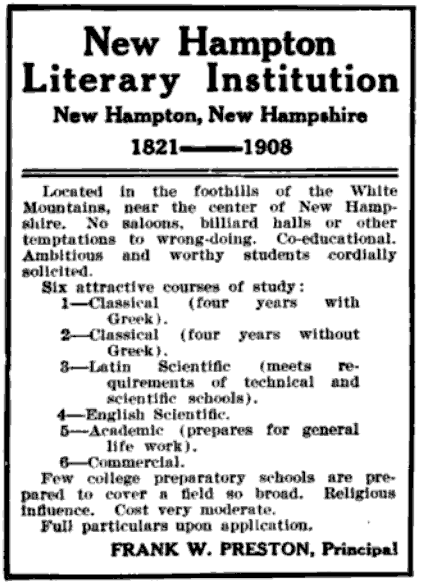
1908 ad for what is now called New Hampton School.
Our 'Banana Republics'
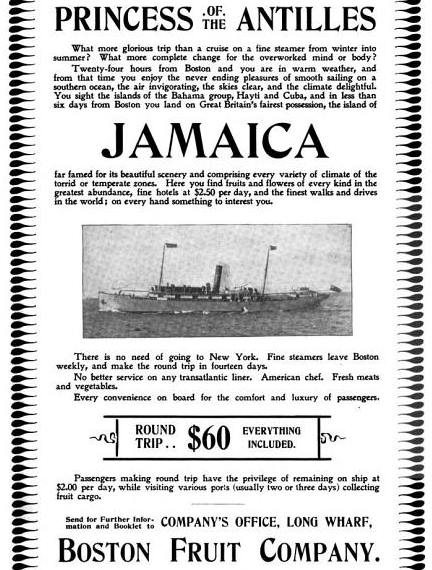
This was a predecessor company of the Boston-based United Fruit Co., which did a lot of business in Central America.
From Robert Whitcomb’s “Digital Diary,’’ in GoLocal24.com
On the immigration “crisis’’ approaching our southern border, some context: As Nicholas Kristof of The New York Times noted the other day:
“More than 1.4 million foreigners emigrate to the United States each year. If, say, half the caravan { around 5,000 people} reaches the border, and half of those people actually enter the U.S., they would represent less than one-tenth of 1 percent of this year’s immigrants.’’
Despite Trump’s tough-guy approach, unauthorized crossings of our southern border are up slightly this year from last and the number of families crossing together as a unit hit a monthly record last month: more than 16,500 people. That’s how bad things are in much of Central America. (Still, U.S. has about 328 million people.)
The pictures of the desperate marchers are of course dramatic, and being heavily used by the orange man in the Oval Office and his propaganda arm – Fox “News’’.
The Democrats, not being “reality TV’’ experts, are slow on the uptake on the caravan. No, they don’t favor “open borders’’. But mostly because they don’t have the presidency, they lack the opportunity to present a clear position that the public will listen to.
Of course, they should clearly ask the marchers to go back home, but perhaps with the hope for some of them that the U.S. government, which has been controlled by the Republican Party for the majority of time since 2001, might finally come up with a coherent, pragmatic and fair immigration policy that would let them legally enter the country.
Congress, meanwhile, should block Trump threats to cut off aid to Central America, a cutoff that would only increase the lawlessness and poverty that drives these desperate-people north. And they should remind Americans that we are indirectly the cause of much of the trouble. Consider our insatiable demand for drugs, which in turns spawns corruption and gangs in Central America, and that much of the illegal-alien problem can be blamed on U.S. business’s love of cheap labor. A lot of Republican businessmen have loved having low-paid illegal-alien workers.
Also note that many of Central America’s woes can be traced back to the socio-economic-environmental damage done by their past status as heavily exploited economic colonies of the United States. For years such American companies as the old Boston-based United Fruit Co. basically ran these little nations, protected by the U.S. government.
American companies profited from very stratified social classes, a very large impoverished working class and a plutocracy, composed of the business, political and military elites, with whom U.S. firms and government officials worked closely. The dictatorships pushed, in return for kickbacks, the exploitation of large-scale plantation agriculture, especially of course bananas. Thus, “Banana Republics.’’
In any event, the Democrats (and Republicans) should emphasize that the marchers must go through the ordinary orderly process demanded of asylum seekers at our borders. Given the numbers in the current caravan, this will require additional personnel at the southern border, probably including military.
House Minority Leader Nancy Pelosi and Senate Minority Leader Chuck Schumer ought to jointly and repeatedly affirm the above.
Oh what a paradise
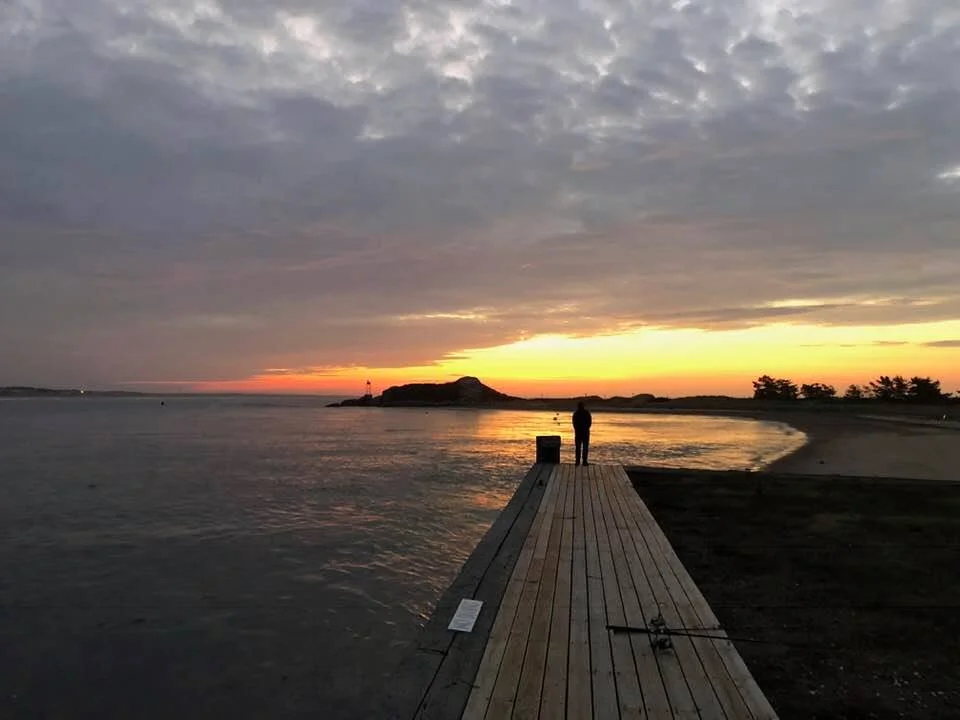
On All Souls Day, looking toward Point of Rocks (also charmingly called The Knubble), where the Westport River meets Buzzards Bay.
— Photo by Kevin Vendituoli

UMass Dartmouth gets state grant toward developing 'blue economy corridor'

This is from The New England Council (newenglandcouncil.com)
The University of Massachusetts announced that UMass Dartmouth and its SouthCoast Development Partnership received a $300,000, three-year state investment from the Massachusetts Executive Office of Housing and Economic Development. The money will go towards the development of a “blue economy corridor.”
The blue economy marks a cross section of marine-related industries, including offshore wind, fishing, aquaculture, watercraft design and marine scientists. The “blue economy corridor” initiative is intended to develop the blue economy supply chain, workforce and higher education research, all while identifying challenges to growth and exports and looking for ways to diversify the regional economy.
Speaking of the three-year plan for the Blue Economy, UMass Dartmouth Chancellor Robert Johnson said that he intends to create a strategic, regional economic plan by first talking to stakeholders and brainstorming about what the region can become. He said, “What we’re doing is laying the foundation on solid ground.”
Just taking a break

Beech tree in autumn.
“Consider again the November trees which lift their arms to say that they have only temporarily yielded; that next spring they will again assert their determination to live. Those trees, like the frog now sleeping under the mud, are on our side.’’
— Joseph Wood Krutch
Chris Powell: Just asking question gets Megyn Kelly canned

White singer and actor Al Jolson wearing blackface in the musical film The Jazz Singer (1927). The movie was the first feature-length “talkie’’.
MANCHESTER, Conn.
Anyone might be glad to be fired if it meant the tens of millions of dollars that Megyn Kelly will get in severance pay from NBC for cancellation of her Megyn Kelly Today show. There's little need to feel sorry for her.
But Kelly's dismissal is another blow to the national dialogue, since she was fired, at least nominally, just for asking a couple of questions on the air. That is, why is wearing blackface in Halloween costumes always wrong, and what is racist?
Kelly seemed to be wondering if blackface might be acceptable for someone who just wanted to dress up like a particular character. While blackface has a long association with racial mockery, Kelly didn't defend mockery.
So why wouldn't just answering Kelly's question and making an argument have been sufficient? Why was it necessary to execute her quickly, even after she apologized for her ignorance of history?
For if mere ignorance is cause for dismissal, lots of people are unfit for their posts, and Kelly's firing may strike them as raw intimidation by a political correctness that wants to punish without having to argue. That would be disrespect far greater than anything Kelly committed and would add to the country's bitter political resentments.
xxx
BIDEN MISSES LAMONT AD: Former Vice President Joe Biden came to Connecticut last week to campaign for the Democratic ticket and urge an end to vilification in politics. "Fear stokes bad behavior," Biden said. "Personal attacks stoke fear."
Ironically, just hours earlier one of the candidates Biden was endorsing, gubernatorial nominee Ned Lamont, began broadcasting a television commercial described as the hardest-hitting of the campaign, declaring that Republican gubernatorial candidate Bob Stefanowski's lack of enthusiasm for gun control might cause another mass murder at a school.
Of course, the campaign for governor has been mainly the vilification that Biden deplored, with Lamont likening Stefanowski to President Trump and Stefanowski likening Lamont to Gov. Dannel Malloy, even as the two candidates have proposed nothing useful about state government's catastrophic finances. Biden didn't help either.
xxx
REJECT THE AMENDMENTS: Two state constitutional amendments on next week's Connecticut election ballot should be rejected.
One, purporting to establish a "lockbox" for money collected by state government in the name of transportation, is as phony as the "spending cap" amendment offered to the voters in 1992 as an apology for the income tax imposed the previous year. To become effective the "spending cap" amendment needed implementing legislation, but the General Assembly let decades go by before enacting any.
The loophole in the "lockbox" amendment is that it would allow state government to withhold transportation revenue from deposit in transportation accounts, and the "lock" would not work until the revenue was actually deposited in the "box." Besides, transportation money should be subject to diversion in emergencies, as all state government money should be. The problem is that governors and legislators have defined emergency too broadly.
The second amendment, requiring public hearings for any disposal of public land, is too trivial for the Constitution. Its objective could be achieved by ordinary legislation.
The bigger problem with the two amendments is that they pretend that there is some substitute for the ordinary integrity and conscientiousness of legislators. There isn't.
Chris Powell is a columnist for the Journal Inquirer, in Manchester, Conn.
In Mass., stitching together land to save wildlife
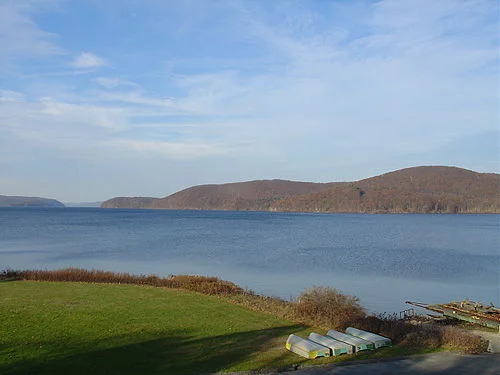
The Quabbin Reservoir, in central Massachusetts.
From Robert Whitcomb’s “Digital Diary,’’ in GoLocal24.com
One of the lethal challenges facing other animals as humans relentlessly develop land and destroy natural habitat is that there are smaller and smaller parcels for wild creatures to roam in. But local conservationists are working hard to try to address this as best they can.
For example, in Petersham, Mass., a $7 million federal Forest Legacy grant and a $1.2 million Massachusetts Landscape Partnership grant are helping to fund the protection of Chimney Hill Farm -- 760 acres of forest and fields -- as part of the Quabbin Heritage Landscape Partnership. The ambitious partnership seeks to ensure that there are long stretches of contiguous countryside in north-central Massachusetts.
The aim has been to create “a vast, interconnected 130,000-acre quilt of conservation land made up of different but adjacent protected lands that include state parks and wildlife management areas, working farms, wildlife sanctuaries and privately owned woodlands, a remarkable result for one of the most densely populated states in the country,” Jay Rasku, stewardship and engagement director of the Mount Grace Land Conservation Trust, one of the partners, told The Worcester Telegram.
More animal species will go extinct without many more efforts like these. Some opportunistic animals, such as raccoons, coyotes and deer, have learned how to survive in small tracts, in part by eating food planted by or left by humans. But others, such as (usually!) bears, wildcats and many bird species, need spacious protected countryside away from humans.
There are also such obvious benefits (for humans and other animals) of interconnecting these tracts as protecting watersheds.
To read more, please hit this link.
'Hidden crevises'

Work by Mimi Howard in the joint show with Marcia R. Wise, “Where Earth Meets Sky,’’ at Fountain Street gallery, Boston, through Nov. 25. The gallery says: “Mimi Howard’s work is inspired by a fascination with the magic and beauty found in nature, especially in the garden. Each vessel is a unique combination of hand-built and wheel-thrown parts that are then fired multiple times in a kiln. Howard’s sculptures have a tactile quality that allows those who see and touch it to readily experience the work's fluid movement and its natural edges, turn and hidden crevices.’’