
Vox clamantis in deserto


William Morgan: In a N.H. town, an oasis of high artistic creativity
The MacDowell Colony, a 400-acre artists' retreat in the woods in Peterborough, N.H., represents one of the most notable gatherings of creative energy anywhere. It is a refuge, an oasis, a special place where writers, musicians, and all kinds of visual artists, come to create. It provides, its mission statement declares, “an inspiring environment” in which artists can produce “enduring works of the imagination.” Despite its many famous alumni, MacDowell is successful because it is virtually inaccessible to the world beyond.
Artists, ranging in age from 25 to 80, are “here because they want to be,” says the resident director, David Macy. Competition is fierce for a place to work alone all day in the silence of the forest, in sight of Mount Monadnock. One thousand applications are received for just the summer session. The reputation of MacDowell is such that a MacDowell residency bestows an immediate career boost. (MacDowell alumni have garnered 65 Pulitzer Prizes.) The sole criterion for acceptance is artistic excellence.
Since the colony’s founding, in 1907, by composer Edward MacDowell and his pianist wife, Marian, over 8,000 artists have traveled far from New York lofts and ateliers around the globe (a tenth of the residents are from abroad) to make art there. Around 300 colonists come to MacDowell every year, and are blessed with housing, a place to work, good food, and the precious gift of time. Thirty-two studios provide working space from anywhere from two weeks to three months, but the average fellowship is for a month.
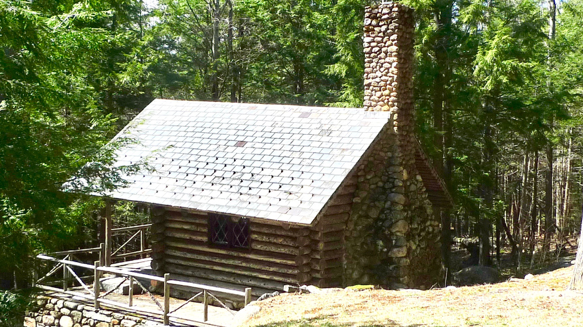
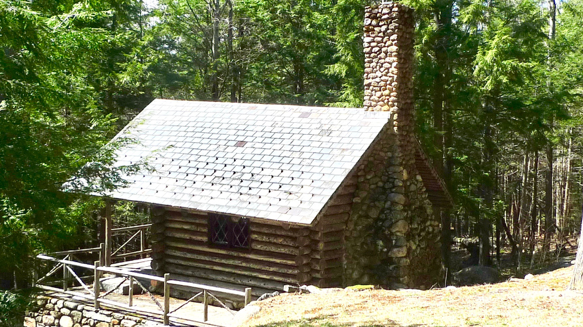
Edward MacDowell's composing cabin.
Thornton Wilder wrote Our Town, which some call the greatest American play, at the MacDowell. Peterborough was apparently a partial model for the town — called Grover’s Corners in the play. Leonard Bernstein and Aaron Copland found the quiet to compose here, while MacDowell provided succor and sanctuary to such writers as Willa Cather, Toni Morrison and James Baldwin. Were their privacy not so carefully guarded, this demi-Eden might have become a magnet for celebrity watchers.
The colony welcomes the public only one day a year when its awards the MacDowell Medal. Medalists have included Edward Hopper, Georgia O’Keeffe, Norman Mailer, Isamu Noguchi, Merce Cunningham and Stephen Sondhiem, among others. In 1997, the colony itself was awarded the National Medal of the Arts, America’s highest honor for an artist or an art patron.

One of the musician’s cabins.
A stay at MacDowell can feel a bit like visiting your favorite grandmother on the family farm. This kind of idyll, however, is hard won. Running a community with 30-some residents at all times, an equal number of staff, and a spread out physical plant requires extraordinary management skills. Despite an endowment, millions of dollars need to be raised every year to keep the colony going. Director Macy, who dropped out of biomedical engineering to go to art school, has been the ideal colony shepherd for almost a quarter of a century.
This is a campus like few others. Colony Hall, the administrative hub and center of post-studio social life (residents have breakfast and dinner here, but lunch is delivered to the individual studios), was repurposed from a late 18th-century barn. Concord, N.H., architect Sheldon Pennoyer renovated the building a decade ago to comply with current building codes. Although reminiscent of the main hall at one’s childhood summer camp, no attempt was made to hide the changes or make it overtly rustic. Pennoyer was also responsible for the recent renovation of a hundred-year-old music studio
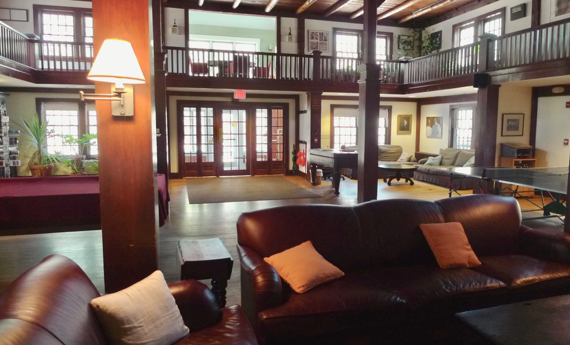
Colony Hall.
That same frugal but playful spirit infused the other studios, most of which are scattered deep in the woods; some are in outbuildings and barns. The progenitor was small log retreat that Marian built for her ailing husband. After his death in 1908, she began building a series of non-pretentious workspaces. There are painting studios with high ceilings and lots of light, musicians have pianos, and suitable equipment is supplied for sculptors. The emphasis is decidedly woodsy, and the studios have fireplaces and rocking chairs. All display “tombstones,” wooden tablets inscribed with the names and dates of everyone who has worked in that particular studio.
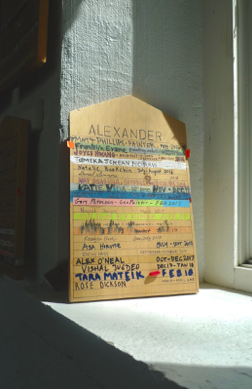
A tombstone in Alexander studio.
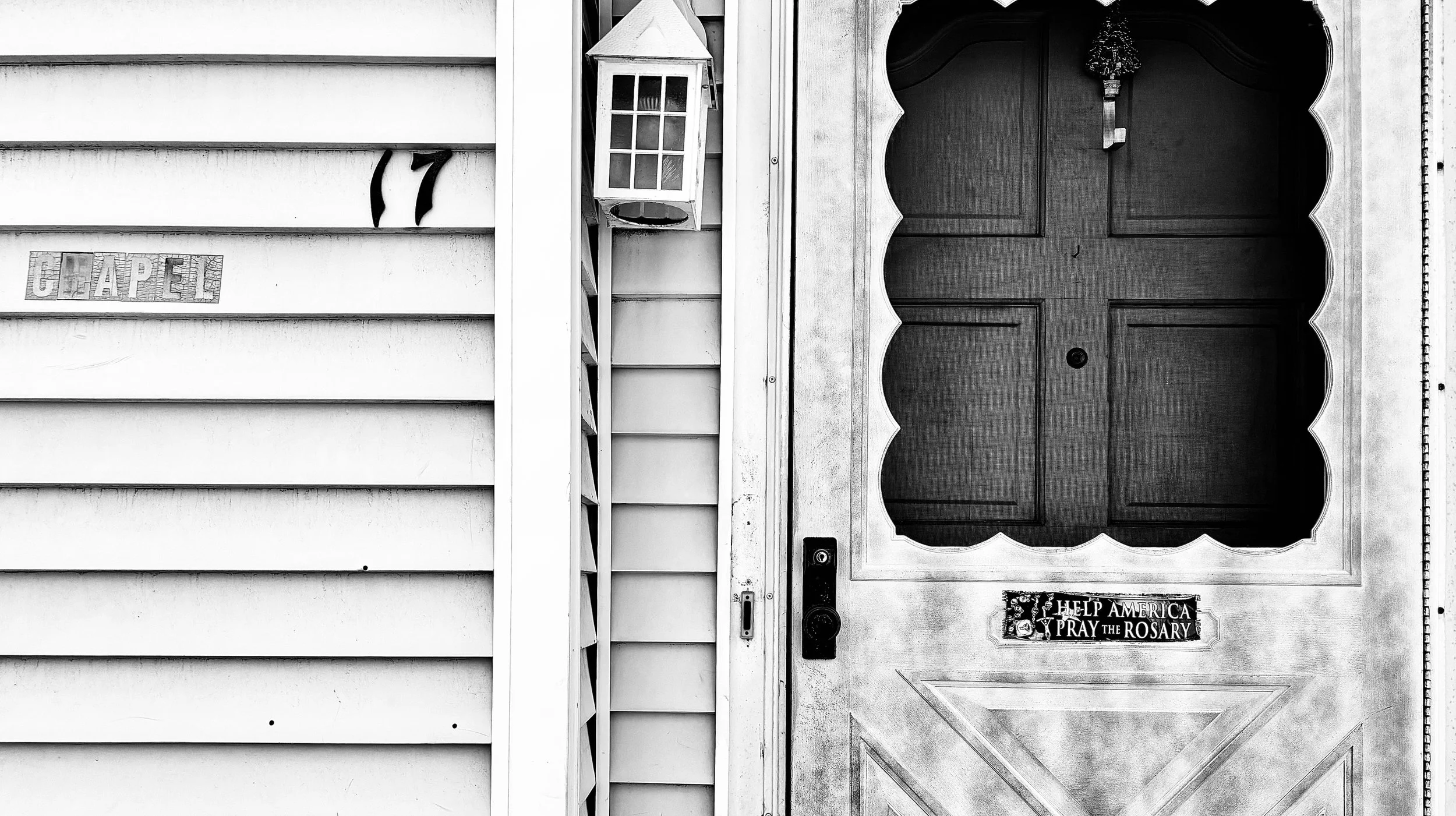
The MacDowells, who met while studying in Germany, had a favorite monastery in Switzerland that provided inspiration for most the most impressive studio. The widow of the noted American portrait painter John White Alexander built this stone “chapel” as a gallery. Although impractical as an exhibition hall, it is now a most sought-after studio, with tall ceilings, exposed beams, and a giant north window.
A major part of the work of running MacDowell is maintaining and updating the mostly early 20th-Century studios; they are in constant use, but they also needed to be made more energy- efficient.Ca
A few years ago MacDowell decided “to combine comfortable vernacular forms with architecturally sophisticated ones,” remarks New York University architectural historian and colony board member, Carol Krinsky. Cambridge, Mass., architects Charles Rose and Maryann Thompson designed an interdisciplinary arts studio, but it awaits funding. Calderwood Studio, designed as a writer's haven by Burr and McCallum Architects, of Williamstown, Mass., is a contemporary tribute to its predecessors. Many of the early cottages were built for summer use and have had to be retrofitted for year-round use. So, Calderwood, a writer’s was built, says Macy, “to be indestructible,” with a two-story high living room and a long view across a meadow.
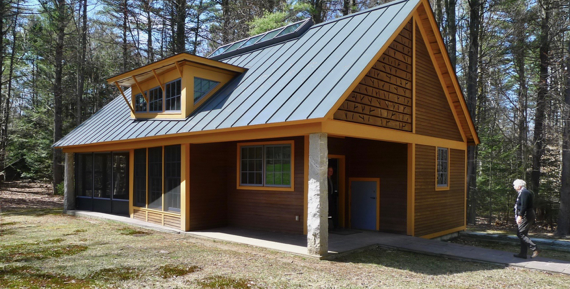
Calderwood Studio.
The 1926-28 stone library by the fashionable Boston architects Strickland, Blodget & Law is similar in its memories-of-medieval-Europe-style to the Alexander studio. Its single 1,000 square-foot, timber-trussed room outlived its role as repository for colony archives and residents' manuscripts, scores, and paintings. In 2013, a 3,000-square-foot addition by Tod Williams Billie Tsien Architects of New York, designers of the Barnes Foundation in Philadelphia and the Obama Library in Chicago, provided a home for such valuables as a first edition of Willa Cather’s Death Comes For the Archbishop, inscribed to Marian MacDowell. This gem of black Québec granite has been sensitively grafted to the meadow and woods by the equally exceptionable landscape architects, Reed Hilderbrand, of Cambridge, Mass.
Announcing its quiet presence is an outdoor fireplace that stands like an ancient stele, honoring the theme of the studio hearths. The selection committee liked that the design was “both harmonious and deferential to the older building,” Professor Krinsky recalls. It was “beautiful, sturdy outside, calm, light, and expansive inside.”

Outdoor fireplace, original library and new library.
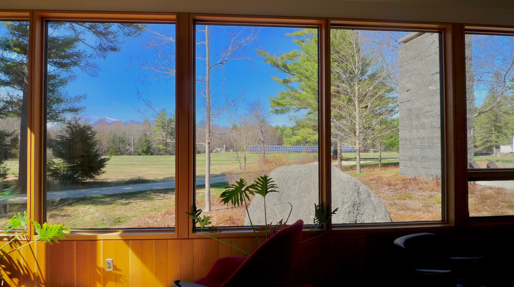
View from the library.
Like the colony itself, the library wears the names of its famous designers lightly. This maybe one of the handsomest pieces of architecture in New England, but it is modestly tucked away, there to reinforce the MacDowell Colony’s role as an incubator of genius.
William Morgan is a Providence-based architectural historian and essayist. He conducted an historic resources study of Peterboro in 1971-72, and is the author, among other books, of Monadnock Summer: The Architectural Legacy of Dublin, New Hampshire.
A teen's suicide and a football coach in Portsmouth, R.I.

Student-created mural at Portsmouth High School.
Here’s the executive summary of a report, by lawyer Matthew T. Oliverio, on the death by suicide of 15-year-old Nathan Richard Bruno, a student at Portsmouth High School. The Newport Daily News continues to press for more information on this case.
newportri.com
EXECUTIVE SUMMARY
A. Scope of Assignment
At the direction of the Portsmouth School Committee, I have investigated the facts and circumstances relating to a complaint filed by Richard Bruno, parent of the late sophomore NB. In summary, Mr. Bruno contends that Head Football Coach Ryan Moniz, and others, intentionally or unintentionally placed an undue amount of mental and emotional stress upon his son in the weeks and days leading up to his tragic death causing the 15-year-old NB to feel isolated, shamed and bullied to the point where his only escape from the pressure was to end his life on February 7, 2018.
The scope of my investigation was to determine if any teacher, coach, staff member or member of the administration violated any current policies, procedures and protocols in their interactions with NB, and in particular those interactions with NB once it was determined that he was involved in a pattern of harassing conduct directed toward Coach Moniz. My assignment was not to determine the cause of NB's death, although officially it has been ruled a suicide. I have interviewed 36 individuals; other individuals had been contacted for information, but for reasons undisclosed refused to speak with me or never returned my call to schedule an appointment. Many of those interviewed were friends or acquaintances of NB, and some of them are members of the high school football team. In all cases, I insisted on meeting or speaking with the minor students in the presence of their guardian or parent. My investigation also consisted of reviewing memos, numerous, relevant email communications, text messages, Codes of Conduct, Student Athlete Handbook, Superintendent interview summaries, letters of complaint regarding Coach Moniz, letters of support regarding Coach Moniz, Professional Development summaries, school district policies, performance evaluation forms, educational records and autopsy report.
A consistent theme expressed by parents of students whom I interviewed was a concern that their participation could lead to retaliatory measures or adverse actions against their child by a coach, the football community or anyone else affiliated with the athletic program. I assured them that by participating in this investigation, it would be against the law for the school district or any elected or appointed town official or its agents to retaliate in any form. Accordingly, this summary and my comprehensive Confidential Report come with the firm admonition that no retaliatory measure can be taken for one's participation in this investigation .
B. Summary of Findings and Analysis
Another common theme emerged among the individuals l interviewed: Coach Moniz can be a polarizing figure. He is either revered, primarily by the supporters of the "Gridiron Club" or he is despised and loathed. Many of the parents/grandparents I interviewed expressed that the coach could be vulgar and abusive at games, disrespectful, over aggressive in language and demeanor, and unwittingly engaged in bullying-type behavior. ln other words, some of these parents find that the coach takes advantage of his position of authority over these adolescents to drive a wedge between various players and to belittle or demean the less talented students or those who do not show the same level of commitment that others possess. What may be construed as motivational behavior on the part of the coach is really controlling, egotistical, manipulative behavior. The supporters of the Portsmouth Gridiron Club, and particularly a football family who was willing to be interviewed, tell a different story. They find the coach to be totally selfless, demonstrating an unwavering commitment and devotion to all players and the football program in general. "Coach Moniz exhibits the type of motivation, knowledge and leadership qualities that make our program the envy of all others around the state."
The Coaches' Code of Conduct is not merely an aspiration, it is a pact between a coach and the players over whom he/she has responsibility and authority, the players' families and the community as a whole. It is not to be taken lightly or used to manipulate a player(s) or to compel adverse behavior to serve the self-interests of a coach. Some of the more relevant provisions include:
"Teachers have a duty to assure that their sports programs promote important life skills and the development of good character....’’
COMMUNITY — In our PHS Community our coaches will:
• Be worthy of trust........... and teach student-athletes the importance of integrity, honesty, reliability and loyalty.
• Model good character.
• Promote sportsmanship not gamesmanship.
ACHIEVEMENT — in order for our student-athletes to achieve our coaches will:
Be a worthy role-model.
• Strive to provide a challenging, safe, enjoyable, and successful experiences for the athletes.
RESPECT — Coaches will:
• Treat all people................ with respect all the time and require the same of student-athletes.
• Be a good sport, teach and model class.
• Use positive coaching methods to make the experience enjoyable, increase self-esteem and foster a love and appreciation for the sport.
EXCELLENCE — In order for our student-athlete to excel our coaches will:
• Teach student-athletes positive life skills and always strive to enhance their physical, mental, social, and moral development.
SUCCESS — Our student-athletes will have success as our coaches:
• Enforce the guidelines set forth by RIIL regulations and the PHS Student-Athlete Handbook including this Code of Conduct and adhering to the levels of play consistently in all activities and venues even when the consequences are high.
• Assure that student-athletes understand that participation in interscholastic sports programs is a privilege, not a right and that they are expected to represent their school, team, and teammates with honor, on and off the field.
• Require student-athletes to consistently exhibit good character and conduct themselves as positive role models.
Based on the content of the text messages received by Coach Moniz, he believed that a former player was responsible for the inappropriate conduct directed toward him in the form of incessant, harassing phone calls and text messages at night. He had a natural curiosity to ascertain the identity of the individual. Despite the fact that he was aware in early January that NB was the primary culprit (by rumor and by police investigation), he opted to pursue another avenue for outing any other offenders - enlist the services of the existing team players. He wanted to quash any dissension existing among the football players and believed he was justified in doing so under the mantra of"integrity, trust, honesty, reliability and loyalty." He pursued this by calling a meeting on January 10 during which he alerted his team to his personal situation and asked that the team inform him of any knowledge they may have about the prank calls. Accordingly, I find his team meeting held on January 10, although somewhat self-centered, exaggerated and immature by certain players' accounts, did not offend the Coaches Code of Conduct or any other policy.
It was only after the NB came forward to accept responsibility and agreed to apologize on February 2, 2018 where the coach's conduct turned suspect and violated aspects of the Code. First, his text messages by and between Mr. Bruno are most revealing: after having agreed to meet with NB and his father to accept an apology and move forward, on February 6 he reversed course and outright refused to meet with NB and his father unless "NB...provides me with the other two names involved ...provides me with the other two names involved."
“Sorry about the delay. Detective Carlino has reached out to me and told me, like you did, there were two others involved. Unexpectedly, he also told me that two others were current members of our football team. In all honesty, I'm shocked, disappointed, and hurt by this. I put my full effort in building our program which above all else, including providing a positive outlet and to build character in the process. I have never had any issues like this in 8 seasons as the head coach. I need all of the information so I can assess how to move forward from this. I can't move forward without this information. In light of this, I am only agreeing to meet with NB if he provides me the other two names involved.
Thank you, Ryan Moniz.’’ (Emphasis added.)
This simple highlighted statement, tantamount to a threat, unwittingly placed pressure on a father to urge his son "rat out" friends, a person who was trying to do the right thing by coach and son, namely have his son take responsibility, apologize and serve his penance. More importantly, this statement underscores the immaturity of a 39-year-old adult, charged with exhibiting a good example as a role model. Coach Moniz utterly failed in this regard. He knew or should have known that such a threat would have placed a 15-year old adolescent in a compromised or vulnerable position to be disloyal to his friends. In so doing the coach was not a worthy role model and did not enhance NB's physical, mental or social well being and development. Although Coach Moniz professes that no one is at fault, nor could anyone have foreseen these tragic consequences, it cannot be overemphasized that Coach Moniz was cognizant of the influence he had over NB and the pressure that would befall him. Although he denied it, his email communications to NB's father reveal otherwise: "I called for a team meeting after school today. Sorry to put NB and the other two on the clock but this is how I am choosing togo forward with it." (Emphasis added.) This statement exhibits a knowing indifference to the impact that such a and threatening message can have on an adolescent. It clearly implies that NB and two others will be shunned or isolated, unless NB comes forward. To alert NB and his father that all such information will now be shared with many other friends, students and athletes pits NB against his peers. Clearly, these actions did not create or ensure a "safe, enjoyable and successful experience" for NB or his fellow students. This statement is also consistent with the credible accounts of other student/athletes who have stated that the coach had a propensity for encouraging them to disassociate with students whom he considers "quitters" or "bad influences."
Perhaps the most egregious conduct occurred during the course of the team meeting later that day, described in great detail throughout my comprehensive Confidential Report. The reality is that Coach Moniz was short, angry and upset with his team. He was well aware that the vast majority of his student/athletes viewed him as a "father figure, " with trust, confidence, and respect; where winning was paramount . He was by all accounts a tough taskmaster, and those athletes would follow his lead and do as he asked. When he threatened to resign and abandon the team, leaving the room to have them "figure it out," he knew or should have known that such an unwelcome consequence, resignation, would have evoked action on the part of those trusting athletes. Though Coach Moniz did not verbally communicate that the team should use any means, including a visit to NB's home to "figure it out," the implied message was the same. He used his position of power, authority and influence over emotionally charged adolescent students to resolve an adult problem - Coach Moniz 's problem, not the team's problem. In so doing, he knew or should have known that he was causing a schism between members of the team, NB and NB's friends, and he manipulated those relationships to satisfy his own personal interests, despite the fact that NB had stepped forward and was willing to take responsibility.
C. Recommendations
l. Refrain from reappointing Mr. Moniz from serving in any capacity as a coach in the Portsmouth School District for the 2018-19 school year, and until such time as he receives appropriate training, at the Superintendent's discretion, so that he may successfully comport himself to the Coaches' Code of Conduct, the purpose of which through good role modeling is to promote positive experiences in a safe environment and to assist student athletes with important life skills and the development of good character.
This Executive Summary is respectfully submitted to Ana Riley, M. Ed, Superintendent of the Portsmouth School District, on this 6th day of June, 2018.
After all, everyone I interviewed, including the coach, acknowledged that Portsmouth has been infamously dubbed ‘‘Sportsmouth" because sports in general, and the football program in particular, is considered a cult.
'A comely thing'
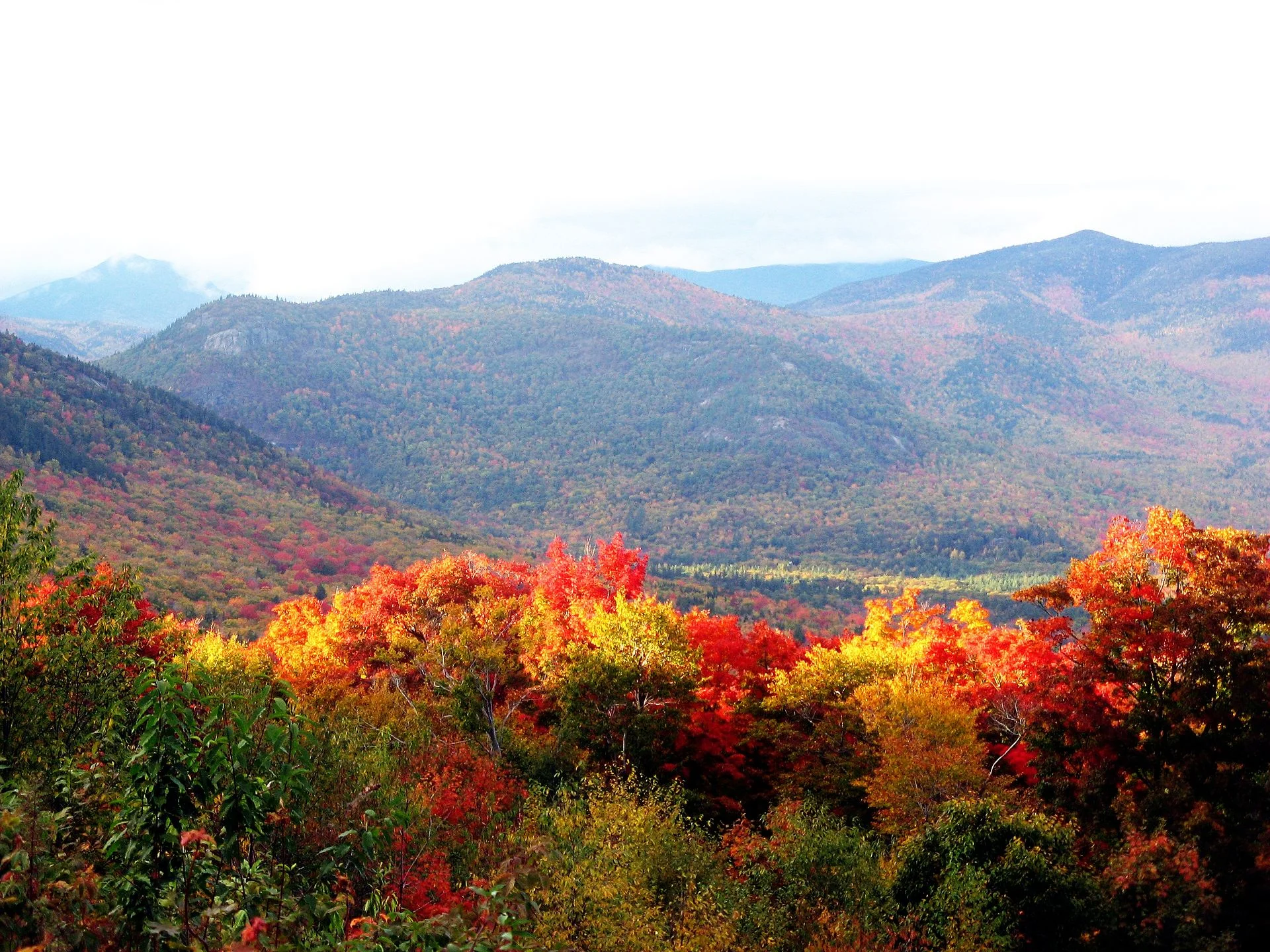
In New Hampshire.
Know'st thou not at the fall of the leaf
How the heart feels a languid grief
Laid on it for a covering,
And how sleep seems a goodly thing
In Autumn at the fall of the leaf?
And how the swift beat of the brain
Falters because it is in vain,
In Autumn at the fall of the leaf
Knowest thou not? and how the chief
Of joys seems—not to suffer pain?
Know'st thou not at the fall of the leaf
How the soul feels like a dried sheaf
Bound up at length for harvesting,
And how death seems a comely thing
In Autumn at the fall of the leaf?
— “Autumn Song,’’ by Dante Gabriel Rossetti

Alex Parnia: A survival kit for small colleges

Nichols College, in Dudley, Mass., with about 1,500 students. The author served as provost there.
Via the New England Board of Higher Education (nebhe.org)
The future looks very bleak for many small and medium-sized colleges and universities in the U.S. According to a report published in Inside Higher Education, the high school graduation rate is expected to drop over the next seven years, and the numbers are aggravated by up to 4.5 million fewer babies being born since the financial crisis of 2008.
U.S. colleges and universities can no longer meet their operational budgets and can finance expansion only by continuing to increase tuition, which is not sustainable. Furthermore, colleges and universities have poured millions of dollars into marketing and advertising in the past 15 years, which has fueled massive competition to attract domestic students; these initiatives have resulted in stiff competition for market share in different regions of the country. Adding insult to injury, Clayton Christensen, the Harvard guru on disruptive innovation, predicts that 50 percent of American colleges and universities will close within the next 10 years. Amid all the gloom and doom, though, there is one strategic opportunity for small to medium-sized universities: incorporating carefully designed international student recruitment into the overall recruitment plan for the next five to seven years.
The landscape of international recruitment has been changing rapidly. Up until 15 years ago, there was a steady stream of international students to the U.S., meaning that some small and medium-sized universities and colleges were able to attract international students to their campuses
In the 1990s and early 2000s, the United Kingdom and Australia made strategic forays into international recruitment. In 2000, the percentage of international students in these countries stood at 5 percent of total higher education students. Today, both nations have reached a 20 percent figure and are probably at their limits. In August 2018, the United Kingdom government decided to include international students in overall immigration numbers to slow down the intake of international students.
In the meantime, Canada has emerged as the next favorable destination for international students, and recent comments from the Trump administration have accelerated the rate of international students heading to Canada by scaring students away from the U.S. Most colleges and universities in Canada are bursting at the seams with international students; therefore, sooner rather than later, the pace of international students choosing to study in Canada will slow.
As a result, the U.S. remains an attractive destination for international students, and the ratio of international students in higher education remains at about 5 percent. However, there is one new hurdle for U.S. colleges and universities: the emergence of multinational companies that have entered into the international student recruitment market in the U.S.
These multinationals, such as Kaplan, Navitas, Shorelight and INTO, and a few other smaller firms are now guiding many students toward attending large public, private, and nonprofit universities. These companies are not interested in working with small to medium-sized liberal arts universities, but they have certainly become a major force in recruiting students on a large scale. This new environment has reached a tipping point in market share, which makes it more difficult for small and medium-sized universities and colleges to recruit directly on their own given their limited resources.
A series of articles in Inside Higher Education revealed a massive infusion of commissions by these corporate recruitment companies, which makes it almost impossible for any small to medium-sized university to mount and sustain long-term international recruitment efforts and compete effectively.
In addition, international recruitment remains a treacherous road. Stories abound of university presidents traveling overseas and coming back empty-handed. There are plenty of land mines, with many fly-by-night agents and bad apples in the mix of overseas recruiting agencies. Consequently, international recruitment requires seasoned staff, who come with expensive price tags.
That’s why it is realistically almost impossible for any small to medium-sized college or university to put together an international recruitment team. In addition, international recruitment requires a substantial upfront investment in marketing, which is impossible to stage. Several colleges coming together to form a recruitment partnership is an idea that faces the same obstacles as the individual universities, such as a lack of expertise, limited resources and the massive upfront marketing and other investments that are required to recruit in more than 100 attractive international markets.
Therefore, the solution lies in forming partnerships with reputable private-sector companies with strong track records that specialize in recruiting for small to medium-sized colleges. There are only a handful of these companies, and they must be vetted and selected carefully to make sure they are the right fit for a specific institution. It is very important that colleges and universities consider forming quality recruitment partnerships with private international companies, given that such partnerships can generate new revenue streams and contribute to campus diversity.
Forming a partnership is the first of many steps that must be taken to internationalize a campus. It is a strategy that requires careful planning; institutions must work closely with the partnering entity to outline successful strategies for bringing international students to campus and orienting them to campus life. The partnership development is the foundation for determining how to serve the international students while also benefiting the host higher education institution. Though not a panacea for the ills of higher education, small to medium-sized American colleges and universities must consider international recruitment as part of their overall strategy for a sustainable future.
Alex Parnia is the executive chairman of Global Education Access, LLC. He previously served as president of EC Higher Education from 2016 to 2018. He was president at Pacific Oaks College & Children’s School from 2012-2015. He also served as provost of Nichols College, in Dudley, Mass,, and executive vice president at Cambridge College, which is now in Boston.
In Braintree, plants seen as 'intelligent beings'

By Debra Claffey, in the show “Tipping Point: Changing Paradigms,’’ at Thayer Academy’s Thayer Art Gallery, in Braintree, Mass., through Nov. 8.
The exhibition features the art of Elemental, an all-female art collective made up of Debra Claffey, Patricia Gerkin, Donna Hamil Talman and Charyl Weissbach. The gallery says: “Each artist uses encaustic wax and mixed media to convey the connection between all living things and humanity's responsibility to help our planet. As Debra Claffey says, ‘We must begin to restore the balance in the relationship of human to nature. My daily reminder is that plants and trees are intelligent beings that we have disrespected in so many ways, and we must find ways to reconnect."‘
Braintree was the birthplace of presidents John Adams and his son, John Quincy Adams, as well as statesman John Hancock. Gen. Sylvanus Thayer, the "father of West Point", was also born in the town. The academy, conceived in 1871 at the bequest of General Thayer, who was also founder of the Thayer School of Engineering at Dartmouth College, was established in 1877.

Braintree was also the site of the internationally famous/infamous case in which Nicola Sacco and Bartolomeo Vanzetti, Italian-born American anarchists, were controversially convicted of murdering a guard and a paymaster during the April 15, 1920 armed robbery of the Slater and Morrill Shoe Company in Braintree. They were convicted and executed.
Bigger bridges, bigger traffic

The Bourne Bridge and the Cape Cod Railroad Bridge in the sunset.
From Robert Whitcomb’s “Digital Diary’’ in GoLocal24.com
The Feds are considering replacing, in the next few years, the two highway bridges – the Bourne and Sagamore (there’s also a quaint railroad bridge) over the Cape Cod Canal, necessitating mini-Big Dig construction on the approaches on each side of the canal. Each new bridge would, as with the bridges now, have two lanes in each direction, but with an additional lane at each end to, it is hoped, ease merging.
Prepare for massive summer traffic jams during construction, when, you’d hope, the two existing bridges, built in the Depression, would continue to be open.
But get ready for even bigger summer traffic jams than now after the “improvements’’. Highway expansions quickly serve to lure more traffic, in a variant of Parkinson’s law: Expenditure rises to meet income. The fragile, eroding, increasingly suburbanized giant sandbar will get chewed up even more by development. And officials of its towns will probably feel compelled to widen local roads to deal with more cars coming over the bridges.
Far better if a lot of people could travel to and from the Cape by train. And how about, for example, trains to take people to Woods Hole and Hyannis to meet the ferries to Nantucket and Martha’s Vineyard?
Frank Carini: How to start blocking catastrophe

From ecoRI News (ecori.org)
History will not be kind to many of us, most notably Baby Boomers, Millennials, the Joneses and Gen Xers. We’ll be remembered for savaging the planet even though we knew better. We’ll be synonymous with selfishness. Our hubris will be infamous.
The latest projections from the U.N.’s Intergovernmental Panel on Climate Change (IPCC) aren’t pretty: widespread drought, food shortages, and a mass die-off of coral reefs, perhaps as soon as 2040. Our collective modus operandi will be to ignore the report’s facts, discredit its science, and blame more frequent and intense storms and raging wildfires on everything but the burning of fossil fuels, our unrelenting procreation, and human arrogance, from flatulent bovines to the pesky sun.
We’ve been ignoring climate change for generations. Even though our 140-character attention span was recently increased to 280, the issue is too big for our selfie society to take the time to understand. Plus, if we did, we’d actually have to change our behaviors and reduce our consumption.
The future other generations — and many of us — are facing will be even crueler to the desperate and will be more devoid of biodiversity. More people will suffer and more species will be lost. And you know what, the sad truth is we don’t give a damn — at least not enough of us, at least not yet.
The daily news cycle largely ignores the topic of climate change, because it doesn’t change much from day to day. It can’t be measured in polls, there aren’t many sexy soundbites, and it doesn’t get good ratings. Plus, much of the media can’t be bothered to focus on a slow-motion crisis that impacts everyone and everything on the planet.
The IPCC’s recent report, which was released Oct. 8, warns that world governments have only a dozen years to take meaningful action. The reaction so far to the latest climate warning? You can hear what’s left of the world’s crickets chirping.
With recent climate-change projections being more dire than previously thought, heading off disaster and suffering will require a massive effort from governments around the world. Unfortunately, generations’ worth of evidence shows there’s little reason to believe that humanity is up for the challenge.
The kind of political will and movement away from partisan pandering required to make the necessary changes could be driven by a nagging public, but that sort of pressure depends on the collective public diverting its attention away from the latest iPhone, the escapades of real housewives, the D.C. follies, and the fortunes of sports teams. The odds are against that, which is exactly what the profiteers want. We’re easily distracted when the status quo yells “squirrel.”
For instance, the recent U.N. report, which stresses the need to protect and restore forests, was released two weeks after more than 200 organizations, elected officials, and scientists unveiled their Stand4Forests campaign. The nationwide effort demands the protection of forests as a vital climate solution and warns against false technology solutions such as bioenergy with carbon capture and storage. The campaign’s message has largely been ignored.
“Climate science shows that we cannot stop a climate catastrophe without scaling up the protection of forests around the world,” according to Stand4Forests supporters.
In Rhode Island, the ongoing debate surrounding the protection of forestland provides a microcosm of the world’s larger problem. During the past several years, Rhode Island has clear-cut forest, both young and oldish, to build a casino and an office park, and to accommodate other revolutionary ideas, such as a fossil-fuel power plant. There’s a current rush intensifying to chop down forests to build solar arrays, to help power our growing collection of mobile devices and televisions. To defend this shortsighted practice, some profiteers have argued that this sacrifice is necessary to protect the environment. They ignore the land we have already ruined for use as potential solar fields.
Just because renewable energy is much cleaner than fossil fuels doesn’t mean that such projects have the right to be sited irresponsibly.
The current recorded amount of carbon dioxide in the atmosphere is nearly 406 parts per million (ppm) — well beyond the 350 ppm that climate scientists have deemed safe for humans, never mind most of the planet’s other living inhabitants.
Nevertheless, the U.S. forest industry, for one, is rapidly replacing much of the nation’s mature forests with younger forests and commercial tree plantations. Degraded and fragmented woodlands are far less effective at storing carbon than old-growth forests, they are more vulnerable to wildfires, and they aren’t nearly as helpful when it comes to flood prevention.
Forests, especially mature ones, also provide clean air and fresh water, are home to thousands of species of plants and animals, and are a vital necessity when it comes to addressing climate change — should we ever really decide to.
Part of a true action plan, according to the Stand4Forests campaign, should include:
Ending subsidies for false solutions such as industrial-scale bioenergy and genetically engineered trees.
Investing in forest protection as a resiliency and adaptation strategy for communities vulnerable to the impacts of pollution and climate change.
Developing just economic transition strategies for communities dependent on an extractive forest economy and provide more options for landowners and municipalities to keep forests standing and thriving.
Rhode Island could also start doing its part, beyond signing toothless executive orders, ignoring policy recommendations, and supporting schemes such as voluntary compliance.
The time is now for Rhode Island and the rest of the world to reflect on our behaviors, actions, and attitudes that are bankrupting the future. The only real answer to mitigating our life-changing impacts is sacrifice. It starts with you.
Frank Carini is the ecoRI News editor.
We don't get mawkish

“Jonathan is a musician and my best friend. I hope he does not read that last part. I would never call him my ‘best friend’ to his face. I am from Massachusetts and he is from Connecticut, and New Englanders do not say things like that.”
― John Hodgman, from Vacationland: True Stories from Painful Beaches
Granitic courage

A cemetery in Camden, Maine. The poet lived for a time as a young person in Camden, which has since become a rather wealthy summer-resort town..
“The courage that my mother had
Went with her, and is with her still:
Rock from New England quarried;
Now granite in a granite hill.’’
From “The Courage That My Mother Had,’’ by Edna St. Vincent Millay (1892-1950), who grew up on the Maine Coast.

Llewellyn King: Brexiteers have no clear road map so it's fear and chaos for business

Anti-Brexit demonstration in Birmingham, England.
WEST WARWICK, R.I.
Blimey! What a cock-up!
That is what you might say in British vernacular about the mess that Britain is dealing with as it struggles to leave the European Union by March 29, 2019.
With the deadline in clear line of sight, there is no exit plan and Britain is becoming -- depending on whom in the Great British Divide you ask – either critically alarmed or hysterically impatient.
British industry and the whole import-export infrastructure are in panic. Supply lines need to be adjusted and possibly new ones established. Manufacturers are wondering whether it will be possible to continue as Britain-based or whether they should up and move to Europe. The British motor industry, which is not owned in the United Kingdom any longer, is a case in point. Jaguar and Land Rover may be iconic marques, but they are Indian-owned, and will they always be made in Coventry, England? Can London remain the financial center of Europe when Paris, Dublin and Frankfurt are scrambling for the title?
On the impatient side, Brexiteers are screaming for an end to the European linkage no matter what.
In the middle, and in a muddle, is Prime Minister Teresa May, distrusted by the extreme Brexit supporters and considered incompetent by the “Remainers,” who still hope that there will be a miraculous reprieve from the referendum vote of June 29, 2016.
Collectively, the British media are not helpful. Most of the press (especially but not exclusively those newspapers controlled by Rupert Murdoch) is for leaving, often vociferously so. When it appeared, in the latest development, that more time may be granted for Britain to find solutions to the thorniest issues, such as the Irish border question, they howled in unison for faster action.
The newspapers, representing almost the entire readership of daily newspapers in Britain, have fought for Brexit and fight against reconsideration: The Daily Mail, The Daily Telegraph, The Times and The Sun are adamantly and relentlessly for Britain getting out, mostly with little regard to the consequences.
You cannot consider these newspapers without understanding that they have played the same role as Fox News in the United States in inflaming nationalism and worries about sovereignty -- a word that has been taken out of history’s locker for the purpose of stirring up antagonism to Europe.
The newspapers I have cited have been aggressively antagonistic to Europe for decades and were, it could be argued, decisive in the “advisory” referendum in which the British public voted to leave Europe by 51.9 percent to 48.1 percent. The die was cast for the most extraordinary change of direction ever voted by a democracy.
The Brexiteers had the advantage of passion, a well-oiled disinformation campaign and the wild-card endorsement of Boris Johnson, the clownish but clever politician who wants to be prime minister beyond all else. David Cameron’s government, which called the referendum, misjudged the electorate through over-reliance on the polls.
Hopes that Parliament will finally assert itself, take charge of Brexit and call another referendum or nullify the first on the grounds that it was not constitutionally binding, are fading. There is wide acceptance in Britain that the nation is set to sail into waters uncharted -- stormy but somehow having the lure of the nation’s explorer past.
Economists are not so sure, and business is looking at decampment to the European mainland.
The Brexiteers see a glowing new era for Britain, which shed its empire with little pain at home, and they may feel this will happen again. British creativity has always been one of its great strengths; for example, creativity in technology which contributed to the success of the empire, including John Harrison’s chronometer and James Watts’s steam engine.
The British will continue to create, to be sure. But how will they sell their creations if they have exempted themselves from their largest market?
The United States, if we do not choke off all immigration, can look forward to a surge of British talent coming across the Atlantic.
Llewellyn King, based in Rhode Island and Washington, D.C., is executive producer and host of White House Chronicle, on PBS. A native of Zimbabwe (formerly Southern Rhodesia), he was a journalist in England before moving to America, where he has been a columnist, editor, publisher and international business consultant. His email is llewellynking1@gmail.com.

Diversified fishing; Shifting away from the Sunbelt

Cultured sea scallop.
From Robert Whitcomb’s “Digital Diary,’’ in GoLocal24.com
A wonderful story and video by Maine Public Radio’s Fred Bever describes how Maine fishermen are diversifying to address the challenges posed by overfishing and global warming.
Mr. Bever writes:
“These days it’s mostly lobster, but he {fisherman Marsden Brewer} has fished cod and shrimp, and carted urchin to market. They were all once-vibrant species, but now they’re mostly off-limits after being overfished and weakened by climate change.’’ And Mr. Brewer has moved in a big way into scallop aquaculture.
Jon Gorman, who works at Bangs Islands Mussels, told Mr. Bever:
“I see a lot of growth and you never know. We’re going to be doing scallops, then we’ll be back to mussels, and then the springtime and fall we’re into kelp. It’s fun.”
There are some good ideas in the story for southern New England fishermen.
To see and hear Mr. Bever’s report, please hit this link.
As global warming intensifies, and extreme storms, drought and floods ravage some areas, some predict a reverse migration of people from the southern and western U.S. to such places as the Upper Midwest and inland (!) New England, whose climates are expected to remain relatively moderate and that will continue to have lots of fresh water, which is actually better to have than oil, coal and natural gas!
The big population move to the Sunbelt, with all its socio-economic and political effects, may reverse in the next couple of decades – or before.
By the way, water temperatures in the Gulf of Mexico are four degrees warmer than “normal’’. They’ve often been warmer than “normal’’ for some years now, and at the moment are about 85 degrees. This means more fuel for hurricanes – e.g., Hurricane Michael. Keep burning those fossil fuels and maybe we can get the Gulf up to 95 degrees in the summer in a couple of decades. There won’t be much sea life left, but it will be perfect for a soothing swim. To read more, please hit this link.
Keeping up appearances at the Groton School
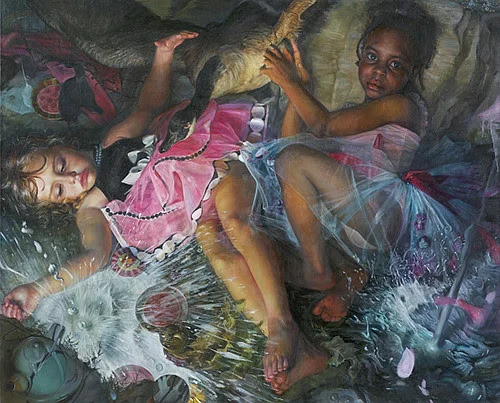
“The Tea Party’’ (oil on linen), from the series “Babes the Woods,’’ by Margaret Bowland, in her show “It Ain’t Necessarily So,’’ at the de Menil Gallery, at the Groton School, Groton, Mass., through Nov. 9. The gallery says that Ms. Bowland “creates realistic, detailed portraits of costumed or made-up women and girls. Bowland demonstrates how much women must change themselves in order to be conventionally attractive and appeal to others. At the same time, women try to express themselves through the makeup and costumes.’’
The Groton School (see picture below), founded in 1884 and in an affluent Boston exurb, was the alma matter of some famous people, most notably Franklin D. Roosevelt, and a symbol of New York-New England WASP “old money’’ families. Louis Auchincloss’s most famous novel, The Rector of Justin, is roughly based on Groton, which is affiliated with the Episcopal Church (natch!), and its formidable founding headmaster, The Rev. Endicott Peabody. Auchincloss graduated from Groton in 1935 and died in 2010.
Groton is also known for its beautiful old houses and its apple orchards.
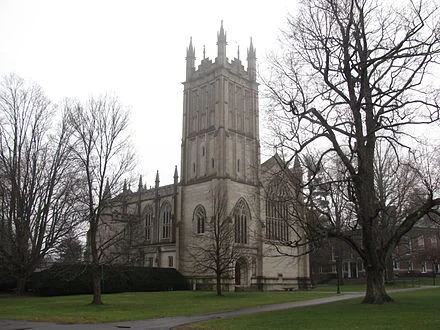
The chapel at the Groton School.

Gibbet Hill, in the lovely Groton countryside.
Too rich for Providence?
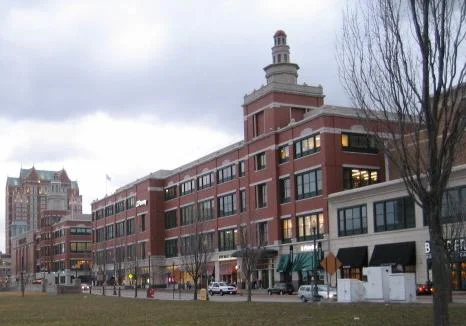
Providence Place
From Robert Whitcomb’s “Digital Diary,’’ in GoLocal 24.com
‘Nordstrom’s announcement that it will close its store in Providence Place, in the Rhode Island capital’s downtown, didn’t surprise me. I was always skeptical that a large high-end department store could succeed in Providence; I’m surprised that it has lasted this long. There aren’t all that many very affluent people around here, and some of them do their expensive shopping in relatively near – and very big – Boston and New York. Boscov’s, which will take Nordstrom’s place, is mid-to-down-market.
Further, the rise of the Internet has posed a huge threat to large department stores in general, except for very down-market chains such as Dollar General.
As I’ve written before, what will survive and, in some places prosper, are some smaller specialty stores with close connections with affluent neighborhoods – e.g., Wayland Square, in Providence, and Main and Water streets in East Greenwich – or in destination/resort towns such as Newport.
Nordstrom’s exit is a blow to Providence Place, and more are likely to come. But the huge building does have something big going for it: It is a very attractive and solid complex made of good materials and all or part of it could be retrofitted for other purposes, such as education, health clubs (with swimming pools!), state and/or city offices and even a hotel or two. It’s not your typical big-box-based suburban mall.
Maybe a company called Scape, which runs student housing in the United Kingdom, Australia and Ireland, should look at Providence Place. The Boston Globe reports that the company says, in The Globe’s words, “that it will spend $1 billion over the next few years to develop privately run student housing in Boston, and it will also locate its North American headquarters in the city.’’
The Globe continues: “It’s a move that could help meet the huge demand for college housing in Boston, where an estimated 36,000 undergraduate and graduate students live in off-campus apartments, and establish a new model for student housing here — independent of any particular school and less taxing on universities’ already-tight budgets.’’ Lots of college kids in Providence, too.
To read The Globe’s story, please hit this link.
Jill Richardson: Chapter 2 in Elizabeth Warren's Native American ancestry political saga
Massachusetts Sen. Elizabeth Warren recently released DNA results as evidence she has a Native American ancestor. Trump, meanwhile, has been referring to Warren as “Pocahontas” to ridicule that claim.
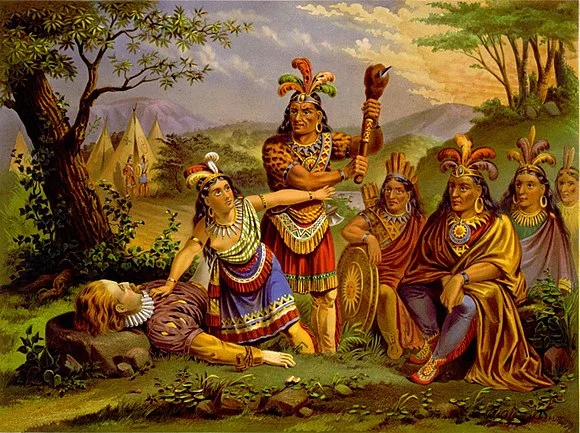
The two show useful examples of different kinds of racism and stereotypes. (See picture below.)
Trump’s racism is obvious. He’s using the name Pocahontas as a racial slur. He means to target Warren, but he doesn’t mind being hurtful to Native Americans either.
Trump doesn’t seem to pay much of a price for saying this. His base apparently loves it, and the rest of us seem to numb to be shocked anymore. Trump’s doing exactly what we expect him to do.
Warren’s gotten some criticism too, though.
She’s a progressive Democrat, and her base holds her to a higher standard. They would never vote for Trump anyway, and Warren might run for president in 2020. Warren’s base wants to vote for someone who reflects their values.
But while liberals (specifically, white liberals) usually abhor overt racism, many still practice more subtle forms of it. It’s less obvious than when people use racial slurs or clearly say they do not like a specific ethnic group.
It’s when a white person treats a person of color as if they’re exotic, or fetishizes them. Or when a white person doesn’t notice or care about racial dynamics and inequality because they don’t have to. Or when a white person doesn’t believe a person of color has faced racism just because the white person didn’t see it and has never experienced it themselves.
In this case, Warren is stepping into a sensitive issue. For one thing, what makes someone a Native American?
Do you have to be raised within the culture of your tribe? How can one measure that? Who gets to be enrolled as members of each specific tribe?
Or do you have to have Native American ancestors? What percent of your ancestry must be Native American for you to qualify?
That’s something for Native American tribes to decide for themselves, not for others to speculate on or decide for them.
The point is that Warren stepped into a controversial issue without much sensitivity for the people who are most affected by it.
The Cherokee Nation issued a statement disapproving of Warren’s use of a DNA test. One Native American journalist, Jacqueline Keeler, said that Warren’s use of DNA as evidence reinforces the idea of Native Americans as a race and thereby undermines their claims of citizenship in sovereign nations.
In this case, the liberal white racism may seem subtle: It was Elizabeth Warren thinking that she had the right to speak on Native American identity without checking with Native Americans and becoming educated about the issues related to it.
Some also say it was Elizabeth Warren using Native American identity to bolster her own political career without concern for how her use of it might harm Native Americans.
However, there are three takeaways here. One is that if you identify as a white liberal, there are good odds that you could do some learning about racial issues and how to combat racism.
The second is that Warren could try to set things right now by educating herself and learning how she can best advance the interests of Native Americans in her political career. She should listen to Native American leaders.
The third is that what Trump did was worse. Far worse. We must remember that, too.
Jill Richardson is an OtherWords.com columnist.
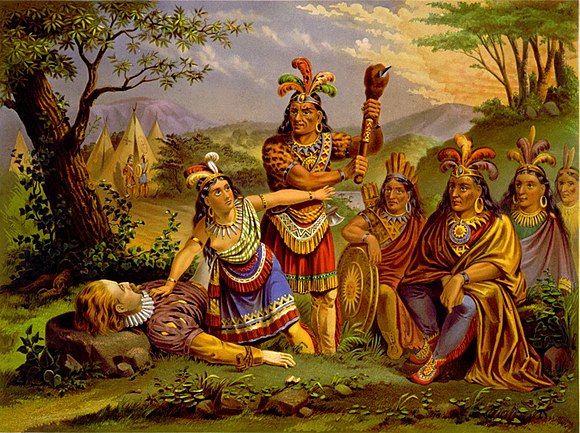
In this chromolithograph credited to the New England Chromo. Lith. Company, around 1870, Pocahontas saves the life of John Smith in what is now Tidewater, Va., in 1607. The scene relies on stereotypes of Native Americans rather than on reliable information about the particulars of this historical moment. There are no mountains in Tidewater Virginia, for example, and Native Americans in the region lived not in teepees but in thatched houses.
Healthy Food Fund grants

At Haymarket, in downtown Boston.
— Photo by Daniel Brody
From the New England Council
Harvard Pilgrim Health Care recently announced its 2019 Healthy Food Fund Grant Guidelines and RFP. The grants will be awarded to 25 local nonprofit organizations throughout Connecticut, Maine, Massachusetts and New Hampshire in efforts to support the growth and distribution of free produce to low-income families and older adults.
Evidence of the fund’s widespread impact is reflected in the data: since 2016, 25 organizations supported by Harvard Pilgrim’s Healthy Food Fund increased their distribution by 116 percent to nearly 1.8 million pounds of fresh produce. In the coming year, $625,000 worth of grants will be awarded to volunteer-powered food access programs that focus on people in rural, low-income, and/or communities of color.
Michael Devlin, Director of Grants & Initiatives for Harvard Pilgrim Health Care Foundation, said, “By mobilizing the energy of local and corporate volunteers to grow, glean and distribute healthy produce for low-income families across our region, we want to create a movement of ‘neighbors feeding neighbors’ and expand the number of citizens advocating for fresh, local, healthy food equity.”
Coming excitement

— Photo by David Lombardo
“Here in the suburbs of New Haven
Nature, unrestrained, lops the weaker limbs
Of shrubs and trees with a sense of aesthetics
That is pratical and sinister….’’
-- From “Ice Storm,’’ by Jane Kenyon
Art meets conservation

From Adam S. Doyle’s "Urban Wildlife: Learning to Co-Exist” show (firestarter, dye sublimated aluminum), at ArtProv Gallery, Providence.

From Patricia Hansen’s show “A Memory of Elephants,’’ also at ArtProv Gallery (charcoal and pastel on paper).
Both connected shows, which run through Nov. 9, look at the consequences of our interactions and interdependency with animals. Art meets conservation. The gallery says:
“‘Urban Wildlife: Learning to Co-Exist’ is staged in collaboration with Creature Conserve (creatureconserve.com), run by Dr. Lucy Spelman, whose aim is to bring artists and scientists together to foster informed and sustained support for animal conservation. The exhibit, which features works by 40 artists, explores the lives of wild animals in urban areas and the human responses to this shared territory. The goal of the show is to encourage the viewing public to take an active role in healthy co-existence with urban animals. Dr. Spelman will also lead a discussion titled ‘Art Can Save a Panda’ at the gallery on Nov. 7 from 6 to 8 p.m.
‘‘‘A Memory of Elephants’ is a mother/child elephant series evolved from a journey in northern Thailand, where Ms. Hansen spent time with former working elephants, now rescued, learning to care for them and developing a bond and mutual trust in the process. Babies of different ages were present as well and the tender mother/child relationship was a joyous, life-affirming thing to witness. Upon her return to the U.S., Ms. Hansen found that the elephants has become a metaphor for her of our relationship to the earth, prompting her to reflect more deeply about the issues of our co-existence and how we need to live now – respectful in a sustainable world.’’

'Preventive Food Pantry'
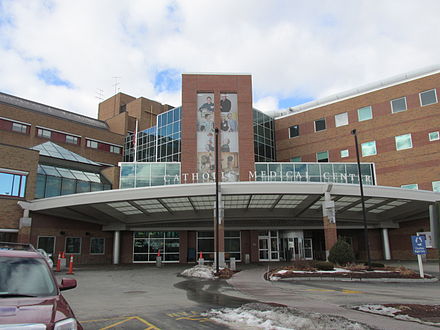
Catholic Medical Center in Manchester, N.H., the state’s biggest city and a former textile mill town (famous for the gigantic Amoskeag Mill, on the Merrimack River; see below). A lot of tech and other business has migrated to Manchester from Greater Boston, of which Manchester and Nashua are now parts.
From The New England Council
Catholic Medical Center recently launched a Preventive Food Pantry for its patients. While programs like this one are growing in nationwide popularity, CMC is the first hospital in New Hampshire to launch such an initiative.
The program is intended to serve patients identified by social workers and nutritionists as having chronic medical conditions such as hypertension, diabetes and obesity by providing them with wholesome foods and nutrition counseling. It will also bridge the gap between physicians, nutritionists, and patients. Upon receiving their prescription, patients will visit the Parish of the Transfiguration Food Pantry to check in with volunteer nurses and then collect their boxes of healthy food. Instrumental contributors to the program include the Bishop’s Charitable Assistance Fund, who provided an initial donation to assist with startup costs, as well as the New Hampshire Food Bank, who will supply the food.

The Amoskeag Manufacturing Co’s mills, on the Merrimack, in 1911. Most of the structures are still there, put to a wide variety of uses. At its height, Amoskeag was the largest cotton textile factory in the world.