
Vox clamantis in deserto






William Morgan: Haunting words and images in Concord
All photos except the last by William Morgan
There are few better ways to spend an autumn afternoon than wandering amidst the headstones in an old New England cemetery. And some of the best old necropolises are in the historic town of Concord, west of Boston. Sleepy Hollow, the large garden cemetery with its Author's Ridge, resting place of Thoreau, Emerson and Hawthorne, is a big draw for tourists. But don’t ignore the Old Hill Burying Ground, overlooking the east end of Main Street, which has an astounding collection of carved tombstones from the 17th and 18th centuries.
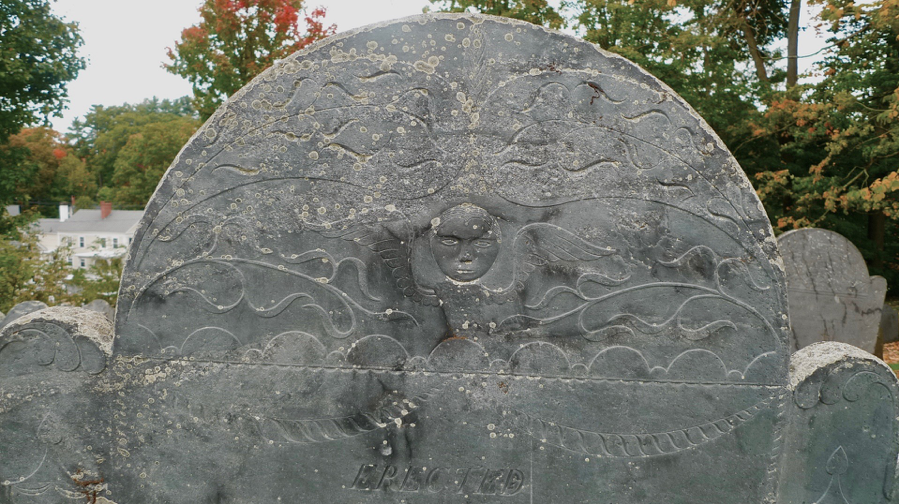
Mary Minot, wife of Jonas Minot, who died at age 54.
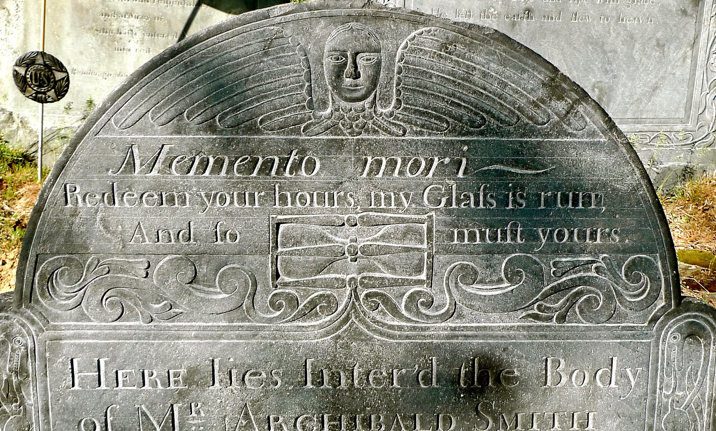
Archibald Smith (1716-1780).
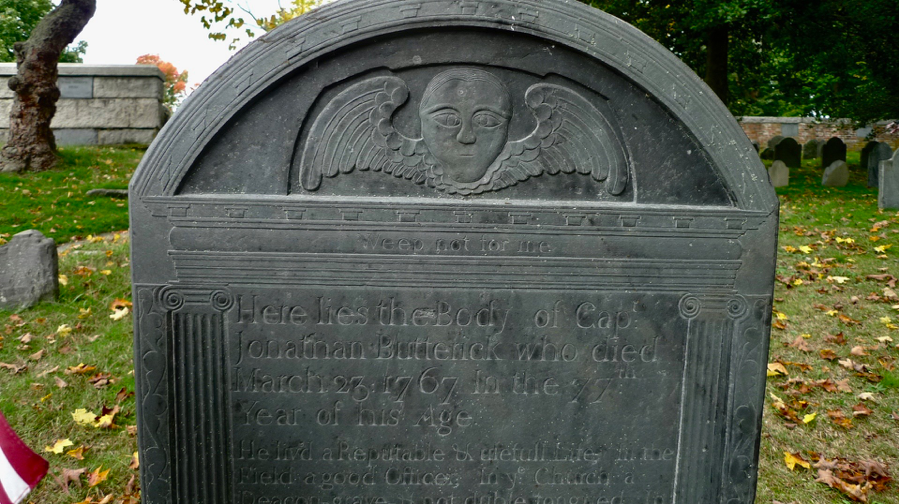
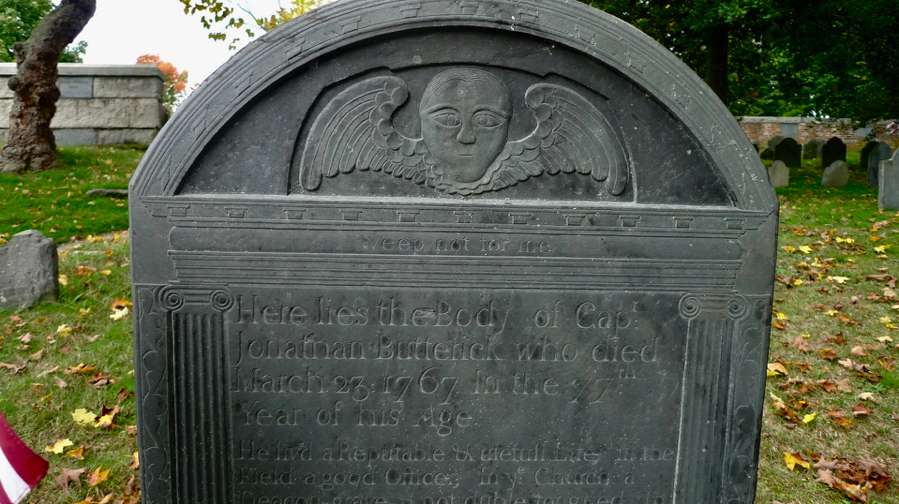
Old Hill contains some classic and noted examples of New England stone carving: seraphim, death’s heads and hourglasses that have run out of time. This is the resting place of Captain Jonathan Butterick (1690-1767). The grave says “Weep not for me’’.
Butterick, according to his stone, "lived a reputable & Useful life; in the field a good officer in ye Church a deacon." He was we can read, "not doubled-tongued; in private life a good Christian, loving husband, a kind father, a friendly neighbor." At his death, he was "followed to his grave by his aged widow & 13 well-instructed children."
Perhaps Butterick's captaincy was in the local militia, the very one that would hold the North Bridge against the King's regulars a few years later. Or perhaps he fought in one of the Indian wars.
But the quaint description of Butterick's life seems almost cozy and quaint compared to the memorial to the Concord men killed in the slaughter of the War to End All Wars, whose centennial we are now celebrating. Just across the street from Old Hill is the town's dark tribute to the carnage of modern warfare.
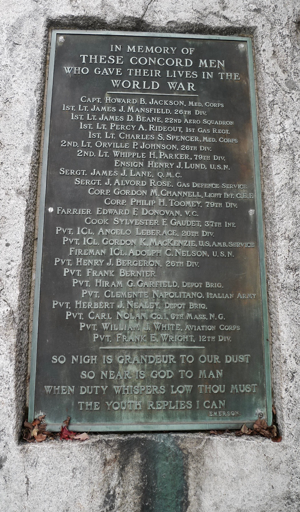
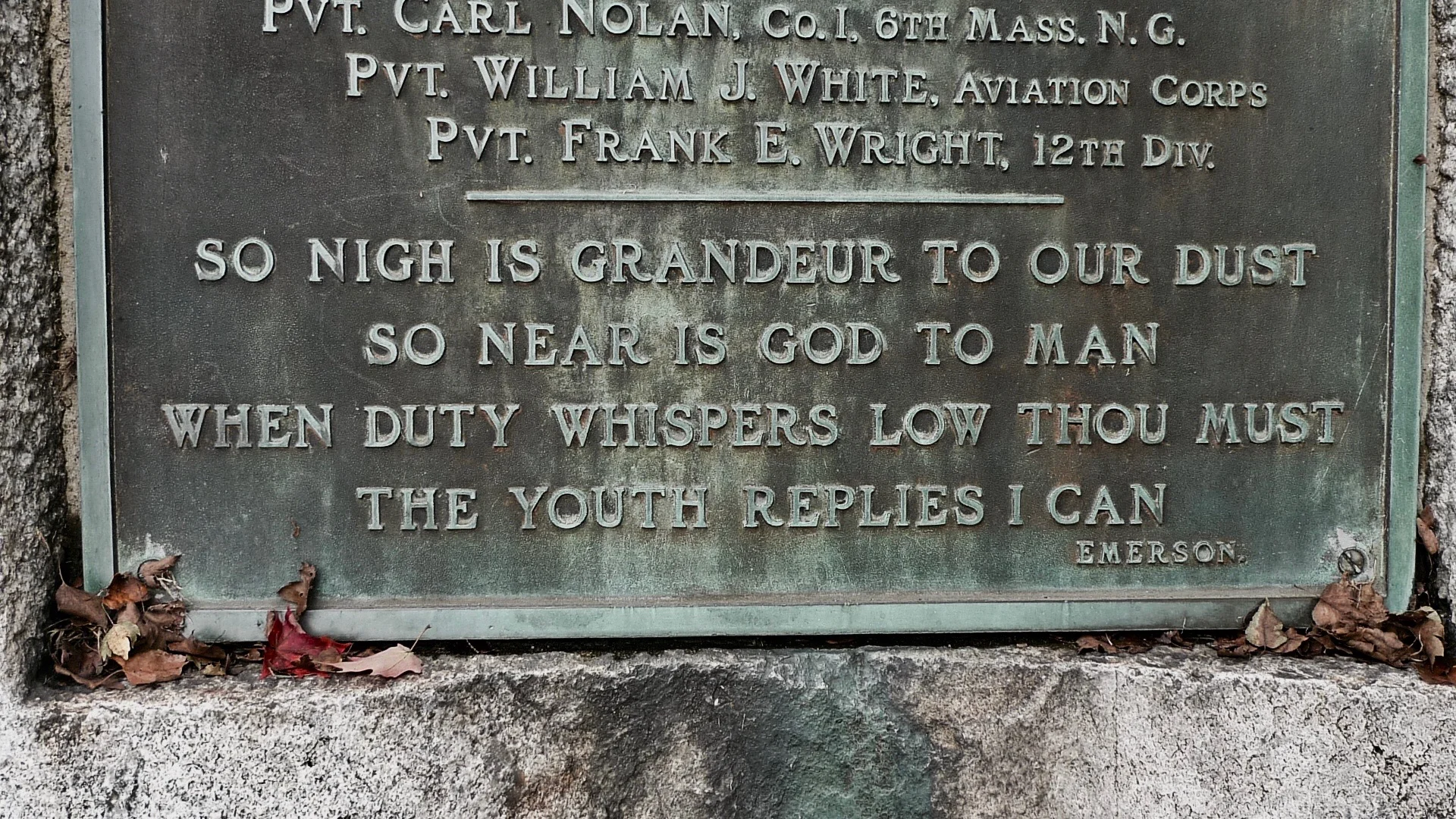
The seemingly straightforward recitation of the names of the 25 "Concord Men who gave their lives in the World War" provides an intriguing history lesson.
There are the usual soldiers, sailors, marines and national guardsmen, plus two deaths in the heretofore-unknown Aviation Corps. Another new wrinkle in modern killing are the members of the 1st Gas Regiment and the Gas Defence Service (given the spelling, were these two different outfits, one British?). There are medical corpsmen, quartermasters and ambulance drivers and maybe the most ancient craft represented, a farrier in the Veterinary Corps.
Being Massachusetts a century ago, there are a sprinkling of French (Gaudet, Bergeron and Bernier), Irish names (Toomey, Donovan) and Italian (Liberace and Napolitano).
Private Clemente Napolitano was in the Italian Army. Was he an immigrant drafted home, or did he go back to Italy to fight in the years before the United States entered the war? Captain Gordon M. Channel was in a Canadian light infantry regiment. Was he one of the many Americans who went north to join up to fight in Europe, not waiting for an isolationist America to confront the Hun?
The list of names tells us little more than the warriors' names and their outfits. Were that not poignant enough, Concord added the words of its own Ralph Waldo Emerson. While eloquent, the sentiment feels more high-minded Victorian, nobler than the grim reaper's cast of local boys lost in a senseless conflict, far from home.
Of course, Emerson has long been associated with Concord. Consider one of the most famous American poems, his “Concord Hymn,’’ written to commemorate the Battle of Concord (and, by extension, the Battle of Lexington, too), on April 19, 1775, at the start of the Revolutionary War. The most famous line is the fourth.
It was read and then sung at the Completion of the Battle Monument, in Concord, on July 4, 1837.
By the rude bridge that arched the flood,
Their flag to April’s breeze unfurled,
Here once the embattled farmers stood
And fired the shot heard round the world.
The foe long since in silence slept;
Alike the conqueror silent sleeps;
And Time the ruined bridge has swept
Down the dark stream which seaward creeps.
On this green bank, by this soft stream,
We set today a votive stone;
That memory may their deed redeem,
When, like our sires, our sons are gone.
Spirit, that made those heroes dare
To die, and leave their children free,
Bid Time and Nature gently spare
The shaft we raise to them and thee.

The Concord Battle Monument, next to the Concord River.
— Photo by Dave Pape
William Morgan, an essayist and architectural historian, is a frequent contributor to New England Diary on the subject of cemeteries, among other topics. He is the author of The Cape Cod Cottage, The Abrams Guide to American House Styles and Monadnock Summer, among other books.
Choke points
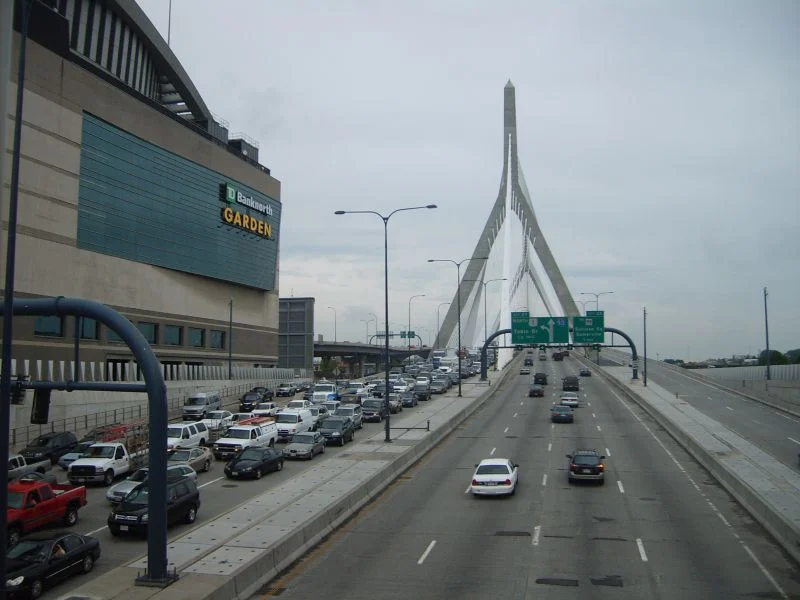
Stay on the right! Near the Zakim Bridge, in Boston.
From Robert Whitcomb’s “Digital Diary,’’ in GoLocal24.com
The Boston Herald, in an Oct. 2 article headlined “Choking on Growth,’’ reported on environmental experts warning about the downside of Boston’s booming economy and thus ever heavier traffic: more air pollution and thus more asthma. Some of this is caused by the fact that there are more commuters, mostly driving alone, and some by such services as Lyft and Uber.
The solutions are obvious: more public transportation and more electrification of the transportation system, meaning more and better subway and street-car lines and more electric-powered private vehicles and places to charge them. To read the Herald piece, please hit this link.
xxx
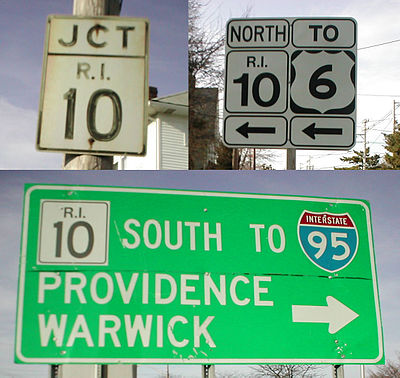
It’s too bad that at this late date the Rhode Island Department of Transportation thinks it has to delay starting reconstruction work on the long-overdue Routes 6 and 10 Interchange project in Providence in order to do another study of lane shifts and closures. The new study might take a couple of months. Apparently this has to do with trying to head off the sort of motorist outrage that accompanied the traffic jams caused by westbound-lane closures needed for repairs on the Route 195 Washington Bridge. But are these situations similar enough to warrant more delays and thus higher costs?
The traffic plan for the 6/10 project was approved in the spring. Are officials reinventing the wheel? Or was the earlier plan somehow clearly flawed? In any event, at least a few of the people reading this will be dead before the project is completed, perhaps in 2024.
The latest snag will almost certainly raise the total cost of the project, which is now estimated at $410 million. But that amount includes $162 million in Amtrak-related work: The interchange crosses the railroad’s Northeast Corridor line. Which makes me think of how nice it would be if there were more rail lines carrying commuters in and out of Providence and fewer polluting and space-taking cars. We can at least hope that the new 6/10 will be less ugly than the current one.
Flat and rounded

“he Gentle Barbarian’(oil on board (top) and porcelain), by Elizabeth Strasser, at the Bromfield Gallery, Boston.

Judith Graham: Mainers to vote on expanding home health care, to be paid for by new tax

By JUDITH GRAHAM
As Election Day draws near, a ballot initiative in Maine to provide universal home care is shining a spotlight on the inadequacies of the nation’s long-term-care system. The essential problem: Although most older adults want to live at home when their health starts to decline or they become frail, programs that help them do so are narrow in scope, fragmented and poorly funded. Medicare’s home care benefits are limited to seniors and adults with disabilities who are homebound and need skilled services intermittently.
State Medicaid programs vary widely but are generally restricted to people at the lower end of income ladder. Long-term-care insurance is expensive and covers only a small slice of the older population. That leaves millions of middle-class families struggling to figure out what to do when an older relative develops a serious chronic illness, such as heart failure, or suffers an acute medical crisis, such as a stroke. “We’re about to have the largest older population we’ve ever had, which is going to need exponentially more care than has ever been needed before. And we’re not prepared,” said Ai-jen Poo, co-director of Caring Across Generations, an organization working to expand long-term care services across the U.S. Maine, with nearly 20 percent of its residents age 65 and older, is exploring a radical response to this dilemma that’s being closely watched by other states.
Its ballot initiative, known as Question 1, proposes that home care services be available to all residents, at no cost, regardless of income. If enacted, it would become the first such program in the nation. Adults would be eligible for the program when they need help with at least one “activity of daily living”: walking, bathing, dressing, eating, toileting, personal hygiene and getting in or out of bed. Services covered would include care from aides and companions; speech, physical and occupational therapy; counseling; home repairs; transportation; respite care; devices for people with disabilities; and even, occasionally, small rent subsidies. Stipends would be granted to family caregivers. Seventy-seven percent of program funds would be directed to home care aides, in a move to strengthen this workforce.
More than 21,000 people could qualify for home care services under the new program, in addition to about 5,600 people who already receive services through Maine Medicaid and other state programs, according to the most definitive analysis to date, published last month by researchers at the University of Southern Maine’s Muskie School of Public Service.
Funding for the new program would come from a new 3.8 percent tax on wages and non-wage income that isn’t taxed by Social Security: a threshold of $128,400 per person in 2018. Between $180 million and $310 million would be raised annually, according to various estimates. The program would be fully implemented by January 2022. The political battle over Question 1 is fierce, although no one questions the need for affordable home care for seniors and people with disabilities.
In AARP’s most recent “Long-Term Services and Supports State Scorecard,” Maine ranked last in the nation on affordability of home care. Among thousands of people affected are Rick Alexander of Blue Hill, Maine. 70, a retired school librarian, and his wife, Debbie, 64, who has multiple sclerosis.
“Since Debbie has a progressive form of MS, her needs are going to increase,” said Alexander, his wife’s sole, unpaid caregiver and a supporter of Question 1. “We brought in some paid help years back, but we couldn’t do that for very long: It’s too expensive.” Alexander wants to keep Debbie at home as long as possible, but he worries about the physical demands and emotional consequences.
“I have chronic clinical depression and periodically I go down into the dumps, a long way,” he admitted. “When that happens, it’s hard for me to motivate myself to do anything.” Also, it’s generally accepted in Maine that something needs to be done about a severe shortage of home care aides — a problem surfacing nationwide. Each week, 6,000 hours of home care services that have been authorized aren’t delivered by Maine agencies because of staff shortages, which are particularly acute in rural areas, according to the Maine Council on Aging.
Despite these areas of consensus, however, disagreements surrounding Question 1 are intense and most Maine health care and business associations oppose it, along with all four candidates for governor.
Taxes are a key point of contention. Question 1 supporters argue that a relatively small number of high-income individuals would pay extra taxes. The Maine Center for Economic Policy estimates that only 3.4 percent of people earning income in Maine would be affected, according to a September report. Citing ambiguous language in the initiative, opponents argue that families earning more than $128,400 would also be subject to the tax hike, significantly expanding its impact. A pressing concern is that higher taxes would discourage doctors, nurses and other professionals from moving to or remaining in Maine.
“We have a workforce crisis already, and this increase — which would make our income tax rate among the highest in the country — would be a disaster,” said Jeffrey Austin, vice president of government affairs at the Maine Hospital Association. The program is too expansive and expensive to be sustained long term, other opponents say.
“We have limited public resources in Maine and those should be dedicated to the people most in need, fiscally and physically,” said Newell Augur, a lobbyist for the Home Care & Hospice Alliance of Maine and chair of the “NO on Question One/Stop the Scam” campaign.
In a statement, AARP Maine, which has not taken a stand on Question 1, expressed reservations. “Using a payroll tax to pay for HCBS [home and community-based services] is an untested policy at the local level,” it noted. Also controversial is the board that would be established to operate the home care program. The initiative calls for nine members (three from home care agencies, three direct care workers and three service recipients) elected by constituent organizations to oversee the program.
“The board wouldn’t be accountable to the governor or the legislature, and Maine taxpayers would have no say over how their money is being spent,” said Jacob Posik, a policy analyst at the conservative-leaning Maine Heritage Policy Center. Supporters note that an advisory committee would include state officials from multiple agencies. The board’s structure is meant to be “responsive to the people providing and receiving the care,” said Mike Tipping, communications director for the Maine People’s Alliance, a grass-roots organization that’s spearheading Question 1 and that helped pass a 2017 ballot initiative expanding Medicaid in Maine, currently tied up in the courts.
For all these policy disputes, it’s clear that Question 1 has considerable emotional resonance. “I’ve never had people cry signing a petition and tell me how much something like this would have changed their lives,” said Kevin Simowitz, political director for Caring Across Generations. One of the people who’s spoken out publicly is the Rev. Myrick Cross, 75, of St. Patrick’s Episcopal Church in Brewer. Cross works part time at the church so he can pay for aides that care for his 38- year-old daughter with Down syndrome and his 95-year-old mother, who has suffered from kidney disease, falls, wounds that didn’t heal and pneumonia in the past several years.
Cross works part time at the church so he can pay for aides that care for his 38-year-old daughter with Down syndrome and his 95-year-old mother, who has suffered from kidney disease, falls, wounds that didn’t heal and pneumonia in the past several years. “I will do whatever I need to keep them home,” he said.
Originally, Cross looked to home care agencies for assistance, but with rates of $23 to $25 per hour “that was more than I could afford,” he said. Today, three local residents provide more than 50 hours of care a week for $12 to $15 an hour.
“I’m blessed that I’m able to work and to hire all these people to keep us going,” Cross said. “But several members of my congregation are older and don’t have the family resources that we have. This would make the quality of their lives better.”

The Quakers

A new documentary film presents the history of the Quakers, who have played a major role in southern New England. To view the movie trailer, please hit this link.

On the road in Mexico
Robert Whitcomb’s daughter prepares to defend herself.
Somewhere near Nogales, Mexico.
Two opposing views of New Hampshire's economy
Read about two very different opinions on the state of New Hampshire’s economy by hitting this link.
A new tuna acquaculture industry in R.I.?

Schooling yellowfin tuna.
From Robert Whitcomb’s “Digital Diary,’’ in GoLocal24.com
All hail the University of Rhode Island’s planned
, whose mission is to create a sustainable yellowfin tuna aquaculture industry. The project includes a 125,000-gallon tank (which I’ve visited) at URI’s Graduate School of Oceanography, on the shore in Narragansett. The tank now has about a dozen tuna swimming in it. Do fish suffer from claustrophobia?
This is still entirely a research program, focused on studying tuna reproduction. But the idea is to eventually create an important industry, with perhaps some of it based in our region. Presumably other finfish species will be studied and, ultimately, farmed because of URI research. This is the sort of project in which the Ocean State should have a strong comparative advantage. URI continues to do great things.
Distilling the simplicity

“Finally” (oil), by Anthony Padula, in his show “true,’’ at the Marblehead Arts Association, Marblehead, Mass., through Nov. 4.
Mr. Padula pursued a career in the sciences before following his artistic passion. He paints still life, portraits and figures with a keen focus on light and shadow, focusing, he says, on “the quiet, hidden and pure simplicity of each."
Touba Ghadessi: We must rethink the dialogue on the role of the humanities

16th Century anatomist Andreas Vesalius has lessons for talking about the humanities.
Via The New England Board of Higher Education (nebhe.org)
NORTON, Mass.
As we see more U.S. higher education institutions dropping their humanities majors, we also read about the need for academia to actively defend the humanities. A number of colleges, including my own, are linking humanities and liberal arts majors with career-preparation programs. Some welcome this trend. Others view it as another reason to defend the traditional teachings of humanities in an era of change.
Many of us may ask ourselves: Exactly what is the role of the humanities in higher education and in American society in 2018? And why all this defending?
It’s no secret that we live in a careerist age. We may actually want to use this notion of professionalism to reassess the path that we humanists in academia are following. Already, I hear the cries of my colleagues at colleges and universities across the country, claiming that the drop in the numbers of students and the threat to funding requires a defensive approach if we are to survive. It’s less a need to defend turf, they argue, and more a calling to protect the classical legacy of inquiry in its purest form.
I know. I too am, at heart, an intellectual who can spend hours musing on etymological differences and their significance or on the elegant complexities of an intricate iconological program. I understand why defense matters and I also have a good sense of how that translates on the ground. When I am interviewed on the radio, or when I speak to senators and representatives in Congress, I understand the need for direct talking points that can be brought to the floor to defend the intrinsic value of the humanities for successful communities.
Defending the humanities is in the best interest of all in academia, as well as of those who hire and employ college graduates. The truth is, if we don’t stand up for what makes our society intellectually richer and better informed, we will lose ourselves—and lose the respect of other nations by forgetting the responsibility to culture and history that comes with this country’s leading innovative and economic position in the world.
I firmly believe that the humanities offer historical warnings that help us navigate the complex choices we make every day. Without them, we lose our collective memory and are doomed to repeat distressing patterns and endanger our world. Isolationist policies are not new. Repression of the press is not new. The use of popular media to promote specific messages is not new. We have seen what happens when these tactics have been in place—history has given us a road map to behaving with integrity and when we ignore it, ignorance wins.
But a defensive approach is not the only way to protect and promote the humanities. Even though statistics show that students in the humanities are gainfully employed and satisfied with their positions post-graduation, those who lead majors and programs in the humanities are still losing numbers in the classroom. Indeed, we are struggling to prove we are not only relevant but that we are, in fact, as successful as many other fields of study.
Image problems
It’s time to realize that we have a PR problem. And that’s largely on us: humanities faculty. Many of us seem to believe that opening access to knowledge equates to its cheapening, that collaborating with other fields of studies is betraying our expertise, and that sharing resources means we are not valued for our proper worth.
All of us, especially we humanists, must reconsider this, embrace new thinking and spread the word more effectively and more widely to an increasingly varied audience. This is why I am privileged to be the board chair of my state humanities council. It is why I go to Washington, D.C. every year to advocate on the hill for increased National Endowment for the Humanities (NEH) funding, because I believe that generating greater visibility and understanding of—and more support for—the humanities will help all of us and our students and make it possible to build better humanities programs. Getting actively involved can change how we see academic responsibility.
The 1965 founding legislation of the NEH recognizes the responsibilities that come with the U.S. holding a commanding position in the world. Among them is the obligation to promote knowledge and creativity, which many presidents have recognized by supporting and increasing NEH allocations, regardless of political party lines. In spite of the ideological war on knowledge waged by the current administration, Congress has recognized the inherent value of the NEH and has in fact increased its budget for this coming year. While this increase is tied to releasing other monies in the federal budget, it nevertheless speaks to the understanding that the NEH serves the common good, for both red and blue states.
Thankfully, the NEH is one of the most economically beneficial programs the federal government has implemented. It costs about $152 million per year, which represents less than 0.002% of the federal budget and less than $0.50 per year per taxpayer. Every dollar spent on the NEH brings back at least $5.
This argument alone should end any discussion regarding the necessity and the validity of investing in the humanities. This plain and clear economic case about return on investment should suffice. However, the defense of the humanities has become an ongoing exercise that grows more convoluted with each passing year. By listing the many reasons that make the humanities worthy of study, we get involved in a zero-sum game where only one field of knowledge, only one set of disciplines can rise to the top, at the detriment of all others.
Inherently, this contradicts everything about academia. Universities were created as a microcosm of the world, a world where knowledge was not to be worshipped as an untouchable and lifeless object, but was meant to ignite debates and fuel passionate exchanges.
The case of Vesalius
As an early modern historian of art and of anatomy, I have the pleasure of examining how knowledge tied to a subject changed from an inchoate idea, to a theoretical exploration, and finally to a demonstrable substantiation. And this knowledge mattered beyond the walls of academe—it changed the world because it was not limited to a restricted set of disciplinary approaches.
In the 16th Century, Andreas Vesalius used the knowledge he had acquired in his public—and private—dissections to produce and publish De humani corporis fabrica (On the fabric of the human body). In doing so, he did not limit himself by looking at the human body only through the lens of Galen’s anatomical works or only through theological disputes over divine purpose. Rather, his compendium combined knowledge he gathered from all these disciplines.
This allowed Vesalius to produce an epistemologically coherent exploration of the human body that set new standards for the understanding of anatomy as we know it today. Because he saw no disciplinary boundaries to his explorations, his understanding grew further.
I realize that a 16th-Century professor of anatomy may seem like an odd choice for a discussion on the importance of the humanities today. And admittedly I did oversimplify both his life’s work and his glaring mistakes. But in Vesalius’s work, we can see how powerful scientific knowledge becomes when it is in dialogue with humanistic fields of study.
As we are pushing for STEM (science, technology, engineering and math) fields to grow, we forget that without an understanding of historical purpose, none of these disciplines can in fact find a lasting place in our world. If we do not determine why we are dissecting a body, accelerating particles or creating software, we fail our students, our colleagues, our fellow citizens. Relationships between various fields of knowledge have not fundamentally changed; we have. We have lost sight of those scholarly partnerships and we—humanists—have wasted our efforts in drafting defensive arguments rather than building collaborative ones.
Why are we in academia in the first place? Surely not to hoard knowledge … not to look inward and justify our own importance while closing our eyes to an ever-changing world. Let us collaborate so that we can educate the next Vesaliuses of this world. And let us welcome interdisciplinary dialogues that move beyond our divisions so that we can allow the humanities to codify and express what our human experience means, in its plentiful, diverse and beautifully chaotic way.
Touba Ghadessi is associate provost for academic administration and faculty affairs at Wheaton College, in Norton, Mass., where she is co-founder of the Wheaton Institute for the Interdisciplinary Humanities. She also chairs the board of the Rhode Island Council for the Humanities.
Julie Bates: Save the Postal Service, burdened by grossly unfair pre-funding law
Via OtherWords.org
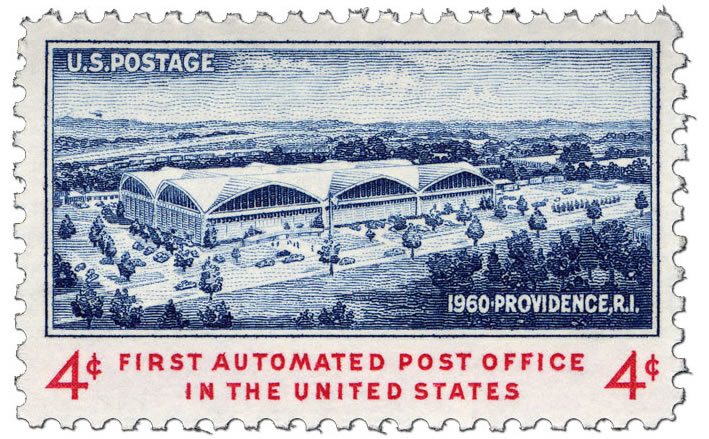
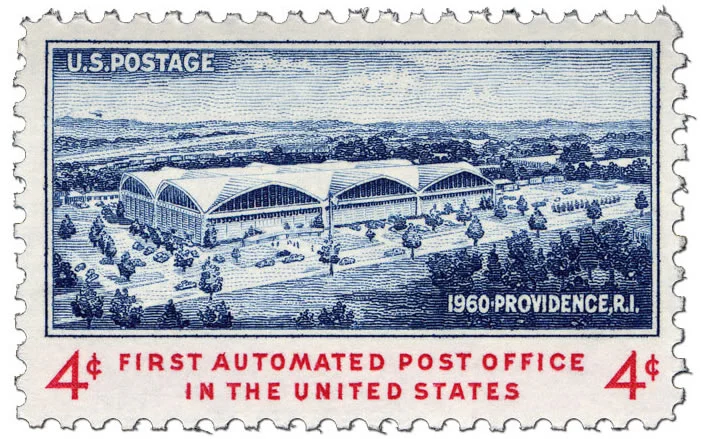
This summer, the White House proposed selling off the U.S. Postal Service to private corporations.
As a 22-year postal worker, I recently joined my coworkers, our families and neighbors across the country to rally in support of our public Postal Service. Our message to those who want to sell off our national treasure to the highest bidder: U.S. mail is not for sale.
Many may think that in the Internet age, the Postal Service has outlived its usefulness, and that the decline of letter mail is the cause of the Postal Service’s financial troubles. But the Postal Service actually turns a profit on its deliveries.
The truth is that the USPS’s problems were largely created by Congress.
A bipartisan 2006 law, the Postal Accountability and Enhancement Act mandated that the USPS pre-fund future retiree health benefits 75 years into the future. That means we have to fund retirement benefits for postal employees who haven’t even been born yet.
It’s a crushing burden that no other agency or company — public or private — is required to meet, or could even survive.
The mandate drained $5.5 billion a year out of Postal Service funds and accounts for more than 90 percent of its losses. In fact, if it weren’t for this manufactured pre-funding crisis, the USPS would have reported profits in four of the last five years — all without receiving a dime of taxpayer money.
While it’s true that the way people use the mail is changing, the Postal Service is still a vital part of the country’s infrastructure.
Package volumes have exploded with the e-commerce boom. Companies as large as Amazon and as small as a one-room Etsy vendor rely on the Postal Service. USPS delivers 30 percent of FedEx Ground packages and 40 percent of all of Amazon’s many shipments. Vitally, the USPS is at the heart of a $1.7 trillion mailing industry that employs more than 7.5 million people.
The people of this country love the Postal Service. A recent Pew Survey showed 88 percent of Americans view the USPS favorably.
One reason for this success is our commitment to serve 157 million homes and businesses six — and sometimes seven — days per week at affordable, uniform prices. Our public Postal Service reaches everyone, everywhere, no matter one’s health, wealth, age, or race. We should never lose sight that it’s veterans, seniors, and people in rural areas who rely most on the Postal Service for essential goods and life-saving medications.
What could the public expect if the Postal Service were sold to off to private interests? Higher prices, slower delivery, and an end to universal, uniform, and affordable service to every corner of the country.
And who would pay the price? All of us.
Postal services that have been privatized abroad provide a cautionary tale: In the UK, postage is up nearly 80 percent since 2007. The privatized Portuguese post has closed nearly a third of its post offices.
Our postal system is older than the country itself. It was a vital component of our country’s public good then. It still is today. And along the way, one fundamental fact has always been true: Our postal system has never belonged to any president, any political party, or any company. It’s belonged to the people of this country.
Postal workers are rallying to urge lawmakers to stop the selling off of the public postal service for private profit — and to remind everyone the Postal Service is yours. Keep it.
Julie Bates is a 22-year postal worker at the Des Moines, Iowa post office.
Last in the season

— Photo by Quercusrobur
“Is that foolish youth still sawing
The good branch he’s sitting on?
Do the orchard and hill wheeze because of it,
And the few remaining apples sway?
Can he see the village and the valley
The way a chicken hawk would?’’
—From “Ancient Autumn,’’ by Charles Simic
Chris Powell: Lamont's conflicting poses; New Haven a haven for expense-account excess
Pouring more of his personal wealth into his campaign for Connecticut governor, zillionaire Democrat Ned Lamont went on television the other day with a new commercial touting "change." In the ad Lamont says he'll cut property and small-business taxes, reduce medical costs, and demand equal pay for equal work for women.
The latter already has been the law for a long time but Democrats need to nurture resentments to rile up their tribal base. The other objectives proclaimed by Lamont's new commercial will be delusional until state government manages to close the $4 billion deficit projected for the next state budget, and Lamont offers no ideas about that.
Indeed, while Lamont's campaign distributes press releases every day, the projected budget deficit is so large that whoever is elected governor will be lucky just to keep the lights on at the state Capitol for his first few years in office. Any proposals that cost money will be mere posturing and pandering until the deficit is closed.
At the end of his new commercial Lamont declares, "Change starts now." But even as the commercial began airing, Lamont received the endorsement of another state employee union, that of the state police. The unions are not supporting Lamont in pursuit of change but rather in defense of their privileges under the political status quo. The unions are confident that, since they dominate the Democratic Party, which has controlled state government for eight years, as governor Lamont will go easier on them than any other candidate.
Meanwhile, Lamont keeps charging that the election of the Republican candidate, Bob Stefanowski, will destroy all public services, since the Republican's only idea is to eliminate the state income tax and thus forgo half of state government's revenue. In effect, Lamont is arguing that no state and municipal government operations can manage with less money -- that no employees, contractors and welfare recipients can be directed to do more with less. That is, Lamont is arguing that the government and welfare classes must not be disturbed and that change is actually impossible.
So Lamont is presenting himself as the candidate of both change and continuity. This is incoherent. But it may be more than Stefanowski offers.
For at least Lamont is making appearances around the state, issuing statements, and being accessible. As for Stefanowski, other than his ads attacking Lamont as a clone of the ever-unpopular Gov. Dannel Malloy, the Republican is hardly to be seen. The only advantage of this campaign strategy seems to be to prevent the candidate from displaying his unfamiliarity with state government and the state itself. After all, Stefanowski never before has been involved with public life and didn't even vote for the last 16 years.
xxx
A HAVEN FOR EXCESS: Next time New Haven Mayor Toni Harp shows up at the Connecticut Capitol to plead poverty and to clamor for more state money for her city, legislators might ask her about her administration's concealment of its travel expenses, as reported this week by the New Haven Independent.
Officials with city credit cards, the Independent found, have not disclosed to the Board of Alders their cross-country flights, hotel stays, and luxurious meals on city business. Trips to meetings of the U.S. Conference of Mayors have cost two or three times more than was reported.
Since state government reimburses half the city's budget, New Haven seems to figure that it's nobody's money.
Chris Powell is a columnist for the Journal Inquirer, in Manchester, Conn.
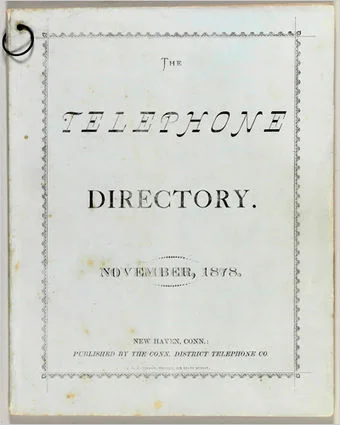
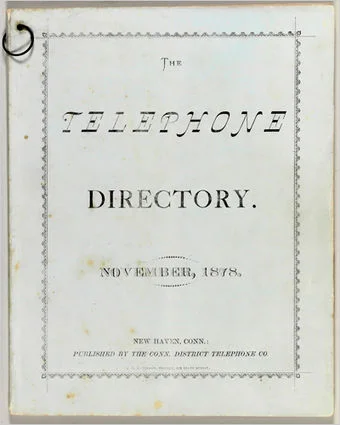
The world's first phonebook was made in New Haven in 1878.
America's social recession
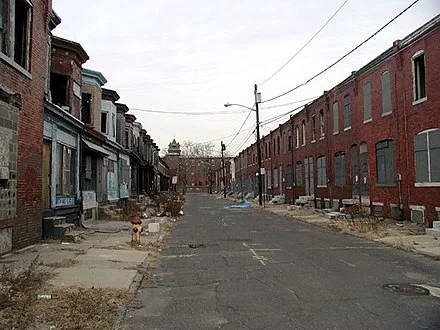
In Camden, N.J.
From Robert Whitcomb’s “Digital Diary,’’ in GoLocal24.com
Michael Porter, a professor at the Harvard Business School, had a disturbing column in The Boston Globe the other day headlined “America Traded One Recession for a Far More Serious One,’’ instigated by the 10th anniversary of the Crash of 2008. He cited something called the Social Progress Index. Among his observations:
“Despite being among the wealthiest nations, the United States ranks 25th overall on social progress, behind all our peers in the Group of Seven. In important areas, the United States ranks even lower: We are 61st on secondary school enrollment and 88th on homicide rates. Despite spending more per capita than any other nation on earth on health care, we achieve just 62th on maternal mortality, 40th on child mortality, 47th on premature deaths from noncommunicable diseases, and 35th on life expectancy at age 60.’’
“In equality of political influence among lower socioeconomic groups, we rank 65th.’’
“Americans’ overall health and wellness is way below other advanced countries, and quality of life and economic opportunity for many is diminished.’’
To read Professor Porter’s essay, please hit this link.
'Lost & Found' in Middletown, R.I.
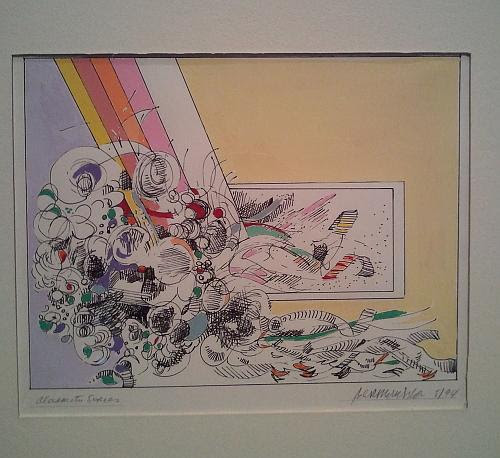
From “Alexameta Series’’ (pen and gouache), by the famous surrealist painter Ben Katz (1934-2012), in his joint show with sculptor R.L. Stetson entitled “Lost & Found — Reclamation and Celebration,’’ at DeBlois Gallery, Middletown, R.I.
Middletown, to the immediate north of Newport, is known for, among other things, a large number of Navy-connected people because of the big naval facilities in Newport, some beautiful beaches, an elite boarding school called St. George’s School recently made infamous by sex scandals, some rather pretty vestigial countryside and some of New England’s ugliest shopping strips.
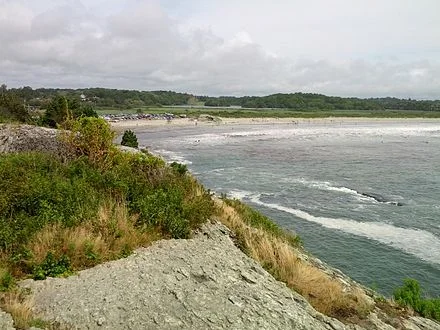
Second Beach, in Middletown.

St. George’s School.
Chemical weapon in the endless romance war

“Mesmerized’’ (collage on shaped panel with resin), by Robert Mars, in the group show
”Text Messages,’’ at Lanoue Gallery, Boston, through Oct. 14.
A very unusual antique table

Jennifer Lacker, a Connecticut-based antique-furniture and restorer, sent along this note:
Arthur Liverant, a third-generation antique dealer at Nathan Liverant and Sons, in Colchester, Conn., is presenting the Fowler-Brown family Pembroke table, which has been held by the family since its creation, sometime before 1791.
Benjamin Fowler (1739-1818), a prosperous merchant in Wickford, R.I., is believed to have commissioned Peleg Weeden (1772-1839), a silversmith who worked in Richmond, R.I., and later Wickford, to make the table. The piece, made of beautiful mahogany, combines many details copied from Thomas Chippendale’s Gentleman and Cabinetmaker’s Director (1754) in a highly unusual form.
The dropleaf edges are shaped in porringer corners; the straight legs with cuff feet are stop fluted but at the top of the leg; the lower cross stretchers are a series of undulating curves. This combination of features by a highly skilled craftsman is very unusual in American furniture.
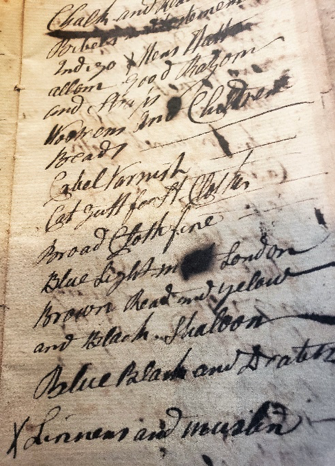
The table has been included in Yale University Art Gallery’s epic online database of Rhode Island antique furniture for some time. See rifa.art.yale.edu. Now it needs a new home. The heirs prefer a museum that would honor its Rhode Island background. Also for sale is a large collection of family documents. (See photo below.) If a museum doesn’t acquire this this beautiful example of furniture artistry, a private collector might scoop it up.
In 2 old cities, the triumph of hope over experience

“View of Springfield, Massachusetts, on the Connecticut River’’ (oil on canvas), circa 1840-45, by Thomas Chambers, as seen at the Springfield Metropolitan Museum of Art. .
From Robert Whitcomb’s “Digital Diary,’’ in GoLocal24.com
I wonder what lower-income people in Worcester think of U.S. Census data that show that the median income for Worcester households fell nearly 6 percent last year even as plans were being solidified by the city to spend a fortune to help build a baseball stadium for the bunch of very rich businessmen who own the Pawtucket Red Sox. Given the record of Minor and Major League stadiums built over the last couple of decades, it seems unlikely that the “Woosox’’ stadium will make things better for the city’s poorer residents.
Worcester’s unemployment rate is only about 5 percent but many of those jobs, as around America, pay poorly and/or are part-time. Indeed, the very low official U.S. unemployment rate masks the fact that many people have dropped out of the workforce because of low wages that don’t keep up with inflation.
A large factory being built in the city would be far better news than a facility, like a baseball stadium, employing only a couple of dozen full-time jobs, if that. Hard to believe now that the city was once sort of the Pittsburgh of New England!
In other parts of the bread-and-circuses industry, we have the newly opened MGM casino in Springfield, Mass. Despite the hoopla, this facility, which will drain money from the region to send to investors, isn’t doing that well.
Consider that the slot-machine take at this full-service (table games, slots and “resort hotel”) scam is about the same as at the much less promoted and all-slots Plainridge Park, in Plainville. Will the commonwealth encourage more cannibalization of this sector by permitting yet another casino to open?
A frenzied fall

Hatches Harbor marshes on Cape Cod Bay.
‘’….Wellfleet stayed
Remarkable that fall. And so did we.
Confessions, confidences kept us up
Half the night….
Yet who could forget those wet, bucolic rides,
Drunk dances on the beach, the bonfires,
The sandy lobsters not quite fit to eat?
Well, there were other falls to come as bad,
But I still see us on a screened-in porch,
Dumbly determined to discover when
The tide turned and the bay sank back in mud.’’
-- From “Shorelines,’’ by Howard Moss
Adversity makes them glow

Swamp maples in early fall.
“New Englanders are like the pasture slopes
Behind their barns. You put them down as sober,
And then one day you’ll wake up, and you find them
Red and golden maples of October.
It takes adversity or coming close
To trouble and hard times to make them glow,
Then they really flower as swamp maples
Flower on the edge of frost and snow.’’
From “New Englanders Are Maples,’’ by Robert P.T. Coffin (1892-1955)