
Vox clamantis in deserto






The fully adult state
“Massachusetts is the first state in America to reach full adulthood. The rest of America is still in adolescence.’’
— The late Princeton health-care economist Uwe Reinhardt, referring to the Bay State’s first-in-the-nation near-universal health-care system
'Love, loss, conflict and more'

“Untitled, from Women of Marwencol,’’ by Mark Hogancamp (digital image, courtesy of 1 Mile Gallery and Mr. Hogancamp), in the show “Mark Hogancamp: Women of Marwencol and Other Possible Histories,’’ at Keene State College’s (N.H.) Thorne-Sagendorph Art Gallery. The show opens Sept. 22.
The gallery says:
“The show is a photo-series and collection of photographs by Mark Hogancamp, an upstate New York artist who creates his pieces as a way of recovering from a violent assault. He customizes and arranges 1/6 scale figures in miniature settings to form a continuous narrative and tell an ongoing story of love, loss, conflict and more. His work addresses the dynamic of narrative, fantasy and fiction and aspects of war and gender.’’
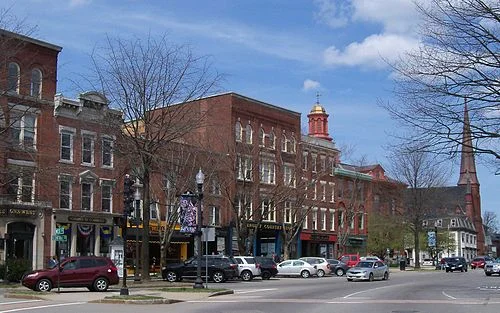
Downtown Keene.
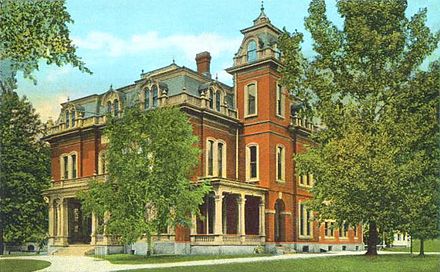
The Colony Mansion, circa 1920. It now houses the Keene Public Library.
Keene was for many years a factory town for making pails, wooden kitchen ware, chairs, sashes, shutters, doors, pottery, glass, soap, woolen textiles, shoes, saddles, mowing machines, carriages and sleighs. It also had a brickyard and foundry.
But as New England manufacturing declined in the mid 20th century, Keene transitioned to become a center for insurance, education and tourism — the last to no small degree because of its proximity to the very scenic Monadnock Region, often called “New England’s Currier & Ives Corner.’’
The city has some fine Victorian architecture from its mill town era. One is the Keene Public Library, in a Second Empire mansion built about 1869 by manufacturer Henry Colony.

Chris Powell: Of American single parenthood and low test scores

How much money has Connecticut state government thrown lately at what is called the "achievement gap" in the public schools, the gross underperformance of minority and impoverished students? Probably hundreds of millions of dollars.
But the results of the most recent standardized test taken by students in Grades 3 through 8, announced last week, show no improvement over the last four years, the period during which the current test has been administered.
Two-thirds of black, Hispanic and impoverished students are below grade level in math or English or both, 40 percent of them far behind. While the "achievement gap" correlates largely with household poverty, other standardized tests long have shown that half to two-thirds of all Connecticut high school seniors never master high school English or math but are graduated anyway. (Results are similar in other states.)
The evidence in Connecticut is overwhelming that educational achievement has little connection with spending and everything to do with parenting. But the major-party candidates for governor, Democrat Ned Lamont and Republican Bob Stefanowski, pledged last week not to reduce state funding for municipal education. They pledged this not because it makes any sense as policy but because most of the money underwrites teacher compensation, there are more than 40,000 teachers in the state, they constitute its biggest special interest, and they want parents to think that money equals education.
Many parents want to think that as well. They don't want to be told that the failure of education is their failure to raise their kids properly. About 40 percent of Connecticut's children live in single-parent households and thus many get only half or less of the attention they should get. In the cities it's close to 90 percent.
In guaranteeing the status quo in state aid to municipal education, Stefanowski has made himself especially ridiculous, since, while pledging to repeal the state income tax over eight years -- or, as his latest remarks suggest, maybe 10 years -- he is locking a huge amount of spending into future state budgets before identifying even one substantial expense he would reduce.
But last week Lamont made himself ridiculous enough on education by proclaiming what he supposes to be the need for more "workforce training" even as the test scores show that primary education itself is failing amid the state's policy of social promotion. That is, all students know that they needn't learn anything to advance from grade to grade and graduate from high school.
So it's no wonder employers complain that while they have openings for good jobs they can't find skilled workers. It's hard enough to find high school graduates who have a high school education.
There can be no improvement while public education in Connecticut remains too politically influential to audit. It will keep consuming more and producing less.
Those Grade 3-8 test scores weren't the only hint last week that simple demographics are everything. A survey by the United Way concluded that 40 percent of the state's households don't have enough income to cover necessities.
A closer look indicates that most of those households are single-parent. It is as if people never heard that having children and raising them properly is expensive and not to be undertaken without a dependable spouse and income security. But then government long has been encouraging childbearing outside marriage.
Chris Powell is a columnist for the Journal Inquirer, in Manchester, Conn.
North Country beauty
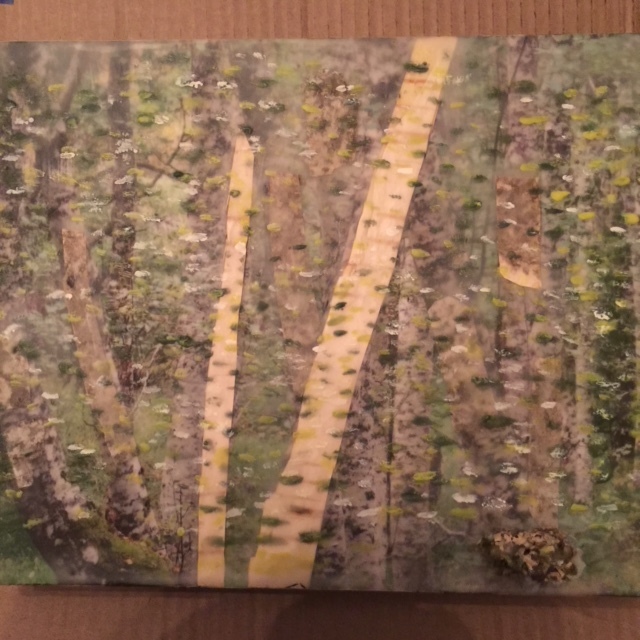
Adapted From Robert Whitcomb’s “Digital Diary,’’ in GoLocal24.com:
Artists love New England’s white birches. (One of my favorite pictures is an encaustic painting (which uses a wax process) of a stand of birches by Nickerson Miles, of Barrington — above). Castle Freeman Jr. pays a Yankee Magazine tribute to these trees, often associated, along with maples and elms, with our region. The further north you go in New England the more you see them. The birch, Freeman writes, is “by no means a flamboyant, show-offy tree {unlike, say, the flaming sugar maples of fall} but by its unique coloration {including pale-yellow leaves in autumn} and habit of growth, it makes its pale, slender presence very welcome. It’s not for nothing that the white birch is New Hampshire’s officially designated state tree.’’
Birches are also fun to carve words on and, as Frost famously wrote (below), to swing on. And, Freeman notes, its medicinal qualities make it “the apothecary shop of the north woods.’’ I hope that global warming doesn’t kill them off.
‘‘When I see birches bend to left and right
Across the lines of straighter darker trees,
I like to think some boy's been swinging them.
But swinging doesn't bend them down to stay
As ice-storms do. Often you must have seen them
Loaded with ice a sunny winter morning
After a rain. They click upon themselves
As the breeze rises, and turn many-colored
As the stir cracks and crazes their enamel.
Soon the sun's warmth makes them shed crystal shells
Shattering and avalanching on the snow-crust—
Such heaps of broken glass to sweep away
You'd think the inner dome of heaven had fallen.
They are dragged to the withered bracken by the load,
And they seem not to break; though once they are bowed
So low for long, they never right themselves:
You may see their trunks arching in the woods
Years afterwards, trailing their leaves on the ground
Like girls on hands and knees that throw their hair
Before them over their heads to dry in the sun.
But I was going to say when Truth broke in
With all her matter-of-fact about the ice-storm
I should prefer to have some boy bend them
As he went out and in to fetch the cows—
Some boy too far from town to learn baseball,
Whose only play was what he found himself,
Summer or winter, and could play alone.
One by one he subdued his father's trees
By riding them down over and over again
Until he took the stiffness out of them,
And not one but hung limp, not one was left
For him to conquer. He learned all there was
To learn about not launching out too soon
And so not carrying the tree away
Clear to the ground. He always kept his poise
To the top branches, climbing carefully
With the same pains you use to fill a cup
Up to the brim, and even above the brim.
Then he flung outward, feet first, with a swish,
Kicking his way down through the air to the ground.
So was I once myself a swinger of birches.
And so I dream of going back to be.
It's when I'm weary of considerations,
And life is too much like a pathless wood
Where your face burns and tickles with the cobwebs
Broken across it, and one eye is weeping
From a twig's having lashed across it open.
I'd like to get away from earth awhile
And then come back to it and begin over.
May no fate willfully misunderstand me
And half grant what I wish and snatch me away
Not to return. Earth's the right place for love:
I don't know where it's likely to go better.
I'd like to go by climbing a birch tree,
And climb black branches up a snow-white trunk
Toward heaven, till the tree could bear no more,
But dipped its top and set me down again.
That would be good both going and coming back.
One could do worse than be a swinger of birches.’’
— “Birches,’’ by Robert Frost
Making the most of it

Fred Barnard Illustration for Charles Dickens's “Cricket on the Hearth.
"September days have the warmth of summer in their briefer hours, but in their lengthening evenings a prophetic breath of autumn. The cricket chirps in the noontide, making the most of what remains of his brief life. ‘‘
— “September Days,’’ by the late Vermont writer Rowland E. Robinson
Measuring the health of health-care environments

Med Page Today reports, from a study done at Boston Children's Hospital:
“According to the American Association of Critical-Care Nurses (AACN) {a good working environment} is a place where healthcare professionals can make their optimal contribution. For almost a decade, critical-care nurses have been able to evaluate the health of their work environment with the association’s online assessment tool based on its Healthy Work Environment standards.
“Now a new study finds that the tool has applications beyond critical care, and is effective for assessing the health of the work environment for interprofessional patient care teams throughout a hospital’s patient care settings.
“‘Although AACN’s assessment tool has been used primarily among acute and critical-care nurses, our findings support consideration of wider use in multiple healthcare settings’ said the study’s principal investigator, Jean Anne Connor, PhD, RN, CPNP, director of nursing research, cardiovascular, and critical care patient services at Boston Children’s Hospital. ‘Clinical leaders understand that to safeguard the quality of patient care, attention must be focused on the performance of healthcare teams.”‘
“The assessment tool is an 18-question survey designed to help organizations or departments identify areas for improvement. It assists in measuring the health of a work environment against AACN’s six Healthy Work Environment standards:
Skilled communication
True collaboration
Effective decision-making
Appropriate staffing
Meaningful recognition
Authentic leadership
“The study, published in the American Journal of Critical Care, reports the results of a two-phase administration of the tool to 2,621 patient-care employees at Boston Children’s Hospital.”
To read the full Med Page article, please hit this link.Via
Heart-stopping pleasure

"New England clam chowder, made as it should be, is a dish to preach about, to chant praises and sing hymns and burn incense before. [...] It is as American as the Stars and Stripes, as patriotic as the National Anthem. It is Yankee Doodle in a kettle.''
-- Joseph C. Lincoln (1870-1944), an American fiction writer much of whose work is set on Cape Cod.
New England clam chowder, sometimes called Boston Clam Chowder in the Midwest, is a milk- or cream-based chowder, usually thicker than other regional styles of clam chowder. It is usually made with potatoes, onion and clams.
New England clam chowder is often accompanied by oyster crackers, a real salt fest.
From the Wikipedia page on Mr. Lincoln:
"Lincoln was born in Brewster, Mass., on Cape Cod, and his mother moved the family to Chelsea, Mass., a manufacturing city outside Boston, after the death of his father. Lincoln's literary career celebrating 'old Cape Cod' can partly be seen as an attempt to return to an Eden from which he had been driven by family tragedy. His literary portrayal of Cape Cod can also be understood as a pre-modern haven occupied by individuals of old Yankee stock which was offered to readers as an antidote to an America that was undergoing rapid modernization, urbanization, immigration and industrialization.''
Wider bike paths coming?

From Robert Whitcomb's "Digital Diary,'' in GoLocal24.com.
The brief appearance on Providence streets of those Bird electric scooters, before they were ordered off pending adjustments of local regulations, raised the issue of what to do with the proliferation of little vehicles on city streets. The still far too few bike paths in some cities aren’t wide enough to accommodate the increasing number of human-powered bikes, electric scooters, skateboarders, runners, wheelchairs (some motorized), three-wheelers walkers with dogs and so on.
This is becoming more of a pressing matter now that such ride-sharing companies as Uber and Lyft have said that they, too, are going to go big into the scooter- and bike-sharing business. That’s good news if it mean less business for Uber and Lyft cars, which are sometimes dangerously clogging city streets.
Emotions in tapestry
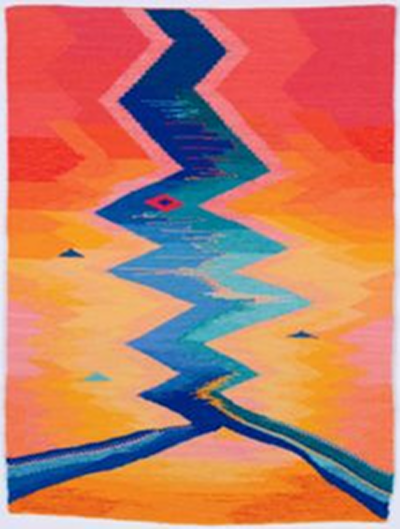
"Journey II' (hand-dyed wool), by Priscilla Alden, at Highfield Hall {a gallery} and Gardens, in Falmouth, Mass. It's part of the group show "Tapestry in New England and Beyond,'' through Oct. 31.
The gallery says: "The exhibition showcases the wide variety of style and vision found in contemporary tapestry weaving. Each piece expresses an impactful moment or experience in the artist's life, tackling everything from the plight of refugees, nature and the environment, the beauty of language, and more. Each of these moments is expressed in beautiful, detailed weavings that show the depth of the artist's emotions and convey those emotions to the viewer.''
Built in 1878 by the Beebes, a very rich Boston mercantile family, whose patriarch was James Beebe, Highfield Hall was one of Cape Cod's early summer mansions, made possible by the extension of rail service to the Cape after the Civil War. It's one of the few remaining examples of Stick-style Queen Anne architecture in the Northeast. The institution says: "Along with its adjoining mansion, Tanglewood, Highfield Hall was originally surrounded by park-like gardens, carriage trails, and almost 700 acres of woodlands. Both homes are believed to have been designed by Boston architects Peabody and Stearns, while the landscape design for both estates was created by Ernest Bowditch...."
"Brothers Pierson and Franklin Beebe, along with sister Emily, lived at Highfield Hall while their brother, J. Arthur Beebe, along with his wife and children lived at Tanglewood. Both Beebe families entertained in grand fashion and embraced a genteel and formal lifestyle supported by a large cadre of servants.''
Highfield is but a short drive to Falmouth's village of Woods Hole, probably the world's pre-eminent center for oceanographic research, and a very scenic place.
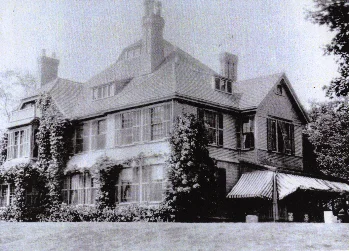
Highfield Hall some decades ago.
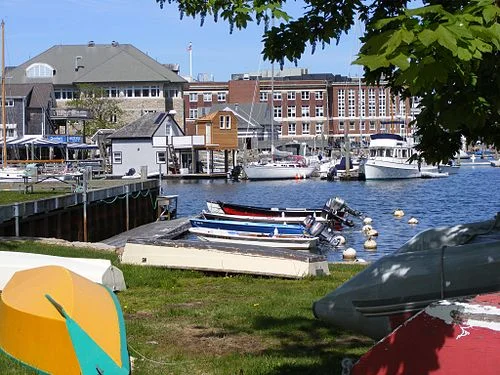
In Woods Hole, with research buildings. The village's two best-known institutions are the Woods Hole Oceanographic Institution and the Marine Biological Laboratory (whose work includes a major medical component).
From 'text messages' to real ones
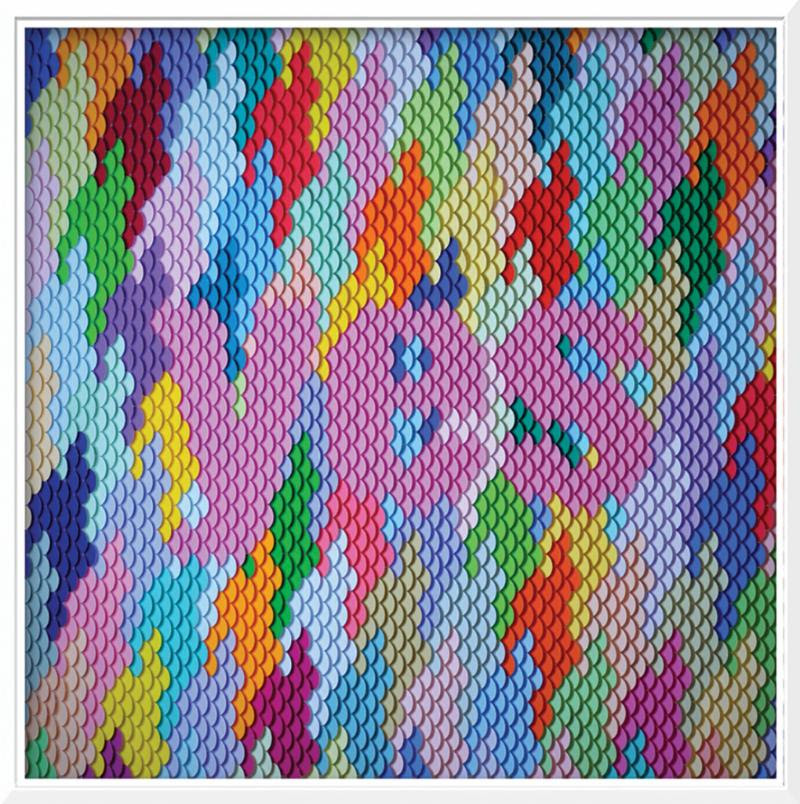
"Yes'' (hand-punched, found paint chips and mixed media) by Peter Combe, in the group show "Text Messages,'' at Lanoue Gallery, Boston, through Oct. 14. The gallery says:
"Text-based artwork requires engaged, not passive, viewers who bring a sense of curiosity and personal experience to the interpretation of each work. Like the now pervasive use of sending short bursts of words to one another through mobile devices, the artworks in 'Text Messages' primarily rely on visually 'bite-size' but carefully chosen words to both efficiently and impactfully communicate ideas, thoughts, or emotions to its receiver. Each work assumes a kind of communication shorthand with the viewer based on a perceived common experience shared through our hyper-connected lives on a variety of social media platforms. A gallery art exhibition of these physical objects, however, allows the sharing of these 'text messages' to happen among its viewers in a shared physical space, potentially sparking real-time, face-to-face conversations.

David Warsh: The lingering mysteries of the Clintons

SOMERVILLE, Mass.
Donald Trump continues to advertise his itch to fire Atty. Gen. Jeff Sessions, presumably in hopes of short-circuiting Special Counsel Robert Mueller’s Russian probe. There is another reason thsat replacing Sessions is a bad idea. The practices of the Clinton Family Foundation during the period when Hillary Clinton was secretary of state remain under investigation by the FBI.
The existence of the Clinton probe was established a week before the 2016 election by reporter Devlin Barrett in The Wall Street Journal. A few months later, Barrett left the WSJ for The Washington Post. Earlier this year, Barrett and Matt Zapatosky reported that the investigation had continued after the election.
Confidence in the attorney general’s decision-making is thus doubly important. Sessions has shown himself to be sturdily perpendicular with respect to the Russia investigation; there is reason to expect his judgement will be level with respect to the Clinton matter as well.
Meanwhile, sniping at the FBI has continued, from Congress and in the conservative press. The feud within the Bureau apparently continues as well. Last week The Post’s Zapatosky reported that federal prosecutors had been using a grand jury to investigate charges that former Deputy Director Andrew McCabe had lied when he denied authorizing the disclosure of the Clinton investigation in the first place, placing his own interests above those of the Justice Department, at least according to Michael Horowitz, the DOJ’s inspector general.
If the provenance of the FBI’s Russia investigation was somewhat tainted – Hillary Clinton’s campaign paid for the so-called Steele Dossier, which helped prompt the investigation of Russian influence on the Trump campaign – the predicate of the Clinton Foundation investigation was apparently equally suspect. Agents in four FBI field offices had read copies of Clinton Cash: The Untold Story of How and Why Foreign Governments and Businesses Helped Make Bill and Hillary Rich, by Peter Schweitzer, president of a foundation created by Breitbart editor Steve Bannon, and financed by the right-wing Mercer Family Foundation.
It has been clear since the 2016 election that the political legacy of Bill and Hillary Clinton is due for a full-scale reappraisal, as background to the 2020 campaign and beyond. Too few experts are working on the narrative of their foreign policies, chiefly NATO expansion and various humanitarian interventions; fewer still on the successes of their domestic policies; and fewest of all, I suspect, on the sources of the virulent opposition they faced, and their reaction to it. The Clinton Foundation seemed like a bad idea since the beginning. Whatever it concludes, the FBI investigation won’t make it any easier to begin to locate the Clintons in American history. That process will take decades.
David Warsh, a long-time columnist, is proprietor of economicprincipals.com, where this first ran.
Chris Powell: Will 'starve the beast' work in Conn.?

Original Godzilla film poster in 1954.
From his remarks to reporters last week at the Crocodile Club lunch at Lake Compounce in Bristol, the Republican candidate for Connecticut governor, Bob Stefanowski, seems to think it's not important to tell voters how he would cut the half of state government that is financed by the state income tax, which he wants to eliminate over eight years.
“We're ready and happy to talk about it," Stefanowski said, but he still has not done so specifically. "I don't think the argument is about what the details of people's plans are," Stefanowski added, because there is such a "stark contrast" between him and Ned Lamont, the Democratic candidate for governor. Lamont, Stefanowski said, "is going to raise taxes and I'm going to try like heck to get rid of the income tax.”
Yes, telling voters the consequences of his platform before the election might spoil the lovely dream of escaping the income tax. Since he won the Republican primary with nothing but that lovely dream, maybe Stefanowski thinks he can keep avoiding specifics because a candidate's credibility doesn't matter.
Stefanowski doesn't seem to have noticed that he got only 29 percent of the Republican primary vote and that only 20 percent of Connecticut's voters are Republicans. Or maybe he doesn't think that matters either.
But maybe even if a governor had no budget priorities and just began to cut spending across the board -- pursuing the good, old conservative platform, "starve the beast" -- much help might be volunteered to him, if resentfully.
Maybe just reversing the dynamics of budgeting would spark the necessary reforms. That's because all the spending-dependent groups in Connecticut long have been on the same side, clamoring together to increase taxes so they all could get more.
This has always worked for them, since, despite the whining about spending cuts, total spending in state government always increases and the only "cut" is in its rate of increase.
If a governor was determined to reduce or even just freeze spending and had enough support in the General Assembly to sustain his veto, the spending-dependent groups might be forced to split up and scrutinize each other for inessentials and excesses. Knowing the tricks of budgeting, these groups might make excellent auditors.
For example, advocates for the mentally handicapped, 2,000 of whom are always languishing on a waiting list for placement in group homes, might start caring about the expense of the paid day off enjoyed by state and municipal employees in the name of Columbus. They might even question collective bargaining and binding arbitration for government employees, policies that put the compensation of those employees ahead of all other purposes in government.
Employees of nursing homes and nonprofit groups with whose salaries state government long has been stingy might protest the extravagant pay at the University of Connecticut.
Passengers of the Metro-North commuter railroad, where maintenance is always neglected, might protest the bus highway to nowhere.
Parents of special-education students for whom services are hard to obtain might denounce the huge but never tabulated cost of social promotion in the schools.
They all could have fun picking through the bonding package.
If Stefanowski really thinks that most voters care only about taxes, let him run on "starve the beast."
The beast does need to go on a severe diet. But if voters are more sophisticated, Stefanowski better start explaining.
Chris Powell is a columnist for the Journal Inquirer, in Manchester, Conn.
Trying to protect Maine from the Brits in a border dispute

Entrance to Fort Knox, in Prospect, Maine.
-- Photo by SarekOfVulcan

Fort Knox, painting by Seth Eastman done sometime between 1870 and 1875.
“On the Penobscot River, on the opposite bank from the once-upon-a-time paper mill, stands Fort Knox {in Prospect, Maine}, proudly named after the nation’s first secretary of war, Henry Knox, who lived in Thomaston, Maine. It was built between 1844 and 1869 {initially} to guard against the British in a border dispute with Canada. The fear was that if this part of Maine fell, the British would take over some of the best lumber-producing areas on the East Coast and this would cost the United States a most valued natural resource in the building of ships. Other than training recruits during the Civil War, the fort was never used and is now a scenic location overlooking the new bridge, crossing the Penobscot River.”
― Captain Hank Bracker, "Seawater One: Going to Sea
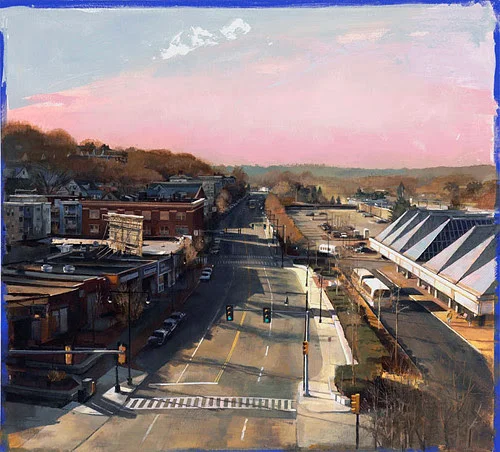
In outer Boston
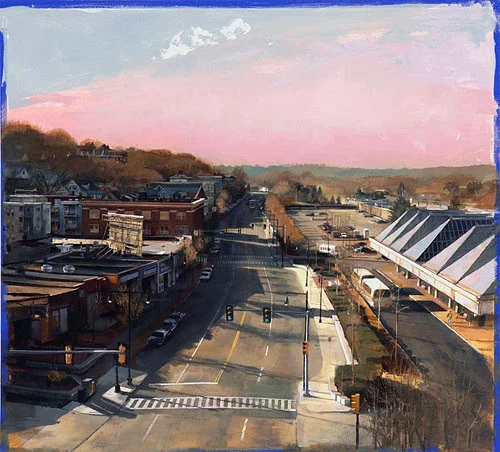
"Stony Brook Valley'' (in Boston's Jamaica Plain section) (acrylic on panel), by Andrew Haines, in the group "2018 Annual Landscape Exhibition,'' at William Baczek Fine Art, Northampton, Mass. The gallery says the show "addresses the preconceived notions of what landscape art can be. The artists remove context, utilize unexpected mediums, and avoid cliché to make their works standouts among the art of landscapes. The featured work is at turns concrete and ethereal, straightforward and abstract. No two pieces are alike, just as no two artists' personal idea of landscapes are alike. The result is an exhibit that encourages a different view of not just the art of landscapes, but of the world these landscapes reside in. ''
'A kiss from the tomb'

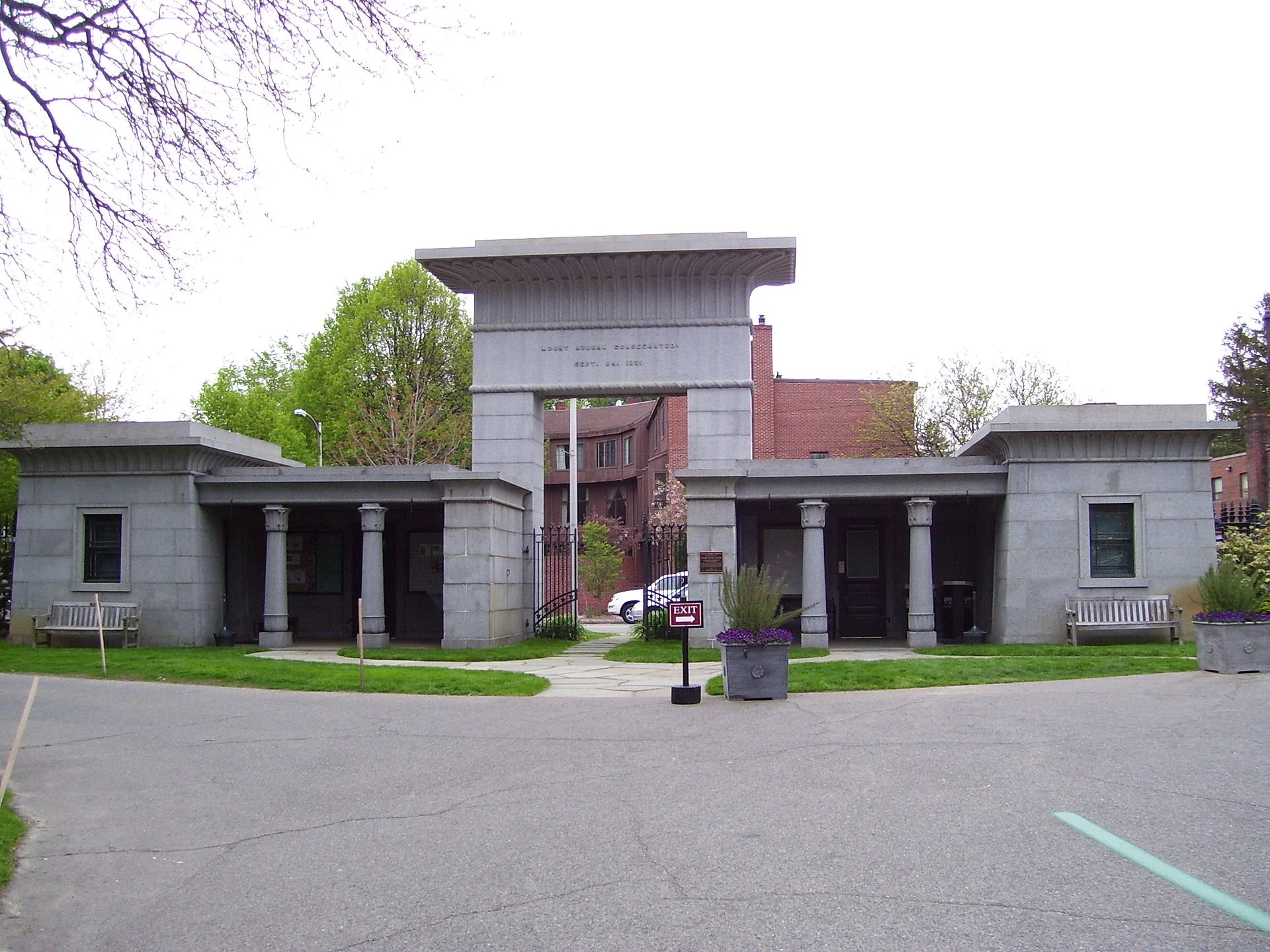
-- Photo by Swampyank
The Egyptian Revival entrance to New England most famous cemetery, Mount Auburn Cemetery, which straddles the Cambridge-Watertown line just outside of Boston. Dedicated in 1831, Mount Auburn is the first so-called "rural cemetery'' in America and is the resting place of many prominent Bostonians. It's a National Historic Landmark and a wonderful place for a stroll, with glorious landscaping, trees and shrubs -- many of them flowering -- on its 174 rolling acres.
The development of Mount Auburn coincided with the rising popularity of the term "cemetery," derived from the Greek for "a sleeping place," instead of the darker view of death and the afterlife expressed in older New England graveyards and church burial plots.
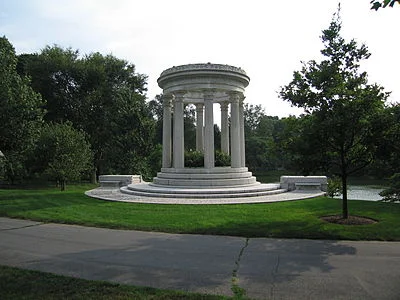
There's an erroneous old story that Christian Science founder Mary Baker Eddy's monument (below) at Mount Auburn has a phone.
"I did not obstruct the state, nor religion,
But I saw through both and maintained my independence.
I kept my counsels among the learned.
My learning was more private and precious than worldly.
The world had no sense of the devious,
So my private vicissitudes were mine alone.
I say all this with a special sort of grace
For I avoided many of the pitfalls of fallen man
And while I did not have heroic size, the
Creative grandeur, or mastership of the mind
I earned my bread by cynicism alone,
And blow you all a kiss from the tomb.''
-- From "A New England bachelor,'' by Richard Eberhardt
Wildlife in unwild places

From Robert Whitcomb's "Digital Diary,'' in GoLocal24.com
I remain astonished by the number of rabbits in some affluent urban neighborhoods, such as the East Side of Providence. Far more than you’d see in many more rural areas. But rabbits are as opportunistic as most animals. These neighborhoods are relatively safe for most wild animals: Most dogs are leashed (though too many irresponsible cat owners let the pets run free to kill birds and small mammals), there’s plenty of water from residents’ irrigation systems and lots of plants to eat, albeit some with toxic levels of pesticides.
Thus the best places for some wildlife (raccoons come to mind) are in places that are anything but wild. Another sign of how humans have made the world topsy-turvy.
Llewellyn King: We must prepare for cyberattacks on our infrastructure
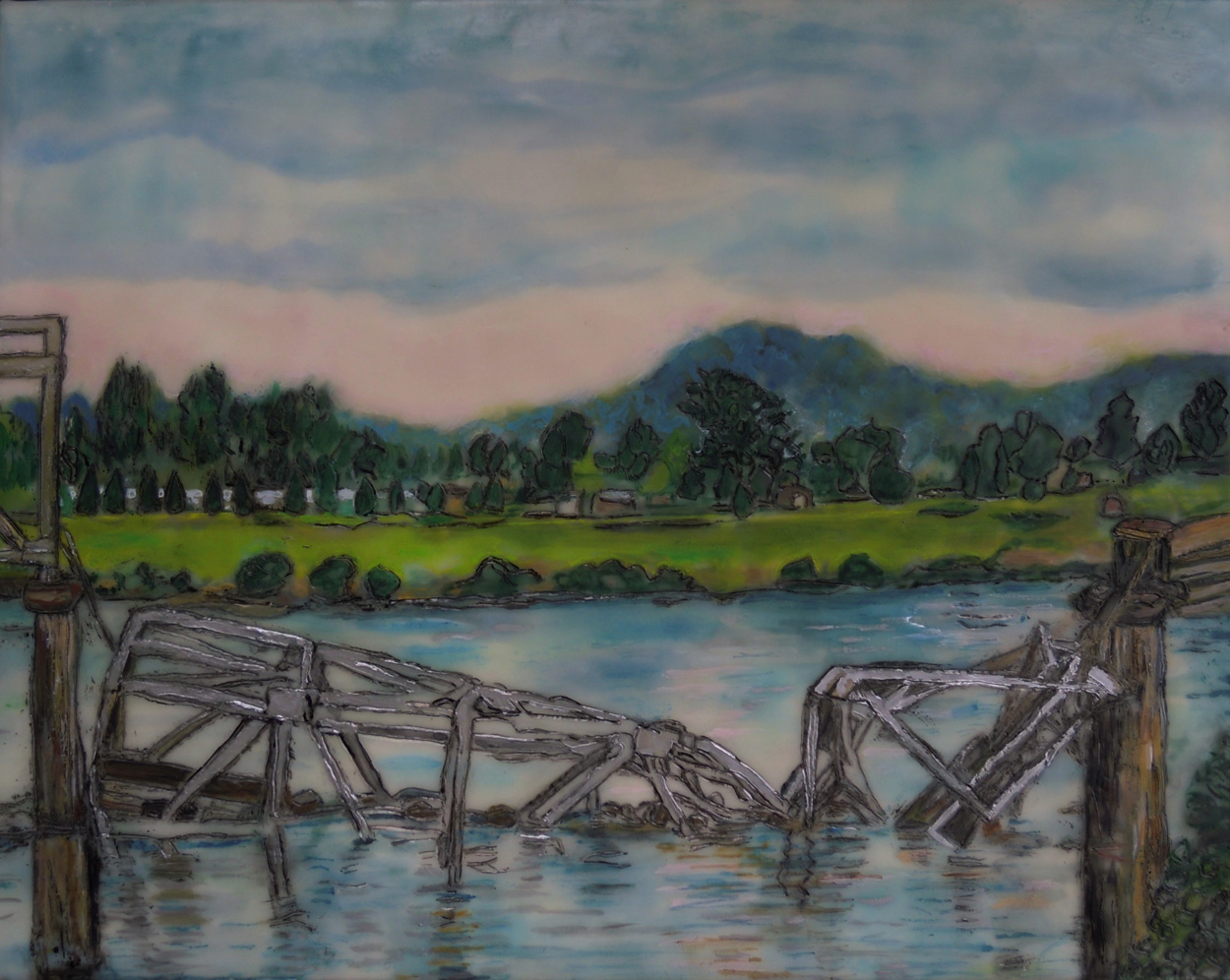
"The Bridge'' (encaustic painting by Nancy Whitcomb.
WEST WARWICK, R.I.
War always goes for the infrastructure: Take out the bridges, cut off the electricity and water supplies. All that used to be done with artillery, tanks and bombs from above.
Going forward, it will be done by computers: cyberwar.
Every day the early skirmishes -- the tryout phase, if you will – are taking place. There are tens of thousands of probes of U.S. infrastructure by potential enemies, known and unknown, state and non-state. A few get through the defenses.
Jeremy Samide, chief executive officer of Stealthcare, a company which seeks to improve cyberdefenses for a diverse set of U.S. companies, sees the cyber battlefield starkly. He says the threat is very real; and he puts the threat of serious attack at 83 percent.
As Samide looks out across the United States from his base in Cleveland, he sees probes, the term of art for incoming cyberattacks, like an endless rain of arrows. Some, he says, will get through and the infrastructure is always at risk.
Director of National Intelligence Dan Coats issued a warning in July that the alarms for our digital infrastructure are “blinking.” He compared the situation to that in the country before the 9/11 terrorist attacks. The situation, he told the Hudson Institute in a speech, is “critical.” Coats singled out Russia as the most active of the probers of U.S. infrastructure.
Samide says probing can come from anywhere and Russia may be the most active of the cyber adventurers.
A common scenario, he says, is that the electric grid is target one. But considerable devastation could come from attacking banking, communications, transportation or water supply.
Retired Army Gen. David Petraeus, a former director of the CIA and current chairman of KKR Global Institute, in an article coauthored with Kiran Sridhar and published in Politico on Sept. 5, urges the creation of a new government agency devoted to cybersecurity.
Samide and others endorse this and worry that the government has much vital material spread across many agencies and not coordinated. Behind Petraeus’s thinking is one of the lessons of 9/11: Government departments aren’t good at sharing information.
Conventional wisdom has it that the electric grid is super-vulnerable. But Politico’s cybersecurity reporter David Perera, who consulted experts on the feasibility of taking down the grid, somewhat demurs. In a Politico article, he concluded that the kind of national blackout often theorized isn’t possible because of the complexity of the engineering in the grid and its diversity.
The difficulty, according to Perera, is for the intruder to drill down into the computer-managed engineering systems of the grid and attack the programable controllers, also known as industrial control systems -- the devices that run things, such as by moving load, closing down a power plant or shutting off the fuel supply. They are automation’s brain.
Perera’s article has been read by some as getting the utilities off the hook. But it doesn’t do that: Perera’s piece is not only well-researched and argued but also warns against complacency and ignoring the threat.
John Savage, emeritus professor of computer science at Brown University, says, “I perceive that the risk to all business is not changing very much. But to utilities, it is rising because it appears to be a new front in [Russian President Vladimir] Putin’s campaign to threaten Western interests. While I doubt that he would seek a direct conflict with us, he certainly is interested in making us uncomfortable. If he miscalculates, the consequences could be very serious.”
Samide warns against believing that all probes are equal in intent and purpose. He says there are various levels of probing from surveillance (checking on your operation) to reconnaissance (modeling your operation before a possible attack). Actual attacks, ranging from the political to the purely criminal, include ransomware attacks or the increasing cryptojacking in which a hacker hijacks a target’s processing power in order to mine cryptocurrency on the hacker’s behalf.
The threats are global and increasingly the attribution -- the source of the attack --concealed. Other tactics, according to Samide, include misdirection: a classic espionage technique for diverting attention from the real aim of the attack.
The existential question is if cyberwar goes from low-grade to high-intensity, can we cope? And how effective are our countermeasures?Today’s skirmishes are harbingers of the warfighting of the future.
Llewellyn King is executive producer and host of White House Chronicle, on PBS. His email is llewellynking1@kingpublishing.com. He's based in Washington, D.C. and Rhode Island.
Wait'll next year
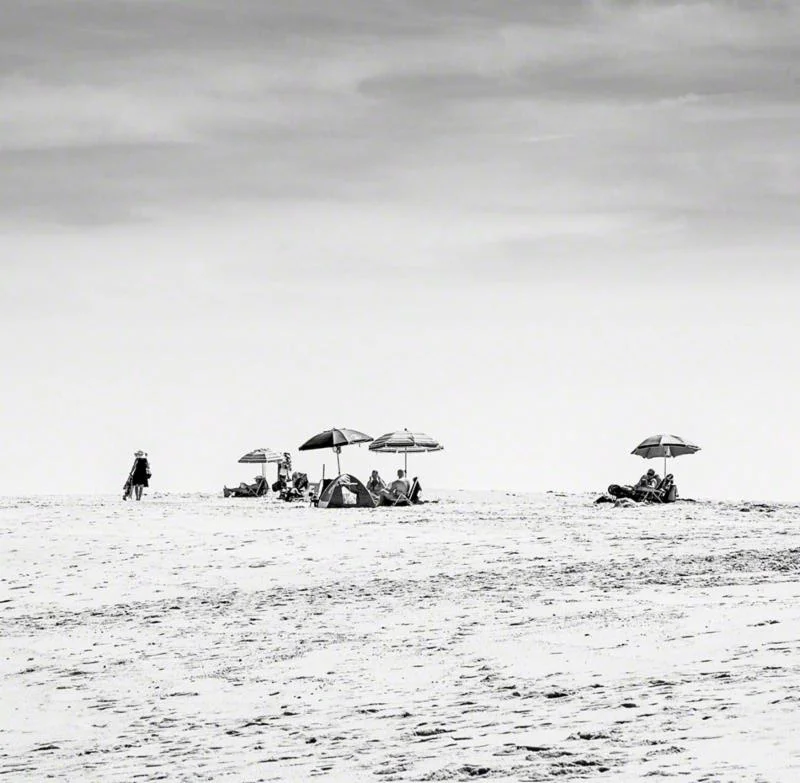
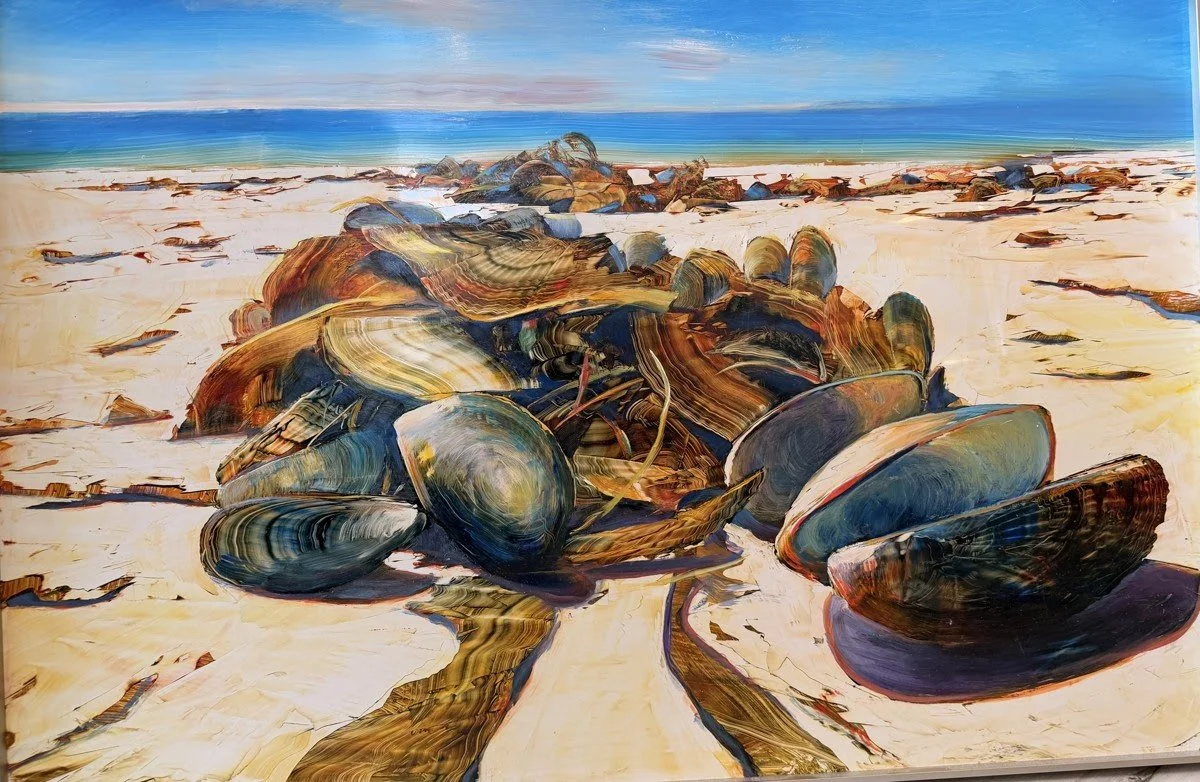
"Day After Labor Day,'' at Head of the Meadow Beach, Truro, Mass. (aluminarte print), by Bobby Baker (copyright Bobby Baker Fine Art, Cataumet, Mass.)
'Allusions to the body'
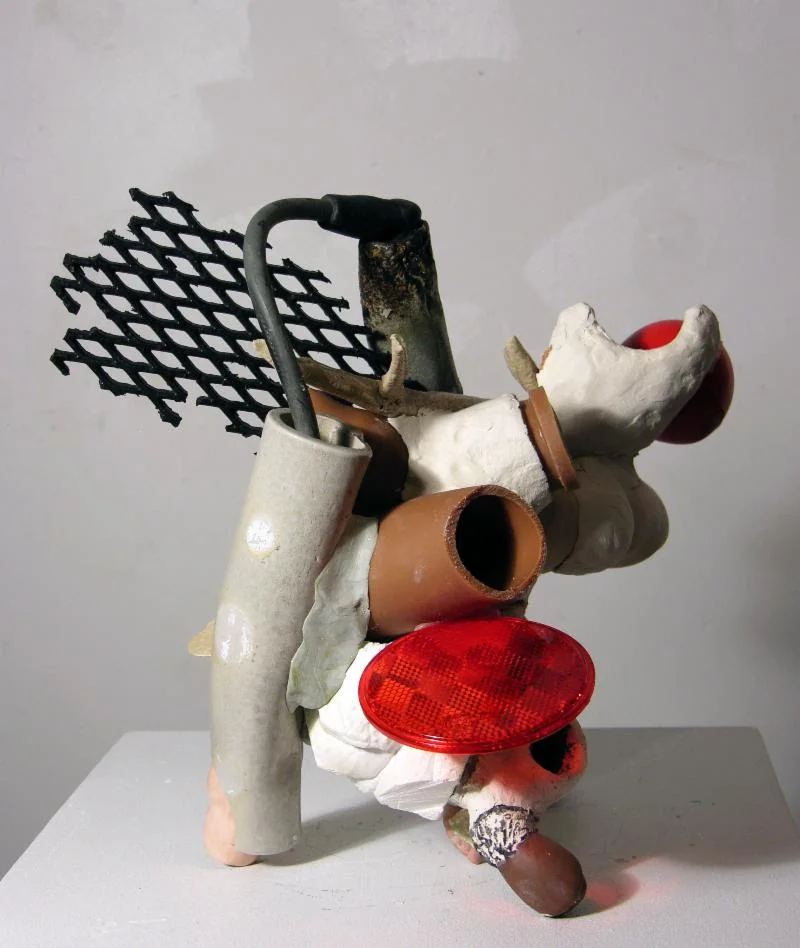
"Fused'' (mixed media), by Linda Leslie Brown, in her show "Plastiglomerate,'' at Kingston Gallery, Boston, Oct. 3-28. The gallery says:
"As a sculptor Linda Leslie Brown’s work metaphorically plays with the literal and the imagined as seemingly random, mostly discarded materials interact to build works rife with allusions to the body. At the same time, her sculptural assemblages suggest the plastic, provisional and uncertain world of a new and transgenic nature where corporeal and mechanical entities recombine, serving as relics of possible futures and symbols of human behavior on the global environment. Her sculptures suggest a creaturely symbiosis as with holobionts: assemblages of different species that form ecological units.''
'New Englanders of the Year'
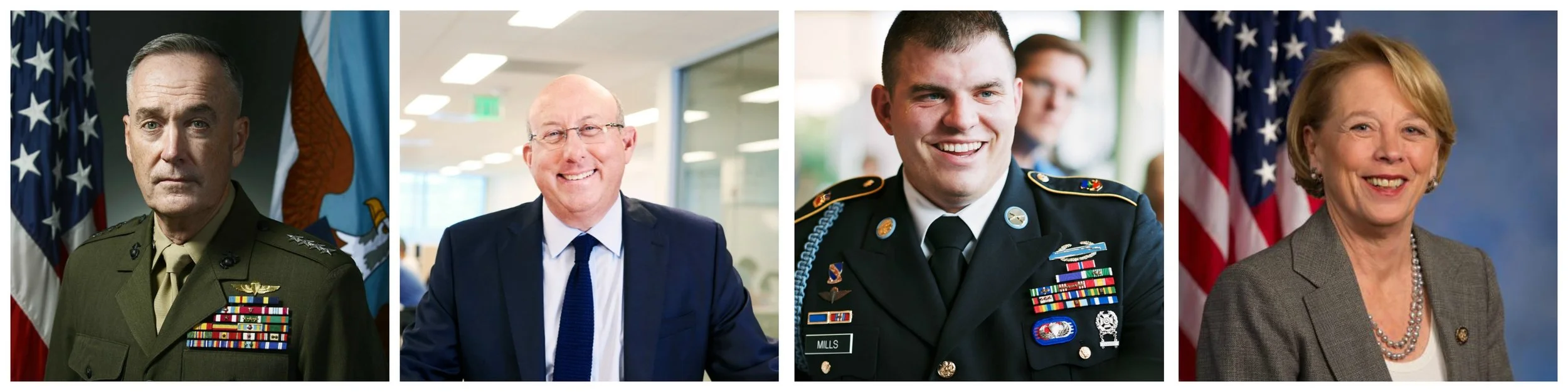
From left, Dunford, Leiden, Mills and Tsongas.
This just in from The New England Council (newenglandcouncil.com)
"The New England Council is pleased to announce our 2018 New Englanders of the Year. These four remarkable New Englanders will be honored at our 2018 Annual Dinner on the evening of Thursday, October 11, 2018, at the Seaport Hotel/World Trade Center in Boston. .... This year, we will honor three individuals who have made tremendous contributions to our region and our nation:
Gen. Joseph F. Dunford, Jr., Chairman, Joint Chiefs of Staff. He is the 19th Chairman of the Joint Chiefs of Staff, the nation’s highest-ranking military officer, and the principal military adviser to the President, Secretary of Defense, and National Security Council. Prior to becoming Chairman, in October 2015, he served as the 36th Commandant of the U.S. Marine Corps. Over the course of his four decades of distinguished service in the Marines, he has served as an infantry officer at all levels and is the first Marine Corps officer to serve in four different four-star positions. General Dunford has served in a variety of key leadership posts, including senior command posts in in both Afghanistan and Iraq. A native of Boston, he is a graduate of Saint Michael’s College and holds master’s degrees from both Georgetown University and the Fletcher School of Law and Diplomacy at Tufts University.
Jeffrey Leiden, M.D., Ph.D., Chairman, President and CEO, Vertex Pharmaceuticals. Dr. Leiden is a physician and scientist who, for the last 30 years, has dedicated his career to improving the lives of people with serious diseases. His experience spans all aspects of the biotech and pharmaceutical industries. Under Dr. Leiden’s leadership, Vertex has brought to patients the first and only medicines to treat the underlying cause of cystic fibrosis (CF), and is now developing a medicine that could reach 90 percent of people living with this devastating disease. It is his mission and the basis of the company’s research priorities to bring transformative medicines to people with CF and other serious diseases. Dr. Leiden also cares deeply about inspiring and equipping under-resourced students and young women to become the next generation of scientific leaders. He established a signature program at Vertex to enhance science, technology, engineering, art and math (STEAM) education among Boston students, including an on-site Learning Lab, mentorship programs, internships and college scholarships.
Staff Sergeant (ret) Travis Mills, U.S. Army Veteran and Founder of the Travis Mills Foundation –Retired U.S. Army Staff Sgt. Mills, a Maine resident, served three tours of duty in Afghanistan as a member of the 82nd Airborne Division. In April 2012, during his third tour, he was critically injured by an improvised explosive device (IED) while on patrol, losing portions of both legs and both arms. He is one of only five quadruple amputees from the wars in Afghanistan and Iraq, and today is an advocate for veterans and amputees. In September 2013, he established the Travis Mills Foundation to benefit and assist combat-injured veterans. In June 2017, he opened the Travis Mills Foundation Veterans Retreat, in Rome, Maine, where war-injured veterans and their families are welcomed for rest and relaxation at no charge. Sergeant Mills is also the author of the New York Times best-selling memoir Tough as They Come.
The Honorable Niki Tsongas, U.S. House of Representatives. Congresswoman Tsongas was elected to the U.S. House of Representatives in 2007, becoming the first woman to represent the Bay State on Capitol Hill in 25 years. She is in her final year representing Massachusetts’ 3rd Congressional District, having announced her retirement in 2017. Throughout her tenure in Congress, Rep. Tsongas has served on the House Armed Services Committee, where she has been a tremendous advocate for our region’s defense sector and military installations, and has fought tirelessly to support and protect our men and women in uniform. She has also been on the front lines of developing policies related to domestic energy production, the environment, and our National Park System as a member of the Natural Resources Committee. The Congresswoman is a graduate of Smith College and Boston University School of Law.''