
Vox clamantis in deserto


In outer Boston
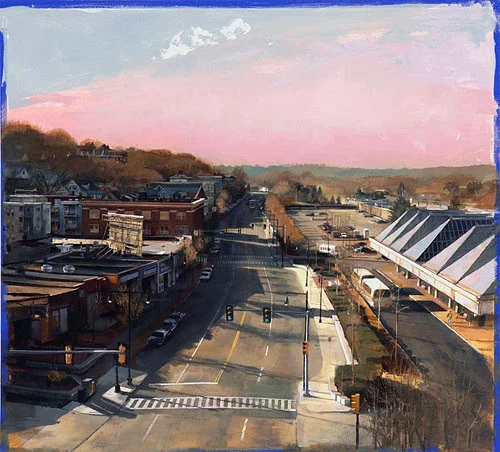
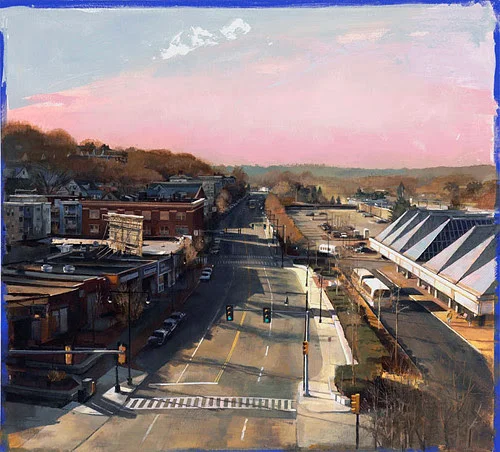
"Stony Brook Valley'' (in Boston's Jamaica Plain section) (acrylic on panel), by Andrew Haines, in the group "2018 Annual Landscape Exhibition,'' at William Baczek Fine Art, Northampton, Mass. The gallery says the show "addresses the preconceived notions of what landscape art can be. The artists remove context, utilize unexpected mediums, and avoid cliché to make their works standouts among the art of landscapes. The featured work is at turns concrete and ethereal, straightforward and abstract. No two pieces are alike, just as no two artists' personal idea of landscapes are alike. The result is an exhibit that encourages a different view of not just the art of landscapes, but of the world these landscapes reside in. ''
'A kiss from the tomb'

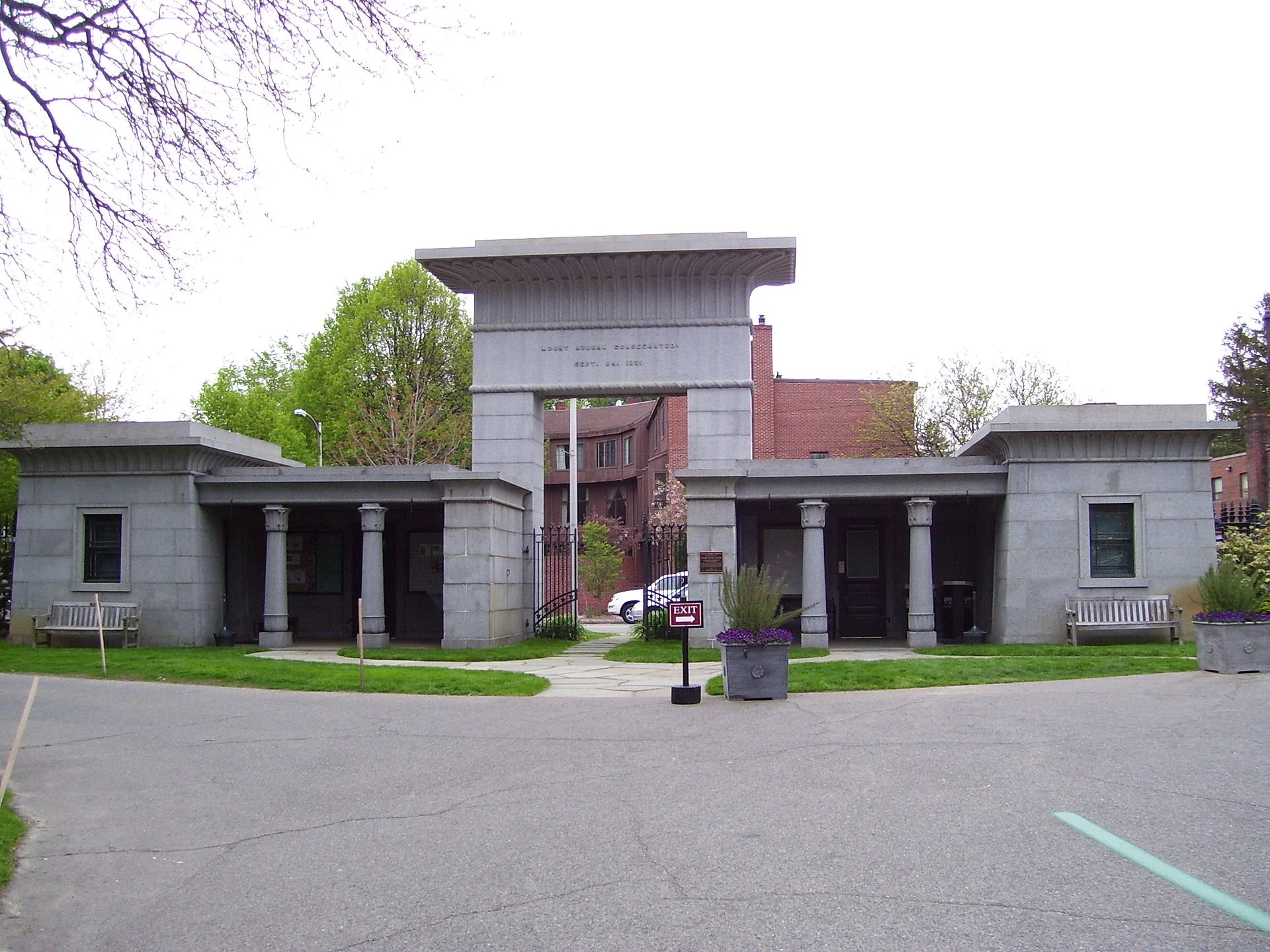
-- Photo by Swampyank
The Egyptian Revival entrance to New England most famous cemetery, Mount Auburn Cemetery, which straddles the Cambridge-Watertown line just outside of Boston. Dedicated in 1831, Mount Auburn is the first so-called "rural cemetery'' in America and is the resting place of many prominent Bostonians. It's a National Historic Landmark and a wonderful place for a stroll, with glorious landscaping, trees and shrubs -- many of them flowering -- on its 174 rolling acres.
The development of Mount Auburn coincided with the rising popularity of the term "cemetery," derived from the Greek for "a sleeping place," instead of the darker view of death and the afterlife expressed in older New England graveyards and church burial plots.
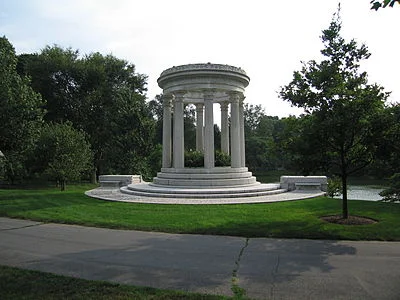
There's an erroneous old story that Christian Science founder Mary Baker Eddy's monument (below) at Mount Auburn has a phone.
"I did not obstruct the state, nor religion,
But I saw through both and maintained my independence.
I kept my counsels among the learned.
My learning was more private and precious than worldly.
The world had no sense of the devious,
So my private vicissitudes were mine alone.
I say all this with a special sort of grace
For I avoided many of the pitfalls of fallen man
And while I did not have heroic size, the
Creative grandeur, or mastership of the mind
I earned my bread by cynicism alone,
And blow you all a kiss from the tomb.''
-- From "A New England bachelor,'' by Richard Eberhardt
Wildlife in unwild places

From Robert Whitcomb's "Digital Diary,'' in GoLocal24.com
I remain astonished by the number of rabbits in some affluent urban neighborhoods, such as the East Side of Providence. Far more than you’d see in many more rural areas. But rabbits are as opportunistic as most animals. These neighborhoods are relatively safe for most wild animals: Most dogs are leashed (though too many irresponsible cat owners let the pets run free to kill birds and small mammals), there’s plenty of water from residents’ irrigation systems and lots of plants to eat, albeit some with toxic levels of pesticides.
Thus the best places for some wildlife (raccoons come to mind) are in places that are anything but wild. Another sign of how humans have made the world topsy-turvy.
Llewellyn King: We must prepare for cyberattacks on our infrastructure
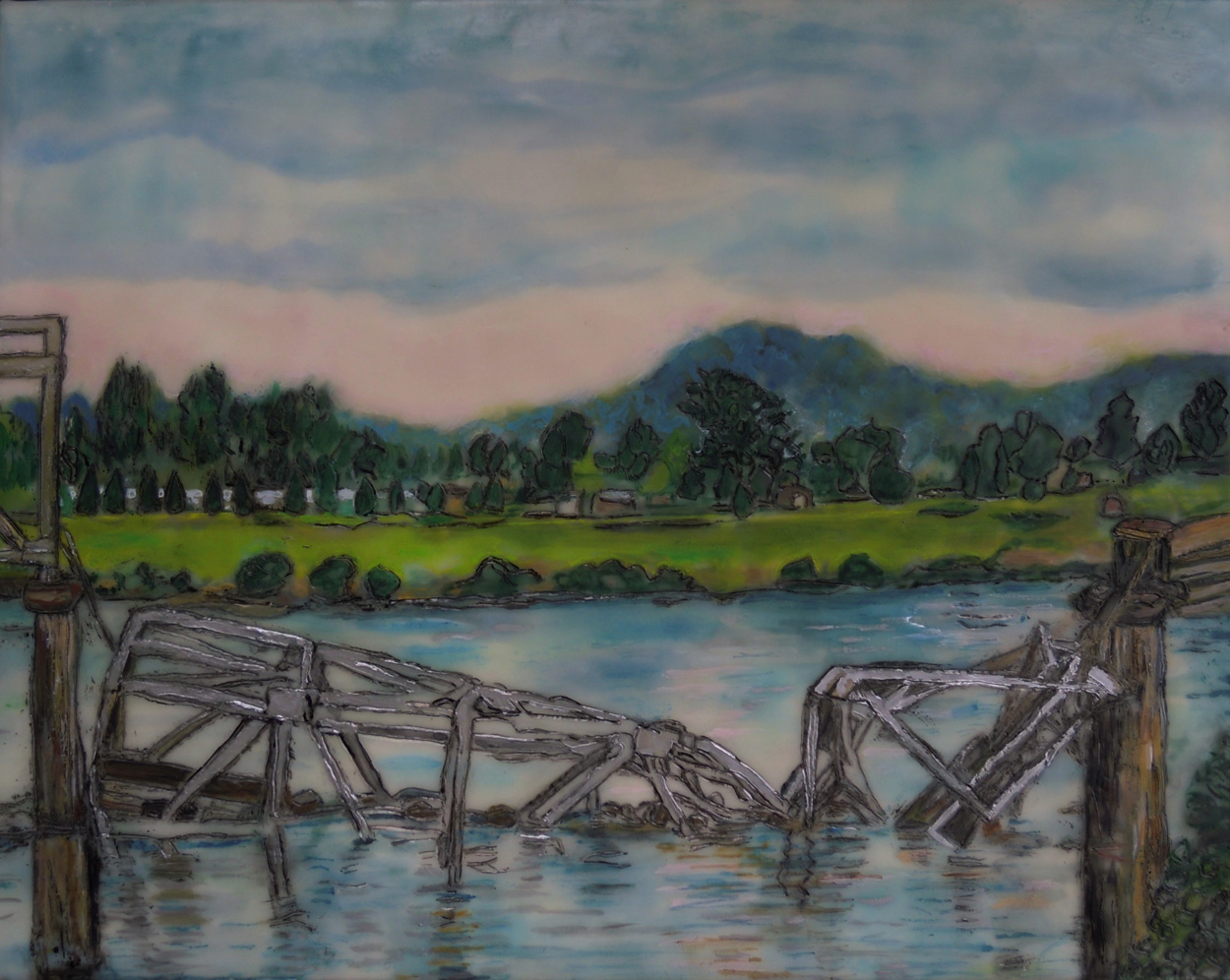
"The Bridge'' (encaustic painting by Nancy Whitcomb.
WEST WARWICK, R.I.
War always goes for the infrastructure: Take out the bridges, cut off the electricity and water supplies. All that used to be done with artillery, tanks and bombs from above.
Going forward, it will be done by computers: cyberwar.
Every day the early skirmishes -- the tryout phase, if you will – are taking place. There are tens of thousands of probes of U.S. infrastructure by potential enemies, known and unknown, state and non-state. A few get through the defenses.
Jeremy Samide, chief executive officer of Stealthcare, a company which seeks to improve cyberdefenses for a diverse set of U.S. companies, sees the cyber battlefield starkly. He says the threat is very real; and he puts the threat of serious attack at 83 percent.
As Samide looks out across the United States from his base in Cleveland, he sees probes, the term of art for incoming cyberattacks, like an endless rain of arrows. Some, he says, will get through and the infrastructure is always at risk.
Director of National Intelligence Dan Coats issued a warning in July that the alarms for our digital infrastructure are “blinking.” He compared the situation to that in the country before the 9/11 terrorist attacks. The situation, he told the Hudson Institute in a speech, is “critical.” Coats singled out Russia as the most active of the probers of U.S. infrastructure.
Samide says probing can come from anywhere and Russia may be the most active of the cyber adventurers.
A common scenario, he says, is that the electric grid is target one. But considerable devastation could come from attacking banking, communications, transportation or water supply.
Retired Army Gen. David Petraeus, a former director of the CIA and current chairman of KKR Global Institute, in an article coauthored with Kiran Sridhar and published in Politico on Sept. 5, urges the creation of a new government agency devoted to cybersecurity.
Samide and others endorse this and worry that the government has much vital material spread across many agencies and not coordinated. Behind Petraeus’s thinking is one of the lessons of 9/11: Government departments aren’t good at sharing information.
Conventional wisdom has it that the electric grid is super-vulnerable. But Politico’s cybersecurity reporter David Perera, who consulted experts on the feasibility of taking down the grid, somewhat demurs. In a Politico article, he concluded that the kind of national blackout often theorized isn’t possible because of the complexity of the engineering in the grid and its diversity.
The difficulty, according to Perera, is for the intruder to drill down into the computer-managed engineering systems of the grid and attack the programable controllers, also known as industrial control systems -- the devices that run things, such as by moving load, closing down a power plant or shutting off the fuel supply. They are automation’s brain.
Perera’s article has been read by some as getting the utilities off the hook. But it doesn’t do that: Perera’s piece is not only well-researched and argued but also warns against complacency and ignoring the threat.
John Savage, emeritus professor of computer science at Brown University, says, “I perceive that the risk to all business is not changing very much. But to utilities, it is rising because it appears to be a new front in [Russian President Vladimir] Putin’s campaign to threaten Western interests. While I doubt that he would seek a direct conflict with us, he certainly is interested in making us uncomfortable. If he miscalculates, the consequences could be very serious.”
Samide warns against believing that all probes are equal in intent and purpose. He says there are various levels of probing from surveillance (checking on your operation) to reconnaissance (modeling your operation before a possible attack). Actual attacks, ranging from the political to the purely criminal, include ransomware attacks or the increasing cryptojacking in which a hacker hijacks a target’s processing power in order to mine cryptocurrency on the hacker’s behalf.
The threats are global and increasingly the attribution -- the source of the attack --concealed. Other tactics, according to Samide, include misdirection: a classic espionage technique for diverting attention from the real aim of the attack.
The existential question is if cyberwar goes from low-grade to high-intensity, can we cope? And how effective are our countermeasures?Today’s skirmishes are harbingers of the warfighting of the future.
Llewellyn King is executive producer and host of White House Chronicle, on PBS. His email is llewellynking1@kingpublishing.com. He's based in Washington, D.C. and Rhode Island.
Wait'll next year
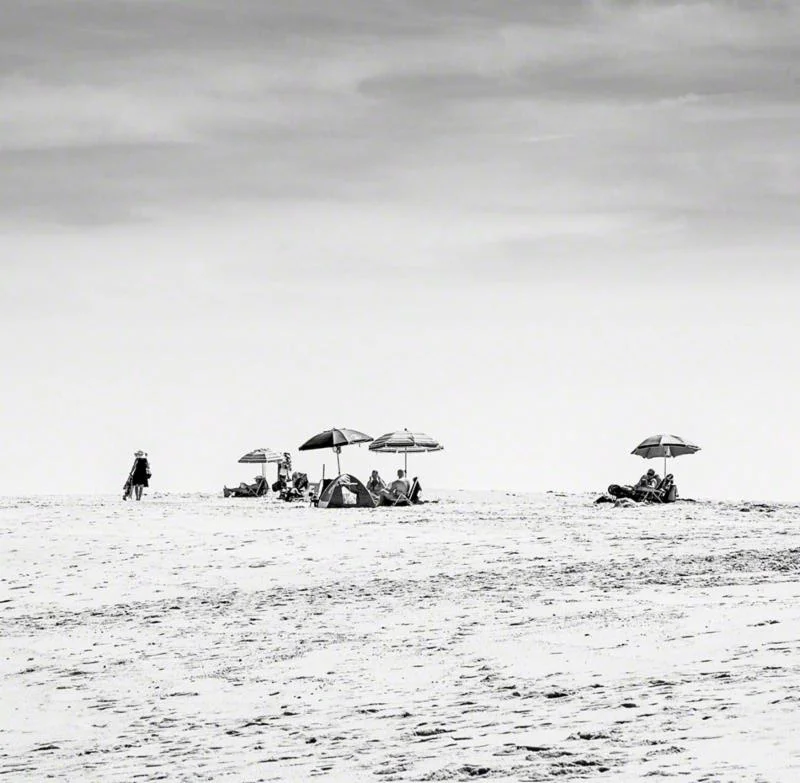
"Day After Labor Day,'' at Head of the Meadow Beach, Truro, Mass. (aluminarte print), by Bobby Baker (copyright Bobby Baker Fine Art, Cataumet, Mass.)
'Allusions to the body'

"Fused'' (mixed media), by Linda Leslie Brown, in her show "Plastiglomerate,'' at Kingston Gallery, Boston, Oct. 3-28. The gallery says:
"As a sculptor Linda Leslie Brown’s work metaphorically plays with the literal and the imagined as seemingly random, mostly discarded materials interact to build works rife with allusions to the body. At the same time, her sculptural assemblages suggest the plastic, provisional and uncertain world of a new and transgenic nature where corporeal and mechanical entities recombine, serving as relics of possible futures and symbols of human behavior on the global environment. Her sculptures suggest a creaturely symbiosis as with holobionts: assemblages of different species that form ecological units.''
'New Englanders of the Year'
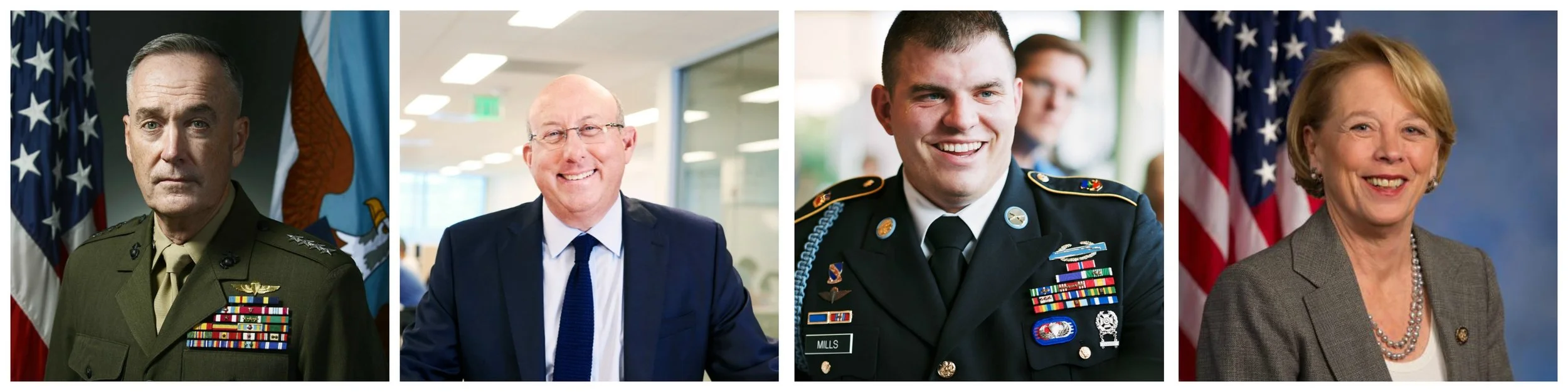
From left, Dunford, Leiden, Mills and Tsongas.
This just in from The New England Council (newenglandcouncil.com)
"The New England Council is pleased to announce our 2018 New Englanders of the Year. These four remarkable New Englanders will be honored at our 2018 Annual Dinner on the evening of Thursday, October 11, 2018, at the Seaport Hotel/World Trade Center in Boston. .... This year, we will honor three individuals who have made tremendous contributions to our region and our nation:
Gen. Joseph F. Dunford, Jr., Chairman, Joint Chiefs of Staff. He is the 19th Chairman of the Joint Chiefs of Staff, the nation’s highest-ranking military officer, and the principal military adviser to the President, Secretary of Defense, and National Security Council. Prior to becoming Chairman, in October 2015, he served as the 36th Commandant of the U.S. Marine Corps. Over the course of his four decades of distinguished service in the Marines, he has served as an infantry officer at all levels and is the first Marine Corps officer to serve in four different four-star positions. General Dunford has served in a variety of key leadership posts, including senior command posts in in both Afghanistan and Iraq. A native of Boston, he is a graduate of Saint Michael’s College and holds master’s degrees from both Georgetown University and the Fletcher School of Law and Diplomacy at Tufts University.
Jeffrey Leiden, M.D., Ph.D., Chairman, President and CEO, Vertex Pharmaceuticals. Dr. Leiden is a physician and scientist who, for the last 30 years, has dedicated his career to improving the lives of people with serious diseases. His experience spans all aspects of the biotech and pharmaceutical industries. Under Dr. Leiden’s leadership, Vertex has brought to patients the first and only medicines to treat the underlying cause of cystic fibrosis (CF), and is now developing a medicine that could reach 90 percent of people living with this devastating disease. It is his mission and the basis of the company’s research priorities to bring transformative medicines to people with CF and other serious diseases. Dr. Leiden also cares deeply about inspiring and equipping under-resourced students and young women to become the next generation of scientific leaders. He established a signature program at Vertex to enhance science, technology, engineering, art and math (STEAM) education among Boston students, including an on-site Learning Lab, mentorship programs, internships and college scholarships.
Staff Sergeant (ret) Travis Mills, U.S. Army Veteran and Founder of the Travis Mills Foundation –Retired U.S. Army Staff Sgt. Mills, a Maine resident, served three tours of duty in Afghanistan as a member of the 82nd Airborne Division. In April 2012, during his third tour, he was critically injured by an improvised explosive device (IED) while on patrol, losing portions of both legs and both arms. He is one of only five quadruple amputees from the wars in Afghanistan and Iraq, and today is an advocate for veterans and amputees. In September 2013, he established the Travis Mills Foundation to benefit and assist combat-injured veterans. In June 2017, he opened the Travis Mills Foundation Veterans Retreat, in Rome, Maine, where war-injured veterans and their families are welcomed for rest and relaxation at no charge. Sergeant Mills is also the author of the New York Times best-selling memoir Tough as They Come.
The Honorable Niki Tsongas, U.S. House of Representatives. Congresswoman Tsongas was elected to the U.S. House of Representatives in 2007, becoming the first woman to represent the Bay State on Capitol Hill in 25 years. She is in her final year representing Massachusetts’ 3rd Congressional District, having announced her retirement in 2017. Throughout her tenure in Congress, Rep. Tsongas has served on the House Armed Services Committee, where she has been a tremendous advocate for our region’s defense sector and military installations, and has fought tirelessly to support and protect our men and women in uniform. She has also been on the front lines of developing policies related to domestic energy production, the environment, and our National Park System as a member of the Natural Resources Committee. The Congresswoman is a graduate of Smith College and Boston University School of Law.''
Fizz Parkal: Stop the use of prison slave labor to enrich big companies
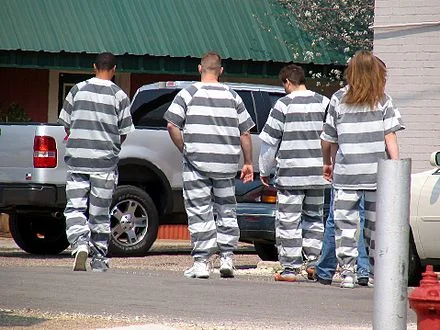
Via OtherWords.org
As wildfires rage across California, some of the people risking their lives to fight them are paid only a few dollars a day. They’re part of a 2.3 million-strong underclass of American employees making sweatshop wages: incarcerated workers.
Slave wages are just one of the many reasons why incarcerated people around the U.S. on strike. The strike was organized in response to deadly violence at Lee Correctional Institution in South Carolina earlier this year, a result of the prison’s abysmal living conditions.
Organizers have a list of 10 demands, which include the need for prompt improvement of prison conditions and policies.
They also call for the “immediate end to prison slavery,” which is legal thanks to a constitutional loophole. The 13th Amendment famously outlaws slavery — except, less famously, “as a punishment for a crime.”
That’s how the Prison Industry Enhancement Certification Program was created in 1970. In theory, the program was meant to establish work opportunities for incarcerated people so that they could both earn money and develop skills, increasing their chances of getting a good job upon release.
However, this is hardly the case. These work programs teach few relevant skills and pay less than $1 an hour on average, if they pay at all.
Earned income is essential for folks on the inside because it allows them to buy necessities not provided by the prison, like soap, calling cards, and tampons. Fair wages during incarceration are doubly important due to the stark barriers to employment upon release.
There’s an economic argument in addition to the moral one. In 2000, five economists conducted a study on the impact of prison labor and found that it benefits the overall economy — if incarcerated workers are paid more, given the opportunity to unionize, and have access to workers’ compensation.
While workers lose out, companies are turning a profit off the work of incarcerated people.
For-profit corporations like Geo Group and Core Civic — formerly the Corrections Corporation of America — benefit from incarceration in general and prison slavery specifically. Over the years, many corporations — including Victoria’s Secret, Starbucks, Microsoft, Dell, Boeing and Whole Foods — have also profited by paying incarcerated people substandard wages to do everything from sewing garments to producing plane parts.
Going on strike is the best way for incarcerated folks to contest the inequality they face and leverage what little political power they have.
“Frankly, it’s the only way to challenge their slave status,” Paul Wright, editor of Prison News, told me. Since there’s no legal or judicial way to challenge their institutionalized slavery through the courts, the only option available for incarcerated workers is to withhold their labor.
National strikes also draw attention to an issue where media is generally silent.
“Even in cases like the massacre that occurred in Lee County earlier this year, prisoners were not given space to respond or share their experiences with the press,” Amani Sawari, an outside organizer for Jailhouse Lawyers Speak, explained to me. “It wasn’t until the call for the strike that prisoners were beginning to receive media attention directly.”
While this strike is powerful for all incarcerated folks, it’s an especially important for those who identify as LGBTQ. They experience higher rates of incarceration than the general population and are more likely to experience violence there — or be put into solitary confinement (often as the only way to “protect” them).
Organizers are asking people to support the strike by educating themselves on the conditions in prisons and the demands put forth by incarcerated people. People can spread the word by posting stickers and flyers, using the hashtag #PrisonStrike on social media, or organizing call-in campaigns and solidarity demonstrations.
Fizz Perkal is a Next Leader at the Institute for Policy Studies.
Todd McLeish: Using biocontrol to thwart invasive species in New England

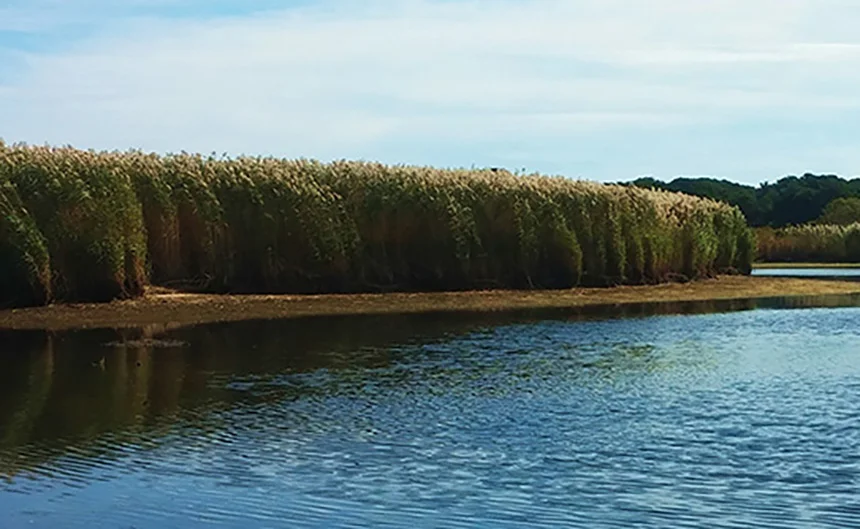
Phragmites are often controlled with the application of herbicides, which shouldn’t be used in salt marshes and other coastal locations where this invasive species grows extensively. Two moths whose caterpillars feed inside the stems of the invasive wetland plant phragmites are being tested to combat the spread of these fast-growing invasive plants.
-- ecoRI News photo
From ecoRI News (ecori.org)
The announcement in July that the emerald ash borer, an invasive beetle that kills native ash trees, had been found in Rhode Island raised questions about how to eradicate the invader before it wreaks havoc on the attractive trees found in parks, along roadsides, and in forests.
One strategy being employed against many other invasive species is biocontrol, the use of one organism to control another. And while it may be too late to use it to fight the emerald ash borer and save area trees in many locations, the strategy may help combat the beetle in the future so the next generation of ash trees can thrive.
“Biocontrol is essentially reuniting natural enemies with a target organism,” said Lisa Tewksbury, an entomologist at the University of Rhode Island who manages the University of Rhode Island’s Biocontrol Lab. “They have an evolutionary relationship in which one organism feeds on another organism. So through biocontrol we’re re-establishing that relationship.”
Typically, that means finding an insect in the region where the pest originated — often Europe or Asia — testing to make sure the insect only feeds on the pest, seeking a permit from the government, releasing the insect wherever the pest resides, and letting nature take its course. It’s considered an effective alternative to the widespread use of pesticides.
In July, for example, Tewksbury announced that she had released a moth from Eastern Europe whose caterpillar eats nothing but invasive black and pale swallow-wort vines. The vines were introduced to North America in the 19th Century and quickly spread throughout the East Coast. Not only do the vines outcompete native species and alter soil chemistry, they harm monarch butterfly populations. If monarchs lay their eggs on swallow-wort leaves instead of the closely related milkweed, the larvae that hatch are unable to survive.
Tewksbury and her students spent 10 years testing a Hypena moth to ensure that its caterpillars don’t eat any native plants in the United States — only the invasive swallow-worts — before getting a government permit to release it in Charlestown and on an island in Buzzards Bay last year.
The practice of biocontrol has its critics, however, who worry that the release of non-native insects could create additional harm to native wildlife. They point to several horror stories from a century ago, including the release of mongooses in Hawaii and cane toads in Australia. But for many invasive pests that are well established, there is no alternative to biocontrol.
URI has been conducting biocontrol research for several decades and has released numerous pest enemies through the years. Many of those pests are no longer a significant concern, thanks to the arrival of the pests’ natural enemies.
Birch leafminer
A parasitic wasp from Europe was tested and released in North Kingstown, R.I., by Tewksbury and her colleagues in 1989 to combat the birch leafminer, an invasive insect that “mines” between the surfaces of birch tree leaves. The leafminer was a significant pest in the Northeast in the 1970s and ’80s, turning leaves brown in about 80 percent of the region’s birch trees, though killing very few. The wasp lays its eggs in the leafminer, and when the eggs hatch, the wasp larvae consume the leafminer from the inside.
In addition to the Rhode Island site, the wasp was released in many other locations throughout the Northeast in the 1980s and ’90s. Birch leafminers are no longer considered a pest in the region, and damage from the insects hasn’t been observed in Rhode Island since 2004.
Purple loosestrife
A leaf-eating beetle native to Europe was released at Roger Williams Park Zoo and other locations in Rhode Island to control the spread of the invasive wetland plant purple loosestrife in the late 1990s. The beetles reproduced so well at a site in North Kingstown that some were collected there and redistributed elsewhere.
“In areas that had large infestations of purple loosestrife, the beetles have cut it back quite a bit,” Tewksbury said. “The beetle does best in open water areas, but the plant is still growing in shady areas like along rivers. It’s been a nice long-term success at keeping loosestrife under control, but it hasn’t eradicated it. Biocontrol of weeds doesn’t typically eliminate the pest, but just provides long-term management.”
Lily leaf beetle
A beetle that consumes ornamental lilies was accidentally introduced in Cambridge, Mass., in 1992, and many gardeners in southern New England gave up trying to grow lilies due to the damage from the beetle. URI scientists identified three parasitic wasps from Europe that control the lily leaf beetle, tested them in their lab for several years, and released the wasps at many locations in Rhode Island, Massachusetts, New Hampshire and Maine.
According to Tewksbury, anecdotal evidence suggests that the beetle is no longer a significant problem in Rhode Island, though it can still be found in a few isolated gardens. She continues to raise the wasps in her lab to provide to colleagues in other states as the beetle continues to spread elsewhere.
Winter moth
The caterpillars of invasive winter moths, which are native to Europe, have defoliated tens of thousands of acres of trees in Rhode Island in recent years, but a European fly introduced at about eight sites in the state since 2011 has helped to keep the moth population under control.
According to entomologist Heather Faubert, a URI colleague of Tewksbury, the fly lays its eggs on tree leaves at about the same time that the caterpillars are feeding on the leaves. When the caterpillars consume the fly eggs, the eggs hatch inside the caterpillar and the fly larvae feeds on the inside of the caterpillar.
“Moth numbers have really come down, and they don’t seem to defoliate much anymore, other than blueberry and apple trees,” she said. “Some of that is due to the fly, but I’m also seeing mice and beetles eating a lot of moth pupa, and birds love to eat the caterpillars.”
Phragmites
Two moths whose caterpillars feed inside the stems of the invasive wetland plant phragmites are being tested at the Biocontrol Lab, and Tewksbury will soon seek government approval to release them in the area. Phragmites are often controlled with the application of herbicides, which shouldn’t be used in salt marshes and other coastal locations where phragmites grows extensively.
Mile-a-minute vine
A weevil native to the Far East is the weapon of choice in the fight against a fast-growing invasive vine that was first found on Block Island in 2008 and has spread to at least seven communities in the state. Tewksbury has released more than 60,000 weevils — some she has reared herself, others she obtained from a biocontrol lab in New Jersey — and she is continuing annual releases at many of the sites.
“The weevils are definitely established and having an impact,” she said. “I can see the feeding damage they’re having. But this plant is a really tough one to combat, and I’m not sure how well it’s going to do. It will probably prevent the vine’s spread, but I don’t see populations going away any time soon.”
Regardless of the level of success the weevil has achieved against mile-a-minute vine, most scientists agree that biocontrol is a vital option in the battle against invasive species.
“Having this lab enables us to have an impact on a lot of natural areas in Rhode Island by controlling introduced pests without using pesticides,” Tewksbury said. “The costs are low compared to chemical methods, and you hope for a long-term ecological solution.”
Rhode Island resident and author Todd McLeish runs a wildlife blog and reports and writes for ecoRI News.
Restaurants and overfishing

In the 19th Century, dories were carried aboard larger fishing schooners, and used for handlining cod on the Grand Banks, which was heavily harvested by fishermen from Gloucester, Mass.
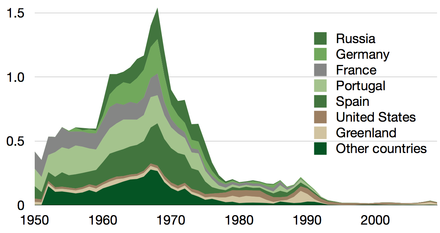
Capture of the Atlantic northwest cod stock in million tonnes, apart from Canada."
[If] we can celebrate that in a way that celebrates our love for New England as well as our love for the Italian culture as well as the American culture, then we've done something that's really good and supporting these fishermen who are doing the right thing in sustainability . . . paying attention to make sure we don't overfish our world.''
-- Mario Batali, who co-owns restaurants in Westport and New Haven, Conn., among other places.
An old inn, Rockwell, a mental hospital and Arlo

The Red Lion inn (first part built in 1773), in Stockbridge.
“And in the quiet, rural middle of it {the Berkshires}, Stockbridge sits like nothing so much as a living postcard from small town America. Standing at dusk on Main Street, looking at the row of seasoned old storefronts, the long, classic porch of the fabled Red Lion Inn wrapping around the corner, and the tree-studded ridgeline of the Berkshires creating a green and gold and backdrop to it all, a visitor might be put in mind of a Norman Rockwell painting. Which would be perfectly apt. Rockwell lived only a block away, and he painted that very scene.’’
-- From New England Notebook, by Ted Reinsteim
He might also have noted that Stockbridge is also home to the Austen Riggs Center, a psychiatric hospital known for its celebrity patients. Its presence was a factor in Rockwell and his wife moving to the town from Arlington, Vt. Mr. and Mrs. Rockwell were both treated there for anxiety and depression. Stockbridge also hosts the Norman Rockwell Museum, which has many of the famous illustrations he did for the old Saturday Evening Post and other publications in the Golden Age of Magazines.
His Stockbridge studio was on the second floor of a row of buildings; directly underneath Rockwell's studio was, for a time in 1966, the Back Room Rest, better known as the famous "Alice's Restaurant of song and movie fame, about a bunch of '60s Hippies led (sort of!) by songwriter Arlo Guthrie and their interactions with small-town life.

The Norman Rockwell Museum.

Colorized postcard of Stockbridge made in the early 20th Century.
Bashing the Blues
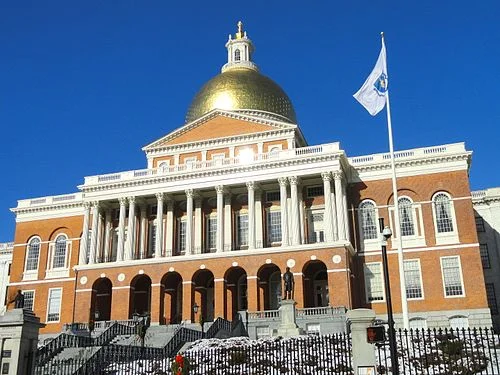
The Massachusetts State House. The Bay State and Connecticut are two of the richest states.
From Robert Whitcomb's "Digital Diary,'' in GoLocal24.com
It doesn’t take a genius to see that Trump is trying to punish Blue States. After all, he’s never made much of an effort to suggest that he’s president of all the people. Almost all of his big speeches are before screaming hordes of cultists/wishful thinkers (suckers) at MAGA rallies, with opiate- and amphetamine-rich West Virginia a favorite venue. There, many folks have long since stopped reading in favor getting their “news’’ from another New York crook, Sean Hannity.
Paula Dwyer, writing for Bloomberg Business Week, did a nice review of this the other day in “Trump’s War Against Blue States’’.
Among her observations about a few of our mobster-in-chief’s anti-Blue State policies, let’s just concentrate on GOP tax “reform.’’
“His tax overhaul has capped at $10,000 the federal income tax deduction that a homeowner can claim for payment of state and local taxes, affecting taxpayers especially severely in the Northeast and California,’’ which have higher taxes because they generally have, to varying degrees, better and more humane public services than the Red States and because the people in Blue States are bigger wealth creators. Because of the nature of the economies in the aforementioned Blue States, even middle-class taxpayers can reach the $10,000 cap fairly easily.
Red State Republican members of Congress complain that letting Blue State folks deduct their higher state and local taxes results in Red States subsidizing the Blue ones.
In fact, it’s always been the opposite. As Ms. Dwyer notes, and as I said here before, Red States generally have low state and local taxes (except some have high sales taxes, which are regressive) because most have thin public services and generally rely much more than do Blue States on federal money. Consider that in the heart of Trump Country – Mississippi – the state gets about 40 percent of its operating money from the Feds, with much of it coming from the big federal taxes paid by Blue State folks.
Eight of the 10 biggest winner states in getting more money from the Feds than they pay are Red States, seven of the 10 biggest losers are Blue States, notably including the vast sums from New York and New Jersey. (Massachusetts was 13th biggest loser but poor little Rhode Island was 18th in the states that get more from the Feds than they pay – because of poverty and, more happily, the big Navy-related facilities.) The figures are of course affected by poverty levels, and Red States do less to help the poor than do Blue States, thus necessitating more federal help to make up some of the differences. The presence and absence of military bases (e.g., Naval War College) and federal contracts also play a big role.
I have long thought that Trump especially wants to stick it to New York because he knows how detested he is there.
To read Ms. Dwyer’s article, please hit this link.
Vanity, vanity....

"Enlightenment'' (oil on canvas, detail), by Anita Loomis, in her joint show "Untold Stories','' at Fountain Street Gallery, Boston, through Sept. 30.
The gallery says:
"Anita Loomis's narrative-driven paintings are playful and cartoonish, poking fun at some of our less attractive characteristics such as vanity, clumsiness, and frustration. The paintings encourage the viewer to notice how beautiful a line, color, or shape can be; how funny human behavior can be; or how interesting that something so plain and unassuming can touch souls or create laughter.''
UMass Boston finally has dorms
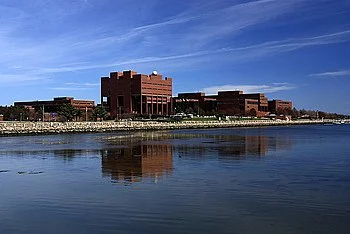
The UMass Boston campus, on Boston Harbor.
The New England Council (newenglandcouncil.com) reports:
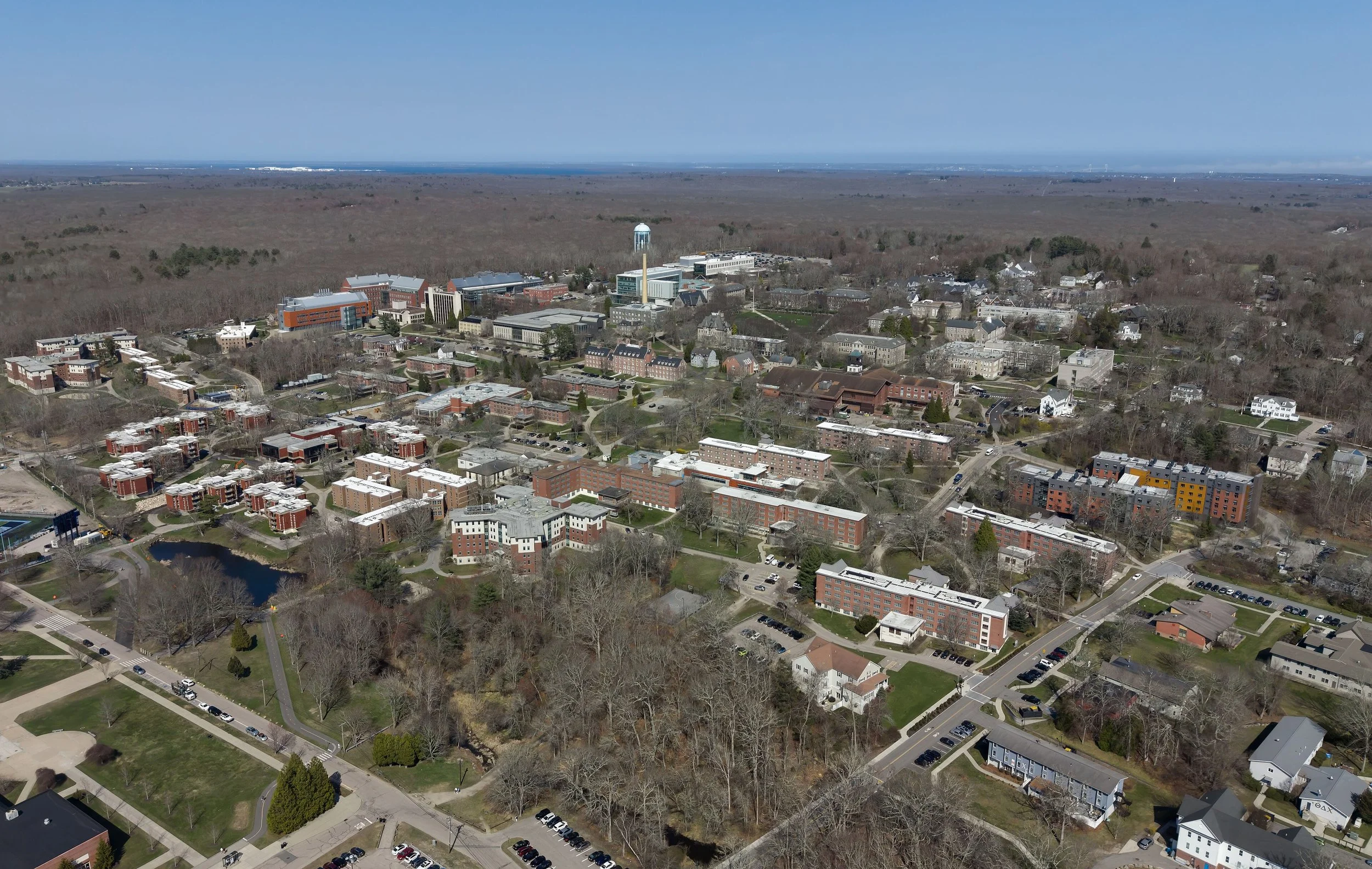
The University of Massachusetts at Boston, a New England Council member, opened its first-ever residence halls in late August 2018, just in time for the beginning of the new academic year. The new residence halls are the result of a $120 million investment by UMass Boston and will provide housing for over 1,000 students at the university’s Columbia Point campus in Dorchester.
The New England Council (newenglandcouncil.com) reports:
"Long considered a “commuter school,” the University of Massachusetts at Boston has worked for years to develop on-campus housing for students. Planning for the new facilities dates back over a decade, with the project approved in early 2016, and groundbreaking in December of that year. The 1,077-bed student-housing complex includes two buildings, ranging from seven to 12 stories. The new dorms offer a mix of styles ranging from single-occupancy apartments to four-person units. The buildings also feature living-learning amenities open to the entire UMass Boston community, including seminar rooms, study lounges, and a 500-seat dining commons.
'The whole campus is going to feel completely different,' interim Chancellor Katherine Newman told The Boston Globe.
Boston Mayor Martin J. Walsh and University of Massachusetts President Martin Meehan joined interim Chancellor Newman for a ribbon-cutting ceremony on August 28, and students will move in over Labor Day weekend.''

David Warsh: Why we still read Adam Smith, economist and humanist
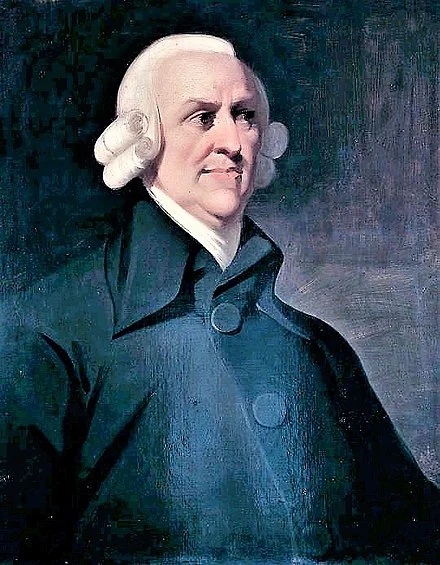
Adam Smith.
SOMERVILLE, Mass.
Jesse Norman, 56, is a rising star in British politics. Member of Parliament since 2010 for Hereford and South Herefordshire, a county seat 135 miles west of London, today Norman is Minister for Roads, Local Transport and Devolution in the Conservative government of Theresa May and a potential future Tory leader. What is he doing as the author of a readable and thoughtful book, Adam Smith: Founder of Economics (Basic Books, 2018)?
Part of the answer is that he’s thinking through his politics in an unusually thorough fashion. His previous book, equally salient, was Edmund Burke, The First Conservative (Basic Books, 2013). Mainly, though, I expect he is looking for approbation. I aim to give him some.
Long has there been considered, at least in some quarters, to be a problem with Smith, because he was author of not one but two great books, The Theory of Moral Sentiments (1759), and An Inquiry Into the Nature and Causes of the Wealth of Nations (1776). In the first, the sympathy that humans feel for one another, and specifically desire for acceptance and approval, is the motive force at the heart of human nature. In the second, the force examined is “self-love,” better rendered today as self-regard or self-interest. How could the same man have written both books?
The Germans call this the Umschwung aspect of Smith’s work, meaning the reversal they perceive, known since the ancient Greek playwrights: that moment in a narrative when one’s attention is suddenly called away to an unexpected change of direction in the plot. Sometimes the shift in emphasis is ascribed to a conversion that Smith experienced when he visited France and met Quesnay and the French physiocrats. At that point, as Norman describes the German argument. “the soft-hearted young moral philosopher must have yielded to the flinty older economist.”
Following most British students of Smith, Norman thinks this is nonsense, that there exists no such discontinuity between the books. He writes, “Smith saw his great works as self-sufficient but deeply complementary [systems]… built on the single idea of continuous and evolving mutual exchange: communicative exchange in language, exchange of esteem in moral and social psychology, market exchange in political economy.”
I’m inclined to disagree. What happened between the one book and the other, I think, is that Smith made a discovery, that he espied what today we call the self-equilibrating price system, and set out what he called “the system of natural liberty” in such a way as to attract a community of adherents who founded a social science they called political economy. He puzzled over the relationship of the one book to the other for the rest of his life, adding the concept of “the impartial spectator” to explain the nature of conscience and the origin of sense of duty, with a whole new Part VI appended shortly before he died.
This much is a matter for experts. Smith was the founder of economics, there is not much doubt about that. But The Theory of Moral Sentiments has brought forth no such progeny – at least not yet. If not economics, what is it? Norman at one point describes it as a work of “moral psychology, or sociology.” Eventually, I expect, today’s evolutional psychologists will claim it as their own. The real problem with Adam Smith is that he wasn’t able to read Charles Darwin (though Darwin read Smith), and tucked away at the end of On the Origin of Species is Darwin’s surmise that psychology would one day be based on evolutionary theory. For an introduction, already well out-of-date, see The Moral Animal: Why We Are the Way We Are, The New Science of Evolutionary Psychology (Vintage, 1995), by Robert Wright.
For now, however, The Theory of Moral Sentiments is best classed under the heading of a work in the humanities. What, you may ask, are the humanities? Everything that’s not considered social science: classics, literature, history, religious studies, philosophy, music, theater, even linguistics, at least for now. In Cents and Sensibility: What Economics Can Learn from the Humanities (Princeton, 2017) Gary Saul Morsonand Morton Schapiro write that “Stories are a mainstay of the humanities, but not of economics.” Certainly The Theory of Moral Sentiments is full of stories. Here is one of my favorite passages. (I was reminded of it reading Escape from Democracy: The Role of Experts and the Public in Economic Policy, by David Levy and Sandra Peart, Cambridge, 2017. This is why we still read Adam Smith. Consider this quote from The Theory of Moral Sentiments:
"A very young child has no self-command; but, whatever are its emotions, whether fear, or grief, or anger, it endeavours always, by the violence of its outcries, to alarm, as much as it can, the attention of its nurse, or of its parents. While it remains under the custody of such partial protectors, its anger is the first, and, perhaps, the only passion which it is taught to moderate. By noise and threatening they are, for their own ease, often obliged to frighten it into good temper; and the passion which incites it to attack, is restrained by that which teaches it to attend to its own safety. When it is old enough to go to school, or to mix with its equals, it soon finds that they have no such indulgent partiality. It naturally wishes to gain their favour, and to avoid their hatred or contempt. Regard even to its own safety teaches it to do so; and it soon finds that it can do so in no other way than by moderating, not only its anger, but all its other passions, to the degree which its play-fellows and companions are likely to be pleased with. It thus enters into the great school of self-command; it studies to be more and more master of itself; and begins to exercise over its own feelings a discipline which the practice of the longest life is very seldom sufficient to bring to complete perfection.''
This is why we still read Adam Smith. I leave it to the reader to decide whether The Theory of Moral Sentiments is economics or something else. Morson, professor of Slavic Language and Literature at Northwestern University, and Schapiro, the president there and also professor of economics, want to shoe-horn it into economics under a program of “de-hedgehogization” of Adam Smith, recalling Isaiah Berlin’s old distinction between the hedgehog (who knows one big thing) and the fox (who knows many different truths.) On the way they make a strong case for “narrativeness” in the service of the explanation of culture.
Jesse Norman has done his homework. The British people are fortunate to have him. May his next book be about the way his nation goes forward from Brexit. Whatever future lies ahead for the United Kingdom depends on a debate no less extraordinary than the one that brought Burke, Smith, David Hume, Edward Gibbon, and Samuel Johnson to the fore, two hundred and fifty years ago
David Warsh, a long-time economics and political columnist, and an economic historian, is proprietor of Somerville-based economicprincipals.com, where this first ran.
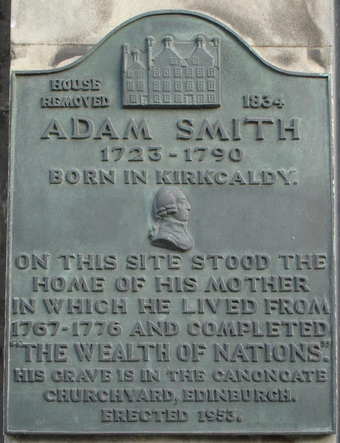
Marker in Kirkcaldy, Scotland.
Be very afraid
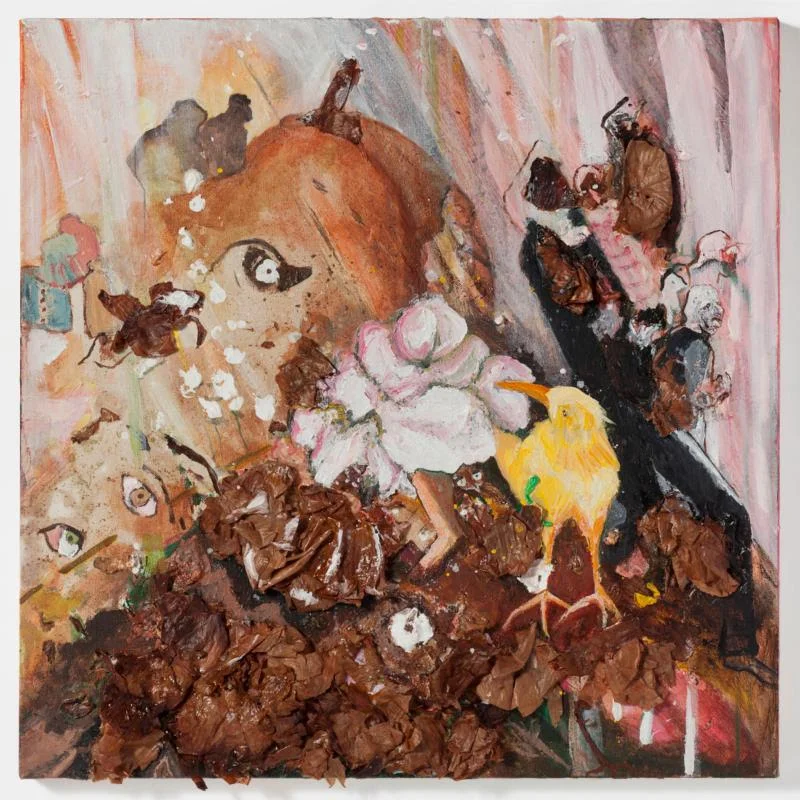
"Chicken Little" (onion skins and dye with acrylic paint on stretched canvas), by Nouritza Odabashian, in the show "Resiliency and Resistance,'' at Galatea Fine Art, Boston, Sept. 5-Sept. 30.
Woodland as an organism

In Borderland State Park, which straddles Easton and Sharon, Mass.
"I have been trying to think of the earth as a kind of organism, but it is no go. I cannot think of it this way. It is too big, too complex, with too many working parts lacking visible connections. The other night, driving through a hilly, wooded part of southern New England, I wondered about this. If not like an organism, what is it like, what is it most like? Then, satisfactorily for that moment, it came to me: it is most like a single cell.''
-- The late Lewis Thomas, physician, essayist and poet. wrote Lives of a Cell: Notes of a Biology Watcher.
Eyes in the water

One of Monet's many water lily paintings.
“Night covers the pond with its wing.
Under the ringed moon I can make out
Your face swimming among minnows and the small
Echoing stars….
Within, your eyes are open. They contain
A memory I recognize, as though
we had been children together….’’
-- From “The Pond,’’ by Louise Gluck, who lived for years in Vermont
Accelerating into September
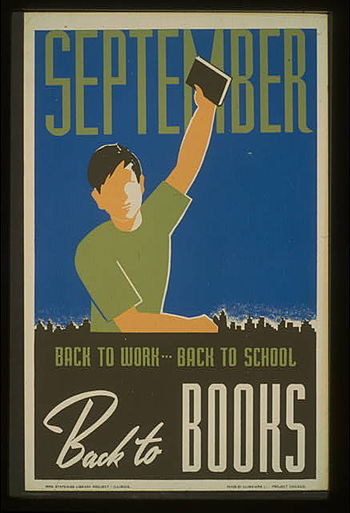
“The unlucky ones are those for whom summer was ending, in their thoughts, even as it began.
We, the unlucky ones, are cursed with the capacity to see the ending in every beginning. It is one of the dismal faculties some people some people develop after they first discover their own personal time is constantly accelerating. Later on, if they turn lucky, they are blessed again, not with the blessing of childhood, which is that each moment can seem eternal and complete for itself, but with the blessing of wisdom and philosophy, which can conquer the foreordained passing of a precious thing, like a summer.’’
-- From the September section of In Praise of Seasons, by the late Connecticut editor and essayist Alan H. Olmstead