
Vox clamantis in deserto





Medieval beauty in 'Suck City'

Boston's famed Trinity Church, on Copley Square.
“Trinity Park lies directly across from the {Boston Public} library, Trinity Church rising like a medieval thought amidst the glass and steel towers'' {around Copley Square in Boston's Back Bay}.''
-- From Another Bullshit Night in Suck City, by Nick Flynn
Trinity Church and its parish house were designed by Henry Hobson Richardson, and built from 1872 to 1877, when the complex was consecrated. Trinity Church established Richardson's reputation. It is the archetype of the Richardsonian Romanesque style, with its clay roof, polychromy, rough stone, heavy arches and a massive tower. This style was soon adopted for many public buildings, and some churches, across the United States.
The church is considered one of the greatest buildings in America.
The church was structurally damaged in the ‘70s by construction of the 60-story skyscraper at 200 Clarendon St., first called the John Hancock Tower, and still colloquially known as The Hancock. Among other problems with the tower were that a few panes of glass fell from it until engineering flaws were fixed. The flaws added the thrill of possible decapitation of visitors to Copley Square – one of the grandest public spaces in the Western Hemisphere.
The structural damage to the church was fully fixed, with the cost borne by the developers.
Just keep caffeinated

Three deckers in Boston's Jamaica Plain neighborhood.
“I guess no true Bostonian would trust a place that was sunny and pleasant all the time. But a gritty, perpetually cold and gloomy neighborhood? Throw in a couple of Dunkin’ Donuts locations, and I’m right at home.”
― Rick Riordan, in The Sword of Summer
The first college book?
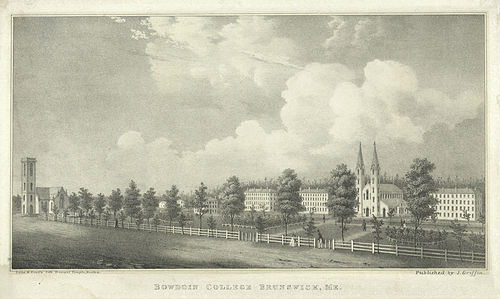
Bowdoin College about 1845.
"In an ancient though not very populous settlement, in a retired corner of one of the New England states, arise the walls of a seminary of learning, which, for the convenience of a name, shall be entitled 'Harley College'.''
--From the novel Fanshawe: A Tale, by Nathaniel Hawthorne. It is said to be the first novel about college life. Harley is based on Bowdoin College, in Brunswick, Maine, which Hawthorne attended in 1821-25.
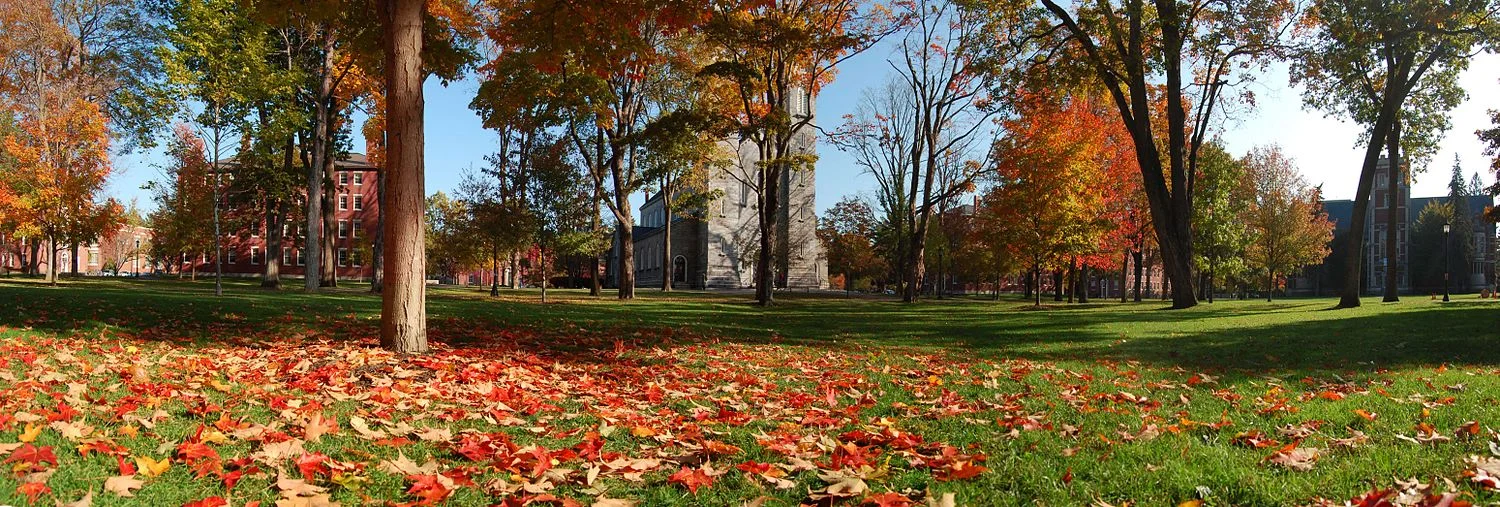
The Main Quad at Bowdoin.
We've got your back

"Then III" (mezzotint print), by Cleo Wilkinson, in the "Footprint International Exhibition 2018,'' at the Center for Contemporary Printmaking, Norwalk, Conn.,, through Aug. 26. The show showcases the current trends in printmaking within one square foot configuration.

A view of a couple of the more than two dozen islands off Norwalk, which is a mostly affluent New York City suburb on Long Island Sound. The quaint village of Rowayton may be the most interesting section. It's very pretty and has long attracted as residents many writers and painters. But it's now overdeveloped along the shore. That piled up the damage in Hurricane Sandy, in 2012, and the construction of waterfront McMansions has not ceased since then.
Don Pesci: In Connecticut, touching third rails
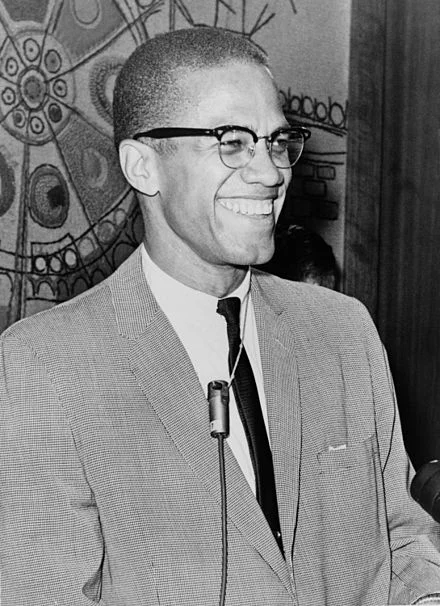
Malcolm X -- a firm believer in self-reliance.
Some people, not generally Friends of Tim Herbst (FOH), think that the Republican contender for Connecticut governor is aggressive. He is, as has been noticed during the Republican primaries, somewhat less aggressive in his advertising than David Stemerman, but then Herbst commands a more modest campaign war chest.
Herbst disputes the slur; he says he is competitive. However, the former first selectman of Trumbull does have a habit of fondling third rails that other Republicans running for governor fear touching.
Some of those rails – a hearty defense of the Second Amendment to the U.S. Constitution, every bit as inviolable as the First Amendment; peace and security in Connecticut; the socially disruptive effects of certain justice reforms under Gov. Dannel Malloy; the abolition of Connecticut's death penalty on social rather than legal grounds by Connecticut’s constitutionally confused, left-leaning Supreme Court; serious crime ripening in Connecticut cities; a plenitude of illegal guns in a state that boasts some of the most restrictive gun laws in the country; the baneful effects of fatherlessness among young urban African-American boys; and the constant chipping away of traditional morality by pretentious moral “reformists” – have gotten Herbst in Dutch with progressive social warriors. T
To be sure, Herbst not only stands squarely in a traditional Christian moral universe, his plans to lift Connecticut from its economic doldrums represent the larger part of his campaign message. Still, there are those rails pulsing with electricity, and also a sense on the part of many Democrats that Herbst is treading on sacred ground reserved to Democrats, a part of their progressive moral preserve.
The flight from social issues by Republicans has surrendered half the political battlefield to Democrats. That is how Democrats win elections. And now the left has to deal with this interloper. It’s best to make quick work of him, after which Democrats can set about winning elections by couching all issues in glossy moral terms.
Not so long ago, U.S. Sen. Dick Blumenthal, a progressive attached by a permanent umbilical cord to Planned Parenthood, advised everyone that any regulation of the abortion provider would reek of immorality. Herbst, not unreasonably or immorally, thinks that parents of children should be advised when their daughters procure abortions.
A ridged division between social and financial issues is not only false; it is silly. There is no Berlin Wall separating such issues. Welfare dependency among what English aristocrats used to call “the lower orders” is both a social and an economic issue. When welfare payments are unaccompanied by work requirements, you create a permanent dependent underclass that is certain to be preyed upon by rootless and fatherless males.
The notion that independence or self-reliance is morally superior to a cringing dependence on the mercy of strangers was the center pillar of the social philosophies of both Malcolm X, whom some of his critics during during his own day regarded as aggressive, and Martin Luther King Jr.
They weren't far removed from crusading journalist Ida B. Wells, who recommended arming black men who wanted to put the fear of the Lord in the KKK, King kept a pistol close by; so did Malcolm X, bushwhacked by the hoods that surrounded Elijah Mohammed after Malcolm X publicly accused the religious leader of having illicit sex with young girls. And it was President Bill Clinton, no hard-hearted conservative, who approvingly signed into law the “Personal Responsibility and Work Opportunity Reconciliation Act” of 1996 (PRWORA), having promised during his 1992 campaign to "end welfare as we have come to know it.”
That is the kind of third rail Herbst likes to fondle, even as his own Republican Party has been for decades in full retreat from welfare reform, silent on the matter of the Second Amendment, stonily silent as generation after generation in the state’s inner cities drift towards social and moral anarchism. Republican incumbents insincerely believe that ceding the moral high ground to moral reformists like Planned Parenthood will in the end assure them enough votes to remain a second rate minority party; better a live mouse in office than an out of office lion prowling on the political perimeter.
In the meantime, cowardly Republicans continue to win economic arguments and lose elections to gifted Democrat demagogues proficient in the art of fooling most of the people most of the time. A thoughtful media would blow many of them out of the water with raucous, cleansing laughter. For 50 years and more, hegemonic Democrat political organizations have been holding the lower orders in cities, many of them bankrupt, hostage to feel good programs, gilded cages that shrink the soul and open the heart to endless despair and misery. Herbst and a few fearless Republicans know this, and they are roaring – ENOUGH!
Don Pesci is a Vernon, Conn.-based writer. His email is donpesci@att.net
Still on guard

"Patrolling Fort Warren, Georges Island, Boston Harbor" (painting), by Karie O'Donnell, at the Art Complex Museum, Duxbury, Mass., through Aug. 12.
Fort Warren is a pentagonal bastion fort, made with granite, and built from 1833–1861. It was an important part of the defenses of Boston Harbor from 1861 through World War II, and during the Civil War was a prison for Confederate officers and government officials. It was decommissioned in 1947, and is now a tourist site. It was designated a National Historic Landmark in 1970 as a masterpiece of pre-Civil War coastal engineering, and for its role in the Civil War.
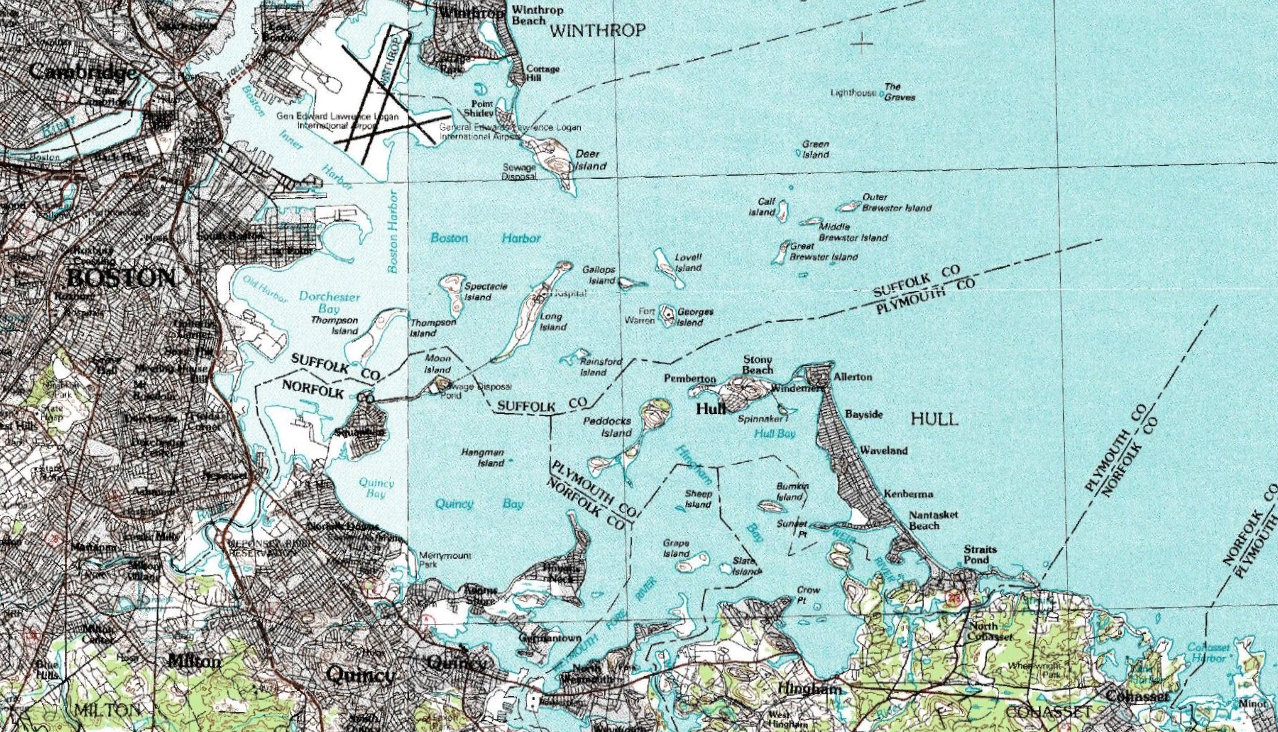
Georges Island is in the middle of the map.

Georges Island.
Using Ukrainian moths to control invasive vines

Swallow-wort, a highly invasive vine from Europe that reduces Monarch butterfly populations.

The Hypena opulenta moth. It eats swallow-wort.
Via ecoRI News (ecori.org)
KINGSTON, R.I.
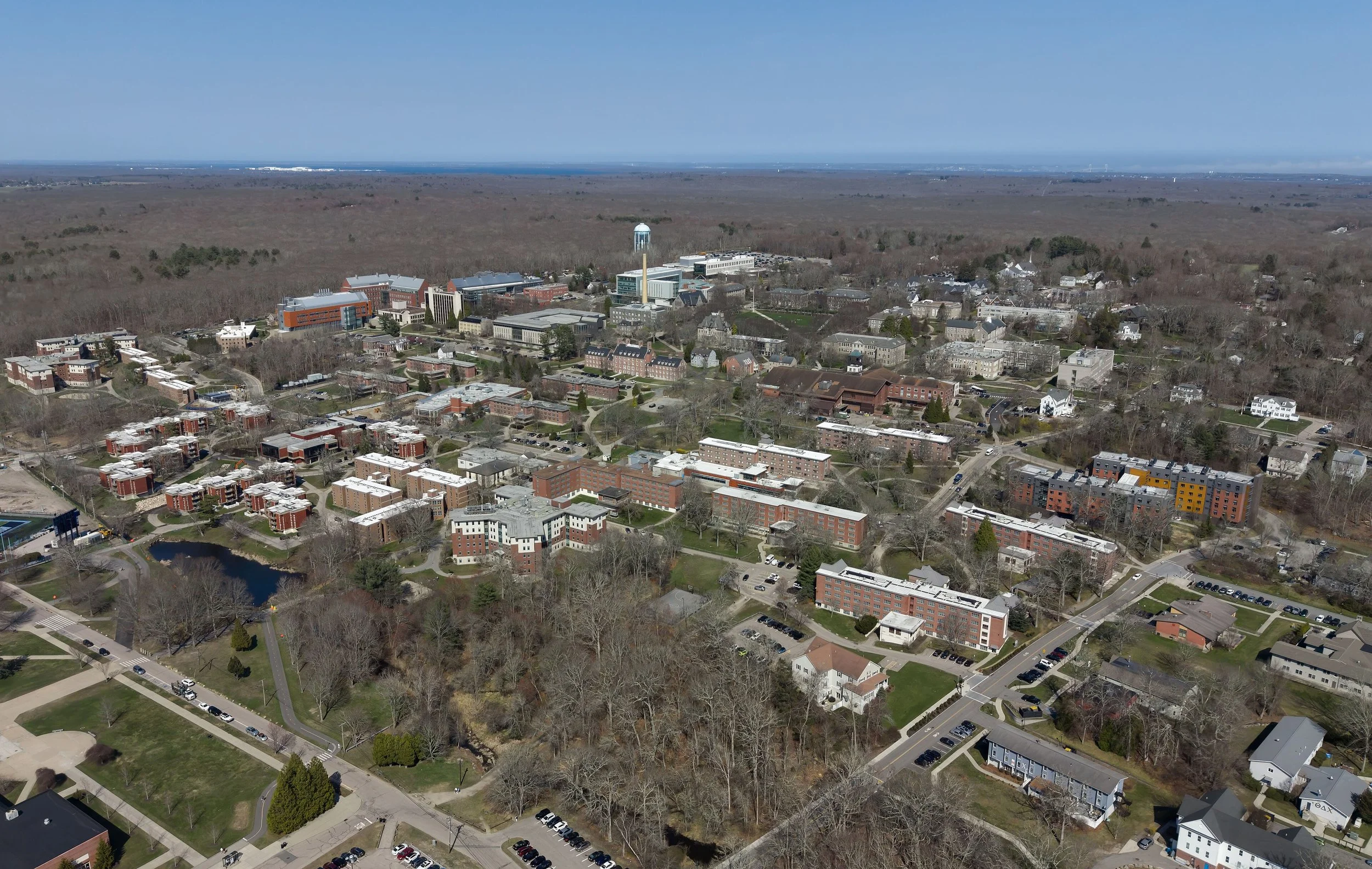
After more than 10 years of research, scientists at the University of Rhode Island’s Biocontrol Laboratory have released a species of moth collected from Ukraine to help control invasive black and pale swallow-worts.
Swallow-worts are invasive vines native to Europe that were introduced into North America in the 19th Century, and quickly spread along the East Coast and into Canada. Not only do they outcompete native species and alter soil chemistry, but they harm Monarch butterfly populations. Because swallow-wort is so closely related to milkweed, Monarch butterflies lay their eggs on swallow-wort leaves, but when the eggs hatch the larvae are unable to survive on the plant.
“Swallow-wort was one of those weeds becoming increasingly problematic,” said Aaron Weed, of Tunbridge, Vt., a former Ph.D. student at URI who spearheaded the project. Back in 2005 when Weed started his research as a URI graduate student, there was increasing interest in controlling swallow-worts. Since then, he’s seen the vine spread aggressively. It thrives in several different environments, including pastures, forests, and urban spaces.
“Integrated management of weeds is a very challenging endeavor,” Weed said. “Biocontrol is potentially efficacious for swallow-wort because conventional methods just weren’t working or were incompatible in sensitive areas.”
Weed traveled to Europe to try and find natural enemies of swallow-worts and brought back several insect species to test at URI’s Biocontrol Lab. Among them was the Hypena opulenta, a small moth collected from southeastern Ukraine, that the lab found feeds exclusively on swallow-wort species. Weed worked with Lisa Tewksbury, URI’s Biocontrol Lab manager, and Richard Casagrande, professor emeritus of entomology at URI, to conduct years of research on the biology of Hypena opulenta and its impact on swallow-worts.
Hypena opulenta was a suitable candidate because it uses swallow-wort exclusively as its host plant, and reproduces several times a year. Its larvae have the potential to cause significant harm to the plants, according to Tewksbury.
URI received the permit to release the moths in 2017, and field tests in controlled cages were conducted in Charlestown, R.I., and in Massachusetts last year. Tewksbury has been monitoring the releases, and if they’re successful, she said the lab plans to work with other local agencies to share resources and release the moths in other areas.
Tewksbury’s lab found the first moth that emerged in June, but hasn’t seen any others yet emerge. Tewksbury hypothesized that Rhode Island’s unusually cool temperatures throughout June may have delayed the moths’ emergence. She also noted that this is the first time that we’re seeing the emergence of this species in New England.
“The goal of biological control is to reacquaint new pests with their historical natural enemies,” Tewksbury said. “This restores the evolutionary relationship of an insect with its host plant, which we hope will provide long-term management of the invasive plant species.”
Continued research is underway to assess how well this insect will control populations across New England.
“Since insects are impacted by the health of their plants, the local climate, and the health of plants is affected by site conditions, we still need to determine under which site conditions biocontrol impact is likely to lead to weed suppression,” Weed said.
1 Comment
It's alive!

“Here something stubborn comes,
Dislodging the earth crumbs
And making crusty rubble.
It comes up bending double,
And looks like a green staple.
It could be seedling maple,
Or artichoke, or bean.
That remains to be seen.’’
-- From "Seed Leaves,'' by Richard Wilbur (1921-2017), a two-time winner of the Pulitzer Prize for his poetry. He spent most his career teaching at New England colleges. He died in Belmont, Mass.
Kathleen A. D'Alessio/Dorothy A. Osterholt: Teaching self-advocacy to students with learning disabilities
From the New England Board of Higher Education (nebhe.org)
PUTNEY, VT.
Over the past year, an increasing number of students have come forward to speak out against school violence. And there has been increased attention placed on helping students seeking support if an incident occurs and exercising their right to speak out against those who may perpetuate such behaviors. With high-profile cases of sexual assault, such as Brock Turner from Stanford University in 2015 and Brandon Vandenburg of Vanderbilt University in 2016, students are awakening to the existing inequities. The student response to these cases was swift and loud. Advocating for changes in attitudes and policies, the students invigorated the public to take notice and colleges and universities to institute changes.
The skill of self-advocacy is not only useful for supporting changes that students want to see in their institutions and beyond: It may be the most important foundational skill behind success in college. In general, students who thrive in college do so as they mature and find their place on campus. It can seem like a natural process for an emerging adult as they grow intellectually. But this is not the experience of all college students. By looking at the experiences of students who are struggling in college, we can have a better understanding of the importance of self-advocacy and its impact on the college experience.
The struggling student
Landmark College is designed for students who learn differently, including students with learning disabilities (such as dyslexia), attention deficit hyperactivity disorder, and autism spectrum disorder. These students are no strangers to the term “self-advocacy.” From the time they are in high school until they reach college, they have heard the term in various settings. Defining self-advocacy includes getting what one needs in an educational setting, as well as, understanding one’s diagnosis, knowing the legislation surrounding individuals with learning disabilities, requesting appropriate accommodations, providing documentation and knowing how to take effective action if difficulties arise. In other words, it means being able to work within a system, knowing how and when it is necessary to challenge that system, while demonstrating independence. Students with learning disabilities still get derailed by obstacles as a manifestation of their own learning difference, or by commonly perceived opinions of others regarding disabilities.
We assert that students with learning differences need direct instruction individualized to their learning to educate them regarding their strengths, challenges and effective learning strategies. Even when practiced in a postsecondary environment of inclusivity, accessibility, approachability and collaboration, students who learn differently struggle with self-advocacy. Landmark College has designed support that addresses the unique needs of these students through the explicit teaching the skill of self-advocacy and the various settings in which self-advocacy is taught. What we have learned may help other colleges that are grappling with the inherent challenges of their diverse student population.
Success attributes linked to self-advocacy
As any professional would attest, the goal of self-advocacy for students who learn differently is to help them become successful adults and to transition to adulthood with the skills necessary to navigate their chosen career. A firm understanding of success attributes is a starting point for working with students.
In the 1990s, Paul J. Gerber, Henry B. Reiff and Rick Ginsberg conducted interviews with successful high-achieving adults with learning disabilities. Seven attributes for success were gleaned from this study. These seven attributes are interactive in nature; and they work best when they are supported by one another.
1) Desire: having a supportive system to help with motivation.
2) Goal orientation: being able to manage one’s time, to stay organized and to establish study routines.
3) Reframing: changing one’s perception of oneself and emphasizing positive traits.
4) Persistence: coping with failure and starting over in order to succeed.
5) Goodness of fit: maximizing strengths and minimizing weaknesses, and aligning these characteristics with choosing classes, a job or a career.
6) Learned creativity: finding creative ways to overcome challenges.
7) Positive social network: having a support system of family, friends, significant others or coworkers. This foundational work can help inform how colleges provide support for this group of students.
Landmark’s approach
Well before self-advocacy became a staple of freshmen orientation programs for students with learning disabilities who are entering into college, Charles Drake, founder of Landmark College in Putney, Vt., framed the concept in 1985 using the simple verbiage: “Don’t do for the student what the student can do for him/herself.”
At the core of Landmark’s philosophy is the belief that each student will be able to become their own strong self-advocate given the proper tools. Learning how to self-advocate permeates every aspect of the student’s program. It begins with explicit instruction in a student’s first year and is reinforced throughout the student’s time at the college.
Beginning with self-understanding, students are given ample time and frequent opportunities to practice self-reflection. The college’s student-centered approach to teaching enables students to access professors and advisors. Self-understanding begins with an individual being able to know what their diagnosis is, but more importantly what the implications are for education and career choices. This includes an understanding of one’s strengths, the knowledge of accommodations that may be needed, and the ability to self-appraise and adjust one’s behavior when necessary.
The college has defined self-advocacy skills as the student’s ability to not only understand general definitions of learning disabilities, but to understand the legislation in order to know one’s rights to request accommodations or services. In addition, self-advocacy includes the ability to provide appropriate documentation for the specific requested accommodations, and to be able to deliver and present this information with strong interpersonal communication skills.
Today’s student
This is a tall order for some students given their challenges, lack of experience and, in some cases, the effect of well-meaning parents doing for the student. Jean M. Twenge advances this position in her 2017 book, iGen: Why Today's Super-Connected Kids Are Growing Up Less Rebellious, More Tolerant, Less Happy—and Completely Unprepared for Adulthood—and What That Means for the Rest of Us. She says that the students of the igeneration are comfortable having a parent speak for them, rather than taking on this responsibility.
While taking the position of advocate may not be always necessary for all students, those parents of children with disabilities are often forced into this position in order to ensure their child receives an appropriate education. Advocating for their student can linger through high school and overlooks opportunities to foster the ability in their child before they enter college. Likewise, this makes the job of teaching and fostering self-advocacy sometimes an uphill battle for faculty as parents are reluctant to step aside. Through explicitly designed support embedded within first year seminar courses and advising, students gradually learn about themselves at a deeper educational and emotional level and become more comfortable in getting support. Other colleges may offer similar support through their institution’s existing programs for incoming students.
Self-advocacy skills are introduced within the curriculum of the advising program as one of 10 advising student-learning outcomes for first-year students. The value of this specific learning outcome to students is to recognize the benefits of self-advocacy in a college setting. Advisors facilitate knowledge acquisition by: working with the student to define self-advocacy and to differentiate between entitlement and self-advocacy; assessing the student’s knowledge of basic email systems, grading systems and intranet tools; informing students of college policies, such as course drop/add, withdrawal periods; discussing and sometimes role-playing how to communicate with faculty regarding coursework concerns; fostering student development of effective self-advocacy with parents; and helping students understand the benefits of accessing college resources.
Addressing the whole student
The work of the advising program is underscored in the student’s first semester particularly in the first year course entitled: Perspectives in Learning. It is within the curriculum of this course that self-advocacy is embedded. The curriculum is holistically presented through Four Domains of Learning: self-regulation, motivation, social/emotional influences and academic skills.
The four domains offer a simple framework to understand the complexity involved in learning. The fact that the learner must have adequate control over each area in order to perceive, process and express their understanding of new information more effectively is also underscored. The goal is to help students develop a more robust understanding of the interconnectedness of influences that affect learning. The World of Learners Wheel, as shown below, leads students toward self-discovery of their strengths as well as their challenges with specific strategies that encourage movement from areas of challenge toward positive success attributes in order to improve academic success.
The World of Learners Wheel
Landmark students will first understand the Four Domains as a whole. Having a common language within the classroom when talking about strengths and challenges proves to be useful as they build their self-advocacy skills.
Next, they learn how each domain is interdependent. Having deficits in one area can have a negative impact on another, and building skills in one domain can also have a positive impact on other domains.
Within the first year seminar, it is important to introduce the success attributes (Outer Circle) first to allow students to identify areas of strength that may not have been apparent to them. Then they can see how the positive attributes will appear if they become barriers (Inner Circle). In identifying their challenges, students are asked to focus primarily on those areas that pose a significant negative impact and impede academic success. Lastly, they will come to understand that there are individual strategies (Middle Circle) that will help them strengthen their areas of challenge.
Once students are familiar with the Four Domains framework, they will be asked to set relevant, sustainable and attainable personal goals that are reflected in the wheel. Deepening their understanding of how to develop new habits and break old habits will encourage greater success and a process for assessing their progress. Taking the time to self-reflect on their progress every few weeks is also important so they can make adjustments when necessary.
When students begin discovering and using their own strategies they learn about the distinction between strategies they implement themselves and accommodations provided for them by the teacher or institution. It is important for students to not only understand the distinction between strategies and accommodations, but they must also be able to express their needs to others in a clear and comprehensive way.
At the end of the semester a final advocacy portfolio is comprised of a compilation of documents that display their self-understanding gained through assessing and addressing their own learning processes. The portfolio includes a display of strengths and weaknesses identified, lifestyle habits that impact their academic performance, personal reflections and how their disabilities impact their academic progress. Students are also asked to compose a written statement disclosing their disability that may be use at their discretion for college or the work place. The Final Advocacy Fair at the end of the semester gives them an opportunity to present their portfolio orally to visitors.
The conceptual framework and direct instruction around self-advocacy are specifically presented in a holistic manner to reflect the link between the academic and the non-academic components of learning.
Challenges remain
Even within a small structured program with a student-to-faculty ratio of 6:1 and direct instruction in self-advocacy skills, some students will struggle to achieve the skill of self-advocacy. Reasons vary as do students, but a general hypothesis may be attributed to a developmental lag in students who learn differently. In addition, faculty and staff are observing some millennial and Igen students who are more underprepared for college than in previous generations and are more dependent on parents and others. We put forth the assertion that students with a learning disability need direct instruction in learning how to self-advocate. We outlined the holistic nature of this approach and the ways in which self-advocacy is integrated into the advising program and into the curriculum of the first year course. We discussed the communication between advisors and professors of first year students, who are the major stakeholders in this process of self-advocacy. The final product produced by the student in their first semester represents an entire semester’s worth of learning and self-discovery as it pertains to self-advocacy. Students then have the opportunity to practice self-advocacy, with room to make errors and to learn from those errors.
The population of students who learn differently attend all different kinds of colleges in all states, and while their voices might not be taking center stage with those, for example, addressing violence on campus, this current climate of speaking out can ignite greater support for a sometimes-overlooked group of students. It is through their self-advocacy efforts that they can create greater success for themselves and become the consistent whisper in the background for future students. Providing a supportive and instructive environment that fosters greater self-advocacy is an admirable first step.
Kathleen A. D’Alessio is an associate professor and academic adviser at Landmark College. Dorothy A. Osterholt is an associate professor of education at Landmark.
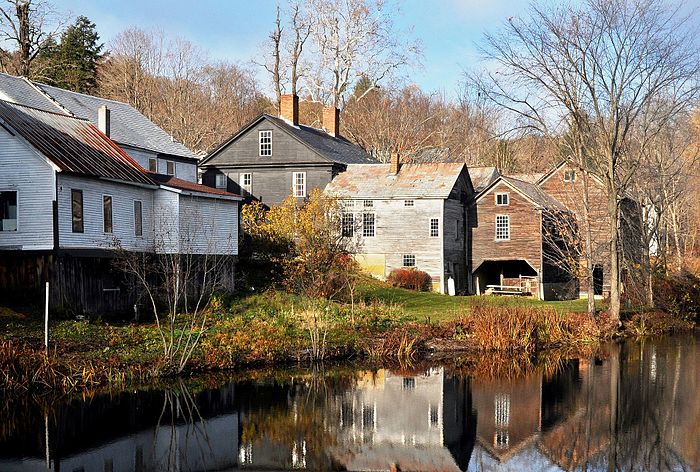
In downtown Putney. The town, in southern Vermont, is also well know for its "progressive'' prep school The Putney School and lots of well-heeled summer folks. In nearby Brattleboro is the Experiment in International Living, another well known educational institution. The area was a favorite for Hippies back in the '70s and late '60s./
When the ER is your primary-care doctor
From Robert Whitcomb's "Digital Diary,'' in GoLocal24.com
Memorial Hospital, in the old mill town of Pawtucket, R.I., may have been too uneconomic to remain open as a full community hospital but state officials and others could have done a better job anticipating that closing Memorial, with its disproportionately sick and low-income clientele, would overwhelm the emergency rooms of the Miriam Hospital and Rhode Island Hospital. One reason is that America has about the most fragmented (and expensive) health-care “system’’ in the Developed World, which leads all too many patients – especially low-income ones -- to use hospital emergency rooms as their main source of health care. That’s a notably inefficient and expensive way of getting care!
Presumably the proliferation of free-standing emergency departments and drugstore-chain clinics will eventually reduce the severe crowding in hospital emergency rooms in coming years. So would public-education campaigns to discourage people from using hospital ERs for such routine ailments as pink eye and bad colds

Textile show in textile town with a National Park and canals

"Evening Song'' (quilt), by Marianne Williamson, in the group show "Interplay: Fiber and Art Quilts 2018'', at the Whistler House Museum of Art, in Lowell, Mass., Aug. 11-Sept. 15. "Interplay," refers to the connection between fiber and art. The museum was the birthplace of the famous painter James McNeill Whistler (1834-1903); remember his painting nicknamed "Whistler's Mother''?
Lowell, at the confluence of the Merrimack and Concord rivers (which Thoreau wrote about so memorably), has a rich history in textiles. Founded in 1826 as a mill town using water power, it was named after Boston's Francis Cabot Lowell, a major figure in the Industrial Revolution who had prospered in the China Trade. Indeed, the city became one of the cradles of the American Industrial Revolution because of its many factories, most of which were textile mills. Also giving the city a certain romance is its canal network, on which you can travel by tourist boat.
In the late 20th Century some of Lowell's historic manufacturing sites became part of the Lowell National Historical Park. It's well worth a visit. During the Cambodian genocide by the Communist Khmer Rouge in the '70s, the city took in an influx of refugees from that country, leading to the development of a section called Cambodia Town.

The Pawtucket Canal, in Lowell's historic mills section.


Tourists get a tour of the Lowell National Historic Park.
Chris Petersen: GOP wants to bring back 'pre-existing conditions' as a reason to deny health care
Via OtherWords.org
For my family, “pre-existing conditions” are more than a technicality. They’re a matter of life or death, of sickness or health.
My wife and I are Iowa family farmers. I have diabetes, and Kristi has a heart murmur. Without the Affordable Care Act (ACA) and its guarantees for people with pre-existing conditions, there’d be nothing standing between us and the insurance corporations.
We know firsthand what happens when insurance corporations can discriminate based on a pre-existing condition. Years ago, I had health coverage through an outside job and was diagnosed with a nickel-sized hernia that didn’t require immediate surgery.
When farming started looking up, I began to farm full-time and applied for my own insurance. My wife and I disclosed our health conditions and were approved. Each month we religiously paid the $700 premium.
After about a year, I decided to fix the hernia and was pre-approved for surgery. Then the bills started. After months of back-and-forth, my insurer denied the claim, citing a pre-existing condition. They dropped me.
Then my wife had pre-approved tests for her heart, and the insurer dropped her, too. They cited “discrepancies” between medical records and the insurance forms we’d filled out two years earlier.
The discrepancies? A one-inch difference in her height and the fact that she’d gained 12 pounds!
It took us 14 years to pay those medical bills with no help from the insurer. After years of us sending them monthly premium payments, they’d left us holding the bag.
Then came the ACA. Kristi and I finally got quality, affordable health care, like many other small-business owners. The law isn’t perfect, but it provided a measure of stability we needed to keep our business going strong.
Now the Trump administration and some Republicans in Congress are attacking the ACA again. They want to let insurance corporations discriminate against people with pre-existing conditions, like my wife and me.
This comes after Republicans in Congress voted to pass the new tax bill — a huge giveaway to giant corporations that did nothing for farmers like us.
This tax bill doesn’t just funnel billions in preferential tax treatment to mega-corporations. It also eliminates the ACA’s penalty for not having health insurance. Trump is using that as an excuse to ask a judge to throw out the ACA’s pre-existing condition protections, too. A new Trump-appointed Supreme Court justice like Brett Kavanaugh just might help him do it.
Meanwhile, Republicans in Congress are advancing a budget that cuts health care and raises prices for all of us enrolled in Medicare, Medicaid, and the ACA.
Let’s not go backwards.
Any politician who believes in thriving family farms and small businesses should protect people with pre-existing conditions and support universal health care.
Any politician who believes in us should reverse the Republican corporate tax giveaways and adopt fair taxes that fund public investments and help fuel small business development.
And any politician who supports us should reject the finger-pointing. No more blaming our hard times on immigrants, people of color, or on those who seem “different.” Our strength comes from working together — on health care and all the other things that matter in our lives.
Last year, the GOP Congress tried to repeal our health care. People of all walks of life stopped them. Believe me, like my friends and neighbors, this family farmer is persistent. We’re not done fighting for everyone to get the health care they need.
Chris Petersen is an independent family farmer near Clear Lake, Iowa. He’s a leader of the Main Street Alliance, a national small business network.
Looks rather cool to us

"Heat Wave" (watercolor on paper), by Brian Herrick, at the Patricia Ladd Carega Gallery, Center Sandwich, N.H.
Basav Sen: 'Energy-efficiency' technology creates far more jobs than fossil fuel
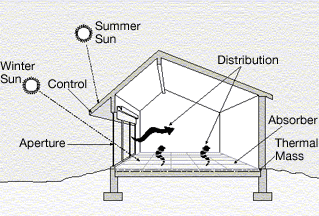
Elements of passive solar energy design.
Via OtherWords.org
We’ve all heard claims that such fossil fuels as coal, oil and gas are major job creators. President Trump says so all the time.
But it turns out that developing and installing the technology to reduce fossil-fuel use — known in the industry as “energy efficiency” — creates many more jobs than fossil fuels.
Energy efficiency jobs in the United States totaled 2.18 million in 2016, more than double the total of fossil fuel production and fossil-fuel based electricity generation combined.
They’re growing at a much faster rate, too. From 2015 to 2016, there was 53 percent employment growth in advanced and recycled building materials, and 59 percent employment growth in Energy Star appliances. Compare that to just 9 percent growth in fossil fuel-based electricity generation.
These energy-efficiency jobs are much cheaper to create. According to an academic study, every $1 million invested in energy efficiency creates 12 jobs, compared to just 4 or 5 for fossil fuel jobs.
These are good, well-paying jobs. For example, electricians have a median hourly pay of $26, and the corresponding numbers for heating, ventilation, and air-conditioning (HVAC) workers and carpenters are $22.64 and $21.71, respectively. (Compare that to the median hourly pay for all U.S. workers, $18.12.)
These jobs are more likely to be unionized, too. And they’re a great way to lift up people who’ve been left out of the fossil fuel economy.
So it’s no wonder that many states are working to grow their share of efficiency jobs, especially for traditionally excluded populations such as people of color and low-income people. I looked at a bunch of inspiring examples in a new report for the Institute for Policy Studies that will be out this week.
For example, Illinois has passed legislation requiring larger utilities to create renewable energy and energy efficiency job training programs, especially for people from economically disadvantaged communities — including youth of color, formerly incarcerated people, individuals who’ve been in the foster care system as children, and others.
Oregon is another success story. Forty-seven percent of new jobs created through Oregon’s statewide residential energy efficiency program — and 55 percent of the hours worked — went to women and people of color. Median hourly wages for these jobs were 7 percent higher than the median hourly wage of $17.24 for all Oregon workers, and 81 percent of workers had health benefits.
These successes didn’t happen by themselves — they were the product of setting goals and making serious efforts to meet them.
So energy efficiency creates more jobs than fossil fuels — and at a faster rate and a lower cost.
They’re good jobs, with good wages and above-average rates of unionization. And states have taken concrete measures to make these jobs accessible to everyone and raise standards for energy efficiency workers.
Why, then, does the federal government lag behind? And worse still, why does it pursue fantasies such as bringing back coal? Sadly, the answer is bribes, bribes, bribes.
Fossil-fuel interests pour money into congressional and presidential campaigns, and politicians return the favor by doing their bidding. The Trump administration’s push for coal is driven by two billionaire coal oligarchs, Robert Murray and Joseph Craft. Both have pumped money into Trump’s campaign and openly advocate deregulating fossil fuels and bailing out coal.
If the federal government really cared about “jobs, jobs, jobs,” they would follow the lead of Illinois and Oregon and make a big push to subsidize energy efficiency — instead of bailing out coal.
Basav Sen directs the Climate Policy Project at the Institute for Policy Studies.
PCFR to soon launch new season

To members and friends of the Providence Committee on Foreign Relations,
The PCFR returns for the 2018-2019 season, and we are excited to share our lineup of notable, expert presenters with you.
Thank you in particular to all members who shared feedback and speaker suggestions. Your input is valued as we aim to provide events that are edifying to our members.
We invite you to attend all these events, and encourage members to bring guests, especially as prospective new members.
Just a reminder, we are collecting 2018/19 member dues. Thank you to those who have already sent them in.
We have four membership categories:
Sustaining: Annual dues are $120. We much encourage your becoming a sustainingmember for the additional resources that it gives us to bring in good speakers and boost our related services.
Regular: Annual dues are $90.
Associate: For spouses of regular or sustaining members annual dues are $50. Thus, for example, the total dues for a sustaining member and his or her spouse would be $170. For a regular member and spouse, $140.
Student: Current full-time students may join for $50.
To pay your dues and dinner charges via credit card, please visit our website at thepcfr.org. Otherwise, please mail your checks, made out to “PCFR,’’ for dues to:
Hannah Hazelton
PO Box 146
Fiskeville, RI 02823
Dinners and dues can also be paid for at the welcome table on the night of a dinner by check, credit card or cash.
The cost of dues and dinners may be deductible for business reasons in some cases. Consult your tax adviser.
Please get your dues in for the 2018-19 season. The earlier we get them, the easier it is to plan for the new season. Thanks to everyone who has already sent them in.
Regards,
Hannah Hazelton
Chairperson
Providence Committee on Foreign Relations
pcfremail@gmail.com
Thursday, September 13
Paulo Sotero, Director, Wilson Center’s Brazil Institute
6:00, The Hope Club, 6 Benevolent Street, Providence
Paulo Sotero, the Director of the Wilson Center’s Brazil Institute, has covered the evolution of his native Brazil and U.S.-Brazilian relations for nearly forty years as a journalist and analyst. An award-winning reporter, he worked for publications across his country before serving as the longtime Washington correspondent for O Estado de S. Paulo, one of Brazil’s top dailies. A frequent guest commentator for the BBC, CNN, NPR and major newspapers in Latin America and beyond, Sotero has taught at Georgetown University and The George Washington University.
If you're paying at the door, please RSVP by replying to this email.
Wednesday, September 26
The Good Citizen and American Civilization
Fred Zilian
6:00, The Hope Club, 6 Benevolent Street, Providence
American Civilization is under stress and therefore also its exceptional leadership of the free world. Since the divisive 1960s, its basic building block—the good citizen—has been buffeted by at least seven factors: the legacy of the Sixties, the breakdown of the family and community, changes in our public education system, the rise of the Wild-West digital world, the degradation of cultural ethical standards, under-regulated capitalism, and a decline in leaders of character. This talk will explore the roles and responsibilities of the good citizen in historical perspective, those of the good citizen today, and the seven stresses on the good citizen today. It will then propose a partial solution: a universal national service program. Finally it will relate these challenges to the “Real Thucydides Trap,”—an alternate to Graham Allison’s—which threatens America’s leadership of the free world.
After graduating West Point in 1970, Fred Zilian completed a 21-year career as an infantry officer in the Army, a career that included four years teaching international relations at the U.S. Military Academy and four years teaching “Strategy & Policy” at the Naval War College. His second career was as an educator at Portsmouth Abbey School, 1992-2015, where he taught history, ethics, and German. Currently he is an adjunct professor at Salve Regina University, Newport, RI, where he teaches history and politics, and also a monthly columnist for the Newport Daily News.
Zilian holds a Ph.D. in international relations/strategic studies from the Paul H. Nitze School of Advanced International Studies, Johns Hopkins University.
Wednesday, October 3
Social Entrepreneurship with Dr. Teresa Chahine, Harvard
6:00, The Hope Club, 6 Benevolent Street, Providence
Dr. Teresa Chahine is the author of “Introduction to Social Entrepreneurship,” based on her course at Harvard. She is the Innovation Advisor at Alfanar Venture Philanthropy, which she helped launch in her home country of Lebanon. Alfanar provides tailored financing and technical support to social enterprises serving marginalized populations in the Arab world.
Dr. Chahine divides her time between Beirut and Boston, where she leads the social entrepreneurship program at the Center for Health and the Global Environment, Harvard T.H. Chan School of Public Health.
Wednesday, October 17
Two Paths to Brexit: Michael Goldfarb
6:00, The Hope Club, 6 Benevolent Street, Providence
On the eve of an EU summit where the bloc's chief Brexit negotiator, Michel Barnier, hopes to present a draft treaty for Britain's withdrawal from the EU former NPR correspondent, Michael Goldfarb, who covered the creation of the euro and the border free Europe, looks at the details of the deal: the rights of millions of British and European citizens now living in what have become "foreign" countries, how to keep the Irish border fully open, maintaining supply chains, and the time frame for transition.
It is also possible talks will have collapsed. In that case, Goldfarb will explain the likely impact on UK, Europe and global economy of a no-deal Brexit.
Michael Goldfarb is an author, journalist and broadcaster. He has written for The Guardian, The New York Times and The Washington Post but is best known for his work in public radio. Throughout the 1990’s, as NPR’s London Correspondent and then Bureau Chief, he covered conflicts and conflict resolution from Northern Ireland to Bosnia to Iraq for NPR.
Thursday, November 8
Geopolitics Underlying US Foreign Policy
Sarah C. M. Paine
6:00, The Hope Club, 6 Benevolent Street, Providence
Sarah C. Paine is a professor of strategy and policy at the U.S. Naval War College located in Newport, Rhode Island. She has written or co-edited several books on naval policy and related affairs, and subjects of particular interest to the United States Navy or Defense. Other works she has authored concern the political and military history of East Asia, particularly China, during the modern era. She is the author of the 2012 award-winning book, Wars for Asia 1911–1949.
Suggestions for speakers and topics are always much appreciated.
We’re all in this together.
We want your feedback.
Do you have ideas for PCFR? Thoughts? Opinions? Please share your feedback with us by sending an email to pcfremail@gmail.com
Hannah Hazelton
Chairman
Providence Committee on Foreign Relations
Young physicians embracing single payer
By SHEFALI LUTHRA
When the American Medical Association — one of the nation’s most powerful healthcare groups — met in Chicago this June, its medical student caucus seized an opportunity for change.
Though they had tried for years to advance a resolution calling on the organization to drop its decades-long opposition to single-payer health care, this was the first time it got a full hearing. The debate grew heated — older physicians warned their pay would decrease, calling younger advocates naïve to single-payer’s consequences. But this time, by the meeting’s end, the AMA’s older members had agreed to at least study the possibility of changing its stance.
“We believe healthcare is a human right, maybe more so than past generations,” said Dr. Brad Zehr, a 29-year-old pathology resident at Ohio State University, who was part of the debate. “There’s a generational shift happening, where we see universal health care as a requirement.”
The ins and outs of the AMA’s policymaking may sound like inside baseball. But this year’s youth uprising at the nexus of the medical establishment speaks to a cultural shift in the medical profession, and one with big political implications.
Amid Republican attacks on the Affordable Care Act, an increasing number of Democrats — ranging from candidates to established Congress members — are putting forth proposals that would vastly increase the government’s role in running the health system. These include single-payer, Medicare-for-all or an option for anyone to buy in to the Medicare program. At least 70 House Democrats have signed on to the new “Medicare-for-all” caucus.
Organized medicine, and previous generations of doctors, had for the most part staunchly opposed to any such plan. The AMA has thwarted public health-insurance proposals since the 1930s and long been considered one of the policy’s most powerful opponents.
But the battle lines are shifting as younger doctors flip their views, a change that will likely assume greater significance as the next generation of physicians takes on leadership roles. The AMA did not make anyone available for comment.
Many younger physicians are “accepting of single-payer,” said Dr. Christian Pean, 30, a third-year orthopedic-surgery resident at New York University.
In prior generations, “intelligent, motivated, quantitative” students pursued medicine, both for the income and because of the workplace independence — running practices with minimal government interference, said Dr. Steven Schroeder, 79, a longtime medical professor at the University of California-San Francisco.
In his 50 years of teaching, students’ attitudes have changed: “The ‘Oh, keep government out of my work’ feeling is not as strong as it was with maybe older cohorts,” said Schroeder. “Students come in saying, ‘We want to make a difference through social justice. That’s why we’re here.’”
Though “single-payer” healthcare was long dismissed as a left-wing pipe dream, polling suggests a slim majority of Americans now support the idea — though it is not clear people know what the term means.
A full single-payer system means everyone gets coverage from the same insurance plan, usually sponsored by the government. Medicare-for-all, a phrase that gained currency with the presidential campaign of Sen. Bernie Sanders (I-Vt.), means everyone gets Medicare, but, depending on the proposal, it may or may not allow private insurers to offer Medicare as well. (Sanders’ plan, which eliminates deductibles and expands benefits, would get rid of private insurers.)
Meanwhile, lots of countries achieve universal healthcare — everyone is covered somehow — but the method can vary. For example, France requires all citizens purchase coverage, which is sold through nonprofits. In Germany, most people get insurance from a government-run “public option,” while others purchase private plans. In England, health care is provided through the tax-funded National Health System.
American skeptics often use the phrase “socialized medicine” pejoratively to describe all of these models.
“Few really understand what you mean when you say single-payer,” said Dr. Frank Opelka, the medical director of quality and health policy for the American College of Surgeons, which opposes such a policy. “What they mean is, ‘I don’t think the current system is working.’”
But the willingness to explore previously unthinkable ideas is evident in young doctors’ ranks.
Recent surveys through LinkedIn, recruiting firm Merritt Hawkins and trade publication NEJM Catalyst indicate growing support. In the March NEJM survey, 61 percent of 607 respondents said single-payer would make it easier to deliver cost-effective, quality healthcare.
Delving further, that survey data shows support is stronger among younger physicians, said Dr. Namita Mohta, a hospitalist at Brigham and Women’s Hospital and clinical editor at NEJM Catalyst.
But it’s unclear whether these findings reflect young doctors’ feelings about the policy or whether they are tapping in to broader frustrations with the American health system.
Much like the general public, doctors often use terms like single-payer, Medicare-for-all and universal healthcare interchangeably.
“Our younger generation is less afraid to come out and say we want universal healthcare,” said Dr. Anna Yap, 26, an emergency medicine resident at UCLA, who served as a medical student delegate to the AMA until this past June. “But how? It’s different in what forms we see.”
Younger doctors also pointed to growing concern about how best to keep patients healthy. They cited research that broadly suggests having health insurance tracks with better health outcomes.
“Medical students, I would say, are very interested in public health and improving social determinants of health — one of them being access to health insurance,” said Dr. Jerome Jeevarajan, 26, a neurology resident at the University of Texas-Houston, referring to non-medical factors that improve health, such as food or housing.
Some of the shift in opinion has to do with the changing realities of medical practice. Doctors now are more likely to end up working for large health systems or hospitals, rather than starting individual practices. Combined with the increasing complexity of billing private insurance, many said, that means contracting with the government may feel like less of an intrusion.
The debate is, at this point, still theoretical. Republicans — who control all branches of the federal government — sharply oppose single-payer. Meanwhile, single-state efforts in California, Colorado and New York have fallen flat.
Also, doctors represent only one part of the sprawling healthcare industrial complex. Other health care interests — including private insurance, the drug industry and hospital trade groups — have been slower to warm to catchphrases like single-payer or universal health care, all of which would likely mean a drop in income.
But increasingly physicians seem to be switching sides in the debate, and young physicians want to be part of the discussion.
“There’s tremendous potential … to be at the table if single-payer becomes a significant part of the political discourse, and create a system that is more equitable,” Pean said.
Mysterious island

"Mohegan (Manana Nocturne III)'' (mixed media on canvas), by Tom Hall, at the Corey Daniels Gallery, Wells, Maine. Mohegan Island, off the Maine Coast, is famous as an artists colony.
Photography and the genius of Winslow Homer

"Winslow Homer at Marshfield {Mass.}, " ca. 1869 (albumen silver print), by an unknown photographer. Bowdoin College Museum of Art, Brunswick, Maine. This is in the show "Winslow Homer and the Camera: Photography and the Art of Painting,'' through Oct. 28. The museum building is famous, having be designed by Charles McKim, who also designed the Rhode Island State House and much of Columbia University.

Winslow Homer with 'The Gulf Stream' in his {Prouts Neck, Maine} studio," ca. 1900, (gelatin silver print), by an unidentified photographer.
The museum says:
"This exhibition explores the question of Homer’s relationship with the medium of photography and its impact on his artistic practice. As one attuned to appearances and how to represent them, Homer understood that photography, as a new technology of sight, had much to reveal. This exhibition thus adds an important new dimension to our appreciation of this pioneering American painter, demonstrating his recognition that photography did not undermine, but instead complemented his larger artistic interests.''
Overlapping seasonal music

Male katydid.

Groundscraper thrush.
“One evening early this month of August, we were privileged to hear a joint presentation of the summer song of the thrush and the fall fiddling of the katydid. We are told that it is not unusual for these two musical halves of the season to overlap; it often happens that a thrush will sing late or some katydid rehearse early.
“But this year there was that single evening on which we heard the very last of the song that denotes the fullness of summer and the very first stirrings of the insect that it is supposedly the prophet of the frost to come within six weeks. And this, according to friends of ours who make something of such notations and who also observed that the thrush remained silent on succeeding evenings, was an unusually precise timing for the changing of the musical guard.’’
-- From In Praise of Seasons, by the late Connecticut editor Alan H. Olmstead, who lived in a rural area east of Hartford.
Chris Powell: Using trivia to rile up voters
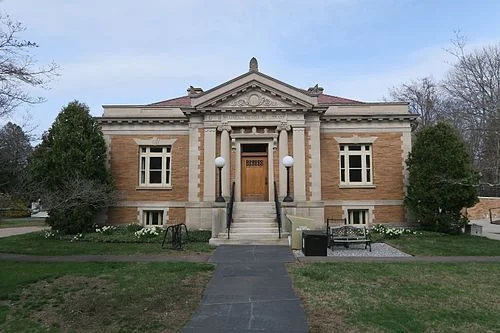
Brainerd Memorial Library, in Haddam, Conn. Haddam is in south-central Connecticut, in the lower Connecticut River Valley and home of Cockaponset State Forest. Incorporated in October 1668 as Hadham, It was later renamed Haddam because of people saying Hadham too fast.
Haddam is the only town in Connecticut divided by the Connecticut River, by far New England's biggest river. It contains five villages – Hidden Lake, Higganum, Shailerville and Tylerville on the west side of the river, and Haddam Neck on the east. For its first 200 years, the river was a major source of the town's livelihood and, of course, transportation. Today, Haddam is almost entirely a residential community.
Connecticut's politicians seem determined to vindicate H.L. Mencken, who observed a hundred years ago: "The whole aim of practical politics is to keep the populace alarmed (and hence clamorous to be led to safety) by an endless series of hobgoblins, most of them imaginary."
A round of hobgoblining was triggered two weeks ago at a meeting of Haddam's Board of Selectmen, when Selectwoman Melissa Schlag, a Democrat, knelt during the Pledge of Allegiance to protest President Trump. Schlag had been protesting this way for some time without wrecking the country or the flag. Indeed, she had been doing it without being noticed outside Haddam at all.
But the episode two weeks ago was noticed on local cable television and was quickly turned into a national sensation by two Connecticut Republican primary candidates -- Tim Herbst, running for governor, and Art Linares, state senator from the Haddam district, running for treasurer.
Herbst and Linares called a rally in Haddam, supposedly to defend the flag but actually to boost their campaigns by riling people up over an issue having no connection to the offices they seek. Thus they gave Schlag's protest far more publicity than she had gotten on her own.
The rally coincided with another Haddam selectmen's meeting, which was attended by hundreds of people who sought to criticize if not intimidate Schlag and who recited the pledge as loudly as they could. Schlag knelt again but this time placed her hand over her heart, perhaps now perceiving that the pledge is not to the president but to the country and that using it politically may give offense.
While many in the audience rebuked Schlag, some still acknowledged her right to protest as she did and some supported her outright. The confrontation managed to stay above the brawling of the aspiring Nazis and Communists elsewhere in Weimar America.
But Schlag still had to trample on the remnant of civility. As the meeting ended cell phone video caught her remarking that her town is "fascist and racist" even though she had been allowed to continue her protest and race never figured in the controversy. She ended up revealing herself as another looney leftist, her self-promoting and self-righteous stunt having been trumped by a bigger stunt by far more accomplished and self-righteous self-promoters.
Then some Connecticut Democrats took their turn at hobgoblining, jumping on the federal lawsuit seeking to suppress publication of blueprints for plastic guns made by three-dimensional printers, called "ghost" guns because they carry no identification marks and don't activate metal detectors.
Not just Connecticut's two U.S. senators but the two contenders for the Democratic nomination for governor, Ned Lamont and Joe Ganim, and even a candidate for the party's nomination for treasurer, Shawn Wooden, called for outlawing such guns.
But only federal law can have much effect on items potentially in commerce like these, and so state law and state officials are virtually irrelevant here.
Of course Connecticut and the country have a serious gun-violence problem, but it is not guns themselves as much as the worsening of poverty on top of drug prohibition. Democrats seem to think that if they can scare voters with "ghost" guns, they might not have to address their failure with poverty policy.
Chris Powell is a columnist for the Journal Inquirer, in Manchester, Conn.