
Vox clamantis in deserto








City getting bad for cynics

The Rhode Island School of Design, along the banks of the Providence River.
From Robert Whitcomb's "Digital Diary,'' in GoLocal24.com:
Local cynics will be depressed to read that Magnify Money has ranked the Greater Providence area the fifth-best metro area in America in which to retire. The rankers looked at lifestyle, cost of living, medical quality and cost, and assisted-care quality and cost.
The high score was explained by what were seen as reasonable (in regional terms) monthly housing and goods-and-services costs and the quality and quantity of its retirement and assisted-care facilities. Assisted-care establishments are certainly thick on the ground in Rhode Island, especially in Providence!
The highest-ranked cities: Portland, Ore.; Salt Lake City; Denver; Charlotte, and then Kansas City, Mo., and Providence, tied for fifth. The bottom three, by the way, are Miami, Houston and New York. (The first two have an increasing propensity to be underwater.)
Interestingly, the Providence area’s “lifestyle’’ ranking, a much better than average index score of 55.9, was brought down by a low volunteerism rate (18.6 percent, compared to a 50-city average of 24.7 percent) – something I have long lamented about Rhode Island. The highest rates of volunteerism tend to be concentrated in affluent parts of the state, such as Barrington, East Greenwich and the East Side of Providence. We need to widen that!
Porch maintenance and righteousness.

Sitting in a demoralizing screened-in porch.

A "connected farmhouse'' in Windham, Maine. The barn dates from the late 18th Century. The house itself was built in three stages during the 19th Century while the unconnected garage was a 20th-Century addition. All doors of the structure are visible in this view from the south side, where sun would melt accumulated snow and ice. Following the 20th-Century outbreak of Dutch elm disease only one American elm remains of the line that provided summer shade along the southern and western sides of the building.
"Yankees traditionally build porches that will sag after a decade, and tack them onto houses built to stand a century. …New England is a harsh climate not only for crops but for neighbors and porches as well. Any flagging of morale – any passing of days skulking indoors in a state of depression…any slacking of righteousness – and down goes the porch.''
-- From Three Farms, by Mark Kramer
Eerie beauty in P Town

Photo by Charlie Hunter in his 25-photo show at Gallery 444, Provincetown, showing the beauty of the Outer Cape. The show runs through June 20.
William Morgan: A back-of-beyond town in New Hampshire

Union Church, Town Hall, and Congregational Church, Kensington, N.H.
-- All photos by William Morgan
Despite the grand-sounding name, there's not much to see in Kensington, in southeastern New Hampshire. "Downtown" Kensington is just a wide place in the road, with a cluster of two churches and the town hall. Many Granite State towns were named not for places back in the mother country, but for members of Parliament, in this case, 1st Baron Kensington.
The town library, a small late-Victorian gem, is some distance away, next to the elementary school (104 students in kindergarten through 5th grade), while the Bell Hill Schoolhouse, built in 1839, and the North School, built in 1842, now unused brick boxes, were erected farther out in the country to serve the scattered populace. No doubt, there is a country store-cum-filling-station at a crossroads somewhere else in the town.

The Union Church, built in 1840, is a conservative mix of the late Georgian and Greek revival styles.
Kensington has just over 2,000 people spread out over 12 square miles. As is typical of northern New England, many people wanting to live here will have to commute considerable distances to work – to Exeter, Portsmouth, Haverhill or even Boston. Yet, though only a stone's throw from Massachusetts, Kensington captures that back-of-beyond quality of rural New Hampshire. As in much of the state, the forests are reclaiming what was open grazing land for two centuries or more.

Gravestone of Henry Lamprey, who died May 12, 1764, aged 90.

Samuel Tucke's stone of 1843 is of slate, the stonecutter's name is inscribed at the bottom and the urn and weeping willow motifs are more sophisticated than the primitive winged head of the early stones.

There are almost no gravestones beyond the middle of the 19th Century, suggesting that the town's young people had migrated to Yankee mill towns or out West. One gets the inescapable feeling that Kensington is a place passed over.
William Morgan is an architectural historian and essayist. He is the author of American Country Churches and The Abrams Guide to American House Styles, among other books. He has taught at Princeton University, the University of Kentucky, and the University of Louisville and his essays have appeared in numerous publications.
Beware when it stops

"Restless Vapor'' (painting), by Cristi Rinklin, in her current show, "Paramnesiac," at the Newport (R.I.) Art Museum. The museum cites her "flowing and luxurious work, which uses swelling shapes and clouds of fog and smoke to create a dreamlike reality. "
'Thrusting aside the soil'

The Old Manse is an old house in Concord, Mass., famous for its historical and literary associations.
"I used to visit and revisit it a dozen times a day, and stand in deep contemplation over my vegetable progeny with a love that nobody could share or conceive of who had never taken part in the process of creation. It was one of the most bewitching sights in the world to observe a hill of beans thrusting aside the soil, or a rose of early peas just peeping forth sufficiently to trace a line of delicate green.''
-- Nathaniel Hawthorne, from Mosses from an Old Manse
In 1842, the novelist Nathaniel Hawthorne rented the Old Manse for $100 a year. He moved in with his wife, Transcendentalist Sophia Peabody, on July 9, 1842, as newlyweds and lived there for three years before they were being evicted for not paying their rent.
Ms. Peabody had previously visited Concord and met Ralph Waldo Emerson while working on a bas-relief portrait medallion of his brother Charles, who had died in 1836. She praised the town to Hawthorne. Before the Hawthornes' arrival at the Manse, Henry David Thoreau created a vegetable garden for the couple. In the upstairs room that Hawthorne used as his study, you can see affectionate sentiments that the two etched into the window panes.

Llewellyn King: The case against mega-mergers is written in U.S. history

A judge has green-lighted the $85 billion merger of Time Warner and AT&T. Unless the Trump administration appeals and wins on appeal, another behemoth will take the field.
This merger, it is assumed, will lead to a flurry of other mergers in communications. Witness Comcast’s $65 billion bid for Fox, topping Disney’s $52.4 billion offer.
This is heady stuff. The money on the table is enormous, in some cases dwarfing the economies of small countries.
Merging is an industry unto itself. A lot of people get very rich: They are investment bankers, arbitragers, lawyers, economists, accountants, publicists and opinion researchers. When really big money moves, some of it falls off the table into the willing hands of those who have managed the movement.
The fate of the real owners of these companies, the stockholders, is more doubtful after the initial run-up. The earlier merger of Time with Warner Communications is considered to have been disadvantageous for stockholders.
Another concern is the mediocre performance of conglomerates. The latest to have run into trouble is General Electric, which had managed to do well in many businesses until recently.
A more cautionary story is what happened to Westinghouse when it went whole hog into broadcasting and lost its footing in the electric generation businesses. This was spun off, sold to British Nuclear Fuels in 1997, then sold again to Toshiba and later went into bankruptcy.
From the 1950s, Westinghouse it bought and sold companies at a furious rate, until the core company itself was sold in favor of broadcasting. One of Westinghouse’s most successful chairmen, Bob Kirby, told me it was easier for him to buy or sell a company than to make a small internal decision.
In another pure financial play, a group of hedge funds bought Toys R Us and with the added debt, it failed.
In many things, big is essential in today’s economy. News organizations need substantial financial strength to be able to do the job. Witness the cost of covering the Quebec and Singapore summits. As Westinghouse proved by default, big construction needs big resources. That is indisputable.
When growth through acquisition becomes the modus operandi of a company, something has gone very wrong. The losers are the public and the customers. The new AT&T, if it comes about, will still need you and I to lift the receiver, watch its videos and subscribe to its bundles.
Recently, I was discussing the problems customers have with behemoth corporations on SiriusXM Radio's "The Morning Briefing with Tim Farley" when a listener tweeted that I hated big companies and their CEOs and loved big government.
Actually, I’d just spent a week with the CEOs of several companies, admirable people, and I don’t think government should be any bigger than needs be. I certainly don’t think government should perform functions that can be better performed in the private sector.
The problem is size itself.
When any organization gets too big, it begins to get muscle-bound, self-regarding. Although it might’ve been built on daring innovation, as many firms have been, supersized companies have difficulty in allowing new thinking, reacting nimbly and adopting innovative technologies and materials.
If large corporate entities were as nimble as small ones, the automobile companies would’ve become the airplane manufacturers in the 1920s and 1930s. They had the money, the manufacturing know-how and the engineering talent. They lacked the vision. It was easier to be rent-takers in the production and sale of automobiles.
Likewise, it’s incredible that FedEx was able to conquer the delivery business when another delivery system, Western Union, was up and running. But Western Union was big, smug and monopolistic. They had the resources and an army of staff delivering telegrams.
Companies like Alphabet (Google’s owner) snap up start-ups as soon as they are proven. That snuffs out the creativity early, even if it wasn’t meant to, and makes Google even more dominant. I would argue too big for its own good -- and for ours.
Llewellyn King (llewellynking1@gmail.com) is executive producer and host of White House Chronicle, on PBS. He is based in Rhode Island and Washington, D.C.

The epicenter of merger mania -- Wall Street, with the New York Stock Exchange draped with the flag.
They don't do it for the money
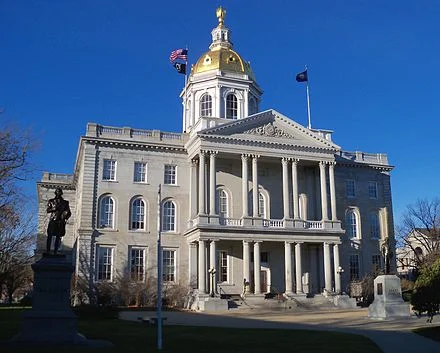
The New Hampshire State House, in Concord.
"The fact that a New Hampshire legislator's position is not seen as a career or a way of supporting a family has meant that it draws women. At times, I think men who might be looking for a paid career have known that they couldn't make one out of serving in the legislature. So there's a little more space for women.''
-- Maggie Hassan, now U.S. senator and former New Hampshire governor.
New Hampshire state legislators are paid $100 a year.

At the New Hampshire State House.
Briefly scary in spiffy Southboro

"Entelodont,'' by Robert Shannahan, in the "Art on the Trails 2018'' show at the Beals Preserve, Southboro, Mass. The show includes 18 outdoor art installations in the Beals Preserve. The theme of the exhibition is "Unexpected Gestures''. The juried works were created and selected with the setting of the preserve in mind, contrasting and blending with its woods, meadows, trails and ponds. See artonthetrails.com for more information.
Southboro is a rich Boston outer suburb, with snob zoning and lots of open space. It is well known as the home of a prestigious boarding school, St. Mark's School, founded in 1865 by Joseph Burnett. It also hosts the nation's oldest junior boarding school, the Fay School, founded a year later by Joseph Burnett's first cousin Harriet Burnett Fay.

Unbustling downtown Southboro (aka Southborough).
In N.H., mothers in opioid treatment struggle to keep children
By RACHEL GOTBAUM
Jillian Broomstein starts to cry when she talks about the day her newborn son Jeremy was taken from her by New Hampshire’s child welfare agency. He was 2 weeks old.
“They came into the house and said they would have to place him in foster care and I would get a call and we would set up visits,” she said. “It was scary.”
Broomstein, who was 26 at the time, had not used heroin for months and was on methadone treatment, trying to do what was safest for her child. The clinic social worker told her that since Jeremy would test positive for methadone when he was born, she would need to find safe housing or risk losing custody.
Broomstein moved in with a friend and her kids — but it turned out that friend had her own legal battles with the state’s Division of Children, Youth and Families, known as DCYF. The friend’s home would not pass muster as “safe housing” because of that.
Since Broomstein grew up in foster care and had no family to take her in, Jeremy was taken from her. She had 12 months to try to get her son back or lose her parental rights permanently.
To get their children back from the foster care system in New Hampshire, parents struggling with addiction are required to be compliant in drug treatment and have a safe place to live. If they can’t find housing or if they relapse, the clock does not stop ticking.
“I cannot stress enough that 12 months is a really short window for somebody who’s in early recovery,” said Courtney Tanner, who runs Hope On Haven Hill, one of the few places in New Hampshire where pregnant women and new mothers can live with their children and get treated for addiction. But with just eight beds here, the waitlists can be long.
There are more than 430,000 children in foster care in the U.S., according to the latest government figures. The opioid crisis is definitely a factor in an increasing trend of more children being removed from the home, but the scope of the problem is hard to measure due to poor tracking.
New Hampshire has some of the highest rates of opioid abuse in the country. One of the fastest-growing groups of heroin users is women of childbearing age. In the past few years the number of children taken into state custody has more than doubled, according to DCYF. Last year, New Hampshire spent $36 million for foster care.
“Here in New Hampshire, what I have seen is a mom can be enrolled in this program and compliant in treatment and they are giving birth to a child and that child is still being removed and put into foster care,” said Tanner.
In 2012 state legislators made major budget cuts to DCYF — and those dollars have not been restored. Child welfare workers in New Hampshire have more than triple the caseloads than in many other states, according to the agency’s director Joseph Ripsam. Also as a result of the budget cuts, DCYF can only engage a family once case workers have opened a legal case of abuse and neglect. There’s little money to support parents before that happens.
“The result of that is … that more children coming into the foster care system that otherwise might not if we had the capacity to serve families more holistically up front,” said Ripsam.
After her son Jeremy was placed into foster care, Jillian Broomstein continued her methadone treatment and her parenting classes.
She was determined to get her son back. She finally got off a waiting list and got a bed at one of the residential treatment centers for young mothers. After a few months she was reunited with Jeremy. But she was told that her case was unusual.
“They said in court that it was an odd case that they gave me my child back so quickly,” Broomstein said. “It made me want to cry.”
“I knew it was going to be hard,” she said. “Not everybody tries to get their children back. A lot of people I’ve known just give up; they just resort back to drugs again.”
Invented figures and steam trains in once-war-torn Essex, Conn.

"Peony Dress'' (painting), by Jennifer Knaus, in the group show "The Imagined & Invented Figure,'' with Aris Moore and Jennifer McCandless, at the Melanie Carr Gallery, Essex, Conn., June 23-July 23.
The gallery says that Ms. Knaus's work consists of paintings and drawings that are "both beautiful and absurd, depicting women dressed in plant life in the style of 17th Century still lifes.'' Tourist information on Essex below.


From Wikipedia:
"The Essex Steam Train is one of the most famous and popular Essex attractions. The main station is located in Centerbrook, with other stations in Deep River, Chester, and Haddam. The regular train ride goes from Essex to Deep River and then the Becky Thatcher Riverboat takes the passengers up to the Haddam area. The Essex Clipper Dinner Train goes from Essex all the way up to Haddam.
"The Ivoryton Playhouse is a regional theater located in Essex's village of Ivoryton. The theater produces 8-12 plays and musicals each year.
"The Connecticut River Museum, located at the end of Main Street and right on the Connecticut River, is home to numerous river artifacts and is home to the Connecticut River Eagle Festival each year.''

Essex Steam Train.
Don Pesci: 'A decent respect for reality and truth'

Themis of Rhamnous, Attica, by the sculptor Chairestratos, c. 300 BCE
Some time ago, the Republican leader in the Connecticut State House, Themis Klarides, reminded a reporter that she was Greek. Her first name, she said, meant “justice.” rje
That was almost right. Themis was an ancient Greek Titaness, the “lady of good counsel,” a personification of divine order, fairness, law, natural law and custom. The name Themis literally means “that which is put in place.” The symbols by which Themis is known are the scales of justice, tools in the ontological order that assure balance.
Balance is the baseline in the Greek cosmos according to which right order is measured. To know whether a thing is right and just – morally, legally, ethically, religiously, secularly, atheistically -- one must have more than a nodding acquaintance with reality. Idle dreaming is a fatal threat to right order. Political visions – modern politics is consumed with visions that the ancient Greeks might have considered nightmares – are justifiable and practical only when they take into account the reality of life on the ground. Therefore, the best and most just politician is the one most solidly grounded in reality.
Klarides does not have her feet firmly planted in the clouds. She has more than a decent respect for reality and truth. And while she may be willing to suffer fools gladly, she is not willing to afford foolishness the same compassionate tolerance.
Klarides, along with Democratic House Speaker Joe Aresimowicz, appeared recently on Tom Dudchik’s Capitol Report.
Dudchik cited a report in The Boston Globe: “If all politics is local in the era of {the late U.S. House Speaker} Tip O’Neill, the reverse may be true under Trump.” He then turned to Aresimowicz and asked, “How big an issue are you going to make Trump?” And to Klarides, “What do you think about the issue?”
Aresimowicz: I’m not going to make that an issue…
Klarides: (scoffing) Oh, that’s not true (laughter from all).
Aresimowicz: We’re not Washington. We will listen to each other. We have to work with each other. When we can find common ground, we will. But now it’s about who has the best vision for the state of Connecticut, and who’s going to move it forward. Who do you want to align your political beliefs with? That’s what I’m going to be talking about.
Klarides: Well, I will tell you: I think this will be a fight between who is more unpopular, Governor {Dannel} Malloy or President Trump. Clearly, Governor Malloy is more unpopular. But I … It’s very frustrating to me to have to answer to what the President is doing or saying. If he does something I like, I say he is. If he does something I don’t like, I say I don’t. But the frustration here is this: Let’s remember something very clearly. There has been a Democrat governor for eight years, and there has been a Democrat controlled House and Senate for about 40 years. If Connecticut was booming, if businesses wanted to come here, if there were job after job and people had more money in their pockets – my good colleague (Aresimowicz) who I like very much – but our vision is a little bit different as to what the state should be doing – they [Democrats] would be pounding their chests, saying the following: We have brought this state back, and a Democrat governor and a Democrat controlled legislature [are responsible for the recovery]. The words Donald Trump would never be mentioned. But they can’t – because they have single-handedly ruined the state. And I do agree with him. We have done some bipartisan budgets. But as much as he and I like each other personally, the only reason we’ve done Democrat and Republican budgets is that there is only a four seat difference in the House and a tie in the Senate. That is the reality. It has nothing to do with the deficit. And that’s where we are.
The most important part of Klarides’s response to Dudchik’s question is, “And that’s where we are.”
A vision detached from reality does not produce a corresponding corrective reality; it produces havoc, disorder and the justifiable wrath of Themis, the “lady of good counsel.”
Reality is simply the sum of occurring events and their inevitable consequences. Perhaps the most banal expression in modern politics is “moving things forward,” rather as if it were possible to move present events into the past. The question that must be decided in the upcoming election is not a matter of the glittering vision we might prefer. Politics is the art of the possible. Forty years of Democrat hegemony in the General Assembly and two terms in office of one of the least popular governors in Connecticut history have made nightmares of political visions. Voters in Connecticut, Republicans hope, have awakened; they are hungry for real solutions to real problems.
Don Pesci is a Vernon, Conn.-based columnist.

Teaming up to fight straw pollution

From ecoRI News (ecori.org)
NEWPORT, R.I. — In response to increased plastic waste on beaches and in the ocean, Green Drinks Newport recently partnered with Clean Ocean Access and The Last Straw to launch Strawless by the Sea, a collaborative campaign to eliminate plastic straws in the City-by-the-Sea.
Strawless by the Sea launched June 8, on World Oceans Day, and will continue through the summer. Bars, restaurants and other establishments in Newport, such as coffee shops and yacht clubs, are encouraged to make a voluntary commitment to stop offering plastic straws and stirrers, in an effort to stop plastic pollution at the source.
According to the Ocean Conservancy, more than 500 million plastic straws are used daily in the United States — enough to circle the earth 2.5 times. Plastic straws are used for 20 minutes on average, but take up to 500 years to break down.
“Last summer I was eating at an outdoor establishment on a very windy day and watched several plastic straws blow into the water,” said Kara DiCamillo, Green Drinks Newport organizer and Clean Ocean Access board member. “I’ve attended many beach cleanups hosted by Clean Ocean Access and knew that I’d be picking those same straws up one day.”
In Newport, straws are among the top 10 items found during beach cleanups, and can do so much harm to seabirds, turtles and other marine creatures. Clean Ocean Access (COA) staff and volunteers have picked more than 2,000 straws on local beaches during the past five years, and some 650 more have been collected by COA’s marina trash skimmers in Newport Harbor in just eight months.
“We are thrilled to see the community-led efforts to eradicate plastic straws, and this effort aligns perfectly with our successful two-year campaign for a plastic bag ordinance on Aquidneck and Conanicut islands,” said Dave McLaughlin, COA’s executive director and co-founder. “The spirit of our position for the plastic bag ordinance was to tickle more persuasion so that people start making better choices in their daily lives to eliminate single-use plastics and to switch to durable reusable alternatives. There are real cost savings for businesses and consumers and this initiative advances the efforts of the biggest islands in the Ocean State to lead by example that a thriving economy and a healthy economy go hand in hand.”
Restaurants can reduce the use of plastic straws by implementing a “straws upon request” policy, switching to paper straws or reusable straws, or by going completely “strawless.”
Tyler Bernadyn, a local hospitality professional who started The Last Straw, an internalized campaign to educate bartenders and their guests on the importance of recognizing and reducing plastic pollution, said he knows we can all do better.
“Seeing how many single-use straws and plastic cups are wasted during a single service and watching these same items wash up on our beaches and pollute our harbor really inspired me to start this initiative,” he said. “Being behind the bar, you have an opportunity to encourage change and help protect our most valuable resources here in Newport, which is our beaches and waterways.”
Several Newport-area establishments have joined Strawless by the Sea: Bannister’s Wharf Marina & Guest Rooms, Belle’s Café at the Newport Shipyard, Brix Restaurant at Newport Vineyards, The Clarke Cooke House, Fluke, Malt, Mission, Newport Dinner Cruises, Scales & Shells, TSK, Winner Winner, and Taproot Brewing Co. at Newport Vineyards (scheduled to open June 20).
Environmental groups and local businesses have also backed Strawless by the Sea, including Bowen’s Wharf, Discover Newport, Sail Newport, Sailors for the Sea, The Ocean Project, and World Oceans Day.
“As an individual, refusing a single-use plastic straw in our bars and restaurants in Newport is the easiest and simplest way to take action to address plastic pollution that is in our waters and on our beaches,” DiCamillo said.
Jim Hightower: Trump's bid to use Postal Service to hit Amazon may backfire big time
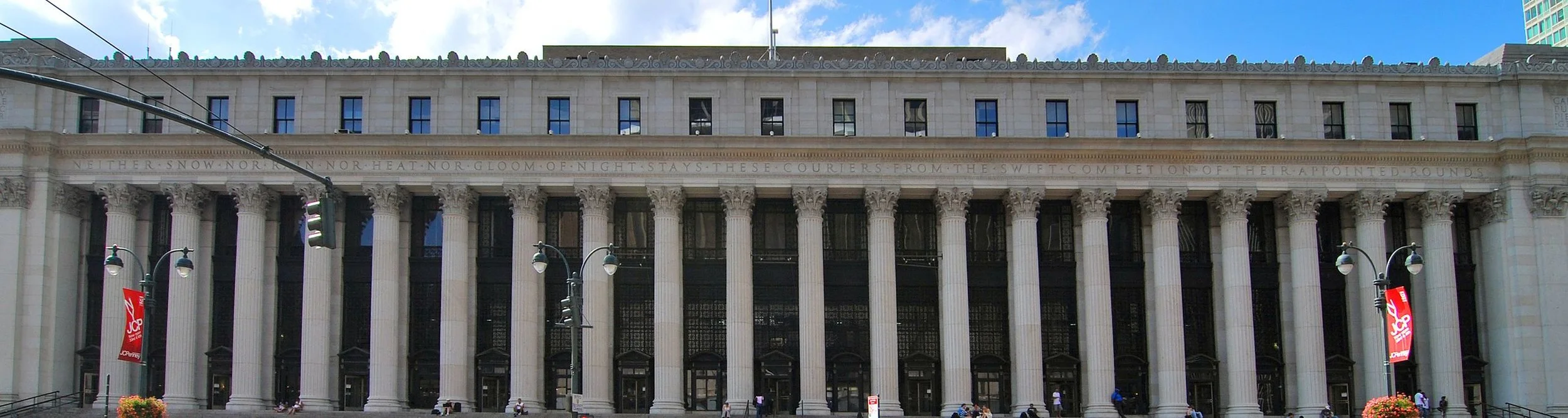
Photo by Chensiyuan
Close up of the James A. Farley Post Office, in Manhattan. Read the inscription over the columns: "Neither snow nor rain nor heat nor gloom of night stays these couriers from the swift completion of their appointed rounds''
Via OtherWords.org
The U.S. Postal Service has 30,000 outlets serving every part of America. It employs 630,000 people in good middle-class jobs. And it proudly delivers letters and packages clear across the country for a pittance.
It’s a jewel of public-service excellence. Therefore, it must be destroyed.
Such is the fevered logic of laissez-faire-headed corporate supremists like the billionaire Koch brothers and the right-wing politicians who serve them.
This malevolent gang of wrecking-ball privatizers includes such prominent Trumpsters as Treasury Secretary Steve Mnuchin (a former Wall Street huckster from Goldman Sachs), and Budget Director Mick Mulvaney (a former corporate-hugging Congress critter from South Carolina).
Both were involved in setting up Trump’s shiny new task force to remake our U.S. Postal Service. It’s like asking two foxes to remodel the hen house.
Trump himself merely wanted to take a slap at his political enemy, Amazon chief Jeff Bezos, by jacking up the prices the Postal Service charges to deliver Amazon’s packages. The cabal of far-right corporatizers, however, saw Trump’s temper tantrum as a golden opportunity to go after the Postal Service itself.
Trump complained about the Postal Service not charging Amazon enough for mailing packages. But instead of simply addressing the matter, the task force was trumped-up with an open-ended mandate to evaluate, dissect, and “restructure” the people’s mail service — including carving it up and selling off the parts.
Who’d buy the pieces? For-profit shippers like FedEx, of course. But here’s some serious irony for you: The one outfit with the cash and clout to buy our nation’s whole postal infrastructure and turn it into a monstrous corporate monopoly is none other than… Amazon itself.
I’d prefer my neighborhood post office, thanks. To help stop this sellout, become part of the Grand Alliance to Save Our Public Postal Service: www.AGrandAlliance.org.
Jim Hightower, an OtherWords columnist, is a radio commentator, writer and public speaker. He’s also editor of the populist newsletter, The Hightower Lowdown.
Babson College to open Dubai branch

"The Babson Globe,'' on the college's campus in Wellesley.
From our friends at the New England Council (newenglandcouncil.com)
"Babson College (in Wellesley, Mass.) recently announced its plan to expand internationally, opening a new location in Dubai, in the United Arab Emirates, to offer graduate and executive education programs for working professionals across the region. The expansion is part of an effort to extend its reach and impact around the world, adding to its existing hubs in Wellesley and Boston, MA, San Francisco, and Miami
The Babson MBA – Dubai will be delivered through a blended online and face-to-face format, and will launch in January 2019. Babson Executive Education will be working with organizations in the region to develop customized programs in addition to offering specialized open enrollment programs at part of the Academy at Dubai International Financial Centre (DIFC).
Babson College President Kerry Healey said, 'At Babson, we believe that the success of entrepreneurs is critical to economic growth and sustainability around the world. By bringing Babson’s recognized leadership in entrepreneurship education to Dubai, we will support the U.A.E.’s long term economic development goals, make Entrepreneurial Thought & Action accessible to more people and places, and educate global leaders who will create great economic and social value everywhere.'''
The New England Council congratulates Babson College on this expansion and commends its efforts to promote economic growth around the world. Read more on the Babson College Web site.
No silver lining

"Irene has shining golden hair,
And fame and glory without end,
And greater wealth than even she
Could ever find a way to spend.
But Beth cannot afford to buy
What goes beyond her basic needs.
She must make do with what she has
And squeeze each penny till it bleeds.
Which woman hates her empty days?
Whose sadness makes her hard and mean?
Who yearns and yearns to change her life?
I’m sorry, but . . . it’s not Irene.''
-- "Irene and Beth,'' by Felicia Nimue Ackerman
Preppie summer

-- Photo by Ryssby
Camden is a summer center of the sort of WASP (faux and real)/preppie culture from which Ralph Lauren and some other designers draw inspiration.
"I have always been inspired by the dream of America -- families in the country, weathered trucks and farmhouses; sailing off the coast of Maine; following dirt roads in an old wood-paneled station wagon; a convertible filled with young college kids sporting crew cuts and sweatshirts and frayed sneakers.''
-- Ralph Lauren, the clothes designer and retailer.
Still in the textile industry

"Window' (extruded pigmented medium), by Erica Licea-Lane, at the Kingston Gallery, Boston, through July 1.
Licea-Lane, a former textile artist, uses deep layers of paint to create surface density and deep structure, creating intricate abstract pieces. Licea-Lane says that "They speak about time, process, and the textiles that became the common thread in my childhood."
'Our Town' in our town

The play Our Town, by Thornton Wilder, was first produced in 1938. It's set in a small New Hampshire town around the turn of the 20th Century.
"In Middlebury’s production of Our Town,
three local churches served as the stage:
Baptist for the first act; Methodist, the second;
And St. Stephen’s Episcopal (mine) for the third.
Between the acts, we followed ushers
who carried lanterns past stages vignettes:
two lovers spooned behind the bandstand on the green,
a horse and buggy meandered down the street,
and in the window of the barber shop
a barber stood with razor and strop''
-- From "Our Town: Middlebury, Vermont,'' by Jennifer Bates
Lynette Paczkowski: Colleges' limited responsibilities regarding potentially suicidal students
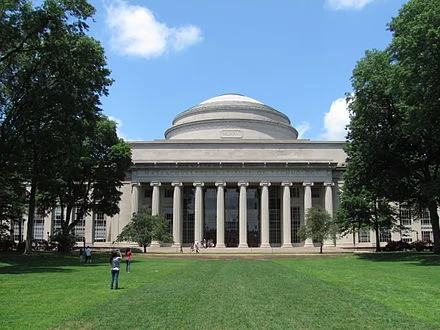
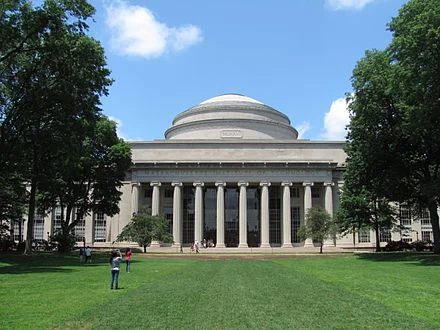
The Great Dome at MIT, in Cambridge, Mass.
From the New England Board of Higher Education (nebhe.org)
In 2004, then-University of New England President Sandra Featherman authored a piece for NEBEHE's New England Journal of Higher Education (NEJHE), then called Connection, headlined “Emotional Rescue” and focused on how a new generation of troubled college students was straining campus resources. Featherman, who died in April, wrote of colleges and universities scrambling to provide additional and better support services for students in need. She cited to a 2001 University of Pittsburgh survey in which 85 percent of schools reported increases in the severity of problems presenting at campus counseling centers over the preceding five years
Eight years later, a NEJHE article by Lasell College admission counselor Christopher M. Gray asked whether the proliferation of natural disasters and tragedies, such as the Sandy Hook mass shooting, were creating a new category of emotionally vulnerable college students. Specifically, he suggested that it was higher-education professionals’ “duty to aid these college-bound students as much as possible,” and urged the provision of counseling, knowledge and support. But moral duties and obligations aside, what is a higher education institution’s legal obligation to provide support services? And from a risk-management perspective, if the institution provides such services, what is its liability if the student’s mental-health issues nevertheless consume him or her?
The recent case of Nguyen v. Massachusetts Institute of Technology, et al., considered the question of whether a college or university has the obligation to protect its students from all harm at all times, including suicide. Han Nguyen was a 25-year-old graduate student at MIT when he committed suicide in 2009. His family sued the school, alleging that the school lacked sufficient support services, did not provide adequate care for its students, and failed to intervene despite knowledge of his mental state. The Massachusetts Supreme Judicial Court did not find MIT liable under the facts of the case, and within its decision, the court articulated the obligations of colleges and universities when it comes to suicide prevention.
Ultimately, the court rejected the notion that colleges and universities must act in loco parentis and keep its students safe under all circumstances. “University students are young adults, not young children. Indeed, graduate students are adults in all respects under the law. Universities recognize their students’ adult status, their desire for independence, and their need to exercise their own judgment. Consequently the modern university-student relationship is respectful of student autonomy and privacy.”
The court identified limited circumstances under which a college or university must take reasonable measures to protect a student from self-harm: where the college or university has actual knowledge of a student's suicide attempt that occurred while enrolled or recently before matriculation, or of a student's stated plans or intentions to commit suicide.
The court also addressed what would satisfy the college or university’s obligations under such circumstances. “Reasonable measures by the university to satisfy a triggered duty will include initiating its suicide prevention protocol if the university has developed such a protocol. In the absence of such a protocol, reasonable measures will require the university employee who learns of the student’s suicide attempt or stated plans or intentions to commit suicide to contact the appropriate officials at the university empowered to assist the student in obtaining clinical care from medical professionals or, if the student refuses such care, to notify the student’s emergency contact. In emergency situations, reasonable measures obviously would include contacting police, fire, or emergency medical personnel.”
The court’s decision is crucial in encouraging schools to continue to offer resources to students in need. The court not only placed finite parameters on when a school has a duty to intervene, but also identified the “complex and competing considerations” giving rise to its decision: adult students’ privacy and autonomy; the notion that non-clinicians cannot and should not be expected to probe or discern suicidal ideations that are not expressly evident; and allowing schools to take steps to acknowledge and manage the risk of campus suicide with realistic duties and responsibilities.
To be sure, the MIT student at issue had a history of presenting with academic concerns, even admitting to mental-health issues. In May 2007, he had contacted his program coordinator for assistance with test-taking problems. The program coordinator referred him to a coordinator in the MIT student disability services office, who described some of MIT’s accommodations for students with disabilities.
The student declined the accommodations. The program coordinator then referred him to MIT’s mental-health and counseling service. The student met with a psychologist on three occasions, but ultimately reported that he would be receiving treatment at Massachusetts General Hospital, not through MIT. Subsequently, the student twice met with the assistant dean in the student support office. Ultimately, the student did not seek or receive assistance from that office either. Nor did he ever communicate to any MIT employee that he had plans or intentions to commit suicide, and any prior attempts that were discussed took place well over a year before matriculation at MIT.
The plaintiff nevertheless claimed, among other things, that MIT had voluntarily assumed a duty of care. But the court found that “[a]lthough MIT voluntarily offers mental health student support services, there [was] no evidence that [the] services increased [the student’s] risk of suicide [or] that [the student] relied on [these] mental health services.”
Nothing within this case minimizes the tragedy that is the loss of a student. Nothing within this case suggests that colleges and universities can or should be ambivalent to the needs of their students or that an institution will never, under any circumstances, face liability for failing to prevent a foreseeable student suicide. Rather, the court made clear what the school’s duties and obligations are. To have decided this case any other way would have had a chilling effect on colleges and universities’ efforts to provide support and services to the increasingly large population of students in need of assistance.
Lynette Paczkowski is a partner at the Massachusetts law firm of Bowditch & Dewey, with experience representing clients from various industries including education, construction, utility, professional services, real estate and nonprofit, as well as individuals in litigation matters and litigation-avoidance strategies.