
Vox clamantis in deserto





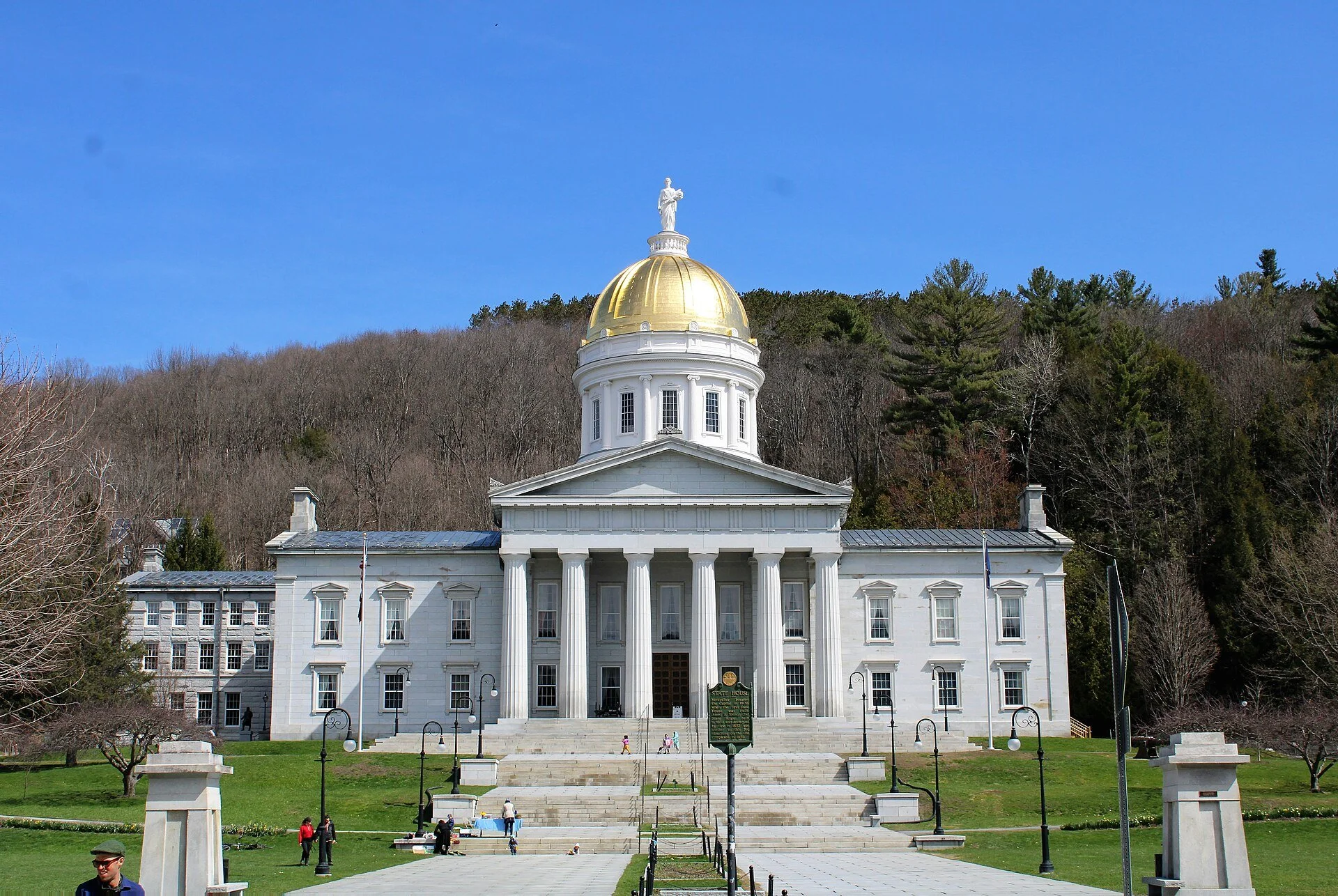
Well, yes, there's only one

The Housatonic River at Shelton, Conn.
"Housatonic, Quinnipiac and Connecticut,
Making their way to Long Island Sound.
Connecticut, what does it mean?
With its New Englanders of every race, color and creed.
A state of great beauty and a state of mind,
There is no other place that you will find ...
A State called Connecticut.''
-- From "A State Called Connecticut,'' by Camille Simone
Industry and high culture in Worcester
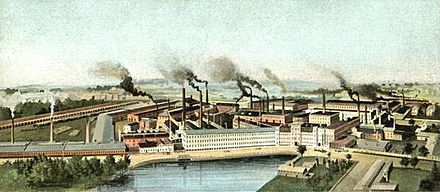
American Steel & Wire Company, circa 1905, in Worcester. At its height, the company employed thousands.
To many, Worcester may be best known as an old industrial city, with a particular focus on things made out of metal. Indeed, some people used to call it "The Pittsburgh of New England.''
Bu it also has such aesthetic and educational delights as many fine examples of Victorian-era mill architecture and Victorian mansions as well as such treasures as the American Antiquarian Society, the Worcester Art Museum, the Higgins Armory Museum, the Mechanics Hall concert venue, the EcoTarium and Clark University, where Freud gave his only lecture in America and from which came Robert Goddard, the pioneer of rocket technology. Then there's a leading Catholic institution, the College of the Holy Cross, up on a windy hill.
Many of the rich local industrialists were avid patrons of the arts and education even as some of them were happy to employ children in their factories.
And there's the Worcester Music Festival, allegedly the oldest music festival in the U.S., the Canal Festival (there are canals in Worcester dating back to Industrial Revolution days) and Rock and Shock

Beautful Mechanics Hall, in downtown Worcester.
Art against misogyny
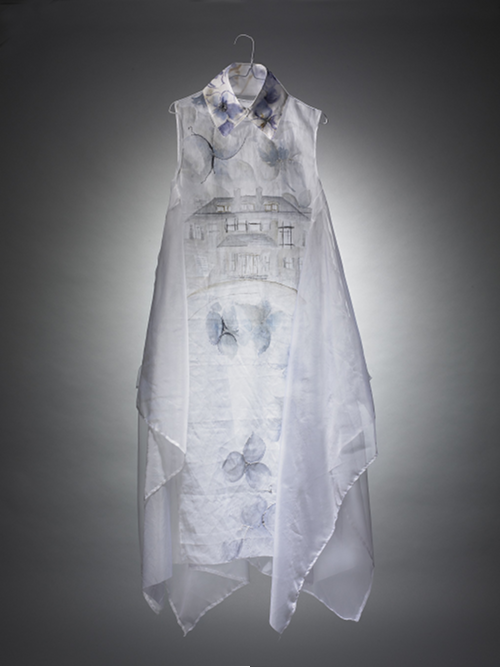
"Bees with Honey'' (fiber), by Kimberly Becker, in the group show "A Woman's Place,'' at the Belmont Gallery of Art, Belmont, Mass., through March 10. Kimberly Becker, a painter and embroider who is also the curator of "A Woman's Place." Becker explains on her Web site, kimberlybecker.com; "My work speaks to current political and social issues that I believe need a loud voice. Women must tell their stories, and insist that the misogyny stop."
Chris Powell: Political sanctimony won't solve gun-violence challenge

An AR-15, which was easily bought by Nikolas Cruz at a gun store and then used to murder 17 people at a Florida school.
Estimates are that 300 million guns are in private possession in the United States, 55 million Americans own guns, and that at any particular moment about 20 percent of the population is suffering some form of mental illness.
So the remarkable thing may be not that the country has mass shootings every week but that there aren't several every hour and that anyone lives beyond age 40, especially as the political atmosphere has become stifling with sanctimony about guns.
The country sure does have a gun violence problem. But the rhetoric about it often lacks much relevance.
The bodies hadn't even been hauled away from the high school massacre in Florida last week before Connecticut U.S. Sen. Chris Murphy was pacing the Senate floor denouncing Congress for having done nothing about guns. Gov. Dannel Malloy, whose administration gave early release to convict Frankie "The Razor" Resto, who quickly went on to murder a store owner in Meriden, angrily accused Republican congressmen of having blood on their hands.
As is often the case, the problem with the quick denunciations arising from the Florida massacre is that none of the common prescriptions for diminishing gun violence would have made any difference.
More background checks? Desirable as they are, the perpetrator in Florida had no criminal record and his rifle was legally purchased at a gun shop. No "gun show sales loophole" was involved.
More mental-health appropriations? These would be helpful. But while many of the perpetrator's acquaintances regarded him as troubled and he had been expelled from high school because of misconduct, he rejected treatment.
Limit the capacity of gun magazines? This is trivial, since plenty of damage can be done whatever the magazine size and empty magazines are quickly replaced with loaded ones.
Outlaw "assault weapons"? This usually means any rifle that just looks scary. But the only thing that matters about a gun is not its appearance but its mode of firing, and there are only three kinds of guns.
There are fully automatic guns, semi-automatic guns and single-shot or double-shot guns The first kind reloads automatically and permits multiple rounds to be fired with a single squeeze of the trigger. The second kind also reloads automatically but requires individual trigger pulls for the discharge of each bullet. The third kind requires reloading for every one or two discharges.
Fully automatic guns are tightly regulated by the federal government and are not widely in public possession. Most modern guns are semi-automatic, as the Florida perpetrator's was. Outlawing them means outlawing most modern rifles and pistols -- that is, outlawing most of the guns held by the public -- and limiting public ownership to shotguns, bolt-loading guns, and derringers.
If outlawing most guns is what the advocates of more restrictions want, they should be honest about it -- and they will need luck with confiscation. After all, when guns are outlawed, only outlaws will have guns -- along with President Trump, that paragon of mental stability who also controls the country’s nuclear arsenal.
So unless the country chooses gun confiscation, it may be stuck with the public identification and preventive detention of the mentally ill and more armed security for its many soft targets like schools, theaters, and nightclubs.
Where 20 percent of the population is armed and another 20 percent is psychotic, inevitably there will be some overlap, against which the usual political sanctimony will be no defense.
Chris Powell is a columnist for the Journal Inquirer in Manchester, Conn., and a frequent contributor.
Study suggests benefits of 'home hospital' care for acutely ill

A study by researchers at Boston’s Brigham and Women’s Hospital suggests that a “home hospital” care model in which patients receive hospital-level acute care at home may cut costs without hurting quality, including patient safety.
Although many patients prefer to receive care at home, there are few “hospital at home” programs in America.
FierceHealthcare reports that gaps continue between hospitals and home-based care providers, which can pose patient-safety issues. “Home health workers are often provided incomplete or inaccurate information, and they often lack access to electronic health records to doublecheck patient information,” the news service reported.
The Brigham and Women’s Hospital’s small randomized control trial on its pilot home hospital program found that it cut healthcare costs by half.
The program included a daily visit from a physician and two daily visits from a home health nurse with patients also linking to physicians outside of those visits through video and/or texting.
“We haven’t dramatically changed the way we’ve taken care of acutely ill patients in this country for almost a century,” David Levine, M.D., a primary-care doctor at Brigham and the study’s lead author, said in an announcement about the study.
“There are a lot of unintended consequences of hospitalization. Being able to shift the site of care is a powerful way to change how we care for acutely ill patients and it hasn’t been studied in the U.S. with intense rigor,” Dr. Levine added.
He and his team plan to expand the study to include a larger number of patients.
To read the study, please hit this link.
To read FierceHealthcare’s take on this, please hit this link.
The usual state of things
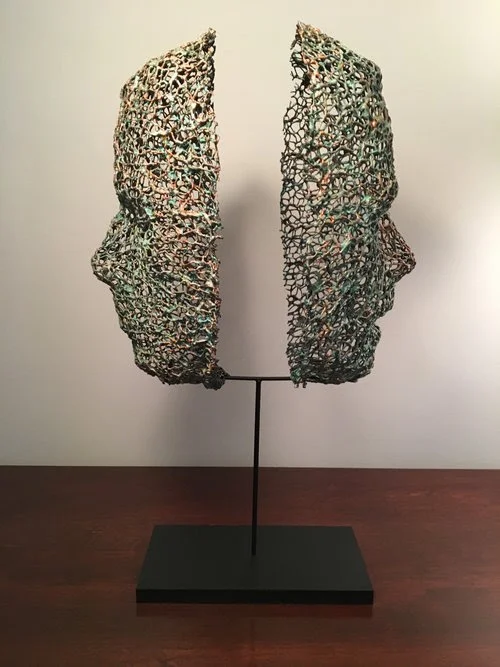
"Stalemate.'' by Cindy Journey, in the group show "With Eyes Wide Open,'' with the National Association of Women Artists, at the Thompson Gallery at the Cambridge School of Weston, Weston, Mass. through March 2.

Into a rapture

Snow drops blooming on south-facing slope in Providence on Feb. 18.
"Was it the smile of early spring
That made my bosom glow?
'Twas sweet, but neither sun nor wind
Could raise my spirit so.
Was it some feeling of delight,
All vague and undefined?
No, 'twas a rapture deep and strong,
Expanding in the mind!"
-- Anne Bronte, "In Memory of A Happy Day in February''
A foundation for prettiness
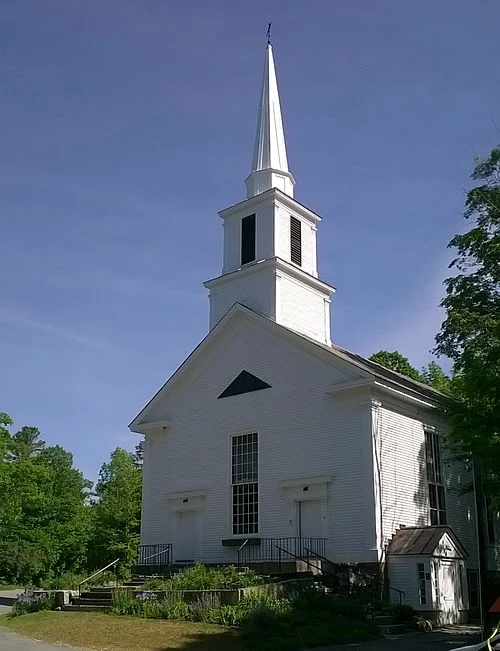
"The White Church'' in Grafton, Vt.
You want a pretty town? It helps to find a rich foundation.
Thus it was with lovely Grafton, Vt., where back in the' 60s the Windham Foundation set up a preservation program for the whole town that did such prettifying things as restoring old buildings and covered bridges and burying all electrical and telephone lines.
The foundation says it "strives to preserve Vermont's rural way of life'' and works "to enhance the social, economic and cultural vitality of Vermont's smaller communities.''
Its efforts in Grafton were helped by the fact that many rich people "from away'' have weekend and summer homes in the rather precious-looking town.
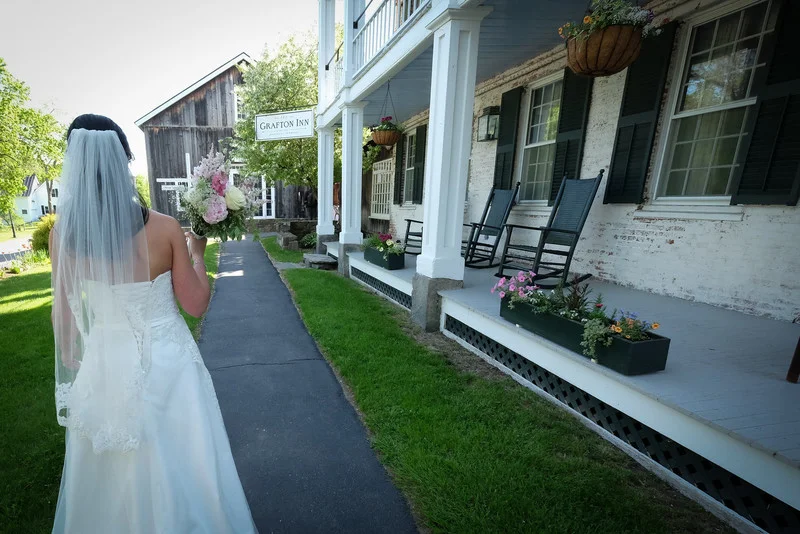
The Grafton Inn, founded in 1801, has hosted many famous people, including Ralph Waldo Emerson, Rudyard Kipling (who lived in Dummerston, Vt., in 1892-96; a battle with his alcoholic brother-inn-law drove him away) Theodore Roosevelt and other celebs down to the present day.
Frank Carini: Rhode Island tries to deal with a rising sea
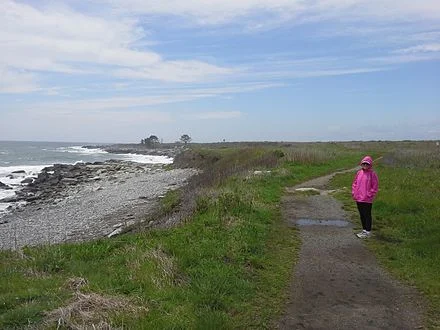
Here at the Sachuest Point National Wildlife Refuge, in Middletown, R.I., the Nature Conservancy and the U.S. Fish & Wildlife Service are working to restore and strengthen salt-marsh habitat as the rising sea level poses an intensifying challenge.
Via ecoRI News (ecofri.org)
NARRAGANSETT, R.I. — Rhode Island is losing and has lost thousands of acres of salt marsh, much of it to development. These unique ecosystems are a priceless resource with irreplaceable benefits, including their ability to protect the human-built world from sea-level rise.
“We’re going to hit a point when marshes can’t keep up with sea-level rise,” University of Rhode Island researcher Simon Engelhart said. “We need to let them migrate inland, or we will lose them. We need to allow marshes to do what marshes do.”
He said humans should already be retreating from the coastline. He also noted that the clearing of trees and the destabilization of soil impacts the ability of salt marshes to migrate inland.
Engelhart, an assistant professor in URI’s Department of GeoSciences, is investigating how the state’s coastline has responded to past sea level-rise changes and studying the influence of land subsidence from the last ice age to better understand future implications as sea level-rise projections continue to climb.
So far, his research has found that sea-level rise is happening faster than at any point in Rhode Island’s past 3,000 years, in part because the Ocean State is sinking. Low-lying areas such as Island Park, in Portsmouth, and Oakland Beach, in Warwick, are among the most vulnerable areas.
Engelhart noted that sea-level rise is a complicated issue with many variables, such as gravity, density changes of water, water temperatures, the strength of the Gulf Stream and other ocean currents, the draining of aquifers, groundwater withdrawals, and the rate of ice-sheet melting in Greenland, the West Antarctic, the East Antarctic and the Southern Patagonian Ice Field.
“It doesn’t go up uniformly everywhere. The ground moves, shakes and is active,” Engelhart said during a Feb. 14 talk at the Coastal Institute Auditorium on URI’s Bay Campus as part of Rhode Island Sea Grant’s annual Coastal State Discussion Series. “Sea-level rise is about what the ocean is doing and what the land is doing.”
Although Rhode Island is losing only 1 millimeter of ground annually, according to Engelhart, it plays a meaningful role in present-day flooding along a coastal state that is mostly at sea level or 10-30 feet above.
He said land subsidence — the gradual settling or sudden sinking of the Earth’s surface owing to subsurface movement of earth materials — “is going to be important in the short-term even though it’s small because it’s still a component of what we’re seeing,” referring to nuisance flooding where high tides can now cause road closures and overwhelm storm drains. These events are expected to increase with continuing sea-level rise, he added.
“This may seem minimal compared to projected sea levels, but is still a significant contributor to sea-level rise at present,” Engelhart said.
Since 1930 the Newport tide gauge has measured about 2.7 millimeters annually of relative sea-level rise. The Providence tide gauge has measured 2.2 millimeters. Those measurements, however, don’t tell the full story.
“Eighty to ninety years of data is not enough to put anything into context,” Engelhart said. “Those are just linear rates ... they’re not accounting for the acceleration of the current rate. There’s clear acceleration in the records of the past 25 years. We need to address greenhouse-gas emissions.”
Last year the National Oceanic and Atmospheric Administration increased its sea-level rise projectionsto up to 8 feet by 2100. The Northeast is projected to experience an additional 1-3 feet on top of NOAA modeling.
Salt marshes are highly productive ecosystems that filter out pollution, provide habitat for wildlife and protect homes from flooding. They’re also sensitive to development.
For the long-term context of Rhode Island sea-level rise, Engelhart and his research team turned to Narragansett Bay salt marshes. He explained that salt marshes grow at different elevations to the ocean and that life in them tells a specific story. To read these marsh stories, Engelhart’s team has taken core samples from four salt marshes — Fox Hill, Touisset, Nag Creek and Osamequin — and closely examined their finds with radiocarbon dating.
The team has plans to expand the number of salt marshes where core samples are taken.
Salt marshes are shoreline wetlands that are flooded and drained by salt water brought in by the tides. These intertidal ecosystems — foraging habitat for fish, shellfish, birds and mammals, and home to nursery areas and spawning grounds — are essential for healthy coastlines, communities and fisheries. They are an integral part of Rhode Island’s economy and culture.
They also have and continue to take a pounding. For instance, more than 50 percent of Narragansett Bay’s salt marshes have been destroyed during the past three centuries. Much of the remaining marshes have been diminished by coastal development and failed mosquito ditching. Mosquito ditches are narrow channels that were dug to drain the upper reaches of salt marshes. It was believed that such efforts would control mosquito breeding, but all that work did was drain salt marshes and kill off mummichogs, a mosquito-eating fish that are important prey for herons, egrets and larger predatory fish.
Healthy salt marshes help communities, buildings, infrastructure and the environment better withstand the impacts of sea-level rise and coastal storm surge. Salt marshes protect shorelines from erosion by buffering wave action and trapping sediment. These vital ecosystems reduce flooding by absorbing rainwater, and protect water quality by filtering runoff and metabolizing excess nutrients, such as nitrogen.
Salt marshes, however, are highly sensitive to development. Polluted stormwater runoff from inland development can damage salt-marsh health. Engelhart also noted that the marshes of Narragansett Bay face another problem: a lack of sediment supply.
James Boyd of the state’s Coastal Resources Management Council partook in an informal conversation, which included about a dozen questions from the audience, after Engelhart’s recent presentation.
Boyd noted that if sea level in Rhode Island rose a foot, 13 percent of the state’s remaining salt marshes would be lost; 3 feet, 62 percent; 5 feet, 83 percent.
“Our salt marshes are in trouble,” said the coastal policy analyst. “The ability of salt marshes to migrate inland is the most important element. We need to preserve that upland. That’s what will save our salt marshes: room to move.”
The impact of losing healthy salt marsh can be seen across southern New England. The coastal portion of the Sapowet Marsh Wildlife Management Area, in Tiverton, has experienced more than 90 feet of shoreline erosion in the past 75 years, according to the Rhode Island Department of Environmental Management.
The Nature Conservancy and the U.S. Fish & Wildlife Service are working to restore and strengthen salt-marsh habitat at the Sachuest Point National Wildlife Refuge, in Middletown, to better withstand the impacts of sea-level rise, coastal storm surge and coastal erosion.
Salt marshes of the picturesque Narrow River are threatened by a combination of rising water and human activity. In recent years, motorboat wakes and extreme weather events such as Hurricane Sandy have destroyed 15 percent of the watershed’s marshland, according to state officials.
Salt-marsh islands in the West Branch of the Westport River have declined by nearly half during the past 80 years, according to a 2017 report.
By studying aerial imagery of six salt-marsh islands in the river’s West Branch, scientists found that the total area of salt marshes has consistently declined during the past eight decades, with losses dramatically increasing in the past 15 years. Altogether, the six islands lost a total of 12 acres of salt marsh since 1938. If marsh losses continue at the accelerated rate observed during the past 15 years, the Westport River’s marsh islands could disappear within 15 to 58 years, according to the researchers.
“Plan for the worst-case scenario is the best way to handle sea-level rise,” Engelhart said. “Take the longer-term view. There’s benefits regardless if we cut greenhouse-gas emissions.”
Engelhart’s research aims to provide a better understanding of future coastal hazards, to help coastal planners make more informed decisions.
Frank Carini is editor of ecoRI News.
David Warsh: Amidst scandals, centrists are gaining as Mueller plays a long game
SOMERVILLE, MASS.
Prosecutors’ charges against 13 Russian individuals and organizations for interfering with the 2016 presidential election are the latest step in a lengthy and painful process in which serious people of both political parties are working to straighten the U.S. political narrative out of a very difficult twist of the plot.
Remember its central feature; it now seems a long time ago. The 2016 campaign was widely expected, at least for a time, to become a Hillary Clinton-Jeb Bush rematch -– a continuation of a 25-year antagonism in which both candidates had been damaged. That prospect was so unattractive that challengers arose in both parties – 16 of them in the Republican case. Bernie Sanders failed to win his party’s nomination, but Donald Trump improbably gained his. The election campaign began. As Michael Wolf’s Fire and Fury: Inside Trump’s White House (Henry Holt, 2018) makes clear, Donald Trump never expected to win.
Two disruptive forces of particular interest intervened in the election itself. One was the Russian interference. The other was an incipient FBI mutiny, involving agents in at least four field offices, eager to indict Clinton for matters related to the Clinton Foundation, and threatening to go to the press or to Congress. Wall Street Journal reporter Devlin Barrett surfaced as much in "FBI in Internal Feud Over Hillary Clinton Probe'' (subscription required) on Monday, Oct. 31, 2016, a few weeks before he left the WSJ for The Washington Post. Those angry agents had a point, of course: there was something suspect about the Clinton Foundation from the very beginning. But the late stages of a presidential campaign is no time to begin an investigation.
The Russian campaign has received a great deal of attention, the FBI mutiny hardly any at all, but it was the threat of disclosure of previously unexamined Clinton e-mails on Anthony Weiner’s laptop that forced then FBI Director James Comey to reopen the investigation of Clinton’s private server. As former WSJ columnist Bret Stephens wrote last month in The New York Times (he moved to The Times a few months after the election), the FBI “probably did more than any other agency of government to create the Trump presidency in the first place, in part because disgruntled FBI field agents were intent on forcing James Comey to reopen the Clinton e-mail investigation 11 days before the election.”
It is impossible to say with any real authority that either intervention tipped the election. Clinton contends that Comey cost her the White House. Trump pretends that he received no such help. This much is clear: Had Clinton won, she would by now be up to her ears in investigations of the Clinton Foundation, from Congress at least. Talk about the winner’s curse!
The new indictments mean that the Russian meddling that Trump has repeatedly denounced as a “hoax” turns out to have been quite real. The charges make it much more difficult to fire Mueller. The president was quick to pronounce himself off the hook. Soon after the Justice Department delivered the news, he tweeted, “Russia started their anti-US campaign in 2014, long before I announced that I would run for President. The results of the election were not impacted. The Trump campaign did nothing wrong. No collusion!”
Yet there are many more steps to go. It is still very much an open question whether Trump will serve out his term; it is highly unlikely that he could be re-elected. Congressional Republicans remain in Trump’s corner, it is true. Some development may yet turn them against him. Maybe. Maybe not.
Meanwhile, dealing with FBI mutineers remains part of the problem, moving them onto side tracks, or out of the bureau altogether, proceedings the still-divided agency understandably hopes to keep within the family. They may not be able to. Part of Trump’s aim in firing Comey presumably had to do with hopes of advancing the careers of agents who helped him during the campaign, including the mutineers. The rogues continue to stick up for themselves, in leaks to two WSJ columnists, William McGurn and Holman Jenkins Jr. (subscription required). Former federal prosecutor Rudy Giuliani has all but disappeared from the news, after serving as one end of a conduit for “outraged FBI agents” during the campaign.
This is how plot lines adjust. Elections take time. It doesn’t help for the enraged Left to say that the Republican Party “basically lies about everything.” Everything? Deputy Atty. Gen. Rod Rosenstein announced Special Counsel Robert Mueller’s indictments last week – both men are long-time Republicans. Secretary of State Rex Tillerson, a James Baker III proxy, is still on the job. So are White House Chief of Staff John Kelly, and the other two calming generals: Defense Secretary James Mattis and National Security Adviser H.R. McMaster.
Meanwhile, former presidential nominee Mitt Romney announced his candidacy last week for the Senate in Utah. If elected, he will take on the role performed to this point by Sen. John McCain (R-Ariz.) – a conscience of sorts for a political party that has otherwise lost its head.
The sooner the current Republican majority in Congress loses power to the Democrats, the sooner that sensible women and men can begin rebuilding the party. The Democrats’ own major rebuilding is well underway.
David Warsh, an economic historian and long-time business and political columnist, is proprietor of economicprincipals.com, where this first ran.
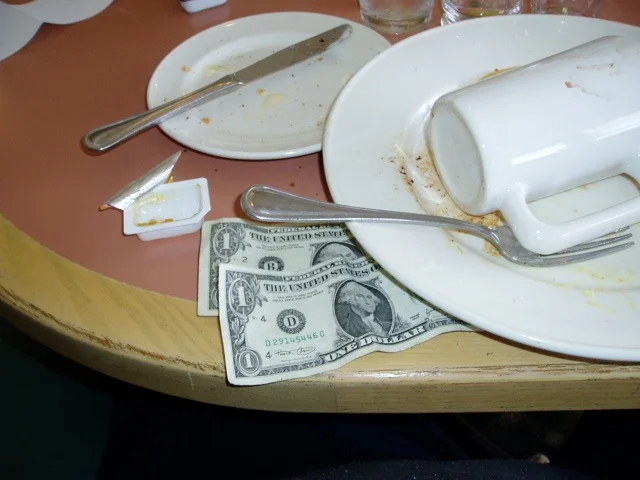
Irene Tung/Teofilo Reyes: Now the big restaurant-chain owners seek to steal workers' tips
Via OtherWords.org:
When we give someone a tip, we expect the money will go to the workers who provided us with service.
We might leave a little extra because someone went above and beyond for us. Or because we want that person to have a slightly easier time getting by.
Whatever the circumstance, we trust that the money will help the workers who served us.
But the National Restaurant Association — a group controlled by owners of major restaurant chains —has long been promoting the idea that business owners, not workers, should control the tips we leave.
If they have their way, the U.S. Department of Labor will soon let minimum-wage employers confiscate all tips left by customers. Business owners would not have to disclose to patrons what happens to tips, and could simply pocket the tips themselves.
This would apply to anyone who receives tips — from the housekeeper who makes up your hotel room, to the valet who parks your car, to the assistant who pushes your wheelchair at the airport.
Overall, women represent two out of three tipped workers.
The NRA’s key leadership includes Olive Garden, IHOP and Applebee’s, Denny’s, Cracker Barrel, Chili’s and Outback Steakhouse. These companies already have an egregious track record of squeezing workers while inflating CEO pay. If the new rule is finalized, they could use tips to fuel even more stock buybacks and CEO pay hikes.
By doing these companies’ bidding, the Trump administration is poised to make life even harder for restaurant workers and their families. A recent study shows that more than half of hourly earnings for servers and bartenders come from tips.
Restaurant lobbyists claim that giving employers control over tips would let them redistribute tips from servers to such non-tipped workers as dishwashers. But there’s nothing in the rule to require this. And even if they do redistribute, there’s a good chance that employers would cut base wages to make up the difference.
With the rule change, employers would have a strong incentive to pay only the federal minimum of $7.25 and then claim ownership of all tips. The Economic Policy Institute estimates that changing the rule would transfer $5.8 billion from workers directly to employers, and 80 percent of that amount would come from the pockets of women who earn tips.
To be clear, this rule will hurt workers — and the Labor Department knows it. Revelations that senior political officials there tried to bury a damaging economic analysis of the proposal have led to an internal investigation.
Even with tips, servers and bartenders take home only $10.11 per hour. This is already far below what workers throughout the country need to make ends meet. These employees need more wage protections, not fewer.
And voters seem to agree.
Recent polling from the National Employment Law Project shows 83 percent of voters disapprove of the proposal to give employers control of worker tips, and most respondents say they would tip less often if the rules are changed.
This is an attempt by lobbyists to transfer a massive amount of wealth and power from consumers and workers to corporate restaurant chains and their private equity owners
Irene Tung is a senior policy researcher with the National Employment Law Project. Teófilo Reyes is a visiting scholar at the Goldman School of Public Policy at the University at California. at Berkeley, and research director with Restaurant Opportunities Centers United.

Chris Powell: As civic life and local news media decline, why keep slogging on?

How many more press runs?
When the Journal Inquirer, of Manchester, Conn., merged the weekly newspapers in Rockville, South Windsor, and East Windsor, Conn., and went daily in August 1968, its premise, like the premises of the Connecticut newspapers that had been started long before, was that people wanted local news. The Hartford newspapers serving the growing suburbs to the north and east were not providing much of it. For 25 years the upstart's circulation grew steadily and two of its competitors closed, in large part because they lacked local news.
Back then Connecticut, literate and prosperous, had the highest per-capita newspaper readership in the country. But for most of the last 25 years newspaper circulation throughout the country and in Connecticut has declined, even for the most local of papers.
This is commonly blamed on the rise of the Internet, but recent surveys suggest it is something else. They find that most people are not using the Internet much to obtain local and state news, that most of the news sought on the Internet is national and world news, that there isn't so much interest even in that news, and that most use of the internet is not for news but for social contact, shopping, and amusement.
While newspapers and their internet sites remain the primary providers of local and state news, it seems that interest in such news has collapsed.
Indeed, the collapse of interest in local and state news may correlate less with the rise of the Internet than with the collapse of civic engagement generally as indicated by measures like voter participation.
Census and voter registration figures suggest that even in Connecticut about 25 percent of the eligible adult population doesn't even register to vote. As a result, actual voter participation is probably only 50 percent of the eligible population for presidential elections, a third for state elections, and around 10 percent for municipal elections.
For example, far more people voted in Manchester's town election in 1962 than in its town election in 2017, though the town's population is 40 percent larger.
That is, newspaper readership, like voter participation, is mainly a matter of demographics. The more literate, self-sufficient, and engaged with public life people are, the more they read newspapers. The less literate, self-sufficient, and engaged with public life people are, the less they read newspapers -- and the demographics of Connecticut and the whole country are declining fast.
No one needs newspapers for keeping up with the Kardashians.
Trouble for newspapers is not the worst of it. Democracy and the country are in jeopardy.
So someone who has spent 50 years at a newspaper in Connecticut may be permitted his discouragement. The civic engagement business was never lucrative, but now nearly all local- and state-oriented newspapers struggle to survive.
As the state's economic and demographic decline accelerates, knowledge of Connecticut's past, present, and public policy has lost all financial value except for those who would use it to extract the last scraps of patronage and graft from the state's hapless and insolvent government.
Of course many lives are always wasted, but what kind of future awaits Connecticut when most of its high school graduates never master high school English and math, much public college instruction is remedial, and most people cannot identify the state's three branches of government? (You know -- the teacher unions, the lawyers, and the liquor stores.) Maybe Dire Straits was right:
I shudda learned to play the guitar.
I shudda learned to play them drums. ...
Maybe get a blister on your little finger.
Maybe get a blister on your thumb.
Some pensioners wear T-shirts inscribed: "I'm retired. Having fun is my job." They may have earned their fun, and old folks remain the best newspaper readers, but how much attention are even they paying to Connecticut these days, especially since so many of them are moving to warmer and less-taxed jurisdictions, as even the state's most recent former governor has done?
While everyone of a certain age is entitled to a little time out of the winter cold, for a former governor to leave the state is also demoralizing, and a warning too.
For many state residents have nowhere else to go, nor, as Bing Crosby and Judy Garland sang, do they want to abandon Connecticut despite the damage being done to it:
Circled the globe dozens of times.
Seen all its wonders, known all its climes.
I've searched it with a fine-tooth comb
And found that I only have one home, sweet home.
Connecticut always will be my home.
Still, after so much time in the news business it can be difficult not to view much of what is reported as trivial or a cliche, as T.S. Eliot did even before the era of "weather every 10 seconds."
You will see me any morning in the park
Reading the comics and the sporting page.
Particularly I remark:
An English countess goes upon the stage,
A Greek was murdered at a Polish dance,
Another bank defaulter has confessed.
Of course while the news is repetitive it is not all trivial to the people directly involved, and it usually involves different people, who make it new, though they may no longer care as much about appearing in print as they care about appearing on "social media," where news tends to be less about wars and rumors of wars than boyfriends, girlfriends, relatives, and pets.
So what is the point of staying in the newspaper business? Maybe only spite. It might be hard to let certain people in what is left of the state's public life think that no one was on to them.
Fare thee well now.
Let your life proceed by its own design.
Nothing to tell now.
Let the words be yours. I'm done with mine.
Chris Powell will retire Monday as managing editor of the Journal Inquirer in Manchester. He plans to continue writing columns for Connecticut newspapers and New England Diary.
-
Llewellyn King: Learn a trade and study liberal arts at a tiny, one-stop college

American College of the Building Arts junior measuring for a custom stair.
An awful lot of people would love to work with their hands. But there’s a problem: If you don’t go to college, preferably a four-year college, you’ll be doomed to a stigmatized existence. You are blue collar, seated all of your life below the salt.
Yet blue-collar industries across the country are facing a massive skills shortage. There are shortages of bulldozer and crane operators, carpenters, electricians, automotive mechanics, truckers and welders, among other workers.
If you want to build or fix things, you need skilled workers, artisans — men and women who work with their hands and their heads.
The popular solution, which I hear a lot about (including on White House Chronicle, the television show I host, where we’ve been running a series on the future of work), is that we need more apprenticeships.
The apprenticeship approach has an ancient and noble lineage, but it may not be for our time. It involves a degree of bondage to a trade. I’ve seen apprenticeships up close in a number of trades including construction, printing and newspaper production in general.
While apprenticeships work, they don’t address the social consequences of not going to college. Ergo, trade schools don’t solve the social dynamic that keeps willing hands off essential tools.
Society doesn’t expect blue-collar workers to have ambition. They’re expected to drive a pickup, go bowling and love hunting.
They aren’t expected to enjoy the refined things of life; they’ve chosen to travel by the low road, at least in society’s thinking. They may love the poetry of Keats and revel in grand opera, but the corner office doesn’t care. They haven’t been stamped out by a four-year college; they’re inferior.
Well, you can have both and a small college (so small you might not think it’s a college) is nurturing a big idea, a really big idea — an idea for our time. It’s the American College of the Building Arts (ACBA), in Charleston, S.C
As Anthony Wade Razzi, chief academic officer, explained it in a letter to the Charleston Post and Courier, and in a telephone interview with me, “At ACBA, we teach six traditional trades: architectural carpentry, timber framing, architectural stone, masonry, plaster and architectural forged iron.”
But while learning their specialties for years, the students still get a traditional liberal arts education. This includes math, science, literature, philosophy, foreign language, drawing and drafting, and business management.
Razzi, who holds a doctorate in English literature from Oxford, says the college “fuses two branches of learning that have been artificially separated for 2,500 years.”
The college came out of the devastation following Hurricane Hugo, which hit in 1989. A group of civic-minded South Carolinians realized that there weren’t enough artisans to help with the rebuilding. So they founded the four-year college, which has a two-year option.
In the letter, Razzi says the students “learn to lay brick, carve stone, forge iron and frame timber” but they also learn to plan work and manage a job.
The unanticipated outcome: entrepreneurism. Many ACBA graduates have started their own businesses because they graduated with skills that allowed them to do that.
ACBA is minuscule, hardly a speck of its own stone dust on the face of education. There are just 55 students this year at the private, nonprofit college but, as Razzi says, it’s a start.
I think it’s more than a start. I think it should be a guiding light to the future of education; a curriculum for the future that addresses the urgent need for artisans, allows many to do the manual work they love, and ends the “no college” stigma. Yes, you can enjoy framing carpentry and aspire to be the president of the construction company.
There’s a way forward for society and the individual in this tiny, private venture in Charleston. Eureka!
On Twitter: @llewellynking2
Llewellyn King is executive producer and host of White House Chronicle, on PBS.

American College of the Building Arts.
New Bedford as a green-energy Houston? thanks, Dunkin'; a big city running out of water
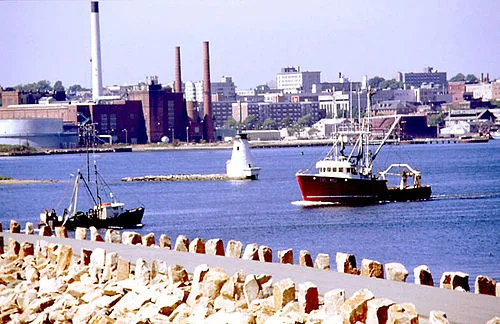
New Bedford Harbor.
From Robert Whitcomb's "Digital Diary,'' in GoLocal24.com:
Could southeastern New England become to offshore wind power what Houston has been for oil and natural gas? Maybe, but gradually. New Bedford’s Marine Commerce Port Terminal would probably be its center; it’s the first dock in the U.S. that’s strong enough to handle those very heavy offshore wind-turbine parts, and the Whaling City is all in about becoming a renewable-energy center.
Despite the Trump administration’s affiliation with the fossil-fuel industry, interest in offshore wind may be as intense as ever. The Boston Globe reported that an offshore-wind supply-chain conference held last year in Newton, Mass., attracted nearly 150 companies. And unions love this industry, which employs highly paid, highly skilled workers in the “blue-collar elite.’’
It’s too early to know what the impact of the Trump administration’s anti-green energy might be. U.S. solar-energy companies, for their part, have expressed concern that they’ll be hurt by the administration’s tough tariff policy on imports of solar panels from China.
Recently, survey ships for proposed projects south of Martha’s Vineyard have set forth from the Whaling City to study seabed conditions and plan transmission routes. Indeed, all the current developers for Massachusetts’ first wind projects have agreed to deploy from New Bedford. (Wouldn’t it be nice if Quonset could get some of that business?)
Another very promising port for offshore wind-turbine operations would be the recently decommissioned Brayton Point coal-fired plant, in Somerset.
New Bedford, Fall River, Quonset, Brayton Point and other places in southeastern New England could also become sites for other new renewable-energy projects that might develop, such as tidal and wave power. Meanwhile, the Trump administration would like to allow oil and gas drilling off New England near famous fishing areas….
New Bedford was an energy capital in the 19th Century because of the whale oil used for lighting; it was considered “clean’’ energy for the time. It was said to burn brightly and cleanly.
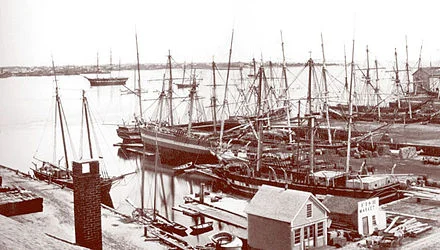
New Bedford Harbor in the late 19th Century, as the whaling boom disappeared.
xxx
Thank you, Canton, Mass.-based Dunkin’ Donuts, for deciding to phase out your polluting and nonrecylable foam cups by 2020. I hope that other fast-food operators do the same thing. These cups leave a mess: They last in the environment for many years. And the chemicals used to make them are dangerous. The main ingredient, styrene, may cause cancer in humans.
xxx
Cape Town, South Africa, is expected to run out of water in May, as extended drought, population growth and insatiable agricultural use drain aquifers. Some have linked the drought to man-made climate change.
The crisis in Cape Town recalls the sort of crisis that other basically dry places, such as Southern California, may soon face. Note that that drought continues to worsen across much of the West and South. But many places will eventually need detailed long-term and emergency measures to address climate change. In New England the biggest climate challenge will be coastal flooding; Boston had a foretaste of that last month during a big Northeaster.
New England’s, er, vigorous climate poses challenges but at least we have lots of fresh water – even more valuable than, say, oil.
Art, of a sort, on a gas tank, has become yet another New England 'icon'
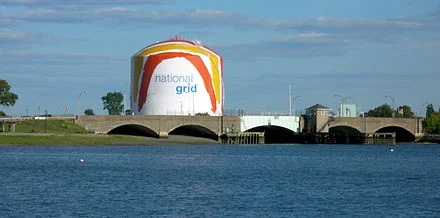
The Rainbow Swash is the official name for an untitled work by the late Sister Corita Kent, a Roman Catholic nun and artist, in Boston's Dorchester neighborhood. (We always just called it the "Sister Corita splashes''). The design, painted on a 140-foot-tall LNG storage tank, on Boston Harbor, is called the world's largest copyrighted work. It's highly (too?) visible by the hundreds of thousands of tortured commuters driving on the stretch of Interstate 93 called the Southeast Expressway, aka Distressway or World's Longest Parking Lot.
The design first went up in 1971 and was transferred to its present location in 1992, after the original LNG tank on which it was painted was torn down. The pattern seems a relic of schlock and pop art of the '60s and '70s. It was controversial for a long time because some said they saw the profile of Vietnamese Communist dictator Ho Chi Minh in it. Remember that the U.S. was in the Vietnam War until May 1975. Sister Corita was said to be a bit of a lefty and was a pacifist.
A superb and overdue book about a great American architect

The building above is the Merchants Exchange, Philadelphia.
William Strickland (1787-1854) was one of the most important American architects. His re-interpretation of Greek temples for a modern democracy in such monuments as the Second Bank of the United States and the Merchants’ Exchange, both in Philadelphia, along with the Tennessee State Capitol, in Nashville, are among the noblest landmarks of this country’s civic identity.

William Strickland, by John Neagle, 1829, with Second Bank of the United States in the background.
-- Courtesy, Yale University Art Gallery.
Although a pioneering monograph on Strickland was published in 1950, a serious study of this master has been desperately needed. Now, Robert Russell has written the definitive book, William Strickland and the Creation of an American Architecture (University of Tennessee Press).
Despite his national stature, Strickland designed only one building in New England, the Providence Athenaeum. The building committee of one of the city’s oldest cultural institutions “ascertained that William Strickland of Philadelphia had a reputation second to none in this country and in his profession” and invited the architect to Rhode Island, where he submitted a design. The library opened in the summer of 1838, having cost $18,955.76.

The Providence Athenaeum (1837-38).
Professor Russell, who wrote his dissertation at Princeton University on late medieval architecture in Italy, is one of those civilized, non-politicized historians whose interests and abilities range far beyond one narrow field. He has written a book on the buildings of Memphis and is a noted authority on gravestone restoration. His last academic post was at Salve Regina University, in Newport, where he was the director of the historic-preservation program. He is now breeding goats in the mountains of western North Carolina.

Robert Russell, in Richmond, R.I., in 2013.
Architectural histories, like that exemplified by William Strickland, set the standard in the profession before academia was sabotaged by political correctness and infected by pseudo-philosophical posturing. Russell’s writing is clear, eloquent and without the overlay of verbal obfuscation that characterizes so much contemporary writing about buildings. The sort of scholarship that characterizes the Strickland book will undoubtedly be dismissed as old-fashioned, and, since its subject led an upright life with no sex scandals or financial skullduggery, it is unlikely that the book will receive much notice. Yet the Strickland book it is the kind of treatment that so many inadequately documented American architects need, and far too few will receive in our increasingly know-nothing culture.
Architectural historian William Morgan wrote his Columbia University master’s thesis on William Strickland’s contemporary Alexander Parris, and is the author of The Almighty Wall, The Architecture of Henry Vaughan.
Grinding away at a sub

"Although you might be just as likely to hear a submarine sandwich in New England called a 'sub' as anywhere else, New England has an additional term: 'grinder.' No, not the dating/social networking app, but a New England word that either referred to the Italian-American slang term for a dock worker or the fact that it took a lot of chewing to eat the hard crust of the bread. It’s worth noting that some only use the term grinder for a hot sandwich — using sub for other large sandwiches — and some call them all grinders.
-- From The Daily Meal (thedailymeal.com)
Don Pesci: 'A moralist in disguise,' Mark Twain was funny and deadly serious on politics
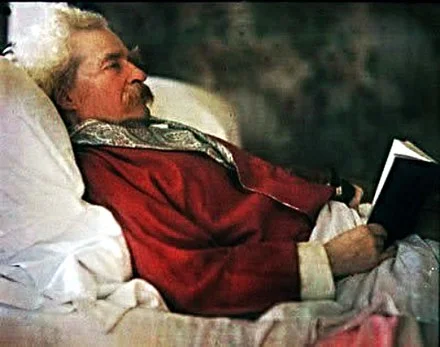
Mark Twain photographed in 1908 via the Autochrome Lumiere process.
Anyone hoping to hammer into a coherent ideology Mark Twain’s robustly critical admonitions on politics and politicians is bound to be disappointed. (Reminder to New Englanders: Twain lived for many years in Hartford.)
Here is Twain on the Congress of his day: “An honest man in politics shines more there than he would elsewhere.” That is taken from A Tramp Abroad, written in Hartford, Connecticut. Twain wrote most of his important novels in Hartford, including The Adventures of Tom Sawyer, The Prince and the Pauper, Life on the Mississippi, Adventures of Huckleberry Finn and A Connecticut Yankee in King Arthur's Court. Towards the end of his life, tragedy became the uninvited guest at Twain’s table. He lost his beloved wife, both a spiritual anchor and a literary censor. Twain did not believe that writers should self-censor. Olivia Clemons was concerned about her husband’s place in the world, as all good wives should be, and worked to keep his combustible politics from bursting into flame – at least publicly -- and singeing the politicians of his day and ours.
The following dictation note is taken from the Autobiography of Mark Twain: “Look at the tyranny of party -- at what is called party allegiance, party loyalty -- a snare invented by designing men for selfish purposes -- and which turns voters into chattels, slaves, rabbits, and all the while their masters, and they themselves are shouting rubbish about liberty, independence, freedom of opinion, freedom of speech, honestly unconscious of the fantastic contradiction; and forgetting or ignoring that their fathers and the churches shouted the same blasphemies a generation earlier when they were closing their doors against the hunted slave, beating his handful of humane defenders with Bible texts and billies, and pocketing the insults and licking the shoes of his Southern master.”
Twain left instructions that his uncensored autobiography, a product of his political “pen dipped in Hell,” should not be let loose on the general public until a century had passed after his death.
This from A letter to Helene Picard, in 1902: “Yes, you are right -- I am a moralist in disguise; it gets me into heaps of trouble when I go thrashing around in political questions.” Helen Picard was the French member of Twain’s private “Juggernaut Club.”
Here is Twain’s note to Helen, published in the Lady’s Home Journal posthumously, as was much of his writing on politics: “I have a Club, a private Club, which is all my own. I appoint the Members myself, and they can't help themselves, because I don't allow them to vote on their own appointment and I don't allow them to resign! They are all friends whom I have never seen (save one), but who have written friendly letters to me. By the laws of my Club there can be only one Member in each country, and there can be no male Member but myself. Someday I may admit males, but I don't know -- they are capricious and inharmonious, and their ways provoke me a good deal. It is a matter which the Club shall decide.”
Seriously?
Twain died on April 21, 1910 of a heart attack in Redding, Conn., where he had moved to escape certain ghosts. Perhaps not unexpectedly, the death of those he most loved liberated him. Following his near bankruptcy, the premature death of his daughter Susy of spinal meningitis at age 24 in 1896 and the passing of his wife, Olivia, in 1904, Twain went “thrashing around in political questions.”
Was Twain serious in his political writings? Indeed, is it possible to take seriously any humorist? He was deadly serious, and his writings did get him into no end of trouble with his political targets, among them President Theodore Roosevelt. Twain thought Roosevelt a rare political showman and a preposterous fraud. Roosevelt, for his part, wanted to strangle Twain – and said so.
But the question is an important and serious one: can someone with a comic turn of mind say anything useful about politics in the widest sense of the word? For a broad thinker like Aristotle, politics was anything and everything having to do with the polis, the nation state of his day. The family, for instance, was, in Aristotle’s view, a primary political unit. What we know of Socrates we have gleaned from two sources: Plato, whom everyone takes seriously, and Aristophanes, the most famous Greek comic playwright of his day and a contemporary of Socrates.\
One day, someone, possibly a political flunky whose patron Aristophanes had raked over the coals in one of his nuclear tipped theatrical satires, approached him in the street and demanded to know, “Don’t you take anything seriously?” to which Aristophanes replied, “Of course, I take comedy seriously.” Very Twainian that response.
Was Twain serious when he said of Teddy Roosevelt in a letter to Joseph Twichel in 1905, “We are insane, each in our own way, and with insanity goes irresponsibility. Theodore the man is sane; in fairness we ought to keep in mind that Theodore, as statesman and politician, is insane and irresponsible.” A year earlier, Olivia Clemons had died in Florence, Italy.\
Olivia was six years gone when the following item written by Twain appeared in The Ottowa Free Trader in 1911. William Howard Taft, a conservative Republican and a great disappointment to Roosevelt, had just been sworn in as president: “Astronomers assure us that the attraction of gravitation on the surface of the sun is twenty-eight times as powerful as is the force at the surface of the earth, that an object which weighs 217 pounds elsewhere would weigh 6,000 pounds there. For seven years this country has lain smothering under a burden like that, an incubus representing in the person of President Roosevelt, the difference between 217 pounds and 6,000.
“Thanks be we got rid of this disastrous burden day before yesterday, at last -- forever, probably not. Probably for only a brief breathing spell, wherein under Mr. Taft, we may hope to get back some of our health. Four years from now we may expect to have Mr. Roosevelt sitting on us again, with his twenty-eight times the weight of any other Presidential burden that a hostile Providence could impose upon us for our sins.
“Our people have adored this showy charlatan as perhaps no impostor of his brood has been adored since the golden calf; so it is to be expected that the nation will want him back again after he is done hunting other wild animals heroically in Africa, with the safeguards and advertising equipment of a park of artillery and a brass band.”
And indeed, Roosevelt, frustrated with the non-progressive policies of Taft, did make a showy comeback a year later as a “Bull-Moose” candidate for president. William McKinley’s Vice President, Roosevelt became president following McKinley’s assassination, was elected to a full term in 1904 and vigorously promoted a progressive agenda. The person Roosevelt groomed for president, Taft, is now heralded as a conservative, politically pretty much Roosevelt’s opposite number. Frustrated with Taft, Roosevelt sought the Republican endorsement for president in 1912, failed in his effort and, storming out of the Republican convention, founded the progressive “Bull Moose” party, ultimately throwing the presidency to Woodrow Wilson, a progressive Democrat.\
Twain would have witnessed some of this drama in his rear view mirror, and his reaction to Roosevelt was both splenetic and humorously titillating. Three years before he died, Twain dictated the following assessment for his autobiography: “Mr. Roosevelt is the Tom Sawyer of the political world of the twentieth century; always showing off; always hunting for a chance to show off; in his frenzied imagination, the Great Republic is a vast Barnum circus with him for a clown and the whole world for audience; he would go to Halifax for half a chance to show off and he would go to hell for a whole one.”
Perhaps the most read modern biography of Roosevelt is Theodore Rex, by Edmund Morris. Two paragraphs in the book mention Twain, who is quoted disparaging Roosevelt mildly only once: “Twain was never-the-less moved to express the misgivings of not a few thoughtful observers who wondered if a Roosevelt unrestrained might not become a Roosevelt moving too fast for his own good.” Morris embeds a Twain quote here: “’He [Roosevelt] flies from one thing to another with incredible dispatch… each act of his, and each opinion expressed, is likely to abolish or controvert some previous act or expressed opinion.’” This is a wordy way of saying that Twain thought Roosevelt a hypocrite; his real feelings about Roosevelt were much fiercer than that. In any case, Twain’s anti-Roosevelt vituperation is under-displayed in Morris’ book.
A Gilded Twain
Roosevelt was a type that challenged Twain’s temperamental disposition. H. L. Mencken approached the truth about Twain reverently when he wrote: “Instead of being a mere entertainer of the mob, he [Twain] was in fact a literary artist of the very highest skill and sophistication… he was a destructive satirist of the utmost pungency and relentlessness, and the most bitter critic of American platitude and delusion, whether social, political or religious, that ever lived.” Of course, Mencken’s appreciation is tinged with his own Nietzschean prejudices. Writers tend to regard as saintly other writers whose views can be forced into their own Procrustean beds.
Mencken notes that Twain’s comic mask had publicly been thrown off after Harpers Magazine had published The Mysterious Stranger and What Is Man?
Mencken lifts a quote from Twain’s preface: “The ideas in it are very simple, and reduced to elementals, two in number. The first is that man, save for a trace of volition that grows smaller and smaller the more it is analyzed, is a living machine — that nine-tenths of his acts are purely reflex, and that moral responsibility, and with it religion, are thus mere delusions. The second is that the only genuine human motive, like the only genuine dog motive or fish motive or protoplasm motive is self-interest — that altruism, for all its seeming potency in human concerns, is no more than a specious appearance — that the one unbroken effort of the organism is to promote its own comfort, welfare and survival…”
These determinist ideas, aggressively promoted by Thomas Huxley, sometimes called “Darwin’s Bulldog,” were throbbing in the public pulse during Twain’s own day. We do not know – and perhaps cannot know – whether Twain’s sentiments, as expressed above, are simply a “thought experiment” placed in the mind of a fictitious character or, more ominously, whether this dark vision of God and man represents Twain’s own world view. Nietzsche, we now know, read and liked Twain. But Twain came by Nietzsche indirectly, through a back door. George Bernard Shaw, a more rigorous Zarathustrian, yoked together both Twain and Nietzsche in a review of two translations of Nietzsche titled “Giving the Devil His Due,” only to dismiss Twain later, in a preface to Three Plays for Puritans, as a member of the Diabolonian Junior Varsity team.
Twain professed a lack of interest in Nietzsche, or indeed in any other philosopher. He drew his own philosophy, Twain insisted, “from the fountainhead… that is to say, the human race… Every man is in his person the whole human race … in myself I find in big or little proportion every quality and every defect that is findable in the mass of the race.”
Comparisons between Twain and Nietzsche lead, more often than not, into a philosophical snake pit. Aspiration is a more certain architect of character, and Twain’s aspirations mirror those of the Gilded Age and the Manchester School, a 19th Century movement that began in Manchester, England, whose most prominent proponents were Richard Cobden and John Bright. The school has more in common with modern conservativism than either modern liberalism or progressivism. The Manchester School carried into politics the theories of economic liberalism popularized by Adam Smith and Davin Hume: free trade, laissez-faire, pacifism, anti-slavery, freedom of the press, separation of church and state, and anti-colonialism.
No one can doubt that Twain was a fierce anti-colonialist. The Spanish-American War was a large stone in his shoe, and he was, one might say, instinctively wary of strong-man politicians, possibly because he was, like some important writers of his day, a superb psychologist who drew his perceptions, as did Dostoyevsky and Dickens, from a deep private well. The most important note of Manchester liberalism is its belief in free – non-government regulated – consensual relations of all groups at every level. Henry David Thoreau was shouting from the Manchurian rooftops when he said -- that government governs best which govern not at all.
It may be best to adopt a historical view of Twain and anchor him, as one sets a stone in its setting, in his own time. Twain wrote and rose to public prominence near the end of the La Belle Époque, roughly the Victorian age in Europe (1837-1901). In America, this period was called The Gilded Age, and it was Mark Twain himself who named the age in a lesser known book he wrote along with Charles Dudley Warner, published in 1873 and titled The Gilded Age: A Tale of Today.
Warner came from Puritan Massachusetts stock, practiced law in Chicago from 1856-1860, was assistant editor then editor of the Hartford Press, which later became The Hartford Courant, and also an editor for Harper’s Magazine.
The Gilded Age marked the period of rapid economic growth in America following the Civil War up to the turn of the century. And what a boom it was! The United States had come into its own. Millionaires were popping up on every street corner. And for the first time, the United States economically was outpacing Europe, torn as usual by its historic divisions. The rise of the progressive movement in the United States marked the end of the Gilded Age.
In 1884 so-called Bourbon Democrats elected Grover Cleveland to the presidency. It was the first time since 1856 that a Democrat had sat in the White House. The Bourbon Democrats, often contrasted with Republican Mugwumps, were very close in spirit to modem conservatives. Bourbon Democrats supported low tariffs, reductions in government spending and, most importantly, a laissez-faire government. Tarrifs, they argued, increased the cost of goods and subsidized government supported monopolies. They fiercely denounced imperialism and an expansionary overseas policy. Remind you of anyone?
“The mania for giving the Government power to meddle with the private affairs of cities or citizens is likely to cause endless trouble,” Twain wrote in a letter to Enterprise in 1866. “And there is great danger that our people will lose that independence of thought and action which is the cause of much of our greatness, and sink into the helplessness of the Frenchman or German who expects his government to feed him when hungry, clothe him when naked … and, in time, to regulate every act of humanity from the cradle to the tomb, including the manner in which he may seek future admission to paradise.”
Republicans, on the other hand, felt national prosperity depended upon an economy that produced high wages; they feared a flood of low priced goods from Europe would depress both wages and the burgeoning economy. The tariff , they thought, should be used as tool necessary to prevent the impending catastrophe.
The Gilded Age was brought to a stop by Progressivism, which began as a Prairie Populist movement shortly after the Civil War and flooded Teddy Roosevelt’s ambitious and fertile mind with dreams of glory. Roosevelt, the hero of San Juan Hill, was the first important progressive president. And Twain, who fulminated against the Gilded Age in the book he wrote with Warner, intensely disliked Roosevelt, the Spanish America War, US expansionist policies in the Philippines, monarchs of every shape and hue – most venomously, the Czar of Russia.
When Roosevelt, rejected by Republicans in favor of Howard Taft, now embraced as a conservative by modern American conservatives, went off to Africa on a safari – TR liked to kill things and share stuffed carcasses among his friends – Twain wrote that Zarathustra-on-the-hunt had gone off to Africa to “kill cows.” Roosevelt, hunting water buffaloes at the time, was not amused.
Progressives And Libertarians
Twain was a laissez faire child of the Gilded Age and – most importantly – an acerbic social critic and humorist. Fredric Bastiat, the father of libertarianism, also was a Manchester School liberal who, like Twain, was a suburb dialectician. In the modern period, Twain would be a libertarian and, as he was in his own day, a virulent opponent of what then was called, approvingly, muscular Christianity. It was from muscular Christianity that the progressive movement in America arose. The very notion of missionary Christianity was abhorrent to Twain, because he was an apostle of liberty as it pertains to individuals. Equally abhorrent was politics as a missionary activity.
Here is Bastiat on law officers before and after elections:
“When it is time to vote, apparently the voter is not to be asked for any guarantee of his wisdom. His will and capacity to choose wisely are taken for granted. Can the people be mistaken? Are we not living in an age of enlightenment? What! are the people always to be kept on leashes? Have they not won their rights by great effort and sacrifice? Have they not given ample proof of their intelligence and wisdom? Are they not adults? Are they not capable of judging for themselves? Do they not know what is best for themselves? Is there a class or a man who would be so bold as to set himself above the people, and judge and act for them? No, no, the people are and should be free. They desire to manage their own affairs, and they shall do so.\
“But when the legislator is finally elected — ah! then indeed does the tone of his speech undergo a radical change. The people are returned to passiveness, inertness, and unconsciousness; the legislator enters into omnipotence. Now it is for him to initiate, to direct, to propel, and to organize. Mankind has only to submit; the hour of despotism has struck. We now observe this fatal idea: The people who, during the election, were so wise, so moral, and so perfect, now have no tendencies whatever; or if they have any, they are tendencies that lead downward into degradation.”
And Twain: “No country can be well governed unless its citizens as a body keep religiously before their minds that they are the guardians of the law and that the law officers are only the machinery for its execution, nothing more.”
And here is Twain in the Galaxy Magazine telling what Huck Finn once styled one of Twain’s stretchers: “I shall not often meddle with politics, because we have a political Editor who is already excellent and only needs to serve a term or two in the penitentiary to be perfect.”
Twain did meddle with politics, and it did get him into trouble. But isn’t trouble the theatre in which a comic talent like Twain performs? The question remains: To what extent should we take comedy seriously? Does the comic lose authority by speaking behind a mask of humor?
On Christmas Eve 1909, Twain had returned four days earlier from Bermuda to his Redding home, “Stormfield.” Hours earlier, Twain’s youngest daughter, Jean, had drowned in a bathtub from a heart attack that may have been related to her epilepsy.
On Christmas Eve, Twain wrote the following eulogy:
“I lost Susy thirteen years ago; I lost her mother – her incomparable mother! –five and a half years ago; Clara has gone away to live in Europe; and now I have lost Jean. How poor I am, who was once so rich! Seven months ago Mr. Roger died – one of the best friends I ever had, and the nearest perfect, as man and gentleman, I have yet met among my race; within the last six weeks Gilder has passed away, and Laffan–old, old friends of mine. Jean lies yonder, I sit here; we are strangers under our own roof; we kissed hands good-by at this door last night–and it was forever, we never suspecting it. She lies there, and I sit here–writing, busying myself, to keep my heart from breaking. How dazzlingly the sunshine is flooding the hills around! It is like a mockery.”
Let others say Twain was not to be taken seriously. I will not say it.
Don Pesci is a Vernon, Conn.-based essayist.
'Mardi Gras Indians' in Boston

"White and Pink Feathers'' *(photo), by Max Stern , in the joint show with Robert Freeman called "Mardi Gras Indians,'' at Adelson Galleries, Boston, March 2-April 29.
The gallery's owner, Adam Adelson says:
"The photographs are more than documentation. Each image carefully captures the emotional expression of these subjects. Stern expertly focuses his lens towards plumes of feathers, beads, and a cacophony of assembled decorations that make up the elaborate garb worn by the Mardi Gras Indians of New Orleans. The figures are larger-than-life, and Stern makes it clear that the people he snapshots are just as important as the suits they inhabit. Freeman’s paintings illustrate movement and energy while Stern’s photography reveals the individuals that are responsible for this ritual and the intricacy of craftsmanship in their suits. ''
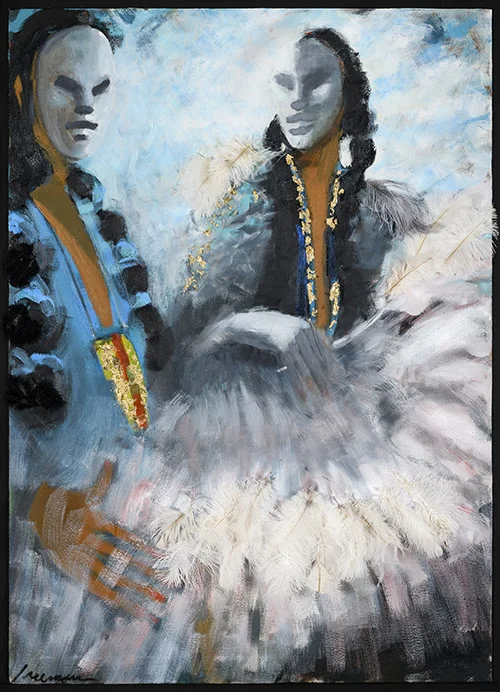
"Golden Pendant'' (painting), by Robert Freeman.
Mr. Adelson writes:
"Upon walking into Robert Freeman’s studio for the first time since our last exhibition, I was stunned to see the evolution of his work, which was inspired by his recent trip to visit his friend, Max Stern, in New Orleans. The two encountered a parade of locals referred to as Mardi Gras Indians, familiar to Max, but completely foreign to Robert. The origin of these people started after the Civil War, when African American ex-slaves were taken in by Indigenous Americans.The group melded African and Native American rituals, and have evolved into a community that is unique to New Orleans. Individuals in these local tribes will spend an entire year creating their elaborate outfits, which are rarely worn more than once. These locals emitted a passion that Robert and Max could not help but record.
"The canvases are bursting with color and the figures seem to dance off the edges of the canvas. Freeman has taken a bold new approach to his painting by adding ostrich feathers as well as gold leaf to represent the elaborate 'suits' worn by the Mardi Gras Indians. Looking at Freeman’s new paintings transports me to a place I have never been, yet as with his other series, these anonymous figures seem to invite me to participate. The loud and energetic paintings appear fictional until they are put into context with the photography of Max Stern.''