
Vox clamantis in deserto




Don Pesci: Chris Powell has been very important to Connecticut
I happen to be writing something on Mark Twain’s politics, and I couldn’t help but wonder what he might have thought rather than written – for Twain was fairly cautious, some would say over-cautious, while his wife and censor Olivia was still alive – about recent Connecticut politics.
Surely Twain would have noticed that the flight of progressive politicians from their sinecures have followed the flight of businesses and entrepreneurial capital from his beloved state. There’s got to be some heavy levity, Twain’s specialty, in there somewhere. Not even Olivia, the keeper of Twain’s reputation, could have prevented him from poking fun at Connecticut’s political Grand Guignol. Following a fatal dip in the polls, Gov. Dannel Malloy has chosen not to run again, and he has been followed out the door by his lieutenant governor, a promising Democrat gubernatorial prospect who has not spent time in prison, Comptroller Kevin Lembo, Atty. Gen. George Jepsen, and other Democrat celebrities, all banging their tushies, frantically attempting to put out pant fires.
We don’t have Twain with us anymore. But Chris Powell, whose retirement from his job as managing editor of the Journal Inquirer, in Manchester, Conn., is still pending, will be with us for some time to come. Though he will be leaving the paper as a regular employee after 50 years, Powell will maintain his column – good news for the good guys, bad news for the bad guys.
State Sen. Joe Markley said on Facebook that Powell was Connecticut’s “indispensable man,” and this flushed out some doubters. One would think in the era of President Trump, country and state would have gotten used to a little hyperbole. A little rich, one guy thought. We hauled that guy off to a dark corner and gave him a public thrashing, because Powell really is the indispensable man. It’s OK; you can do this sort of thing on Facebook and, if you are president of the United States, on Twitter, which has become a kind of tumbril used to transport distasteful politicians to the guillotine.
I provided half a dozen items -- all written by me; interviews with Powell on Connecticut Commentary, mentions of him in past columns, his indispensable review of Lowell Weicker’s autobiography Maverick, which Powell titled “Mr. Bluster Saves The World,” and such like -- to support Markley’s thesis.
At the same time, I received from my nephew Craig Tobey, who is living in California – please don’t ask me why – a message on LinkedIn congratulating me for having spent 38 years writing columns. Powell is wholly responsible for this. So, I wrote Craig back saying “Thanks. It’s a long time to have been writing on water.”
When the waves break, when time passes, all of it is writing on water. You try to say some things that will stay fresh on the shelf, and Powell is better at this than most. He’s quotable and memorable, always the sign of a superior intellect. And he likes all the right thinkers -- Frédéric Bastiat, for instance, and G.K. Chesterton. Tethered to either of these sane anchors, you cannot wander far from the truth.
There are, as we know, two kinds of truths, pleasant and unpleasant -- mine and yours. It is the unpleasant but necessary truths we all instinctively retreat from.
We all are servants of the truth, not its masters. Writing in “The Examiner” in 1710, Jonathan Swift said it best: “Besides, as the vilest writer has his readers, so the greatest liar has his believers; and it often happens, that if a lie be believ’d only for an hour, it has done its work, and there is no farther occasion for it. Falsehood flies, and the truth comes limping after it; so that when men come to be undeceiv’d, it is too late; the jest is over, and the tale has had its effect.”
It is the business of honest journalism to see to it that the truth is not washed away by lies. To lie is to say the thing that is not, and journalists should avoid this too common practice like the plague. For fifty years in journalism, that has been Powell’s honorable trade. He will never receive a Pulitzer – neither did Bill Buckley, astonishingly – but he has retired from the paper only, and during his long haul he has kept faith with Joseph Pulitzer’s ever-fresh observation that “good journalists should have no friends” -- in the political world, I should hasten to mention. Isn’t it uplifting to think that we will have Powell with us to kick around threadbare politicians a bit more?
Don Pesci is a Vernon, Conn.-based essayist, and, like Chris Powell, a frequent contributor to New England Diary.
'Green under the snow'

"Ice comes undone
Skin shining and
hair full of
March
girls spill out of
offices their
bones whispering strong
hands to marry
glazed orchards
and vines coming back
Green is under the
snow....''
-- From "Thaw,'' by Lyn Lifshin
Llewellyn King: Why doesn't Musk get more respect?
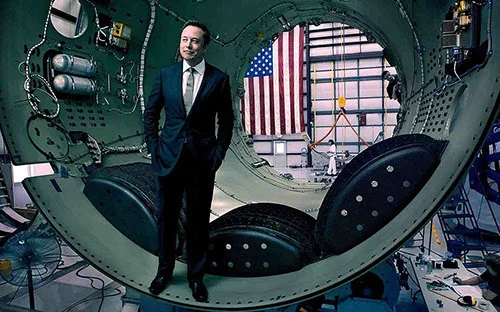
Elon Musk stands inside a rocket that is awaiting assembly.
-- SpaceX photo
I present to you the strange case of Elon Musk. Whatever he does, his detractors, or at least his minimizers, seem to control the narrative.
When his Falcon Heavy rocket — the largest and most sophisticated flying today — blasted into space on Feb. 6, there should have been a national outpouring of unabated joy.
Yet it only briefly edged out the news coverage of the GOP memo, emanating from House Intelligence Committee Chairman Devin Nunes, (R-Calif.) and its Democratic counter-memo. The greatest show on earth had it all: a rocket you could watch ascending, shedding its reusable stages and flying away, whimsically, with a sports car for a payload.
It was a showcase of American technology and know-how. It was a clear statement that the individual can still triumph in the United States.
President Trump acknowledged the achievement, which was probably hard for him because he and Musk don’t see eye to eye on global warming or much else. Musk’s visions are wildly futuristic, like populating Mars, while Trump is a man firmly rooted in the glories of the United States as an industrial power tethered to past strengths. Also, awkwardly, Musk is an immigrant who might have been kept out under Trump’s policies.
But the general indifference and in some circles antipathy to Musk goes far beyond politics. We embraced Bill Gates, Steve Jobs and Mark Zuckerberg as tech heroes, the faces of the future. Musk less so or not at all; maybe because we have narrowed our view of what is exciting tech to the internet and its collaterals.
Although he made his first $500 selling a game program when he was 12, and his first billion as a founder of PayPal, Musk’s real claim to fame is as an engineer and physicist. His Tesla electric car may not survive as the industry leader, but today it is out front.
His rocket may not be the future of heavy-lift space vehicles, but it is the leader today: cheaper and with reusable stages. His SolarCity is not alone in seeking to convert idle roofs to electricity sources, but it is a big player. And Musk’s batteries, though disappointing at the outset, may yet make grid-free houses a reality.
Yet Musk’s detractors are legion and effective. I know quite a few and they range from an electric company chairman (who accused him of lying and denounced him to me in the most vociferous tones), to financial seers (who question the viability of any of his companies), to conservatives (who believe that he has misused government funds, and his “private” company owes everything to government support). The transportation industry, almost to a man, believes Musk’s plan for an underground, people-mover vacuum tube is nuts.
I, too, have been in the ranks of the detractors, at least in part. I sought to have him correct a whopper about nuclear versus solar power. He had his sums wrong by a factor of hundreds.
Yet you have to love Musk for thinking on a scale that hasn’t been seen for over half a century. He is a throwback to the great builder-engineers of the past: men who built the bridges, canals, dams and railroads, and electrified the United States.
As a nation, we used to be devoted to the big, the bold and the futuristic. Now, we’ve developed sophisticated ways of defeating big projects.
After the 1960s we lost our passion for the big idea and the big machine, from nuclear power plants to big civil engineering. The late, great Sen. Daniel Patrick Moynihan, D-New York, lamented this lack of courage to go big on a project.
Westway — the highway for New York City’s West Side — was defeated partly to protect the striped bass in New York Harbor. Moynihan said, “There is a kind of stasis that is beginning to settle into our public life. We cannot reach decision.”
I don’t wish to live on Mars, I don’t want to be whisked in a tube from Washington to New York. I’m even undecided whether I want to ride in space — but try me.
I don’t know whether Musk will go broke, whether he’ll overreach or whether he’ll give the whole world a new frontier. But until (and if) a better dreamer comes along, I’m glad we have him reaching for the planets.
On Twitter: @llewellynking2
Llewellyn King (llewellynking1@gmail.com) is executive producer and host of White House Chronicle, on PBS.
Whining Uberites & Lyftites
Adapted from Robert Whitcomb's "Digital Diary,'' in GoLocal24.com:
The complaints from car-hailing services and their passengers about the $6 pickup fee at T.F. Green Airport, in Warwick, R.I., ring hollow to me. Jim Hummel wrote about this in a good Jan. 28 Providence Journal story, “Driving revenue: Price of arrival rises at T.F. Green’’. All users should help pay for the airport, which has been much improved in recent years. Uber and Lyft have taken away some of the airport’s revenue from rental cars and taxis. It’s generally cheaper to take a car-hailing service than a ca b. Further, many airports charge to drop off and pick up passengers.
As usual, people want more services but lower charges. Take the federal gasoline tax. It was last raised in 1993! No wonder the roads are such a mess. And while Trump talks about improving transportation infrastructure, he got Congress to enact a huge tax cut, mostly for business and the rich. America remains a fiscal Fantasyland.
Neal Costello: Down in the depths of Dorcester
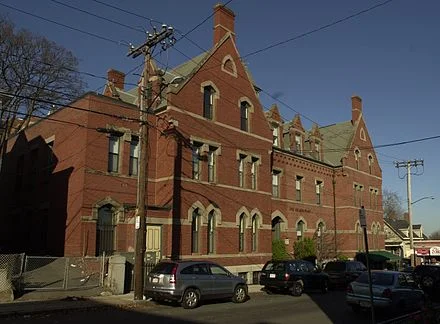
Fields Corner Municipal Building.
From Neal Costello's memoir Last Tinker Caravan, about growing in in Boston's tough Dorchester neighborhood in the Sixties and Seventies. (It was tougher then than it is now.)
Dorchester
"Fourteen times by the time I was sixteen, we played a game of Irish ghetto hide and seek. My father was a common laborer; he worked construction most of his life. In those days he would work eight, maybe ten months of the year. During the winter months, when the snow slowed the work down, Iron Mike would be laid off and 'loaf' until Spring, when he could find steady work again. The evil Italian forman, and they were all Italian, would lay guys off on a Friday afternoon, giving the mostly Irish laborers what was known as an 'Irish payroll'. The fucking Mussolini motherfuckers figured since every thick Mick was a fucking boozebag, they could shortchange them by wrapping a twenty around a bunch of ones and hand it to them as they fired them. The Turkeys would be in such a hurry to get to the nearest bar they wouldn’t notice they’d just been fucked as well as fired.
Luckily for us, Iron Mike feared Olive too much to ever fall for that bullshit. Besides, he never trusted Italians. He made sure to count his cash. Whenever he got laid off, he would come straight home with a couple of Hi-Fi pizzas and some Pepsi, and give the rest of the cash to my mother. Iron Mike and Olive would never tell us what had happened. We’d figure it out Saturday afternoon, when my father would sit at the kitchen table, drink O.F.C. (Old Fart Cure) straight and play The Free-Wheeling Bob Dylan and The Clancy Brothers with Tommy Makem and Pete Seeger on the phonograph record player. Then it was on to Enrico Caruso and John McCormick at 78 speed. Our hearts sank when we heard the scratchy yet velvet stylings of Woody Guthrie 45s. When Iron Mike, drunk as a fucking hoot owl, started singing his own version of 'In The Pines,' we knew we were fucked. 'In the pines, in the pines, where the sun never shines, and you shiver when the cold wind blows'. Shit. He would do odd jobs, sweep bar room floors on Sunday, handyman stuff, but never made enough to make ends meet over the winter months. The Jewish landlord would come looking for the overdue rent, usually on a Sunday afternoon, and we’d all be huddled in silence in the kitchen 'where we had gathered for fear of the Jews,' as Saint John the Divine first reported in his Gospel detailing the super adventures of Jesus. The book Divine John wrote before he got all paranoid and shit from dropping peyote, hanging out by himself in caves and writing fucking weird shit like The Book of Revelation (surpassed only in outright incomprehensible sucking by that movie Head, by Jack Nicholson and The Monkees). In no time, all the utilities would be shut off, we’d be out of milk, bread and gray, salty meat (but still plenty of Pall Malls), last year’s Zayre’s Christmas Layaway bill was way past due (Zayre’s was owned by the Feldberg family because Zayre’s just wasn’t Jewish enough), and we were facing eviction. Evictions were a sort of harbinger of Spring for us, kind of like our robin. Not that we had ever seen a robin or any other bird other than pigeons, dead pigeons, and sparrows. So we had all Twelve Fucking Tribes wandering the desert looking for us because we owed them money, some of them still drunk from Purim. Money changers my Royal Irish Ass, more like Money keepers. We had the Goddamn Mossad after us. Who are we? Fucking Mengele? But Olive would quietly find some other available dump a few blocks away. The landlords didn’t live in the neighborhood, or know anyone who did, so there was little fear of being found if we could just slip away to another dump. We just needed to escape our current abode without being detected. So the extended family would suddenly show up in the middle of the night, load up the shitboxes, and we’d move to the next place, skipping out on all past debts. I’d go to bed at eight in the evening on the third floor of a triple-decker on Geneva Ave., and wake up in a yellow brick tenement house in an apartment no bigger than an H-Block cell on Ditson Street (the first place we lived that was so small, decrepit, dreary, frightening and entombed, with no windows or back door, with so many other cells piled on top above ours, all brick and cement, that I still believed in Santa Claus but had no idea how he would ever get in). Then just spell the last name a little differently, put utilities and such in an uncle’s name, real or imagined, and there you go. No fucking problem. The chase is on. Catch us if you can.
We lived in one of the poorer sections of white Dorchester on Geneva Avenue in Fields Corner. I never bought the nonsense, still don't, that Boston is a racist city. If it is it is no more racist than any other city in America and far less racist than any lily white suburb. That said, there most certainly was a white Dorchester and a black Dorchester back then, an arrangement wanted by and agreed to by both races, however begrudgingly. Dorchester had been founded by the Puritans in 1630 and had been annexed by the city of Boston in 1870. It is a section of the city the size of Worcester, which I'm told is another city in Massachusetts, located near the Mississippi River, just this side of Japan. My family had invaded white Dorchester in 1959 from my birthplace on Dudley Street in Roxbury. White Dorchester in those days stretched on one side from the Fields Corner area, for a couple of miles to the Atlantic ocean at the absurdly named Malibu Beach. Nothing but rocks, broken glass, seaweed, cigarette butts, dog shit and jellyfish with nary a Beach Boy or Barbie lookalike to be found. Miss Jean of Romper Room lived in a really nice house overlooking Dorchester’s Malibu Beach. She worked at the old WHDH Channel 5 studio, where Bozo lived, right up Morrissey Boulevard, beside Boston College High School and across from the reviled Boston Globe. Always hated that bitch. Miss Jean. At the end of each show she’d look in her magic mirror and call out the names of all the 'Good Doo-Bees'. Fucking bitch never once called out my name. I sat in front of our tiny black and white Zenith for twenty-five years and that bitch never once called out my name. We can’t all be fucking Bobbies and Johnnies, you fucking hoebag. Don’t you know any Neals ??!??! Bitch ! Nancy ??!?! Who the fuck is named Nancy anymore ??! How about Neal ??!! Whore!"
Tumultuous coast

"Sunken Ledges'' (oil on canvas, c. 1910), by Charles H. Woodbury, at the Art Complex Museum, Duxbury, Mass.
'A medieval thought'
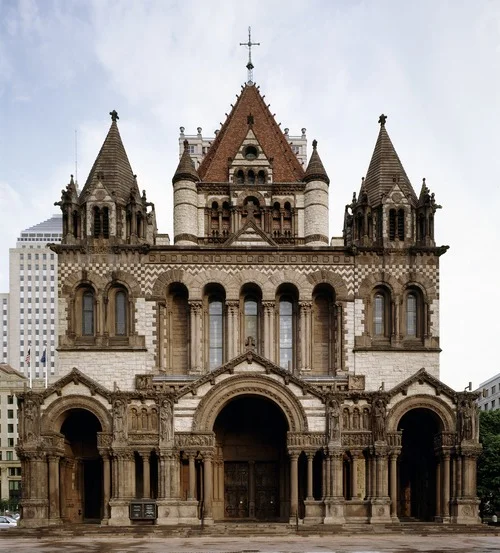
“Trinity Park lies directly across from the {Boston Public} library, Trinity Church rising like a medieval thought amidst the glass and steel towers.”
― Writer Nick Flynn, from his memoir Another Bullshit Night in Suck City, about his difficult early life in the Boston area. His mother killed herself and his father was homeless.
Trinity Church, designed by Henry Hobson Richardson and built in 1872-77 on the north side of Copley Square, in Boston's Back Bay neighborhood, is the birthplace and archetype of the Richardsonian Romanesque style, with a clay roof, polychromy, rough stone, heavy arches and a massive tower. The style became popular across the United States, especially for such institutions as schools, libraries and churches.
Towering kitsch

The statue of legendary woodsman Paul Bunyan in the old lumber town of Bangor, Maine, is one of those pieces of kitsch that can bring a smile on otherwise depressing days. But sadly, as Lonely Planet noted, "his view of the Penobscot River {which used to be used to float logs down to the coast when Maine was a huge supplier of wood} is now blocked by a casino. ''
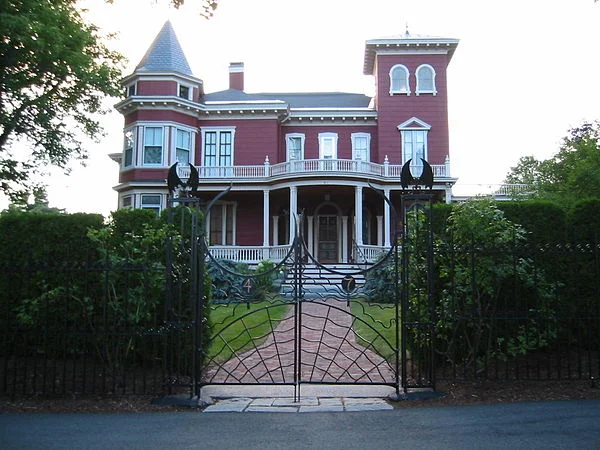
Big fortunes were made in the wood business, and Bangor still has many mansions built by those who made these fortunes. One is below, now owned by famous writer Stephen King.
Alison Stine: Where the fracking industry dumps its waste
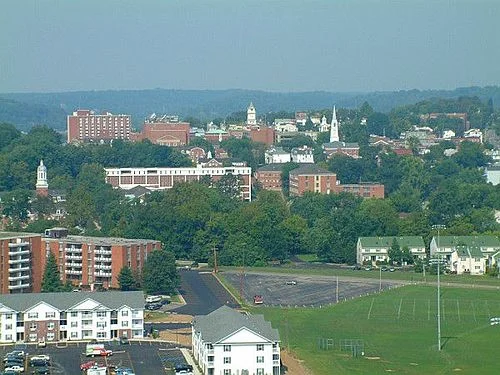
View of Athens, Ohio.
Via OtherWords.org
At Athens, my southeastern Ohio town in the Appalachian foothills, is a small, rural place where the demolition derby is a hot ticket, Walmart is the biggest store, and people in the surrounding villages must often drive for 30 minutes to grocery shop.
We hold the unfortunate distinction of being the poorest county in the state: an area that is both stunning — with rolling hills, rocky cliffs, pastures, and ravines — and inaccessible, far from industry.
It’s here, at the Hazel Ginsburg well, that fracking companies dump their waste. Trucks ship that sludge of toxic chemicals and undrinkable water across the country and inject it into my county’s forgotten ground.
My step-grandmother, the daughter of a Kentucky miner, used to tell me stories of washing her clothes in polluted red water, downstream from mines. Coal companies exploited employees like her father, paying him in company scrip and keeping him poor and exploiting the land.
That kind of abuse continues. It’s just changed shape. The Ginsburg well has a long history of violations, so many that the Ohio Department of Natural Resources ordered it shut.
It was not.
It’s a pit well, which looks like an old swimming pool, covered by a tarp. No sign indicates the presence of chemicals, just a “no trespassing” sign. Allegedly, a guard will snap your picture if you stop or turn your car around. The well is in a residential area, with houses — some with swing sets — just down the road.
In 2012, Madeline ffitch (whose last name is spelled lowercase and with the double ff) was arrested there. Her arrest was part of an action by a local anti-fracking group, Appalachia Resist. The then 31-year-old’s arms were locked into cement-filled plastic drums just before the gates, blocking the entrance.
Two years later, Christine Hughes, co-founder of the local Village Bakery, was arrested protesting against another well site, as were seven others. My town called them “the Athens 8” and they were hailed as heroes.
Ffitch and her young family continue to protest wells, despite the attempts of the fracking industry to, according to her, “paint anyone who is organizing resistance around this stuff as outsiders or extremists.” Her husband, Peter Gibbons-Ballew, was arrested in a peaceful protest in 2016, while ffitch watched, their baby strapped to her chest.
Our local economy now depends on tourism and farming. The long, humid growing season makes this part of Appalachia ideal for wild specialties such as pawpaws, black walnuts, and mushrooms. And many hunters stay here to be near our famous bucks.
By contaminating the environment, fracking wastewater wells threaten all these businesses. In 2015, tank trucks injected 4 million barrels of waste into my small county alone.
It’s hard to get answers about what it’s in that waste. But Jason Tremby, an engineering professor at Ohio University, is leading a local team to “clean” fracking wastewater using ultraviolet light, water softening techniques, and a high-pressure reactor.
It makes sense to me that a solution to the wells might come not from outside, but from people like ffitch, Hughes, and Trembly, working and living in Appalachia. People are used to doing things for themselves here — and used to the community helping the community.
I keep hoping more will be done to protect this place. “You want to forget it,” begins the Appalachian-born Ruth Stone’s poem “Garbage.” But the fracking waste in the injection wells of Appalachia can’t be forgotten forever.
It’ll bubble up, one way or another, before long.
Alison Stine is a novelist. Her most recent book is a novella, The Protectors. A longer version of this piece was produced by the Economic Hardship Reporting Project.
He went to the airport

"Waiting for Isaac Levitan After School'' (oil on canvas), by Alexandra Rozenman, at Fountain Street Fine Art, Boston.
The Maine way to boost lobster stocks
From Robert Whitcomb's "Digital Diary,'' in GoLocal24.com:
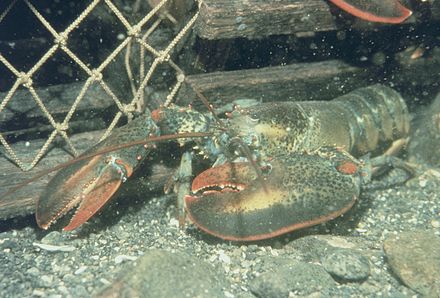
Southern New England lobstermen (or should I say lobsterpersons?) may have hurt themselves by taking as many lobsters as they can, without looking at the species’ ability to reproduce. It may be a case of “the tragedy of the commons’’ -- wherein individual users in a shared-resource system acting independently in what they see as their own self-interest undermine the common good by depleting that resource through their collective action.
Has that attitude had as much impact on the plunging lobster stocks along the Massachusetts, Rhode Island and Connecticut coasts as environmental changes, especially warming seas? Hard to tell. Commercial fishermen are notoriously independent and secretive about their catches.
You can’t but think of that when you learn that many Maine lobsterman have long used what seems to be a very effective conservation method. As reported by Fred Bever for Maine Public Radio:
For years, Maine lobstermen have used "’V-notching’: when they found an egg-bearing female in their traps, they would clip a ‘V’ into the end of its tail, and throw it back. The next time it turns up in someone's trap, even if it's not showing eggs, the harvester knows it's a fertile female, and throws it back. Later, the lobstermen also pushed the Legislature to impose limits on the size of the lobster they can keep — because the biggest ones produce the most eggs.’’
“And those fertile females have been doing that job very well in Maine. Since the 1980s, lobster abundance here has grown by more than 500 percent, with landings shooting up from fewer than 20 million pounds in 1985, to more than 120 million pounds in 2015 with a value of more than a half billion dollars.’’
To read more, please hit this link.
https://nenc.news/research-concludes-maine-conservation-technique-helped-drive-lobster-population-boom/
A small-town Hollywood for documentaries
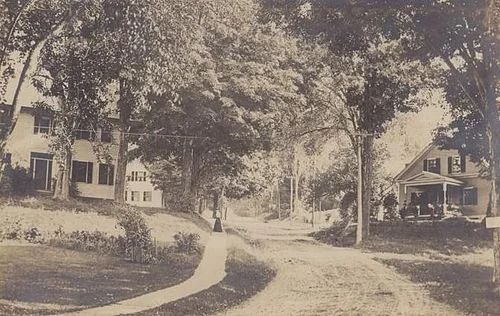
Walpole in 1915. Some of the town hasn't changed that much since then.
It's surprising what you can find in small New England towns. Consider Walpole, N.H., in the southwest corner of the Granite State.
That is where Ken Burns, Elaine Mayes and Roger Sherman, classmates at Hampshire College (in nearby Amherst, Mass.), in 1976 founded a documentary film company called Florentine Films, which went on to produce the famous films The Civil War (1990), Baseball (1994), Jazz (2001), The War (2007), The National Parks: America's Best Idea (2009), Prohibition (2011), The Roosevelts (2014) and The Vietnam War (2017).
The name of the company came from Florence, Mass., Mayes's home town, also in the Connecticut River Valley. A rather cozy company.
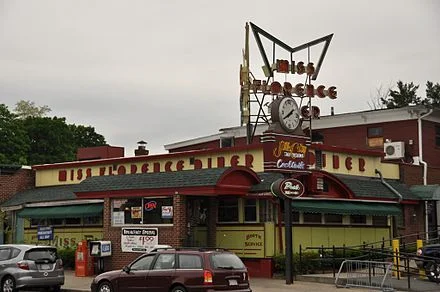
The famous Miss Florence Diner, in Florence, Mass. Such diners are civic ornaments of many small New England towns and some cities, too. They sometimes serve as informal town halls -- chatty and caffeinated central meeting places.
Retrograde spring

"Springtime in Massachusetts is depressing for those who embrace a progressive view of history and experience. It does not gradually develop as spring is supposed to. Instead, the crocuses bloom and the grass grows, but the foliage is independent from the weather, which gets colder and colder and sadder and sadder until June when one day it becomes brutishly hot without warning...It was fitting, then, that the first people who chose to settle there were mentally suspect."
-- Rebecca Harrington
(Editor's note: Meteorological spring starts soon -- on March 1.)
'Life principle'
"Winter. Time to eat fat
and watch hockey. In the pewter mornings, the cat,
a black fur sausage with yellow
Houdini eyes, jumps up on the bed and tries
to get onto my head. It’s his
way of telling whether or not I’m dead....
Off my face! You’re the life principle,
more or less, so get going
on a little optimism around here.
Get rid of death. Celebrate increase. Make it be spring.''
-- From "February,'' by Margaret Atwood
Make the whole state a foreign-trade zone?
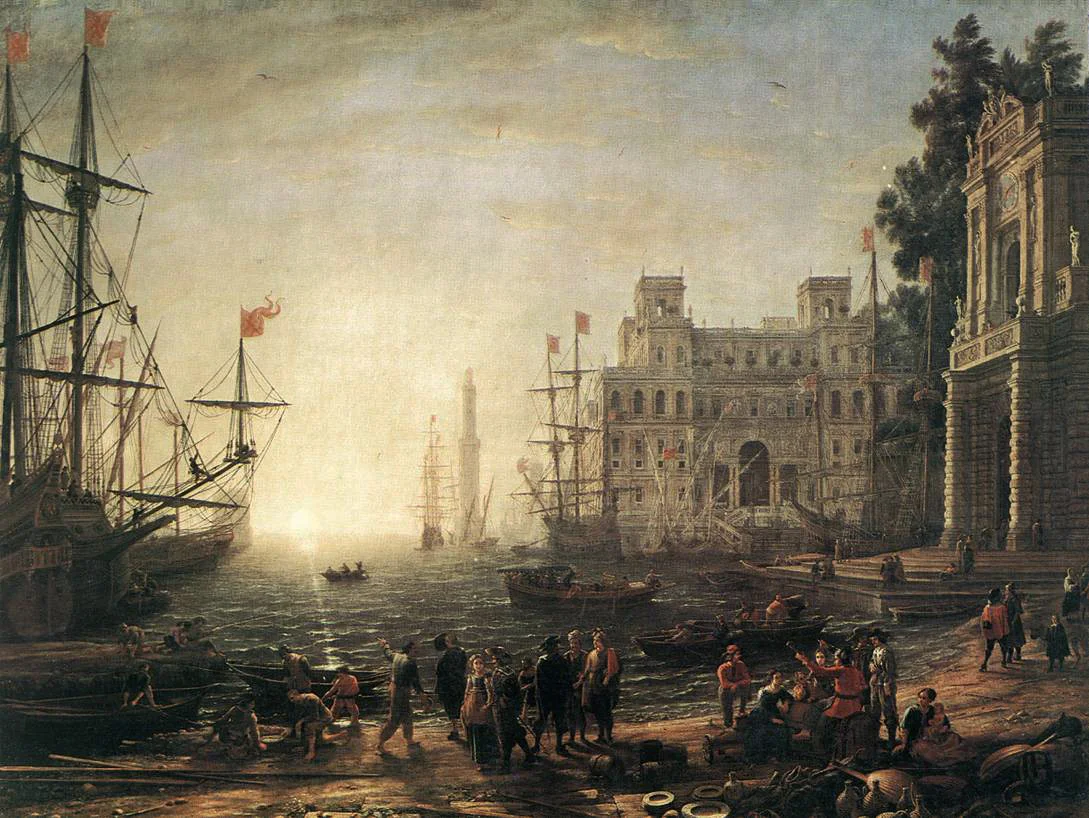
"Seaport,'' by Claude Lorrain.
Adapted from Robert Whitcomb's "Digital Diary,'' in GoLocal24.com:
With its big and mostly sheltered bay on the Northeast Corridor and proximity to major shipping lanes, Rhode Island is very well-situated for the state to expand its foreign-trade zone to the entire state. As I remember from my business editor days here and in Europe, Free Trade Zones, if promoted well, can be big prosperity builders in the jurisdictions that have them. Rhode Island’s compactness, ports on Narragansett Bay and increasingly international T.F. Green Airport should make it an easier place than most to go after revenues from international trade.
In the Jan. 26-Feb. 1 Providence Business News, Mary MacDonald well summarized the attractions of foreign-trade zones in her article headlined “R.I. bids to become a statewide foreign trade zone. Who will benefit?’’
“{A}approved companies that make use of a zone do not have to go through Customs entry or pay import duties on certain merchandise. Duties and excise taxes are only paid when products move into the U.S. market for sale. If the items are then moved on to another country, the company pays no duties or taxes on those items.
‘’Companies will often move product through a FTZ if they want to hold it before sale, because this allows them to delay the payment of their tariff, and frees that money for other purposes….there is no time limit for how long something can be stored in the trade zone.’’
Pretty alluring.
Llewellyn King: Tribute to a mad wordsmith; the comfort dog crisis
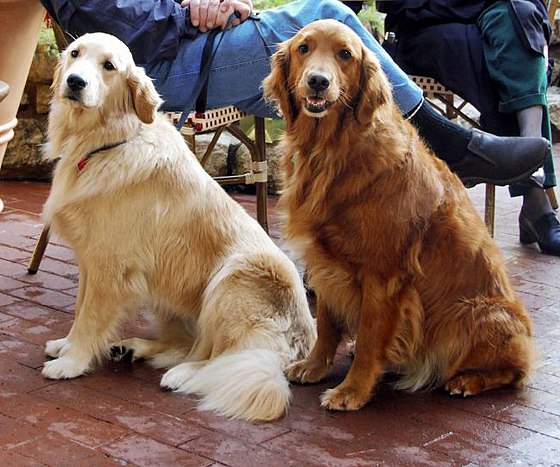
Ready to board.
Nicholas von Hoffman, who has died at the age of 88, streaked across the journalistic sky in the 1970s like a comet. From the pages of The Washington Post, he shined in a way that no journalist had done on any paper since H.L. Mencken in The Baltimore Sun in the early 20th Century.
Nick, as he was called, burst onto the pages of The Post's Style section in a way that was unique. At that time, the section itself was novel and about to be copied across the country.
People lined up to buy The Post to be entertained, to be outraged, to be titillated, but mostly to see what the mad wordsmith devil was up to that day. Nick used words to create explosive devices, which he lobbed from the pages of the paper with awesome effect.
He was my colleague at The Post and he proved that the page, any page in any newspaper, can come alive with great writing; in Nick’s case, combative stuff that took no prisoners, favored none and offended all. If you read him long enough, eventually you would be outraged. It was so exquisitely abusive, so willfully offensive that The Post had to hire security personnel to sort the mail: It contained dead animals, feces, razor blades and possibly poison.
Nick was not the perfect journalist. The serious people in the journalism schools would not cite him, I imagine, as a model. His facts were chosen to accommodate his point of view that day.
He said he was a “radical journalist”. He had worked for Saul Alinsky, the admired and reviled Chicago community organizer. Criticizing the high cost of medicine, Nick wrote that if you stare at the sign of the Hippocratic oath it will morph into a dollar sign.
Nick did not go to college, but he had a deep knowledge and love of language. He was, well, a poseur, a literary exhibitionist and a controversialist.
He did not let the facts stand in the way of a great rant. He skewered Republicans and Democrats alike, calling the Republican minority leader in the Senate, Everett Dirksen, of Illinois, “a piece of American political bric-a-brac.” The Democratic Party, he wrote ,“to its committed members was still the party of heart, humanity and justice, but to those removed a few paces it looked like a Captain Hook's crew of ambulance-chasing lawyers, rapacious public-policy grants persons, civil rights gamesmen, ditzy-brained movie stars, fat-assed civil servant desk squatters, recovering alcoholics, recovering wife-beaters, recovering child-buggers, and so forth and so on: a grotesque lineup of ill-mannered, self-pitying, caterwauling freeloaders, banging their tin cups on the pavement demanding handouts.”
He was fired from CBS's 60 Minutes for likening Richard Nixon, during the last days of his presidency, to a dead mouse on a kitchen floor, waiting for someone to take it by the tail and throw it in the garbage.
Yes, Nick was reprehensible. And I loved him. I loved him for his outrageousness and his hatred of cant. I loved his personal insouciance and his extraordinary literary skill. But most of all, I loved him because he made the pages of newspapers thrilling and unmissable: the place to have your nose buried first thing in the morning. Thanks, Nick.
Comfort Dogs Brought Up Short by the Airlines
Doggone, but it was nice while it lasted.
I refer to the number of dogs you saw in the airports during the last holiday season. People had simply declared their dogs “comfort dogs.” Quite right. Every dog is a comfort dog. I have never had a dog that was not a comfort. They are the great reliable comfort in human life, bar none, I might add.
But I read that the airlines, appalled at the sheer number of canines traveling, are going to try and limit the number of comfort dogs to those of the truly sick, blind and otherwise incapacitated. It makes me heartsick.
By the way, dogs love to fly. I used to take my Siberian Husky flying, back in my private pilot days. He loved it, except for landing: He was upset by the ground rushing up. No fool he.
The Things They Say
“There comes a time to join the side you're on.” -- Midge Decter, journalist
Llewellyn King is executive producer and host of White House Chronicle, on PBS. His e-mail is llewellynking1@gmail.com.
Russian mob money in Trump's Mob-style business. Shttp://www.msnbc.com/brian-williams/watch/report-russian-mob-money-helped-build-trump-business-empire-1002228291948
Chris Powell: The road to fiscal confusion in Connecticut
Last Wednesday may have told the crazy story of state government in Connecticut.
In the morning the Connecticut Mirror's Jacqueline Rabe Thomas reported that most state agencies had dismissed a request from Gov. Dannel Malloy's budget director to suggest savings in their budgets. Most agencies, Thomas wrote, suggested nothing or failed to reply at all, while some recommended increasing spending instead.
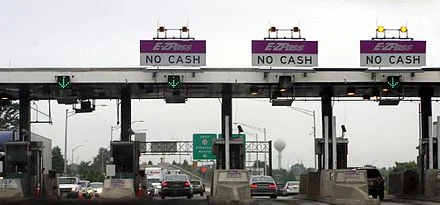
A few hours later the governor proposed a seven-cent increase in the gasoline tax, installation of electronic tolls on state highways, and a special $3 tax on the sale of tires. He reserved the right to propose budget cuts next week without the assistance of his own administration.
But there are suggestions from other sources. The Connecticut Conference of Municipalities, whose acronym CCM long has been mocked as really meaning "Conference of Crying Mayors," had gotten relevant a week earlier. Its executive director, Joe DeLong, and its president, Waterbury Mayor Neil O'Leary, told a study commission that state law should start excluding pension benefits and medical insurance from collective bargaining and binding arbitration of contracts for government employees.
This was remarkable, since the government employee unions control Connecticut's Democratic Party, CCM represents many local Democratic administrations, and O'Leary himself is a Democrat.
The major candidates for the Republican nomination for governor also propose to curtail collective bargaining and binding arbitration for government employees. So the idea may gain legitimacy after the state election in November.
The problem is not just the huge cost of state and municipal employees. More important is the cost to democracy, since collective bargaining and binding arbitration in government remove the bulk of public expense from the ordinary democratic process. Indeed, that is the objective -- to let elected officials avoid responsibility to taxpayers for the advantages conferred on government employees.
The biggest issue in state government is not its financial collapse. It is whether the public ever again will be master in its own house.
* * *
DEDICATED FUNDS AREN'T PERSUASIVE: Opposition to tolls is strong, and even advocates condition their support on a new state constitutional amendment guaranteeing that revenue from tolls and fuel taxes is reserved for transportation purposes. An amendment purporting to accomplish that will be on the ballot in November.
The rationale for reserving user taxes for particular purposes is that particular people who cause a particular expense should pay particularly for the benefit they receive -- that the transportation system's users should pay for it. But the rationale is not really so persuasive.
For everybody benefits from transportation, whether he or she buys gasoline or tires or not, and while everybody pays sales tax on the purchase of goods and services, the use of those goods and services usually causes no particular expense to government.
Further, for many years state government has kept 2,000 mentally handicapped adults living with elderly parents because there are not enough group homes, and there is no dedicated fund for these people, though they constitute a far more compelling need than the bus highway from Hartford to New Britain, the planned commuter railroad between New Haven and Springfield, and pothole repairs.
So why should any particular amount of tax revenue feeding a dedicated fund determine government's priorities? Shouldn't those priorities determine the allocation of revenue? And shouldn't elected officials reconsider government's priorities with every new budget?
Chris Powell is managing editor of the Journal Inquirer in Manchester, Conn.
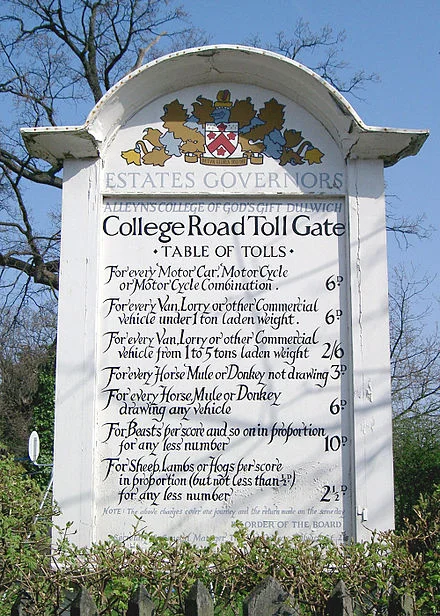
A table of tolls in pre-decimal currency for the College Road, Dulwich, London.
Once a metro area
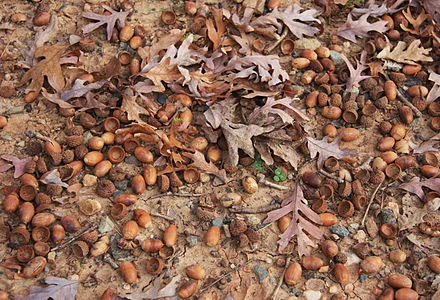
"Today they cut down the oak.
Strong men climbed with ropes
in the brittle tree.
The exhaust of the gasoline saw
was blue in the branches.
It is February. The oak has been dead a year.
I remember the great sails of its branches
rolling out green, a hundred and twenty feet up,
and acorns thick on the lawn.
Nine cities of squirrels lived in that tree.
Today they ran through the snow
squeaking their lamentations.''
-- From "The Stump,'' by New Hampshire poet and former poet laureate Donald Hall.
Saving a stoner signpost

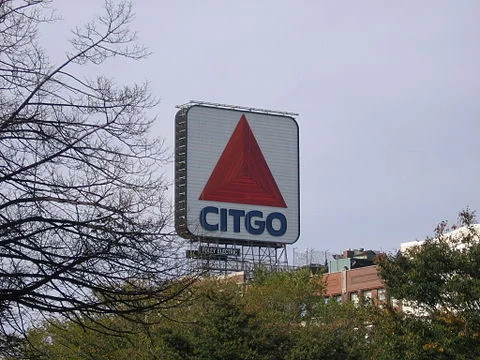
Boston Citgo sign viewed from Lansdowne Street.
From Robert Whitcomb's "Boston Diary'' column in last week's The Boston Guardian:
Even ads for companies owned by South American dictatorships can be beloved. Consider the Citgo sign at Kenmore Square. Since 1965 the spectacle with the red trimark atop 660 Beacon St. has told many millions of Bostonians and visitors where they are. Few care that Venezuela’s state oil company now owns Citgo (a descendent of the old Cities Service oil company).
The pulsing (throbbing?) logo presides in its surreal way over Fenway Park, which helps expand its hypnotic allure well beyond Boston. After all, people around the world can view it in televised Red Sox games. And exhausted Boston Marathon runners love it because they know when they see the sign that they’re near the finish.
As most Guardian readers probably know, Kenmore Square development pressures in the past few years had put the sign’s future in doubt. But happy news comes from real-estate firm Related Beal, which now owns the Citgo sign building. The company says it will preserve the damn thing and protect views of it from various points around the city and Cambridge. Mayor Marty Walsh, relentless preservationists and many in the general public deserve much credit for saving this hallucinogenic treasure.
Some proper Back Bay folks in the mid-‘60s complained that the sign was too tacky. That reminds me of the delayed love of the Twin Towers at the World Trade Center, in Lower Manhattan. I worked across the street from those skyscrapers for a few years in the ‘70s as they were being built and then slowly rented out. For quite a long time many people hated them as a sterile Modernist travesty. But as their “twinness’’ became that overused word “iconic’’ and as New York recovered from its woes of the ‘70s and again became prosperous in the ‘80s and ’90s, a deep affection developed for the towers, which, of course, with their extreme height also served as markers for those confused amidst Manhattan’s density.
I most remember the Citgo sign from summer jobs in Boston in the late ’60s, and then as a reporter for The Boston Herald Traveler in 1970-71. The sign provided geographical guidance and psychological soothing for the college kids, Hippies and even many respectable people. Further, staring at the sign was a way to, er, enrich the pot-smoking experience of that rowdy time. And it evokes the Pop Art of the ‘60s; it looks like an Andy Warhol poster.
Growing reverence for the sign was manifest when it was turned off during stretches of two energy crises. Some then called it “Boston’s very own ‘North Star,’ and The Boston Globe’s celebrated architecture critic, Robert Campbell, in 1980 called it a “symbol’’ of the city.
I remember when the gold-topped, Art-Deco United Shoe Machinery Building dominated Boston’s Financial District and the company itself, nicknamed “The Shoe,’’ was a very powerful player in the New England economy. Now you’ll have a hard time finding the quaint skyscraper amidst the many new, higher office buildings around it and the company itself is long gone.
Will the Citgo sign be there in 50 years? I doubt it. But I hope it remains to help guide me through Boston’s labyrinth for the rest of my days.
Robert Whitcomb is president of The Boston Guardian, editor of newenglanddiary.com and a GoLocal24.com columnist.