
Vox clamantis in deserto





Crazy classroom identity politics
From Robert Whitcomb's "Digital Diary,'' in GoLocal24.com:
One of the worst things about some corners of “liberalism’’ and “progressivism’’ is that too many of their denizens tend not to look at individuals as, well, individuals but solely as representatives of groups. This leads to runaway identity politics.
Consider the University of Pennsylvania’s Stephanie McKellop, who unfortunately is a teaching assistant for the class "Sinners, Sex and Slaves: Race and Sex In Early America.’’ She has announced: "I will always call on my black women students first. Other POC {people of color} get second tier priority. WW {white women} come next. And, if I have to, white men."
Why is she teaching at that Ivy League school? Stories like this help enlarge the white-bigot community. One fine traditionally conservative (?) idea, in my view, is to treat each person as a complicated individual and not as symbol or stand-in for some huge population
It's a living
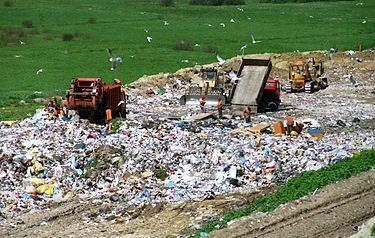
"She sits on a smoldering couch
reading labels from old tin cans,
the ground ground down
to dirt, hard as poured cement.
A crowd of fat white gulls
take mincing, oblique steps
around the couch, searching
for an orange rind, a crab claw....''
-- From "The Woman on the Dump,'' by Elizabeth Spires
Lawrence Welk: Healthcare promoter

"G is Geritol " (encaustic), by Angel Dean. in the 113th Annual Little Pictures Show at the Providence Art Club, through Dec. 23.
Chris Powell: Open immigration leaving American society defenseless
Hardly anyone in Connecticut can see much point in the U.S. government's trying to deport Denada M. Rondos, a 32-year-old illegal immigrant from Albania with a U.S. citizen husband and three young U.S. citizen children.
For eight years the government repeatedly postponed execution of a deportation order against her, but a few weeks ago she was denied another stay and was told to leave the country by last Monday. Accepting Rondos's emergency appeal just hours before the expulsion deadline, a federal court ordered another postponement, giving her lawyer more time to look through the law and bureaucracy for a way to get a more sensible result.
Most people have the impression that the rights of U.S. citizenship include the right to marry and confer legal residency on a foreigner. So while Rondos used false papers to enter the United States in the name of fleeing supposed ethnic and religious persecution in Albania, most people would let her marriage confer forgiveness for that, and more so because of her children. After all, the government knowingly allowed Rondos to stay in the country illegally as she built her family here. Thus the government is complicit in this case and many others.
Now with her husband Rondos runs a successful restaurant in Cheshire. Her community gladly would sponsor her for legal residency if there was a provision for that.
While the point of deportations in such cases is mostly lost in Connecticut, it is not lost elsewhere. For cruel as they are, such deportations are discouraging illegal immigration generally and encouraging the departure of illegal immigrants who are without immediate families here.
U.S. Sen. Richard Blumenthal, who, along with Connecticut's other members of Congress, has been supporting Rondos and other illegal immigrants in similar situations, says her case shows that the immigration system is broken. The system is broken insofar as border control is so weak and deportations long have been slow once illegal entrants have been identified, inducing them to use delays to build families as hostages against deportation, as Rondos has done.
But it's not clear what Blumenthal and the other congressmen would do to fix the system, or even if they really want it fixed.
For the congressmen do a lot of hanging around with people who do not want the immigration system fixed, like the Connecticut Students for a Dream, a group that a few days ago was clamoring for what it calls a "clean" DREAM Act -- federal legislation to legalize people who were brought into the country illegally as children. By "clean" Connecticut Students for a Dream means legislation "without any dangerous enforcement add-ons."
That is, Connecticut Students for a Dream wants no immigration law enforcement at all and no compromise with elected officials who support stronger enforcement. Instead the group wants open borders that leave the country's democratic and secular culture and its language defenseless.
According to Connecticut Students for a Dream, any compromise providing for immigration law enforcement would constitute "a hate-filled racist agenda." Yes, it's their way or the highway. Yet even our often-deranged president says he is open to compromise about the "Dreamers."
Illegal immigrants might get more sympathy if some of them weren't presuming to dictate to citizens politically and calling them racists. If they disagree with the illegals about open borders, Connecticut's congressmen should let them know.
Chris Powell is managing editor of the Journal Inquirer. in Manchester, Conn.
Shifting borders

"Build a Wall" (acrylic on canvas), by Esteban Del Valle, at the Montserrat College of Art, in Beverly, Mass., in the group show "Transmutations,'' through Jan. 20. The show's theme is the shifting of borders, literal or metaphorical.
Stuart Vyse: The hidden brightness of the dark season
I used to dread the descent into darkness in late autumn. There comes a time when, well before you get up from your desk to go home, the world outside your window is as black as midnight. It is barely five o'clock in the afternoon, but there is no natural light left to guide you home or illuminate your evening activities. It is too early to sleep, and yet you must push against the blackness to stay alert and awake. Eventually here in the northern latitudes, the reluctant cold-weather sun manages only the briefest appearance in the middle of the day before slipping away behind a mid-afternoon sunset.
It is easy to feel depressed by the weight of light's absence -- by a life that sometimes feels subterranean and nightmarish. But I have come to welcome the change of year. Seasons mark the time. All seasons. They tell us we have been here before, and if all goes well, we will be here again. The changing light and landscape conjure memories: of jumping in piles of leaves, of a beautiful ice storm, or of a frozen lemonade drunk in the car on the way home from the beach.
Thanks to a quirk of our psychology, we tend to suppress the unpleasantness of the past, and our memories are often warm and nostalgic, no matter what the temperament of those distant times.
I have grown to appreciate the brightness hidden within the winter black. There are the familiar holidays clustered around winter solstice -- that shortest day when the darkness begins to slowly pull back its veil. These celebrations are filled with candles and lights and burning fires that show the way to the equinox and warm weather beyond.
Although there is less light around the solstice, the light there is is of a special quality. The winter sun hurls its shafts through the window at a flatter angle, crashing them against the floors and walls. During the season we are inside the most, the sun finds a way to light the room as brilliantly as possible, and then too soon it is gone.
But, for me, the great hidden light of the dark season can only be seen from outside. As you walk the sidewalks or drive through your neighborhood at night, the houses are lit from inside out, throwing great yellow beams onto the lawn. We never know what goes on in other people's homes, and sometimes it is better that way. But from a safe distance away I imagine families together -- not avoiding the darkness outside, but drawn to the light and heat inside. Making a warm world together within the wintry one beyond the walls.
Perhaps it is wishful thinking, but I like to imagine that, for those of us who live where there are seasons, this cycle serves an important purpose. I want to believe that during this time of year when the sun recedes beyond the horizon, nature compels us to go home. Like bears returning to their caves, we come inside -- not to hibernate -- but to awaken to a different source of illumination.
The spinning Earth tells us to spend a little less time outside and a little more with family and friends -- and, perhaps, a little more in the smaller spaces of our inner worlds. Ideally, when the warm weather returns, we emerge restored, with a new appreciation of the world outside.
Of course, life is not always ideal. Sometimes the sense of cold-weather fellowship is more an idea -- a memory -- than a reality. Easier seen from outside on the sidewalk than from inside the house. But even then, the blackness of winter provides the perfect backdrop for imagination and reexamination. As we are forced indoors we have a chance to look inward, too. A chance to seek a private incandescence to guide us through the dark season.
Perhaps this is part of what the winter holidays are supposed to do. Show us a different source of light; encourage us to look inward as we go inside; and give us hope that the spring will come again.
The gathering shadows of autumn are often difficult to accept. The hope of longer days seems so far away. But I have come to understand that, when darkness comes, we need not rue the absent sun. It is simply time to go inside and make our own light.
Stuart Vyse is a psychologist and writer living in Stonington, Conn.
Torture by leaf blower

Adapted from Robert Whitcomb's "Digital Diary,'' in GoLocal24.com:
Localities need to crack down hard on the screeching, polluting use of gasoline-powered leaf blowers that make living in many neighborhoods with lots of trees (which in New England means most neighborhoods) miserable for weeks at time. No wonder people have come to blows over these machines, often wielded by “landscaping companies’’ staffed by illegal aliens.
Their homeowner customers are too lazy to pick up a rake for a little while, or hire a teen to do so, and too self-absorbed to think about the misery that leaf blowers impose on their neighbors. More and more communities are banning these infernal machines. Many more should.
I’ve missed the sweet smell of burning leaves in the late fall, although the banning of leaf-burning was good for public health.

'Rusty and broken'

A street on Boston's Beacon Hill, an epicenter of Lowell family activities.
"The vine leaves against the brick walls of my house,
Are rusty and broken.
Dead leaves gather under the pine-trees,
The brittle boughs of lilac-bushes
Sweep against the stars.
And I sit under a lamp
Trying to write down the emptiness of my heart.
Even the cat will not stay with me,
But prefers the rain
Under the meager shelter of a cellar window. ''
-- "November,'' by Amy Lowell
'Slides through the glass'

So this is aging: the bare sun, skinned,
palely bucking the dark wind,
slides through the glass, crawls on the carpet,
climbs the footboard, lies crosswise on the blanket,
a spoiled dog waiting to be fed.
-- From "November, Late in the Day,'' by John. M. Ridland
Don Pesci: P.T. Barnum, Trump and Connecticut politics

Likeness of showman and Bridgeport Mayor P.T. Barnum on the Bridgeport centennial half dollar commemorative coin, minted in 1936 to celebrate the centennial of the incorporation of the city.
President Trump does not like the press he is receiving. The press – we now call it the media, because bloggers and ideologues with knives in their brains have been folded into it – convinced of its moral rectitude, begs to differ. Trump’s press notices would be very much different if he were the media, and his Twitter activity has been taken by some as an attempt to offset this lamentable deficiency.
Trump has been setting the day’s press calendar by tweet-twerking. He is, his Democratic and Republican opponents insist, the presidential equivalent of the-guy-in-a-bathrobe-in-his-mom’s-cellar turning the world upside down by loosing upon it nuclear-tipped declarations. To Trump, tweets may be no more than a new colorful crayon in his box of tricks. To the contra-Trump media, they are a threat that must be disposed of, as the Sixties radicals used to say, “by any means necessary.”
The anti-Trump media so far has been successfully baited. The New York Times and the Washington Post have been so unforgivingly anti-Trump that they appear to Americanus Ordinarius to be purposefully unhinged, confirmation that Trump’s relentless opponents are either disappointed establishment congressional timeservers, part of the D.C. swamp that Trump has pledged to drain, or reporters and editors longing for a return to the balmy days of President Obama, an interregnum that allowed them to snooze at their keyboards while the president performed cosmetic surgery on the face of Mother America.
Throughout the first year of the Trump Presidency, which already feels ancient, bruised Democratic and Republican opponents were rubbing their sore noggins and wondering groggily, as Hillary Clinton did in her most recent book, What Happened?
Ya’got mugged. That’s what happened. And, as the majority of Americans who did not buy Lady Clinton’s latest book suppose, you perhaps deserved it. Since he first stepped out of the cradle, self-advertising has been Trump’s business. He has been compared to President Andy Jackson, the hero of Arthur M. Schlesinger Jr.'s biography The Age Of Jackson. Before Jackson was devalued a decade ago by squeamish Democrats, the seventh president rightly had been considered the father of the modern Democratic Party. Others think that Trump is the 21st Century’s reincarnation of P.T. Barnum, who was, people tend to forget, a pretty savvy state legislator and mayor of Bridgeport, Conn.
Energetic and forward-looking, Barnum was an early abolitionist. He protested against the city’s saloons, pushed for prisoners to have work, and modernized Bridgeport’s utilities. Barnum certainly would not have been pleased to learn that Bridgeport politics has become something of a two-ring felony circus: Current Mayor Joe Gamin, now exploring a run for governor, spent years in prison for corruption, and Ernie Newton, having spent more than four years in prison, is returning to his roots in Barnum’s old haunts, which Mr. Newton served in the state General Assembly.
Trump’s name has been invoked by leading Democrats and some media analysts as a cautionary tale that Republicans in Connecticut would do well to heed. According to some Democrats, presidential toxicity will infect Connecticut Republicans in the state who perversely refuse to denounce the nominal head of the national Republican Party. The Republican leader in the Connecticut House of Representatives, Themis Klarides, already has been reproved for supporting the nominal head of her party.
Voters in Connecticut will be asked during the upcoming 2018 race, if only indirectly, whether they believe a president or a governor wields more political influence in Connecticut. The correct answer to the question is: Governors play a more decisive role in state government than presidents, however toxic.
Oddly enough, the upcoming elections in Connecticut will in large measure be a contest between two politicians not running for office in the state: Gov. Dannel Malloy, who has lame-ducked himself, and Trump, who is at best a moving target.
Both Connecticut U.S. Senators Dick Blumenthal and Chris Murphy have taken turns thwacking the Trump piñata. In recent remarks, Murphy has suggested that Trump may be batty and therefore impeachable. "We are concerned that the President of the United States is so unstable, is so volatile, has a decision-making process that is so quixotic that he might order a nuclear weapons strike that is wildly out of step with U.S. national security interests," said Murphy, who often dashes in where even devils would fear to tread.
Impeachment and salacious behavior in the post-Harvey Weinstein period, some political watchers suppose, could be a touchy matter for Democrats, many of whom, including Connecticut moral avatars Blumenthal and Murphy, have enthusiastically supported impeached President Clinton and his wife, co-President and First Lady Hillary Clinton, who has only recently discovered the moral impropriety of married men sexually mauling women. The late political provocateur Christopher Hitchens wrote a whole book about this titled No One Left To Lie To that probably did not sell as many copies as What Happened?
Don Pesci is a Vernon, Conn.-based political and cultural essayist.
Chuck Collins: Stop talking about 'winners and losers' in GOP tax scam

Via OtherWords.org
Republicans are pushing a huge corporate tax cut bill through Congress. You might’ve seen a lot of coverage trying to sort out “who wins” and “who loses.”
All that misses the point.
The driving motivation behind this bill, rhetoric and packaging aside, is to deliver a whopping $1 trillion tax cut for a few hundred badly behaved global corporations — and another half a trillion to expand tax breaks and loopholes for multi-millionaires and billionaires.
All the other features of proposed tax legislation are either bribes (“sweeteners”) to help pass the bill or “pay fors” to offset their cost.
The news media has been talking about “winners and losers” like this were some sort of high-minded tax reform process with legitimate trade-offs, as in 1986.
But this isn’t tax reform. This is a money grab by powerful corporate interests.
The key question isn’t who wins and loses, but whether we should undertake any of these trade-offs to give massive tax breaks to companies like Apple, Nike, Pfizer and General Electric — companies whose loyalty to U.S. communities and workers is historically abysmal.
These companies have been dodging their taxes for decades while small businesses and ordinary taxpayers pick up their slack to care for our veterans, maintain our infrastructure, and educate the next generation.
Apple alone is holding $250 billion in offshore subsidiaries to reduce its taxes.
For wealthy individuals, the proposed House tax bill eliminates the federal estate tax, which is paid exclusively by families with over $11 million, mostly residing in coastal states.
It eliminates the Alternative Minimum Tax, a provision that ensures that wealthy taxpayers chip in at least a few dollars after gaming all their possible deductions.
And while the top tax rate on high earners remains roughly the same, Congress is proposing to open up a “pass through loophole” that will enable wealthy people and their tax accountants to convert their income to be taxed at a lower tax rate.
We should avoid distracting debates over whether to reform one provision or another, such as the home mortgage interest deduction. The real estate industry understands the score. “These corporations are getting a major tax cut, and it’s getting paid for by the equity in American homes,” said Jerry Howard, chief executive of the National Association of Home Builders.
Reforming the home mortgage interest deduction makes a lot of sense — the current tax break mostly benefits the already wealthy and fails to expand homeownership. But we shouldn’t restructure housing tax incentives to pay for a massive tax cut for billionaires and badly behaved global corporations.
Nor should we eliminate the deductibility of student debt, eliminate the deduction for state and local taxes, or require families with catastrophic health expenses to pay more to reduce taxes on big drug companies and Jeff Bezos of Amazon. This tax bill would do all of those things.
The good news is people aren’t falling for the marketing baloney that this tax cut will help the middle class. Fewer than 30 percent of voters support these tax cuts, and solid majorities believe that the wealthy and global corporations should pay more taxes, not less.
But this won’t stop Republicans who care more about their campaign contributors than they do about voters.
If the GOP majority in Congress were responsive to voters, they’d invest in updating our aging infrastructure and in skills-based education, as we did after World War Two. Instead of saddling the next generation with tens of thousands in student debt, real leaders would be figuring out how to lift up tomorrow’s workers and entrepreneurs, just as we did in previous generations.
Under this tax plan, small business and ordinary taxpayers will be the big losers. That’s the only score that matters.
Chuck Collins directs the Program on Inequality at the Institute for Policy Studies and co-edits Inequality.org.
Scofield Thayer: Genius, Modernism and madness
Coming soon: Stroke of Genius: Scofield Thayer, the thrilling movie about how Thayer, a rich young man from Worcester, helped bring some of the greatest figures of Modernism to the rapt attention of America -- before he went insane. His main vehicle was the now legendary magazine The Dial, where for a few years he showed himself as the most brilliant editor in America. He was also a poet, and he amassed one of the nation's greatest collections of modern art.
To see the preview of the film, please hit this link.
To see the film's Facebook page, please hit this link.
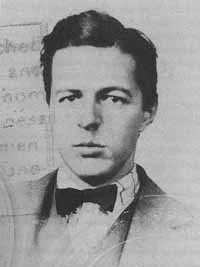
Scofield Thayer.
Cold-weather commute

"John Messner Clung With Mittened Hand'' (oil on canvas), by Frank Schoonover, at the National Museum of American Illustration, Newport, R.I.
-- Photo of painting copyrighted by the National Museum of American Illustration
A cool one

"Sam Adams'' (oil on panel), by Linda Demers, in the "33rd Annual Almost Miniatures Show,'' at Francesca Anderson Fine Art, Lexington, Mass., Nov. 16-Jan. 13.
Purpose up in the sky

"The wild gander leads his flock through the cool night,
Ya-honk! he says, and sounds it down to me like an invitation:
The pert may suppose it meaningless, but I listen closer,
I find its purpose and place up there toward the November sky."
-- From Leaves of Grass, by Walt Whitman
'Thousand shifting nuances'
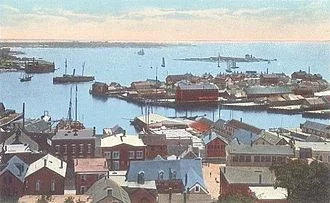
View of Gloucester Harbor, circa 1915.
"Not infrequently this almost landlocked bowl of the heavenliest light you ever experienced, in its thousand shifting nuances from day to night and night to day, scowl to smile, season to season, has been compared to the Bay of Naples alone. And many the traveler has rounded the world, only to return, gaze about him, breathe a deep sigh, and announce as if he had the tablets in hand at last that there was nowhere, anywhere, for that interplay of land and sea and sky and inhabitants to surpass the old, old fishing port of Gloucester, on the North Shore of Massachusetts Bay.''
-- From The North Shore, by Joseph E. Garland
Training for the underwater industry

From Robert Whitcomb's "Digital Diary,'' in GoLocal24.com:
Here's an example of both New England interstate collaboration and of using our region’s comparative advantage in marine affairs:
The University of Rhode Island and the University of Connecticut have created a joint venture called the National Institute for Undersea Vehicle Technology, at UConn’s Avery Point campus, in Groton. Researchers there will collaborate with General Dynamics’s Electric Boat unit, based in Groton and with a big operation at Quonset, as well as with Navy institutions in the region, which are concentrated on Aquidneck Island. Indeed, the center got a $1.3 million grant from the Office of Naval Research in August, with the aim of preparing students to work in shipbuilding, reports the Providence Business News.
Somehow, such projects look more promising for the region’s economy than, say, helping some rich folks finance a baseball stadium for their team in Pawtucket, much as I love the PawSox.
Kurt Hesch, Electric Boat’s chief operating officer, said of the new center:
“The intellectual horsepower and state-of-the art research facilities at the universities provide the tools necessary to research technologies so that industry partners can transition them for integration onto undersea vehicles.’’
Take this guide to some of New England's grandest houses and gardens on your summer jaunt
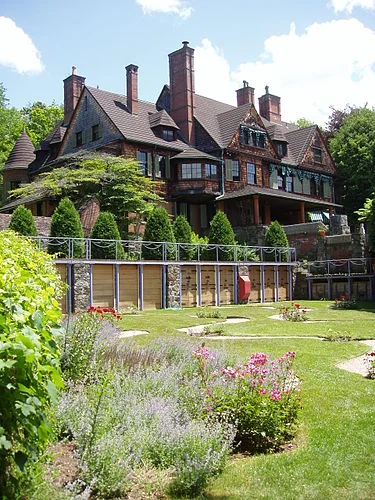
Naumkeag, in Stockbridge, Mass., in the Berkshires, one of the stately homes featured in Dr. Mason's guidebook. It was built in 1884 at the height of the Gilded Age as a summer house for the family of Joseph Choate, one of America's first corporate lawyers. He was a highly successful defender of monopolies.
William (“Willit’’ ) Mason, M.D., has written has a delightful – and very handy -- book rich with photos and colorful anecdotes, called Guidebook to Historic Houses and Gardens in New England: 71 Sites from the Hudson Valley East (iUniverse, 240 pages. Paperback. $22.95). Oddly, given the cultural and historical richness of New England and the Hudson Valley, no one else has done a book quite like this before.
The blurb on the back of the book neatly summarizes his story.
“When Willit Mason retired in the summer of 2015, he and his wife decided to celebrate with a grand tour of the Berkshires and the Hudson Valley of New York.
While they intended to enjoy the area’s natural beauty, they also wanted to visit the numerous historic estates and gardens that lie along the Hudson River and the hills of the Berkshires.
But Mason could not find a guidebook highlighting the region’s houses and gardens, including their geographic context, strengths, and weaknesses. He had no way of knowing if one location offered a terrific horticultural experience with less historical value or vice versa.
Mason wrote this comprehensive guide of 71 historic New England houses and gardens to provide an overview of each site. Organized by region, it makes it easy to see as many historic houses and gardens in a limited time.
Filled with family histories, information on the architectural development of properties and overviews of gardens and their surroundings, this is a must-have guide for any New England traveler.’’
Dr. Mason noted of his tours: “Each visit has captured me in different ways, whether it be the scenic views, architecture of the houses, gardens and landscape architecture or collections of art. As we have learned from Downton Abbey, every house has its own personal story. And most of the original owners of the houses I visited in preparing the book have made significant contributions to American history.’’
To order a book, please go to www.willitmason.com
Four tough customers
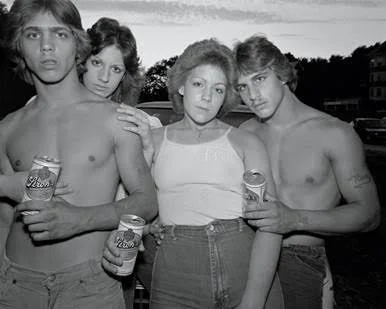
"Butch, Natasha, Krissy and Tony, August 25, 1983'' (silver gelatin print), in the "Bell Pond Series' by Stephen DiRado, in his show "A Photographer's Embrace,'' at the Museum of Art at the University of New Hampshire, Durham, through Dec. 15.
The gallery explains: "Stephen DiRado highlights the artist’s thirty-five-year artistic career as a photographer. Known for his humanistic outlook, DiRado’s work evolved from straight photography of people and places to intimate, empathetic images made in collaboration with his subjects. Using a large-format camera and a black and white silver-gelatin photographic process, his long-term documentary projects explore the structures and identities of communities, families, couples, groups and individuals.
"Works on display include several from DiRado’s series, such as 'Bell Pond,' a series documented during the summer of 1983 of a densely populated community of new and old immigrants residing on Belmont Hill in Worcester, Mass. Bell Pond is a public park and pond, a magnet for families, individuals and teen gangs. Other series included in the exhibition are "Mall Series,'' and DiRado’s 'Martha's Vineyard, Jump Series, ' which depicts people in the midst of their leap of faith from a bridge into the waters....''
So far from but so near to industry
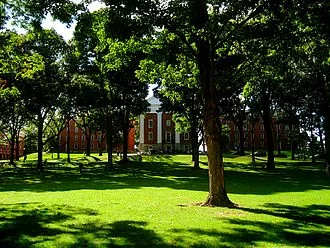
The Main Quad at Amherst College, Amherst, Mass.
"Life, {my mother} felt, should be everywhere as it was in Amherst, where poverty was an accident and great fortunes unknown. We lived so far from industry that we didn't know the industrial revolution had happened. Yet within a few miles of us were the manufacturing towns of Holyoke, Chicopee and Springfield.''
-- From "A Footnote to Folly'' (1935), by Mary Heaton Vorse.