
Vox clamantis in deserto





PCFR talk on Syrian refugees on Lesbos
Next at the Providence Committee on Foreign Relations (thepcfr.org; pcfremail@gmail.com:
On Thursday, Nov. 16 (note change from the previously announced Nov. 15), Maria Karangianis will speak on the refugee crisis in the Aegean:
In May 2015, she traveled to the Greek Island of Lesbos, within sight of Turkey. At that time, hundreds of thousands of refugees were spilling onto the beaches in leaky boats, many of them dying, trying to find freedom from war-torn Syria. The Greek people of the island, who have been nominated for a Nobel Peace Prize for their generosity, have faced an economic catastrophe with tourism, their main source of income. Maria is currently a Woodrow Wilson visiting fellow and has traveled across the United States speaking at colleges and universities. She is a former guest editor and an award-winning writer on the editorial board of The Boston Globe.
'Colony collapse disorder'

From White House Chronicle:
WASHINGTON, Nov. 3, 2017 -- Stephen H. Burke, a Rhode Island lawyer, advocates for U.S. honey bees as though they were his clients.
On the latest White House Chronicle, which airs beginning Nov. 2 on PBS, Burke argues for the importance of honey bees, which pollinate $15 billion worth of U.S. crops each year, including more than 130 fruits and vegetables.
“One out of three bites of food in the United States depends on honey bees. But the population is declining due to numerous causes, including Varroa mites and other parasites, construction and habitat loss, and pesticides,” he said.
Llewellyn King, White House Chronicle executive producer and host, said, “Honey bees are sentinels. If we live in a healthy environment, they will be healthy.”
During the winter of 2006 to 2007, some U.S. beekeepers began to report unusually high losses – 30 to 90 percent – of their hives. As many as 50 percent of all affected colonies demonstrated “mysterious” symptoms.
“This 'Colony Collapse Disorder' occurs when the majority of worker bees in a colony disappear and leave behind a queen, plenty of food and a few nurse bees to care for the remaining young bees and the queen. Hives cannot sustain themselves without worker bees and would die,” explained Burke, who is the secretary of the Rhode Island Beekeepers Association.
While colony loss has declined, it is still a concern. But it isn't Burke's only argument for beekeeping.
“We call ourselves 'beekeepers,' but it’s been suggested that perhaps a better description would be 'bee hosts.' We don’t really 'keep' them at all. They’re free to leave whenever they want, and sometimes they do. But we provide a place where a colony of honey bees can be warm, dry, well fed, and protected from predators.
“We dedicate our time and resources to financing, building and maintaining bee residences: hives. We purchase protective equipment as required, and food, and medicines to assure our charges stay healthy and productive.
“In return, we get the joy and satisfaction of a success in a challenging and rewarding hobby, as well as honey, beeswax, and other products of our hives,” he said. On the set, he had some of his hives' wildflower honey, his protective white hat and veil, and an empty wooden beehive.
Burke's joy-of-beekeeping argument is falling on willing ears. He is a beekeeping instructor at the University of Rhode Island and he said his classes are “always oversubscribed.”
Linda Gasparello, the program's co-host, said, “If anyone has caught the bug from watching or listening to Stephen Burke, we have posted his beekeeping steps on whchronicle.com.”
White House Chronicle airs nationwide on PBS and public, educational and government access stations, and on the commercial AMG TV network. It airs worldwide on Voice of America Television and Radio. An audio version airs three times weekends on SiriusXM Radio's P.O.T.U.S., Channel 124. An interactive list of stations which carry the program can be found at whchronicle.com.
The buzz on beekeeping

-- Photo by Michael Gabler.
The latest White House Chronicle show looks at the joys and challenges of beekeeping, in New England and beyond.
In Rhode Island and southern Massachusetts, the program airs Fridays at 7:30 p.m. on Rhode Island PBS, Digital 36.1, and other carriers; and 7 p.m. on PBS Learn, Digital 36.2, and other carriers.
Episodes are listed among the Sunday talk shows in Saturday's edition of The Providence Journal.
On PBS in Washington, D.C., the program airs Saturdays at 6 p.m. on Howard University’s WHUT, Channel 32, and Tuesdays at 9 a.m. It airs Sundays at 9 a.m. on WETA, Channel 26. Episodes are listed among the Sunday talk shows in Saturday's edition of The Washington Post.
An audio version airs three times weekends on SiriusXM Radio's P.O.T.U.S. (Politics of the United States), Channel 124: Saturdays at 8 a.m. and 10 p.m. ET; and Sundays at 1 p.m. ET.
The White House Chronicle staff post episodes on Vimeo, Facebook and the White House Chronicle Web site www.whchronicle.com following their weekend airings on the show's broadcast outlets.
Maine's heart-attack highway

"It {Route 1} is a road rich in the effluvia of clams in batter, frying doughnuts, sizzling lard; in tawdriness, cheapness, and bad taste, but in little else.''
-- Kenneth Roberts writing about the highway between Kittery and Portland, Maine, in For Authors Only (1935)
A third person in the car in the Chappaquiddick scandal?
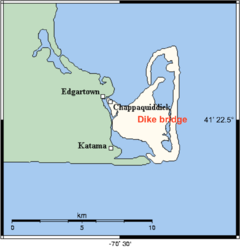
Adapted from Robert Whitcomb's "Digital Diary,'' in GoLocal24.com:
I'm looking forward to reading Donald Frederick Nelson's book CHAPPAQUIDDICK TRAGEDY: Kennedy’s Second Passenger Revealed (Pelican, 191 pages, sold in bookstores and online), in which he argues that there was a third person in the car that then Sen. Edward Kennedy drove off the Dike Bridge on July 18, 1969, killing young Kennedy aide Mary Jo Kopechne and, as it turns out, probably dooming Kennedy’s presidential ambitions.
Mr. Nelson, a retired physicist who lives in Oak Bluffs, on Martha’s Vineyard, and Worcester, argues that Ms. Kopechne had climbed into the back seat of Kennedy’s car after some heavy drinking at a Kennedy party in a house on Chappaquiddick Island, the easternmost part of the Vineyard, and passed out, unbeknownst to Kennedy and another Kennedy “boiler room girl,’’ Rosemary (Cricket) Keough, who was sitting in the front passenger seat. When Kennedy drunkenly drove the car off the bridge and then, with Ms. Keough, escaped from the submerged car, they had no idea that there was somebody in the back seat, Mr. Nelson argues. In any case, Kennedy and his many enablers then went on to do a fairly effective coverup.
I still remember vividly the guys in the un-air-conditioned (but with salt tablets!), smoky newsroom of the old tabloid Boston Record American, where I spent the summer of 1969 as a news clerk, showing far more interest in the Chappaquiddick scandal than in the moon landing, the Vietnam War and Woodstock that summer. It was like something out of the movie The Front Page. Vividly sordid.
Editor's note: Earlier versions of this comment said that Ms. Kopechne "drowned''. We changed that to "killed''.
This was after Mr. Neal Costello, a reader, wrote to correct us with: "She died a long and horrible death by asphyxiation, clinging to life for hours in an air pocket in the car. Perhaps she could have been saved if Kennedy had returned with help instead of only thinking of himself. ''
Unsettling indent

Still from Ana Mendieta's Silueta Sangrienta, (1975. Super-8mm film transferred to high-definition digital media, color, silent, 1:51 minutes), in her show at the Colby College Museum of Art, Waterville, Maine, through Dec. 17. The remarkably large and rich museum says the film focuses on an indent in the ground shaped like Mendieta's body. The body is first shown naked, then it disappears, and then it suddenly fills with red paint before she reappears in it face-down. The two-minute film is quite unnerving.
Stay within the music
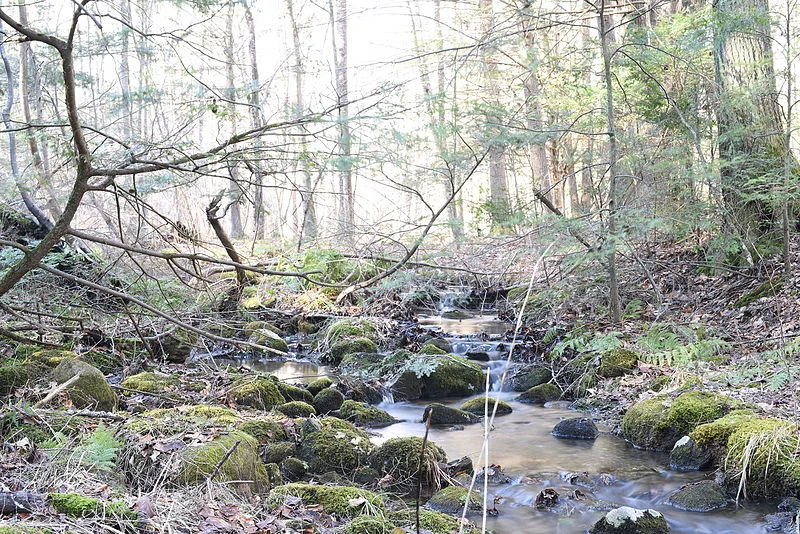
Stream in Southbury, Conn.
-- Photo by Karlfonza
"New England's brooks, streams and small rivers have incited many to poetry, starting with Anne Bradstreet's meditations on the Merrimack -- in whose tributary the Concord Emerson discovered a symbol of the flow of Being. Frost's 'West-Running Brook' handsomely ponders one of our lesser watercourses. I suppose I could stand beside the brook in our woods and rehearse such meditations, or think up something of my own about the great symmetries of the creation, of which the water cycle is one. But such thoughts are best worked out in the study.
The thing to do with a brook, I think, is to climb or descend it, now scrambling along the bank, now jumping across from rock to rock, now crossing back over a fallen tree trunk. That way you are always within the infinitely changing music of it.''
--- From poet Richard Wilbur's essay "New England Brooks,'' in the book Arthur Griffin's New England: The Four Seasons. Mr. Wilbur died Oct, 14 , in Belmont, Mass.

Chris Powell: Amidst current sexual-abuse scandals, prurience is a growth industry; 'fake media' love Trump's pro-monopoly FCC
MANCHESTER, Conn.
Suddenly it seems as if everyone has been sexually abused or worse by someone else. But it only seems to be sudden. In fact it has been going on since sex was discovered by people who had power over other people. It has become fashionable to declaim about it only recently, thanks to mass media that increasingly profit less from useful information than from mere prurience, which seems to be what most people want most these days, after sex itself.
What has this phenomenon really proved? Not much -- maybe two things.
First, that power still corrupts, most of all in regard to sex, and that its victims ordinarily keep silent about it to avoid embarrassment except when going public long afterward can unhorse a perpetrator who has achieved some high position. Then the victim's enjoyment of revenge outweighs embarrassment and may signify a sort of corruption itself.
And second, that a contemporaneous complaint to the police or at least the perpetrator's acquaintances is worth any number of belated and merely vengeful complaints. For a contemporaneous complaint can stop an abuser before he makes a career out of it.
The movie industry was infamous for this corruption long before Harvey Weinstein began taking advantage of the casting couch. Back in 1955, having spent two years as a screenwriter in Hollywood, Norman Mailer novelized about it well in The Deer Park, concluding that the world was a place "where orphans burn orphans and nothing is more difficult to discover than a simple fact."
Having married six times, Mailer himself turned out not to be such a nice guy either. Maybe it took one to know one.
RACKETEERING ISN'T INNOVATION: To lure Amazon's second headquarters, Connecticut has joined nearly every other state and dozens of cities in offering the company billions of dollars. Amazon is to be exempted from state and municipal taxes for many years while the company strives to put other retailers out of business even though they do pay state and municipal taxes.
It's as if the retail business isn't hard enough already. Indeed, the site that the town of Enfield, Conn., is pitching to Amazon is the Enfield Square shopping mall, which used to house the major department stores Amazon has undermined. Now Enfield Square is struggling.
Other retailers and businesses generally should respond to the Amazon frenzy by demanding similar payoffs just to stay put.
Amazon justly profits from its innovation in internet retailing but its original innovation was only to enlarge sales-tax evasion. Now the company wants direct subsidy from government. That's a racket.
‘FAKE MEDIA' LOVE TRUMP'S FCC: While President Trump rants about "fake news" from the "fake media," his Federal Communications Commission is planning to repeal regulations so that media companies can become even bigger and concentrate ownership of television and radio stations and newspapers.
The FCC, which now has a Republican majority, aims to let companies combine ownership of television and radio stations and newspapers in the same market and to let TV stations absorb each other even if doing so would leave a market with fewer than eight stations.
The commission already has repealed a rule requiring TV and radio stations to have offices in the communities they are licensed to serve.
Government policy should diversify and democratize ownership of the news media and the whole economy, not concentrate it. Concentrating ownership of the news media just makes "fake news" and propaganda easier to spread. Trump's "fake media" love his FCC.
Chris Powell is managing editor of the Journal Inquirer, in Manchester, Conn.
James P. Freeman: Questions for two GOP candidates eager to take on Senator Warren
It’s been said that you can’t split dead wood.
Surprisingly, the Massachusetts Republican Party, usually barren tundra when competing in statewide races, is fielding a forest of formidable candidates to challenge Democrat incumbent U.S. Sen. Elizabeth Warren in 2018. Two of them — Beth Lindstrom and John Kingston — are twin oaks of establishment politics and just recently announced their candidacies. They are worthy contenders, nevertheless, and deserve recognition.
Lindstrom is a Groton resident. She was executive director of the Massachusetts Lottery in the 1990s and, later, worked as director of the Office of Consumer Affairs and Business Regulation while Mitt Romney was governor. She also managed Scott Brown’s successful U.S. Senate campaign during the 2010 special election and is the first female executive director of the state Republican Party. Lindstrom appeared, notably, on television ads in 2014 for a super PAC backing Republican Charlie Baker. She announced her candidacy on Twitter on Aug. 21, with a formal announcement on Oct. 14.
John Kingston is a Winchester resident. He is a rich businessman and philanthropist. He was a lawyer at Ropes & Gray and went on to hold leadership positions at Affiliated Managers Group, the global asset-management company. He serves on the board of the Pioneer Institute, the public-policy organization, and is a member of the American Enterprise Institute, the Washington D.C., think tank. He is also involved with several charitable endeavors. Active in state and national Republican Party affairs, Kingston was part of Mitt Romney’s 2008 presidential campaign and was an executive producer for the 2014 documentary film Mitt. He formally announced his candidacy on Oct. 25.
So, before debate moderators and deceitful mainstream media can ask them their favorite color or when they last wept, they should be asked serious questions. Herewith are some to ponder:
1. Your mentor, Mitt Romney, was mocked during the 2012 presidential campaign for suggesting that Russia was the biggest geopolitical threat to the United States. Considering the allegations that Russia meddled in the 2016 election, is Russia today still the biggest threat to American security? Why or why not?
2. What should be done to mitigate North Korean provocations? Can America live with a nuclear-armed North Korea?
3. In May, with over $70 billion in outstanding debt, Puerto Rico filed for bankruptcy (believed to be the largest ever U.S. local government bankruptcy) under Title III of a U.S. Congressional rescue law known as PROMESA. Puerto Rico’s poor fiscal condition, highlighted again after Hurricane Maria, mirrors many mainland municipalities. What should this debt restructuring look like? Do municipal bankruptcy laws need modification given the sheer number of over-incumbered, bankruptcy-prone municipalities?
4. Some would argue that the likes of Google, Facebook, and Twitter are effectively operating as monopolies, and that their size and influence far exceed those of Standard Oil, and AT&T, for instance, which were ultimately broken up. Do the current examples raise anti-trust concerns? Does the Justice Department need to rethink its anti-trust policies?
5. For better or worse, President Trump is the leader of the Republican Party, your party. In what regard is the president doing well? In what regard can the president improve?
6. In Massachusetts, you will not win election without winning over some Democrats. How do you garner their vote? What do you say to Senator Warren’s core constituency, progressive populists, to gain their vote?
7. The commonwealth has one of the highest rates of opioid overdose deaths in the country. This year police in several Massachusetts cities and towns are seeing massive increases, not decreases, in non-fatal overdoses. The rightly called opioid epidemic has been trending for over a decade in the wrong direction. What are your proposals for action? How should state and federal governments better address this matter?
8. The Wall Street Journal reported that Amazon lured 238 bids from cities and regions for its second corporate headquarters. With no public vetting or commenting process, a total of 26 Massachusetts sites are competing for Amazon’s business, which, according to estimates, will bring tens of thousands of jobs to the winner. Is public policy perverted when one of the world’s richest companies is seeking — and will be granted — generous subsidies and tax benefits from these places where there is already high indebtedness, massive unfunded pension liabilities, and where there is need for drastic infrastructure improvements? What are your thoughts on these arrangements?
9. Does Obamacare need to be repealed and replaced? If yes, what are your proposals? If no, what improvements need to be made to make it a sustainable health care system? And looking at health care locally, Romneycare is now eating up close to 45 percent of the Massachusetts budget, prompting state Rep. Jim Lyons to call the budget “an insurance company.” How do you bend the cost curve? Is the expansion of Medicaid slowly bankrupting Massachusetts? How do you finance it on the federal level?
10. Former Sen. Scott Brown said during the 2012 senatorial campaign that he was a “Scott Brown Republican.” He lost by a wide margin. Likewise, both of you have described yourselves as abstractions. (Lindstrom: “a common-sense Republican.” Kingston: “an independent thinker.”) What do you mean by these Twitter-inspired thought bubbles? Do you have better descriptions?
11. Speaking of 2012, Brown and Romney could not decide if they were moderates or conservatives or something else. Lacking such identity probably hurt them. Warren is proudly progressive. What are you? And does it make political and electoral sense to fight a progressive with a conservative?
12. What are your reactions to the Massachusetts Republican Party settling charges for $240,000 in 2015 with Tea Party member Mark Fisher? (He claimed that the party stymied his efforts at getting on the Republican gubernatorial primary ballot in 2014, which raised larger issuers of attempting to purge the party of conservatives.)
13. On March 10, The Boston Globe’s Frank Phillips wrote: “A major concern for the governor’s political team is that the party’s U.S. Senate candidate in 2018 be compatible with Governor Charlie Baker and his political positions.” You both speak of not being beholden to President Trump but you’re both considered insiders in the state Republican Party. How do you refute Phillip’s premise that you are not beholden to Baker? Do you think his team favored the party’s proposal of doubling the number of super-delegates at next year’s nominating convention?
14. Who are your political role models? Why?
15. Has the national legislative branch abdicated its constitutionally prescribed powers to the executive branch? If yes, how do you bring the balance back?
16. Candidate Lindstrom: In the announcement video for your candidacy, you say you are “not a professional politician.” (Technically Olympic athletes aren’t professional athletes either.) Granted, you were never elected to public office, yet a substantial portion of your career has been involved in government. Do you think that the average voter would believe your statement?
17. Candidate Lindstrom: In 2008, Former Republican Lit. Gov. Kerry Healy would have been the first woman elected Massachusetts governor. You would be the first Republican woman elected Massachusetts senator. What advice has she given you?
18. Candidate Kingston: It was reported that you switched party registration last year from Republican to unenrolled and led an effort to create a movement to field an independent candidate in the presidential election. You have lent your own campaign approximately $3 million. You are a harsh critic of President Trump. Candidate Trump also had a history of switching party affiliations and lending his campaign personal funds. Philosophically and operationally, aren’t you behaving like Trump? Why are you running as a Republican and not as an Independent?
19. Candidate Kingston: You made a fortune in the asset-management business and spent a significant amount of your career in financial services. Did Wall Street learn any lessons in the wake of the financial crisis in 2008-2009? What were they? Are Americans more protected from Wall Street shenanigans today than last decade? Should hedge funds, which play increasingly powerful roles in trading and asset accumulation, be taxed and regulated more?
20. Candidate Kingston: In your formal announcement video, you say you are a “different kind of leader.” How so? In a separate statement you also said, “We cannot risk that chance [defeating Warren] on candidates who cannot deploy the resources necessary to win, or on candidates who are unelectable or uninspiring.” Is that an elitist sentiment, and don’t ideas matter too? Are you suggesting that your primary opponents’ lack of comparable wealth is a disqualifier? How are you inspiring?
Lindstrom and Kingston aren’t the only GOP candidates. State Rep. Geoff Diehl, businessman Shiva Ayyadurai, and Allen Waters of Mashpee are also running. But these questions are for the two candidates formally jumping in this month.
It’s too early to tell if Lindstrom and Kingston will split the vote or split their differences with Massachusetts Republicans. Each will need 15 percent of the vote at next April’s state party convention to secure their respective names on the primary ballot. But already there is controversy and trouble among them. Kingston, it was reported by the Globe, has bizarrely urged Lindstrom to drop out of the race. Surely a brush fire Baker wants extinguished immediately.
James P. Freeman is a New England-based writer, former columnist with The Cape Cod Times and former banker. This column first appeared in New Boston Post. His work has also appeared in The Providence Journal as well as here, newenglanddiary.com.
Best toward the end
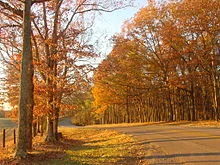
"Here in the Autumn of my days
My life is mellowed in a haze.
Unpleasant sights are none to clear,
Discordant sounds I hardly hear.
Infirmities like buffers soft
Sustain me tranquilly aloft.
I'm deaf to duffers, blind to bores,
Peace seems to percolate my pores.
I fold my hands, keep quiet mind,
In dogs and children joy I find.
With temper tolerant and mild,
Myself you'd almost think a child.
Yea, I have come on pleasant ways
Here in the Autumn of my days.
Here in the Autumn of my days
I can allow myself to laze,
To rest and give myself to dreams:
Life never was so sweet, it seems.
I haven't lost my sense of smell,
My taste-buds never served so well.
I love to eat - delicious food
Has never seemed one half so good.
In tea and coffee I delight,
I smoke and sip my grog at night.
I have a softer sense of touch,
For comfort I enjoy so much.
My skis are far more blues than greys,
Here in the Autumn of my days.
Here in the Autumn of my days
My heart is full of peace and praise.
Yet though I know that Winter's near,
I'll meet and greet it with a cheer.
With friendly books, with cosy fires,
And few but favourite desires,
I'll live from strife and woe apart,
And make a Heaven in my heart.
For Goodness, I have learned, is best,
And should by Kindness be expressed.
And so December with a smile
I'll wait and welcome, but meanwhile,
Blest interlude! The Gods I praise,
For this, the Autumn of my days. ''
-- "My Indian Summer,'' by Robert Service
In city redevelopment, go organic
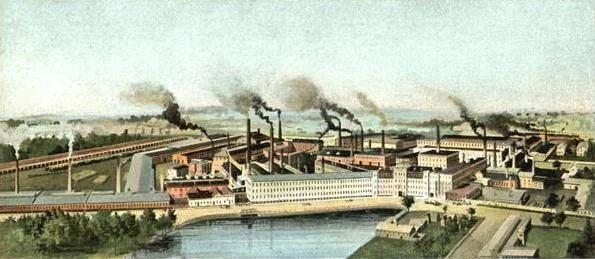
American Steel & Wire Co., Worcester, about 1905. Worcester used to be nicknamed "The Pittsburgh of New England''.
From Robert Whitcomb's "Digital Diary,'' in GoLocal24.com:
The Worcester Telegram ran a boosterish editorial on Oct. 22 about its downtown renaissance.
Among its points, which folks in other old New England cities should remember:
“{E}xisting buildings are also being transformed. As opposed to large, government-driven urban renewal projects that once cut off entire neighborhoods and laid waste to broad swaths of midcentury Worcester, what we’re seeing now is different. It’s different in the number of independent private developers, all seeing opportunity here and now, who in their own ways are driving a renewal of the city.’’
“This isn’t some giant urban renewal project. It’s an organic renewal.
“Organic in that so many developers have discovered opportunity here. But a renewal that is far from accidental. It’s not happening on its own. It’s a product of what came before, and of city leadership in both the public and private sectors.
“The fact that all this development is not reliant on a single, large developer or a giant government project, as has happened before and elsewhere, may be its greatest strength. That so many individual developers, all with a vision and a belief in the city’s future prospects, and with the resources and willingness to put those resources at risk, is the sort of development that drove the emergence of Worcester into an industrial giant. Failure by any single developer doesn’t doom the entire enterprise. ‘’
In other words, don’t depend on a few big developers, or one big company moving in (e.g., Amazon), to turn your city around. Diversify your economy, fix the city’s physical infrastructure and improve the schools. Companies come and go, with a moment’s notice.
The creativity of exile
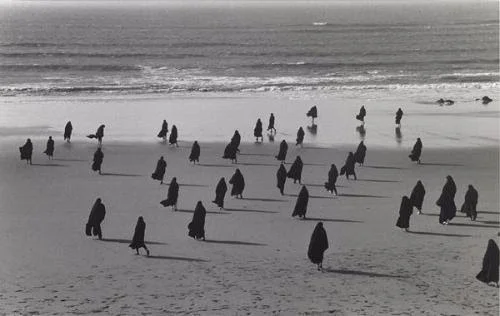
Gelatin silver print by Iranian artist Shirlin Neshat in her series "Rapture,'' in the show "Artists in Exile,'' at the Yale University Art Gallery, New Haven, through Dec. 31. The gallery says the exhibition addresses exile, featuring the work of artists who have left their home country or adopted home. It explores the physical, mental and emotional effects of exile on people and the creativity that a severance with the familiar and journey into the unknown can cause.
Defining Indian summer

"{Indian summer} comes after the early frosts, when the wind is southwest, and the air is delightfully mild and sweet. The sky is then singularly transparent, pure and beautiful, and the fleecy clouds are bright with color. The Indians believed the season to be caused by a wind that was sent from the southwestern god Cautantowwit, who was regarded as superior to all other beings in benevolence and power, and the one to whom their souls went when the departed from the earthly body.''
-- By Sidney Perley, in Historic Storms of New England (1891)
Survival and decoration

"The flowers that thrive on the margins,
by the tracks and roadsides as we pass
on our way somewhere else,
planted by no one and often unnoticed,
their beauty gratuitous, prodigal,
have nothing to do with us,
have nothing to do with decoration
but with survival.''
-- From "Arrangement,'' by Massachusetts poet Jeffrey Harrison
Dangerous dogs
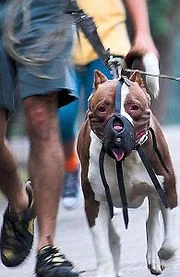
A safe pit bull in public.
Adapted from Robert Whitcomb's "Digital Diary,'' in GoLocal24.com:
Two pit bulls killed a seven-year-old boy Oct. 21 in Lowell. Attacks on people by pit bulls are common. They’re aggressive and muscular dogs with very strong jaws. In some urban neighborhoods, they’re often kept by young men eager to display how tough they (the young men) are; the same as brandishing guns. And sometimes these dubious “pets’’ are kept to help guard drugs and drug dealers.
It is not the dogs’ fault that their physical strength, their breeding and (often) their training to be aggressive make them so dangerous. But it’s past time to ban them from urban neighborhoods.
Pit bulls are generally seen as including the American pit bull terrier, American Staffordshire terrier, Staffordshire bull terrier and American bully. They have been bred to bite and hold their victims.
After some pit-bull attacks, Lowell tried to stem the menace in 2011 by requiring the dogs to be spayed or neutered and muzzled and leashed when off owners’ property. But the Massachusetts legislature, prompted by owners of these breeds denouncing this quasi-racial “discrimination,’’ barred cities and towns from enacting breed-specific ordinances.
With the latest horrific attack, Lowell officials are again demanding that pit bulls be brought under control. Meanwhile, owners who fail to properly control these sometimes murderous beasts must face severe criminal-law punishments.
Seeding Southie

"Study for Day Boulevard at Pleasure Bay, Samaras'' (a samara is a winged nut or achene containing one seed, as in ash and maple), by Ann Wessmann, in her show "Wandering,'' at Kingston Gallery, Boston, Nov. 29-Dec. 30.'' Day Boulevard is in South Boston.
Daniel Regan: Climate-change denial and the limits of higher education
Via the New England Board of Higher Education (nebhe.org):
Last year, I attended my 50th reunion at Amherst College, in Amherst, Mass.. One evening at dinner under a tent, a former roommate, “Nick,” dominated the conversation with assertions that claims about human-induced climate change were a hoax and those about global warming a fraud. At first, I thought he was trying to be entertaining—or provocative.
But after a while, I realized my error. His was no parlor game; nor was he merely pushing his dinner partners by challenging the basis for their own strongly held convictions. He was a climate-change denier and a true believer when it came to denialism.
Since that dinner, I have wondered: How could an Amherst graduate arrive at these conclusions in the face of overwhelming evidence and scientific consensus? Similar questions could be asked of graduates from colleges and universities across the nation. Had the lessons of rigorous thinking, widespread reading, respect for evidence and trustworthy sources been lost on Nick? He had been, as I recalled, a brilliant student. So the answer was not, simply, that a college education had failed somehow to “take.”
On the contrary. He had fully internalized the critical thinking skills at a premium in his college days, but placed them now in the service of climate-change denialism. His lengthy enumeration of purported holes in the evidence was skillful. Indeed, it was strongly reminiscent of Big Tobacco’s methodological arguments in the highly orchestrated, sophisticated and clever campaign to fend off and postpone the inevitable declaration of tobacco as a carcinogen.
Nick was more a product of his regional background—in a hotbed of skepticism about human-induced climate change—than a product of Amherst. He was more a member of that region’s upper-class—its social networks, media preferences and economic interests—than of the Amherst class of ’66.
A higher education—what our college and university students learn both inside and beyond their classrooms—emerges as one of multiple influences but maybe not the most important one. A striking example of this hierarchy of influences emerges in a series of voting studies conducted in the aftermath of the Vietnam War. Not very long after the war’s conclusion, sociologist Seymour Martin Lipset and political scientist Everett Carll Ladd Jr. produced a small avalanche of studies examining the voting patterns and preferences of 1960s college students.
Within a decade, the researchers were able to document shifts in students’ political orientations. Those who came from more liberal or radical backgrounds remained on the left. Those who came from more conservative or centrist backgrounds shifted rightward. The collegiate generation that had seemed so univocal was, in fact, increasingly divided.
Lipset and Ladd found that family background was a key factor in explaining the resulting voting patterns and ideological preferences. Although colleges and universities in the 1960s were viewed as possibly permanent bastions of liberalism, the generational shift to the left may have left its mark upon the lifestyles of those on campus, but did not necessarily leave a lasting impact upon their politics.
There was little chance that a higher education could compete with Nick's social background and current circumstances in influencing his eventual stance of climate change. His higher education was important, just not all-important.
The distinction should be both humbling and liberating. It can allow faculty, staff and administrators to take a deep breath, relax a little and adopt a spirit of what I would call well-considered but “playful experimentalism.” Such an ethos is sorely needed to spur much-needed innovation in higher education. This means risk: trying out that new advising model; experimenting with a novel course format and set of exercises, even though the tried and true ones have served well enough; trying out a new orientation for students at risk; collaborating in untested ways with a sister institution, and so on, through every level of the institu
But paralysis has its own perils in today’s more challenging environment for higher education. Thoughtful experimentation, despite the risks, is by far the wiser strategy for today's higher educators.
Daniel Regan is accreditation liaison officer and former dean of academic affairs at Johnson State College, in Vermont.

Chris Powell: Spoiled NFL players' protests are too vague

MANCHESTER, Conn.
What exactly are the National Football League players trying to accomplish with their protest by kneeling during the National Anthem?
President Trump's assertion that standing should be mandatory rather than done sincerely has focused the controversy on the players' freedom of expression rather than the target of the protests, vaguely described as racial injustice.
Back in the heroic era of civil rights, the 1950s and 1960s, the movement for racial justice had a specific and compelling agenda: voting rights; ending segregation in schools, public accommodations and housing; and improving job opportunities so that the formerly oppressed could advance. Voting rights have been achieved and segregation in public accommodations has been ended, but schools and housing remain segregated informally and racial minorities remain underemployed. Criminal justice and police misconduct increasingly raise racial issues as well.
The players have not articulated what they want the country to do about these issues, and it is little help just to harrumph that racial justice has not yet been fully achieved. It probably never will be.
Whatever the players want, the controversy they have caused shows that they are pursuing their objective in the wrong way, alienating more people than they are gaining sympathy from. For the players have failed to learn from the heroic era of the civil rights movement, whose success resulted in large part from the movement's patriotism, its seizing the flag on behalf of the nation's founding ideals, such as "all men are created equal."
The movement's participants had no special wealth and often put themselves at great risk by confronting armed racists.
By comparison, the players look like spoiled children, rich guys parading what they purport to be their virtue while risking nothing.
This is too bad because the players might accomplish something for racial justice and improve the country if they applied their celebrity to specific legislative proposals and volunteer work to help the disadvantaged. The players' resentment is hollow and they are lucky that the president's usual thoughtless bluster has changed the subject for them.
TRUMP NEEDS TO FIGHT EVERYONE: While he was never a sympathetic character in public life, when he was President Richard Nixon once managed to admit a mistake and thereby resolved an embarrassing problem.
It happened in August 1970 when, at an impromptu press conference in Denver, Nixon remarked on what he saw as the news media's glorification of cult leader Charles Manson, then on trial with his followers for murders in California. Manson, the president said carelessly, was "guilty, directly or indirectly, of eight murders."
That indeed was the charge but nobody had been convicted yet. Within hours the president's remark prompted a defense motion for a mistrial.
Nixon's press secretary quickly tried to clarify things and upon returning to Washington that day the president issued a formal statement saying that he did not know whether Manson and his followers were guilty, adding that they had to be presumed innocent during trial. The mistrial motion was denied and the trial continued and resulted in convictions.
But with President Trump everything has to be a personal challenge and a fight. About his telephone call to the widow of a soldier killed in Niger the other week, Trump could not say simply that he was sorry that he had been misconstrued as callous. No, he said the people on the other end of the call were lying about him.
The next 3½ years may be long ones.
Chris Powell is managing editor of the Journal Inquirer, in Manchester, Conn.
Boston sports teams announce anti-racism initiative
This is from The New England Council
The five major sports teams from the Boston area – the Boston Red Sox and Celtics, New England Patriots, Boston Bruins and New England Revolution – have teamed up to spearhead a campaign to combat racism.
The New England Council reported:
"The 'Take the Lead' initiative was launched with the support of Boston Mayor Marty Walsh at Fenway Park. In a PSA broadcasted in Fenway Park, Gillette Stadium and TD Garden, players urge fans to have open conversations about race and speak up when they hear offensive statements. Team executives spoke about their teams’ efforts to become more racially inclusive and engage in local communities. As part of the initiative, teams will participate in fellowships and career fairs to help all members of the community be on 'an equal playing field.'
“'We, like many Americans, made the mistake of thinking that our region’s and country’s less-than-stellar pasts were firmly behind us, that 21st-century America was becoming a more inclusive nation committed to celebrating diversity. That is not the case,' said John Henry, the Sox’ principal owner. 'Our sports teams, our athletes, are woven into the fabric of our society. For that reason, we cannot remain silent nor still.'''
The Sacklers' deadly drug peddling
Adapted from Robert Whitcomb's "Digital Diary,'' in GoLocal2.com
The Sackler drug-fortune family, whose total wealth is estimated at around $15 billion, recalls the over-the-top Balzac line that “behind every great fortune is a great crime.’’ Theirs was to help create the opioid epidemic.
The Sacklers are the status-obsessed clan that puts its name in large letters on bronze and other fancy signs announcing members’ gifts to already rich museums and colleges and universities (including New England Ivy League schools) to affirm their membership in the social/mercantile aristocracy. Most of their money comes from their closely held company Purdue Pharma, which hugely hyped their painkiller OyxContin to physicians and patients. Purdue lied that the opiate was remarkably safe. No. It's a menace.
The company’s outrageous marketing of OxyContin has led to massive addiction and the overdose deaths of many thousands of people.
Even before OxyContin, Arthur Sackler, one of the three brothers who bought then tiny Purdue Pharma in 1952 and then built it up in a vastly profitable behemoth, heavily and misleadingly promoted the glories of the benzodiazepine Valium when he was an ad man. Valium is also very addictive and potentially lethally dangerous. What an innovative family!
From the start, the family-held firm’s secrets to success have included (as with some members of Big Pharma) its relentless pushing of its products to physicians, with junkets to fancy places, paying doctors big fees to give very short speeches and other perks that some might simply call bribes in the world’s most avaricious health “system.’’
Instead of showing off its money with well-advertised contributions to institutions catering to the elite, the Sacklers would do far better to set up a nonprofit chain of drug-rehabilitation clinics to address the vast damage that they have done.
In a weird way, New Englanders have seen this sort of money-laundering before, when the “China Trade’’ of the late 18th and early 19th centuries earned fortunes from opium sales. Some of it ended up in (what are now called) Ivy League colleges and other prestigious institutions. Opiates forever!