
Vox clamantis in deserto







Llewellyn King: TV talking heads rarely include the main human subjects of the shows

"The Conversation,'' by Arnold Lakhovsky (circa 1935).
Guess you’ve noticed: There are no politicians on the politics-obsessed cable news channels. Instead, there are journalists talking about politicians and politics; rafts of journalists organized into “panels” to comment, in seconds, on events.
Twenty years ago, it was different. So much so that I started a television program with the avowed intention of letting the public see who was writing the political news in the newspapers. We are still on the air, but with fewer journalists commenting.
In that seemingly distant time (which was, in reality, not very long ago), the principal political talk shows were The McLaughlin Group, under the pioneering John McLaughlin; Inside Washington, formerly Agronsky & Company, with Gordon Peterson, and the long-lived Washington Week in Review, with Ken Bode.
They were weekly, half-hour programs and mine, White House Chronicle, joined the roster as a distant “also ran.” We aimed at introducing print journalists to a TV audience. Other programs had set round tables that included Tribune Media’s Clarence Page, because he was a delight to work with — as we found on our program — and because he was informed and entertaining.
Women were fewer and they were led by Elizabeth Drew, of The New Yorker, Eleanor Clift,of Newsweek, Cokie Roberts of NPR, and syndicated columnist Georgie Anne Geyer.
Cable news meant CNN, then still trying to be magisterial.
Fast forward and television is chock-full of journalists talking about the news in what is now a staple of cable television; and rather than occupying half an hour a week these “panels,” as the hosts call them, are on pretty well 24/7.
The New York Times publishes under the slogan “All the News That’s Fit to Print.” On television, it’s all the news that can be talked about — and they do, endlessly. I think that is pretty entertaining and most of the talking heads seem to have really good sources; they are on the news — all the politics that can be talked about. It is the fat and sugar diet of TV.
What is missing are the subjects. Few members of Congress, with the exception of the leaders, are seen or talked about by name on television. They have been cleared from the television politics smorgasbord. Even the talking heads do not name them. The ubiquitous panelists talk about “my sources” or “a conservative congressman” or “a Democratic member.” No names. No faces.
There are reasons aplenty for this. One, now that there is more party discipline, except for a few people such as Sen. John McCain ( R-Ariz.), it is known what the party line will be: It is there in the talking points — and that makes for little news and boring television.
Another is that while journalists go for instant analysis, a cable television staple, politicians are scared of “stepping in it.” Search technology is so fearsome now that almost anything any politician says can be retrieved and put on the screen. That is fodder for future “gotcha” moments. The late Tim Russert, of Meet the Press, was a master of this. “In 2003, you said” and there it was, right on the screen, the politico making a regrettable remark.
Also, there is always the question of what the public wants (ratings to the TV industry). The public appears to be more interested in journalists debunking political leaders than the nuts and bolts of legislation or even what is happening in, say, science or the rest of the world. Salt and fat gets the eyeballs.
The late Arnaud de Borchgrave lamented that in his day, aspiring reporters longed to be foreign correspondents, now they yearn to cover Capitol Hill and the White House. Ralph Nader — who was once a prized “get” in the parlance of television bookers — has just issued a paper regretting the dominance of political chatter in the news space. Maybe he will be asked to talk about it on television, but it is unlikely.
On the upside, there are some awesome new talents, and more women in the Washington journalistic firmament — even if some of us like it when journalists, in the words of radio veteran Dan Raviv, just set out to “find out what’s happening and tell people.” No salt, no fat, just the facts.
Llewellyn King (llewellynking1@gmail.com), a veteran publisher, columnist and international business consultant, is host of White House Chronicle, on PBS. This piece first ran in Inside Sources.

Chris Powell: In Conn., another self-funding rich Republican ignoramus running for governor

"Avarice,' by Jesus Solana.
David Stemerman, 48, of Greenwich, a successful investment fund manager, announced the other day that he is closing his fund and planning to become a candidate for the Republican nomination for governor of Connecticut.
Those who hope for change in state government's direction may be forgiven for thinking: not again. For Connecticut's minority party has an unfortunate habit of giving major nominations to candidates whose main qualification seems to be just their having enough money to finance their own campaigns.
Now that Connecticut's program of government financing of campaigns for state office is in doubt because of the state budget mess, a candidate's ability to finance his own campaign may seem more important to Republicans, especially since their legislators, considering it an extravagance, are the ones who want to do away with the Citizens' Election Program. But from multimillionaire Brook Johnson's campaign for U.S. senator in 1992 to multimillionaire Linda McMahon's campaigns for U.S. senator in 2010 and 2012 to multimillionaire Tom Foley's campaigns for governor in 2010 and 2014, Connecticut's Republican Party has failed, even when political circumstances were highly favorable.
As it turned out, campaign money wasn't nearly enough. Candidates also need a record in Connecticut's public life and some knowledge of the state and its government, and those self-funding Republican candidates didn't have it. Worse, they didn't care to learn, and it showed embarrassingly.
In a letter to his fund's investors disclosing his political ambition, Stemerman tried to take the edge off his wealth. "I am deeply concerned that a small number of people in our state are thriving while many are struggling to make ends meet," he wrote. He also tried to make a virtue of his political inexperience: "I do not claim to have all the answers, but as an outsider with a fresh perspective, I believe that I can bring a different approach."
"All" the answers? Even one might be nice.
Of course, someone without a record in the state's public life has as much right as anyone else to run for governor and may have valuable insights. But since Stemerman has no record, only a lot of money, Republicans and others who want political change in Connecticut should be concerned about what may be discovered about him by the opposition shortly before the election. That sort of thing badly damaged the candidacies of McMahon and Foley.
The Republicans already have a few potential candidates for governor who, while possessing no special wealth, at least have records and an idea of the state's problems. Whether they have the courage to speak about these problems as the state's sad circumstances require remains to be seen, but in any case the worst disaster that could befall Connecticut next year would be another self-funding ignoramus.
xxx
PUERTO RICANS LONG HAVE BEEN CITIZENS: Since many Connecticut residents are from Puerto Rico or have family there, the damage done to the island by the recent terrible hurricanes has been big news here. But it would be nice if journalists interviewing local Puerto Ricans stopped saying that so-and-so "came to the United States from the island," as if today's Puerto Ricans are or ever were foreigners.
They're not. They're Americans. The United States seized Puerto Rico during the Spanish-American War and federal law conferred citizenship on Puerto Ricans in 1917, if only because Congress wanted to make more men eligible for the military draft in World War I.
Chris Powell is managing editor of the Journal Inquirer in Manchester, Conn.
Coming up at the PCFR: War with China? Refugees on Lesbos; Selling out U.S. tech
Coming up at the Providence Committee on Foreign Relations (thepcfr.org; pcfremail@gmail.com):
On Wednesday, Oct. 11, comes Graham Allison, who will talk about, among other things, Chinese expansionism in the South China Sea. He'll discuss his new book Destined for War: Can America and China Escape Thucydides's Trap?
Graham Allison was director of Harvard's Belfer Center for Science and International Affairs from 1995 until July 2017. Allison is a leading analyst of U.S. national security and defense policy, with a special interest in nuclear weapons, terrorism and decision-making.
On Wednesday Nov. 15, comes prize-winning journalist Maria Karagianis, who will talk about the refugee crisis on the Greek island of Lesbos.
In May 2015, she traveled to Lesbos, which is within sight of Turkey. At that time, hundreds of thousands of refugees were spilling onto the beaches in leaky boats, many of them dying, trying to find freedom from war-torn Syria. The Greek people of the island, who have been nominated for a Nobel Peace Prize for their generosity, are now facing an economic catastrophe with tourism, their main source of income, which is now destroyed. She is currently a Woodrow Wilson visiting fellow and has traveled across the United States speaking at colleges and universities. She is a former guest editor and award-winning writer on the editorial board of The Boston Globe..
On Wednesday, Jan. 27, comes Victoria Bruce, who will talk about China's near monopoly of rare-earth elements.
She is the author of Sellout: How Washington Gave Away America's Technological Soul, and One Man's Fight to Bring It Home. This is about, among other things, China’s monopolization of rare earths, which are essential in electronics.
Victoria Bruce holds a master's degree in geology from the University of California, Riverside, where she researched the chemistry of volcanic hazards on Mount Rainer in Washington State. She has directed and produced four documentary films, earning the Alfred I. duPont-Columbia University Award for excellence in broadcast journalism for her film, The Kidnapping of Ingrid Betancourt. She also received the Duke University Human Rights Book Award for Hostage Nation.
On Wednesday, Feb. 21, comes Dan Strechay, who will talk about the environmental and socio-economical effects of the vast palm-oil agribusiness.
He is the U.S. representative for outreach and engagement at the Roundtable on Sustainable Palm Oil (RSPO). He'll discuss, among other things, the massive deforestation associated with producing palm oil in the Developing World and what to do about it. Prior to joining the RSPO, he was the senior manager for Sustainability Communications for PepsiCo.
Mass. creates a wilderness

The Quabbin Reservoir.
"In front of me stretched the water of the Quabbin (Reservoir}. It was for this water that the Swift River Valley {of central Massachusetts} was flooded. It was because of this water that the wilderness, with its eagles and its extensive woodlands and abandoned cellar holes, exists in the Quabbin region.''
-- From Quabbin: The Accidental Wilderness, by Thomas Conuel
Come into my catacomb

A photo from the show "Recent Photography by Ron Rosenstock,'' at the Hopkinton Center for the Arts, Hopkinton, Mass., through Ot. 26.The show's photographs, all black and white, are of complex forms, large in scope and rich in detail, both natural and manmade. The gallery says that the images, although disorienting in their large scale, are also beautiful and peaceful.

'Undifferentiated life forms' in Conn.

From Robert Whitcomb's "Digital Diary,'' in GoLocal24.com:
In an orgasm of political correctness and, well, silliness, Metro-North, thepublicly owned commuter railroad that serves southwestern Connecticut and thelower Hudson Valley, announced that it will no longer note a purchaser's gender identification on month-long train tickets.
The railroad said that it had used such identification to make it more difficult for riders to let others use their monthly passes. Makes sense! And one would think that police seeking suspects on trains or in train station might, from time to time, like to know the sex of suspects they seek. Gender-identifying tickets could help.
But Connecticut Gov. Dannel Malloy opined. "We should not be using antiquated gender norms as a method of personal identification.’’
The wonderful Chris Powell, managing editor ofthe Manchester (Conn.) Journal Inquirer asked:
“{H}ow can the governor be sure that there are no longer any circumstances in which it is useful to distinguish male from female? While the governor seems to think that the right of anyone to assume either gender at any time trumps the right of sexual privacy in bathrooms, he strangely has not yet insisted on erasing the divisions between boys and girls and men's and women's sports. ‘’
“But even if the governor really thinks that gender norms are ‘antiquated,’ there's not enough time left in his term for him both to run Connecticut's creaky old government and to persuade the rest of the world that there are no longer boys and girls and men and women, just undifferentiated life forms.’’
'Comely thing'

"Know'st thou not at the fall of the leaf
How the heart feels a languid grief
Laid on it for a covering,
And how sleep seems a goodly thing
In Autumn at the fall of the leaf?
And how the swift beat of the brain
Falters because it is in vain,
In Autumn at the fall of the leaf
Knowest thou not? and how the chief
Of joys seems—not to suffer pain?
Know'st thou not at the fall of the leaf
How the soul feels like a dried sheaf
Bound up at length for harvesting,
And how death seems a comely thing
In Autumn at the fall of the leaf? ''
-- "Autumn Fall,'' by Dante Gabriel Rossetti
Amy Hahn: A primer on the risks of green energy

From The New England Journal of Higher Education, part of The New England Board of Higher Education (nbehe.org)
It is difficult to travel on any road today without seeing solar panels on the rooftops of houses, larger solar farms across vast fields or wind turbines in the distance. With larger initiatives to create more environmentally sustainable energy and reduce carbon footprint, many universities are reviewing their options for alternative energy sources.
Three of the most common types of alternative energy solutions being installed today are solar panels, wind turbines and cogeneration plants. Ensuring that these efforts to “go green” have long-term success requires an understanding of possible risks and how best to manage them.
A primer:
Solar (photovoltaic) panels
Solar panels convert sunlight to electricity. The individual panels comprise multiple photovoltaic cells. Typically, the panels will be installed as part of a solar array, either on a roof or mounted in a field. Solar is one of the fastest-growing segments in renewable energy and it’s easy to see why. With low maintenance costs and high reliability, solar panels can lower overall electricity costs and add some independence from the electrical grid and its peak prices.
But the addition of solar arrays does carry some potential risk that needs to be taken into account, including:
Roof penetrations can lead to leaks
For wind load requirements, ballasted assemblies should be used, rather than mechanical attachments
For snow load, the weight of panels plus ballasted securement requires structural analysis
Electrical hazards because solar panels are “always on” and need a way to be isolated from the inverter system
Fire hazards can be of higher risk with solar panels and conduit located on a rubber membrane roof covering
Hail damage to the solar panels.
In addition to these specific hazard considerations, it’s important to understand who will be financially responsible for the array. In most cases, arrays tend to be owned by a third party, which can complicate risk mitigation and damage repair efforts. Be sure that this is decided on and understood early on.
Wind turbines
Wind turbines convert kinetic wind energy into electricity, using this to turn the blades of a rotor that is connected to a main shaft, which then spins a generator to create current. Along with solar, wind is a rapidly growing option and one of the most visible of the green-energy sources. Like solar, it has some key benefits, including the use of a free, abundant resource (wind) to create the electricity, as well as relatively low operational costs. Like solar, wind also has risks that should be factored into planning, installation and operation, including:
Noise from the whirring of the rotors, especially at large scale, can be quite disruptive
When equipment breaks down, replacement parts are expensive and lead times are long
Catastrophic failures can present projectile dangers (i.e., blades) to humans and buildings
Installation risks including falls, confined space, fire, electrical hazards, machine guarding, arc flash and elevation leave workers vulnerable to injury
Projects can take as long as two years to complete.
Cogeneration
Cogeneration systems are so-named because they produce both heat and power. The excess thermal energy produced in the production of electricity is captured and used for heating buildings or water, or even for powering absorption refrigeration to provide building cooling. As with both solar and wind, cogeneration can provide a measure of grid independence and insulation against price spikes and outages, and—in many areas—provide an income stream from excess energy sold back to the utility.
Like the systems themselves, the downsides of cogeneration can be a bit more complex. They include:
Substantial initial investment in equipment, construction and building upgrades
Complex systems requiring experienced operators and mechanics
Presence of pressurized oil lines near heat sources.
Ensure early, open and regular communication between risk management and the design teams
Involve your insurance broker and carrier early in the process to gain a full understanding of potential insurance implications of the project
As with any project, follow a general construction guide that includes risk management and insurance company involvement
Obtain credentials, licensing and insurance certificates for all contractors involved. Ensure the contractor is experienced and reputable. This applies to both installation and subsequent third-party operation
Obtain proper warranty documentation for any new equipment.
As technologies have matured, environmental concerns have grown and, where other fuels have become more unpredictable in cost, going green has gained real momentum. So, bringing some form of renewable energy to campus is likely a question not of “if” but of “how.” Risk is real, but with foresight, planning and insurance, it can be easy—and beneficial—to be green.
Amy Hahn is a lost-control engineer and certified fire-protection specialist at Risk Strategies Company, which is based in Boston.
David Warsh: A little-reported visit by the Russians
SOMERVILLE, Mass.
The story raised eyebrows in my circles. Vladimir Putin had dispatched one of his diplomats to the State Department in April to deliver a bold proposal: an across-the-board re-normalization of the many channels that had been severed after Moscow’s military interventions in Ukraine and Syria — diplomatic, military and intelligence.
“The broad scope of the Kremlin’s reset plan came with an ambitious launch date,” wrote John Hudson, a foreign-affairs reporter for Buzzfeed: “immediately.” In early May, President Trump received Russia's foreign minister, Sergei Lavrov, and its ambassador to the U.S.,, Sergey Kislyak, at the White House. The earlier overture remained secret until last week.
Johnson’s Russia List, the most widely read agglomerater of news about Russia, circulated Hudson’s story. Putin’s press secretary confirmed the authenticity of the offer at a news conference in Moscow. The White House and the State Department acknowledged the offer had been received but declined to tell Hudson who had delivered the offer.
The WSJ had replicated the story and advanced it the next day: "Moscow Acknowledges Effort to Woo Donald Trump’s Administration''. For the next four days, The New York Times and The Washington Post gave Hudson’s scoop a good leaving-alone.
Instead, The Times continued reporting on its discovery of “a cyberarmy of bloggers posing as Americans and spreading propaganda and disinformation about an American electorate on Facebook, Twitter and other programs.” It front-paged a dispatch on Russian military exercises: “With War Games, Russia Creates a Fake Enemy, but Real Alarm.” And it reported that the U.S. banned the use of Russian-made Kaspersky software on computers of federal agencies.
The story seem likely to appear eventually, but two things already seem clear
Putin thoroughly misunderstood the political situation in the United States as of April, when he made its offer.
The editors of the The New York Times, have a great deal of explaining to do. Editors are curators of narratives. They are entitled to mull over the meaning of Hudson’s story. But they also obligated to report news when it breaks. Much is to be learned from the lags.
. xxx
Another report likely to be in the news for months to come appeared this week. “Are Ideas Getting Harder to Find?” published as a working paper by the National Bureau of Economic Research. Authors Nicholas Bloom, Charles I. Jones, Michael Webb, all of Stanford University; and John van Reenen, of MIT, answer unequivocally in the affirmative.
“Across a broad range of case studies we find that [new] ideas — and in particular the exponential growth they imply — are getting harder and harder to find.”
Among the case studies were Moore’s Law, or computer performance per watt of electricity; agricultural crop yields; and mortality and life expectancy and the productivity of medical research.
Economic Principals is traveling and unable to pursue either story right now. Expect more in due course.
David Warsh, a veteran economic and political columnist and an economic historian, is proprietor of Greater Boston-based economicprincipals.com, where this essay first ran.
'Ripe brown body'

Ragweed.
"{W}we had to conclude that something in the September combination of waning sun and increased humidity released vapors a stronger sun or an earth more parched would have beaten down or imprisoned and that the fragrance was indeed a distillation of all the things it suggested --- of the late flowers in the meadows and the low, matted tangle of the half-rotted undergrowth, of the turning grape and of the falling apple and of the ragweed and the breath of the trees and the September rose and of the ripe brown body of Autumn herself.''
-- From In Praise of Seasons, by the late Alan J, Olmstead, a Connecticut newspaper editor and an essayist.
New Hampshire's first great industry

"For more than a century, the big business of Gravesend was lumber, which was the first big business of New Hampshire. Although New Hampshire is called the Granite State, granite -- building granite, curbstone granite, tombstone granite -- came after lumber; it was never the booming business that lumber was. You can be sure that when all the trees are gone, there will still be rocks around; but in the case of granite, most of it remains underground.''
-- From the novel A Prayer for Owen Meany, by John Irving
'People Watching: Then and Now'

"Mrs. Charles McEvers Verplanck'' (1771, oil on canvas), by John Singleton Copley; "Figure, Looking #2, by Susan White Brown, in the show "People Watching: Then and Now,'' at the Fitchburg (Mass.) Art Museum, Sept. 24-Jan. 14.
(Editor's note: The picture of the young man was misidentified in earlier editions as a photo rather than as a painting.)
The curator writes: "This exhibition contains portraits painted in various time periods by numerous different artists, from African sculptors to eighteenth-century Western painters to thirteen contemporary New England artists. The works not only reveal the role of portraiture throughout the years, but reveal pieces of history and human nature itself.''
States of happiness?
From Robert Whitcomb's "Digital Diary,'' in GoLocal24.com:
WalletHub has come out with an interesting ranking of the states by their degree of happiness. The five most unhappy were the deep Red, pro-Trump states of, ranked in order of misery: West Virginia, Oklahoma, Louisiana, Alabama and Arkansas. Given theirpolitics, social services and demography, I doubt they’ll be much happier any time soon. The happiest? The top five are: Minnesota (Scandinavian-style civic system and courtesy?); Utah (hard-working, honest, strong-family and charitable Mormons? community spirit?); Hawaii (climate and beauty?); California (lots of sun? dynamic?), and Nebraska (friendly, civic-minded, salt of the earth Corn Huskers?).
For the New England states: New Hampshire was 10th(honest and civic-minded? entrepreneurial? nice scenery?); Vermont 13th (honest and civic-minded? scenery? low jobless rate?); Connecticut 18th(rich folks? pretty towns?); Massachusetts 19th (high energy? innovative?); Maine 25th (natural beauty but economically poor for the region), and Rhode Island 33rd(Decades of slow economy? (unfairly) low self-image? ). Readers can plug in their own explanations.
Of course, as I’ve written, all such rankings are to varying degrees dubious because they’re all comparing apples and oranges. Perhaps what’s most significant is what the creation of such rankings says about our insecurities.
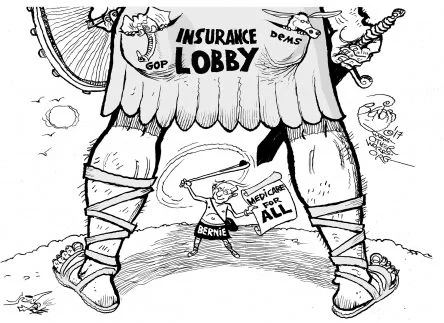
Remarkable if true
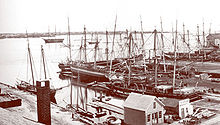
New Bedford's port in the 19th Century.
The only thing that was dispensed free to the old New Bedford whalemen was a Bible. A well-known owner of one of that city's whaling fleets once described the Bible as the best cheap investment a shipowner could make.
-- WPA Guide to Massachusetts, 1937
Carolyn Morwick: Legislative gridlock in the Constitution State
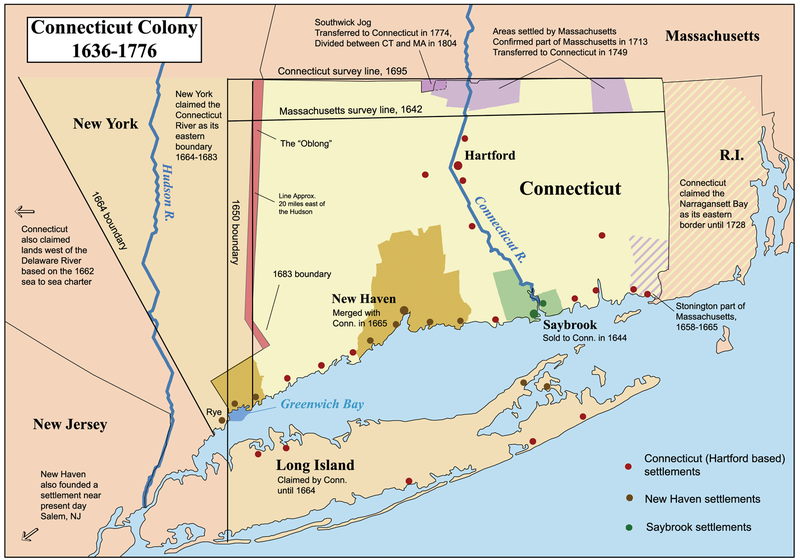
- Kumusser
From the New England Journal of Higher Education, part of The New England Board of Higher Education (nebhe.org):
On June 7, Connecticut legislators wrapped up their session without passing a two-year budget. The failure to pass a budget or a provisional budget reflects a deeply divided Legislature with an 18-18 split in the Senate and a slight Democratic majority, 79-72, in the House. As lawmakers adjourned, Gov. Dannel Malloy chastised them for failing to break the deadlock and pass a budget.
A big sticking point is a deficit of $3.5 billion over the two-year budget cycle. Previously, the deficit was estimated at $5 billion but was reduced to $3.5 billion as a result of concessions negotiated with state labor unions that are slated to save $1.57 billion over the next two years. The deficit for FY18 is $1.6 billion.
Malloy has indicated that at least $116 million would be cut from three of the state's major human services agencies—Social Services, Developmental Services and Mental Health and Addiction Services. The state’s hospitals could also be the victim of cuts. Malloy noted that state tax reimbursements of $35.6 million would, in turn, trigger $75.8 million in federal Medicaid funds, which could also be lost. His plan seeks to restore these funds.
One of the big challenges facing Malloy is getting the support of Connecticut municipalities to close the deficit. He has asked for the cooperation of municipal leaders to contribute to the teacher’s pension system, which is now financed by the state and the state’s teachers. Malloy also wants local leaders to help come up with a new formula for distributing a reduced amount of local aid to school districts. As if things weren’t bad enough, the capital city of Hartford has declared bankruptcy and is looking for a state bailout.
Solutions to help resolve this situation include new sources of revenue such as a hike in the sales tax. The current rate is 6.35%, which is the 12th highest in the U.S. The proposed increase would raise the tax to 6.99% which would be the second highest in the country. (California is the highest with a rate of 7.25 %.) Another source of revenue which has already received approval is a third casino proposed for East Windsor.
Legislation Passed, Signed Into Law
Workforce Development System
HB 5590 An Act Creating a Task Force to Improve the Workforce Development System in the State of Connecticut
Codifies the state’s existing longitudinal data system and governing board. Requires the state’s Labor Commissioner to develop a universal intake form for persons entering American Job Centers or Workforce Development Board facilities. The Commissioner uses the information from the standardized intake forms for an annual report to the General Assembly, including: the number of people using American Job Center or Workforce Development Board employment rates and average wages of persons who utilized those services; the number of people in various pathways; and the industry sectors in which completers find employment.
Separate Technical High School System
HB 7271 An Act Concerning the Establishment of a Technical High School System
Establishes the technical school system as an independent state agency, beginning July 2019.
Postsecondary Vocational Programs, Technical High School System
HB 7202 An Act Establishing a Division of Postsecondary Education Programs Within the Technical High School System
Classifies licensed practical nurse programs and aviation maintenance programs as “postsecondary education programs” to maintain students’ eligibility to for federal Pell Grants.
Transportation Lockbox
JR 100 Resolution Approving a State Constitutional Amendment to Protect Transportation Funds
Voters in the November 2018 election will decide whether to amend the state Constitution to ensure that money in the Special Transportation Fund be used solely for transportation-related costs–a transportation “lockbox.”
Third Tribal Casino
SB 957 An Act Concerning the Regulation of Gaming and the Authorization of a Casino Gaming Facility in the State
A third casino supported by the Mashantucket Pequot Tribe and the Mohegan Tribe was approved for East Windsor. This would be the first casino built on non-tribal land. MGM Resorts International, which has a casino under construction in Springfield, Mass., has issued a court challenge to the action taken by the Connecticut General Assembly.
Defendants Unable to Pay Bail
HB 7044 An Act Concerning Pretrial Justice Reform
Reduces the chance some defendants will be jailed solely over their inability to afford bail.
Gay Rights
HB 6695 An Act Protecting Youth From Conversion Therapy
Bans conversion therapy for changing the sexual orientation of minors—a discredited practice blamed for depression and teen suicide.
Abused and Neglected Children
SB 895 An Act Concerning the Department of Children and Families’ Standards and Reporting Requirements
Improves investigating tools related to allegations of abused and neglected children. Requires Department of Children and Families to establish protocols for proper visitation and oversight by caseworkers.
Abused and Neglected Children in Foster Care
HB 6741 An Act Concerning the Right of Counsel to Access Records in Certain Abuse and Neglect Proceedings
Grants attorneys immediate access to records of abused and/or neglected children in the foster care system.
Requirements for Preschool Staff
SB 912 An Act Concerning Revisions to the Staff Qualifications Requirement for Early Childhood Educators
Requires an associate degree in early childhood education to be employed at state-funded preschool programs.
Graduation Requirements
SB 1026 An Act Concerning Revisions to the High School Graduation Requirements
Delays and revises the requirements set to go into effect with the freshman fall class that would have required additional credits in math, science and foreign language, senior project and passing exams in algebra, geometry, biology, American History and English to graduate as ordered by Superior Court judge. The legislation does away with exit exams and a senior project while expanding the description of courses needed for students to graduate.
Legislation That Failed
Dreamers
SB 17 An Act Assisting Students Without Legal Immigration Status With the Cost of College
Would include undocumented students as eligible for student financial aid.
Transfer Requirements
SB 971 An Act Concerning the Promotion of Transfer and Articulation Agreements
Streamlines the process for transferring credits from community colleges to state universities, resolves the lost transfer credit
Early Voting
HJ 37 Resolution Proposing a State Constitutional Amendment to Provide for Legislation by Direct Initiative and Referendum
Requires a change in the state constitution, which could take several years unless the General Assembly votes by supermajority to put a constitutional amendment on the ballot. Approved by House; Senate failed to vote on this.
For-Profit Colleges
SB 972 An Act Concerning Tuition Integrity at For-Profit Institutions of Higher Education
Limits what for-profit colleges can spend on advertising to recruit students while putting a cap on federal financial aid spent on non-instructional costs.
Tesla
HB 797 An Act Concerning the Licensing of New and Used Cars Dealers
Authorizes the commissioner of motor vehicles to issue a new or used car dealer’s license to an electric vehicle manufacturer.
Women’s Health
SB 586 An Act Expanding Mandated Health Benefits for Women, Children and Adolescents.
Preserves the Affordable Care Act’s protection for women and children in Connecticut should the ACA law be repealed. Failed in House; passed in Senate.
K-12 and Higher Education In Limbo Without a State Budget
On Aug. 15, school superintendents, teachers, administrators, members of school boards and parents pleaded with Malloy and members of the Connecticut General Assembly to produce a budget before the school year starts. The failure to produce a budget has forced school districts to cut dozens of positions and put hundreds more on hold.
Higher Education Funding
Malloy proposed cutting an additional $62.2 million for the University of Connecticut, the UConn Health Center, Connecticut state colleges and universities. Both the UConn and the Board of Regents for Higher Education are expected to wait on setting final budgets until the size of the cuts are known.
Carolyn Morwick directs government and community relations at NEBHE and is former director of the Caucus of New England State Legislatures.
By the crustacean calendar

Which one will be pardoned in return for his contribution to Maine tourism?
From Robert Whitcomb's "Digital Diary'' in GoLocal24.com:
So here we have a story from WLBZ-TV, in Bangor Maine, in which a group of Mainers (or Mainiacs) report that Passy Pete the Lobster “has predicted six more weeks of summer at an annual ceremony.’’
“The crustacean has been fished out of the Passagassawakeag River {which runs from Waldo to Belfast, Maine} for the past three years in a tradition modeled after famed groundhog Punxsutawney Phil's winter prediction in Pennsylvania,’’ the station reported.
Passy Pete is watched as “he picks a scroll to determine whether Maine will see an extended summer or soon be greeted by winter.’’ Pete's been right the past two years. Or so they say. Anything for a photo op to draw some tourists as the main tourist season winds Down East.
Ignorance is bliss
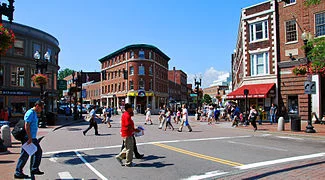
Harvard Square.
Born to Harvard, she had gone to Smith and returned to marry Harvard. She had grown up in contact with the beauty and chivalry of Cambridge. She, and presumably her husband as well, represented the cultivation, good manners, consideration for others, cleanliness of body and brightness of mind and dedication to high thinking that were the goals of outsiders like me, dazzled western barbarians aspiring to Rome.
-- Wallace Stegner, in the novel Crossing to Safety (1987)
If Kenya can ban plastic bags, why not us?
From Robert Whitcomb's "Digital Diary'' in GoLocal24.com:
Kenya, of all places, has enacted the world’s strongest ban on those flimsy single-use plastic bags. While the law is mostly targeted at manufacturers and suppliers, police can go after individuals, although the government indicated that it would go easy on “the common man’’. And, The Washington Post reports, the penalties “could include four years in prison and up to {the equivalent of} $40,000 in fines.’’
Some other African nations have imposed full or partial bans on plasticbags, perhaps surprising given their poverty. However, they realize that their long-term prosperity depends in no small part on protecting their environment.
Probably for a long time to come, such a ban will only happen in a few localities in America. We usuallyvalue convenience above environmental protection. That’s too bad because the petrochemical-based bags cause tremendous plastic pollution, kill much wildlife that ingest them and clog sewers and other drains. There are toxic chemical compounds in these bag, and they take many, many years to decompose. These nasty if handy things ought be phased out by a proposed federal law to be enforced by the Environmental Protection Agency, but don’t expect that from the Trump administration, whose EPA is all too often anti-environment. (More mountaintop removal for coal!)
Carolyn Morwick: Maine legislature overturns the will of the people on tax on the affluent

By Jana Matusz, in the show "Land, Sea, Sky," at ArtProv Gallery, Providence, Sept. 20-Nov. 4.
From The New England Journal of Higher Education, a unit of The New England Board of Higher Education (nebhe,org)
The first regular session of Maine’s 128th state Legislature was exceptionally challenging, as lawmakers engaged in a bitter fight over the budget while wrestling with four ballot questions approved by voters in the November 2016 election. Lawmakers were divided on Question 2, which was approved by voters and would have imposed a 3% tax on those making $200,000 or more. Funds would be used to support teacher salaries in K-12 school districts. Lawmakers rejected this question, but included $162 million in new funding for K-12 school districts in the budget—providing an additional $48.4 million in FY18 and $113.6 million in FY19.
Days before the July 4 holiday, budget deliberations reached an impasse, resulting in a four-day government shutdown. A compromise was reached by lawmakers, and on July 4, Gov. Paul LePage signed a two-year budget of $7.1 billion. This legislative session lasted nine months, the longest on record.
Part of the final budget included the following:
New education funding for K-12 school districts in the amount of $162 million (this was the response of legislators who agreed to reject Question 2)
Budget language to prevent further cuts to support services for children and adults with severe and persistent mental illness
A transfer of $3 million into Maine Clean Election Fund to provide access to funds for candidates for governor and the Legislature
An investment of $14.25 million in additional funding for employees serving those with disabilities
Doubling the number of hours to serve Mainers receiving disability services
Continues the reimbursement rate for “Critical Access Hospitals” that serve most of Maine’s uninsured residents statewide.
Legislative Action on Ballot Questions 1, 2, 4 and 5
Question 1 provides for the legalization and regulation of recreational marijuana. Lawmakers passed legislation, subsequently signed by the governor, to delay implementation to February 2018.
Question 2 imposes a 3% tax on those making $200,000 to fund education. Lawmakers rejected this question, siding with opponents who argued that it would hurt the economy, particularly small businesses, and would leave Maine with one of the highest marginal tax rates in the country.
Question 4 raises the minimum wage in increments to $12 per hour by 2020.Lawmakers passed LD 673, which restores the tip credit and allows employers to pay tipped workers, half the minimum wage.
Question 5 provides for rank choice voting. Under this system, voters rank candidates in order of preference. If no one has 50% of the vote after the first count, the candidate with the fewest votes is eliminated. Voters who chose the candidate who had been eliminated would have their ballots added to the total of the second ranked candidate. Then the votes would be re-tabulated. This process continues until one candidate has a clear majority of the vote. Lawmakers failed to pass legislation to overturn the voters’ will. The Maine Judicial Supreme Court ruled rank choice voting unconstitutional, but the vote to approve the ballot question still stands.
Legislation Passed, Signed Into Law
Firearm Registry
LD 9 An Act to Prohibit the Creation of a Firearms Owners Registry
Prohibits a state agency or political unit from keeping a comprehensive registry of privately owned firearms and the owners of those firearms within its jurisdiction.
Mining Regulations
LD 820 An Act to Protect Maine’s Clean Water and Taxpayers from Mining Pollution
Bans open-pit mining and other mining operations on public lands, prohibits underwater storage of mine waste, requires mining companies to create a trust fund large enough to cover the costs of cleaning up or treating any environmental contamination on a site for at least 100 years after closure of the mine.
Implementation of Marijuana Legislation
LD 88 An Act to Delay the Implementation of Certain Portions of the Marijuana Legalization Act
Clarifies that marijuana is legal for Mainers age 21 or older, prohibits the consumption of marijuana while operating a vehicle and delays the start of retail sales until February 2018, giving agencies more time to craft and implement rules governing the industry.
Opiates, Treatment of Addiction
LD 952 An Act to Ensure Access to Opiate Addiction Treatment in Maine
Allows but does not require the Maine Department of Health and Human Services to increase Maine’s Medicaid reimbursement rate to methadone providers–currently $60 per person per week, the lowest in the nation.
Cell Phones
LD 1089 An Act to Prohibit the Use of Handheld Phones and Devices While Driving
Prohibits a person from using a mobile telephone or handheld electronic device while operating a motor vehicle, unless the phone or device allows for hands-free operation and the hands-free feature is, in fact, being used by a person age 18 or older or the mobile telephone or device is being used to communicate with law enforcement or emergency services personnel under emergency circumstances.
Raises Age to Purchase Tobacco Products
LD 1120 An Act to Reduce Youth Access to Tobacco Products
Prohibits someone who has not reached age 21 from purchasing tobacco products.
Legislation That Failed
Workforce
LD 1467 An Act to Expand Competitive Skills Scholarships and Strengthen Maine’s Workforce Development Program
Proposes to expand and strengthen the Competitive Skills Scholarship Program that helps low-income, underemployed and unemployed workers acquire new skills needed to obtain good-paying jobs in growing industries. Builds on a successful program that helps Mainers get good jobs, and helps small businesses find workers with the skills they need to succeed.
Higher Education Funding, Tuition and Fees
University of Maine System
For the first time in six years, tuition rates will go up at University of Maine campuses. In-state rates will increase from $8,370 to $8,580 and will go into effect in fall 2017. Of great concern to the University System is $25 million in funding that could be lost in the federal budget proposed by the Trump administration. This includes $8.3 million in indirect costs for federal grants at the University of Maine, as well as several programs that could be cut or eliminated. The Trump budget makes significant cuts for Federal Work Study, Trio, and SEOG grants and eliminates funding for the Sea Grant program.
Maine Community College System
Tuition and fees at Maine’s community colleges will not increase. Tuition and fees average $3,600 per year, which are the lowest in New England.
The FY18 budget funds the Maine Community College Systems Strategic Workforce Initiative at $10 million for strategic initiatives related to occupational programming and statewide workforce development.
Carolyn Morwick directs government and community relations at NEBHE and is former director of the Caucus of New England State Legislatures.