
Vox clamantis in deserto



'Then summer ended' in PTown
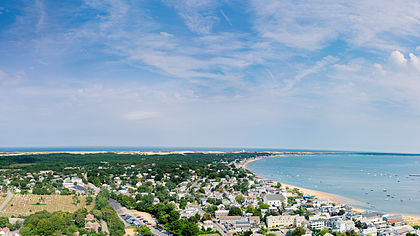
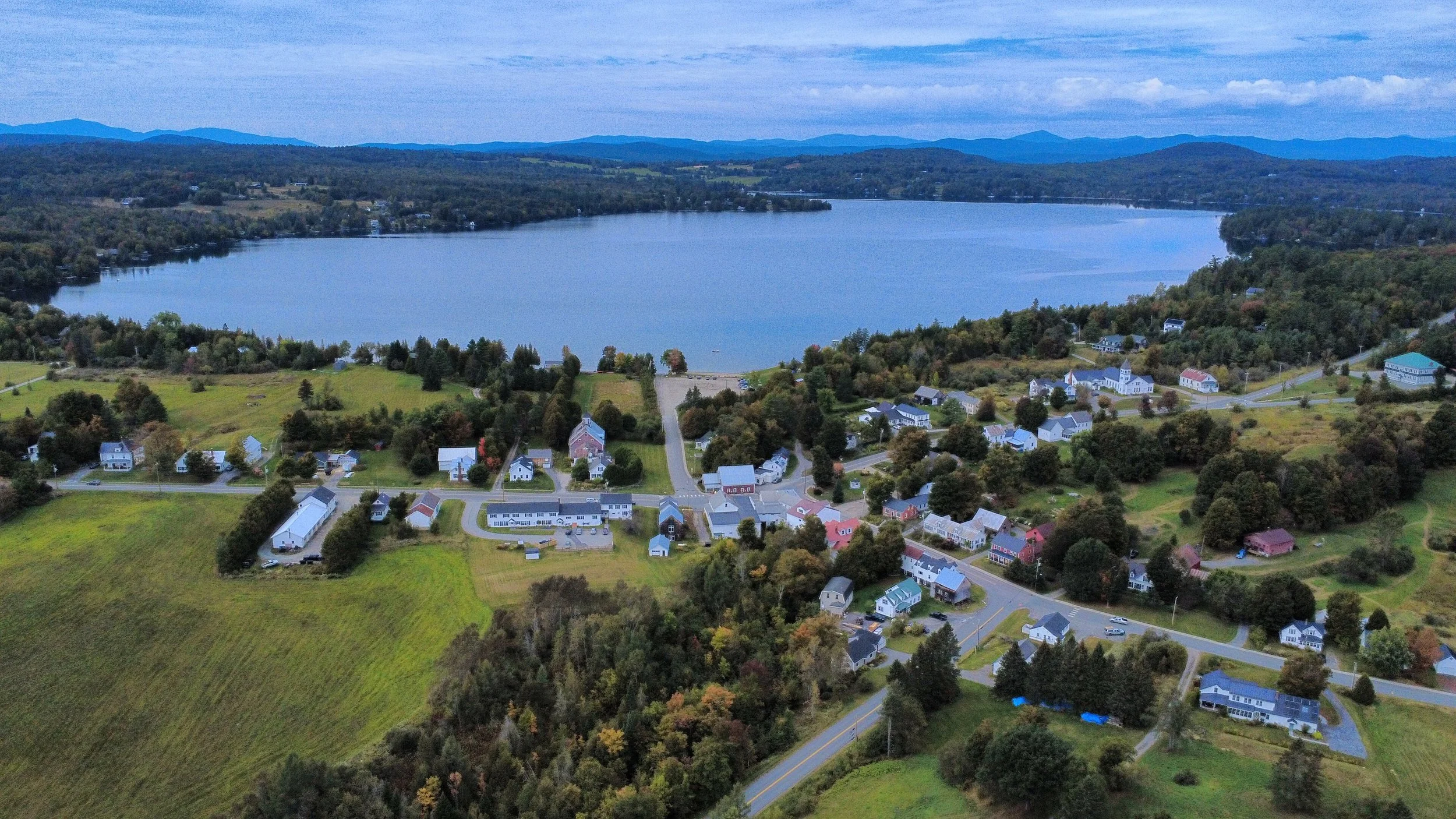
Provincetown in high summer.
"Decade after decade, artists came to paint the light of Provincetown, and comparisons were made to the lagoons of Venice and the marshes of Holland, but then the summer ended and most of the painters left, and the long dingy undergarment of the gray New England winter, gray as the spirit of my mood, came down to visit.
-- Norman Mailer, in "Tough Guys Don't Dance''
Shopping at the fish market
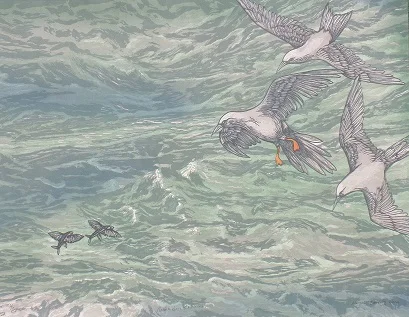
"Noddies Above the Waves'' (woodblock print on Stonehenge paper), by Margaret Barnaby, at the Patricia Ladd Carega Gallery, Center Sandwich, N.H.
Robert Whitcomb: The amazing rise of Singapore

The gigantic container port of Singapore.
Singapore
Unlikely Power
by John Curtis Perry
Oxford, 329 pp., $29.95
This review first appeared in The Weekly Standard.
Central to the rise of the island of Singapore as one of the world’s most important cities are its location on one of the planet’s most important waterways and crossroads and its potent mix of the behavioral values of two cultures – British and Overseas Chinese.
There’s no other city like Singapore, which goes back hundreds of years to a once-prosperous city called Temasek that essentially disappeared. Singapore’s long colonial status started in 1819, when it was founded by Sir Stamford Raffles as a British trading post, and ended in 1963, when Singapore briefly merged with Malaya only to anxiously turn into an independent city-state in 1965, when it became clear that a Malay marriage with a city dominated by Overseas Chinese was doomed.
But then, Singapore has always been a site of grand reinventions, some gradual and some fast. Mr. Perry, an emeritus professor of history at the Fletcher School of Law and Diplomacy at Tufts, provides a usually engaging history of this complicated place. Most importantly for us, of course, he explains cogently why it has become so successful. And he works in some glamour and romance, too, about a place that people of a certain age still see as “exotic,’’ like something from a Somerset Maugham story.
Being part of the mostly well-governed British Empire, which was held together by the Royal Navy and British commerce (based on free trade), was essential to Singapore’s 19th Century development. It wove Singapore into an international system that swiftly made it into a major entrepot and gave the rapidly growing city stable, competent and relatively fair government that promoted prosperity. “Thanks to its strategic location between India and China, and a commitment to free flows of goods and people, the settlement …proved an instant success asa gateway and place of exchange,’’ Mr. Perry writes.
It was, he notes, very profitably linked to two powerful networks – “regional in the case of the Chinese, global in the case of the British….Trade linked the small world of Anglo-Chinese Singapore to the globe.’’
“How pleased he (Raffles) would have been to see contemporary Singapore’s embrace of much of British tradition {especially civility, order and a commitment to fairness},’’ Mr. Perry writes. Indeed, Raffles is still revered in Singapore, where a large statue of him stands in front of the city’s Victoria Memorial Hall and many streets retain their English names from colonial days.
But Chinese entrepreneurialism, which has always included large doses of risk-taking leavened, like traditional British culture, with self-discipline, including the willingness to delay gratification in order to save and invest, was also crucial. “British dominion over the seas provided the foundation but upon this foundation stood the sturdy Chinese middleman, with Straits-born Babas {a term for the so-called Straits Chinese} leading the way with their knowledge of English and their ability to connect with other Asians.’
A lot of Singapore’s revenue was once derived from opium, although the place has been rigorously, sometimes even frighteningly anti-drug since independence. While once having the (much exaggerated) reputation amongst Westerners as a den of iniquity, Singapore has long since been famously puritanical about some behavior, perhaps most famously expressed in its ban on chewing gun and its use of caning to punish such crimes as vandalism.
The helmsman of Singapore’s progress from relative poverty to great wealth was Lee Kuan Yew (1923-2015), the most important person in Singapore from before independence from Britain, through the city’s unhappy marriage with Malaysia and then in its gutsy decision to try to survive and then prosper as a maritime-based city-state (recalling medieval Venice and Genoa). Mr. Perry provides an engrossing analysis of what drove this intensely ambitious, brilliant, ascetic and authoritarian ruler and his colleagues as they made Singapore into a major world city, first primarily as a port/supply center, then also as a manufacturing hub and now as a technological dynamo, too.
As he led his crowded jurisdiction as prime minister, from 1965 to 1990, and then continuing as the dominant figure until his death, he kept driving his people to work hard, be clean, be honest, restrain their desires and plan for decades ahead. Don't get soft in this dangerous world, he warned. Be anxious! It all recalls the Puritan Ethic.
I know quite a few people who worked in Singapore, a couple of them who wrote for me when I was the finance editor of the International Herald Tribune, which had a bureau and printed in Singapore and was sometimes censored there; they either loved its cleanliness and order or hated the Big Brotherism that promoted those qualities. A cousin of mine -- a merchant banker -- couldn’t wait to move out of ‘’boring’’ and “stifling’’ Singapore and move to the messy, manic, raucous and sometimes seamy life in Hong Kong, its big rival at the time in the ‘80s.
Singapore’s leaders worry a lot. For example, they fear that the island could lose much business if, as has long been proposed, a canal is built across narrow southern Thailand, diverting much ship traffic from the Straits of Malacca. They worry that an oil pipeline might be laid across the Malayan Peninsula, undermining Singapore’s status as a huge petro port and refining center, and that new technologies will leave them behind.
And as officials of an implausibly tiny, very vulnerable state, they’re hyper-alert about political, social and economic conditions in their often unstable neighbors Malaysia (on which they depend for much of their fresh water) and Indonesia. Mr. Perry amusingly quotes historian Ian Burama (via architect Rem Koolhaas) on Singapore’s existential tenseness (a tenseness that reminds me of another small place – Israel): “It corresponds to a deep primordial fear of being swallowed up by the {nearby} jungle, a fate that can only be avoided by being ever more perfect, ever more disciplined, always the best.’’
Well, more accurate is Mr. Perry’s point that leaders of the new nation, “anxious to build a sense of identity, seized upon a notion of shared values, articulating and organizing them into a collective ethos, formally approved by Parliament.’’ The ethos says that citizens “must defer to the needs of the community….with consensus {maybe more like obedience to authority) taking precedence over contention…and individualism … disparaged as selfishness…..The prescribed ethic lauds hard work, frugality, and social discipline, with emphasis on the practical and the specific….Discipline is equated with being civilized.’’
Mr. Lee went to university in England and loved English poetry and appreciated the fragility of human achievements. He liked to quote the gorgeous last lines of Kipling’s poem “Recessional,’’ written at the apogee of British power, in 1897.
Far-called, our navies melt away;
On dune and headland sinks the fire:
Lo, all our pomp of yesterday
Is one with Nineveh and Tyre!
Judge of the Nations, spare us yet,
Lest we forget—lest we forget!
Mr. Lee believed that Singapore could never afford to rest on its laurels.
He pushed and pushed. Consider how the prime minister drove Singapore to quickly become one of the world’s first great container ports, helping to transform it into the world’s most important maritime center. Mr. Lee and his associates and successors kept looking ahead, making the island not onlya major manufacturing city but also a hub for research and technology and awide range of sophisticated business services.
His people have mostly accepted the rigorous and mostly very honest autocracy/technocracy that has run Singapore for more than 50 years because it has created such widely shared prosperity. And, after all, Mr. Perry writes, the Singaporean government “is not tyrannous. Instead it is clearly dedicated to the ideal of popular welfare.’’ So far.
Still, Singapore’s recent move into the knowledge industry raises questions about how long this new endeavor can flourish in an authoritarian state, especially one longer led by the giant figure of Lee Kuan Yew. In any event, he and his associates have left Singapore – and us – edifying reminders of certain “old-fashioned’’ civic values that we could use much more of in the West.
Sir Stamford Raffles would have approved Mr. Perry’s remark that a marriage of convenience between “shrewd Chinese entrepreneurship and stable British colonial governance spawned Singapore’s vitality {and} continues to nourish it today.’’ And, I would add, this city-state provides strong lessons to other governments on how to maximize the welfare of their citizens. That’s as long as you don’t care much about real democracy.
Which raises the question of whether Singapore’s future leaders, assuming that they’ll also be autocratic, will be as honest, competent and public-spirited as Lee Kuan Yew or his son Lee Hsien Loong, prime minister since 2004. If not, then Singaporeans may finally demand major political change. Things may get messy in this hyper-orderly place.
Robert Whitcomb, a former finance editor of the International Herald Tribune, is a partner in a healthcare-sector consultancy and editor of NewEnglandDiary.com.
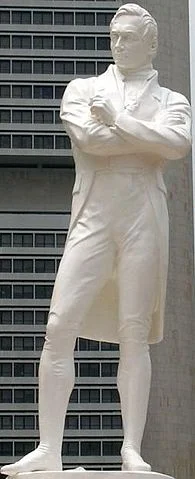
Statute in Singapore of Sir Stamford Raffles, considered modern Singapore's founder.
Wait till it gets really big

"The Source'' (oil paint, stitchery and gold leaf), by Judith Skoogfors-Prip, in her current show with Joan DeRugeris entitled "Twists and Turns,'' at the Providence Art Club.
Embracing impermanence
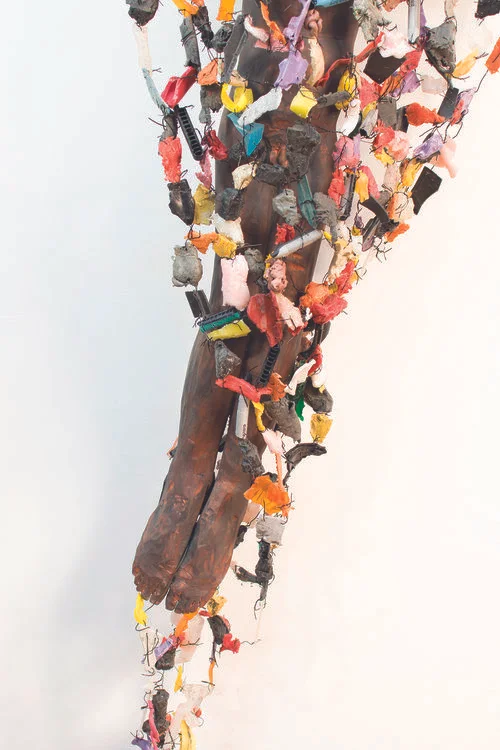
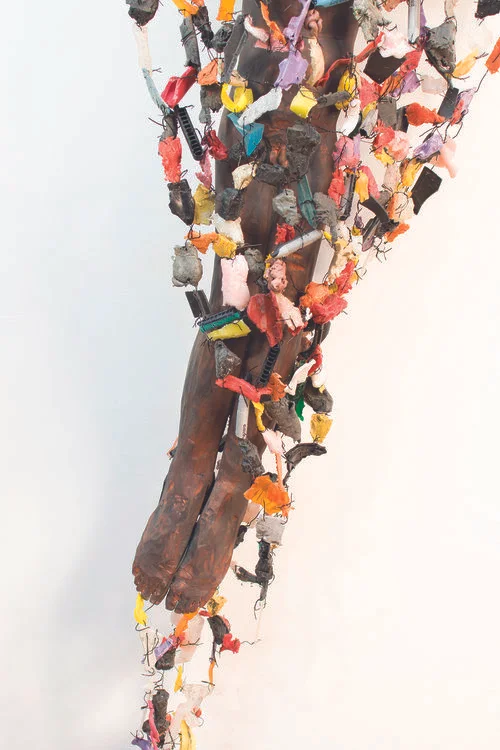
From John Christian Anderson's show "My Inheritance,'' at Boston Sculptors Gallery, through July 23. He used scavenged materials and handcrafted elements. The resulting sculptures, says the gallery, "present themselves as facsimiles and simultaneously evoke an ominous dark element along with a humorous sensibility.''
His work embraces "impermanence, imperfection, and incompleteness as a way to express personal narratives while also reflecting a world that is becoming more ephemeral and out of balance.''
In praise of user fees
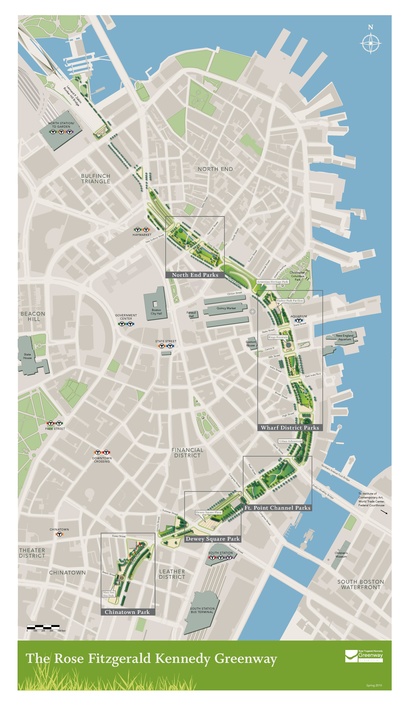
Adapted from Robert Whitcomb's "Digital Diary,'' in GoLocal24.com:
plan to help maintain the 17-acre Rose Fitzgerald Kennedy Greenway, in downtown Boston, may be an example for upkeep of other public parks. Since property owners near the Greenway obviously benefit more than most people from this amenity, they’ve agreed to pay $1 million a year in a voluntary tax on the big buildings along the Greenway via aBusiness Improvement District that would defray the bulk ofyearly maintenance. The idea is to let the state reduce its spending on the park to $750,000 a year by 2020 from the current $2 million.
User taxes, including highway tolls, are very fair. You benefit. You pay.
India Point Park, in Providence, is an example of where similar arrangements could be made to better maintain public spaces and save on local and state government spending. Certainly the Downtown Providence Improvement District has done fine work in making “Downcity’’ a lot more presentable than it was a couple of decades ago.
Boston's 'crooked steel teeth'
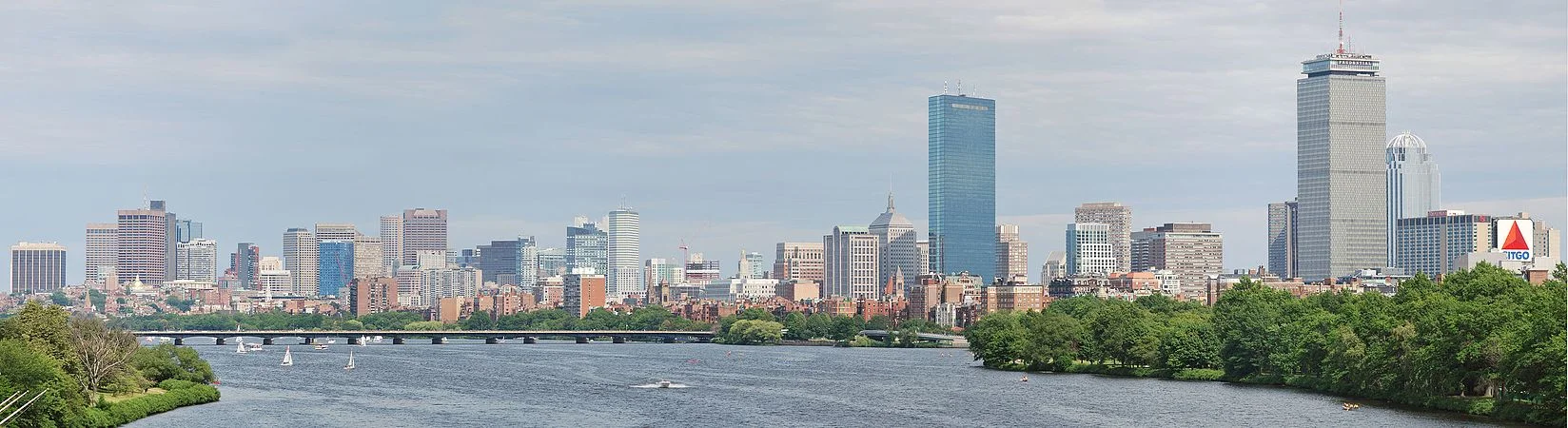
View of downtown Boston, with the Charles River.
I’ve been meaning to tell
you how the sky is pink
here sometimes like the roof
of a mouth that’s about to chomp
down on the crooked steel teeth
of the city,
-- From Aaron Smith's "Boston Poem''
Unforgettable Granite State squirrel
“All the time we were there, you could see that dead squirrel right out in plain sight. Whenever anyone mentions New Hampshire, that squirrel is always what I think of. I bet I’ve thought about that squirrel a million times.”
― Wally Lamb, from "I Know This Much Is True''
View of a protein factory

"Estuary, Looking West' (oil on canvas), by Priscilla Serafin, at Alpers Fine Art.
Chris Powell: New fast-food kiosks rebut promoters of minimum-wage rise
Electronic order kiosks have been installed as part of the renovation of the McDonald's restaurant on West Center Street in Manchester, Conn. There's no one inside the machine to ask if you want fries with that quarter-pounder with cheese.
You push buttons to register your order yourself. Thereby hangs a tale that Connecticut's political class will do its best to ignore. The kiosks are the mocking rebuttal to the demands that Connecticut increase its minimum wage so that every job pays enough to support a family, demands rooted in the delusion of something for nothing, the delusion that employers can pay more than the market's judgment of the value of the work done.
The kiosks also are the mocking rebuttal to Connecticut's public school system, whose rising graduation rate is celebrated by Gov. Dannel Malloy even as half or more of the state's high school graduates fail to master high school math or English. Soon not even "careers" in fast food may be available to the uneducated and unskilled bearing meaningless diplomas. If they are lucky, their limited vocabularies will still include "cheeseburger" and "fries" and the kiosks will accept EBT cards so they won't have to figure the cost of their lunch
Since they are a reaction to government's impoverishing and dumbing down society and leaving young people unqualified for skilled work, the kiosks also may be a mocking rebuttal to Connecticut's newspapers, which have let government get away with it even though newspapers require customers who are literate, interested in civic life, and able to earn enough money to afford a subscription.
Four years ago, arguing that this impoverishment and dumbing down were damaging newspapers far more than the growth of the Internet was, this writer observed: "Newspapers still can sell themselves to traditional households -- two-parent families involved with their children, schools, churches, sports, civic groups, and such. But newspapers cannot sell themselves to households headed by single women who have several children by different fathers, survive on welfare stipends, can hardly speak or read English, move every few months to cheat their landlords, barely know what town they're living in, and couldn't afford a newspaper subscription even if they could read. And such households constitute a rising share of the population."
That observation drew denunciation around the world -- from Hartford, where the Courant editorialized against it twice against it, giving it more scrutiny than the newspaper applied to the governor at that time, to New Zealand, where a columnist for the country's largest newspaper called it a lame excuse for the failings of this writer's own newspaper.
Single mothers and their negligent parenting, the scorners insisted, could not possibly have anything to do with the decline of the press. Yet now it is widely accepted that the impoverishment and neglect of children are the primary causes of their failure in school. Indeed, in testimony last year supporting the latest school-financing lawsuit in Connecticut, East Hartford's school superintendent echoed the infamous observation.
He said his schools are hobbled because 71 percent of their students are so poor that they qualify for free or discounted lunches, 15 percent have learning disabilities, 12 percent don't speak English, many need social workers to make up for parental neglect, and many are transient and disoriented, moving in or out of town or their school district during the school year as their families, most headed by single women, lose and regain housing.
Most such students, the superintendent said, never catch up. In spite of political correctness, no schools like that are going to produce newspaper readers, skilled workers, or good citizens.
Chris Powell is managing editor of the Journal Inquirer, in Manchester, Conn.
Ready for the day

Morning on Rutherford Island, Maine, (Misnamed Richardson Island in earlier version of this post.)
Photo by Jon Salomon
'The Dream of Agata'

See The Dream of Agata, a short film by Kersti Jan Werdal, with music by Mark of Sugar Sleep, graphic design by Simon Lagneaux, voiceover by Serena Vintalaro and jewelry by Tapley. To see it, please hit this link or this (vimeo) link.
Berl Hartman: N.E.'s economy needs the Northeast Canyons and Seamounts Marine National Monument
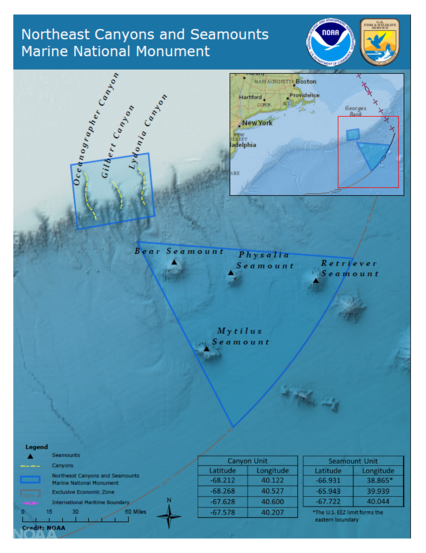
Via ecoRI News (ecori.org)
How can we help ensure that our New England ocean economy continues to thrive? The answer: maximize protection for biological hot spots that nurture vulnerable populations of fish and other sea life. That’s exactly why our country created undersea monuments.
However, it’s not clear that everyone got the message. Interior Secretary Ryan Zinke visited New England last week as part of his review of more than two dozen national monument designations.
The Trump administration apparently plans to scale back or even revoke federal monument protections for some of our nation’s most treasured lands and ocean areas. One monument in the cross hairs is the Northeast Canyons and Seamounts — the first marine national monument off the Atlantic Coast.
There are countless, well-documented scientific reasons for protecting these treasures. But there’s another motivation for New England, and the United States, to preserve this marine monument: economics.
For an administration that prides itself on viewing policy through the lens of business, unraveling protections for the Canyons and Seamounts would be an unsound move.
This ecologically rich ocean area, about 150 miles off Cape Cod, has five undersea canyons and four dramatic submarine mountains. It is habitat to more than 1,000 species, including endangered sperm whales and Atlantic puffins. It’s also replete with corals, some of which are more than a thousand years old and reach the height of small trees. Scientists who have investigated the area say these coral formations and marine species are unique and extraordinary to behold. They are straight out of Dr. Seuss.
On behalf of the national nonpartisan business group Environmental Entrepreneurs (E2), I can attest that America’s oceans are a highly valuable economic resource. Preserving a healthy ocean, with abundant populations of fish and other sea creatures, yields tremendous benefits for the region’s economy.
New England’s ocean economy supports more than 230,000 jobs. It brings in $16 billion to the region — much of it from tourism and recreation. Whale watching in New England is big business, with nearly 1 million watchers in 2008. Seabird watching is also popular. Recreational fishermen visit the closer canyons for marlin, tuna and other game fish.
As climate change threatens fish, shellfish and marine mammals elsewhere, protected canyons and seamounts serve as a refuge and nursery for at-risk marine life. Protecting these ocean wildernesses also can help fish populations. Studies show that fisheries adjacent to marine protected areas have seen spillover benefits over time.
As ocean resources are compromised, so too are the industries that depend on healthy and abundant fish and marine wildlife, including tourism, recreation and commercial fishing. In the Northeast, these sectors contribute billions of dollars annually to the gross domestic product.
To protect the outstanding ecological treasures in the Northeast Canyons and Seamounts Marine National Monument is to support healthy and abundant fish and marine wildlife. And that benefits the regional economy — and the hundreds of thousands of jobs — that depend on these ocean resources.
Berl Hartman is a founding director of the New England Chapter of Environmental Entrepreneurs (E2).
Naked and drunk
"Summer is the time when one sheds one's tensions with one's clothes, and the right kind of day is jeweled balm for the battered spirit. A few of those days and you can become drunk with the belief that all's right with the world.''
-- Ada Louise Huxtable
Triumph of the old
From Robert Whitcomb's "Digital Diary'' in GoLocal24.com
U.S. public policy helps the old far more than the young. Consideran International Monetary Fund study that found that the lifetime net tax benefit in the U.S. – that is, the value of what we receive in government benefits compared to the taxes we pay – is positive for everybody over 18 but with the biggest benefit for those over 50.
But of course deficit spending (i.e., borrowing from the Chinese, etc.) has been paying for much of this. That suggests that eventually, younger people must pay much more in the new few years to cover the cost of old people on Medicare and Social Security.
The attitude of many oldsters is: “Don't cut my Medicare, don’t cut my Social Security; I paid for those benefits!’’ Well, they only paid for part of them. As long as so many young people decline to take 20 minutes to vote, the heavy-voting oldsters will get an ever bigger slice of the pie.
Swimming through life

Untitled Pastel by Michele Poirier Mozzone, in the group show "Figure & Form,'' at ArtProv gallery, Providence, July 19-Aug. 29. The gallery says her work represents "life's journey through youth into maturity and beyond.''
Jill Richardson: J.K. Rowling needs to elevate the role of women
Via OtherWords.org
J.K. Rowling, author of the bestselling Harry Potter series, just made headlines for an epic tweetstorm condemning misogyny. Referring to women politicians, she tweeted, “femaleness is not a design flaw.”
I love J.K. Rowling. I love her books. I’ve read the entire Harry Potter series cover to cover more times than I can count. And I believe J.K. Rowling is a feminist.
But her stance on overt misogyny makes me feel a need to call out the much more subtle, covert forms that our society must address if women are ever to be equal to men.
Rowling could’ve pushed this agenda forward by, for example, portraying the world of gender equality she wishes existed in reality in her books. With so many millions of children reading (and re-reading) her books each year, the world of Harry Potter plays no small role in teaching children about gender roles.
Yet in the world of Harry Potter, men and women aren’t equal at all. Men dominate, by far.
All of the political leaders are male, as are nearly all of the headmasters. So are all of the villains, with the notable exception of Bellatrix Lestrange — unless you want to count Narcissa Malfoy, who remains mostly in a wife role in her evildoing.
Harry’s role models and parental figures are nearly all male, too. The exceptions are his mother — a character who is never well developed, remaining idealized and practically saintlike throughout the series — and Molly Weasley, a shrill, overbearing nag.
The Weasleys, who become Harry’s adopted family, show readers a breadwinner-homemaker relationship in which the father works for the government while the mother stays home to clean, cook, and care for the kids.
The father is lovable, quirky, and not so strict with his children. The mother, Molly, runs the household and loves her children fiercely, but her approach to discipline portrays the worst stereotypes of women.
Hermione Granger, one of Harry’s two best friends, shows women in a positive light because she’s the top student at Hogwarts. But, like Molly Weasley, Hermione nags her friends to no end if she thinks they’re doing something wrong.
The women characters in the series are more likely to cry, whereas the men are more likely to lose control of their anger and resort to violence. And, when each wizarding school selects a pupil to compete in a competition, three boys and one girl are chosen. The girl loses to the boys badly.
This isn’t to say that all women are portrayed negatively, or all men are portrayed positively. But Rowling created a world in which most of the major characters are male and several major female characters conform to lazy or negative stereotypes of women.
Such gender stereotypes seep into our subconscious without our knowing. They don’t stand out, because they fit with the unequal treatment of gender we see in the real world.
We notice when Disney’s Moana is a princess who saves the day and doesn’t need a prince to complete her. But do we notice when the male lead in the movie, Maui, exhibits the worst traits of toxic masculinity? If Moana teaches little girls they can be heroes, what is Maui teaching little boys about becoming men?
Children learn about the world from the people around them, as well as from what they read in books or see in movies. Changing the real world is hard, but changing it in books and movies is easy.
Authors like Rowling could help socialize the next generation to treat women equally to men with a stroke of the pen.
Jill Richardson, an OtherWords,org columnist, is the author of Recipe for America: Why Our Food System Is Broken and What We Can Do to Fix It.
To work and to play with a water view
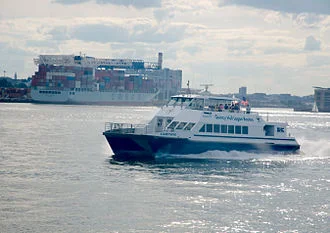
MBTA commuter boat in Boston Harbor.
From Robert Whitcomb's "Digital Diary,'' in GoLocal24.com
Whatever you think of the heavy government subsidy for the Providence-Newport summertime ferry, the service provides more than just a very pleasant way to travel between the two cities. With adequate promotion it could bring many more tourists to the region. And the service’s existence is a reminder of the big potential of traveling – including commuting – by water in densely populated Rhode Island, with so much water. In parts of Europe and Asia a place like Narragansett Bay would be crowded with ferry boats year round.Fr
Massachusetts Bay has long had successful year-round MBTA ferry service connecting Hingham and downtown Boston, although, of course, that’s a richer and more heavily populated area. Not to subsidize the Providence-Newport long enough so that it helps create a traveling habit and becomes a model for other ferry service around here would be a false economy. And wouldn’t drivers on Routes 95 and 195 prefer to have more people onboats and fewer on the roads?
Meanwhile, the small and unsubsidized Newport-Jamestown ferry service operated by Conanicut Marine Services suggests that there could eventually be a plethora of such services linking Narragansett Bay communities. The ferry has been particularly alluring in the past few weeks with reconstruction work on the Pell Bridge causing big delays.
No Ambien needed
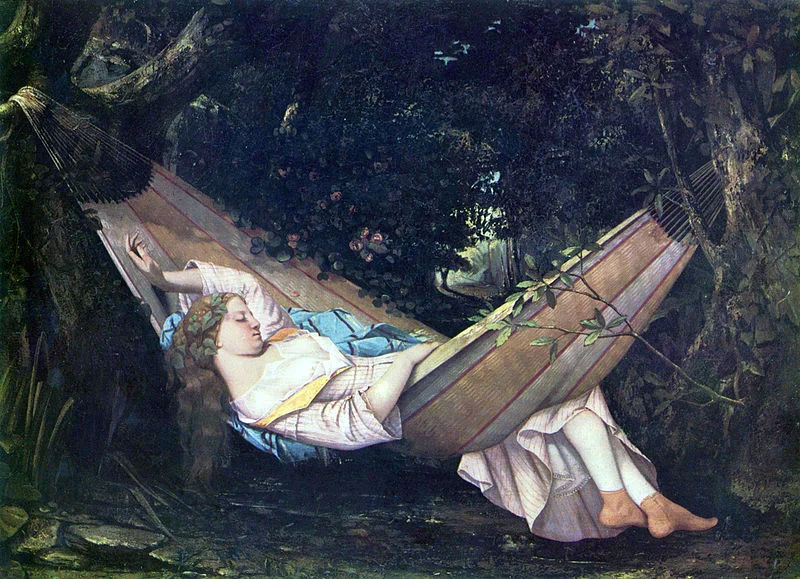
"The Dream,'' by Gustave Courbet
A languid atmosphere, a lazy breeze,
With labored respiration, moves the wheat
From distant reaches, till the golden seas
Break in crisp whispers at my feet.
My book, neglected of an idle mind,
Hides for a moment from the eyes of men;
Or lightly opened by a critic wind,
Affrightedly reviews itself again.
Off through the haze that dances in the shine
The warm sun showers in the open glade,
The forest lies, a silhouette design
Dimmed through and through with shade.
A dreamy day; and tranquilly I lie
At anchor from all storms of mental strain;
With absent vision, gazing at the sky,
"Like one that hears it rain."
The Katydid, so boisterous last night,
Clinging, inverted, in uneasy poise,
Beneath a wheat-blade, has forgotten quite
If "Katy DID or DIDN'T" make a noise.
The twitter, sometimes, of a wayward bird
That checks the song abruptly at the sound,
And mildly, chiding echoes that have stirred,
Sink into silence, all the more profound.
And drowsily I hear the plaintive strain
Of some poor dove . . . Why, I can scarcely keep
My heavy eyelids--there it is again--
"Coo-coo!"--I mustn't--"Coo-coo!"--fall asleep!
-- "A Summer Afternoon,'' by James Whitcomb Riley
Life is a cabaret

"Stepping Out,'' by Bonnie P. Jaffe, in the show opening June 25 at the Providence Art Club called "Captured! Life Through the Lenses of Bonnie P. Jaffe, Marc A. Jaffe and Eileen McCarney Muldoon.''